There was plenty of free time and unlimited polar daylight to sketch while aboard the Plancius.
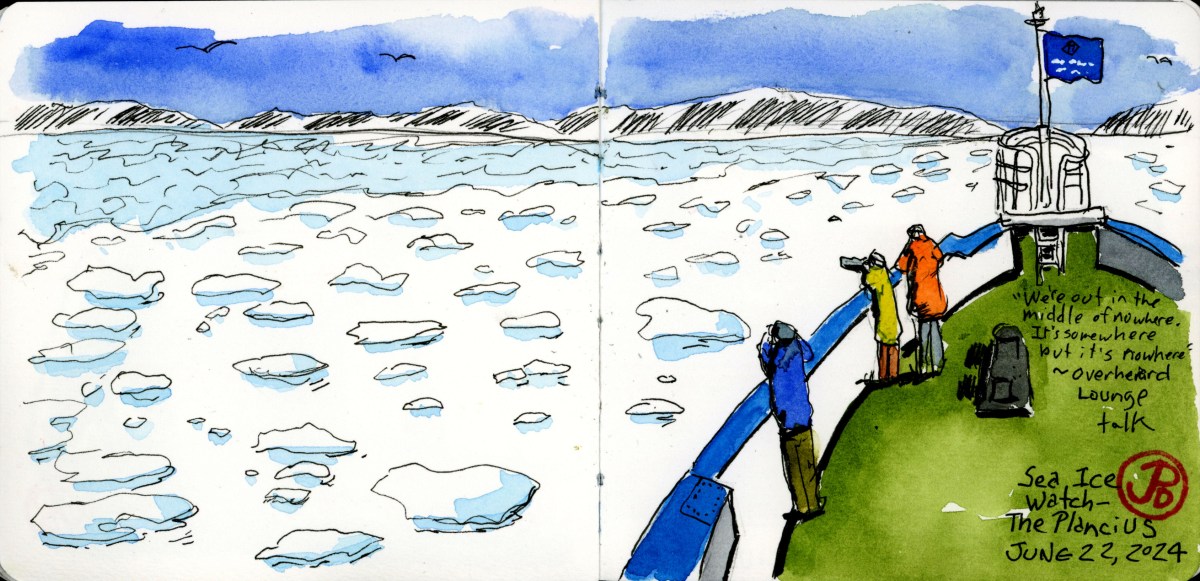
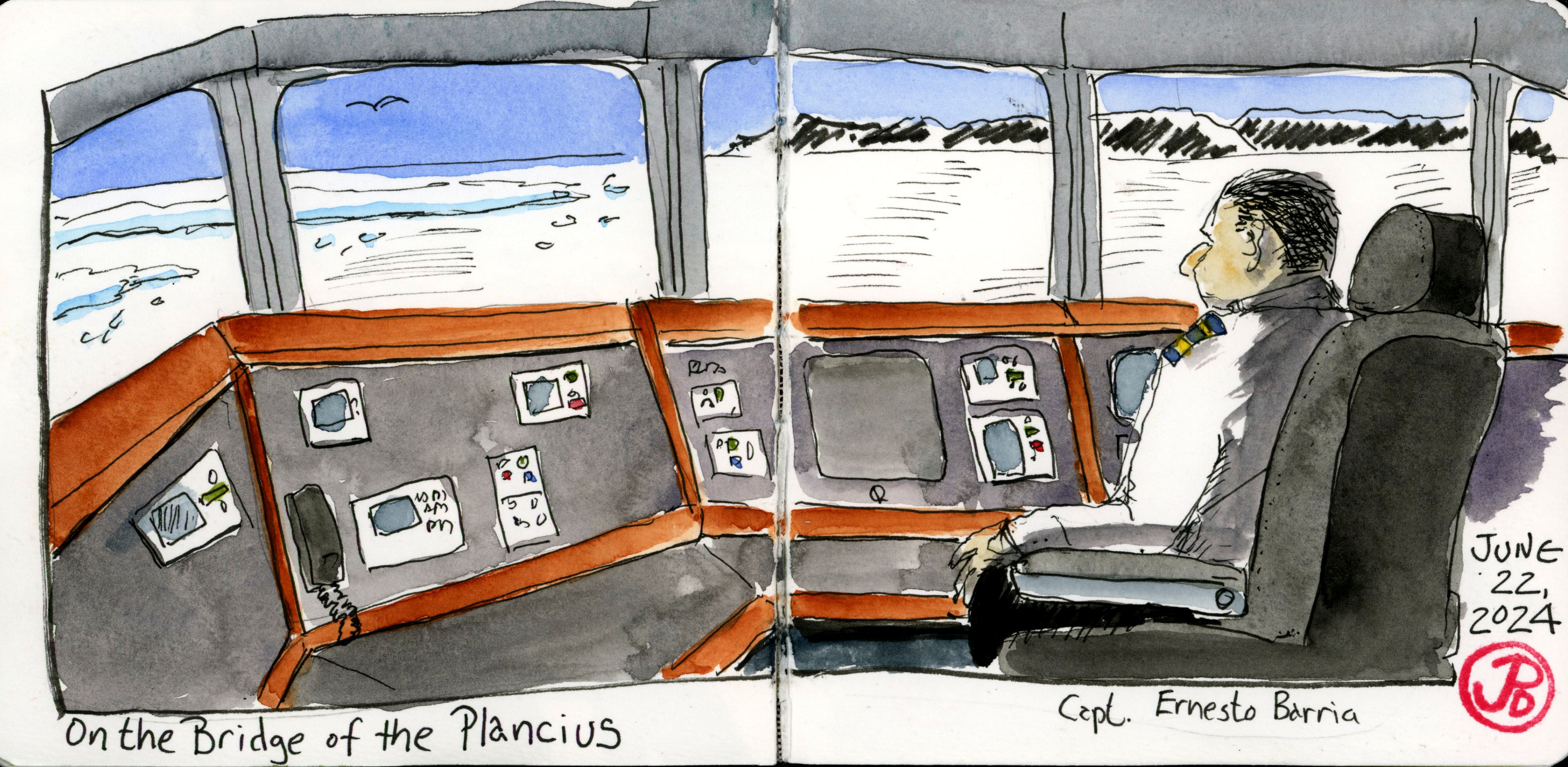
There were two sketches I pre visualize before the trip. Sketching the bow-view of the Plancius and sketching from the bridge.
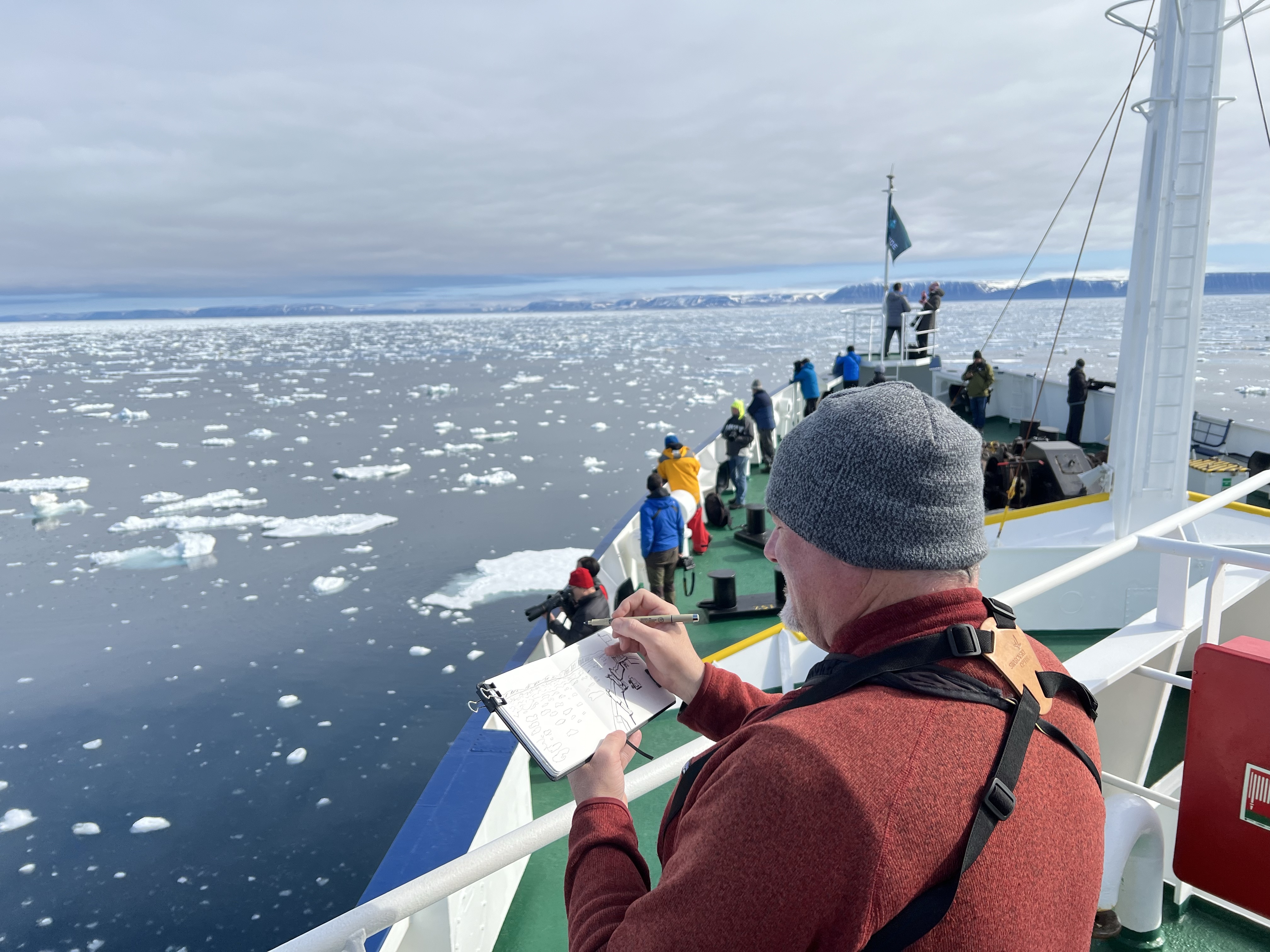
I sketched the bow view while we were moving through the pack ice. On the Plancius they have an open bridge policy which means you are invited to visit the bridge and enjoy the views. I used this time to sketch the bridge and our captain.
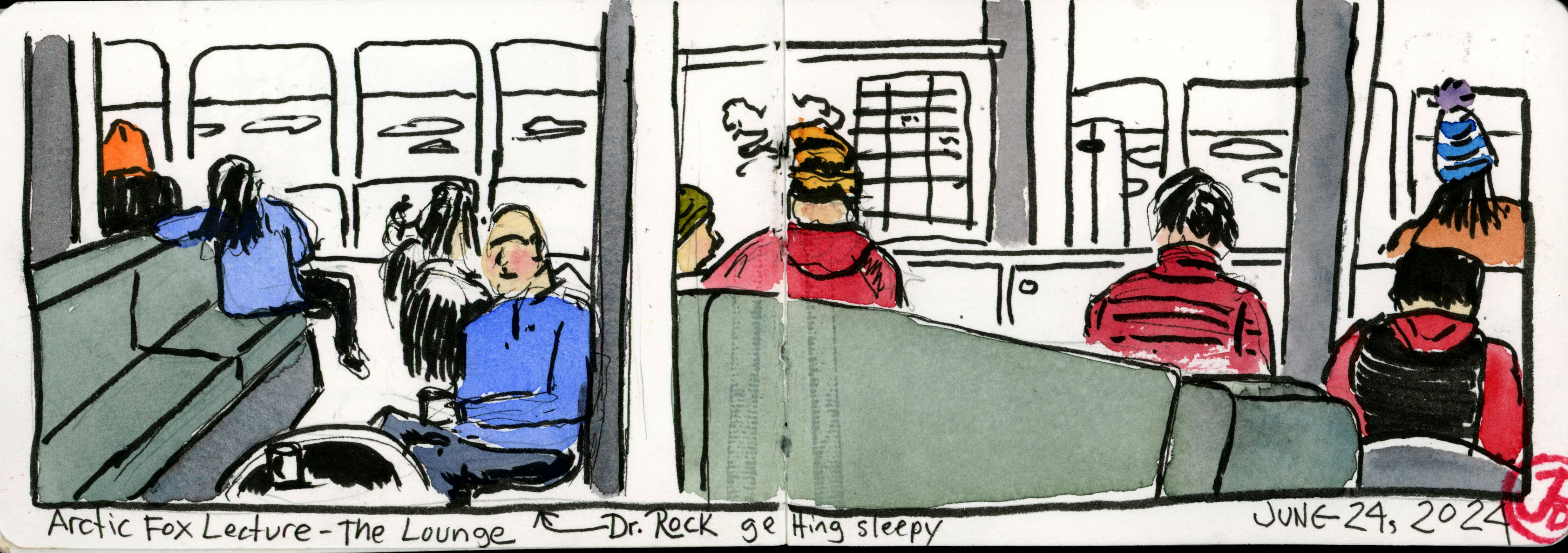
Aside from my berth, there was one part of the ship that I spent most of my time: the lounge. Here was 24 hour coffee, the bar, the library, and amazing views. This was a great place to mingle with other passengers.
It was also where the guide’s lectures were held, ranging in topics such as Svalbard reindeer, Arctic fox, walrus, geology, history, Polar mirages, and sea ice. It was also here where we were briefed about the previous day’s landings.
Before the Arctic Fox lecture I sketched a view of the lounge and its inhabitants.
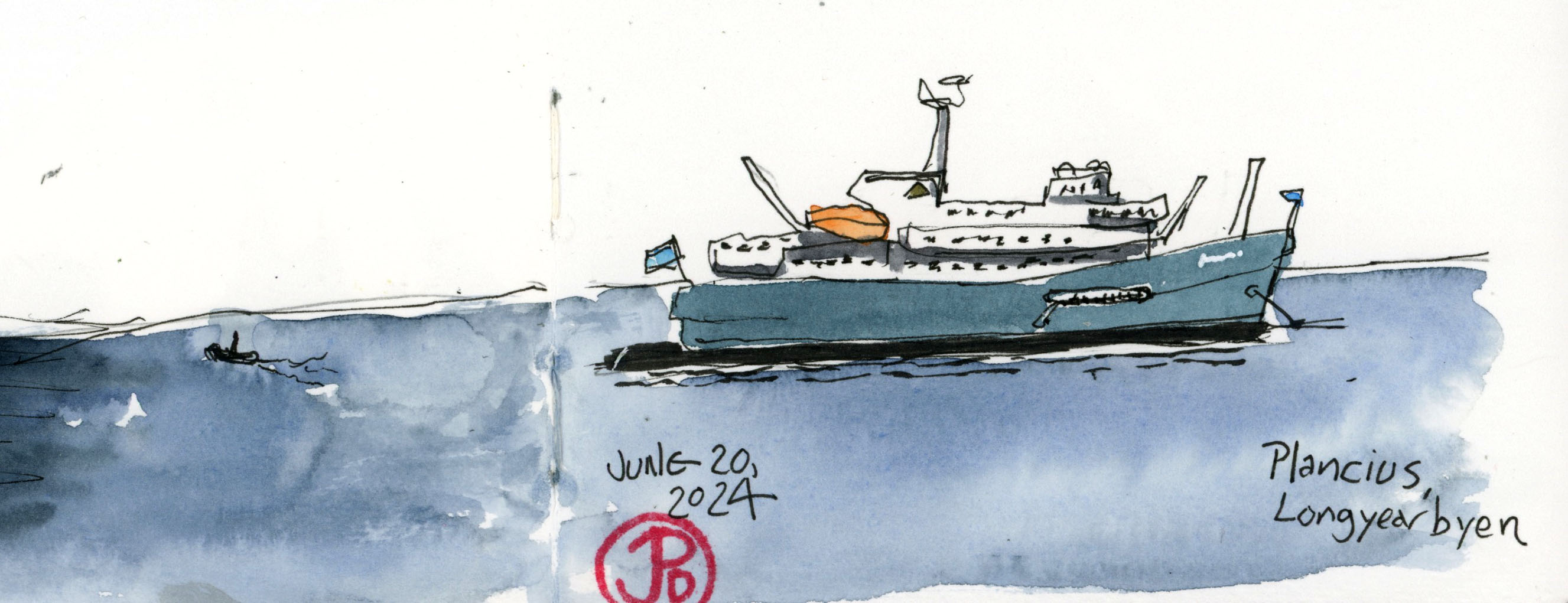
I first caught sight of the Plancius, my home for a week, in Longyearbyen Harbor.
So I sketched it.
The Palancius at anchor At Longyearbyen Harbor.
I was aware of a man with a camera milling about. After my sketch he told me he took my picture while I was sketching. He told me that he was part of an expedition to the North Pole. Svalbard is certainly the starting point of Polar adventures.
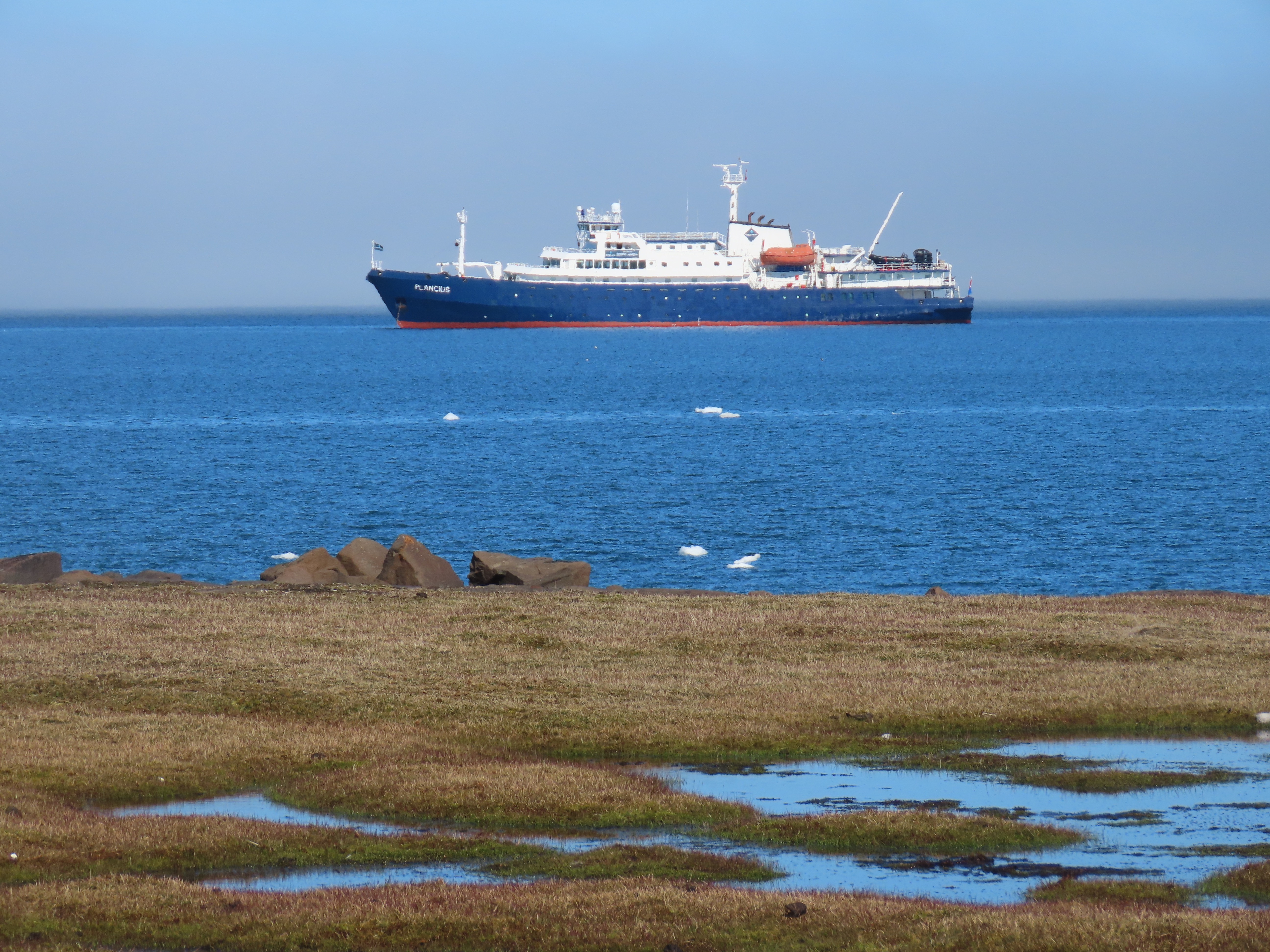
The m/v Plancius was built in 1976 as a research vessel for the Royal Dutch Navy and was christened “Hr. Ms. Tydeman”. She was purchased by Oceanwide Expeditions in 2004 and rebuilt as a passenger vessel. She was renamed Plancius after the Dutch astronomer and cartographer.
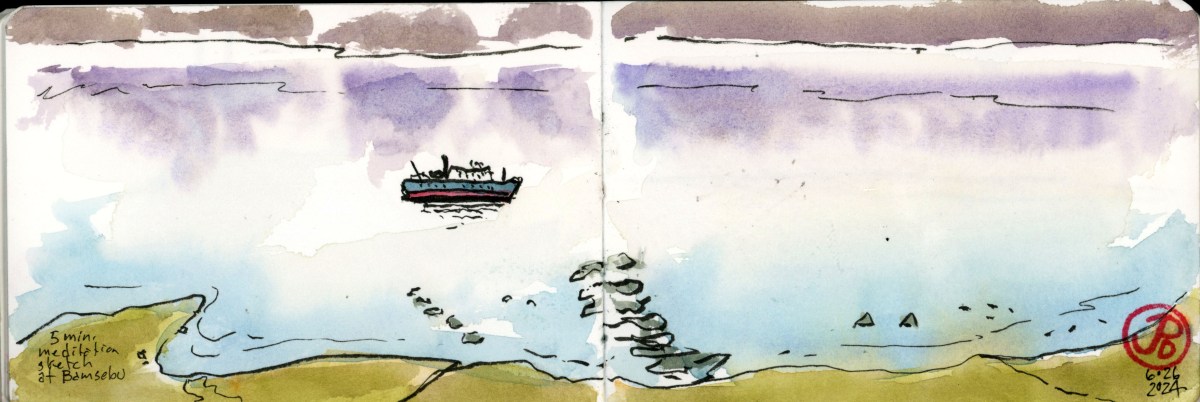
I had plenty of other opportunities to sketch the Plancius from shore. My favorite Plancius sketch was on a hike at Bamsebu. We headed up the slope with amazing views of the fjord with Plancius anchored in the middle.
It was here that our guide had a challenge: sit for five minutes quietly and take in the sights and sounds of the Arctic. This is called a silent sit but I did a silent sketch instead (featuring sketch). This was an easy challenge for me but about three minutes in I heard the tell-tale sounds of cameras.
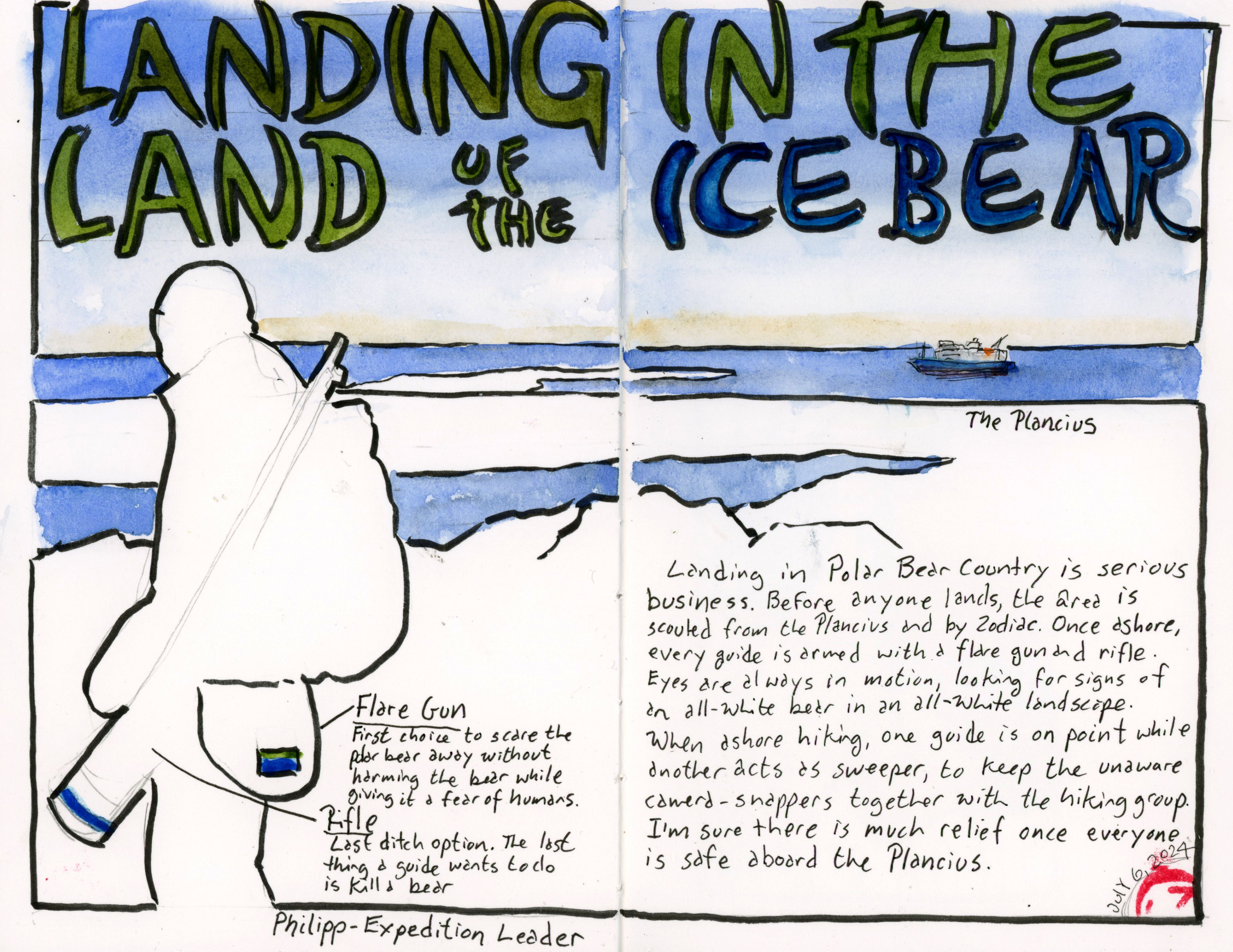
When we made Zodiac landfall we had to always remember that we were in the land of the world’s largest carnivore, the polar bear.
Before any passengers made a landing, the landing site was surveyed both from the bridge and by Zodiac to make sure there were no recent signs of polar bear activity.
Once we landed, all guides were armed with a flare gun and a high caliber rifle. Keeping passengers safe was important but no guide wants to kill a bear. The first option if a bear was heading towards a group, was to use a flair gun in an attempt to scare the bear away. The rifle was the very last resort and none of our guides had ever had to use one in the field.
I’m not sure how reassuring this was, I hoped they were good shots but our lead guide assured me they regularly practice.
Luckily, no rifles were fired on our week-long adventure. But unluckily, spoiler alert, we saw no polar bears.
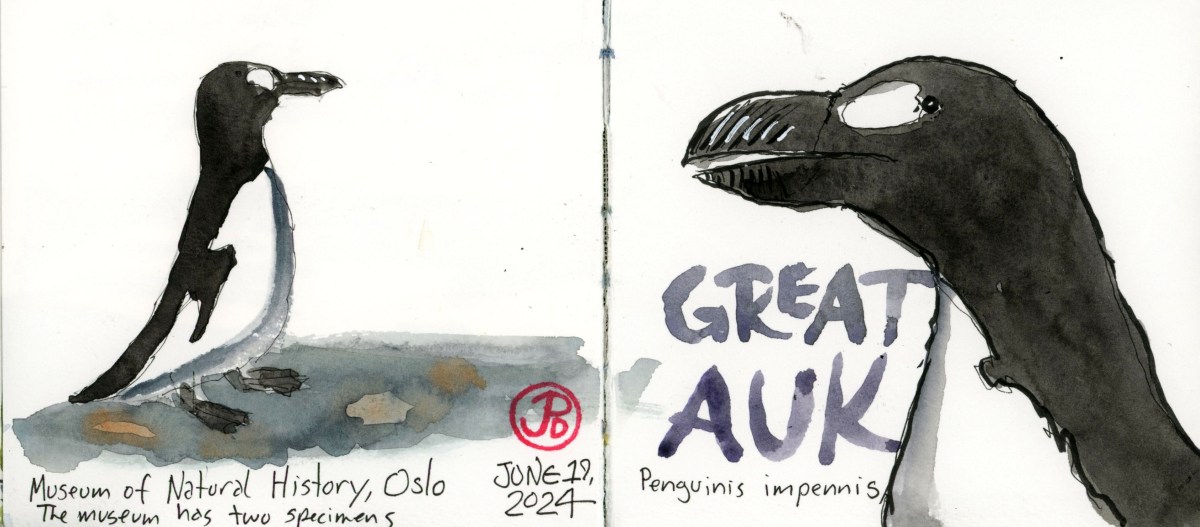
In Iceland last summer I saw the last domain of the now extinct great auk. I have never seen a specimen before and Oslo’s Natural History Museum had two. But the irony is that once 19th Century naturalists knew that the great auk was nearing extinction, there was a mad rush to add a specimen to their museum’s collection thus pushing the auk to full extinction.
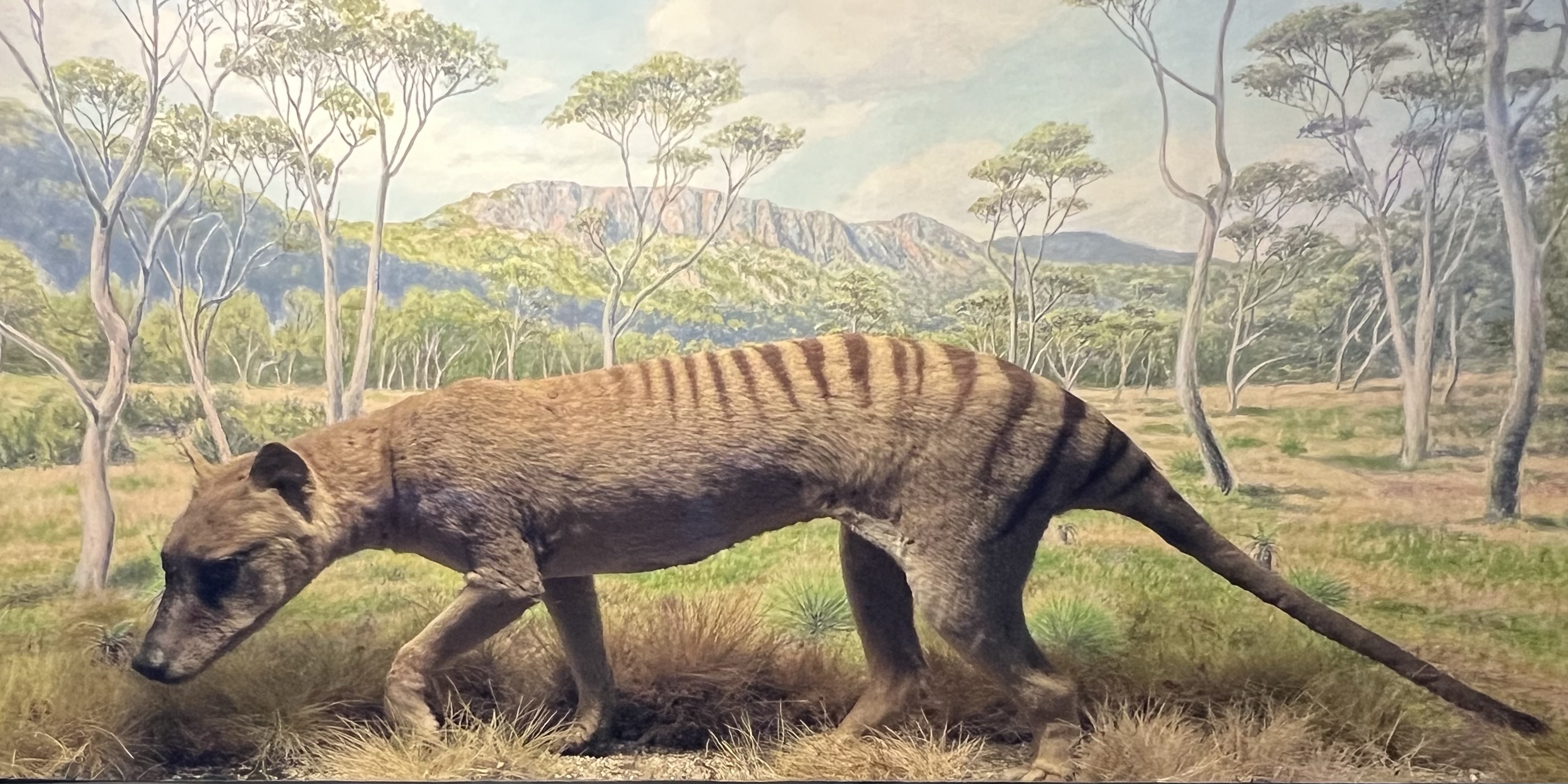
The museum had an extensive collection of mounts featuring animals from around the world. One mount caught my attention, it was an animal from Tasmania. This was the extinct Thylacine or Tasmanian Tiger.
Unfortunately a natural history museum is one of the only places to see extinct animals such as the great auk and thylacine.
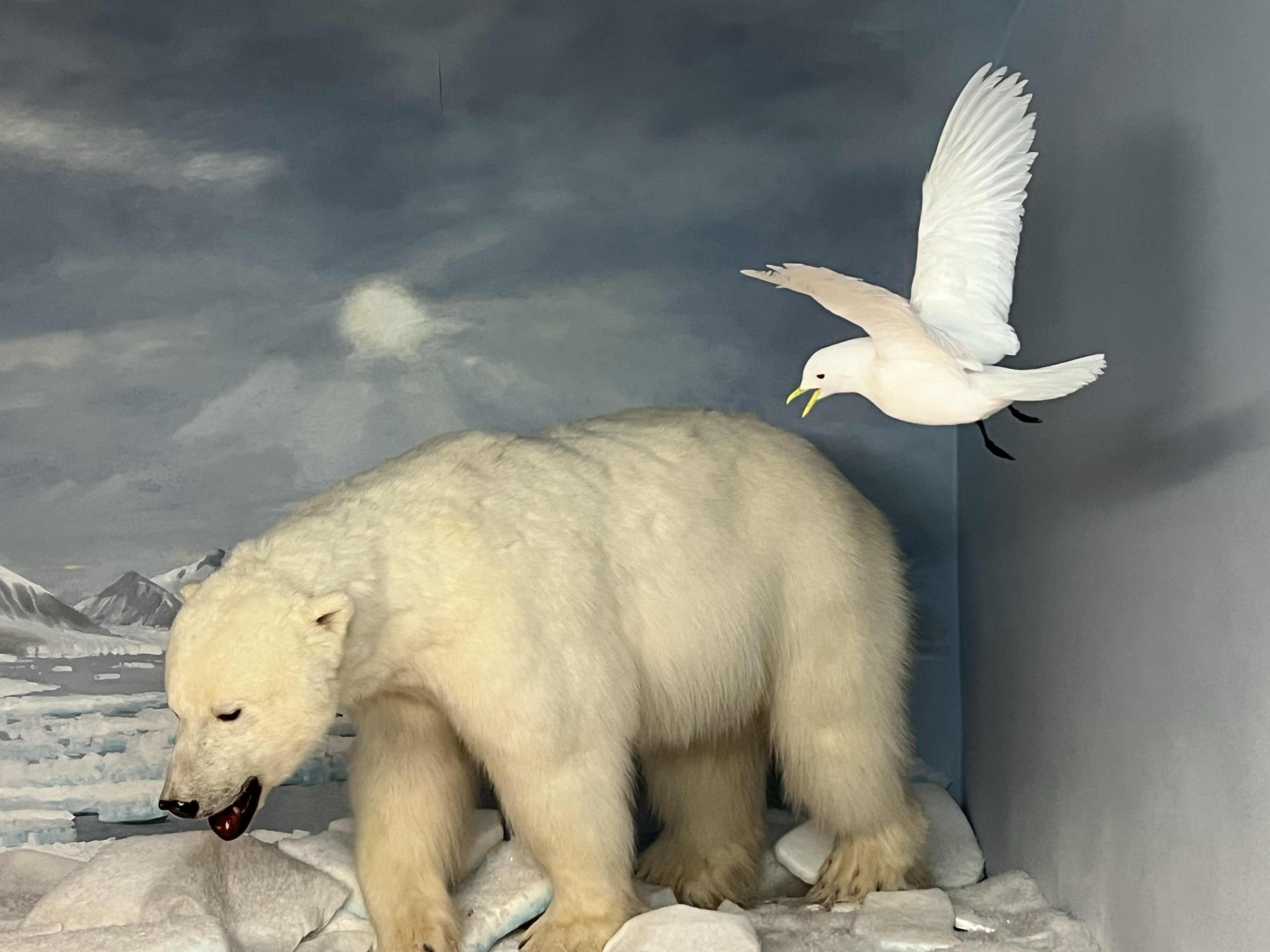
Another part of the museum that I was drawn to was the Svalbard section, featuring animals that I was looking forward to seeing.
Two species topping my list: ivory gull and polar bear.
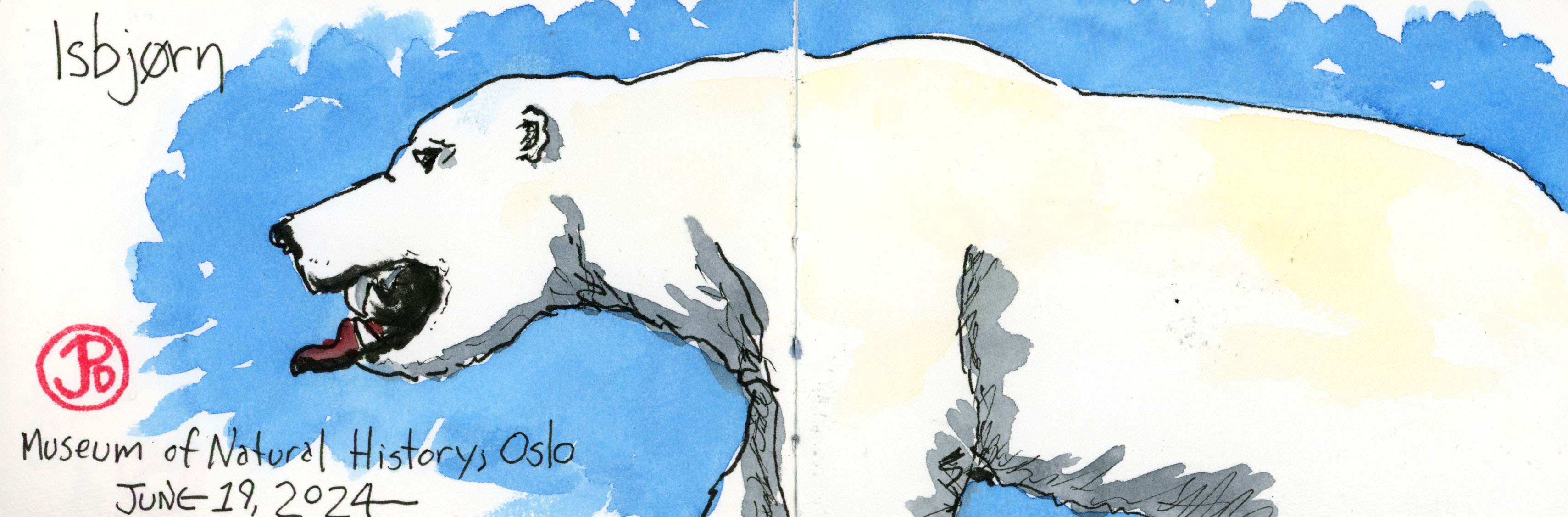
I sketched one of the two polar bear mounts in my small sketchbook, and yes the bear’s tongue was really sticking out.
Unfortunately polar bear mounts are all over Scandinavia and I saw many in museums. There was even one in the Longyearbyen Airport baggage claim. Finding a real live bear, outside of a zoo, proved to be a real challenge.
On Wednesday morning I took the T-Bane (the subway) out to see and sketch the Holmenkollen Ski Jump.
Public transportation in Oslo is so easy to use and you can get anywhere you need to go in or around Oslo. A few stops after Central Station we were no longer underground. Our train was not even on elevated tracks like the Bay Area’s BART. Indeed the 1 train was running at grade level with an exposed third rail! You got to love a people that can deal with accessible high voltage without doing something stupid.
The ride was pleasant with even crossing gates (for a subway!!) and as we climbed the hill towards Holmenkollen, the views of Oslo Fjord were stunning.
The little suburban stations that passed by reminded me of British branch line stations, small but homey. After about a 20 minute ride, I detained at the station and then walked 10 minutes up hill to the ski jump.
In someway this journey was a pilgrimage for my father, he introduced me to skiing and some of the best memories of my life are skiing with him over fresh powder. I really own my life to skiing because my parents met at the South Bay Ski Club.
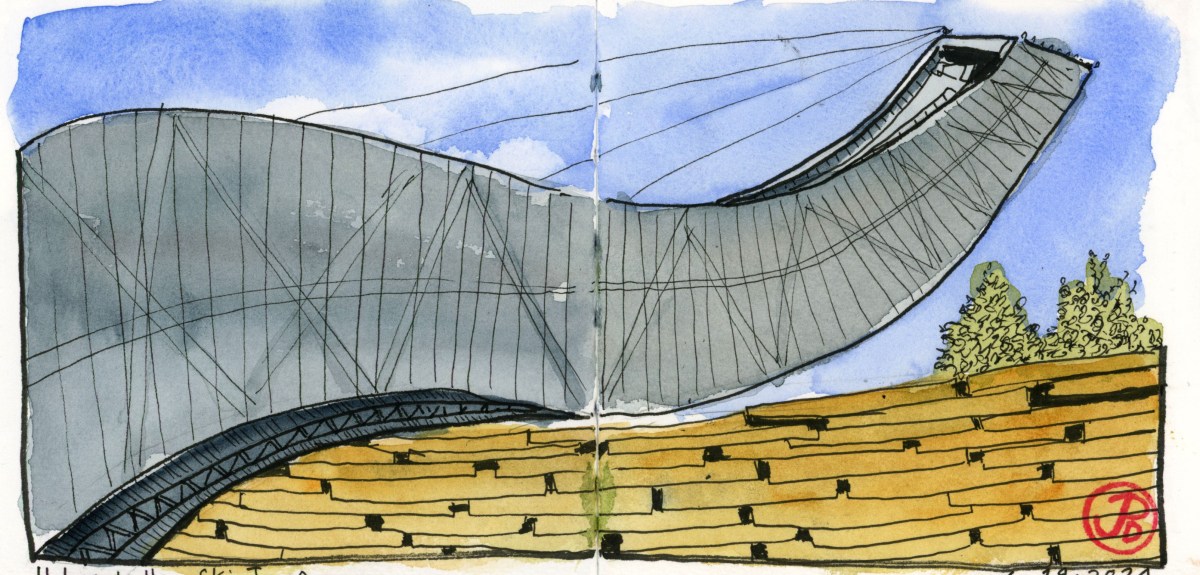
The Holmenkollen Ski Jump is a functional work of art. When I first found a vantage point I had to add its serpentine curves to my sketchbook. (Featured sketch).
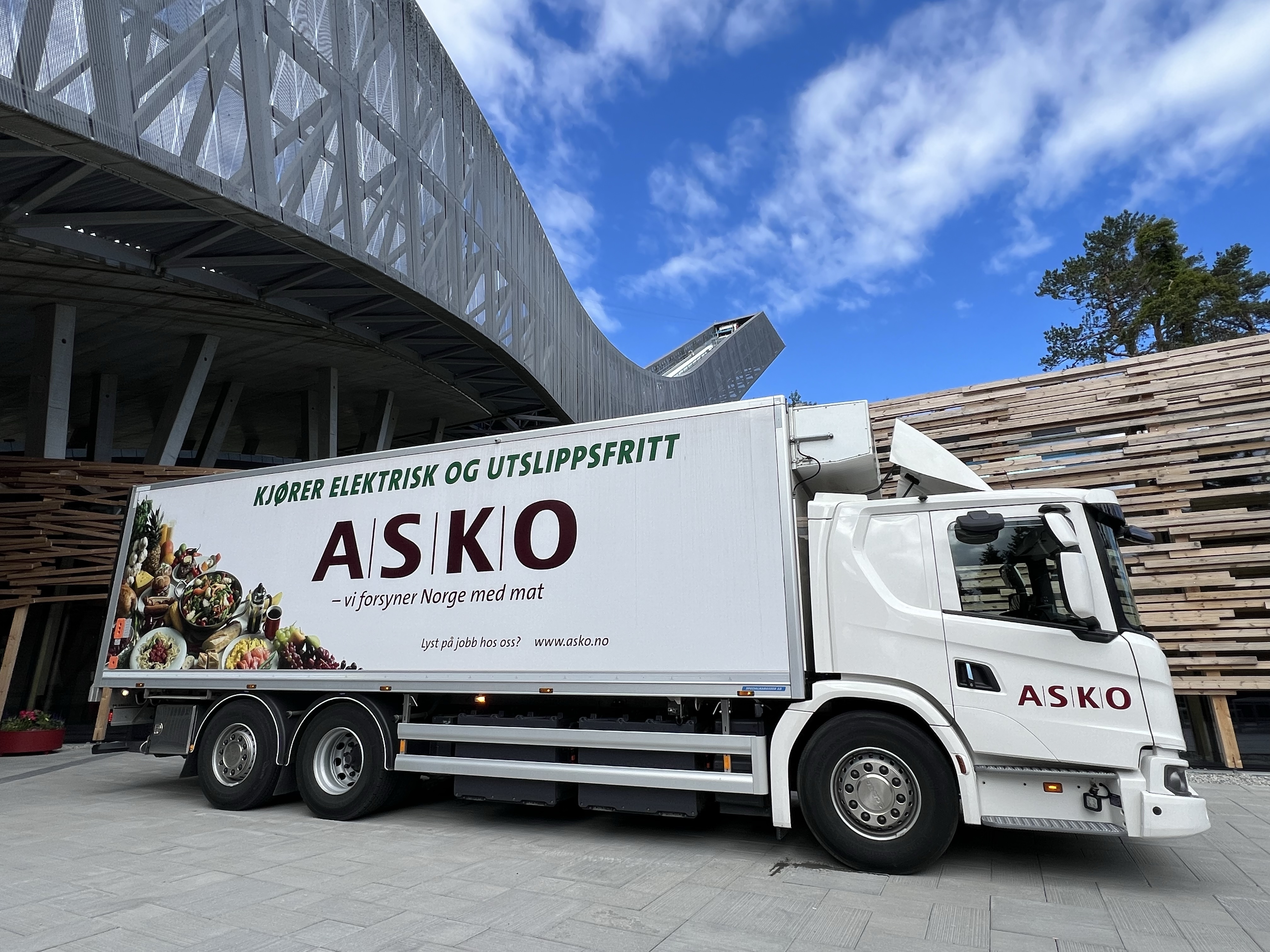
Best laid plans: this truck backed into my sketch so I had to patiently wait to finish my sketch.
After my sketch I visited the oldest ski museum in the world. For some reason it was under-lit as if the museum was in the possession of copies of the First Folio. It did not make for good sketching light.
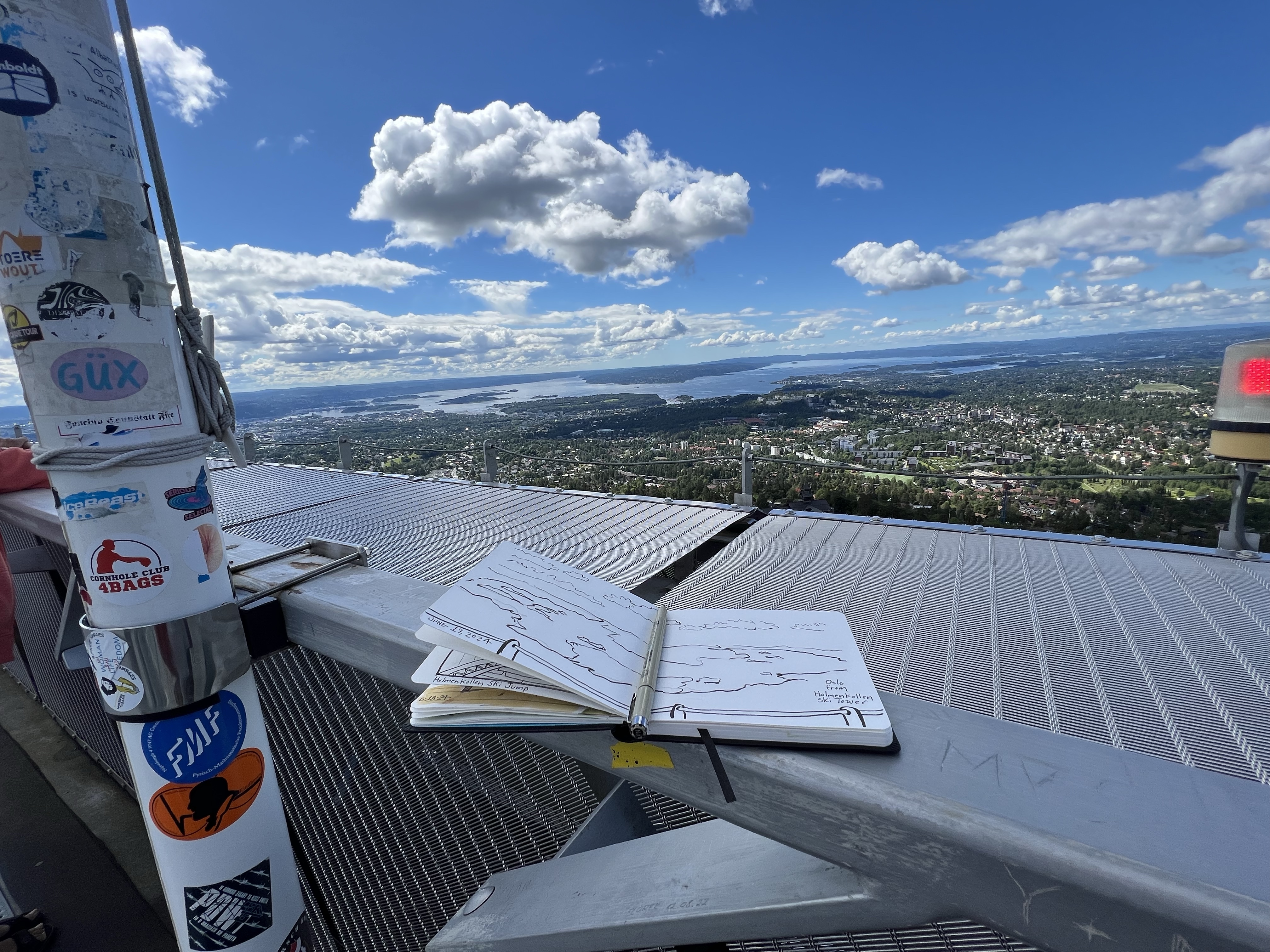
Can’t beat the view!
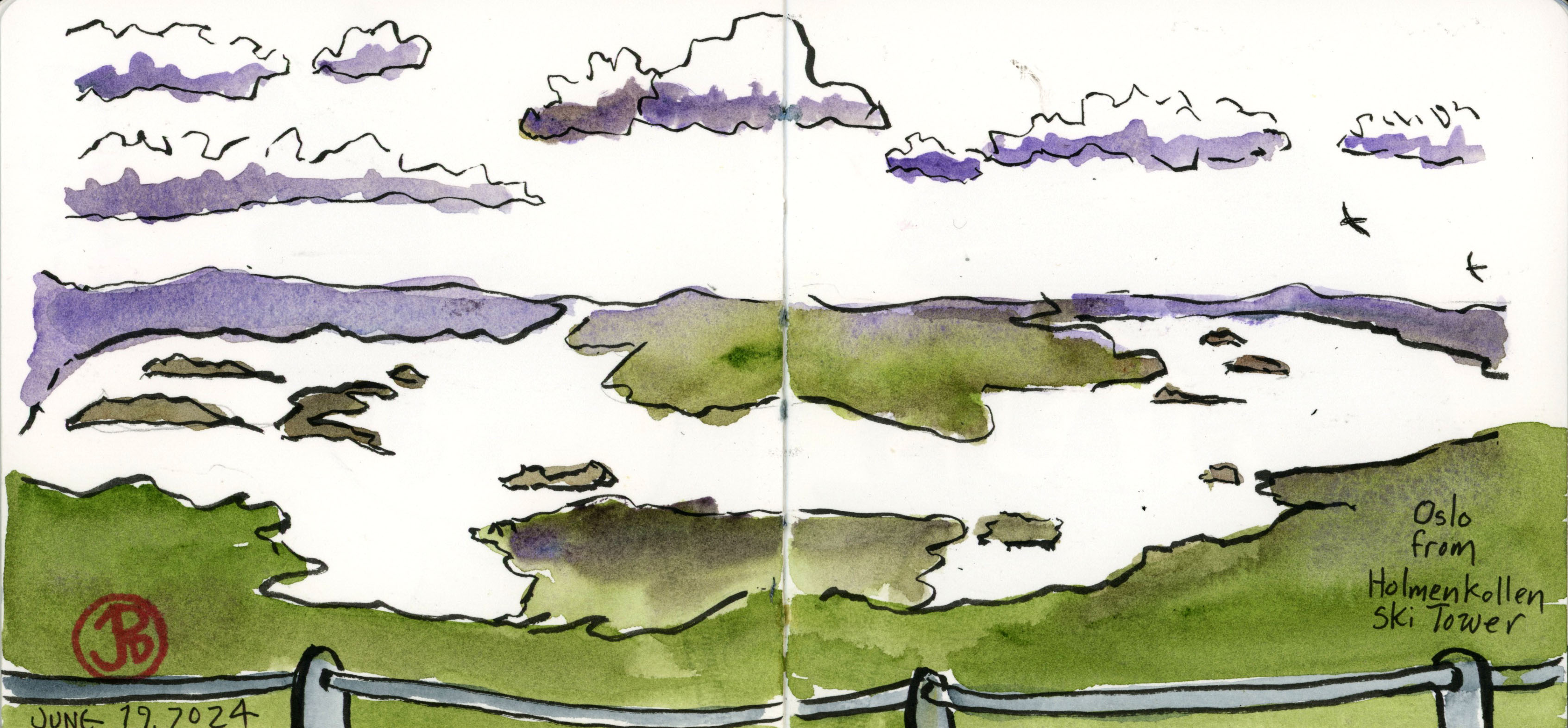
I took the elevator to the top of the ski jump and the views of Oslo Fjord were stunning. So I had to sketch it of course.
A lot of sketcher’s shorthand was involved in this one. I left out all of the buildings, as I was really just trying to focus on capturing the form of the fjord and islands. This is a landscape not a cityscape.
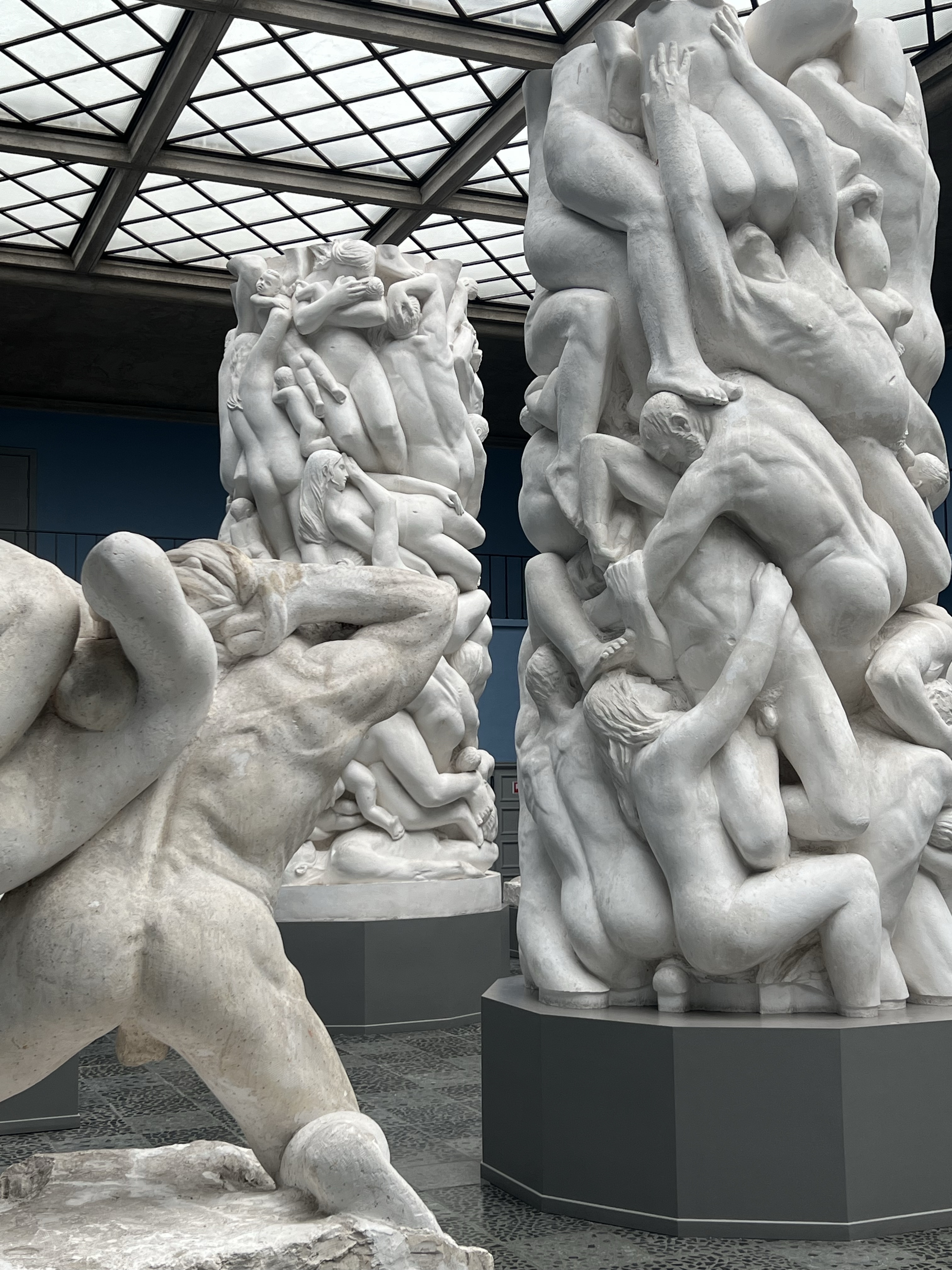
Vigeland park is one of the largest outdoor sculpture parks in the world. All of the sculptures are by Norway’s Gustav Vigeland.
This park is not for the prudish as it’s pure nudity in stone. There are over 200 of Vigeland’s sculptures and it can be an overwhelming place to visit for two reasons: first the sheer size of the collection, the unclothed human form in all sorts of poses and positions and secondly, Vigeland Park is one of Oslo’s top tourist sites. Tour buses disgorge camera-snapping hordes into the park and it’s hard to spend quality time with the art as you can be preoccupied with dodging selfie takers while trying not no wander into someone shot, well maybe I did a few times with purpose!
The plus side of sketching is that you don’t have to wait for the groups to get out of the way to do a sketch. Sometimes I even include them, for scale of course, in my sketch.
Vigeland Park is really a sketcher’s paradise. So many unmoving subjects everywhere you point your sketchbook.
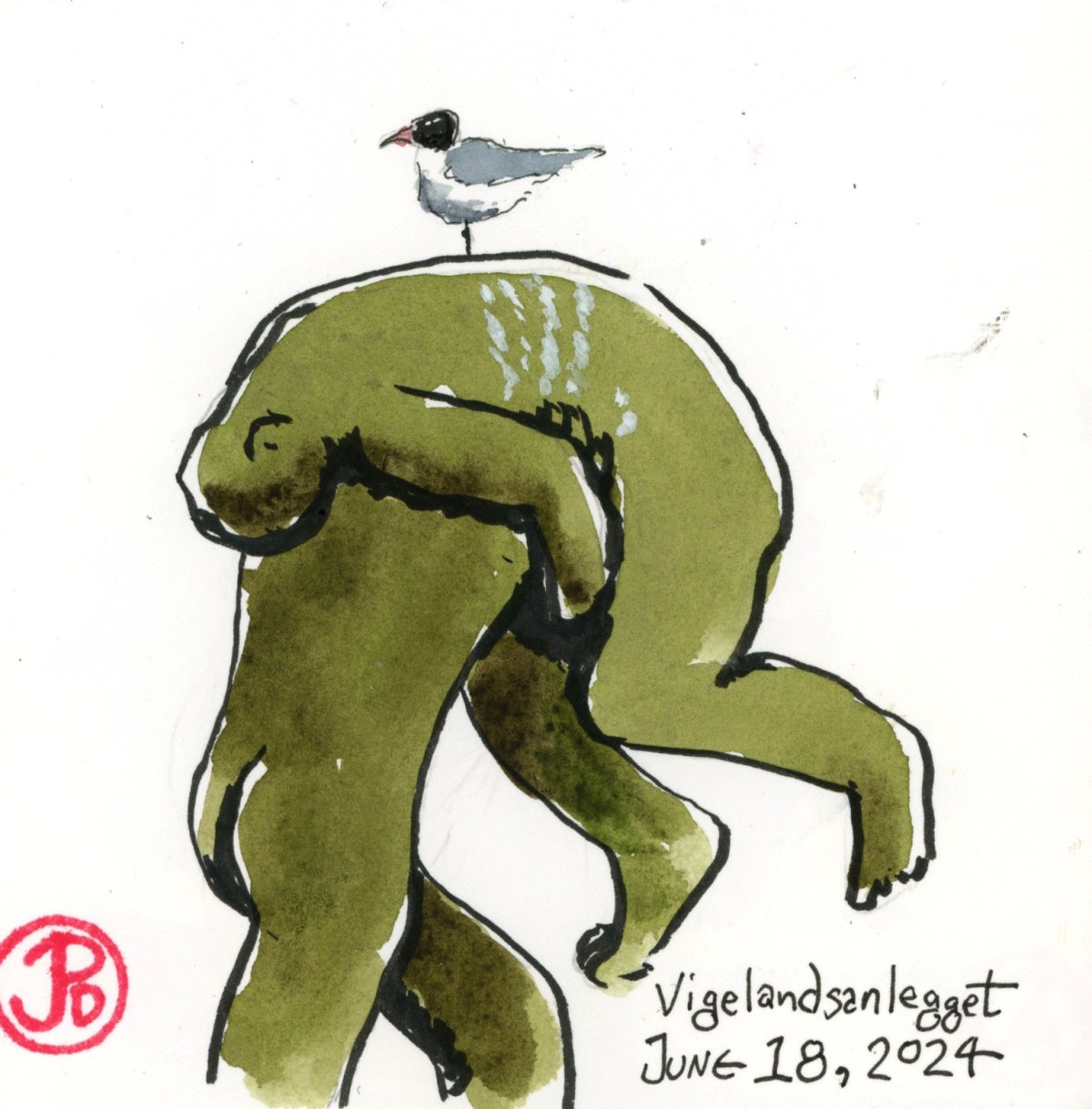
I did three sketches in my two visits. Your constant companion is the park is the black-headed gull (more brown-headed). So I felt I had to include one in a sketch. To these gulls, this elevated art is simply a nice perch and the level of white-wash on the sculptures also turns the gulls into art critics.
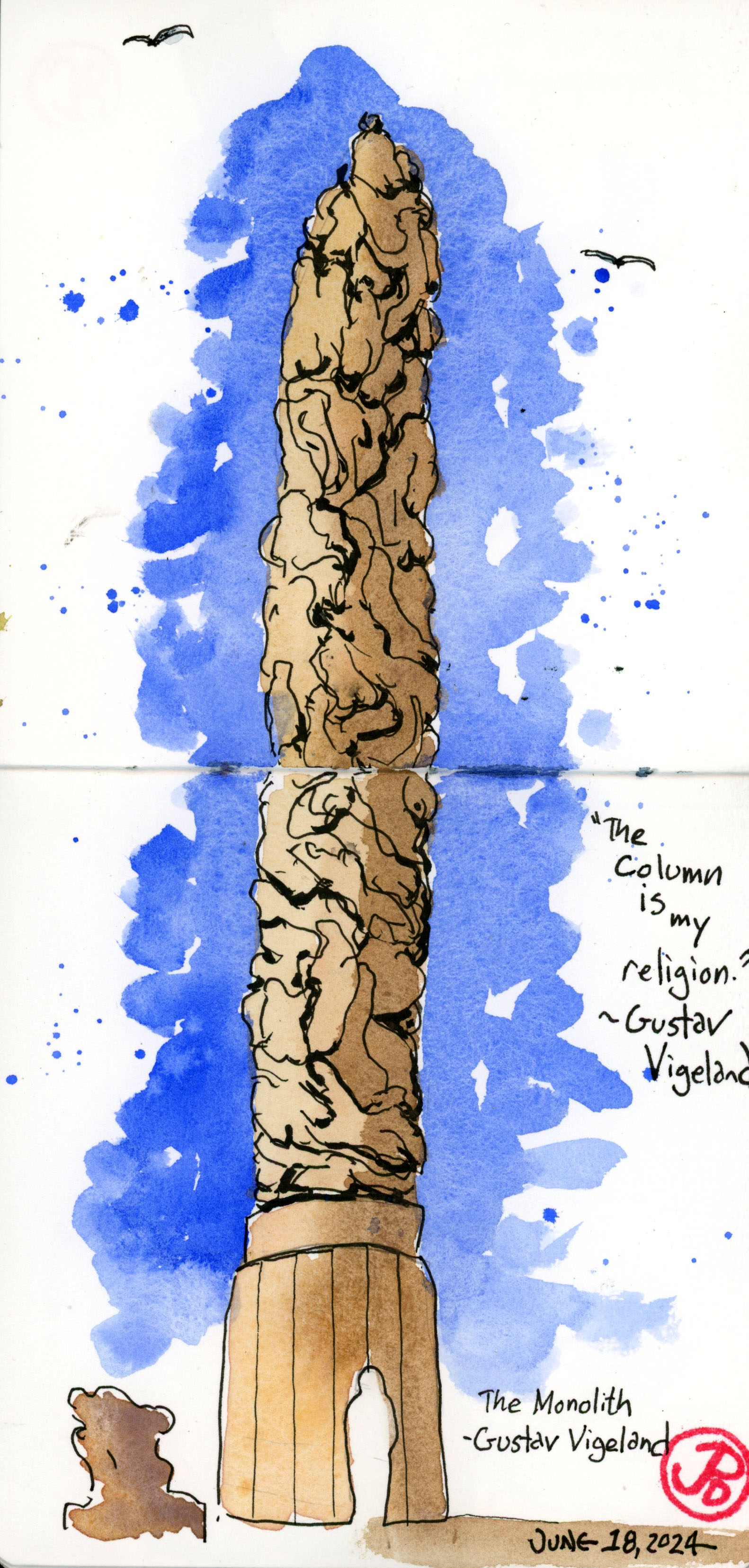
At the highest point is the Monolith. This tower humans was carved out of a single piece of granite and two 20 years to finish.
While sketching the Monolith, I kept it loose, knowing that I was not going to draw every single human figure in the column. I just want to make a suggestion to the viewer without filling in every detail. In the end I am happy with the approach.
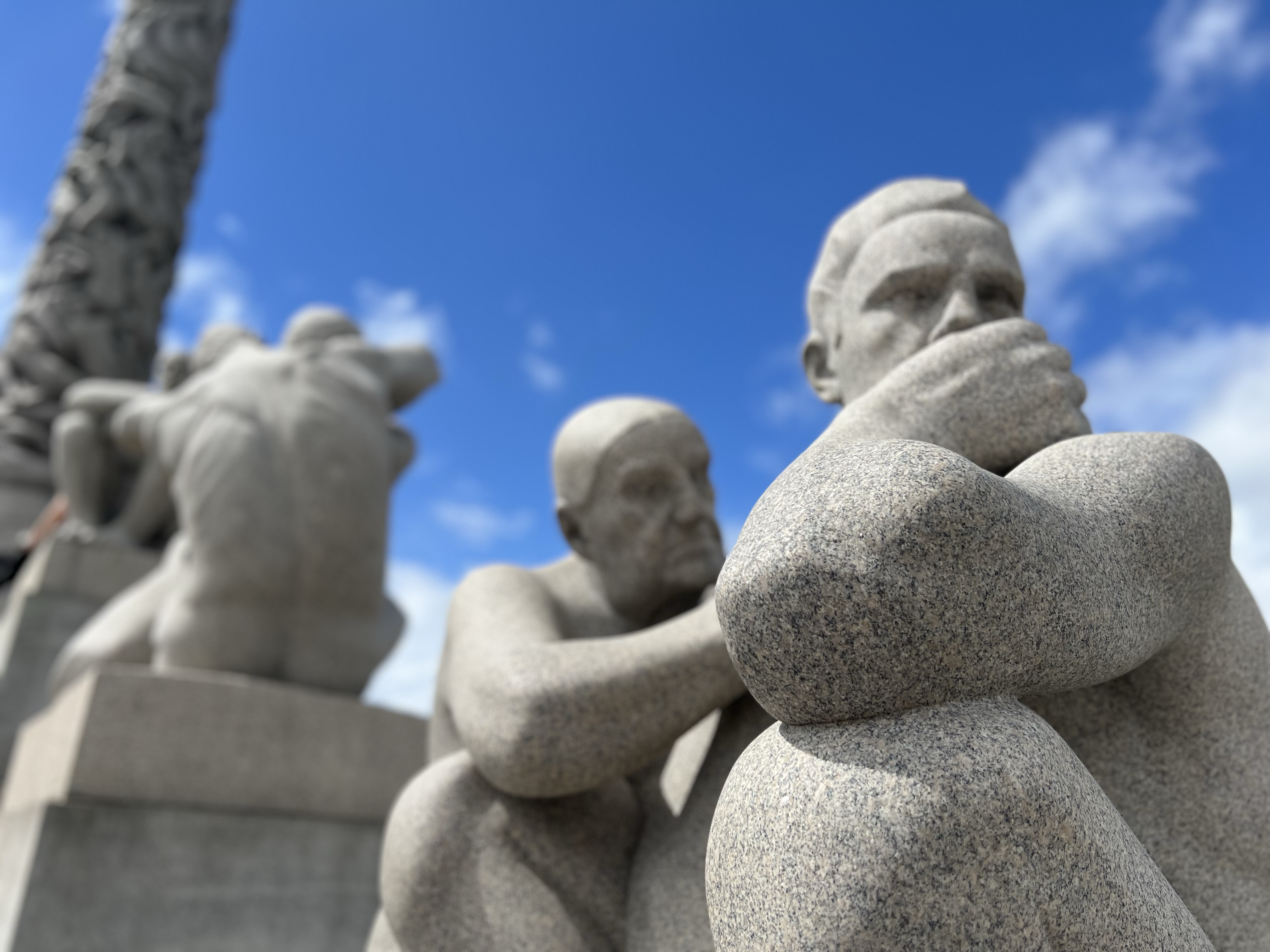
Some of the sculptures around the Monolith are very moving; so very human. I could sketch in this park for years and always find new subjects.
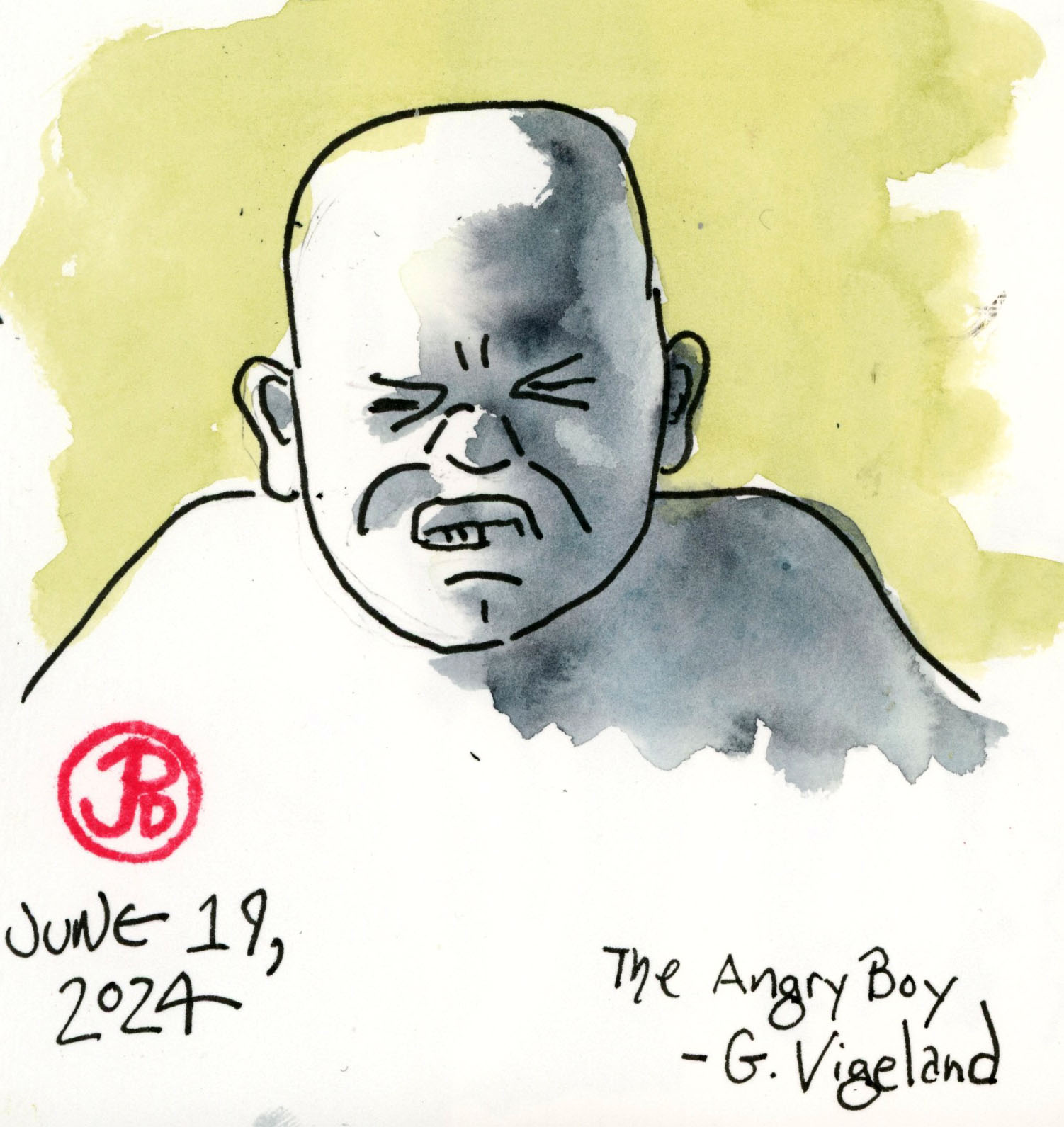
One of the most popular sculptures in the park, the number one sculptures most visitors want a selfie with is the Angry Boy. I sketch a version of the sculpture at the Vigeland Museum, near the park. This Angry Boy is not have a line in front of it so I was able to get a sketch in.
Sections of Monolith at the Vigeland Museum in Oslo. This museum gets much less visitors that the adjacent park.
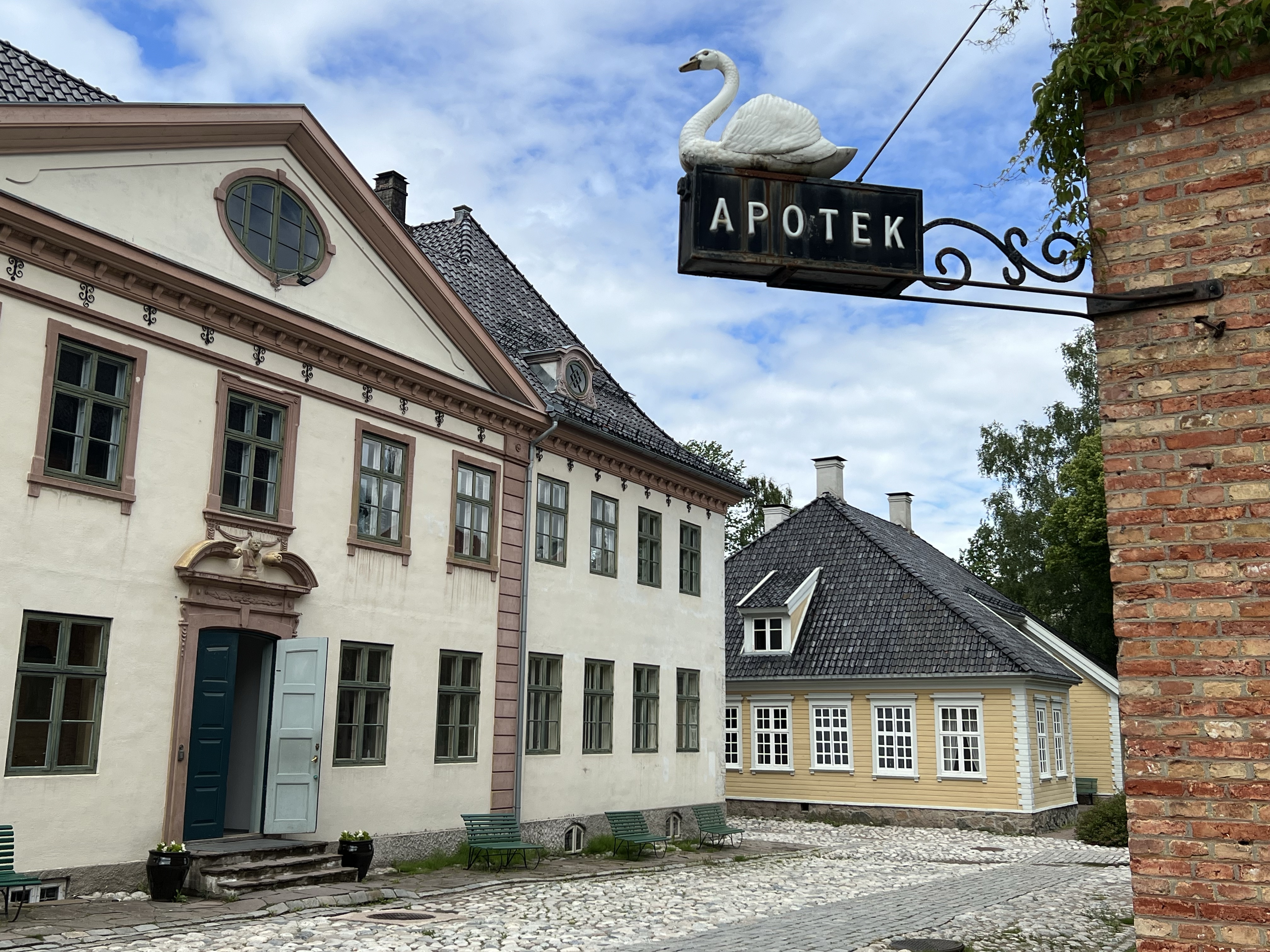
High on my sketch list was the traditional stave church at the Norwegian Folk Museum.
I took the first Bygdoy Ferry to the peninsula to visit this very popular outdoor museum, which is Norway’s largest outdoor museum.
The museum has over 140 buildings from different regions of Norway spanning an impressive span of time.
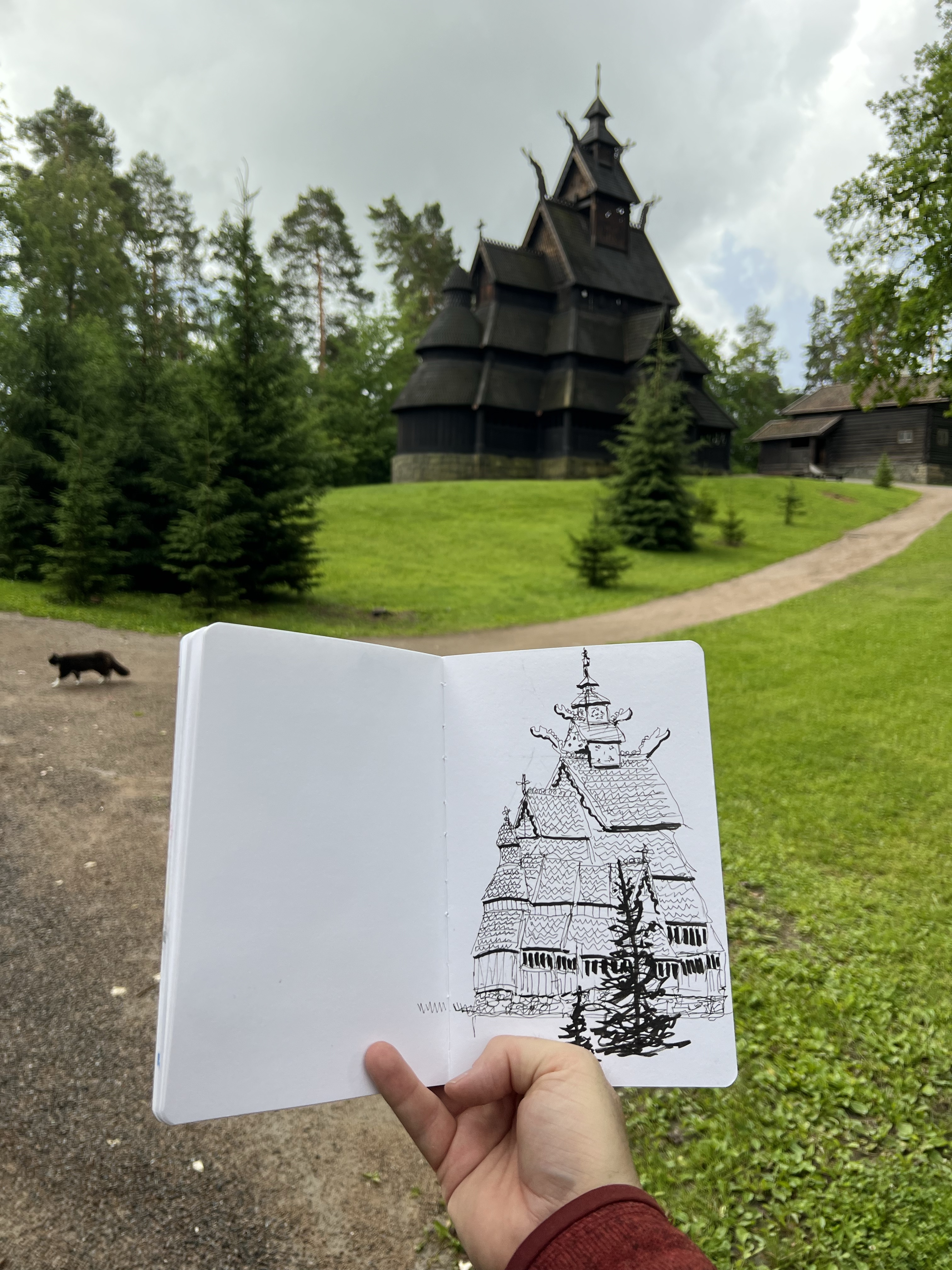
Once the gates opened at 10, I made my way to the stave church, using the map to navigate the large trail system. The church was so full of detail that I went with a very loose style, not focusing on every single shingle but choosing the form of the church.
Church, sketch, and a photobombing cat.
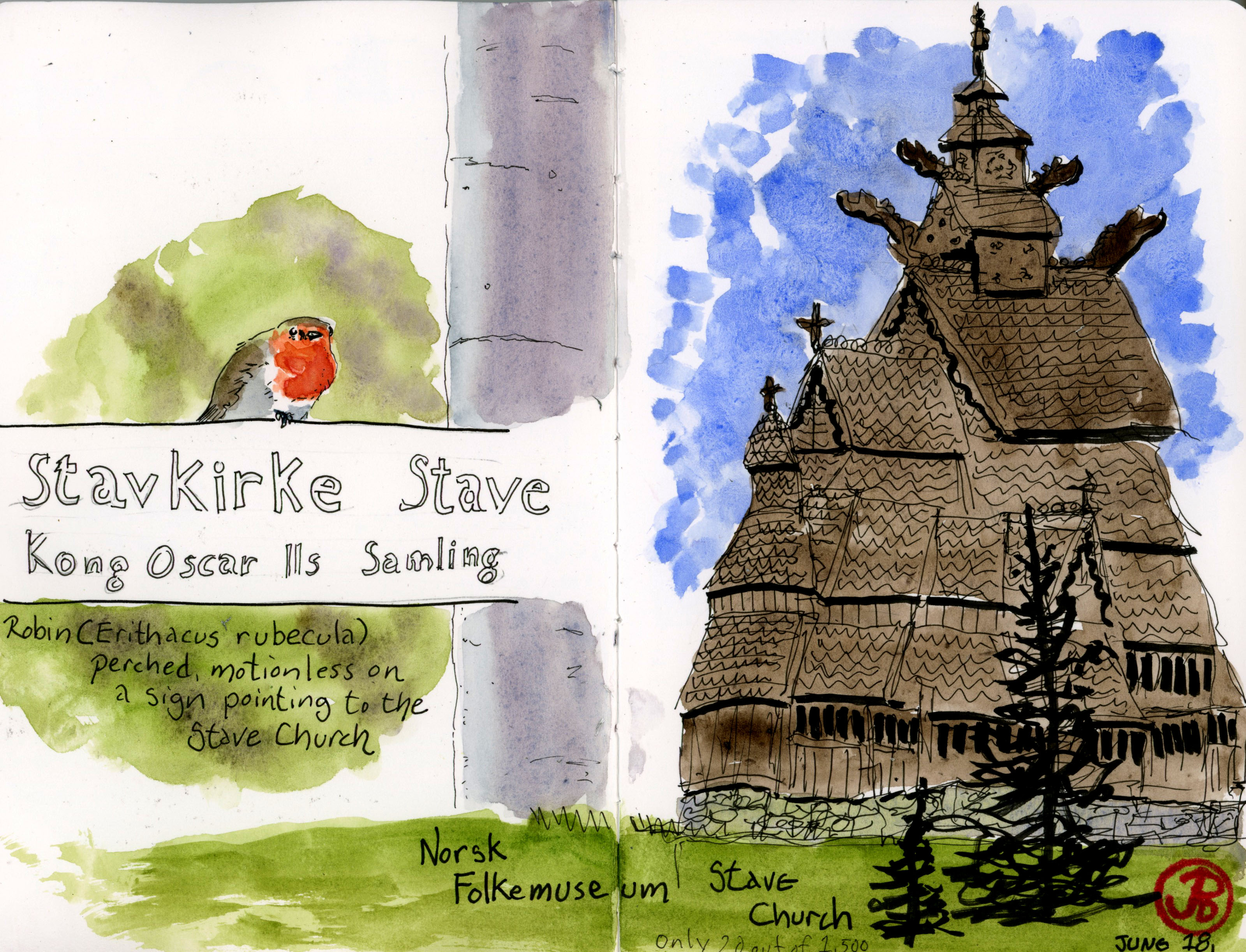
After my sketch I headed to another section and on the way I passed a robin statue-still on a sign. I was almost fooled into believing that this was a wooden carving until the red breast burst into life and shot off to forage in the underbrush. I add this experience to the other side of my spread.
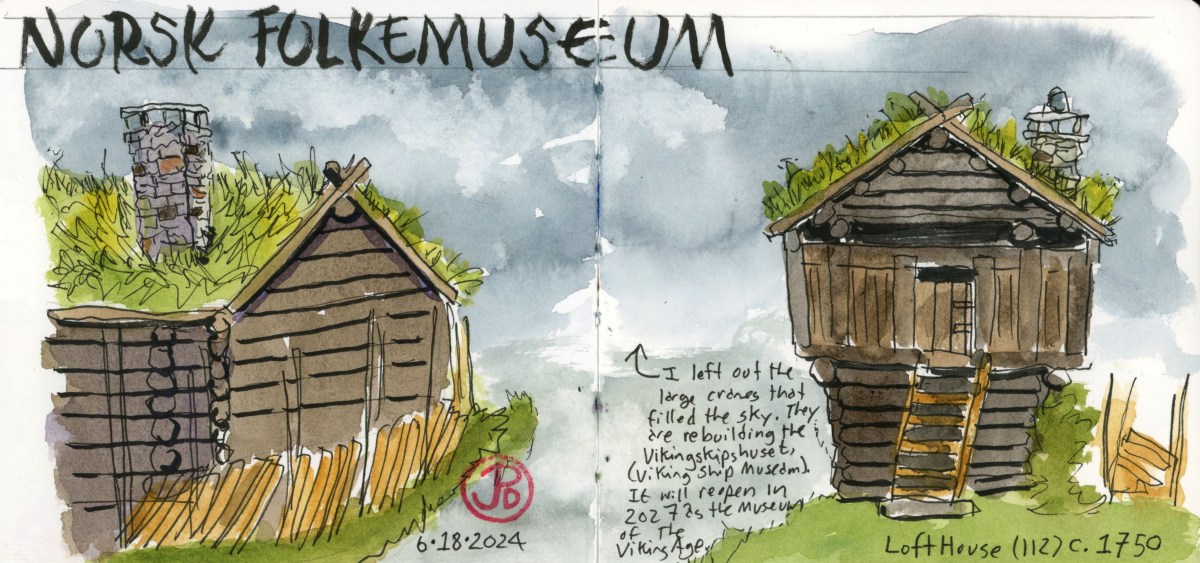
I found a collection of house farmsteads with a living roof of green so I found a bench and started sketching. My sketch was interrupted by rain so I had to finish my sketch in stages while retreating to a nearby house.
For this sketch, featured sketch, I used a little real-time editing. Behind the buildings, huge cranes reached into the air, shattering the feeling of time travel and firmly placing me back in the 21 Century. The cranes where above the site of the Vikingshipshuset (Viking Ship Museum). This museum has one of the most iconic preserved Viking ships in existence, the Oseburg Ship. The museum was closed in September 2021 for a complete renovation. The new museum will reopen in 2027.
This section of the museum felt like I had travelled forward in time from the last two buildings I sketched. I was traveling from Norway’s rural countryside to more developed towns.
Sounds like I need to make another visit to the Bygdoy Peninsula some time in the future!
Oslo is a city coming into its own as a modern Scandinavian city. The architecture around the city center is modern and I wanted to add this newer side to Oslo to my sketchbook.
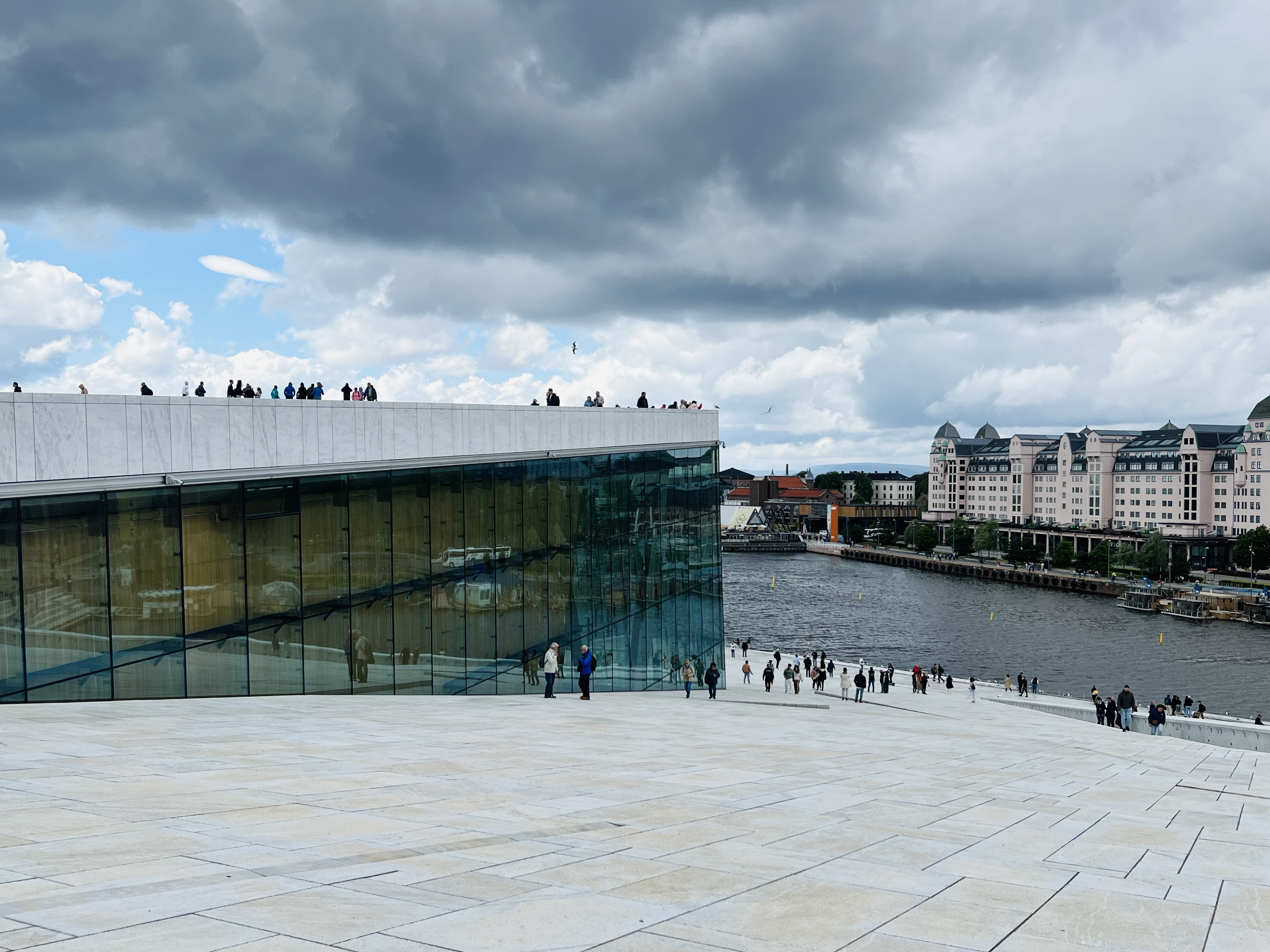
Nothing says modern Oslo more than its glacial Opera House. The innovative design lets you walk up the sloped roof for great views of the cityscape and the fjord.
The architectural glacier that is the Oslo Opera House. You can walk up onto the roof for city views.
Another modern building that made it into my sketchbook is the Munch Museum. This museum is dedicated to the works of Edvard Munch, best known for creating the second most famous painting in the world: The Scream.
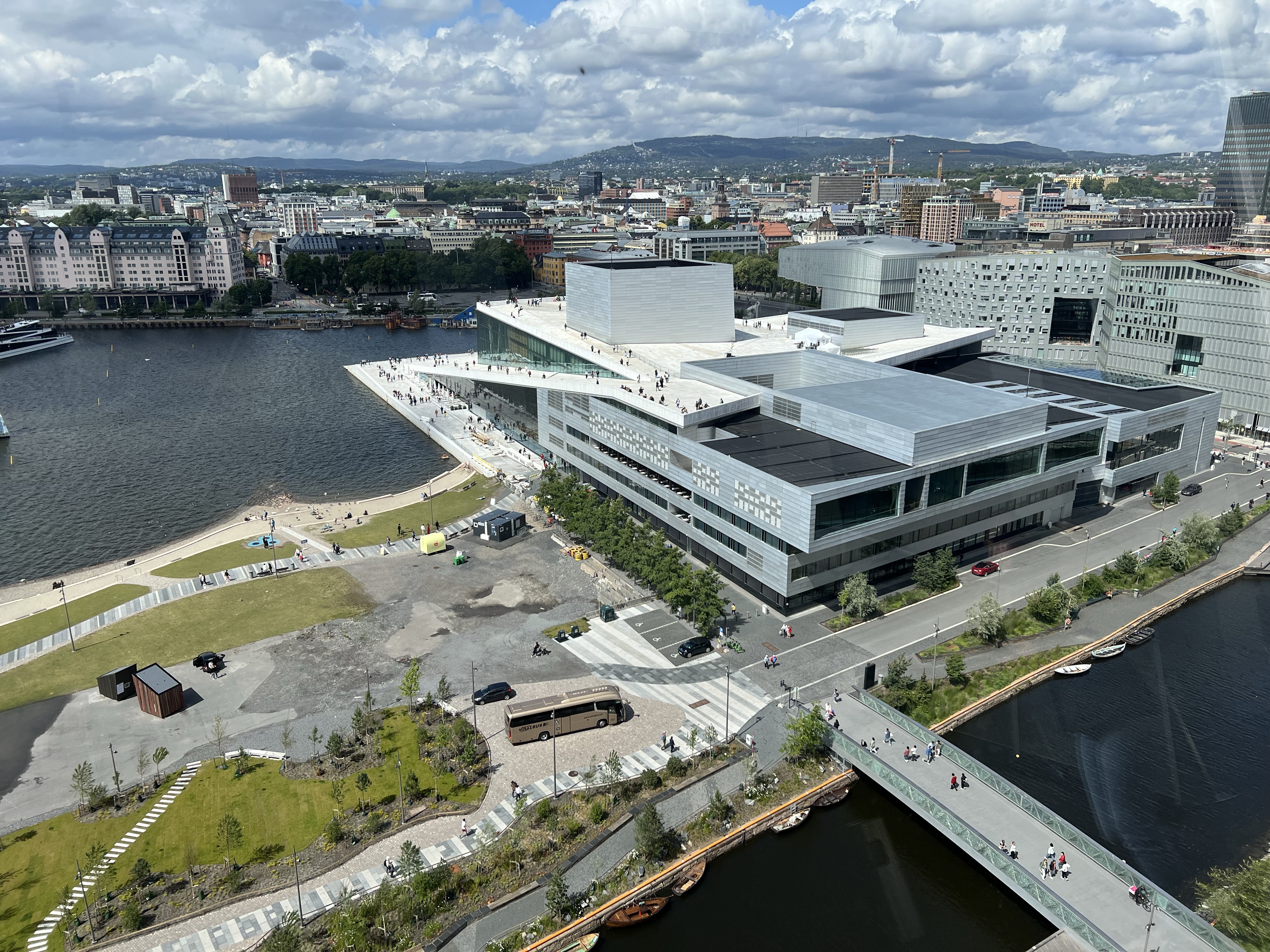
The new Munch Museum was opened in 2021 and the view from the top floor is amazing.
The view from the Munch looking down on the Opera House.
I found a perspective to sketch the museum with a garden and sculpture in the foreground. The 2022 sculpture in title The Mother by Tracey Emin.
When I travel I prefer to stay in a rented apartment rather than a hotel. While a hotel may feature a central location, an apartment puts you in a lively and living neighborhood like Grünerløkka.
Grünerløkka is a hip and lively neighborhood northeast of the city center. Once a working class neighborhood “Lokka” is now a Bohemian enclave full of cafes, bars, restaurants, and vintage shops.
The Paulus Church sketched in the rain from my local park, Birkelunden Park.
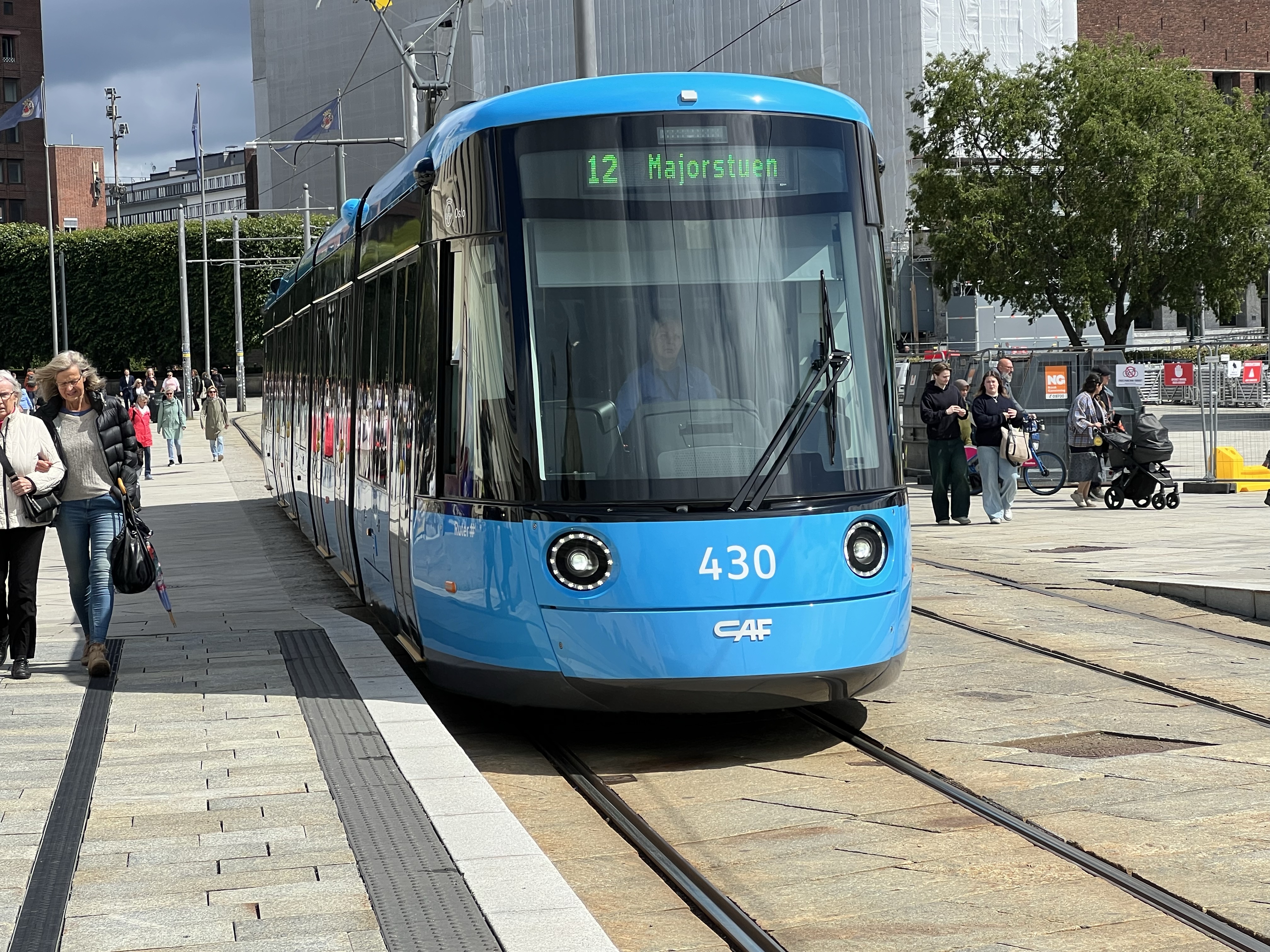
It was a short walk across Birkelunden Park to the tram stop. The lines 11 and 12 took me to Central Station. The 12 was my lifeline while in Oslo.
The 12 also took me to the ferry terminal for the boat to the Bygdoy Peninsula and the Fram, Kon-Tiki, and Norwegian Folk Museums. If I stayed on the 12 a bit longer, it stopped at the entrance to the sketcher’s paradise: Vigeland Park.
The other bonus of my Grünerløkka apartment was the restaurants, bars, and cafes that were a short stroll from my digs.
One of my favorite places to relax in the afternoons was just a half a block away from my Oslo stay. This is Grünerløkka Brygghus. I loved to sit on the cobblestones enjoying a local cold one as the trams passed by, a few feet from my right elbow. So I did a sketch of it (featured sketch).
I waited at the dock for the 9:10 ferry to Bygdoy.
There are three museums that focus on maritime history and I was really looking forward to seeing and sketching a balsa wood raft that was captained by a famous Norwegian.
While I spent some time at the Fram and the Norwegian Martime Museums, I was really here to see the Kon-Tiki!
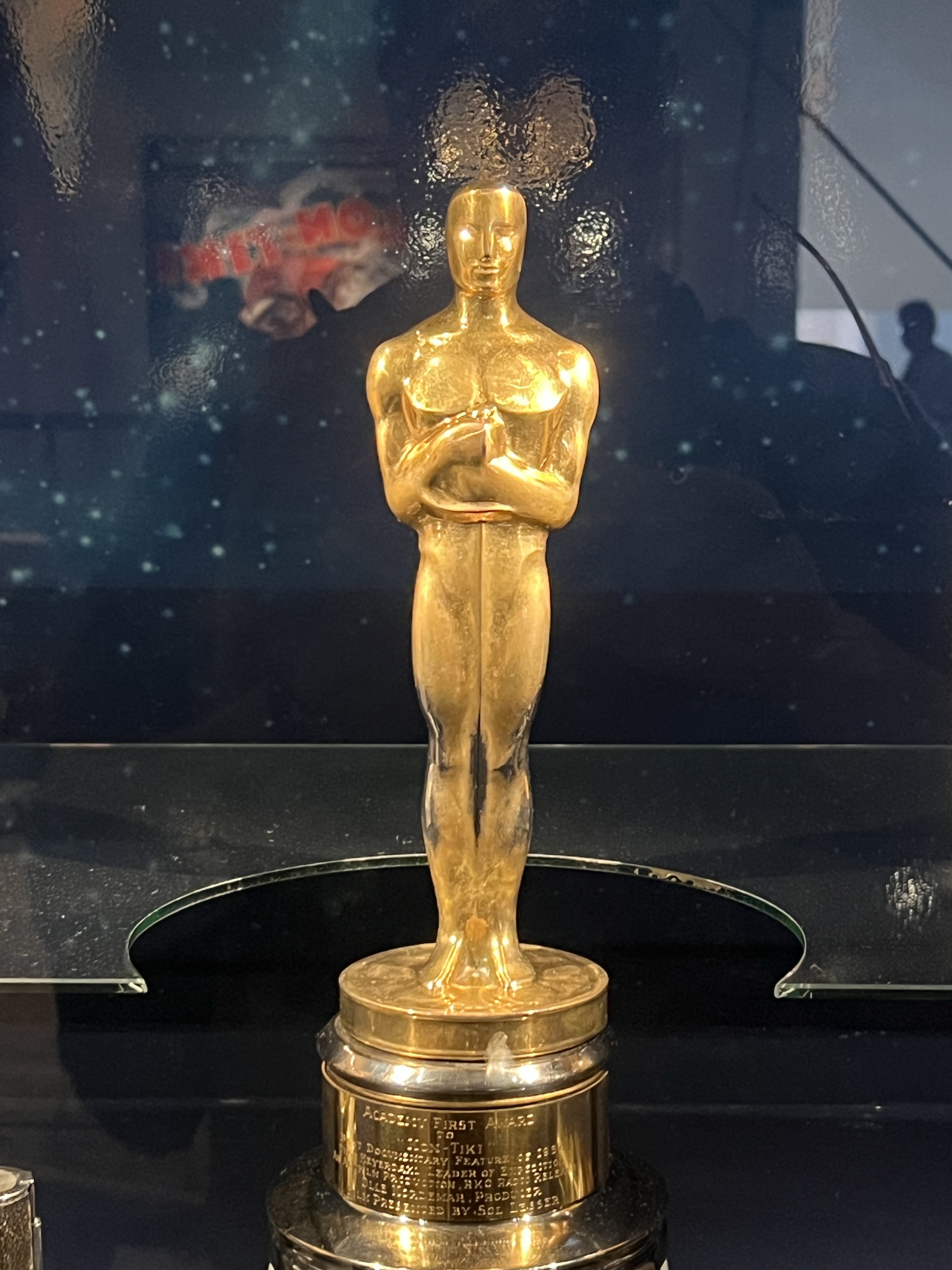
Before my trip I had read Thor Heyerdahl’s book about the adventure, seen two movies about the trip, including the Oscar winning documentary by Heyerdahl. I had done sketches about the raft and its captain and now I was about to see the actual vessel.
Heyerdahl’s Academy Award for best documentary.
The first time I remember reading about the Kon-Tiki was from a Time-Life book called Dangerous Sea Creatures. In the book was an excerpt from Heyerdahl’s massively popular account of the voyage. The passage was about the crews first encounter with a whale shark (this certainly is not a dangerous sea creature!).
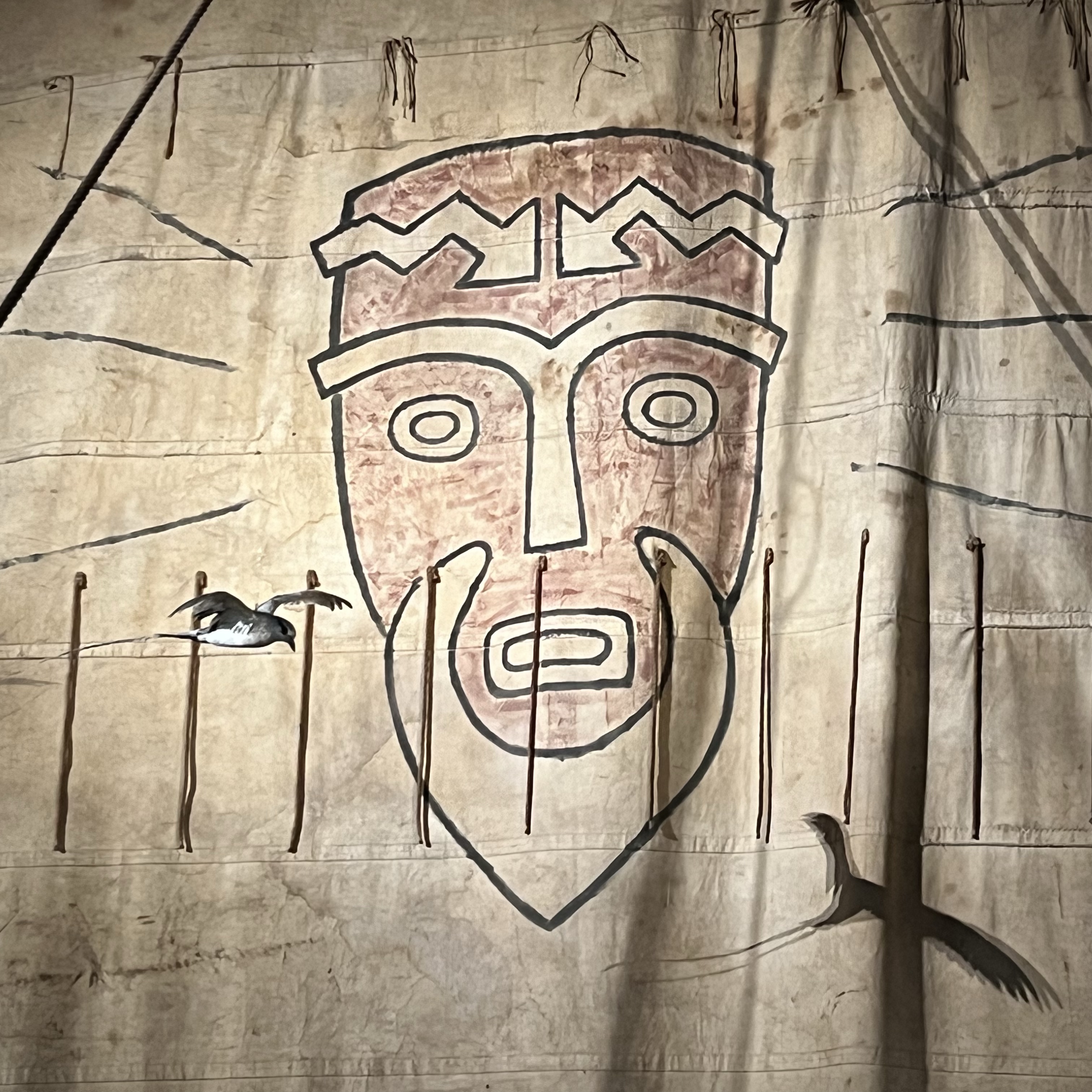
The sail with Kon-Tiki painted on it.
It was amazing to see the famous balsa raft in person that I had read about and which was also featured in the Oscar winning documentary about the voyage. The story of the Kon-Tiki is almost unbelievable had it not been documented. The heroism that the crew engendered on a journey that could very well have ended their lives and at a time when there had very rudimentary forms (ham radio) of communicating with the mainland.
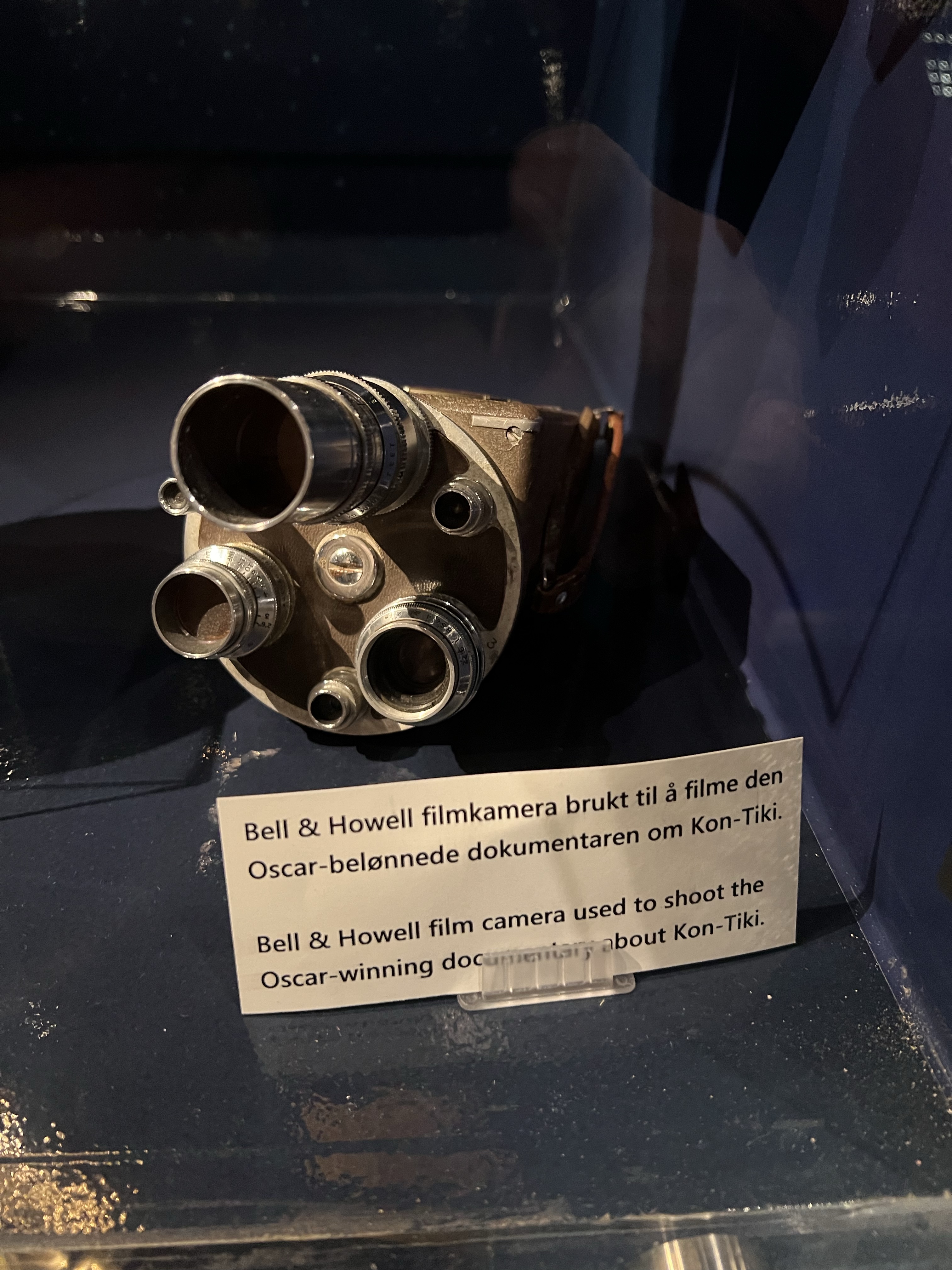
The Bell & Howell film camera Heyerdahl used to film the documentary.
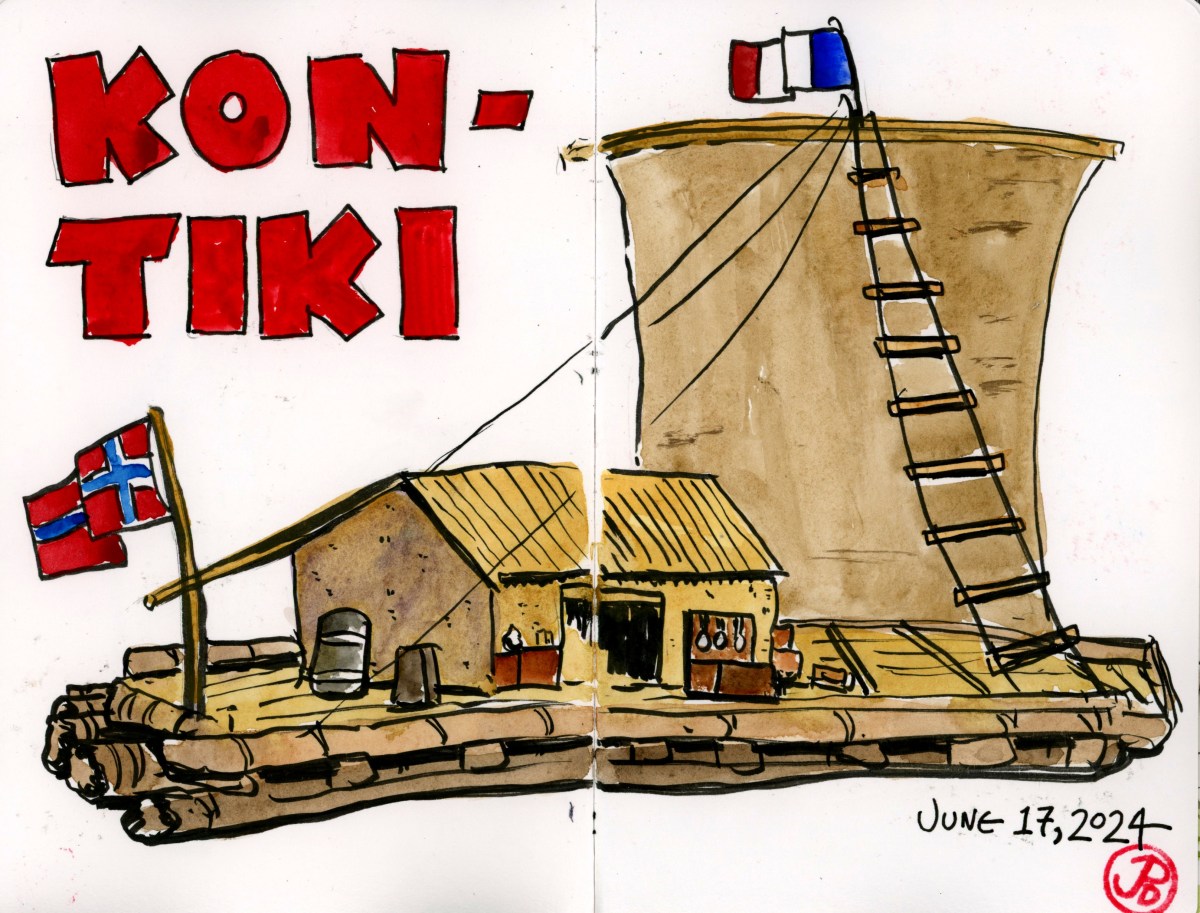
I started a sketch of the Kon-Tiki head on and was not pleased with progress so I aborted the sketch and picked a different perspective. I choose a seat on the starboard side near the stern. With a change of perspective, I was able to add the mythic raft from my childhood to my journal (featured sketch).
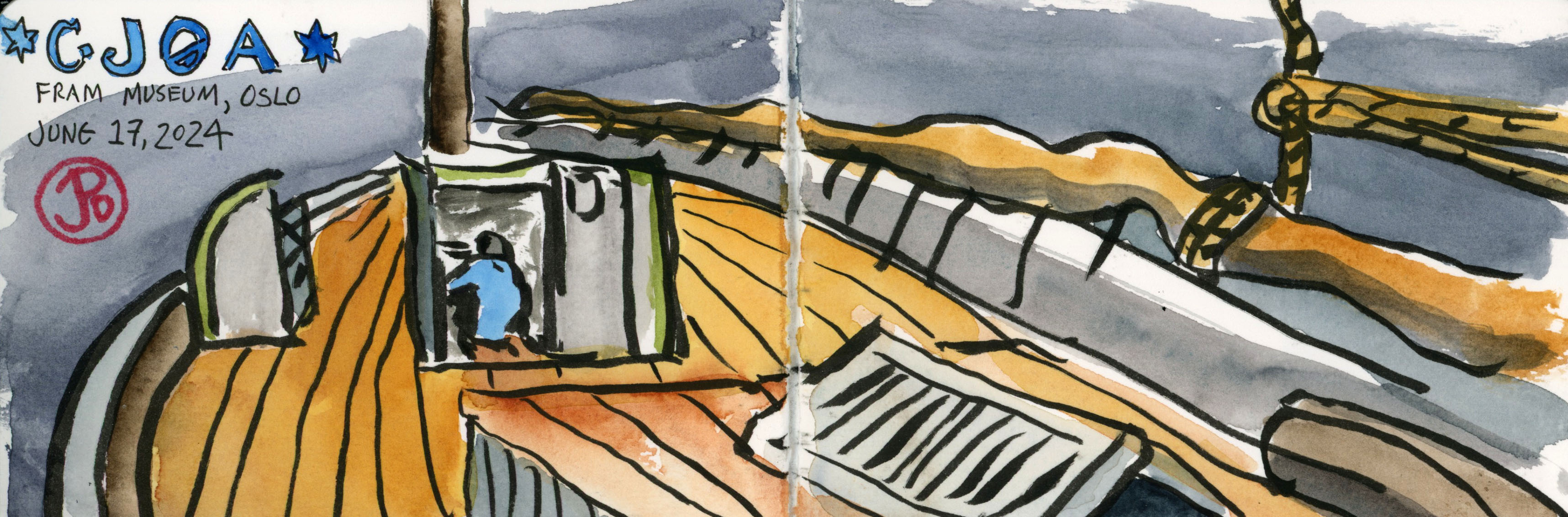
Another ship on the Bygdoy Peninsula was to be found at the Fram Museum. This was the ship that Roald Amundsen sailed through the Northwest Passage named the Gjoa. In 1909, the ship was donated to the city of San Francisco where it was on display at the western edge of Golden Gate Park until 1972. The ship was then given back to Norway where it is now on display in a large A-frame building at the Fram Museum.
Sketching the Gjoa was a bit of a challenge as I could get far enough away from the ship to capture the hull and mast so I sketched the deck from the port side stern.
After a sleepless ten hour flight from SFO to Copenhagen and a short flight from Copenhagen to Oslo, it was now time to shake hands with Oslo.
My focus was sketching in Central Oslo. I left my digs in Gunderlokka and walked across the park to catch the 11 tram to the town center.
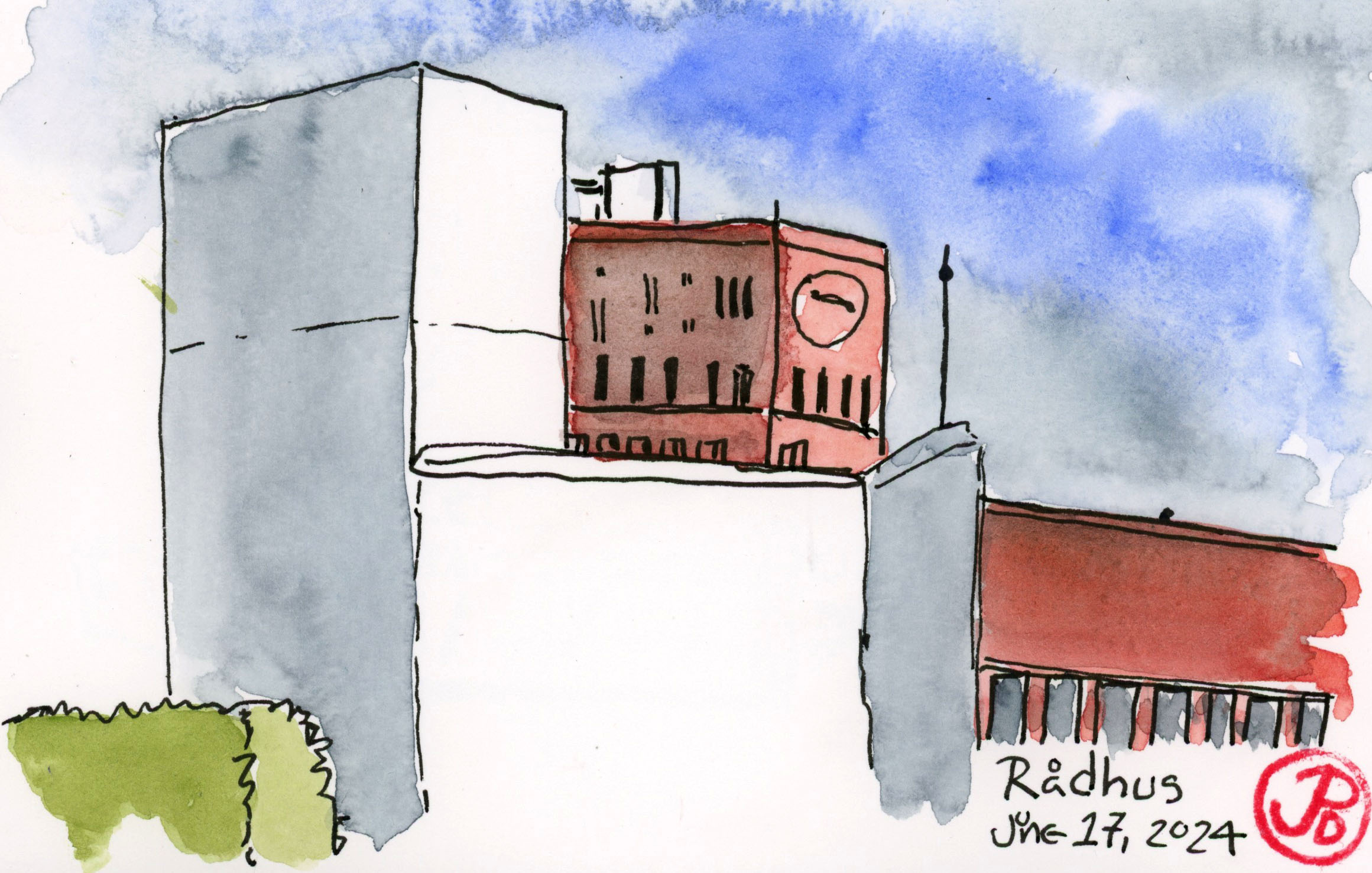
I eventually sketched the Radhas, one of it’s towers was covered in scaffolding and I thought provided and interesting contrast to the tower to it’s right.
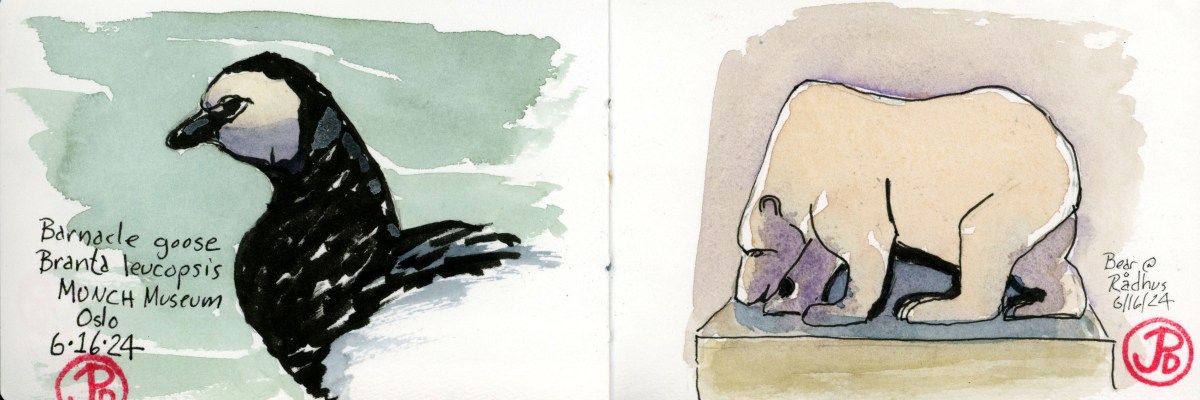
I got off in front of the National Theatre. One of the buildings on my sketch list was the Radhas. Unfortunately one of the red brick towers was covered in scaffolding so I passed on a sketch and instead found a bear sculpture on a fountain near the Radhas. Perhaps it is a polar bear!
There is lots to sketch in Norway’s capital city. Architecture, both old and modern, fjordscapes, and plenty of public art. And I was even able to sketch a life bird.
On a visit to the Munch Museum, I saw a family of Barnacle geese, two adults and two goslings.
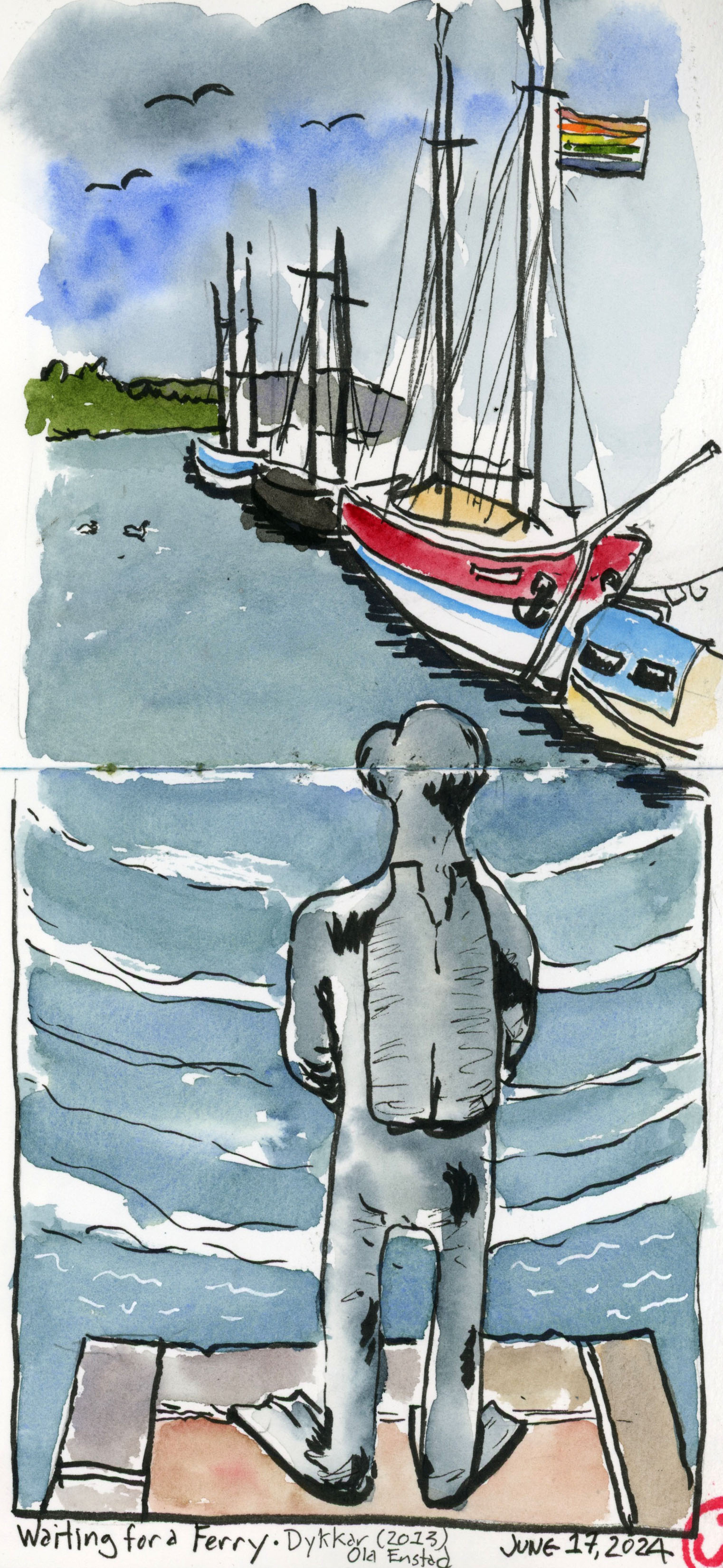
I always love to sketch public art, such as the bear in the featured sketch. I found the statue at the harbor, Dykkar (2013) by Ola Enstad. So I sketched it from behind as I was taking the very of the diver looking out to line of ships and the fjord of Oslo.




 Corvid Sketcher