Image

Lincoln Statues

There are at least 250 statues of our 16th President of the United States around the world. That’s about 150 more statues than that of our first president, George Washington.

On top of these monuments and statues, between 15,000 to 20,000 books have been written about Lincoln, more than any other American historical figure. And there is only one other world figure that has more biographies written about them that tops Lincoln and that’s Jesus Christ.

There were more than enough statues and monuments in Springfield, Illinois. So I sketched a few.

The lucky nose bust of Lincoln outside his tomb at Oak Ridge Cemetery. This was a continuous-line sketch. This is such an iconic statue I sketched it four times.

Near the old state capitol is the group of statues called “Springfield’s Lincoln” by Larry Anderson. The statues represent the Lincoln family on October 4, 1854 as the head of the household pauses before the capital before delivering a speech about the spread of slavery into U. S. Territories. His wife Mary, straightens his tie.
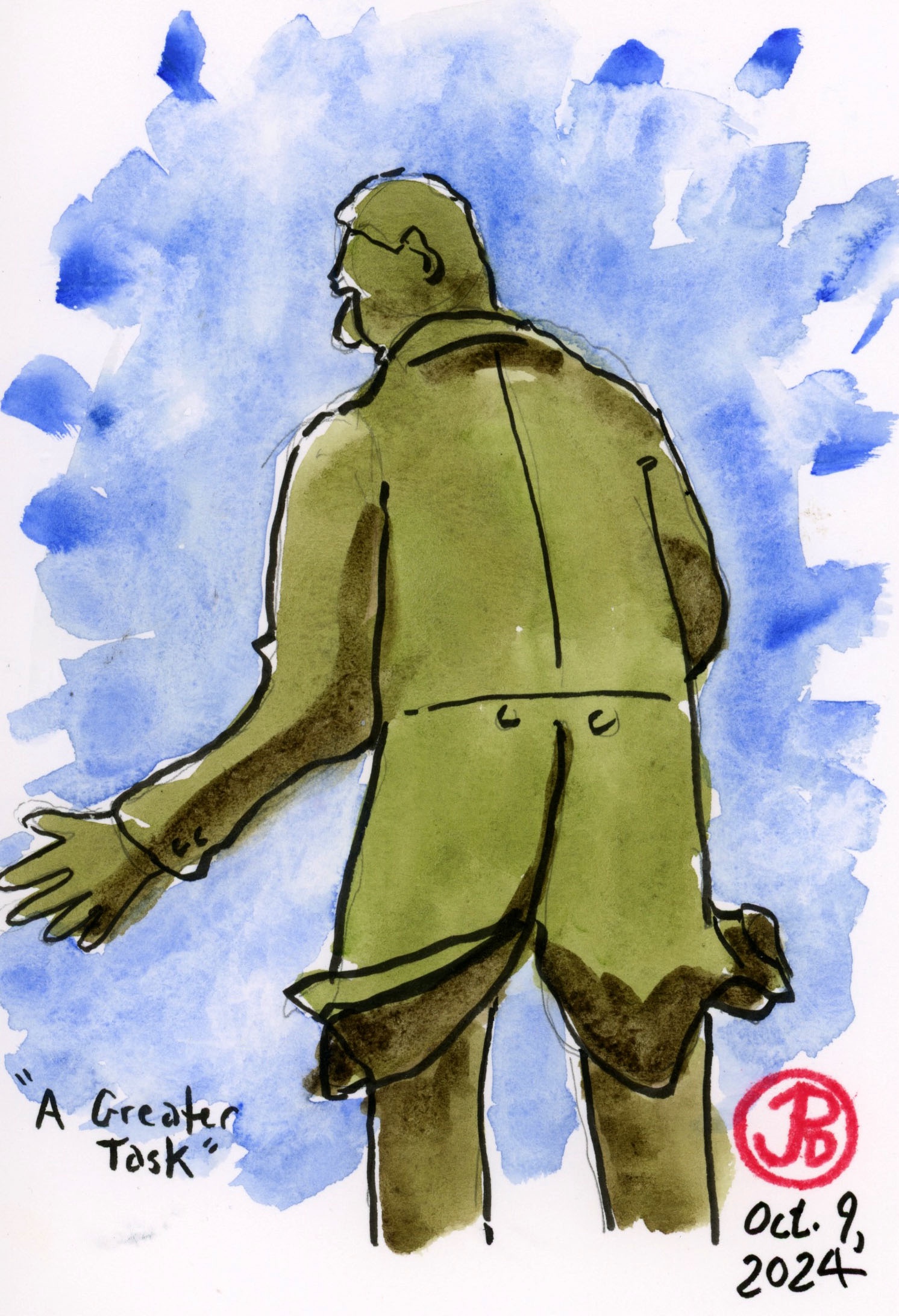
“A Greater Task” in the square in front of Union Station, Springfield.

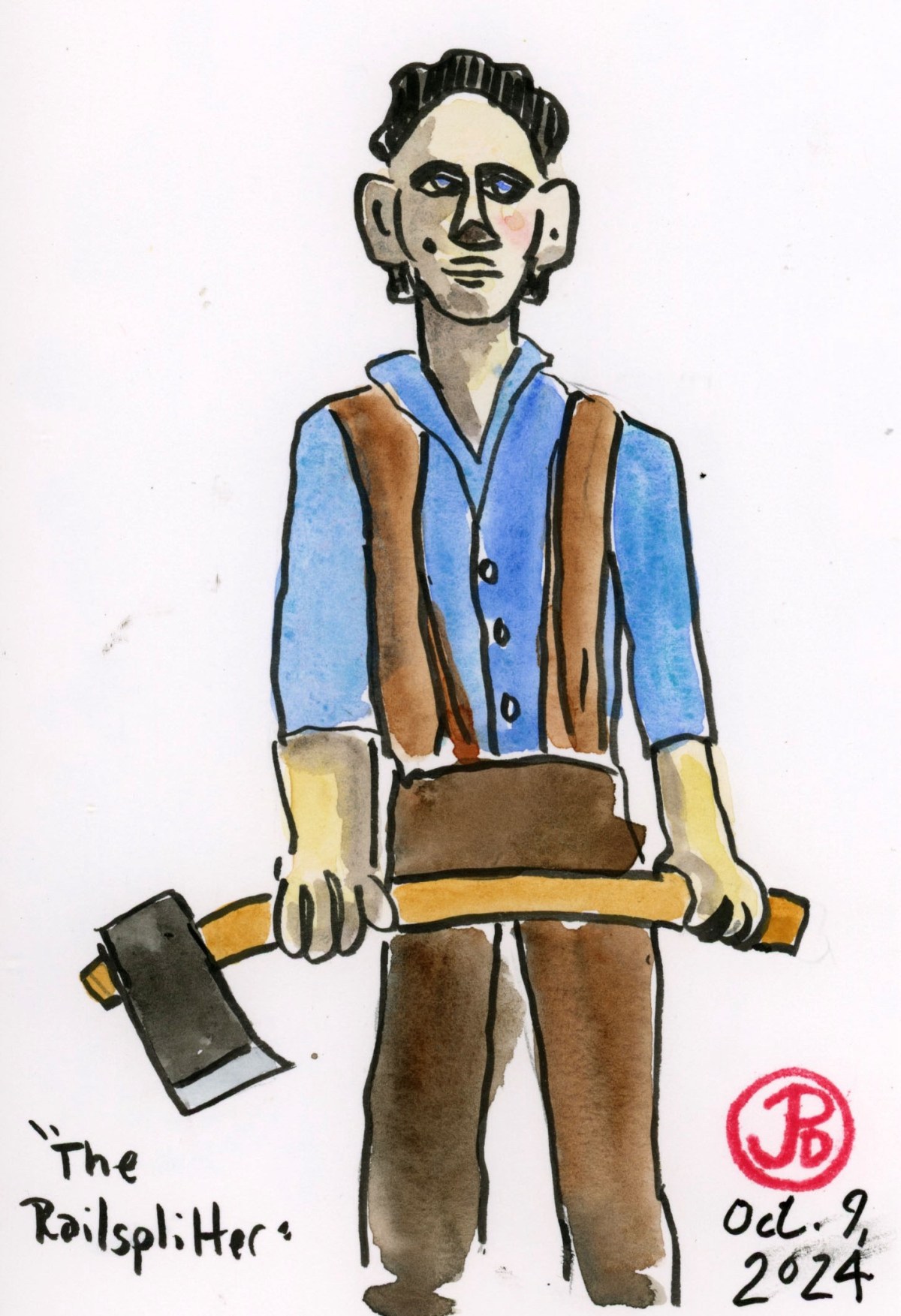
Perhaps one of the oddest representations of Lincoln is to be found at the State Fairgrounds. This is the whimsical “The Railsplitter” statue (featured sketch).

To me in Lincoln History there are two hallowed locations that are a must visit for any Lincolntonian. These are the Lincoln Memorial in Washington DC and the Lincoln Tomb in Springfield. Below is a sketch of the tomb.

Image

House of A. Lincoln

Springfield is the capital of the state of Illinois. Just east of the State Capitol building is a preserved neighborhood which is now a National Historic Site. Walking these streets makes you feel like you’re back in the 1860s.

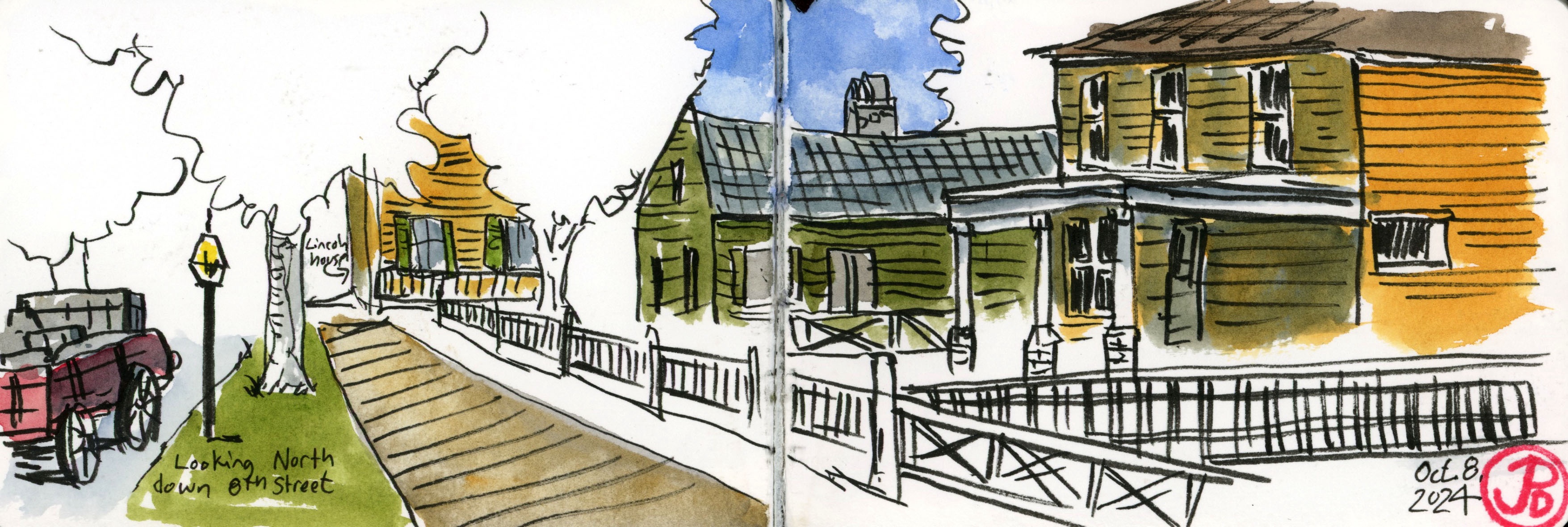
A sketch looking down 8th Street.

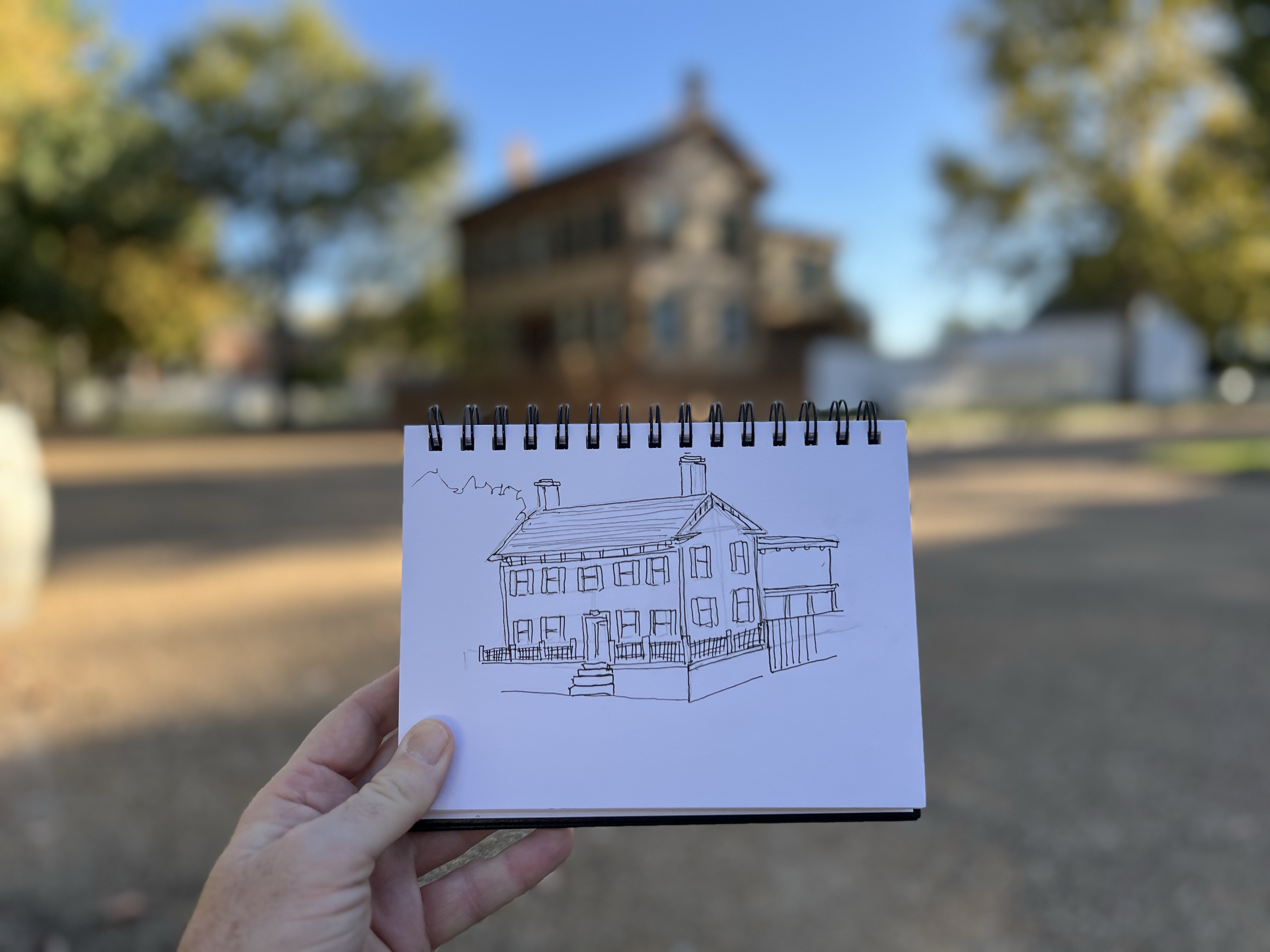
I was here to see and sketch the house on the corner of Eighth Street and Jackson Street. In fact, I was looking forward to sketching this house more than any other structure on my midwestern jaunt.

I headed to the intersection early in the morning to avoid the crowds surrounding the house or the tourists standing behind me wondering or asking what I was doing. The only other people out and about were maintenance workers, gardeners, and park rangers arriving to work.

I sat on the curb, across the intersection from the house, opened my sketchbook, and started to draw. Before me was the only house that Abraham Lincoln ever owned.

The Lincolns lived in Springfield for seventeen years (1844-1861). They raised their four boys here, three of which were born in the house. Lincoln practiced law here, he walked to his law office from this house. When Lincoln bought the small cottage in 1844 in was a small single story house. The cottage expanded with his growing family to be the two story house that exists today.

Lincoln left the house for the last time in February 1861. A few blocks to the northeast, Lincoln boarded a train at the Great Western Station (more about this in another post) to Washington DC as President-elect on his way to become the 16th president.

After my sketch (featured sketch) I joined the first tour of the day (you can only visit with a National Park guide).

The inside of the house was even more impressive than the outside for within these walls is where the Lincoln family lived. Seeing where they ate, lived, wrote, read, played, and slept really humanizes the Lincolns, a contrast to the stern and stale history books of old. About 40% of the furniture and furnishings are original to the Lincolns.

It was here in front of the fireplace in the sitting room that Lincoln was told that he was the Republican nominee for president. His life and the country would be changed forever.
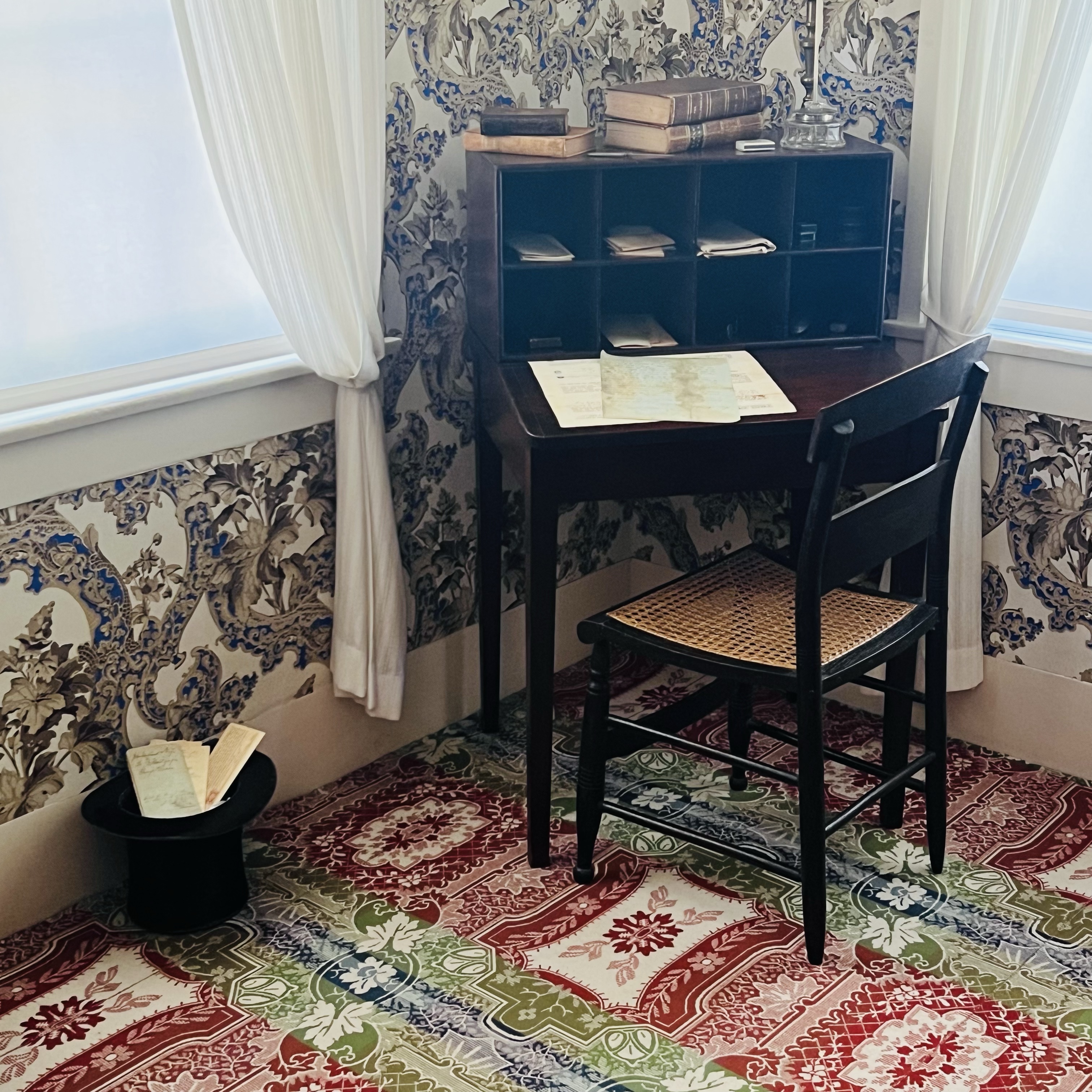
In Lincoln’s bedroom sits his writing desk. He loved this desk and it is believed that he wrote his “house divided” speech while sitting at this desk.
Image

Midwestern Presketching

Before any great or small journey I do some presketching.

On my October Fall break I planned to visit two midwestern states: Missouri and Illinois. I had been to Illinois before but only to Chicago. Now I planned to visit it’s capital, Springfield. And Missouri, Gateway to the West, would be a first visit for me.

My starting point would be St. Louis, Missouri. I had a few sites, destinations, and sketches on my list, chief among them was the National Museum of Transportation.

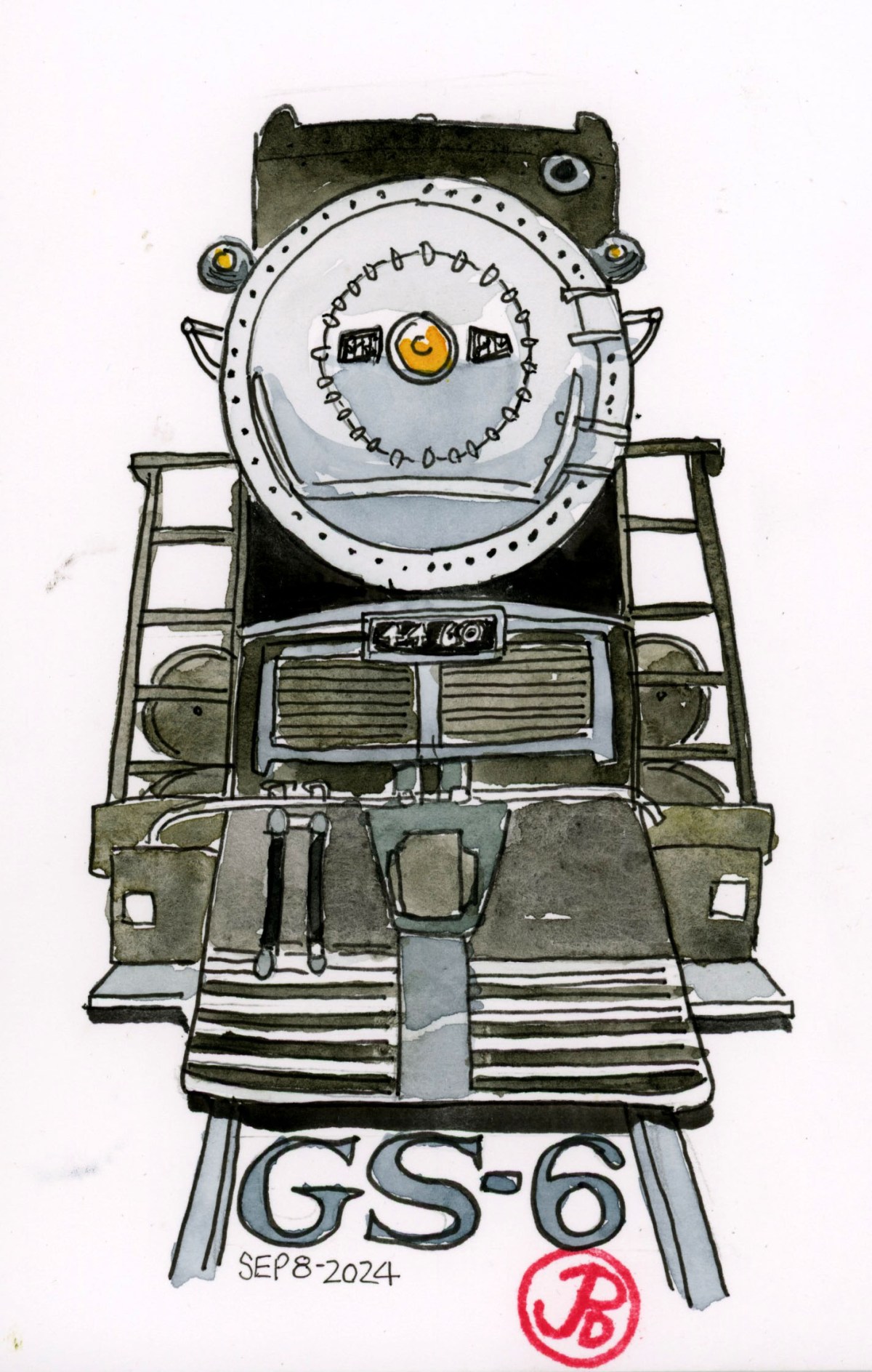
This 42 acre museum is in the St. Louis suburb of Kirkwood. Its collection of railroad history includes: Aerotrain No. 3, Big Boy No. 4006, Norfolk & Western Y-class No. 2156, UP Centennial No. 6944, the Silver Charger No. 9908, and the steam locomotive that I was really looking forward to seeing/ sketching: Southern Pacific’s GS-6 No. 4460 (featured sketch).

I also want to sketch the world’s tallest arch, the 630 foot Gateway Arch in St. Louis. I booked at ticket to take me up to the top to see the city of St. Louis and the mighty Mississippi River.

Illinois is known as the “Land of Lincoln” and the epicenter of Lincoln is the state capital of Springfield. It was here that Lincoln lived for 17 years before he left from the Great Western train station to become the 16th President of the United States. In Springfield are the station where he departed, his home, Presidential Museum and Library, and his tomb.

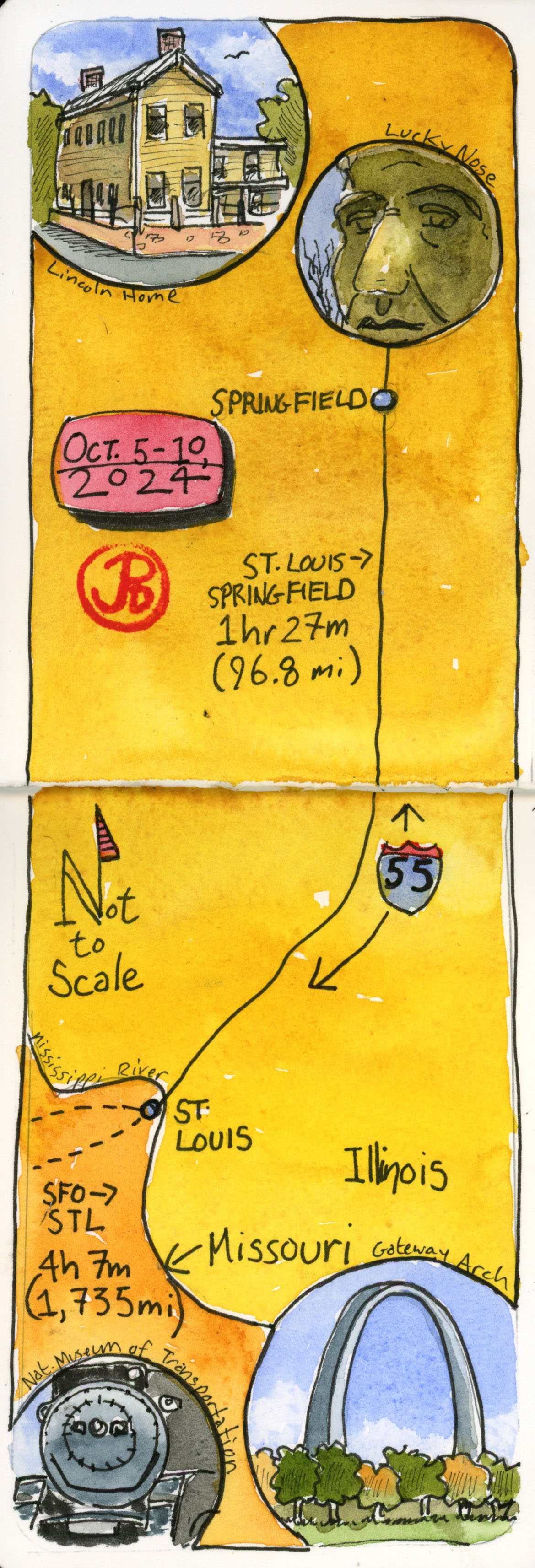
I had much to sketch and many miles to traverse on my short Midwestern jaunt so I drew it out as a map.

Before any trip I like to draw a map to help me visualize where I am going. I like to add travel times (St. Louis to Springfield: 1 hr 27 min) because it helps me plan my time deciding how much time to spend in either city. I’ve always been about seeing less while having quality time on the ground.

In circular inserts I illustrated four of my sketching targets: Lincoln’s house in Springfield, the Lincoln bust at his his tomb (visitors rub his nose for good luck), the National Museum of Transportation (featuring Southern Pacific’s No. 4460), and the Gateway Arch on the banks of the Mississippi in St. Louis.

Let’s go!

Image

Lincoln in the Land of Lincoln

Illinois is known as “The Land of Lincoln”, even though he was born in Kentucky. Lincoln cut his political teeth in Springfield, first as a lawyer and then governor and then later a Senator for the state of Illinois. In 1955, “The Land of Lincoln” became the official state motto.

There was one historical artifact that drew me to a corner of Lincoln Park to visit the Chicago History Museum.

On a past visit to Washington D. C., two highlights of my visit was Ford’s Theatre and the Lincoln memorial.

Ford’s Theatre was where Lincoln was assassinated on the night of April 14, 1865 by the actor John Wilkes Booth during a performance of Our American Cousin.

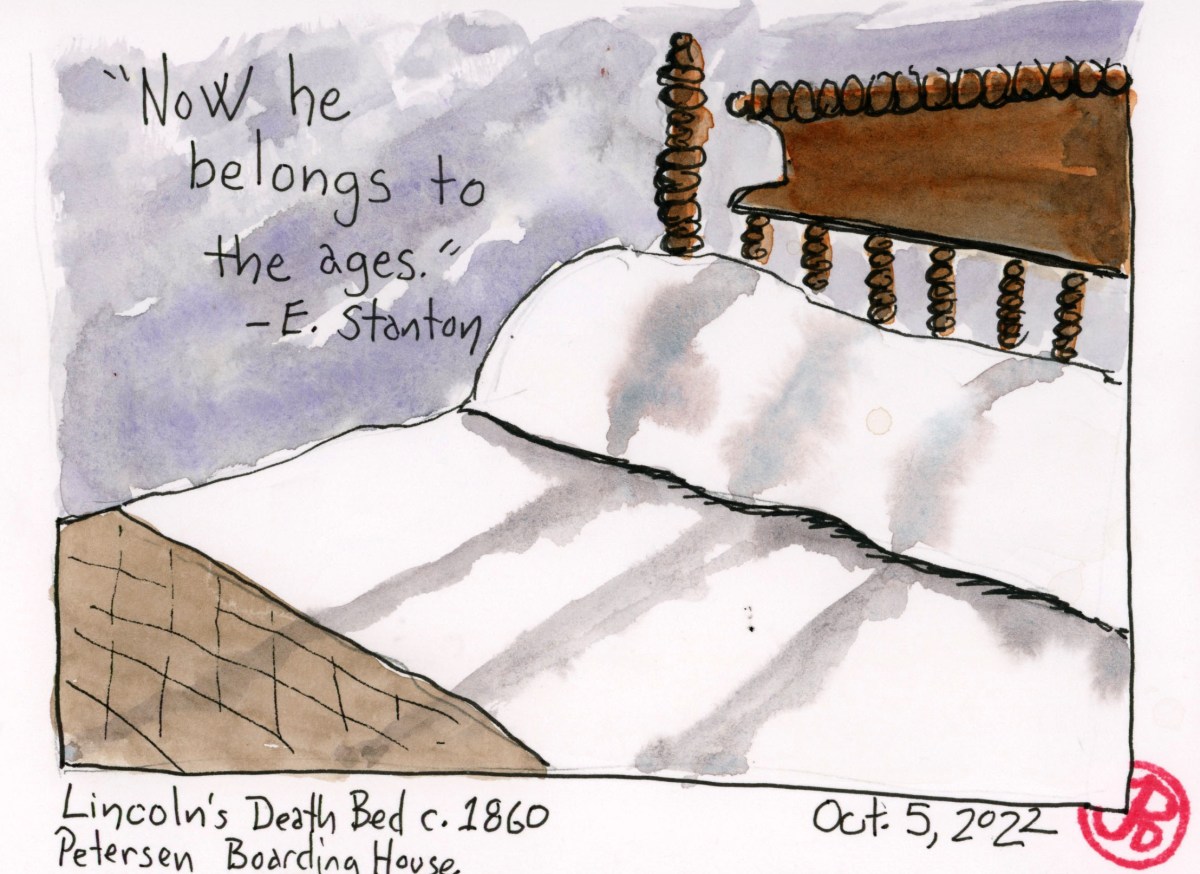
Lincoln was moved across the street to the Peterson Boarding House where the president was placed on a bed on the ground floor, towards the back of the house. Lincoln was too tall (he was 6 ft 4 in) for the small bed that he was laid at an angle, with his feet hanging off the end. He remained in a coma, never regaining consciousness.

Over 90 people came to pay their last respects to the President who had led the country through the Civil War. He died at 7:22 AM on April 15, 1865. Edwin Stanton, Lincoln’s Secretary of War, saluted Lincoln and said, “He now belongs to the ages.”

I had heard from a docent at the Peterson House, which is now a museum, that the bed on display was a replica and the real bed was in a museum in Chicago.

There is only one historical figure that has more books written about them than Abraham Lincoln and that is the son of god himself: Jesus Christ Superstar.

Now that is saying a lot about Lincoln’s impact to our country and his influence around the world.

But I was here to see and sketch a historic bed.

The “Standing” Lincoln statue in Lincoln Park.

In the same display was a life mask of Lincoln that captured the presidents features shortly before his death. I added this to my sketchbook.