Image

Scope Gull

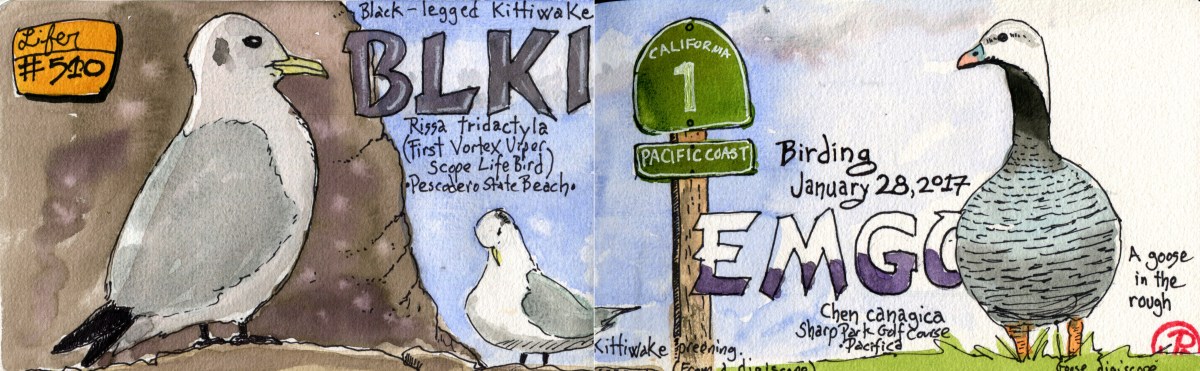
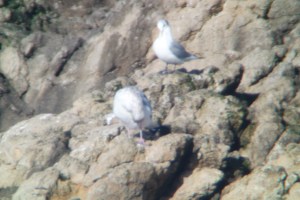
To the naked eye they are white specks on a rock. With binoculars you can discern the white front and grey back, the yellow beak (with maybe a smudge of red on the lower mandible) but the iris and orbital ring color are unknown at this distance. But with a scope the smaller gull,  just on the right, with a yellow bill, dark “earmuffs”, and black feet turns into North American Lifebird #510!

I set out on Saturday morning ,  heading south on Highway One with binos, scope, and tripod stowed in the back. My first detour of the day was in Pacifica to the Sharp Park Golf Course to check on the continuing emperor goose. A short walk south down the berm produced the rare goose, loosely feeding on the fairway with a group of Canada geese. Check.
Emperor

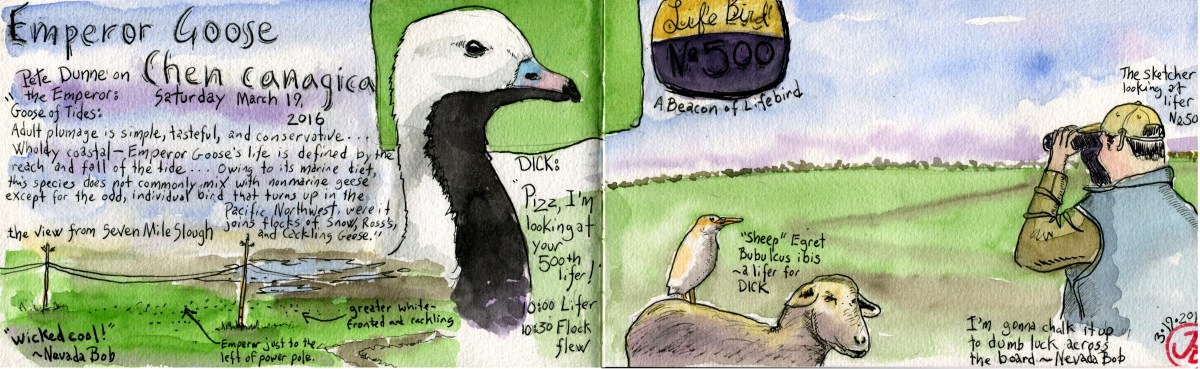
Journal page from the Emperor goose I saw at Seven Mile Slough, Lifebird #500. March 12, 2016.
dsc07316

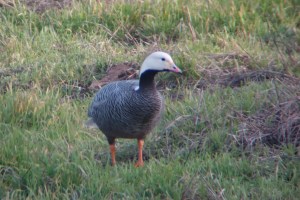
Digiscope shot of the goose in the rough, at Sharp Park Golf Course, January 29, 2017.

The next stop was Pillar Point Harbor to see if anything interesting had blown in. I checked the creekmouth and beaches for any interesting gulls with not much luck. I then returned to Highway One. My plan was to head to Pescadero to scope the rocks and sea to find something interesting.

On my way to Santa Cruz, I frequently stop here, scanning the rocks for one of my favorite rock dwellers, the black oystercatcher. Most times it’s banshee wail, issued as it flies, calls attention to this cryptic colored bird, especially when it tucks its bright orange-red bill into its feathers. I scoped the rocks from the Pescadero State Beach pockmarked parking lot.  I counted 11 oystercatchers among the gulls and pelicans.

I slowly picked through the gulls, noting the beautiful plumage of the Heerman’s gull that were preening near the brown pelicans. As I panned to the left I saw a small gull, one with dark earmuffs, that I had missed on my first pass. This gull was different. Through the scope I ticked off the details: black legs, earmuffs, yellow bill. This was my target bird: an adult black-legged kittiwake! Lifebird #510!
dsc07285

A not so wonderful digiscope photo of the preening kittiwake (the top gull).
Image

500! The Emperor!

As I headed out the door on The Quest for 500, the light rain that constitutes fog in San Francisco, was heavy, making visibility limited to a few blocks. I wondered how I was going to find a needle in the haystack, a single goose among thousands of other geese, in a thick blanket of fog.

As I headed north into Marin County, blue sky started to appear over Mt. Tam. I was on my way to pick up DICK and then we headed northeast on Highway 12, past the riverside town of Rio Vista to green fields, framed by a levee to pick through the thousands of greater white-fronted and cackling geese. Our prize was a pied-headed marine goose that usually forages through the tidal flats on the islands of the Bering Sea, where it breeds, and winters on the Aleutian Islands in Alaska. A few individuals wander south to Washington and Oregon and an even fewer number, the needles, head farther south into California. Since 1884 there have been only 38 accepted sightings in California. This was the quest for the Emperor goose.

We had a vague idea where the goose might be, other birders had whiffed on it earlier in the week and our best case scenario would be that we come upon a group of birders that already had the Emperor in their scopes and we check it off our lists. Once we turned off Highway 12 I was surprised to find only one Prius load of birders. It looked like we had to find this goose on our own.

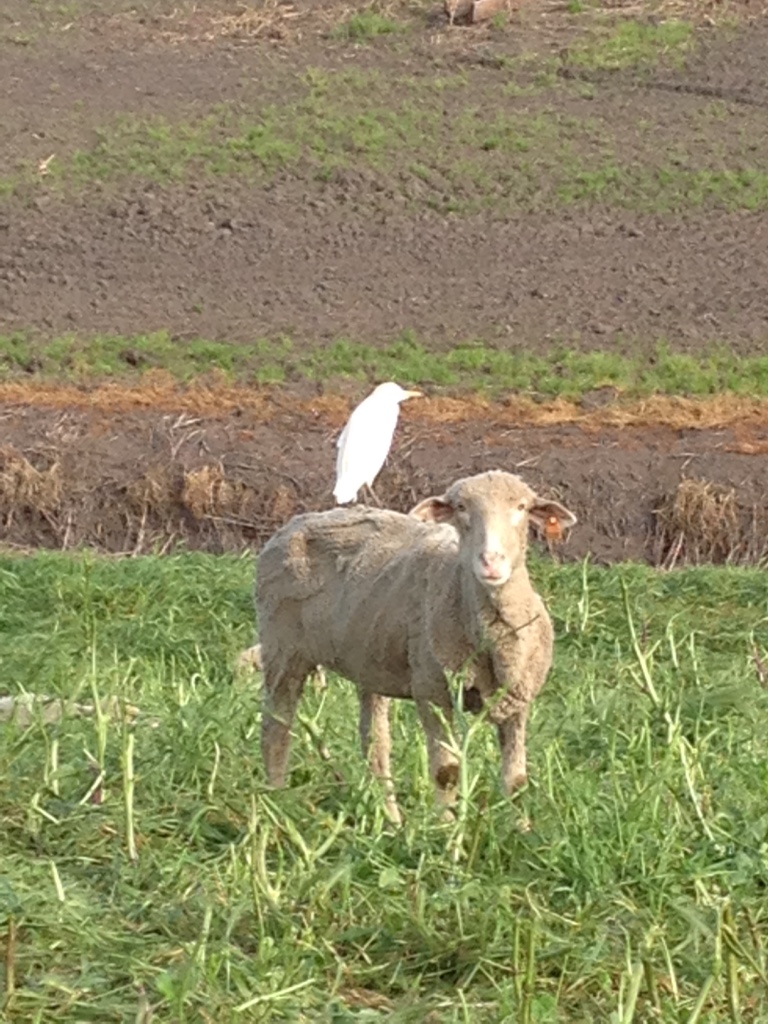
Over the vast green fields we could see little grouped specks as far as the eye could see. This was going to be a tough lifer.We turned right on the levee road, Seven Mile Slough to our left and the fields to our right. A herd of sheep grazing the hill appeared to the right. On one sheep was a “sheep” egret, a small white bird that associates with livestock. Lifer for DICK.

thumb_IMG_4141_1024

The “sheep” egret on its movable perch, otherwise known as cattle egret, Bubulicus ibis.

We stopped every time we saw a flock of foraging geese and scanned the groups for the beacon. No luck. We approached a turn in the road, leading back north towards Highway 12. We stopped and surveyed the vast mass of geese that were forging on either side of the power poles that bisected the field. They were close enough that we didn’t need a scope but there were a lot of geese to pick through. The tall green grass and the up and down feeding dance of the geese made our search even more difficult.

Five minutes into the search DICK said, “I’m looking at your 500th lifer!” I raised my glasses and looked at the flock of geese just to the left of the power pole. The Emperor raised it’s head like a beacon of light, standing out, an exclamation point that announced itself amid all the white-fronted and cackling geese. Life bird No. 500!

thumb_IMG_4151_1024

Corvidsketcher looking at life bird No. 500, Emperor goose, Chen canagica.

We were soon joined by another birder and his two dogs. Then another and another car stopped to see the goose. One couple, Nevada Bob and his wife, had left Nevada a 6 AM to see the Emperor. In all we we had great looks with the sun at our backs for about 30 minutes until something spooked the birds and the flock erupted into the air and the geese and the needle disappeared. The show was over.

Coda

Like the Emerpor’s unique head and neck, a contrast of black and white, light and dark, the experience was also mixed with pathos. Directly across the creased and pock-marked levee road  from where we found the Emperor was a handmade wooden cross with the name Tony Paul Ludricks painted across the top. I later learned that on May 24, 2015, a car veered off the levee road and into the slough. The 20 year old passenger was able to swim to safety but the driver was not so lucky. Tony was 16 years old.