When the North and the South met in the southern Pennsylvanian town of Gettysburg, many in the town fled. People left their homes, farmers abandoned their fields, and the others took the last train out of town. At the time of the battle, Gettysburg had a population of 2,300.
The armies co-opted buildings, farm fields, orchards, and roads for their own uses. General Lee set up his headquarters northwest of town in a house.
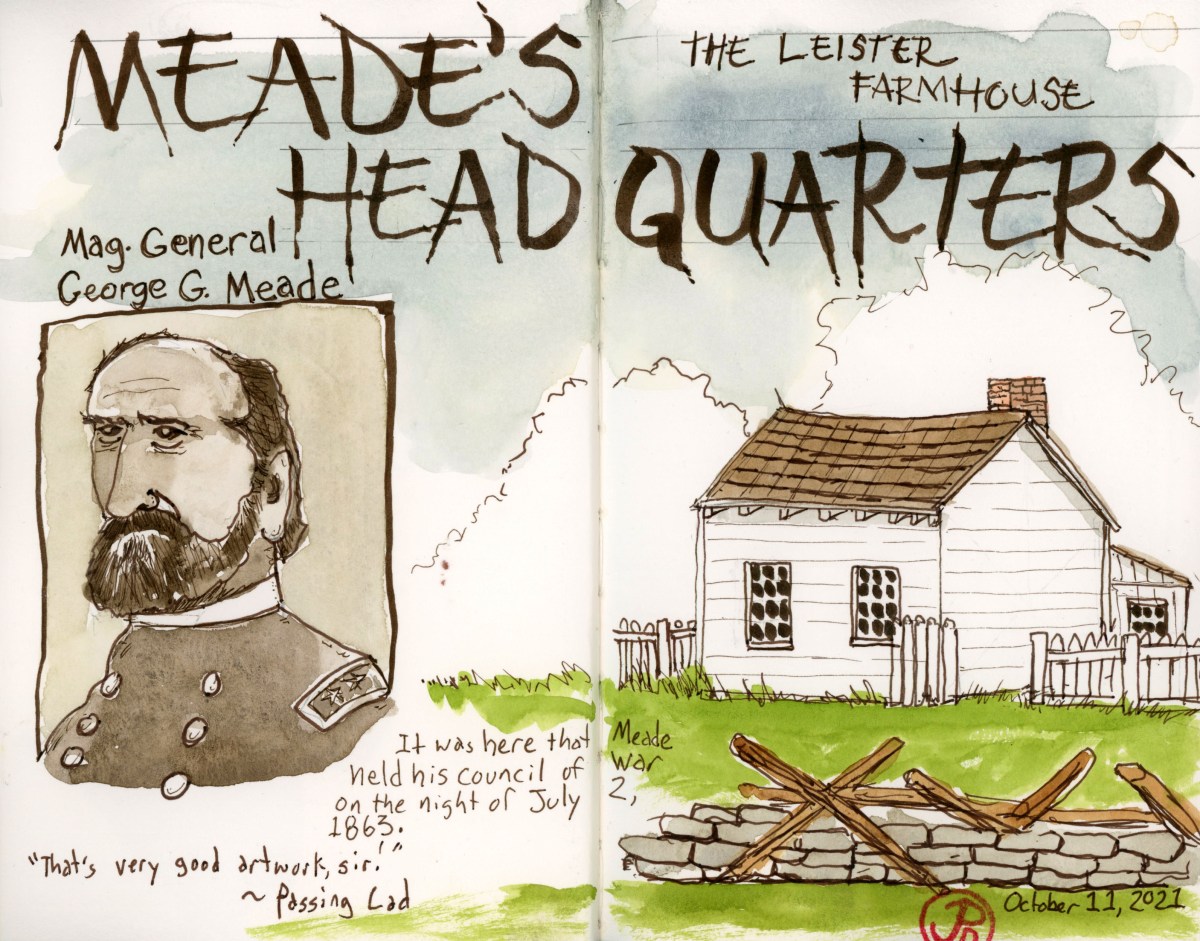
In Gettysburg, east of Cemetery Ridge, General Meade’s headquarters was set up in a small, two room farmhouse. The farmhouse on Taneytown Road, belonged to the Leister family. The widow Lydia Leister and her children had left their home before the battle. The house was perfectly situated behind the center of the Union line on Cemetery Ridge.
Perhaps the house was a little too close to the line because it was damaged during the Confederate artillery assault that preceded Pickett’s Charge.
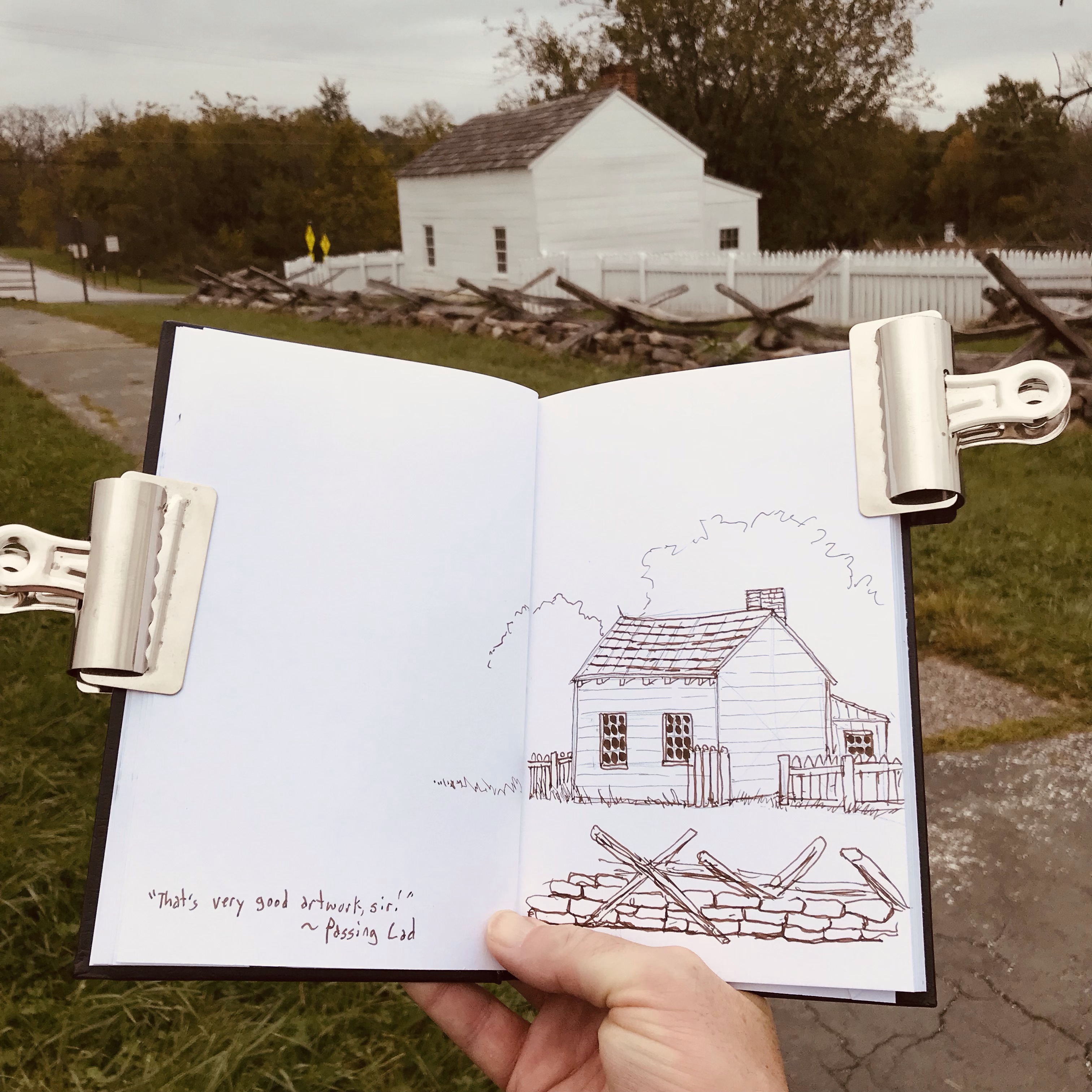
Working on a field sketch at Gettysburg of General Meade’s headquarters. While I was working on the sketch, a group of high schoolers passed by and one commented, “That’s very good artwork, sir.” I thanked the lad and added his comment to the sketch.
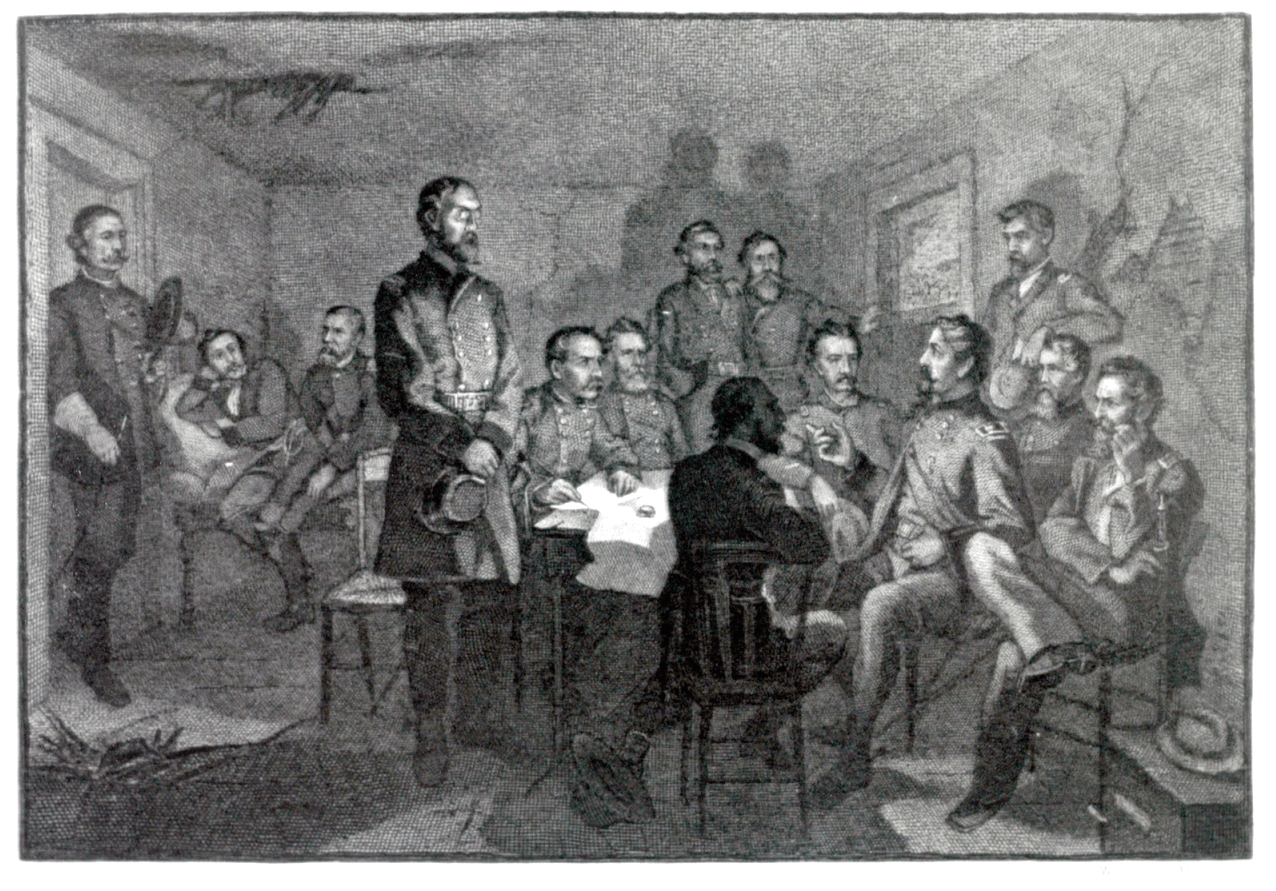
When you see the house today, it is amazing to note that the building is very small. It is even harder to imagine the Meade’s “council of generals” that occurred here in the cramped front room on the evening of July 2, 1863. The room was filled with twelve Union generals. This perhaps was one of the most important meetings of generals, in the entire Civil War because the Union was on the cusp of the turning point of the war but they one more battle to fight, on the last day of fighting on July 3 at Gettysburg.
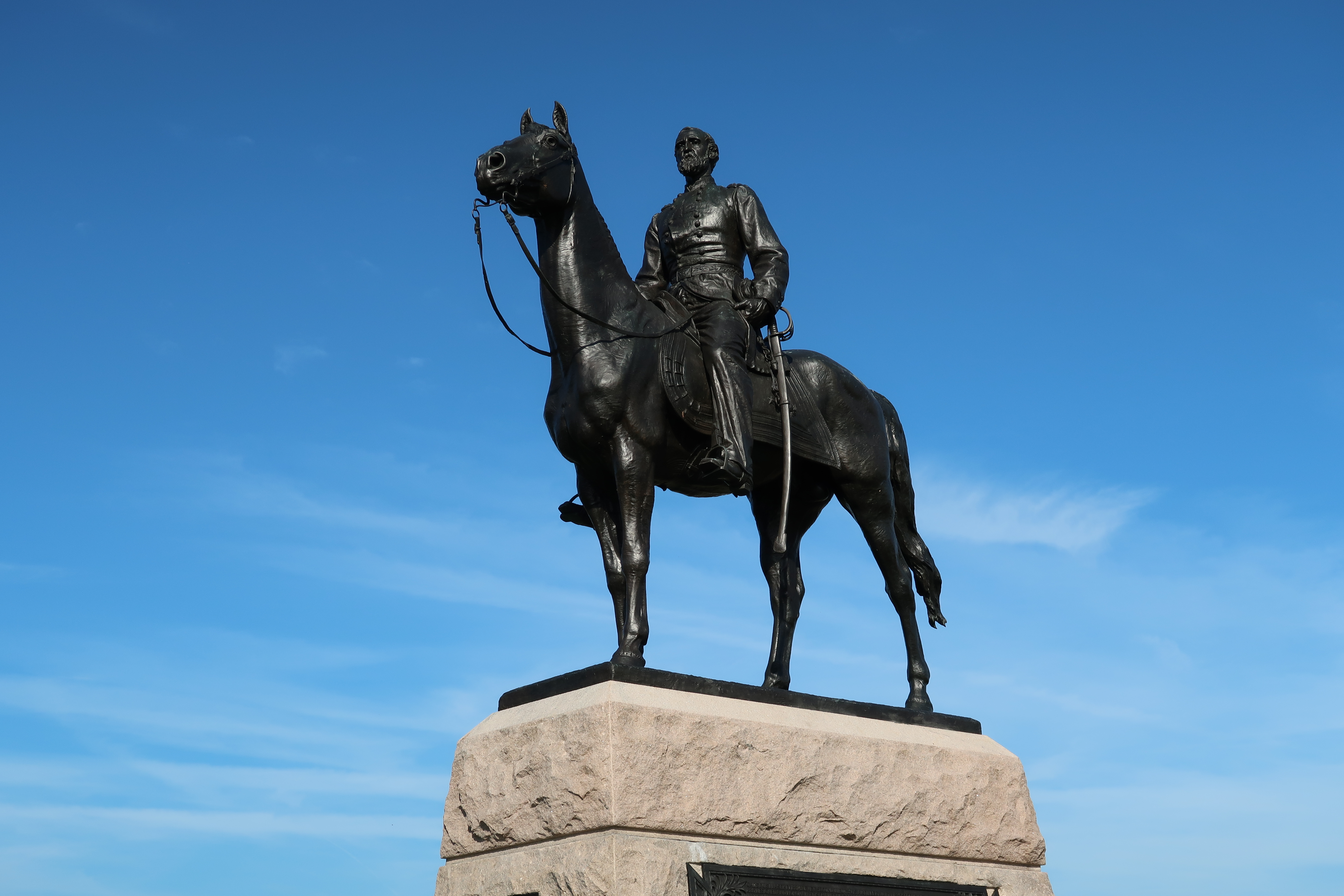
James Kelly’s illustration of the meeting of generals in the cramped front room of General Meade’s Headquarters. General Meade is stand near the table with his hat in hand.The monument to General George Meade, Commander of the Army of the Potomac. Meade was a native of Pennsylvania, so he was defending his home turf. This bronze statue is just west of his headquarters, facing the assault known as Pickett’s Charge.
When Lydia Leister returned to her farm house after the battle, she found it damaged and there were seventeen dead horses in her yard. Her orchard was destroyed and her horse and cow were gone. She was never really compensated by the government for the damage incurred. This is the sort collateral damage of war that we don’t often hear about in history. The people, the civilians, who suffered because a general chose their town as a desirable place to make a stand and fight.
Amazingly enough, there was only one civilian causualty during the Battle of Gettysburg. On July 3, Jennie Wade was baking bread in her sister’s house on Baltimore Street when a Confederate’s sniper round passed through two doors and hit Wade in the back. She had been baking bread for Union troops.
On July 3, 1863, the last day of the Battle of Gettysburg, General Lee put a massive force on a frontal assault, across open ground, towards the Union’s line on Cemetery Ridge. This was to be the decisive battle of the campaign. And it’s outcome would dictate the future direction of the Civil War.
The assault first started at 1:00 PM with a massive artillery bombardment towards the Union line. Some 150 Confederate cannons tenderized the heart of the Union position. With all the cannon fire came a lot of smoke, which made aiming at your intended target problematic. Many rebel shells overshot their target, hence the shells that struck General Meade’s headquarters, which was further east from the heart of the Union line, but apparently not further east enough. The artillery assault did not break or severely weaken the Union center but Lee proceeded with the second part of this plan, the infantry charge.
A stature of Confederate General Robert E. Lee on his horse Traveller, tops the Virginia Monument. This was the first and largest of the Confederate monuments at Gettysburg. It is perhaps one of the few statues of Lee still remaining and one of the very few north of the Mason-Dixon Line. The statue is located close to the location where Pickett’s Charge started and where Lee observed the battle.
At about 3:00 PM, the assault, which came to be known as Pickett’s Charge, began. The 6,000 Union troops positioned on Cemetery Ridge saw a line of Confederate soldiers appear out of the woods a mile away. The line was almost a mile in length. Pickett’s Charge had begun.
Field sketching from the location of the start of Pickett’s Charge looking towards Cemetery Ridge and the “Copse of Trees” which was the destination of the charge. Getting an early start at Gettysburg has it’s advantages, I had the place to myself.
General George Pickett was another interesting figure in the Civil War. His classmates at West Point referred to him as the “goat”. Today that term, when applied to elite athletes, means “Greatest Of All Time” but in Pickett’s time it referred to his academic performance; he was last in his 1846 class at West Point. Pickett cut his teeth during the Mexican War fighting with many of the men he was now fighting against. While the charge now bears his name, Pickett was one of three commanders that led the charge. The charge could have bore any name of those behind it “Longstreet” or “Lee” but for whatever reason, it has gone down in history as “Pickett’s Charge”.
The 12,500 Confederate troops moved over the open ground towards the Emmitsburg Road. They were now open targets for the Union infantry and artillery that waited for them. Union artillery started to blow holes in the rebel line but the charge still moved on as holes in their advancing line was plugged by soldiers marching behind.
One of the Confederate commanders under Pickett was General Lewis Armistead. His story exemplifies the irony of the Civil War as brother fought brother and friend fought friend. Armistead was leading his men to attack one of his dear friends from his US Army days: Major General Winifred Scott Hancock.
Both men became friends while serving in California. In 1861, Armistead resigned from the US Army to join the Confederate Army (Armistead was a native of North Carolina). Hancock’s wife held a going away party for the men who where leaving to fight for the Southern cause and this was the last time that Armistead and Hancock spent together. Before he left, Armistead gave Mrs. Hancock his prayer book. Who know what was going through Armistead’s mind as he advanced toward this good friend with murderous intent. Could he really raise his sword against his friend?
The Confederates continued to move west toward Cemetery Ridge and as they moved closer, their losses grew higher. Still they advanced, filling in the holes caused by death and injury with men at the back. Still they marched towards the Copse of Trees.
A quick field sketch of the part of the Union line on Cemetery Ridge known as the “Bloody Angle”.
The south concentrated there attack on the stone wall the turned in at a 90 degree angle. This location became known as “The Angle” or the “Bloody Angle”. Armistead led his men, his hat on sword point towards The Angle.
The Confederates reached what is know was the High Water Mark, on Cemetery Ridge. The High Water Mark is the farthest the Southern Army ever advanced into the north and it is where they where stopped, dead in their tracks, literally. This was the climax of the Confederate offensive, after this point, the South would be on the defensive for the remainder of the war.
The memorial marker at the spot where General Lewis Armistead fell at the High Water Mark on Cemetery Ridge.
Armistead reached a Union cannon after jumping over the small stone wall that formed The Angle. Armistead and this men were surrounded by Union troops and they were fired upon at point-blank range. The general was mortally wounded and he died without ever seeing his friend Hancock, who was also injured in the battle but he survived his wounds.
Pickett’s Charge had run out of steam and they soon where retreating back to the west. In this failed charge, 6,000 confederate soldiers were killed, wounded, or captured. Half of Pickett’s division was gone. When General Lee saw Pickett, he ordered him to reassemble his division to cover the retreat. General Pickett replied, “General, I have no division.”


 Corvid Sketcher