I headed to San Francisco’s Golden Gate Park to sketch’s some sculptures on a Sunday afternoon.
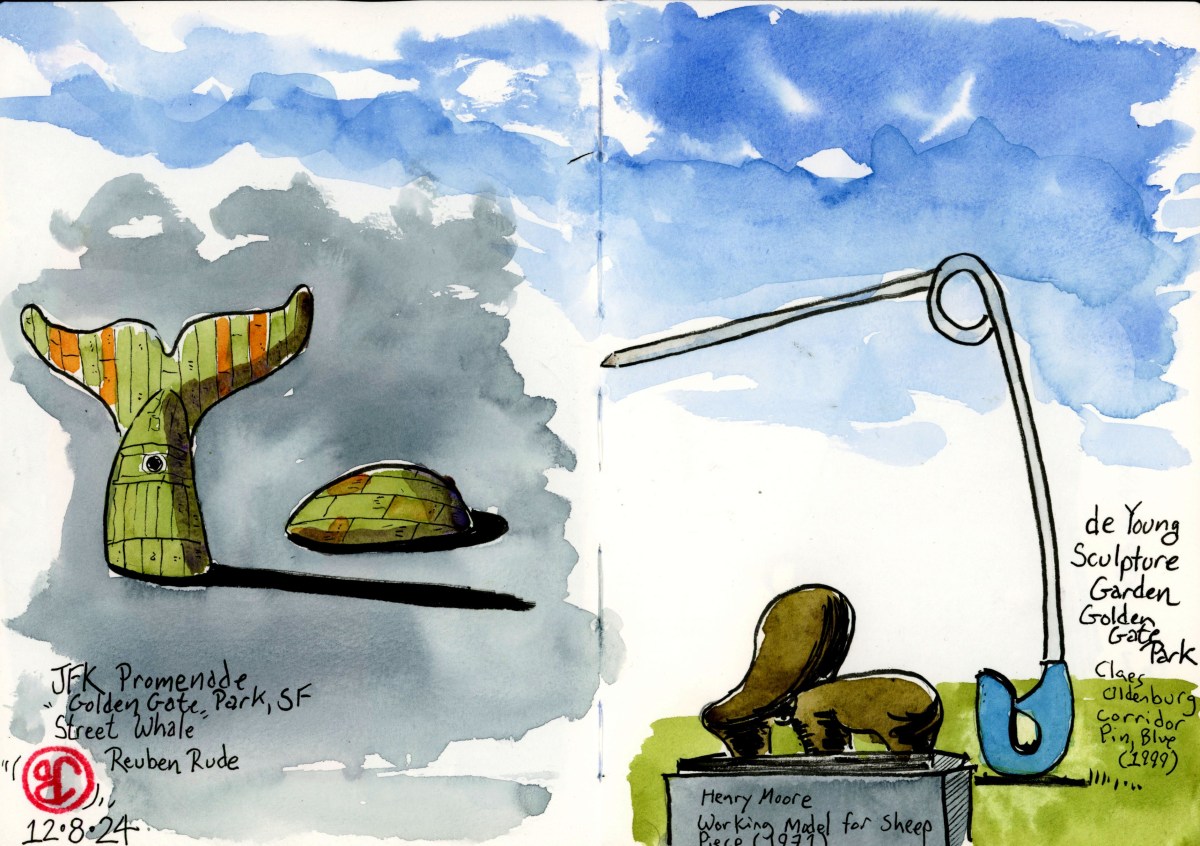
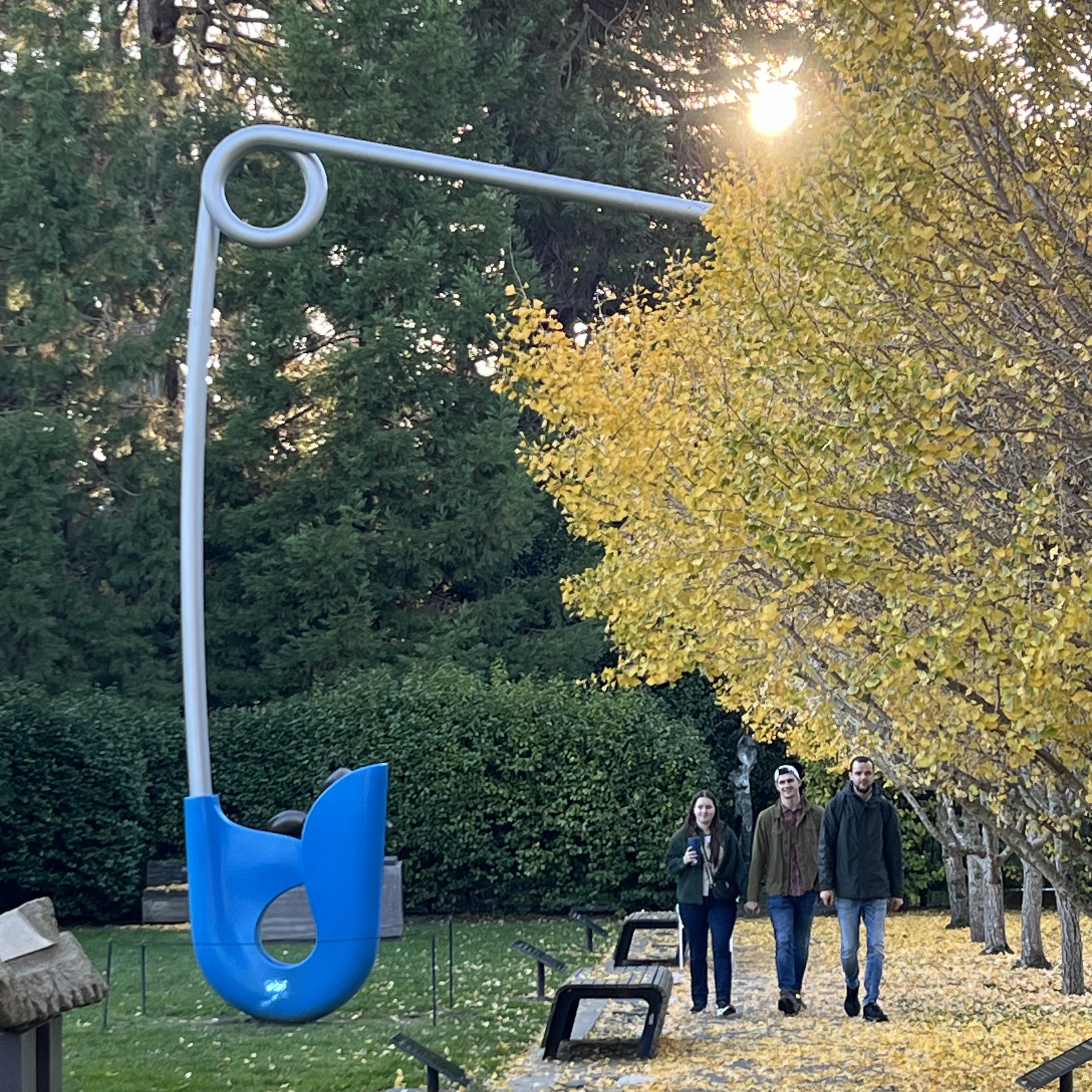
My first destination was the sculpture garden at the de Young Museum. I was going to do a twofer sketch from my sketching bench perspective.
The two pieces that I added to my sketchbook were the 21 foot tall Corridor Pin, Blue (1999) by Claes Oldenburg and in the foreground, Henry Moore’s Working Model for Sheep Piece (1971).
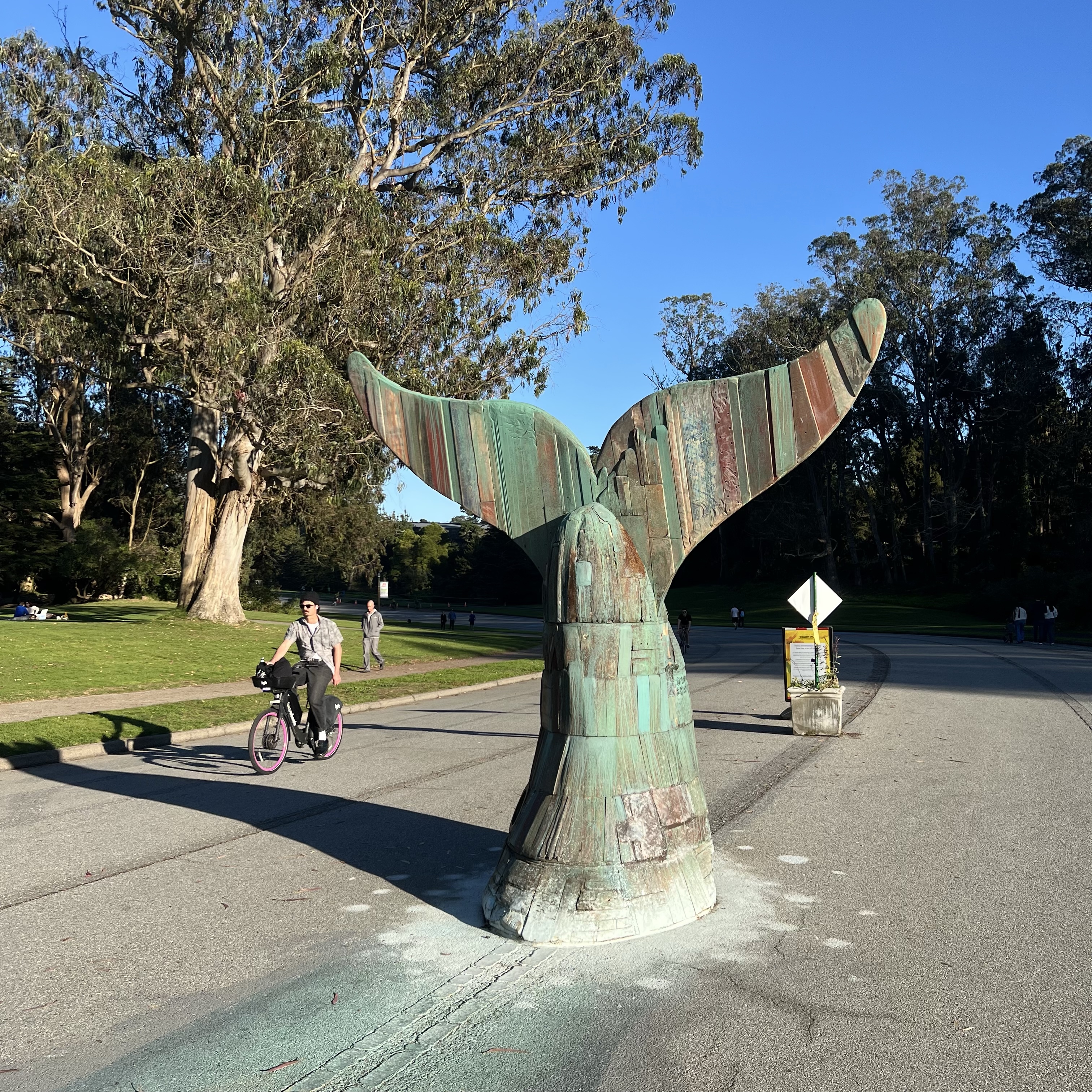
My next piece of public art was to found along The Golden Mile Project along the JFK Promenade just to the north of the de Young Museum.
This roadway in the park has been closed to auto traffic and the road surface is painted with 12 murals produce by a group called Paint the Void.
Near the Rose Garden a life sized wooden humpback whale tail breached the roadway. This piece is called Street Whale. I perched on a bike rack and sketched the piece on the left side of my spread.
I recently found an interesting connection between a Norwegian Polar explorer, an Oslo maritime museum, and Golden Gate Park in San Francisco.
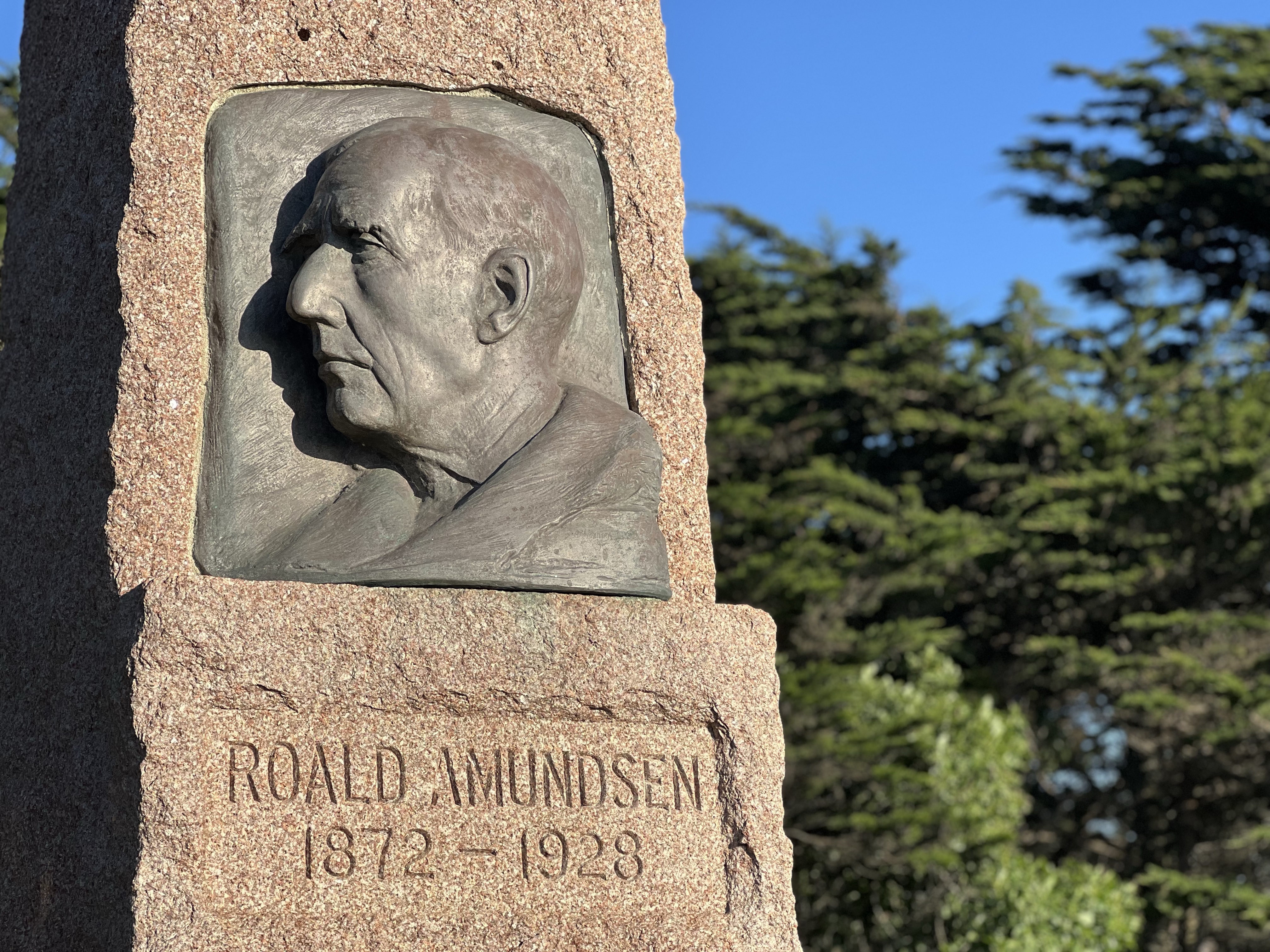
The Norwegian explorer was Roald Amundsen.
The plaque under the monument reads:
Roald Amundsen, the Norwegian polar explorer, was the first to locate the magnetic North Pole and to navigate the Northwest Passage, the Arctic water route from the Atlantic to the Pacific. He left Norway with a crew of six on June 16, 1903 in a 69-foot-long converted herring boat named Gjoa. Amundsen spent three years on the perilous journey. The Gjoa continued on, sailing through the Bering Straits and anchored off Point Bonita, outside the Golden Gate, on October 19, 1906. The San Francisco Norwegian community purchased the Gjoa from Amundsen and donated the ship to the people of San Francisco in 1909. In 1911, Amundsen became the first explorer to reach the South Pole. The Gjoaremained on this site at the western end of Golden Gate Park until 1972, when it was returned to Norway. The restored ship is now on display at the Maritime Museum in Oslo.
The Amundsen monument is a bauta, or stone shaft, or Norwegian granite which was donated by Bay Area Norwegians, March 1, 1930.
I headed west to the end of Golden Gate Park to do an afterwork sketch of the monument that sits in the parking lot just north of the Beach Chalet.
I look forward to sketching the ship that was once on display near this location, it’s bow facing the Pacific Ocean. The Gjoa is now on display at the Fram Museum in Oslo.
The Gjoa was at the western edge of Golden Gate Park until 1970. The elements took their toll on the static Polar ship and rot and vandalism tarnished this once proud and pioneering ship. She was donated to Norway and headed back to her homeland.
A sketch from a c1910 postcard view from Ocean Beach looking east towards the Gjoa and the Dutch Windmill. While the Gjoa is gone, the windmill remains.
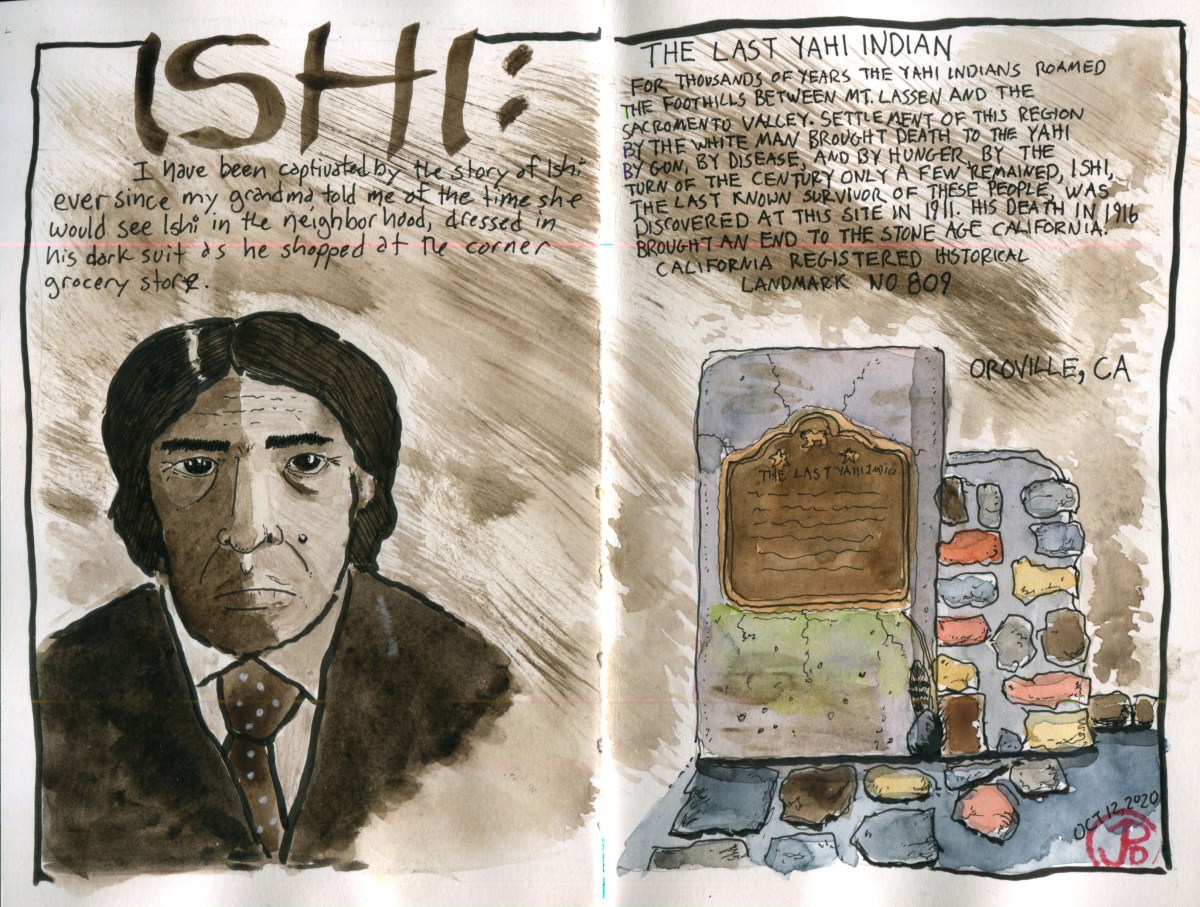
On this Indigenous People’s Day I visited a historical marker to one of the most well known indigenous person in California.
I remember the stories my grandma told me of the man in a suit that she would see in the local corner grocery store in the the inner Sunset neighborhood in San Francisco. He was different but covered in the threads of the times. Although she had seen him as a child, the story she told me in her later years showed what an impression that experience had made on her.
This was the man named “Ishi”, the last surviving member of the Yahi People. And I was going to the point of his intersection with the modern western world.
How did he come to live in San Francisco? It began on an August evening at about 7:30 in eastern Oroville.
On August 29, 1911, Ishi collided with he western world when he was captured near Charles Ward’s Slaughterhouse (note the irony) in Oroville, California. He was captured and put into the Oroville jail (supposedly for his own protection) when the first photograph of him was taken of.
Ishi’s people, the Yahi, had been diminished by attacks by other native tribes and by white settlers who came to California to seek their fortunes in the Gold Rush. His small family group died out and he wandered down from the foothills, tired and dehydrated, to look for food when he was captured.
Ishi at the Oroville jail.
In September, Ishi made his way to San Francisco where he stayed at the University of California Museum of Anthropology at Parnassus and was studied by an anthropologist named Alfred Kroeber. Kroeber learned from Ishi about his culture and language (no living person spoke his language). His voice was recorded as he talked, sang, and told stories.
One favorite story is about the time that Ishi was riding in a car through Golden Gate Park and he made the driver stop the car as he spotted California quail by the side of the road, a bird Ishi would have been very familiar with. Today, there is only one quail remaining in Golden Gate Park, a lone male, which local birders have named “Ishi”.
Ishi’s contact with the modern world proved to be his downfall. He was often sick with western diseases. He died on March 25, 1916 of tuberculosis.
The area where Ishi was found is now a quiet residential neighborhood on a quiet street. The slaughterhouse in gone and the area has been built up with residential, single family houses. The calls of the northern flicker, California quail, and the acorn woodpecker may be the only things recognizable from 1911. At least to Ishi.
Now there is a historical marker, the genesis behind it’s creation was a high school teacher and his son, who wondered why there was not a historical marker about the last of the Yahi: Ishi. And because of their efforts, there now is California Registered Historical Landmark No. 809.
Looking at this marker now, I reflect on our complicated interactions with the native people of California. It is often a tragic story but also with bits of light and wonder. Like the time a little girl saw the man from Parnassus in the local store. A story she would tell, many, many years later to her grandson.
On today’s walk I headed north to Golden Gate Park. My intent was to go to the Bison Paddock in the wild western portion near the Chain of Lakes and do some bison sketching.
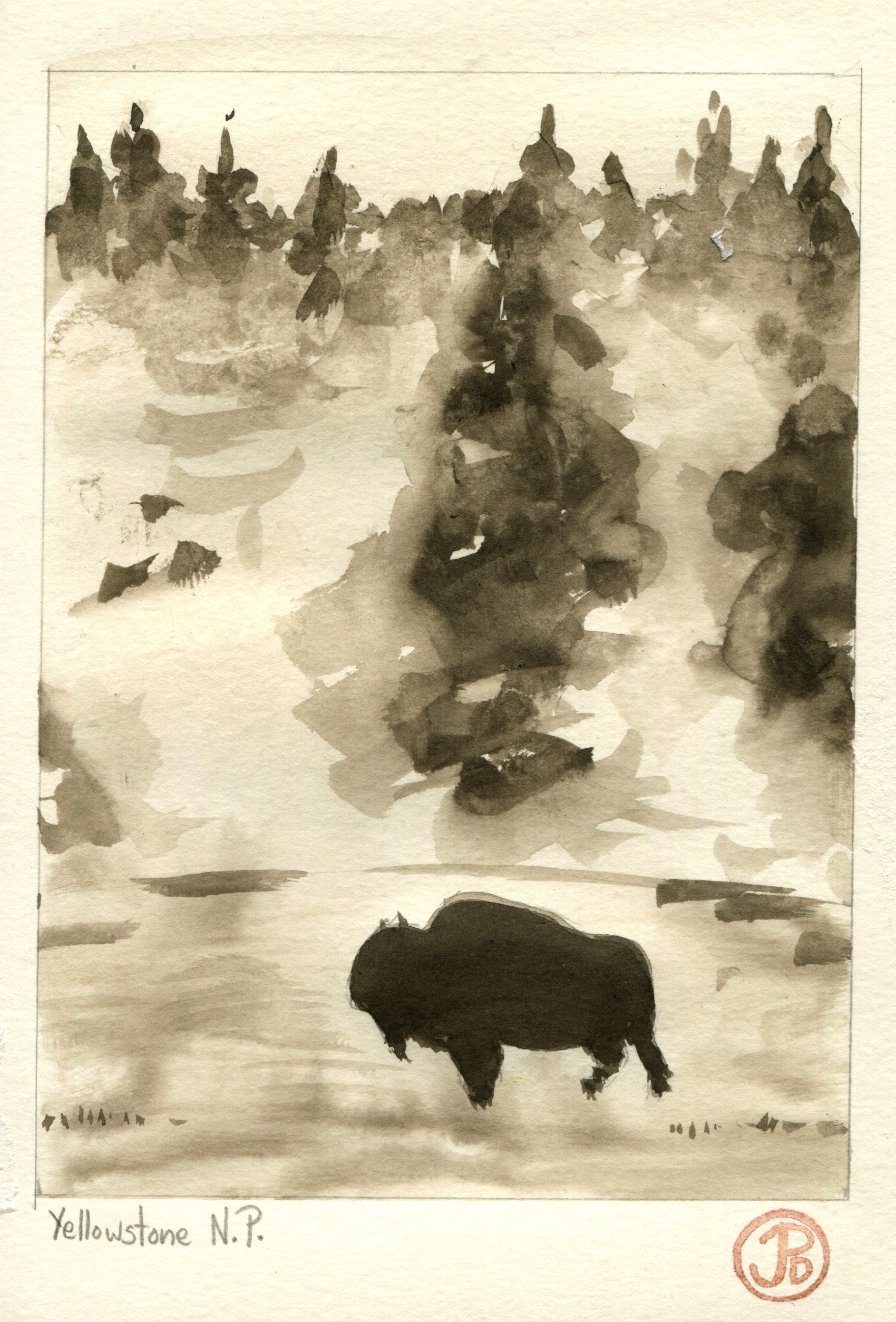
Bison are good subjects because well, they just sit there allowing you some time to get a sketch in. They are certainly better subjects to sketch than say, a Wilson’s warbler, a hyperactive bird that is a challenge even to photograph well. I had practiced sketching American bison in the wild, on a fall trip to Yellowstone National Park in 2017.
This is a sketch from a photo of my October 2017 trip to American’s oldest National Park!
The goal I set for myself was to loosen up my sketches and apply some of the things I have learned in a book I am currently reading, Felix Scheinberger’s excellent: Urban Watercolor Sketching. He advises “less is more” when it comes to watercolor painting and I also take this to mean the economy of the sketch itself. I’m not sure if I succeeded but every sketch can be considered a success because you learn something with each one. And sometimes you learn what not to do!
I picked my spot near the fence and making sure I was at least 12 feet away from any other park visitors (The Bison Paddock is a very popular spot) and I started to sketch a lounging bison. I started using a Micron sepia PN, not using any underlying pencil sketch! I then laid in some color, making sure to leave parts of the sketch unpainted (featured sketch).
An overenthusiastic art lover walked over and would have stood above me breathing into my left ear had I not halted his progress by proclaiming, “I’m practicing social distancing!” He stopped and admired the sketch from a distance.
A bison wandered by, grazing as it went along. I couldn’t let this happen without getting another sketch in! This time I challenged myself to do a continuous line sketch. This means that I sketched the bison without lifting my pen (although the rules of continuous sketching say you can lift your pen for a rest but you have to return to the exact point where you left off). This type of sketching is good practice for loosening up your lines and injecting improvisation into your sketching life.
A continuous line sketch of a bison. To get to other parts of the sketch you have to retrace lines you have already drawn. This is such a freeing way to draw!
On a recent field trip we took 90 fourth graders to the California Academy of Sciences in San Francisco’s Golden Gate Park. I had come here myself when I was in elementary school, back then it was known as the Steinhart Aquarium. The museum was completely rebuilt in 2008 and bears little resemblance to the museum of my youth.
When the museum reopened, which is about a 45 minute walk from my dwellings, I bought a membership and visited some of the 46 million specimens on display many times. I had since let my membership lapse, but on our recent field trip I thought I would take advantage of the teacher’s discount and reconstitute my membership.
So the week after our field trip, after work, I headed to Cal Academy and bought a teacher’s membership. This museum is a wonderful resource for the natural world and I came prepared with my sketchers kit.
At mid-afternoon, after all the school groups had departed, it seemed that I had the museum to myself. I took advantage of this time and did five quick sketches.
I started by sketching an African penguin. This bird is also referred to as the Jackass penguin, a name that makes fourth graders blush and laugh at the same time, but refers to their braying call. These penguins were easy to sketch as they were roosting on their rocks and posing for me. (Well that statement was very anthropomorphic of me!)
I then headed up to one of the best features of the new building ( well it’s just over ten years old), the living roof. I did a quick sketch with Sutro Tower in the background.
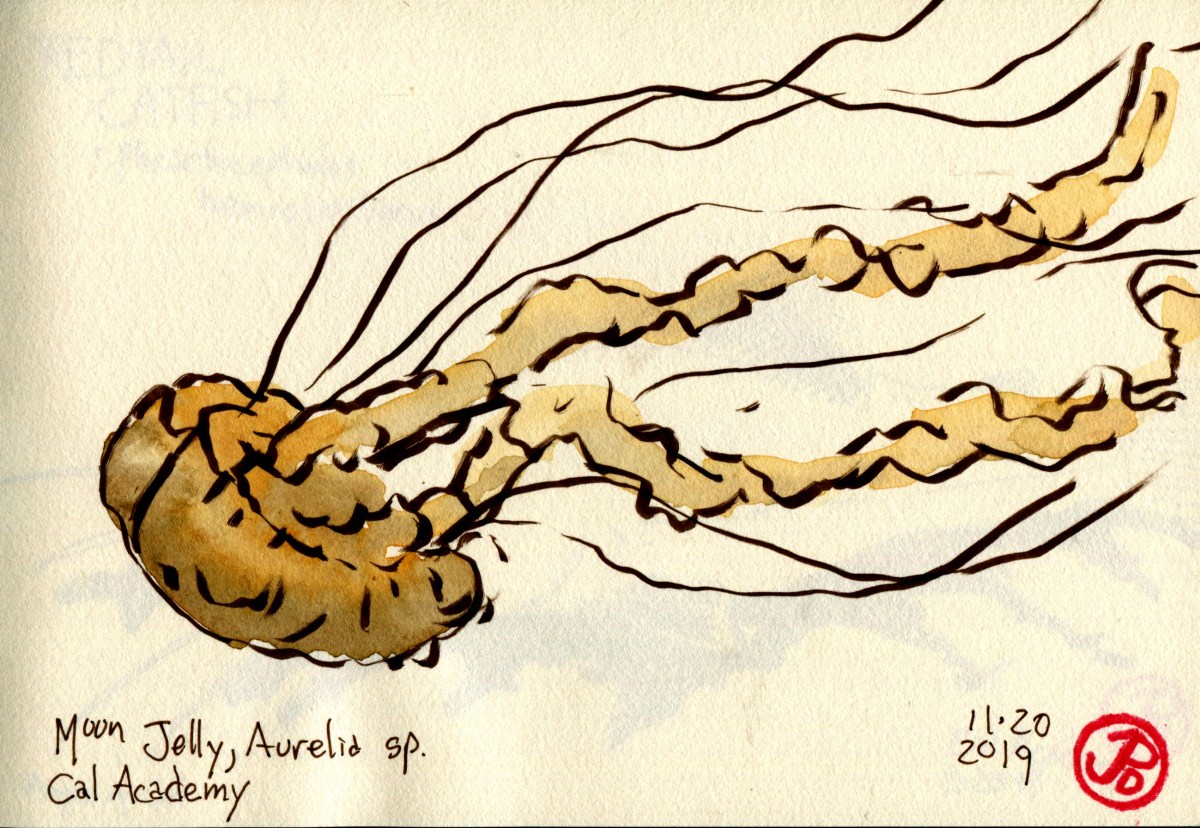
I then headed into the basement where the aquarium is located. Here I sketched a massive but stationary red-tailed catfish(all sketched in pen) in the drowned Amazonian flooded forest tank. I had a grand time sketching a moon jelly with my sepia brush pen, all without a underlying pencil drawing (featured sketch).
On the way out I passed under the Tyrannosaurus rex skeleton at the entrance. When I was a kid I remember an allosaurus skeleton in a similar place. I liked this little reach back to the past and I sat on a bench for a final sketch. Sketching the entire skeleton with the museum soon to close for the day seemed a daunting task so I just sketched the skull.
I look forward to many more visits and more sketchbook pages filled with knowledge and life!
There’s nothing like discovering amazing birds in your own backyard and my “backyard” is Golden Gate Park. And seeing four owls, in the daylight, is even better.
Traditionally great horned owls have nested in the crook of a pine across the street from the Bison Paddock. This nesting tree, and the owlets in, it have featured in a few sketches in the past.
A sketch of the same nest but with different owlets on January 19, 2015.
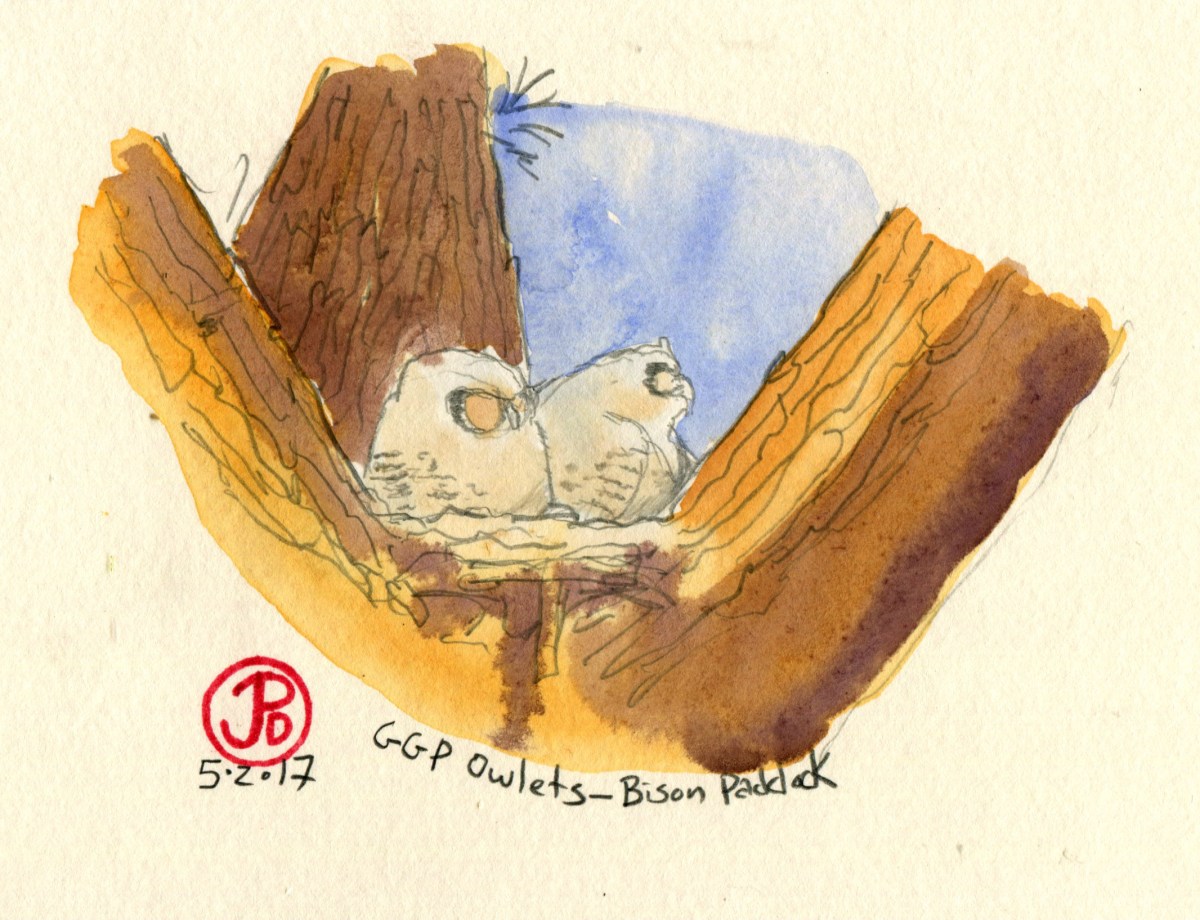
So on a very warm May afternoon, I headed out to the park with my scope, paints, and sketch book. I focused my scope on two owlets in the crook of the pine. Another owlet was branching out and perched on a limb above the nest.
The owls seemed to be nesting a little late in this year, perhaps because of our record Northern Californian rainfall had something to do with the timing. Great horned owls don’t build their own nests, instead they might reuse hawk or crow nests or use caves or crooks in trees as was the case with the paddock owls.
A pre-painting sketch of the great horned owlets.
Which sketching, I was entertained by a black phoebe that would fly in to a puddle on the jogging path, collect some mud in it’s beak and fly off towards the paddock to continue work on it’s mud-cupped nest.
A Golden Gate Park owlet thinking about branching out. Note the whitewash on the rim of the nest. It’s a sure sign of owl activity.









 Corvid Sketcher
