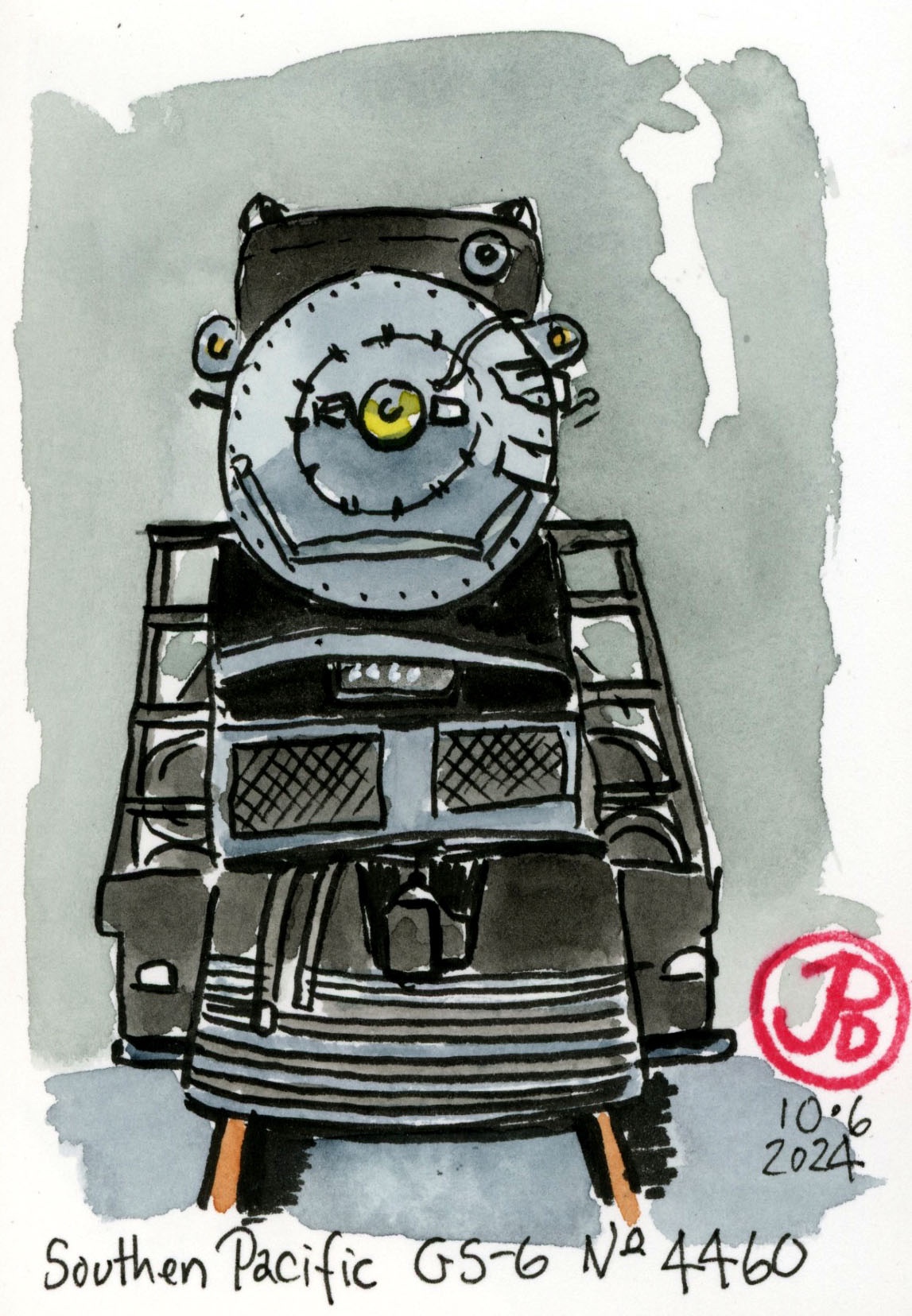
I had to journey to the very edge of the 42 acres of the National Museum of Transportation to see the number one locomotive on my museum sketch list. (Ironically it the first locomotive I saw driving in from Barrett’s Station Road.)
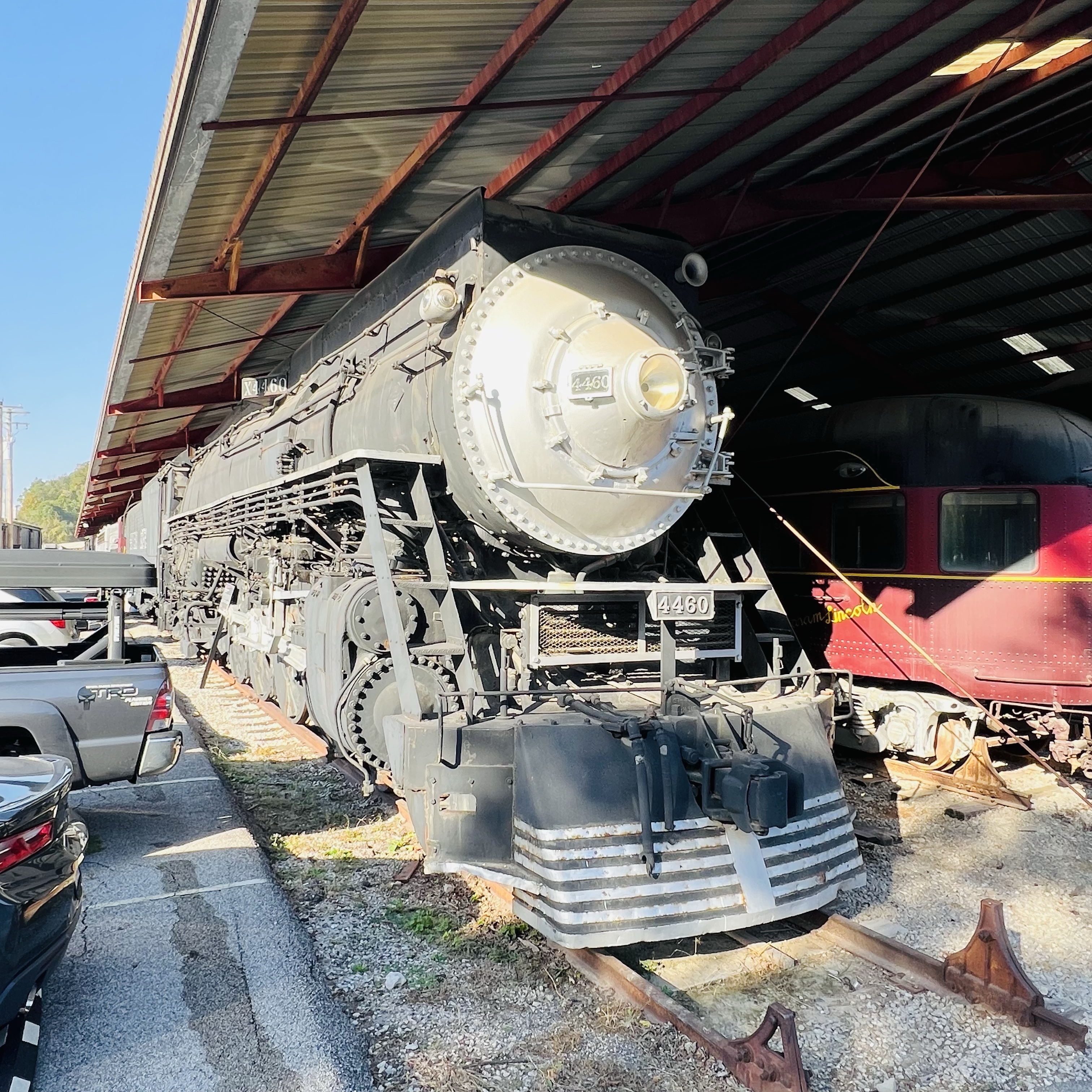
The Northern type 4-8-4 GS-6 (only ten were built) was in the far corner of the engine shed bordered by the employee parking lot. This was an unfortunate and sad location to display one of only two of Southern Pacific’s “Golden State” or “General Service” locomotives in existence.
Another name for 4460 is the “Forgotten Daylight” because it gets far less attention than her famous relative, GS-4 No. 4449. It’s placement in the corner of the engine shed, hemmed in by parked cars at the museum, gives a new meaning to the “Forgotten Daylight”.
No. 4460 with employee’s cars preventing you from getting a nice broadside view of the running gear.
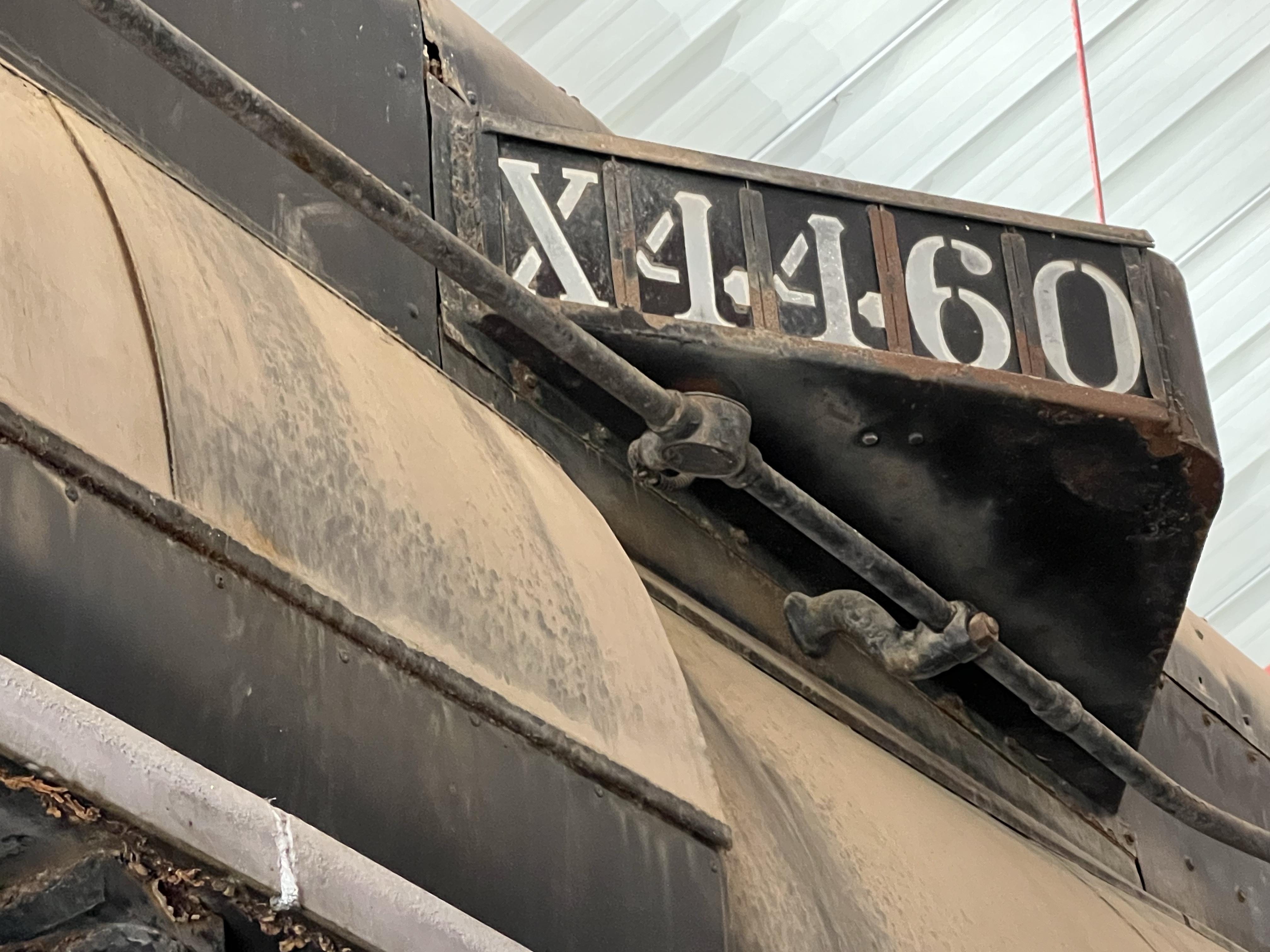
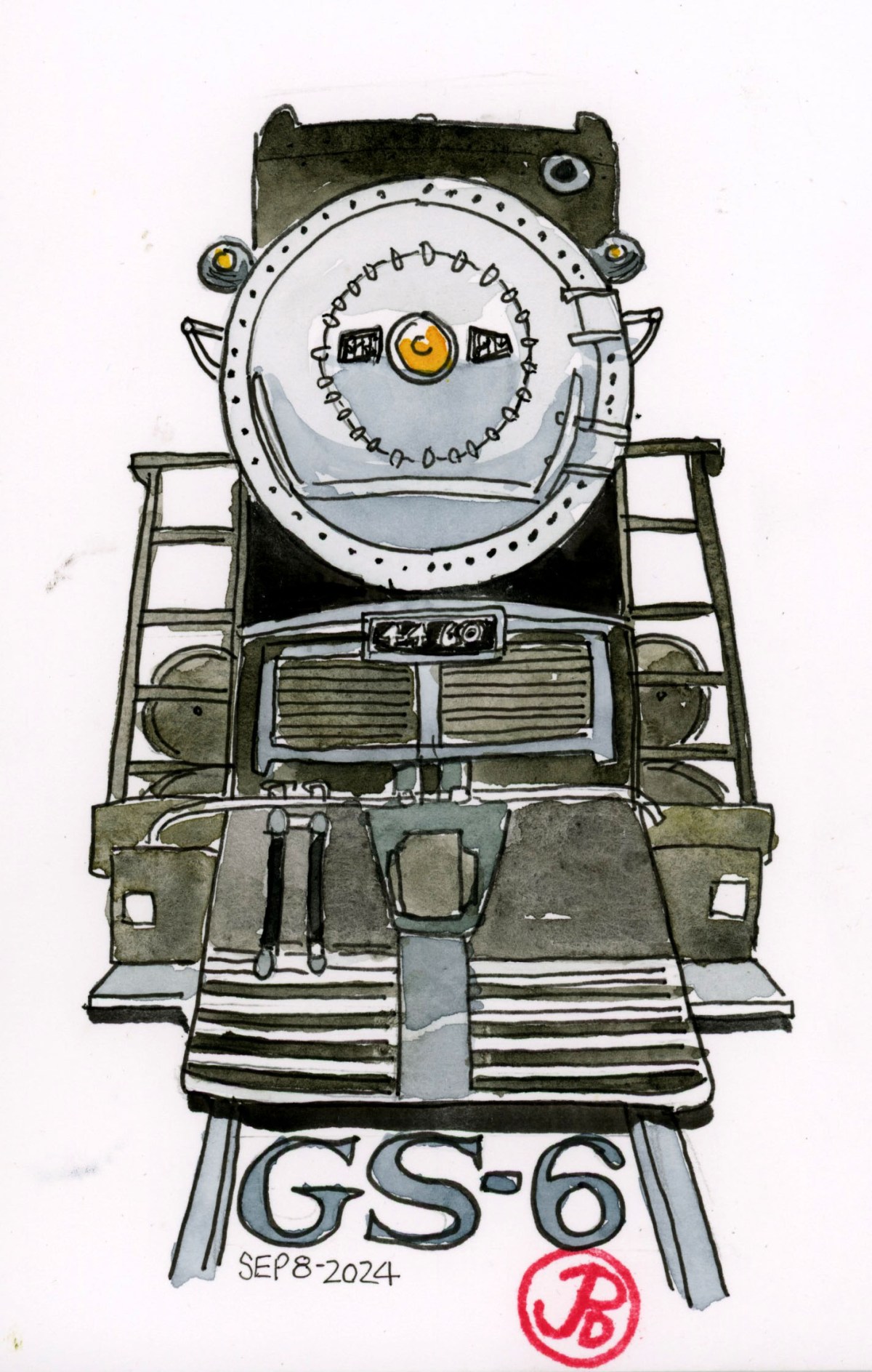
The “War Baby” was built in 1943 by Lima and had to work within the limits of the War Production Board. The side skirting of the previous GSs was removed and the locomotive lacked the mars light of the GS-4, resembling the GS-2s. 4460 was the first GS-6 built at the Lima Locomotive Works in Lima Ohio. These locomotives could be used for passenger and freight trains.
4460 is the last steam locomotive operated by the Southern Pacific. In October 1958 the last run of an SP steam locomotive was between Sacramento and Sparks, Nevada over the famous Donner Pass. This was on a Goodbye to Steam excursion. 4460 ran to Sparks and then back to Sacramento, unassisted.
The iconic GS-6 was not scrapped like so many other steam locomotives but was donated to the Museum of Transportation in April of 1959.
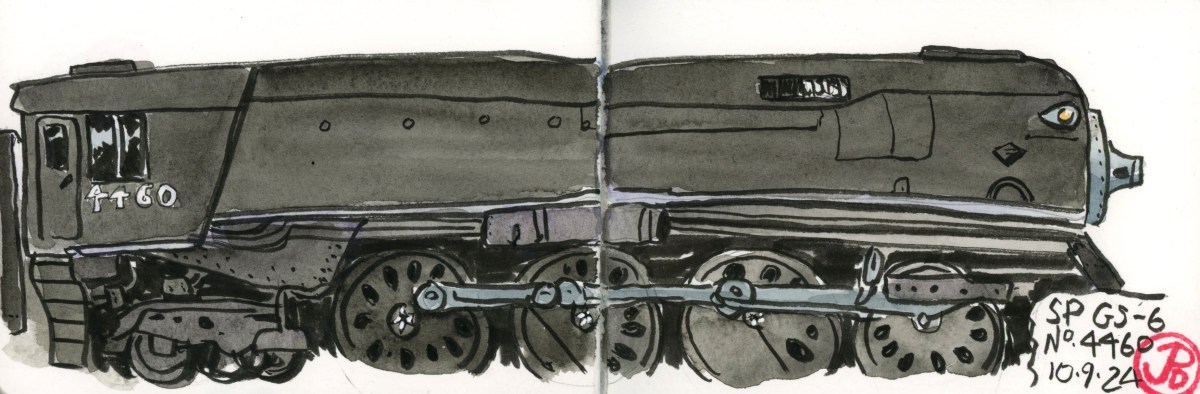
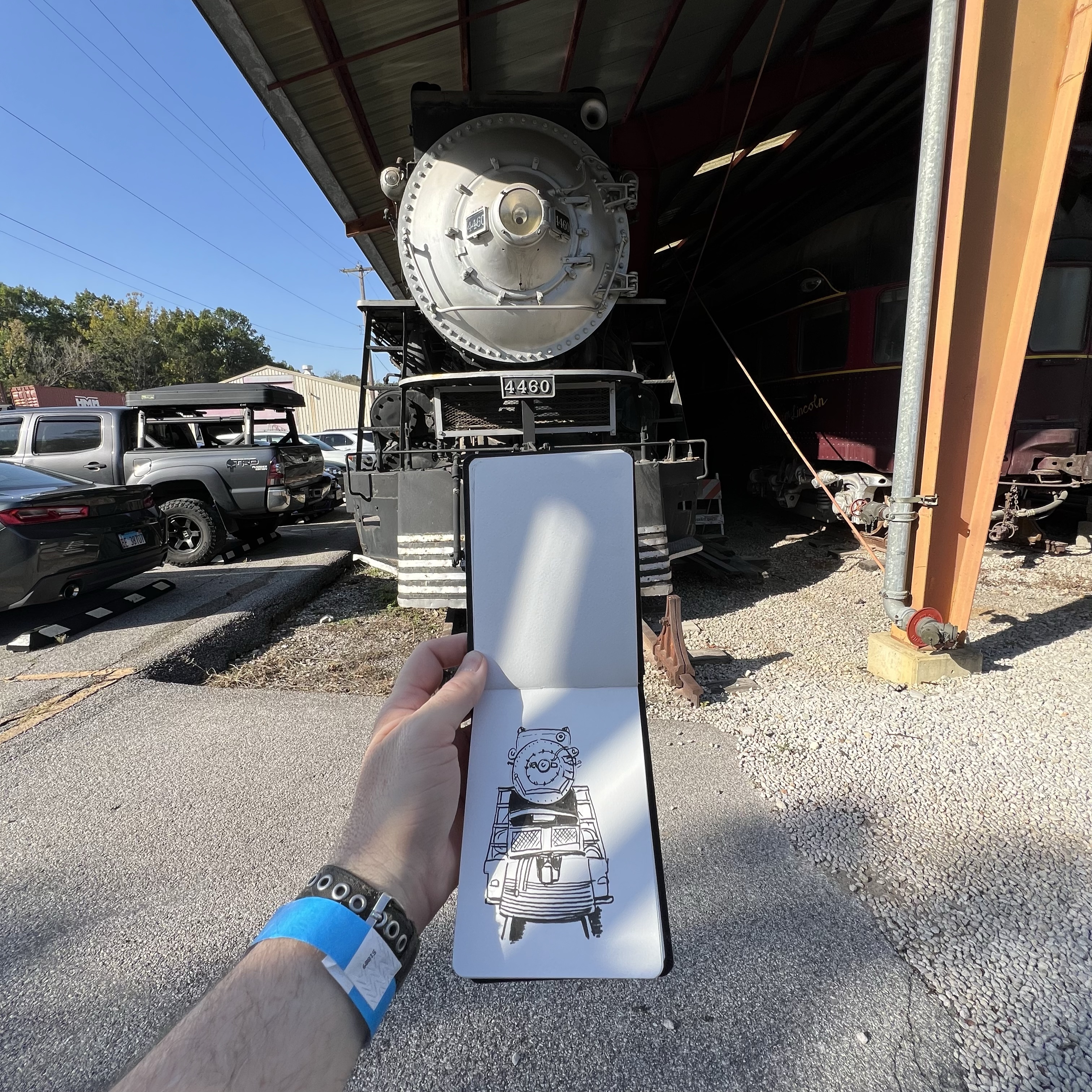
Sketch in progress at the NMOT. This was in my “point and shoot” Hahnemuhle 100% cotton sketchbook.The finished field sketch with watercolor.
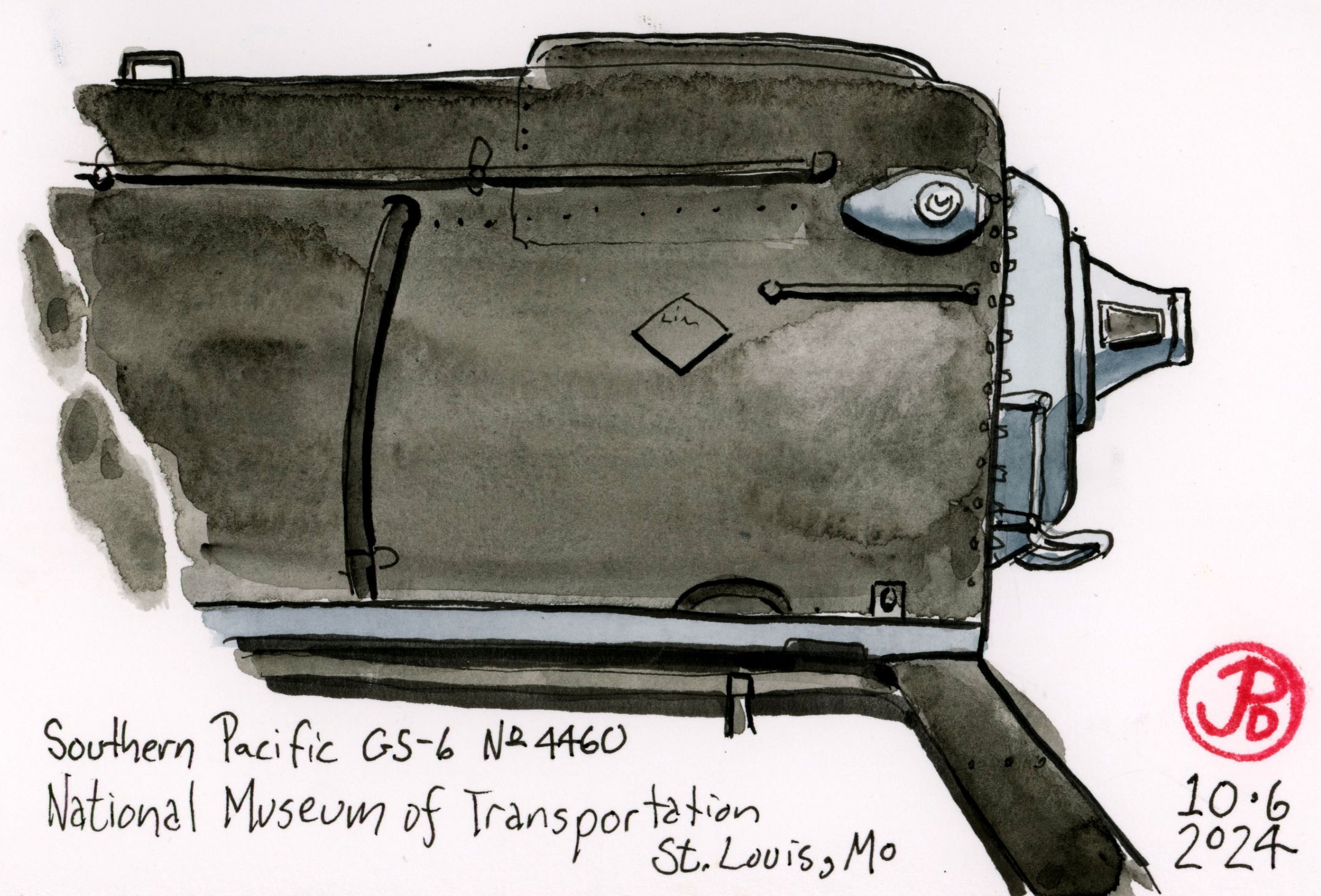
I also sketched 4460 in profile, focusing in on its classy smoke box and headlight.
Before any great or small journey I do some presketching.
On my October Fall break I planned to visit two midwestern states: Missouri and Illinois. I had been to Illinois before but only to Chicago. Now I planned to visit it’s capital, Springfield. And Missouri, Gateway to the West, would be a first visit for me.
My starting point would be St. Louis, Missouri. I had a few sites, destinations, and sketches on my list, chief among them was the National Museum of Transportation.
This 42 acre museum is in the St. Louis suburb of Kirkwood. Its collection of railroad history includes: Aerotrain No. 3, Big Boy No. 4006, Norfolk & Western Y-class No. 2156, UP Centennial No. 6944, the Silver Charger No. 9908, and the steam locomotive that I was really looking forward to seeing/ sketching: Southern Pacific’s GS-6 No. 4460 (featured sketch).
I also want to sketch the world’s tallest arch, the 630 foot Gateway Arch in St. Louis. I booked at ticket to take me up to the top to see the city of St. Louis and the mighty Mississippi River.
Illinois is known as the “Land of Lincoln” and the epicenter of Lincoln is the state capital of Springfield. It was here that Lincoln lived for 17 years before he left from the Great Western train station to become the 16th President of the United States. In Springfield are the station where he departed, his home, Presidential Museum and Library, and his tomb.
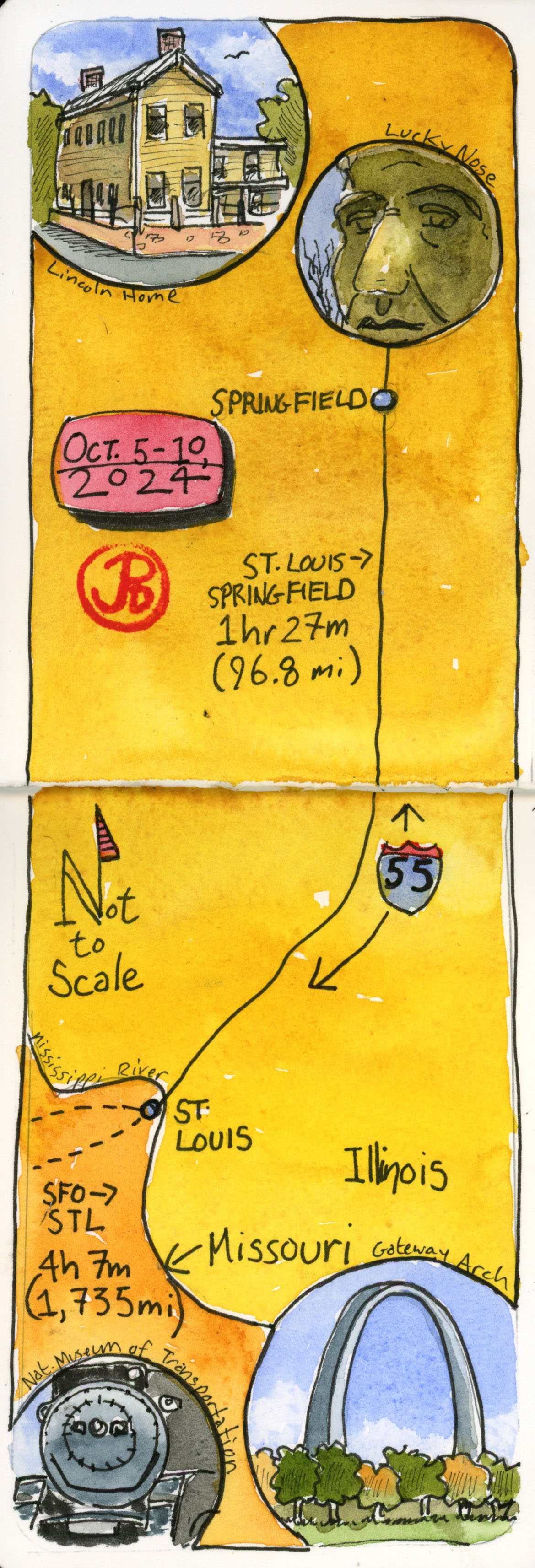
I had much to sketch and many miles to traverse on my short Midwestern jaunt so I drew it out as a map.
Before any trip I like to draw a map to help me visualize where I am going. I like to add travel times (St. Louis to Springfield: 1 hr 27 min) because it helps me plan my time deciding how much time to spend in either city. I’ve always been about seeing less while having quality time on the ground.
In circular inserts I illustrated four of my sketching targets: Lincoln’s house in Springfield, the Lincoln bust at his his tomb (visitors rub his nose for good luck), the National Museum of Transportation (featuring Southern Pacific’s No. 4460), and the Gateway Arch on the banks of the Mississippi in St. Louis.
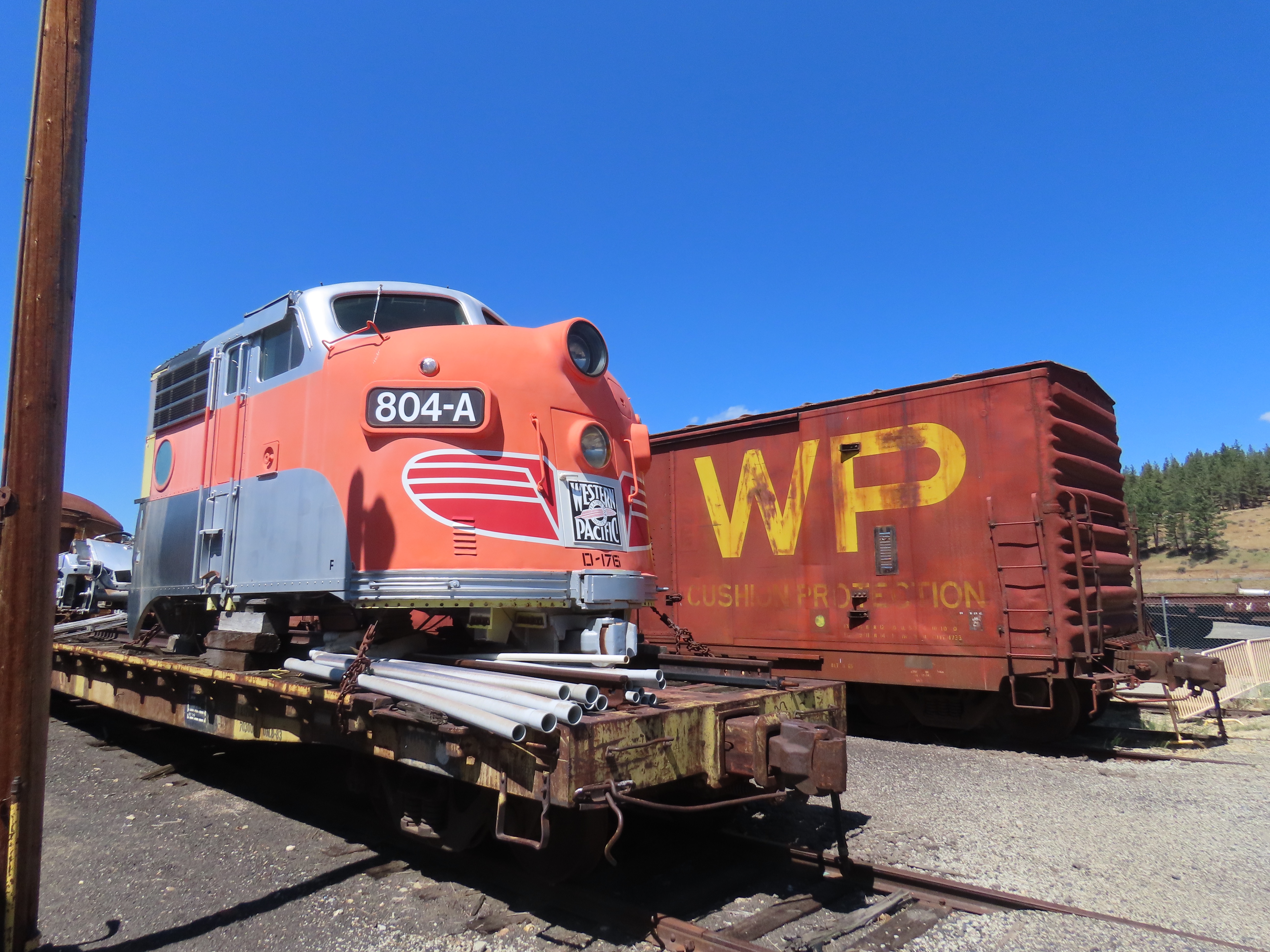
At the Western Pacific Railroad Museum, there are many pieces of railroad equipment: locomotives, cabooses, rolling stock, and maintenance equipment.
It has been said that this railroad museum has the greatest amount of equipment from a single railroad family: Western Pacific (WP).
There is lots to explore at the WPRM and you are free to wander around the yard and look at the diesels and rolling stock. I was in search of an FP7 mock up of WP No. 804-A that was used to pull the California Zephyr. The mockup was just of the cab section and it was on display at Disney’s California Adventure park.
While looking for the cab I came upon an old tender that had the faded WP logo on its side. It was a six axle tender so it must have been attached to a substantially sized steam locomotive.
The mysterious tender.
I thought perhaps that this tender once belonged to the largest locomotive that WP owned and operated the 2-8-8-2 mallet or perhaps a 4-6-6-4 Challenger. The railroad owned 27 mallets, some of which operated up and down the Feather River Route. Sadly all 27 mallets were scrapped as the age of diesels took hold. Was this tender a last relic of the mighty mallets of the WP?
Turns out the answer was much more exciting!
I found out from one of the volunteers that the tender belonged to a GS-6, No. 484. These Northern type 4-8-4s were some of the best passenger locomotives ever made for the Southern Pacific.
The GS originally stood for Golden State and the streamlined locomotives were on point of one of the most beautiful passenger trains, the Coast Daylight. The train took passengers from San Francisco to Los Angeles in under 10 hours. During the war when the GS-6s were produced in 1943, the GS meant “General Service” because the locomotives were designed for freight as well as passenger service.
During the war railroads needed approval from the War Production Board to order new locomotives. SP and WP both petitioned for a new order of passenger locomotives. They were turned down because they didn’t think streamlined passenger locomotives were necessary for the war effort.
The zenith of the GS class (Golden State or General Service) was the GS-4.
28 GS-4s were built by the Lima Locomotive Works in 1941-42. 10 GS-6s were built in 1943 under war time restrictions, meaning the locomotives had to also be used for freight service and lack the streamlining of the GS-4s. What I was unaware of is that Western Pacific had six GS-6s on its roster (No. 481-486).
During the end of the age of steam (the 1950-60s) many railroads scrapped their steam locomotive fleet. The idea of steam preservation did not take hold until the 1960s and 70s.
One GS locomotive that was preserved and put on static display in Oakes Park in Portland, Oregon was Southern Pacific GS-4 No. 4449. The locomotive was restored to working order and pulled the Freedom Train across the United States in the late 1970s.
A 2016 field sketch of the GS-4 No. 4449 at the Oregon Rail Heritage Center in Portland, Oregon.
There is only one other GS class locomotive that is still is in existence. This is the GS-6 No. 4460.
4460 was the first GS-6 manufactured (built in July of 1943) and it is the last steam locomotive to operate on the Southern Pacific when it made an excursion run from Sacramento to Spark, Nevada in October 1958.
4460 was donated to the National Transportation Museum in St. Louis, Missouri in 1959.
Until my visit to Portola, I assumed there were only two relics of the Southern Pacific’s mighty GS class and finding the tender in the yard was like finding a piece of railroad history gold!



 Corvid Sketcher