Image

Scotts Bluff

Scotts Bluff is a narrow pass that the Oregon, California, and Mormon Trails all passed through. Any emigrant, no matter where their jumping off point was, converged and crossed at this point on their way to the west coast.

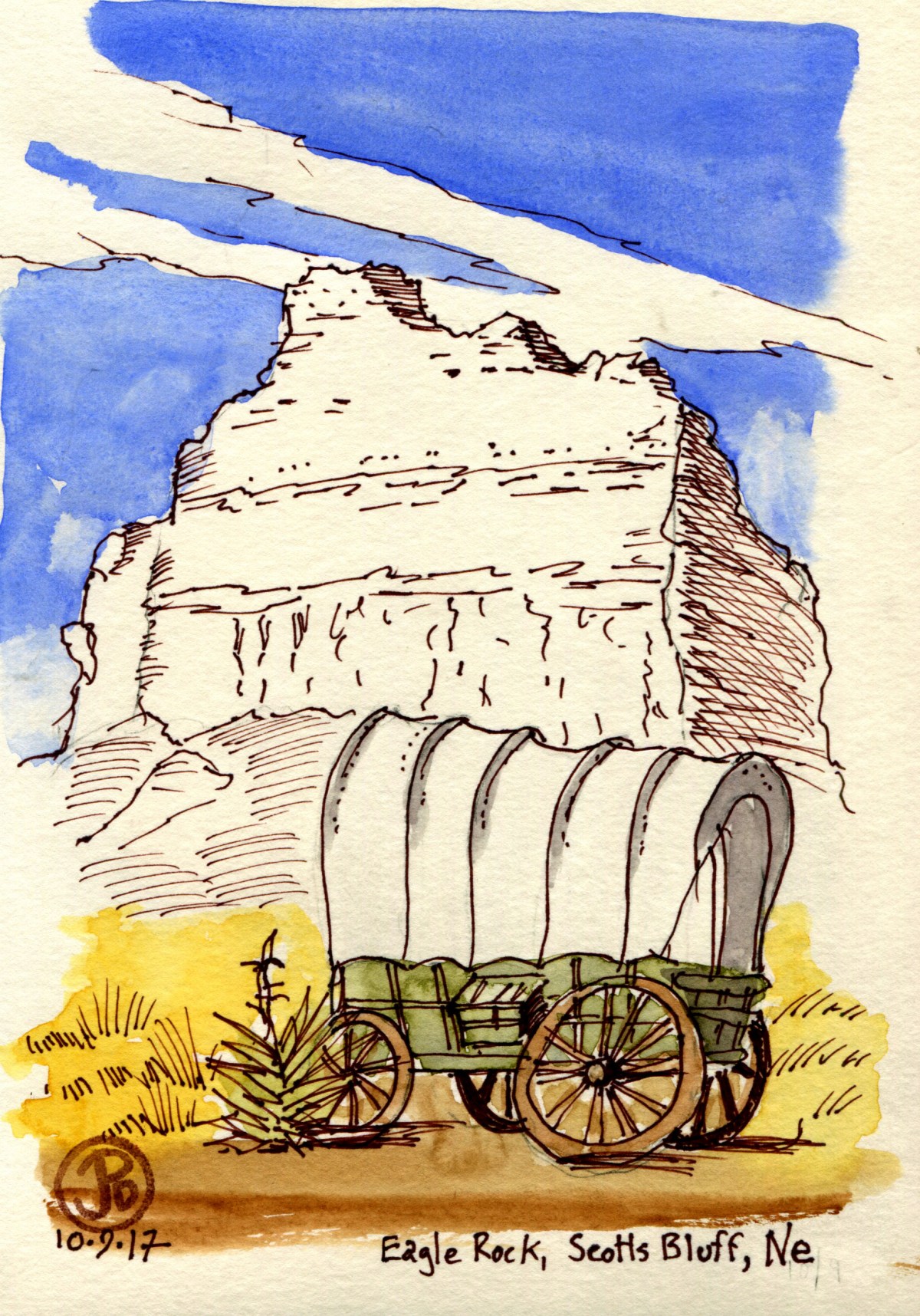
I pulled out my sketching bag, grabbed my sketching stool (yes I packed it in my suitcase) and I walked down the trail at Scotts Bluff National Monument to the three replica wagons along the trail. Rising behind the wagons was the impressive Eagle Rock. I picked my spot, set up my stool and started to sketch. In the late afternoon, I seemed to have the entire park to myself. There was no tourist standing in front of me and my subject asking, “Whatcha do’in? (Long Pause)  “Drawl’in?” Okay maybe I’m exaggerating but only just.

A faux ox with Eagle Rock in the background.

While sketching you enter another world where your focus is complete and the scene before you is translated into lines, shapes, and hashmarks. But a call, from somewhere behind we broke my focus. It was a loud bugle of a call, a call I knew but had trouble placing because I had not heard it a long while. I looked up and I could just make out the flying “V”s heading in a southern directed. These were not the “V”s found in a student handwritting book, no, these were  “V”s like the motion of water around an obstacle on a gently flowing stream. It was the southern migration of the sandhill cranes! I watched as hundreds if not thousands passed on their way to the fallow rice field to the south, their wintering grounds.

The passage of the sandhills was an unexpected bonus, the type of serendipity that can happen on the road when everything seems to come together to make a memorable moment. The late afternoon light, Eagle Rock, the replica wagon, sketching on my sketching stool, the sandhill cranes, and me being in the right spot at the right time. This produced one of my favorite field sketches of the trip. 


Image

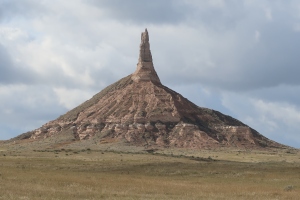
Chimney Rock

There was one landmark that I was looking forward to seeing and sketching, more than any other.  And like the emigrants, I saw it miles before I reached it.

A good number of the pioneers were midwestern flatlands and their first sightings of Chimney Rock must have made them feel like they were in a completely different world, in a landscape they could not quite comprehend.

Seeing the spire of Chimney Rock, through my windshield was like a beacon that drew me toward it. No wonder why this unique landform is the most mentioned landmark in pioneer journal accounts.

As I pulled into the visitor’s center parking lot, I noted the numerous rattlesnake warning signs. The center was closed for Columbus Day so I skirted around the building, keeping my eyes down, scanning for a snake in the grass, to reach the viewing deck.

The winds and the rains of the morning seemed a thing of the past. The storm covered Cheyenne in six inches of snow and closed highway 80 for 9 hours but now the majestic prairie clouds rolled above the spire.

I could picture the masses of wagons, livestock, and people, populating the plains around the rock where now a few cows grazed. As I sketched the landmark, I was continuing a long tradition of drawing the landscape along the trail. At the time the spire was much taller in the mid 19th century due to erosion and a little pioneer vandalism. I read one pioneer pastime included shooting at the spire and collecting what ever pieces were blown off and kept as souvenirs. Another pastime was carving their names into the rock. Now all names have eroded away but in two locations further to the west, emigrates signatures are still visible to this day. But more about that in another post.


Image

A Californian on California Hill

The first major incline on the Oregon trail was California Hill in western Nebraska. The emigrants would have just crossed the Platte River and this was one of many tests along the trail they would encounter on their long journey west.

To begin my first journey on the Oregon and California trails, I drove to Brule and headed west on highway 30, passing corn fields and grazing cattle and keeping highway 80 and the Union Pacific mainline to the south (both parallel parts of the original trails). Four miles from town, to my right, the California Hill historical marker came into view. I read the plaque and now it was time to get the Grand Cherokee dirty!

I turned north on a rutted dirt road with rolling fields stretching off on both sides. If it weren’t for the cows, barbed-wire fences and power lines, I could be on the Oregon Trail back in 1850.

On the left there was a gap in the barded-wire fence, the gateway to the ruts of  California Hill. Julie Fanselow, in her guide: Traveling the Oregon Trail (my Bible for this journey) describes the ruts as, “some of the finest Oregon Trail ruts to be seen anywhere along the route”.

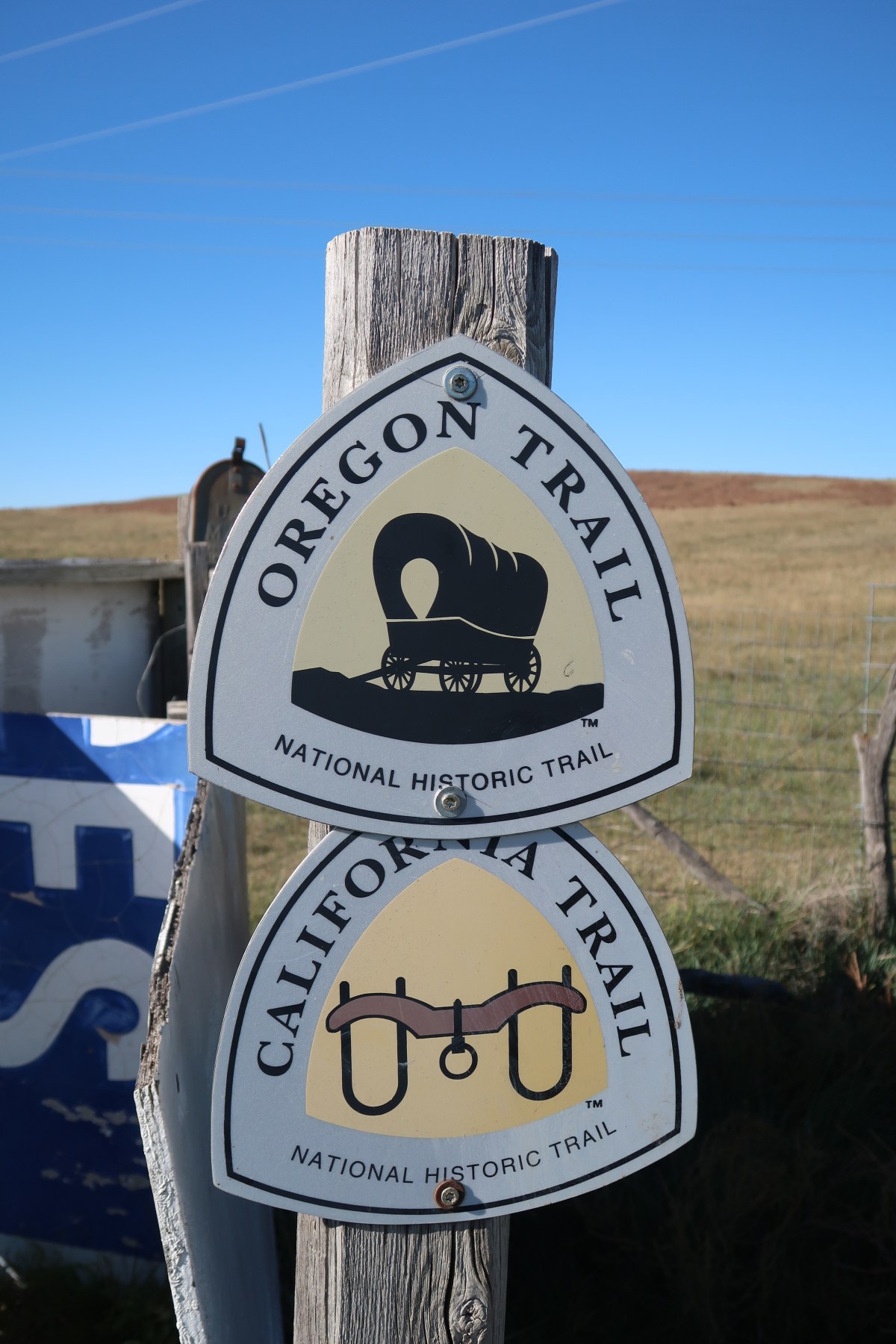
On a post werethe shields of the Oregon and California trails. I was in the right place. Now I just needed to find the ruts.

IMG_1384I passed through the narrow gate, skirted a cattle trough, and spotted a trail marker on the brow of a gentle hill. I headed towards it.

IMG_1380

The Oregon Trail marker and the ruts of California Hill just to the left of the marker, at the brow of the hill.

Once I crested the hill, the passage of thousands and thousands of emigrants was clear. Ruts wound up the hill and amazingly, over 170 years later, they were still visible. The ruts were helped by the erosion of wind and rain, etching the passage of the pioneers into the landscape.

Over the next few days I would be seeing other etchings upon the landscape that spoke of the thousands of travelers that passed by these historic trails, some for a better life, other to an early trailside grave.