Image

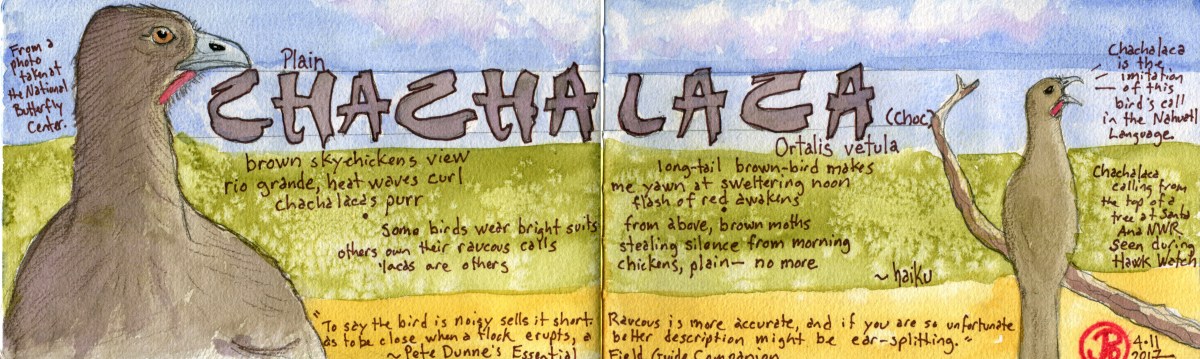
The Not So Plain Chachalaca

There is something mundane about a bird that has “plain” in it’s common name. But when that is paired with “chachalaca” now we are talking about a bird that birders will travel to the deepest depths of Texas to add to their life list, because of it’s very limited range in the US, confined to the lower Rio Grande Valley. The great news for birders wishing to add this species to their list is that it is very common and in some parts of Hidalgo County, it is a backyard bird.

The only thing plain about the plain chachalaca (Ortalis vetula) is it’s uniformly brown plumage. The name “chachalaca” is in imitation, according to the Nahuetl language, of it’s loud and raucous call, most often heard during the breeding season. And I was in southern Texas during it’s breeding season. When chachalacas call, they are very hard to ignore and worthy of a spread in my journal.

While I was hawk watching on the observation tower at Santa Ana National Wildlife Refuge, it afforded views, down into the tops of trees. I would often see, and hear,  chachalacas calling from the tallest branches.
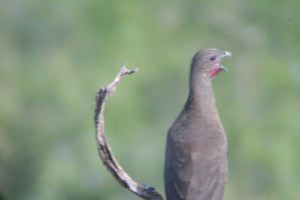
Looking down on yet another plain chachalaca calling from the top of a tree, Santa Ana NWR. Digiscope photo.

After my hawk watch I headed over to the National Butterfly Center to visit their feeders, and to look at butterflies. Here the chachalacas where so tame that they were within grabbing distance. (I kept my hands to myself.)
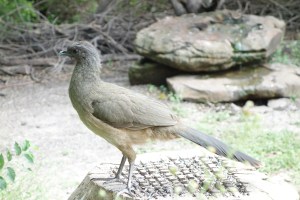
Getting up close and personal with a plain chachalaca at the feeders of the National Butterfly Center. No zoom or scope required.
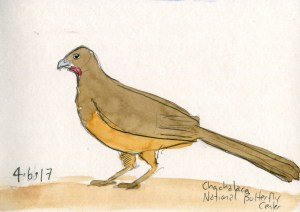
A quick field sketch from the National Butterfly Center.
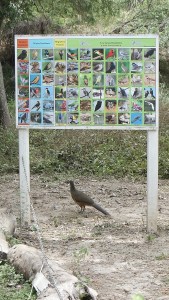
I sometimes wish all birds were this easy to identify. A plain chachalaca under a sign featuring the most common birds of the Rio Grande Valley. National Butterfly Center.
Image

Rio Grande Valley and the Coastal Bend

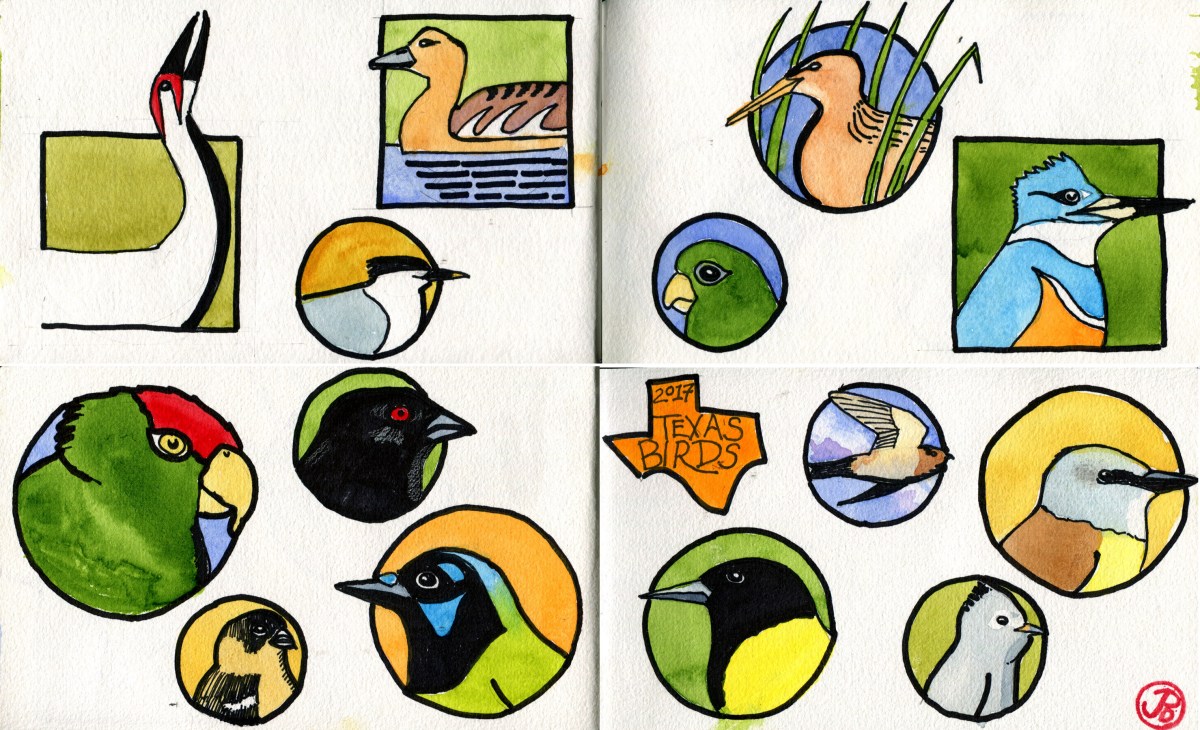
While planning a birding trip to South Texas in April I sketched some  birds on my wish list. I chose to sketch in a woodcut, stylized way that focused more on shape rather than fine detail. The style is that of a preliminary working sketch if I were designing a linocut.

The birds are, from left to right, top to bottom: whooping crane, sandwich tern, fulvous whistling-duck, green parakeet, king rail, ringed kingfisher, red-crowned parrot, white-collared seedeater, bronzed cowbird, green jay, Audubon’s oriole, cave swallow, northern beardless-tyrannulet, and Couch’s kingbird.

Bird notes:

Whooping Crane: One of our rarest and tallest birds in North America. In the 1940’s where were just 21 whoopers in the wild. Since then, with conservation efforts, their numbers have grown. I hope to add this bird to the list on a cruise on Aransas Bay.

Sandwich Tern: A medium-sized tern of the Gulf Coast with a black bill dipped in mustard.

Fulvous Whistleling-duck: I struck out on this duck on my last visit to Texas but am determined to add it to my list in the ponds around McAllen.

Green Parakeet: I should find this gregarious green gem at it’s nighttime roost, about ten minutes from my digs in McAllen.

King Rail: Missed this rail in Florida but I am hoping to hear, if not see it,  at Ticano Lake. This is our largest rail in North America.

Ringed Kingfisher: I missed this kingfisher, the largest in North America, by a few minutes at Bentsen-Rio Grande Valley State Park.

Red-crowned Parrot: Another McAllen specialty.

White-collared Seedeater: Found only in a few places along the Rio Grande. I’m going to search around Falcon Dam.

Bronzed Cowbird: This devil-eyed bird can be found in parking lots in McAllen.

Green Jay: Not a lifer but very common in the Rio Grande Valley. This beautiful jay is a blockbuster bird in south Texas and it’s found nowhere else in the US.

Audubon’s Oriole: Hoping to add this bird to my list near my digs at the McAllen Nature Center.

Cave Swallow: Similar to the cliff swallow. I will keep my eyes to the sky to see this lifer.

Northern Beardless-Tyrannulet: This small, drab flycatcher is inconspicuous, until it sings.

Couch’s Kingbird: Almost identical to the tropical kingbird, until it sings.