Just north of the Victorian town of Ferndale is the small Humboldt County town of Lotleta (population 783).
The name of the town is shrouded in a bit of mystery but the name is supposedly the Wiyot word for “pleasant place at the end of the tide water” or according to Wikipedia, “Go f___ yourself “ or “Let’s have intercourse”. So many varied derivations! Take your pick.
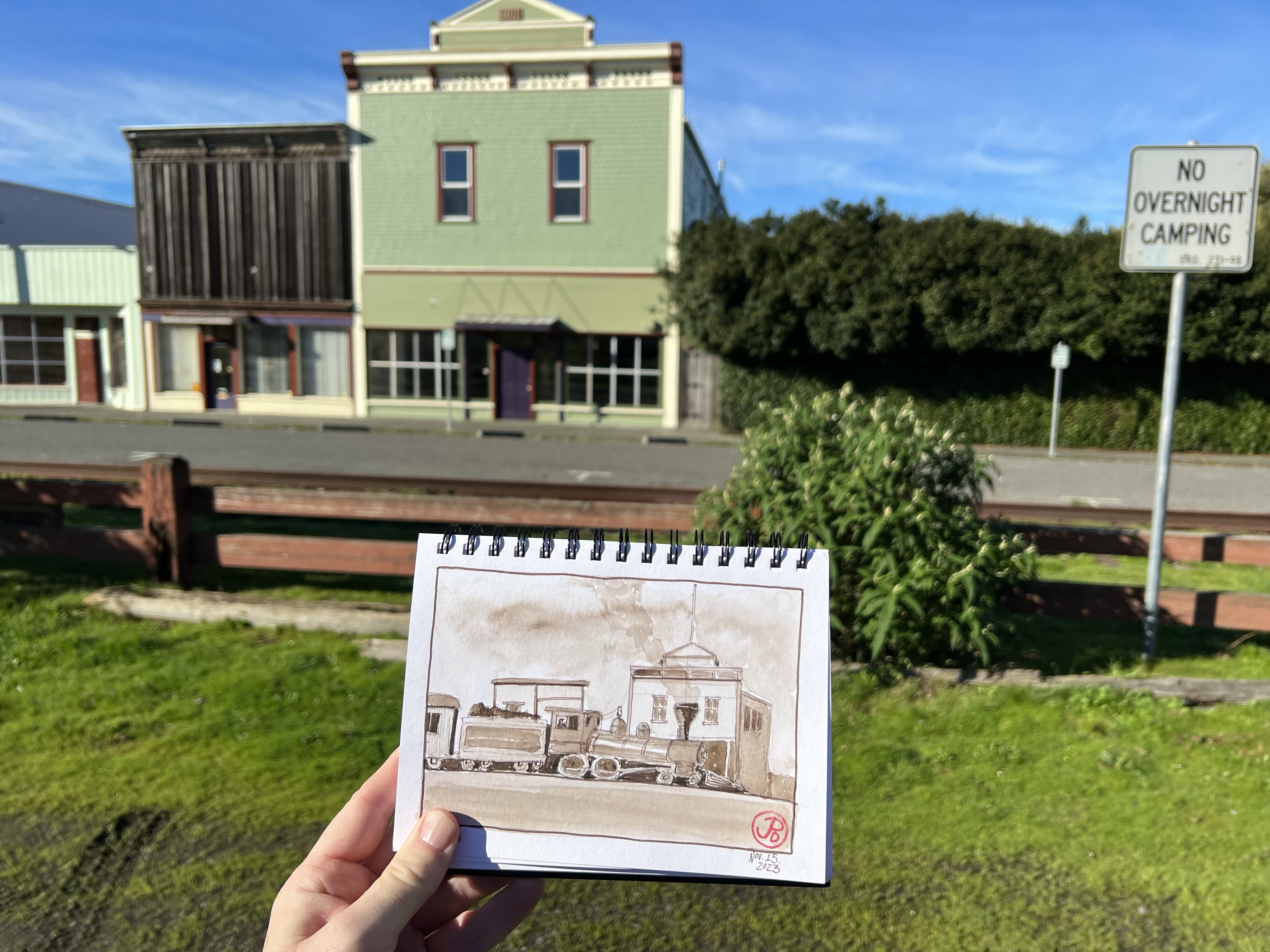
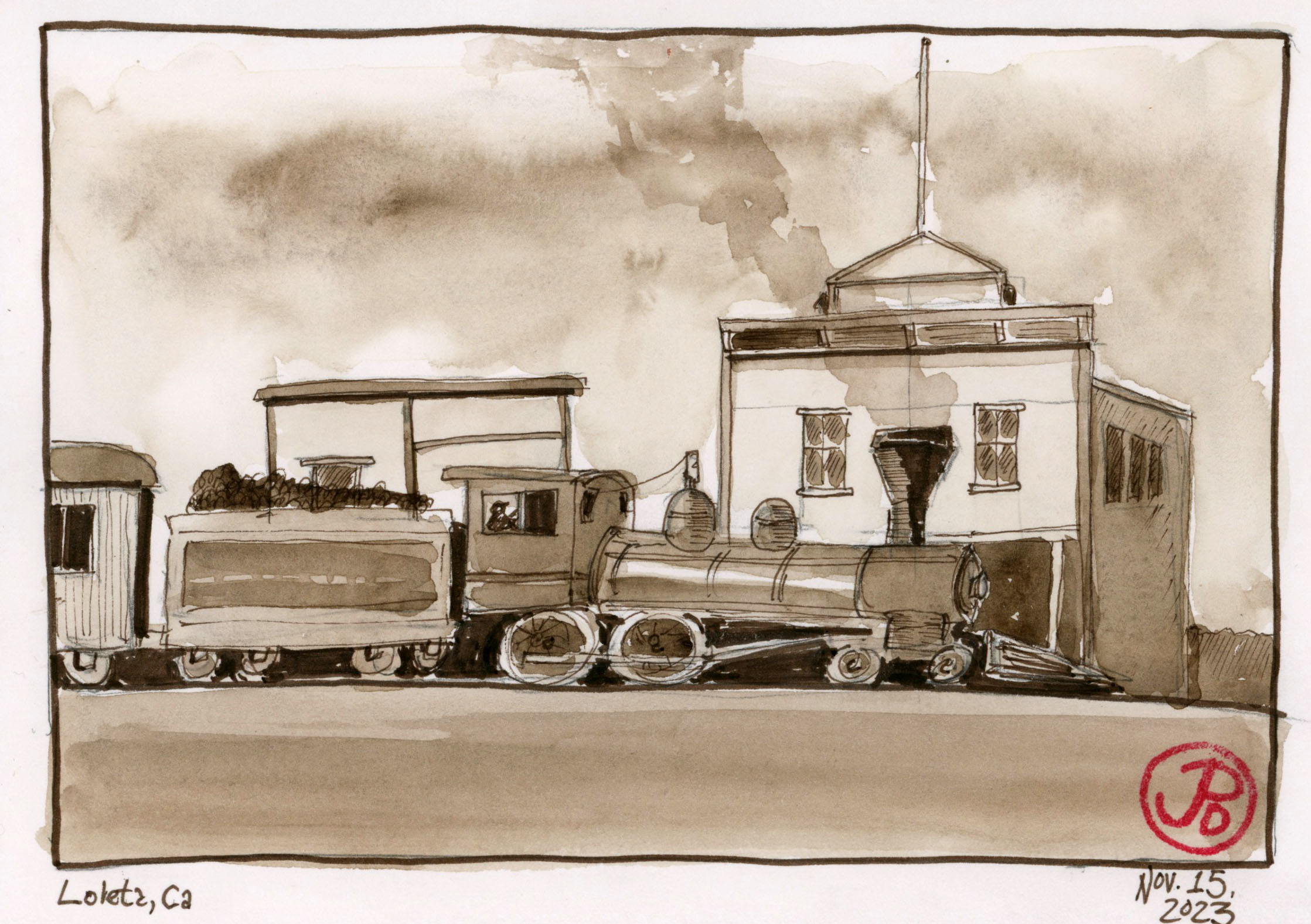
A pre-trip sketch from a vintage photograph. Parts of Loleta have changed very little over the ages.
Through the center of town runs the rusted rails of the Northwestern Pacific Railroad (NWP). Dairy was a very big in this part of Northern Californian economy and this area supplied San Francisco with dairy products. The railroad played a big part in transporting dairy to markets south.
There is a “hiking trail”, much overgrown, along the rails to the abandoned Loleta Tunnel (Tunnel No. 40). I was about to set off on an adventure!
I think this is where the hiking trail begins to the Loleta Tunnel (hard to tell from the sign). In the background is the NWP line. At the grade crossing, the sign reads, “ TRACKS OUT OF SERVICE”.
I set out on the hiking “trail”or the “ING RAIL” which was following the route north of the Northwestern Pacific right of way. In many places the rails were swallowed up in mud or vegetation or both. The Loleta Tunnel was about a mile from “downtown” Loleta. Near the tunnel was a washed out trestle over a small ravine, leaving the NWP rail suspended in midair. Perhaps this is a just metaphor for the hopes of restoring rail to this part of California.
The suspended trestle.
I did not attempt to cross the trestle (or lack of a trestle) but a path had been worn down one side of the ravine and up the other. From here is was a short but muddy slog to the south portal of the Loleta Tunnel.
The Loleta Tunnel runs under Highway 101. This is the much decorated south portal.
Before I headed up to Loleta I did two historic sepia sketches based on period photographs when steam locomotives rumbled through the small town (featured sketch). Parts of Loleta are very recognizable to this day.
Just south of Willits on an unassuming county road is Ridgewood Ranch.
First established as a ranch in the 1850s, the ranch was given the name Ridgewood Ranch by its second owner, Rench Angle in 1859. Angle increased the size of the ranch by buying up surrounding land for $3.25 an acre.
The next owner of note, and the reason for my visit, was multimillionaire Charles S. Howard, who bought the ranch in 1919.
Howard came to San Francisco with 21 cents in his pocket. He worked his way up to become one of Buick’s best salesmen of all time. He ran many Buick dealerships in the west at the rise of the age of the automobile.
On the streets of San Francisco, cars began to replace horses as the motive power of the day. This is ironic because of a purchase he made in August of 1936 for the sum of $8,000.
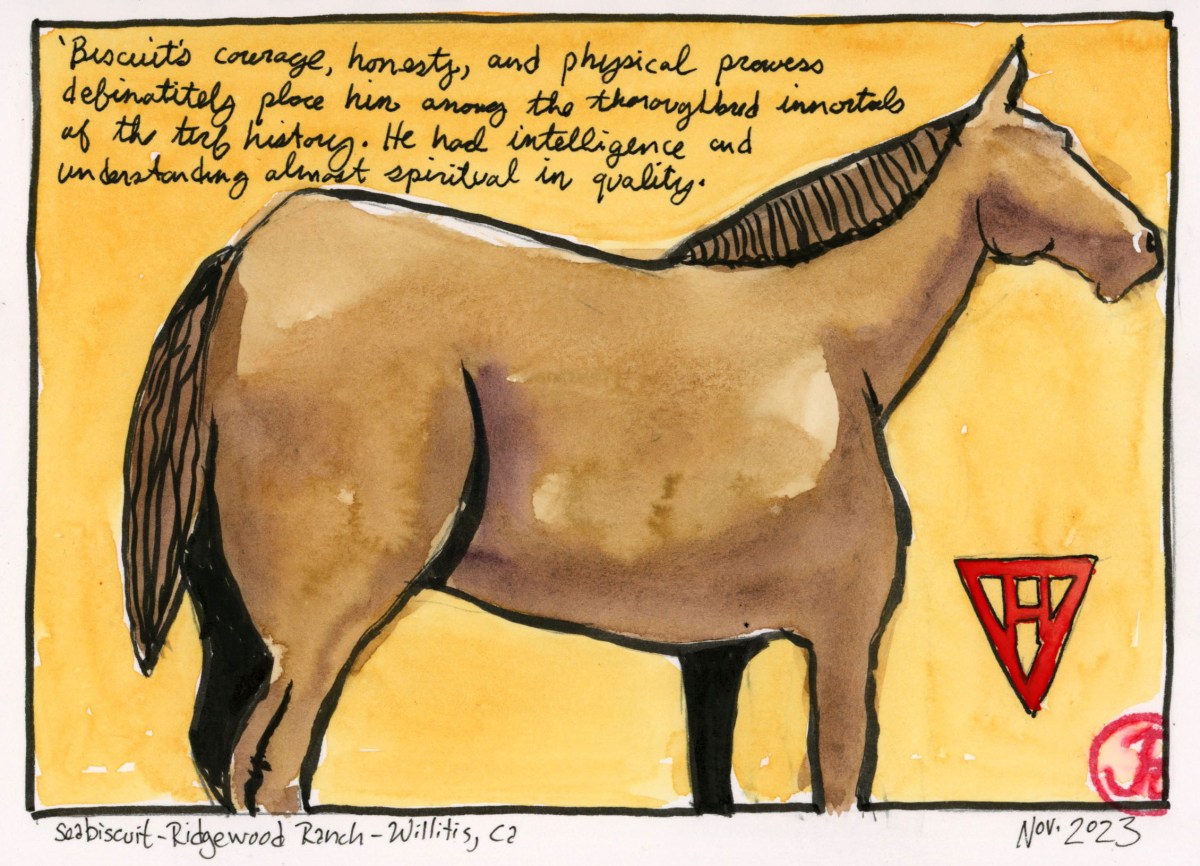
This was the famous thoroughbred Seabiscuit which won many races in the 1930s, lifting a nation in the depths of the Great Depression. He was voted American Horse of the Year in 1938.
The all-time money winner was retired from racing in 1940. Seabiscuit spent the last years of this retired life here at Ridgewood Ranch. He died May 17, 1947 from a probable cardiac arrest.
Seabiscuit is buried near an oak tree at Ridgewood Ranch. Only the Howard family knows the exact location. Seabiscuit’s final resting place is a closely guarded secret.
Schellville is not really a town, just an intersection of a two lane highway and a country road in incorporated Sonoma County. But this is a very important railroad junction.
This is the last bastion of the once great Northwestern Pacific Railroad (NWP).
Schellville was an important rail junction on the NWP and there is a two mile rail yard south of the former train station.
The Schellville Depot has seen better days, just like the rest of the former Northwestern Pacific system. Now it is used for storage.
This was NWP’s only outlet to the greater Southern Pacific rail network. All passenger and freight traffic from Eureka in Humboldt County south to Willits, Santa Rosa, Petaluma and San Rafael in Marin County, had to pass through Schellville.
At one point, post World War II, 11,000 cars a month passed through the junction at Schellville. Many cars went on, under Southern Pacific steam, to the division point at Roseville.
Over the years, declining passenger and freight service, landslides, and the severe winter floods of 1964, sent NWP on a downward decline. The railroad was operated by Southern Pacific and once SP merged with Union Pacific in the mid-1990s, NWP changed hands many times, holding on to it’s diminished existence.
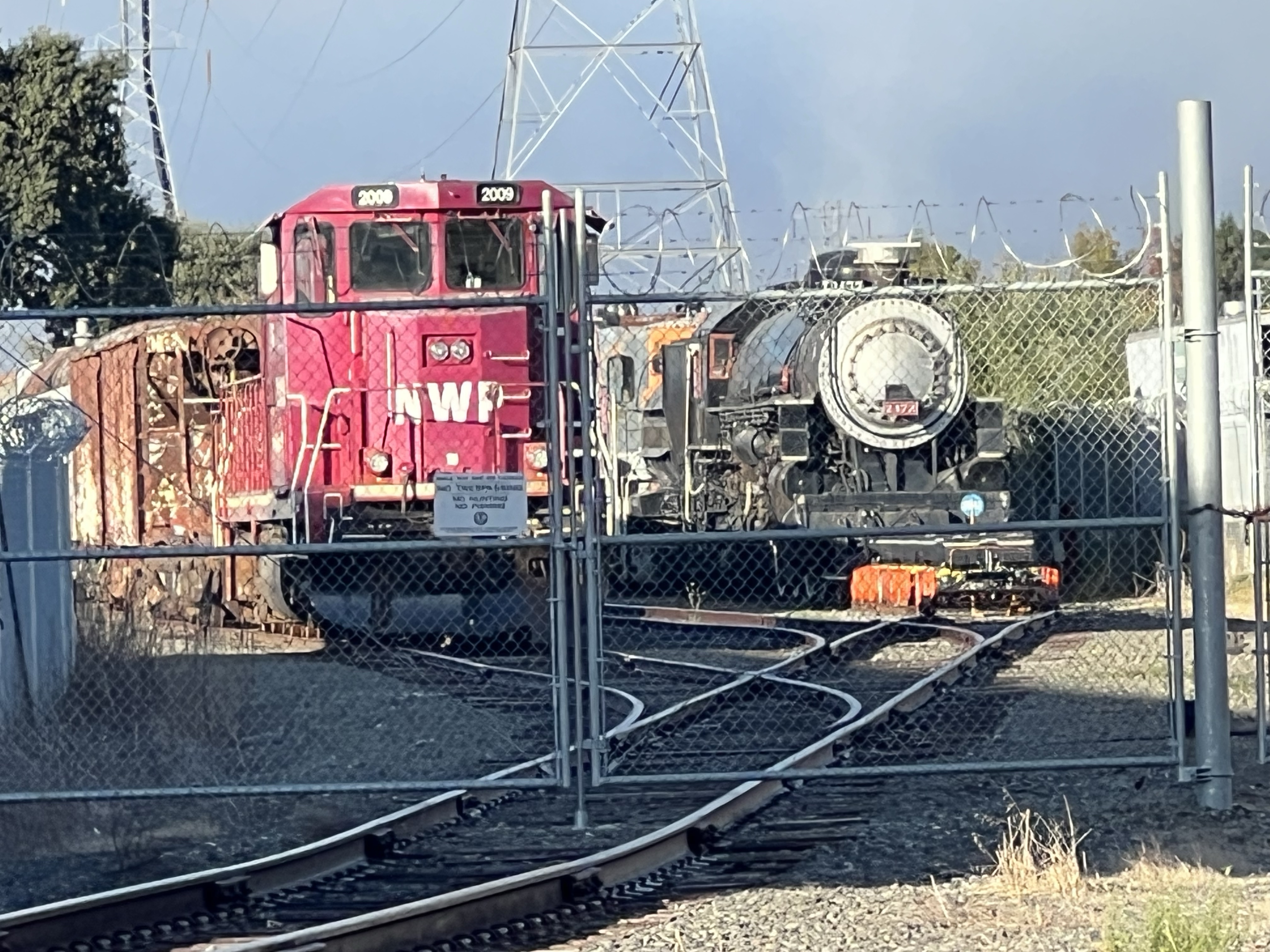
It seemed that the entire fleet of four locomotives where fenced in near the station. This motley collection were painted in the livery of other railroads.
NWP No. 1501 painted in the Southern Pacific “bloody nose” livery.
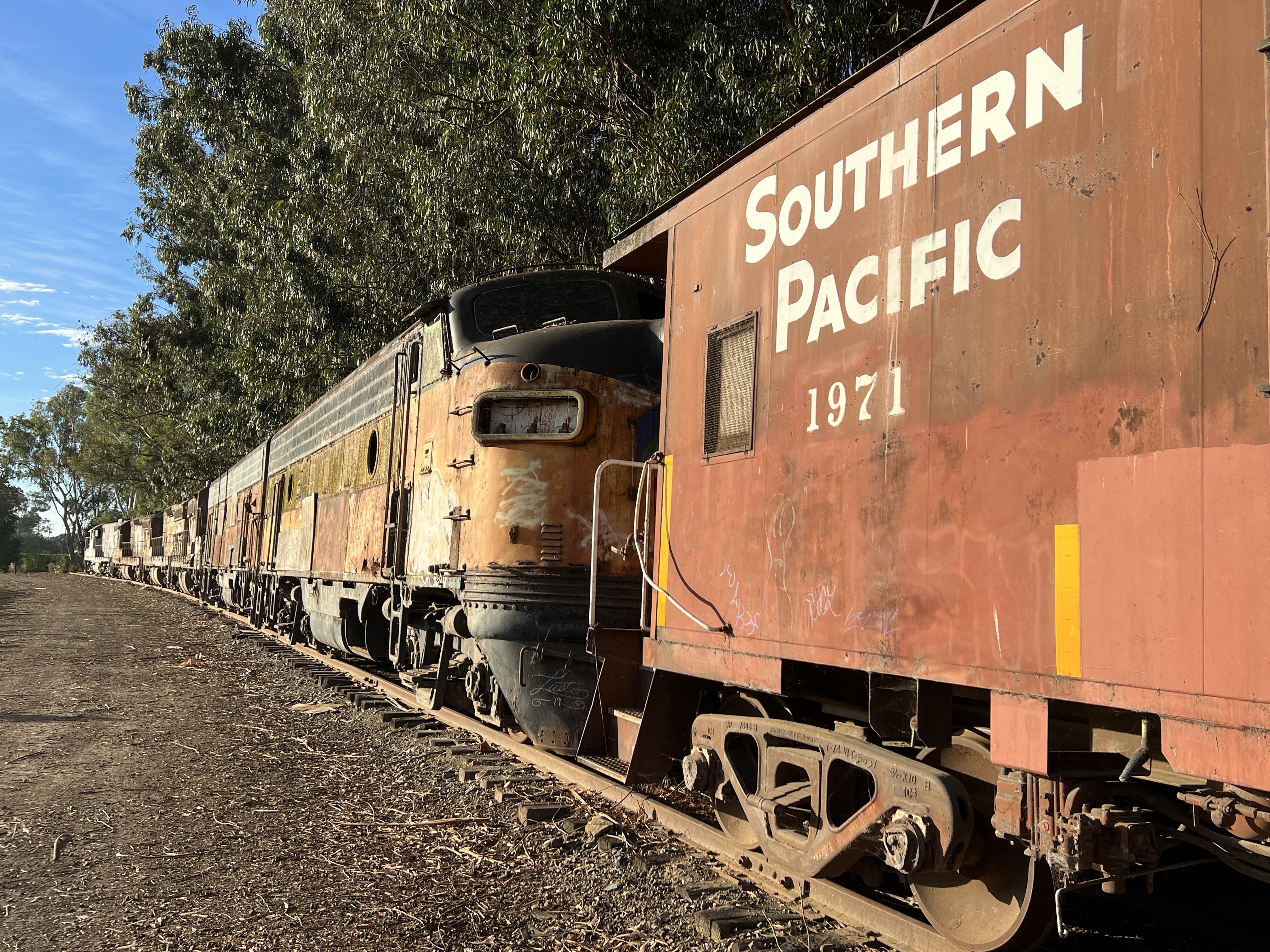
From the Y track at the station I headed north along the line, vineyards flanking either side of the rusted rails. I crossed a short trestle and before me stood a railroad graveyard, a mothballed fleet of NWP and SP diesels and rolling stock.
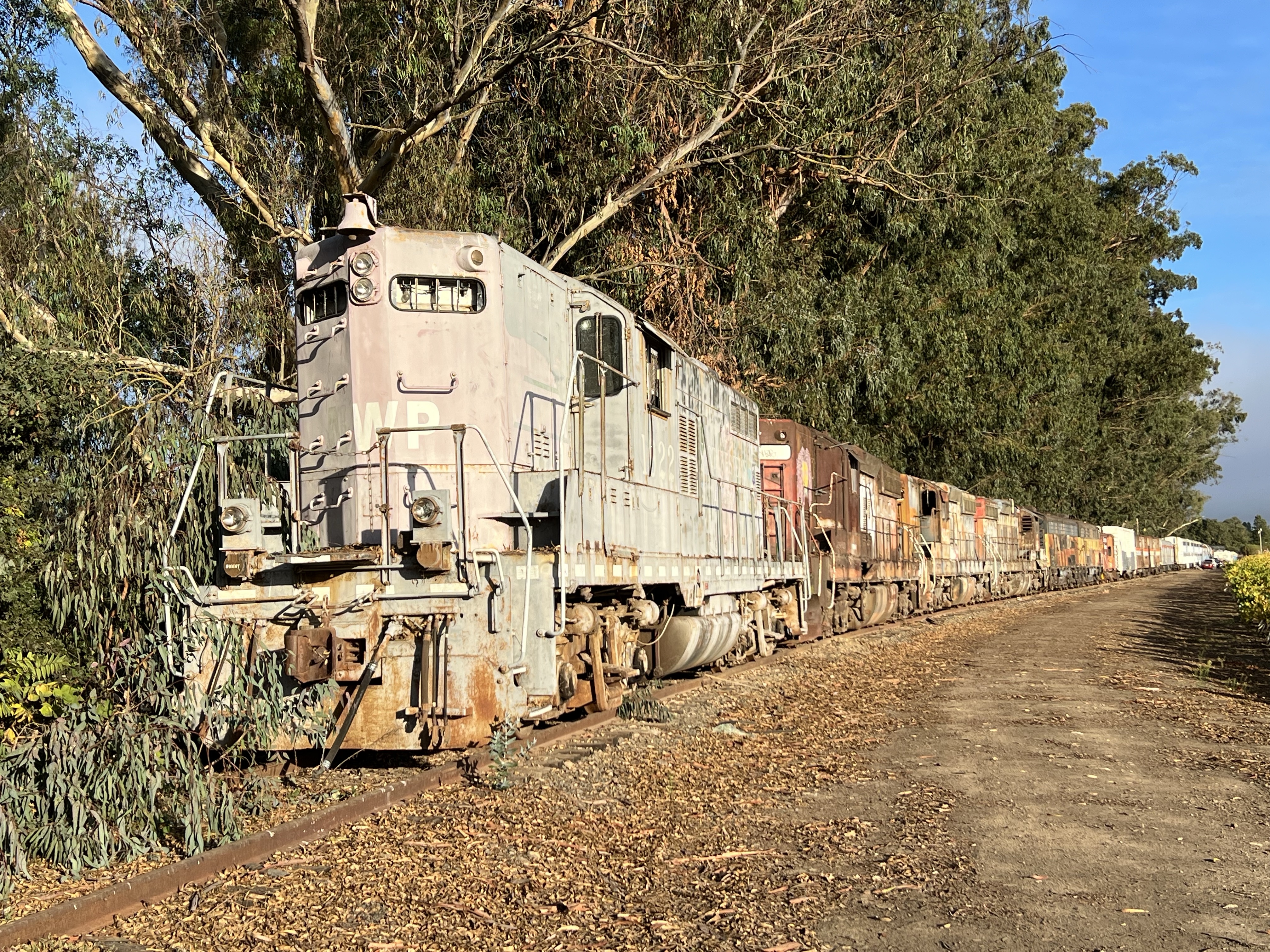
The mothball fleet is mainly Southern Pacific locomotives and a mix other other rolling stock. The locomotive on point is Northwestern Pacific EMD GP 9 No. 1922, faded and being returned to nature.At the end of the diesels is Southern Pacific caboose 1971. The locomotive coupled to the caboose is the former Bessemer and Lake Erie F7 numbers 718 A and 716 B.
While these locomotives had seen better days I was surprised to see a Southern Pacific Steam Locomotive on a siding across 8th Street.
At first I couldn’t believe my eyes. Could this be one of a handful of operable SP steam locomotives? I could barely make out the road number.
It was P-8 Class No. 2572 a 4-6-2 “Pacific” type built by the Baldwin Locomotive Works in 1921.
2472 was retired in 1957 and donated to the city of San Mateo and put on public display at the San Mateo County Fairgrounds.
In 1976 a group decided to restore the SP workhorse to working order. The group, the Golden Gate Railroad Museum, had 2472 ready for Railfair 91 in Sacramento which feature another Southern Pacific legend, 4449.
For many years 2472 operated steam excursions in Niles Canyon but was moved to Schellville on March 1, 2020.
An important bridge that kept Northwestern Pacific Railroad connected with the mainline rail network is the Black Point Bridge.
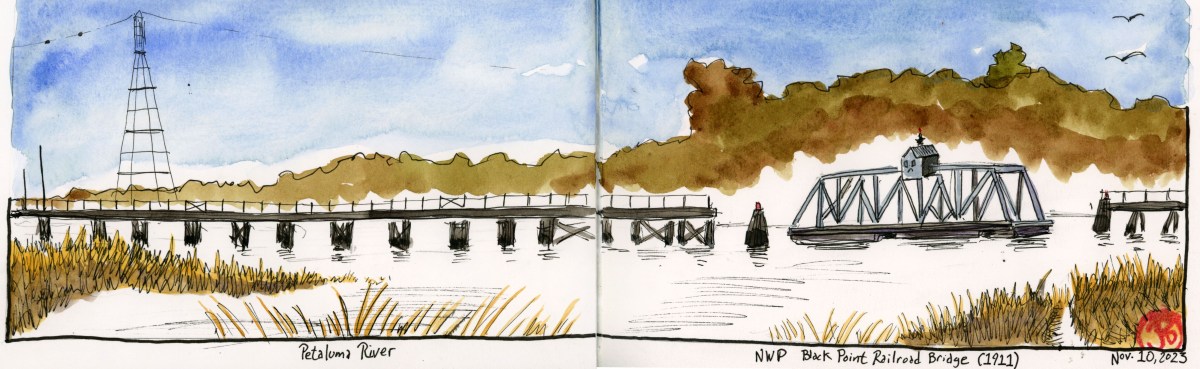
The 50 foot rail bridge at Black Point is a steel swinging truss bridge that turns perpendicular to the rail line to allow boat traffic on the Petaluma River to pass downstream to San Pablo Bay.
In the days of heavier rail traffic, the bridge was aligned with the railroad but now with fewer freight traffic, the bridge is open to allow river traffic to pass.
The Black Point Bridge, which spans the Petaluma River which is the boundary between Marin and Sonoma Counties, was built in 1911 and then rebuilt in 2011.
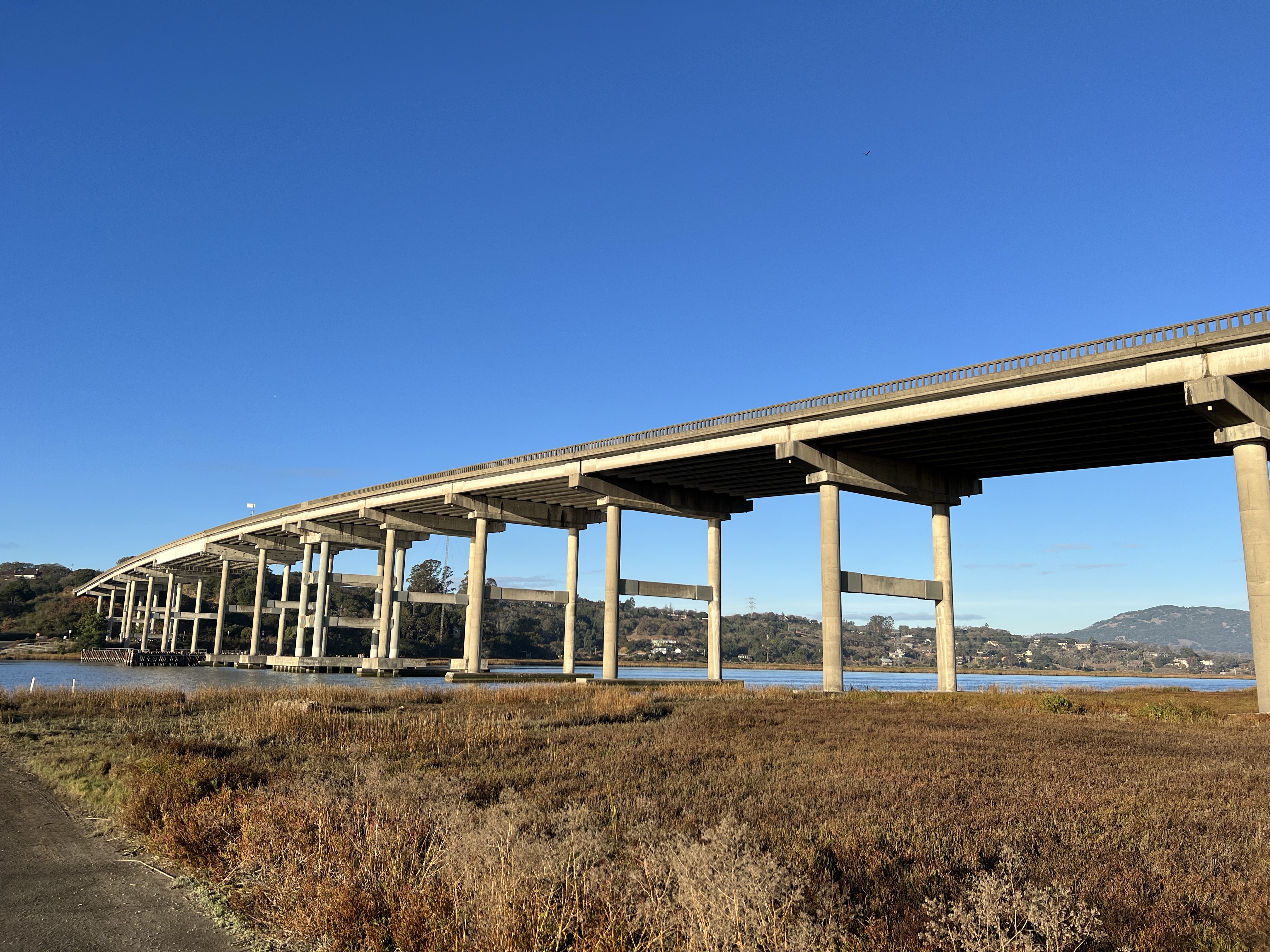
The Highway 37 bridge over the Petaluma River. The Black Point Bridge is just downstream from here.
Atop the bride is the Operator’s House where the bridge operator lived. He was in charge of opening and closing the bridge in the days when all the freight north to Eureka, had to cross this vital span to take freight to the rail junction at Schellville and beyond to the wider rail system. The bridge is now operated remotely.
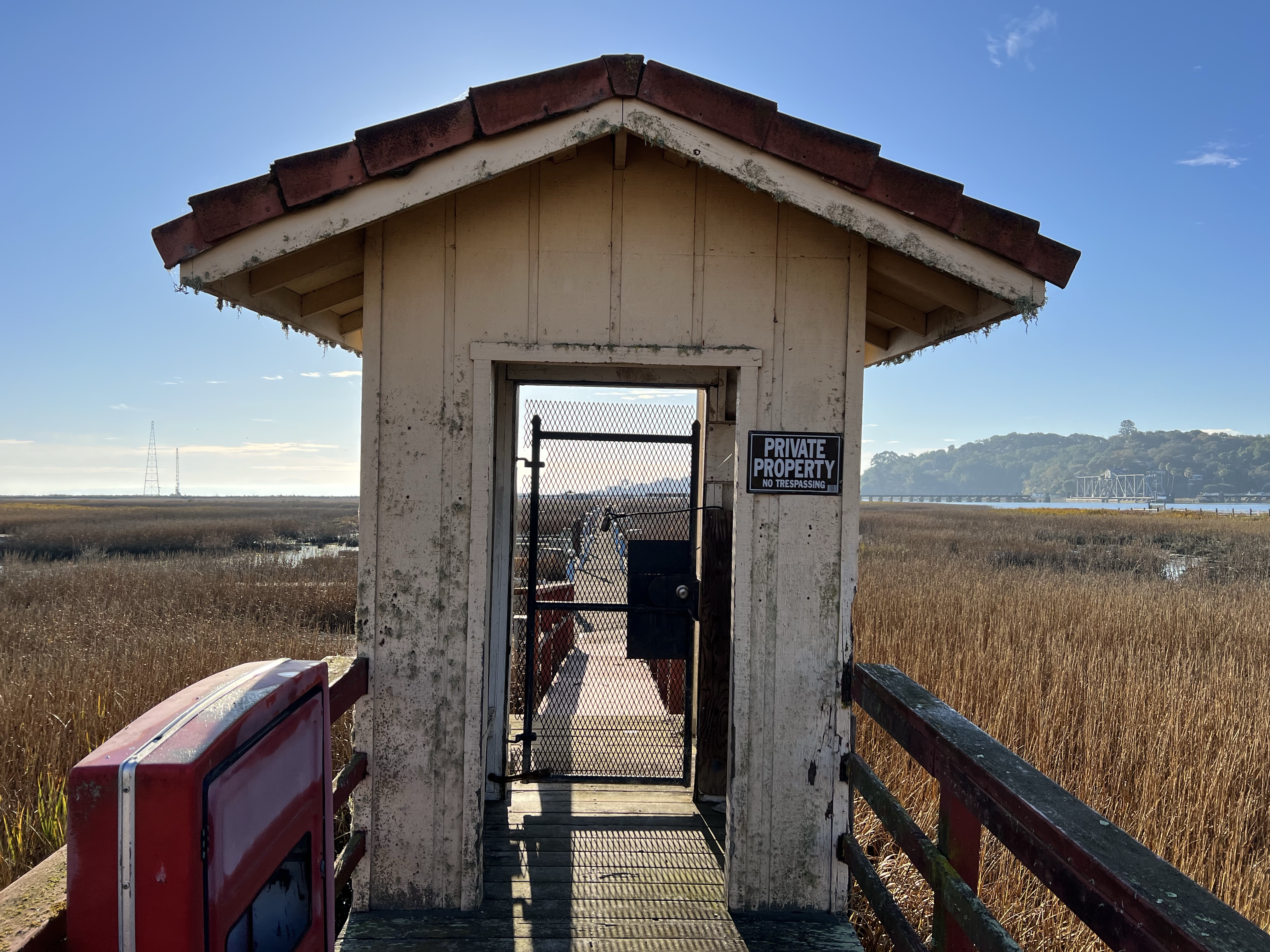
On either side of the steel span, a wooden trestle reaches out into the river.
The marina at Port Sonoma has seen better days. The boat slips are now empty and the reeds are slowly taking over.
I parked in the overgrown parking lot, walked past the abandoned marina, and then headed down the river trail to find a good vantage point to sketch the bridge.
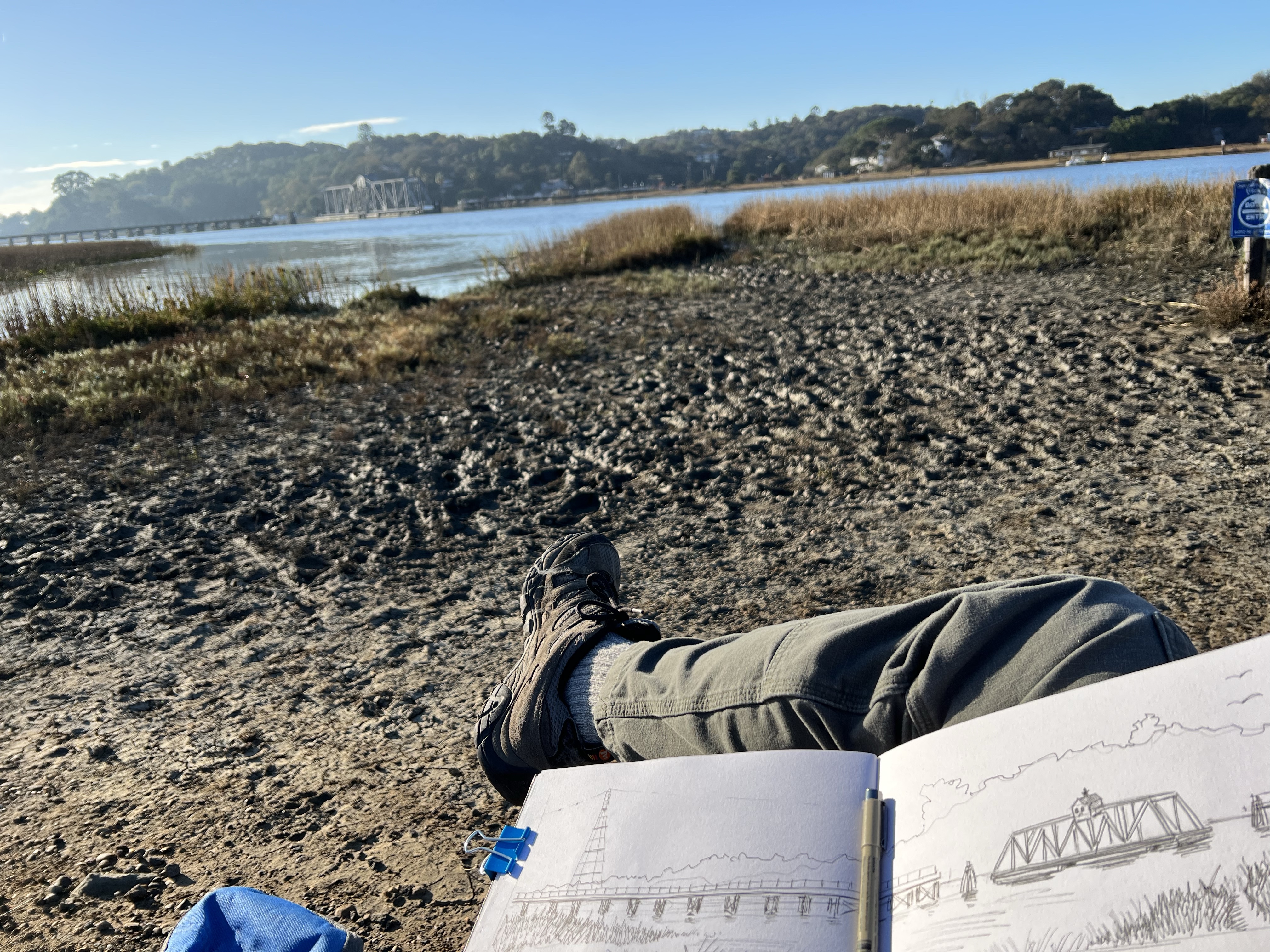
I parked my sketching chair near the outlet of the marina, took a sip of joe, and started to sketch (featured sketch).
A sketcher’s view and beautiful weather for a morning sketch.
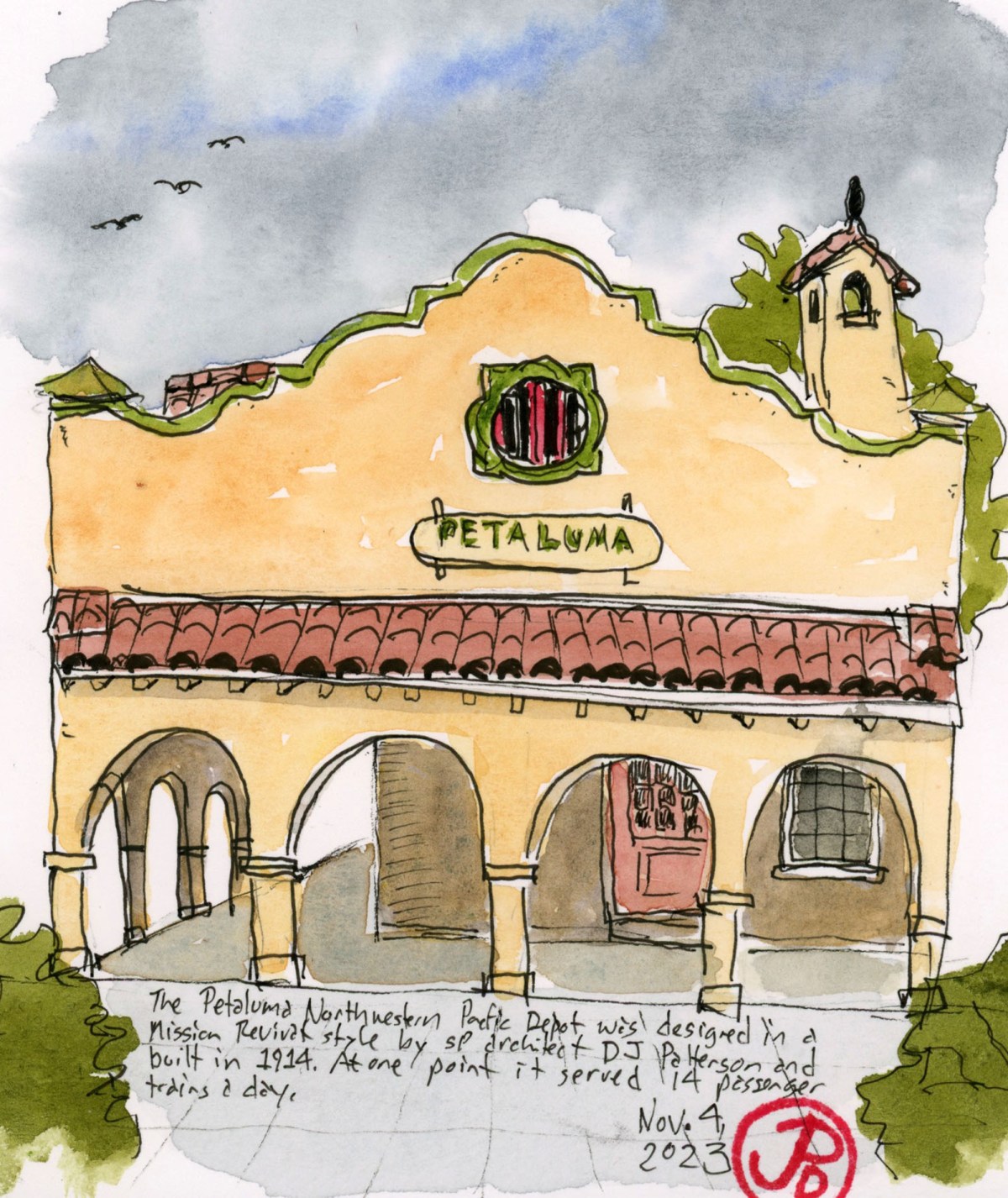
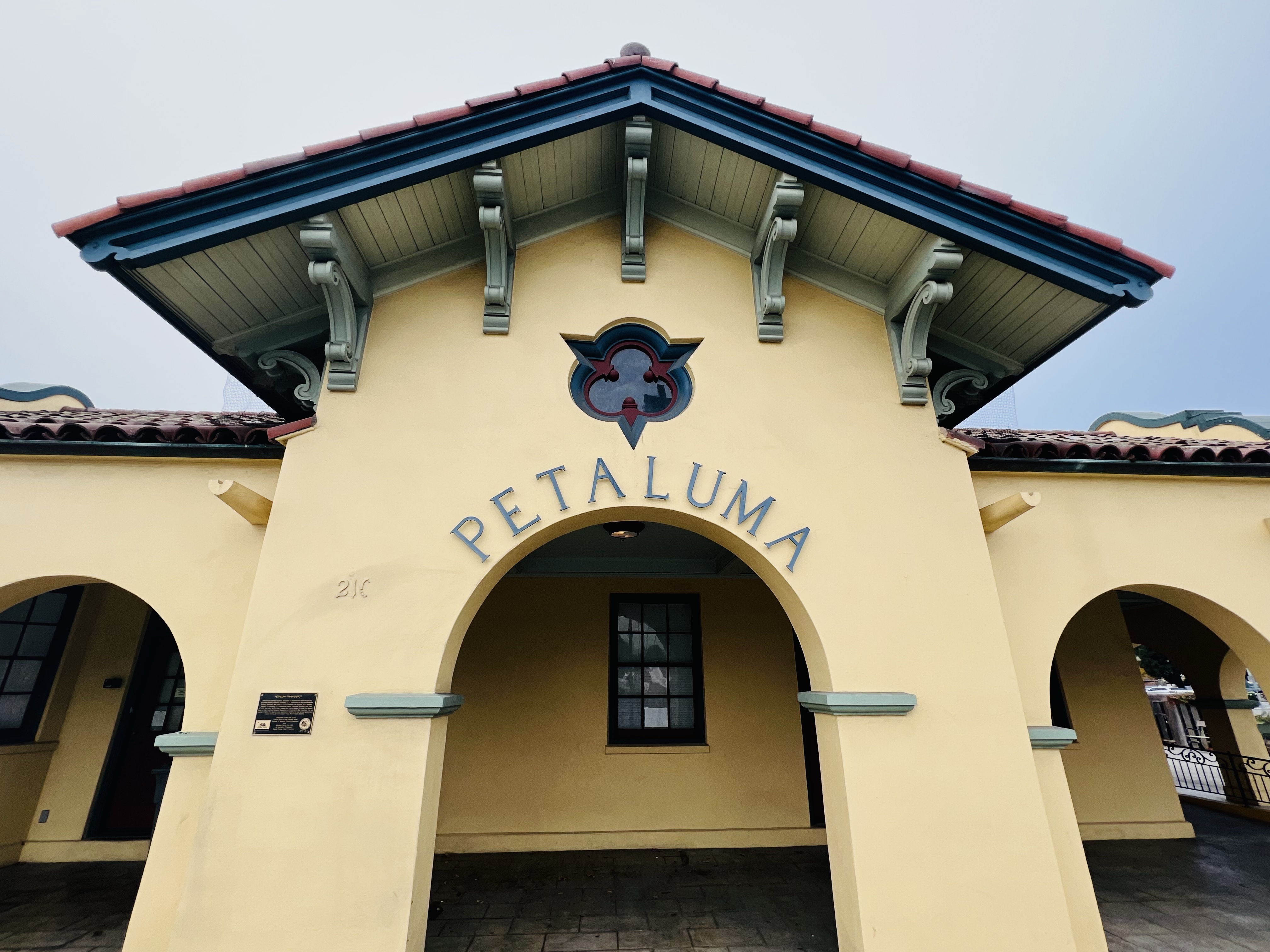
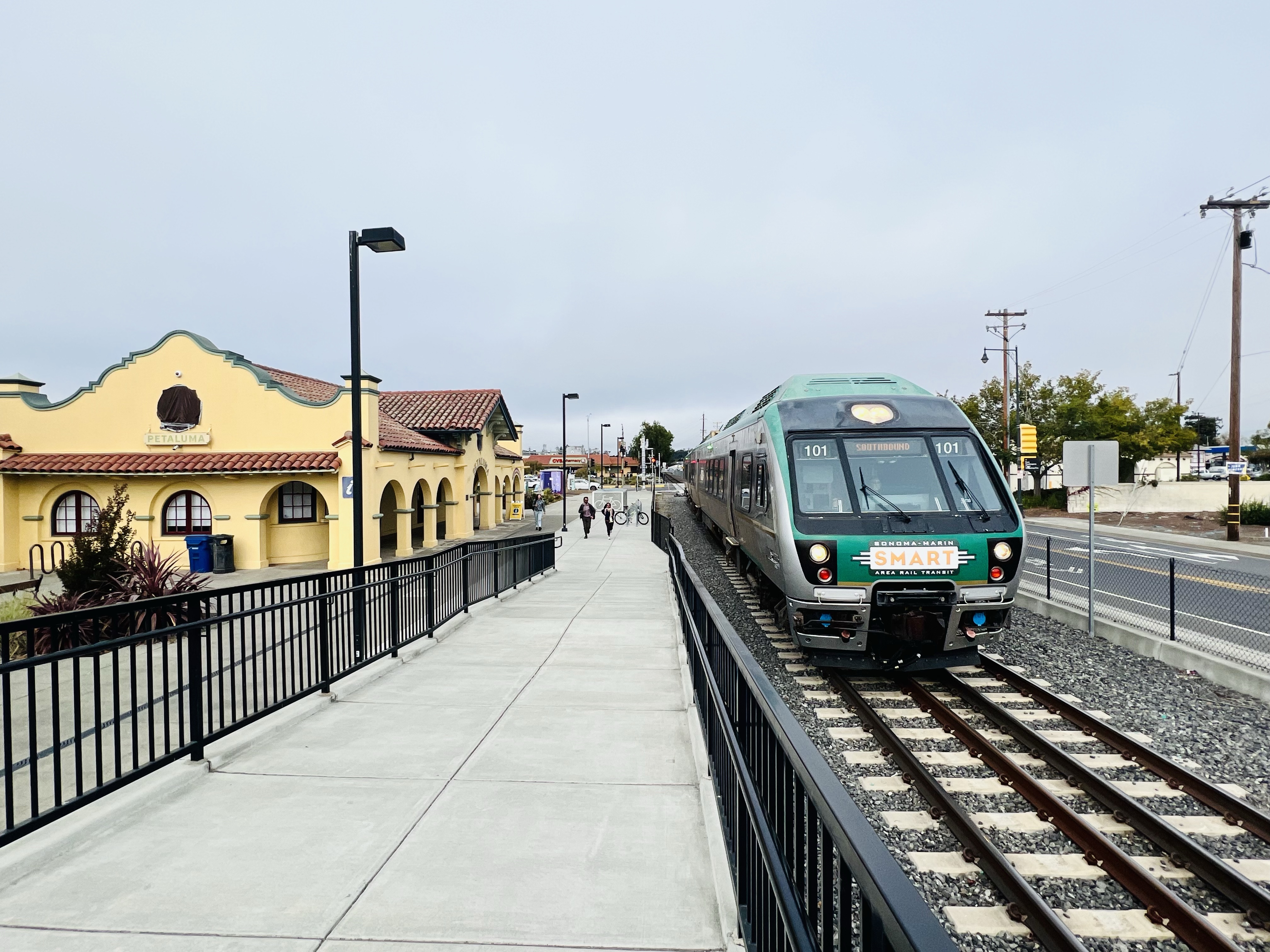
One of the nicest Northeastern Pacific rail depots still in existence, is to be found in the Sonoma County city of Petaluma.
This 1914 depot is designed in the Mission Revival style by Southern Pacific Railroad architect, D. J. Patterson. The passenger station originally cost $7,000 to build. The new station replaced the 1871 wooden stations. Patterson also designed the Galveston, Harrisburg, and San Antonio station. He also designed the Willits Station for the Northwestern Pacific, north of Petaluma.
This was a busy station with 14 passenger trains stopping at Petaluma daily. The construction of the Golden Gate Bridge cut into the passenger numbers and the last passenger train departed from this station in 1958.
That was until almost 60 years later in June 29, 2017 that a passenger train stopped In Petaluma.
The spot now housed the Petaluma Visitor’s Center but passenger service still lives in the form of SMART trains that travel from Santa Rosa to the ferry terminal at Larkspur.
A southbound SMART train pulls into the Downtown Petaluma station.
I’m not really into horse racing and a few of the racing tracks in the Bay Area are now closed. Golden Gate Fields will become a caption to a photo like Tanforan and Bay Meadows before. The recent reports of horse deaths have put a pall over the sport in days of waning interest in horse racing.
What I am into is California history and there is no denying the story of a thoroughbred horse named Seabiscuit with a deep California connections is a great story.
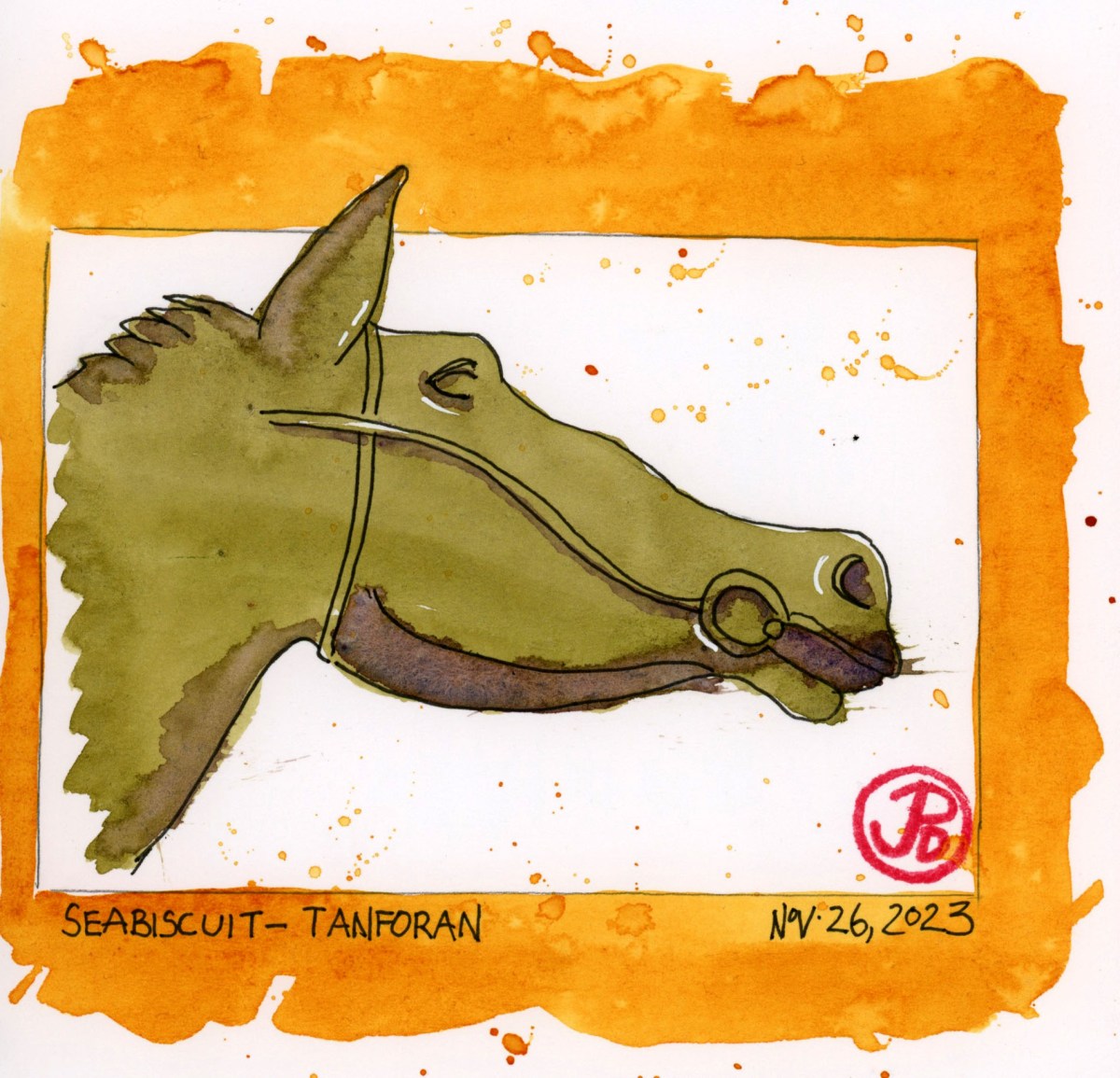
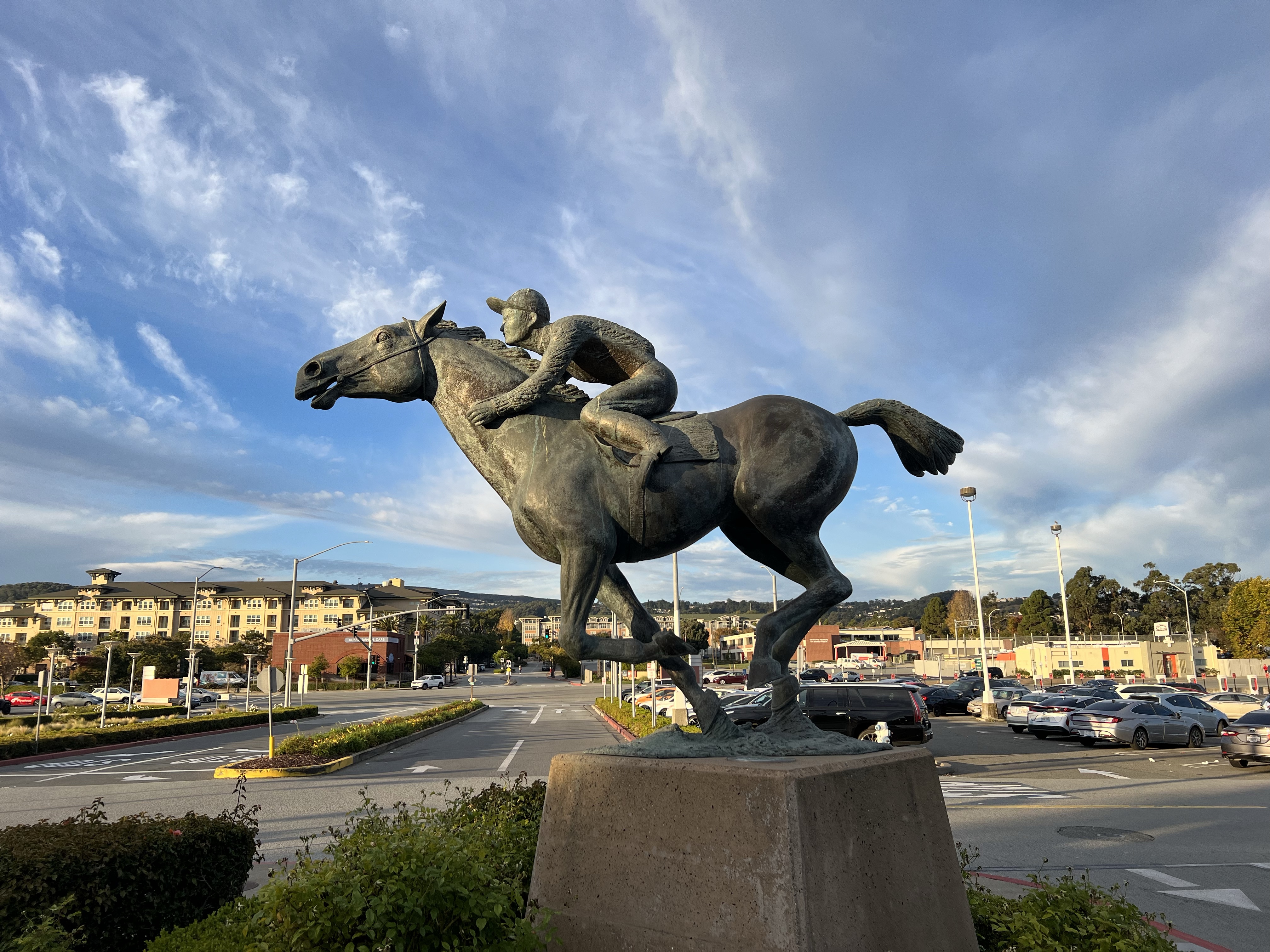
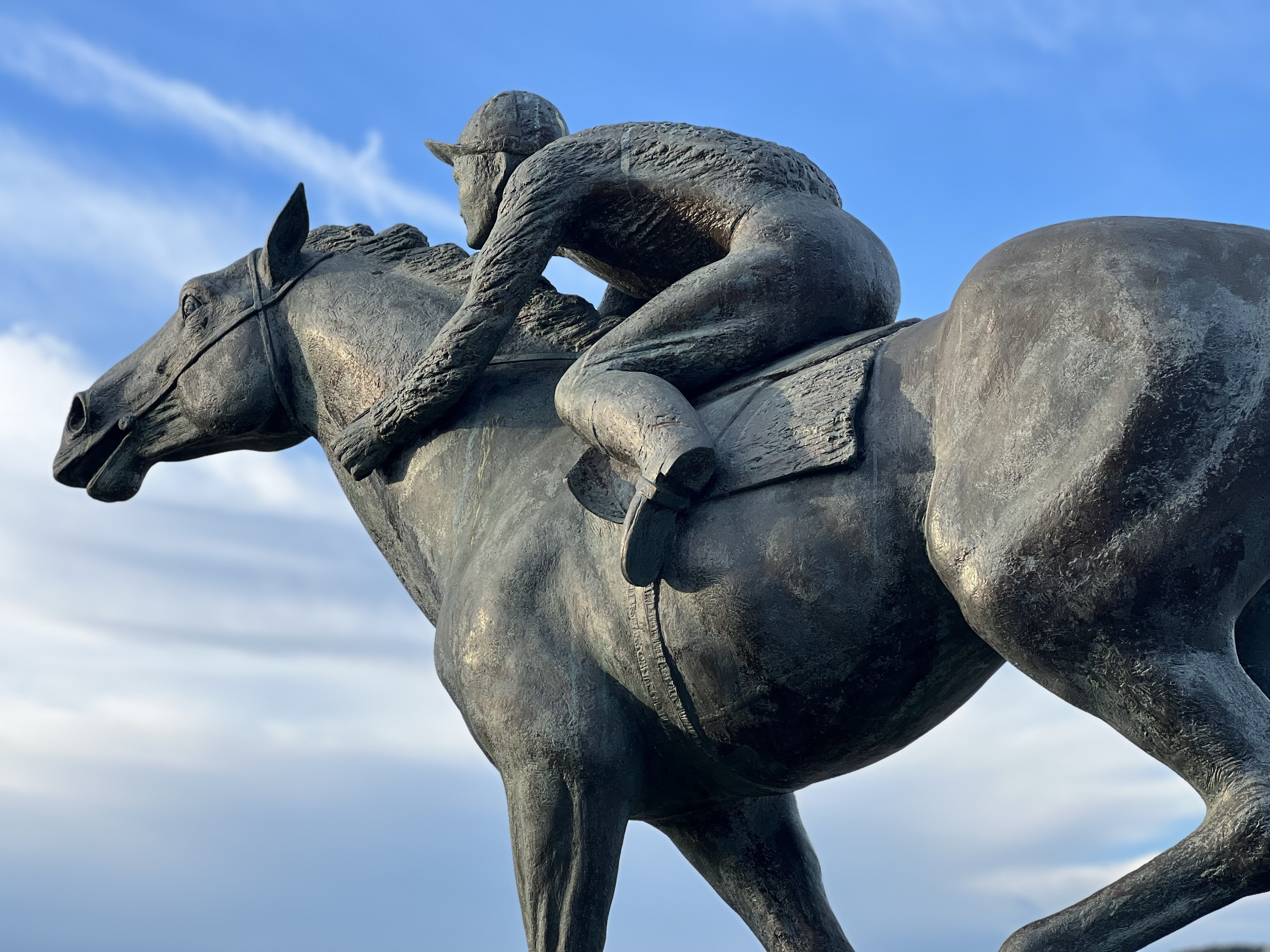
I know Seabiscuit from a statue at the entrance to Tanforan Mall. Seems such an odd place for a horse and rider sculpture but when you know that from 1899 to 1964 the location used to be a racetrack. Tanforan Racetrack featured many of the best thoroughbreds in racing history. The grandstands burned down by suspected arson and then leveled to make way for a mall which opened in 1971.
Tanforan also has a more dubious history as a processing center for Japanese Americans during 1942, then known as the Tanforan Assembly Center. Around 7,800 Japanese Americans were rounded up here and lived in horse stalls for about eight months. They were then sent on to other interment centers across the west.
The plaque under the statue reads: “Seabiscuit Born 1933, Sired by Hark Tack- out of Swing On, Owner- Charles S Howard, jockeys Red Pollard-George Woolf, World Champion Money Winner to 1938.”
Seabiscuit was stabled at Tanforan for a time and ran races here. In 1939 the horse left Tanforan by train when Seabiscuit journeyed east to race War Admiral.
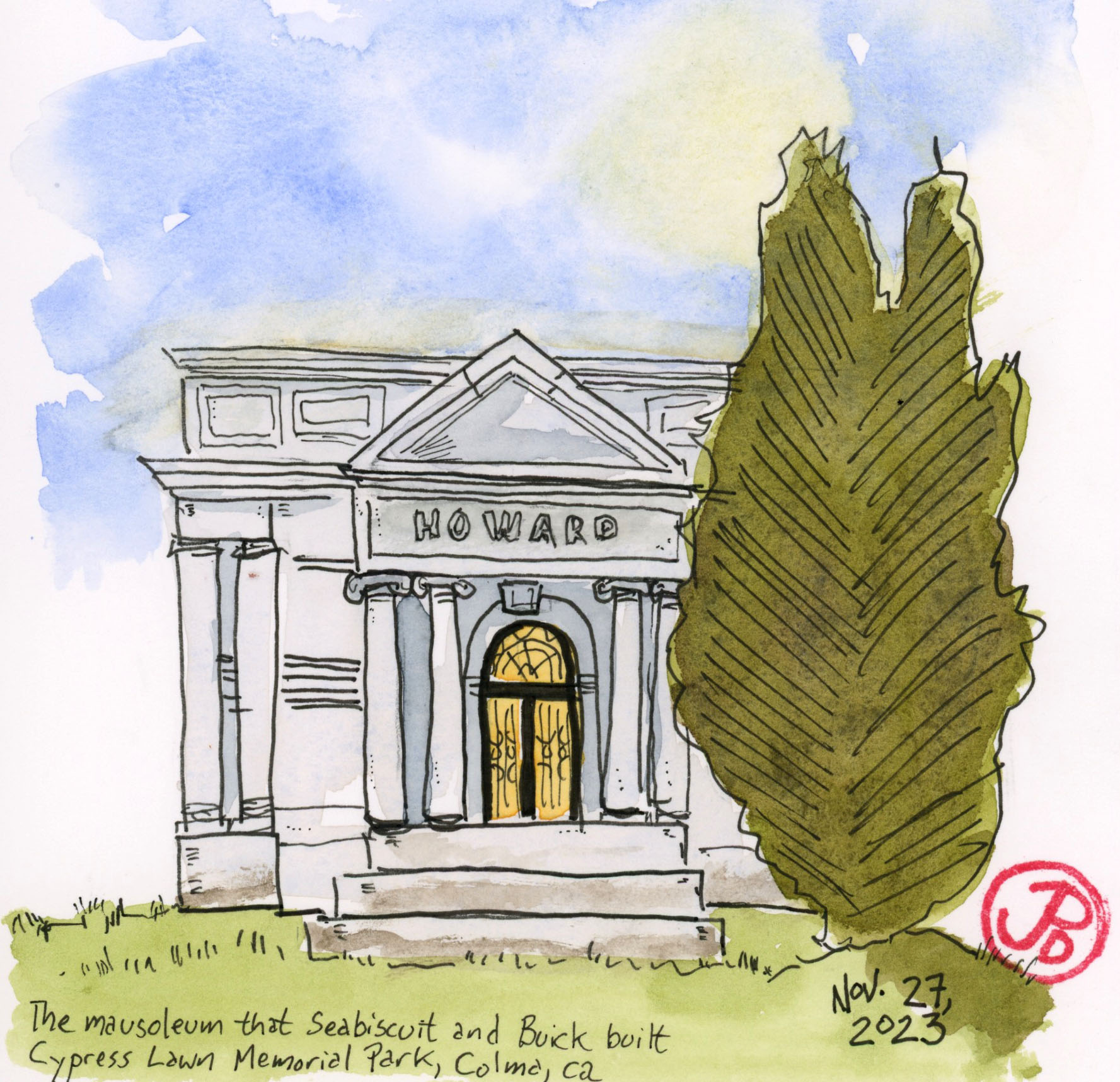
Another bit of Seabiscuit history can be found just north of Tanforan in the sleepy town of Colma. At the Cypress Lawn Memorial Park rests Charles S. Howard.
Howard was Seabiscuit’s owner. The multimillionaire was responsible for Seabiscuit’s success by finding the perfect combination of horse, trainer (Tom Smith), and jockey (Red Pollard).
Manassas/ Bull Run is about 40 minutes to Reagan National Airport so I couldn’t resist the urge to visit the site of the first major land battle of the Civil War.
When I arrived from Winchester, it was still raining.
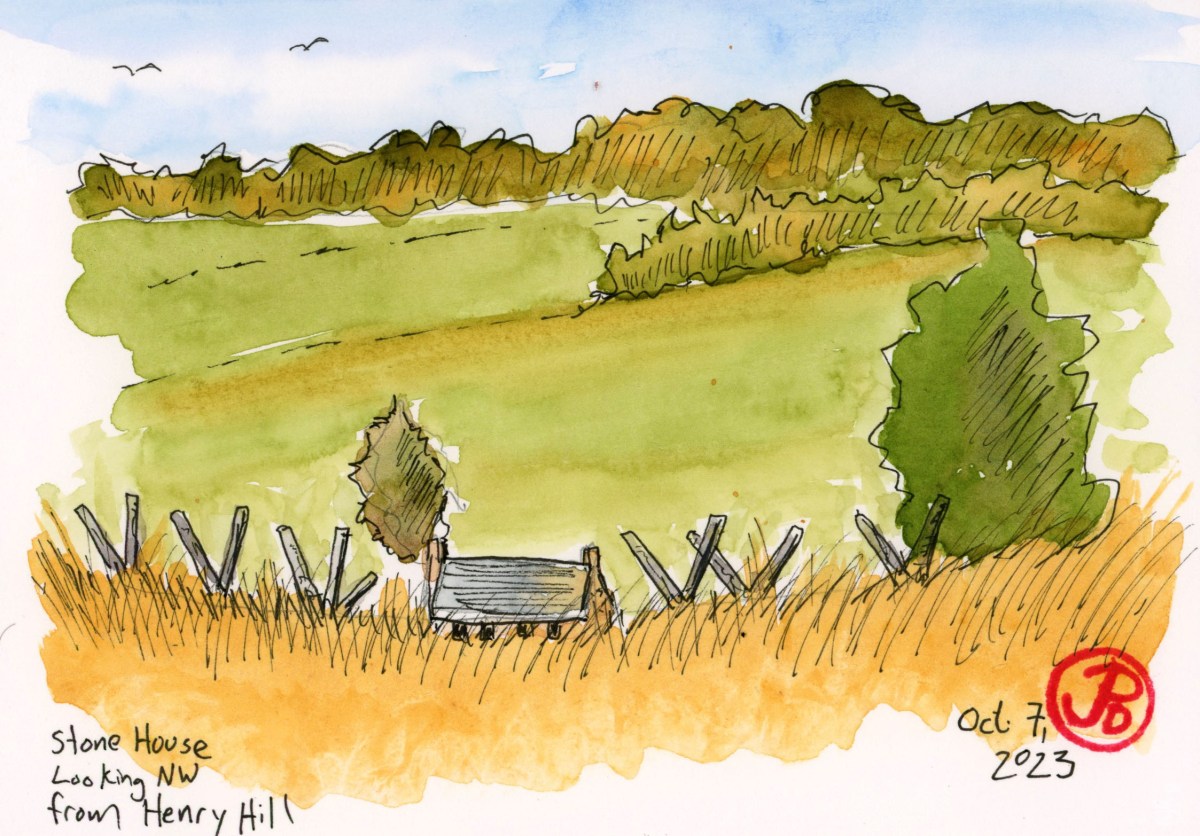
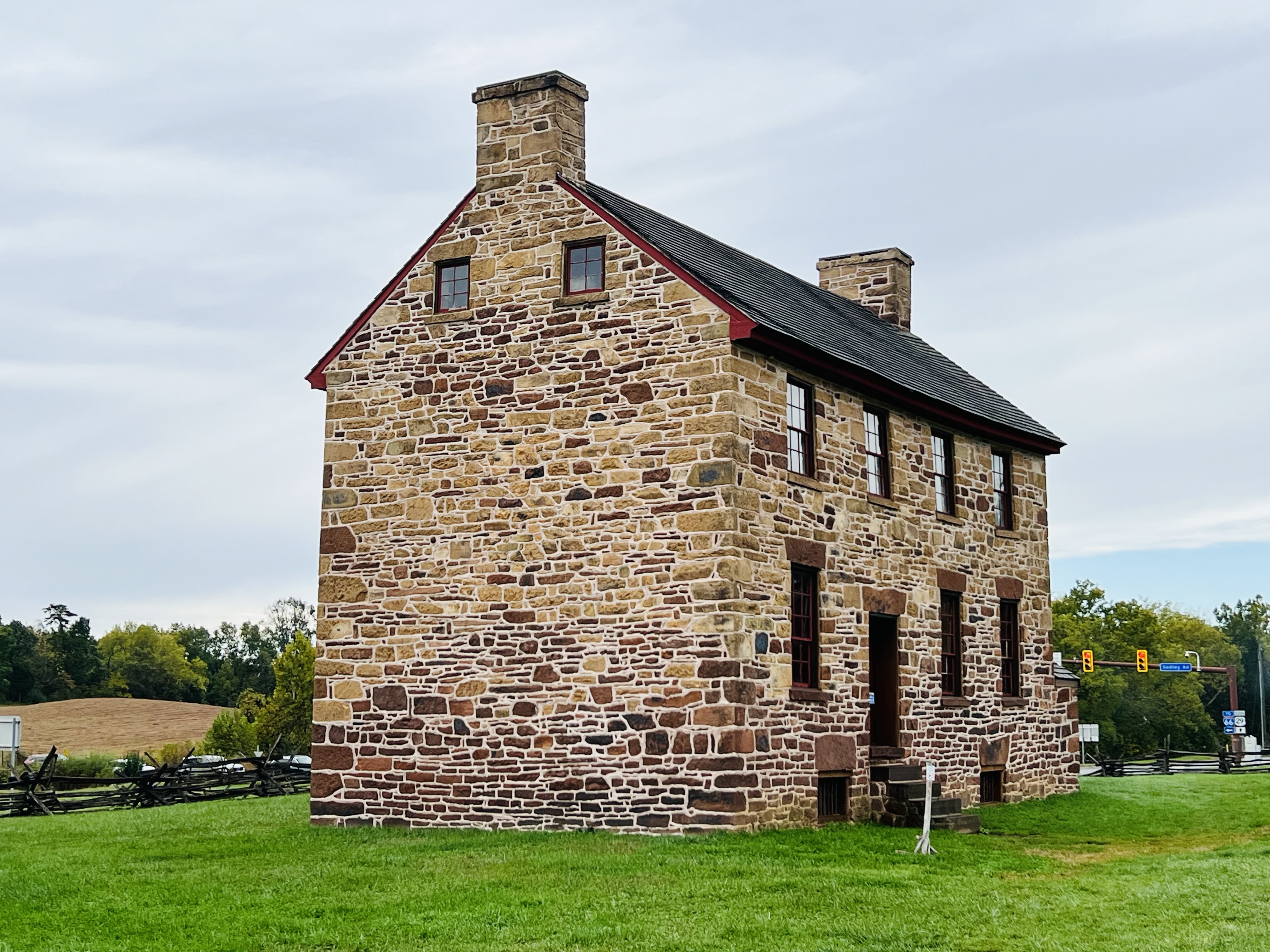
The focal point of the first battle was Henry Hill, named after the widow Judith Henry, who lived on a farmstead during the battle. She refused to leave and was killed in the battle when her house was hit by artillery fire.
On the crown of Henry Hill is the grave of Judith Henry, perhaps the first civilian killed during the Civil War. The stone house is one the few structures that still stands from the two battles at Manassas. It was used as a field hospital during both battles and upstairs solider carved their names into the wood. The Union cannon position on Henry Hill looking towards the woods where the Rebels charged their position. It was the first time the northerners heard the bone-chilling Rebel Yell.
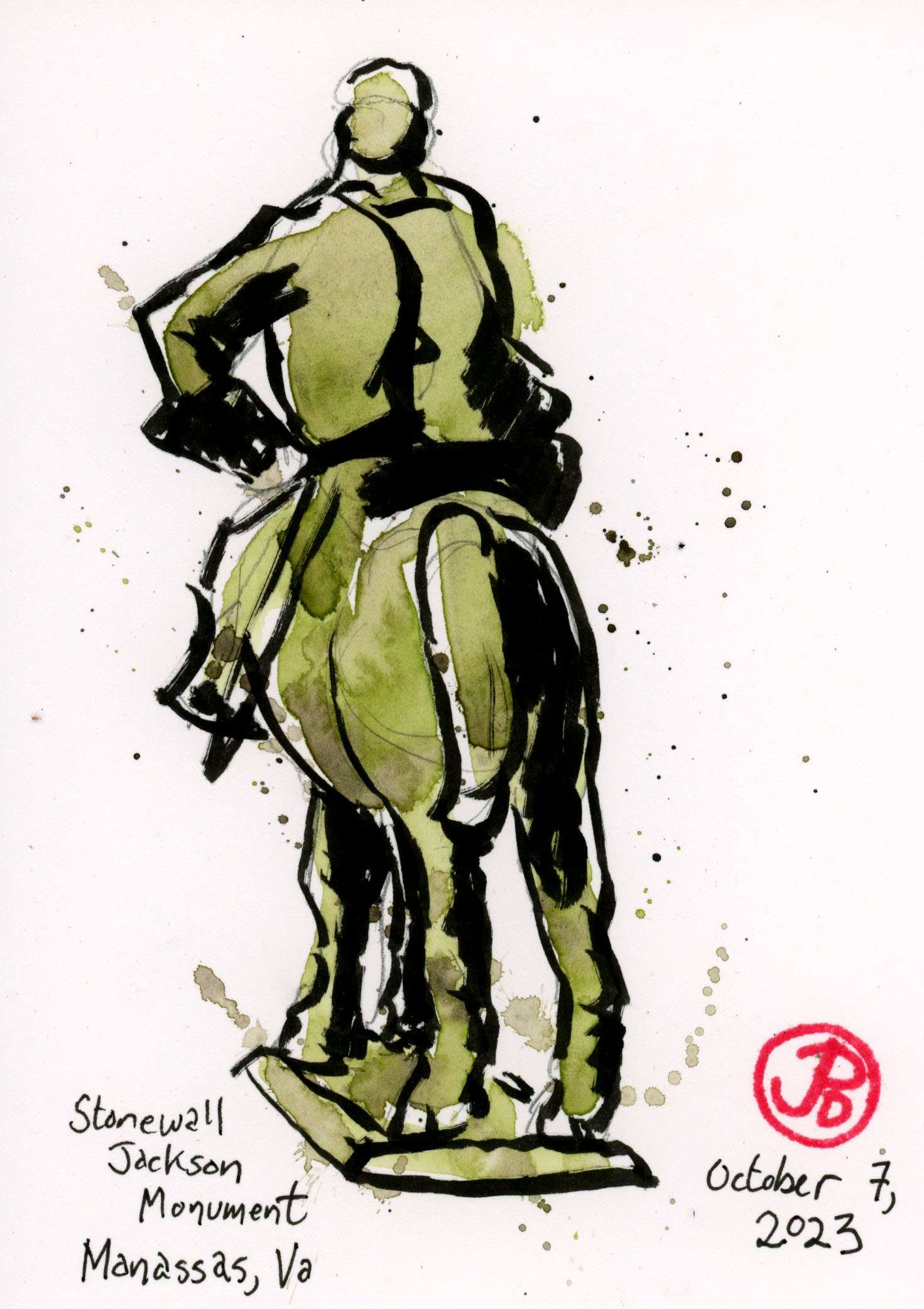
One Confederate commander made his name at the first Battle of Manassas on Henry Hill and his name was Thomas J. Jackson. Jackson held his Virginian troops at the brow of Henry Hill and General Barnard Bee of South Carolina, in a attempt to rally his own troops, supposedly said, “There is Jackson standing like a stone wall! Rally behind the Virginians!” or it could have also been, “Look at Jackson standing there like a damned stone wall!” Whatever Bee really said is lost in history because a Union bullet silenced him forever soon after his remarks. And the Commander is forever known as Stone wall Jackson.
A quick field sketch of the Stonewall Jackson Monument at Manassas.
The northwestern Virginia town of Winchester changed hands during the Civil War 72 times. But my travels to Winchester was not to see a battlefield or a monument but a humble two story house in a working class neighborhood.
The house’s history had nothing to do with the Civil War but was to home one of the world’s best singers: Patsy Cline.
Patsy is one of the most influential singers in county music who transcends musical genres and her music crossed over into popular music with hits like: “Walkin’ After Midnight”, “I Fall to Pieces”, “Crazy”, “She’s Got you”, and “Leavein’ On Your Mind”.
She was born Virginia Patterson Hensley in Winchester, Virginia on September 8, 1932.
It had been raining all morning on my drive from Staunton to South Kent Street in Winchester. I was able to find a parking spot across the street from the humble two story house with a historic plaque out front.
I sketched the house, where Cline lived from ages 16 to 21, in my rain-proof-automobile-blind. I was here too early to get a tour of the inside (I had a Civil War battlefield to sketch before my flight to SFO).
After my sketch was complete I had one other place in Winchester to visit just south of downtown: Shenandoah Memorial Park.
On March 3, 1963, Patsy Cline performed at a benefit with George Jones, Dottie West, Hawksaw Hawkins among others in Kansas City.
On the following day she chose to fly back to Nashville instead of accepting a ride with Dottie West for an 8 hour car ride, saying, “Don’t worry about me, Hoss. When it’s my time to go, it’s my time.”
Patsy Cline’s time was on the evening of Tuesday March 5, 1953, when the Piper PA-24 Comanche she was traveling in crashed in a heavily wooded area near Camden, Tennessee. The time read 6:20 PM on Pasty’s watch, which was recovered after the tragedy. Patsy Cline was 30 years old.
Her final resting place is in Shenandoah Memorial Park.
Perhaps I was expecting a bit more for a memorial to one of the best singers in recording history but her grave, like her childhood home, is humble and simple.
The only way you would know that this was a person of note was the amount of flowers and coins placed on the marker. I had a quiet moment, sung a tune in my head, and then placed a penny at her grave and then drove through the steady rain to Manassas.
Now it was my turn to be a foamer in a car. I planned to chase 611 from Goshen to Staunton on her afternoon run.
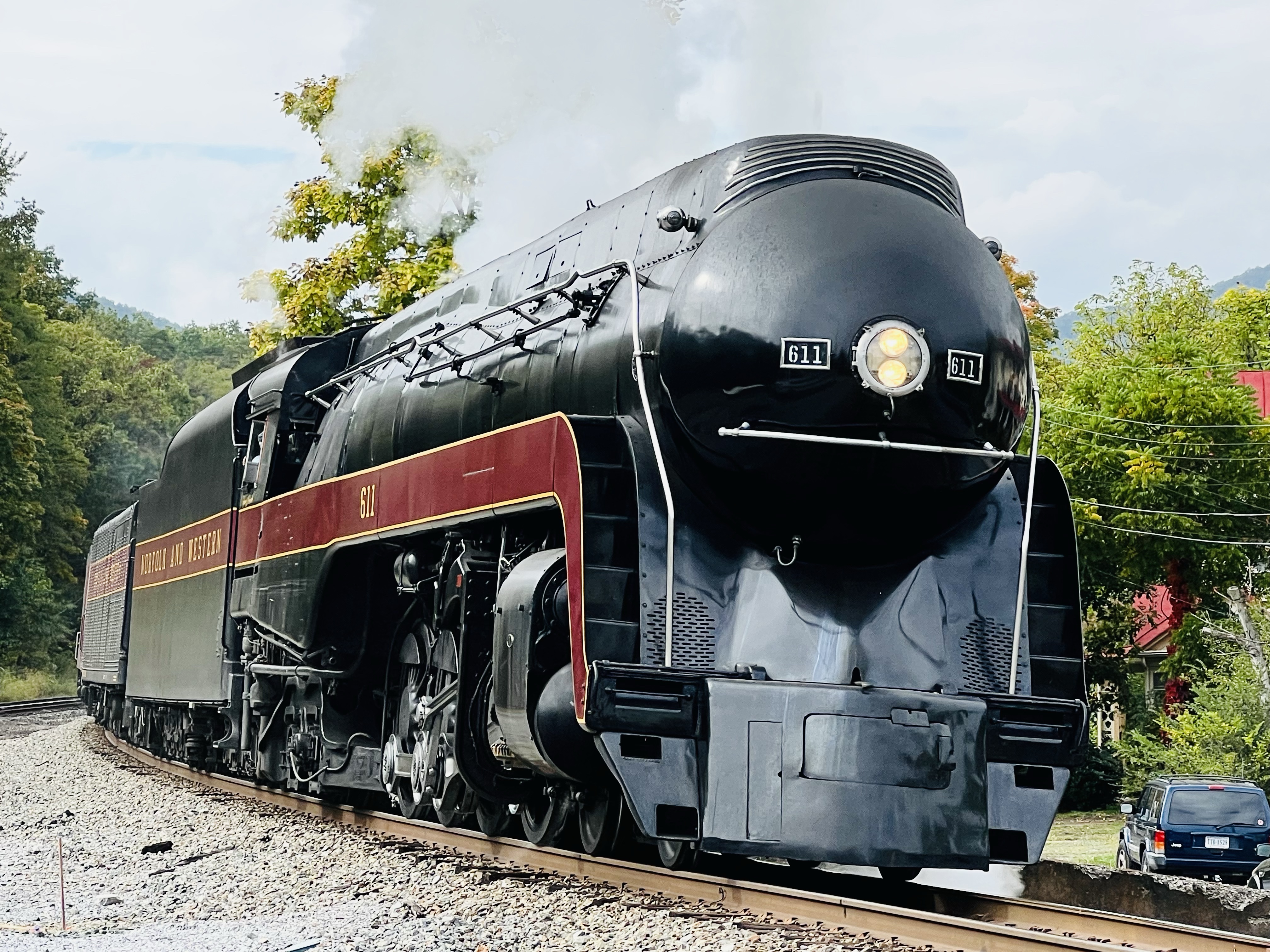
611 being mobbed by fans at Goshen before the afternoon run to Staunton.
I headed into “downtown” Goshen and parked near the railroad. There were already a few chasers getting ready. One was looking over a map and was conversing with another foamer on which grades you could get the best “stack-talk”. He was a serious foamer who had done his research and was willing to share it with the like-minded.
After a wait of about 45 minutes, 611 sounded it’s whistle and the Shenandoah Valley Limited was on it’s way. She had to back her consist onto a siding before headed onto the mainline. Now 611 was facing Staunton and the engineer pushed the Johnson bar forward, released the breaks, and pulled back on the throttle. No. 611 burst in steaming-hissing life!
Down the tracks the sounds of the stack-talk (or the chuff-chuff-chuff of the exhaust) was amazing. 611 blew the crossing and passed the old Goshen Depot and steamed off to Staunton.
Let the foam-fest begin!
611 heading toward approaching the grade crossing at Goshen.
Now this is “stack-talk” as 611 approaches the grade crossing at Goshen. You also hear her powerful whistle.
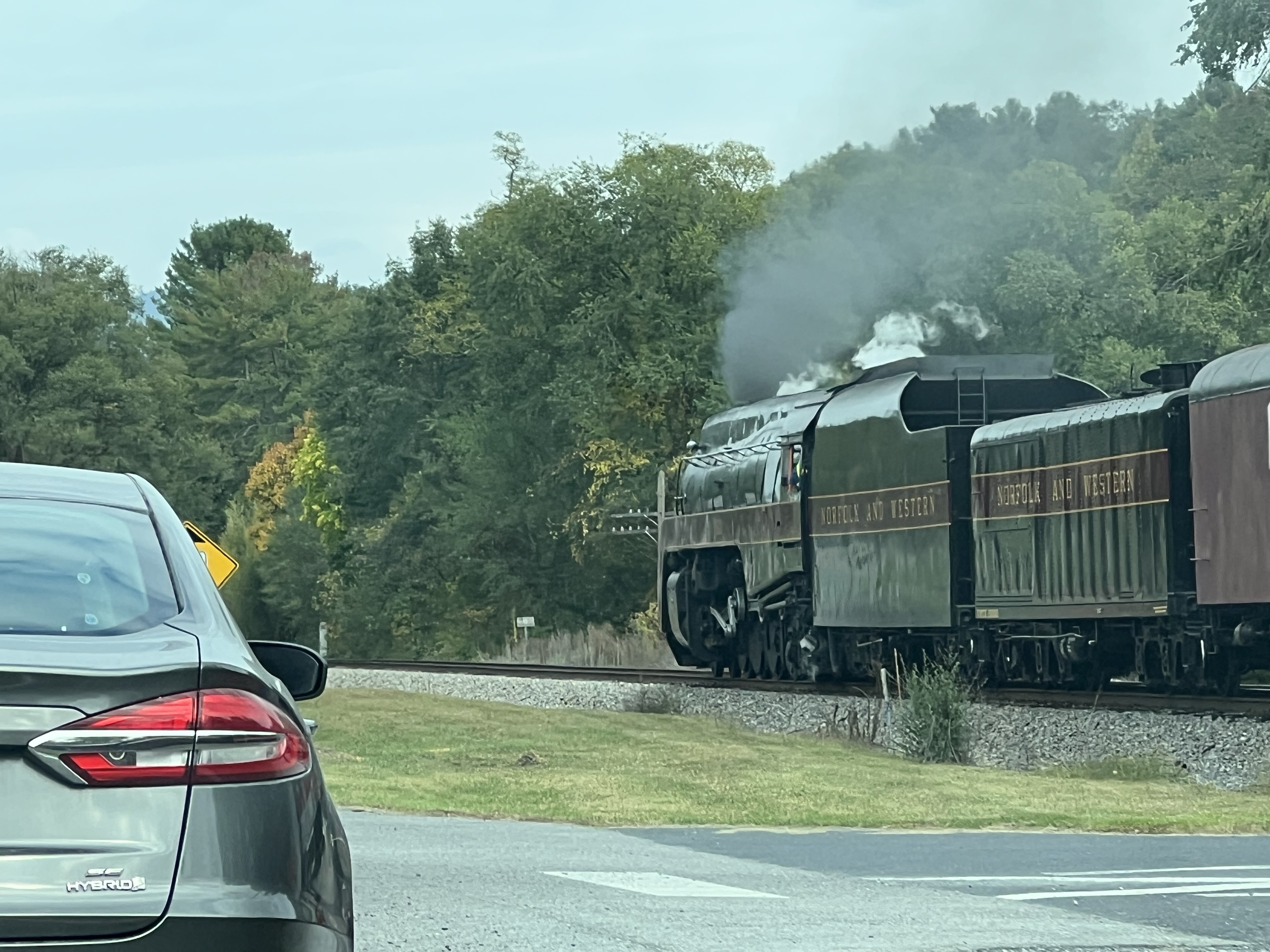
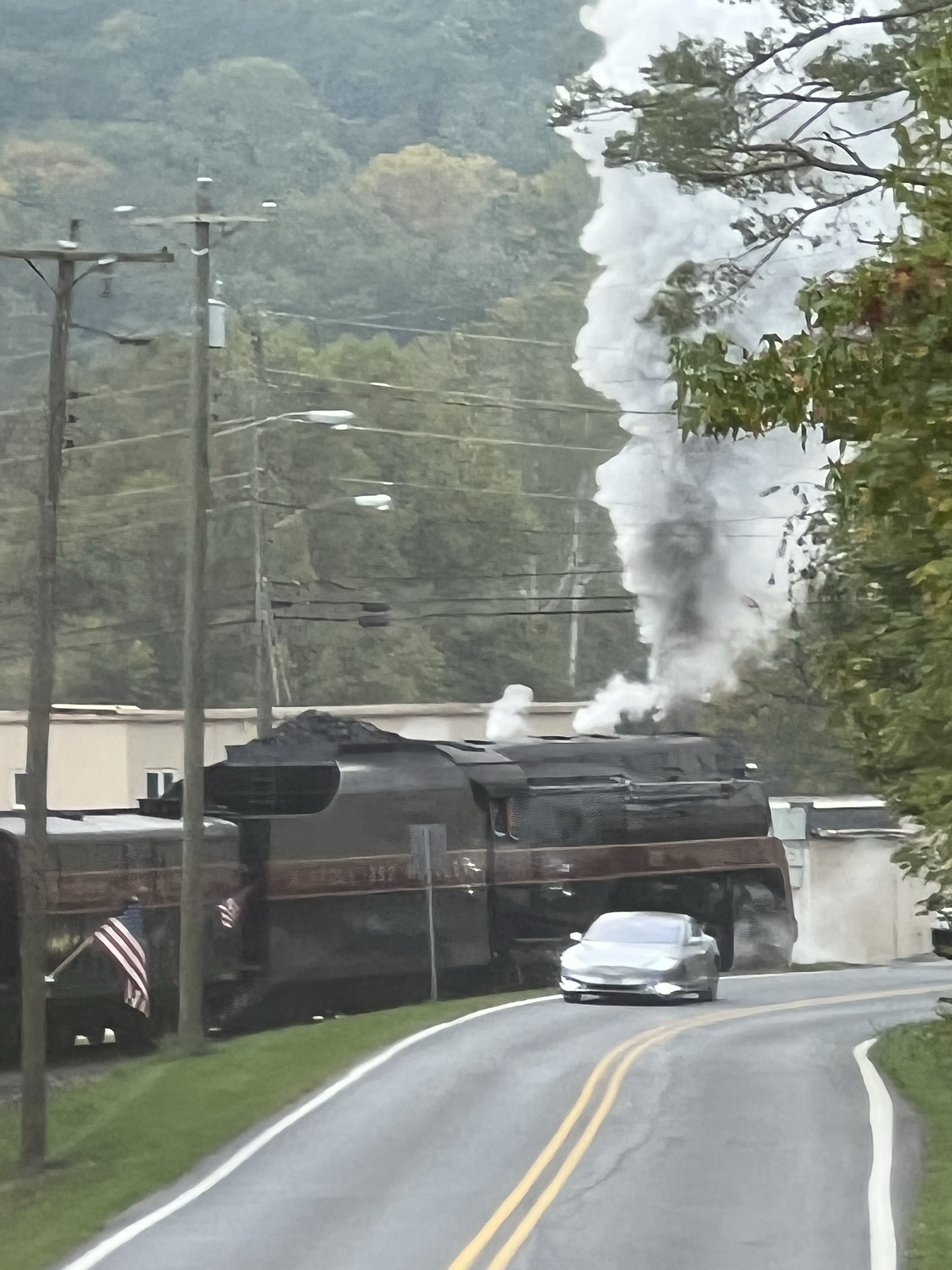
I then joined the line of foamers in cars on Highway 42, which parallels the line. This has created a traffic jam on the two lane road because the pacers wanted to take pacing shots of 611. I and most others on the road, wanted to drive ahead and get shots of 611 on a run by.
611 and dreaded line of pacers in front of me!!
After some of the pacers pealed off, I was able to get ahead of the madding crowd and pulled off to get a run by shot of 611.
611 at a grade crossing.
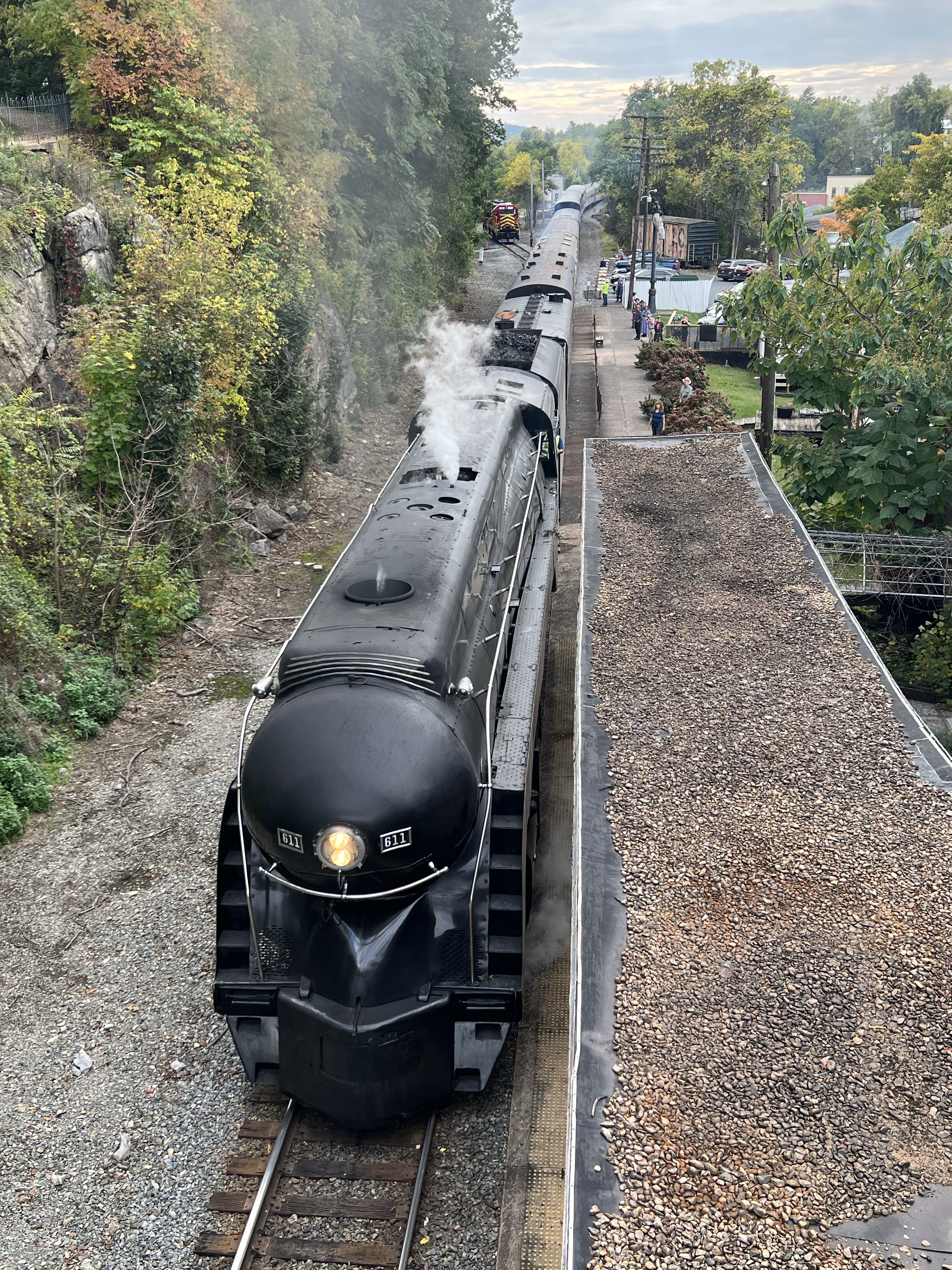
From here, I made a b-line to Staunton because I wanted to get a shot on the walkway above the tracks as 611 pulled into Staunton Station.
611 pulling into Staunton Station. 611 is streamlined even from above. Off to the left are the two diesels that will pull 611 and her consist back to Goshen.
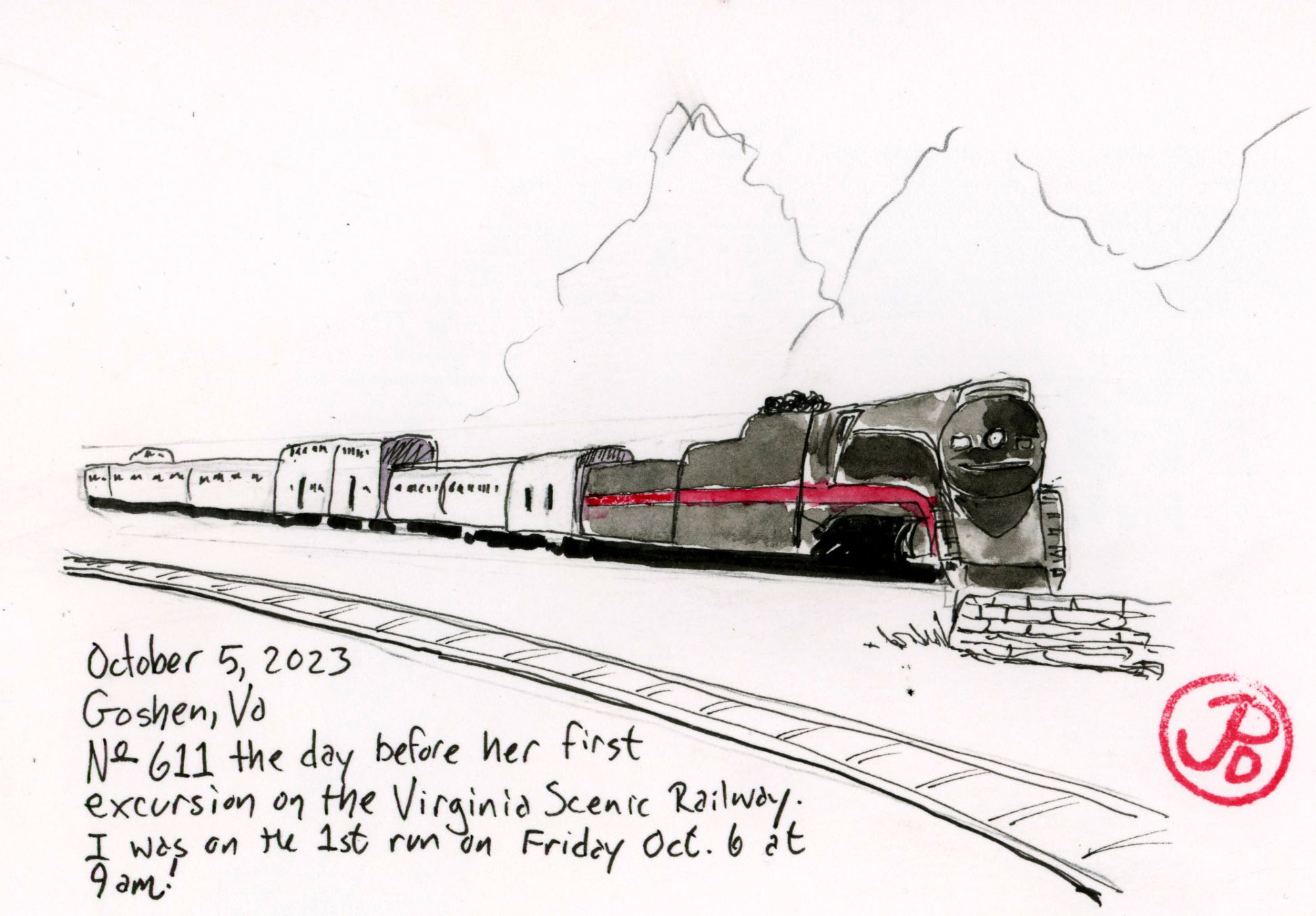
Before my train ride on Friday, I wanted find out where Goshen was. It appeared on my Virginia map but was not mentioned in the travel guide. So I set out of lexington on Thursday afternoon to get an idea of where Victoria Station was.
I came to the station and drove down a dirt road and I could see the excursion train on a siding with 611, under steam, on point. There were still setting up the pavilions and grading the road so I could get a good look at the Queen of Steam.
I returned to the main road and then pulled onto the should where I though I was about level with 611, hoping I could get a look at the iconic locomotive from the road. I was able to get a look at 611 and took a few picture which I based the sketch below on.
I couldn’t wait to Friday morning!
I arrived at Victoria Station in Goshen, an hour early and there was already a line forming at the checkin pavilion.
It seemed a mix of casual rail enthusiasts, older folks out for a guffawing good time, and foamers, train addicts that “foam” at the mouth anytime they get near a piece of vintage rail equipment. Better yet if that equipment has steam pouring out of it and is making hissing sounds.
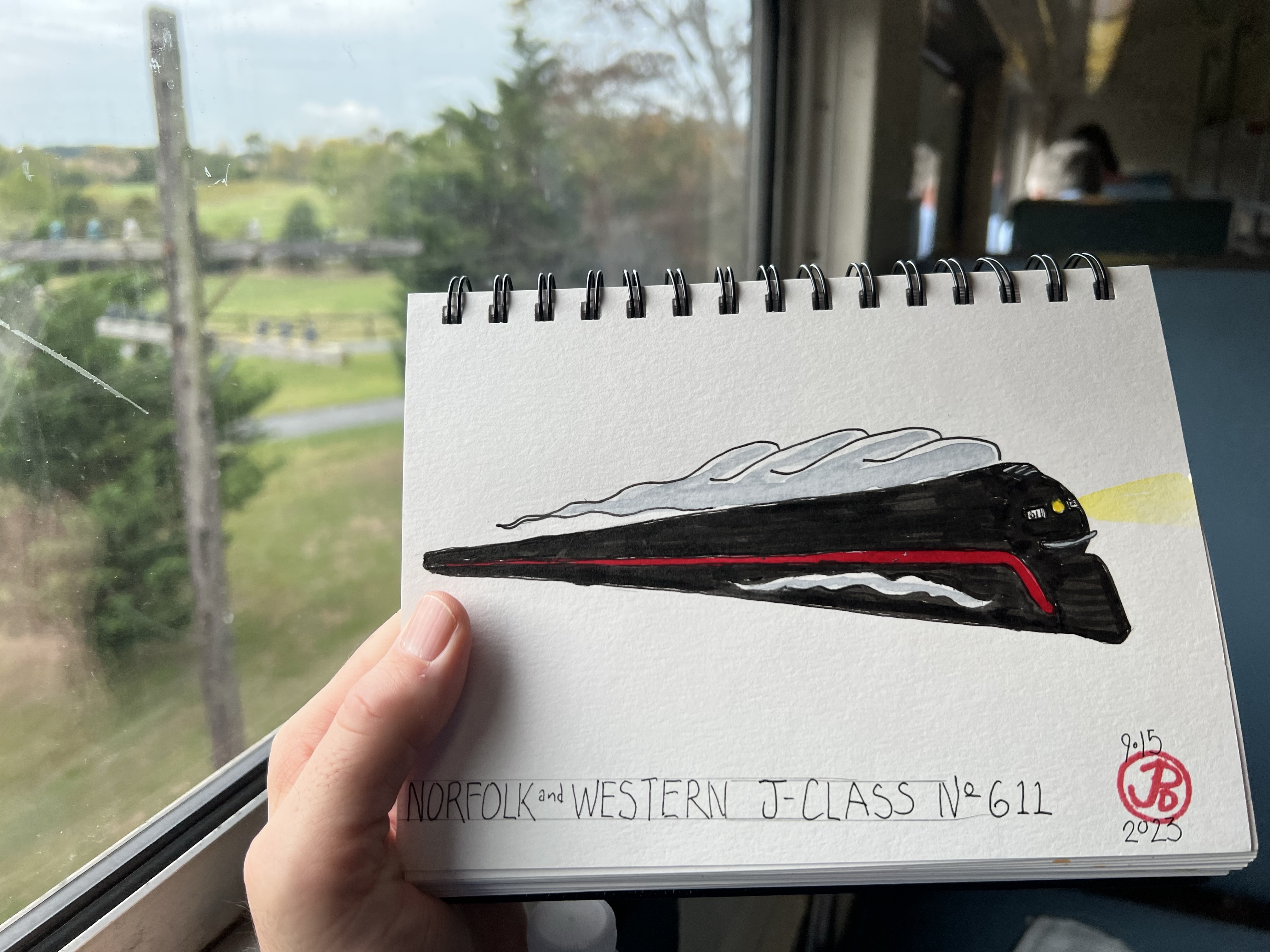
I really wanted to arrive early so I could sketch 611. Norfolk and Western Class J No. 611 is a very beautiful passenger steam locomotive, fully streamlined, giving the machine a sleek look. Her curved and voluptuous lines screamed “speed” and the streamlining makes the locomotive look more an airplane or an ocean-going vessel. She just looks quick!
611 at Victoria Station, Goshen.
It is said that a steam locomotive is like a living, breathing being and I was taking in the sights, sounds, and scents (she’s a coal burner after all) as I was sketching her stately profile.
We boarded and I had a seat in a bi-level car, the type used on commuter lines like Caltrain. I was originally in the bottom level, surrounded by some of those guffawers who were having a Grand Day Out and wouldn’t have cared if Thomas the Tank Engine was pulling our consist. I escaped up to the second level (after first doing a sketch), and had a great view from above.
We backed out of the station at 9:05 AM. This was the first run of the Shenandoah Valley Limited, an excursion that would be running in the month of October, Friday through Sunday with a morning and an afternoon trip daily.
611 backing out of Victoria Station. A foamer is already pacing the Queen of Steam.
611 pulled onto a siding and with a retort of her baritone whistle, she puled onto the mainline, heading towards Staunton (pronounced “Stanton”).
Over the next two hours we headed through the forests starting to show their fall colors. We passed a lumber mill, a few small towns, and backyards scattered with rusted old cars and trucks that were now being repurposed as nature’s planter boxes.
We pulled into Staunton Station at 10:55. From here, two Buckingham Branch Railroad diesels were coupled to the back of the train and be would be pulling the train back to Goshen with 611 riding behind like a big, black smoking caboose.
Throughout our four hour rail journey we were followed by foamers in cars. Some of them would pull ahead of us and then pull off to get a run by photo or video (or both) and them run back to here idling cars and we’d see them a few miles down the line. The worst kind of chaser is called a “pacer” and the drive at the speed of the locomotive which is anywhere between 15 to 40 miles an hour. They hold up traffic and are often driving well below the speed limit to the consternation of other foamers or locals just trying to get to the grocery store.
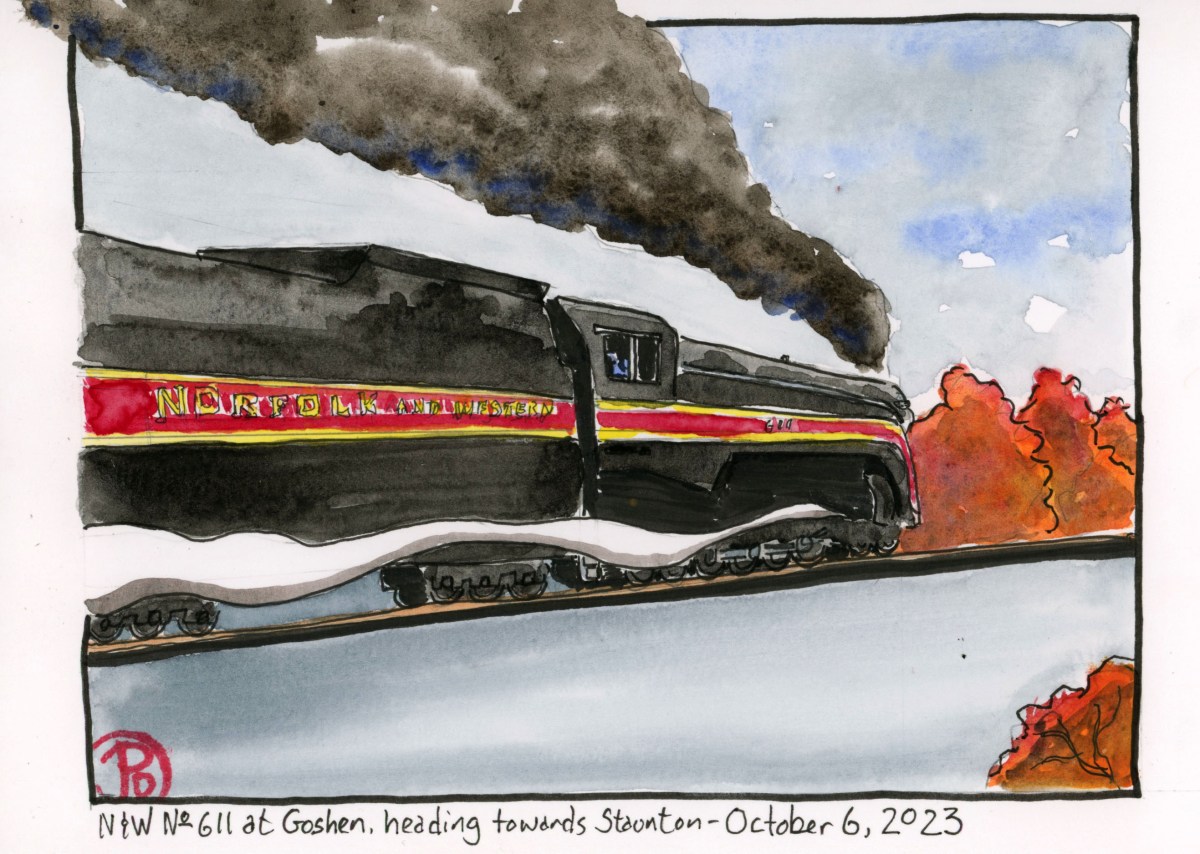
When we returned to Goshen, I knew 611 would be static for a long enough time for me to get a sketch in (featured sketch).
What a great experience with a legend of the steam era.
I had not ridden behind a Northern type (4-8-4) on the main line since 1984 when my father and I rode a train pulled by Southern Pacific GS-4 No. 4449, from San Francisco to Los Angeles. This was a two day excursion with a stop in the bright lights of Fresno.
For the afternoon run to Staunton I became one of those crazy foamers in a car, but that’s for another post.














 Corvid Sketcher