Image

Big Boy 4014 on the High Iron: Oroville

In an old railroad book from my youth, The Illustrated Encyclopedia of North American Locomotives by Brian Hollingsworth, one locomotive featured always caught my attention. It is a locomotive built late in the steam age (1941) and found on page 136. This is Union Pacific’s Big Boy 4-8-8-4.

The last sentence about Union Pacific’s Goliath reads, “Six are preserved at widely-spread locations from California to New Hampshire, but none are operable”.

None were operable until 2019 when that California Big Boy, No. 4014, was restored by Union Pacific’s Steam Shop to work the high iron again.

And I was not going to miss the first visit of the world’s largest steam locomotive to Northern California.

Although 4014 was on static display in Pomona, California, the Big Boys were designed as a freight locomotive to tackle the Wasatch Mountains between Cheyenne, Wyoming and Ogden, Utah.

I planned to see the steam Goliath at Oroville Depot where the locomotive would be making a 30 minute whistle stop after threading its way through Feather River Canyon from Portola.

Now there was just one problem: heat. Intense heat. The forecast high for Oroville was 112! Now that’s way too hot for a coastal inhabitant like me who had just spent a week in the high Arctic!

I figured while it was hot just standing in the shade waiting for 4014, it was even hotter for the fireman and engineer in the cab.

Big Boy was scheduled to pull into Oroville Depot at 2:15, right at the hottest part of the day.

Luckily I found a parking spot under a shady tree. Even though it was a Thursday afternoon, I knew there would be a large turnout to see the first time a Big Boy pulled into Oroville.

As I walked up to the depot, there were more and more people lounging or languishing in the shade. I had arrived about an hour early and we all waited in anticipation for the roar of the whistle announcing the arrival of the visitor from the eastern high plains.

I took up a position across from the depot and a few minutes before 2:15 we could hear the whistle down the track which made the gathered crowd erupt in a cheer. The crowds on either side of the tracks leaned in, waiting for their first view or picture of No. 4014.
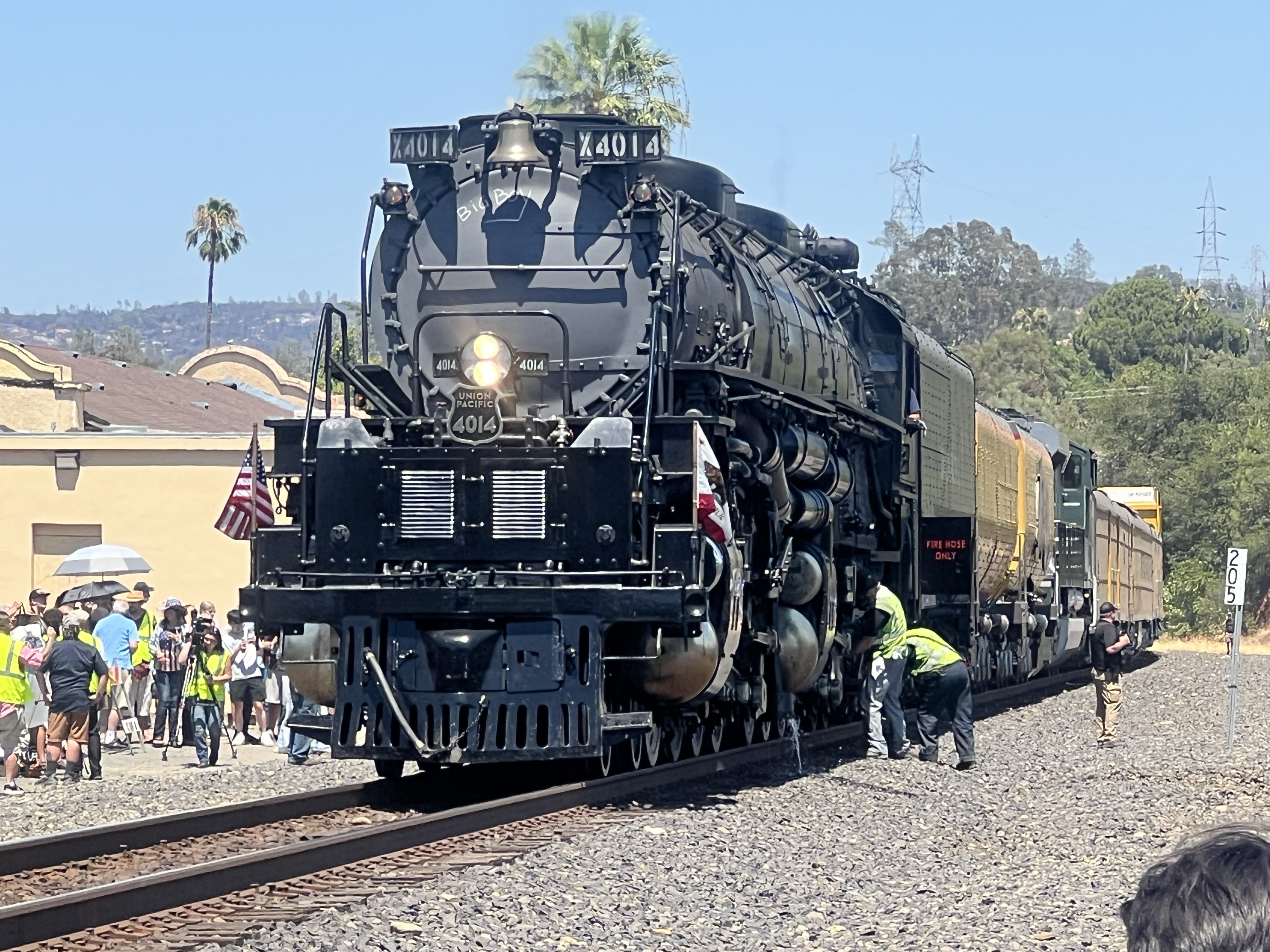
Through the sea of people I first saw 4014 decked out with the Golden State flag. Big Boy was back in California, under her own power.

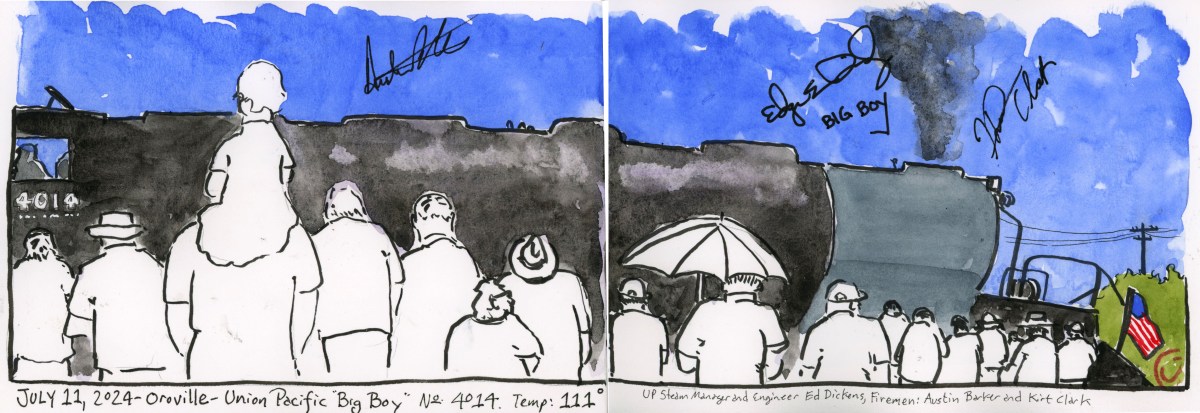
In my featured sketch, the crowds that turned out to see Big Boy were a big part of the story for me. So while 4014 is in the background, the locomotive is obscured by people.

While 4014 was on public display in Roseville, two days later, I had Ed Dickens, engineer and head of Union Pacific’s Steam Program, sign my sketch. He wrote “Big Boy” under his name just as he does every morning on 4014’s smoke box.

The other two signatures are of the firemen. Both the engineer and fireman work as a team to propel Big Boy down the high iron.
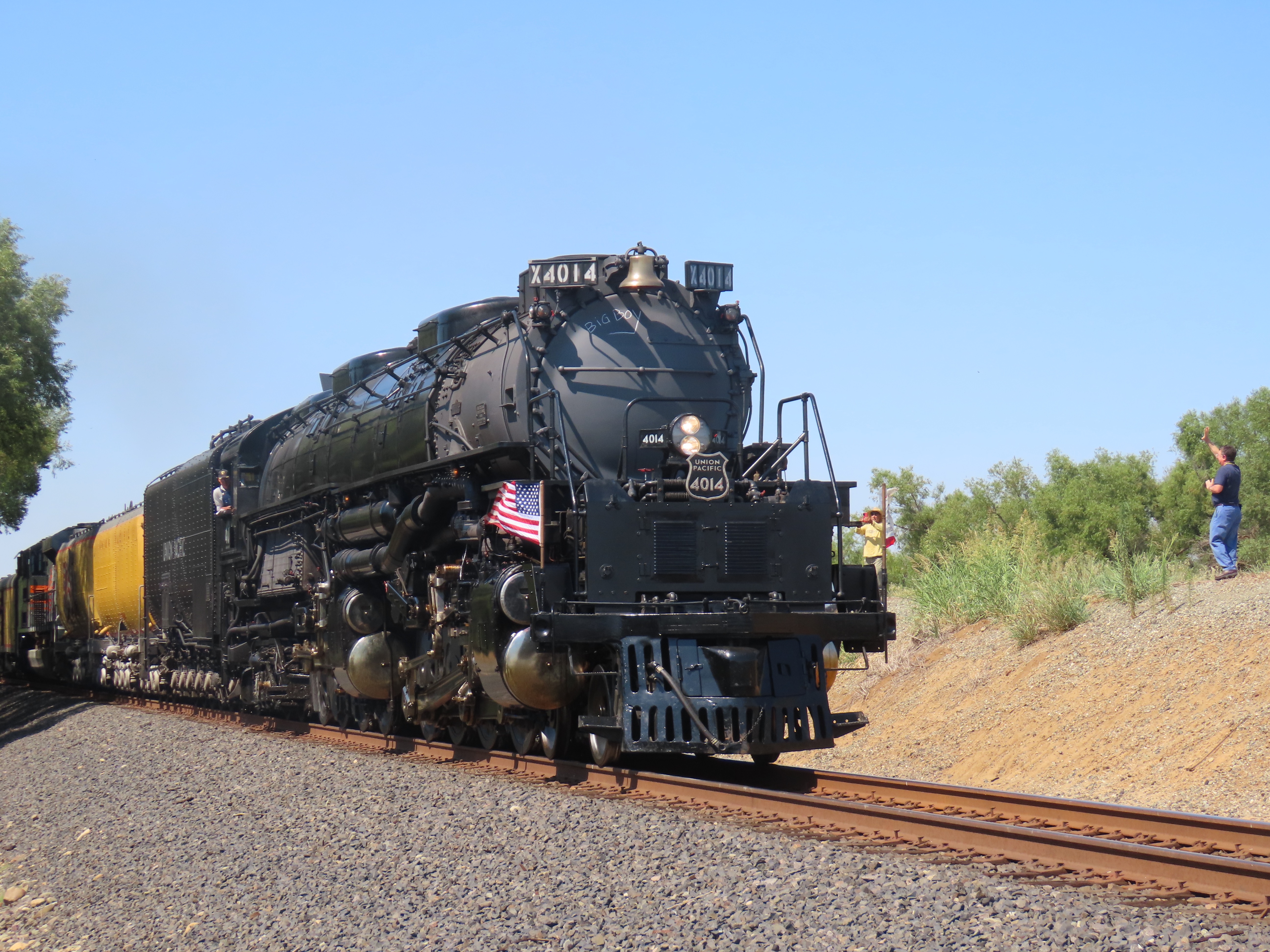
I caught 4014 a little further down the line at the Woodruff Lane grade crossing near Marysville.

Image

Sketchbook Roundup

On my 18 day Scandinavian trip to Norway, Svalbard, and Denmark I brought three sketchbooks (small, medium, and large.) Okay the large was not impressively large.

My prediction at the start of the trip was that if I brought smaller journals I would sketch more (point and shoot journals!)

My prediction proved correct. I sketched 29 sketches in my small sketchbook, 29 in my medium, and 14 in my large sketchbook (although some of the sketches cover two pages).

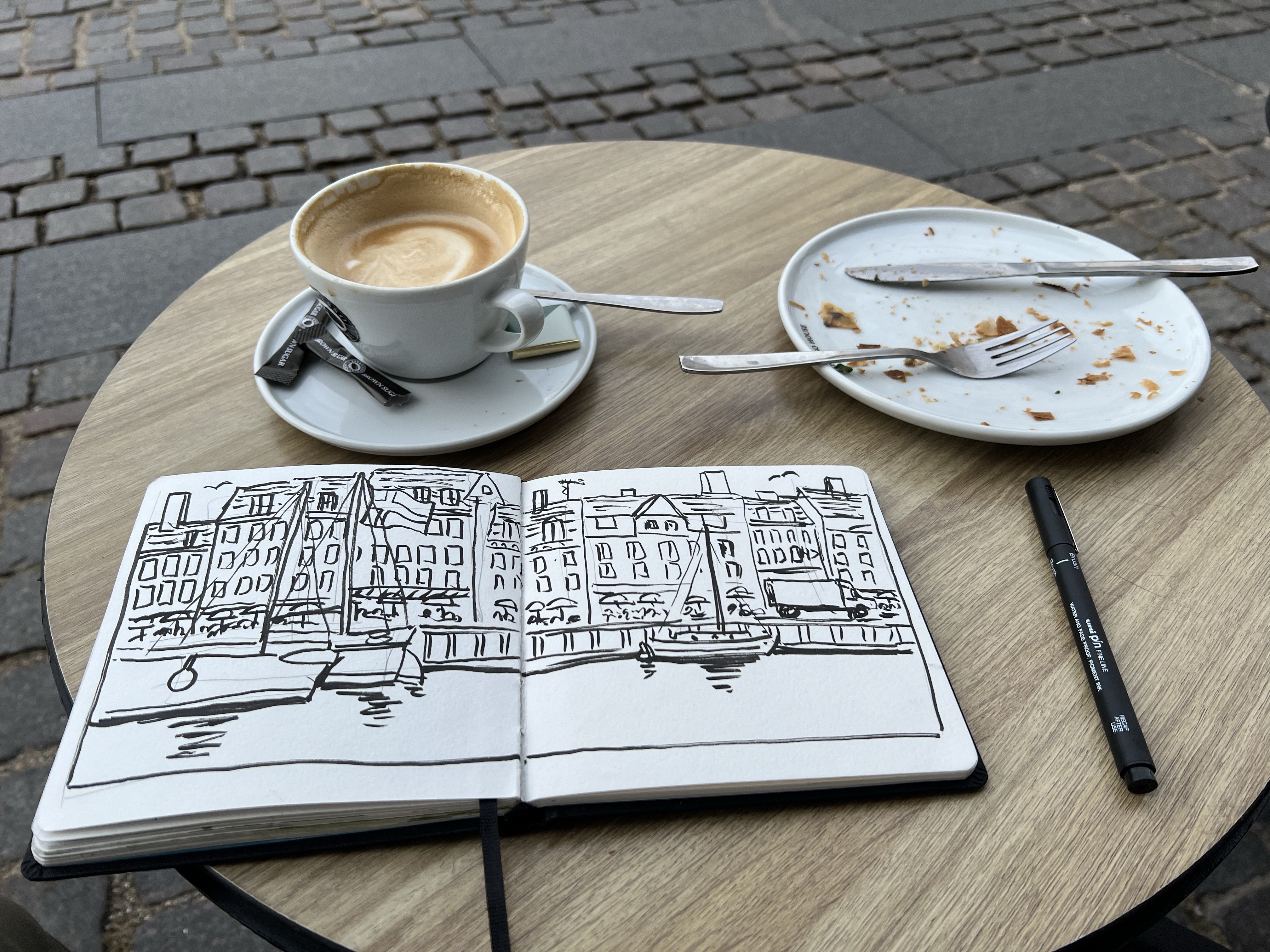
Getting sketchy and caffeinated in Copenhagen.

This trip proved to be very sketchy for me as I averaged four sketches per day for a grand total of 72 sketches over 18 days!

Some of this may have to do with the amount of downtime on my seven day cruise. But it is equally true that I was very inspired to sketch more of the impressive sights I found before me.

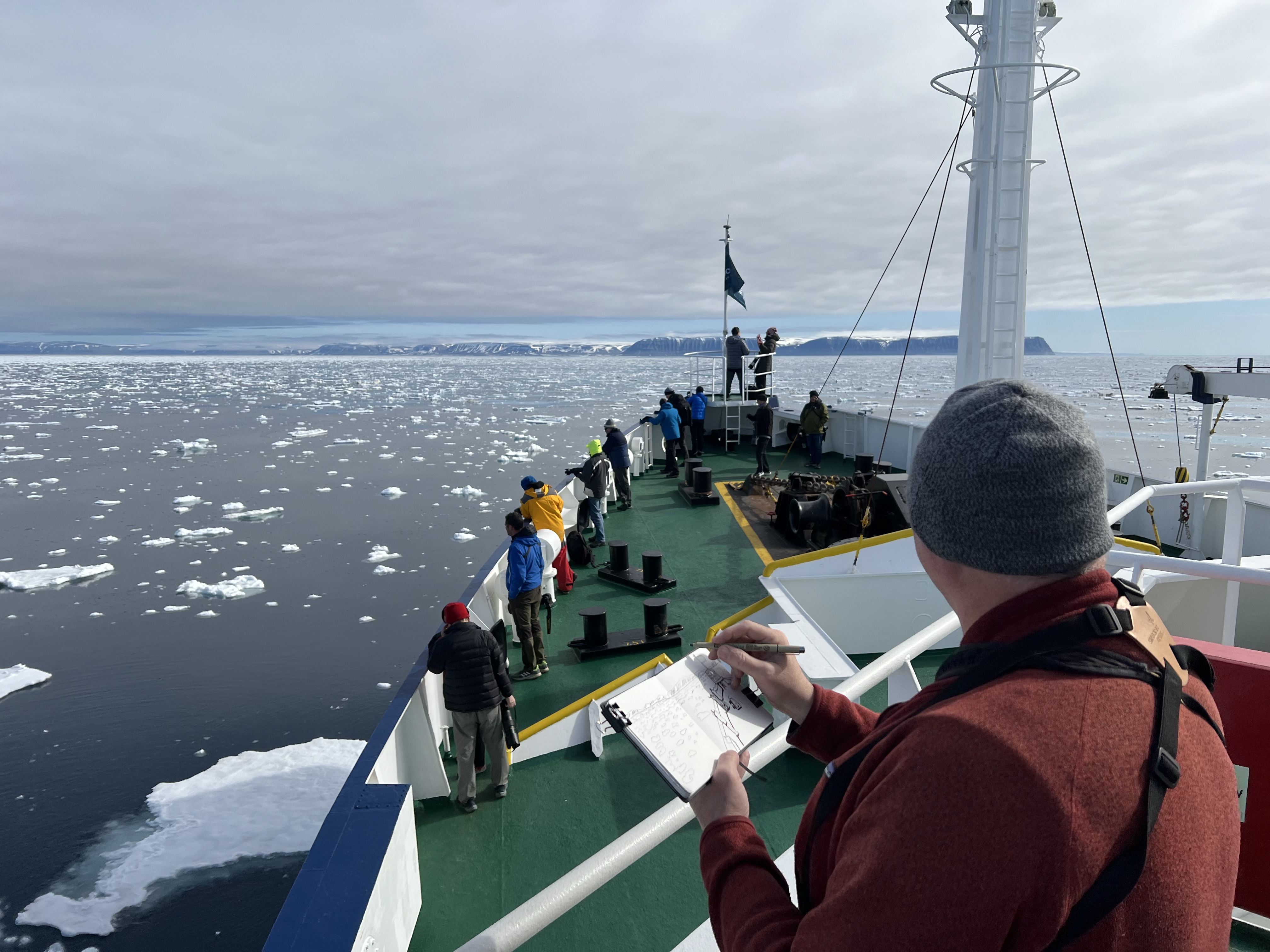
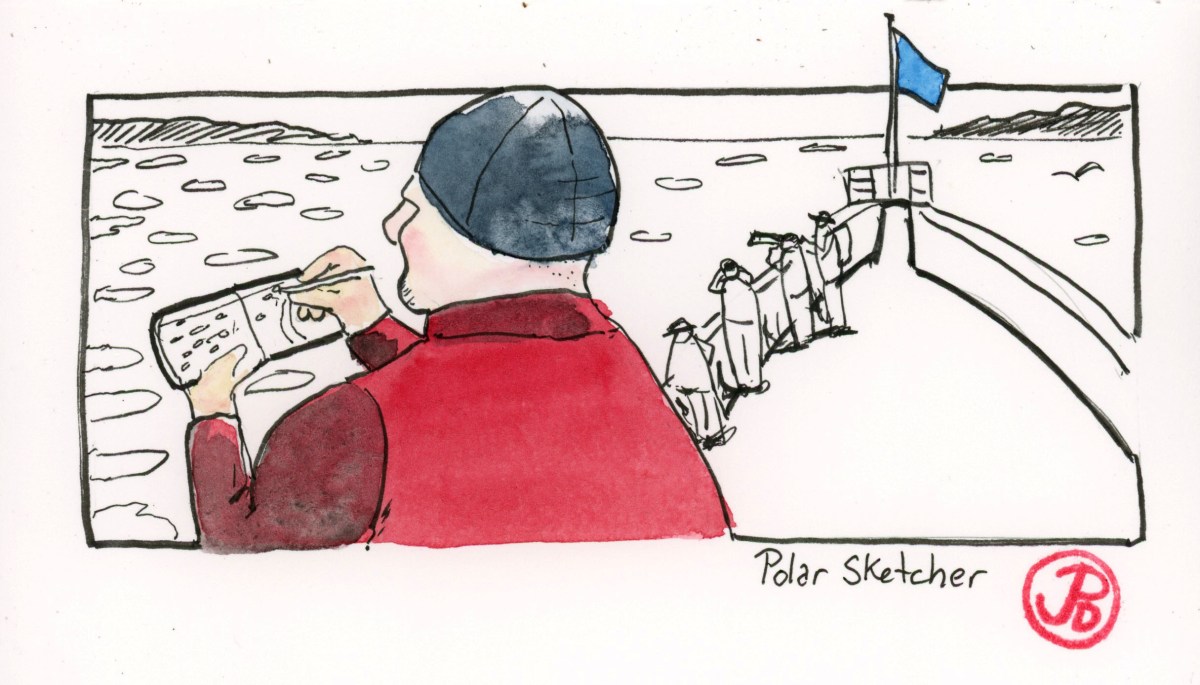
Sketching the sea ice east of Spitsbergen.
Image

World Bike City Copenhagen

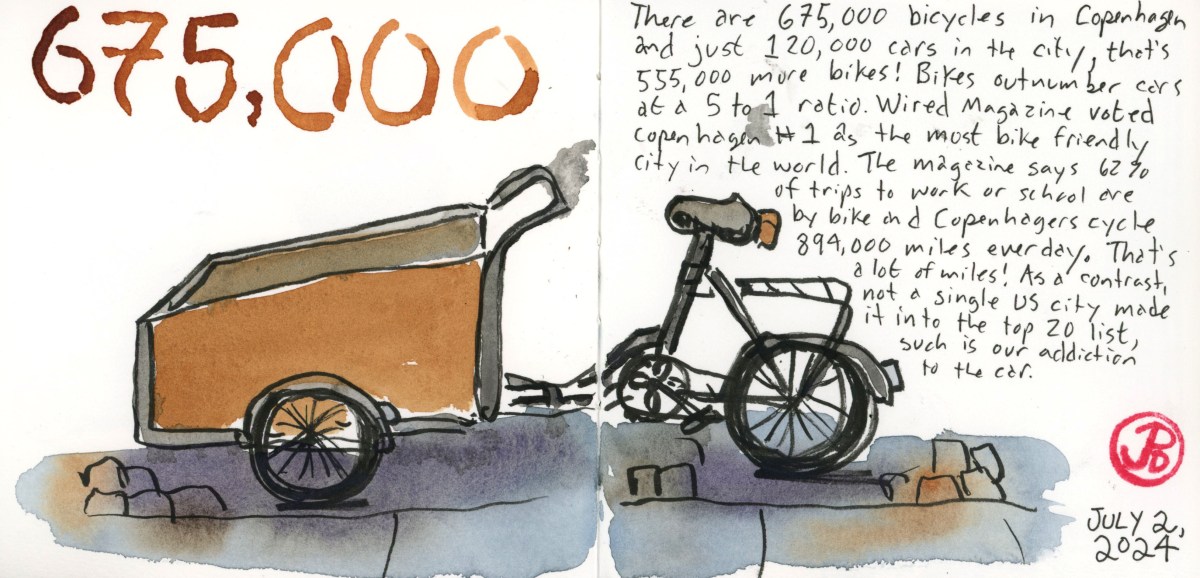
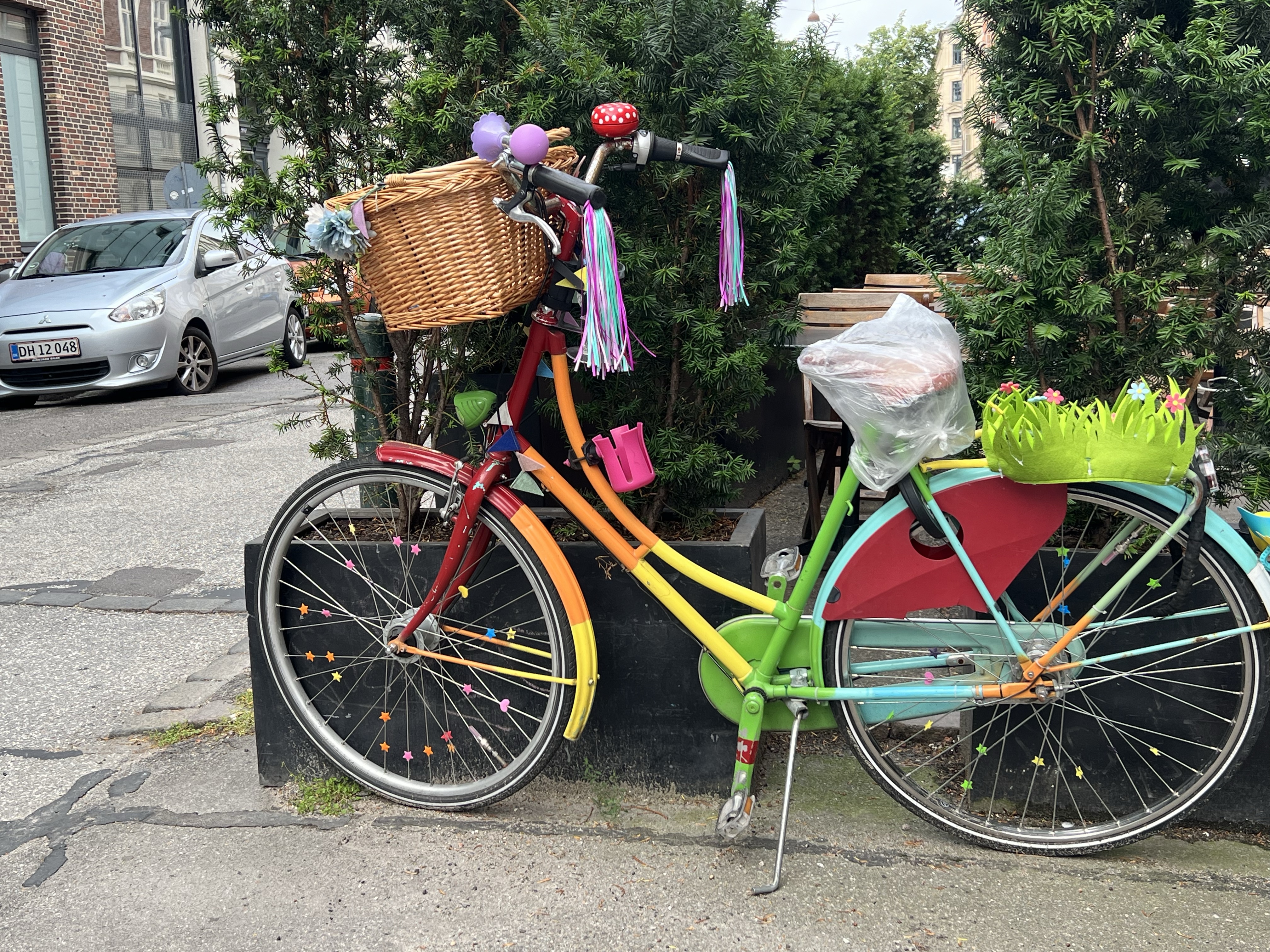
There are 675,000 bicycles (including tricycles) in the city of Copenhagen and just 120,000 automobiles. Bikes outnumber cars by a 5 to 1 ratio.

There are bikes everywhere. Bike lanes in every street. According to WIRED magazine, 62% of Copenhageners ride bikes to school or work. 65% of children ride their bikes to school. Nine out of ten people own a bike.

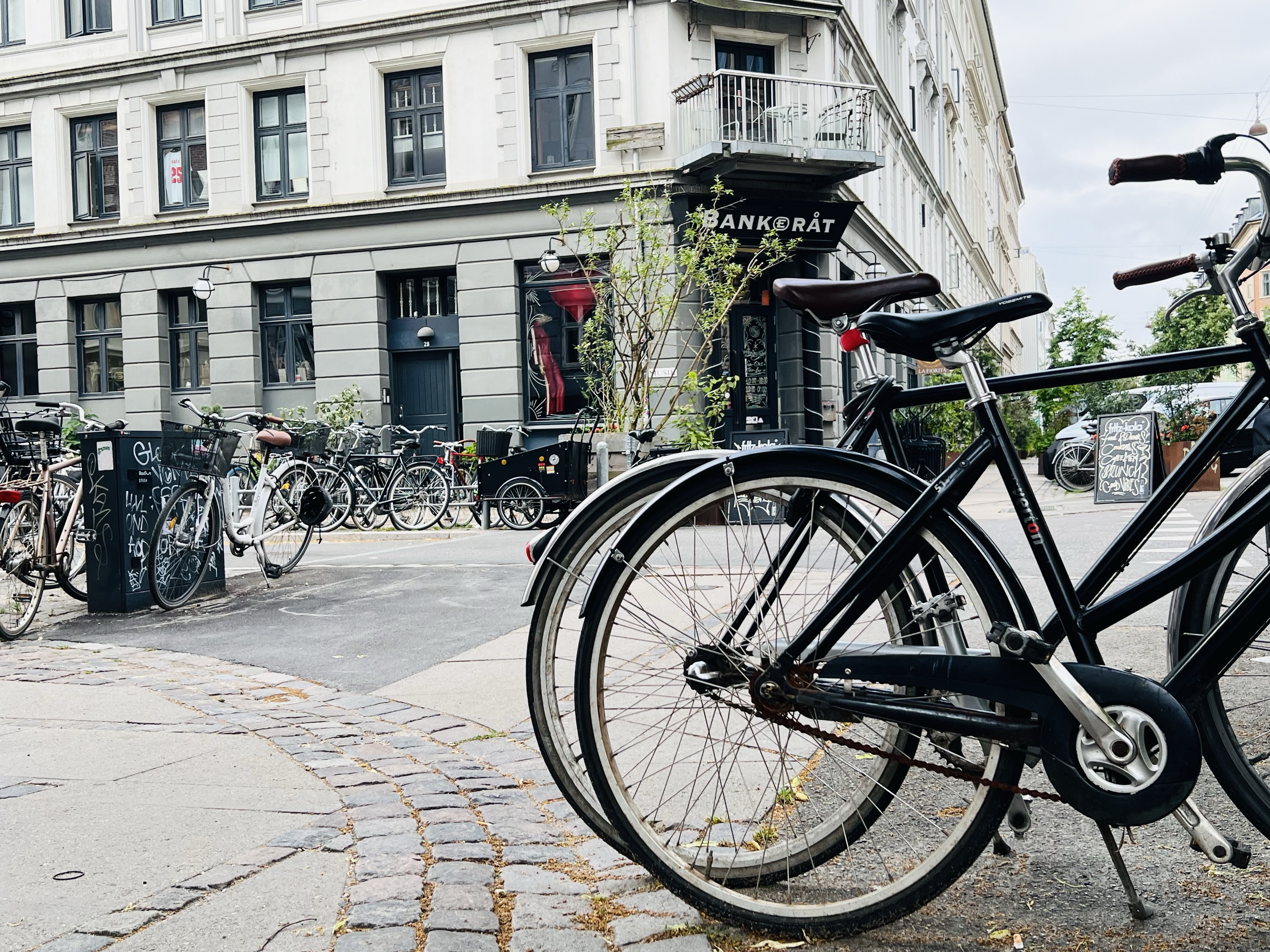
Bikes, bikes everywhere. The corner near my Copenhagen digs.

It was refreshing to see a city with a great public transportation system with buses, metro, and regional rail that could get you anywhere.

One of the quicker ways to get around the city’s streets is on two or sometimes three wheels. There are designated bike lanes everywhere. As a pedestrian you had to be careful not to wander into the bike lanes and look like a clueless tourist.

As a Californian driver I appreciated that cyclists always used their hand signals in Copenhagen to indicate where and what they were about to do, including coming to a sudden stop.

Finding a motorist using their turn signals in the Bay Area is as rare as seeing snow in San Francisco!

Image

The Five Ships of Roskilde

One of my Viking sketching targets was 20 minutes, as the train flies, from Copenhagen. This is the fjord-side city of Roskilde.

Roskilde boasts a cathedral where all the royals are buried, but I was here to see the famous Viking Ships of Roskilde.

It was easy to make my way west on Denmark’s very frequent and efficient metro and rail system. Everyone, if you are not already on a bike, rides the trains in Denmark.

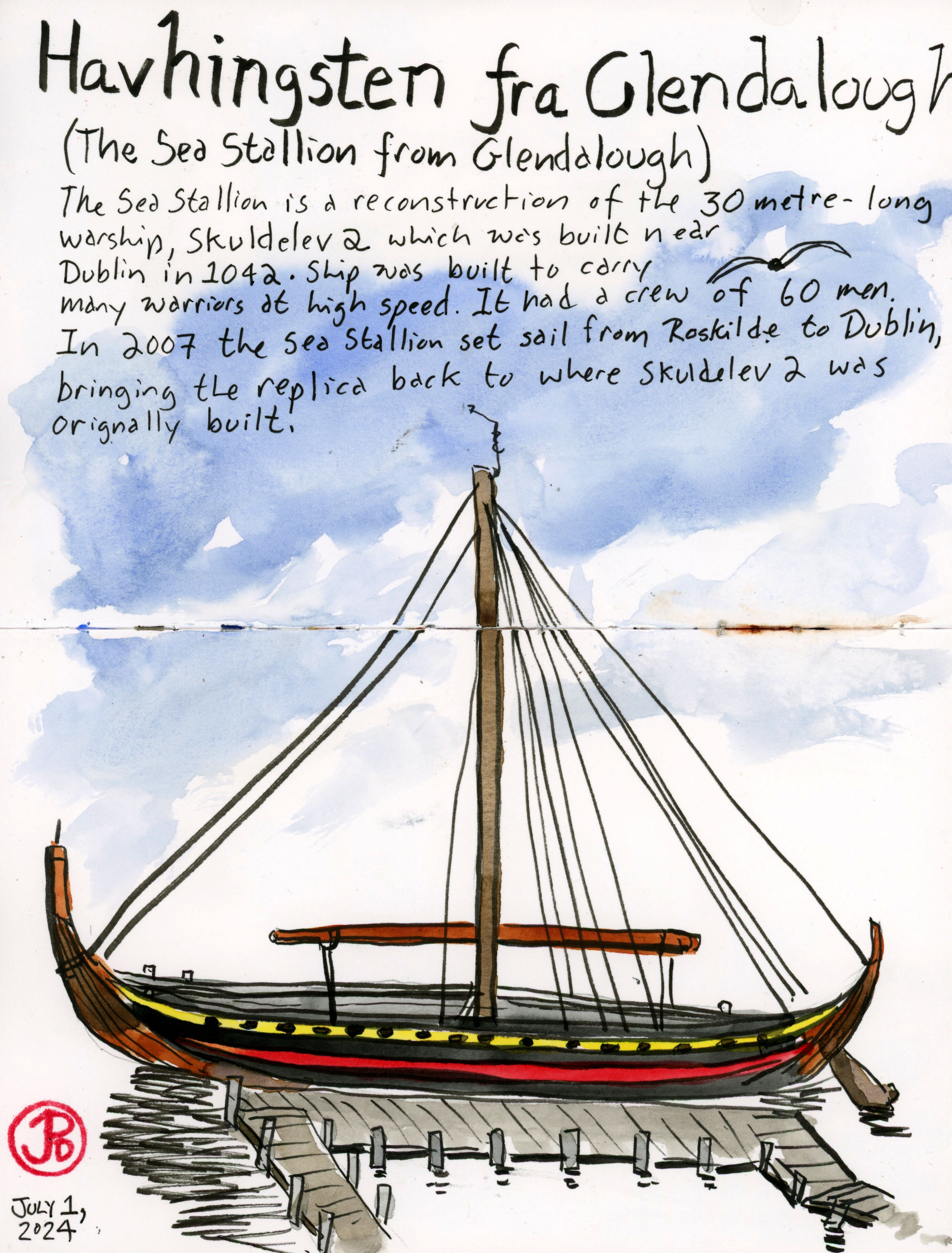
After a 20 minute train ride, I alighted at Roskilde Station and proceeded to walk north from the station to the Vikingeskibene. After about 20 minutes I came to the edge of the fjord and the Viking Ship Museum. The museum would open in 30 minutes so I sketched the Sea Stallion of Glendalough, a reconstruction of the long ship Skuldelev 2.

What’s amazing about the long ship before me is that is not just a show piece but a real sailing ship. In 2007, the Sea Stallion sailed from Roskilde to Ireland (where the original was built).

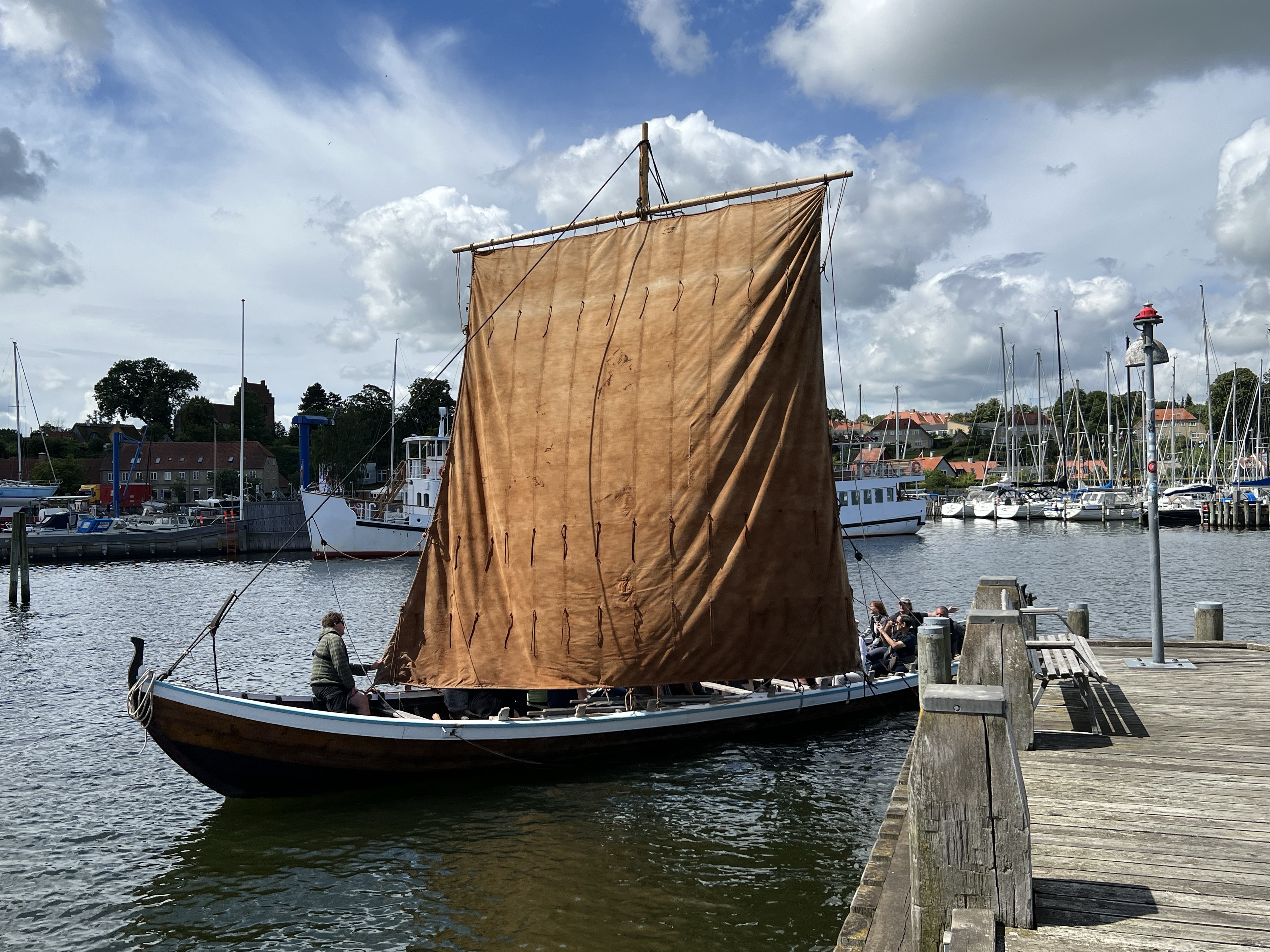
The harbor area around the museum is full of Viking ships, built with the ancient building techniques of the Viking age.

A replica Viking ship “Roskilde”, pulls into the harbor.

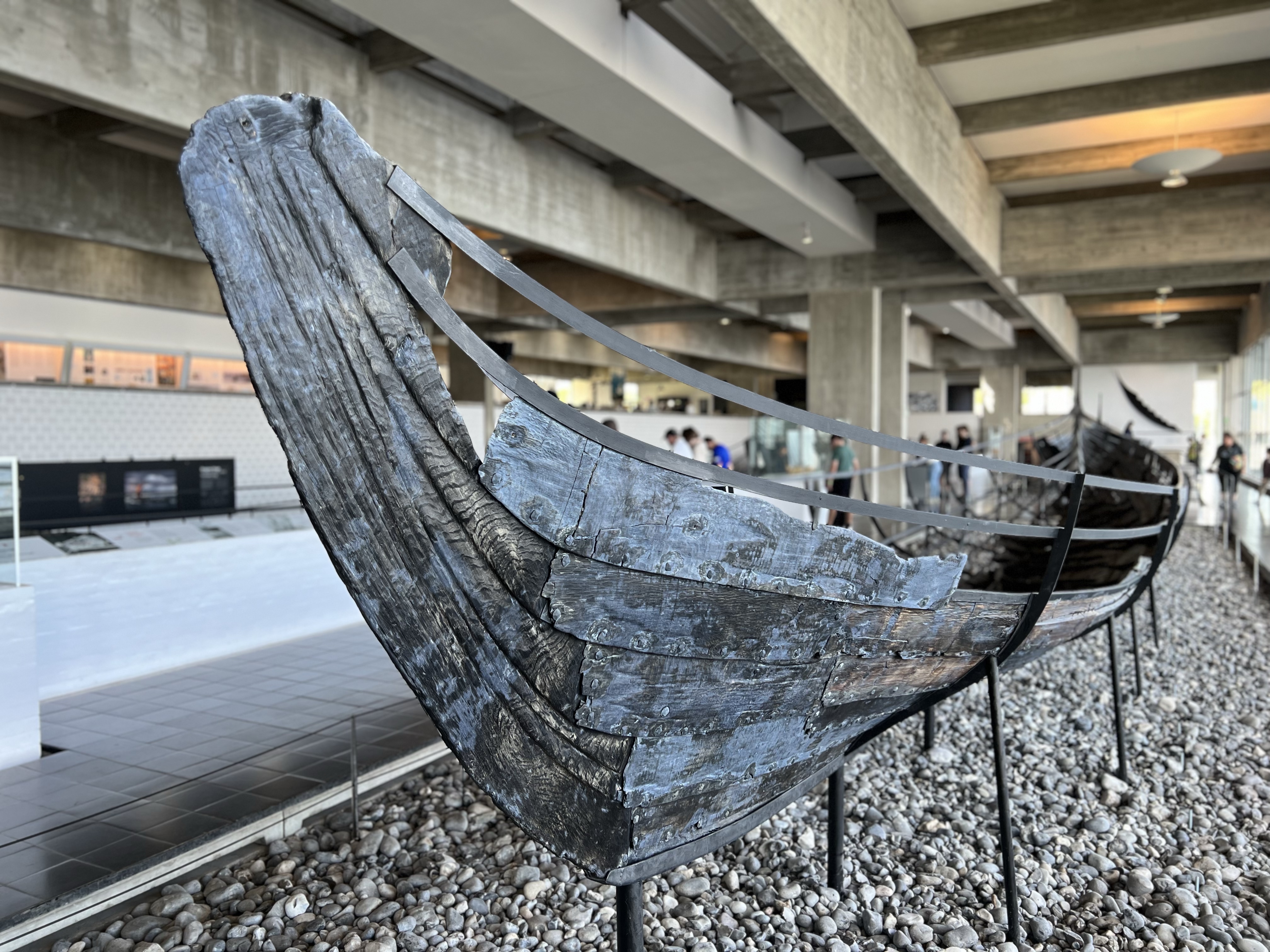
At ten, the museum opened and I was the first one in. The exhibit hall is impressive because it features parts of five Viking ships.

Why parts? Well these ships were deliberately sunk about 1,000 years ago to block a navigable channel that led to Roskilde. The ships were discovered in 1962. The most intact ship is about 75% complete.

The pieces are supported by a metal frame to give you the size and shape of the boats.

I sketched the ships from the top of the staircase, the perspective was challenging but you don’t always get to select your angles to sketch from.

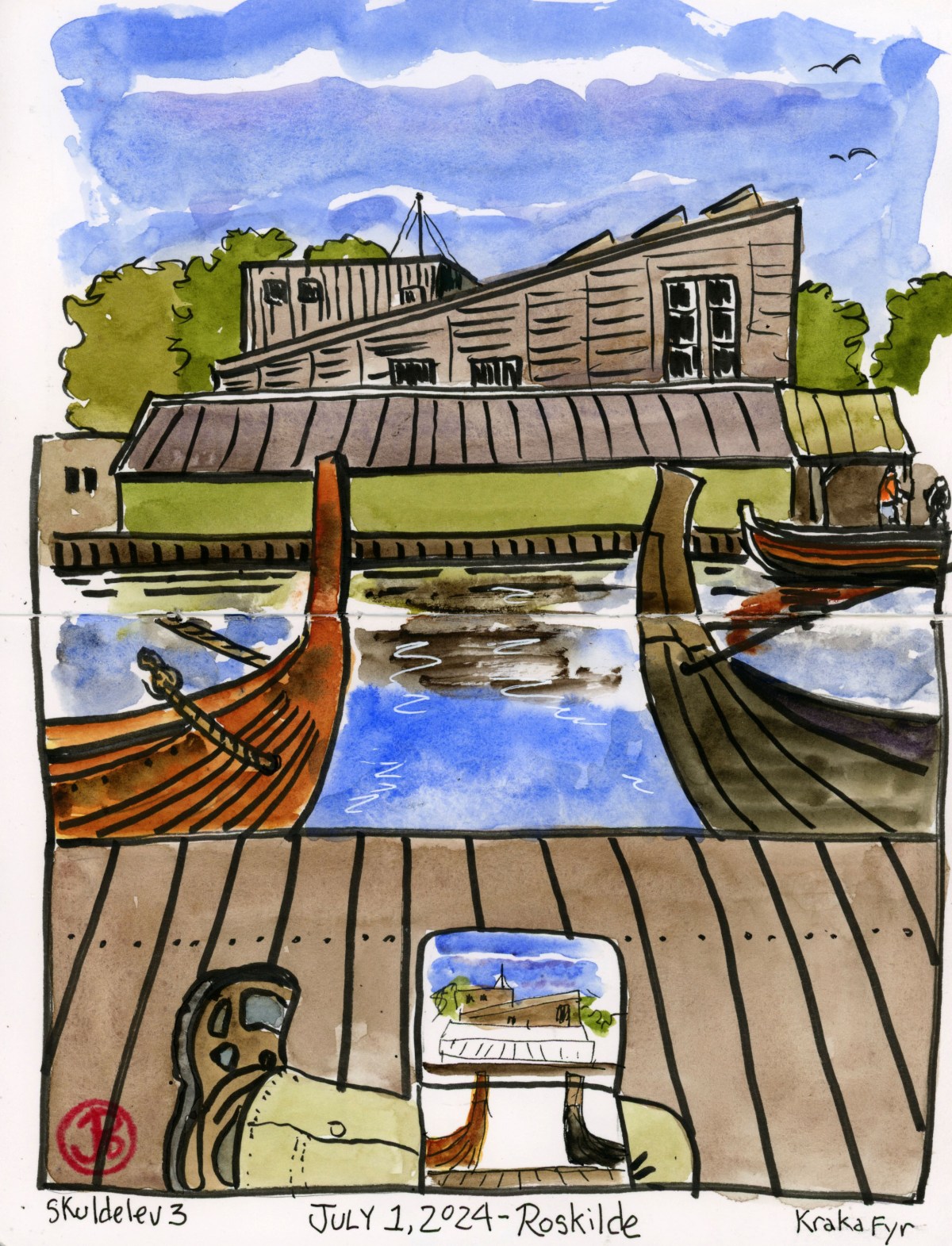
I then walked around all the ships noting the various sizes, including the impressive size of the King’s longship. I gave up trying to sketch the ships and returned outdoors to the bench where I sat before the museum opened. Now this was a perspective I could handle (featured sketch).

I think I produced my favorite sketch of my Scandinavian adventures. This was a fun perspective the draw and a sketch within a sketch self portrait to boot!

Image

Rundetarn: the Round Tower

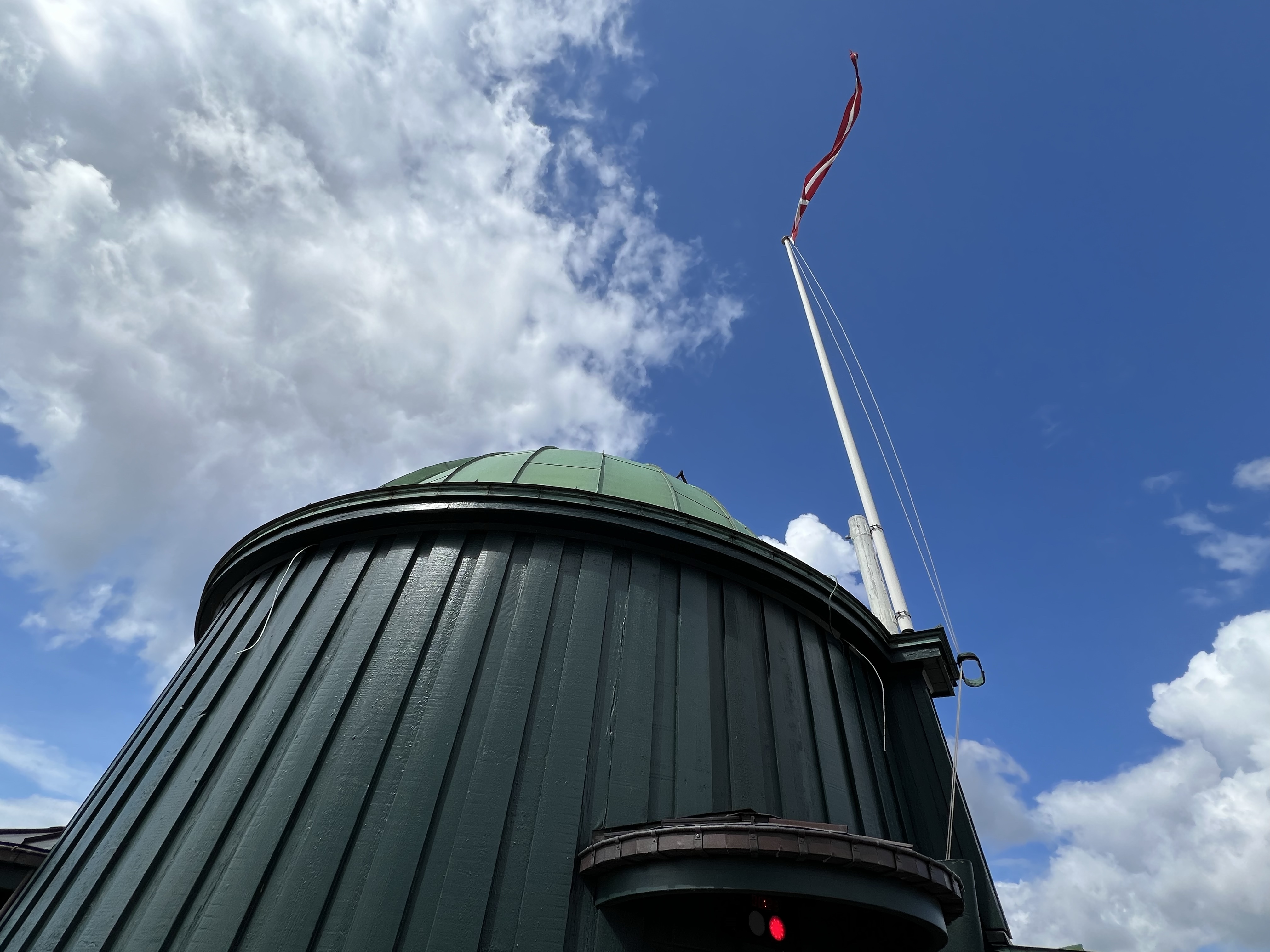
In the Latin District I wanted to ascend the Round Tower to take in the panoramic views of Copenhagen.

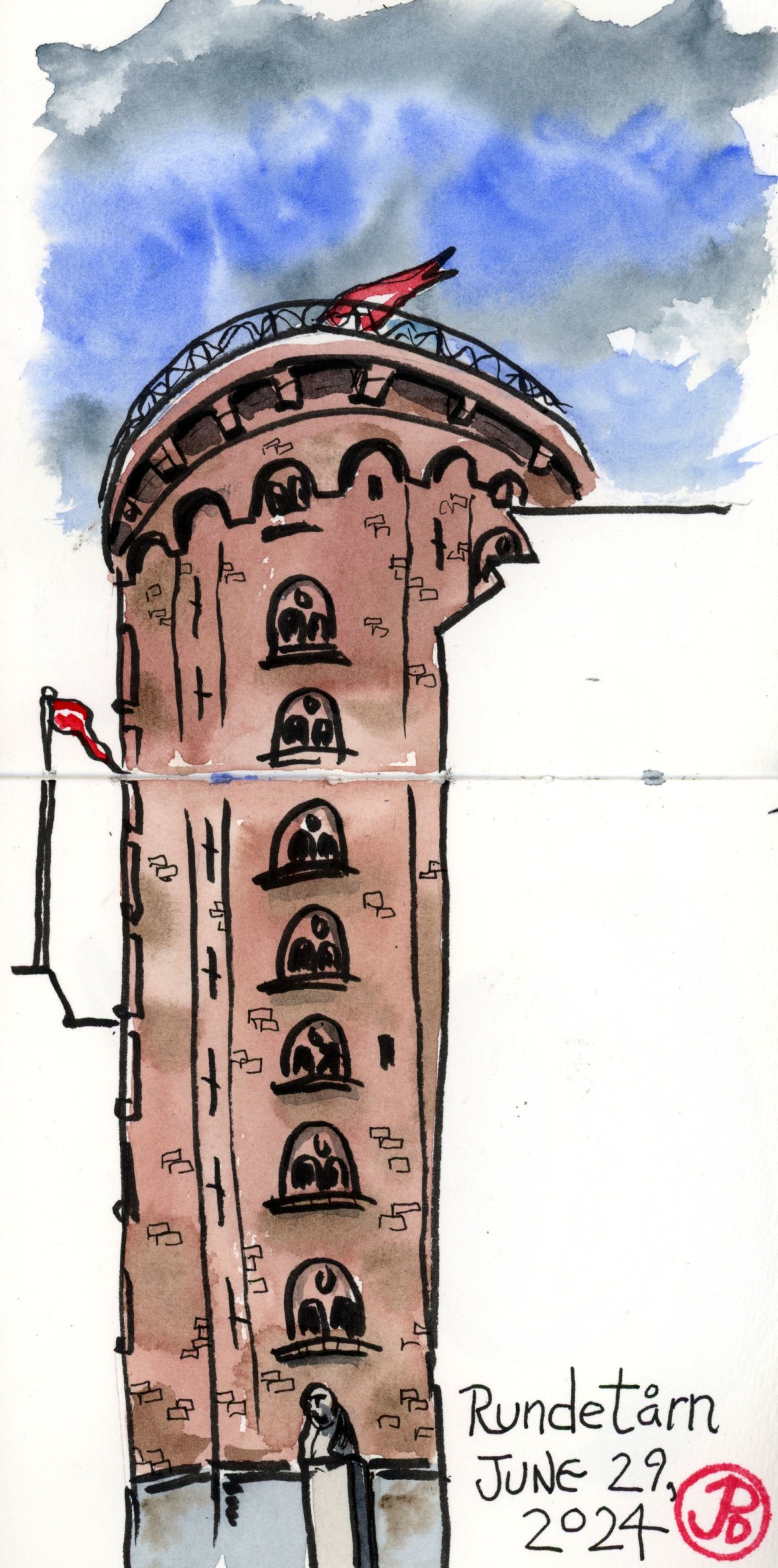
The red brick tower was built in 1642 as Europe’s first and oldest observatory.

But it was about an hour before the tower was open and so I found a bench and sketched the tower (featured sketch).

It was a little challenging to get the cylindrical perspective correct. This is why the pencil sketch is so important before you add any ink to the page. I think of it as the skeleton of the sketch before adding the muscle (pen and watercolor.)

I was second in line, behind an American family of four whose teen boys seemed more interested in looking at their phones rather than the amazing architecture and history that surrounded them. I was certainly glad that smartphones didn’t exist when I first visited Europe in the late 1980s.

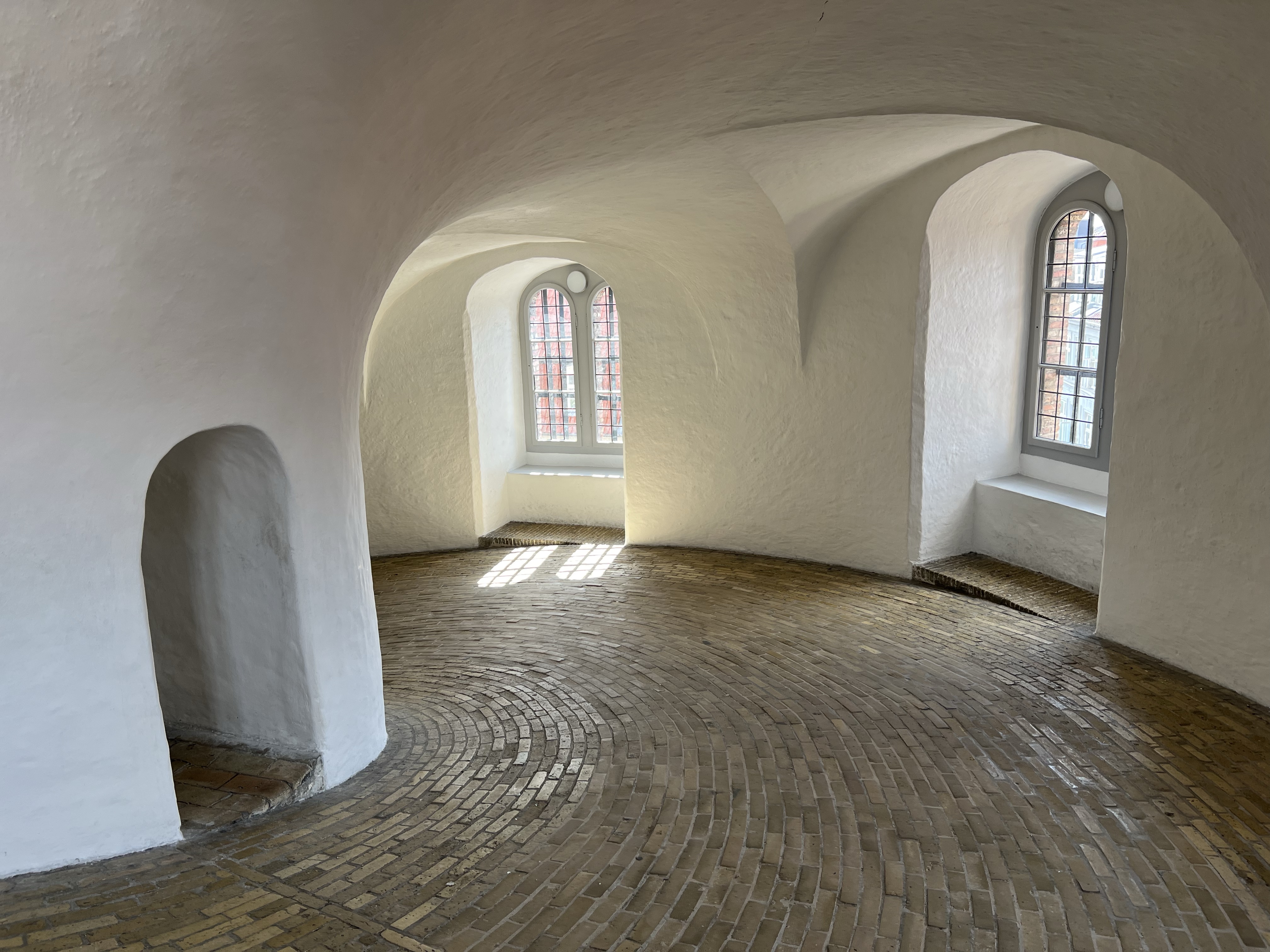
What is unusual about the tower is that instead of climbing steps to get to the top, you climb a brick paved circular ramp.

It is rumored that Czar Peter the Great rode his horse up the 34.8 meter tower. In 1902 an automobile repeated the feat. Apparently there are still skid marks from the drive but I could not find them.

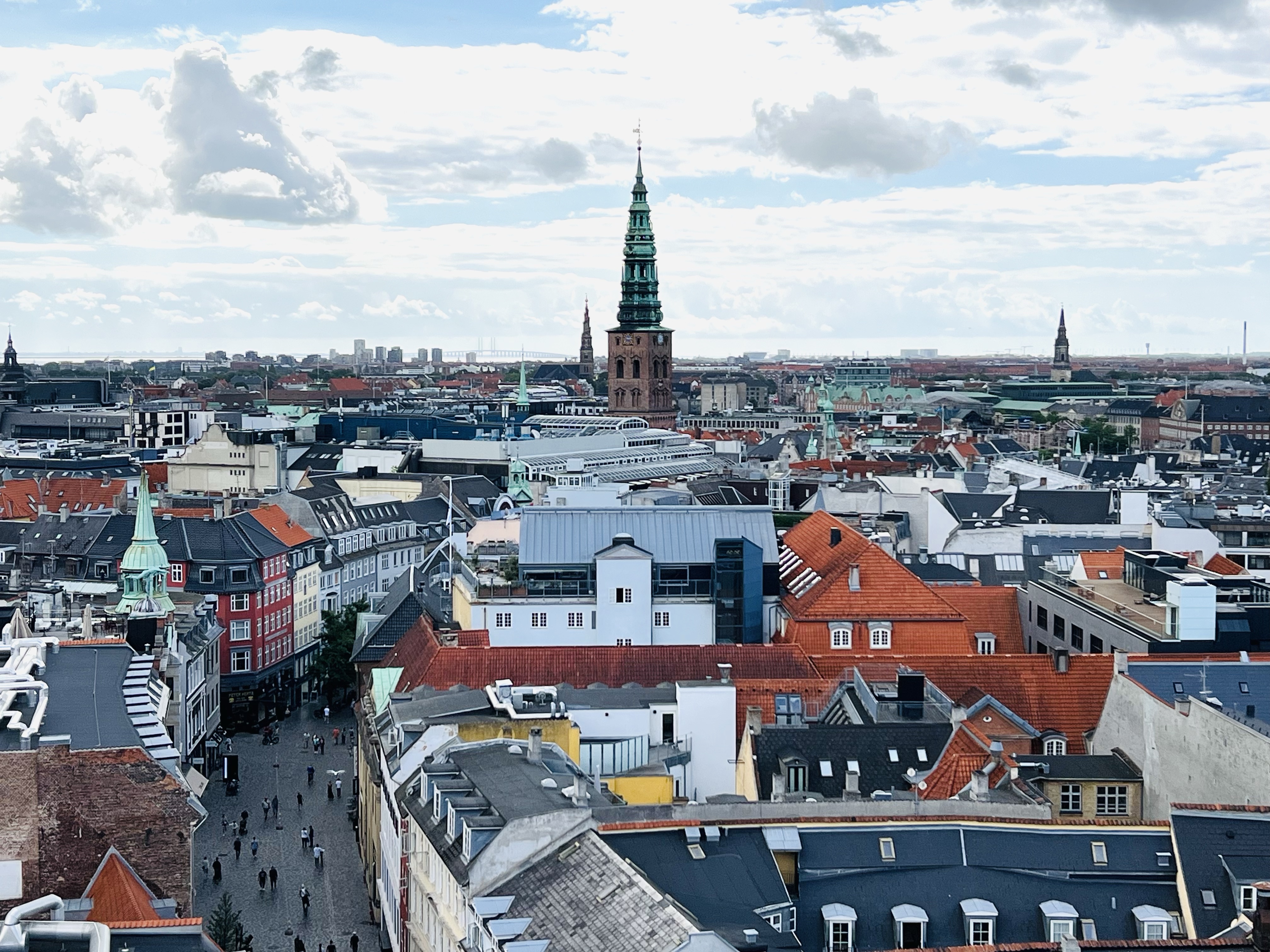
The staircase to get to the observatory is so narrow that there is a stoplight because it is only one way traffic. After a short wait I was the first at the top, having passed the American family on the circuitous way up. The view was certainly worth it!

The view from the top looking east towards Christiania.

On top of the Round Tower is an observatory, which is the oldest in all of Europe.

The observatory at the top of the Round Tower.
Image

Saturday Morning Sketching: Copenhagen

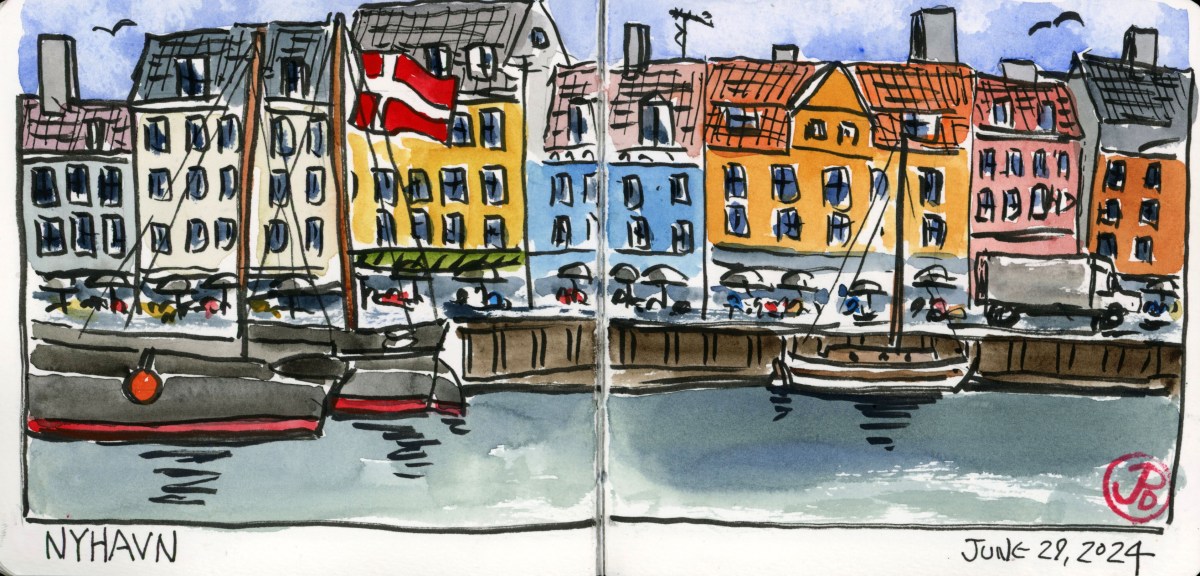
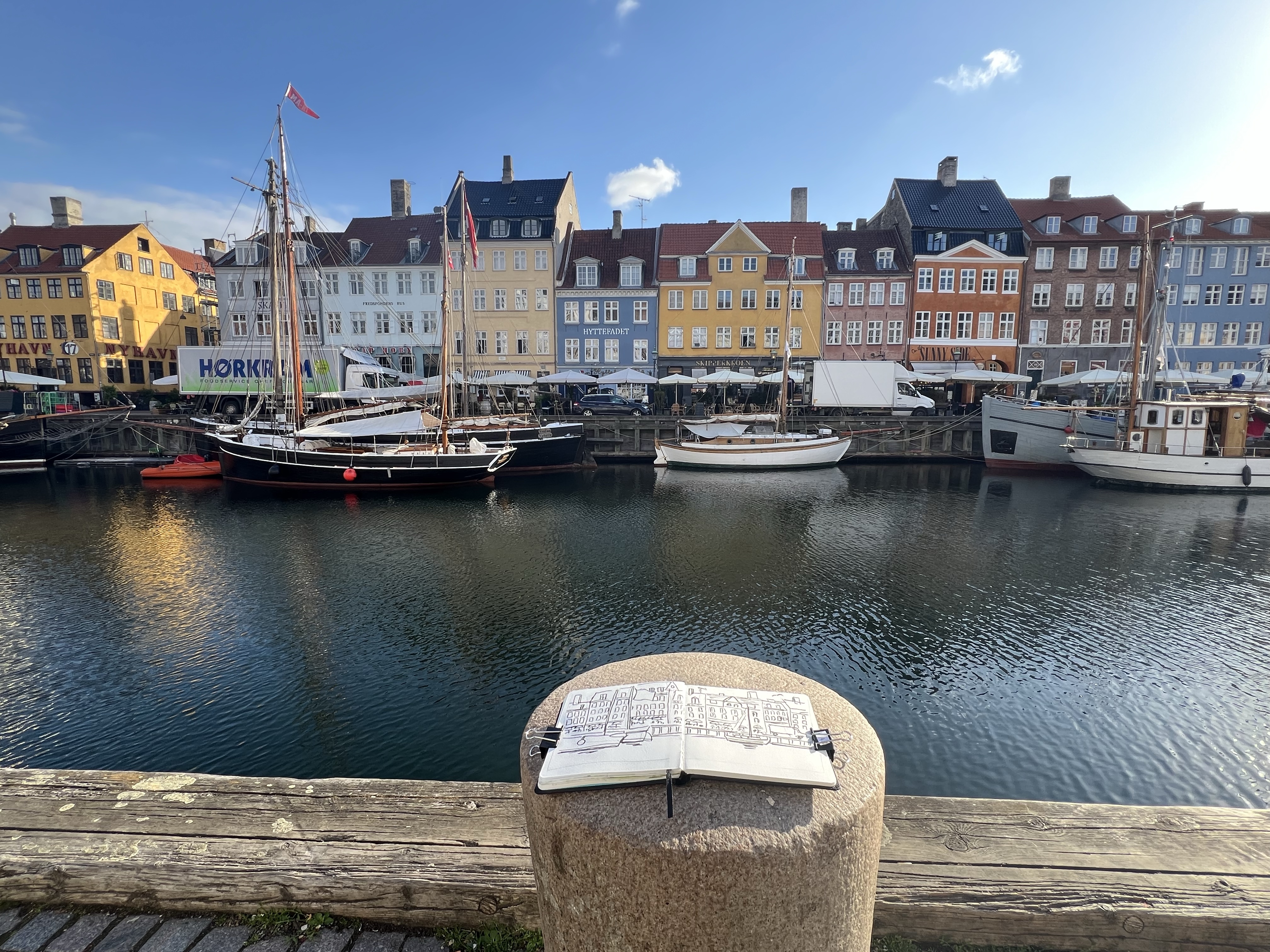
I wanted to get to the very popular Nyhavn (New Harbor) before the tourists hordes descended upon it. So I headed out from my Nørreport digs and walked 25 minutes to the picturesque harbor.

I had the place almost to myself (I was only asked to take one photo). I walked around until I found the right vantage point. I wanted sail boats in the canal with the pastel colored builds in the background.

My canalside sketching stool was a mooring cleat. It was the perfect height. After a few pencil lines I commenced the sketch with my uni Pen brush pen (I have really favored this pen on this journey).

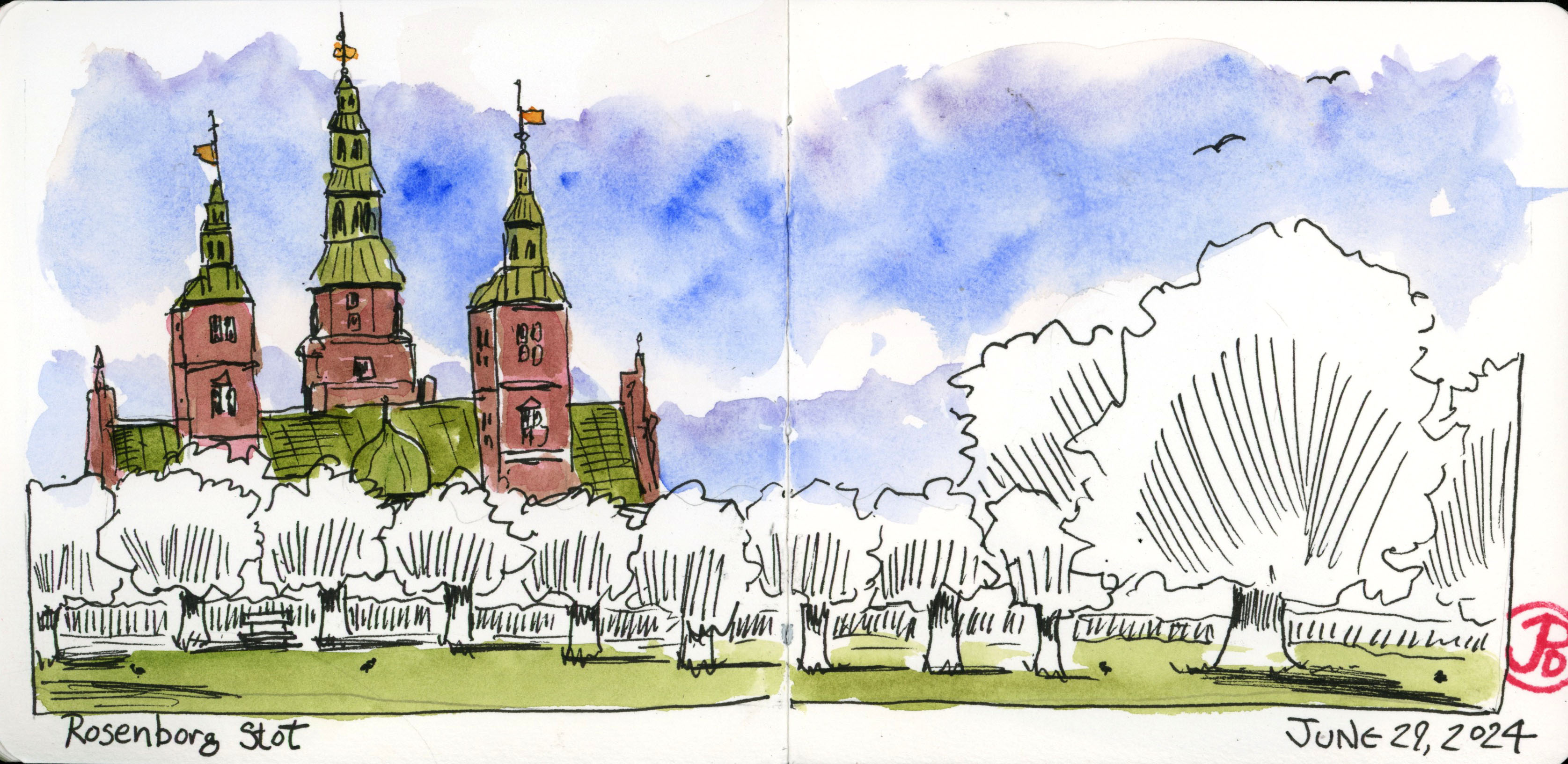
After sketching and cafinating in Nyhavan, I headed back whence I came and entered the park around Rosenborg Castle. I walked around the castle until I found a park bench perspective and started to sketch. The benefit of heading out early is that the park and castle were largely devoid of tourists. It was the time of the morning that the locals strolled through or walked their dogs.

For this sketch I wanted Rosenborg Castle to be the main focus so I left the tress in the park unpainted.
Image

The Little Disappointment

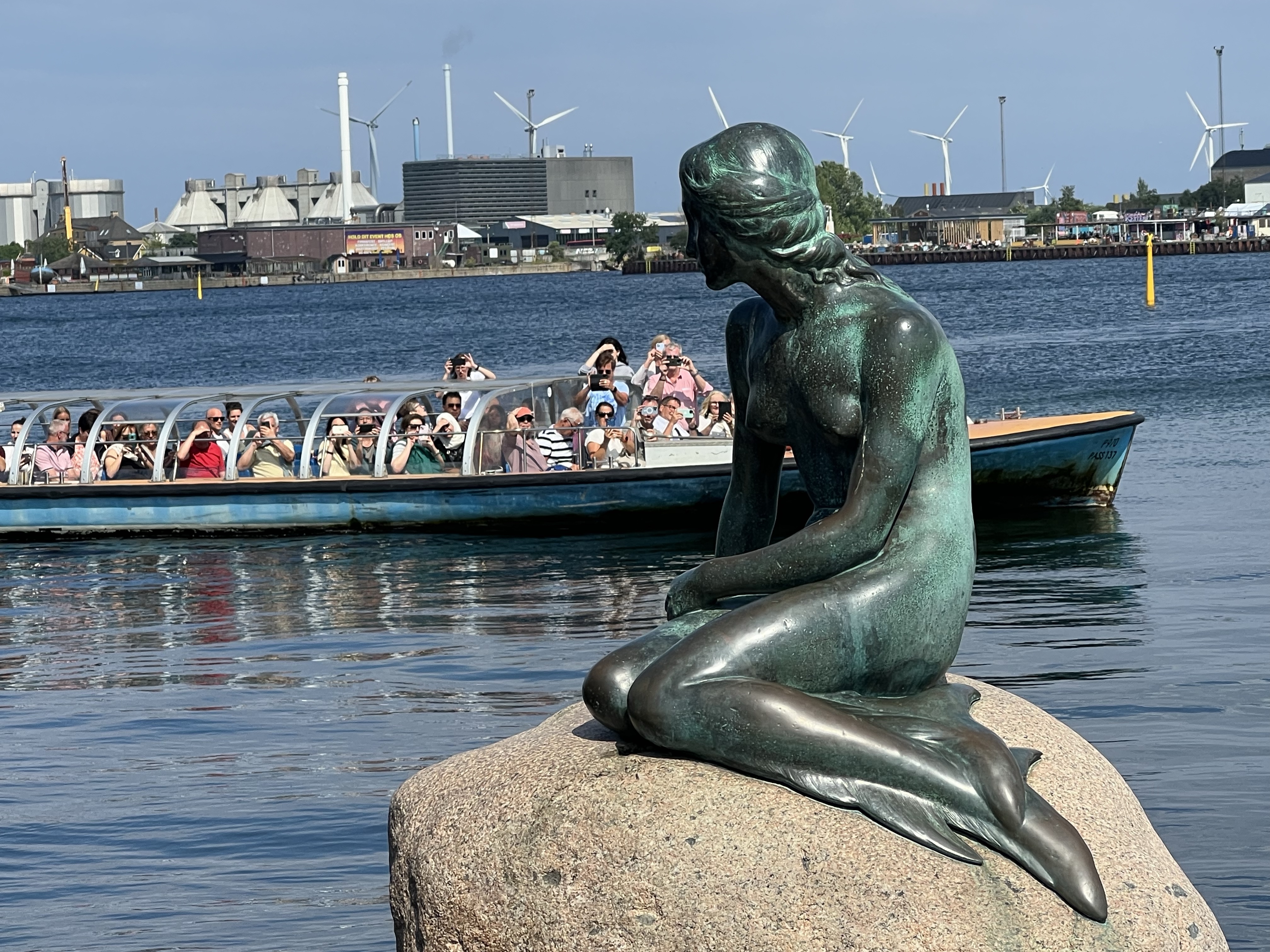
The first site I chose to see and sketch on my first day in Copenhagen, Denmark was perhaps it’s most popular tourist attraction. Yet in my Lonely Guide, it is not even in the Top Experiences in the Danish capital. In fact some guidebooks say skip it entirely and go elsewhere. When people first see it, they are often underwhelmed by how small she is. Her name: “The Little Mermaid”.

I guess the word “little” is in the title so it really shouldn’t be a big surprise at the underwhelming nature of the statue.

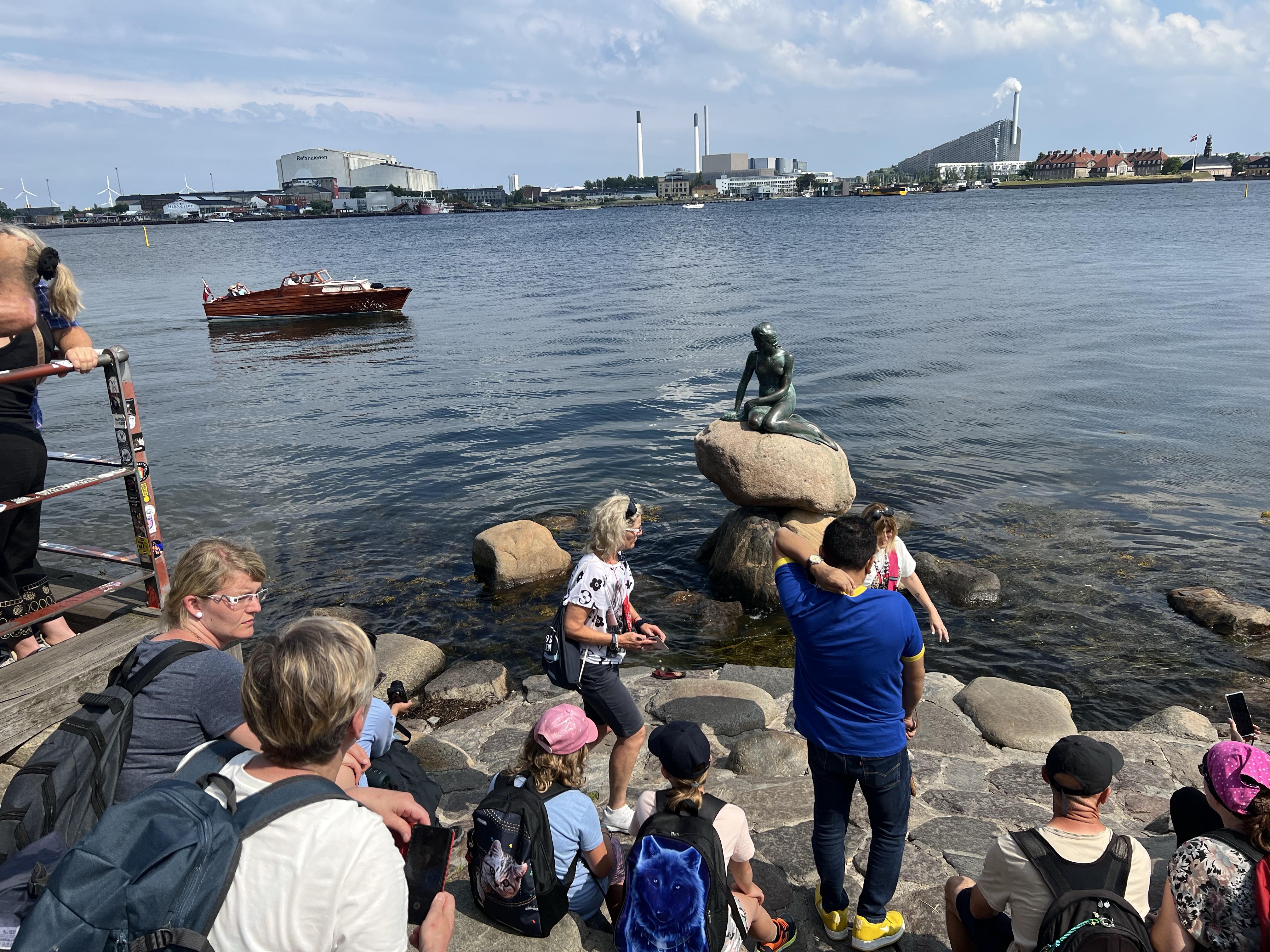
I walked from the Metro station and after a 15 minute ramble, I knew I was getting close because there were more and more people and more parked tour buses. When I first got to the statue I could not see it because of all the picture snapped hordes in front of the statue.

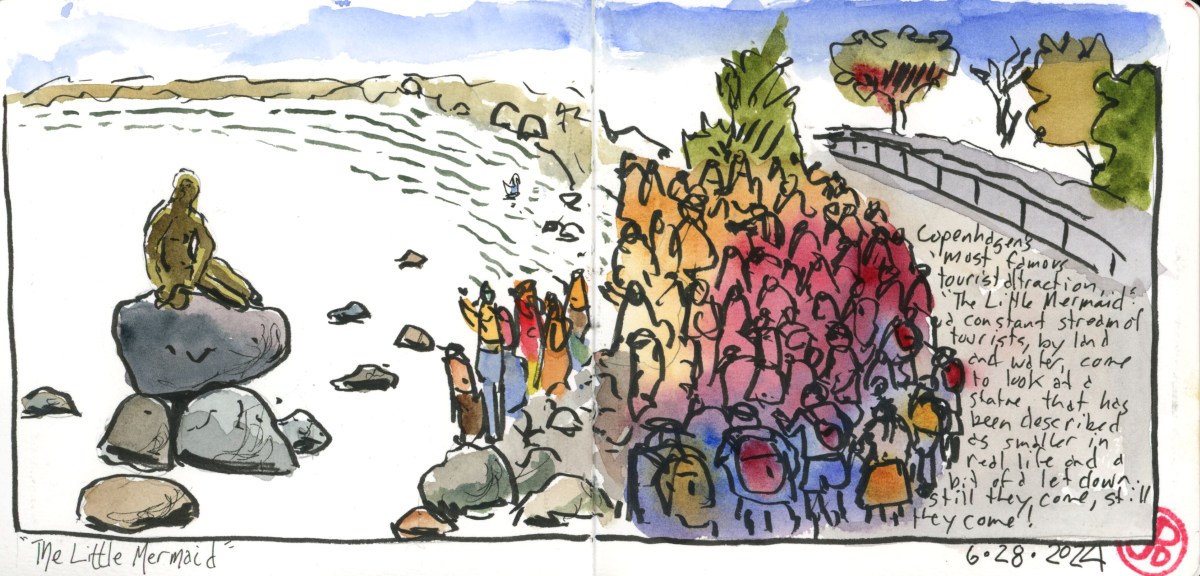
Copenhagen’s most famous statue being besieged from land and sea.

So I took out my sketchbook.

I have to admit that I had previsualized the sketch. I wanted to try and capture how popular this statue really was and it is visited by both land and water. I wanted to try and capture that chaotic, frothing at the mouth, European tourism. Think of the crowds surrounding the diminutive Mona Lisa.

Water visitors.

In the final sketch (featured sketch) I have exaggerated the size of the statue while minimizing the size of her worshippers.

And once I visited the statue, I was not disappointed. The crowds ebbed and flowed like the tide. Snapping pictures or taking a selfie and then retreating back to the comfort of their idling tour bus.

So I had set the bar rather low and from here, Copenhagen could only become more amazing.

And it certainly was!

Image

Norwegian Life Birds

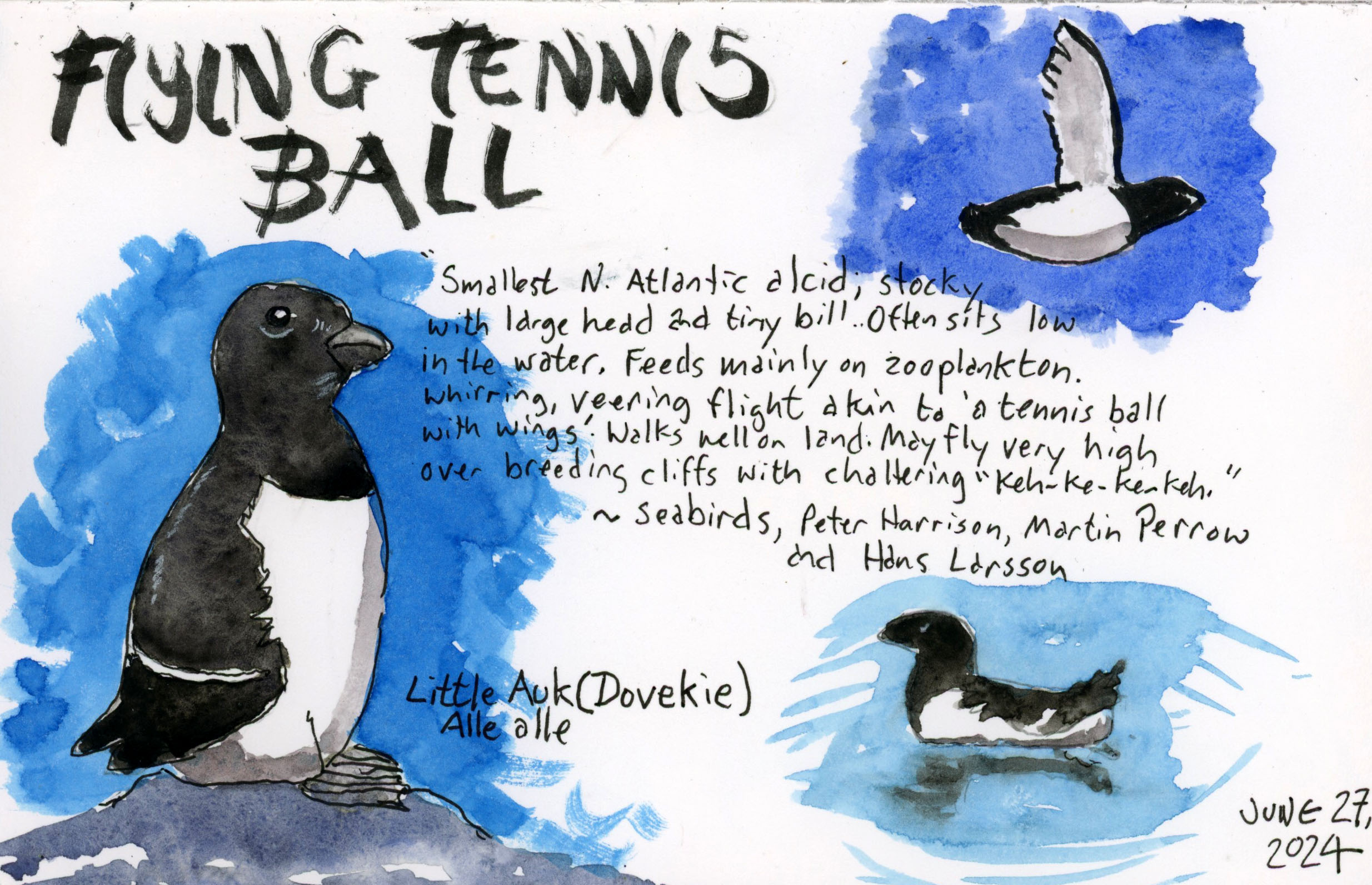
I had three target lifers for my Scandinavian summer adventures: barnacle goose, dovekie (little auk), and ivory gull.

The hardest to get was the ivory gull which was only to be found on the pack ice sometimes in the company of polar bears.

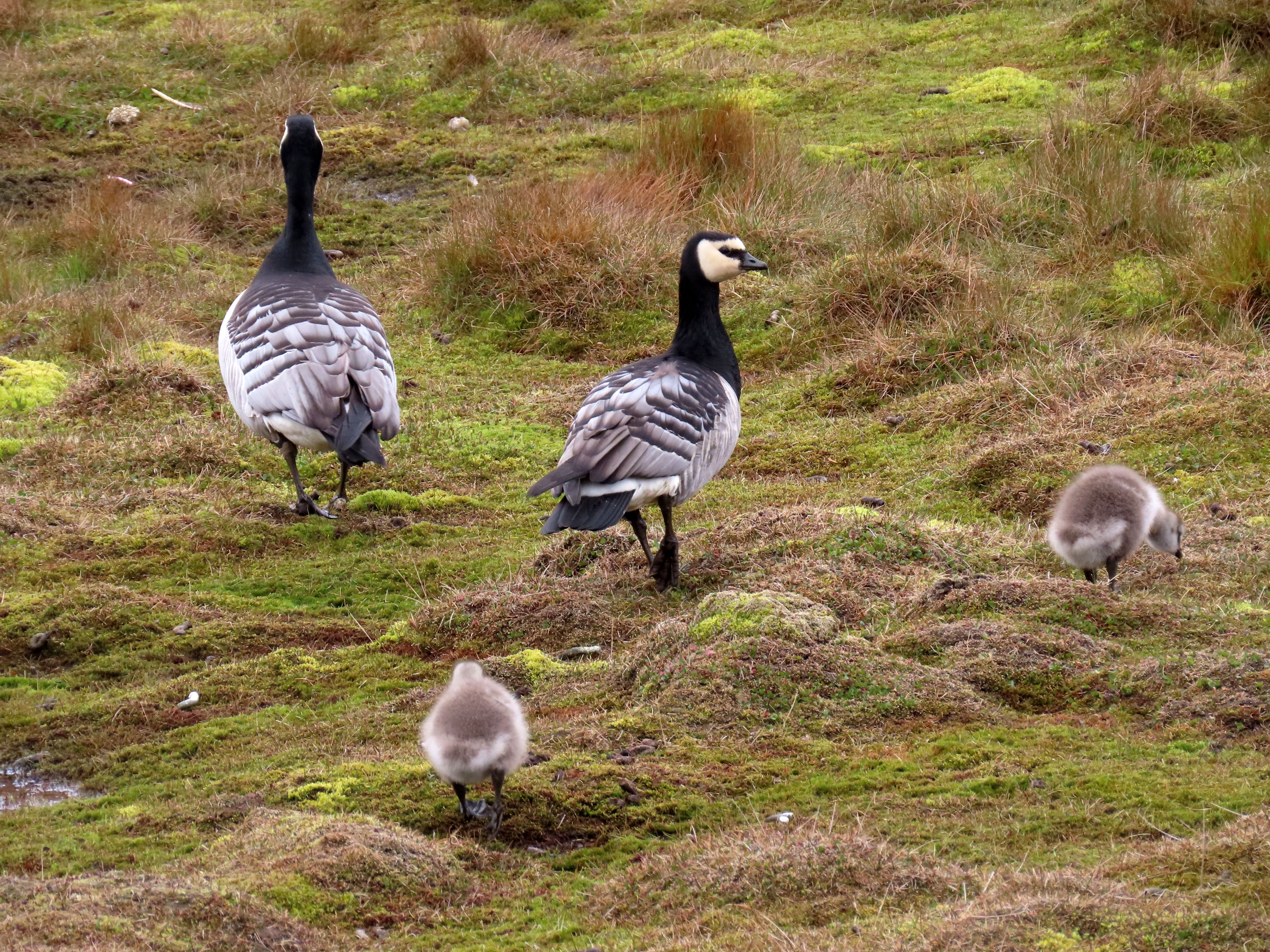
Perhaps the easiest was the barnacle goose and dovekie. I had four geese in the harbor near the Munch Museum in Oslo. I saw many more in Longyearbyen in Svalbard.

Barnacle goose family in Longyearbyen.

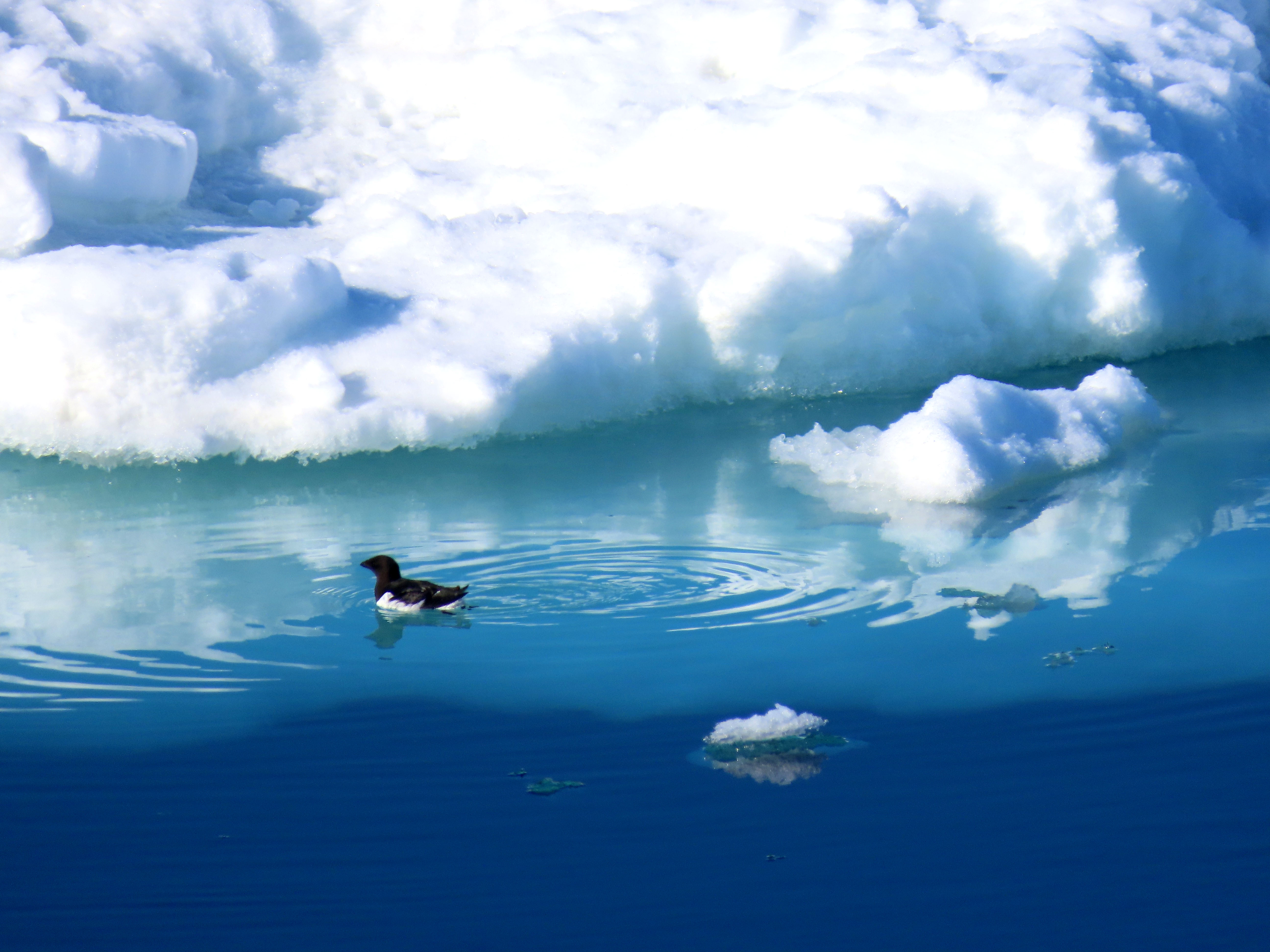
Dovekie or as it’s known in Europe, little auk, was also plentiful around the southern and eastern side of Spitsbergen. I saw many from the decks of the Plancius.

Little auk in its icy summer habitat.

So what’s in a name? Common names vary in different regions and in different languages. For instance Phalaropus fulicarius is known as the red phalarope in North America but on the other side of the Atlantic it is the grey phalarope. Our guide didn’t even know this, falsely claiming that the common name had been changed.

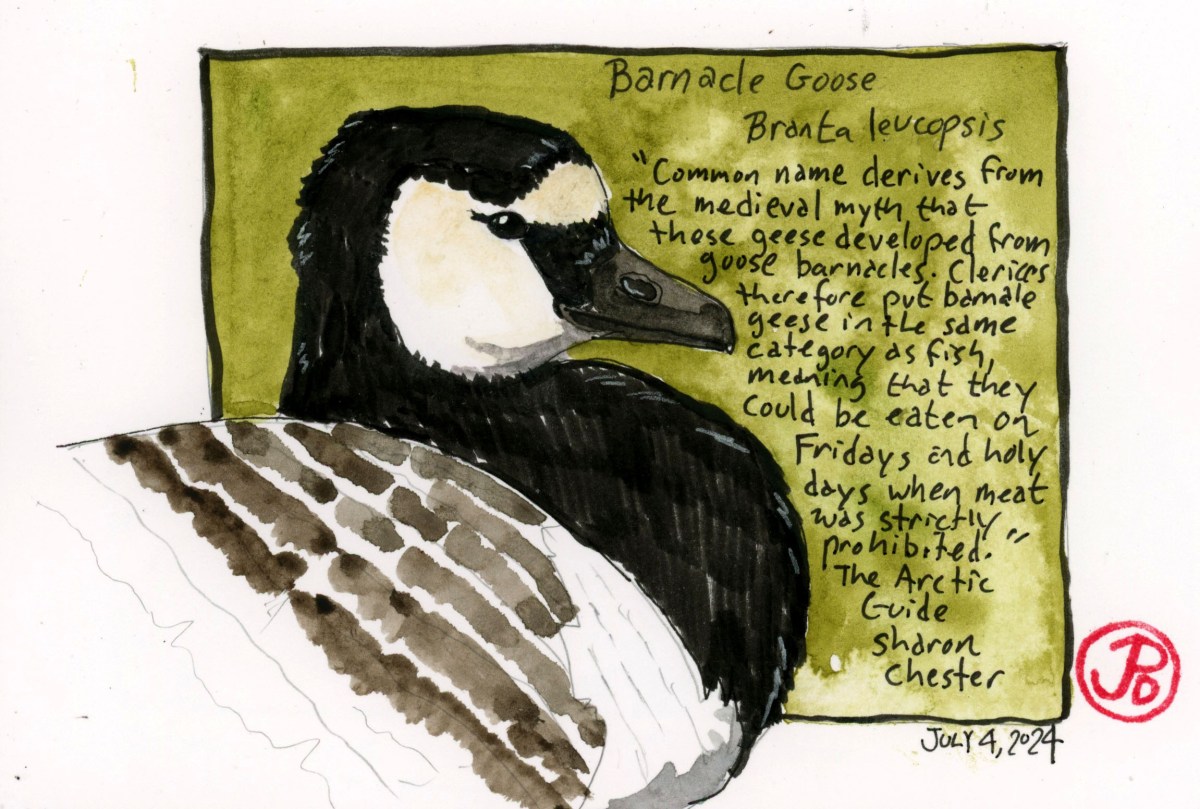
One of the dubious common bird names is barnacle goose. You would think this goose eats barnacles. Nope. The name comes from Medieval times when it was thought that the goose came from goose-necked barnacles. The bird was even considered a fish so it could be eaten on religious holidays such as Lent. Such were the times when folklore trumped scientific learning.

Image

Polar Plungers

An impromptu group developed on board the Plancius.

The group was started by our Chairman and President, an Australian travel blogger. He asked around who would be willing to plunge into the Arctic Ocean and started gathering names, including mine.

He asked our expedition leader about the possibility of a Polar Plunge and we got the green light.

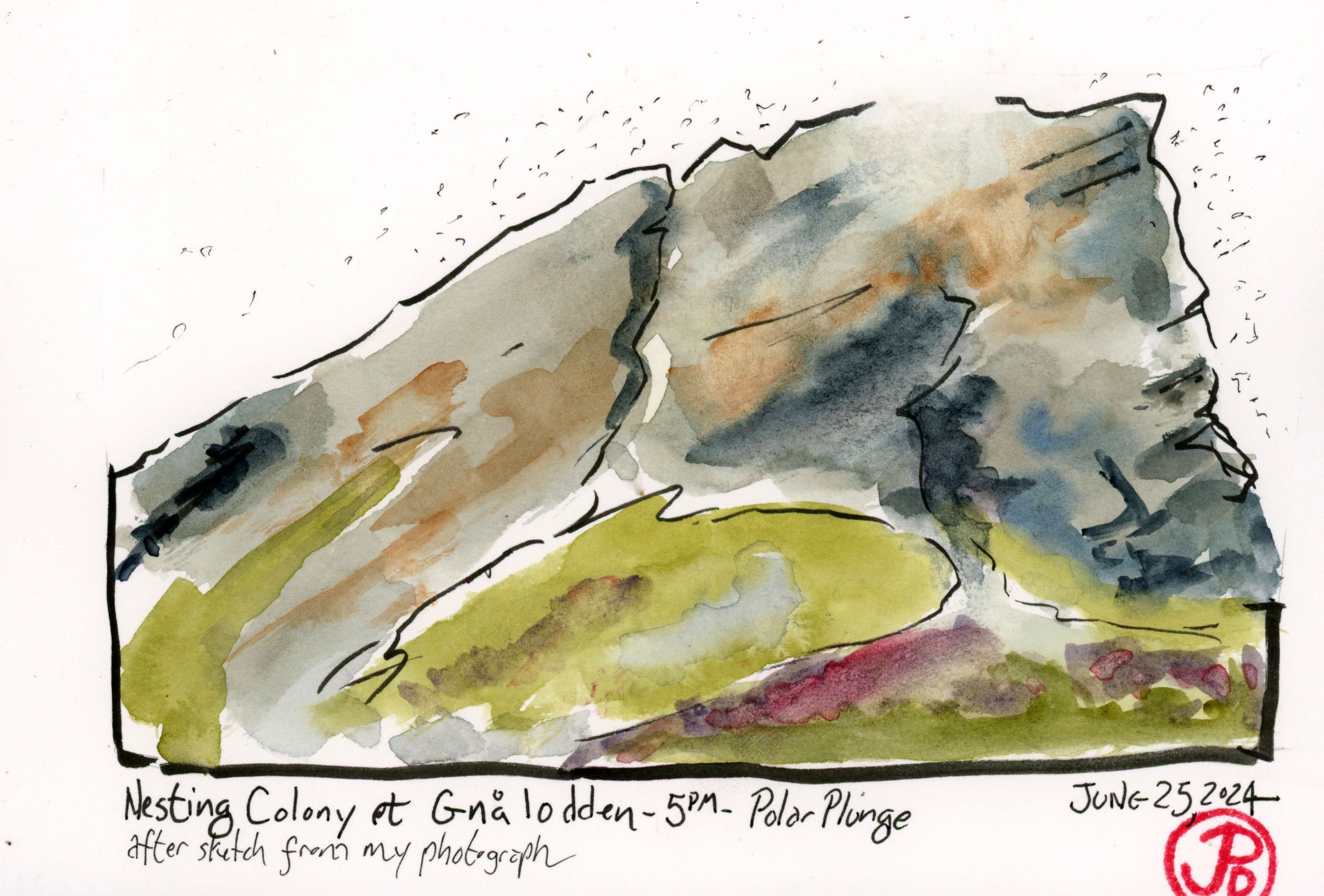
So at the end of our visit to the bird cliffs at Hornsund, at 5 (17:00) the self-chosen few gathered on the rocky beach to begin this Polar right of passage.

The bird cliffs at Horsund.

Those who have plunged in both the Arctic and Antarctic are known as Bi-Polar Plungers.

A light drizzle stared and the temperature hovered around 34 degrees.

My body and mind said “no” but if Dr. Rock was going in, then so was I. My biggest concern was not the plunge, you had to put your head under to make it official, but undressing and dressing with my multi layers in the wind, rain, and cold. And then there was the Zodiac ride back to the Plancius. The sloped rocky beach didn’t make walking to the water in bare feet any easier.

As I was contemplating the cold waters a Dutch member of our tribe (let’s call her Mary), stripped off, ran towards the water, jumped in, and started doing laps.

Well this was a challenge. Bring it on! I divested myself of four layers and hobbled down the pebble beach to the Arctic waters.

Up to the ankle it wasn’t so bad but I wasn’t sure if I could feel my toes. I turned to the crowds on the beach and Christlike, fell backwards for the full immersion.

I’m not sure if I really did a lap but it was more a splashing Polar paddle and before I knew it I was hobbling up the rocky beach to my now damp towel.

After the plunge, Dr. Jon (Ship’s Doctor), gave me a certificate that reads:

This is to certify that

Corvidsketcher

Defied death by surviving a swim in the frigid Arctic waters in Hornsund, Svalbard

This twenty fifth day of June, 2024

Witnessed and certified as still living by

Dr. Jon

Ship’s Doctor

MV Plancius

Footnote: Dr. Jon also joined us as a member of the Polar Plungers!

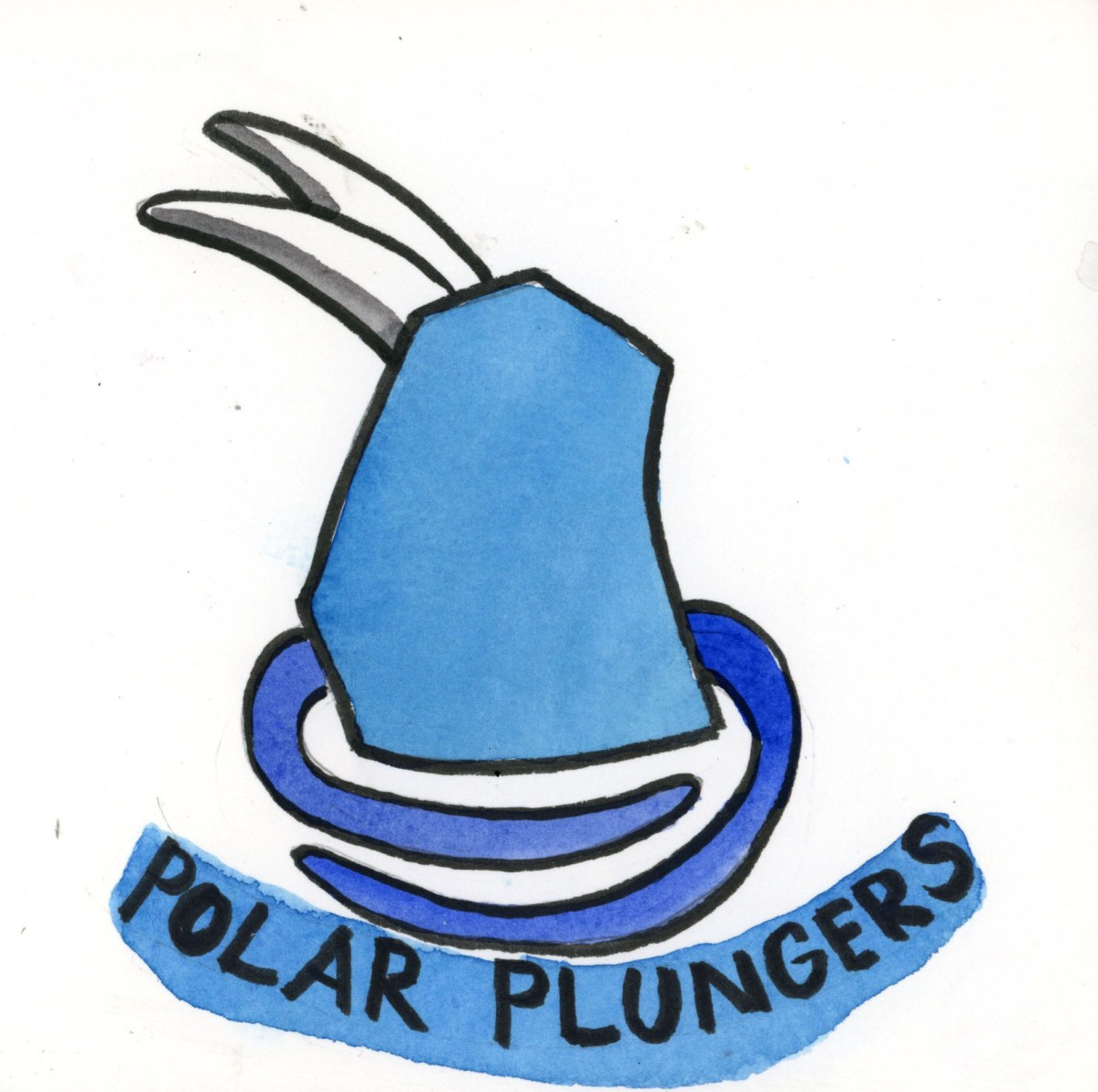
I self-elected myself with the task of designing the Polar Pluggers logo. I thought the walrus would be a good mascot for the group, albeit an icy blue one!

Image

Arctic Fox And Svalbard Reindeer

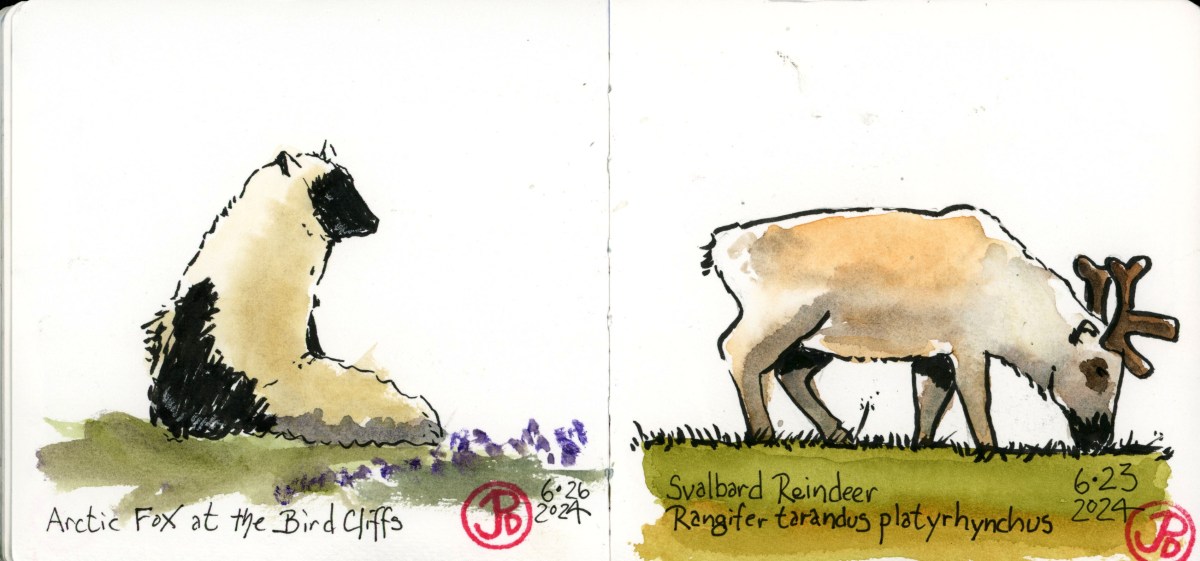
A key arctic mammal that I had missed out on in Iceland last summer was the fox of the north, the Arctic Fox. I know that I would have good chances of seeing this species in Svalbard.

Another mammal that I was also hoping to see was the reindeer subspecies, the Svalbard Reindeer, which is the smallest subspecies or reindeer or caribou.

And on a landing to Russebukta, I had the chance to see both. On our landing I chose to join the medium hiking group that was led by our expedition leader Phillipp. It always pays to be near the leader because he has the knowledge of the land and the rifle (poplar bear protection).

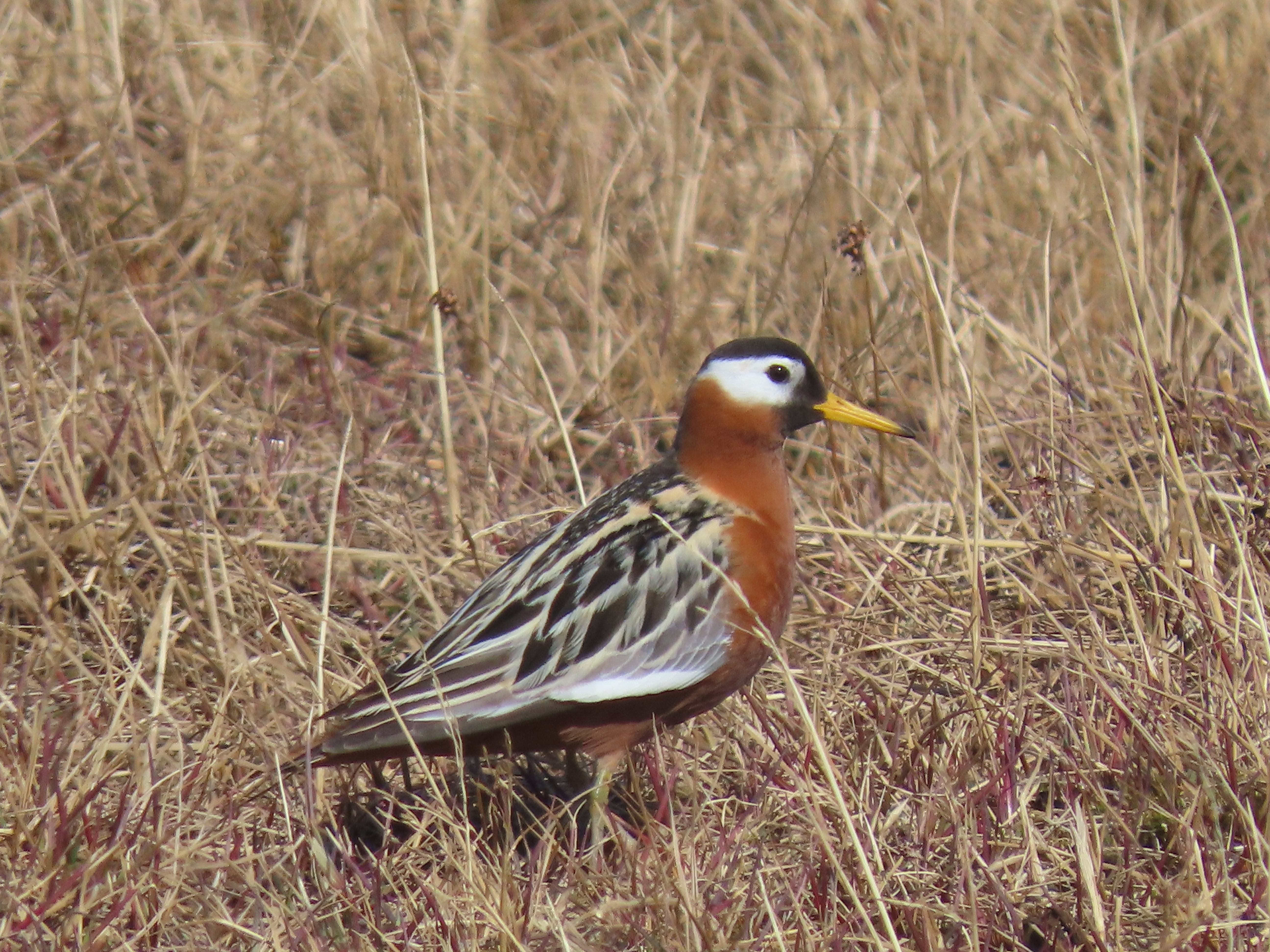
We walked by some ponds that yielded some avian Arctic breeders: the stunning king eider, pink-footed geese, purple sandpiper, snow bunting, and red phalarope. I pointed out red phalarope and Phillipp told me that is now known as the gray phalarope, red in breeding season and grey in non-breeding. Of course this is what the phalarope is called in Europe (grey) but is called red in North America. There is is only one name we can agree on, it’s scientific name: Phalaropus fulicarius, which does not change, unlike there varied common name.

The stunning breeding plumage of the red or gray phalarope.

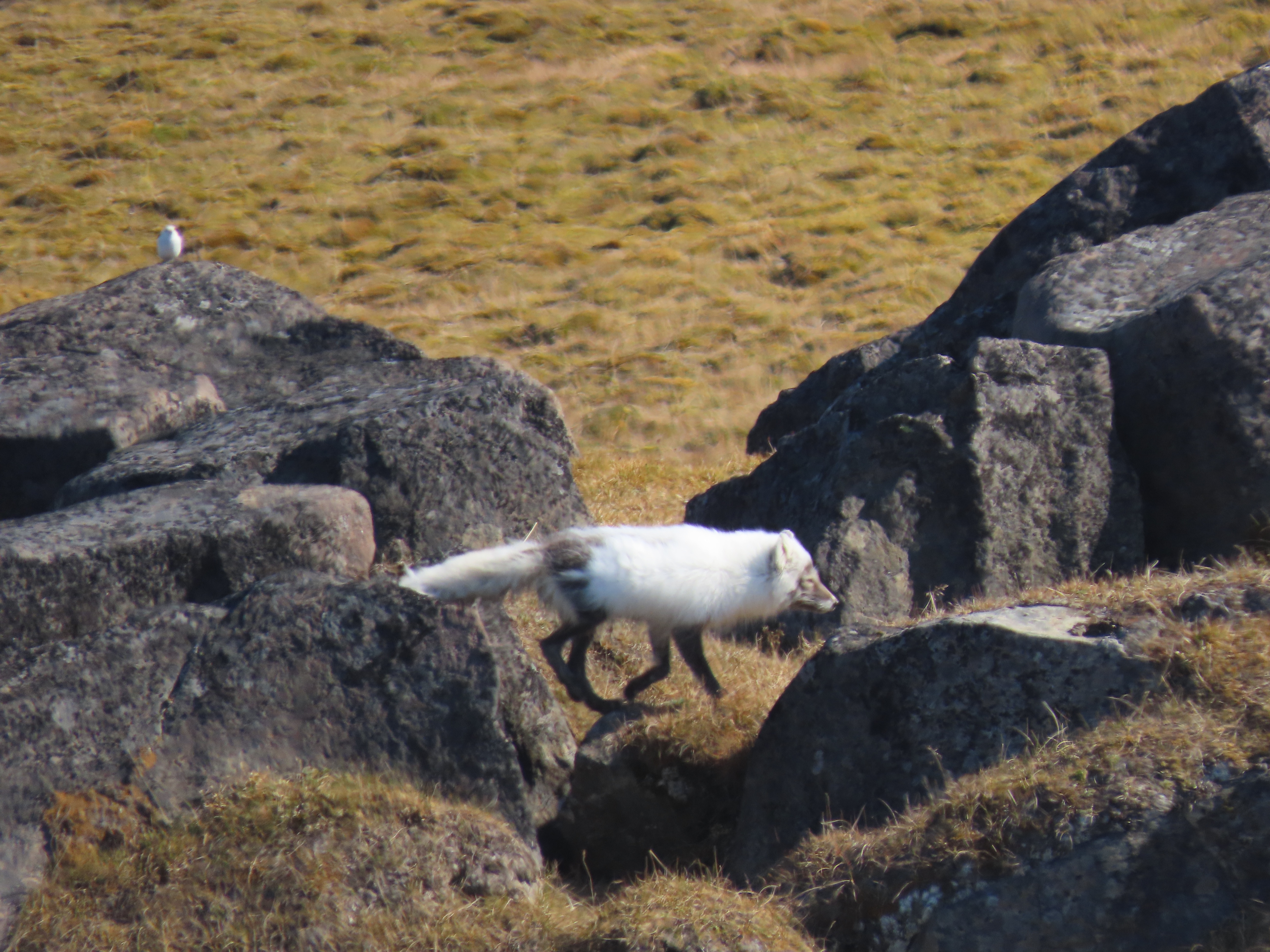
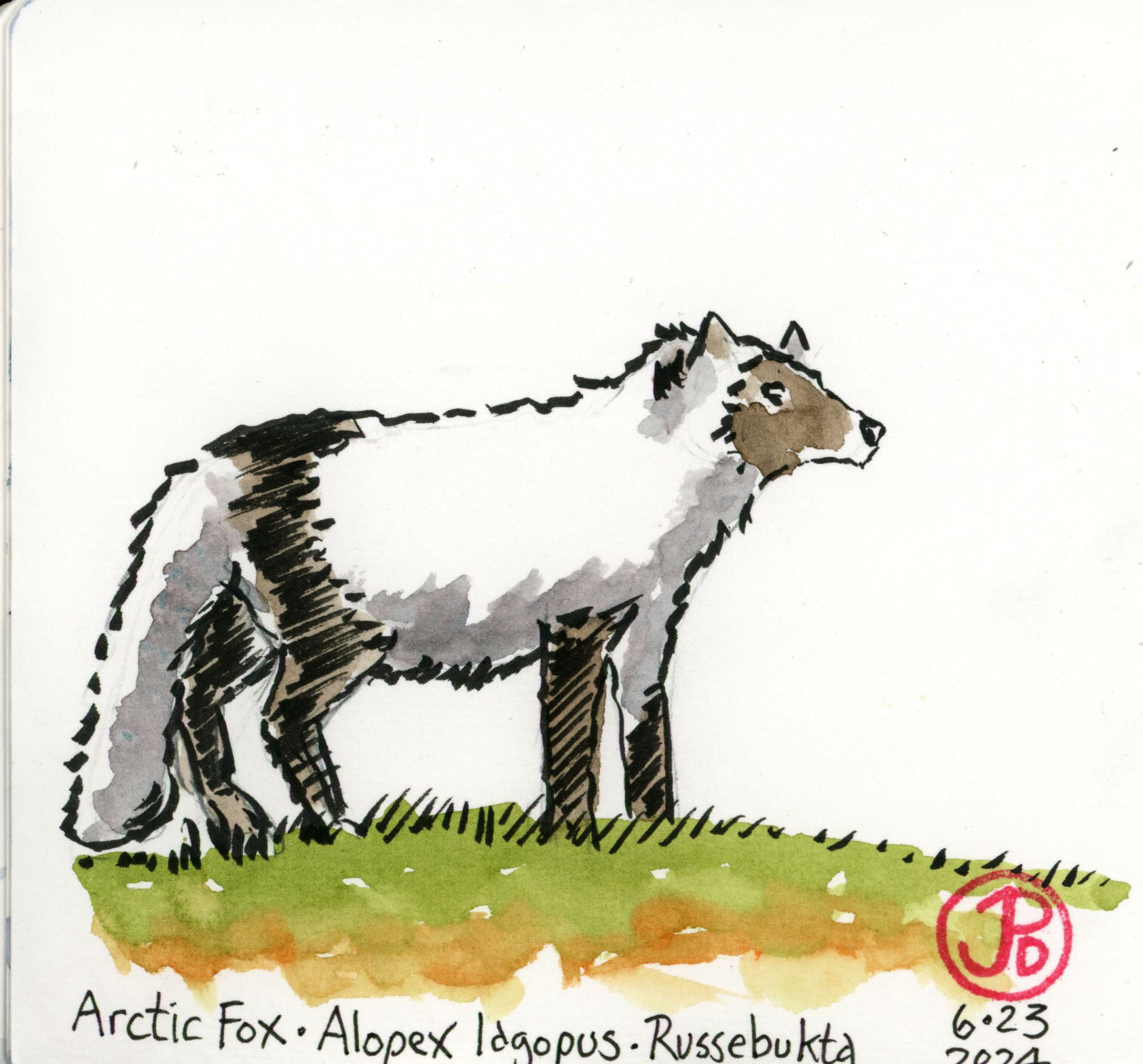
We crested a rise and on the tundra I saw my first Svalbard reindeer! After taking a few pictures we hiked on. At one stop, we were waiting for the camera horde to catch up, I spotted what I thought was a far off reindeer. But it was moving like a reindeer that had had one too many espressos. What I was looking at was not a reindeer, but an Arctic fox! Our guide noted that it was great to have a birder in the group because we are so good at spotting wildlife, even the mammalian variety.

The fox was not clearly visible to the naked eye so we turned back to shore and the Planicus. We were at the crest of a small rise near a line of rock. We were stopped again waiting for our photo stragglers. I looked off to my right and a fox appeared among the rocks, “Arctic Fox!” I exclaimed.

An Arctic fox with most of it’s winter plumage. A snow bunting above for scale.

The fox’s body was white with a darker face and legs. It superficially looked like a wolf in sheep’s clothing!