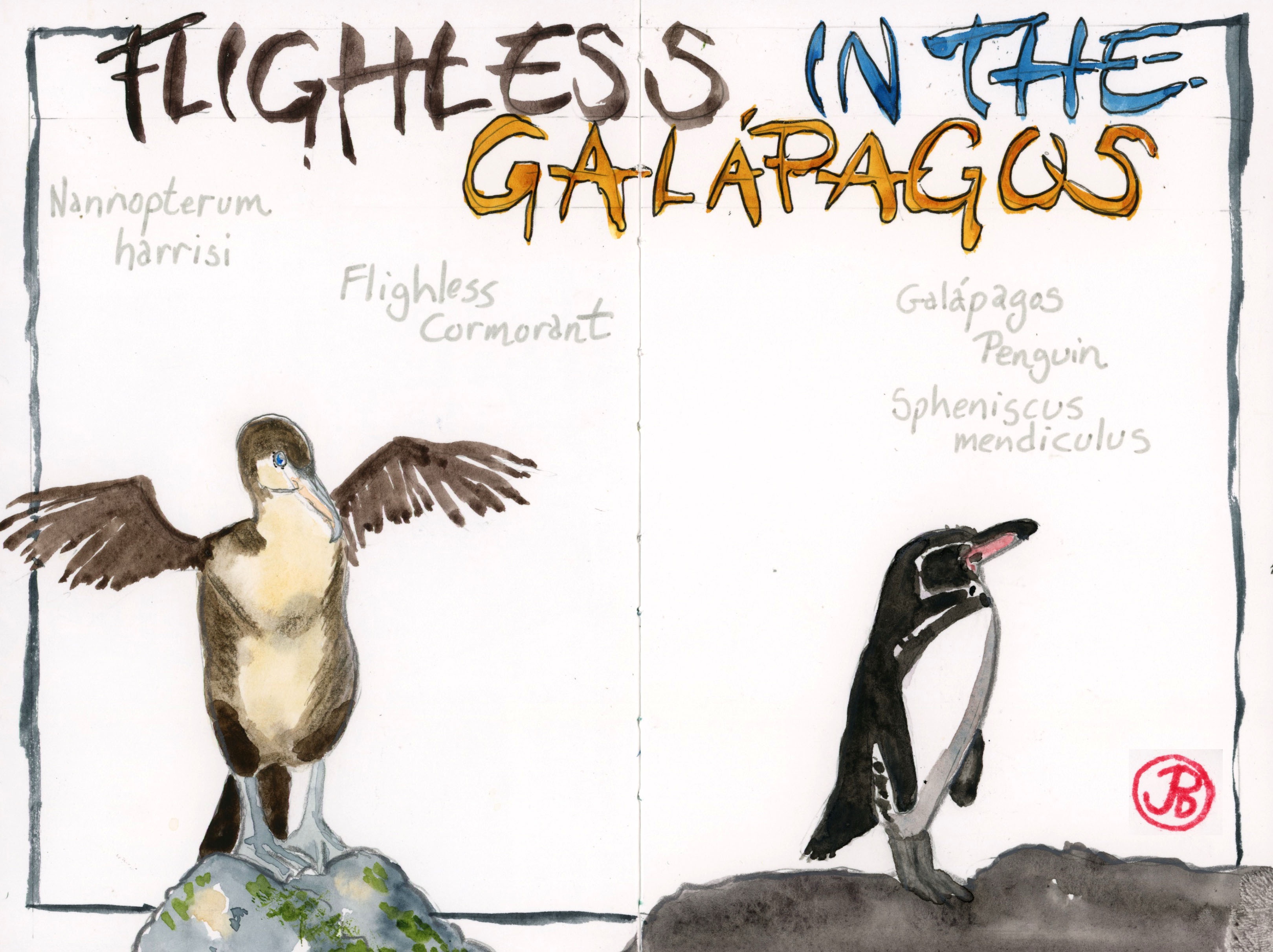
Flightless in the Galapagos

We flew from Quito to get to the Galápagos. But how did birds get to the islands?

We guess that some flew, some swam, and others arrived on rafts of vegetation pushed to the Galápagos by the cold Humboldt Current.

There were two flightless birds I was very much looking forward to seeing and both are found nowhere else in the world. The Galápagos are truly the Enchanted Islands when it comes to endemic species.

I grew up on a street named Cormorant Court so these aquatic fish-hunters have always fascinated me. On the California coast we have three species of flighted cormorants: Brandt’s, double-crested, and pelagic. And the cormorant I really wanted to see is the truly ocean dependent flightless cormorant.

We woke up on near the “seahorse’s mouth” on Isla Isabela. As the night turned to day from the deck of the Nemo III, vertical dark “rocks” turned into roosting flightless cormorants.

After an early breakfast at six, we were boarding the panga by 6:40 to get a closer look at the cormorants.

This is the world’s largest cormorant. I guess you can evolve to be bigger when you don’t need to fly. This is the only flightless cormorant and it is only found around the Galápagos islands of Fernandina and Isabela.

Flightless cormorant on Isla Isabela. Photographed from the panga.

Around the “Seahorse’s Mouth” we had some quality panga time with this amazing endemic, both preening on the rocks and swimming in the bay.

Although they are flightless they still need to dry and preen their wings.

After spending time with the cormorants, we boarded the Nemo III and headed over to Fernandina Island to look for another flightless endemic.

We would be birding from the deck of the catamaran, looking for a vertical black and white rock we were hoping to turn into a Galápagos penguin.

This small penguin is the only penguin found north of the equator (but just barely). It is certainly the most northerly or southerly if in the northern hemisphere, penguin as well as the only tropical penguin.

Before long our guide Willy spotted a lone penguin roosting in the rocks with two brown noddies.
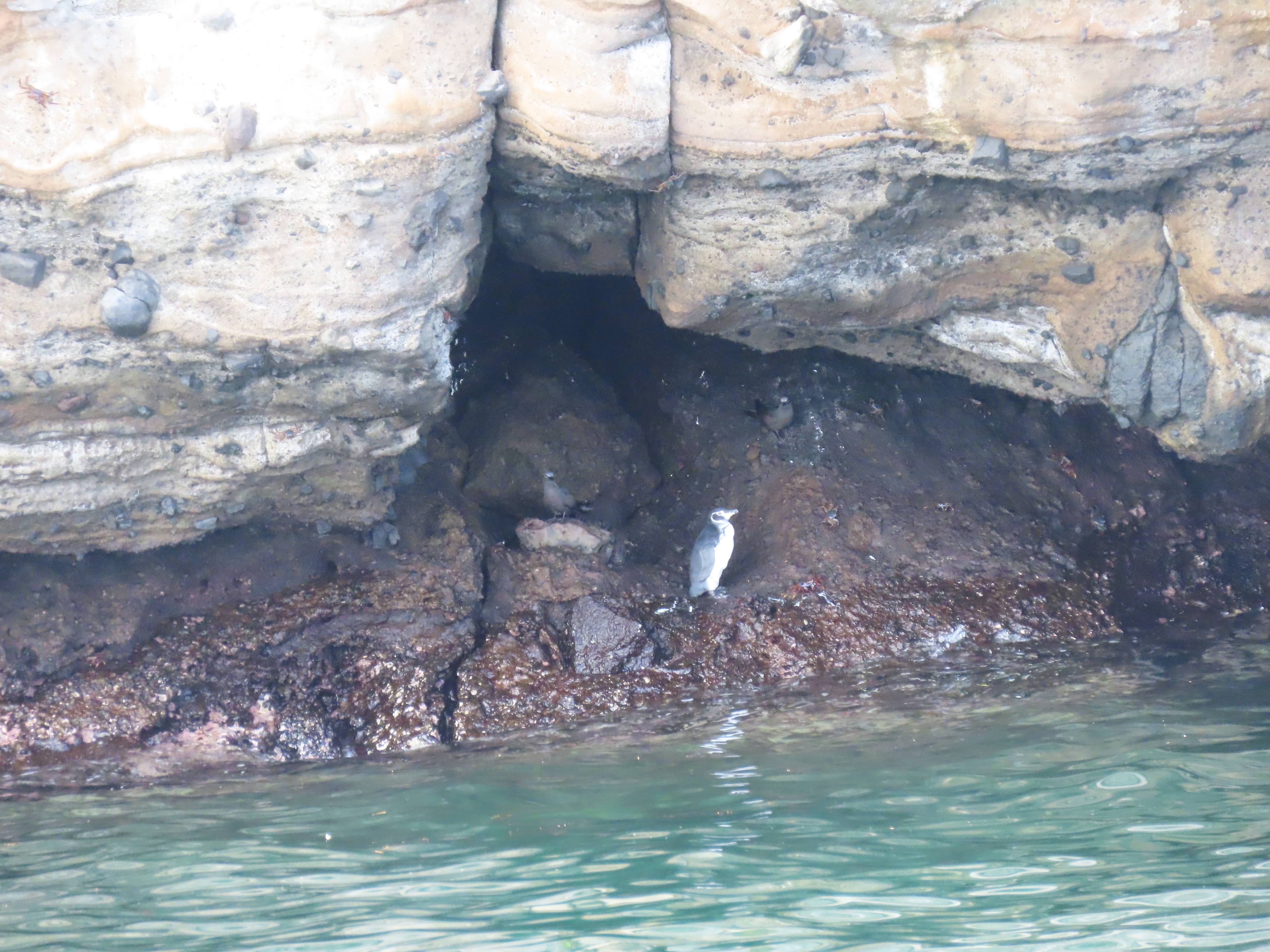
A not so great view of my first penguin species.

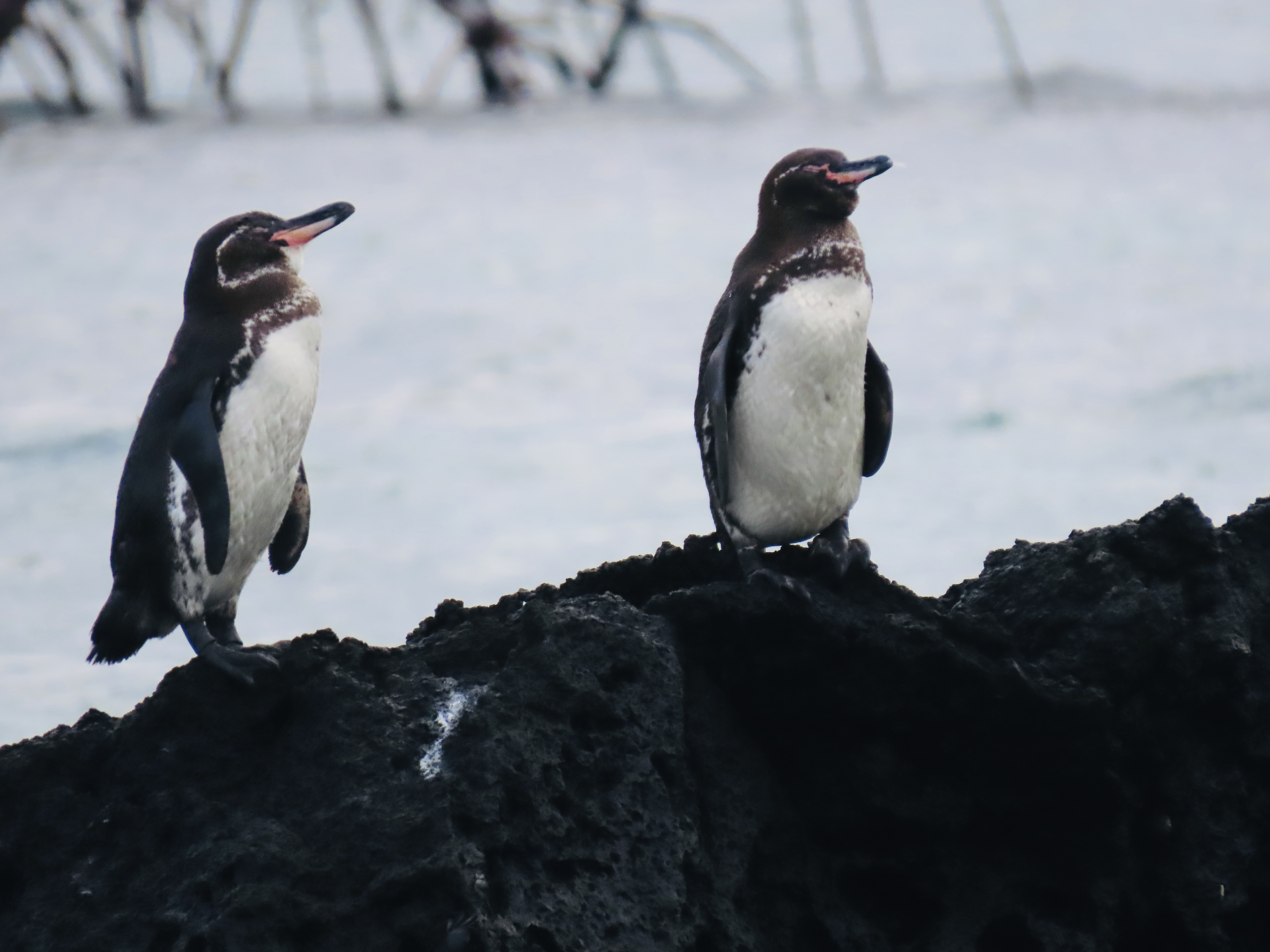
We had much better views on Islabela. Some were roosting and preening while others were swimming and foraging.
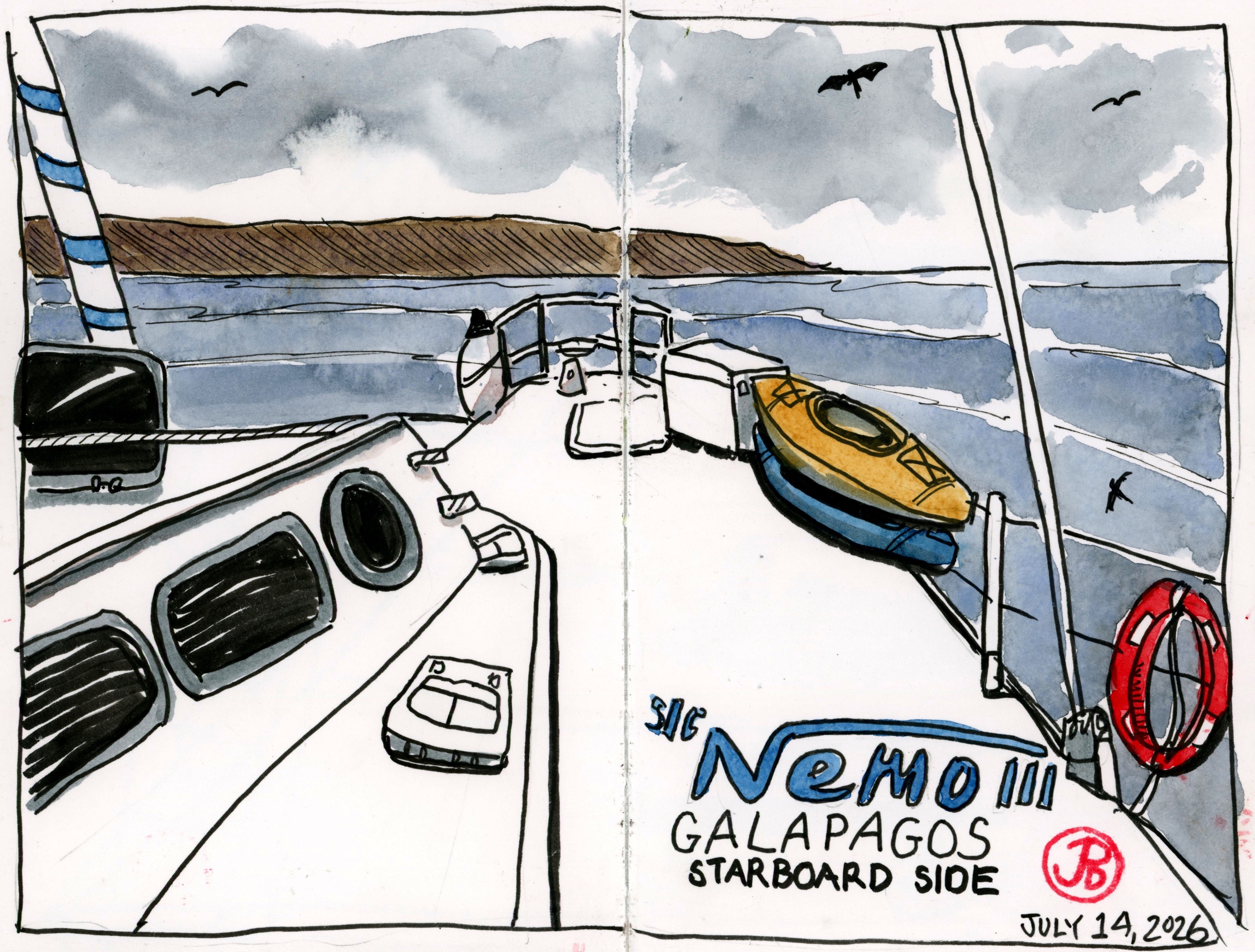
Nemo III

Our vessel for the Galápagos cruise was the catamaran the Nemo III.

It held all thirteen passenger (about half were birders), two guides, and a crew of six. This is like a cruise ship at a smaller scale.

The boat can accommodate 16 passengers in eight cabins. The small galley produced three hearty meals a day which was much appreciated after a day of birding and island exploring.
This catamaran would be our home away from home for eight wonderful days.

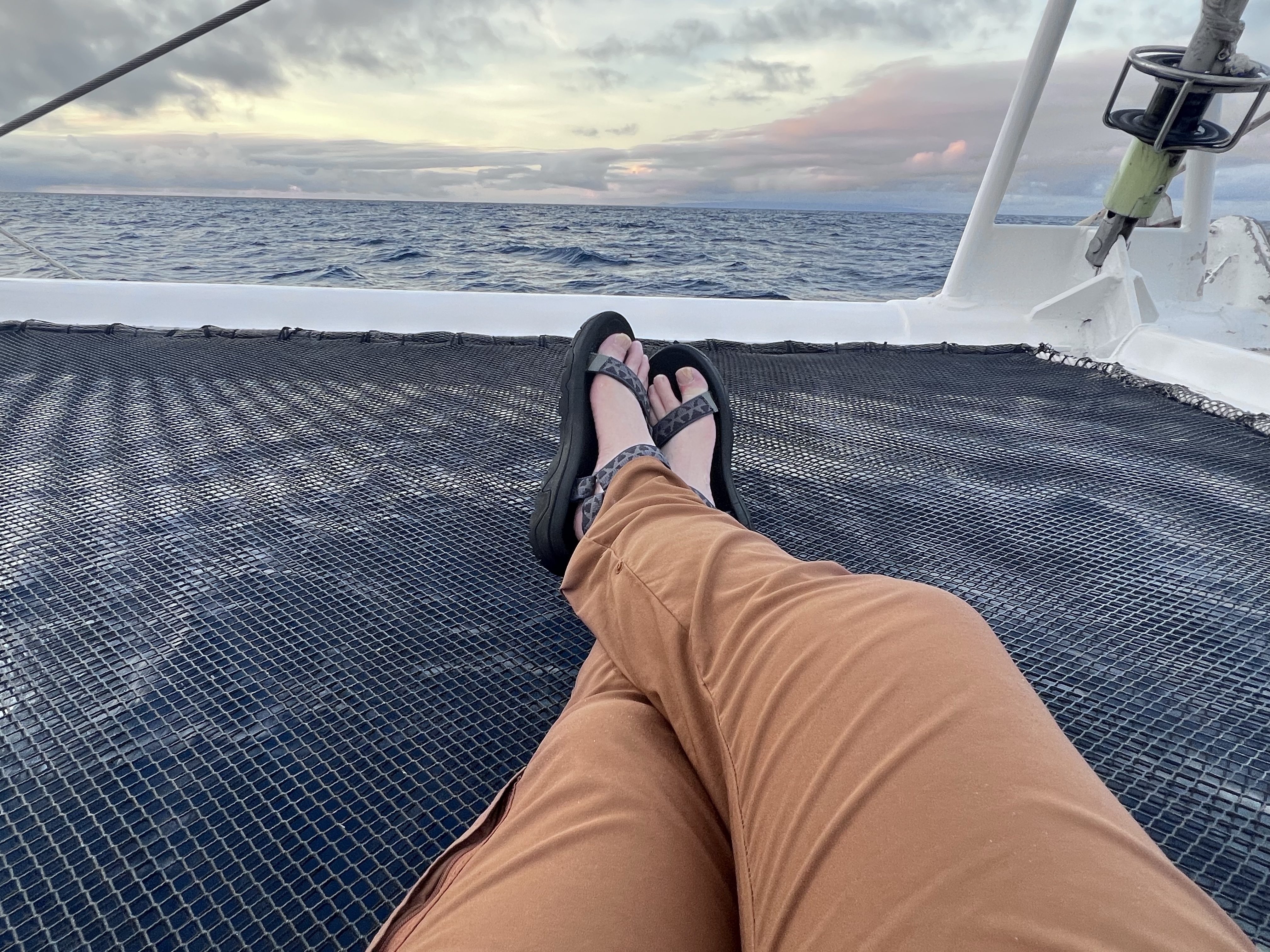
Relaxing on the bow while cruising between the islands of the Galápagos.

Over our ten day cruise visiting nine of the Enchanted Islands I sketched from the Nemo III as well as a few sketches of the catamaran from the shore.

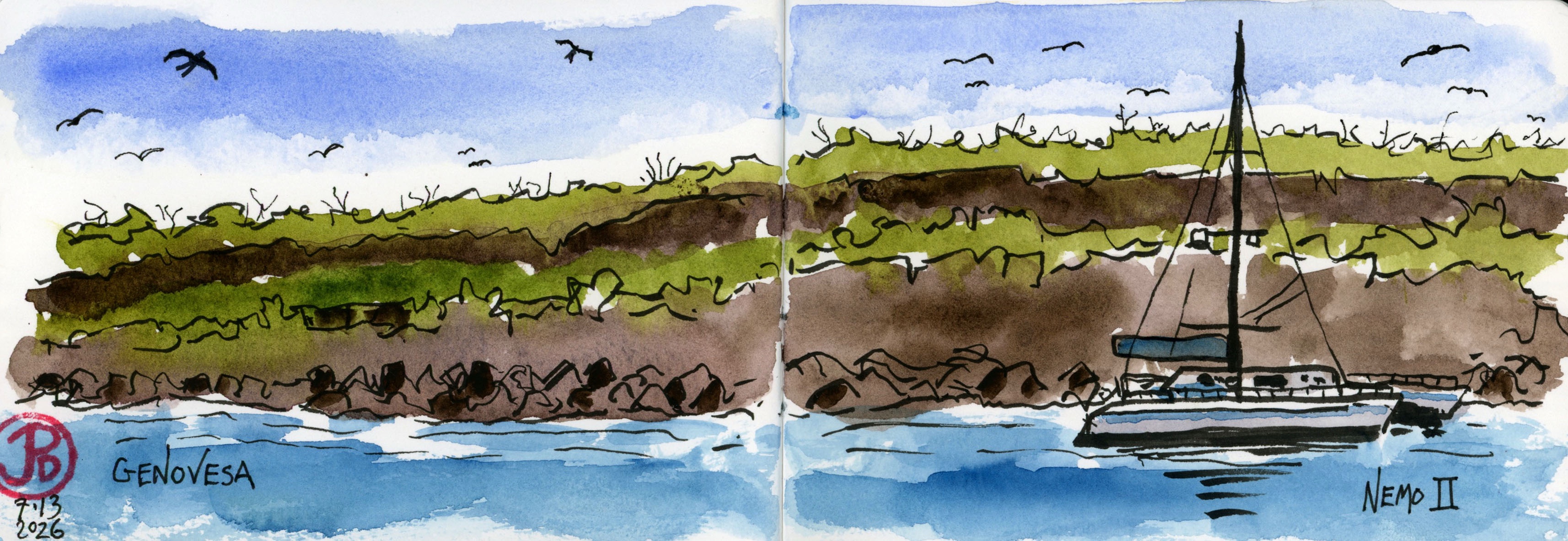
While anchored at Genovesa, I sketched our sister ship, the Nemo II.
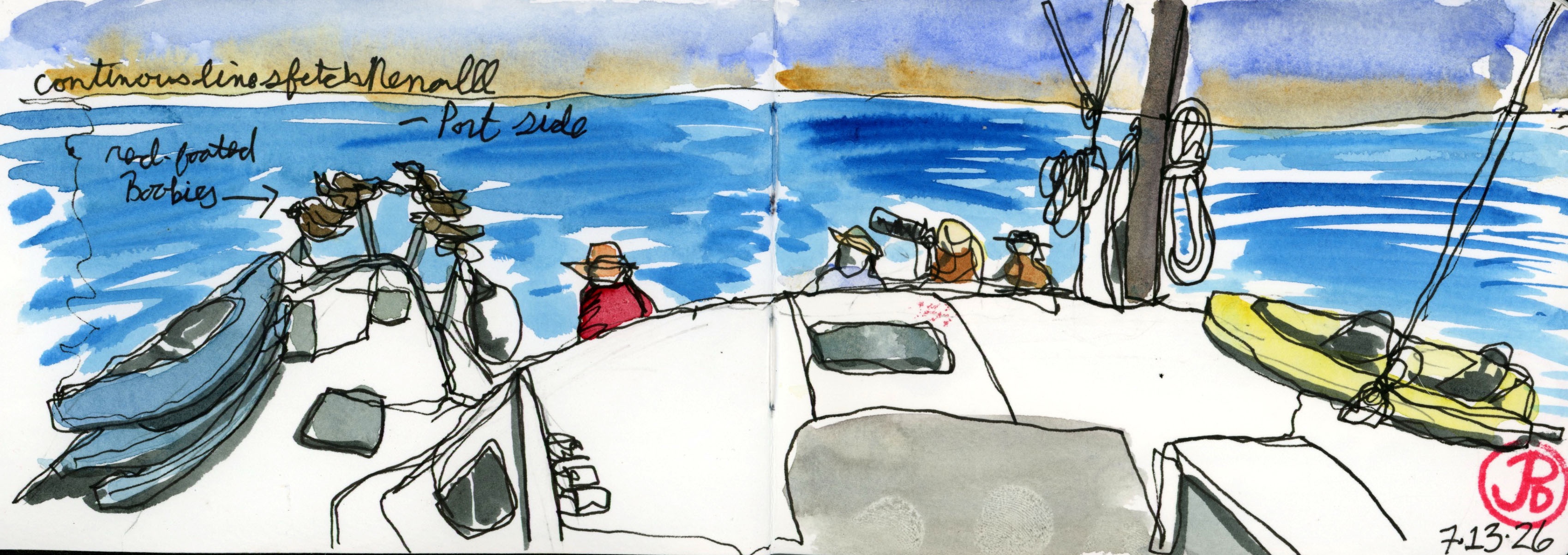
A continuous line sketch from the port side. Red-footed boobies were getting a free ride on the front railing.
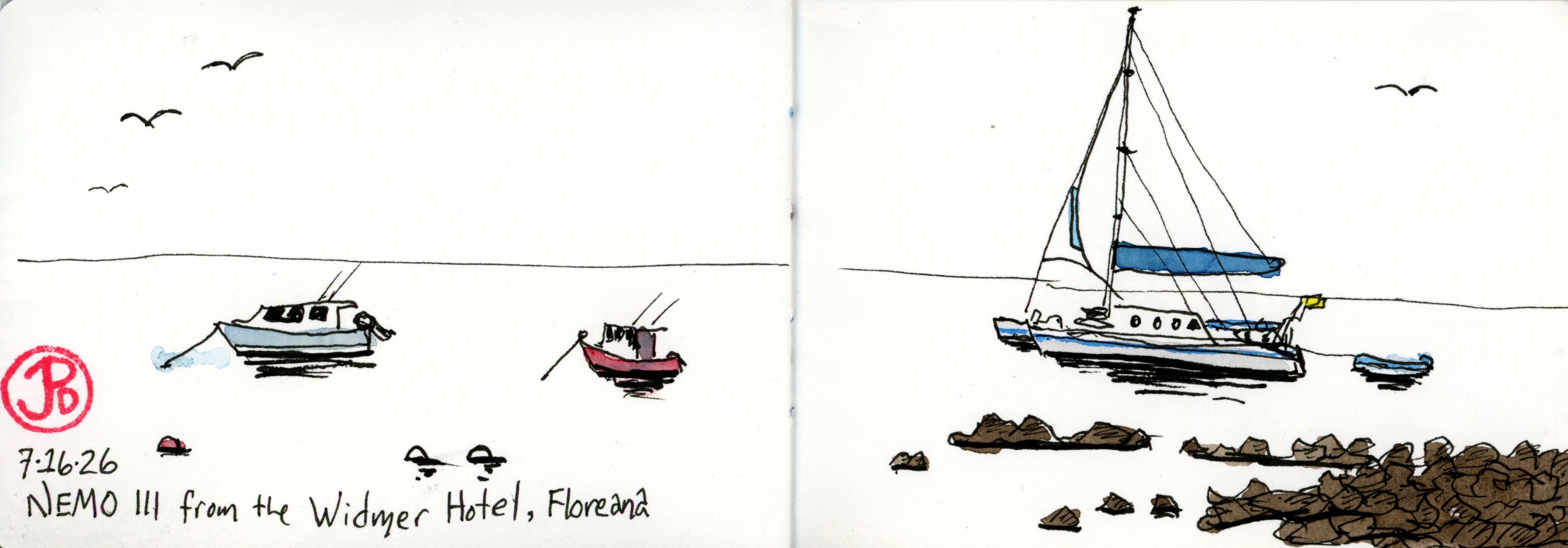
A sketch of the Nemo III from shore on Floreana.

Guango Lodge

I arrived a day early before my Galápagos cruise started so I hired a guide (Andres) for the day and we headed east over the Continental Divide of the Andes Mountains to Guango Lodge.

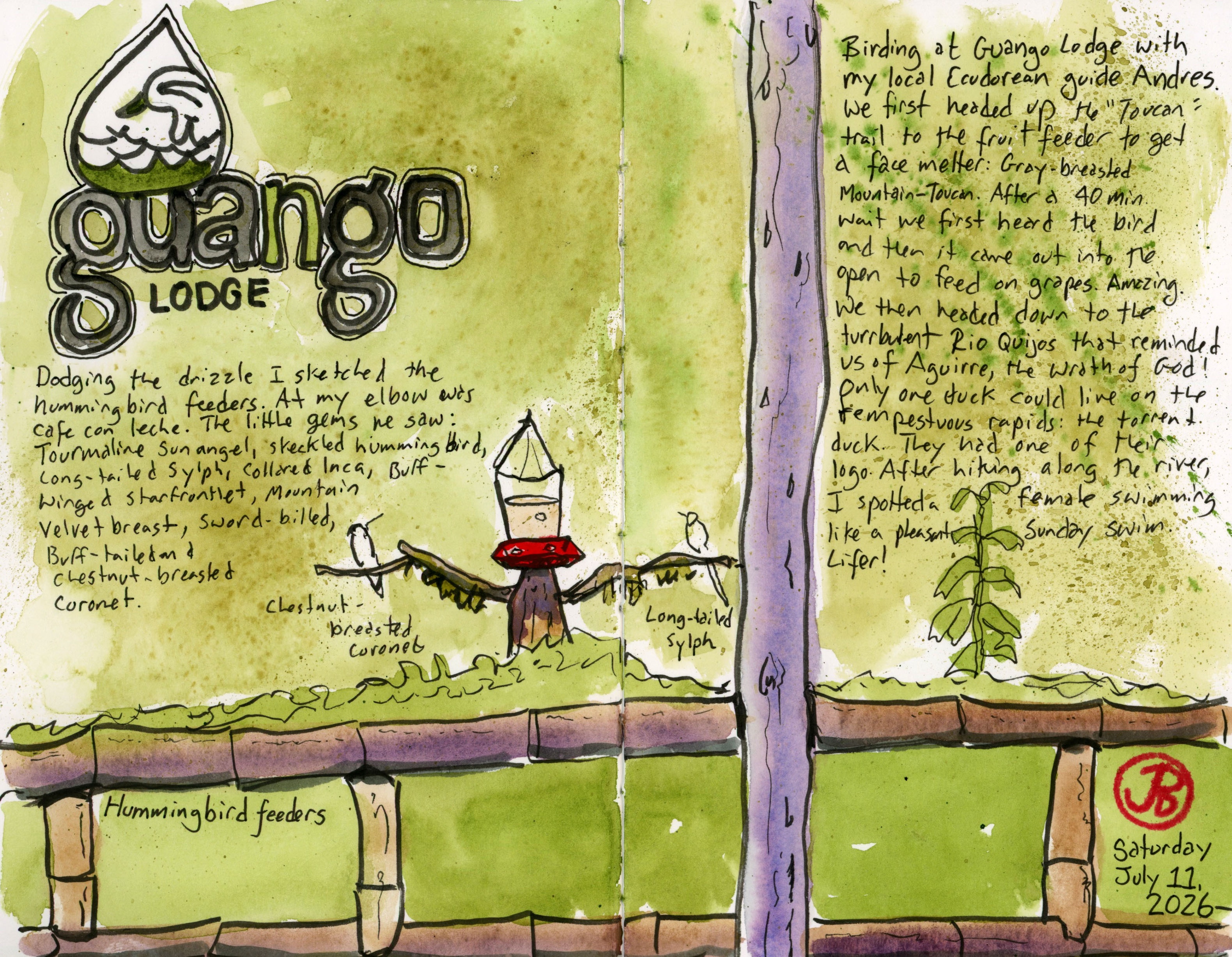
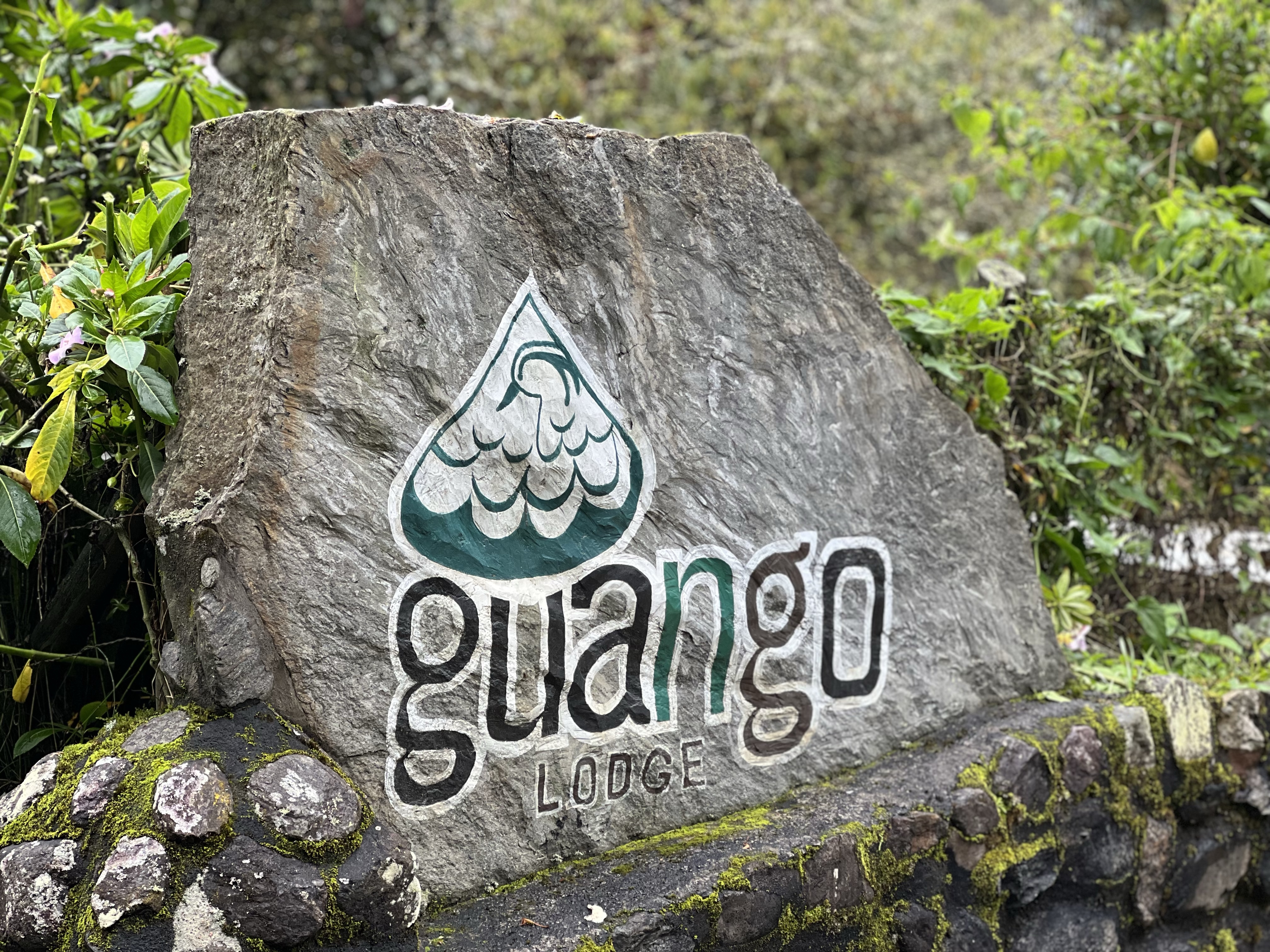
The logo features one of the top birds on my wishlist.

There were two birds that I really wanted to see in the area and with birding, you are not guaranteed any.

I wanted to add another mountain toucan to my list, on a previous Ecuadorian trip I got plate-billed, and now we walked up the muddy Toucan Trail in our rubber boots looking for a second species.

The trail leveled off at a hide where a vertical forked branch was set up. The caretaker, Daniel, came up behind us to add fresh bananas and grapes to the wooden feeder.

The first bird that visited the feeder was the great thrush. No toucans yet.

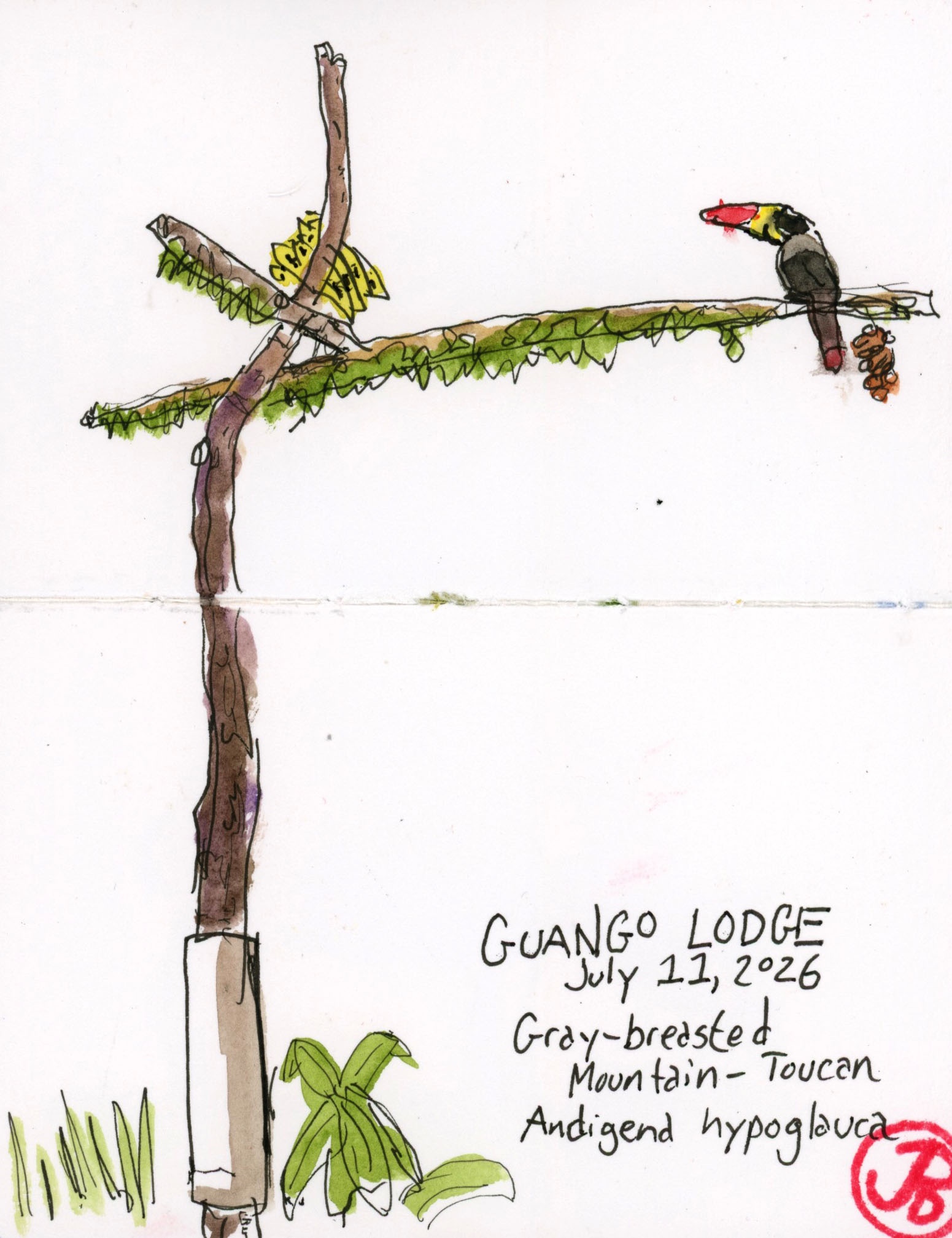
This would take a little patience and the hide was covered to keep us dry. While we waited I pulled out my small softbound sketchbook and sketched the wooden fruit feeder.

Waiting on a mountain-toucan.

Off to our right we heard the call of the toucan. Now we waited for it to fly into the open and land on the feeding perch. The bird was cautious, making sure it was safe.

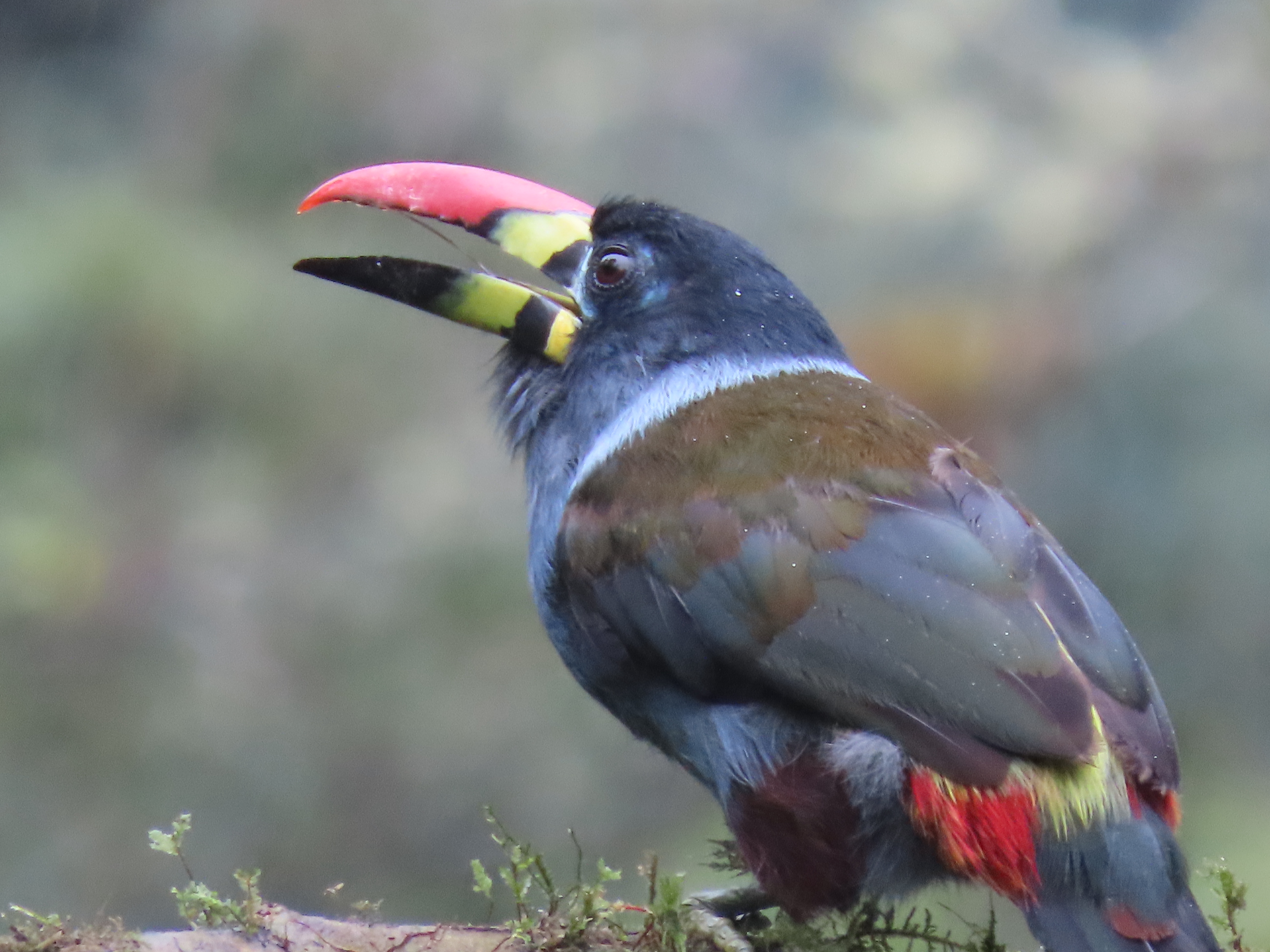
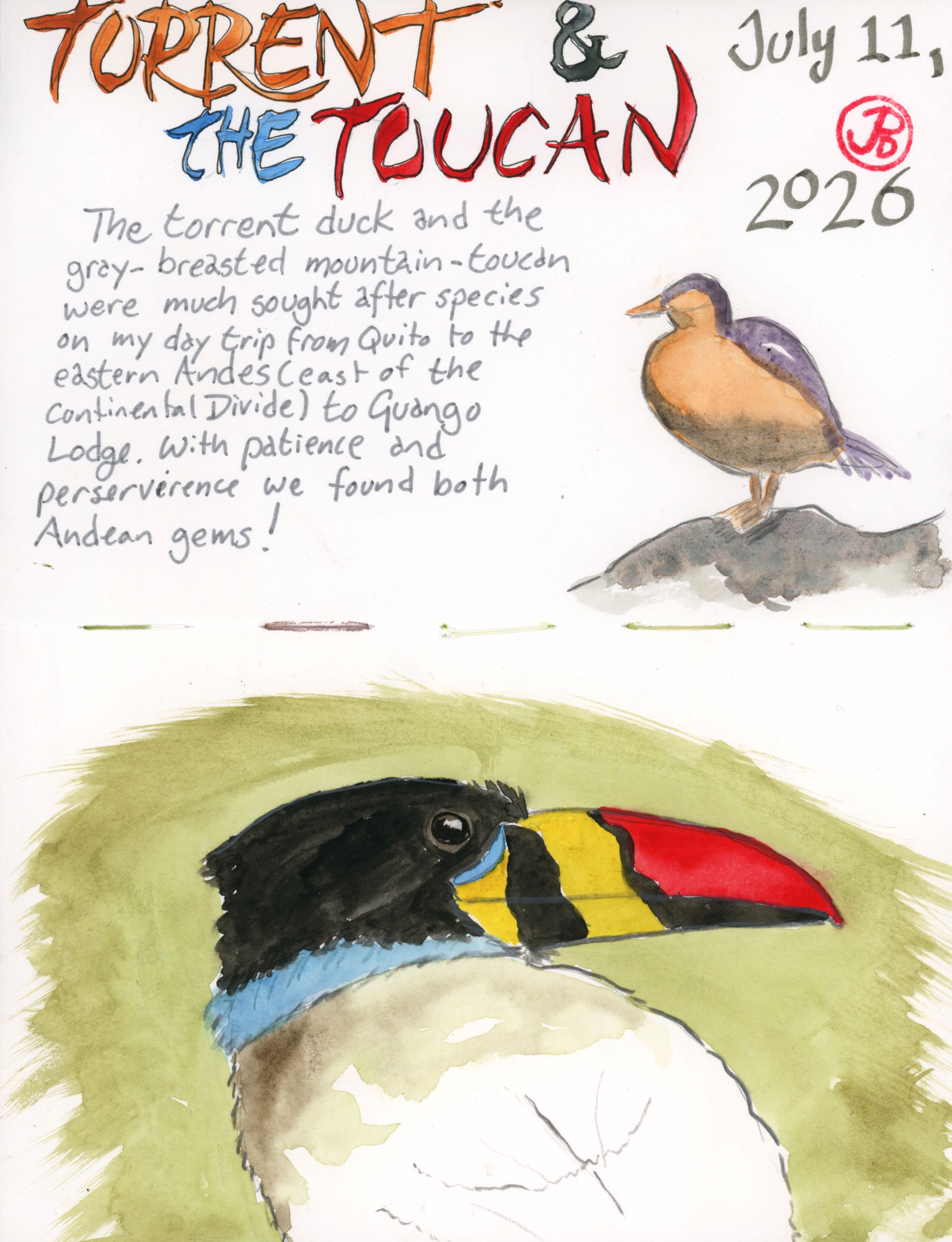
Onto the perch landed the magnificent gray-breasted mountain-toucan. A double hyphen bird of the highest magnitude! Lifer!

After watching the toucan pull grapes at the feeder we headed back to the river to look for another sought after bird.

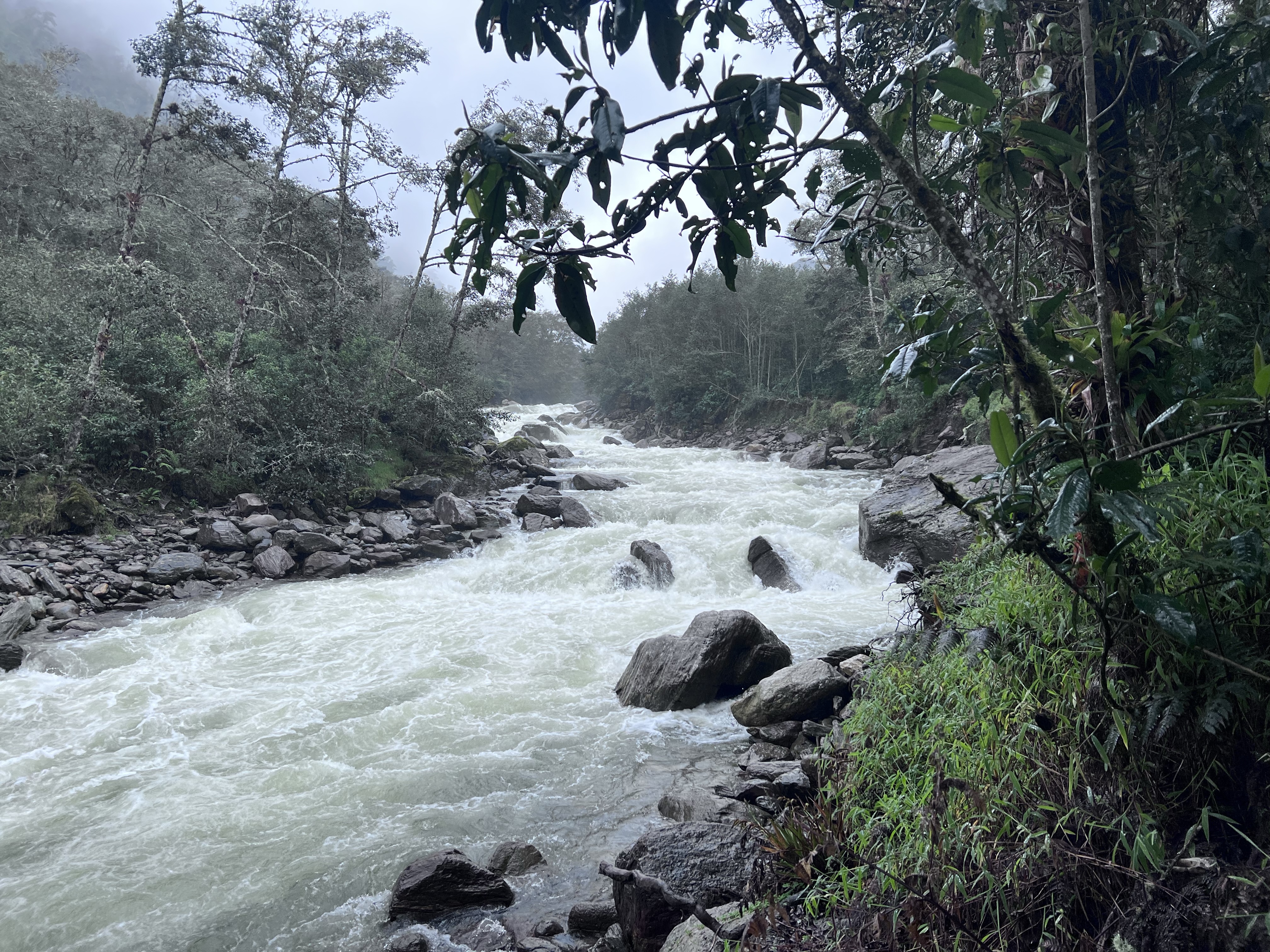
The furious and frothing Rio Quijos cloaked in gray, reminded me of Herzog’s Aguirre, the Wrath of God and Fitzcaraldo. How can a bird possibly survive here among the rapids?

Well one duck not only lives but thrives amongst the Class 6 rapids. And it’s appropriately named the torrent duck.

We walked along the river checking the waters and boulders for this iconic Andean duck.

As we neared the end of the trail I looked downstream and saw a duck bobbing in the frothy rapids. She swam across the river and walked up on a riverside boulder. What an amazingly adapted bird to its turbulent habitat. And what an amazing lifer!

A spread with sketches from my own photos.

After ticking the toucan and duck we returned to the lodge and sat under a shelter from the permanent mist and drizzle, sipping cafe con leche and looked out at the three hummingbird feeders in front of us.

The feeders were very active and I sketched the scene before me (featured sketch).

Out of the 366 species of hummingbirds in the New World (they are found nowhere else), I have seen a mere 96. I have a lot more hummingbirding to do.

Challenge accepted!

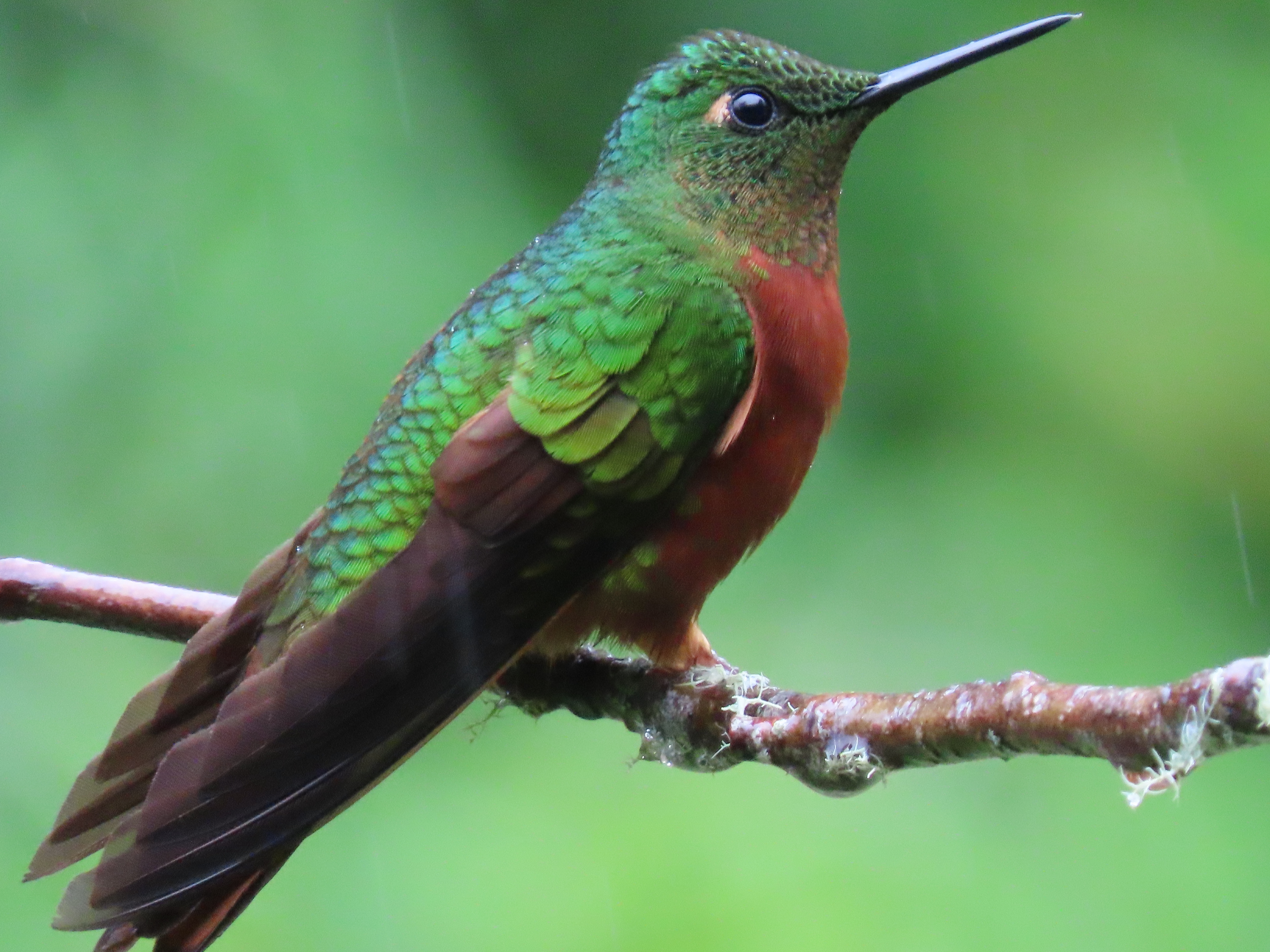
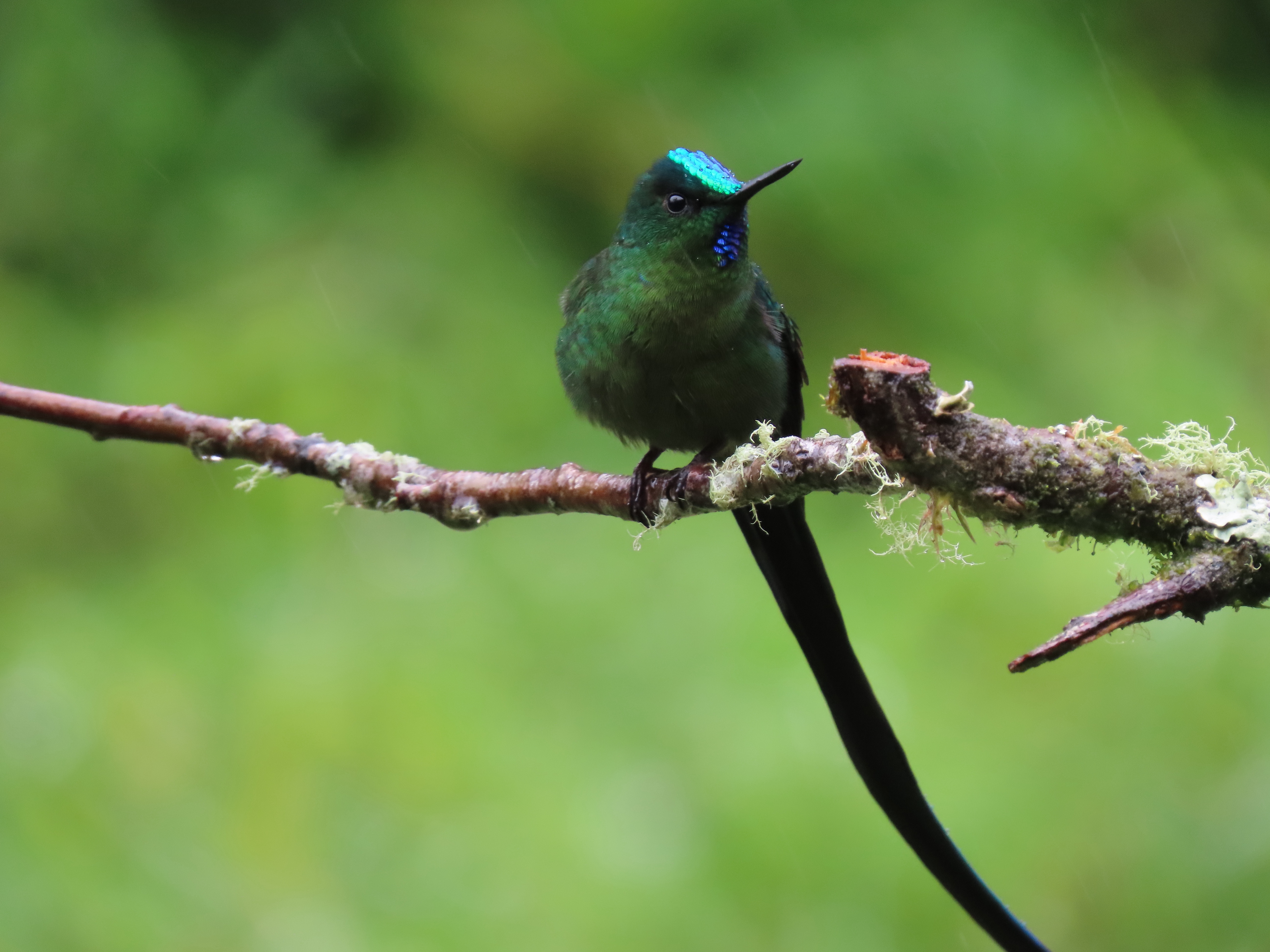
Here are a few photos of some of the visitors to the hummingbird feeders at Guango.

Chestnut-breasted coronet.
Long-tailed sylph.

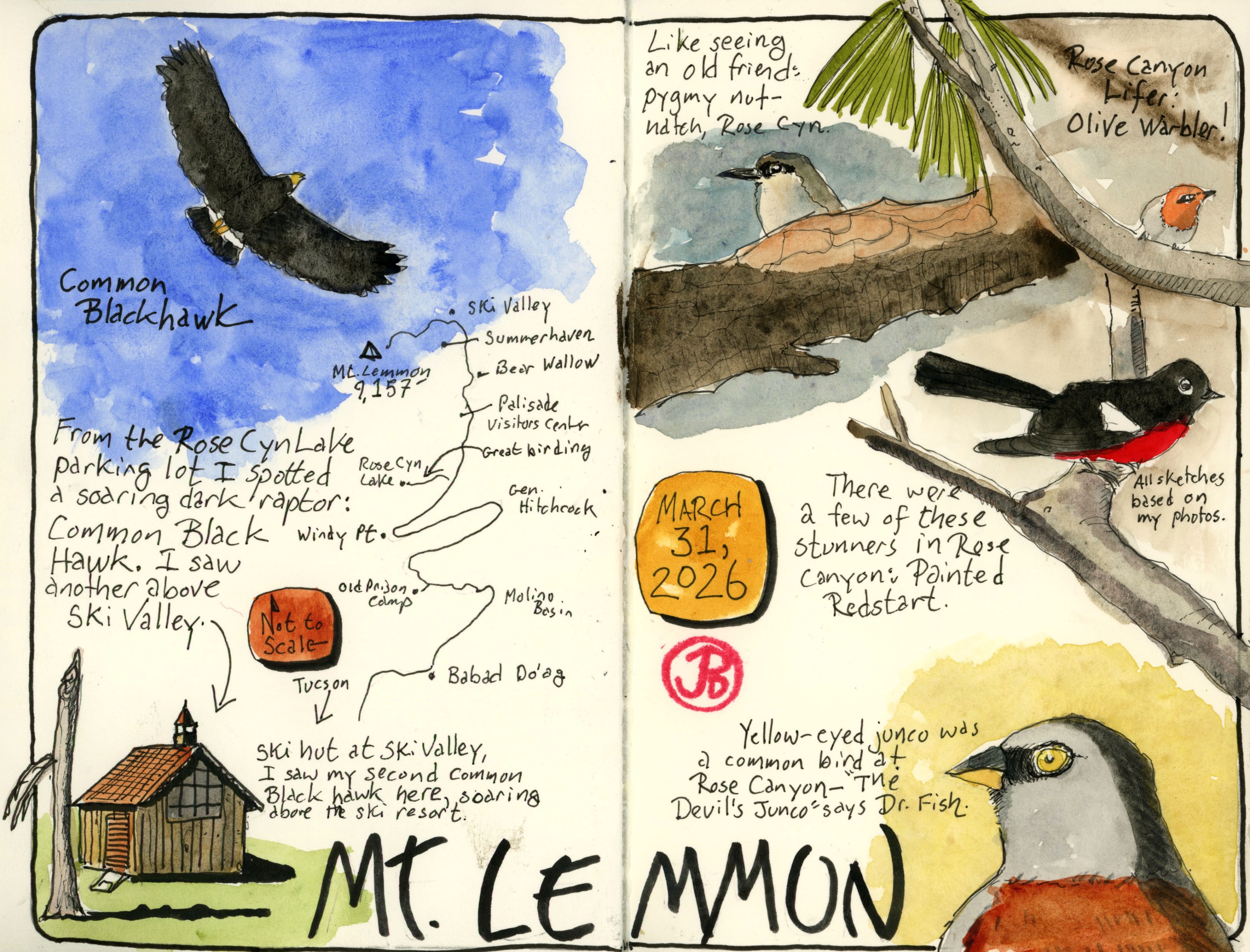
Birding Rose Canyon, Mt. Lemmon

When I arrived at the Rose Canyon turn off at a quarter to eight, the entrance was barred.

Turns out that the campgrounds and picnic areas would not be open for another 15 days.

I parked at a lot to the right of the entrance and there was only one car in the lot. Could they be birders of anglers?

One huge draw of driving up to 7,000 feet above sea level is that it is much cooler than in Tucson. The temps were in the high 50s as I walked down the road towards Rose Canyon Lake.

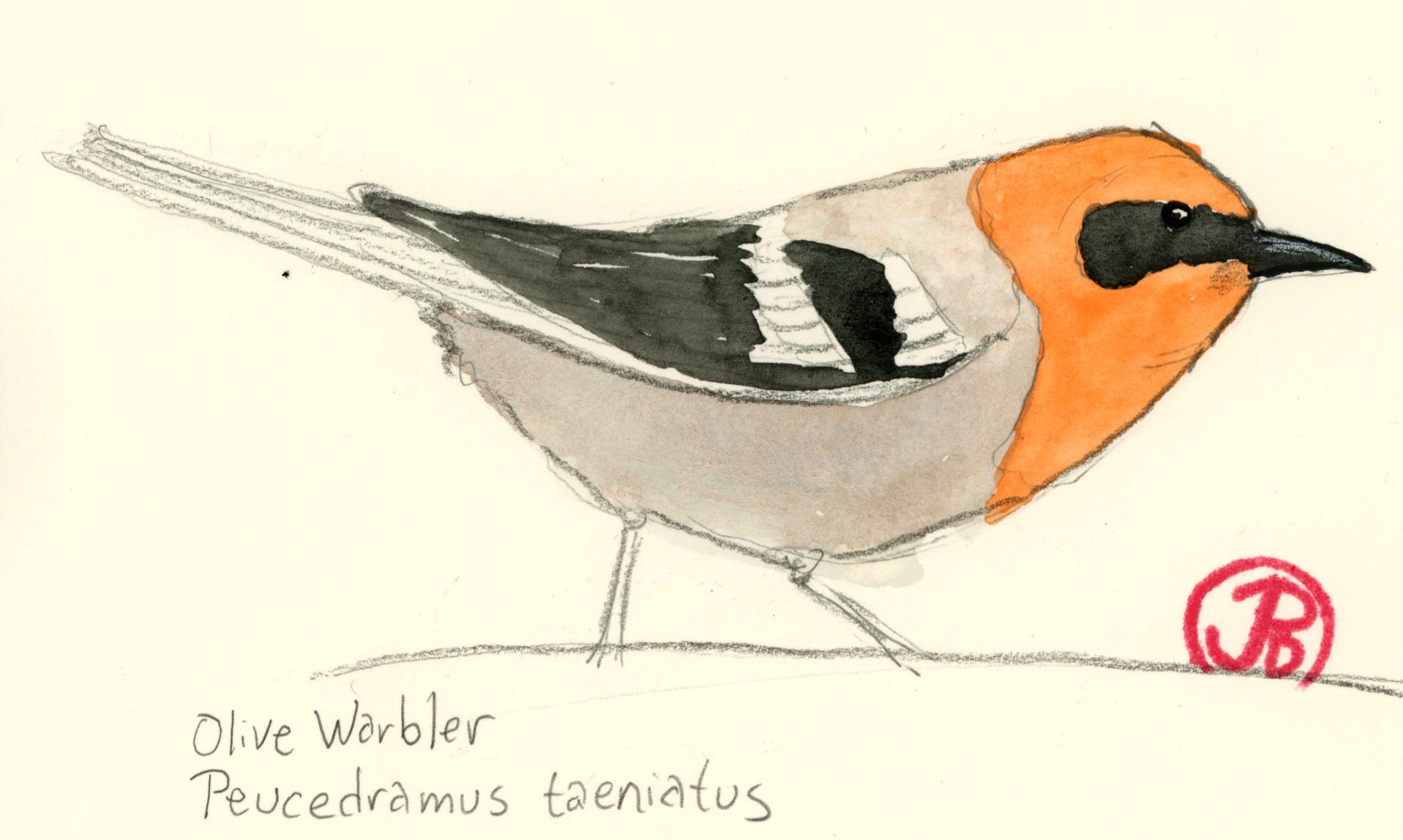
I had two key species I was listening and looking for: olive warbler and greater pewee. I had birded southern Arizona on four occasions but somehow I hadn’t seen these high elevation conifer-loving species. Now is the time to go to a good hotspot at Mount Lemmon, which is the road I was now on in Rose Canyon.

The first species encountered was one I hadn’t seen in a while: yellow-eyed junco. The Devil’s junco.

As I continued down the road past empty campsites and picnic areas, I first heard the greater pewee singing its “Jose Maria” call. Lifer!

I continued on toward the lake looking and listening for the olive. Even this early spring, they didn’t seem to be singing, while many others were in full voice.

At the lake I found the occupants of the car I parked next two: two anglers. But not much on the lake except a few mallards.

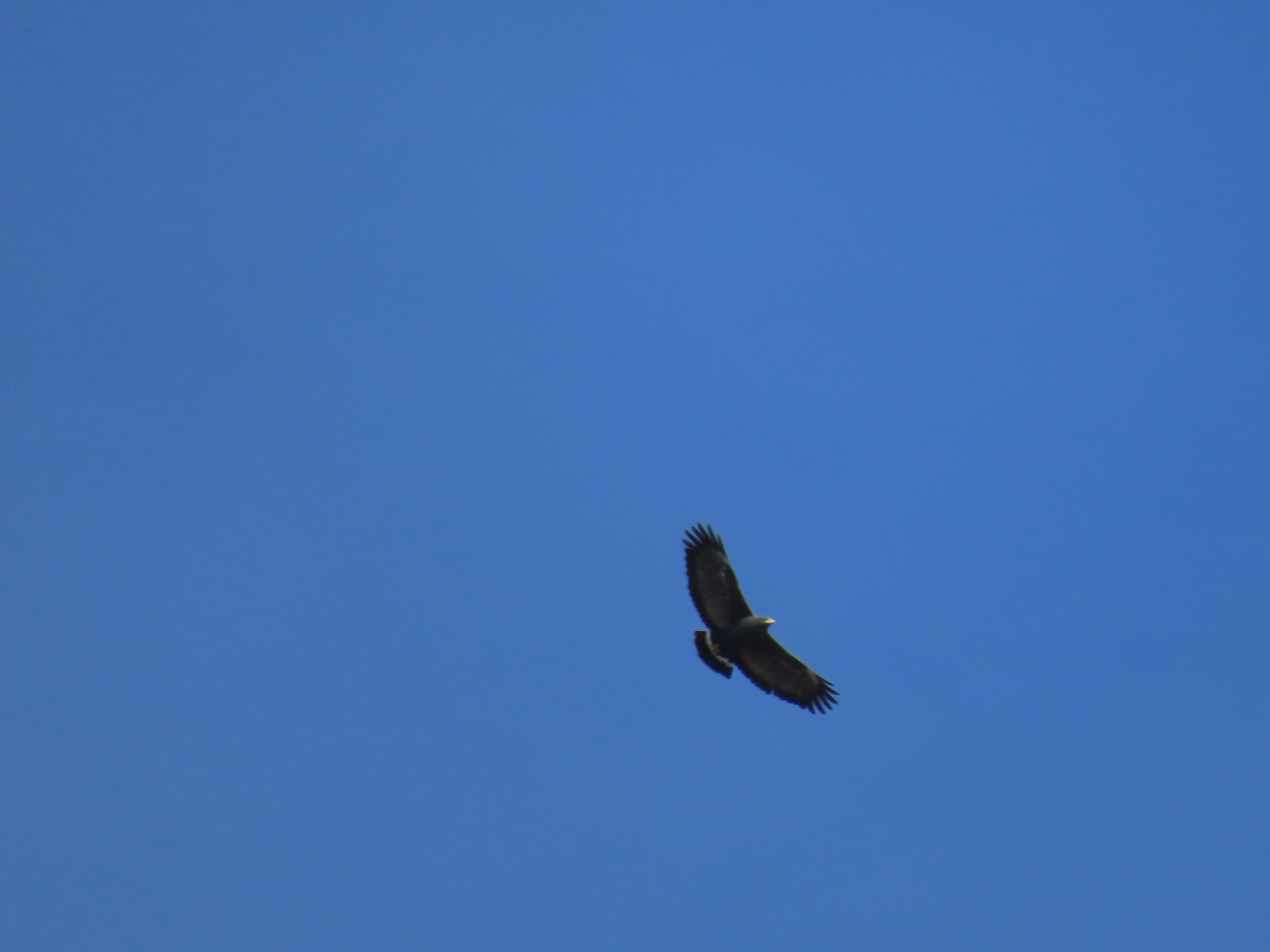
As I walked up the hill towards the lake parking lot, now completely empty, I spotted a dark raptor soaring above the trees.

I put bins on the bird and thought it was either a zone-tailed or a common black hawk. I raised my camera up and got off four shots before the hawk moved over the ridge. I would sort out identification later when I got a better look at the photos.

A common black hawk.

I retraced my route back towards my car, scanning the ponderosa pines for a black-masked bird with a tawny orange head.

Before long I found a male foraging in a pine to my left. Olive warbler, lifer at last!

He flew across the road and was soon joined by a female and they foraged together and then moved higher up the pine and out of sight.

I later saw another female on the ground gathering nesting materials. Spring is here in the mountains!

Once back at the car park I headed up towards the summit and Summerhaven. I pulled off to the small ski resort of Ski Valley.

The resort, the most southern ski resort in the United States, had three lifts and a small building capped with a bell tower which I guessed is the ski school.

Off to my right and above the pines circled a large, dark raptor. Was this the same bird I had seen at Rose Canyon? After reviewing photos I identified the bird as a common black hawk.

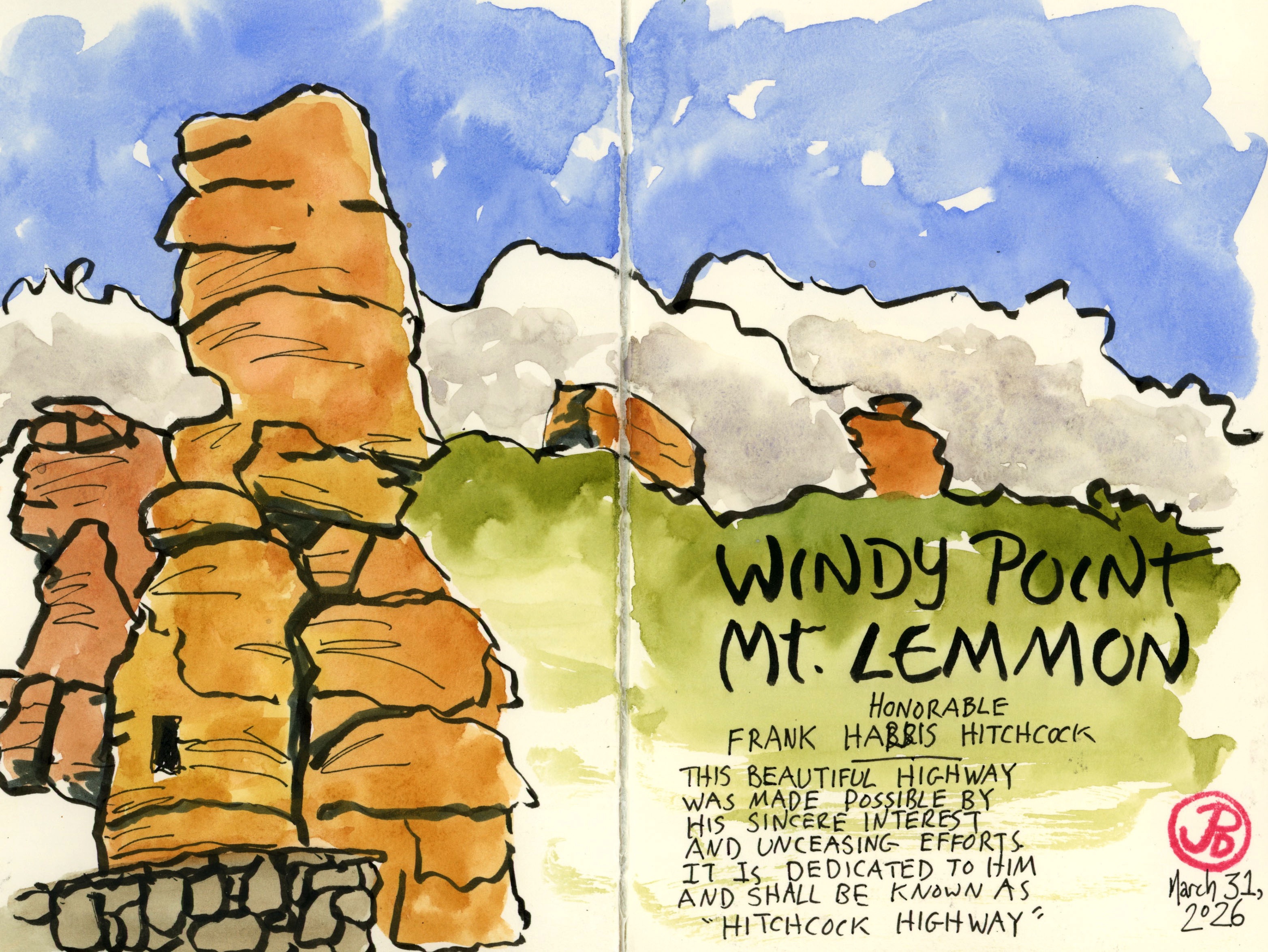
On my return down the mountain I stopped at Windy Point to sketch the otherworldly rocks and to take in the views greater Tucson. It’s amazing to think that I only had to travel about an hour from Tucson to be in a completely different world.

Image

Birding the Esplande

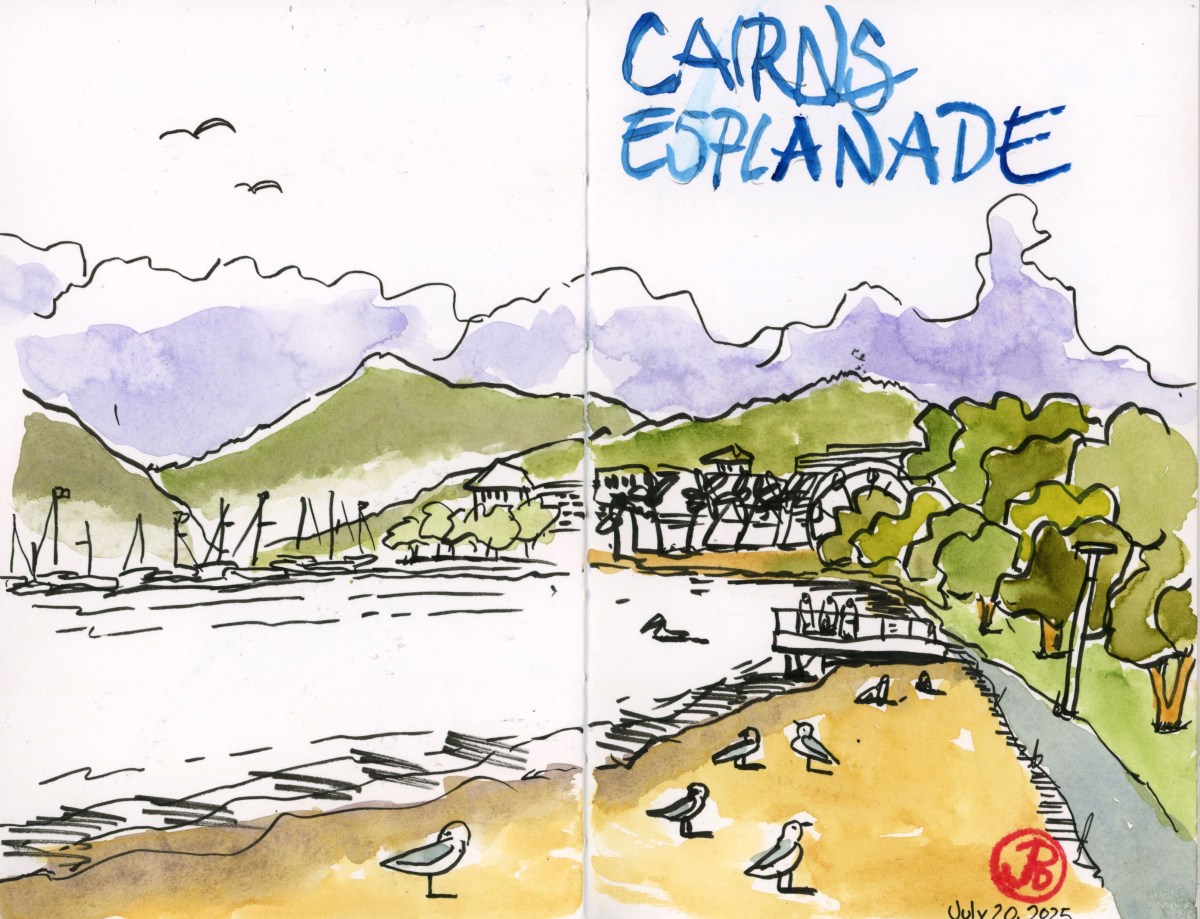
The top birding site in the Australian State of Queensland is the Cairns Esplanade.

The esplanade is a path that runs north to south along the water with parks and trees bordering to the west. This path is popular with joggers, bikers, and dog walkers, as well as birders from around the world.

When the tide is right, many waders feed close in on the exposed tidal flats but there are always birds to be found foraging in the trees.

With the following sketches I highlight a few of the species I encountered on the Esplanade. While none of these species are rare or Esplanade specialties, they are birds that grabbed my attention.

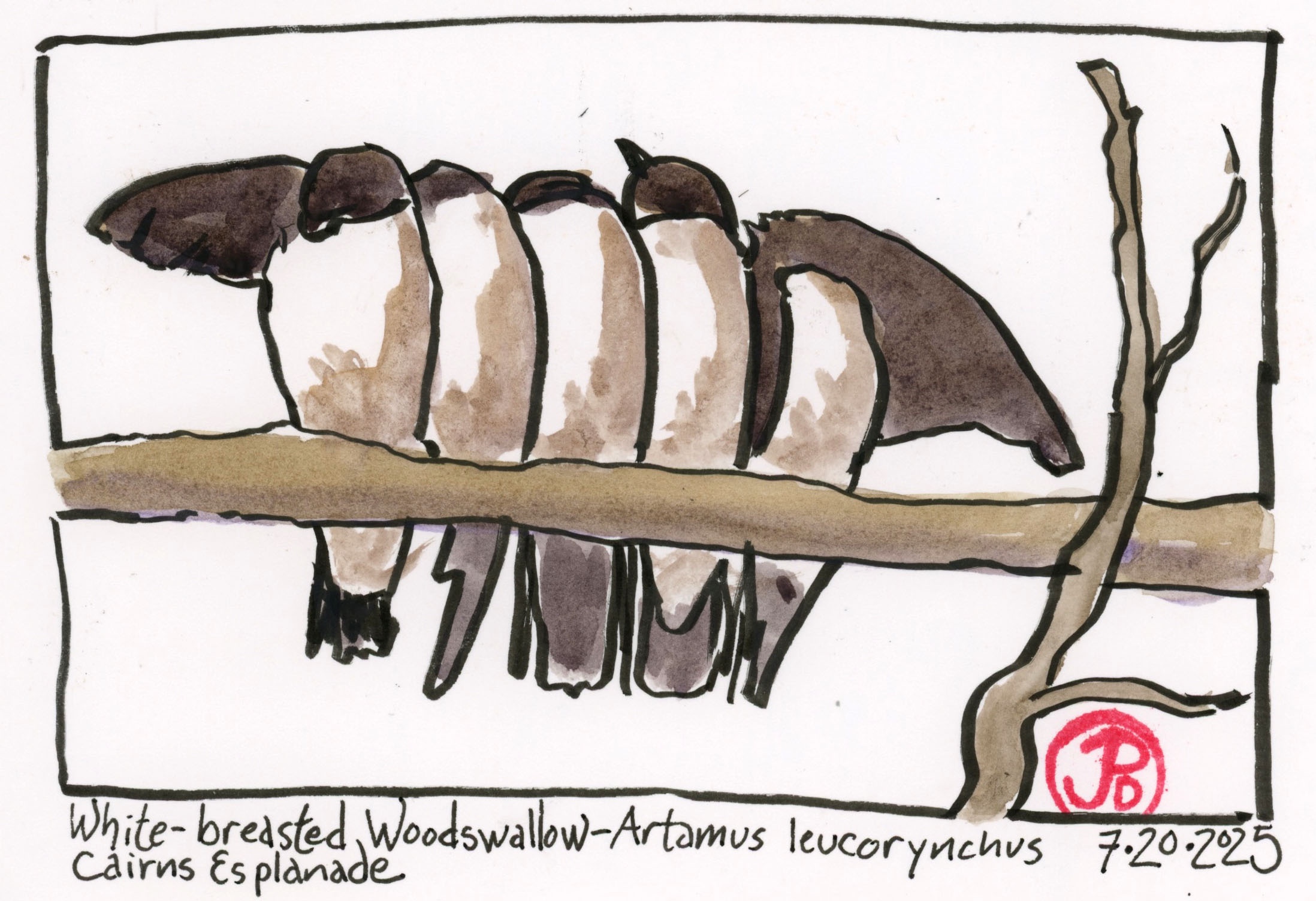
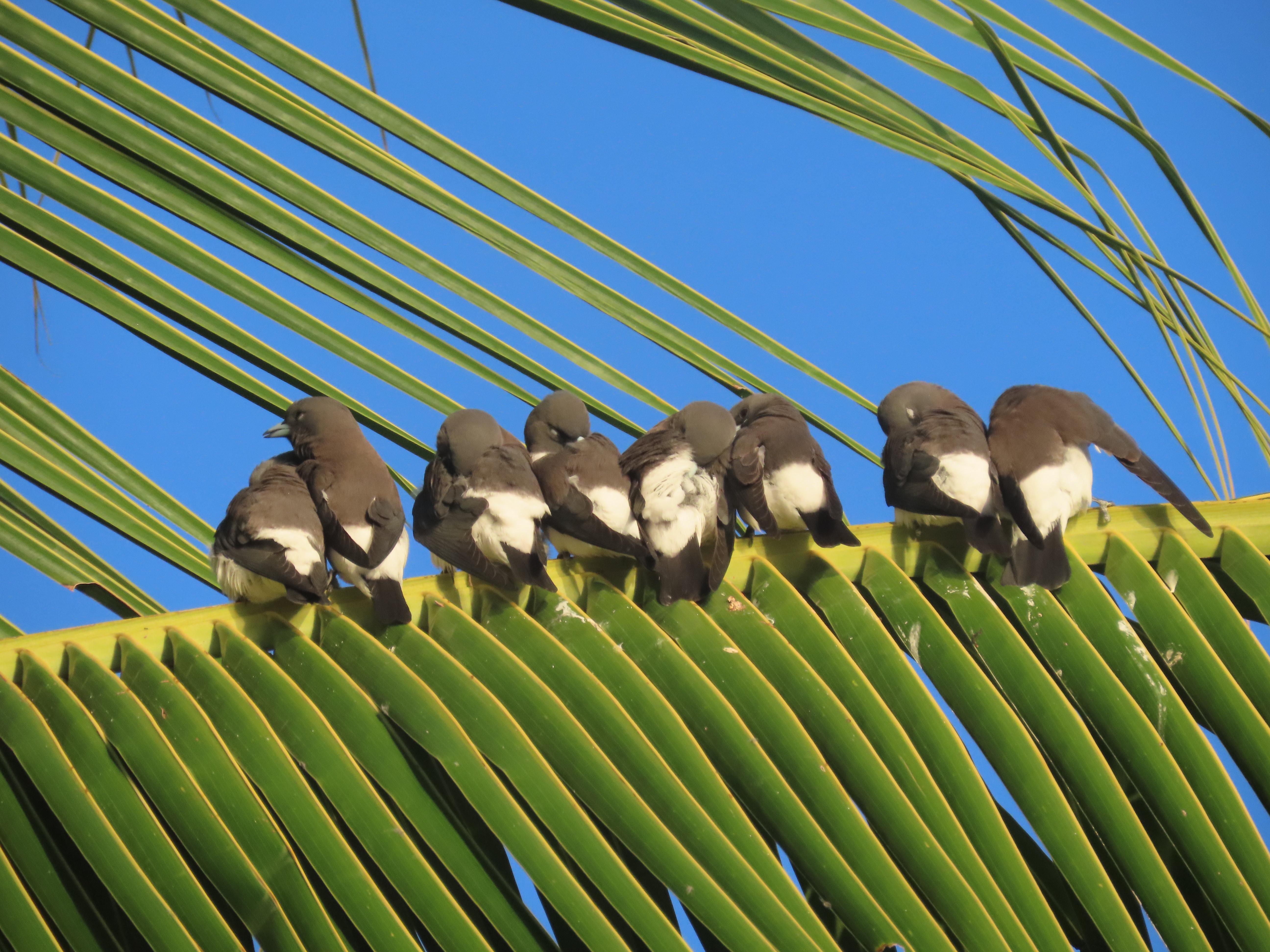
Ever since seeing woodswallows in my Australian bird guide I knew I wanted to see them, primarily because of an interesting behavior. My guide reads, “compulsively social when loafing or roosting, often settling in tight rows on branches to sleep or to preen themselves or each other”. There are six species of woodswallow in Oz, these were white-breasted.

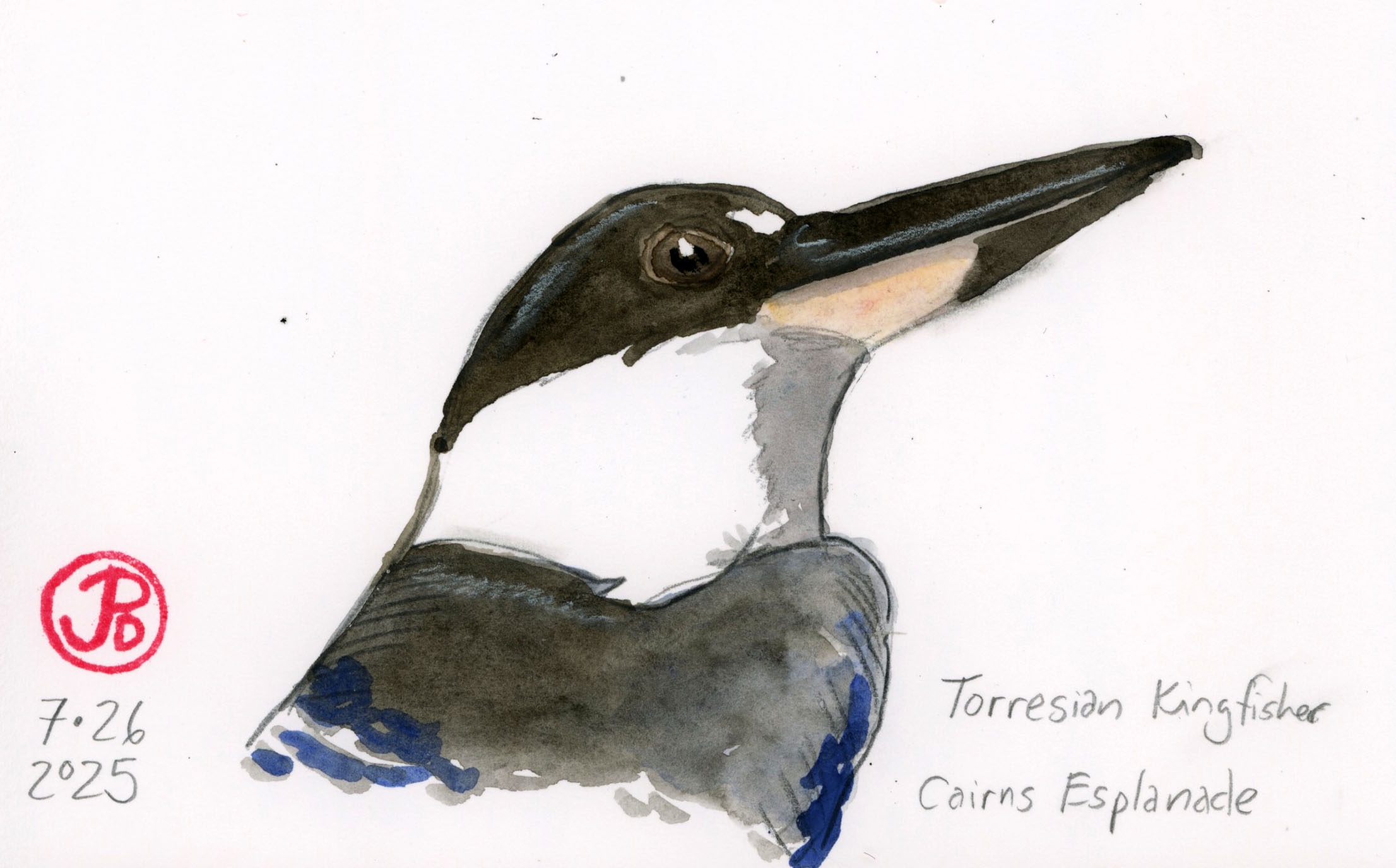
While in Australia I added seven species of kingfisher to my world list including the world’s largest kingfisher, the laughing kookaburra. I added my last species of kingfisher on my final day in Cairns birding the northern Esplanade.

In my bird guide it is known as the collared kingfisher but is now known as the Torrisian kingfisher. Named for the Torres Strait which is the body of water separating Queensland and New Guinea.

I had missed this larger kingfisher on two other visits. The most common kingfisher on the tidal flats and in the trees was the wonderfully named scared kingfisher.

On my last pass I found two Torrisans perched in trees near the water. They were both calling and having me stunning looks in the morning light!

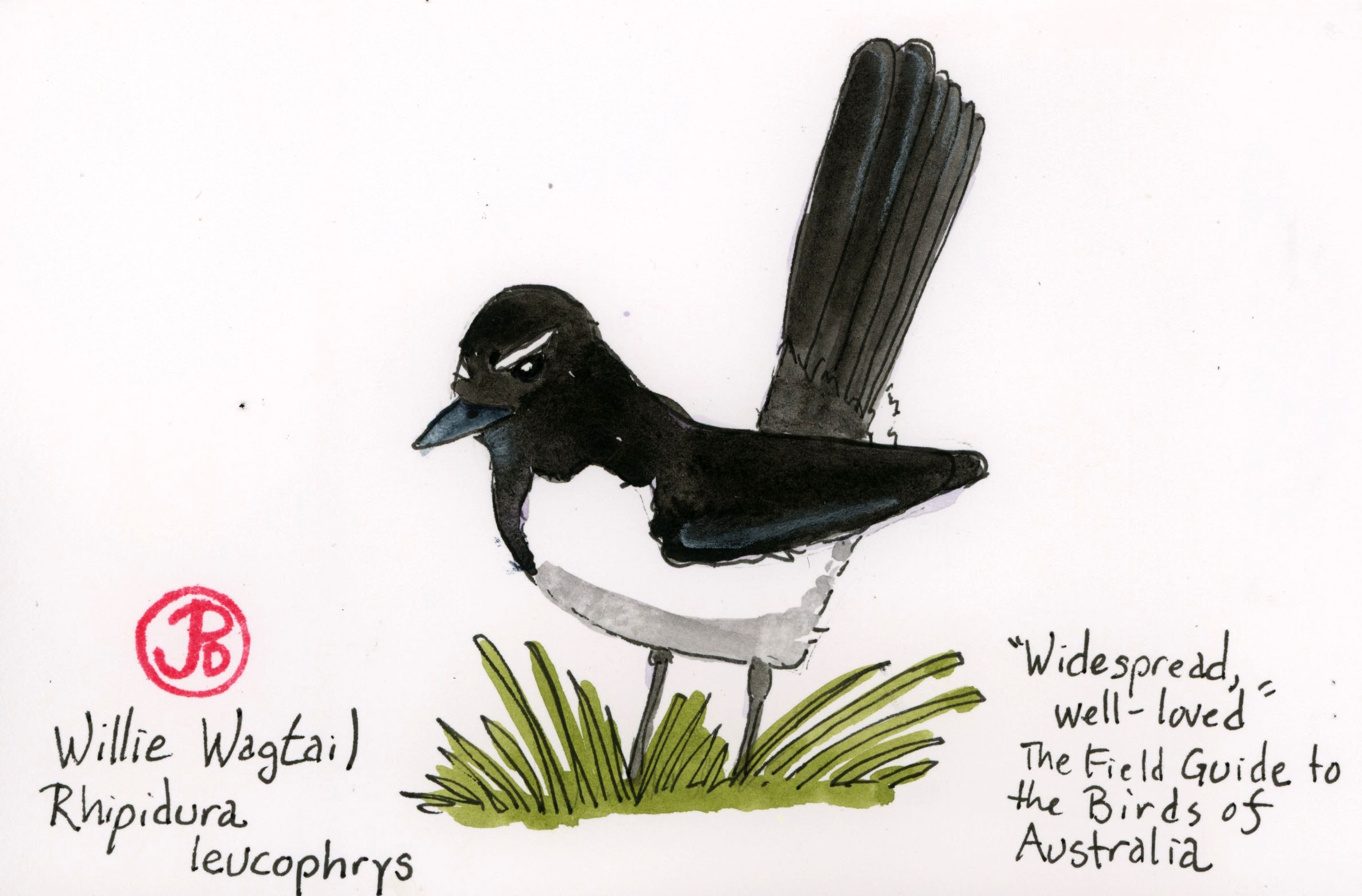
The final bird that I am highlighting is perhaps the most common and as one bird guide notes, “widespread and well-loved”. And I certainly loved my encounters with the Willie wagtail.

The wagtail seems to relish being in the presence of humans. While I was walking across a lawn at the northern end of the esplanade, a Willie wagtail flew up to me and landed close. The bird followed me as I traversed the grass and I realized the wagtail was using me like the cattle egret uses cattle, as a way to scare up bugs from underfoot.

I had experienced this behavior once before, as I was being followed Wunce by a barn, swallow, while I was crossing a soccer pitch.

Image

Searching for the Dinosaur Bird

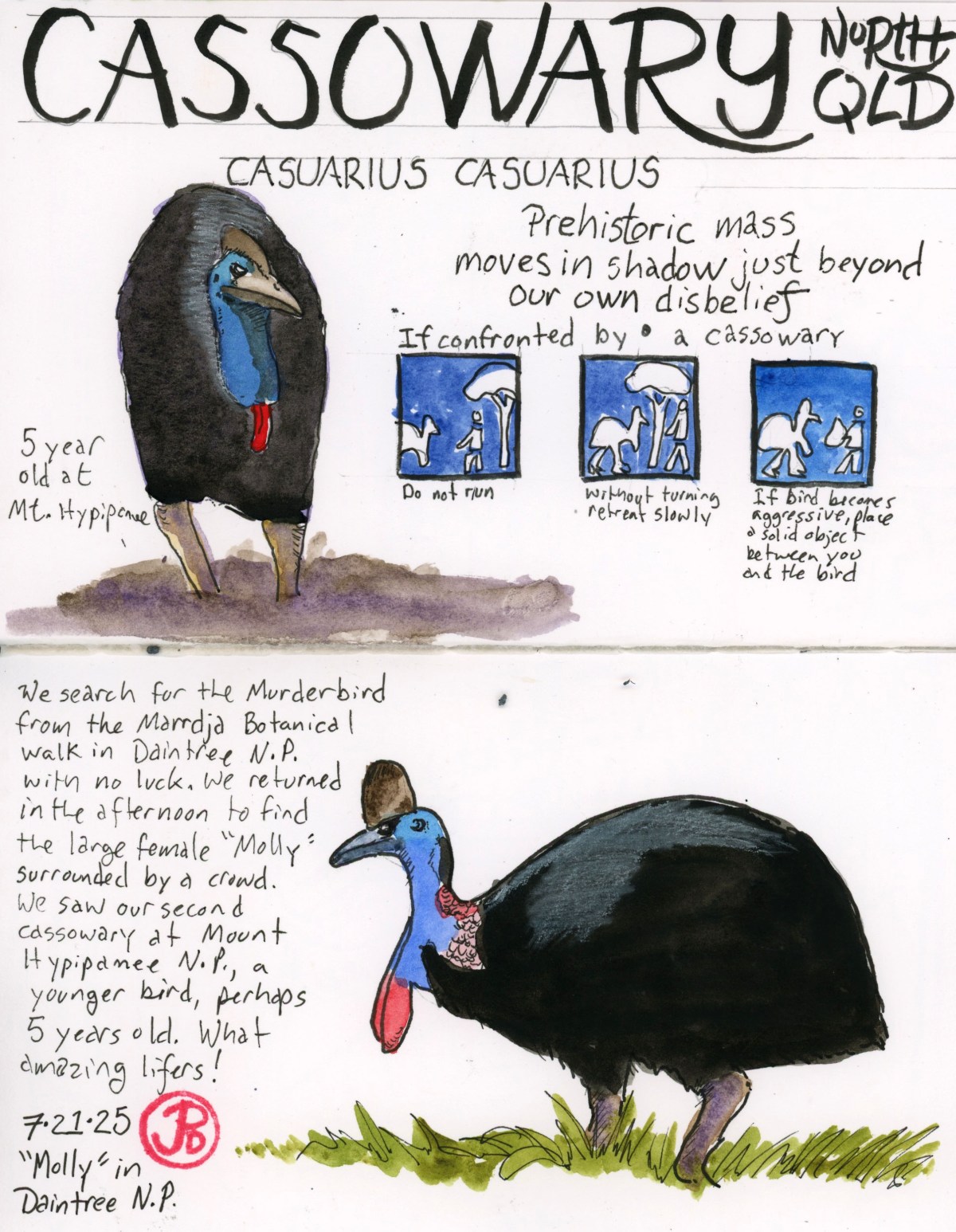
The bird that topped my wishlist for North Queensland (and Australia) is the southern cassowary (Casuarius casuarius).

The southern cassowary is a large flightless bird and the second largest bird Down Under only beaten by the emu. It forages on fallen fruit on the rainforest floor. It is a rather docile unless you try to hunt one. The lit lives up to its moniker: Murder Bird!

There are two known instances in which a cassowary has attacked and killed a person. One was a young boy in Australia, who was attempting to hunt a cassowary , the other was a 75-year-old man in Florida (proof that cassowaries don’t make good pets).

How hard can it be to find a large flightless bird in the rainforest? Turns out, pretty hard.

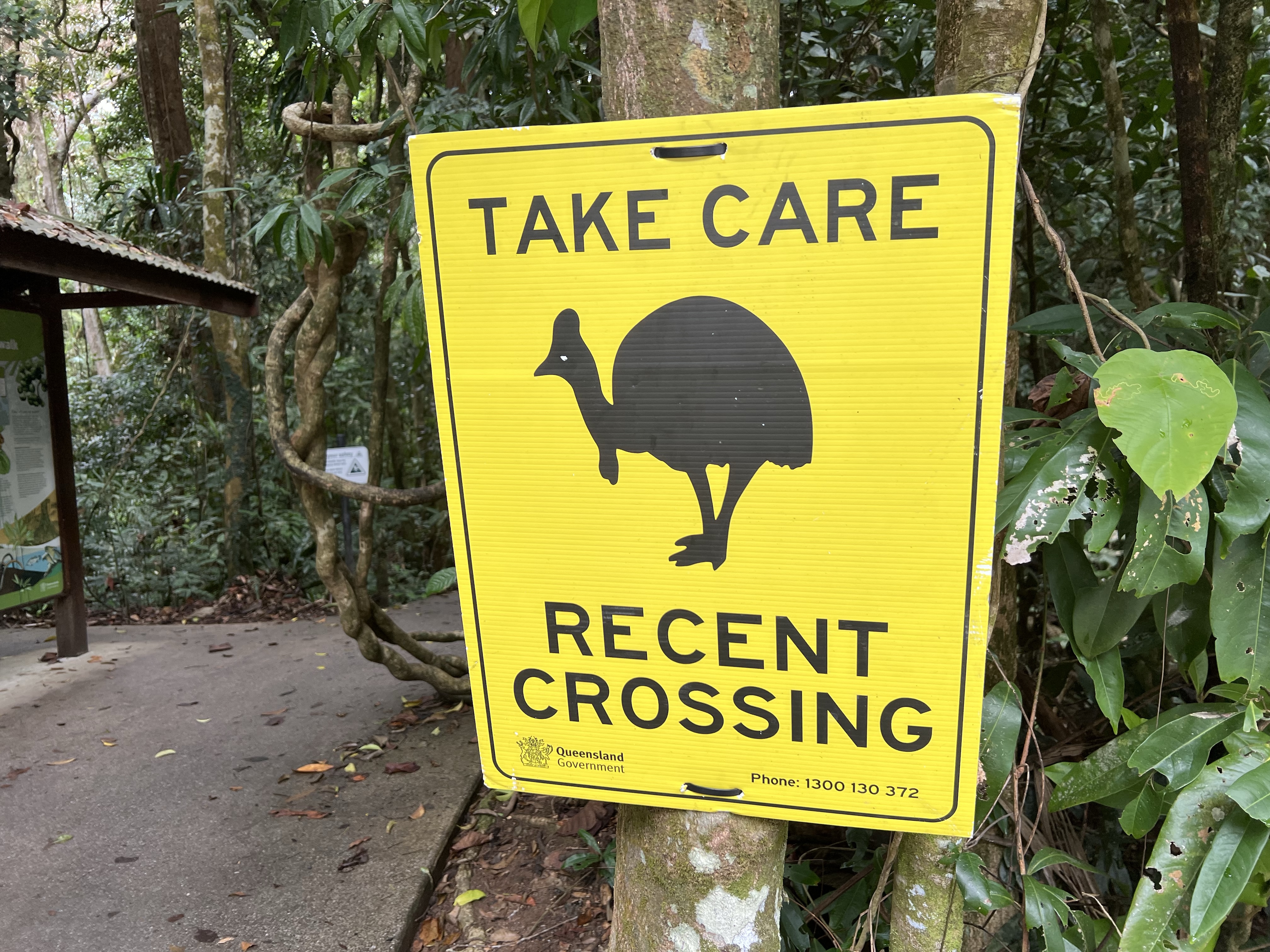
Signs for cassowarys are everywhere in North Queensland. Their images appear on murals, billboards, tour vans, and postcards. But finding one takes sweat (easy in a humid rainforest), perseverance, and patience.

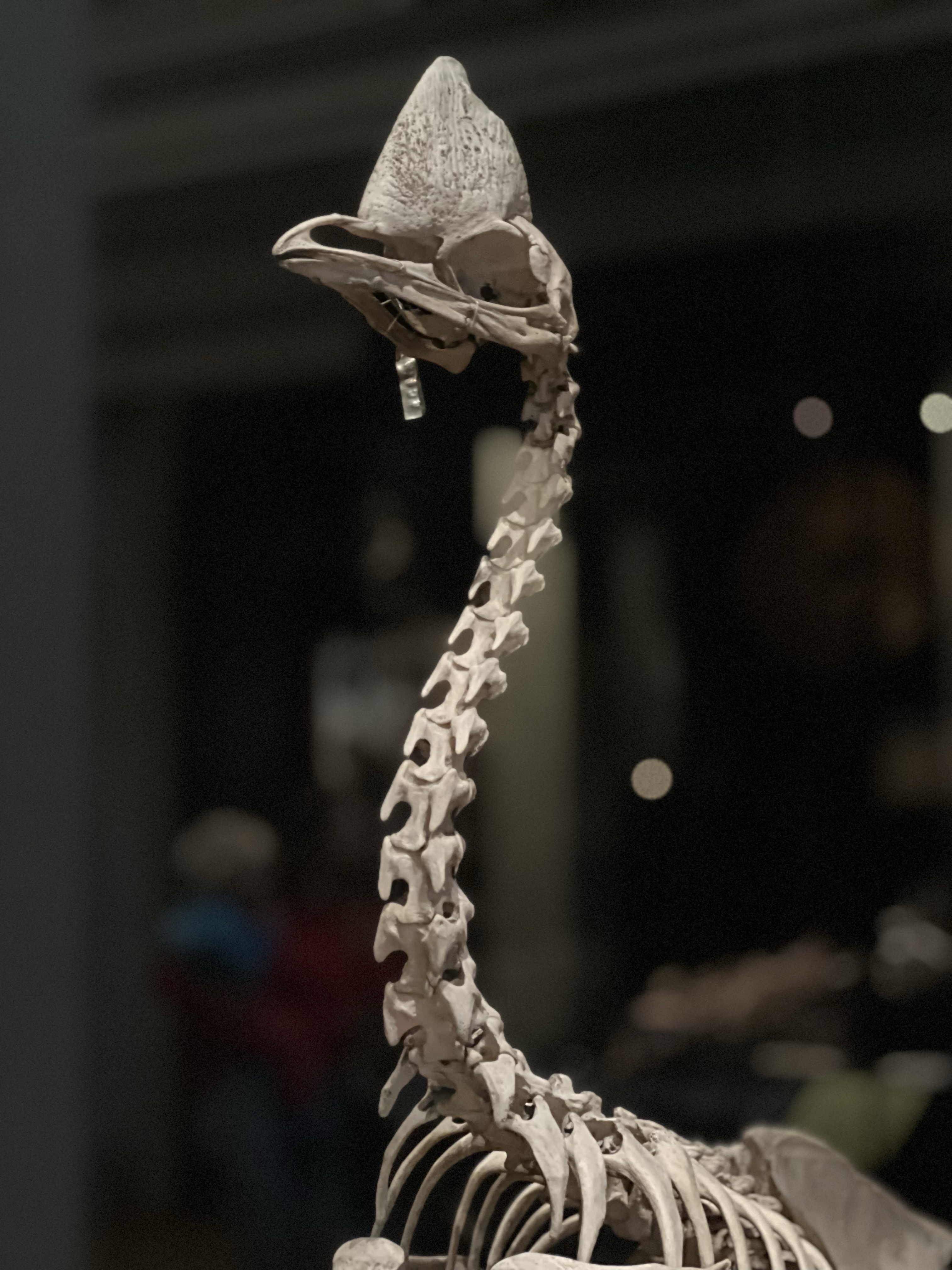
Cassowary skeleton at the Australian Museum.

We first tried for this much sought after bird by walking the boardwalk through Daintree National Park at the Marrjda Botanic Walk. We walked the boardwalk looking and listening for the Dinosaur Bird parting the vegetation with its massive casque or battle helm!

Unfortunately, Bigbird’s angry uncle didn’t show. So we headed out to bird in other parts of the National Park, vowing to return for another try in the afternoon.

A few hours later we returned to the parking lot and as we pulled up, we were told that a Cassowary was on the roadside!

We quickly geared up and sped-walked down the road to where there was a line of people looking down the road. But we could not see the cassowary. We were told the bird had wandered into the forest.

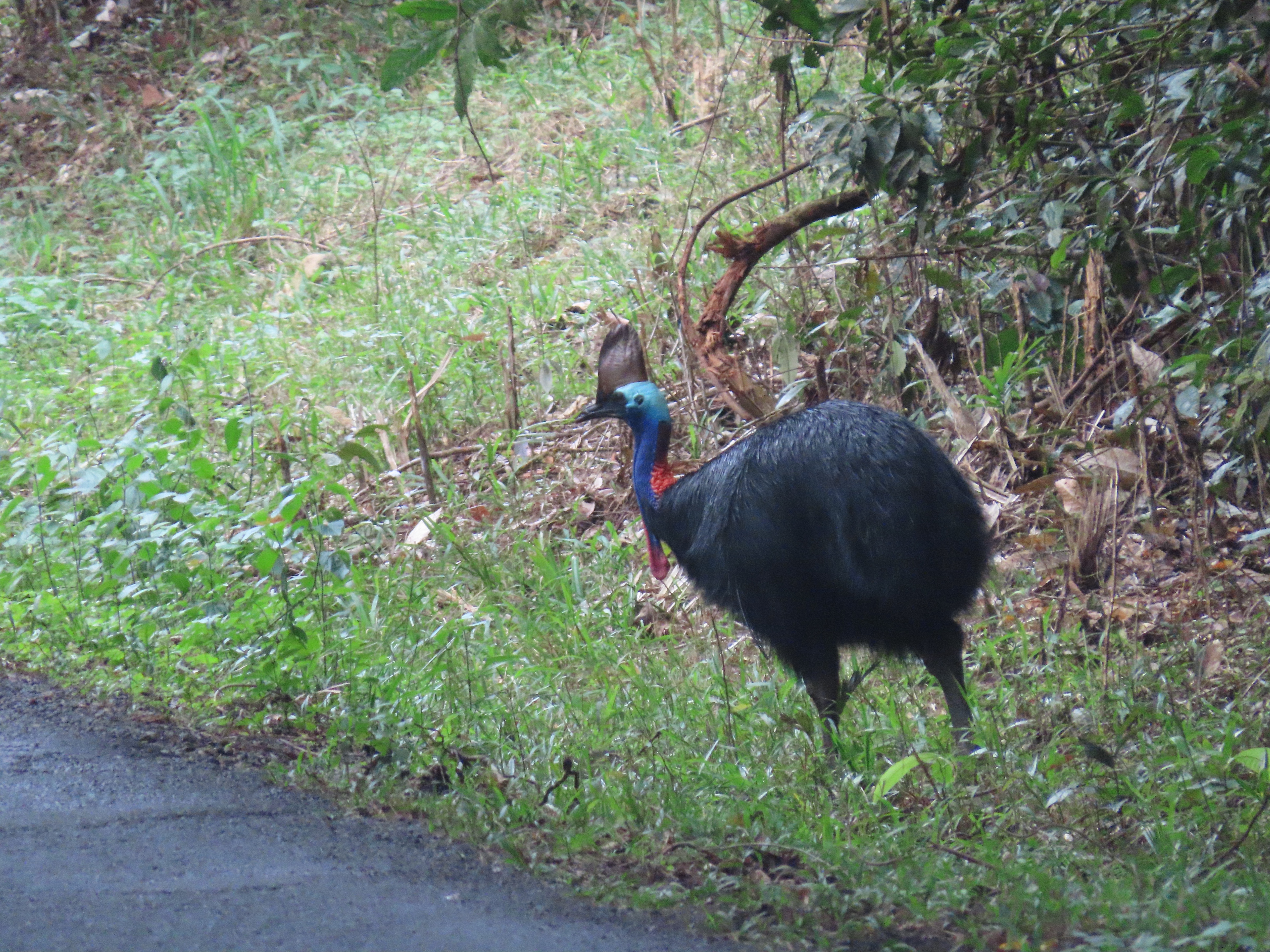
A few seconds later she returned to the grassy roadside. It was a she, in cassowarys, the females are larger and our guide recognized the bird by her casque size and shape. It was cassowary known as “Molly”.

Why couldn’t the cassowary cross the road?

She was trying to cross the road but the mass of people was preventing her from doing so. We all got good looks but “Molly” eventually retreating into the forest to wait it out until the crowds dispersed.

We were lucky enough to not have one cassowary encounter but two.

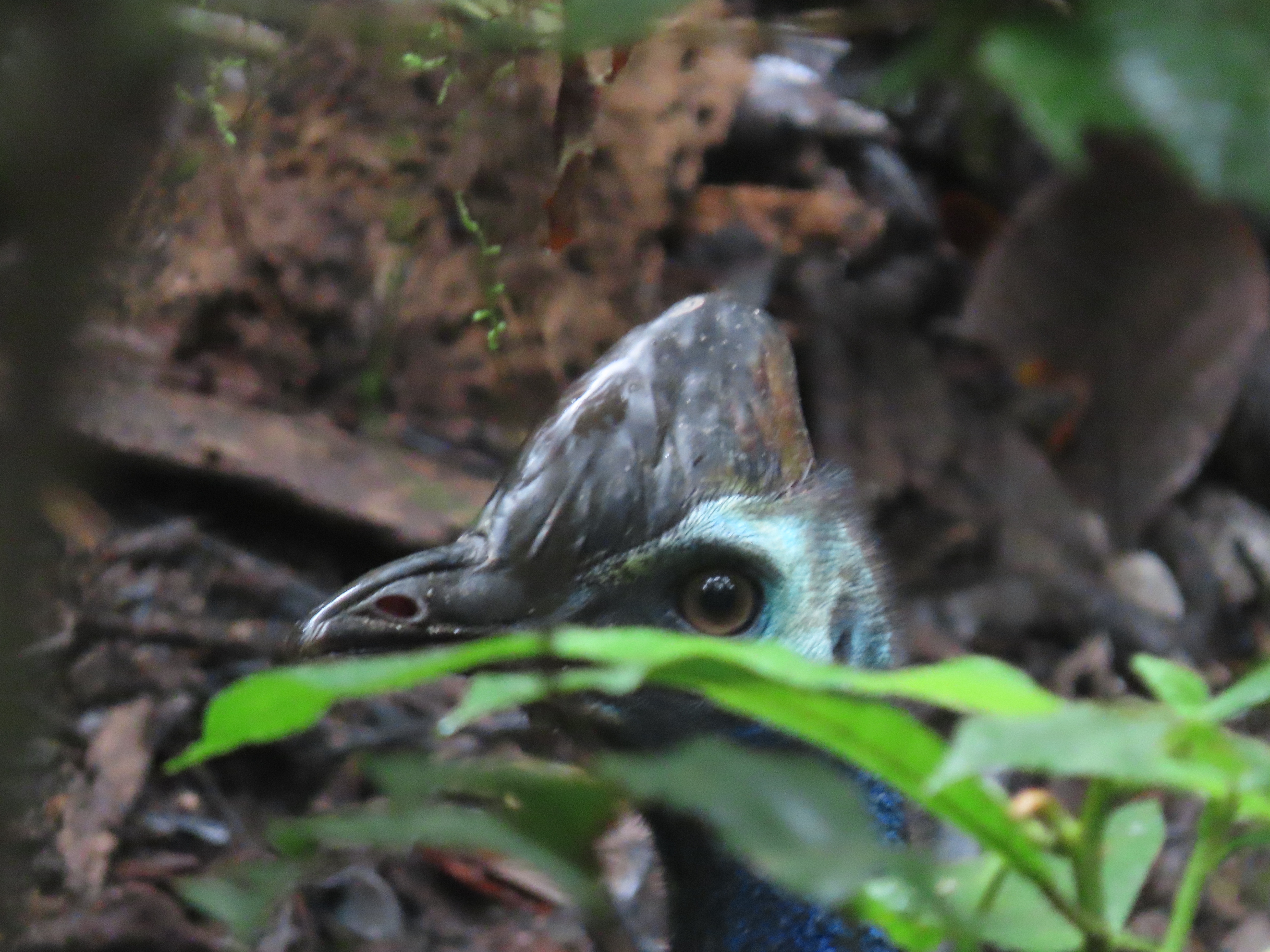
Our second Cassowary was seen in Mt. Hypipamee National Park, resting just off the trail. This bird was much younger than “Molly”, our guide estimated that this bird was about five years old.

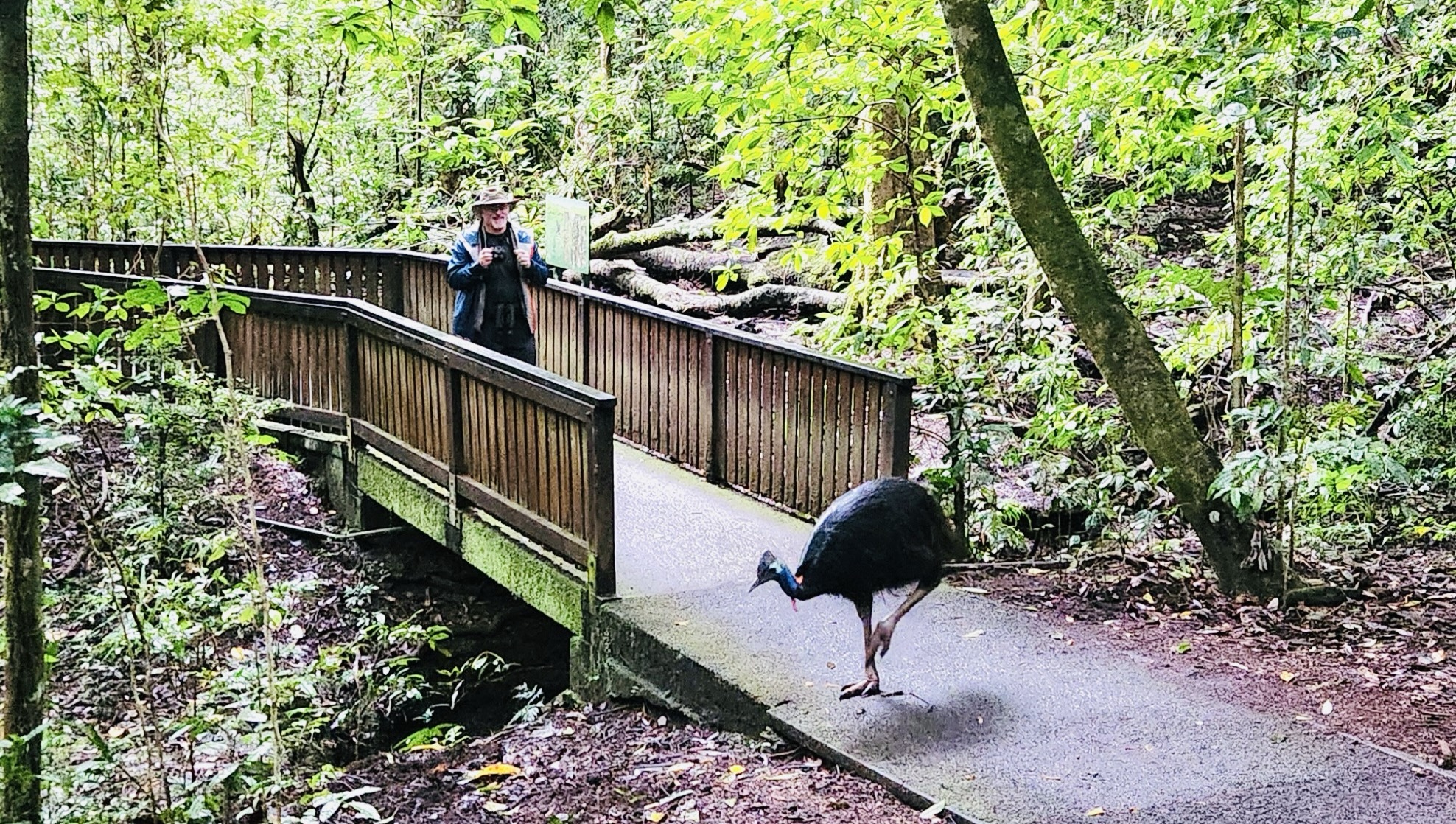
In the young bird’s wandering it headed straight towards me. I stepped aside like a slow motion matador of peace and the bird crossed the path and heard down the bank to the creek.

Corvidsketcher watching a cassowary cross the road.

I watched the cassowary wanted down the hill to the creek where it stood in the cool water and drank. This was a great experience spending some time with the young Murderbird.

Image

Bondi to Coogee

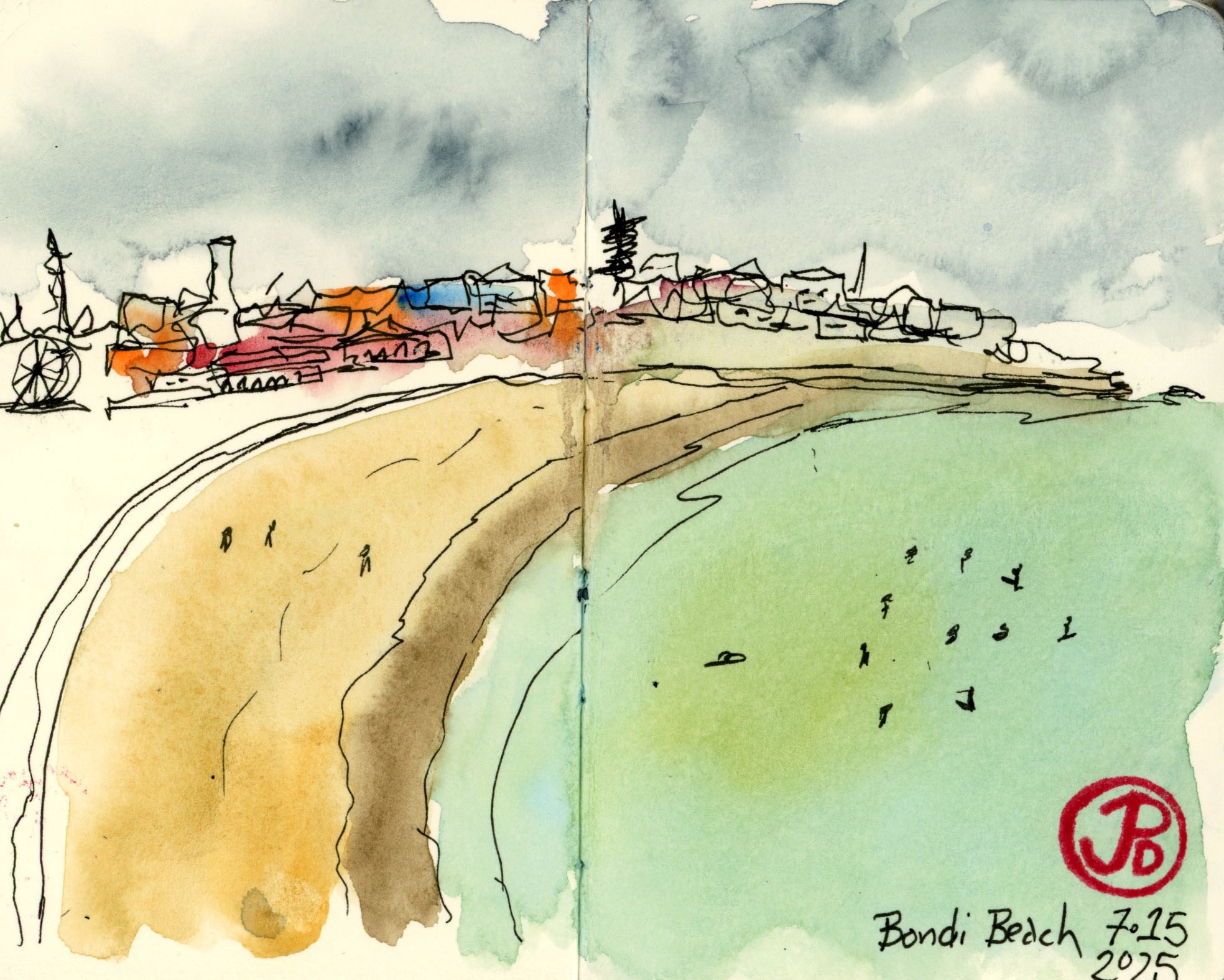
A former parent from Sydney highly recommend the four mile coastside walk from Bondi Beach to Coogee and even with overcast skies, the walk was absolutely stunning. And also very birdy.
A quick sketch of Bondi Beach with its many winter surfers.

I took two buses from my digs in Surry Hills, via Bondi Junction to Bondi Beach. The beach was all Australian but the buildings around it seems more Blackpool or Brighton, showing Australia’s English influence. The windy cold-gray weather even suited the English seaside.

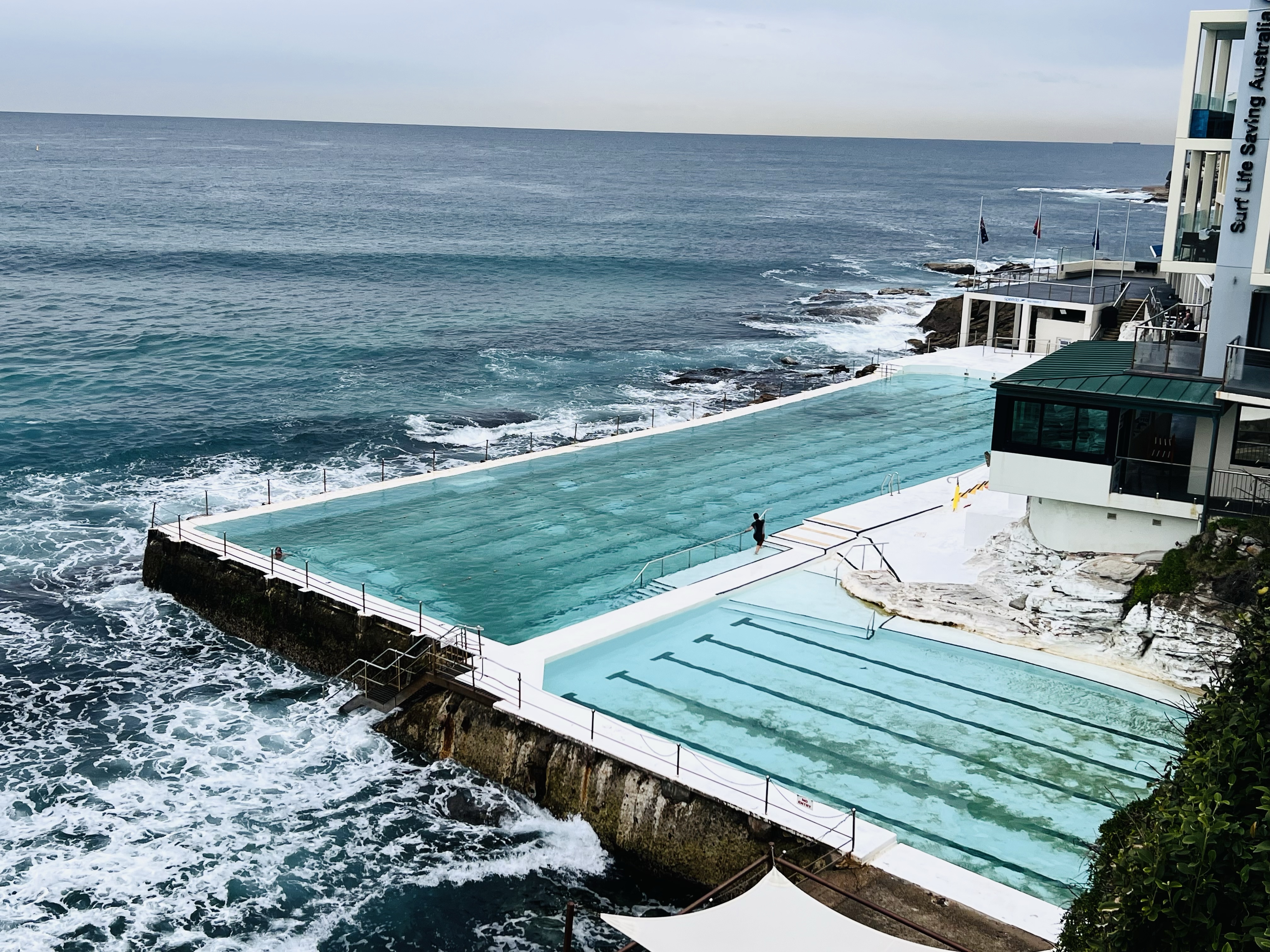
Oceanside swimming at Bondi.

I was starting my coastal walk here and heading south toward Coogee. I had a few birds on my wishlist: Australasian gannet and superb fairywren topped the list.

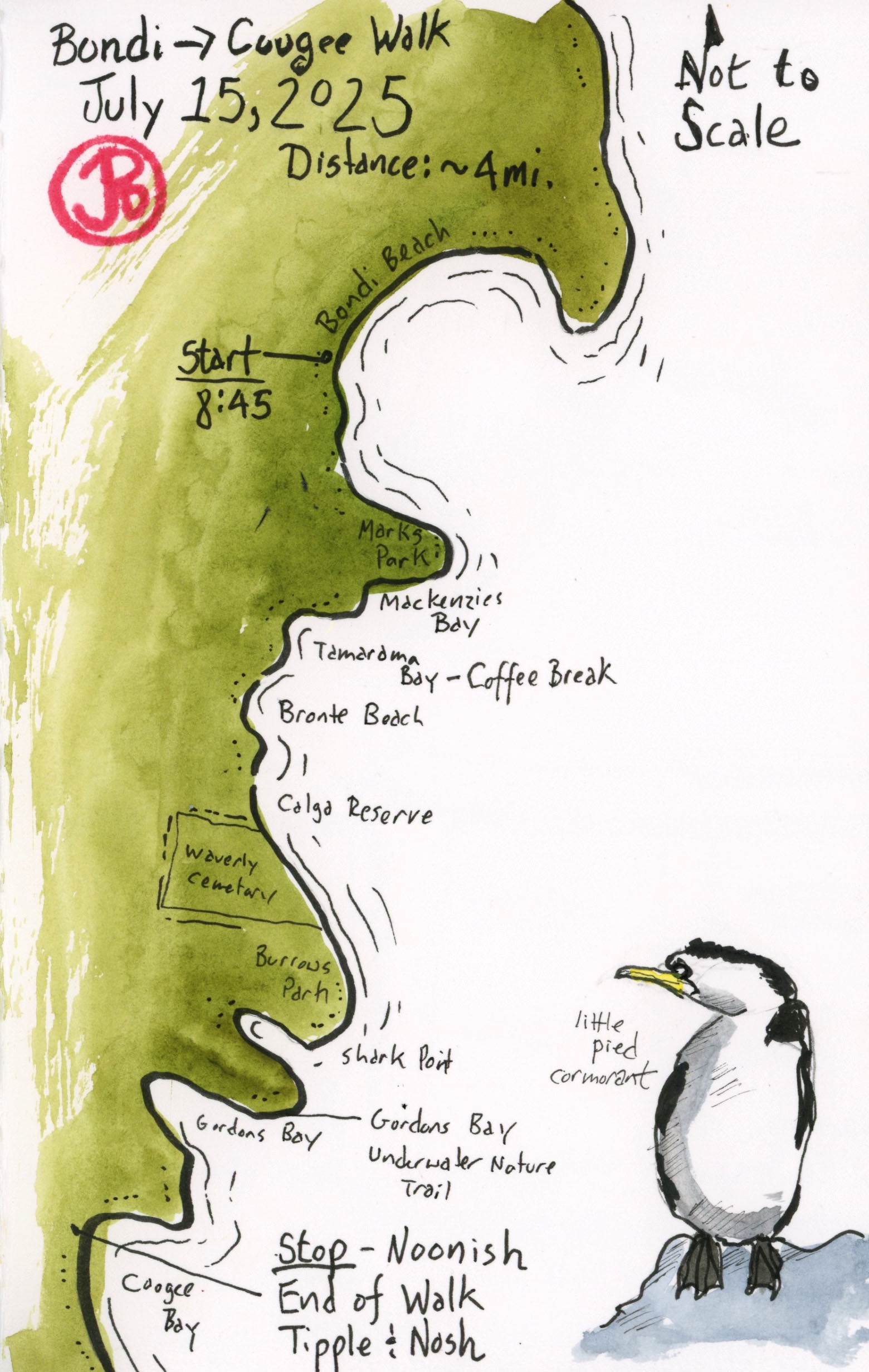
A post trek map of my journey.

I had the Pacific Ocean on my left as I headed south toward the town on Coogee and I kept one eye out to my left for gannet and looked and listened as I passed vegetation for the fairywren.

I came to a point close to Bondi Beach when I saw the telltale sign of a gannet just off the beach. Lifer!

Now it was time to find the 2021 Australian Bird of the Year, the superb fairywren.

As I walked by every trail side bush, I listened for the tell-tale trill of a fairywren, even though I had never heard one before.

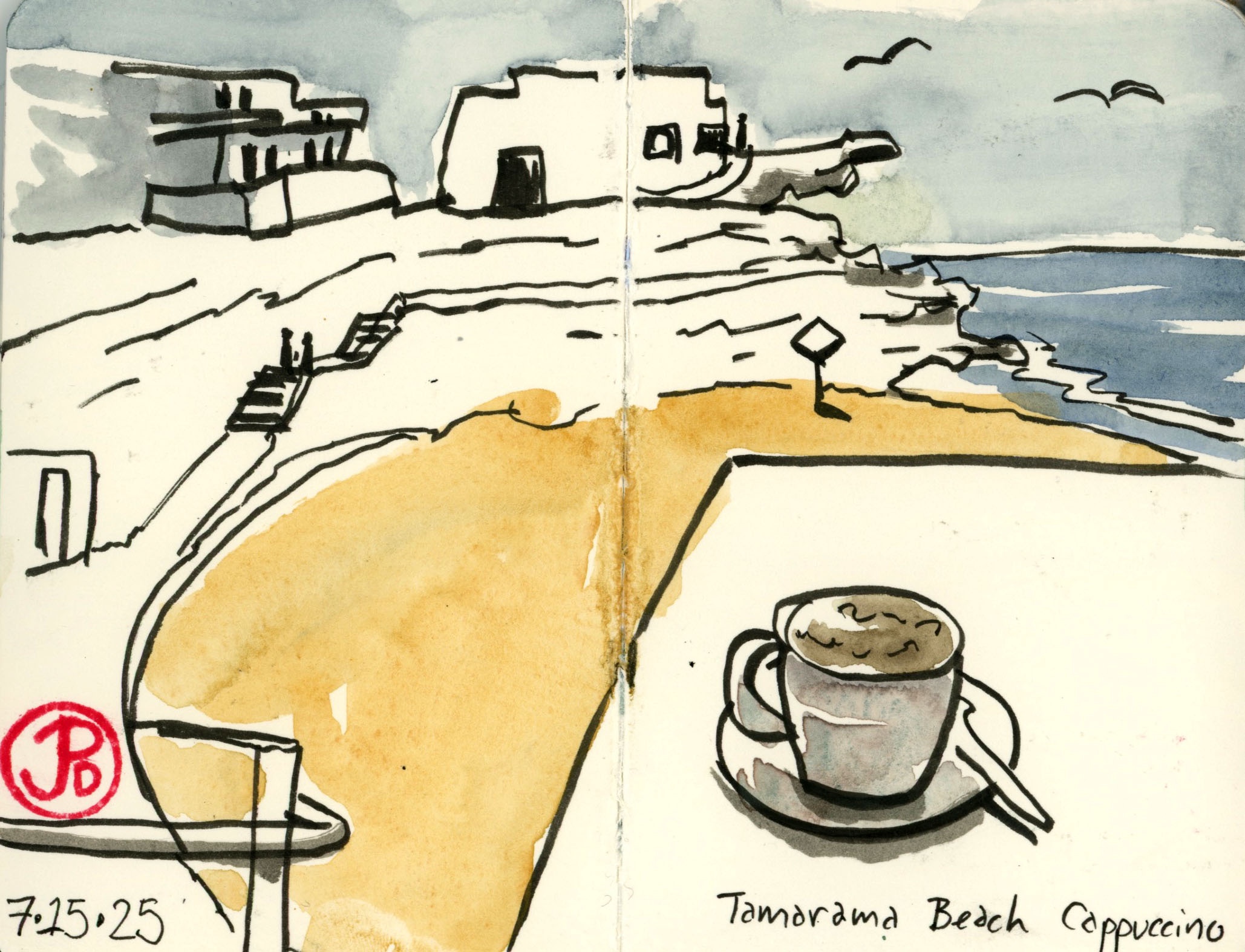
The nice thing about the walk is there are plenty of places to stop and have a cup of joe. I stopped at the cafe at Tamarama Beach and had a cappuccino and sketched the scene over my seaside table.

After finishing my cappuccino, I continued my southward journey towards Coogee. As I neared Waverly Cemetery, the bushes grew denser and more birdy. I heard a high trill nearby and knew there must be fairywrens.

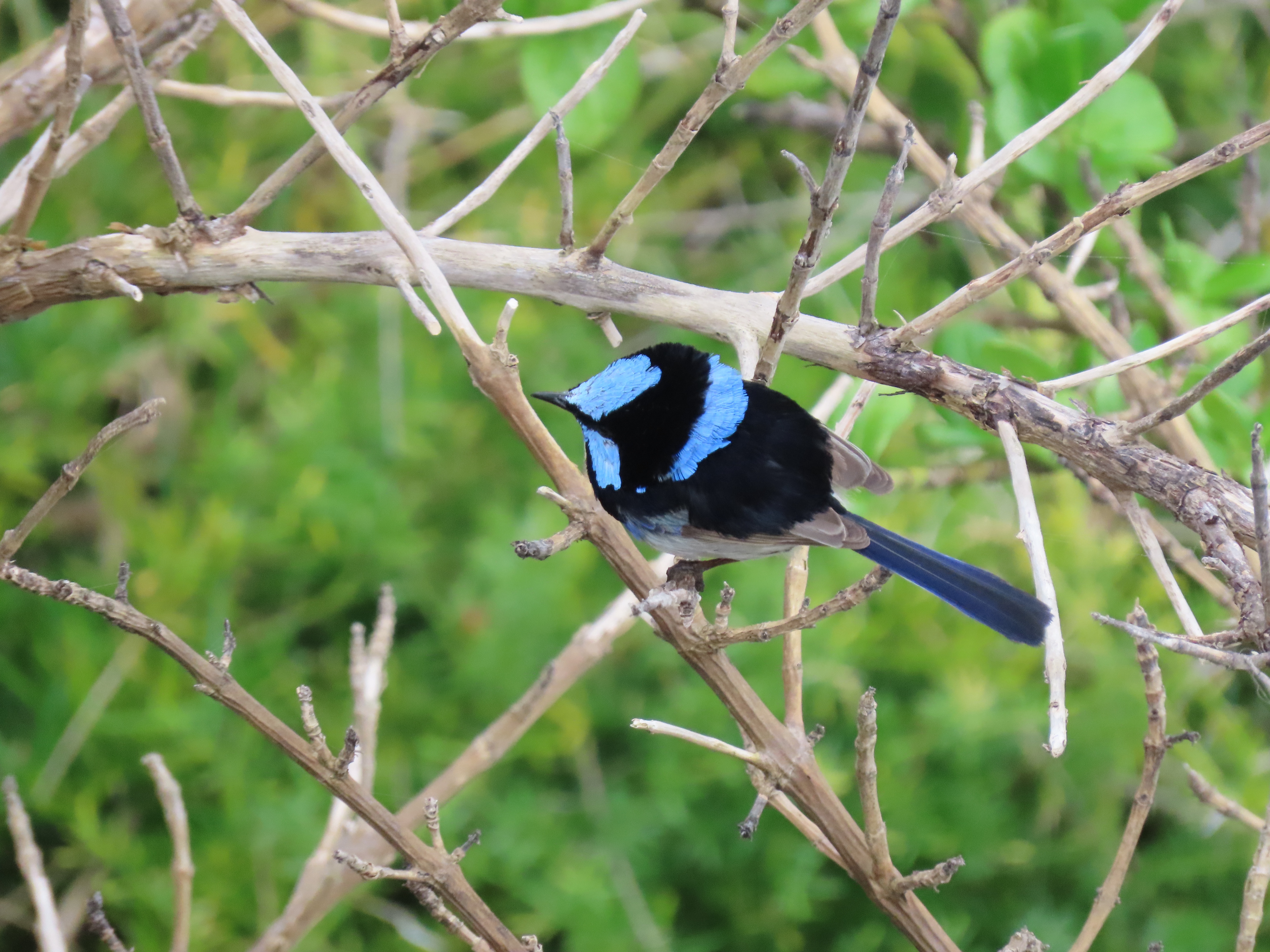
I saw movement in a seaside bush below. With a little patience, a non breeding male with a deep blue tail appeared! I knew that fairywrens forage in family groups. Now with a little more luck a stunning male would appear. So I continued waiting.

A stunning male!

My wait paid off and I had prolonged looks at the vibrant male fairywren. He even perched out on the rock giving me many reason to understand why this was such a beloved Aussie bird!

As I continued south, bordering the cemetery I added grey butcherbird and the amazing yellow-tailed black-cockatoo.

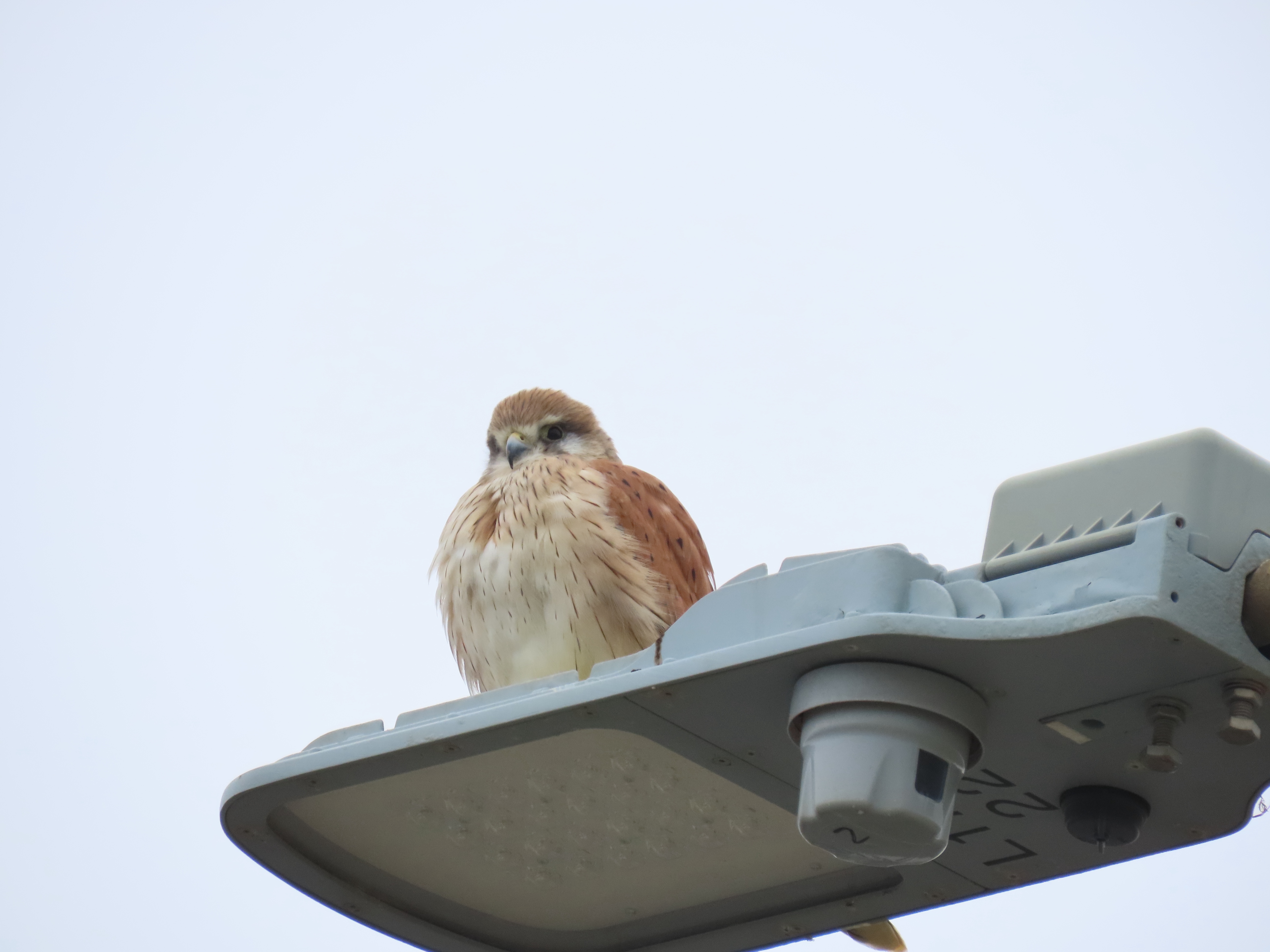
As I neared Coogee, I spotted my first raptor of the trip: a Nankeen kestrel.

On the final third of my journey I added more birds (some lifers) to my list: my fist raptor of the trip, Nankeen kestrel, white-faced heron, another family of fairywrens, a pair of crested pigeons, New Holland honeyeaters, and a foraging gannet in Coogee Bay.

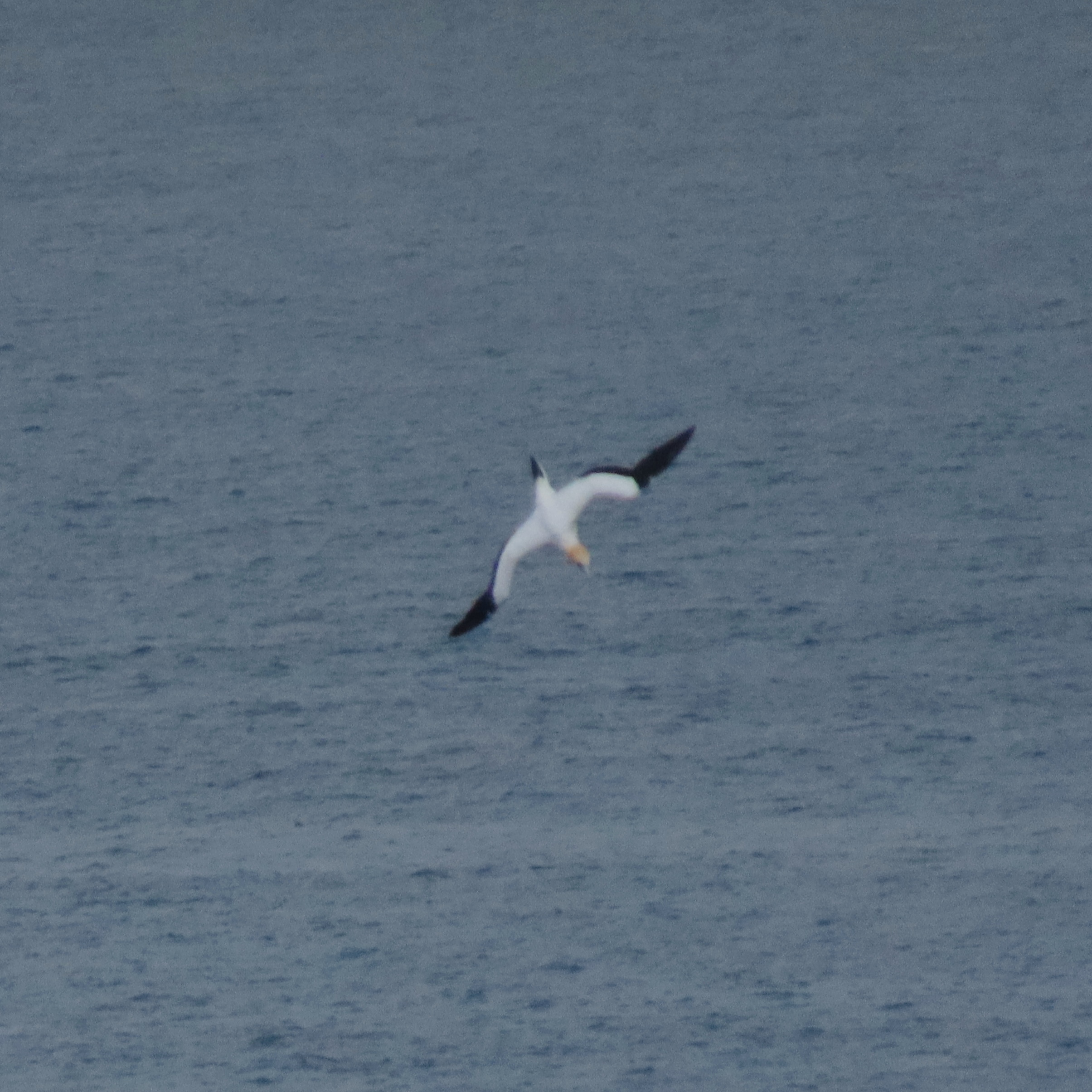
A treat was seeing an Australasian gannet plunge diving into Coogee Bay at the end of my walk!
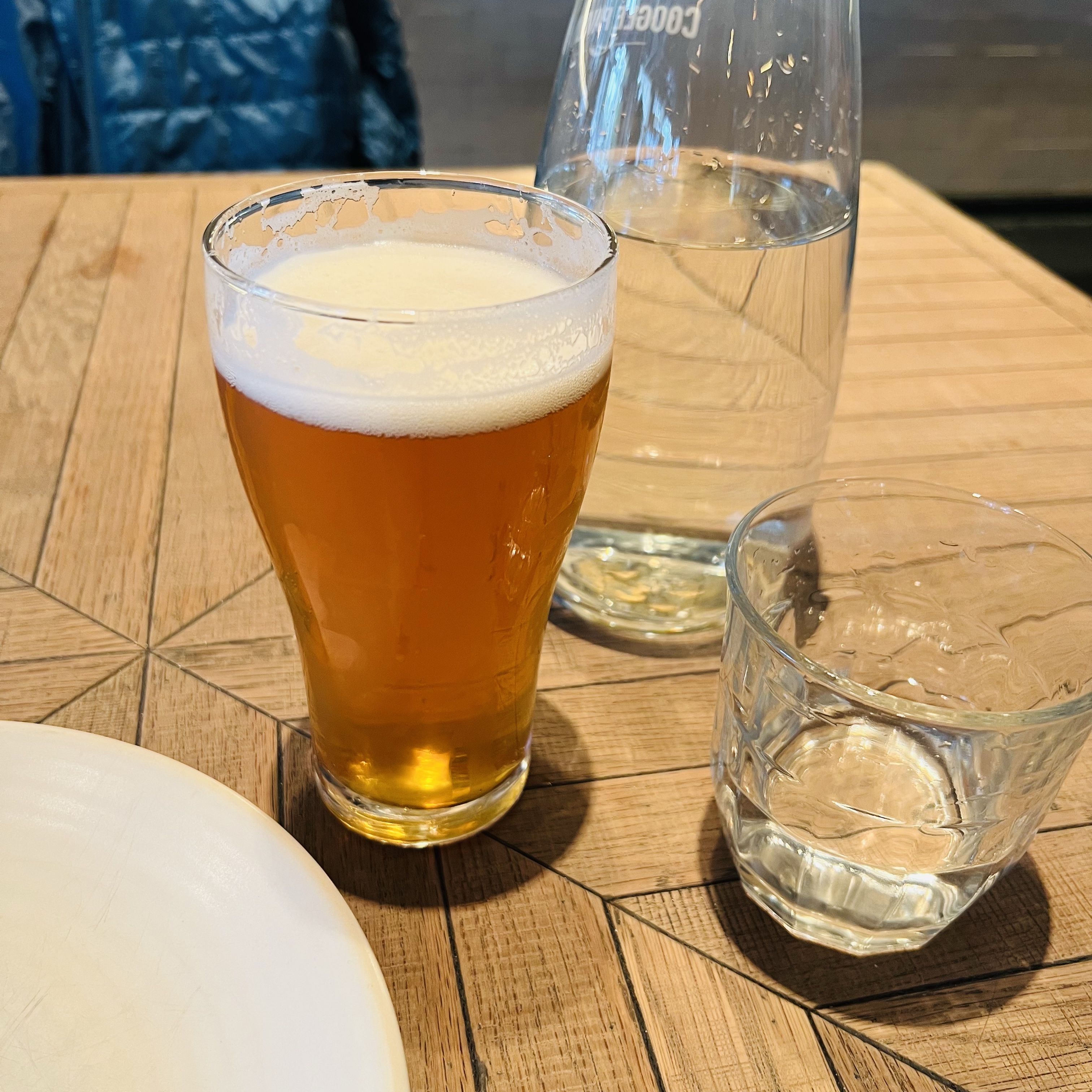
To celebrate the completion of my walk and the many lifers along the way, I had a schooner of fermented liquid bread at a Coogee pub.
Image

Sydney Birds: the Fairy-Wren & the Black Swan

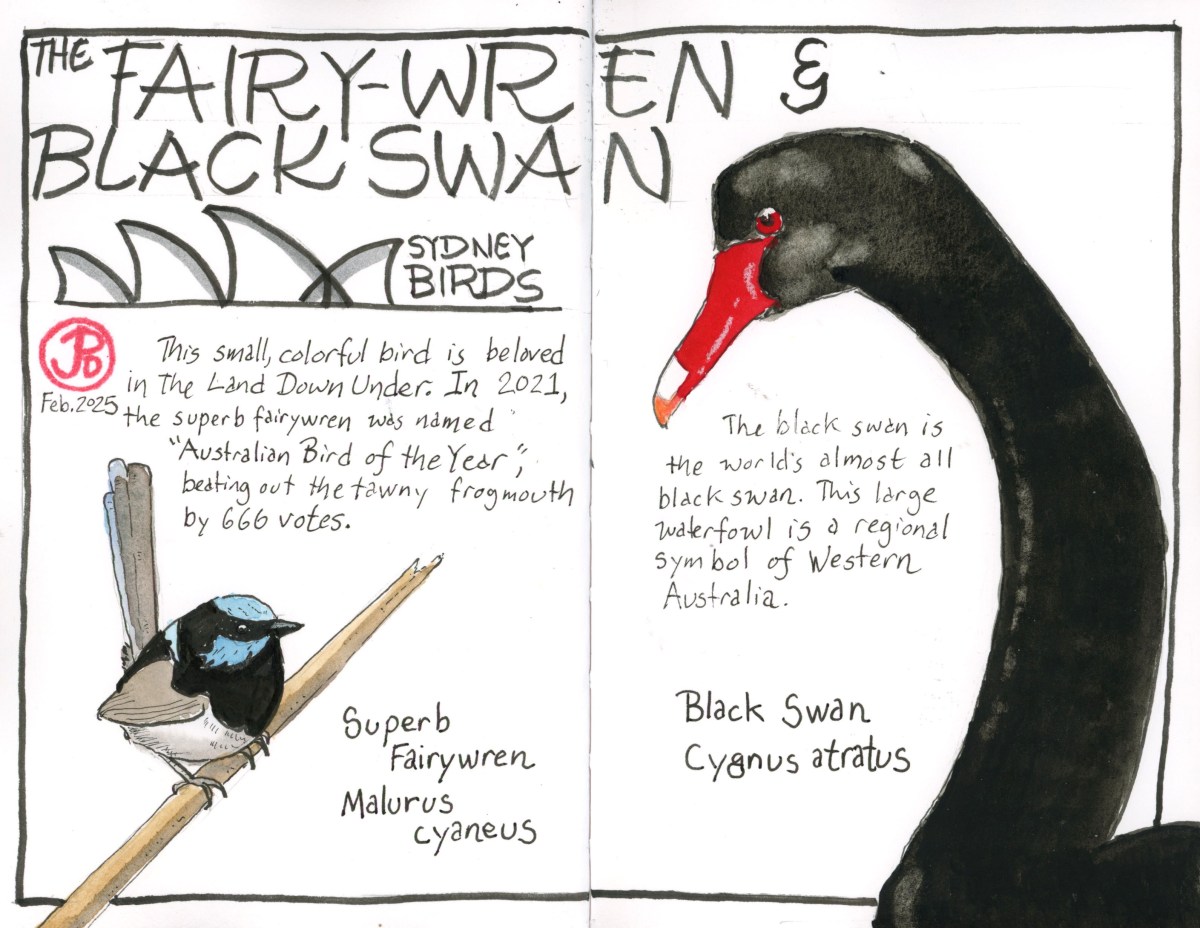
Some of the birds on my Australian trip would be fairly easy to find in Sydney’s parks. Especially a big black swan. The other is a diminutive little bird with a wonderful name of superb fairywren. (This bird is a species featured in The 100 Birds to See Before you Die). Challenge accepted!

The swan can be found in the ponds of Centennial Park. Having seen these all back swans at the San Francisco’s Zoo’s Australian exhibit, I wanted to see this bird in the wild. Or the quasi-wild of an urban park.

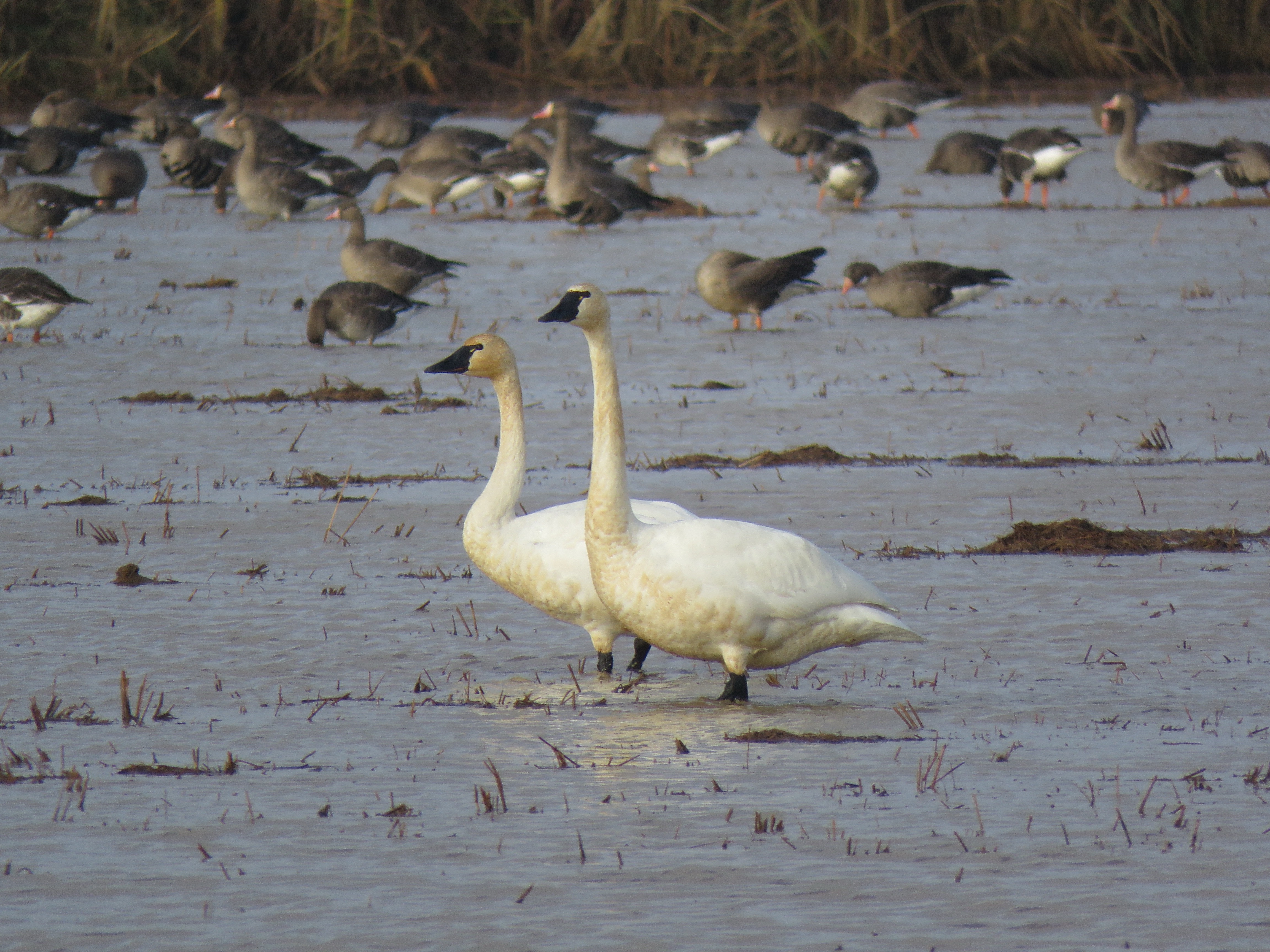
All of the swans found in North America are all white, such as this pair of wintering tundra swans in Yuba County.

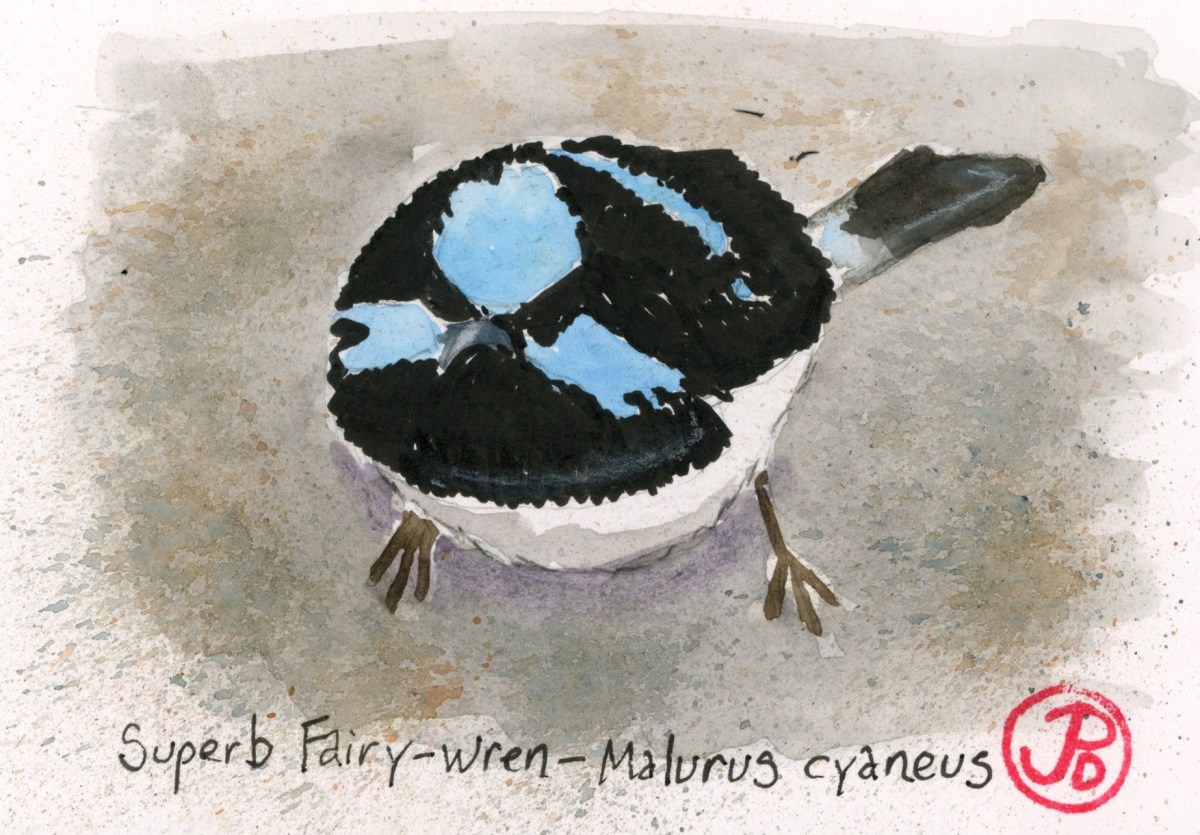
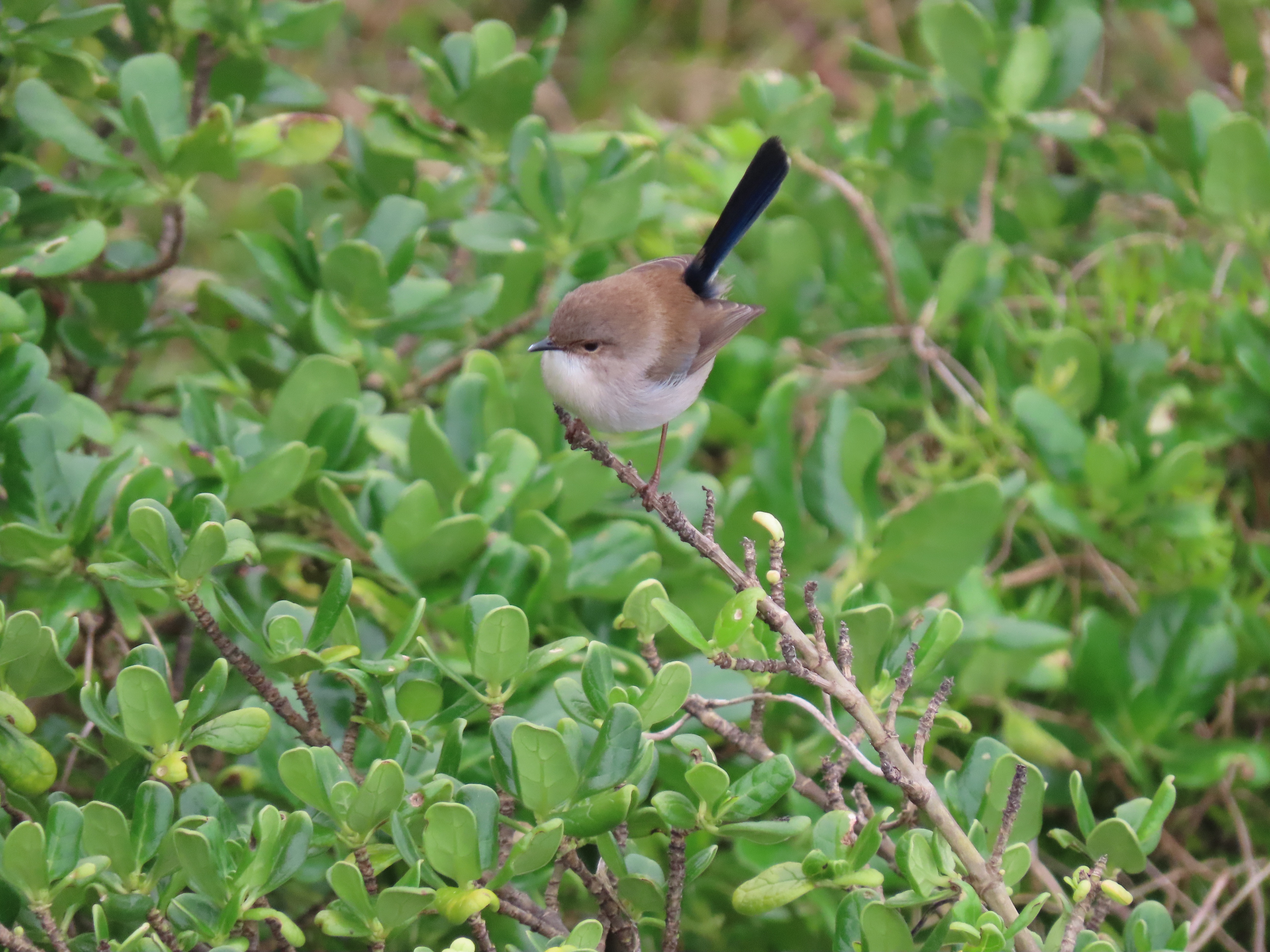
The superb fairywren is a member of the Australian wren family. The male and female, like most ducks, are sexually dimorphic. The male is a stunning mixture of black, brown, and an electric blue. The female is a drab brown with a blue tail held erect.

In 2021, the superb fairywren was voted Australian Bird of the Year, beating out the tawny frogmouth.

Image

The Murderbird

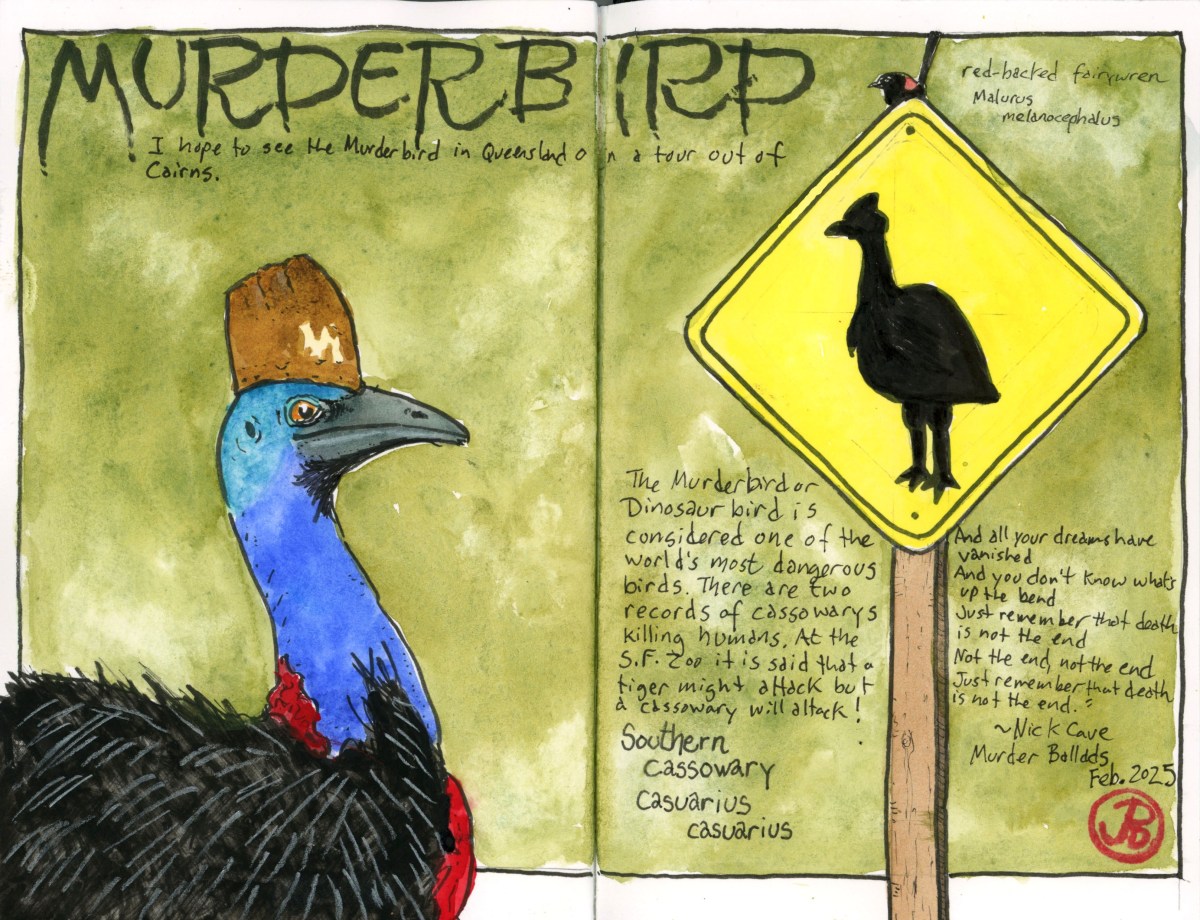
There was one creature in Australia, out of all the deadly and dangerous creatures, that my Australian mate was concerned with me encountering: the murderbird (southern cassowary).

When asking zookeepers at the San Francisco Zoo to list the most dangerous animal in the zoo they often replied: a tiger might attack you but a cassowary will attack you. This flightless beast topped the list.

And I intended to see a cassowary in North Queensland. The Murderbird topped my Australian birding wishlist.

I will be on a five day guided birding trip out of Cairns and we would be looking for the flightless Danger Bird on three different days.

If the tawny frogmouth looks like a Muppet, then the cassowary looks like a denizen of Sesame Street, but from the other side of the tracks. A satanic Big Bird.

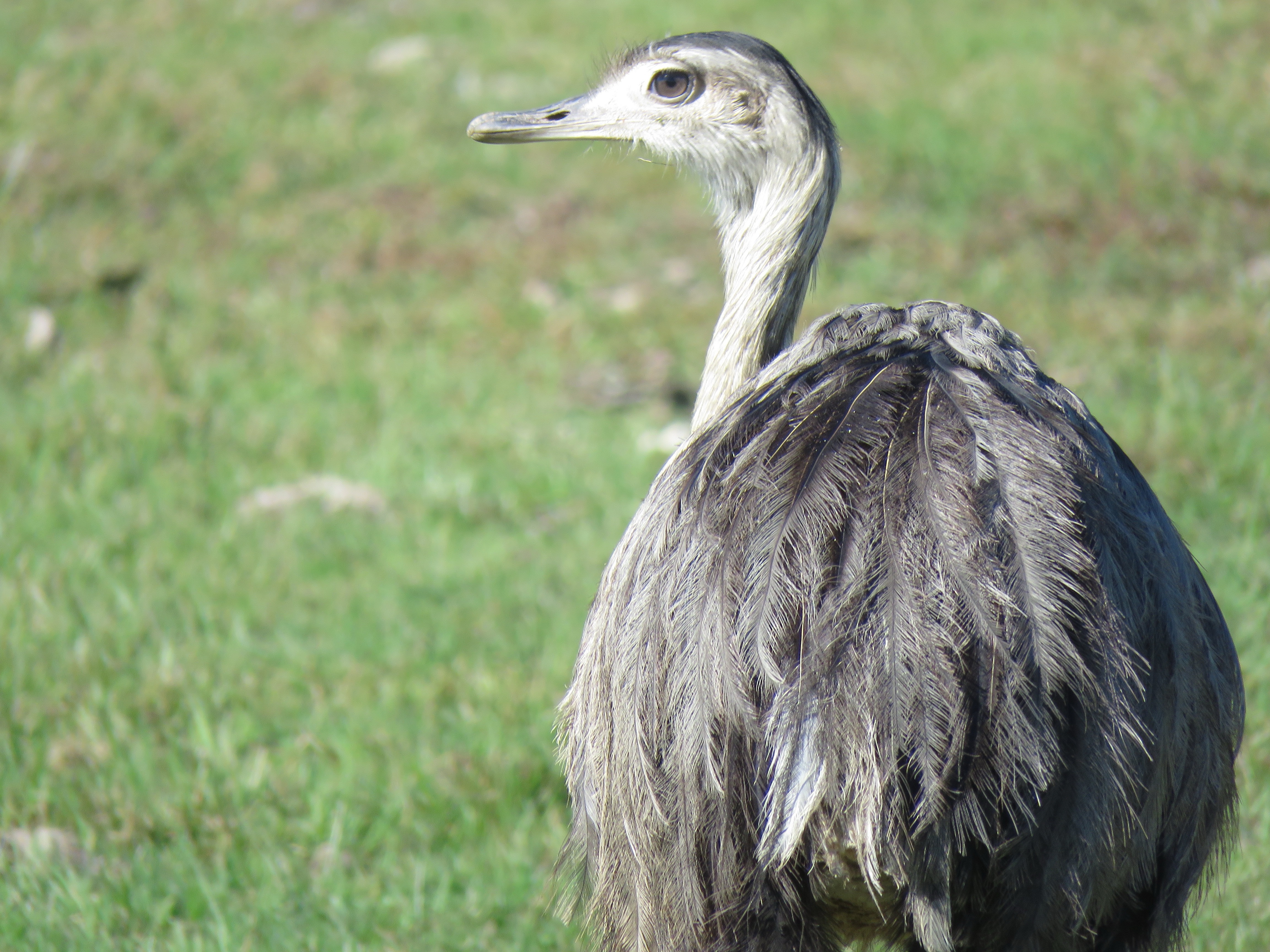
I have seen large flightless birds before, like this greater rhea in Brazil’s Pantanal. The rhea looks friendly and inviting, unlike the cassowary!!
Image

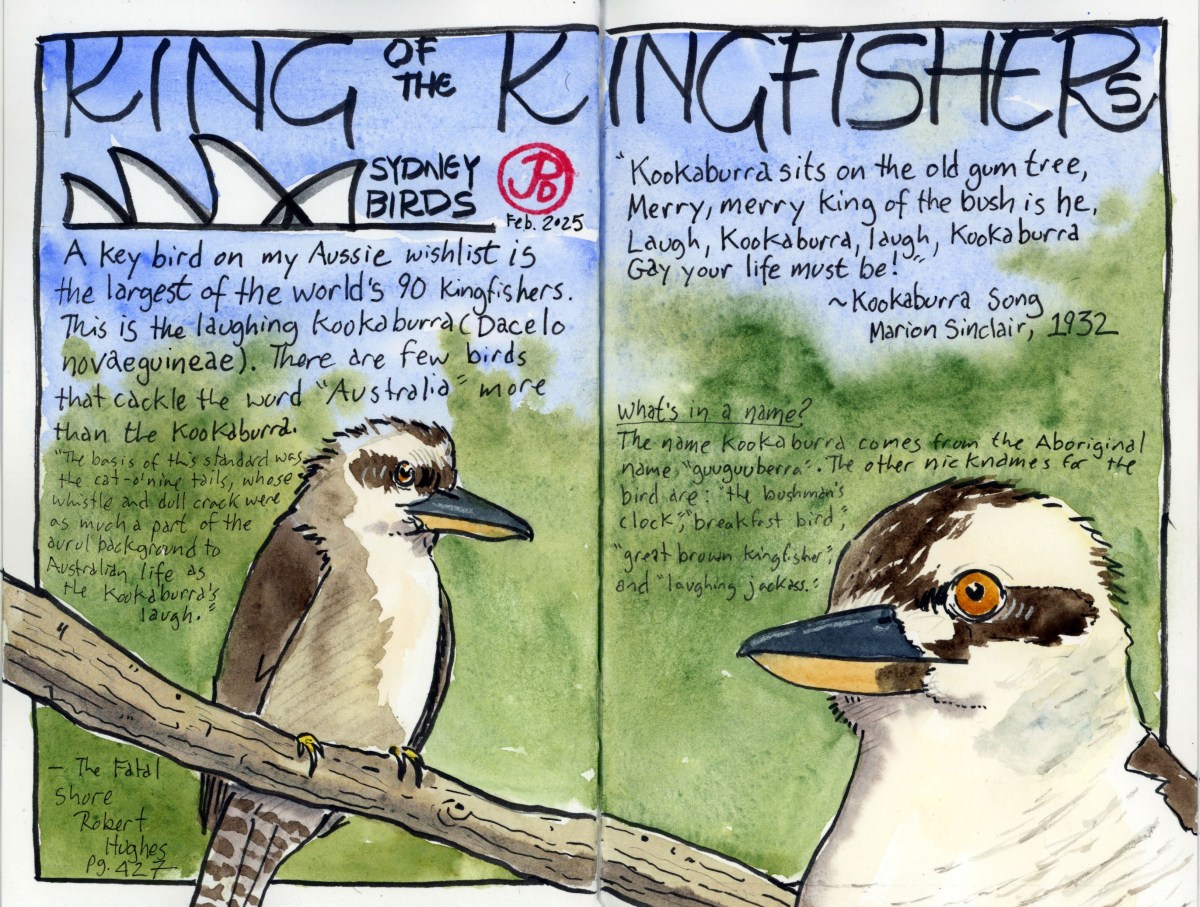
Birds of Sydney: Laughing Kookaburra

“Kookaburra sits in the old gum tree, / Merry, merry king of the bush is he, / Laugh, Kookaburra, laugh. . .”

When it comes to a list of Australian birds that anyone from around the world can list, I bet the laughing kookaburra is in the top two.

This is a species that is commonly held in zoo’s collections. And then there is the song we sing in music class, quoted above.

Of course I have seen a real kookaburra at the San Francisco Zoo but I have never seen one free flying in the wild.

Oddly enough the kookaburra is a kingfisher. Out of the world’s 118 kingfishers, the kookaburra is the world’s largest and heaviest kingfisher, yet fish are a very small part of their diet. The “Bushman’s Clock” mainly eats rodents, insects, worms, snakes, and lizards.

The kookaburra’s laughing calls have been made famous as it is often used as jungle foley in films such as Tarzan, Wizard of Oz, The Treasure of Sierra Madre, and The Lost World: Jurassic Park.

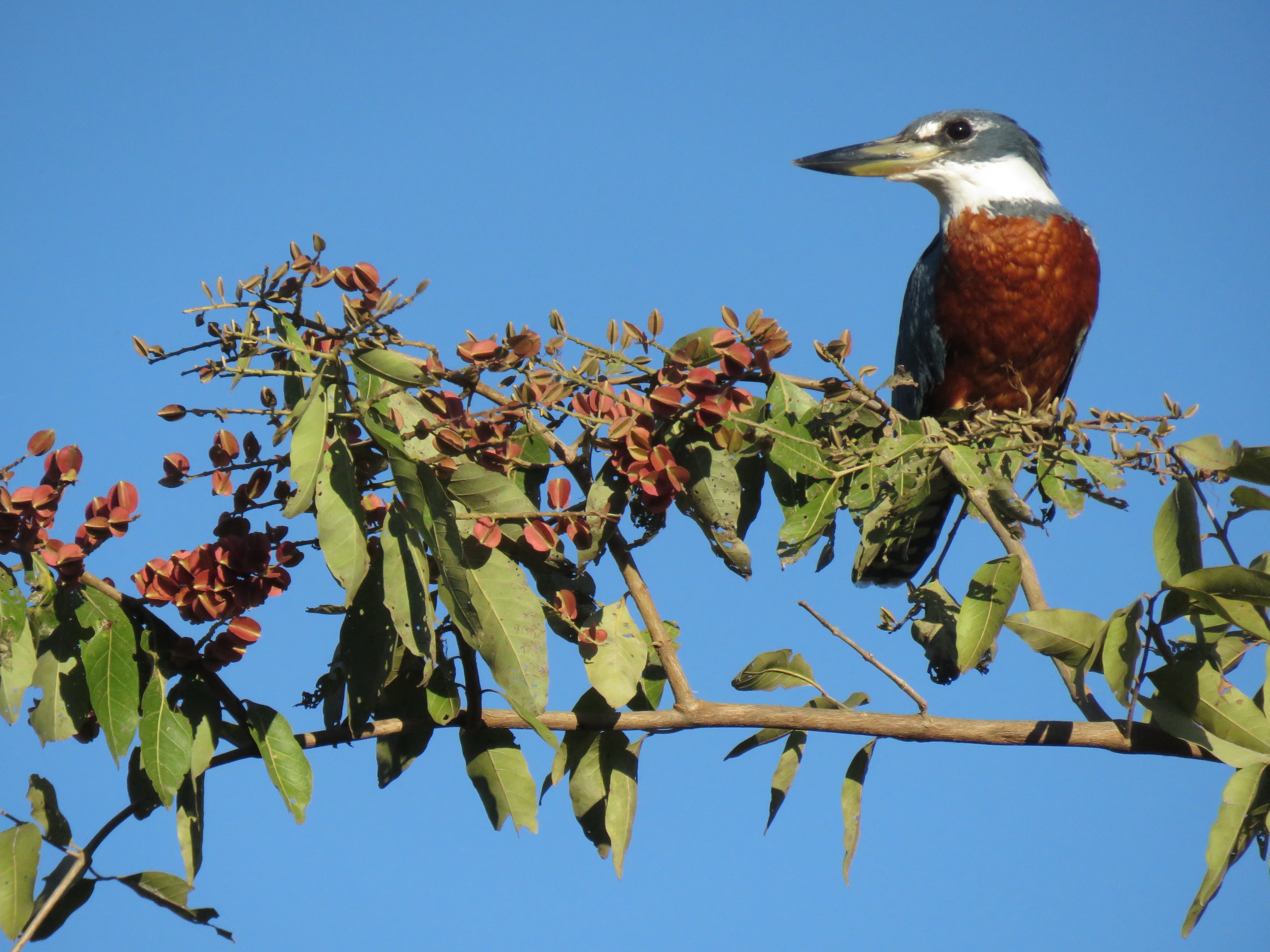
The ringed kingfisher is the largest kingfisher in the Americas. This female was photographed in Brazil’s Pantanal.

For my kookaburra spread I included the first verse of the Kookaburra Song by Marion Sinclair. The song was composed in 1932 and is sung by children all around the world.

There was some controversy involving the song when the flute riff from Men At Work’s hit “Down Under” was deemed to plagiarize the melody of Sinclair’s ditty.

Now all I need is a Vegemite sandwich!

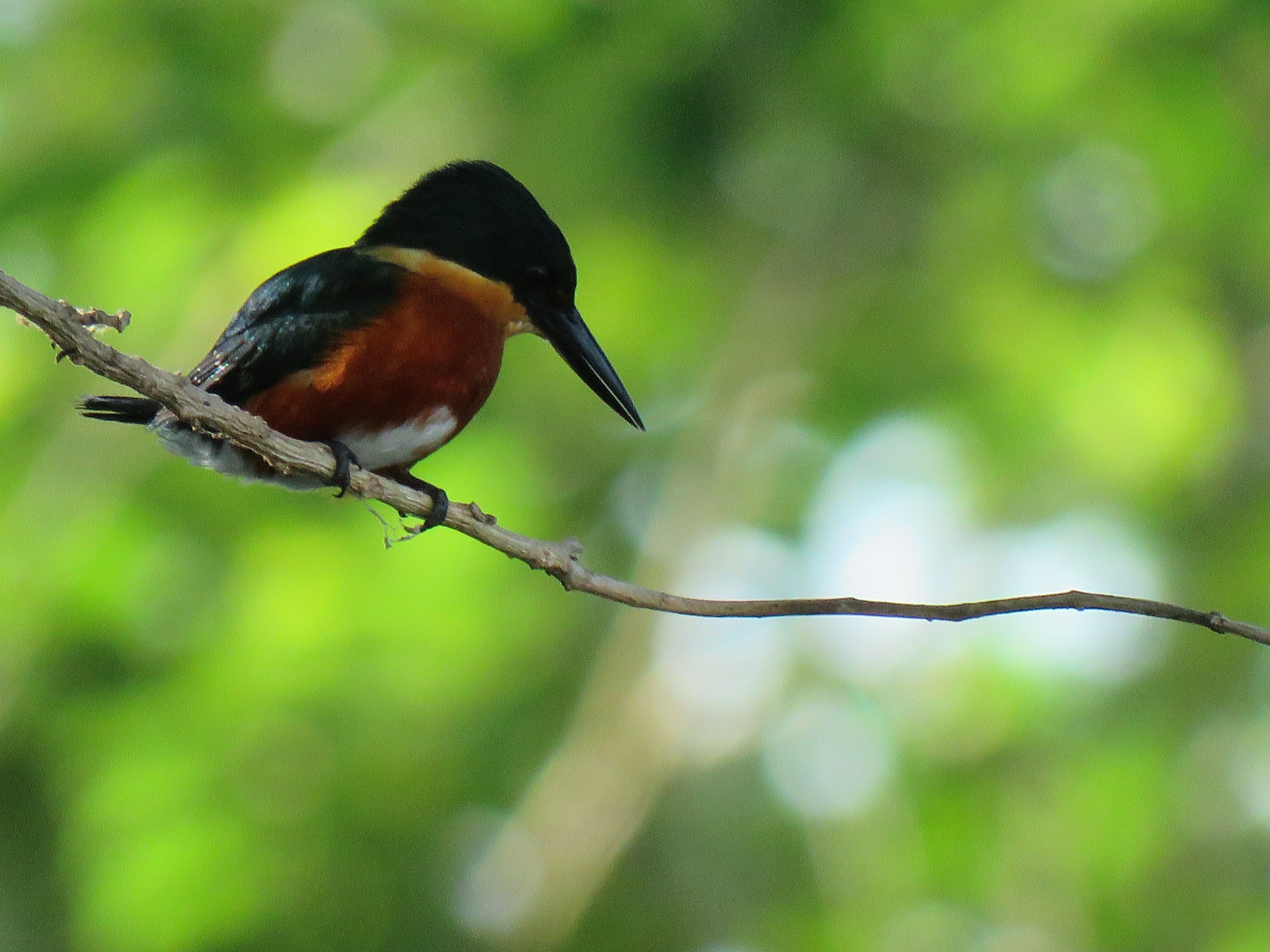
One of the smallest kingfishers in the Americas: a Pygmy kingfisher in Panama.

On my Aussie adventures I hope to add a few other kingfishers to my lifelist: azure, little, forest, red-backed, sacred, and collared kingfisher. And I aimed to add the other kookaburra of Australia to my wishlist: the blue-winged kookaburra. This would more than double my current number of kingfishers (7).