This post is my Memorial Day Continuous-Line Sketch from downtown Santa Cruz.
The World War I monument was dedicated on Memorial Day 1928. This monument of an eagle on a nest is at the start of Pacific Avenue near the Veterans Memorial Building.


This post is my Memorial Day Continuous-Line Sketch from downtown Santa Cruz.
The World War I monument was dedicated on Memorial Day 1928. This monument of an eagle on a nest is at the start of Pacific Avenue near the Veterans Memorial Building.


The last time I sketched Hanger 1 at Moffett Field near Sunnyvale, the side panels had been removed leaving the skeletal supports. The massive hangar was in the process of being restored.
The hangar was built in 1933 to house the dirigible USS Macon. It covers eight acres of floor space. It is one of the largest freestanding structures in the world.

After Moffett was decommissioned as a Naval Airbase, the hangar sat unused. Eventually Google agreed to restore the hanger to the tune of $33 million. This would be my first time sketching the hanger reborn.
To enter the former Naval base you have to show an id at the front gate. This morning it was manned by four policemen. I was a little early for the opening of the Moffett Field Museum but I figured I would get a sketch in of Hangar 1 with the P-3 Orion in the foreground.

I picked a spot in the shade and set up my sketching chair. I planned to sketch and paint the scene before me.

For this sketch I first penciled in the shapes in my panoramic sketchbook and then laid in washes. When the washes dried, I tied the scene together with pen work.
Around this time I noticed some movement behind me over my right shoulder. I turned to see a young police officer approaching me.
Oh no, here we go!
He asked me what I was doing and I told him that I was drawing the refurbished hangar and the P-3. He said he saw me photographing the airplane and (in his head), I might be photographing classified equipment on a military plane (that wasn’t there) on the tarmac.
The young officer was soon joined by three other squad cars. This was clearly the most exciting thing that has happened all week!
At this point a more senior officer took over the questioning. Perhaps to see if I had any dangerous weapons about me like a mechanical pencil or a soft eraser.
I told him that I was drawing the hangar and the Orion (at which point he complemented my work) and that I grew up in Sunnyvale and the P-3 was the plane that flew past my bedroom window. With this explanation and the evidence of my field sketch, I think he realized I was not a threat to National Security and perhaps his young officer had overreacted a bit.
The officers retreated to their vehicles and talked shop as if they were reluctant to leave me to my sketch. They eventually left, I finish my sketch, and then headed over to the museum.

When I visited the museum I related my encounter with the police to a docent who was retired Navy and was also very opinionated. He said their behavior was chicken sh*t and that was one reason he left the Navy.
I talked to another docent at the museum about what Google planned to do with the new and improved hangar and no one seems to know. Mysterious.

After work I headed to do a San Francisco neighborhood to sketch a portal to the past.
I was in the Ingleside neighborhood and my sketching subject was a large timepiece.
This timepiece was dedicated on October 10, 1913. The irony is that this massive sun dial is in an area of San Francisco known for fog.

I sat on a bench and started to sketch.

The sundial was built as the centerpiece of the Ingleside neighborhood that was being developed in the early twentieth century.
The area was formerly a racetrack first opened in 1895 for horse racing. Horse racing at the track proved to be so popular that Southern Pacific Railroad built a branch line to the entrance of the track.

The track later featured early auto races. Businesses slowly declined and the last race at the track was held on December 30, 1905.
The site was later developed as the Ingleside neighborhood.

Sometimes sketching is a form of time traveling; A way to time travel to your own past.
On a March Saturday morning, before the sun was above the horizon, I found myself at the end of the Santa Cruz Municipal Wharf.
Before me was a long building that looked more like a seagoing vessel than a restaurant. My panoramic sketchbook was open and I started my continuous line sketch as the day was coming to life.

This is Stagnero Bros, a Santa Cruz institution.
In my youth I spend much time with my dad and brother on the wharf watching the sea lions, inspecting what fisherman were reeling in, looking at the fish on ice at Stagneros, and eating burgers at Nelson’s.
A lot has changed in those 40 odd years. Nelson’s is gone and so are my father and brother and I don’t eat burgers anymore.
But the business on the wharf has been going since 1937.
The Stagnero’s was founded by Italian immigrants from a small fishing village in the province of Genoa.
Matteo Stagnero worked various jobs including fishing in the waters of the bay before opening a seafood market and cocktail room on the wharf in 1937.
The restaurant and seafood market has expanded since then with it’s latest Streamline Moderne building.

I love sketching the curved lines and portholes of this style of architecture. This style also lends itself nicely to a continuous line sketch.

The restaurant and fish market has some cinematic pedigree as well. It was featured in the highest grossing Dirty Harry film, Sudden Impact, of “Go ahead, make my day” fame. Sudden Impact (1983), was the only film in the series directed by it’s star, Clint Eastwood.
Three scenes were filmed here. It was at the fish market that two of the baddies are employed that Harry dispatches at the Boardwalk during the climactic ending. Perhaps this is why no mention of the film is to found on the restaurant’s website.
When the filming took place in the spring of 1983, the restaurant looked a bit different. Since then, the restaurant was remodeled in its neo-Streamline Moderne style but I have not found information on when the renovation took place.


With the tenets upstairs moved out for Italy I used the opportunity to sketch the view from the empty upstairs east facing bedroom.
Now this isn’t exactly sketching out my back door but the sketching above my back door. With the altitude gain I could see the landmark that dominates the view: Sutro Tower.
Sutro Tower was erected between 1971 and 1973. For 45 years the 977 foot tall radio and television transmission tower was the tallest structure in San Francisco before it was usurped by the Salesforce Tower (1,070 feet) in 2018.
In the foreground are the houses that border my backyard, in the middle ground are the houses of the Golden Gate Heights.
I used my Stillman & Birn panoramic watercolor journal to sketch in the scene. I used a thick pen (Micron 10) and rendered the scene in a continuous-line.
My sketch was loose and not exactly to scale but that what makes continuous-line sketching so exciting and vibrant.


One of our most popular field trips in fourth grade is to Pacifica’s Sanchez Adobe and its infamous mud pit.
The adobe building was built by Francisco Sanchez in 1842-43 and is the oldest building in San Mateo County.
As the former Alcade of San Francisco and Commandante of the Militia he was gifted 8,926 acres of land by the government of Mexico, which is now the city of Pacifica.
Since Don Sanchez, the building has changed hands and has assumed many guises including a hotel, a speakeasy, an artichoke storage warehouse, and now California Historic Landmark No. 391.

When I take fourth graders to Sanchez Adobe we first learn about the layers of history at the site: Native California, Spanish Missions, the Mexican and then the American eras. After our truncated tour of history the real fun begins.
One of the reasons this is such a popular trip for my nine and ten year olds is because it is the best kind of social studies: hands-on history.
My students rotate between three activities: roping a steer and grinding cornmeal, candle making, and forming adobe bricks.
The activity that long remains in the memory is making bricks in the mud pit.

Students take off their shoes and socks and then gather around the pit. They raise their right hand (no your other right hand) and take an oath to promise not to get mud on any other person but themselves.
Now it’s time to enter the pit, students walk in a clockwise circle to mush up the mud for brick making. At first they are tentative and a bit scared of the cold mud. Was that a worm I just stepped on? And then they acclimate and it becomes hard to get students to leave the mud pit and wash up!
Now they use their hands to scoop up mud and put it in a rectangular wooden mold to form the “bricks”.
In some years I become one in the minority: a teacher that enters the mud pit.

I returned to Sanchez Abode on a February Saturday morning and I had the place entirely to myself. We had already had our field trip in January.
It was odd to be here without the sounds of students having fun while learning. The local black phoebes entertained me as I sat on my sketching stump near the mud pit.
For my panoramic sketch the mud pit was my anchor with wooden cart and adobe building in the background.
This was a true plein air sketch that would make urban sketchers proud. I used my small travel palette with half pans of watercolor and my Escoda travel brushes.


One SLO goal on my three day weekend visit was to summit Bishop Peak, and at 1,546 feet tall, it’s the tallest of the Nine Sisters.
The Nine Sisters, aka the Morros, are volcanic peaks stretching from Morro Bay to San Luis Obispo. Bishop Peak, named after the shape of the summit rocks, is a much sought after destination for hikers and climbers.
With forecasts for the day in the high 70s, I got an early start, hitting the trailhead at Highland Drive at 7:30 AM.

One change in my fairly recent hiking gear is trekking poles. I once ridiculed them as useless pieces of hiking chic. But as I grew older I now see them as an essential part of my hiking get up, so much so that I keep a pair in the trunk of my car at all times. They give me more points of contact, improve balance, and take pressure off the knees. And in a pinch I recommend they could fend off a mountain lion or bear. All of which is very necessary on the over 1,200 feet elevation gain thought uneven boulder terrain that is the Summit hike.
The first part of the hike led me to the base of the peak, past a cattle pond. At the top I could see a few hikers that had already summited. They must have gotten a much earlier start and hiked under headlamps. Cal Poly student no doubt.
I passed a climbing wall to my right and my climb to the peak really began in earnest when I reached the first of many switchbacks.

There was a dad with his two teenage sons who passed me. They had far less gear and no trekking poles!! I used them as a pacer, a reminder of my much slower pace, as I saw them on the switchbacks above mine. I would see their heads always moving forward above the chaparral. They were getting farther and farther ahead.
I soon started passing hikers coming down from the summit who had gone up to watch the sunrise. They had far less gear, water, and some were not even wearing hiking shoes. One group of girls had forgotten their headlamps so they had to use their phone light instead. Ah youth!
I was glad to have full sunlight and the views kept getting better and better the higher I climbed.
After hiking an hour, I could see the reddish rocks of the summit. The rocks that give the peak it’s name.

As I got closer to the summit there seemed to be a few false summits and the trail branched off in different directions, hemmed in by brush. One final scramble and I was greeted by a much appreciated bench. It was 8:35 and I had reached the top!

I drank some water, had some trail mix, and unpacked my panoramic sketchbook. It was sketch time.

After my sketch, it was time to descend, which I figured would be much easier than the climb up. It was five minutes to nine.
On my way down I passed about 30 people on their way up, including two large families with toddlers. The summit was soon to be one crowded place. Another great reason for an early start.
At the end of my descent, I turned left at the cattle pond and walked out on the Felsman Loop Trail toward a sketching bench.

The view before me was an acknowledged Historic Civil Engineering Landmark, the 16.6 mile portion of railroad that climbs the Cuesta Grade and the series of tunnels near the summit. From my vantage point, Stenner Creek Trestle was before me and the line snakes around in the famous Horseshoe Curve.

I sketched the beautiful green Californian curvaceous hills. This was a great time to be here!

The view from my front door of my San Luis Obispo digs was a looming symbol of SLO’s railroad history. This is Southern Pacific’s 65,000 gallon water tower.
The tower was built in 1940 for the sum of $2,130 (about $50,000 in 2026). It solved a problem at SLO because steam locomotives that needed watering would have to leave the station and head down track for about a half a mile, to the water tower near the roundhouse. Now with the new tower, locomotive’s tenders could be watered while at the station, saving much needed time.
At the time that the new Mission Revival station was built in 1943, ten passenger train stopped at the station including the iconic Coast Daylight with the classic GS locomotives on point sporting the black, orange, and red livery of this premier passenger service. At SLO a helper would be added to assist the Daylight up Cuesta Grade and the helper would be cut off at the top in Santa Margarita.
With the end of steam at the hands of less labor intensive diesel-electric locomotives, the water tower stood unused and time took its toll. In the 1980s Southern Pacific planned to demolish the tower and the city stepped in and bought the water tower.
The water tower was saved and restored, starting in 1989, by the city of San Luis Obispo as a landmark of the deep Southern Pacific history. The full restoration was complete by 1998. Railroads have been part of SLO since 1894.

I had sketched the water tower before but not from the up close and personal perspective from the front door of my apartment.


The AMTRAK route that parallels the west coast from Los Angeles to Seattle is the Coast Starlight, a journey of 1,377 miles.
In those 1,377 miles the only place that both the northbound and southbound (Trains 14 and 11) meet at a station is San Luis Obispo.
Northbound 14 arrives from Los Angeles at 2:50 PM (if on time) and waits for southbound train 11 (due at 3:24) to descend the single track down Cuesta Grade. And I planned to be there to do some sketching.

My plan was to sketch the northbound Train 14 at SLO station. In the age of steam, the Coast Daylight (SF to LA) stopped for only three minutes at San Luis Obispo in order to keep to its timetable.
During this short stop the Southern Pacific GS (Golden State or General Service) steam locomotives would be serviced and tender topped off with water. A helper locomotive would either be cut in or cut off depending on the direction of the Daylight.
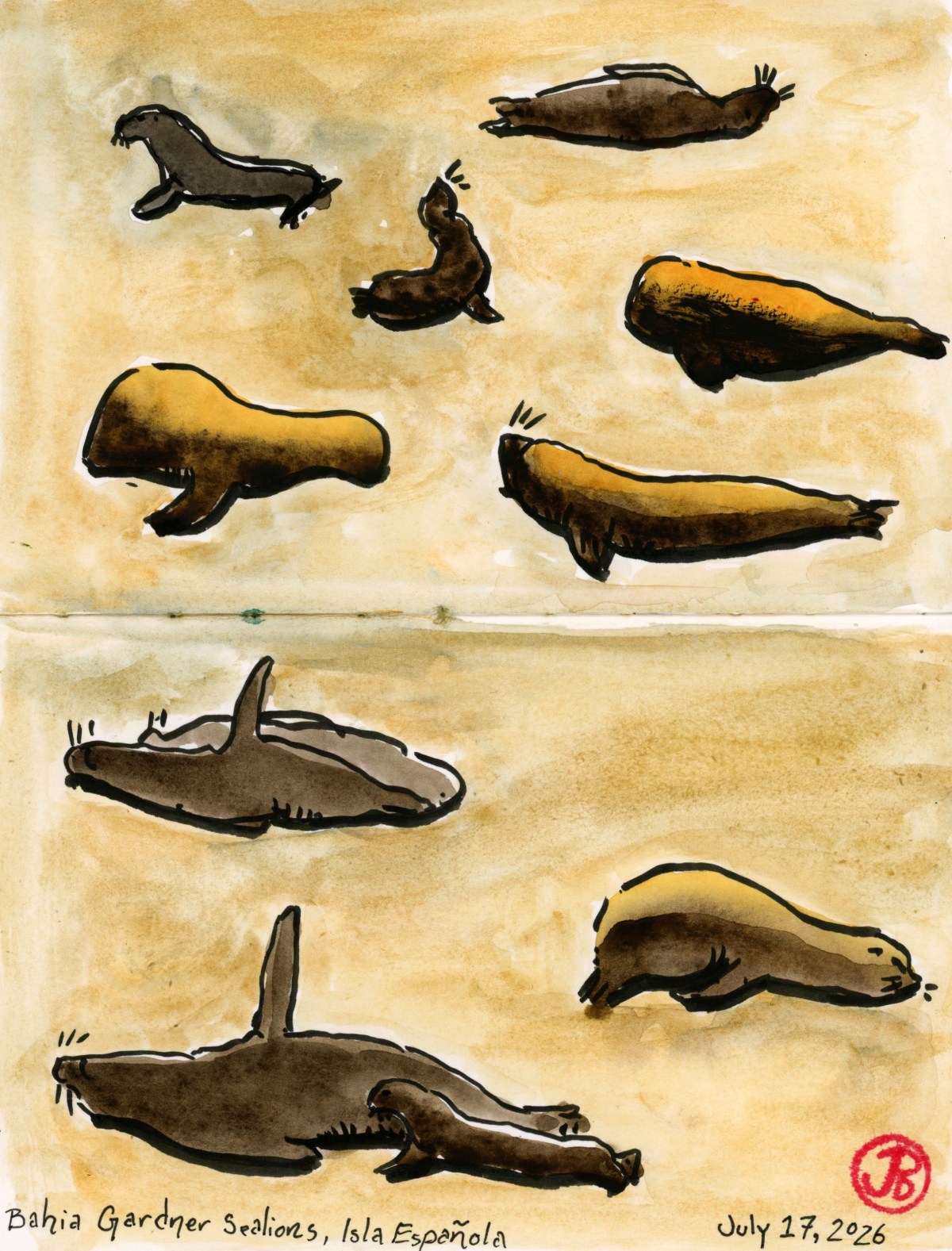
Now the AMTRAK train would stop for about 15 minutes, allowing passengers a stretch break, for some passengers this is also known as a smoke break.

I figured 15 minutes was more than enough time to get a quick sketch in of the train at the platform before the locomotive’s loud retort announced its continued journey up the Cuesta Grade towards Seattle.
I took up my sketching position a little before the Starlight’s arrival. I penciled in the foreground and the trees in the background, not knowing which trees would be eclipsed by the double decker Superliner cars. The answer was: most of them.
When the train pulled into the station, I switched to pen. I love sketching without a net!


While waiting for the northbound Coast Starlight, I found a bench and sketched the statues near the station called the Iron Road Pioneers, with Bishop Peak in the background.
The statues are a monument to the Chinese immigrant workers who built much of the railroads on the central coast as well as other seminal railroads such as the Transcontinental Railroad.

In the northwestern corner of the San Francisco is a patch of green and an art museum.
The museum is the Legion of Honor and I headed over on a rainy Friday to see the current exhibit: Manet & Morisot. I also love to look at the museum’s permanent collection.
The museum is a 15 minute drive from my Sunset Digs and being a member means I can visit the museum as many times as I want.

Looking at the masters: Rodin, Van Gough, Picasso, Monet, and others always inspires me to sketch. What I love about looking at the real deal as opposed to a facsimile is that you can really see the hand of the creator on the canvas or board. This was very true of the expressionists as they lay paint on in heavy patches. Step a few feet back to see what emerges!


The Legion of Honor was used as a filming location in Hitchcock’s masterpiece, Vertigo (1958).
It was featured twice, both the exterior and one of the museum’s galleries, Gallery 6.
Detective Scottie Ferguson (James Stewart) is on a case and he follows Madeleine (Kim Novak) to the Legion of Honor. She sits for hours looking at a portrait of a lady. Scottie finds out it is a portrait of a lady named Carlotta.

While Gallery 6 still looks much the same as when filming took place here in 1957, the paintings on the wall were not here. The Carlotta portrait was painted for the film by John Ferren and removed once filming was completed. But what about the other paintings?

Now it was time for a painting goose chase and I didn’t have far to go.
In adjacent Gallery 7 I located two paintings that James Stewart stood in front of during the Gallery 6 scenes. Two pieces of San Franciscan cinema history!


For my sketch of Galley 6 I sketched in a continuous-line technique to get the shape of the room and then lifted my pen to add details. So it’s continuous-ish.