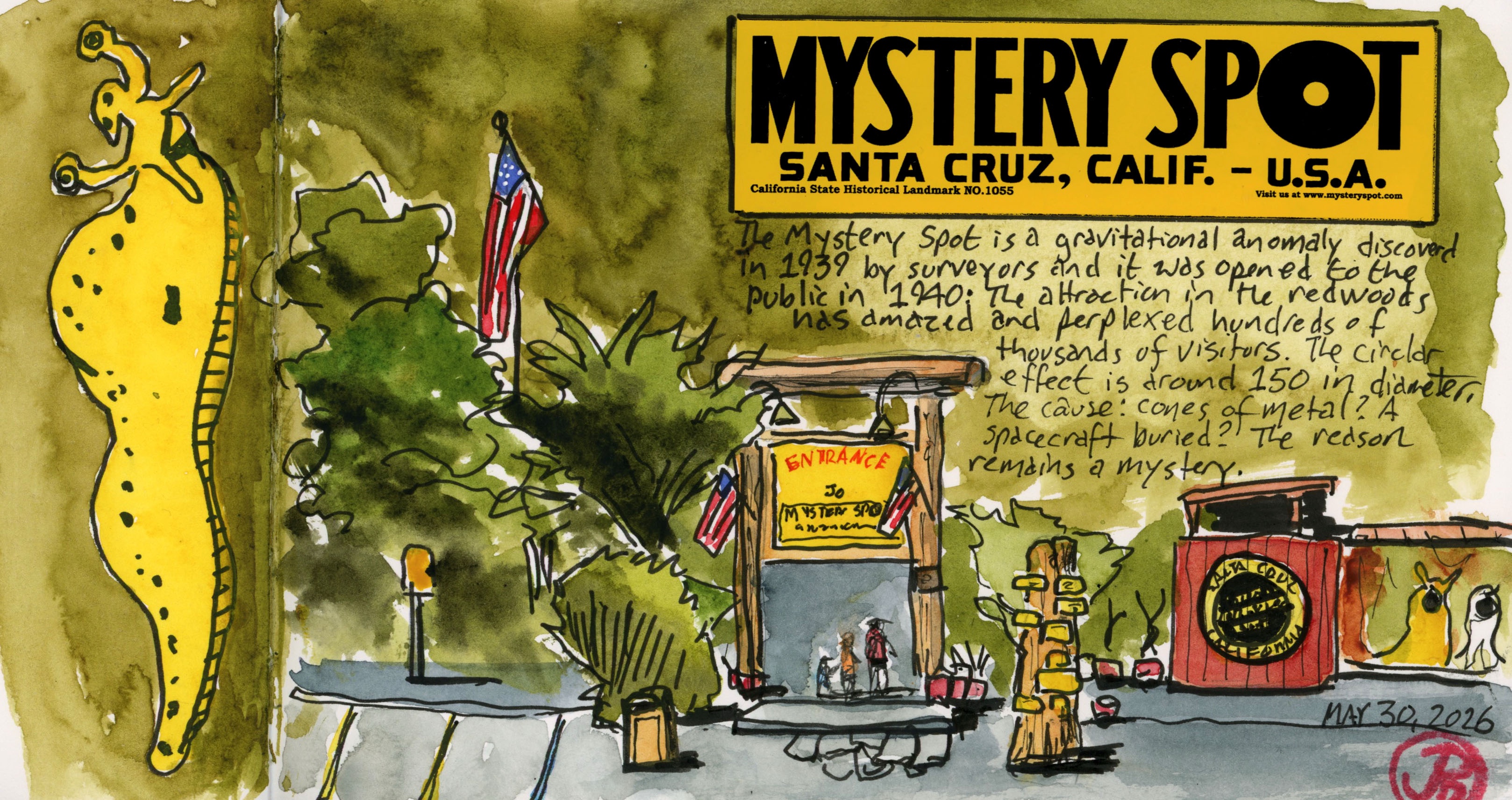
The Mystery Spot

Sketching and researching the history of local roadside attractions of the past such as Lost World and Santa’s Village, made me want to sketch a historic tourist attraction that is still alive and well.

If you’ve never been to the Mystery Spot it highly likely that you have seen the bright yellow bumper stickers on cars in the Golden State.
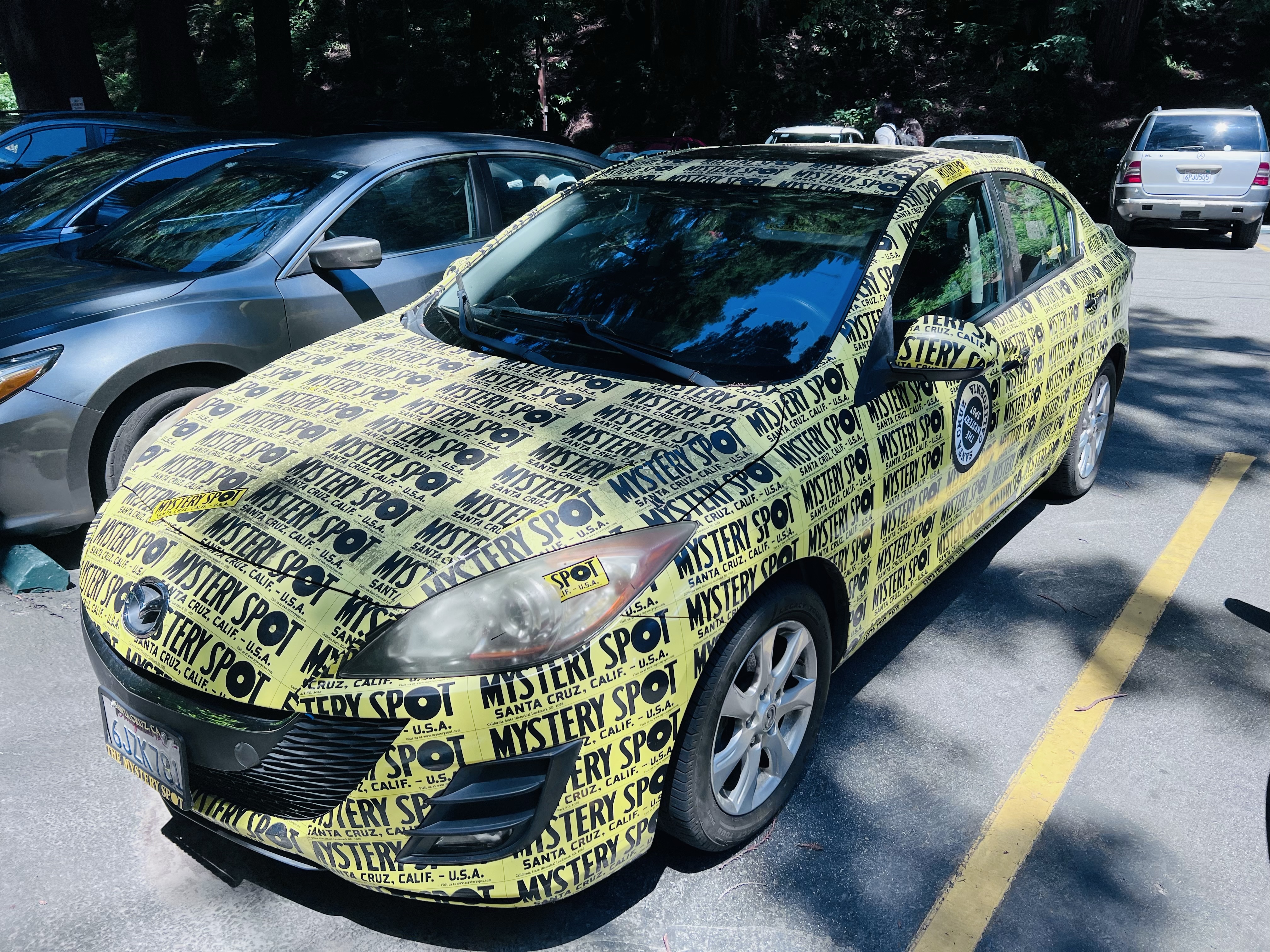
This car’s owner either really loves the Mystery Spot, uses bumper stickers to hold the car together, or is an employee shamelessly promoting their employer; probably all three.

While my family visited the Boardwalk and even Lost World and Santa’s Village, we didn’t make our way up Branciforte into the redwoods. Perhaps the Mystery Spot was just too strange.

I first visited the quirky attraction as an adult and am still trying to decide if it was really worth the time and expense. It some sense it reminded me of the title of a Shakespearean comedy.
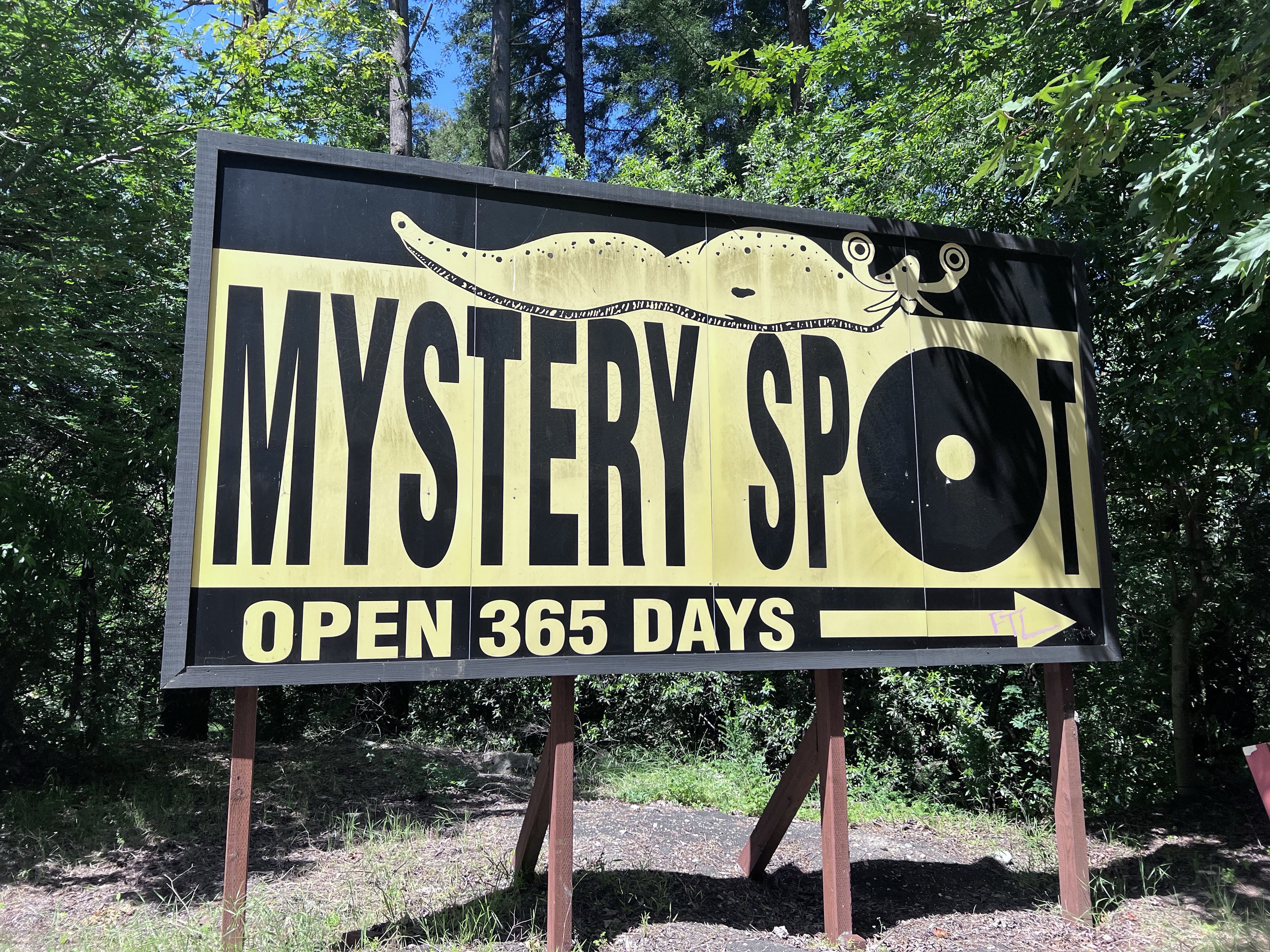
You know you are near with billboards leading the way. I love the funky banana slug which I added to my sketch.

The Mystery Spot was first discovered in 1939 by George Prather and was opened to the public a year later. Since the attraction has garnered enough visitors to keep it open for over 85 years, 365 days a year. But what exactly is the Mystery Spot?
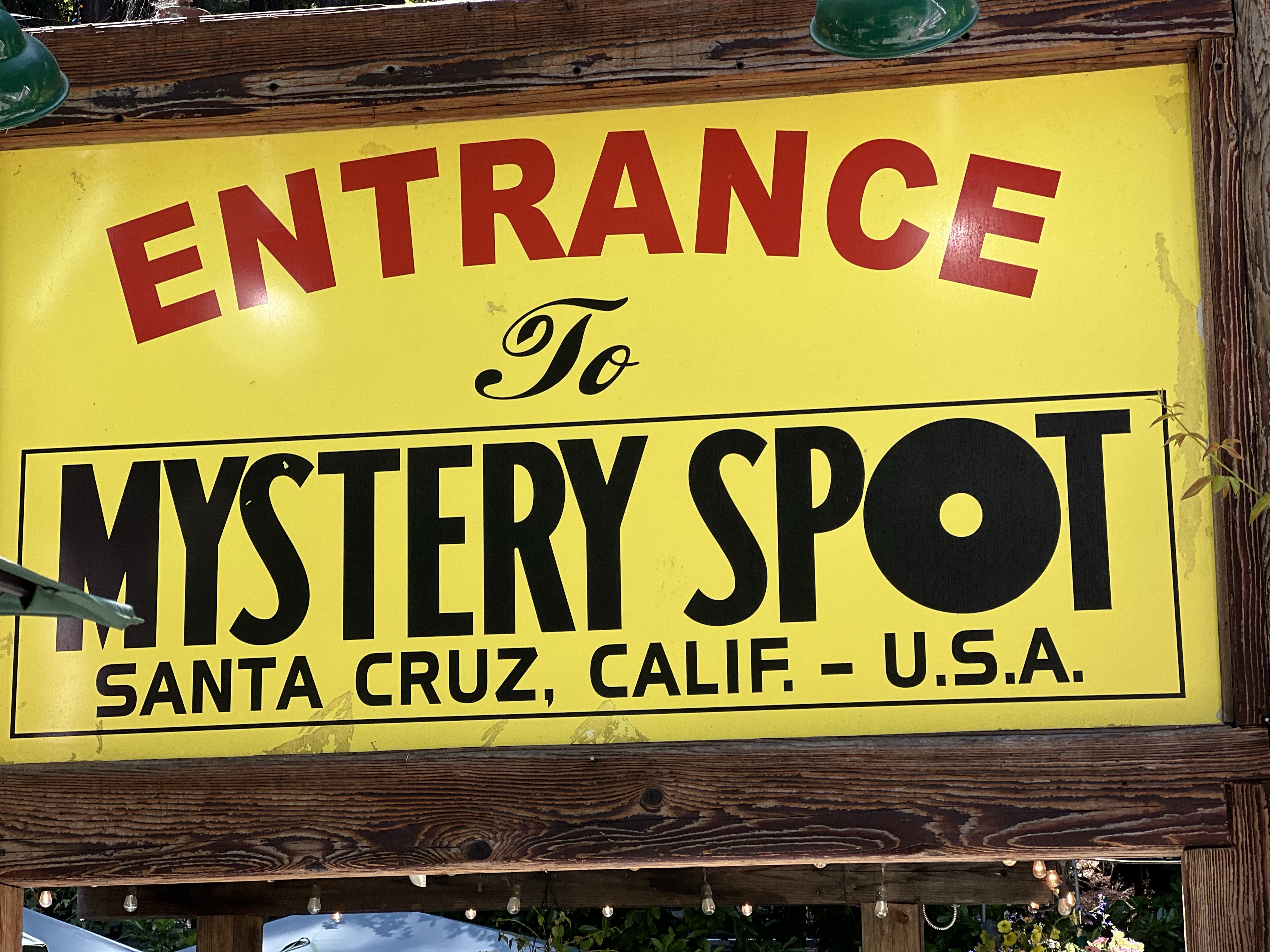
The main attraction to this roadside attraction is that it is a “gravity hill” (the first in California), meaning that the area appears to defy gravity.

In 1941 Prather built a “crazy house” where guides now lead tours to highlight the Mystery Spot’s bewildering effects.

Is this real or just a visual illusion? Spoiler alert: the house is slanted at a 20 degree angle.

The Mystery Spot was designated a California Historical Landmark (# 1055) in August of 2014.
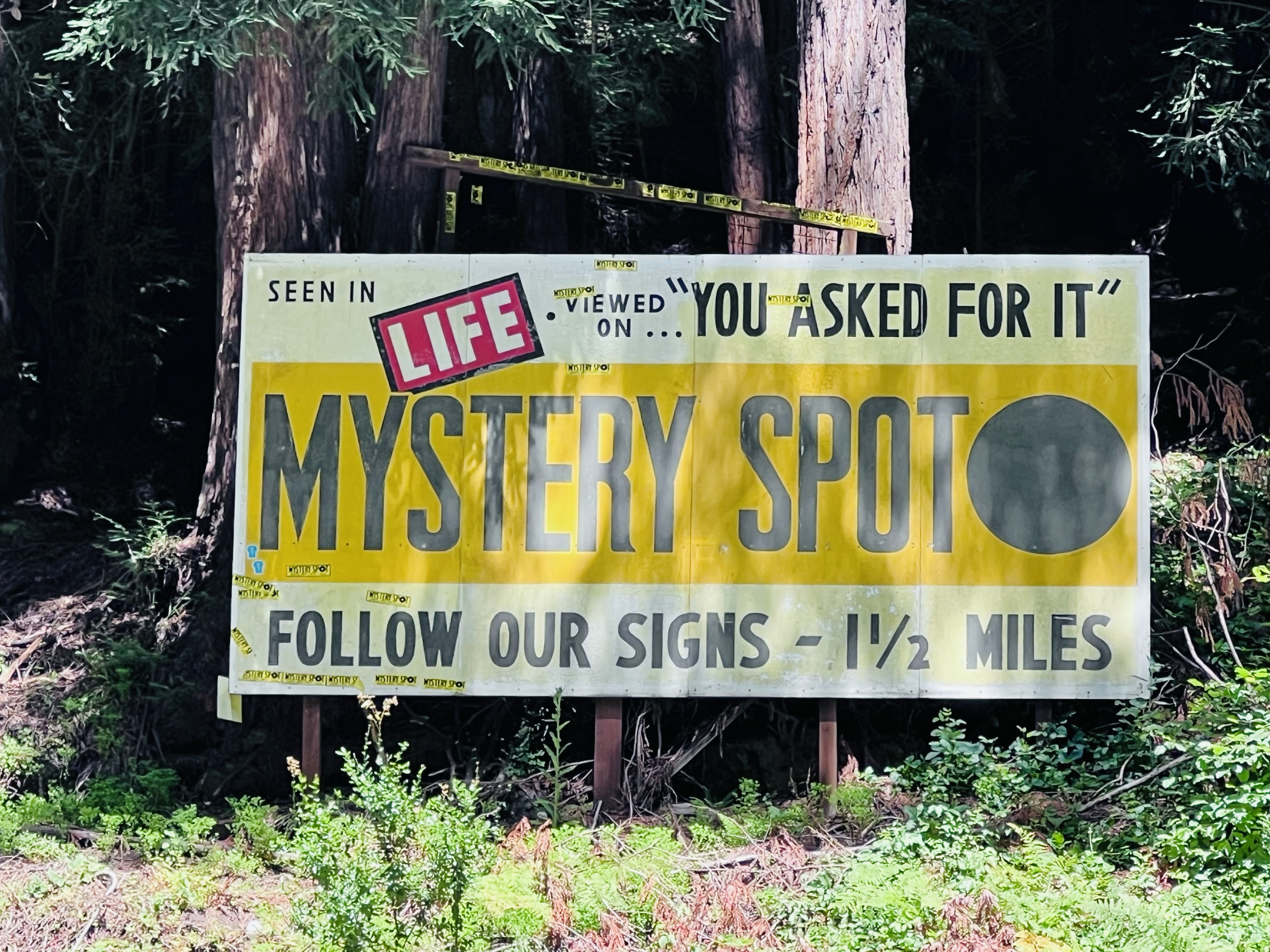
An old billboard, which I assume was located 1 1/2 miles from the Spot. Most contemporary visitors would not know what Life, “You Asked For It”, or even a magazine are!

I arrived on a Saturday afternoon and the parking lot was almost full, proving that this is still a very popular attraction. Now I needed to avoid the crowds and find a good sketching angle.

I took the hiking trail which gave me some elevation and a nice perspective to sketch the entrance (featured sketch).
Lost Trees of Scotts Valley

The Santa Cruz County town of Scotts Valley is bisected by Highway 17. The highway sees a lot traffic as travelers from the Bay Area head to the seaside town of Santa Cruz.

The Santa Cruz area already has it’s attractions, the Santa Cruz Beach Boardwalk and the Mystery Spot being some of the most visited. Scotts Valley needed to capture some of those tourist dollars.

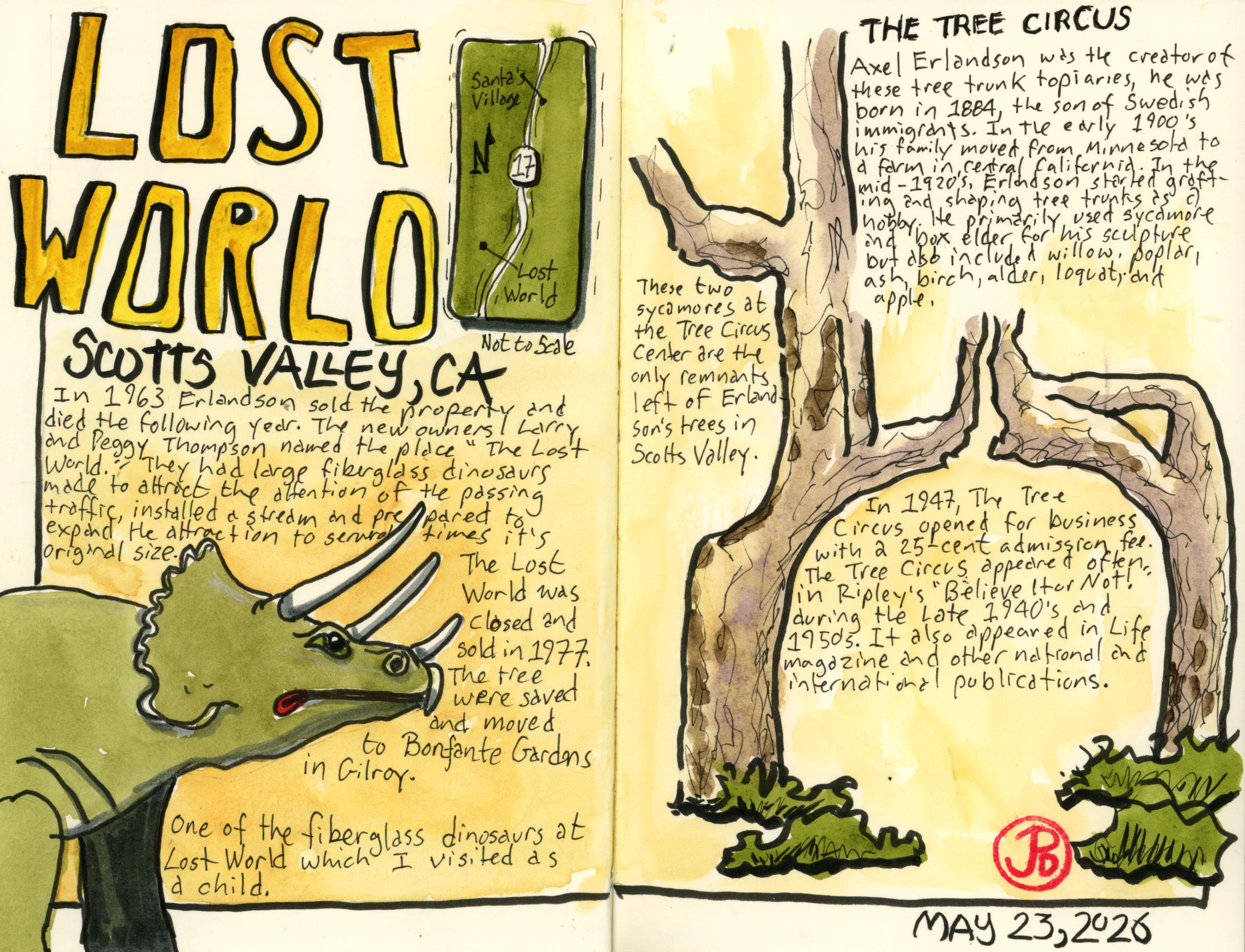
Two attractions were build on either side of the highway. Both attractions are now gone and there is little evidence that they ever existed. But I was going to sketch the only trees left in Scotts Valley that were part of the attraction called The Tree Circus.

The genesis of the Tree Circus was a Swedish-American named Axel Erlandson. In the early 1900s Erlandson’s family moved from Minnesota to California’s Central Valley.

While there, Erlandson began grafting and shaping trees in various shapes. He primarily used sycamores and box elder for his arboreal sculptures.

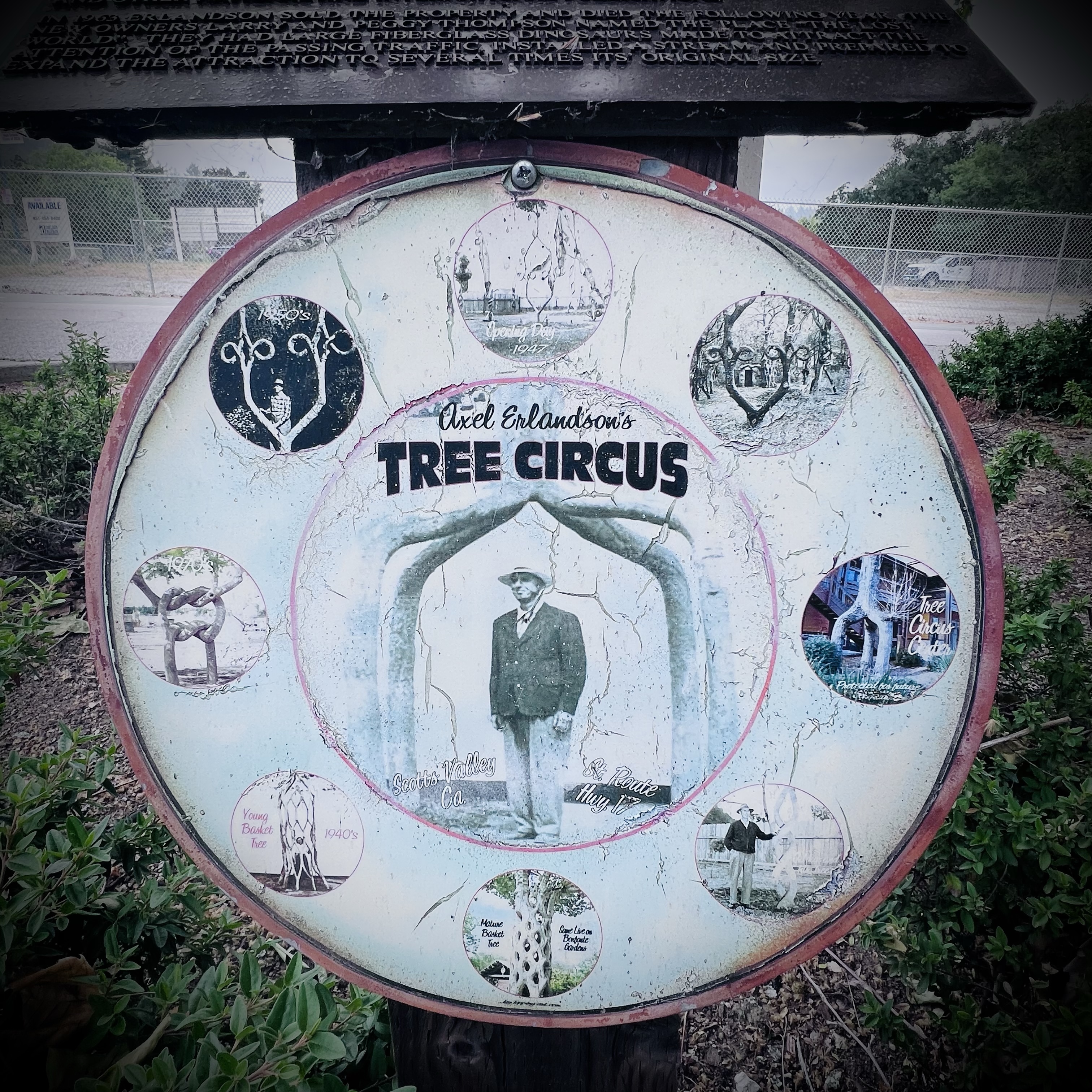
A plaque featuring some of Erlandson’s trees.

Erlandson was looking for a location for his wooden oddities and he opened The Tree Circus in 1947 in Scotts Valley on the western side of Highway 17. The advertising slogan he used was, “See the World’s Strangest Trees Here.” At the time admission was just 25-cents. The attraction was featured many times in Ripley’s “Believe it or Not!” and other publications such as Life magazine.

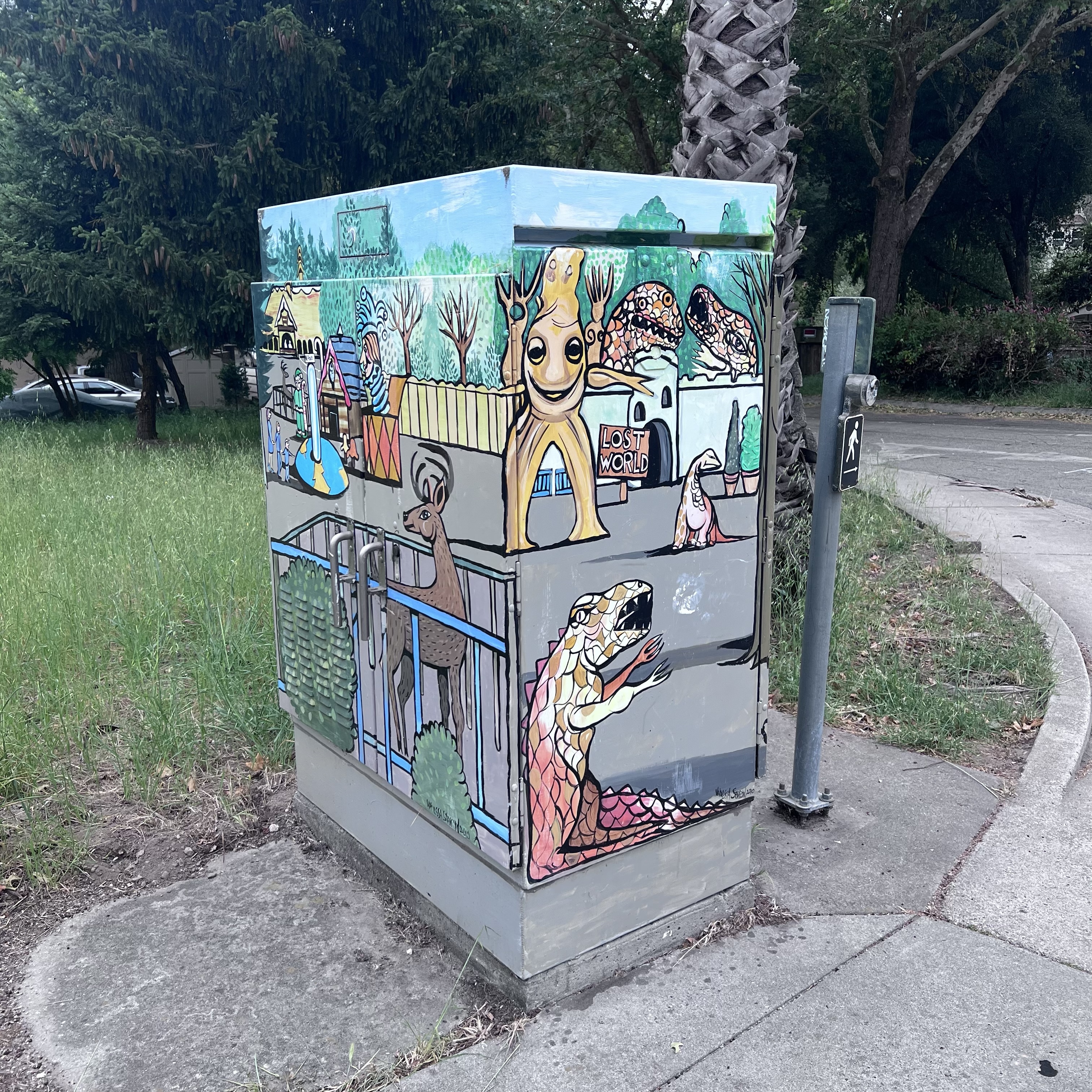
Some murals shows Scotts Valley’s roadside attractions of the past.

In 1940, Highway 17 opened, bypassing the old stage road, Scotts Valley Drive, where the Tree Circus was located.

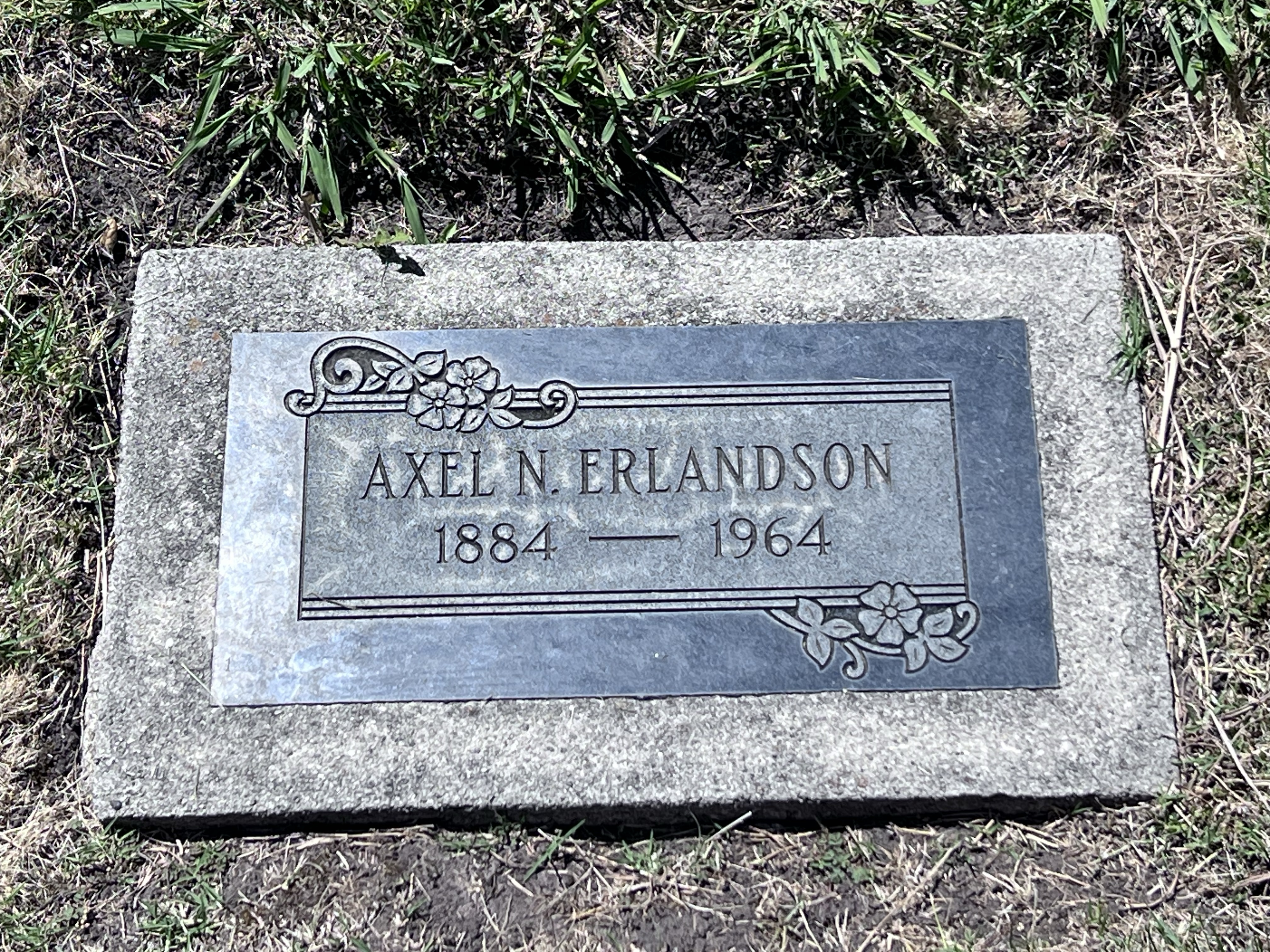
In 1963 Erlandson sold the property to Larry and Peggy Thompson. Erlandson died a year later.

Erlandson’s final resting place at Oakwood Cemetery in Santa Cruz.

The Thompsons added 30 fiberglass dinosaurs, created a stream through the property, and renamed the grove of Erlandson’s tree “The Enchanted Forest”.

The new attraction was named “Lost World”. I remember visiting the park as a kid during this time. From Highway 17 you could see the large T. Rex and triceratops.

The attendance slowed and Lost World was eventually closed and sold in 1977.

The trees were saved and bought by Michael Bonfante, owner of a local supermarket chain, who replanted them in his new amusement park in Gilroy called Bonfante Gardens (now called Gilroy Gardens).

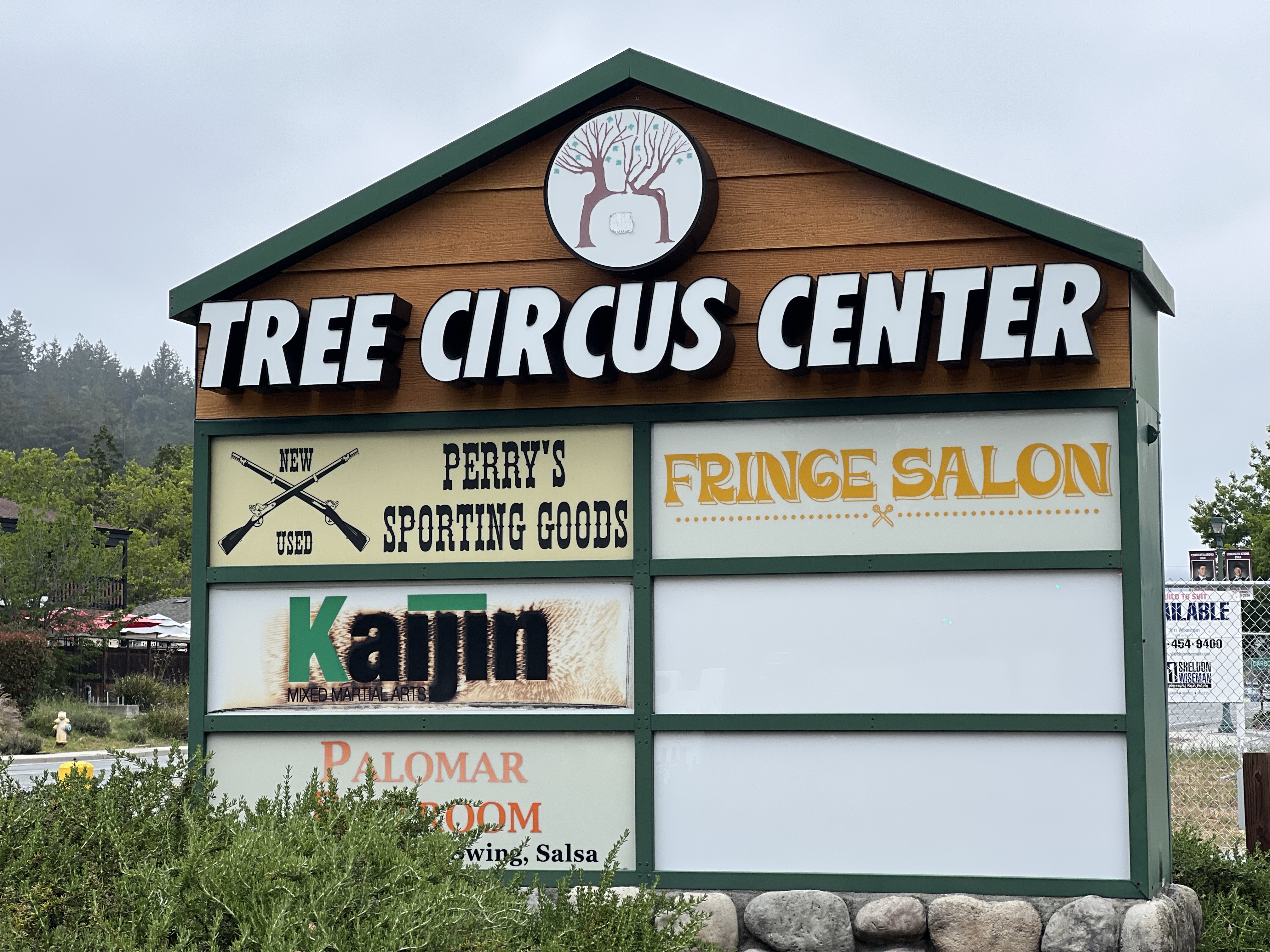
On Saturday I arrived at the Tree Circus Center, sounds like a perfect place to find remnants of Erlandson’s art. The only business open at this hour was a hair salon.

I did know I owned a sporting goods store in Scotts Valley!

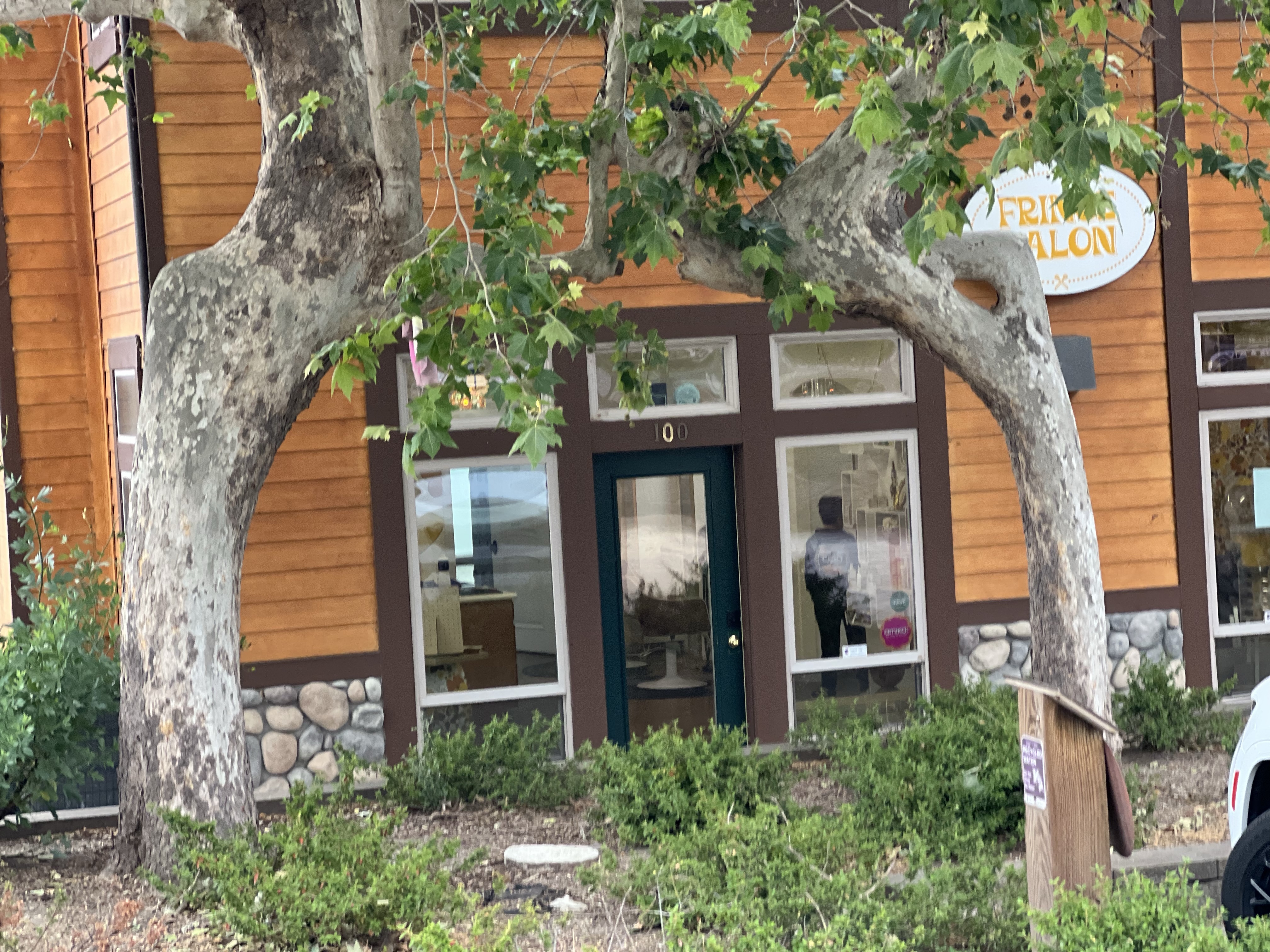
Before me was two sycamores leaning towards each other in an unnatural way. This is all that remains in Scotts Valley of the Erlandson’s Tree Circus.

Two lone sycamores.

Evidence of Santa’s Village is even harder to find. There is nothing left of the former Christmas themed amusement park (yes it was open all year long), which I also attended as a child.

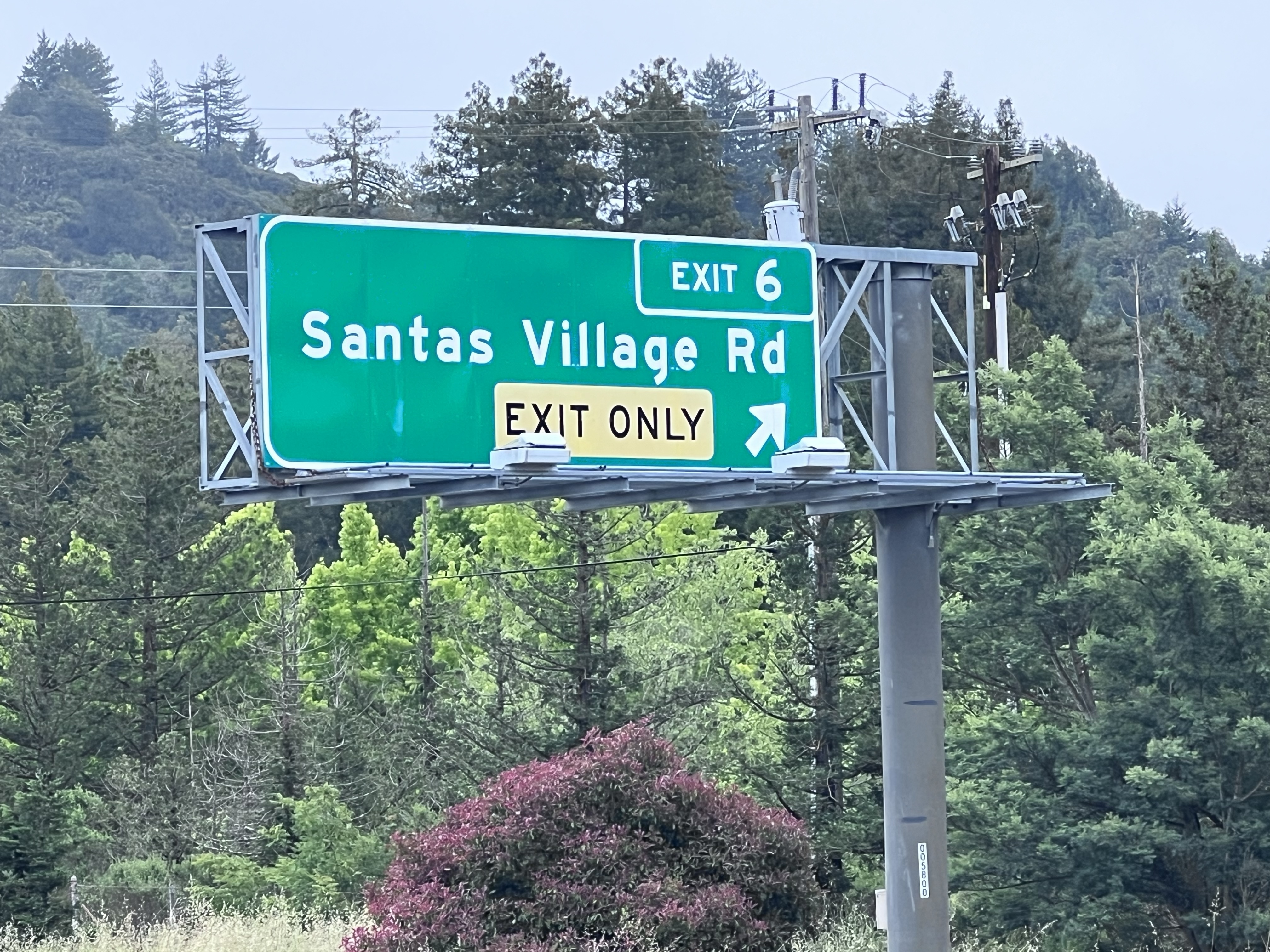
It open in 1957 and remained in business until 1979. There is now a row of houses on the property. But the exit from Highway 17 homeowners take to get to their houses is telling;