Travel Pouch

With my trip to the Galapagos I wanted to try out a new travel pouch.

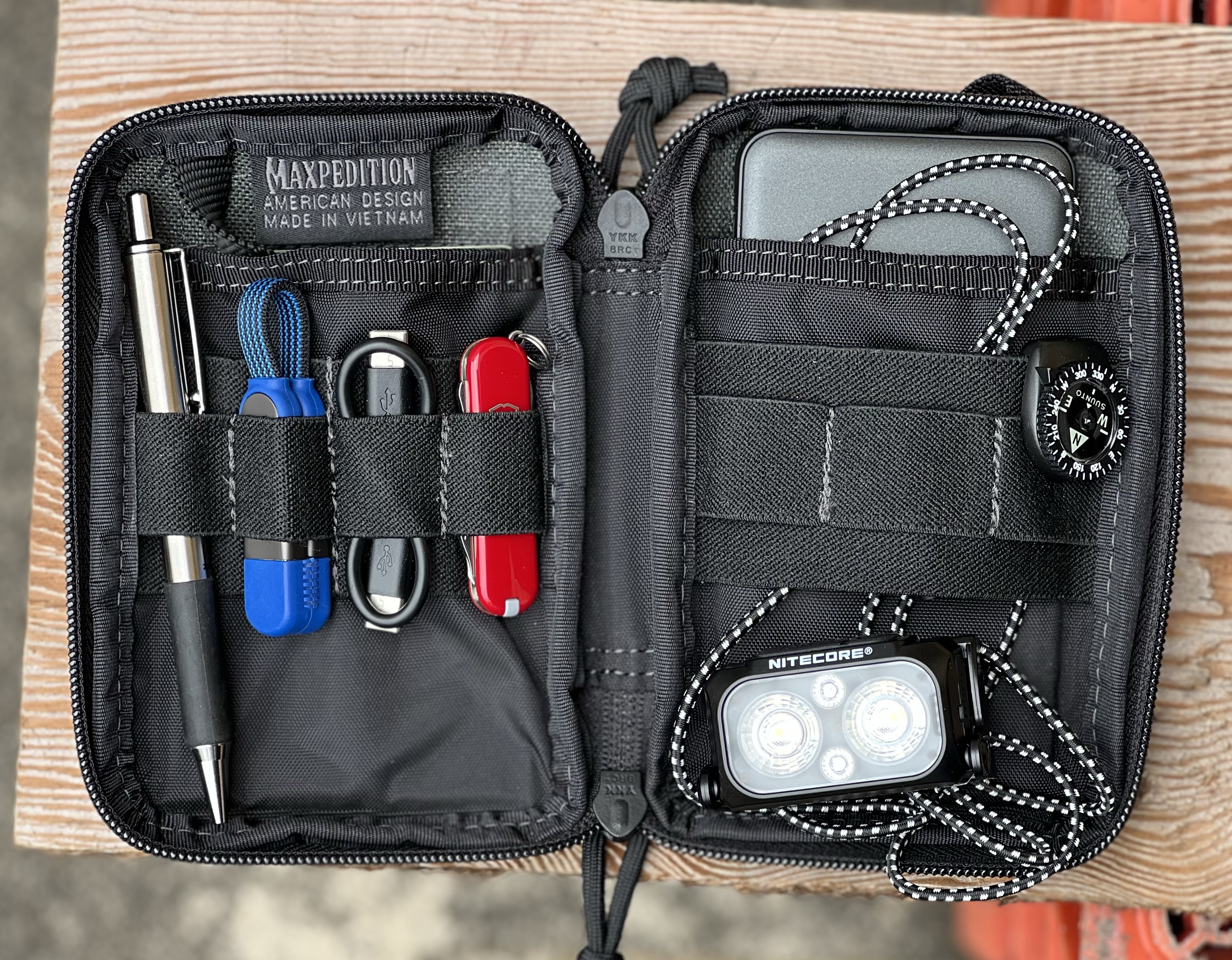
This is a good way to keep things organized on the road so you aren’t on a wild goose chase looking for that adapter or power bank.

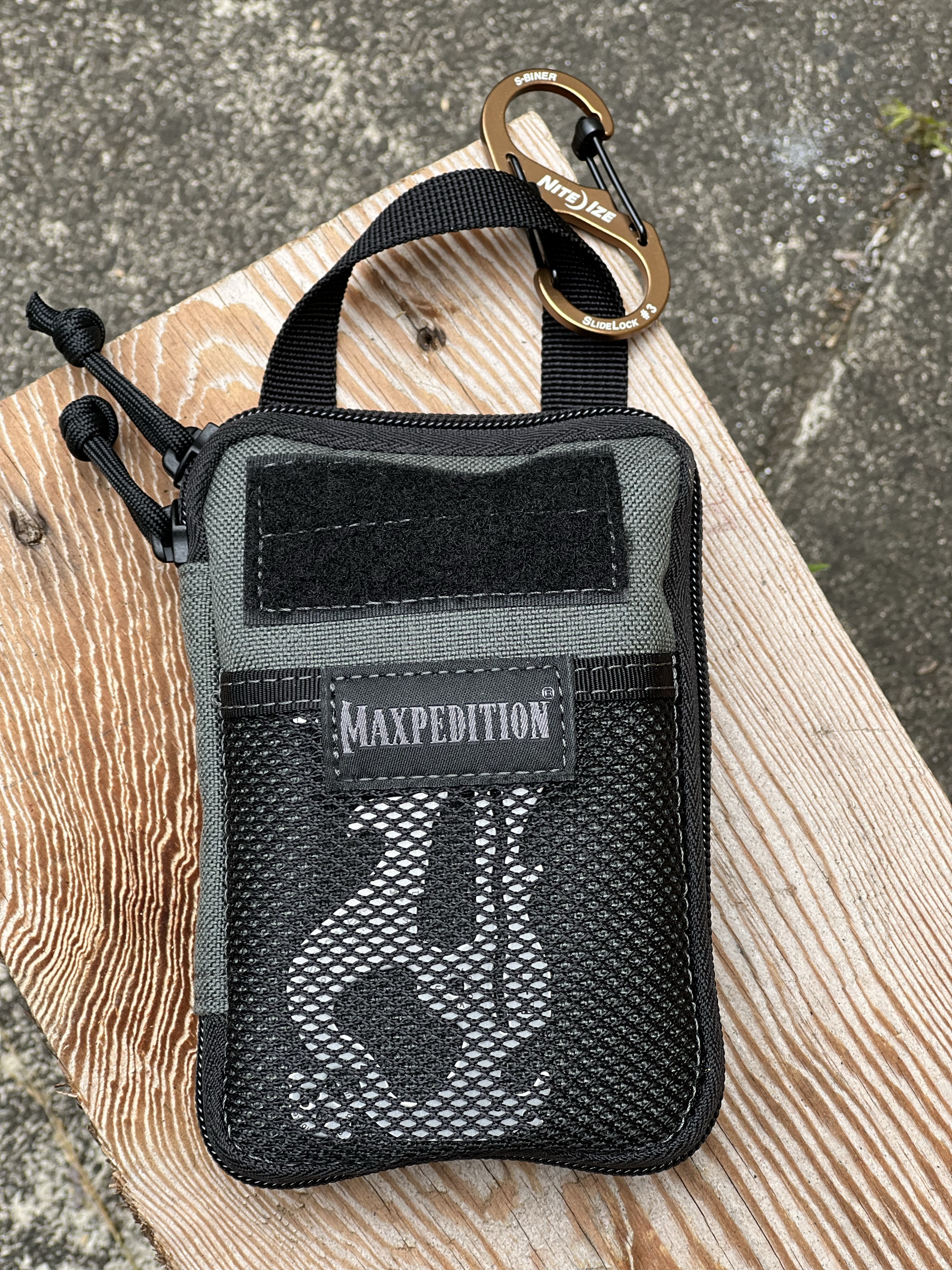
After a bit of research and YouTube binges (thank you Jon Gadget) I settled on the Maxpedition Mini Pocket Organizer. I love new gear!

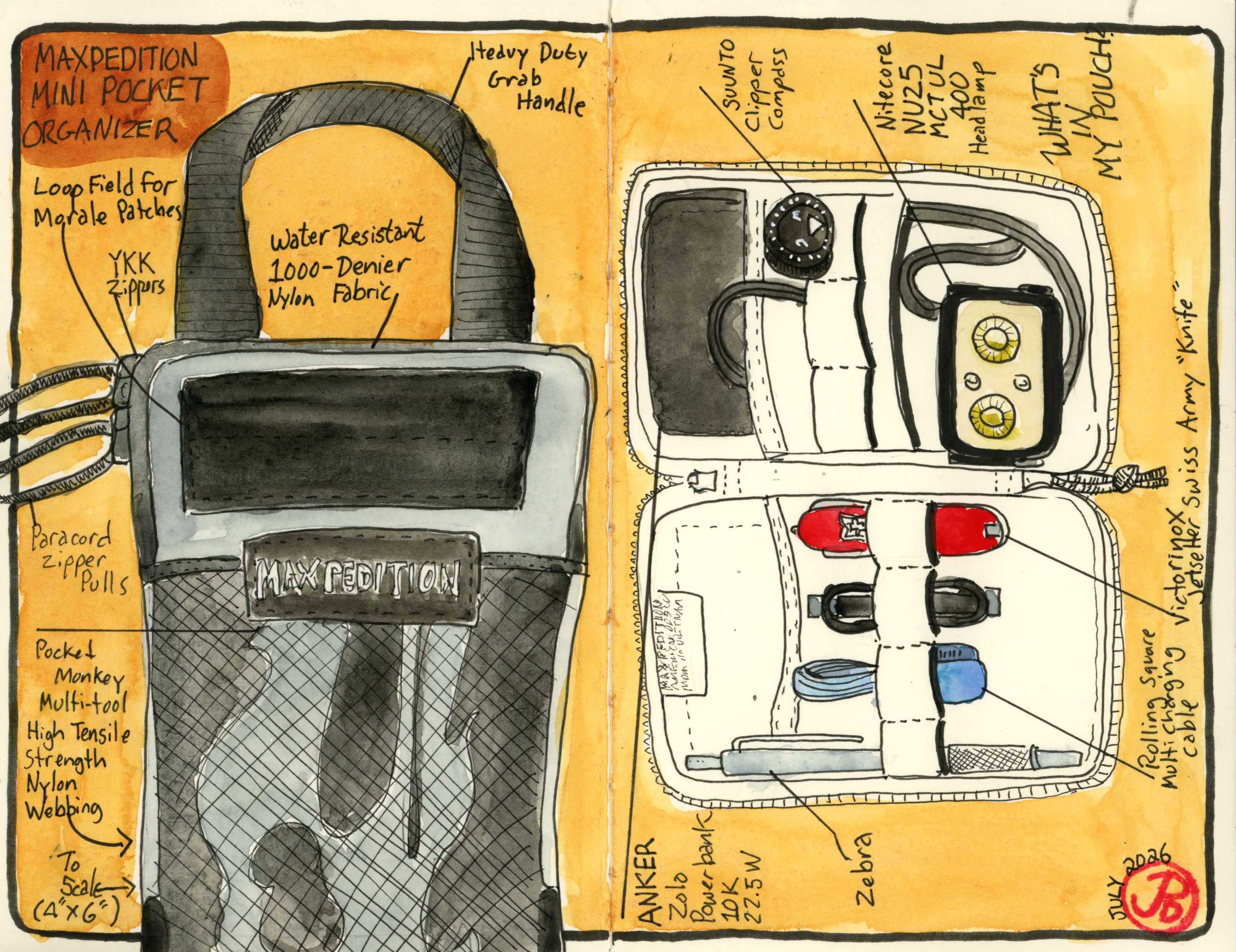
As I often do, I sketch a spread about my new travel gear and what I keep inside.

On the left side is a life sized sketch of the 4” X 6” organizer, pointing out it’s specs: YKK zippers, paracord zipper pulls, water resistant 1000-denier nylon fabric, heavy duty grab handle, and high tensile strength nylon webbing on the back.

What I like about the interior is that there are a lot of pockets to help with organizing. The pouch opens up like a book giving you easy access to the interior.

I’m ready for almost anything!

Pocket Carry Journal

I just couldn’t keep it at two journals for the Galapagos. (What if I fill up all the pages?!)

While at the art store I picked up a Stillman & Birn Softcover Beta journal. Because of its small size (3.3” X 5.5”) it is an ideal size to always keep in your pocket so you can sketch wherever you are. An Every Day Carry (EDC) journal.

I am a one bag, one backpack traveler. No checked bags for me! I try not to bring many guide books or field guides to lighten the load. There are certainly many guides relating to the Galapagos. They would stay at home but some of the information would be traveling with me through my sketches.

This is a cross section of Santa Cruz Island showing its Vegetation Zones.

What I did was use the first few pages in my small Beta journal to copy important information that I might want to reference on my trip.

You would think being on the Equator that the Galapagos would be hot but the cold Humboldt Current cools things off.
I wrote some of my favorite Darwin quotes from the Voyage of the Beagle and portrayed Darwin as a Galapagos giant tortoise.

Galapagos Beginnings

For my summer travels I will journey to a long sought after destination: the Galapagos.

I plan to bring two journals for my 10 day cruise around the islands: one Stillman & Birn Beta hardbound and a Hahnemühle 100% Cotton panoramic journal. I have used both before on previous trips and I hope to fill all the pages like Darwin noodling away in his journals.

I like narrowing my journals to just two, like the two banks of a river that contains yet gives direction to my sketches. Will the scene before fit within the dimensions of the paper? I sure will try and if my lines run out of room, it’s just part of the sketch.

These two journals have been on many trips in the past few years. I love the format and the quality paper.

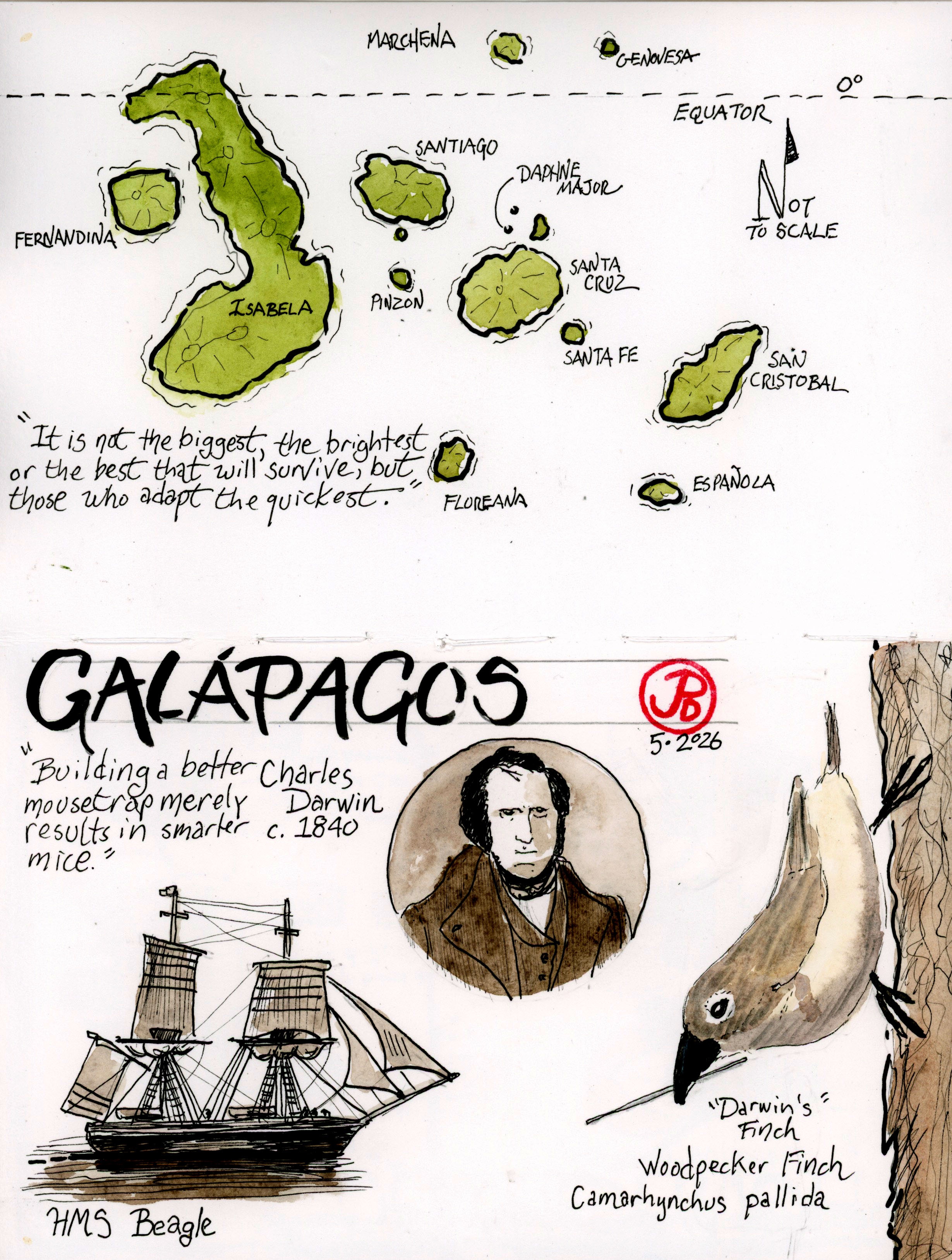
My first page in my Stillman & Birn journal is usually a map. With this map I include a portrait of man who is all over the Galapagos: Charles Darwin. He visited the otherworldly islands in 1835 as the naturalist on the HMS Beagle. And I drew one of Darwin’s finches: the woodpecker finch. (Featured sketch).

Darwin formulated much of his thoughts for his groundbreaking Origin of Species on his five year cruise on the Beagle and his observations and collections on the Galapagos.

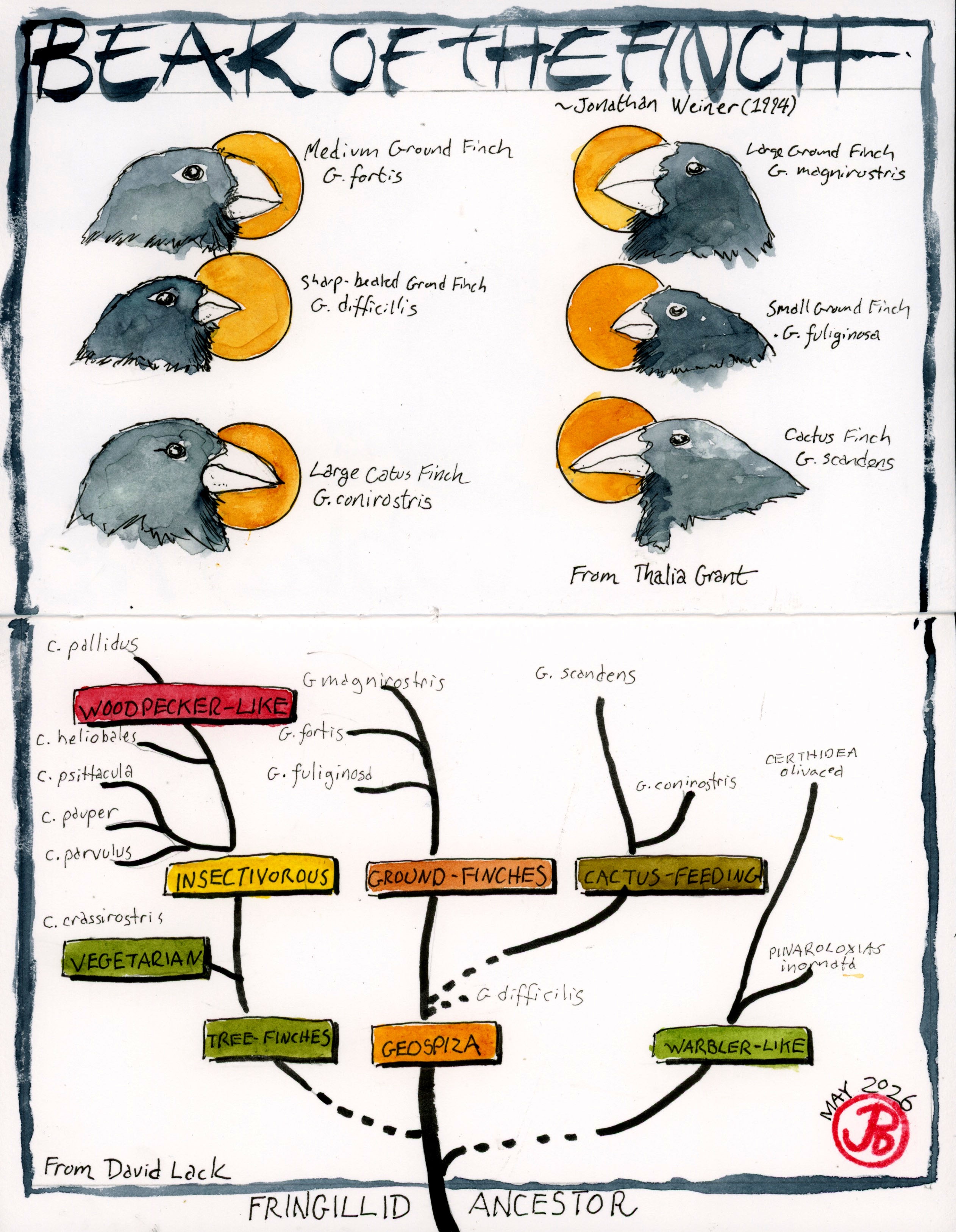
Before any trip I never want to go in blind. I want to learn about my future destination and it’s history, flora, and fauna. Before heading south towards the Equator, I read Beak of the Finch by Jonathan Weiner (1995).

This Pulitzer winning book profiles the research of the Peter and Rosemary Grant on the tiny Galapagos island of Daphne Major. There research highlighted evolution in action with the beak lengths of “Darwin’s” finches.

Aquatic Park

On a Wednesday I became a tourist in my own city and headed over Twin Peaks to the Ferry Building.

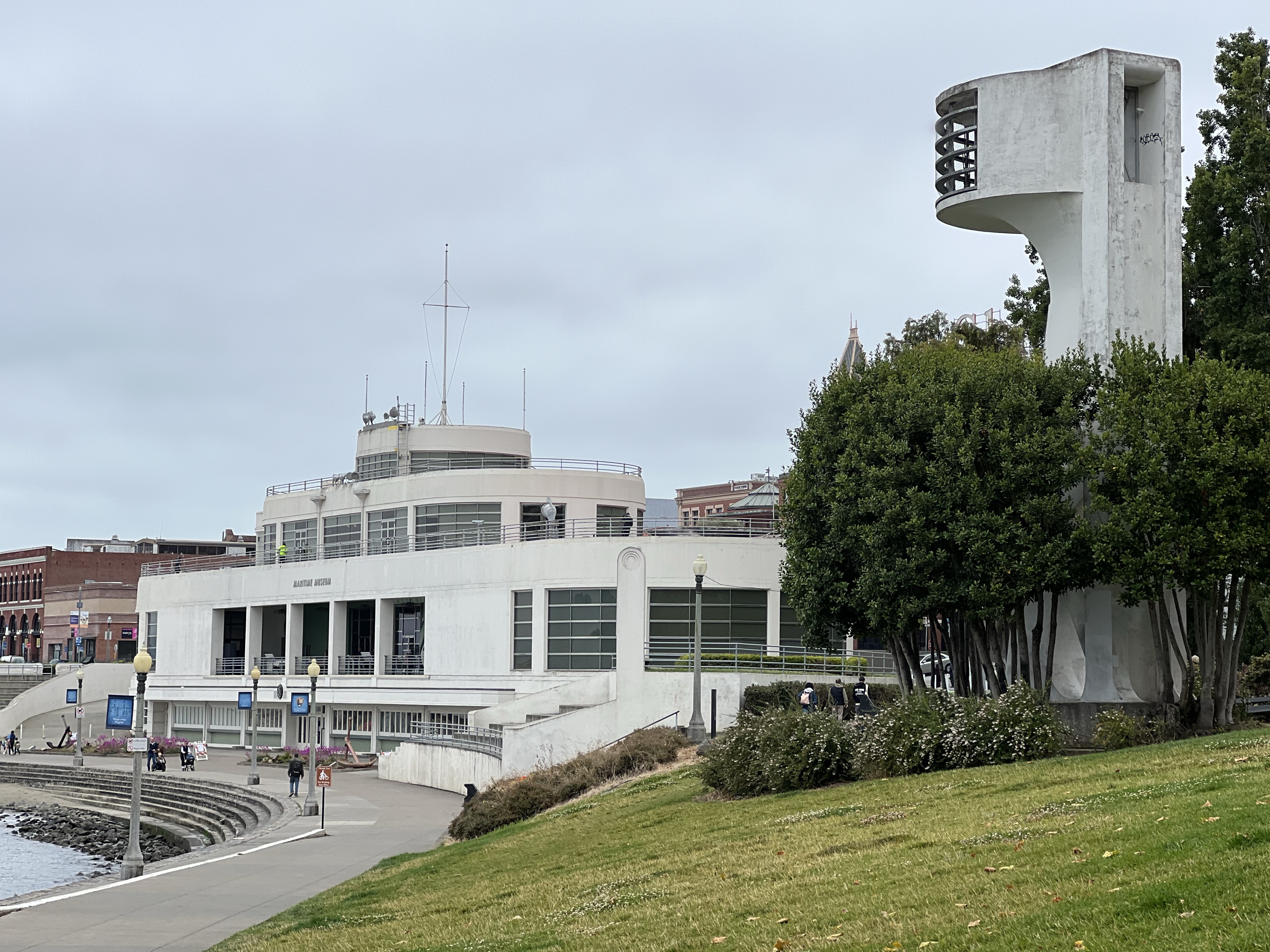
I went from the N Judah to the F Market to Fisherman’s Wharf. This is the epicenter of the tourist industry in San Francisco. I walked to Aquatic Park to the ship-like structure that is the now the Maritime Museum. It was originally built as the Aquatic Park Bathhouse and opened in January 1939.

I love this historical structure which is great example of Streamline Moderne. Being on the water, the building looks like it could sail away at any moment.

Is this a ship or a bathhouse? Well the answer is neither!

The Aquatic Bathhouse has served as a number of uses, most controversial as a Casio for the rich. The building now houses the Maritime Museum.

The murals by Hilaire Hiler on the ground floor are otherworldly. It took visitors minds away from the Depression.
Benny Bufano’s frog sculpture. At least I think it is supposed to be a frog.

I picked a spot along the curve of Aquatic Park to sketch the former bathhouse in my panoramic sketchbook.

On the other side of the spread I added the Fort Mason Beltline Tunnel, which is just a short distant from my first sketching position. This tunnel is historical and featured in a classic 1971 film.

In the Don Seigel film Dirty Harry, starring Clint Eastwood, the serial killer Scorpio (based on the real Zodiac Killer) sends Inspector Harry Callahan on a wild goose chase around San Francisco. One scene features Eastwood going through the tunnel when he is stopped by some unfortunate thugs.

The State Beltline Railroad ran along the Embarcadero and served the piers along the waterfront. The railroad was in operation from 1890 to 1993.

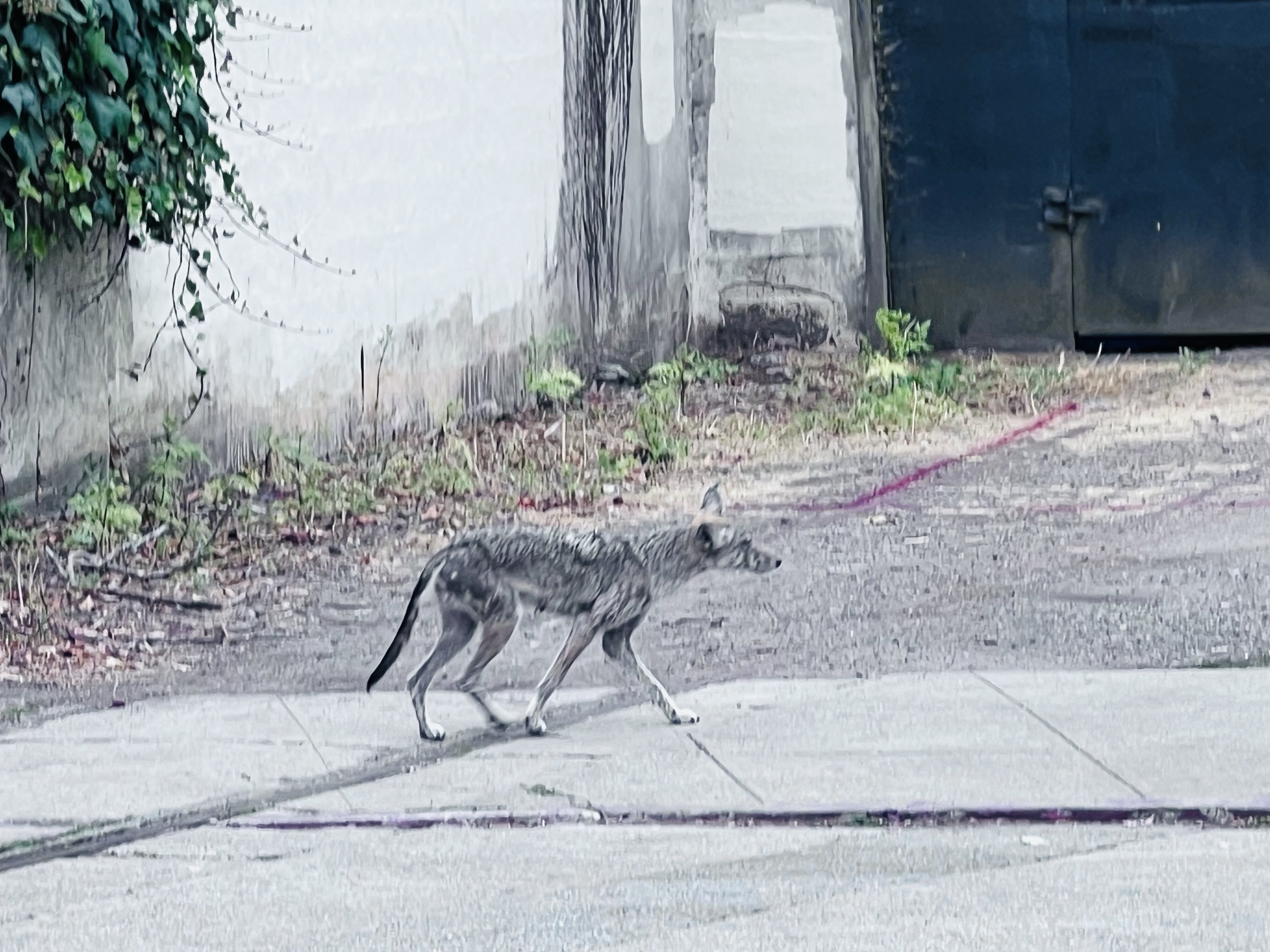
A very scrawny urban coyote walks by the boarded up Beltline Tunnel.

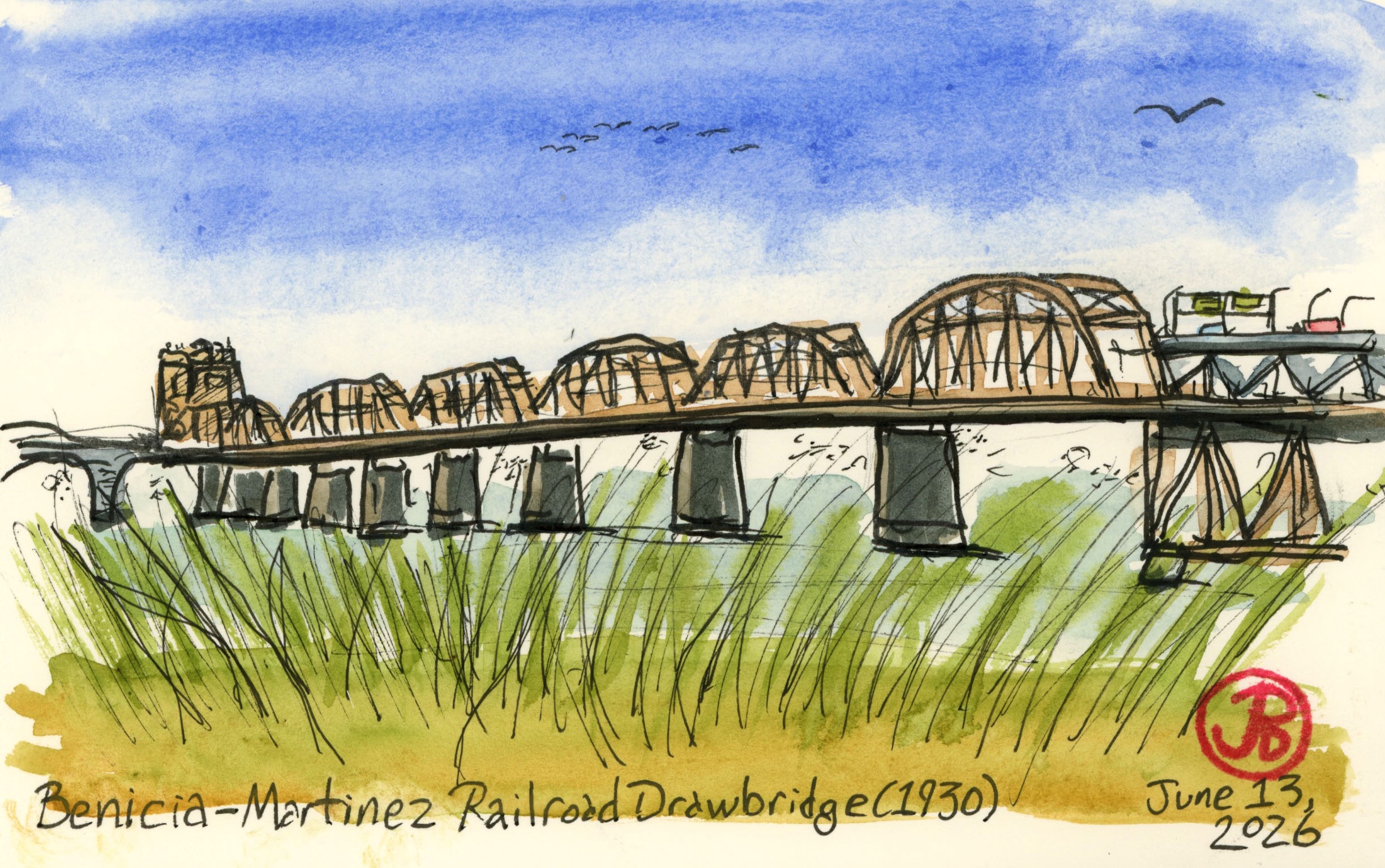
Benicia-Martinez Railroad Bridge

After sketching some Bay Area railroad ferry history, I wanted to sketch the 1930 railroad bridge that killed off the ferry between Benicia and Port Costa.

As rail traffic increased (both passenger and freight) and the rail ferries aged and needed repair or replacement, this caused more delays on the Overland Route (not to mention delays caused by fog). Southern Pacific looked into building another ferry but soon realized that a rail bridge spanning the strait was the best solution.

The railroad bridge was built for Southern Pacific Railroad between the years 1928 to 1930.

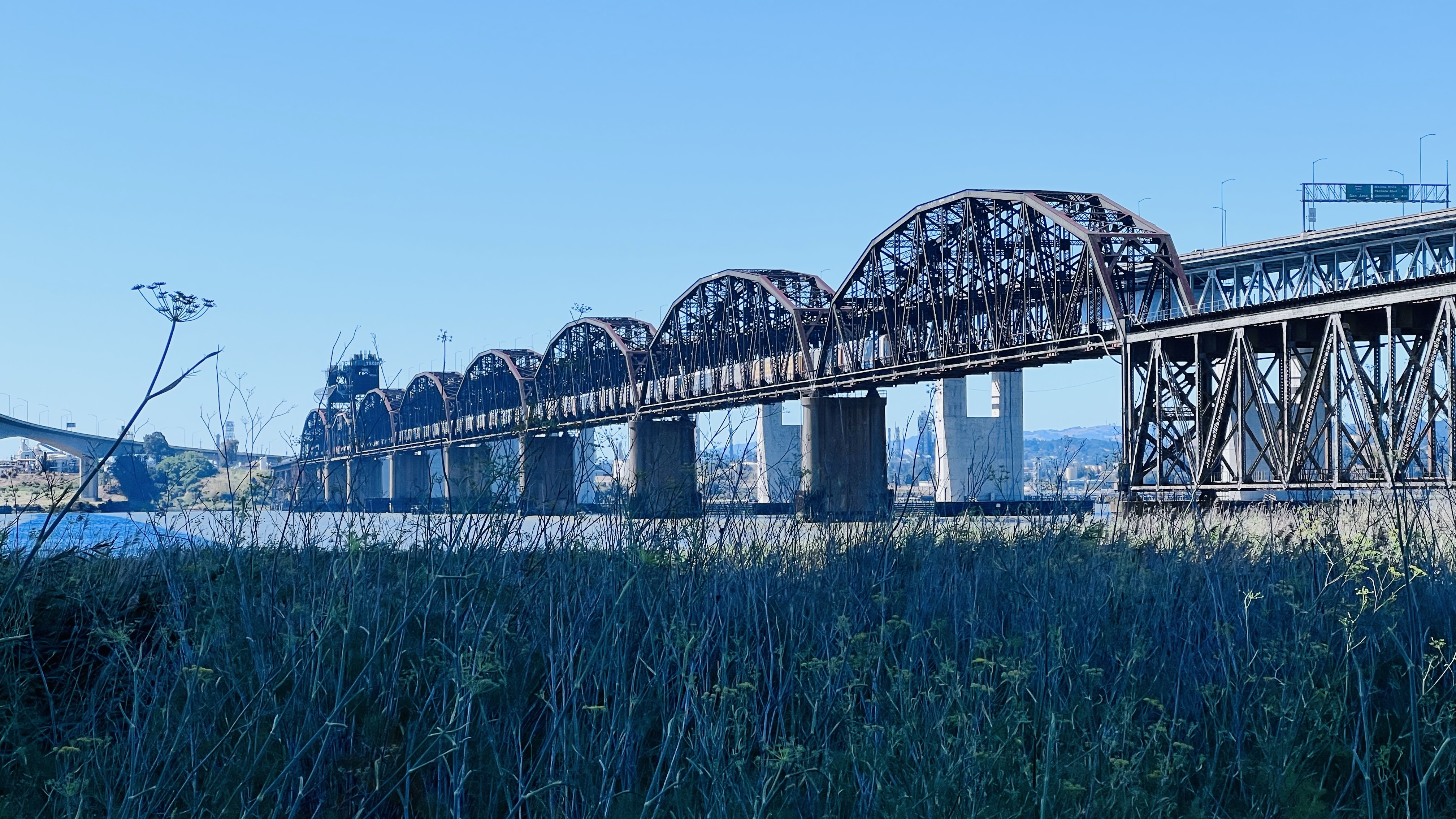
The bridge is impressive because it is the second longest railroad bridge (5,603 ft 6in long) in the country and the longest west of the Mississippi.

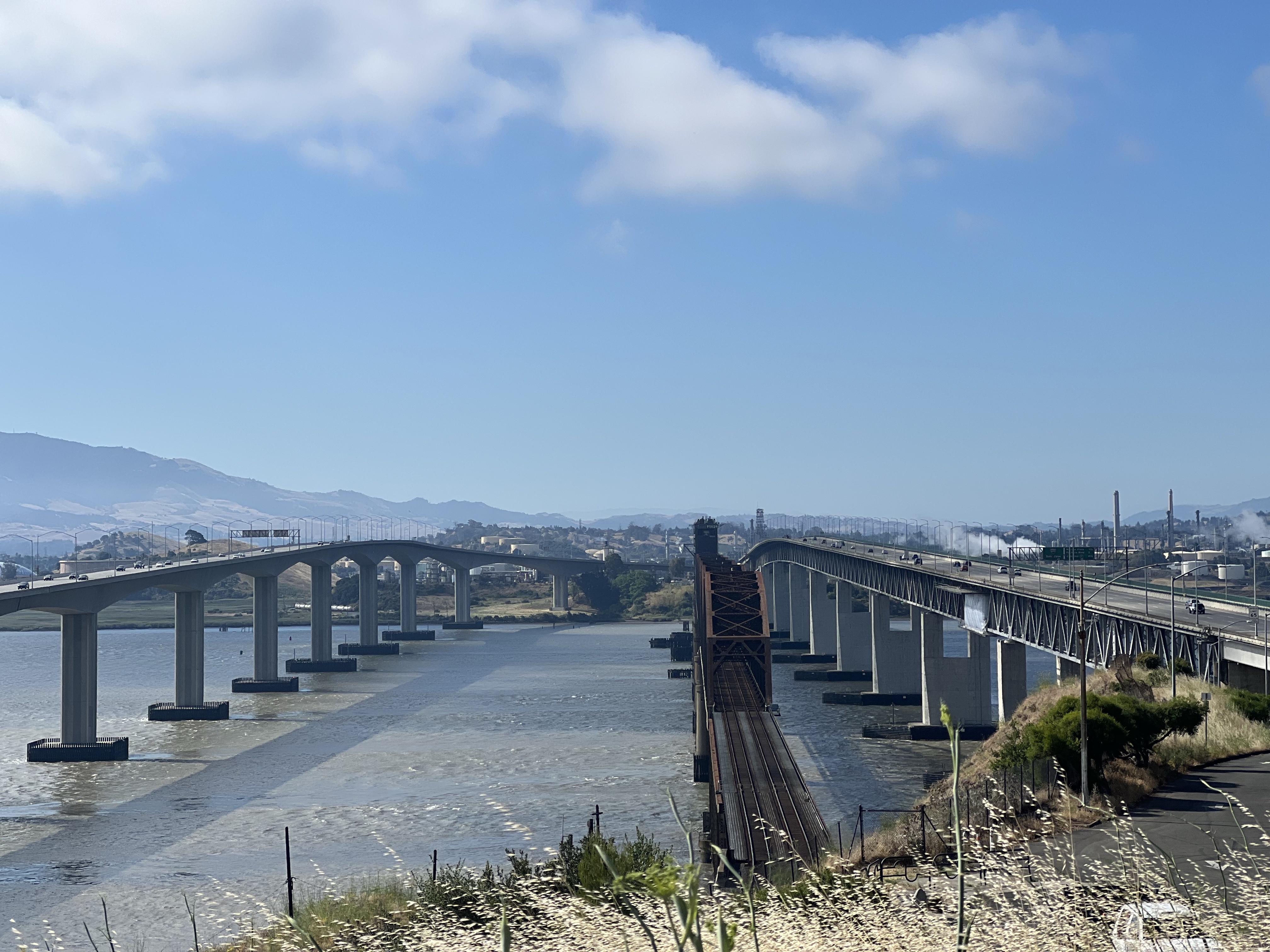
The railroad bridge is now flanked to two automobile bridges that cross the Carquinez Strait. One span was built in 1962 while the other completed in 2007.

The longest railroad bridge west of the Mississippi.

Because the bridge is relatively low to the water, 70 feet in fact, a midsection is a drawbridge that allows tall ships to pass through the strait. When the drawbridge is opened, it gives passing ships 135 feet of clearance.

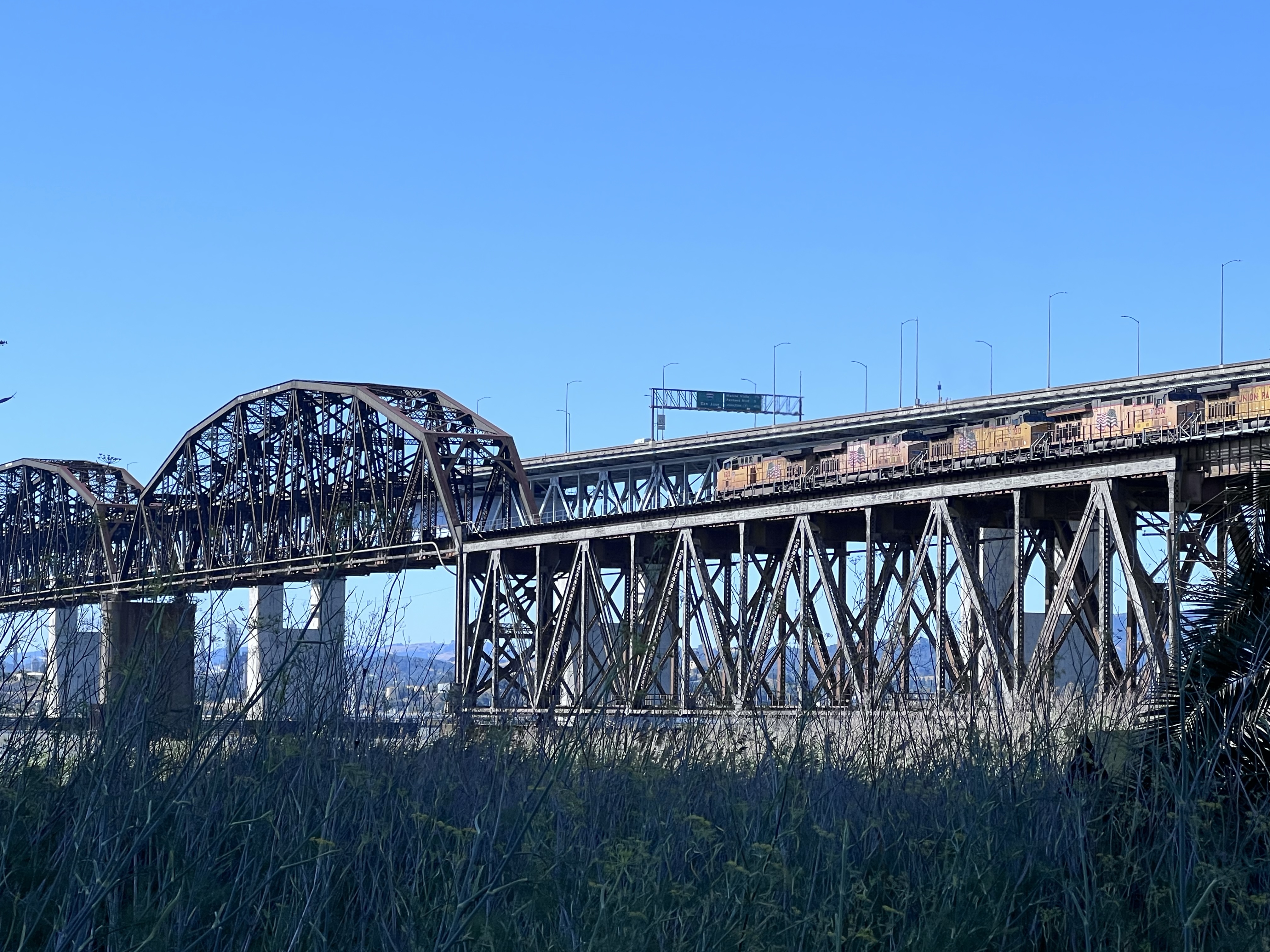
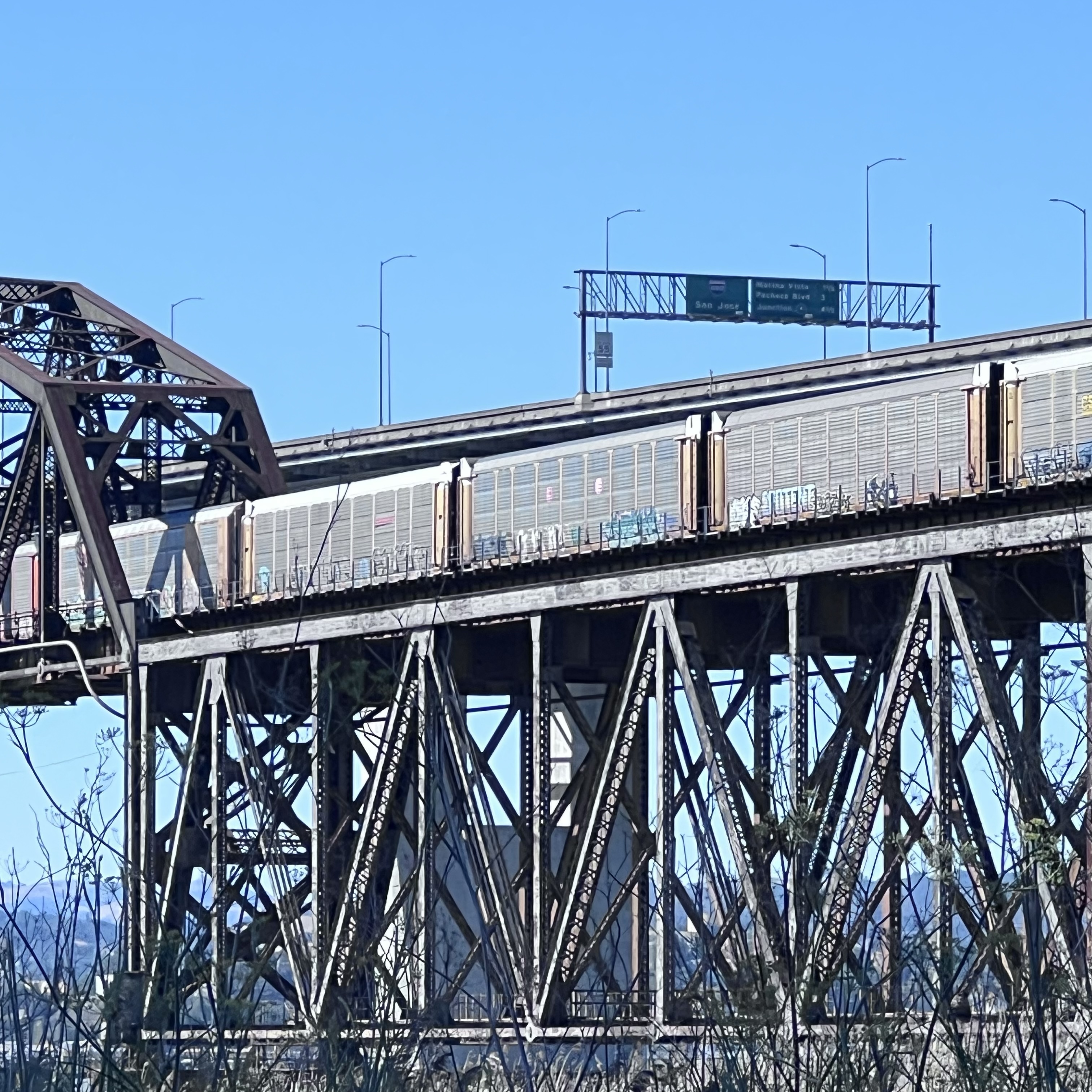
Five locomotives are on point of this Union Pacific westbound mixed consist freight as it comes onto the bridge. This long freight train would take quite a few ferry passages to shuttle across the strait before the bridge was built in 1930. Modern freight trains can be one to two miles long.
There were quite a few car carriers on the consist. The area on the Benicia side is new car transfer point.

Foamer at the Bridge

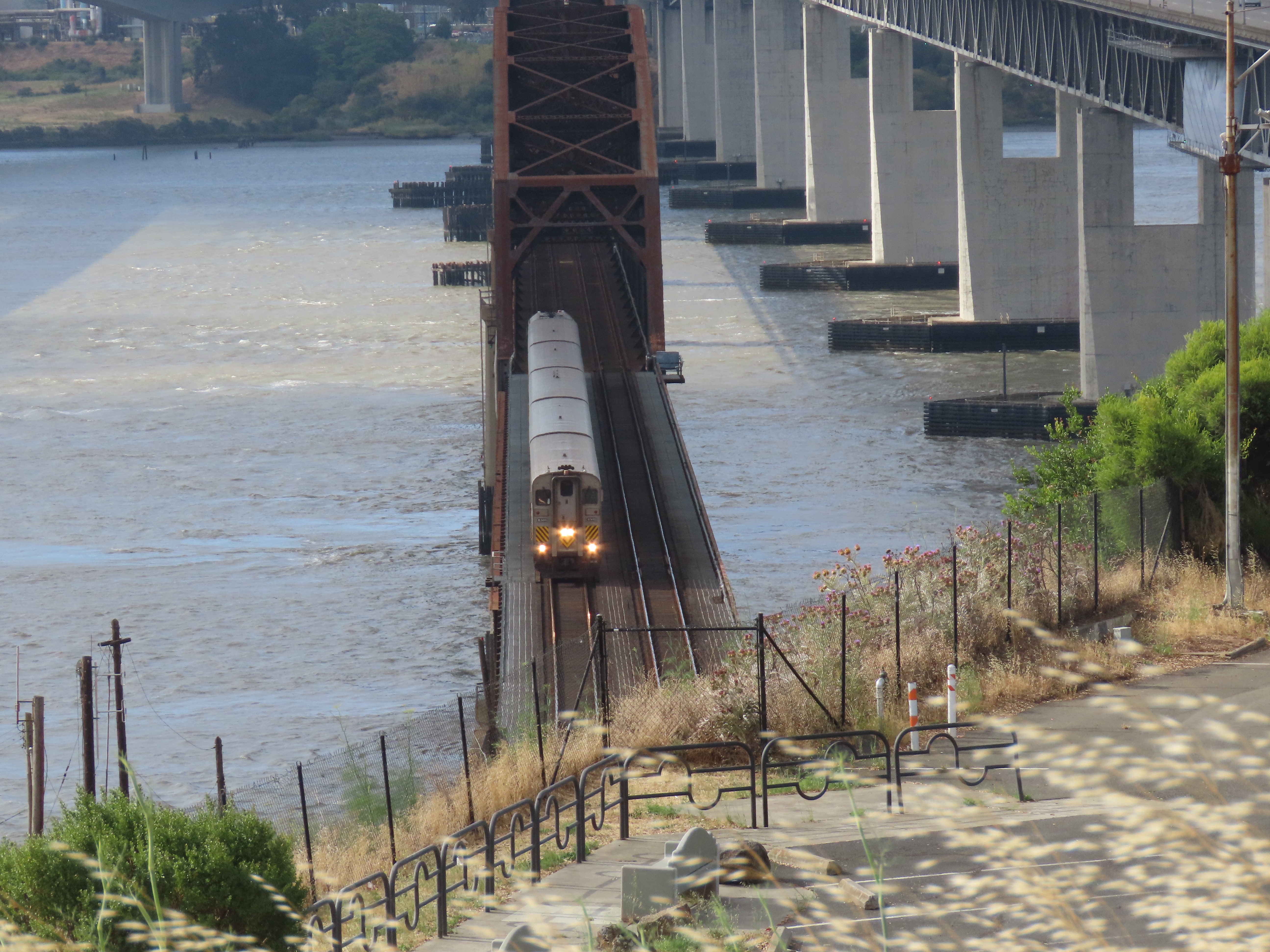
On a Sunday morning I headed up to the northern side of the Benicia- Martinez Railroad Bridge to the vista point, flanked by the two road bridges, to watch some trains transit the historic bridge.

The view southeast from Vista Point. The railroad bridge is in the middle. The newer road bridge (2007) is on the left, the other (1962) is on the right.
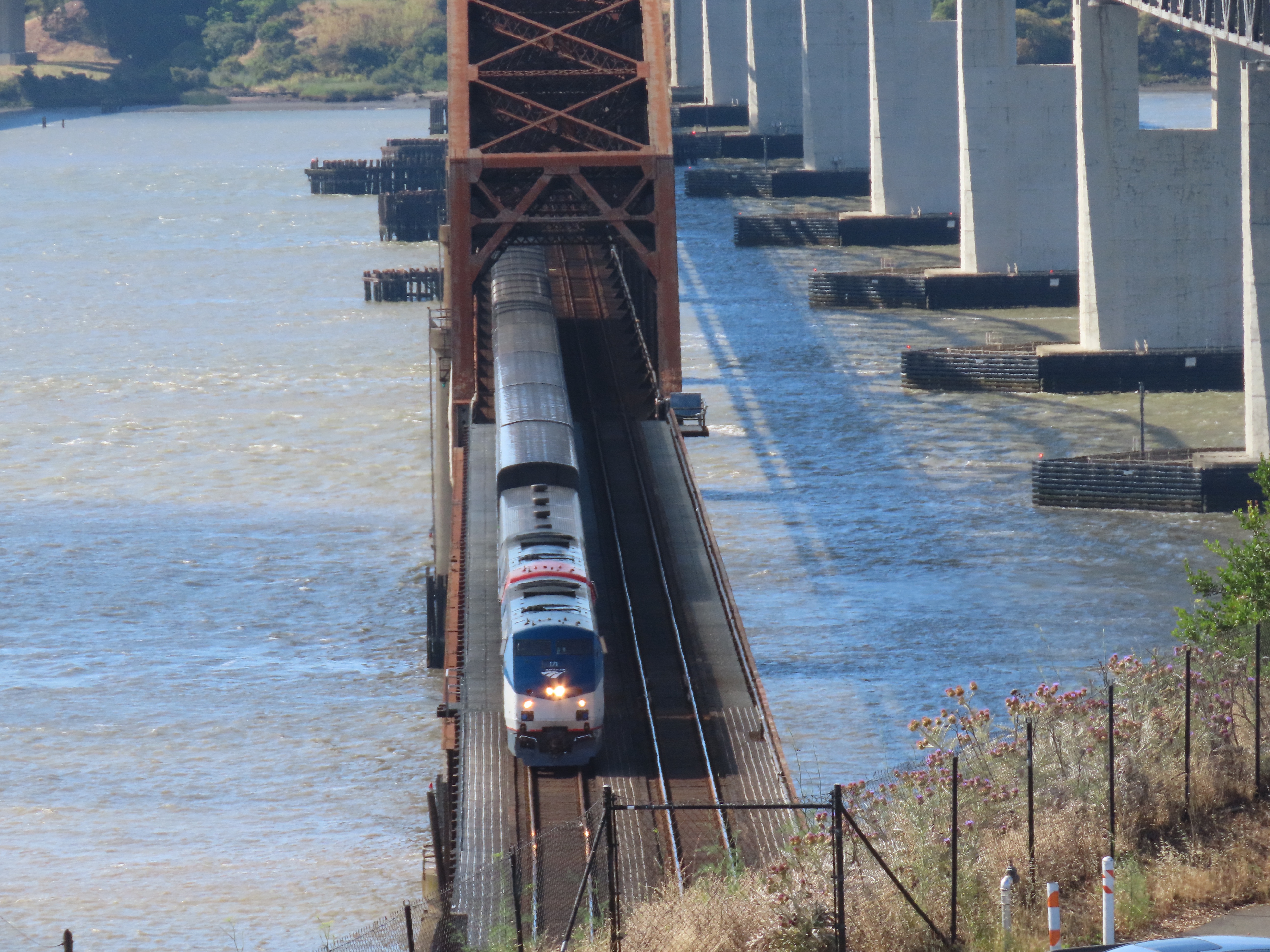
A northbound Capital Corridor train number 720 crossing the bridge. This trains’s final destination is Sacramento.
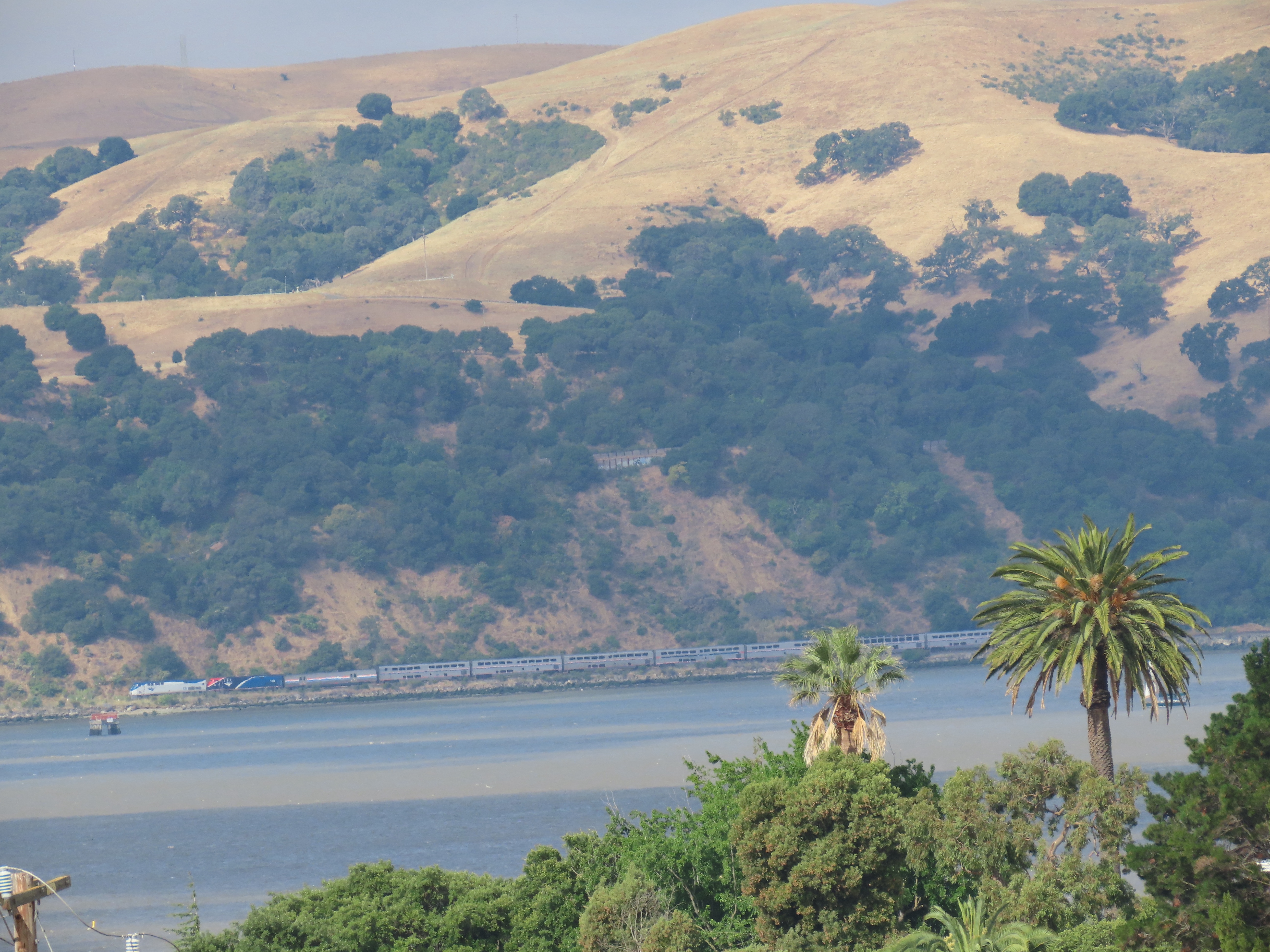
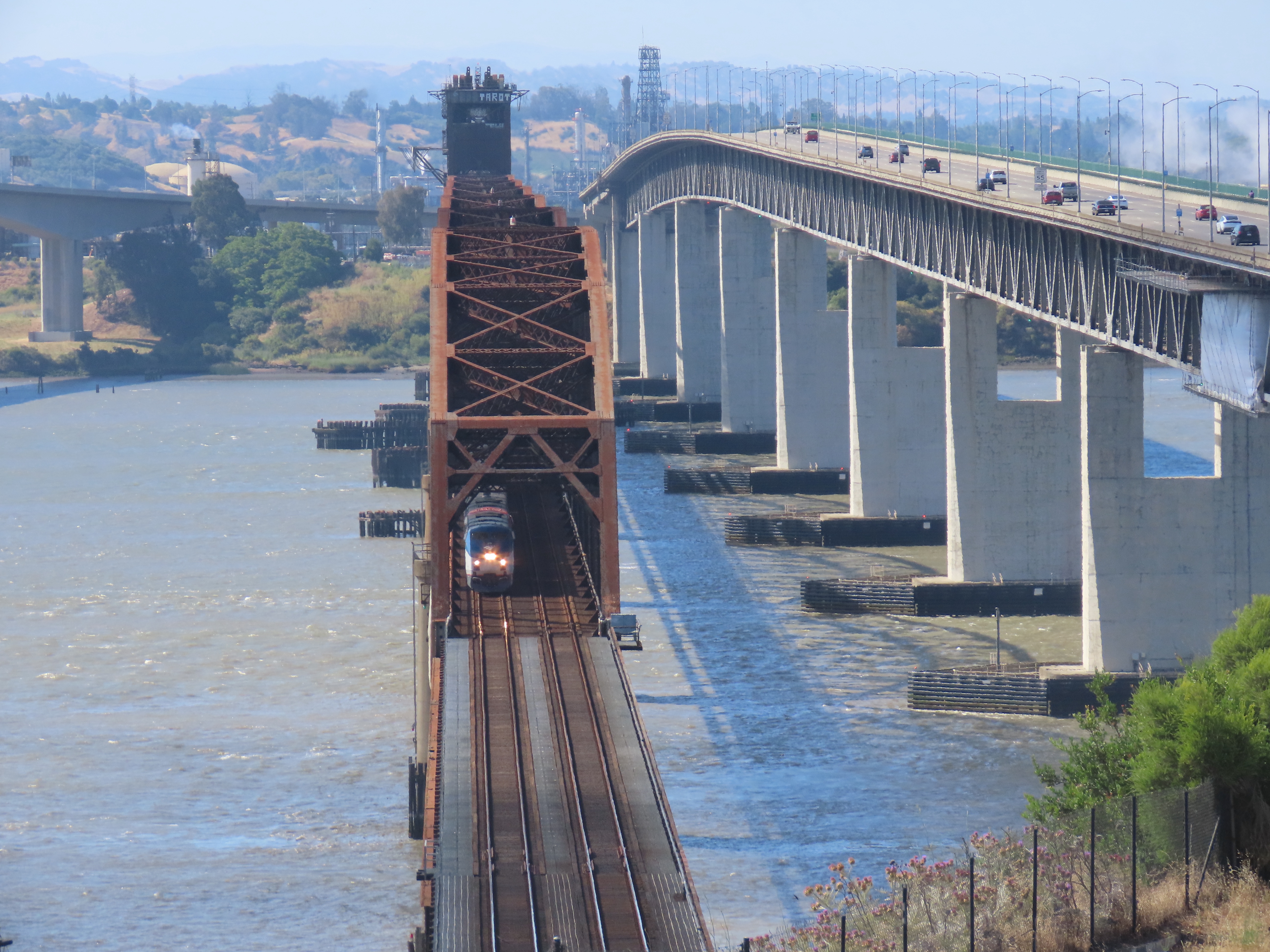
The good thing about the Vista Point is that you can see northbound trains approaching across the Carquinez Strait like California Zephyr train number 6 running three minutes late. Once the train departs Martinez it will cross the bridge about four minutes later.
California Zephyr Number 6 crossing the bridge. Next stop Davis.
I have yet to cross the bridge on the Zephyr as I usually board the train further north in Colfax.