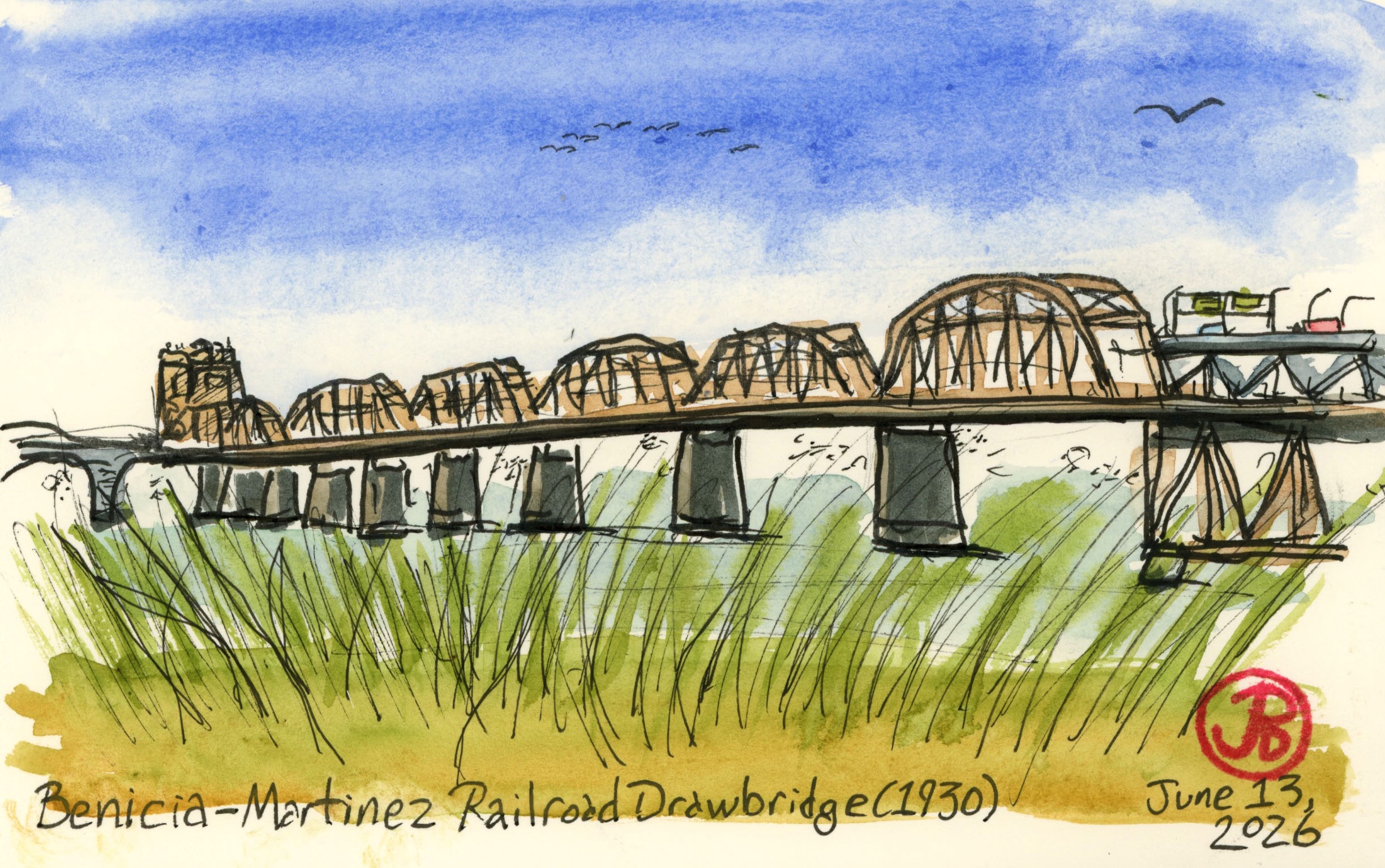
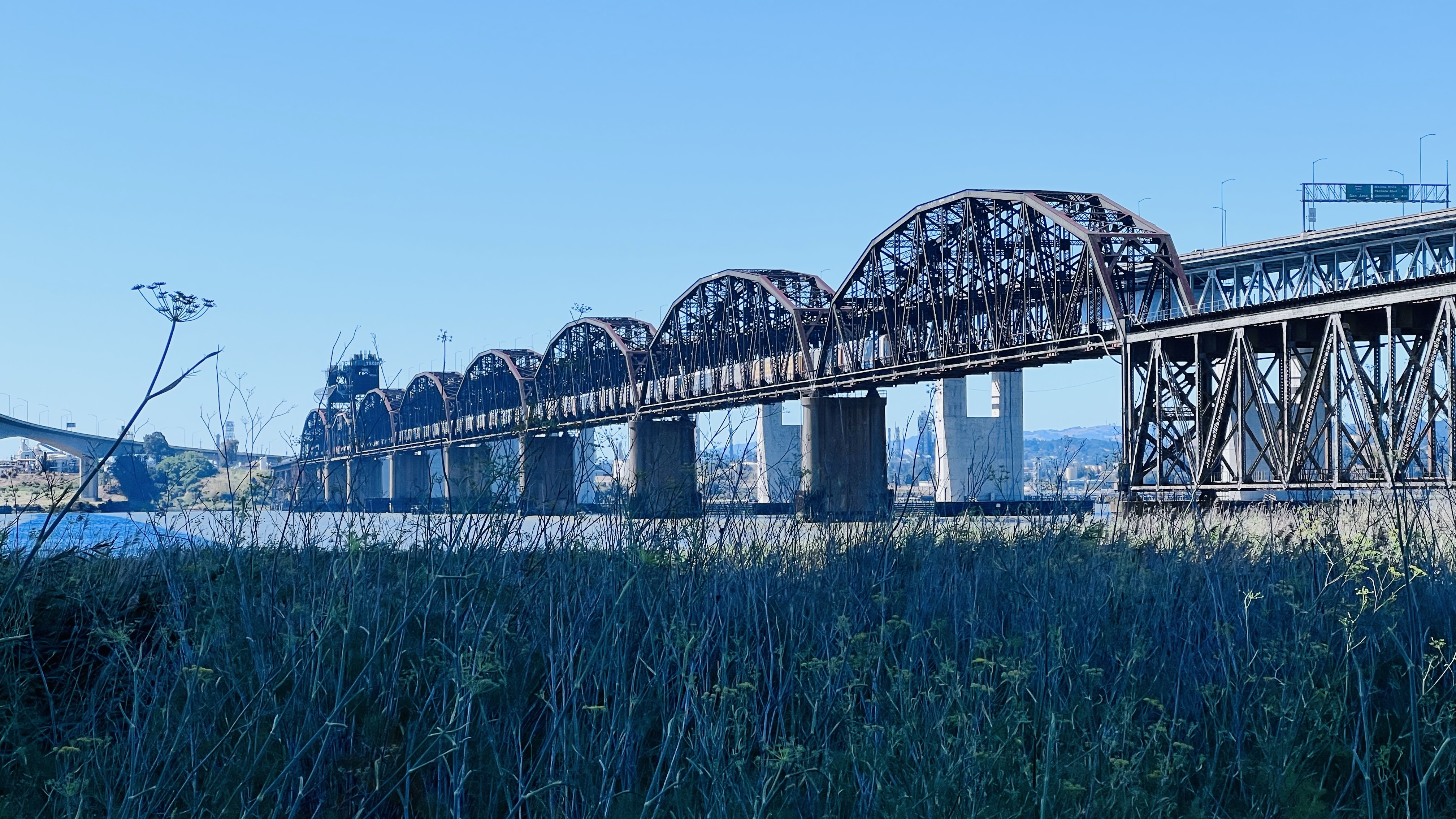
After sketching some Bay Area railroad ferry history, I wanted to sketch the 1930 railroad bridge that killed off the ferry between Benicia and Port Costa.
As rail traffic increased (both passenger and freight) and the rail ferries aged and needed repair or replacement, this caused more delays on the Overland Route (not to mention delays caused by fog). Southern Pacific looked into building another ferry but soon realized that a rail bridge spanning the strait was the best solution.
The railroad bridge was built for Southern Pacific Railroad between the years 1928 to 1930.
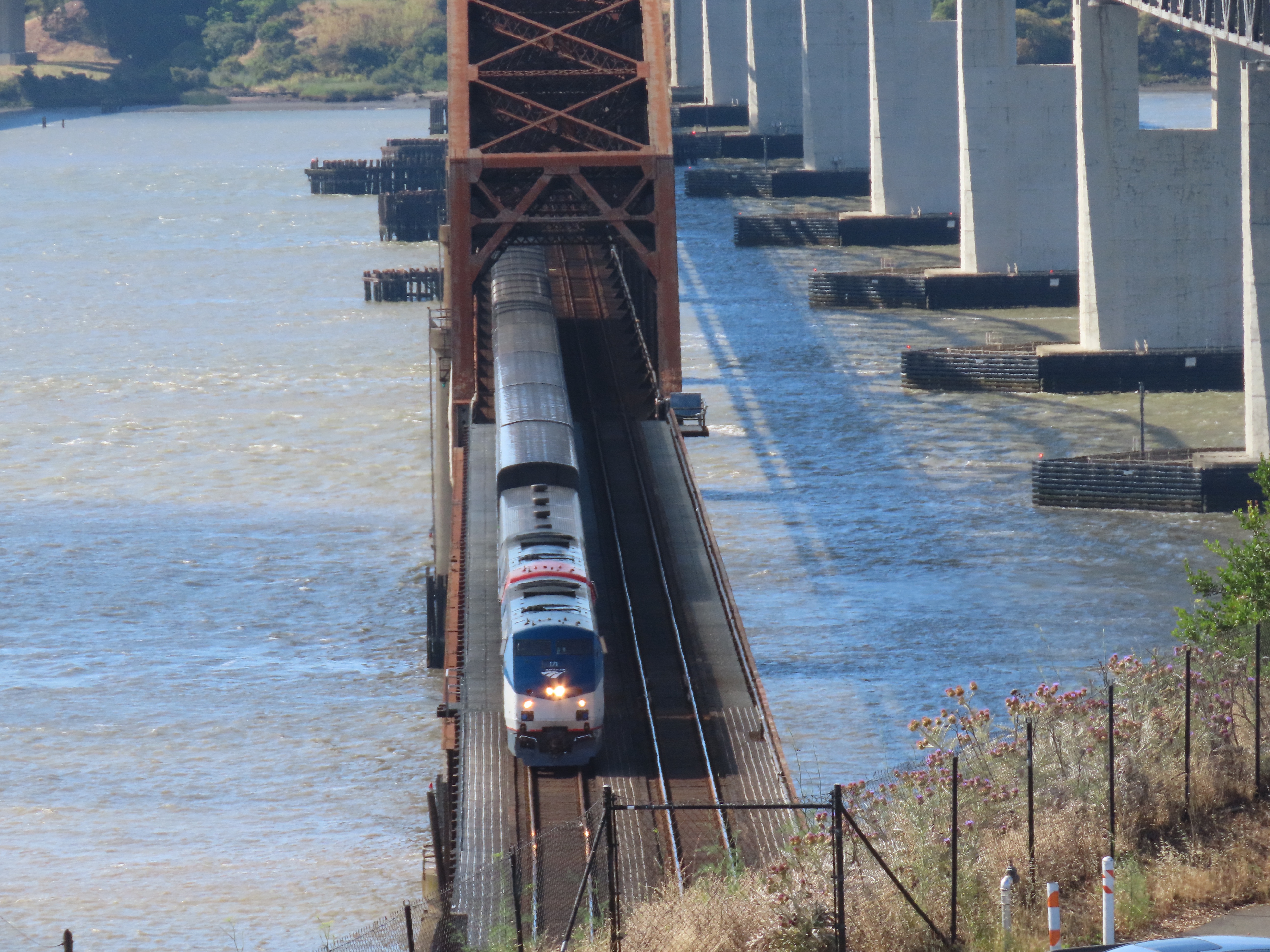
The bridge is impressive because it is the second longest railroad bridge (5,603 ft 6in long) in the country and the longest west of the Mississippi.
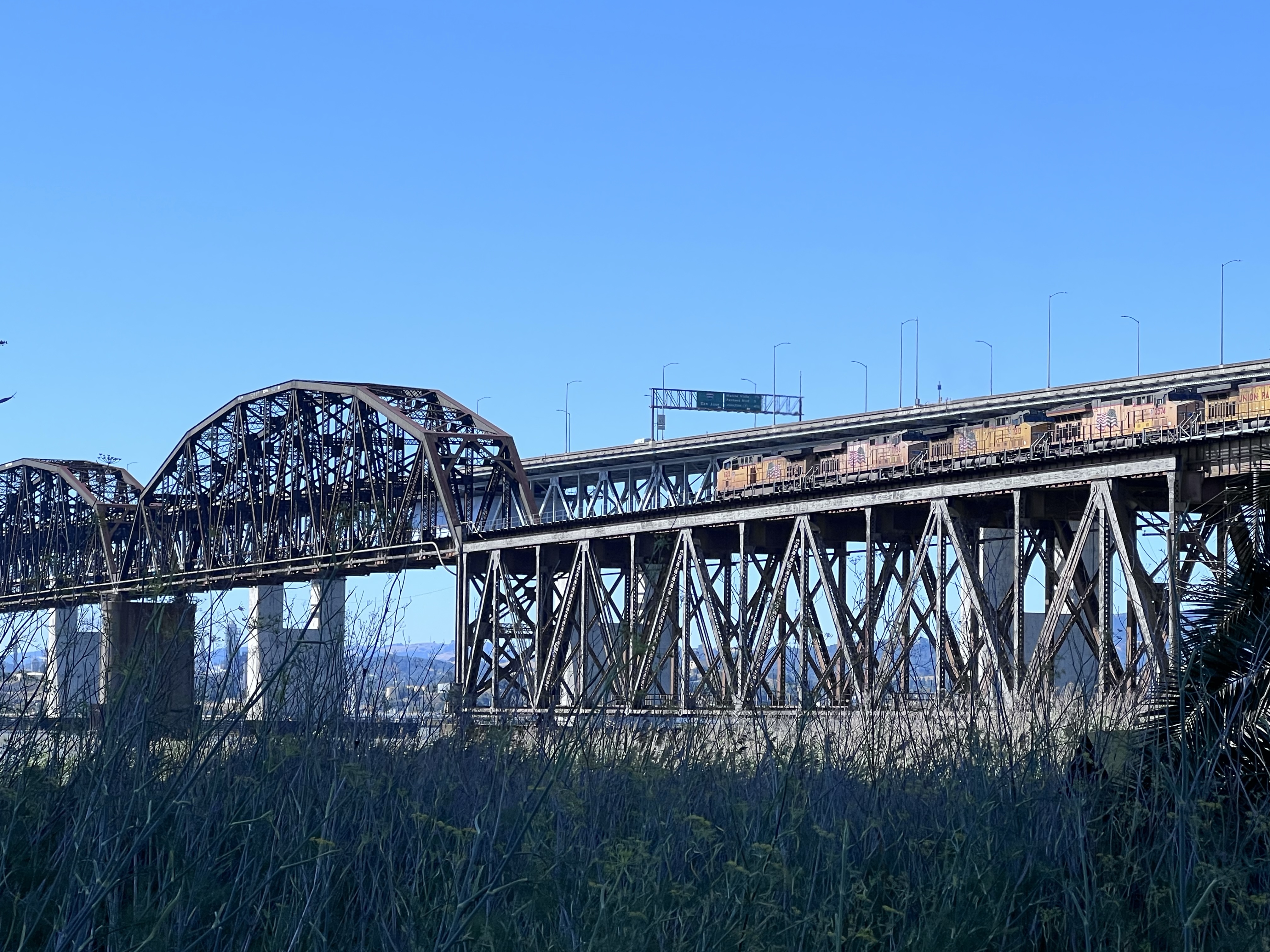
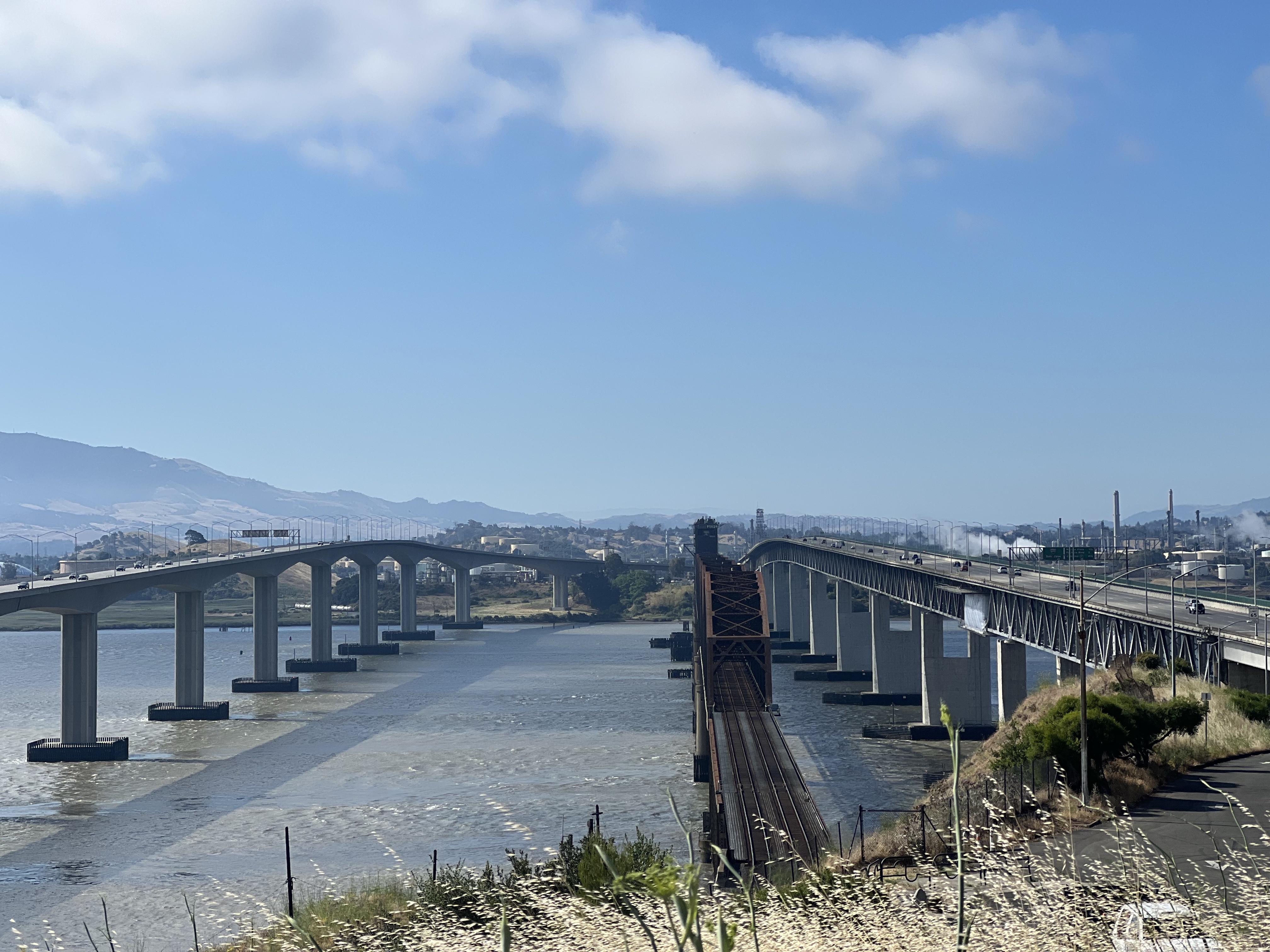
The railroad bridge is now flanked to two automobile bridges that cross the Carquinez Strait. One span was built in 1962 while the other completed in 2007.
The longest railroad bridge west of the Mississippi.
Because the bridge is relatively low to the water, 70 feet in fact, a midsection is a drawbridge that allows tall ships to pass through the strait. When the drawbridge is opened, it gives passing ships 135 feet of clearance.
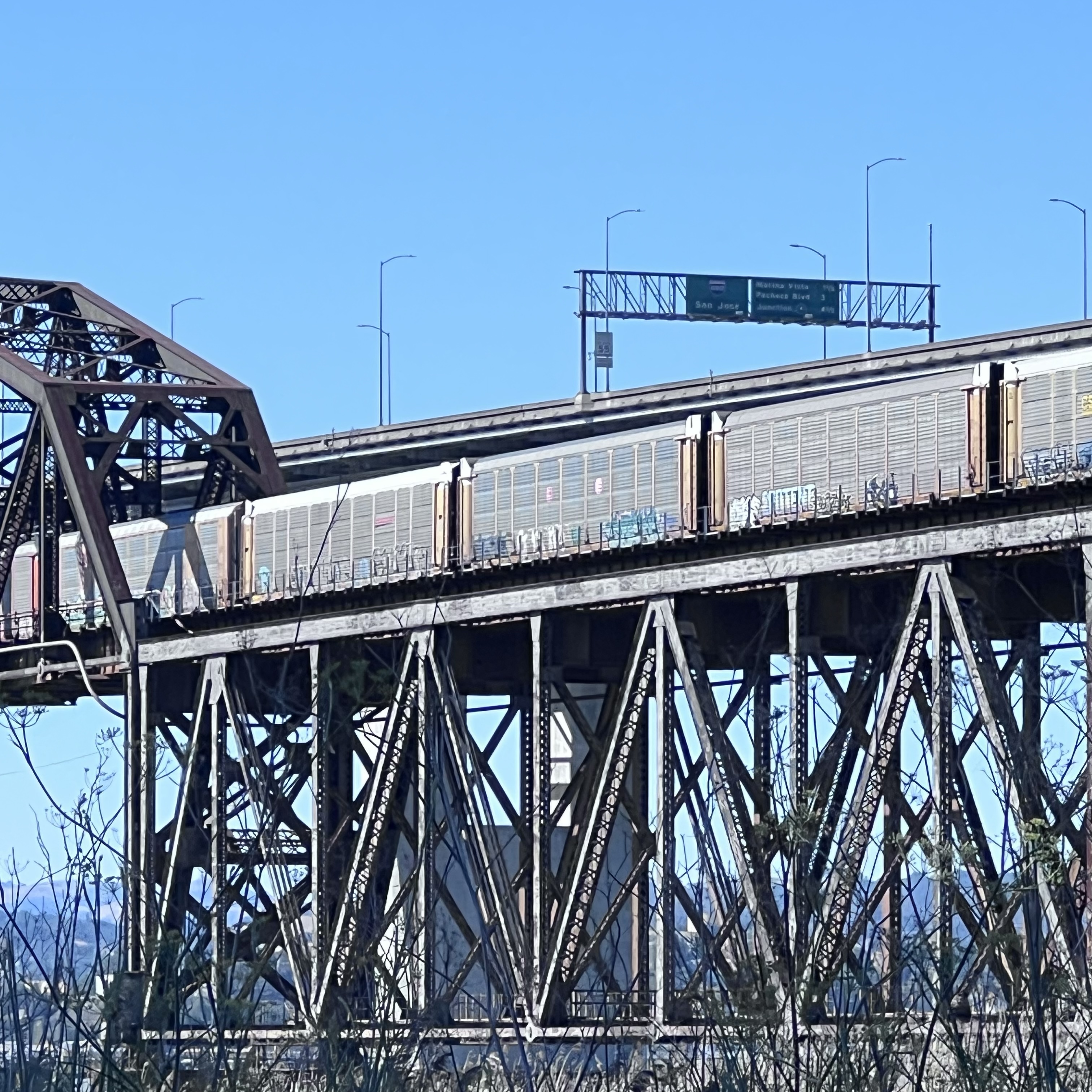
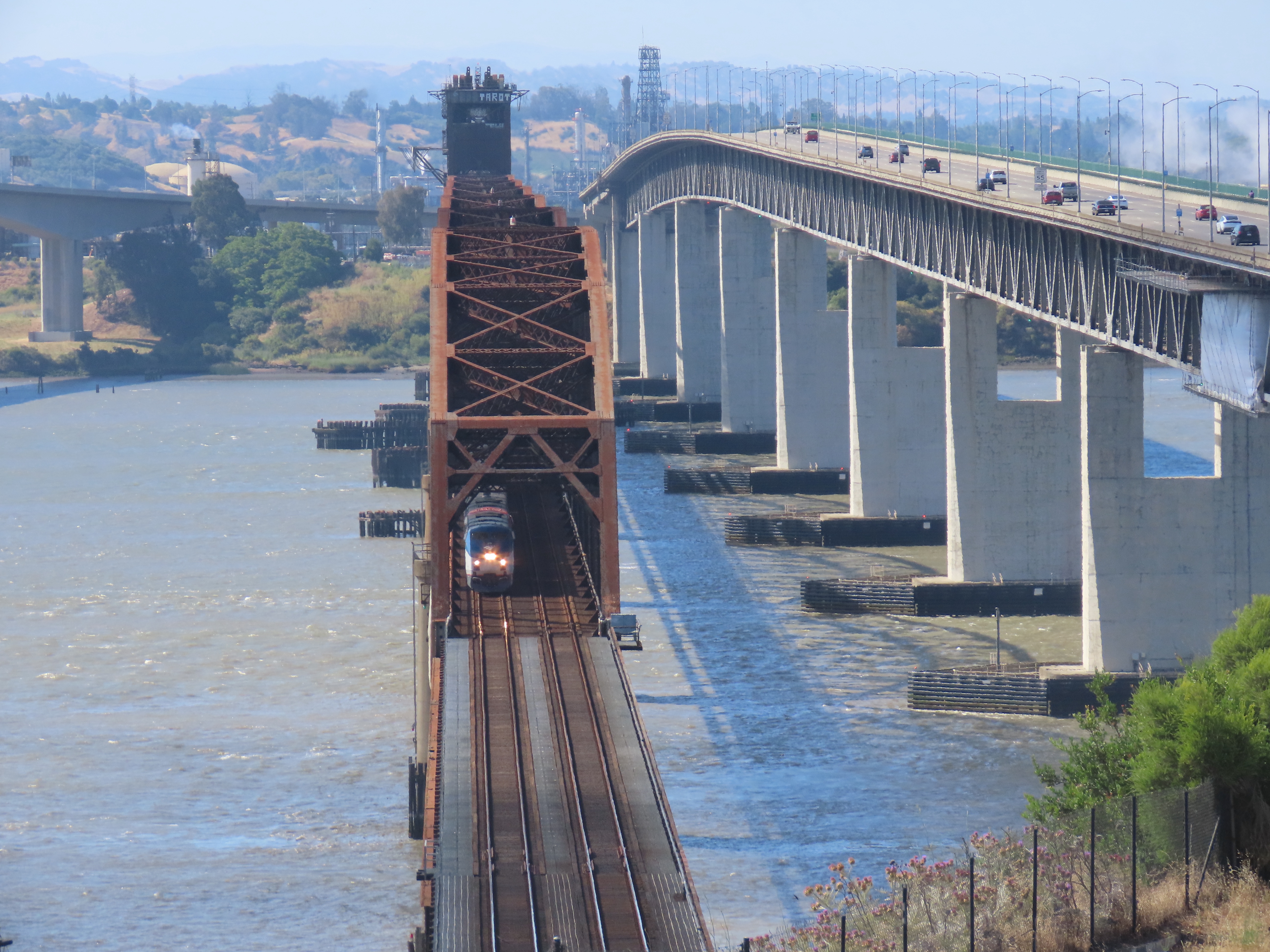
Five locomotives are on point of this Union Pacific westbound mixed consist freight as it comes onto the bridge. This long freight train would take quite a few ferry passages to shuttle across the strait before the bridge was built in 1930. Modern freight trains can be one to two miles long.There were quite a few car carriers on the consist. The area on the Benicia side is new car transfer point.
Foamer at the Bridge
On a Sunday morning I headed up to the northern side of the Benicia- Martinez Railroad Bridge to the vista point, flanked by the two road bridges, to watch some trains transit the historic bridge.
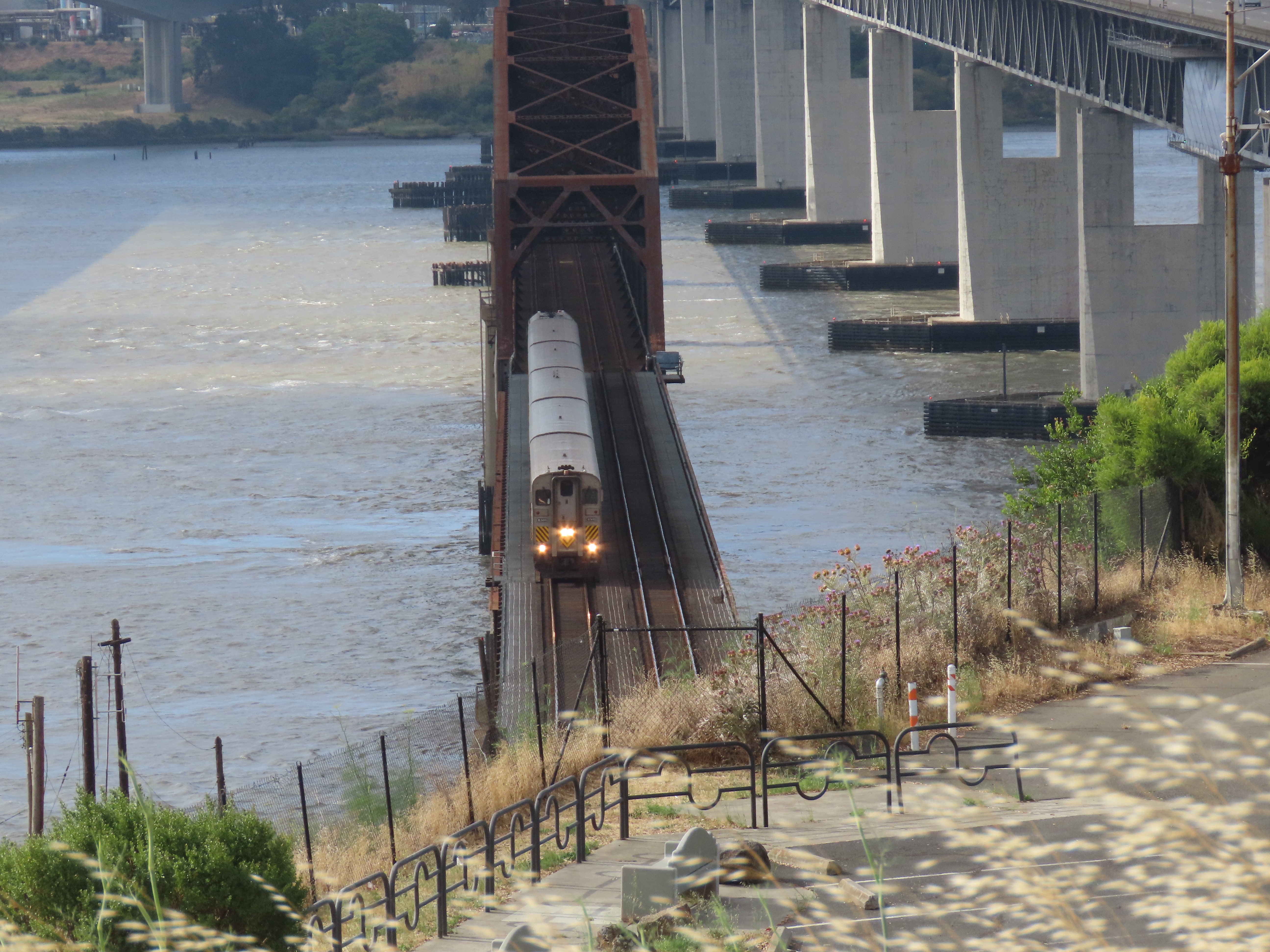
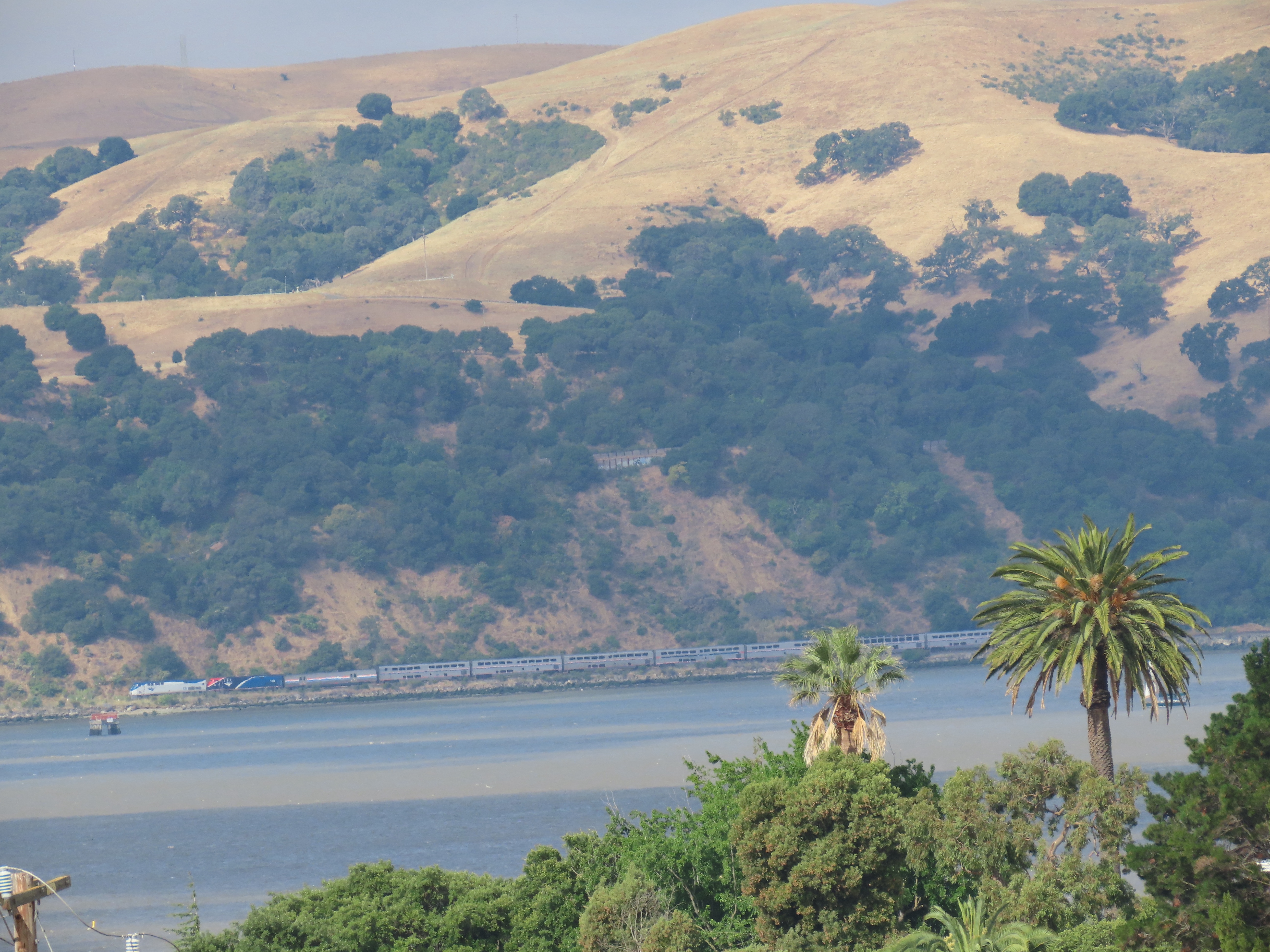
The view southeast from Vista Point. The railroad bridge is in the middle. The newer road bridge (2007) is on the left, the other (1962) is on the right. A northbound Capital Corridor train number 720 crossing the bridge. This trains’s final destination is Sacramento. The good thing about the Vista Point is that you can see northbound trains approaching across the Carquinez Strait like California Zephyr train number 6 running three minutes late. Once the train departs Martinez it will cross the bridge about four minutes later. California Zephyr Number 6 crossing the bridge. Next stop Davis.I have yet to cross the bridge on the Zephyr as I usually board the train further north in Colfax.
My brother spent almost half of his life in the Central Valley college town, Davis, California. He attended the University of California at Davis (UCD), worked in it’s public and private schools, got married, and raised his three children in “The City of All Things Right and Relevant!”
For Mother’s Day we where meeting my mother and sister-in-law in Davis so I arrived a little early to I sketch the historic train station and do a little railfanning.
Most towns start with a train station and Davisville, as Davis was then known, got their passenger depot in 1868. The original station burned down and the current station was built by Southern Pacific Railroad in 1913. The station is built in a Mission revival style. The University Farm, which later became UCD, opened five years before the current building was finished. At the time, the University wanted a befitting station to the town and the university stop. And they certainly got one!
Three passenger trains stop at Davis: the Capital Corridor, AMTRAK’s Coast Starlight, and the California Zephyr.
A view of Davis Station from Track 1. The SP stands for Southern Pacific. The bike racks in the foreground tells you this is Bike City, Davis.
I sat on the north side of the station and sketched it’s Mission Revival stylings. The station is island by three sets of tracks which at the time was an important stop on the Cal-P line. While I was sketching the station, I was very familiar with it’s curved lines, arches, and tile roof because I had sketched all of California’s Spanish Mission and a few Southern Pacific Mission Revival stations (Burlingame Station comes to mind). Davis Station and the Davis Tower are the only examples of Mission Revival in the city of Davis.
The interlocking control tower still stands just northeast of the station. This will have to be for another sketching day.A Union Pacific freight blazes through Davis Station with it’s curved track. Union Pacific owns the tracks and freight, not passengers service, pays the bills for the railroad.
There were a few clues that a train was coming down the line at Davis Station. The first was that the signal light was green, meeting that whatever train was heading down the line had the “high ball”, in other words, the train had the right of passage. The other clue was that people began to arrive at the station with their flowers in pots or plastic; it was Mother’s Day after all.
At 10:40 AM, a westbound Union Pacific freight train sped through the curve at Davis Station on track 1, the engineer giving me a thumbs up as the train rumbled through. At 10:50 AM, on track 2, the eastbound Capital Corridor train #724, pulled into Davis to take on passengers on her way to California’s capital: Sacramento.
The westbound Train # 731 was right on time and pulled into Davis at 11:10 AM. This Capital Corridor passenger train was heading to San Jose.
On point was locomotive 2004. I looked down at the front truck, containing the leading axels of the locomotive and stenciled, in yellow, where the two letters “GP”. In an odd bit of coincidence, I has replaced the initials “SP” on the Davis Station with my brother’s initials, “GP”, as an honor to his memory.
A westbound Capitol Corridor train pulls into Davis Station on it’s way to San Jose. On point is Locomotive 2004, an EMD F59PHI with “California” styling. I should say so.In one of those “I-can-make-this-sh*t-up” moments, the initials “GP”, my bother’s intials, were stenciled into the trucks of locomotive 2004. Unreal.