For my summer travels I will journey to a long sought after destination: the Galapagos.
I plan to bring two journals for my 10 day cruise around the islands: one Stillman & Birn Beta hardbound and a Hahnemühle 100% Cotton panoramic journal. I have used both before on previous trips and I hope to fill all the pages like Darwin noodling away in his journals.
I like narrowing my journals to just two, like the two banks of a river that contains yet gives direction to my sketches. Will the scene before fit within the dimensions of the paper? I sure will try and if my lines run out of room, it’s just part of the sketch.
These two journals have been on many trips in the past few years. I love the format and the quality paper.
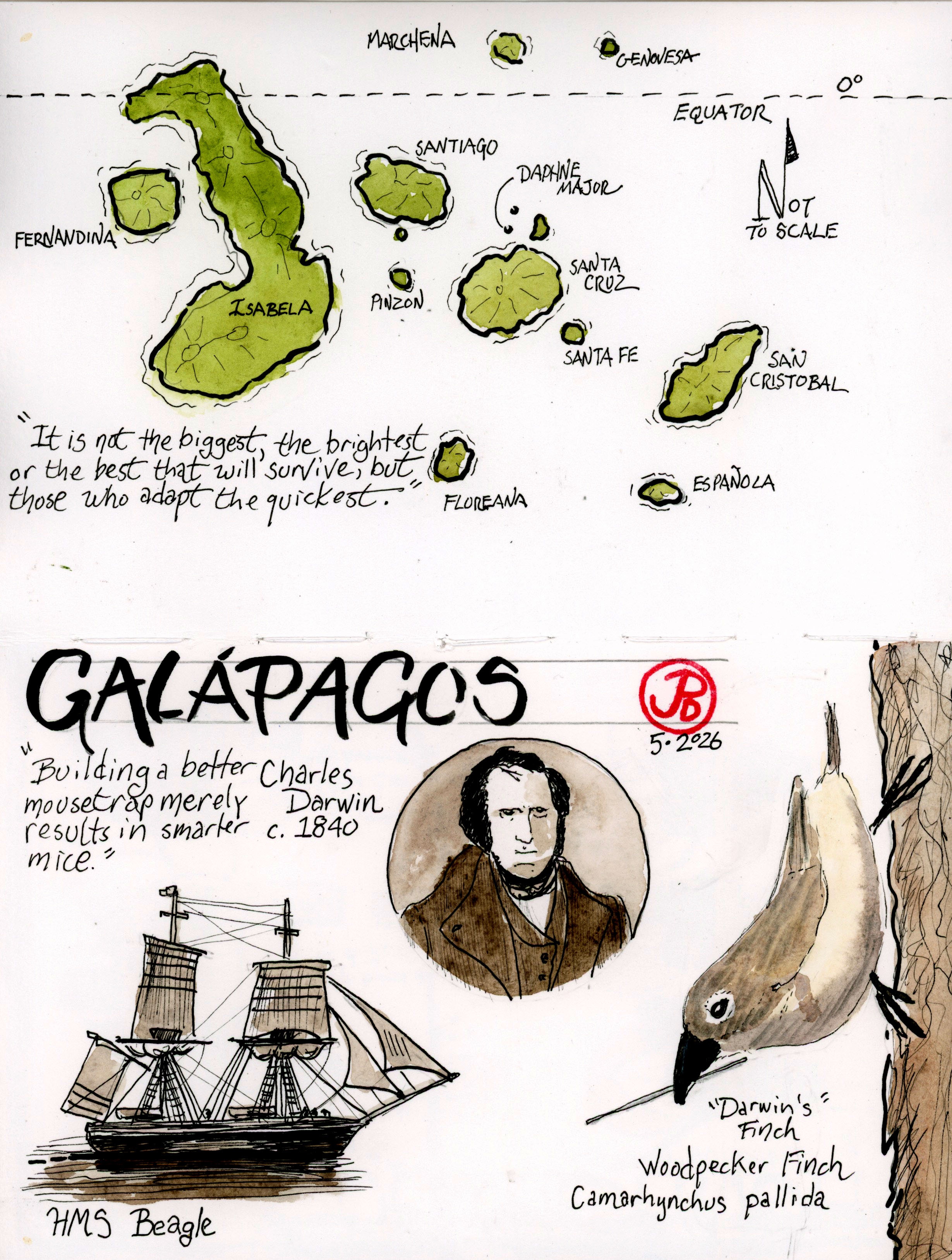
My first page in my Stillman & Birn journal is usually a map. With this map I include a portrait of man who is all over the Galapagos: Charles Darwin. He visited the otherworldly islands in 1835 as the naturalist on the HMS Beagle. And I drew one of Darwin’s finches: the woodpecker finch. (Featured sketch).
Darwin formulated much of his thoughts for his groundbreaking Origin of Species on his five year cruise on the Beagle and his observations and collections on the Galapagos.
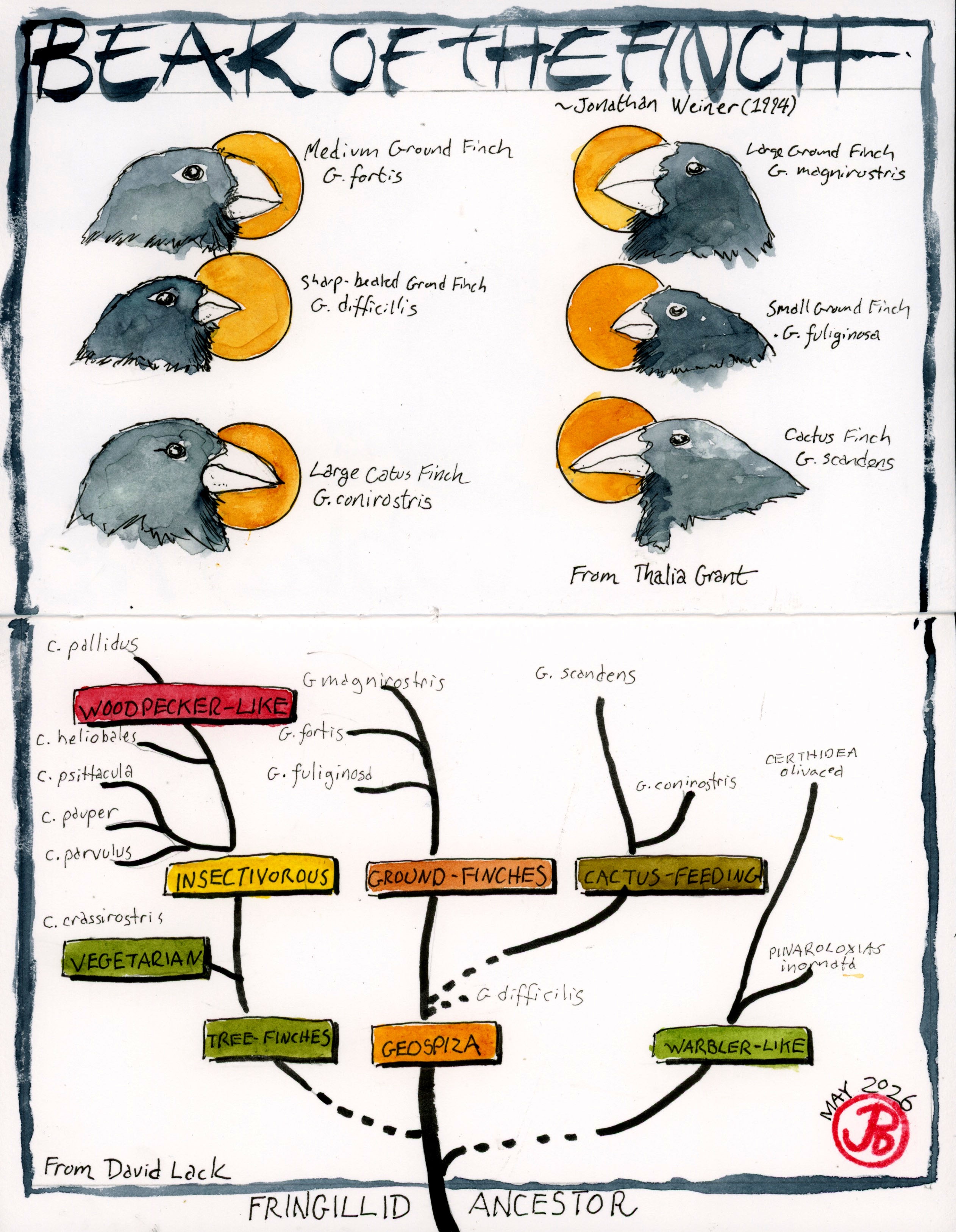
Before any trip I never want to go in blind. I want to learn about my future destination and it’s history, flora, and fauna. Before heading south towards the Equator, I read Beak of the Finch by Jonathan Weiner (1995).
This Pulitzer winning book profiles the research of the Peter and Rosemary Grant on the tiny Galapagos island of Daphne Major. There research highlighted evolution in action with the beak lengths of “Darwin’s” finches.