Image

Vigeland Park

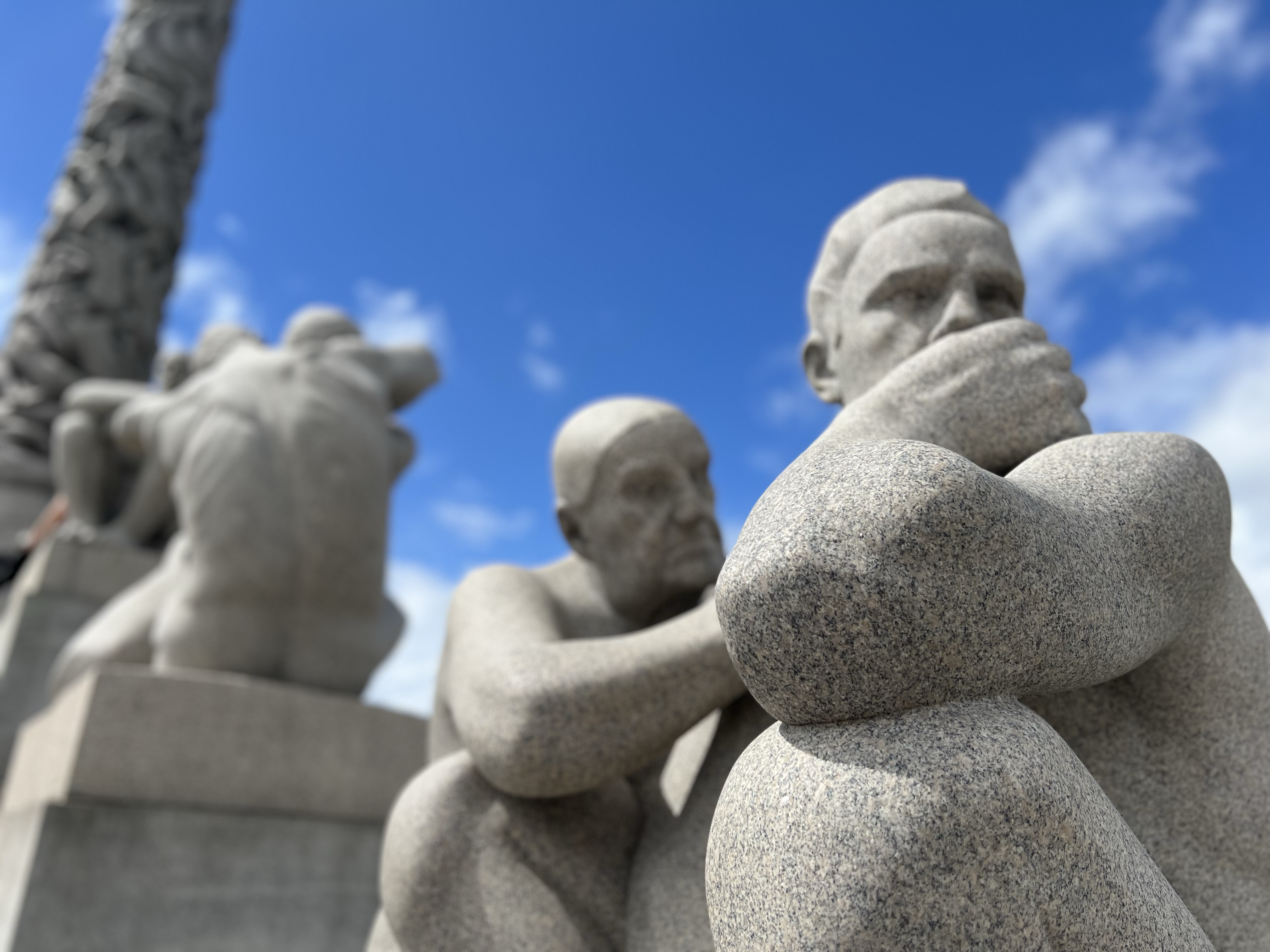
Vigeland park is one of the largest outdoor sculpture parks in the world. All of the sculptures are by Norway’s Gustav Vigeland.

This park is not for the prudish as it’s pure nudity in stone. There are over 200 of Vigeland’s sculptures and it can be an overwhelming place to visit for two reasons: first the sheer size of the collection, the unclothed human form in all sorts of poses and positions and secondly, Vigeland Park is one of Oslo’s top tourist sites. Tour buses disgorge camera-snapping hordes into the park and it’s hard to spend quality time with the art as you can be preoccupied with dodging selfie takers while trying not no wander into someone shot, well maybe I did a few times with purpose!

The plus side of sketching is that you don’t have to wait for the groups to get out of the way to do a sketch. Sometimes I even include them, for scale of course, in my sketch.

Vigeland Park is really a sketcher’s paradise. So many unmoving subjects everywhere you point your sketchbook.

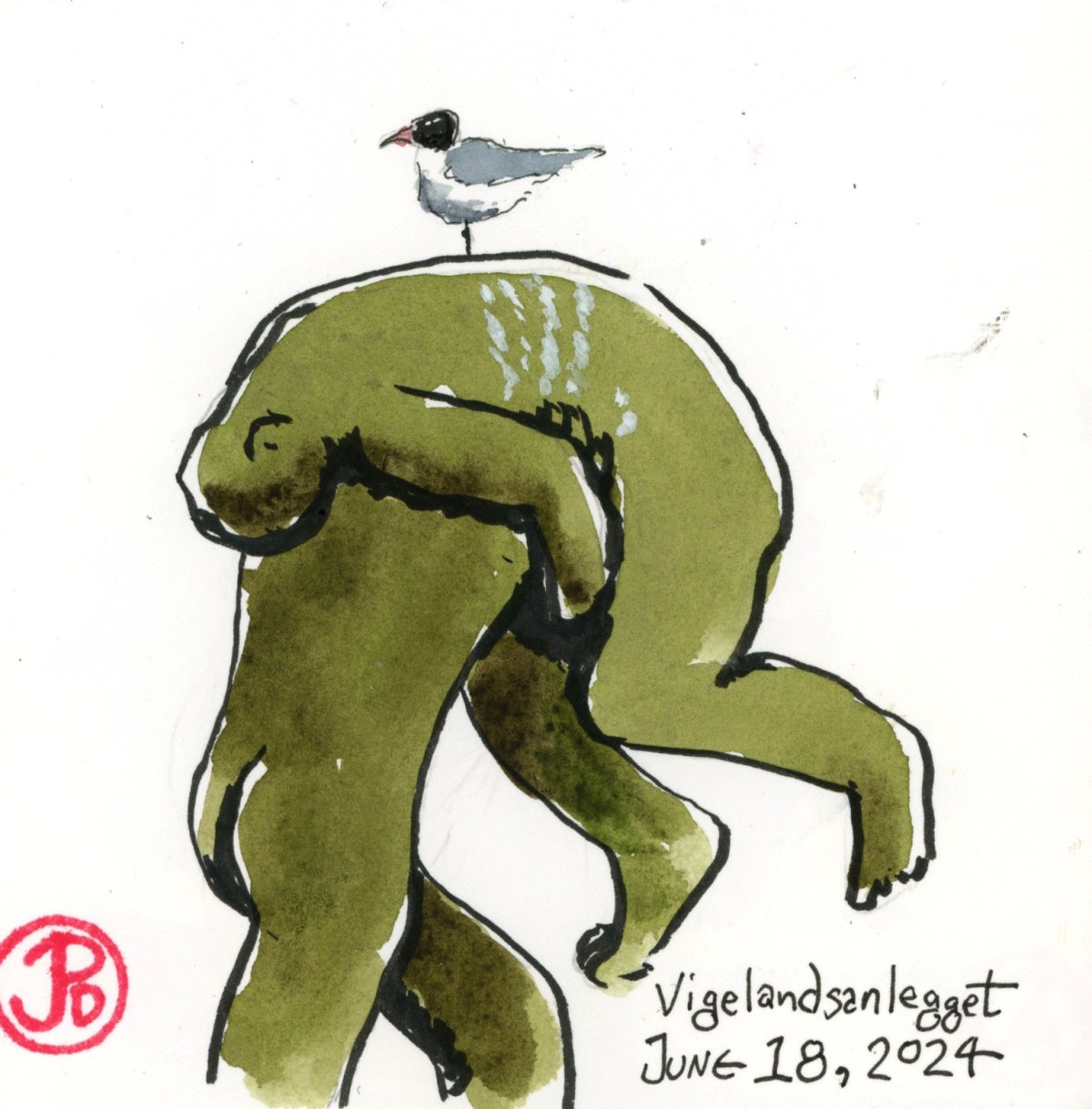
I did three sketches in my two visits. Your constant companion is the park is the black-headed gull (more brown-headed). So I felt I had to include one in a sketch. To these gulls, this elevated art is simply a nice perch and the level of white-wash on the sculptures also turns the gulls into art critics.

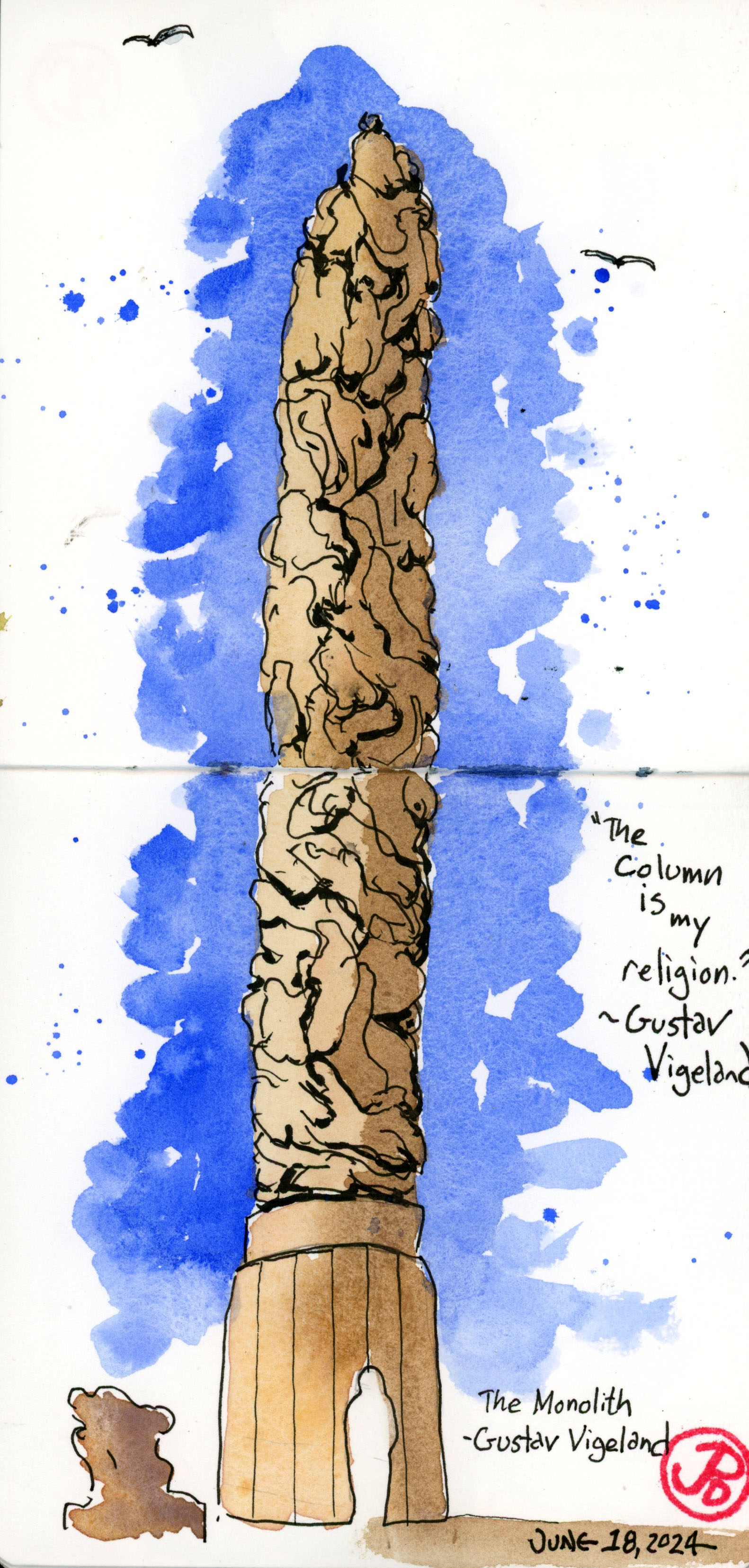
At the highest point is the Monolith. This tower humans was carved out of a single piece of granite and two 20 years to finish.

While sketching the Monolith, I kept it loose, knowing that I was not going to draw every single human figure in the column. I just want to make a suggestion to the viewer without filling in every detail. In the end I am happy with the approach.

Some of the sculptures around the Monolith are very moving; so very human. I could sketch in this park for years and always find new subjects.

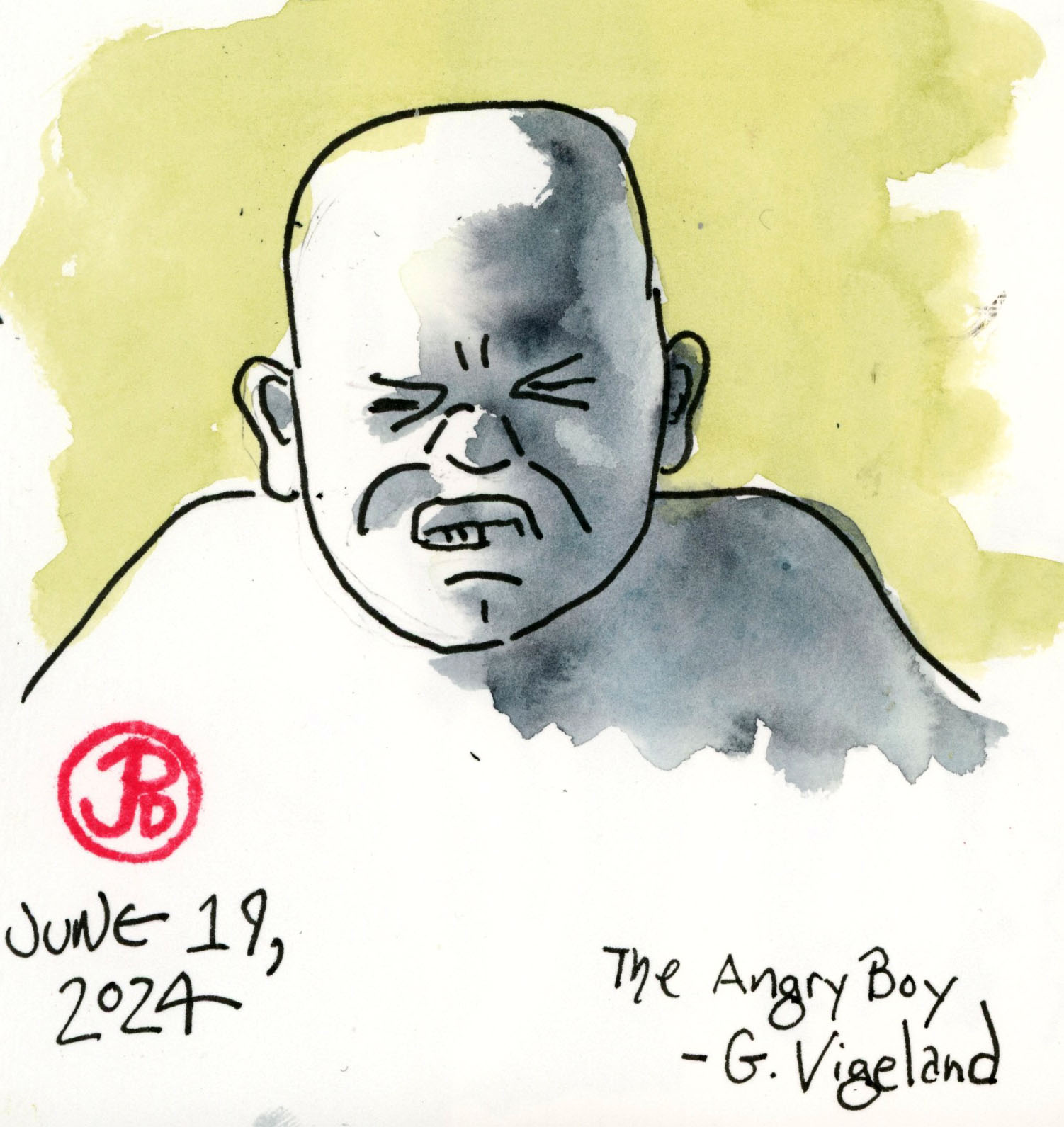
One of the most popular sculptures in the park, the number one sculptures most visitors want a selfie with is the Angry Boy. I sketch a version of the sculpture at the Vigeland Museum, near the park. This Angry Boy is not have a line in front of it so I was able to get a sketch in.

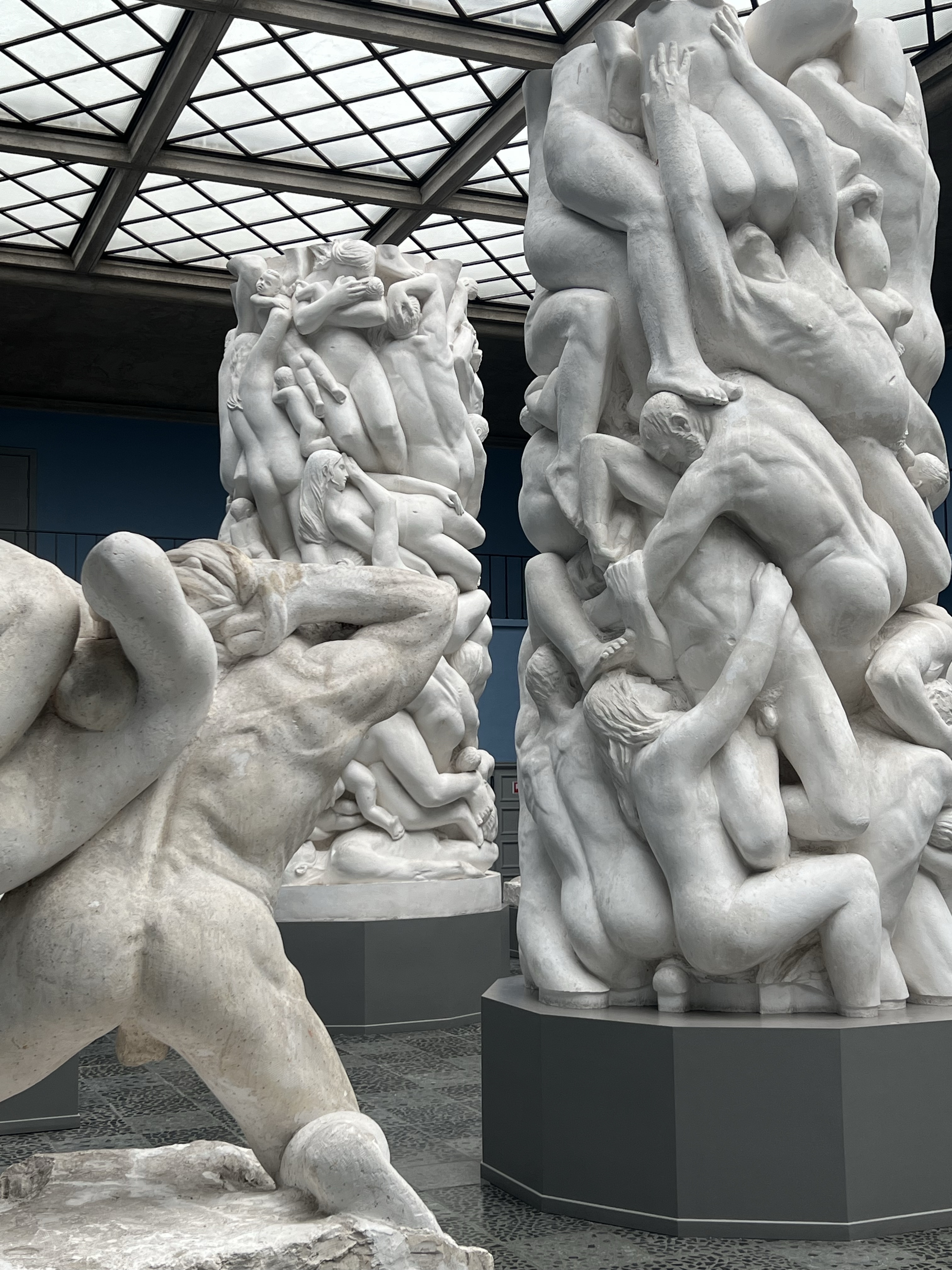
Sections of Monolith at the Vigeland Museum in Oslo. This museum gets much less visitors that the adjacent park.
Image

Norsk Folkemuseum

High on my sketch list was the traditional stave church at the Norwegian Folk Museum.

I took the first Bygdoy Ferry to the peninsula to visit this very popular outdoor museum, which is Norway’s largest outdoor museum.

The museum has over 140 buildings from different regions of Norway spanning an impressive span of time.

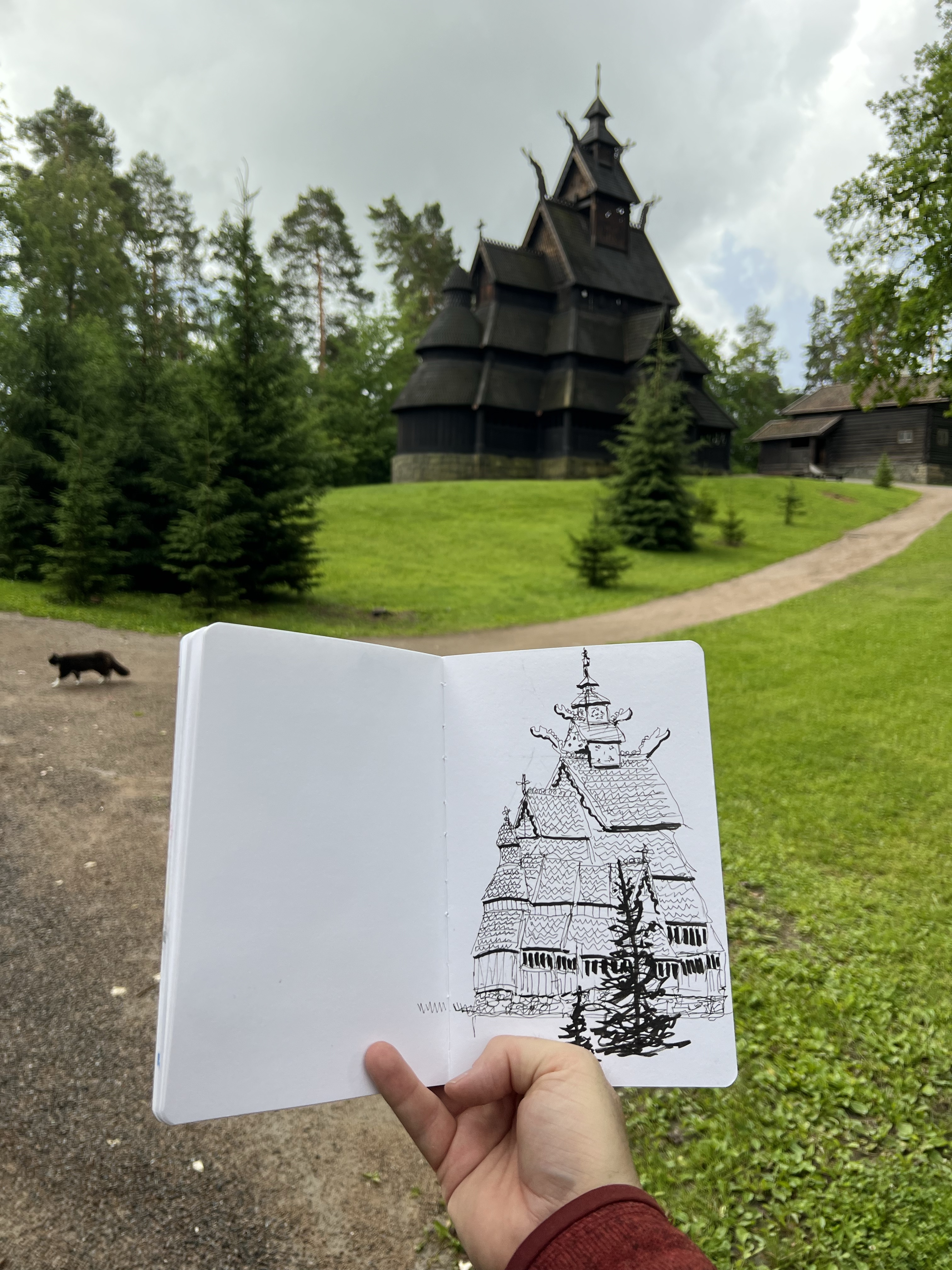
Once the gates opened at 10, I made my way to the stave church, using the map to navigate the large trail system. The church was so full of detail that I went with a very loose style, not focusing on every single shingle but choosing the form of the church.

Church, sketch, and a photobombing cat.

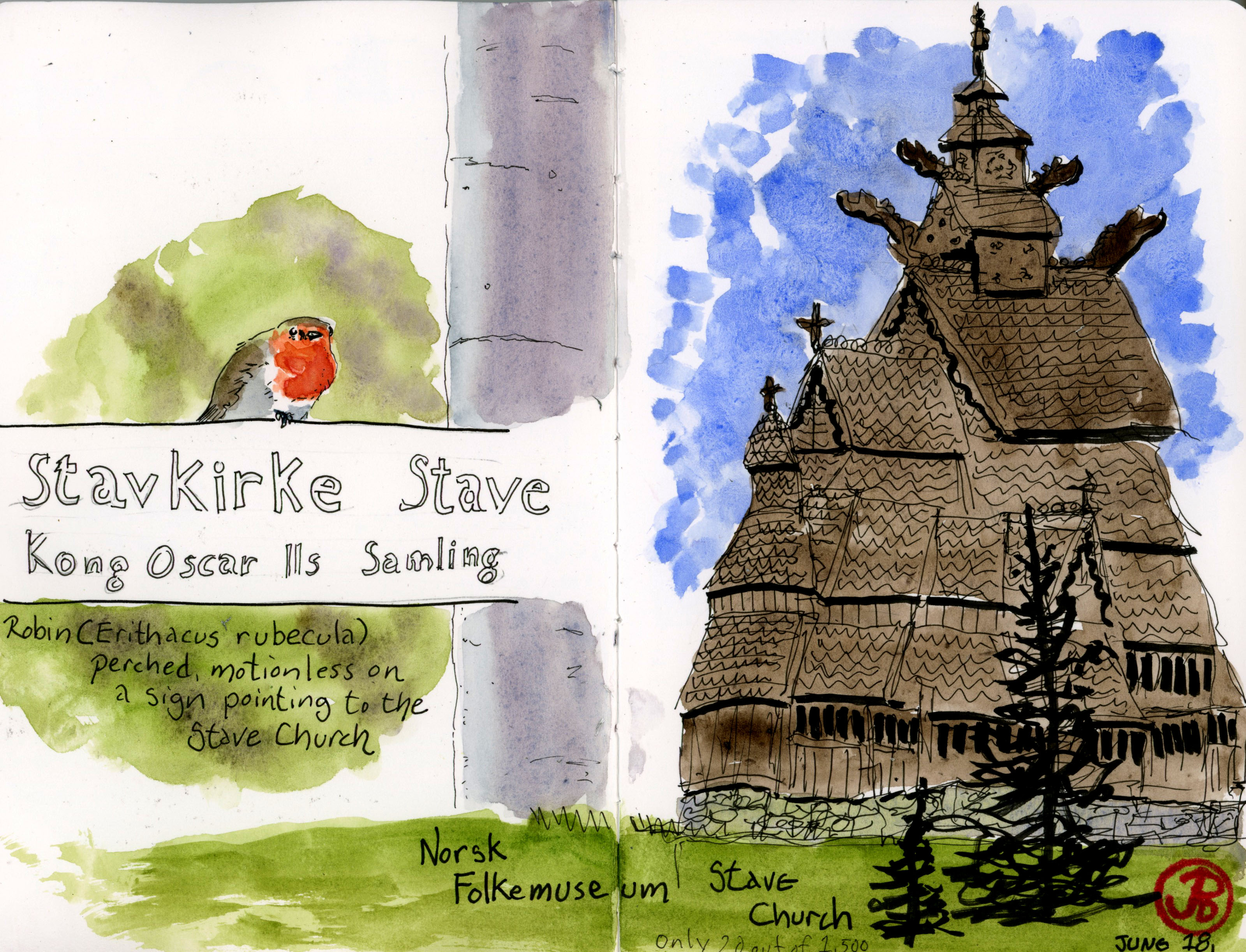
After my sketch I headed to another section and on the way I passed a robin statue-still on a sign. I was almost fooled into believing that this was a wooden carving until the red breast burst into life and shot off to forage in the underbrush. I add this experience to the other side of my spread.

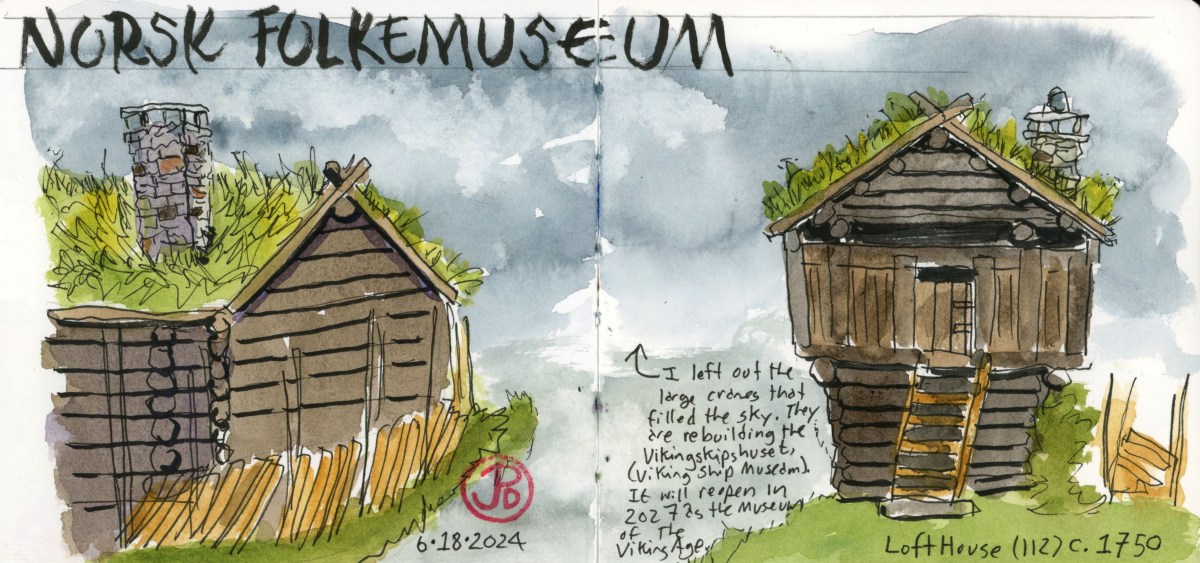
I found a collection of house farmsteads with a living roof of green so I found a bench and started sketching. My sketch was interrupted by rain so I had to finish my sketch in stages while retreating to a nearby house.

For this sketch, featured sketch, I used a little real-time editing. Behind the buildings, huge cranes reached into the air, shattering the feeling of time travel and firmly placing me back in the 21 Century. The cranes where above the site of the Vikingshipshuset (Viking Ship Museum). This museum has one of the most iconic preserved Viking ships in existence, the Oseburg Ship. The museum was closed in September 2021 for a complete renovation. The new museum will reopen in 2027.

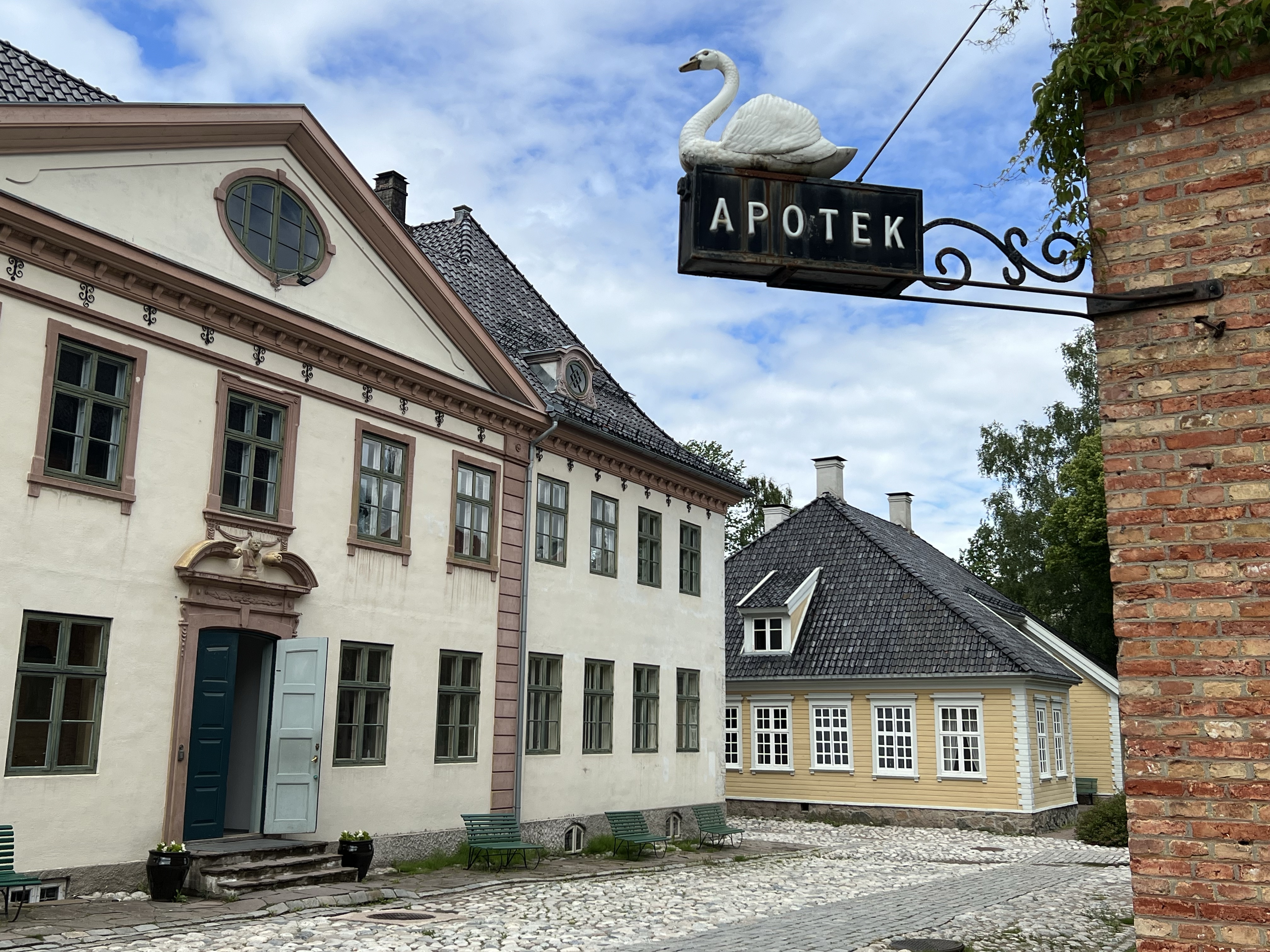
This section of the museum felt like I had travelled forward in time from the last two buildings I sketched. I was traveling from Norway’s rural countryside to more developed towns.

Sounds like I need to make another visit to the Bygdoy Peninsula some time in the future!

Image

Modern Oslo

Oslo is a city coming into its own as a modern Scandinavian city. The architecture around the city center is modern and I wanted to add this newer side to Oslo to my sketchbook.

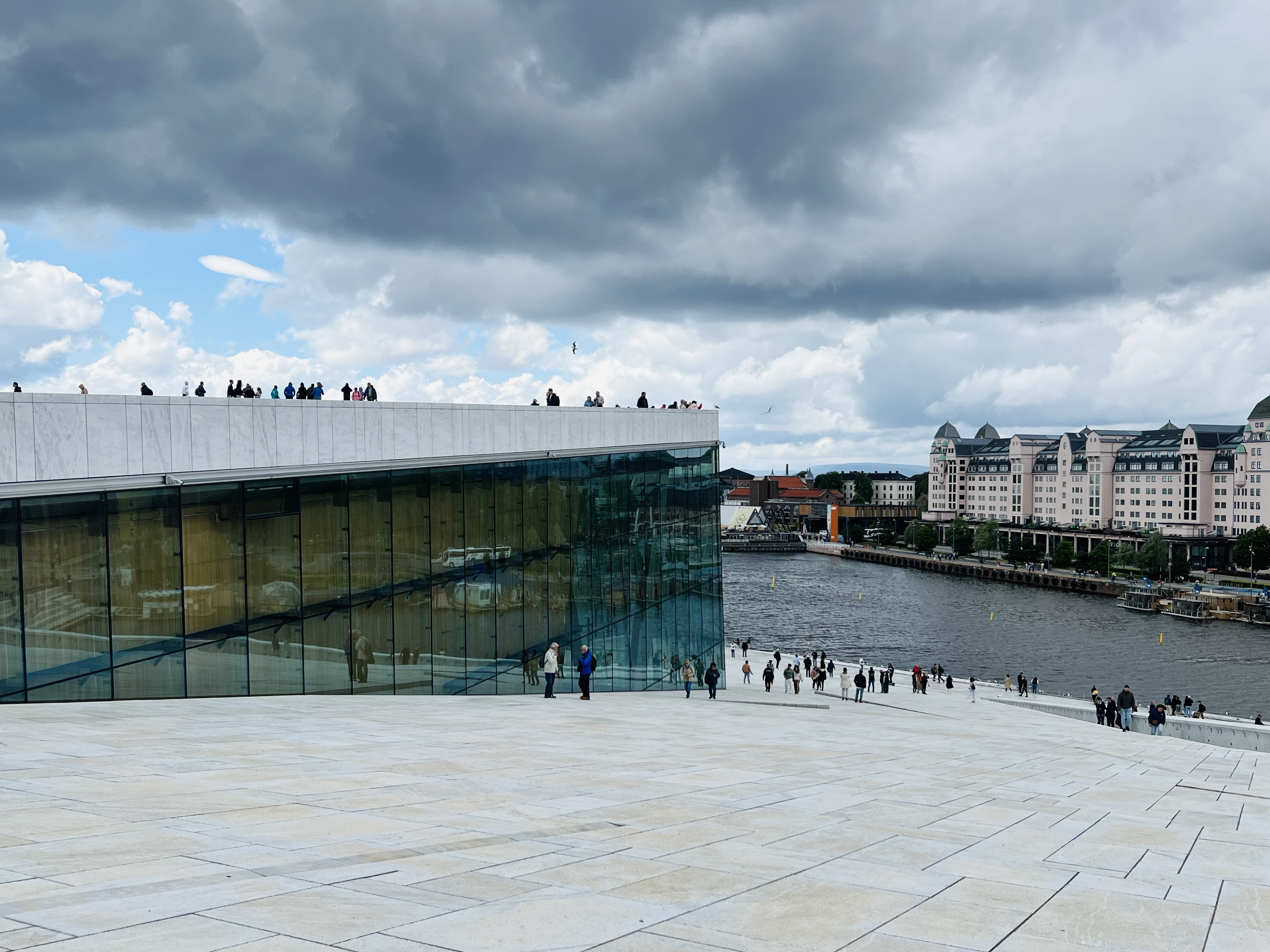
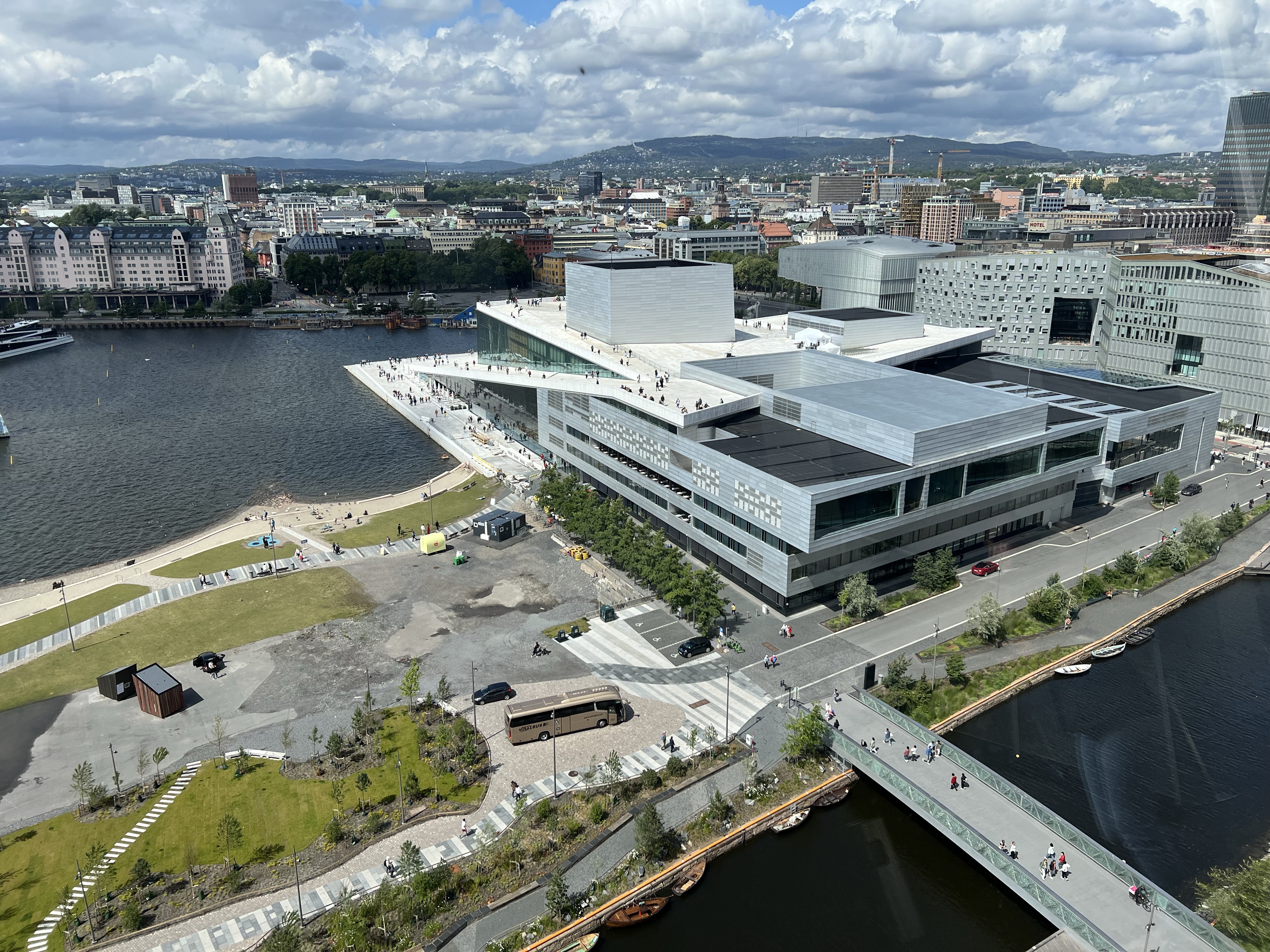
Nothing says modern Oslo more than its glacial Opera House. The innovative design lets you walk up the sloped roof for great views of the cityscape and the fjord.

The architectural glacier that is the Oslo Opera House. You can walk up onto the roof for city views.

Another modern building that made it into my sketchbook is the Munch Museum. This museum is dedicated to the works of Edvard Munch, best known for creating the second most famous painting in the world: The Scream.

The new Munch Museum was opened in 2021 and the view from the top floor is amazing.

The view from the Munch looking down on the Opera House.

I found a perspective to sketch the museum with a garden and sculpture in the foreground. The 2022 sculpture in title The Mother by Tracey Emin.

Image

Grünerløkka

When I travel I prefer to stay in a rented apartment rather than a hotel. While a hotel may feature a central location, an apartment puts you in a lively and living neighborhood like Grünerløkka.

Grünerløkka is a hip and lively neighborhood northeast of the city center. Once a working class neighborhood “Lokka” is now a Bohemian enclave full of cafes, bars, restaurants, and vintage shops.

The Paulus Church sketched in the rain from my local park, Birkelunden Park.

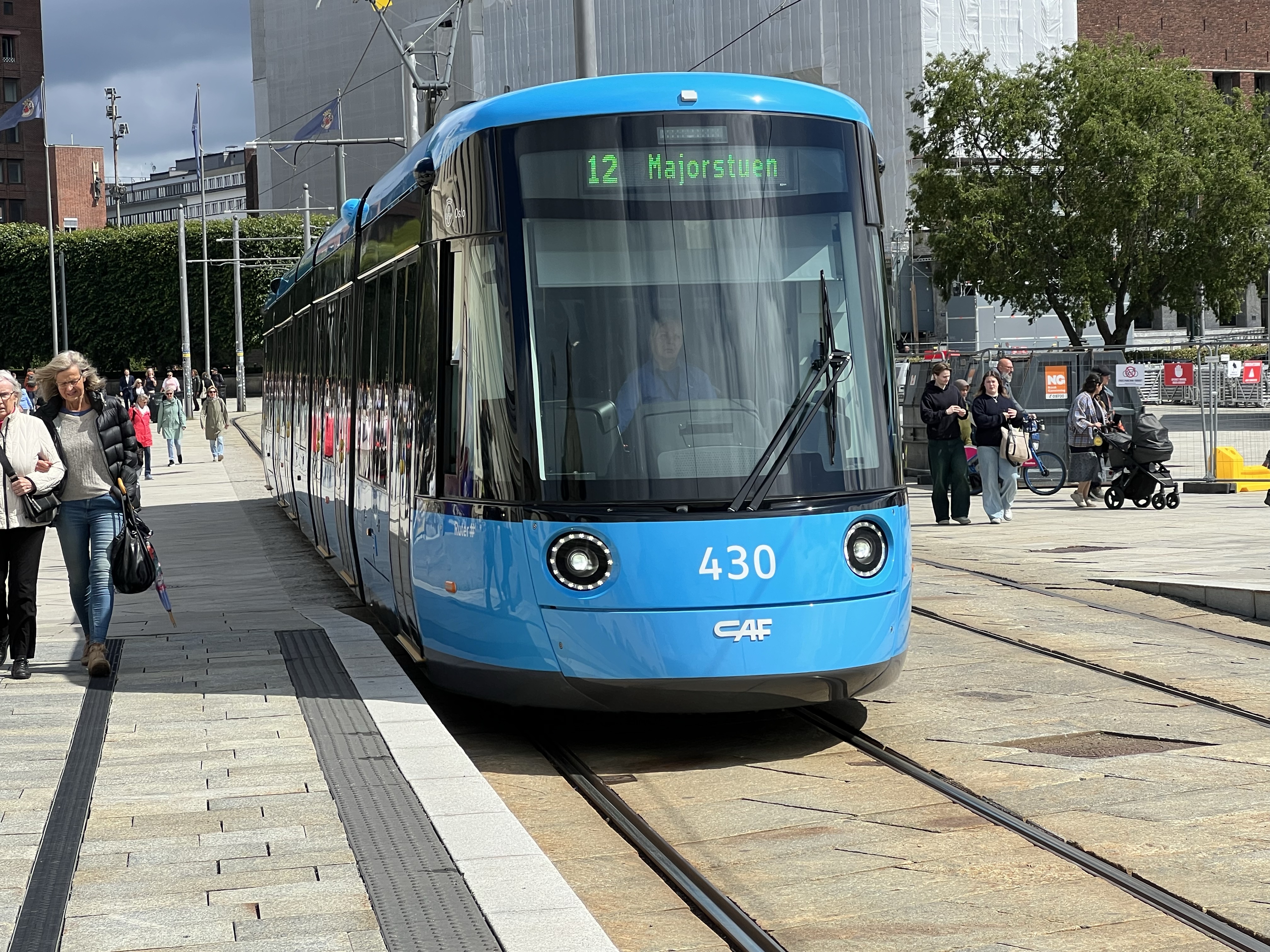
It was a short walk across Birkelunden Park to the tram stop. The lines 11 and 12 took me to Central Station. The 12 was my lifeline while in Oslo.

The 12 also took me to the ferry terminal for the boat to the Bygdoy Peninsula and the Fram, Kon-Tiki, and Norwegian Folk Museums. If I stayed on the 12 a bit longer, it stopped at the entrance to the sketcher’s paradise: Vigeland Park.

The other bonus of my Grünerløkka apartment was the restaurants, bars, and cafes that were a short stroll from my digs.

One of my favorite places to relax in the afternoons was just a half a block away from my Oslo stay. This is Grünerløkka Brygghus. I loved to sit on the cobblestones enjoying a local cold one as the trams passed by, a few feet from my right elbow. So I did a sketch of it (featured sketch).

Image

Bygdoy Peninsula: Kon-Tiki

I waited at the dock for the 9:10 ferry to Bygdoy.

There are three museums that focus on maritime history and I was really looking forward to seeing and sketching a balsa wood raft that was captained by a famous Norwegian.

While I spent some time at the Fram and the Norwegian Martime Museums, I was really here to see the Kon-Tiki!

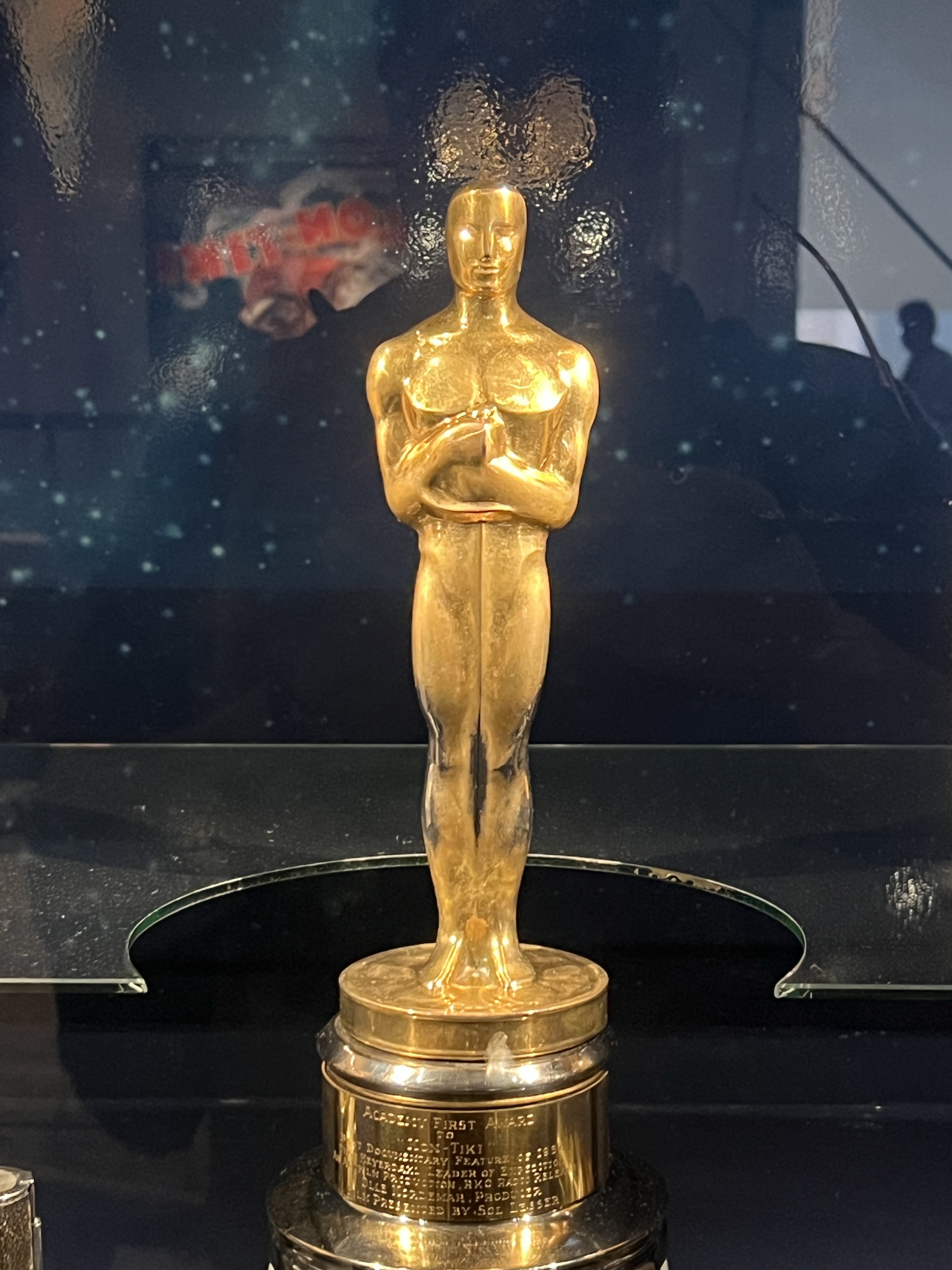
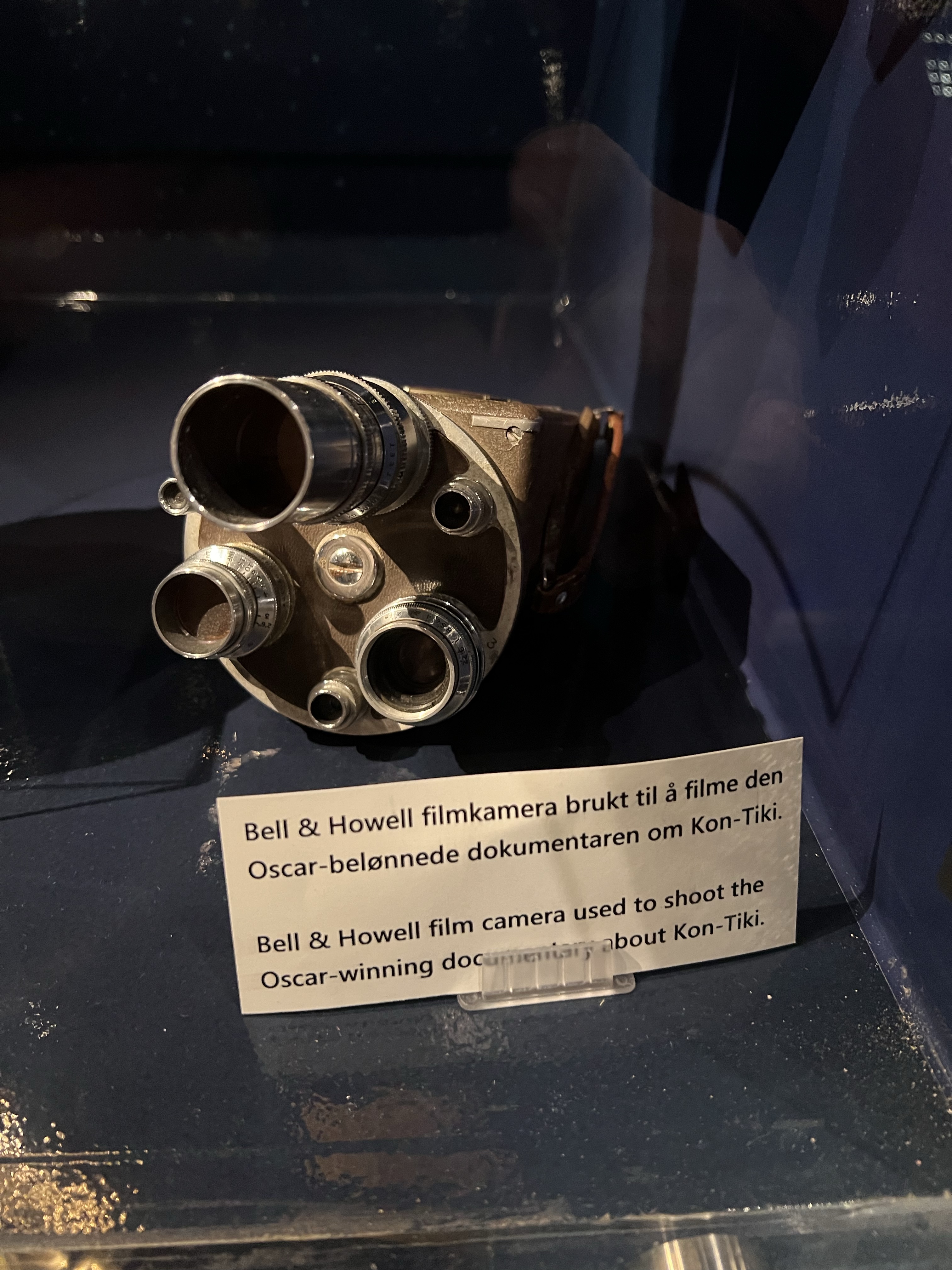
Before my trip I had read Thor Heyerdahl’s book about the adventure, seen two movies about the trip, including the Oscar winning documentary by Heyerdahl. I had done sketches about the raft and its captain and now I was about to see the actual vessel.

Heyerdahl’s Academy Award for best documentary.

The first time I remember reading about the Kon-Tiki was from a Time-Life book called Dangerous Sea Creatures. In the book was an excerpt from Heyerdahl’s massively popular account of the voyage. The passage was about the crews first encounter with a whale shark (this certainly is not a dangerous sea creature!).

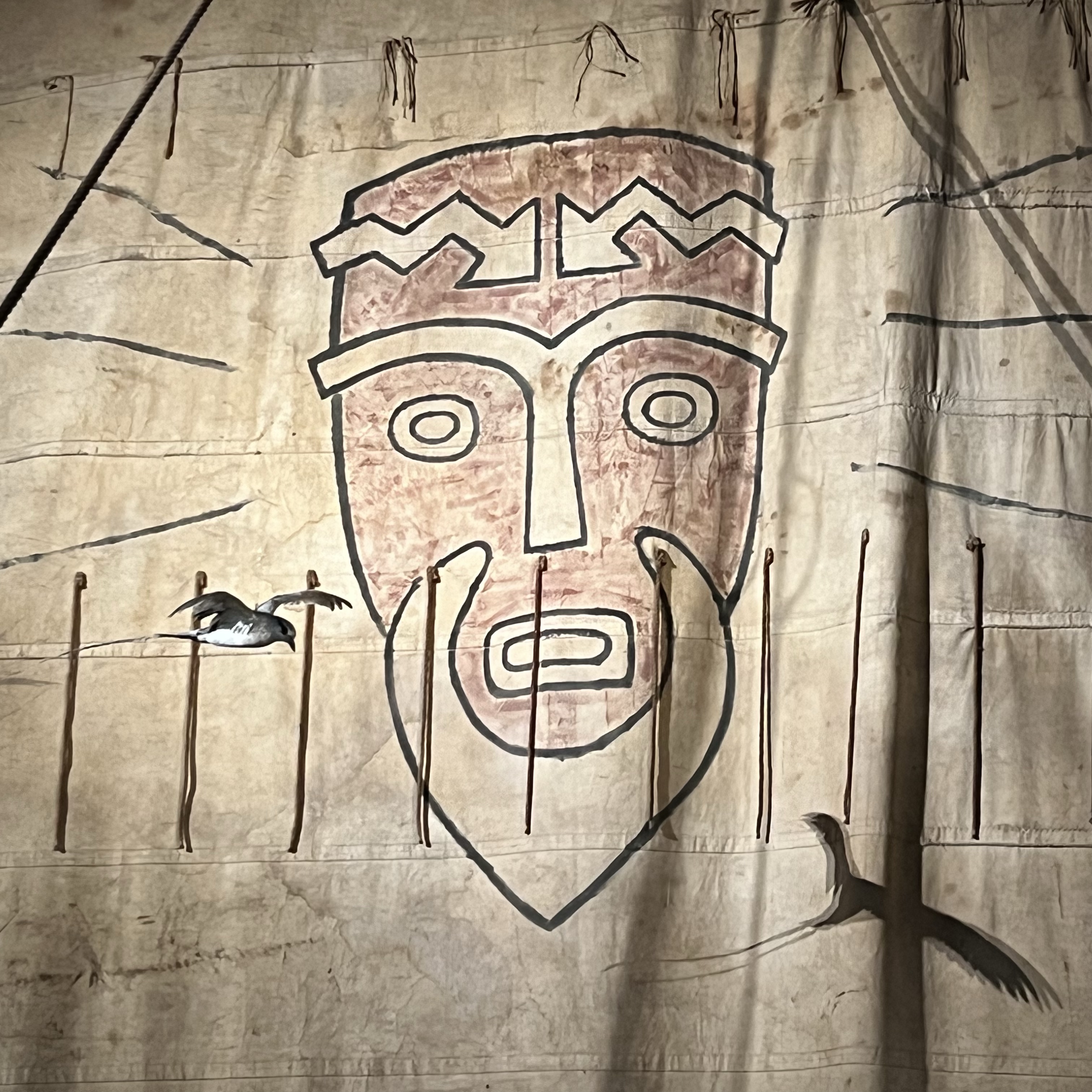
The sail with Kon-Tiki painted on it.

It was amazing to see the famous balsa raft in person that I had read about and which was also featured in the Oscar winning documentary about the voyage. The story of the Kon-Tiki is almost unbelievable had it not been documented. The heroism that the crew engendered on a journey that could very well have ended their lives and at a time when there had very rudimentary forms (ham radio) of communicating with the mainland.
The Bell & Howell film camera Heyerdahl used to film the documentary.

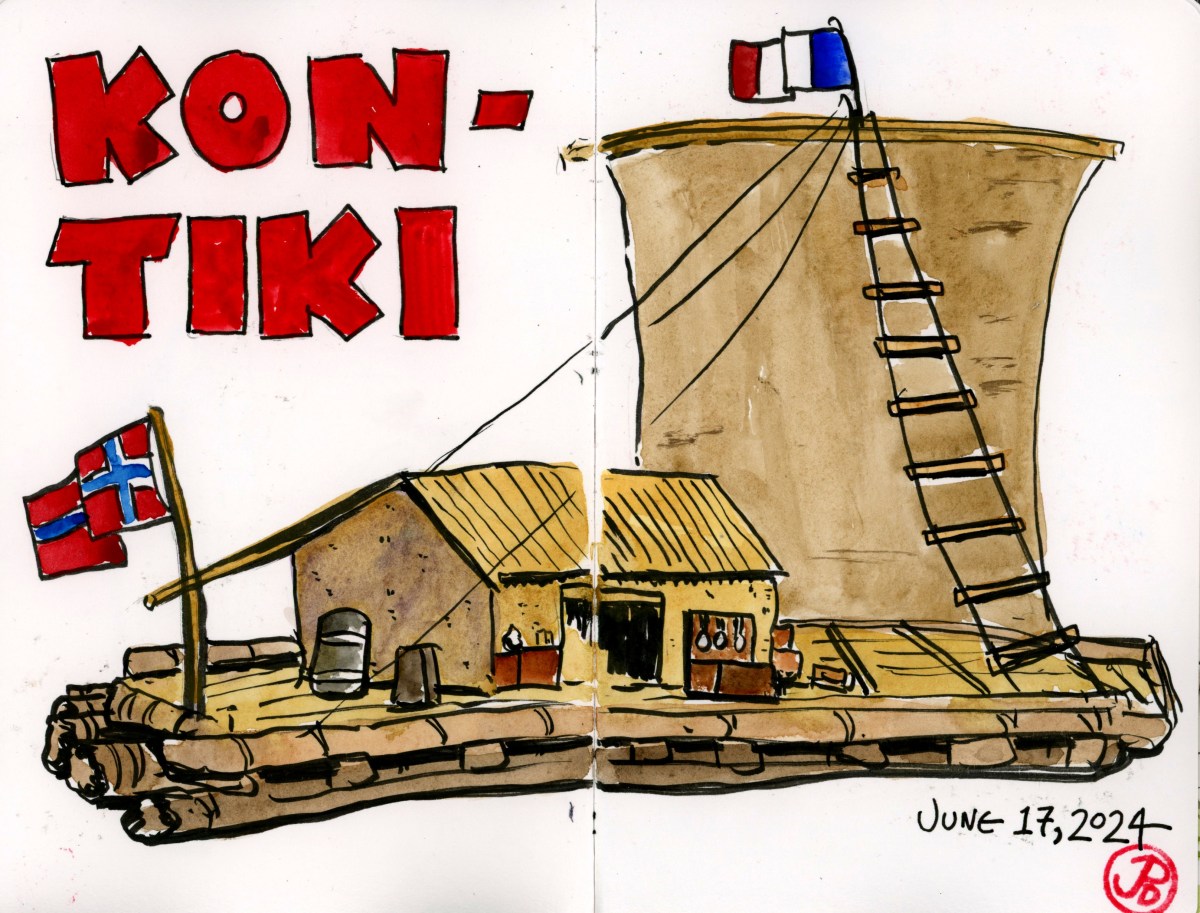
I started a sketch of the Kon-Tiki head on and was not pleased with progress so I aborted the sketch and picked a different perspective. I choose a seat on the starboard side near the stern. With a change of perspective, I was able to add the mythic raft from my childhood to my journal (featured sketch).

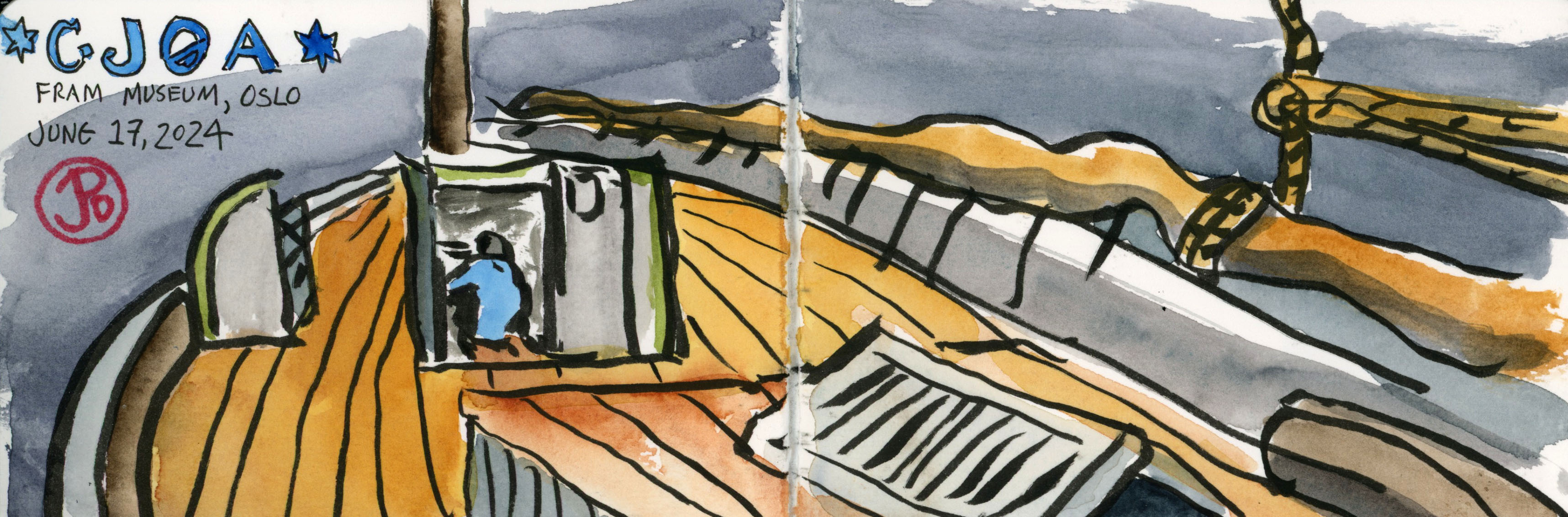
Another ship on the Bygdoy Peninsula was to be found at the Fram Museum. This was the ship that Roald Amundsen sailed through the Northwest Passage named the Gjoa. In 1909, the ship was donated to the city of San Francisco where it was on display at the western edge of Golden Gate Park until 1972. The ship was then given back to Norway where it is now on display in a large A-frame building at the Fram Museum.

Sketching the Gjoa was a bit of a challenge as I could get far enough away from the ship to capture the hull and mast so I sketched the deck from the port side stern.
Image

Shaking Hands With Oslo

After a sleepless ten hour flight from SFO to Copenhagen and a short flight from Copenhagen to Oslo, it was now time to shake hands with Oslo.

My focus was sketching in Central Oslo. I left my digs in Gunderlokka and walked across the park to catch the 11 tram to the town center.

I eventually sketched the Radhas, one of it’s towers was covered in scaffolding and I thought provided and interesting contrast to the tower to it’s right.

I got off in front of the National Theatre. One of the buildings on my sketch list was the Radhas. Unfortunately one of the red brick towers was covered in scaffolding so I passed on a sketch and instead found a bear sculpture on a fountain near the Radhas. Perhaps it is a polar bear!

There is lots to sketch in Norway’s capital city. Architecture, both old and modern, fjordscapes, and plenty of public art. And I was even able to sketch a life bird.

On a visit to the Munch Museum, I saw a family of Barnacle geese, two adults and two goslings.

I always love to sketch public art, such as the bear in the featured sketch. I found the statue at the harbor, Dykkar (2013) by Ola Enstad. So I sketched it from behind as I was taking the very of the diver looking out to line of ships and the fjord of Oslo.

Image

Polar Shades

Protecting your eyes is very important in the Land of the Midnight Sun. In the summer the Polar day can last for 24 hours.

The sun is intense and extreme in the Polar regions in the summer, with rays being reflected from snow, ice, and water into your naked eyeballs.

That’s why you need to clothe your eyes in Polar shades!

I chose to dress my eyes with the Julbo Montebianco 2.

These French glasses are made for high altitudes and snow sports. The Spectron 4 lens blocks out 100% UV rays as well as a, b, & c rays. The glasses also come with removable side shields which protects your peripheral from intense blinding light.

I also like the fact that Julbo has been making eyewear for explorers and adventurers since 1888. And I would be carrying on with the explorer’s tradition.

With so many hours of daylight, you need a different type of eyewear to get some shuteye during the summer Polar “night”.

I found this out on my summer of 2023 birding trip to Iceland. High up on a summer Scandinavian packing list is a quality sleep mask. Most of my accommodations had blackout shutters but a few did not and having a sleep mask gave me much needed shut eye.

My sleep mask of choice for Scandinavian is the Alaska Bear (could it be a polar bear?!) sleep mask. This mask is comfortable and does it was it designed to do: keep out the light.

Image

Beginnings: Point and Shoot Journals

A new adventure means a new sketchbook.

In the past few years my “go to” travel sketchbooks has always been Stillman & Birn Beta or Delta Series. I love the paper and the different sizes in both soft and hard covers.

Now I wanted to try a new sketchbook so I settled on Hahnemulhe’s 100% cotton cold press sketchbook. This is a hardcover book with very high quality paper for watercolor.

For Svalbard I want to downsize, so I chose two journals: a 4″ by 5.5″ panoramic journal and a 5.5″ by 5.5″ square journal. These would fit in well with my lighter one-bag travel ethic and, I thought, if you use a smaller journal, you are encouraged to sketch more because you have less paper to cover. I figured a smaller journal would be easier to do quick, gestural-loose sketches while on my polar cruise. I think of them as my “point and shoot” journals. I still could do detailed sketches with many watercolor washes, but I like the versatility of these journals and I can’t wait to take them to Scandinavia and sketch!

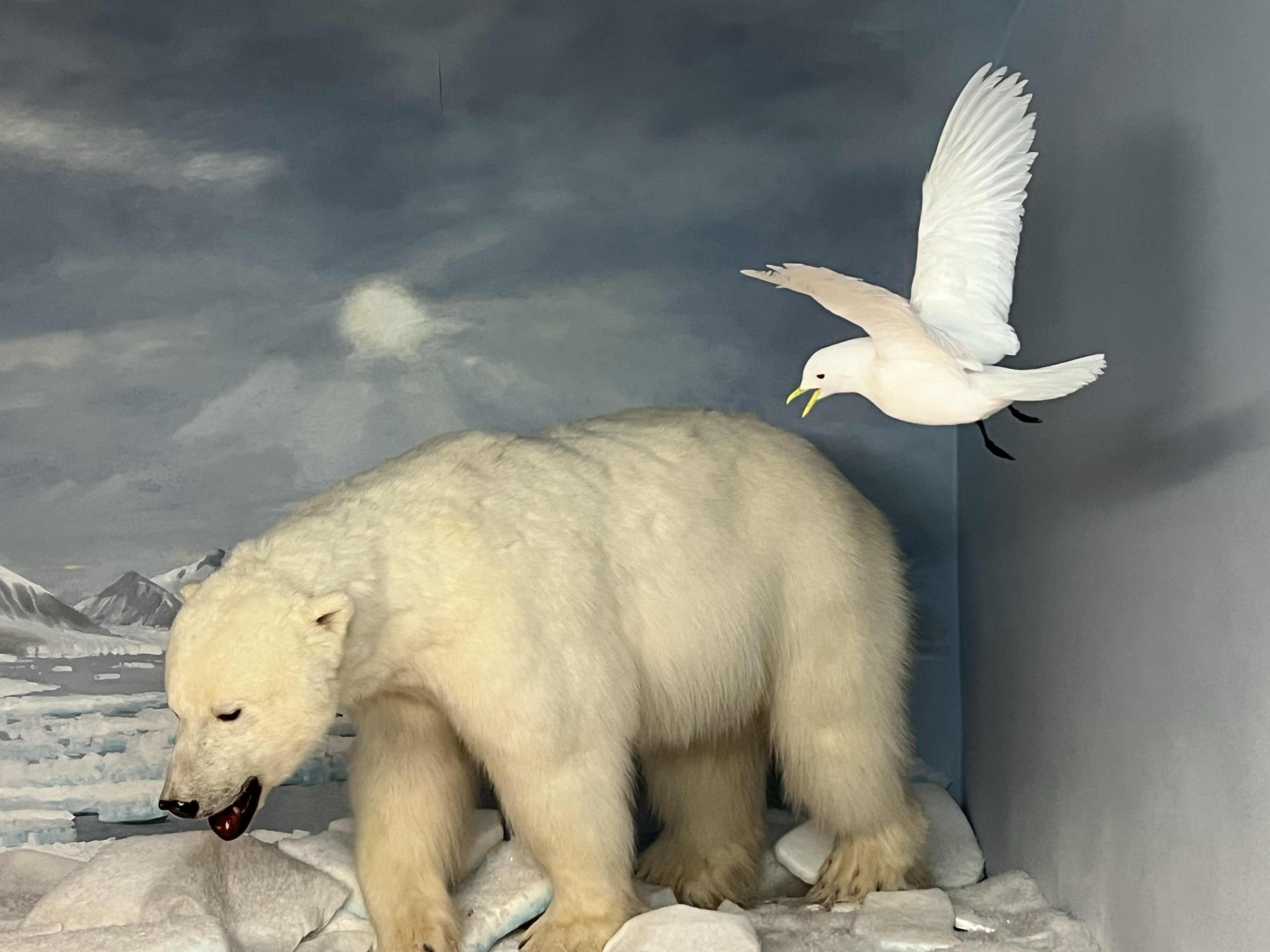
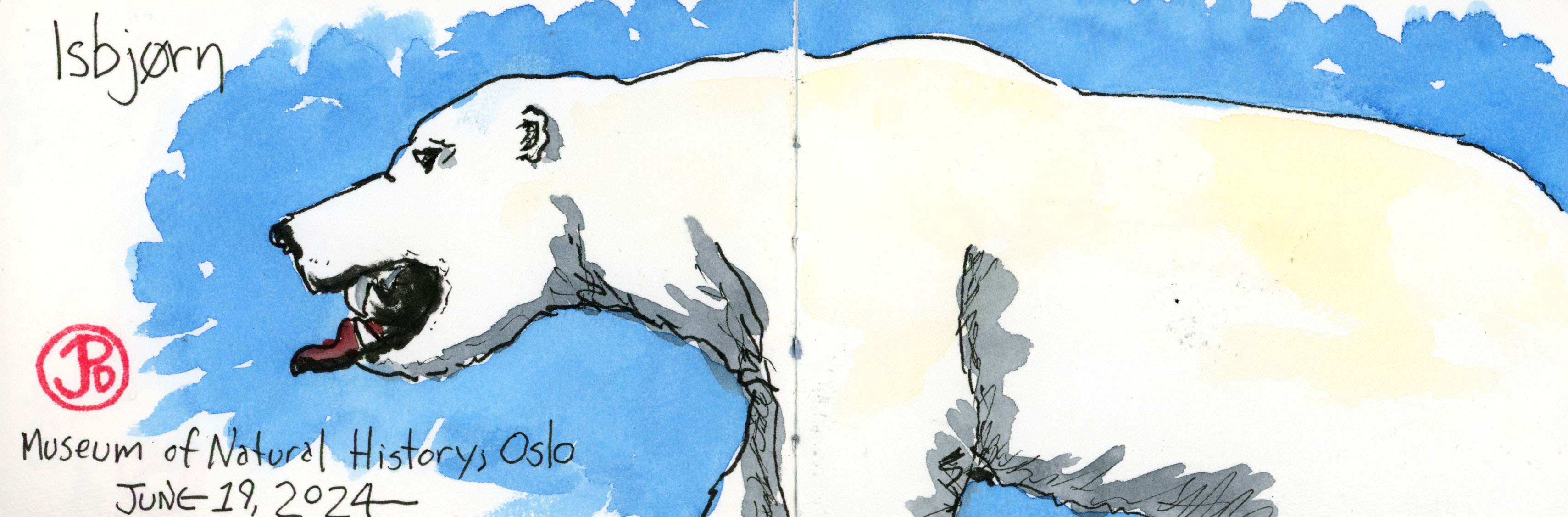
For my opening sketch in the square journal, I chose to paint across the gutter giving me a panoramic spread of 5.5″ by 11″. The spread is the isbjorn (Norwegian for polar bear). This is the number one target mammal on any Svalbard cruise. I loved the way the 100% cotton paper handled the washes (featured sketch).

The introductory sketch of my smaller panoramic journal was the number one target on my bird list: the much sought after ivory gull. This all white gull is only found in the Arctic Polar region. Finding an all white gull in an all white landscape was going to be a challenge! But I was up for it (Bring it on!)

Point and Shoot Watercolor Journals.

Image

Osprey Daylite Sling

In my quest to downsize my travel gear, I was looking for a smaller sketching bag to carry my journals, brushes, paints, and pens on my Polar adventure to Svalbard.

My go-to sling bag has been Patagonia’s Atom 8L. I love this bag but it was a bit too big and I wanted a better fit for the smaller Hahnemuhle watercolor journals I would be bringing.

So I decided on the Osprey Daylite Sling. This bag has a 6 liter capacity, it can be worn on the left or right shoulder (I prefer the right), and it has two wide U-zipper mouths to allow access to the interior.

This is my fourth Osprey bag. They are quality built and very comfortable to carry and as an added bonus they were founded just down River Street from my cabin in Santa Cruz.

I did a spread about my new bag featuring a little auk or dovekie modeling the bag. This is one of three lifers I could get in Svalbard (barnacle goose and ivory gull are the other two). The chances of seeing little auk are high because they are the most populous bird in Svalbard.

The Osprey Daylite in its natural urban habitat.
Image

Packing For the Arctic

There is one part of travel that I really enjoy: planning.

As part of the planning process, I use my journal to map, plan, and diagram. In this case I used a spread to explore packing for the polar summer in one carryon bag.

Was it even possible? Well I was going to find out.

The secret is using compressible packing cubes (it’s fitting that I’m using Thule from Sweden). This way I can pack more into my Osprey Farpoint 40 and the packing cubes help me stay organized on the road.

Before any important journey I also start a notebook. For my Svalbard adventure I chose a 3.5 by 5.5″ (90 X 150 mm) Leuchtturm1917 notebook. I do a lot of my preplanning in these notebooks and it is my constant companion while I’m on the trip.

I use it to write and note down details, lists, checklists, and thoughts and I often write blog posts in these small notebooks which easily fit into a pocket. And sometimes I do quick pens sketches too.

This is the front page of my Norway/Svalbard journal. To the right is a gull high on my wishlist: ivory gull. The cartoony gull reminds me of Kehar in the animated version of Watership Down.