Image

The Laughing Falcon and the Bellbird

Two birds that I was really looking forward to seeing on my Costa Rica trip were the laughing falcon and the three-wattled bellbird.

I remember looking back at a plate of the laughing falcon in my Belize animal guide and thinking, ” Now here is an interesting looking bird, I wonder if I will see it?” Of course I didn’t because I spend much of the time underwater looking at barracudas, queen angelfish, and whale sharks on my first trip to Central America in 2000.

The three-whattled bellbird seems like a species from another planet or a bird you would only see in a BBC documentary, accompanied by David Attenborough’s excitable narration.

Our guide Scott promised that we would certainly hear the raucous laugh of the laughing falcon but we might not actually see the raptor. Such are the ways of tropical birding. We did hear our first snake hawk on our first evening in La Selva. We crossed the suspension bridge in the fading light to see the silhouette of a falcon in the top of a riverside tree calling to the gathering night. I hoped we would get a better look at this tropical falcon.

We did indeed get a better look on our way to Carara National Park on the Pacific coast. Unfortunately I was in a feverish haze and was able to lift myself, get a bin full of the falcon perched on the power pole and get a few photos before I slumped down for another sweaty nap. Great bird.

Our last stop of the trip was the cloud forests of Monteverde and our main target bird was the three-whattled bellbird.

The forests of Montenegro at Curi-Cancha Refugio de Vida Silvestre was oddly silent, the “bonk” call of the male bellbird was absent. As the morning wore on in our final day in the field it became clear that the bellbird would not be on our trip list.

On our way out of Monteverde, we seemed to be taking a circuitous route out of town via some dirt roads (most of the roads in Monteverde were unpaved) through an residential part of town. Scott and our driver appeared to be up to something, but what?

We stopped in the middle of one street and Scott casually turned to us, paused, and said, “Bellbird.” The bus exploded into action as we filed out into the light rain and saw a male bellbird in the top of a fruiting aguacatillo tree. Three bellbirds flew across the street and we relocated then in a tree and we all got scope views of the male calling! What a great way to end our trip!

Image

The Capuchins of Carara

Our guide, Scott, told us that when monkeys are near, all birding comes to a standstill.

This is even more true when these monkeys happen to be capuchins.

We were taking a morning walk through the coastal, lowland rainforest of Parque Nacional Carara. We had great views of a royal flycatcher, seen two circling short-tailed hawks through the trees, and stood on the trail under a mixed feeding flock as they passed over us.

We took a side trail in search of other mixed feeding flocks and were soon alerted to a loud crashing of leaves and branches that signaled that a large animal or animals were very near. Which-necked capuchin monkeys!

It was impossible to ignore these energetic primates that made the howler monkeys that we had seen at La Selva look like lethargic sloths by comparison. The troop of 10 to 15 monkeys moved up, down, and around the canopy as we earthbound mammals craned our necks to follow their frenetic progress.

It is no wonder why primates and these new world monkeys, fascinate us. When you look into the face of a capuchin, it’s like looking into the face of a long, lost cousin. Albeit one with a long, prehensile tail.

These monkeys also share another trait with Homo sapiens: they also use tools. In Manual Antonio National Park (just down the coast from Carara) a capuchin was observed beating a fer-de-lance (a viper responsible for many human death each year) to death with a stick. Well done!

Capuchins in the canopy of Carara National Park, on the Pacific slope of Costa Rica.

Image

Cruising Upriver

One part of the tour that I was really looking forward to was the afternoon boat trip on the Tárcoles River. Judging by the advertising signs on our way to the dock, American crocodiles where the main draw for the tourist dollar on this wide, brown waterway. The larger than life crocodiles with massive, gaping jaws seemed utterly unreal, but we were here for the birds. 

We headed upstream keeping our eyes on the banks and skies for birds and scanning the wide waters for reptilian logs. On the port side, perched on a snag was the America’s largest kingfisher, a bird I had first seen on the Rio Grande on the US-Mexico border. Now here were two ringed kingfishers in one bin-view.

Our captain pulled off to the starboard and planted the bow into a muddy channel to look at a brown scaly “log”. This “log” was over three feet long and was the half submerged head of a massive male American crocodile. We all scrambled to the bow to get views and I got a quick sketch of the crocodilian in which I grossly underrepresented the size of its massive brain case. It was hard to tell how long this croc was but some mature males can reach 20 feet and weigh a ton! Time to get back to birding.

We turned and headed downstream and the birding made a quantum leap. Near the river’s end we came to a debris strewn beach. Everywhere we looked were waders: wood stork, roseate spoonbill, white ibis, Wilson’s, black-bellied, and collared plover, green and little blue heron, spotted sandpiper, and night herons.

We headed up another channel and picked up the impressive boat-billed heron, mangrove warbler, and green kingfisher.

The most impressive sight of the boat trip was soon to come as we headed back down the channel. The raucous calls of scarlet macaws surrounded us. Off to the port side was a tree ornamented by 20 macaws, a tropical Christmas tree in July. We had been seeing this iconic parrot, usually flying in pairs, for parts of the boat trip and it was awesome to see so many in one place as they perched in their roost tree.

A tree full of macaws, a great way to end a wonderful afternoon boat trip.

Image

God of the Air

From the lowland rainforests of La Selva we headed upwards to the cloudforests of the Savegre Valley. We would be at about 7,000 feet in elevation, where the humidity and temperature drops and the oak hillsides reminded me of the rolling green hills of California. In fact some of the same species, band-tailed pigeon and acorn woodpecker, are found in both locations. But we were here to see a species that is not found in California, a species of bird that has been called the most beautiful bird in the world.

This extravagant trogon is the resplendent quetzal (Pharomachrus mocinno). The male is an eruption of iridescent green and red and it’s green tail streamers cascade far below the bird.

The quetzal was revered by early Mesoamerican societies. It’s tail streamers were seen as a sign of strength, freedom, and power by the Maya and Aztec people. The quetzal is the national symbol of Guatemala and the nation’s currency is the Quetzal.

We would begin our search before breakfast in the Savegre Valley. I had envisioned hiking up a steep, mist-shrouded, forested canyon trail to a tree at the far end of the canyon where the quetzal was known to roost. In reality, we drove a mile down the road and were now standing by the roadside near an abandoned rock quarry, looking up into some trees with about 50 other quetzal searchers. Each group had their own guide who was armed with binoculars and scope.

IMG_0525The quetzal searchers gather at the roadside rock quarry to wait for the resplendent quetzal to make an appearance.

We didn’t have to wait long as a juvenile quetzal flew into view. The crowd let out a gasp as this was truly a stunning bird. The male sat in view giving the crowd decent looks through the branches.

About 20 yards down the road a guide was on an even more stunning quetzal, this time an adult male with green, flowing tail streamers.

I was able to do quick field sketches of both males which are the featured images to this post. It was one of the few field sketches I was able to complete due to the quick pace of the tour and the quetzal being an obliging subject, they seemed to do a whole lot of nothing except perch in one place for an extended amount of time. Perfect for sketching.

IMG_0542

The male juvenile quetzal, lacking the long tail streamers.


How many birds

can you count

in a lifetime?

How many birds

make you gasp

in a lifetime?

Holding your

breath,

waiting for

the quetzal

to surface.

Exhale

feathered gem,

the morning mass

worships together.

An adult male resplendent quetzal with full tail streamers, truly on if the most beautiful birds in the world. 

Image

Mammals of La Selva

While birds are the main focus on a Costa Rican birding tour (go figure), we had many opportunities to observe mammals at La Selva. Because La Selva has been a protected reserve for over 50 years, some of the mammals seemed downright tame.

Case in point, the two collared peccaries that wandered about the lawn of the research complex like to off-lead dogs. These members of the pig family, nonchalantly passed within petting distance of our birding group. This sure beat any of the previous views of the animals as they scurried through the underbrush in southeastern Arizona.

IMG_0474

We later passed under a troop of howler monkeys, who were resting (as they do) in the upper branches, digesting their plant-based diets. These new world monkeys are the arboreal cattle of the rainforest, chewing their “cuds” and watching us watch them.

IMG_0381

As day turns to night the mammalian activities ramps up. While walking to dinner a tayra (Eira barbara) practically walking into our dinner party. This large member of the weasel family seems to be put together with pieces of other animals. It is the sole member of the genus Eira and their species name means “strange”. It is also known as the “high-woods dog”, a further example that the tayra does not easily fit into any category.

After dinner, a few of us set off for a night hike. As we approached the suspension bridge that cross the Puerto Viejo River , we spotted a mammal in mid-span. Our light revealed that it was a northern tamandua, a species of anteater. The tamandua crossed the bridge and two biologists made way for it as it crossed to other side and ambled off into the forest. Amazing sighting!

One of the best avian sighings at La Selva was on our last morning at the reserve. We had been hearing the distant calls of the great green macaw but no one had yet seen them in their bins. Downstream we all heard the raucous calls of macaws and our guide urged us, “Wait for it.” and just then two great green macaws appeared over the treetops and they flew in formation, upstream, as the late morning showers started. Great birds!

GGMacaw-1

Image

Toucans

No bird, with the possible exception of the macaw, is the quintessential neo-tropic poster bird than the toucan. These large birds with massive colorful bills, look back at us from tourist brochures, boxes of sugar-coated cereal, and Guiness beer ads. Almost everyone, from around the world, can identify this bird, even if they have not seen one flying in the wild. I was finally going to see one!

Our first stop after leaving our hotel in the outskirts of San Jose was La Selva Biological Station. La Selva was the first private reserve and field station in Costa Rica, it’s genesis going back to 1953, decades before the rise of ecotourism. The birding at La Selva is sensational, the reserve logging 467 species of birds and the reserve includes half a million species including plants and trees, mammals, reptiles, amphibians, and insects.

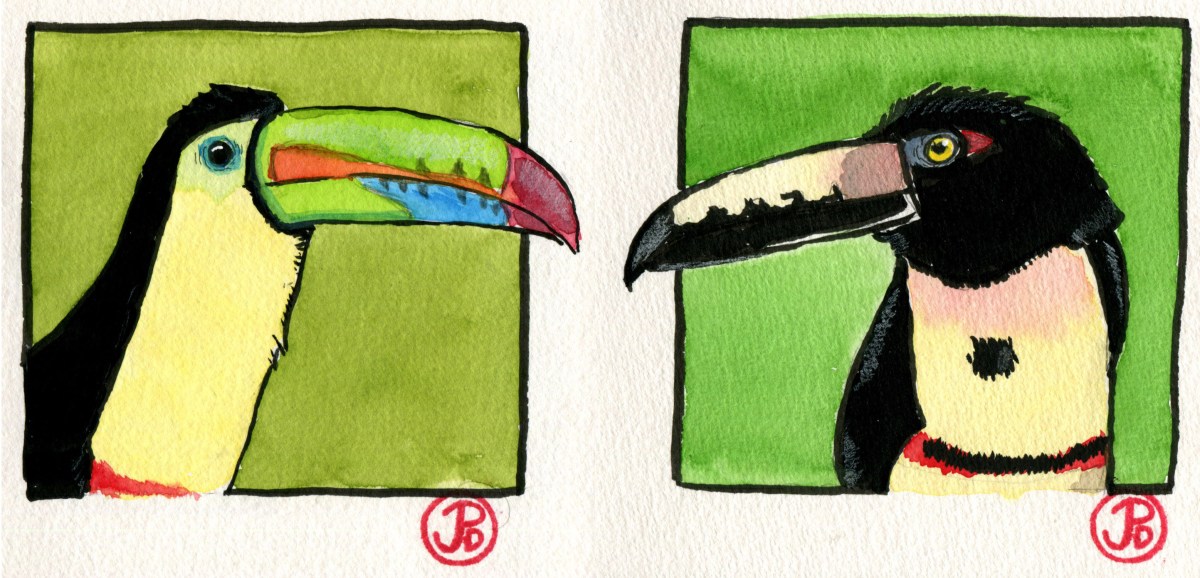
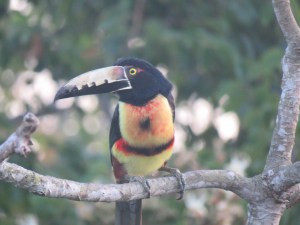
On our morning walk to the dining hall, we passed through the forest. We approached a clearing in the canopy and I saw am unmistakable black-bodied, large-billed bird, “Toucan!”, I exclaimed. It was a yellow-throated toucan (Ramphastos ambiguus). In the same tree, flew in another toucan, the collared aracari (Pteroglossus torquatus). Not a bad haul for our morning walk.

A yellow-throated toucan perched in a clearing near out lodgings at La Selva. Even from a distance, these birds stand out.


The collared aracari. This individual was attacked by a tropical kingbird. While fruit make up a large portion of it’s diet, nest robbing is also one of it’s sources of food.

Image

Hotel Robledal

The Hotel Robledal is about 20 minutes from the airport, along the narrow back streets of San Jose. Open fronted markets, barber shops, and houses blurred past as the hotel shuttle made it’s way in streets full of motorbikes, people, and dogs.

I had arrived in Costa Rica a day early before my birding tour started and I hoped the birding was good from the hotel grounds. I had already seen blue and white swallows circling above the roads.

Within minutes of arrival at the Robledal, I was birding the grounds, turning up a few old Texas friends, the great kiskadee, long-tailed grackle, and the National Bird of Costa Rica,  clay-colored thrush. To these I added social and boat-billed flycatcher. I scanned the skies hoping to see a raptor, perhaps a laughing falcon but they only yielded black vultures.

IMG_0276

A poolside clay-colored thrush, National Bird of CR, at the Hotel Robledal.

These familiar birds where joined by others that remained unidentified. Two of which were hummingbirds that did not sit still long enough to observe details. I was able to id a Hoffman’s woodpecker that was working it’s way up a trunk and the stunning rufous-naped wrens were practically a yard bird here. Our guide dubbed these birds “rapper wrens” for their songs. A white-winged dove was sitting on a nest and some Inca doves were in the process of building theirs. Beyond the back fence, a  melodious blackbird was tending eggs on a stick nest while a nearby snag was always bearing the fruits of tropical birds. None was as stunning as the two parrots that visited in the late afternoons and early mornings.

YNparrot

A pair of yellow-naped Amazons in the snag in the back garden of Hotel Robledal.

During diner I sat down with some of the family that owned the Robledal to watch the Costa Rica National Team play French Guiana in the Gold Cup. Fútbol or soccer as we call it, is the national obsession in CR, where every town of any size has a fútbol pitch. In the second half Marco Ureña was subbed on and one of brothers turned to me and said, “You see that player? He lives down the street from me.”

Costa Rica is a small country, full of birds and fútbol!

Image

Florida Canyon

I meet my guide at the point where Madera Canyon Road turns sharply to the left towards Green Valley and the dirt road begins to the right. We loaded a cooler filled with water and snacks into my rental black Volkswagen Jetta. (How could they give me a black car in the middle of an Arizona summer?!)

The car was surprisingly low to the ground in a part of the country that is crisscrossed with dirt roads in various states of maintenance. On a previous trip I had driven over the Chiricahua Mountains, and being from California, I wondered when the paved road was going to start. It never did.

Our destination this morning was Florida Canyon (pronounced Flor-ee-da) and our target bird was ( as David Allen Sibley puts it, a “very rare visitor from Mexico to southern Arizona”), the rufous-capped warbler (Basileuterus rufifrons). This long-tailed small warbler with a stunning facial pattern is not just a visitor to Arizona but a breeder. In Florida Canyon there could possibly be seven pairs on territory.

We started up the trail and it didn’t take long for my guide to pause and listen. He had heard something off to the right, a bird foraging in the trees. He called in a little gray long-tailed puff of a bird. it was another “rare visitor from Mexico”, the black-capped gnatcatcher (Poliotila nigriceps). A great lifer and another tick off my target bird list! This gnatcatcher was now breeding in a few locations in Arizona, including Florida Canyon.

On our way up the dry creek bed, my guide pointed out a tarantula hawk. He noted that the wasp was not aggressive to humans but it’s sting was second only to the bullet ant of Central America according to the Schmidt sting pain index. Both bullet ants and tarantula hawks received a score of 4 which represents the most painful sting on the pain index (a honey bee is rated at 2). So we gave the wasp a wide berth.

IMG_0216

We headed further up the canyon on a trail that was blazed by birders in their pursuit of the highly sought after rufous-capped warbler. We stopped, looked and listened. No dice. We headed further in and did the same, still no dice. We continued up canyon and as my guide was pointing out a larger boulder, I spotted the warbler than appeared a few feet above his head. It’s facial pattern was unmistakable. Rufous-capped warbler! Lifer!

Image

Feathery Fireworks

July 4 was my first full day in Arizona. I was staying at the legendary birding hotspot the Santa Rita Lodge in Madera Canyon. I awoke early with the intention of adding one elusive quail to my lifelist.

Montezuma quail (Cyrtonyx montezumae) is a Southeast Arizona marquee bird. It is a bird that many birder’s attempt to see in this area. Most birders, if they are lucky,  only see the quail briefly as it is flushes, flying away from the viewer. Pete Dunne notes that the Montezuma, “Spends most of its life not being seen.” On two previous visits, Montezuma’s has evaded my view.

On the 4th, I arose early and walked five minutes to the Madera Picnic Area. It was 5:50 AM and there was already a car in the parking lot. It’s owner was a Tucson birder that was looking over Madera Creek into the hillside. I figured that is was always a good sign. I walked up besides him and he said, “Montezuma quail” and directed my view to a point halfway up the hillside.

The cryptic quail eluded my search until the male moved, his harlequin face pattern flashing on the hillside. The female also appeared as the two quail worked along the hillside. I followed then upstream, keeping them in view for a full 15 minutes!  A one point the two headed down to the creekside. This was a quality lifer with absolutely quality looks!

Mont

This photo will not win any wildlife photography awards but it is a definitive proof that I was looking at the elusive Montezuma quail.

Later I headed south to the small town of Saint David to finally close out North American kites. In this small area, pockets of Mississippi kites where summer breeders. I came to Golden Bell Road and turned right. The road then turned 90 degrees to the north becoming S. Miller Lane. Halfway down the lane I spotted the unmistakable shape of a Mississippi kite. At one point I had three birds soaring above me. I saw one bird fly into the top of a tall cottonwood. I moved closer to investigate. There was a kite perched in the high branches and to its left was a stick nest with a bird on it! Great find.

Missi

A perched Mississippi kite to the right and a nest on the left.

Image

Southeast Arizona 

Southeast Arizona, a true Mecca for birders from around the world. Montezuma quail, Lucifer’s hummingbird, black-capped gnatcatcher, rufous-capped warbler, five-striped sparrow are all highly sought after birds which many birders, after many visits,  have failed to add to their lifelists. These are some of the needles in the haystacks that birders dream about. And my dreams were about to become a reality.

I have birded Southeastern Arizona twice before but only during the winter, when snowbirds double the populations of most towns and cities of the desert. Back then I added some of the most obvious and easiest to find species to my list. Now I have returned in the stifling temps of summer to try and add some of the most emblematic and rarest species to my ABA (American Birding Association) list. And to do this, I needed a little help.

Now driving on the rutted dirtroads of the boarder lands of the United States and Mexico, is not something one should do alone or at night so hiring a birder with knowledge of the area in a high clearance vehicle, is a must.

Enter a twitcher from Leicester, England who know California Gulch like the back of his hand and where individual five-striped sparrow pairs are to be located.

Twitch on!