Image

Scope Gull

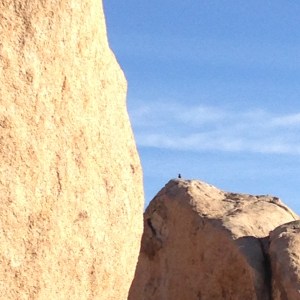
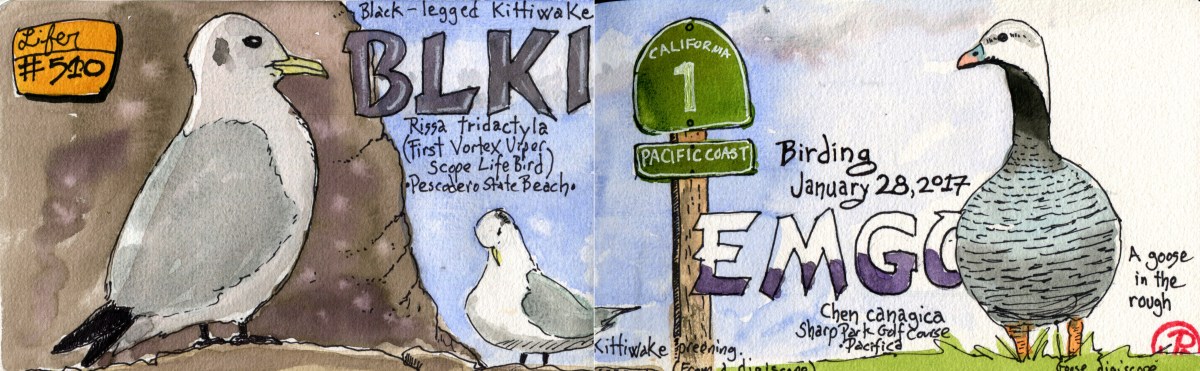
To the naked eye they are white specks on a rock. With binoculars you can discern the white front and grey back, the yellow beak (with maybe a smudge of red on the lower mandible) but the iris and orbital ring color are unknown at this distance. But with a scope the smaller gull,  just on the right, with a yellow bill, dark “earmuffs”, and black feet turns into North American Lifebird #510!

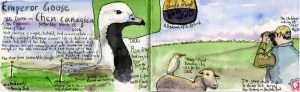
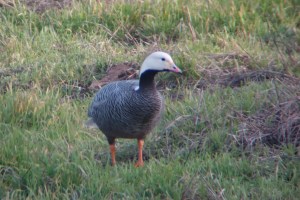
I set out on Saturday morning ,  heading south on Highway One with binos, scope, and tripod stowed in the back. My first detour of the day was in Pacifica to the Sharp Park Golf Course to check on the continuing emperor goose. A short walk south down the berm produced the rare goose, loosely feeding on the fairway with a group of Canada geese. Check.
Emperor

Journal page from the Emperor goose I saw at Seven Mile Slough, Lifebird #500. March 12, 2016.
dsc07316

Digiscope shot of the goose in the rough, at Sharp Park Golf Course, January 29, 2017.

The next stop was Pillar Point Harbor to see if anything interesting had blown in. I checked the creekmouth and beaches for any interesting gulls with not much luck. I then returned to Highway One. My plan was to head to Pescadero to scope the rocks and sea to find something interesting.

On my way to Santa Cruz, I frequently stop here, scanning the rocks for one of my favorite rock dwellers, the black oystercatcher. Most times it’s banshee wail, issued as it flies, calls attention to this cryptic colored bird, especially when it tucks its bright orange-red bill into its feathers. I scoped the rocks from the Pescadero State Beach pockmarked parking lot.  I counted 11 oystercatchers among the gulls and pelicans.

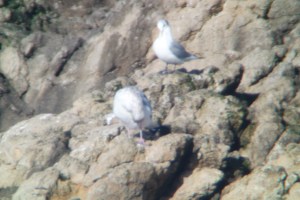
I slowly picked through the gulls, noting the beautiful plumage of the Heerman’s gull that were preening near the brown pelicans. As I panned to the left I saw a small gull, one with dark earmuffs, that I had missed on my first pass. This gull was different. Through the scope I ticked off the details: black legs, earmuffs, yellow bill. This was my target bird: an adult black-legged kittiwake! Lifebird #510!
dsc07285

A not so wonderful digiscope photo of the preening kittiwake (the top gull).
Image

In Pursuit of Phantoms

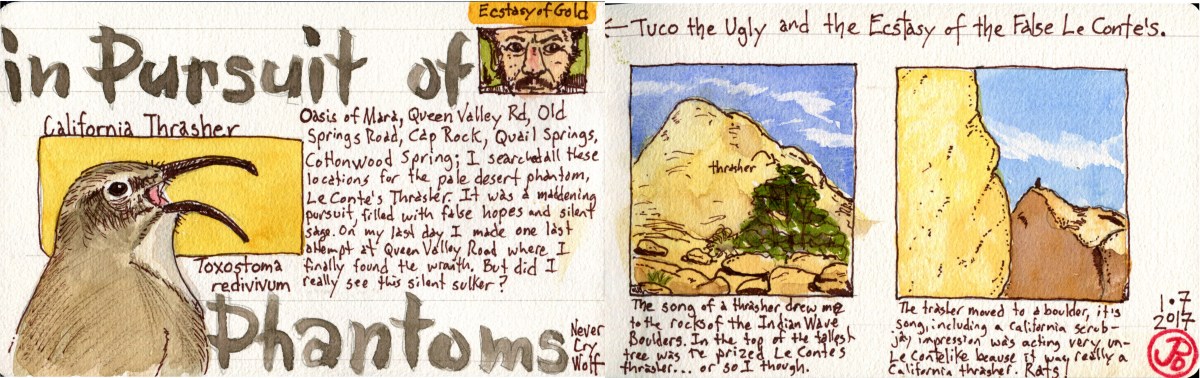
Just west of the Salton Sea, the road begins to rise, just out of Salton City. Slowly you climb up to above sea level and you keep climbing through the Anza-Borrego Desert State Park. My target bird for this little desert detour was the elusive Le Conte’s thrasher. This bird have eluded me all over Joshua Tree National Park and I hoping to add this bird to my life list at the known thrasher hotspot at Old Springs Road Open Space Preserve.

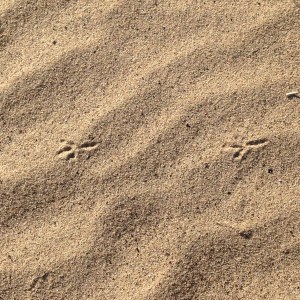
I walked the sand in ever widening circles, hoping to catch the bird that looked like a mouse darting from bush to bush, but the the only evidence of the thrasher were it’s footprints in the desert sands.

With one last day in Joshua Tree I decided to try one last place for Le Conte’s, a location I had tried before, Queen Valley Road. I walked the road, stopping every once in awhile to listen for the thrasher’s song. I was about 300 yards down the road, when I heard the warble of of a far of thrasher off to the left. I maddening ran through the desert brush, like Tuco the Ugly, in the famous “Ecstasy Of Gold” scene in The Good, the Bad, and the Ugly. The song seemed to come from the rock outcrop. I scanned the area for any sign of the thrasher.

I finally spotted the thrasher in the upper branches of a tree, signing it’s heart out and mimicking a scrub-jay, which perched in the tree next to the singing thrasher. I was able to get great looks at the very light, sandy thrasher. Le Conte’s thrasher! I watched the thrasher as it moved around, singing from the highest perches around it’s territory.

img_6311

The singing thrasher on top of a boulder.

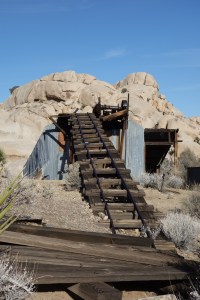
I then walked off to the Wall Street Mine. On the way out to the mine, doubt started to set in. There was something about the bird that didn’t fit. Would a Le Conte’s sing in the top of the tallest tree around? Is the Le Conte’s know for it’s mimicry in it’s songs? Everything I had read about the bird was that it was elusive and sang a quiet, hushed song. This was not the thrasher I had just seen. In my desire to see a Le Conte’s, I had convinced myself that this thrasher fit the part.

dsc07257

The abandoned Wall Street Mine, Joshua Tree National Park.

On my return from the mine, I refound the thrasher and this time I confirmed that it was not a Le Conte’s but a California thrasher. And I so I left Joshua Tree without finding the elusive silent-sulker of a thrasher.

img_6281

Foot steps in the sand are the closest I came to “seeing” the mysterious, Le Conte’s thrasher.


Image

An Extremely Rare California Gull

On Thursday January 12, 2017 at 2:07 PM, word went out of Sialia.com (a birding lists digest) that a very rare gull had been  found in a parking lot in Pillar Point Harbor, just north of Half Moon Bay. This small, dove-like gull was a Ross’s Gull, an arctic breeder that spends it’s time feeding near ice flows in the Arctic. And this gull was only the second time this species had ever been seen in California. It was previously seen in November of 2006 in, (where else?) the Salton Sea.

On the following day, Friday the 13th, I saw that the gull had been seen up until 3:20 PM on Thursday when it had flown north and the Ross’s could not be refound.  I knew where I would be heading after work to attempt to add a rare gem of a bird to my list but in the morning, the gull’s location was a mystery. Then it was refound at 12:20 at the Half Moon Bay Airport. Now if the gull would only stick until I could get there! But the gull flew east, fortunately no further than the flooded Brussels sprout field across highway one.

I left work and headed west on Highway 92, willing the gull to stay put and not head north into oblivion. Traffic slowed through Half Moon Bay and was equally as sluggish once I turned north on Highway One. I passed the intersection to Princeton, just a bit further, then I spotted all the cars pulled over on either side of the highway. I parked and swiftly walked north, towards the hordes of birders.

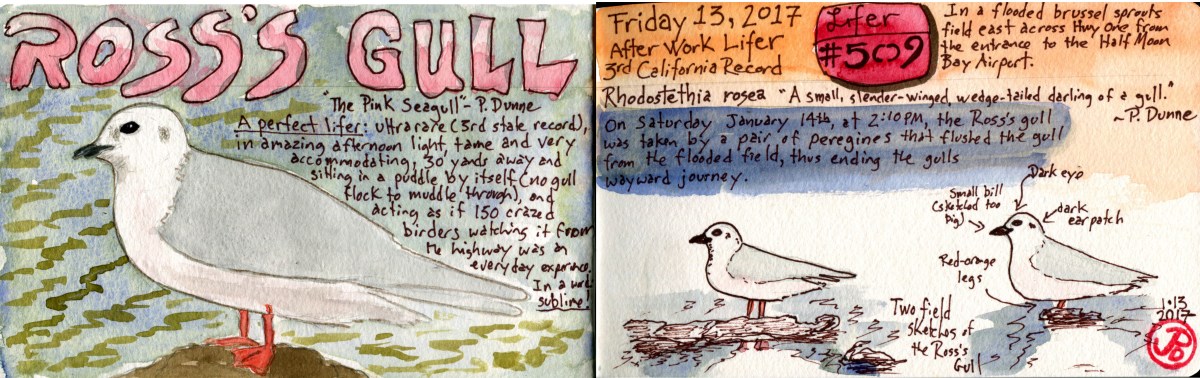
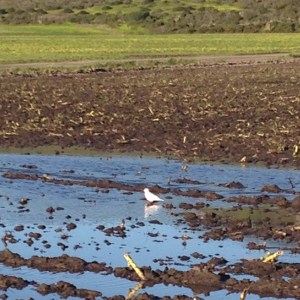
The Ross’s stood out like a sore thumb, a brilliantly white gull in a brown field. Bingo Lifebird #509, the perfect lifer!

img_6340

The Ross’s gull in the flooded field, across Highway One from the Half Moon Bay Airport on Friday the 13th, 2017.

The Ross’s was the perfect lifer because it was ultra rare (only the second California record), it was seen in amazing afternoon light, it was tame and extremely accommodating, it was only 30 yards away in a puddle by itself (no massive gull flock to muddle through), and it acted as if 150 crazed birders watching it was an everyday experience.

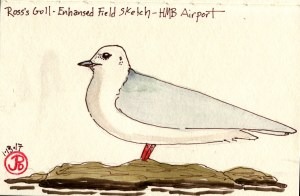
rosss

Field sketch from Highway One.

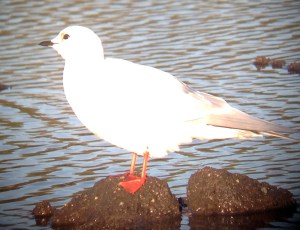
roosg

Overexposed digiscope photo of the Ross’s. The little gull was scanning the skies, two peregrines were spotted earlier, heading northeast.

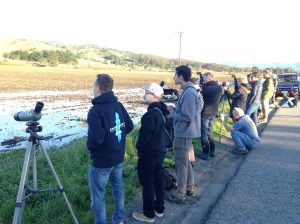
img_6348

The hordes or birders from near and far, enjoying a late afternoon gull from the edge of Highway One.

Coda:

On the following day, Saturday January 14, at 2:10 PM, it was reported that the Ross’s Gull had been flushed up from the flooded field by a pair of peregrines and the gull was taken by the two falcons, ending it’s wayward journey.

Image

Looking for a Gull I Found a Legend Instead

Salton Sea, California.

From Joshua Tree, I headed two hours south to one of the top birding destination in the nation.

The Salton Sea is really an accident. In 1905, the Colorado River breached it’s banks and headed downhill to the Salton Sink, 200 feet below sea level. It took engineers three years to stanch the flow and in that short time, the Salton Sea was created, the largest lake in California and the 2nd largest inland sea in the country (only bested by the Great Salt Lake).

The Salton Sea was a hopping place back in the 1950’s and 1960’s. Water recreation in the form of boating, water skiing, fishing, and sunbathing was the main draw for folks from the Los Angeles Basin. But this boon was short lived. The lake began to shrink, becoming more polluted by agricultural runoff, and growing saltier than the Pacific Ocean. The communities around the sea become dusty ghost towns.

The main visitors to the sea nowadays are birders and the bird that draws then to this remote part of California is the yellow-footed gull, the only place in the United States where this gull can be found. A bird the size of the common western gull but with a heavier bill and yellow legs. This gull breeds on the Sea of Cortez and some spend the summer and fall at the Salton Sea. A smaller number overwinter and I was hoping to see one of these birds from the Rock Hill Trail at the Sonny Bono National Wildlife Refuge on the sea’s southern shores.

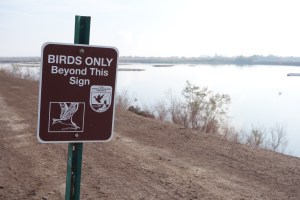
img_6276The sketcher at the famous Salton Sea birding trail: Rock Hill Trail at the Sonny Bono National Wildlife Refuge.
Along the Rock Hill Trail there were many gulls to comb through and the scope was a great help. But try as I might I could not turn a single ring-billed gull into a yellow-footed.

I left Rock Hill Trail and I tried a few other locations  to the seashore, down dirt agricultural roads which were impassable because of New Year’s rain. On one such road (Young) I spotted the bird that stares back at you from the U.S. Fish & Wildlife Service brochure.

dsc07195

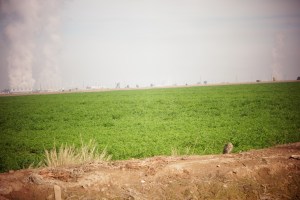
That dirt claude on Young Road, just to the right of center, turned into a burrowing owl, who didn’t give a fig for my search for yellow-footed gull. The plumes of the thermal generation plants can be seen in the distance.

img_6291

This place is for the birds!

thumb_dsc07181_1024

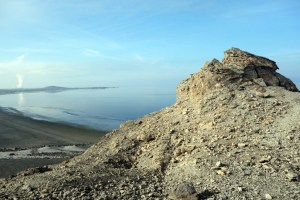
The mystical and surreal Salton Sea from Rock Hill.

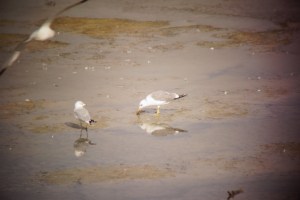
I returned to Rock Hill Trail for one last look for my target gull. I went all the way up to Rock Hill and scoped both shorelines and spotted a gull with yellow legs but I couldn’t convince myself with 100% confidence that it was a yellow-footed gull.

 dsc07212

I tried to turn this gull into a yellow-footed gull but it’s size, back color, and dark eye said, “California gull.”

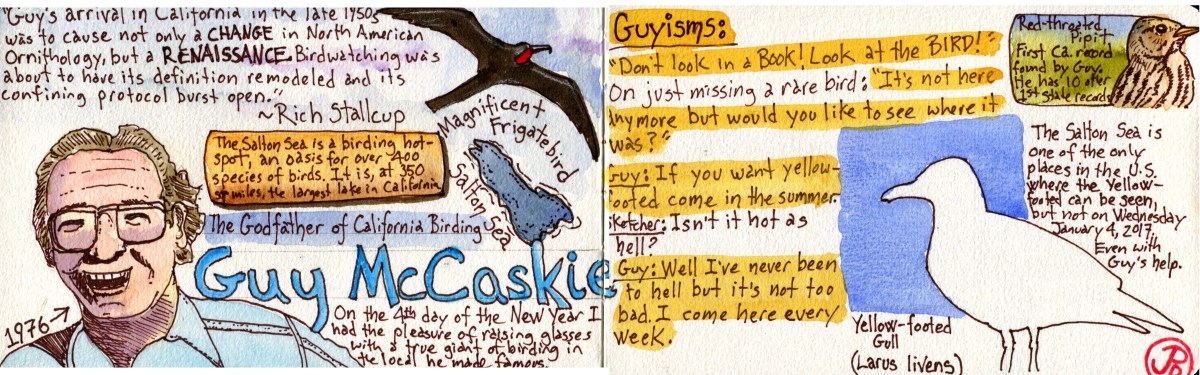
On my return along the Rock Hill Trail I came upon a group of three birders. Two younger birders (a man and woman) and a grandfatherly type, shouldering a tripod and scope. Upon seeing him, I knew immediately who he was, a California birding legend!

The man with a scope was Guy McCaskie. The late California birding legend, Rich Stallcup describes McCaskie impact on birding on the continent thus:

Guy’s arrival in California in the late 1950s was to cause not only a CHANGE in North American Ornithology, but a RENAISSANCE. Birdwatching was about to have its definition remodeled and its confining protocol burst open.

McCaskie, given the moniker of “The Godfather of California Birding”and  became known for finding migrant traps and chalking up 11 first state records of birds first seen in the Golden State. He also became, and stills is, a mentor to generations of California birders.

We scoped both sides of the trail for any large dark-backed gulls and we found none. If Guy McCaskie couldn’t find any yellow-footeds then there probably none within the reach of our scopes.

So instead of finding a yellow-footed gull, I instead found a living, California birding legend. Not a bad trade off.

Now I was off to the northwest to look for a phantom.

Image

GP in JT

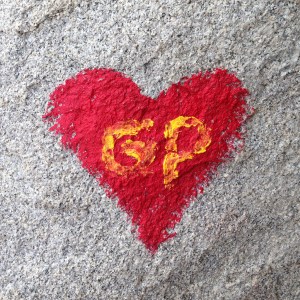
Joshua Tree National Park is most closely associated with one musician: Gram Parsons. This country-rock legend, who played with the Byrds and the Flying Burrito Brothers and created two classic solo albums GP and Grievous Angel, frequently made trips out to Joshua Tree. On some of these occasions he was accompanied by Keith Richards of The Rolling Stones, spending  time at night, searching for UFOs from the park’s boulder outcrops.

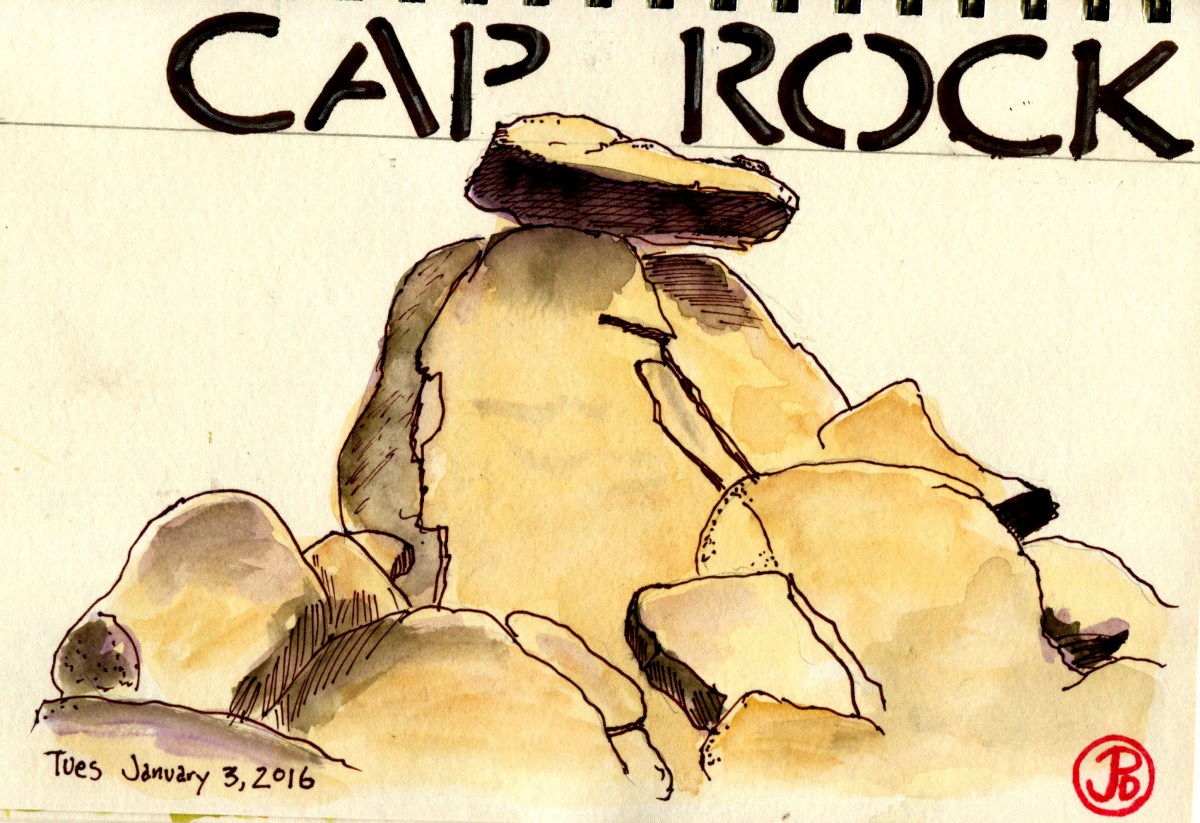
There are two locations that are destinations for any Gram fan: Room 8 at the Joshua Tree Inn (I stayed in Room 9) and Cap Rock.

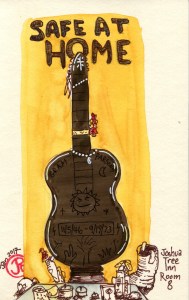
Room 8 is at the epicenter of Gram’s cult legend for it was in this room that he died on September 19, 1973 at the age of 26. He was just shy of joining the infamous “27 Club” whose members include: Robert Johnson, Brian Jones, Hendrix, Joplin, Morrison,  Pigpen, D. Boon, Richey Edwards, Kurt Cobain, and Amy Winehouse.

room-8

The memorial for Gram Parsons erected outside room 8 at the Joshua Tree Inn,  Joshua Tree, Ca. “Safe at Home” is the name of one of Gram’s early albums, then playing with the International Submarine Band.

Gram was another causality of the distructive rock and roll lifestyle, he was another musician cut down too early making many fans wonder what might have been. So far this seemed to be the typical rock and roll tragedy but things were about to get strange, very strange.

Gram’s body was sent to LAX to be flown to New Orleans. But Gram’s friends claimed that he had talked about having his ashes spread in Joshua Tree. So two of his drunk friends put on some suits, borrowed a hearse and convinced airport officials to release the body to them. They then headed east to Joshua Tree stopping to buy gasoline on the way. They took the coffin to Cap Rock, filled it with gasoline and set it on fire.

scan-174

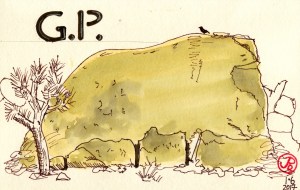
The boulder at Cap Rock where Gram Parsons’ body was set afire. To rock climbers it’s known as the Gram Parsons Memorial Hand Traverse. (The traverse can be seen at the base of the rock.)

Cap Rock is now an unofficial public shire to the legacy of the music and memory of Gram Parsons.

img_6235

Image

The Cabazon Dinosaurs

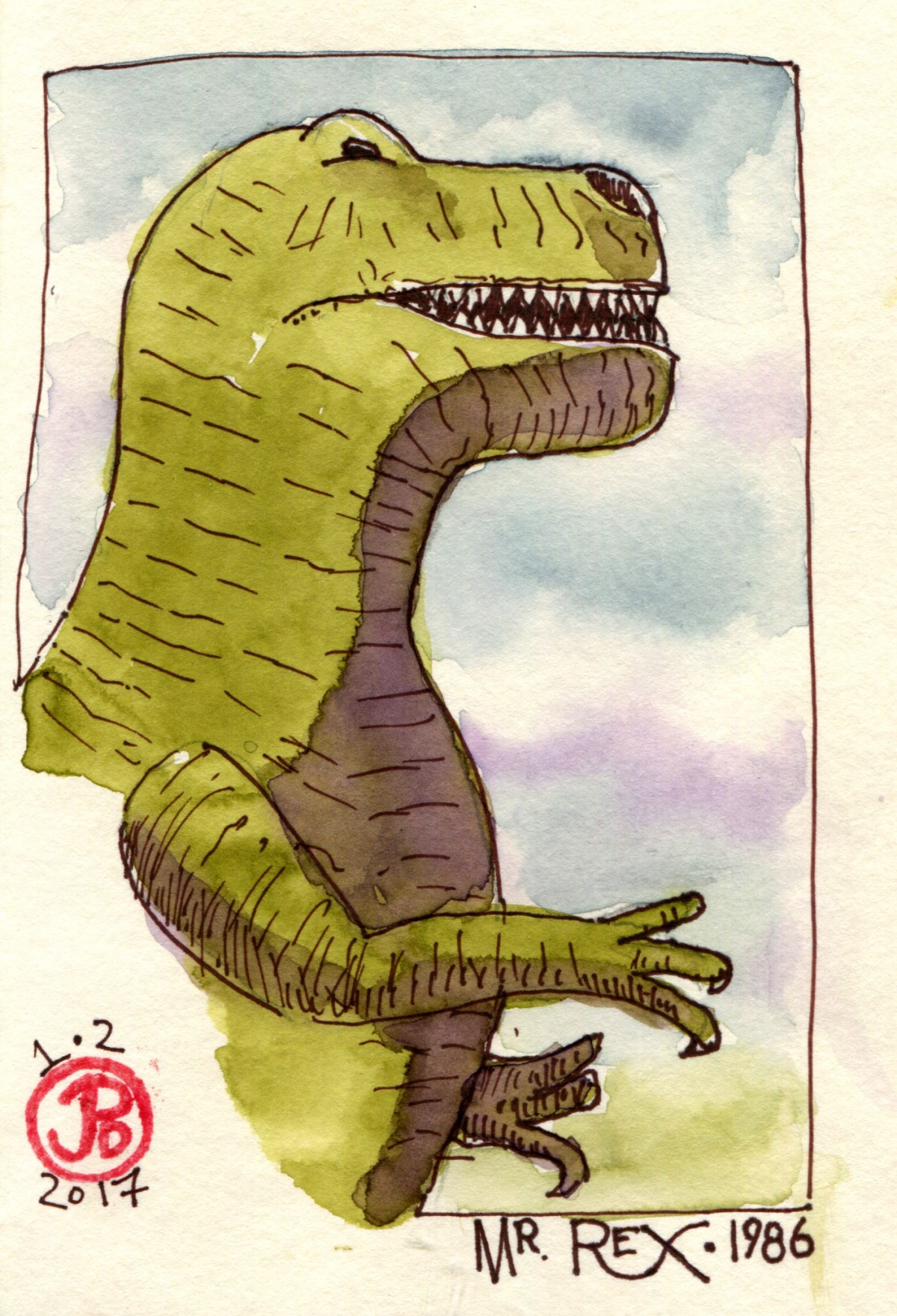
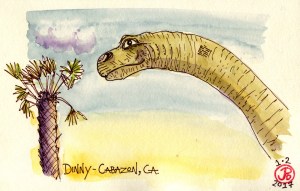
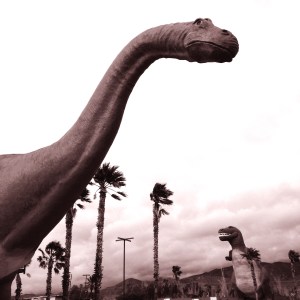
On the way to Joshua Tree you pass a very beloved roadside attraction off of Highway 10, the brontosaurs and tyrannosaurs rex statures/buildings known collectively as the Cabazon Dinosaurs or Claude Bell’s Dinosaurs.

This attractions was built by the Knott’s Berry Farm artist and sculptor Claude Bell to bring visitors to his Wheel Inn Restaurant. The brontosaurs, named “Dinny” was started in 1964 and completed eleven years later. The T. Rex, known as “Mr. Rex” was completed in 1986.

The dinosaurs became famous when they were featured in Tim Burton’s first feature length film, Pee Wee’s Big Adventure (1985). In the film Pee Wee Herman is dropped off by Large Marge (“Tell ’em Large Marge sent you!) at a truck stop (the Wheel Inn Restaurant) and he strikes up a friendship with the waitress Simone. Together they watch the sunrise through the teeth of Mr. Rex’s mouth.

dinny

Dinny is not only a stature but is a building, you can visit the gift shop in the brontosaur’s belly.

 saurs

The Wheel Inn Restaurant has now been demolished but Dinny and Mr. Rex still watch over the traffic on Highway 10.

Image

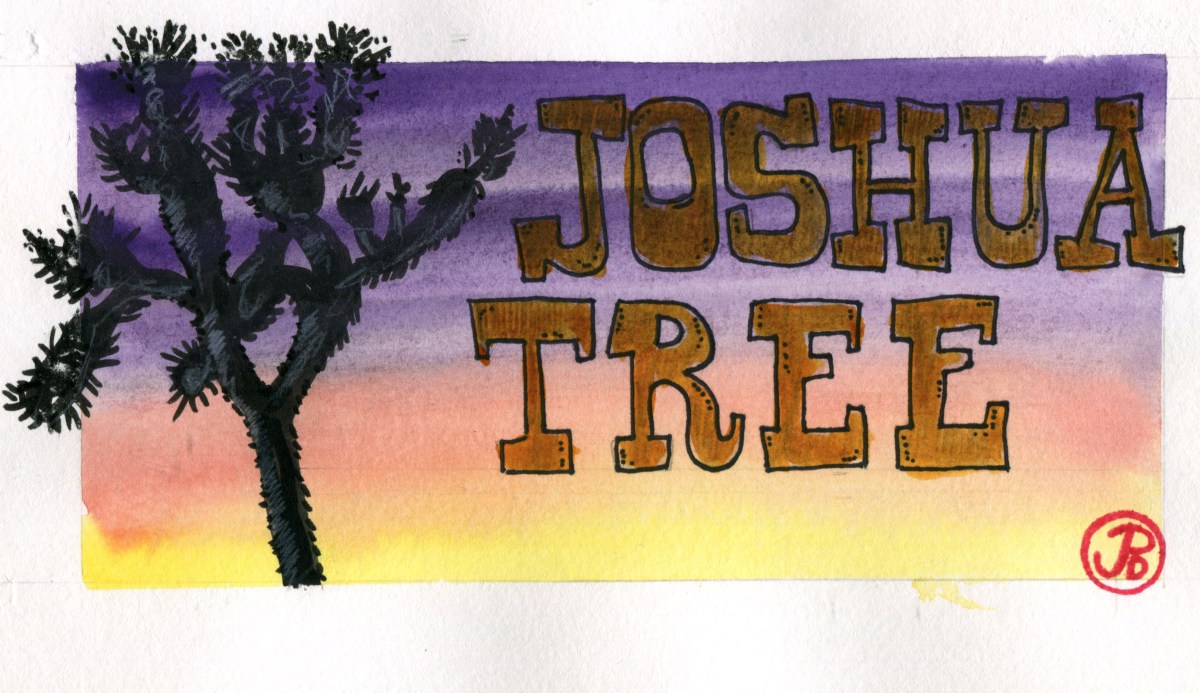
Joshua Tree

I spent the first week of the new year in a sketcher’s paradise. The high desert and alien landforms of Joshua Tree National Park.

As a subject, this almost 800,000 acre park, can seem overwhelming with amazing views and vistas everywhere you look. So where does a sketcher start? I just had to pick a landform and start sketching. It can be impossible to capture every single detail of the eroded rock of Joshua Tree so I use a bit of short-hand where the sketch can almost have a gestural quality. These warm up sketches helped prepare me for sketch the park’s namesake, the serpentine Joshua tree.

These trees are the symbols for the Mojave Desert, made world famous by the band U2 and their multimillion selling album Joshua Tree (1987) which featured a Joshua tree in the albums’s artwork. Musicians and artists have alway been attracted to this part of California. (More about Gram Parsons in a later post).

What follows are a few of the sketches from my Joshua Tree sketchbooks.

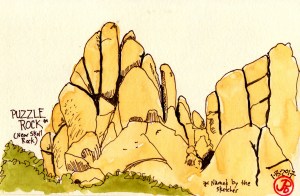
puzzlerock

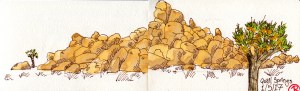
A rock formation near Skull Rock which I named “Puzzle Rock”.

quail-springs

A rock outcrop at Quail Springs sketched on a very windy late afternoon.

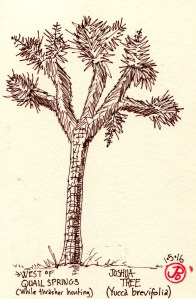
joshua-treetree

The puzzle-like Joshua Tree (Yucca brevifolia) sketched while taking a break from looking for the Le Conte’s thrasher at Quail Springs.

Image

Digisketching

On Christmas morning, with a temperature of 25, I headed down from the foothills of the Gold Country to the flats of the Central Valley. My goal was to practice digisketching: the act of sketching with the aid of a spotting scope. I also wanted to experiment with digiscoping, which is the art of  capturing an image with a camera through a spotting scope. I failed and succeeded in equal measures.

The area around my mother’s house offers many sketchable vistas. The epicenter is Gray Lodge Wildlife Area, just north of the Sutter Buttes. I headed there with scope, tripod, journal, watercolors, and pencils.

The advantages of using a scope for field sketching are numerous, including bringing wildlife much closer than binoculars, providing richer details, and  creating the ability to sketch animals in  a more “natural”, relaxed posture (because you are so far removed from your subjects).

As I neared the wildlife area, the fields and skies filled with birds. As the the retort of shotgun blasts punctuated the soundtrack of the mew of tundra swans and the bugle of flying Vs of snow geese, I attached my scope and tripod on a turnout of a two-lane country road.

dsc07060

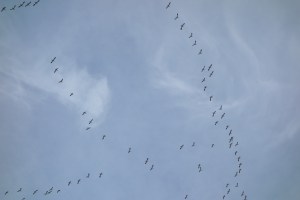
Winter skies above Gray Lodge are filled with snow geese.

dsc07160

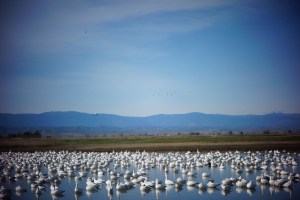
Thousands of snow geese over-winter in California’s Central Valley. It is estimated that a million ducks and half a million geese spend the winter in the valley. This is a mixed flock of snow and Ross’s geese at the Sacramento National Wildlife Refuge.
dsc07076

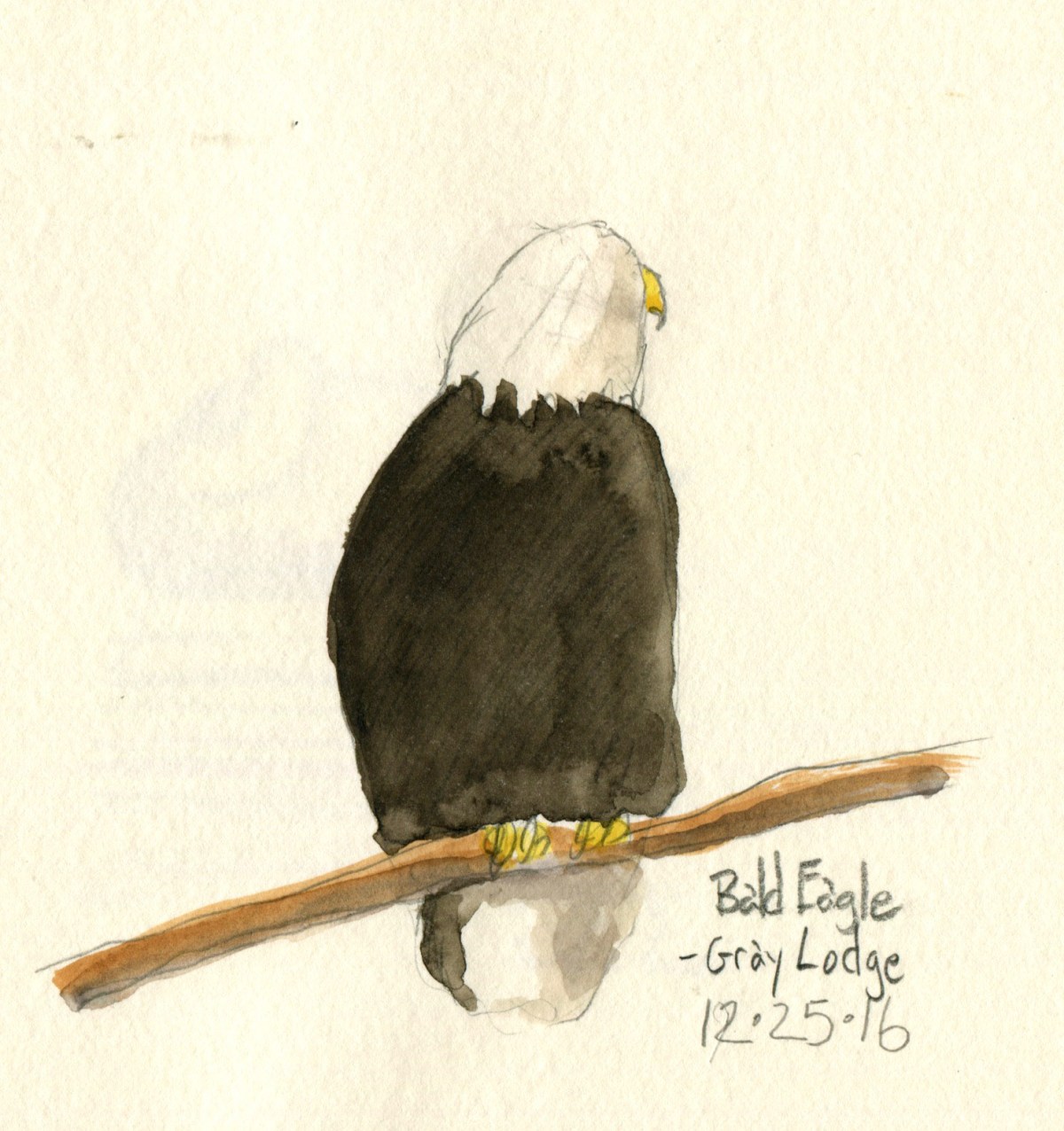
Digiscope shot of an adult bald eagle at Gray Lodge. The field sketch of this eagle is the featured image of this post. The spotting scope brought the far off eagle close so I could add the bird to my sketchbook.

dsc07087

Practice makes perfect. Digiscope shot of a group of sandhill cranes in fields south of the Colusa Highway.

Wildlife field sketching is really about letting go of the pretty picture. These are drawings that are not intended to be framed and displayed or even shown to friends. The end goal of these sketches are self knowledge and improving the eye and the hand when representing an animal in real time. It is a pursuit where mistakes are an opportunity to learn and improve. As I tell my students, “Always make new mistakes”.

juvbald

dsc07114

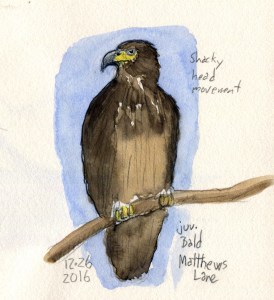
Digiscope shot and digisketch of a juvenile bald eagle seen and sketched on Matthews Lane.  It was later joined by another juvenile for a little duck hunting. They both returned empty-taloned. The vignetting on the left is a downside to the process but this image provides great visual notes that can be used to create studio sketches.

mergan

An easy lesson learned, sketch a bird at rest, they make obliging subjects. This is a common merganser resting on a pond near my mother’s house.

tundra

 dsc07141

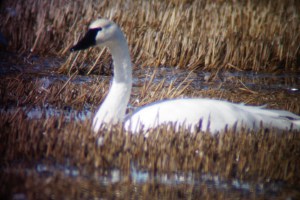
The stunning tundra swan overwinters in flooded fields in the Central Valley. The top sketch was of a bird off Matthews Lane and the digiscope shot was of a swan off of Jack’s Slough near Marysville.

Image

The Making of a Linocut Christmas Print

For the past ten years I have created a holiday linocut (linoleum) print and given it out during Christmas. This has been a turning away from the pervasive commercialism of the holidays and creating something from the heart and by the hand. This year I sketched out designs before carving the final lino block.

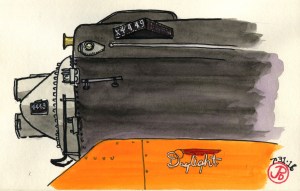
The inspiration for this year’s print was an image that kept reappearing in my thoughts and journal pages. It stemmed from my summer’s visit to Portland, Oregon and the beautiful streamlined 1941 steam engine, a Southern Pacific GS-4 , numbered 4449. This engine I strongly connected with memories of my father and the time we spent chasing the engine on rail excursion across the Golden State and once were even passagers on an excursion from San Francisco to Los Angeles.

img_5100

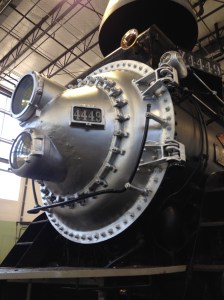
The iconic hood of 4449, which appeared in many sketches since seeing the engine for the first time again. The typhoon air horn on the upper right, was used to cut throught the thick coastal fog on the Coast Daylight’s route. 

4449 no1

The first field sketch I did of 4449 at the Oregon Heritage Railway Center in Portland. I knew that I wanted to do a linocut print featuring the unmistakable profile of this engine.

It took a few months to decide how to represent the engine in a wintery theme. In reality the engine, which was in service on the California Coast, was more likely to encounter a fog bank rather than a snow bank, but that’s why I have an artist license.

Relief printing is the opposite of field sketching. In the field there is a sense of spontaneity, of whimsy and surprise. With relief printing, everything is planned out and there is very little room for improvisation. And to top that, you have to think backwards. So it is a medium that takes patience, planning, and vision. 

daylight-in-winter

Daylight in Winter. This was one of the first really polished sketches, with color, of the lino cut design.  With this sketch, I hit upon the element of the pine tree in the background.

daylight-presketch

This is a pre sketch with notation as I was finalizing my design before carving the lino block. You will notice that it sketched as it would look on the block, the engine going left to right. When the block is printed the image is reversed, the engine going from right to left.

The linoleum key block and the final hand tinted relief print (in watercolor) above. 

Image

The Long View

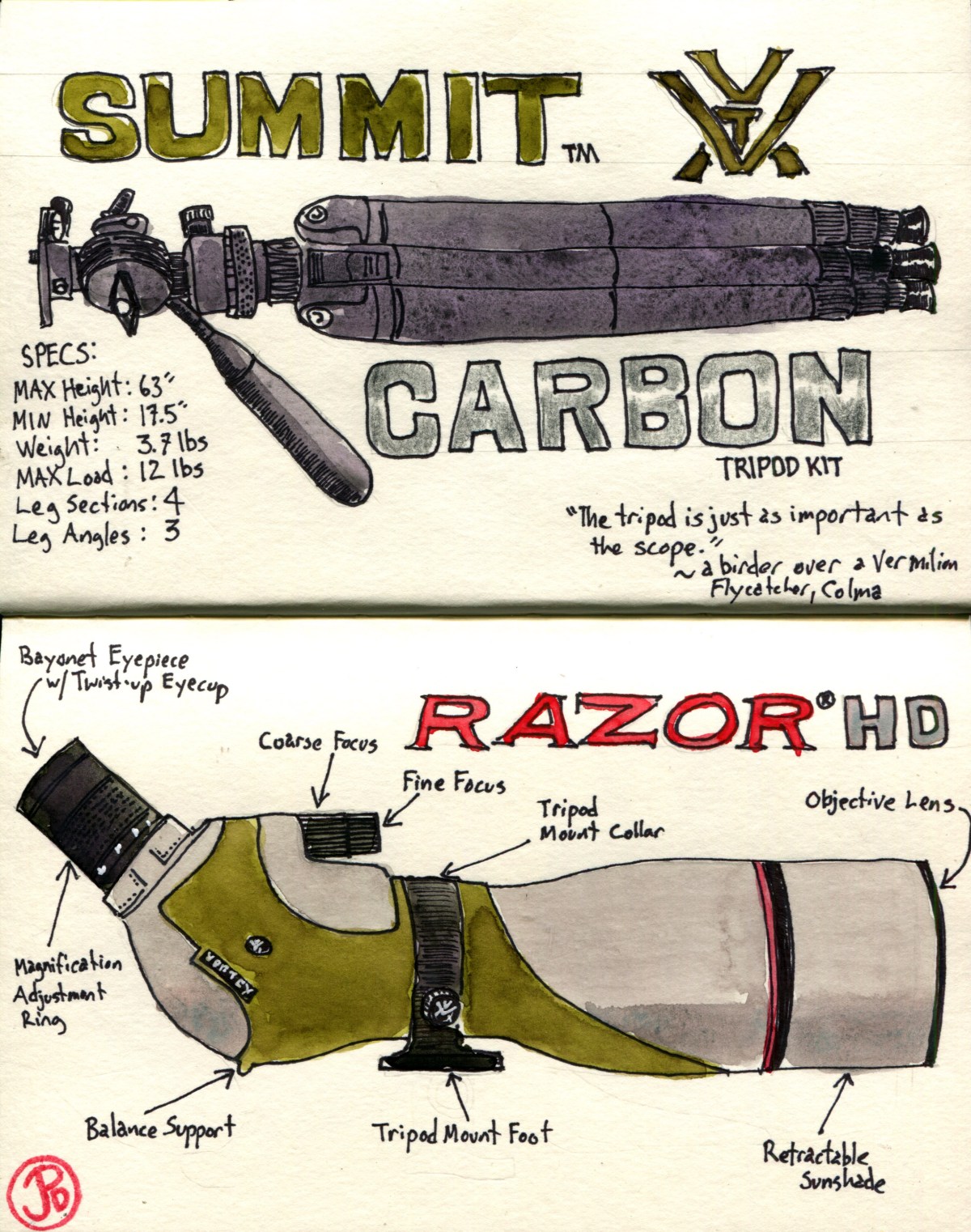
I finally took a great leap forward in my birding by purchasing a scope and tripod. This way I could  observe faraway birds without disturbing them, discern  minute feather patterns, and also it would allow me to sketch, hands-free, in the field.

Now it was time to field test the scope and I could think of no better place to use the scope than the country roads north of Highway 12 near Rio Vista. This area is collectively known as Robinson Road and is a hotspot for wintering raptors, burrowing owl,  and mountain plovers. This was the wide open openness that was made for scoping far off birds.

After scraping ice off my windscreen I headed north and rendezvoused with Dickcissel and Brown Creeper. It was one of the coldest mornings of the season and the sky was crisp and clear, a perfect day for the long view.

We arrived about an hour later and headed off 113 on Robinson Road. We scanned the fields to the north, trying to pick out the cryptic ground plover. A far off tawny bird caught my attention and I lined up my scope to capture the first bird to be seen through my new optics and it was a good one, a ferruginous hawk, Buteo regalis.

Our next target birds were mountain plover and rough-legged hawk. Robinson Road turned to the south and we willed a far off perched raptor to turn into a roughy but not even the scope could give a positive id.

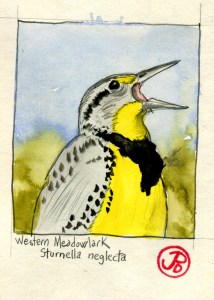
meadowlark

The beautiful call of the western meadowlark was our constant soundtrack on Robinson Road.

Further down the road we had an outstanding  overhead view of a light adult ferruginous hawk that seemed to appear out of the warm winter sun.

To our right was a freshly plowed field, ideal habitat for mountain plover. The road turned to the south, keeping the field to the right. I saw a large group of birds on either side of a farming road that bisected the plowed field. A scope view revealed a large group of killdeer with horned lark and western meadowlark mixed in. This was a very good sign. I scanned to the left of the mixed killdeer flock and that’s when I got our target bird, a flock of about 30 mountain plover; a real ponderous of plover! We had great views of these birds whose entire population is estimated to be at 11,000 to 14,000 birds.

After watching the plovers disappear simply by turning their brown backs to us, thereby melting into the plowed field, we headed south to the intersection of Robinson and Flannery Roads. This intersection always produced burrowing owl. And without fail, Brown Creeper spotted one, crouching on a roadside berm. The scope revealed the owl’s piercing eyes and swivel head.

Heading west on Flannery the raptor activity increased with harriers, red-tails, and ferruginous. One bird, rising in circles above the road caught my attention. It turned towards me and its bold carpal patches screamed rough-legged hawk! Lifer for Dicksissel and Brown Creeper. A toast was in order!

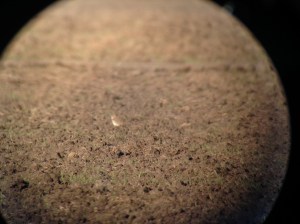
img_5894

That little dirt claude is the much sought after Robinson Road specialty, the poorly named, mountain plover. From a digiscope photo.

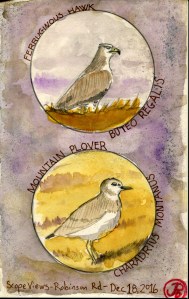
scopeview

Two birds, ferruginous hawk and mountain plover, which where identified with the aid of the scope.