Image

First Flights Over Aptos

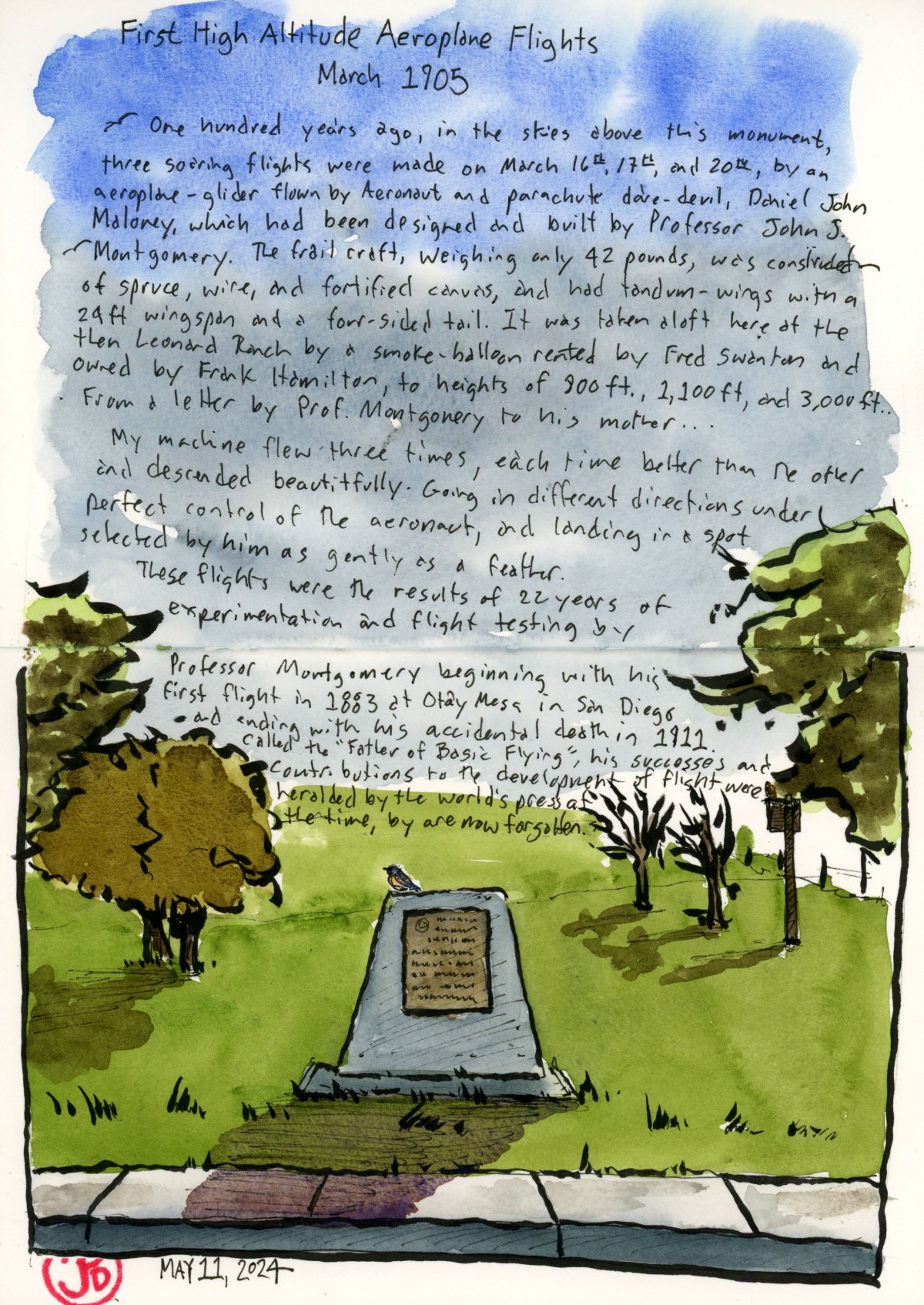
Down a cul-de-sac in a part of residential Aptos I have never explored before there is a monument to aviation at the edge of a green field.

This is what these hidden monuments are for, to reminds us of the anonymous people who have loved, lived, and lost who had come before us. The ones, on whose shoulders we stand, that have changed the world in ways we don’t understand or acknowledge.
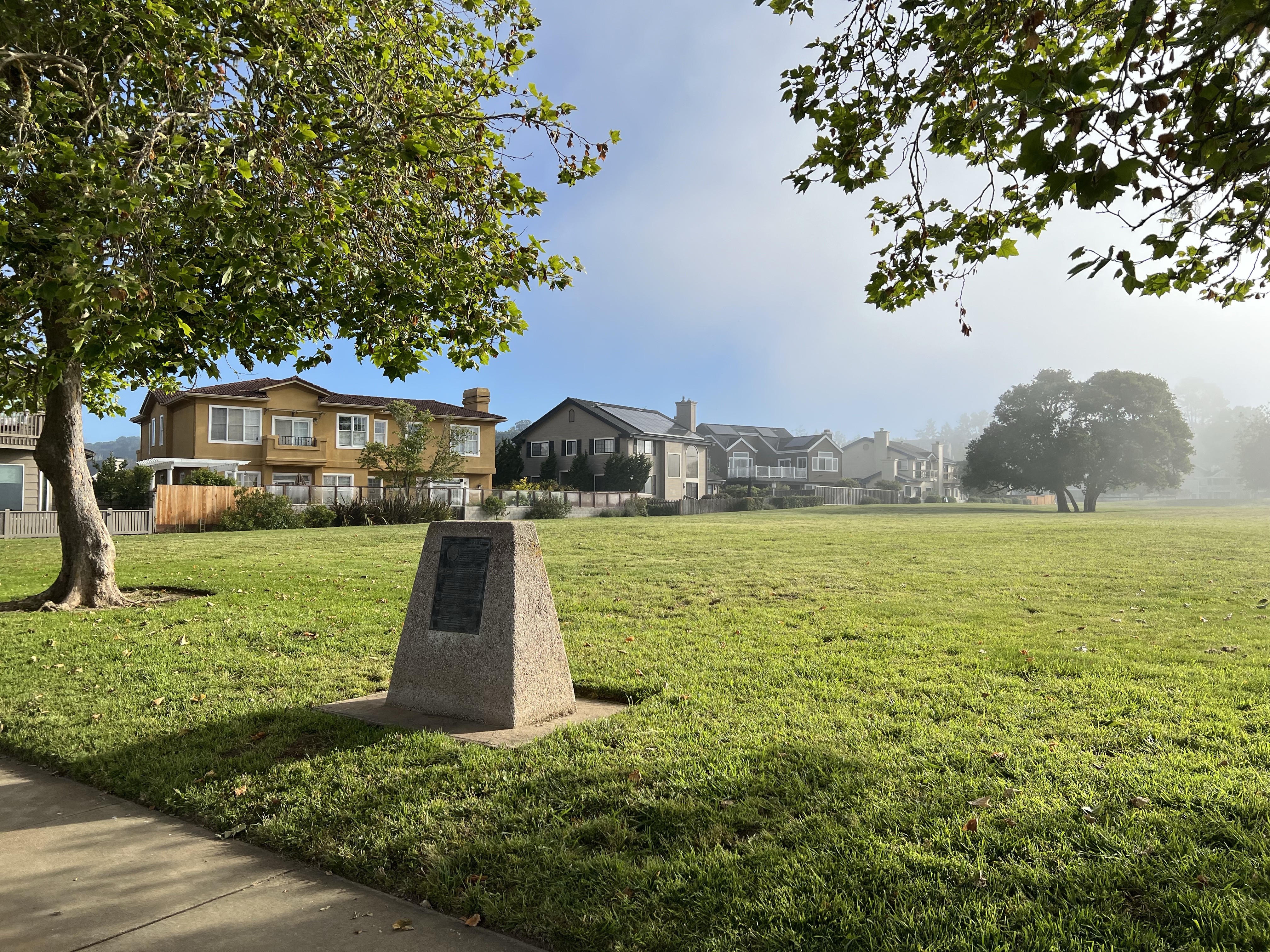
The plaque on the monument reads:

One hundred years ago, in the skies above this monument, three soaring flights were made on March 16th, 17th, and 20th, by an aeroplane- glider flown by Aeronaut and parachute dare- devil, Daniel John Maloney, which had been designed and built by Professor John. J. Montgomery.

The frail craft, weighing only 42 pounds, was constructed of spruce, wire, and fortified canvas, and had tandem-wings with a 24 ft. wingspan and a four sided tail. It was taken aloft here at the then Leonard Ranch by a smoke-balloon rented by Fred Swanton and owned by Frank Hamilton, to heights of 800 ft., 1,100 ft., and 3,000 feet. The longest flight lasted over 18 minutes and covered over 2 miles…From a letter by Prof. Montgomery to his mother…

My machine flew three times, each time better than the other and descended beautifully. Going in different directions under perfect control of the aeronaut, and landing in a spot selected by him as gently as a feather.

These flights were the result of 22 years of experimentations and flight testing by Professor Montgomery, beginning with his first glider flight in 1883 at Otay Mesa in San Diego and ending with his accidental death in 1911. Called the “Father of Basic Flying”, his successes and contributions to the development of flight were heralded by the world’s press at the time, but are now largely forgotten.

The plaque was erected in 2005 by E Clampus Vitus El Viceroy Marques de Branciforte Chapter 1797, E Clampus Vitus Capitulus Redivivus Yerba Buena #1, Hiller Aviation Museum San Carlos Ca,. Aptos Chamber of Commerce and Museum Capitola/Aptos Rotary.

Now the monument serves as a perch for western bluebirds and the green field is used by a murder of crows for foraging. Off to the right is an owl box that a pair of red-shouldered hawks use as a hunting perch.

119 years ago, a frail, 42 pound glider soared above this field. Now it has been returned to the true masters of flight: the gulls, corvids, and hawks that effortlessly glide above.

But if you look further above you will see the great grand children of Montgomery’s passions: the modern passenger jet on final approach to SFO and SJO.

Image

Long in the Tooth

In late May, something interesting washed up on Rio Del Mar Beach in Aptos on the shore of Monterey Bay. It was not your standard bit of driftwood, a dead marine mammal, or a piece of flotsam from Japan.

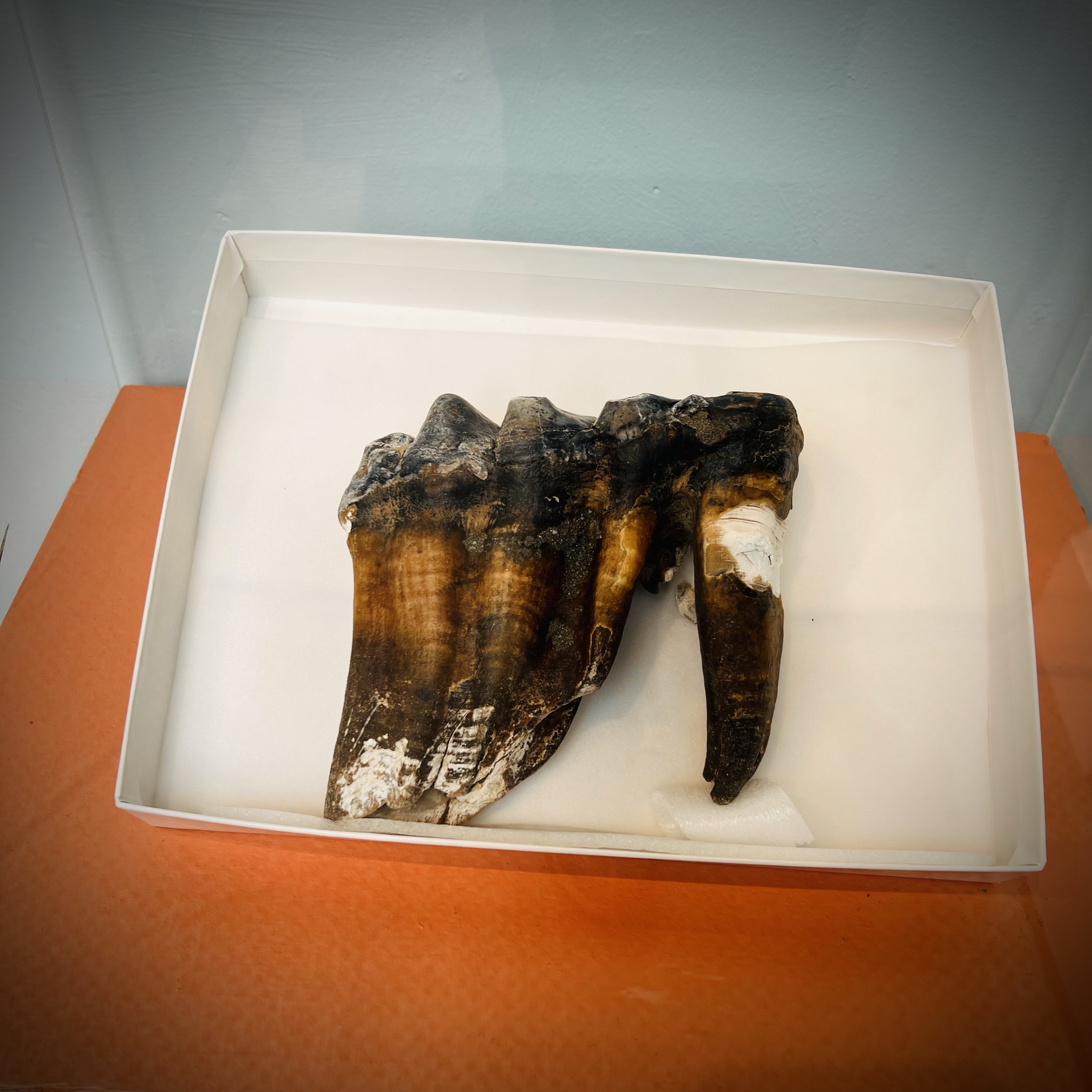
In fact the jogger who found it did not know what she found, so she took a picture of it and did what most of us seem to do nowadays: she posted the picture on social media. Someone who did know what it was saw the post and that person was Wayne Thompson, the Paleontology Advisor for the Santa Cruz Museum of Natural History. He identified the object as a tooth from an extinct mastodon!

When they returned to the beach the tooth was gone. So a search was begun to find where the molar tooth has gone through national and even international media. The efforts soon turned up the tooth. A local man saw the tooth on the beach and took it home. He saw that this was being sought after and he called the Santa Cruz Museum of Natural History.

The tooth was put on display at the museum for three days on the first weekend in June. And that is where I saw the tooth and sketched it.

The recently found mastodon molar in a box, on display for three days at the Santa Cruz Museum of Natural History. I sketched it on the second day.

When I first stepped into the museum, it was much busier than usual. In front of the mastodon display stood the man himself, Wayne Thompson, being interviewed by a local news station. He told the reporter that the tooth was probably washed down Aptos Creek during the record rains of 2023 and then washed up onto the beach. This was a big story. I was told that NPR would be visiting the museum on Monday.

Mastodons are related to the wooly mammoth and the modern elephant. The Pacific mastodon (Mammut pacificus) once roamed the land that became California between five million to 10,000 years ago. So the tooth was an incredible and rare find. In fact the name mastodon comes from ancient Greek meaning “breast tooth”, referring to the nipple-like appearance on the crown of the molars.

Mastodons disappeared from North and Central America about 10,500 years ago. It believed that the mastodon was driven to extinction by early human hunters.

Image

Santa Cruz Sapsucker

For some reason I have a sapsucker blindspot in Santa Cruz County.

I have done more international birding over the past few years but because of Corvid 19, I have been forced to bird inward. And I kinda like it. And the focus of my county list has been Santa Cruz.

A resident (human, that is) along Trout Gulch Road in Aptos had reported a red-naped sapsucker, coming in to feed on an old apple tree in his yard. I wanted to boost my sapsucker numbers because my current Santa Cruz sapsucker count stood at: 0.

The home owner is a bat biologist and birder who knew the difference between a hawk and a handsaw, and for that matter a red-breasted from a red-naped sapsucker. He was kind enough to let me bird from his driveway. He had even set up a camp chair for visiting birders. This highlights the friendliness of the Santa Cruz birding community that is not just about seeing a rare bird but also repaying the favor so others can see a rarity as well.

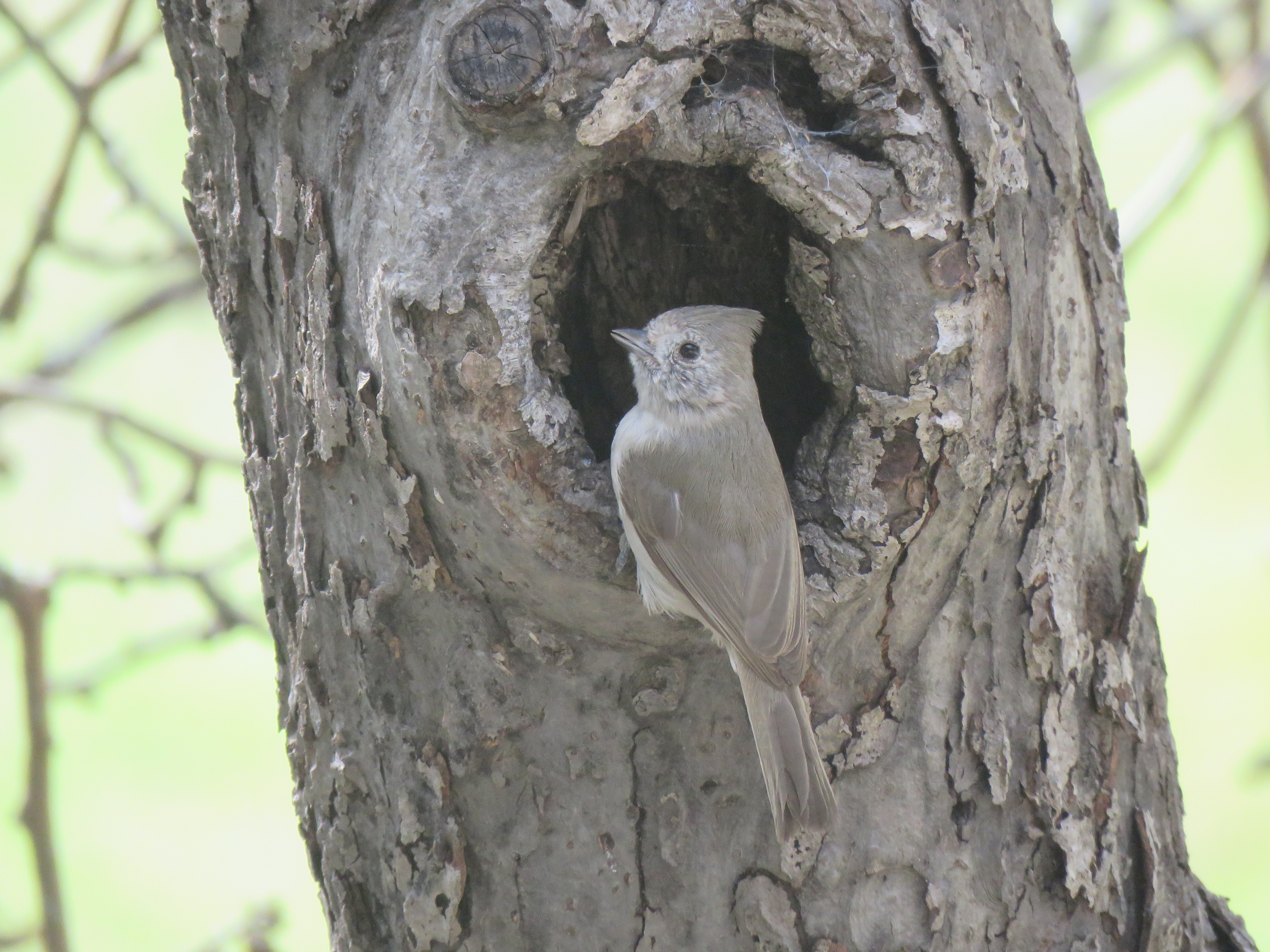
This stretch of Trout Gulch was very birdy, with expansive views of the skies above. Red-tailed hawks circled above and a pileated woodpecker called from the trees across the road. A merlin hightailed it to the south and five high flying swifts moved south. As I waited for the red-naped sapsucker to appeared I became immersed with the micro avifauna. The Anna’s hummingbird had his feeding route and returned to the prominent percent in front of the house. A pair of Oak titmice flew in to investigate a possible nesting nook.

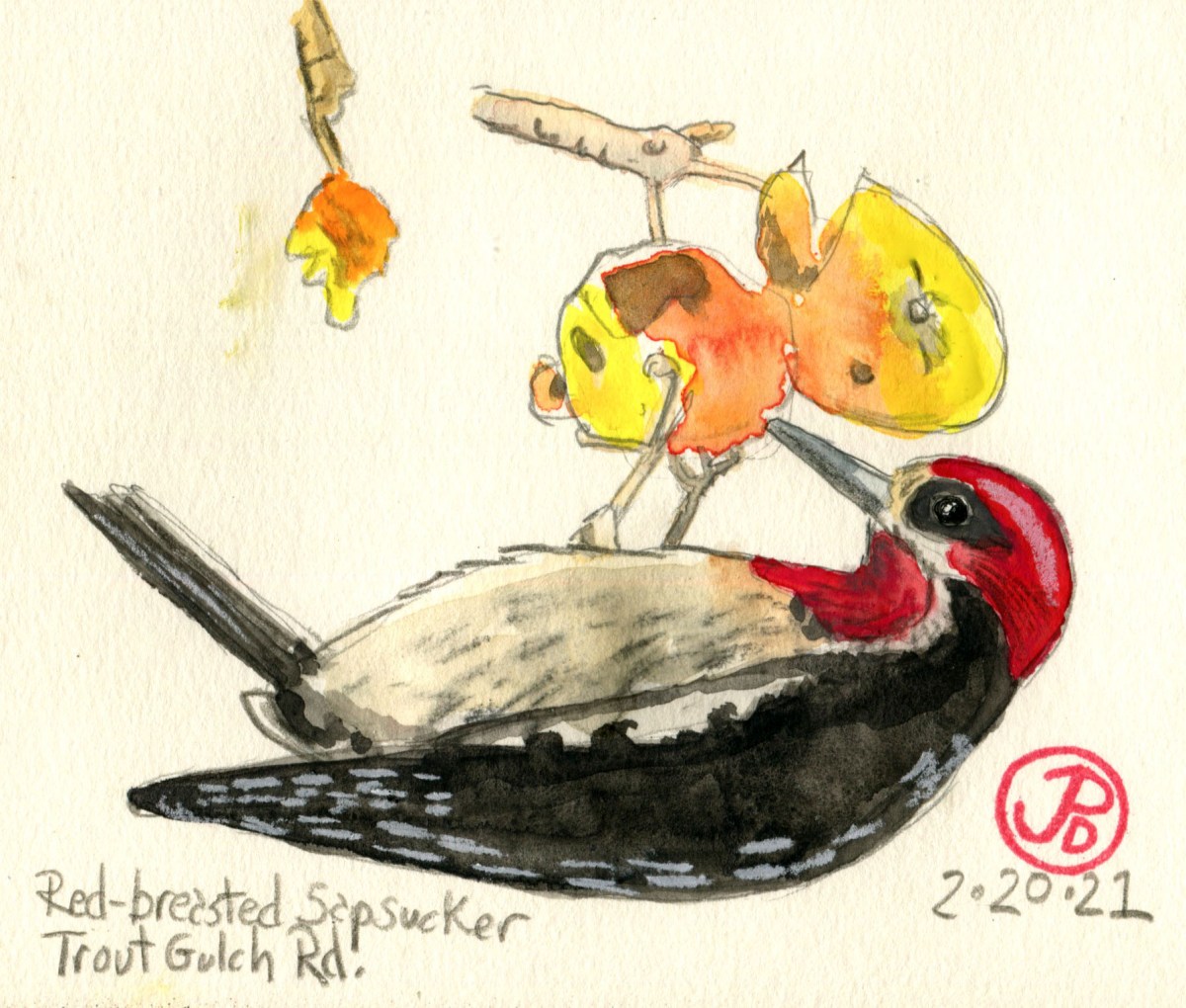
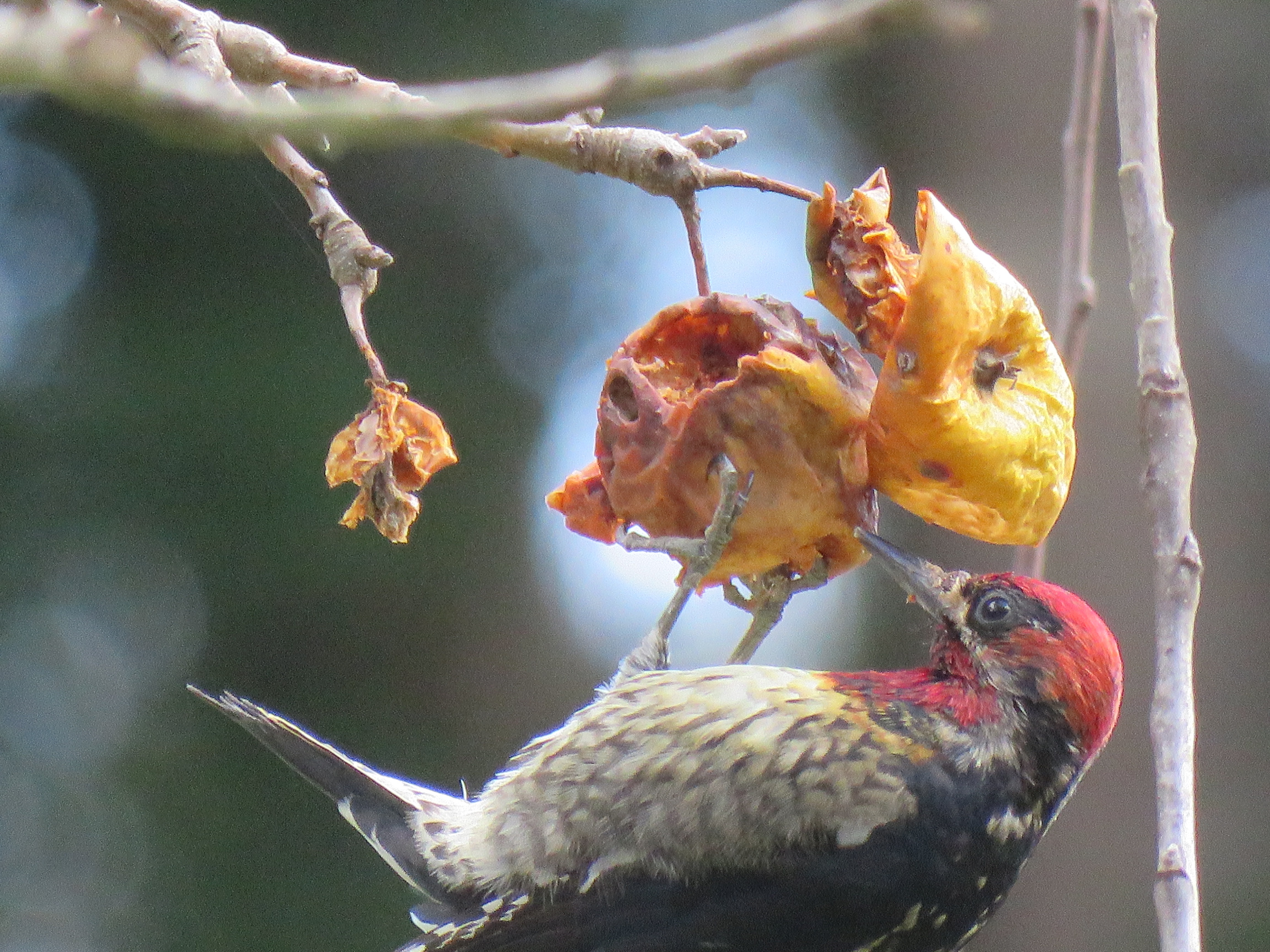
Within the first 30 minutes of my wait, I had a sapsucker! This was a new county bird but but it was the more common red-breasted sapsucker and not the desired red-naped. It flew into the old apple tree and perched on an apple and pecked at it from below. This was a promising sign because the two sapsuckers fed at this tree.

The red-breasted sapsucker having an apple lunch.

This gave me hope that the red-naped was still in the area and it was only a matter of time before the bird would return to the apple tree. So I sat down in the camp chair and sketched to pass then time.

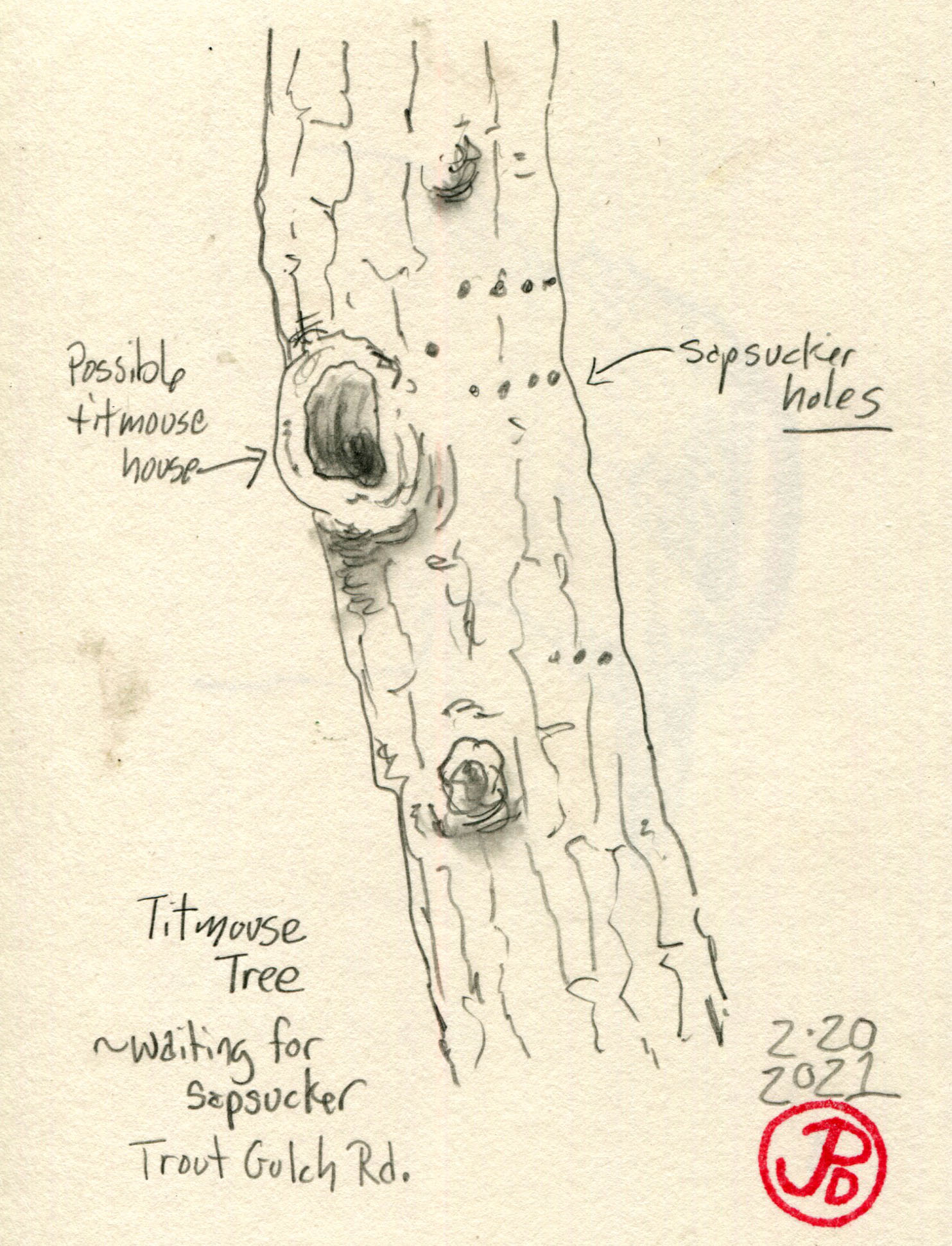
A pencil sketch of the “titmouse” tree. I love to sketch with pencil. It is such a basic tool and the foundation of so much work.

I first sketched the bole of the tree to my right. it was riddled with sapsucker holes. This was the tree that the two oak titmice investigated and I added the potential nesting cavity into my sketch. I next sketched the twisted old apple tree that the sapsuckers favored (but so did the chickadees and juncos.)

I waited for three hours and I decided to end my wait, knowing full well that the red-naped would appear just after I left, with no one to witness it’s continuing existence.

But the experience was so much more that adding a sapsucker to a county list. It was about being in a moment in a beautiful yard, watching the yardbirds and talking with a bat biologist. And it was all made possible by the red-naped sapsucker that refused to show itself in the old apple tree on Trout Gulch Road.