Image

A Sunday Morning Twofer

The Westside of Santa Cruz has been recently active with fall migrants, including a few species that are considered rare in California.

I set out early on Sunday morning and the most challenging part of my migrant search was getting to the Westside of Santa Cruz. Streets where blocked off because of a bicycle race which made getting to the Homeless Garden and Antonelli Pond a chore. Highway One was blocked off at Western Drive and I was hoping the two rarities seen the day before would still be in the area. Now I waited, a bit impatiently, as a CHP officer let in a trickle of traffic at Western Drive, in between clumps of cyclists.

I finally made my way across the intersection and turned left on Shafner, which was also blocked off by a CHP officer. Here was where two passions collided: birding and triathletes. And the triathletes were winning.

I found parking at the end of Shafner and crossed the rusted railroad tracks and headed into the Homeless Garden. The garden was already occupied by five birders, with their large lens, looking for the first of the rare migrants on my list: bobolink.

After wandering around for ten minutes, I noticed a triad of birder-photographers with their lens pointed at a row of tall purple flowers. This is always a good sign because I reckoned they where not photographing a white-crowned sparrow or a lesser goldfinch but a rarer visitor called a bobolink.

What’s in a name? Well bobolink is onomatopoeic of it’s call. Other birds whose common name is derived from the sound of it’s call are: chickadee, whip-poor-will, dickcissel, bobwhite, chachalaca, hoopoe, killdeer, poorwill, willet, kookaburra, and of course the cuckoo.
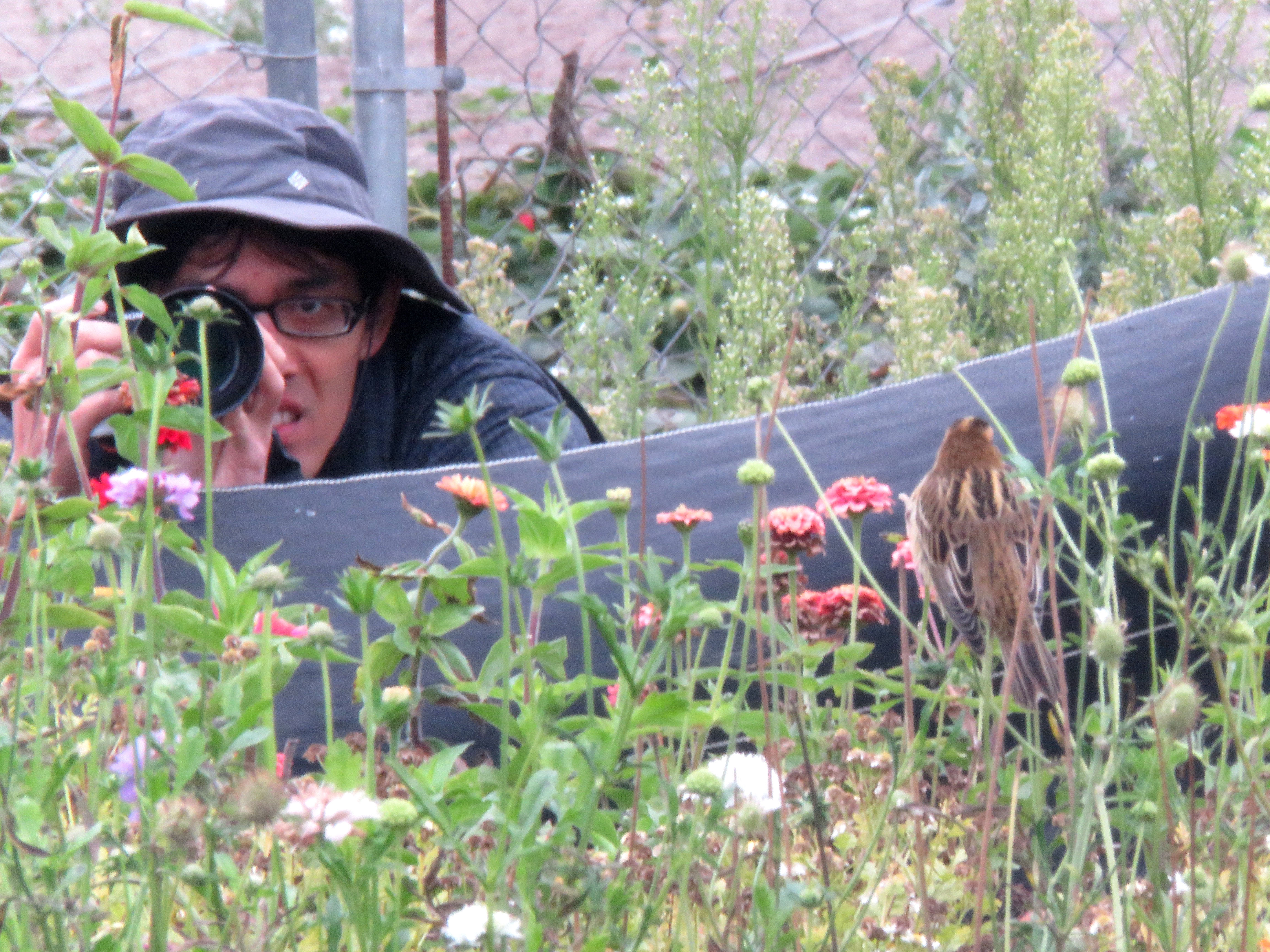
The bobolink with it’s attending birding paparazzi at the Homeless Garden.

And now back to the Homeless Garden in western Santa Cruz: it turns out that the bird all the birders where looking at was the bobolink. The bird was very accommodating as it perched up on the vegetation and held relatively still.

Bobolink (Dolichonyx oryzivorus) at the Homeless Garden in Santa Cruz.

Now I was going to try for the second county bird (and third for the weekend) and this bird was much rarer. This bird had only been recorded in Santa Cruz County once before. I had first seen a white-eyed vireo in Southern Texas in 2013. Now one was out on the West Coast.

I headed east down the railroad tracks and I could see about ten birders peering into the bushes on either side of the track. I had passed two birders who had already given up on the bird and where heading to the garden to look at the bobolink.

Now sometime magic happens in birding. Where you happen to be at just the right place at just the right time. Such was the case as I approached the group of birders and was just about to ask if they had had any luck with the vireo when one of the birders exclaimed, “There’s the bird!” And pointed into the top of a rail side tree. Some of the birders and been searching for the vireo for over two hours and here I come, Johnny- Come-Lately, and the bird seems to appear out of nowhere.

I got bins on the foraging vireo, two white wing bars, yellowish wash, white throat, and a distinctive white eye with a dark pupil. This was the bird all the birders were here to see. White-eyed vireo!

The vireo moved from tree to tree and at one point was foraging with a mixed feeding flock in a pine. Beside the white-eyed, the flock included warbling vireo, pygmy nuthatch, Townsend’s warbler, chestnut-backed chickadee, dark-eyed junco, Bewick’s wren, oak titmouse, both downy and hairy woodpeckers, and bushtits.

As we searched the feeding flock in the pine, we where joined by more birders. I could only gesture to the place where the white-eyed vireo used to be but had not been seen in the last few minutes. We where joined by more and more birders and a tallish, bespectacled man stood to my left peering into the pine. And here is where I used my odd and often under-appreciated superpower: identify obscure “celebrates”.

Low and behold, the birder standing next to me was none other than the acclaimed novelist, Jonathan Franzen. He is the the author of the National Book Award winner, The Corrections (which I have not read). He is also a birder and has written essays about birds and birding (one essay is titled “My Bird Problem”). Franzen now lives in Santa Cruz, which explains why he was here on a Sunday morning, attempting to get a glimpse of the wayward vireo. I’m not sure he got that glimpse because I returned to my car shortly afterwards with a county twofer.
Image

Wild Godwit Chase

A rare godwit from Siberia has been hanging around with a group of marbled godwits on the Monterey Bay Coast in Santa Cruz County. And I was going to try and find it!

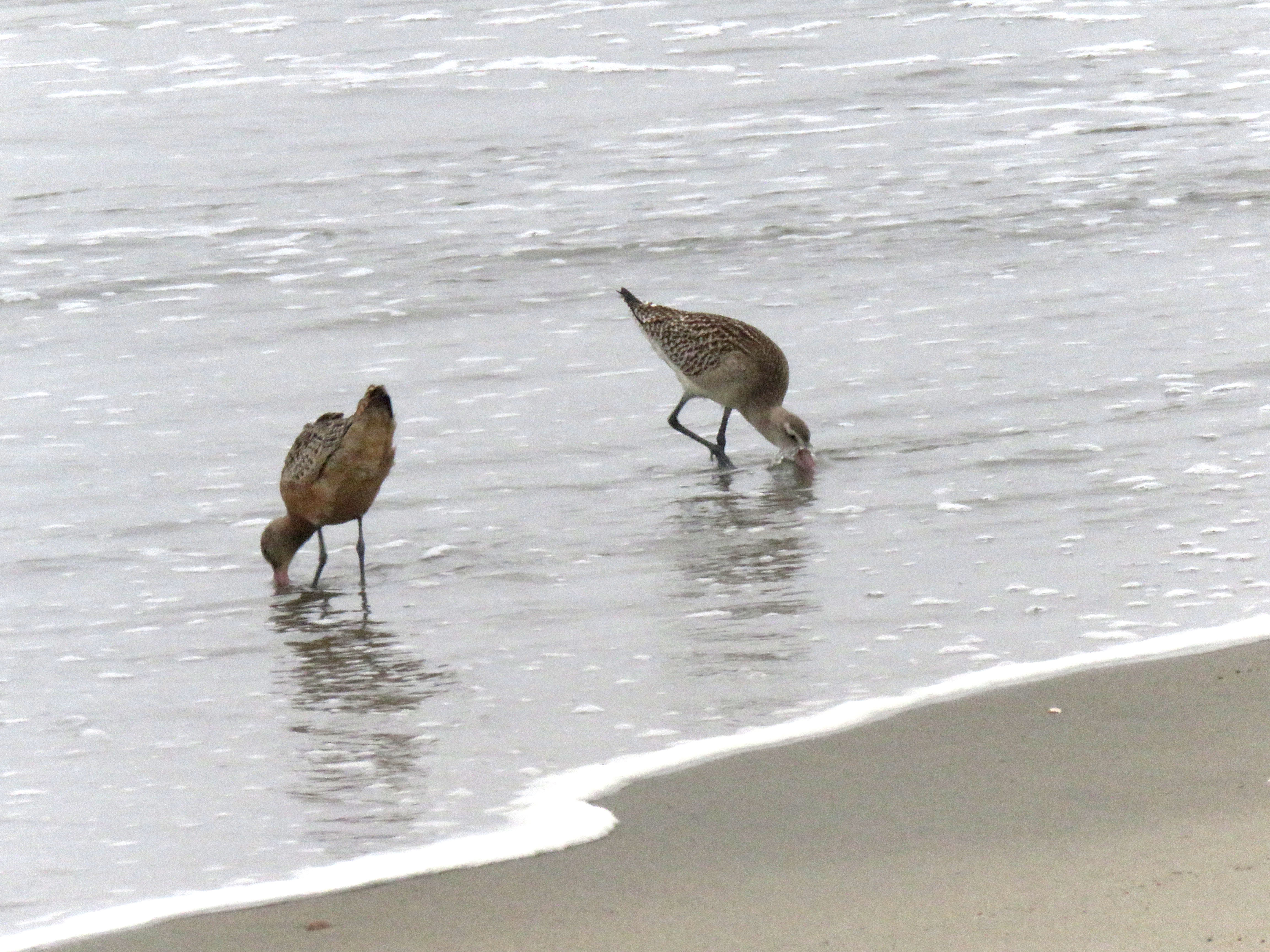
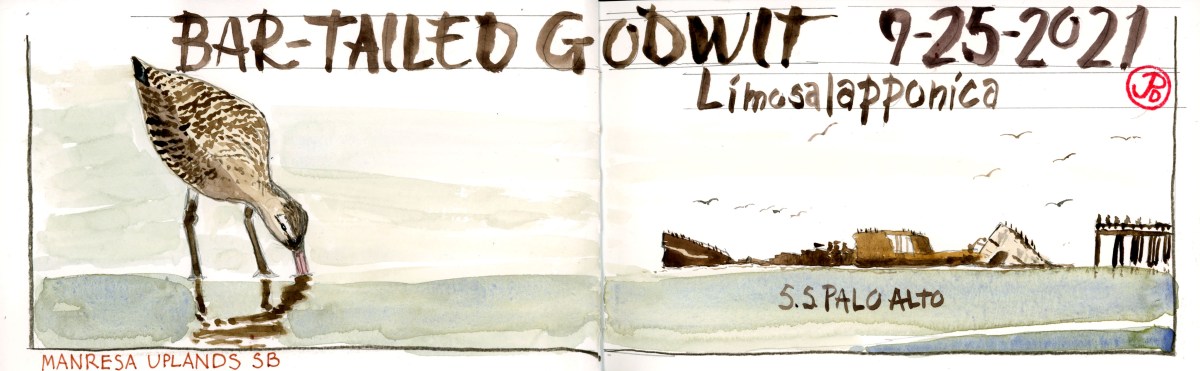
The bar-tailed godwit (Limosa lapponica) could easily be passed over when scanning a flock of foraging godwits. The differences can be subtle, especially if you don’t know what your looking for. The bar-tailed is slightly smaller legged and slightly smaller than the marbled (the difference in size is slight, marbled: 370 grams and the bar-tailed: 340 grams). The bar-tailed has a defined light supercillium (eyebrow) and it’s back is more darkly streaked than the commonly coastal marbled godwit.

This was either going to be a very easy find or a taxing struggle because the godwit flock could be anywhere on the long stretch of beach from Seacliff State Beach in Aptos to Sunset State Beach farther south in Watsonville. I anticipated a lot of leg work over sandy beaches to find the flock.

I first headed to the most northerly location where the flock had been seen: Seacliff State Beach. It is here that the hulk of the SS Palo Alto is rolled over on it’s port side like a huge, beached whale. I scanned the beach from the bluff. No godwit flocks. So I headed down the wooden stairs, used by locals as their personal gym, to the beach below. I headed south and there was a gull flock at the creek sans godwits. I returned to Highway 1 and drove three miles south. It looks like this godwit search was to become my own personal workout.

One of the best things about local birding is that it exposes you to new places, even in your own backyard. Such was the case as I exited Highway 1 at San Andreas Road and passed through La Salva Beach and headed further south. I turned right, heading towards the Pacific. My destination was the trail to Zills Beach. I reckoned that I was somewhere near or in Watsonville.

The trail to the beach that borders an agricultural field.

I headed down the trail, shouldering my scope and tripod. I reached the beach in about five minutes and looking to the south and the north, I did not see any shorebird flocks. Unfazed I decided to try my luck to the north, heading towards Manresa Beach. I set up my scope, to save some legwork, and scanned the water’s edge. I spotted some small peeps, in this case sandering. Beyond the sandering were some larger shorebirds which I hoped were godwits and if they were a flock of godwits, I hoped one of them had a white eyebrow and a darkly streaked back! I shouldered my scope and headed north down the beach to find out.

As I got closer I scoped the flock and indeed, confirmed that it was a flock of marbled godwits but I was too far away to identify a godwit that looked a bit different. As I came closer to the flock I came upon a family of five that was slowly heading up the beach. Lucky a pod of dolphins, frolicking in the inshore waters, was distracting them and they stopped to watch. They were heading towards the godwits too and I was hoping that they wouldn’t flush the flock before I had a chance to identify the bar-tailed. These shorebirds have wings and are at a distinct advantage, should the flock hightail it down the coast to Sunset Beach! That would be a lot of trudging in the sand. A good coastal workout I suppose.

With the family of five preoccupied with dolphins, I headed away from the waterline, in a flanking maneuver to take me closer to the flock without flushing them. I set up the scope and scanned the godwits, left to right, looking for the one that didn’t quite belong. After a short search, I spotted a godwit with a light supercillium and a darker streaked back, compared with the nearby marbled godwits. Bingo! Bar-tailed godwit!

The bar-tailed godwit on the right and a marbled godwit on the left.

I spend about 15 minutes with the bar-tailed, getting scope views and taking photos before a a woman with golden retriever, who was heading south down the waterline, flushed the godwit flock. I traced the flock’s flight down the shoreline toward Sunset Beach. It was inevitable that a dog walker would walk along and send the flock to another part of the beach. At least the golden was on a leash. And I had some good looks at the bar-tailed godwit before it lifting into the air.

Here was an interesting find on the strandline, a former mola mola or ocean sunfish.

As I headed back south along the beach, I felt good about my Godwit Chase, not yet knowing that two more county birds would be added to my list on the following day. But this is a story for another spread and another post. Stay tuned!

Image

A Plover From Another Continental Coast

When I read the report of an extremely rare plover on a Santa Cruz County beach, I knew that I had to head down with GrassHopper Sparrow, to add this find to my county list! (This was a mega lifer for Grasshopper.)

This plover had only been seen in California on twenty occasions. And when it was first seen on the morning of September 17 by Simon Thornhill, he posted on a birding list serve: “Strange Plover at Laguna Beach”. He noted that the plover was slightly larger than the snowy plovers it was loosely associating with. He included a photo and it was identified by the birding community as a lesser sand plover (Charadrius mongolus).

I had first seen a Lesser Sand Plover in California on October 22, 2016 on Pt. Reyes Beach on the Outer Point of Marin County’s Pt. Reyes. This small plover is usually found in Asia (it was formally know as the Mongolian plover), the east coast of Africa, India, and Australia. So when one wanders into California is would have most likely crossed over from Siberia and headed south through Alaska, Canada, and the states of Washington and Oregon.

A rare plover in Santa Cruz County was a bird too good to pass up so Grasshopper and I headed to the coast on a Sunday afternoon. The weekend pumpkin patch traffic was surprisingly light and we make good time down Highway One into Santa Cruz County.

We parked in the dirt lot, crossed the highway, and started down the trail towards Laguna Beach. As we headed down the trail, we met three other birders coming up the trail. They where smiling and this is always a good sign! The rare plover was still present.

The birders gave us directions to where the sand plover was being seen and they predicted that we would find it in less than five minutes! Let’s hope this prediction comes true.

The wind off the ocean was whipping up the sand and I assumed the plovers would be hunkered down in the dunes about 40 yards from the waterline.

We first observed three snowy plovers in the dunes and we knew the sand plover must be close by. To distinguish a snowy from a sand is not a very tough identification. The sand is larger and uniformly a darker grey with a distinct white supercillium (eyebrow). And also most of the snowies on Laguna Beach were sporting jewelry, colored leg bands to help researchers identify individuals.

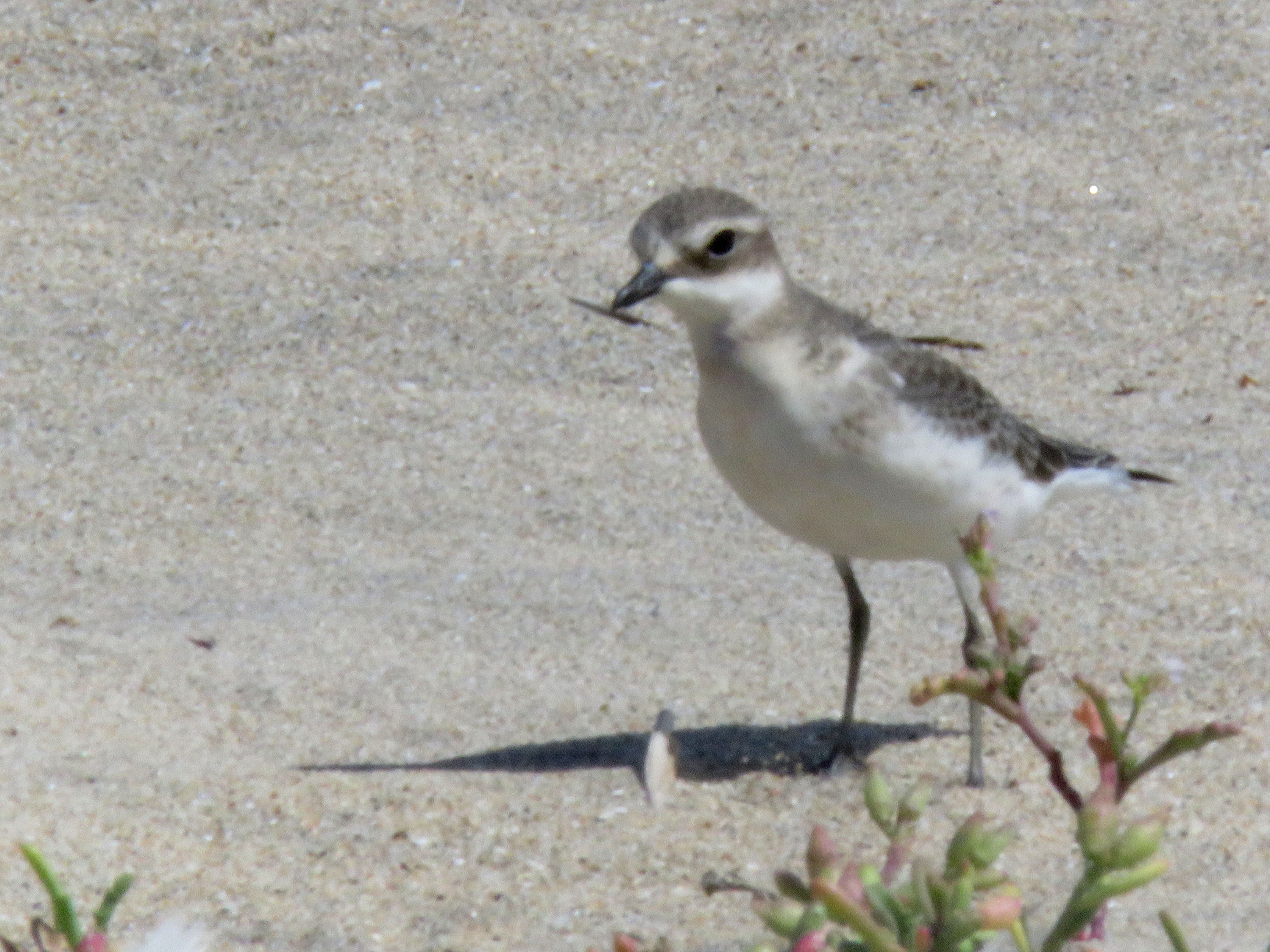
While I did not keep track of time, we did find a darker, slightly larger plover that was loosely associating with the snowies, within about five minutes! County lifer 262!!

A not-so-sharply-focused photo of the lesser sand plover on the sands of Laguna Beach.

We had the sand plover all to ourselves for about 15 minutes. Over the last couple of days the plover had attracted many birders to this almost forgotten beach on this Santa Cruz County beach.

Image

King of Tyrants: Tyrannus tyrannus

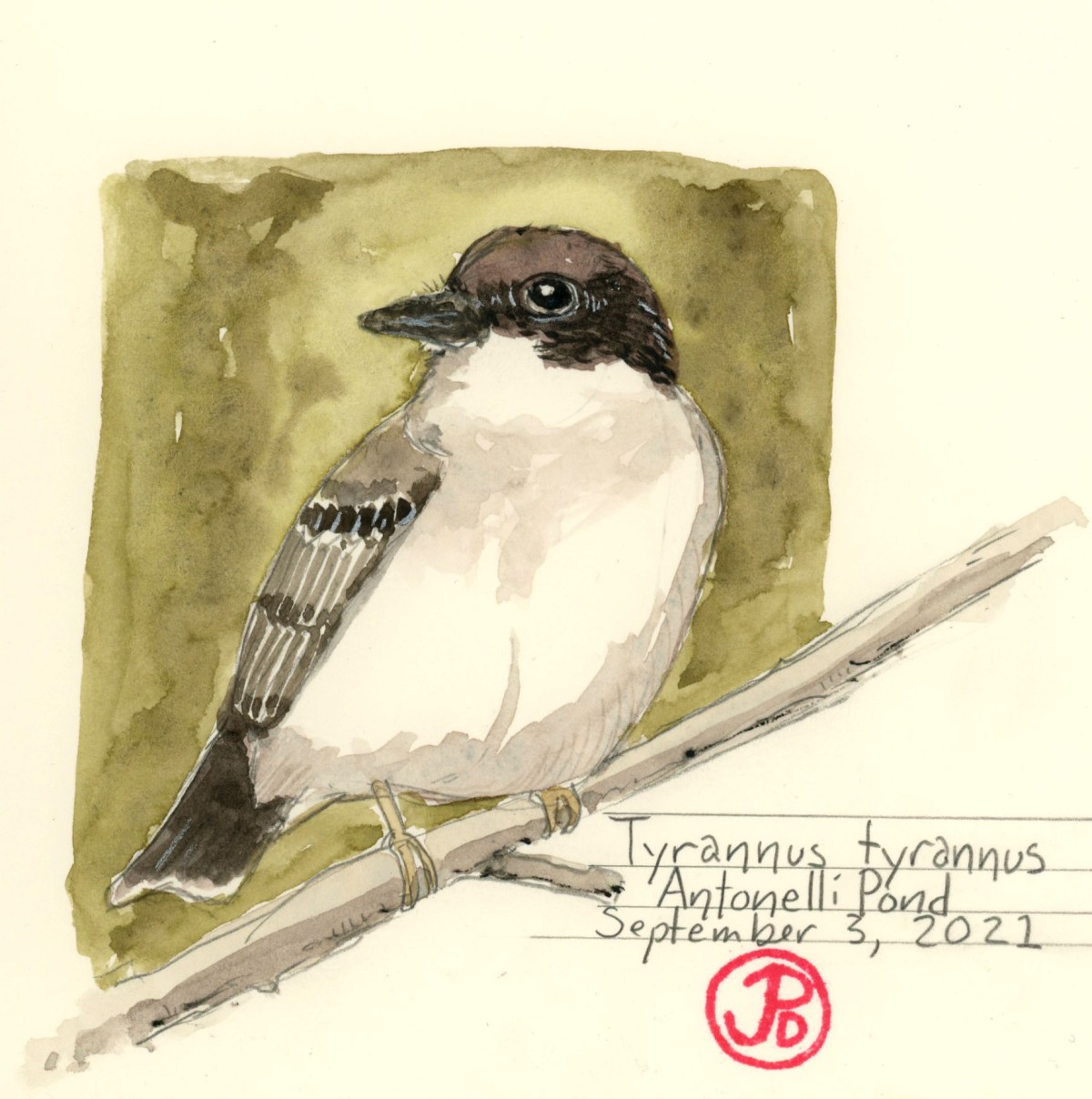
On a Monday, Trrannus tyrannus was first seen in a coffeeberry bush (Rhamnus californica) in the northwest corner of Antonelli Pond in Santa Cruz’s westside. I just hoped this county rarity would stick around until Friday when I could get down the coast to look for it.

The Eastern kingbird, like it’s name implies, breeds on the eastern side of the United States. This kingbird is a neotropical migrant where it spends winters entirely in South America. On their winters grounds, the kingbird travels in flocks and eats berries. (In the north it feeds mainly on insects taken on the wing).

Tyrannus tyrannus, means “tyrant, despot, or king” (take your pick) is named for the kingbird’s aggressive behavior during breeding season. While defending their nesting territory, they will attack birds that are much larger than itself, including hawks, great blue herons, ravens, crows, and even squirrels. There have been reports of kingbirds landing on the back of hawks and vultures, pecking and pulling out feathers. This is the King of Tyrants with a major Napoleon Complex.

So at about five PM I found myself in the northwest corner of Antonnelli Pond reflecting on the long journey this 40 gram bird had made, from the Amazon, eating fruit in flocks to it’s long journey up the Pacific Coast to forage for a few days near a pond in Santa Cruz. So far the coffeeberry bush was sans kingbird.

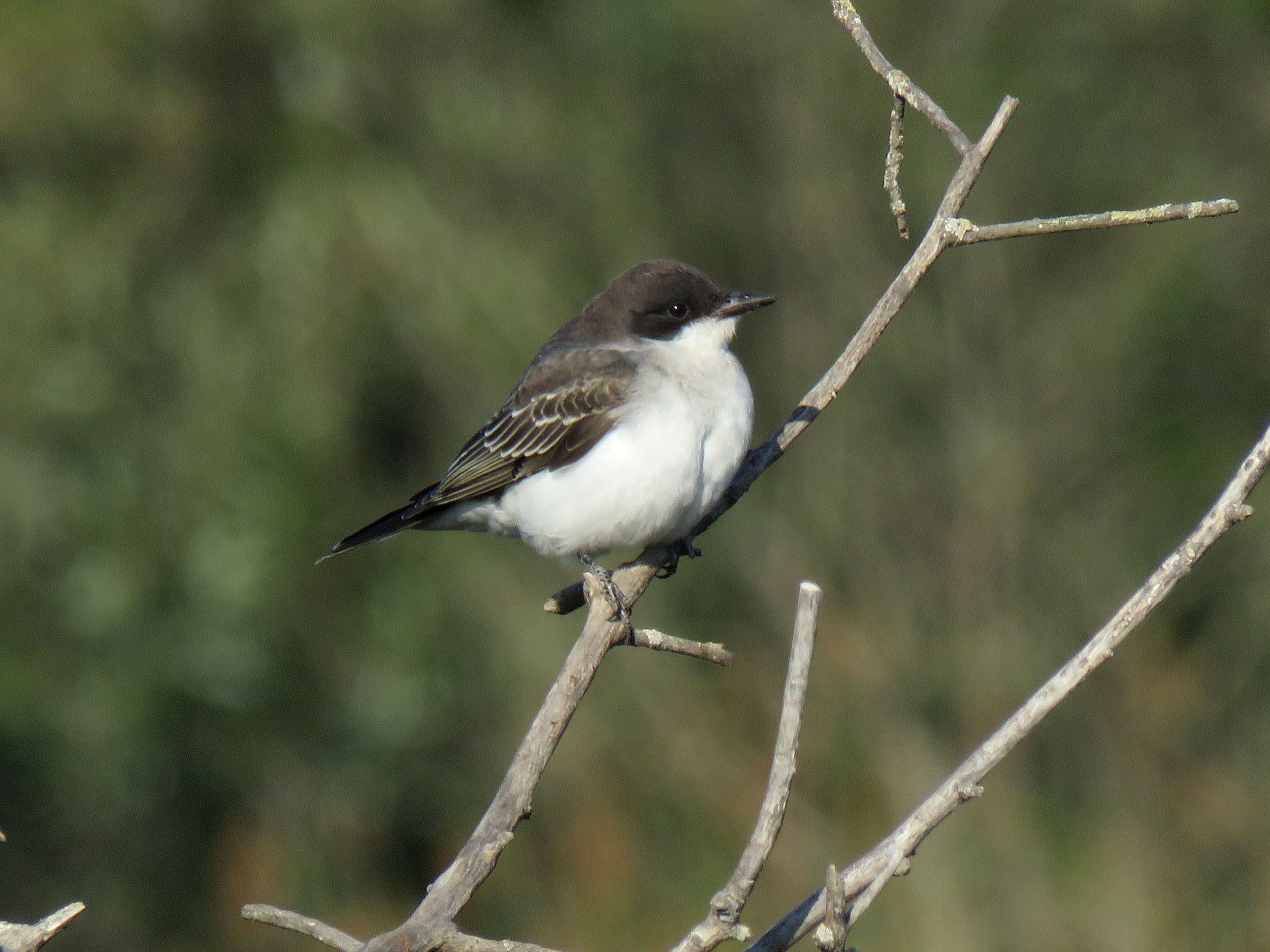
After about a 15 minute wait, a pied bird flew from the north into the bottom of the bush. I attempted to flank the bird to identify it as the wayward tyrant. A bird shot up from the bush, dark above and light below was a fine white border on it’s tail, Bingo! Eastern kingbird! The bird flew to a chain linked fence that bordered the Homeless Garden, where I was able to get a few distant photos.

A common perch for a kingbird: a fence.

The kingbird foraged for a bit in the garden and then flew back and landed on top of the coffeeberry bush in perfect late afternoon light, so I had to take a few photographs to confirm it’s misplaced existence. It stayed on it’s perch for a few minutes and it then flew across the pond and my encounter with the wayward (is their such a thing in nature?) eastern kingbird was over.

The eastern kingbird in great light, showing off it’s kingbird profile.

Often when we are looking for one thing in nature we see so much more. This was the case on Saturday morning, when I returned to Antonelli Pond to look for the eastern kingbird again (and the willow flycatcher that had also been report). While the coffeeberry bush was lacking a kingbird, some movement in the brush in front of me caught my attention.

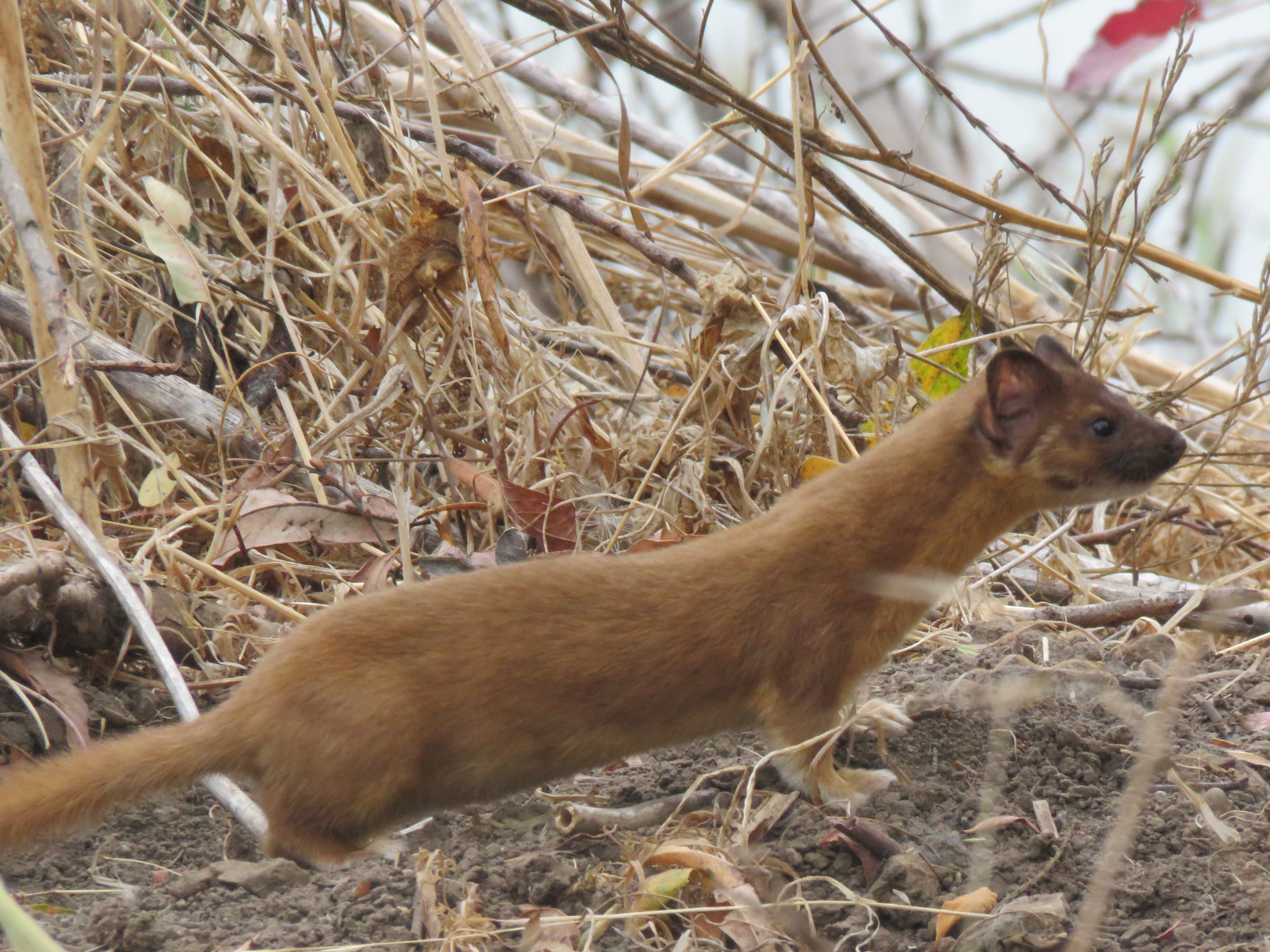
A caught a glimpse of a long mammalian predator. I wanted to entice it out to get a better look so I did my best impersonation of a wounded rodent (I was thinking mouse) and within seconds, it’s snake-like head, ears alert, appeared out of the brush. It was almost licking it’s deadly teeth with delight (I call anthropomorphism on myself!)

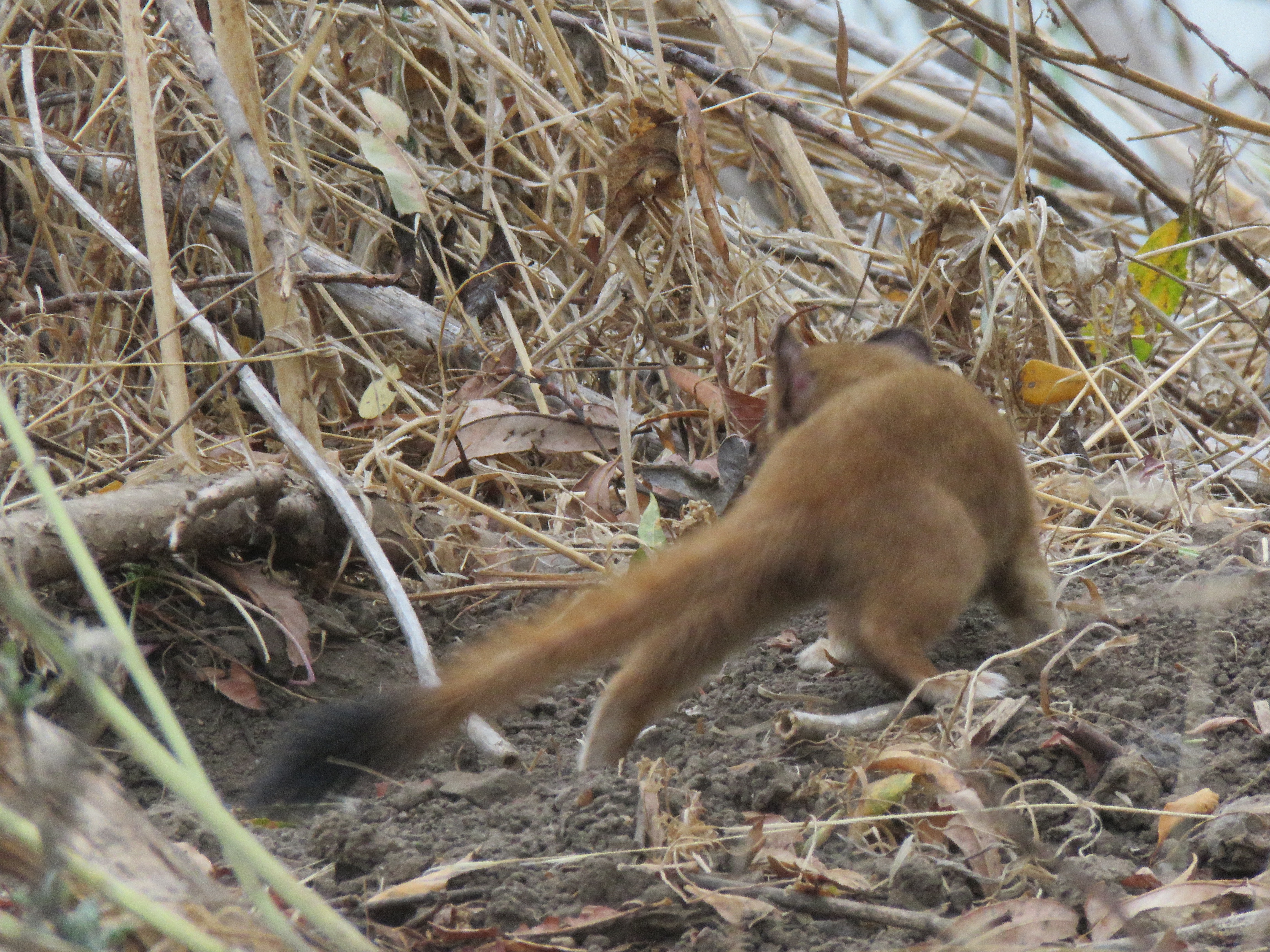
It was a long-tailed weasel (Neogale frenata)! I had seen this predator on two other occasions but both sightings (at Wilder Ranch) were fleeting and I just got a flash of it’s dark-tipped tail as it disappeared into coyote brush.

The long-tailed weasel is an aggressive predator which can take prey twice it’s size such as rabbits and squirrels. On one occasion at Wilder Ranch on the Old Cove Landing Trail, a weasel was hunting bush rabbits and I heard a lagomorphic scream that was hard to forgot. I was not sure if the weasel’s hunt was successful.

The long-tailed weasel, coaxed out of the brush with my wounded rodent impression.
The long-tailed weasel showing off it’s black-tipped tail.
Image

Bird Dunes

On Sunday morning I headed to Watsonville, to worship at the Alter of Shorebird known as Pajaro Dunes.

Yes I know that June us not exactly shorebird central on the Central Coast but I had two shorebirds on my Santa Cruz County wishlist: American avocet, and black-necked stilt.

Pajaro Dunes is a coastal vacation community built on and over the Monterey Bay dunes. No doubt that this development has affected the original residents of these dunes and tidal flats: shorebirds. Their habitat here has been compromised, restricted, and expunged. That is one reason that birders are allowed access to this private community.

I do have a disclaimer: my family has spent much time at Pajaro Dunes when I was a kid. Once a year we rented a house at Pajaro with our neighbors on Cormorant Court. (Pajaro is the Spanish word for bird.) I somehow think that spending time here, as a child, made me appreciate this place and being a noticer, I noticed the natural world that was thriving here. I remember digging for sand crabs and catching lizards. And the brown pelicans that hugged the coast raised my eyes skywards.

On this Sunday morning, after checking in at the gatehouse, I kept my eyes towards the water channel, which was to my left. The tide was in, so water was much deeper, which would not be attractive to both avocet and stilt.

I headed to the bay where the Pajaro River becomes brackish. There where a large group of white pelicans, foraging in a raft and many double-crested cormorants drying their feathers. On the beach was a large flock of gulls, including about 40 Heerman’s gulls, one of the world’s most beautiful gulls, in my opinion.

The beautiful Heerman’s gull a Pajaro Dunes. The white-headed gulls are adults while gray-headed birds are juveniles. These gulls are newly arrived from Mexico or points south.

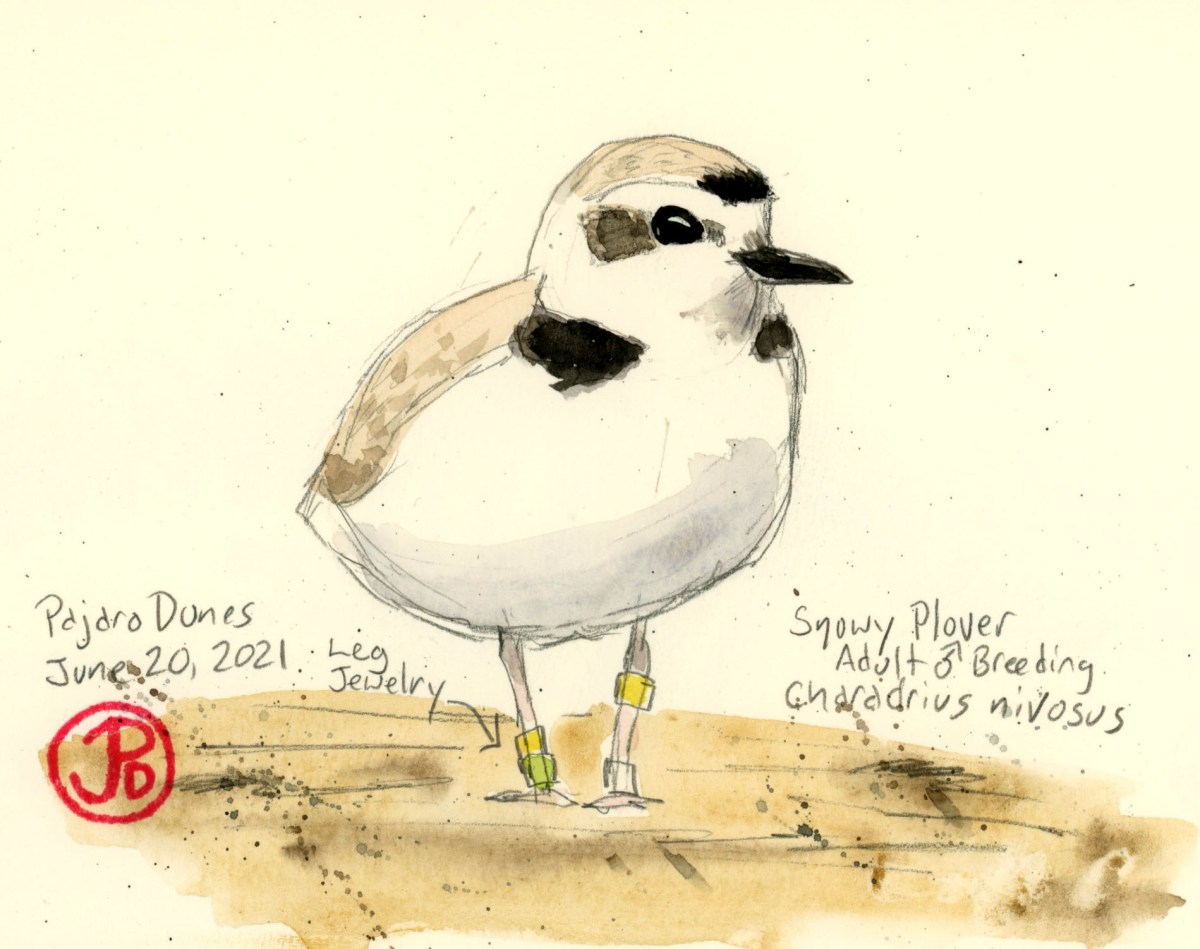
Since I was here last, a fence had been installed around the dunes to protect the breeding habitat of the threatened snowy plover. I have seen snowies here before in the winter where but they where not wearing the black headband and black epaulets of their breeding plumage. Some of the plovers were wearing colored bands on both feet so biologists can identify individual plovers in the field.

A child created sign on the fence placed around snowy plover habitat. Judging by the drawing and the capitalization (or lack of it) I would say it was done by a 3rd grader. It is funny that children draw the head like a separate circle plopped on the body when in reality there is usually a smooth transition from head to body. Sadly, most adults would draw birds in the same way because around this time, nine to tens years old, most realize that their drawing no longer captures realty and their artist development stops at that age.

I did see three snowy plovers. One was running circles around me looking like a windup toy dune-runner. This male was sporting jewelry in the form of four leg bracelets, known as bands in America or rings in Britain. I incorporated the bands in my plover drawing.

It was good to see the plovers on their breeding territory but I did note that there was a woman with her off lead dog that was crossing the fence line. She needed to read and internalize the 3rd graders’ message: “Please Stay away from The BiRDS.” Dog and dog owners vs snowy plover have been an on going conflict on beaches on the west coast where these plovers breed. They nest on the ground, making them vulnerable to walkers and dogs. For all of those whole claim to be “animal lovers” lets not forget about animals that don’t wear a collar, respond to their “given” name, and who are flying free. (I’m starting to sound like the Lorax here!)

I headed back towards the exit gate and I looked to the water channel, which was now to my right. I passed Avocet Circle (no avocets). As I passed the tennis courts and sports field, near Willet Circle, I spotted the undeniable form of a black-necked stilt, foraging on the the far bank. Santa Cruz County life bird!

Black-necked stilt.
Image

Meder Canyon

With my inward focus on county lifers I begin to realize that I had many common and uncommon species on my life list that now became new targets for the county.

In Santa Cruz County I had five species of owls: great horned, barn, burrowing, short-eared, and saw-whet. I had two more that I had not yet heard in the county, when owling, hearing is believing. These are the western screech-owl and northern pygmy-owl.

As day turned to dark, I headed to the slopes of the Santa Cruz Mountains near Corralitos. Owling is a new kind of birding madness that makes one wake up at an ungodly hour or head up into the hills on one lane, windy roads in the darkening night. My destination was Hazel Dell Road, a productive owling road in the county.

I stopped at the intersection of Hazel Dell and Mt. Madonna Road and got out to listen of my target owling. I heard nothing except for the din of frogs just down the road. I struck out on both species.

Seeing a recent online birding post, I was reminded that I did not have white-throated sparrow in county. So on a Sunday morning, I headed out early to looking for this beautiful but uncommon Santa Cruz County sparrow.

I headed up Meder Canyon and turned right into the side canyon. This spot reliably produces California thrashers, except for today. I did hear the cat-like “mew” of a blue-gray gnatcatcher. I climbed up the slope to get a better vantage point to see the gnatcatcher and that’s when I first heard the northern-pygmy-owl!

If the toot-toot call of a saw-whet sounds like a owl on too much coffee, then the northern pygmy-owl has had too much NyQuil. I could clearly hear the slow toot-toot call coming from across the canyon. It was just 8AM.

It may sound odd that a nocturnal predator like an owl would be active in the day but northern pygmy-owl is noted for it’s daytime dalliances. According to David Sibley in his Sibley Guide to Birds, pygmy-owls are “active in daylight” and it’s song is “often heard during the day”.

I headed back down slope and to try to locate the owl. It sounded like the owl was calling from brush or trees further up slope. After about two minutes, the pygmy-owl stopped calling and I was unable to locate it. It was a great encounter anyway.

Now it was time for my next target bird, white-crowned sparrow. I returned to the main canyon and headed up to a location were the sparrow had been recently seen.

It was a warm morning and it had a feeling of a spring morning and I was surrounded by the calls of birds: Steller’s and scrub jays, wrentits, yellow-rumped warblers, a Bewick’s wren, a pair of oak titmice, and a northern flicker.

As I neared the end of the trail at Meder Street and University Terrace Park I stopped at the “bird feeder” house. The back of this house faces the trail and the owners put out seed and suet on the upper balcony. There were some juncos and an acorn woodpecker feeding at the feeder when walked up.

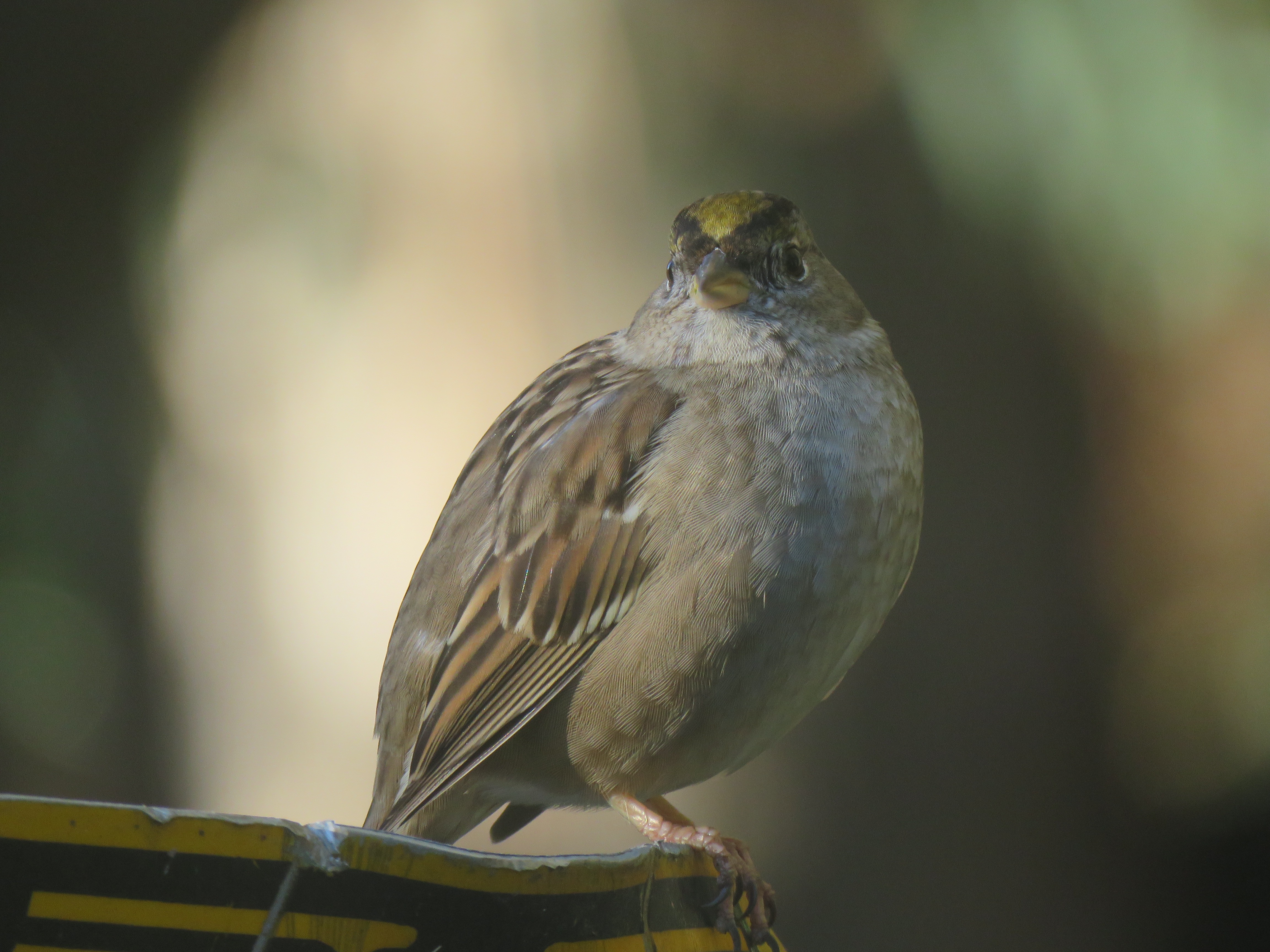
On the right side of the trail was a golden-crowned sparrow perched on a sign. This was a good sign. I was hoping the white-throated was loosely associating with other sparrows.

Golden-crowned sparrow.

I saw a sparrow fly into the eucalyptus about ten feet high. I tried to get a better vantage point. I got bins on the bird: white suplercilium, yellow lores, and the the distinctive white throat! A new county lifer: white-throated sparrow.

White-crowned sparrow singing in the eucs.
Image

Santa Cruz County Beach Birding

A towhee had taken up winter quarters on Laguna Creek Beach. This beach is close to Davenport on Highway One and 10.2 miles from my cabin (I checked).

Two towhees, a large, sparrow-type bird, are common on the California Coast. The appropriately named California towhee and the spotted towhee. Neither of these two species were the reason I headed north on Highway One on a Saturday morning.

I was here, hiking into a headwind on a sunny but blustery winter’s morning, to see a rare towhee on the coast. It is said that every bird is rare somewhere and the green-tailed towhee is rare here on the California coast. I have seen many green-tailed towhees at elevation in the Sierra Nevada Mountains but I was going to attempt to add this species to my Santa Cruz County list. I wanted a green-tailed towhee at sea level!

Who knows how long this wayward towhee had been on the Santa Cruz Coast but on January 12, 2021, two birders happened to be birding this beach and also happened to know that this towhee was out of place in this location. They reported it and other birders searched for it, some getting momentary looks of this sulky towhee. There where even less quality photos of this ever-moving and scrub-loving bird.

So the bar was low for a quality sighting and capturing great photos was an even lower bar. That’s if I didn’t whiff on this towhee altogether, for any sighting is never guaranteed. As one birder noted, “Ducked into a bush and never reappeared.”

The bird was seen on the northern part of the beach, north of the creek and just left of an “AREA CLOSED” sign. The sight was described as being where the sand meets a six foot high cliff. So here I was, peering into the bushes. Flanked by two nude male sunbathers.

The first bird I saw was a blue-grey gnatcatcher as is foraged and called at eye level in the coyote brush.

I turned on my bluetooth speaker and selected a recording of the towhee’s “cat-like ‘mew'” call. I hit play and after a single call, the green-tailed towhee shot out of a bush in front of me and stood before me on the sand. Sometimes birding is just this easy.

I had amazing views of the towhee as it foraged on the sand and I was able to get great photos in amazing light. The towhee stayed out in the open for about two minutes before disappearing into the coastal brush.

This photo proves just how elusive the green-tailed towhee can be! Now you see it, now you don’t. You have to be quick to photograph this bird.
The green-tailed towhee with it’s rufous crest, white throat, and greenish wings. This bird almost seems to be posing for me.
The profile view would have made Roger Tory Peterson proud. Here you can see the greenish tail.

Image

County Birding: San Mateo and San Francisco Counties Part 1

On Saturday morning, Grasshopper Sparrow and I headed east on Highway 92, our destination was Parkside Aquatic Park in San Mateo. Our plan was to do some San Mateo County birding. I hoped to add some new birds to my San Mateo County list and Grasshopper was hoping to add some lifers to his list!

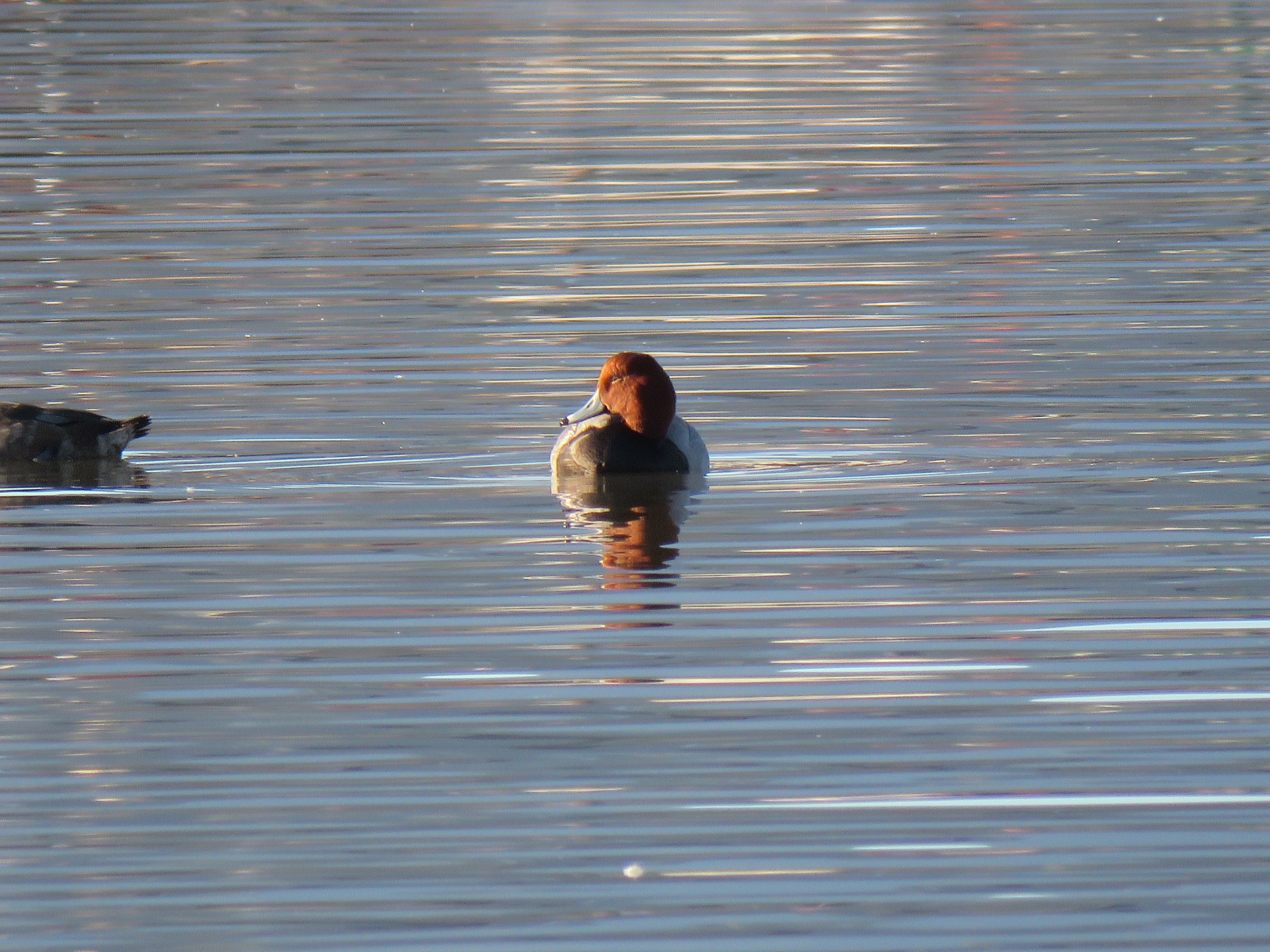
This park lines Marina Lagoon and it is a great place for ducks, geese, herons, and waders. But we where here for the rare county duck, the redhead. After a short search, we spotted the distinctive duck with two females.

The appropriately named redhead. This is a male at Parkside Aquatic Park.
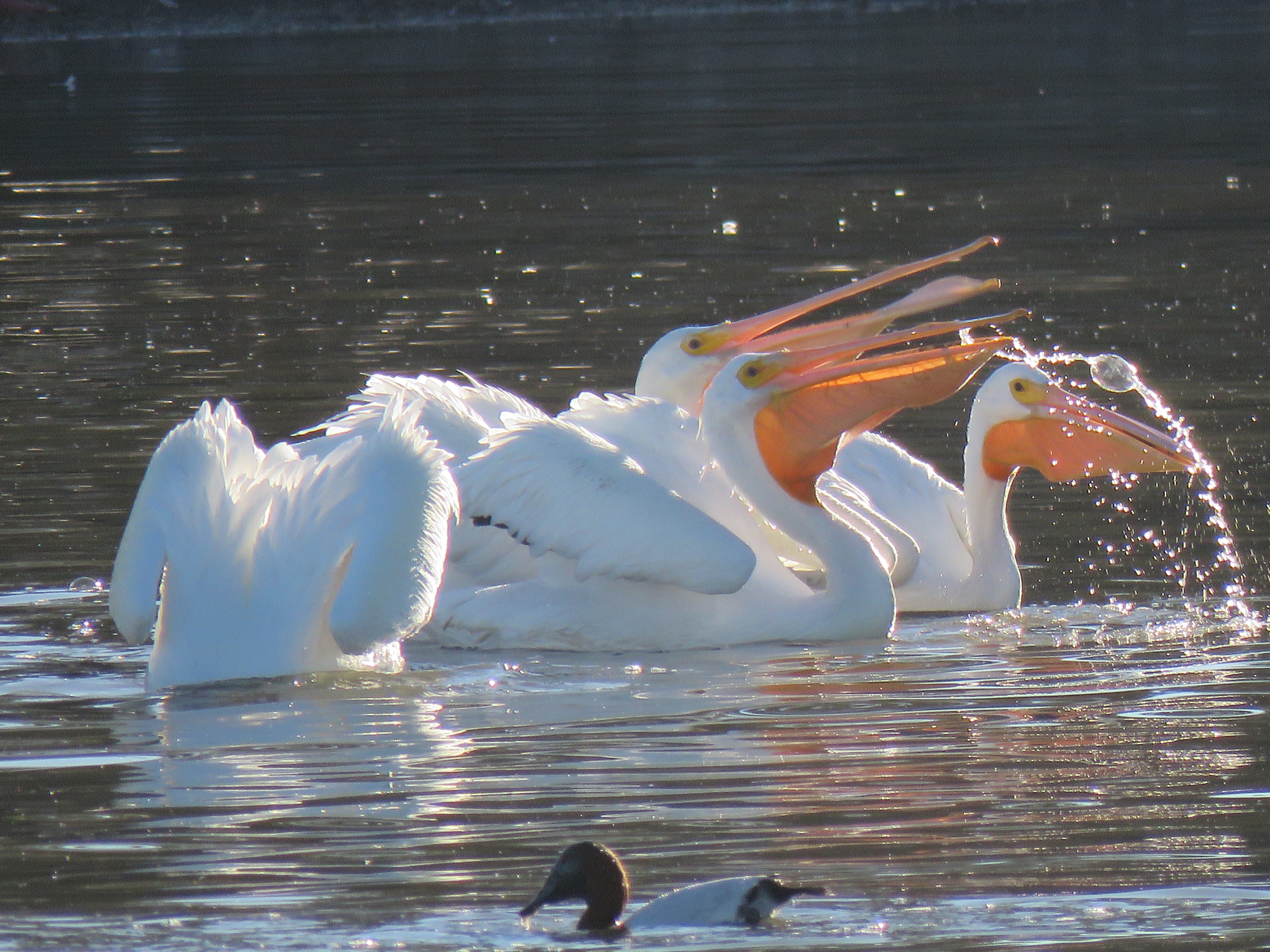
A pouch of American white pelicans foraging in the lagoon.

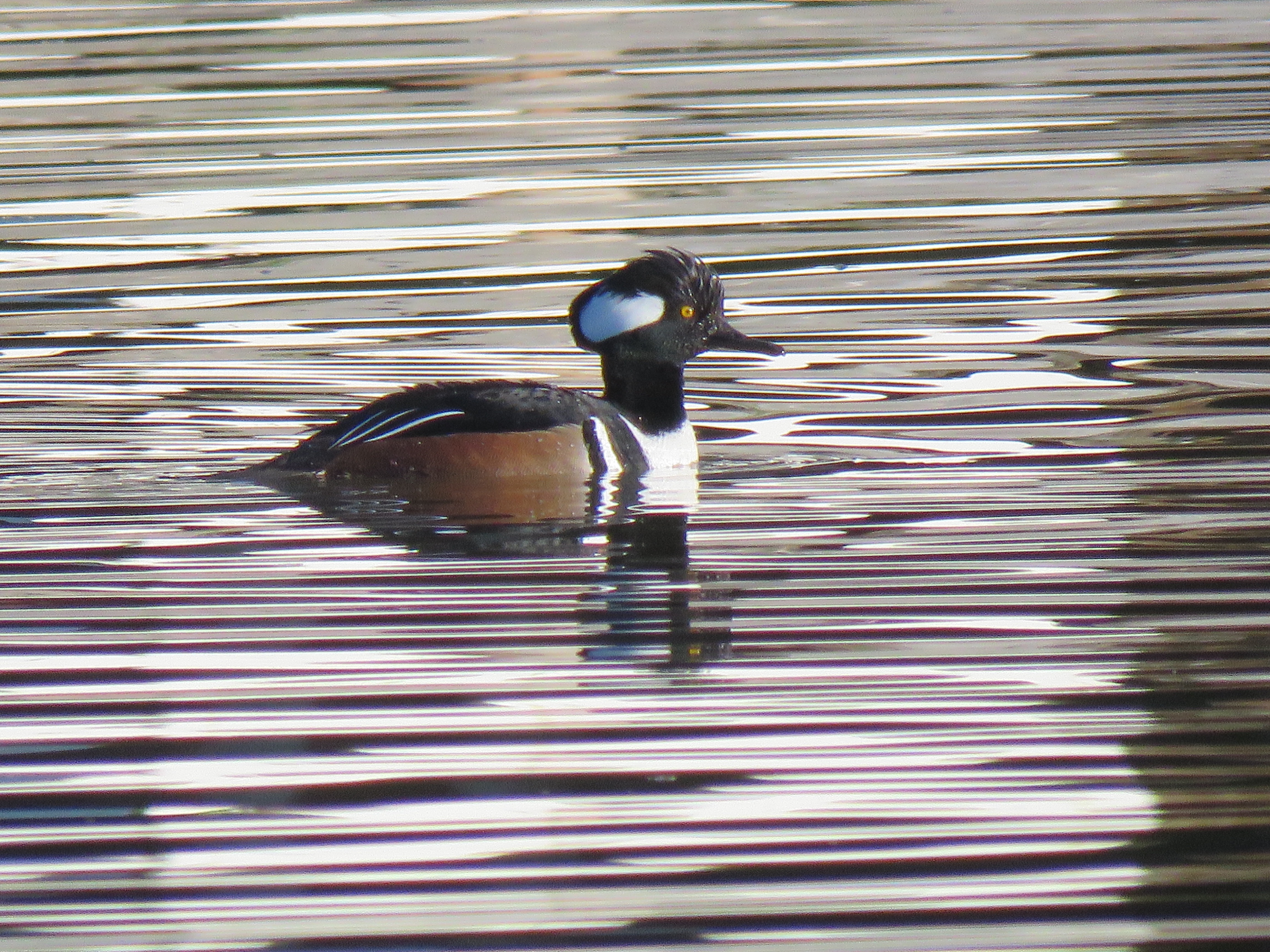
There were plenty of other birds to looked at such as a green heron, a group of American white pelicans, and the stunning hooded merganser.

I love the contrast between this beautiful male hooded merganser and a white house’s reflection on the lagoon.

Our next stop was to Bair Island Wildlife Refuge. Our target bird was a Pacific golden-plover that had been seen a few days early by the legendary San Mateo county birder Peter Metropolis. When we arrived, it was low tide which meant that we were looking for the proverbial needle in a haystack or a plover is a vast mash that was full of other birds. We joined Chris Hayward, a local birder who is also a spotter on many pelagic trips leaving from Pillar Point Harbor. Chris had not yet seen the plover. We were joined by another birder, the more eyes the better.

In the marsh were many ducks and peeps. Grasshopper spotted a male Eurasian wigeon. That was the only rare bird we recorded at the refuge. So we left Chris to continue the search and we headed back north on Highway 101 to the next exit to look for some more county ducks at Nob Hill Pond, so named because the pond is located behind a Nob Hill supermarket.

When we first arrived , when checked the channel near the San Carlos Airport for the continuing female long-tailed duck. We had tried for this bird for about five times, without success. We failed again but we would try again after trying to get a very rare duck on Nob Hill Pond.

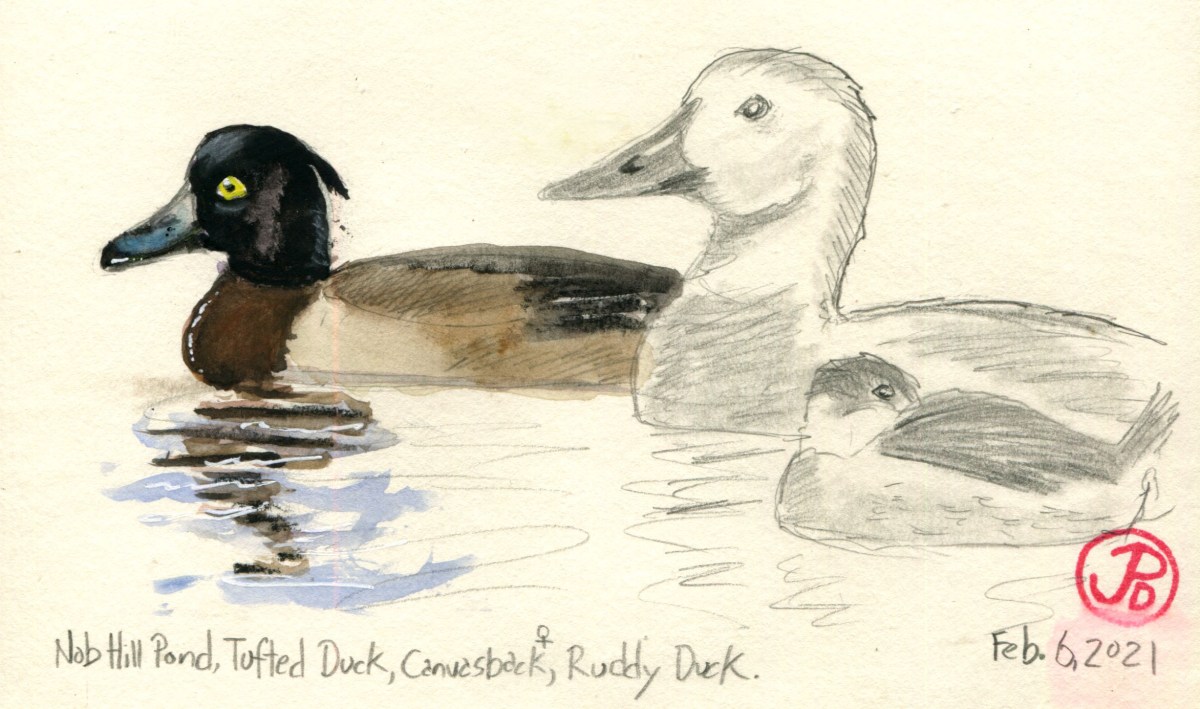
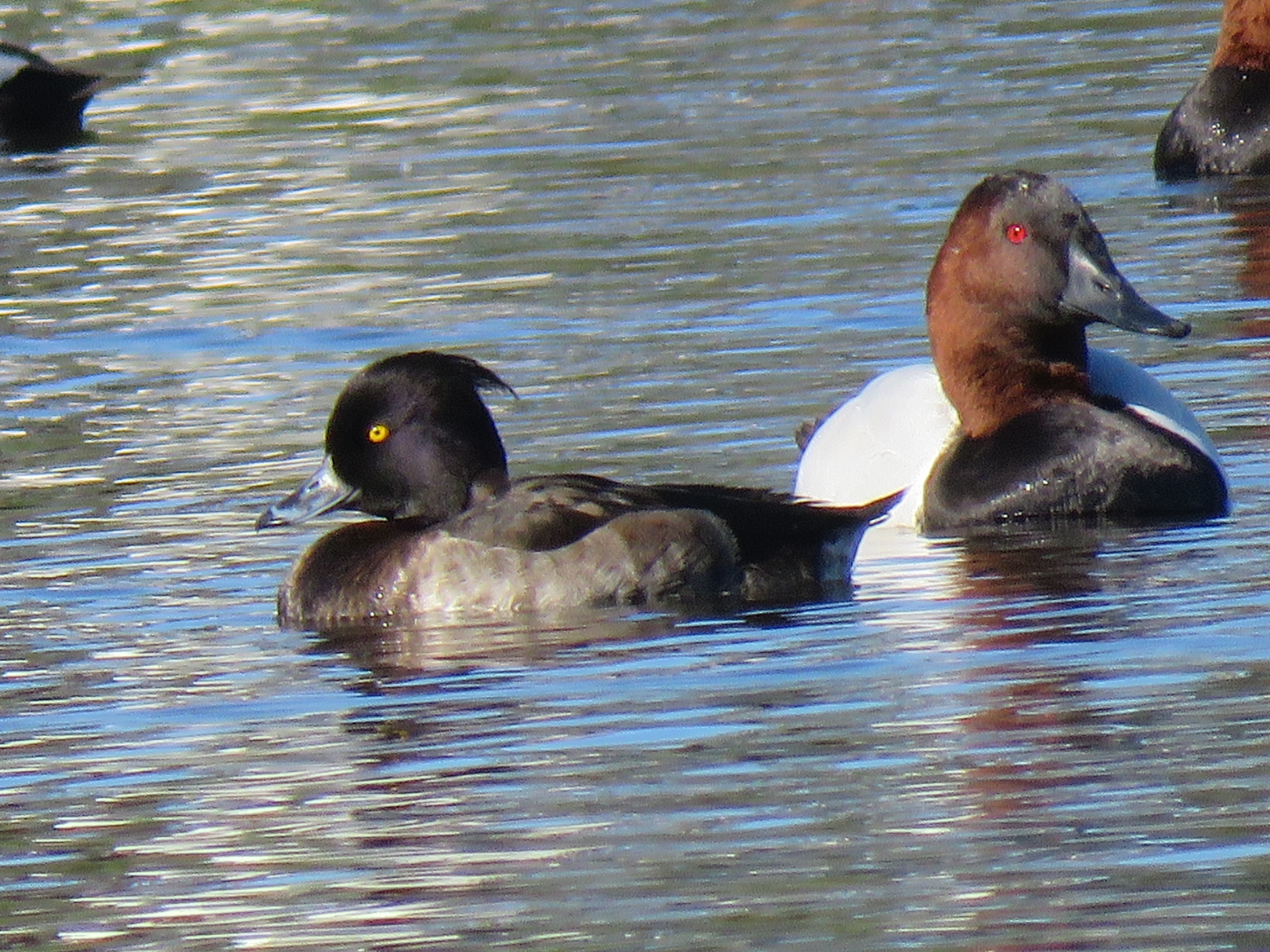
This duck is common in northern Eurasia but rare in Coastal California. This is the smallish diving duck called the tufted duck because of the prominent tuft of feathers emitting from the back of it’s head, most noticeable in the male of the species.

Grasshopper spotted the tufted duck through the scope. It’s tuft was growing in length like my Covid hair! There is nothing like young eyes! Well spotted Grasshopper Sparrow!

Finally, the tufted duck is ours!! On the right is a stunning male canvasback.

We headed back toward the airport to continue on search for the continuing female long-tailed duck. We had whiffed on this species on about five attempts but we adopted a now-or-never approach to this sought after species.

As the the time neared noon, the reflections where intense and from our position, the birds where backlit. Panning with the scope, all we where seeing where buffleheads. Being diving ducks they appeared and disappeared giving us renewed hope followed by disappointment when an bufflehead surfaced. No long-tailed.

After about a 20 minute search the female long-tailed duck appeared near some pylons on the east side of the airport. County bird and a lifer for Grasshopper!

After a three county duck day we headed back to the hacienda in San Mateo. Grasshopper had spotted a rare west coast sapsucker a few weeks before. Because it was rare, he was unsure of the ID, he submitted his photos to some San Mateo County birder and his sighting was confirmed. (This is the correct approach for a young birder, well learner Grasshopper!)

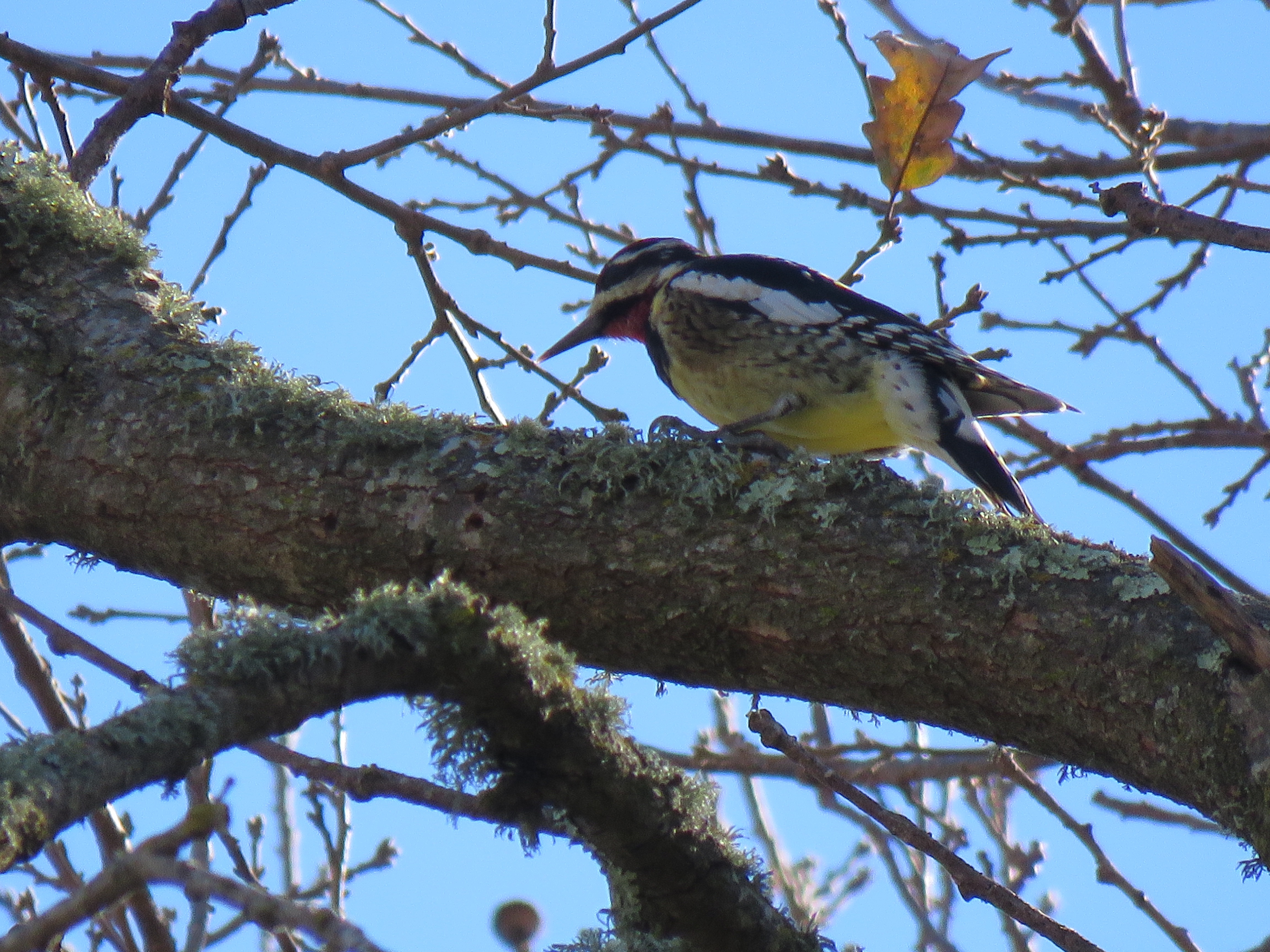
Over some afternoon suds, Grasshopper said excitedly, “woodpecker!” I was able to get some photos of the sapsucker in the oak in the backyard. A yellow-bellied sapsucker, a fourth San Mateo County bird! Not bad for a day’s worth of county birding.

On Sunday I found a bird in San Francisco on Lake Merced that had not been recorded in this location since 1977. Those were the days when birders were few and the optics were poor. But with a open buttoned shirt and bellbottoms, the 1977 birder must have looked sharp!

To be continued. . .

A great bonus was a backyard yellow-bellied sapsucker in Grasshopper Sparrow’s backyard. Four San Mateo County county birds!

Gift of Eagle

Local San Francisco birder, Hugh Cotter, first gave me the Gift of Eagle.

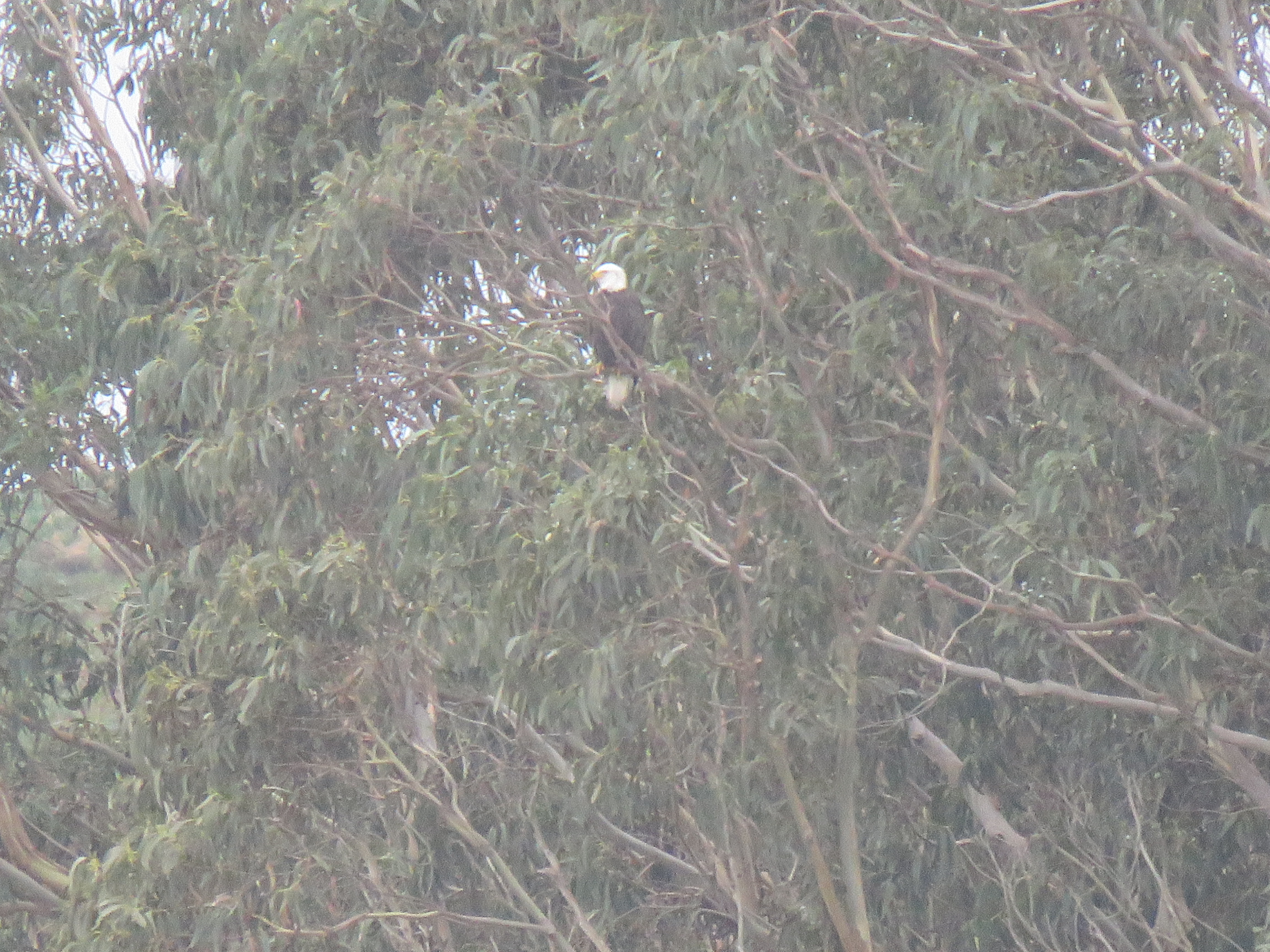
Midmorning on the Friday January 23, Hugh was birding at Lake Merced, in the southwestern corner of San Francisco. He spotted an adult bald eagle flying in from the north. The eagle landed in some eucalyptus trees on the southern shores of Lake Merced. He reported this sighting on eBird.

What was unusual about his sighting is that the eagle didn’t continue on south into San Mateo County but instead, perched in San Francisco County. Most bald eagle sightings are of birds soaring above San Francisco before headed further south down the coast. I wondered if the eagle was going to stick around.

On Saturday January 24, I was going to find out. I headed over to the Boathouse on Lake Merced so see if I could spot the adult bald eagle. I began by eBird checklist at 9:04 AM.

I scanned the eucalyptus trees to the south and the white head of the adult eagle stood out like a shining light. A San Francisco County bird!!

I recorded my sighting on eBird, took a few crappy photos, and continued birding other parts of the lake.

Now it was my turn to pass on the Gift of Eagle.

Across the Bay, Jim Lomax saw my post, confirming that the eagle had overnighted. Jim Lomax is an epic California county birder. He is the first birder to see over 200 species of bird in every one of California’s 58 counties!

Jim wrote on the birding listing service, Sialia:

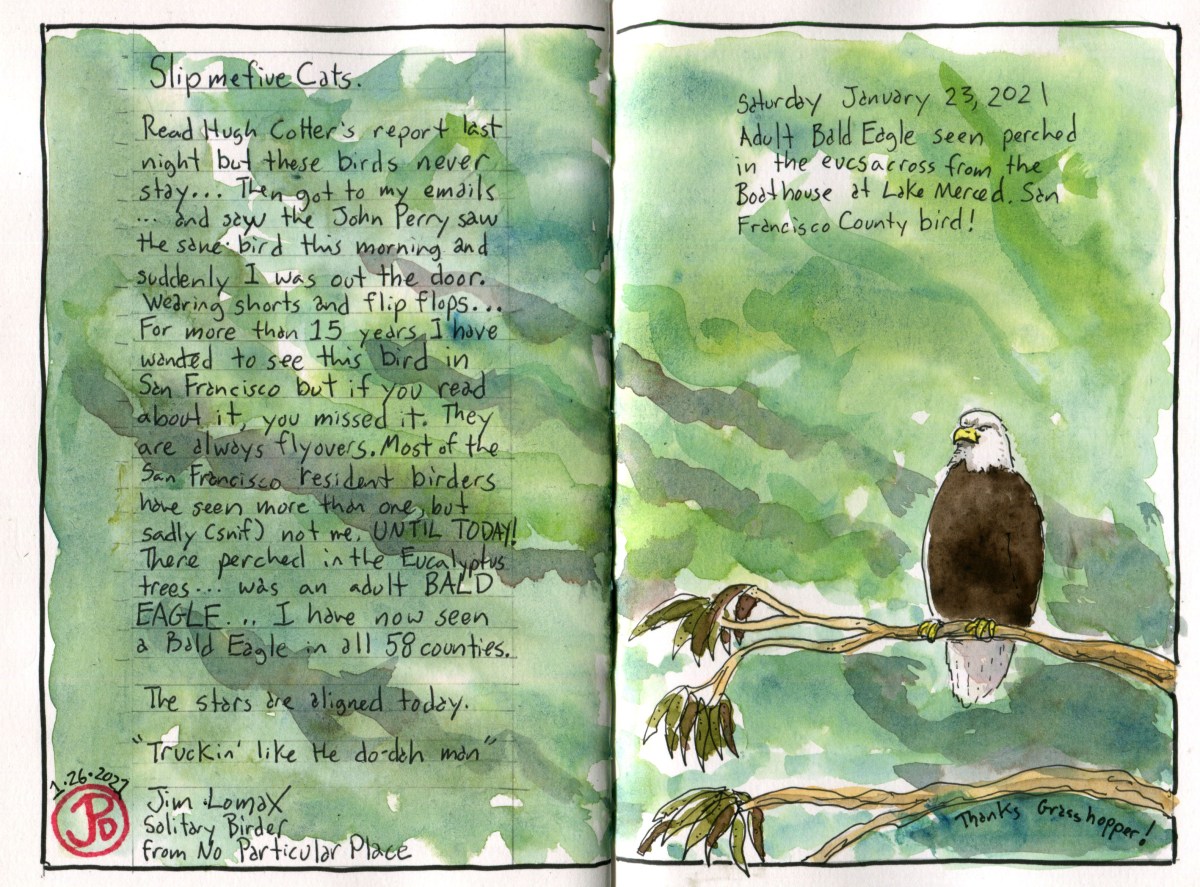
Read Hugh Cotter’s report last night but these birds never stay . . . Then got to my emails . . . and saw that John Perry saw the same bird this morning and suddenly I was out the door. Wearing shorts and flip flops. . . for more than 15 years I have wanted to see this bird in San Francisco but if you read about it, you missed it. They are always flyovers. Most of the San Francisco resident birders have seen more than one, but sadly (snif) . . . not me. UNTIL TODAY!

There perched in the eucalyptus trees . . . was an adult BALD EAGLE . . . I have now seen a Bald Eagle in all 58 counties.

The stars are aligned today.

Wow, what an achievement to see bald eagles in all of 58 counties! That is true birding dedication! And I was glad to play a very small part in making it happen.

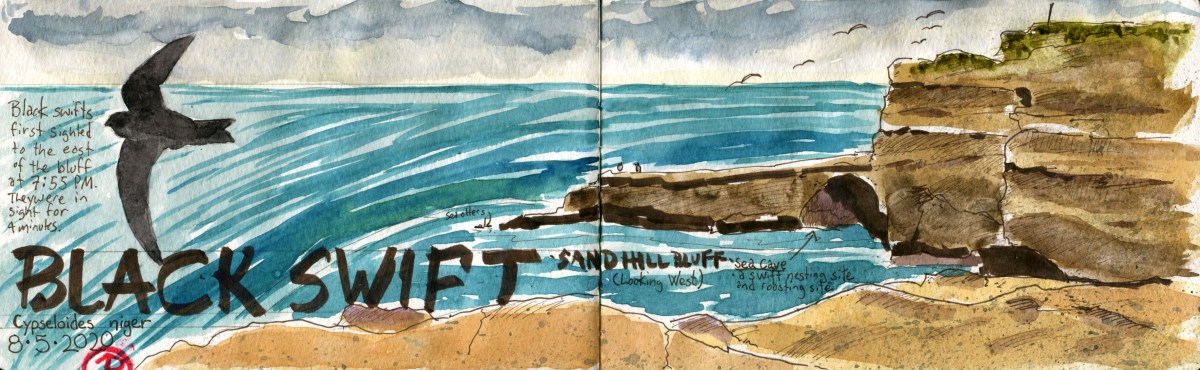
To remember the gift, I did a spread which almost looks like an illustrated diary entry. The sketch is from one of my crappy photos and Jim’s Sialia post is on the facing page.

Here is one of the crappy photos I took of the adult bald eagle at Lake Merced. The white head and tail and the yellow beak says: bald eagle!
Image

Black Swift

Birding is a form of maddness.

It can make us wake at ungodly hours, spend ten hours in an ocean going fishing boat, or drive hours to search for a rarity! All for adding birds to a list or seeing a species for the first time.

This evening I was driven to hike a mile through fields and farmhouse to stand at the edge of the ocean, my face to the wind (a small sacrifice I know). I was standing above the sea caves at Sand Hill Bluff, about five miles from the city limits of Santa Cruz.

The caves are used as a nesting and roosting site for a Santa Cruz County target bird: the black swift (Cypseloides niger).

The black swift is our largest swift and is not often seen because it forages for insects high up in the air column, sometimes as high as 10,000 feet. They live much of their life on the wing, including copulating on the wing. But they return to terra firma to roost and nest. They have a limited distribution in North America, hugging the western side of the continent. Sadly, the black swift population has diminished by 90% since 1970.

I arrived on the bluff at 6:30. The black swifts seemed to be returning to roost just before sunset, which was going to be at 8:10, so I had a little time to wait.

I reflected on the fact that there is so much that is unknown about the black swift. It’s nest was left undiscovered until 1901 when a swift nest was found on the cliffs near Santa Cruz.

After reflecting I set up my sketching stool and sketched the cliffs looking west (featured sketch). Western gulls and Brandt’s cormorants where roosting on the rocks and off shore a steady line of sooty shearwaters where heading west. I estimated that there might be 2,000 shearwaters in this flock. Closer in, there where four sea otter foraging in the kelp beds.

At about seven I was joined by another madman, err, I mean birder. He had come from Sacramento to see the appearance of the black swift. It is always great to have a second set of eyes. In the past the swifts appear for a short time before flying into the sea caves to roost.

At about 7:30 I noticed an uptick in bird movement. The movement of westward sooty shearwaters had diminished and disappeared. The always vocal Caspian terns were heading east to their roost sites and long lines of “checkmark” formations of brown pelicans were flying low over the water heading west. I was waiting with anticipation as I scanned the skies for the arrival of the black swifts. Nothing yet.

At 7:55 PM, the Sacramento birder alerted me of the presence of a lone swift that disappear into a sea cave. I missed it. This was followed quickly by two other swifts that flew just east of the bluff and stayed in sight for about four minutes. County lifer 210!