Image

Santa Fe Caboose # 28

I wanted to add another night to stay at the Railroad Park Resort in Dunsmuir but the SP Caboose # 17 was booked, so I booked one of the popular Santa Fe cabooses.

I spent my last night at the Resort in Caboose # 28 a former Santa Fe cupola caboose.

This CE-2 caboose was built by the Atchison, Topeka & Santa Fe railway in 1942. It was rebuilt in 1970 and renumbered as ATSF 999448. It came to the resort in the late 1980’s.

A caboose is a uniquely bit of United States railroading. At one time all freight trains had a caboose (usually red) at the end of each train. A caboose came at the time when train crews were larger than they are today, during the age of steam. Each locomotive had an engineer and fireman but the conductor was in charge of the train. The conductor’s office was on rails, this was the caboose.

From the caboose, the conductor could throw switches, aid in backing up, check the train for safety, and fill out paperwork. From the view in the cupola, or later the bay window, he could oversee the train to make sure no loads were shifting on freight cars. He could also monitor the train for overheated axels called “hot boxes”.

Most cabooses where fitted with a desk, bathroom, bed, and storage closets. It really was a home-office on wheels, reflecting the long work days and may miles on the railroad.

Laws where in place that all freight train had to contain a caboose for safety reasons. This changed as technology improved and railroad cuts made more with smaller crews. The new, modern diesel-electric engines had larger cabs which means that the conductor could ride up front.

The technology railroads use to replace cabooses are called an end-of-train device. These devices are fitted to the last car of a freight train and monitors air brake pressure and over heated axels. There is also a blinking safely light that warns other trains behind..

By the early 1980’s, laws were changing that no longer required trains to have cabooses. By the mid-1980’s most freight trains no longer ended with a caboose. The era of the red, cupolaed caboose was over.

Whenever I watch a long freight train pass by, I hopefully expect to find a caboose at the end of the train. This comes from seeing so many cabooses on freight trains when I was a young rail fan. In my mind, some how, the blinking, oblong box at the end of a train will never really replace a caboose

This 1972 built Southern Pacific bay window caboose, #1886, was one of the last cabooses in service on the railroad. It was last in service on November 15, 1995 on Southern Pacific’s Lompoc White Hills branch line. I was told the reason for this was that there was a part of the line where the train had to back over a road crossing and the caboose was required for safety reasons. It is now restored and on exhibit at the San Luis Obispo Railroad Museum.
Image

Dunsmuir

Dunsmuir is a train town.

At one time it was a company town for the Southern Pacific Railroad when 3,000 of it’s citizen’s where employed by Southern Pacific Railroad.

Dunsmuir was previously known as Pusher because this is where helper locomotives where either added or taken off trains. They were put on to make it up the Cantara Loop and the climb out of Dunsmuir as the line headed north. Helpers where also used on downslope freight trains to help with dynamic braking.

The town contains a railyard, shops, and a still functioning turntable to turn locomotives around. In it’s heyday, Dunsmuir had a population of 5,000, many of those working for the railroad, serving the labor intensive steam locomotives. When the stream locomotives were replaced by more efficient disel-electric locomotives, the town’s population was almost halved.

Today, the mainline sees two passenger trains and about 15 freight train daily. Most freight trains are now powered by three to four, 4,000 to 6,000 horsepower, diesel-electic engines, so the need to add engines has become obsolete.

Dunsmuir still feels very much like a train town even though Southern Pacific was aquired by Union Pacific in 1996.

The main street, Dunsmuir Avenue, is beautiful in it’s small town charm. And of course the main street parallels the main line.

The crown jewel of downtown Dunsmuir is the California Theatre. This 800 seat movie palace was opened in 1926. The theater featured a stage and a Wurlitzer pipe organ. The theater is only one block from the passenger station and, in it’s heyday, many of Hollywood’s finest and other dignataries visited the theater including Babe Ruth, the Marx Brothers, and Clark Gable.

In recent times the theater has faced some troubling times, after many stops and starts the theater closed in 2016. There was also a Masonic Lodge that met in the building for close to 70 years.

I parked on Dunsmuir Avenue and did a car sketch (great for social distancing) of the the epic sign and marque. I added a bit of artistic license when I added perhaps the best movie ever made featuring a locomotive, Buster Keaton’s masterpiece, The General (1926).

Across from the station is a mural on an oil tank. The mural was created by rail historian, artist, author, and former employee of the Southern Pacific and McCloud Railroad, John Signor. This is a sketch I did from my photograph. It features a Southern Pacific EMD SD45 T-2R diesel-electric locomotive and the famous Daylight GS-4, 4449. This mural represented the future and the past of the Southern Pacific Railroad. It is also a reminder of the name of the railroad that built Dunsmuir.
Only two passages trains stop at Dunsmuir Station. The north and southbound Coast Starlight, an Amtrak service from Seattle, Washington to Los Angeles, California. To catch the Coast Starlight at Dunsmuir, you have to get up very early in the morning (or simply just stay up). The southbound Train 11 arrives in Dunsmuir at 12:35 AM and northbound Train 14 arrives at 4:56 AM!
Dunsmuir is an important division point in the Shasta Division where train crews change over. In this case, a BNSF freight train with a consist of hopper cars, change it’s engineer and conductor. BNSF is granted trackage rights to use this route by the tracks owner: Union Pacific.

Note: Part of sketching, and life I might add, is making mistakes and with this sketch I made one. I am a native Californian and I made unforgivable mistake of misspelling my own state! That sometimes happens when you are so focused on form and not spelling. I added the missing “I” on the street below.

Image

Railroad Park Resort: Caboose # 17

Who doesn’t want to spend the night in a caboose? It ignites the inner child in almost everyone!

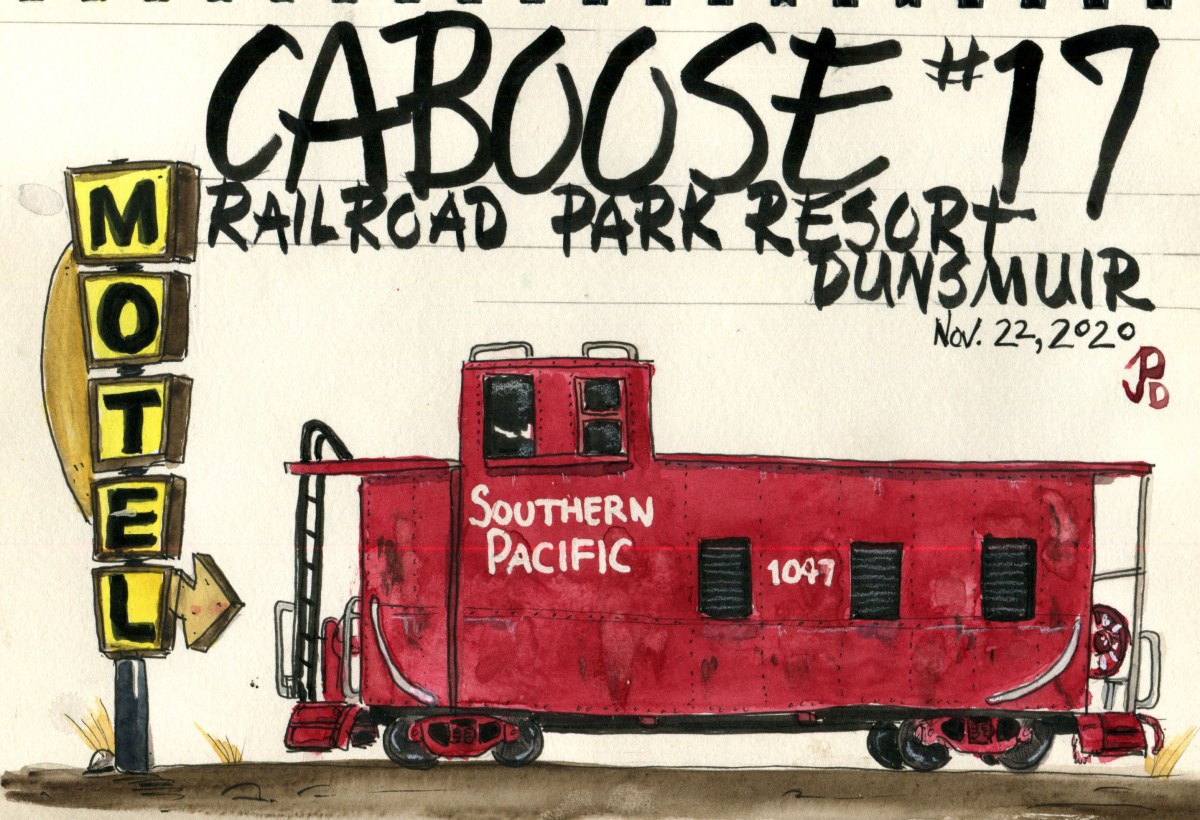
I stayed in a Southern Pacific cupola caboose No. 17 (SP # 1047). This caboose is a class C-40-1 and it was built in 1937 (one of 50 that were built). The caboose arrived at the Railroad Park Resort in the early 1970’s when the interior was remodeled.

This caboose had everything you could ask for in a modern hotel room. The specs of Caboose #17 are: a king sized bed, full bath, refrigerator, microwave, tv (featuring the Resort’s own channel!), an air conditioner (very important on chilly mornings!), and table and chairs. What most hotel rooms lack is a cupola!

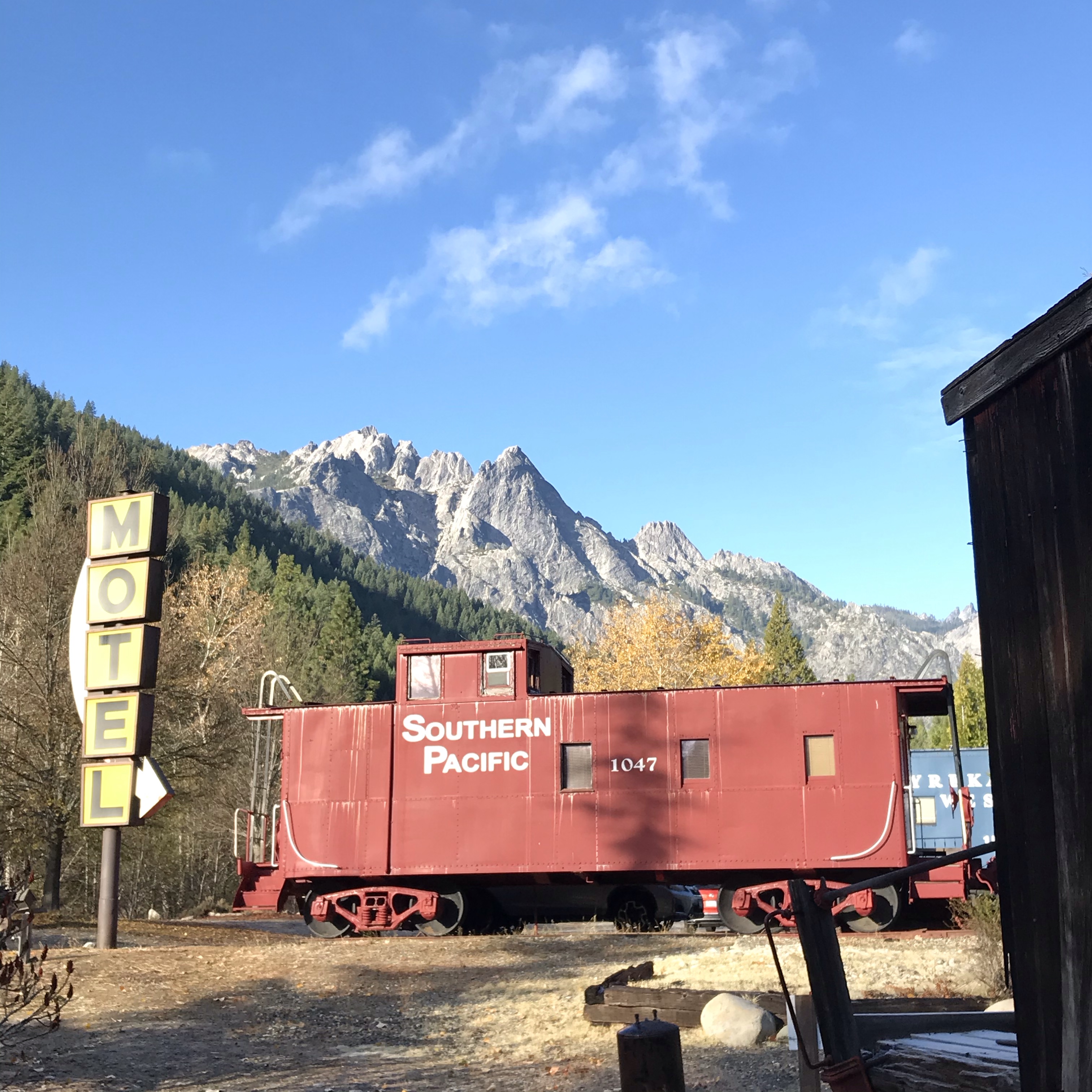
The view from the cupola is probably the best out of any of the cabooses at the resort. When looking to the southwest, the rugged peaks of Castle Crags catch the early morning sun.

I put my bags in the caboose, grabbed by sketching bag and chair, and picked my spot to sketch Caboose #17. To the left of the caboose was a sign that proclaimed like a proud exclamation mark: “MOTEL!” with an arrow that shot out of the “L“, pointing to the red caboose as if to proclaim to the unbeliever that, “Yes, you can stay in this caboose!”

A nice way to spend the chilly mornings was to sit in the cupola, with warm coffee, my sketch book and pens. This is s a cupola view of Caboose No. 17. In this view are three other cabooses at the Resort.
Image

Railroad Park Resort, Dunsmuir

Dunsmuir is a railroad town and what better place to spend the night in Dunsmuir than a caboose?

The resort was first envisioned as a railway museum with a collection of rolling sock. The museum idea fell through. In 1968, the original owners, Bill and Delberta Murphy opened the Railroad Park Resort as a railroad-themed hotel with accommodations being in cabooses.

The resort now has 28 different cabooses to stay in and is a rail fan’s paradise. One prominent feature is the 1927 Willamette three-truck Shay logging locomotive on static display. There are only six of these Willamette locomotives in existence.The Shay rests besides a wooden water tower.

The resort also features a restaurant that is housed in three passenger coaches. Dining was closed due to the pandemic but was open for take out with caboose-delivery. I was treated with a tasty ravioli and a Caesar salad.

To represent the Railroad Park Resort in my journal I decided to paint the Shay and the water tower near the entrance to the park (featured sketch). For this approach I pulled up a sketching chair near the soothing water fountain and I decided to block in the shapes of the locomotive and water tower in loose, broad paint strokes. I was not so concerned with fitting the entire locomotive on the page, nor was I interested in rendering every detail. This is the sort of painting that if a bystander where to look over my shoulder, would think I have the artistic talent of a brown trout. But out this spattered chaos, you slowly form the image with pen work, once the paint has dried.

The challenge of drawing a Shay is the complexities of it gears. It you look at it as a whole it is daunting but if you break it down to small, manageable shapes, it is doable.

My caboose for two nights and the epic Castle Crags in the background. (This caboose will feature in a different post).
The water tender of the three truck Shay with the water tower in the background.