Image

Merino Wool: The King of Threads

Merino wool is expensive, but it can save you money in the long run.

How can paying $25 for a pair of Merino wool socks save you money? Well, because of the anti microbial properties of Merino, your socks don’t stink after you wear them.

In fact you can wear them two or three more times before washing them meaning you don’t have to bring as much clothing while traveling. Less to pack means you don’t check your bags and considering the exorbitant fees on airlines nowadays, you end up saving!

And if your Merino wool socks happen to be made in Vermont by Darn Tough (like some of mine) you get a lifetime guarantee (your life not the socks!) These socks are built to last. Now that’s money well spent!

Also Merino dries much quicker than other fabrics making sink, shower, or bathtub washing much easier. Washing in the afternoon means dry garments in the morning.

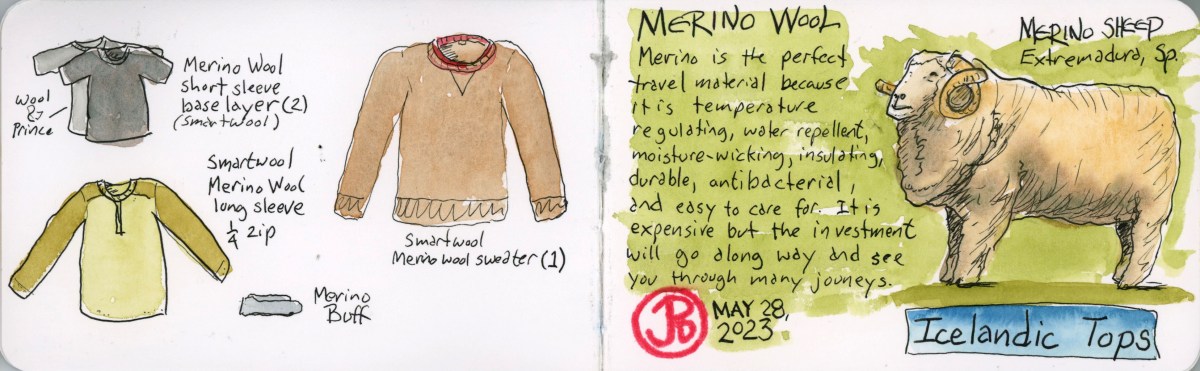
The same is true with any material made from Merino wool. I plan to pack two short sleeve shirts, one long sleeve 1/4 zip shirt, a sweater, and a Merino buff. Merino fits into my less is more packing mantra for my Icelandic saga.

My Smartwool long sleeve 1/4 zip and short sleeve T-shirt and my Wool & Prince short sleeve tee (front).

I may be rocking the same outfit a few days in a row (with no ten years olds pointing it out) but I’m here on vacation not at a fashion show.

The Story of Merino

Merino wool comes from the domestic sheep established in the Extremadura region of Spain. It was at one time illegal to export the sheep or it’s wool outside of Spain. Offenders faced certain death! Eventually these restrictions were loosened and Merino was exported around the world.

Today Merino wool is produced in many places including Australia, China, New Zealand, Argentina, South Africa, the United Kingdom and the United States.
Image

Extremadura and Las Canteras


Why Spain? You ask. The answer has been the same on recent trips both when boarding a plane or hitting the road. Birds, birds, birds.

Extremadura, the province southwest of Madrid, boasts an amazing array of avian riches in Europe, a high consentration of raptors and a handful of endemics which are birds that are found nowhere else in Europe.

Birders come from all over Europe to make a pilgrimage to this rural part of Spain to see Spainish imperial eagle (which once graced the flag of Franco’s Spain), Egyptian, griffon, and black vultures, black stork, Iberian magpie, bee-eater, lesser kestrel, great and little bustard. Many of the twitchers hailed from the mighty triad of birding nations of Northern Europe: the Netherlands, Germany, and Great Britain.

Extremadura sits on the flyway that bridges Northern Europe with Africa. This part of the Iberian Peninsula provides breeding habits for the colorful European bee-eater and roller as well as providing a year round habitat from many other species.

For this expedition I hired the services of a guide to take me to the birds, work as a translator and go-between with the locals, and help me navigate rural Spanish cuisine (which for me meant cheese, bread, and beer but sometimes augmented with wine.)

Las Canteras

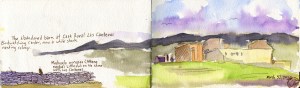
My mastery of Castilian is clearly demonstrated by my different spelling of Las Canteras in this spread. It’s great to know that my spelling is appalling in any language!

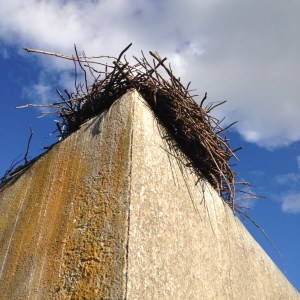
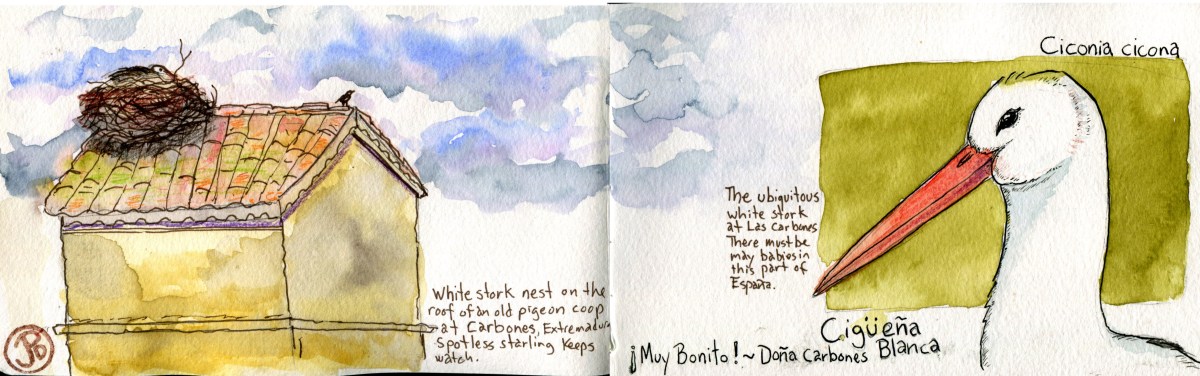
My guide, Pau, chose Casa Rural Las Canteras Birdwatching Center as our base camp. From the front porch you could view the crumbling stone barn that had been reclaimed as a white stork rookery, containing at least eight active nests.  On the other side of the porch was a scope fixed on a little owl. No I mean that’s what the owl is called: Athene noctua ( odd name for a daylight owl). It seemed that no matter when you looked through the scope, the little owl is always perched on the stone wall. Uncanny! Well I had to sketch the owl on it’s permanent perch.

2016-03-31 18.55.26

So this is where babies are made! White stork nest at Las Canteras.

Las Canteras (or Carbones) is run by the innkeeper and his mother, whom I dubbed Doña Carbones. She looked at my white stork sketch and offered a little art criticism: “¡Muy bonito!” I’ll take it!


Image

Sketches of Spain

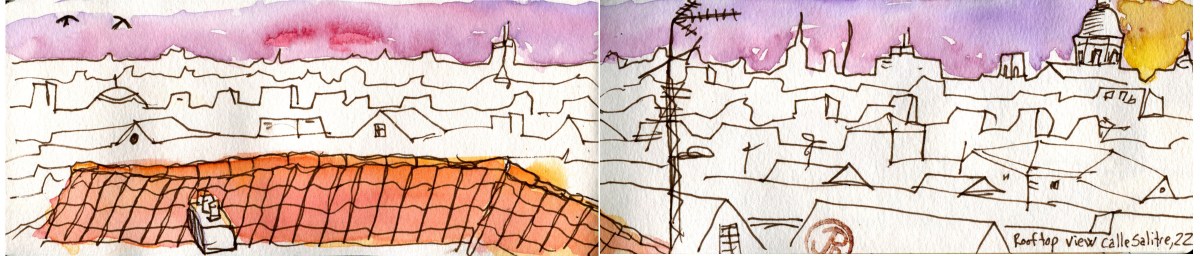
For my two week spring break I headed to the Iberian Peninsula with two sketch books, paints, my Escoda Prado synthetic sable travel brushes, and binoculars. This is the first time I had sketched in a foreign country (no Texas jokes please). It took a little while to “shakes hands with the place” as Goldsworthy would say. A little while to warm up to Spain.

My travels took me to two of the greatest sporting venues in the world, two of the greatest art museums in the world, the top birding destination in Europe, and an art museum that is an architectural masterpiece. Madrid, Extremadura, and Bilbao.

Over the next series of posts I will share pages of my sketchbooks from the Corrida De Toros at the Plaza de Toros de Las Ventas, to the 107 species of birds I saw in Extremadura and the chameleon-silver flying fish that is the Guggenheim Museum in Bilbao.

Enjoy the rich colors, traditions, and cuisine of Spain!

Drinks

Care for a drink with your sketch?