After sketching in Evergreen, I headed north up the Peninsula to San Carlos. My destination: the Hiller Aviation Museum.
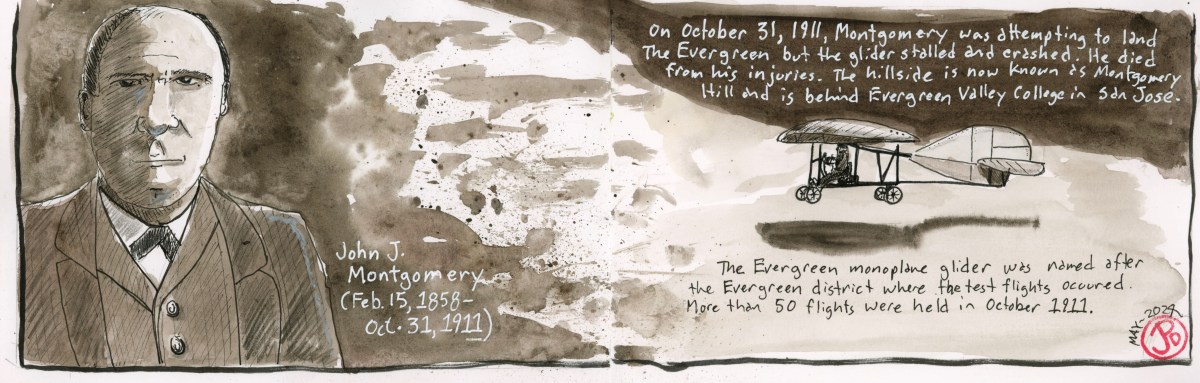
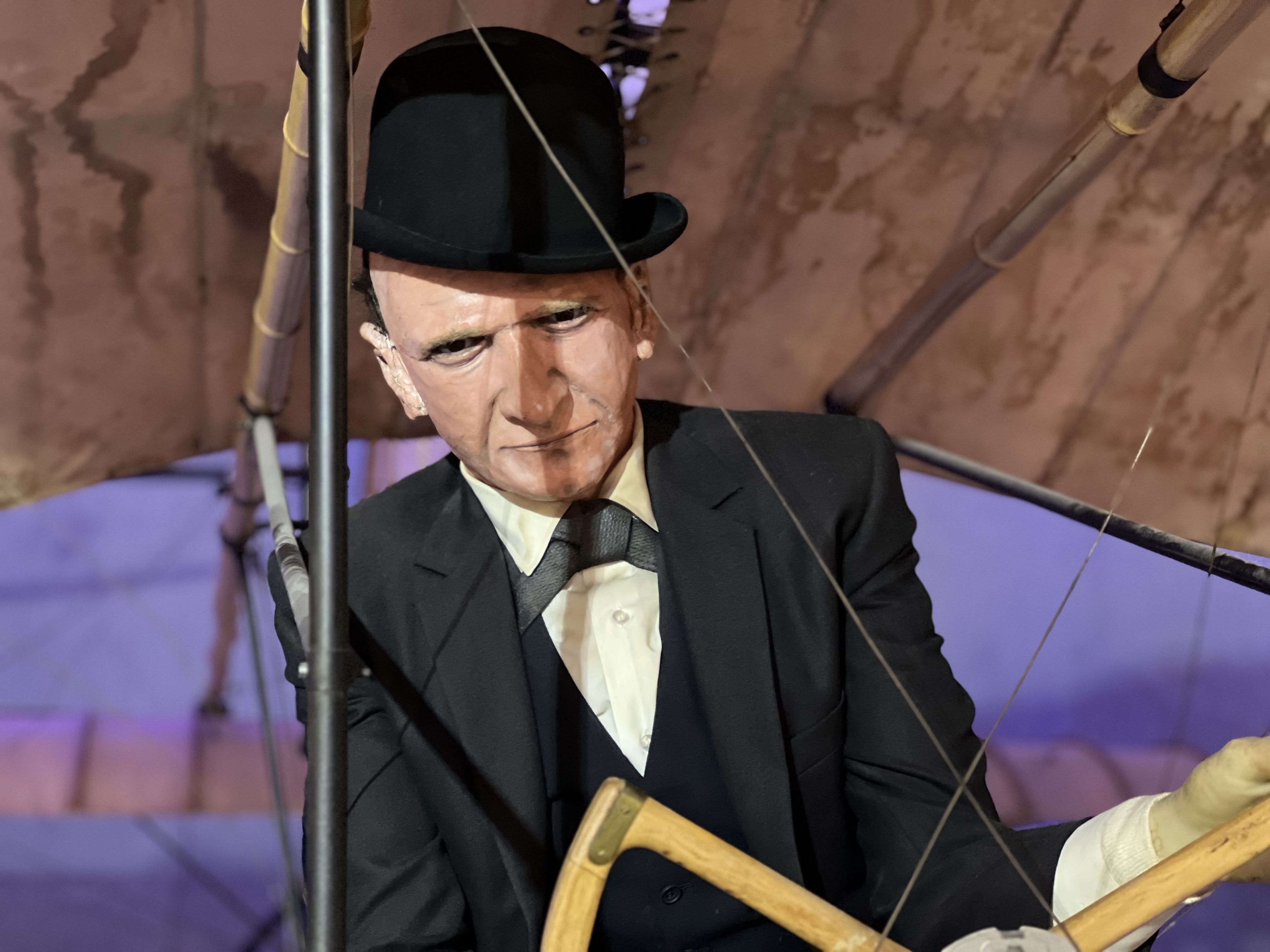
I was here to see and sketch three gliders and look at a plaque. The three gliders are replicas of the Gull, Santa Clara, and Evergreen, all designed by John J. Montgomery. Two are suspended from the ceiling and the Evergreen sits in a dark corner with a dubious mannequin, representing John Montgomery, sitting at the controls.
The plaque sits off to the left of the replica of the Evergreen and mannequin. I have seen a plaque like this before, last fall in Roanoke, Virginia and also at the California State Railroad Museum in Sacramento.
The plaque in Roanoke honored the engineering achievements of Norfolk and Western’s J-Class No. 611. The plaque at the Hiller, by the American Society of Mechanical Engineers, designates the glider as an International Historic Mechanical Engineering Landmark. The plaque reads:
Montgomery Glider
1883
This replica represents the first heavier-than-air craft to achieve controlled, piloted flight. The glider’s design was based on the pioneering aerodynamic theories and experimental procedures of John Joseph Montgomery (1858-1911), who designed, built, and flew it. This glider was way ahead of its time, incorporating a single parabolic, cambered wing, with stabilizing and control surfaces at the rear of the fuselage, with his glider’s success, Montgomery demonstrated aerodynamic principles and designs fundamental to modern aircraft.
The plaques placement is a bit unfortunate because it actually refers to the Gull, which hangs above and not the Evergreen (the curator I talked to admitted that this part of the museum has been neglected).
John Montgomery was a true Californian, born in Yuba City. He was many things in the Golden State: inventor, pilot, engineer, physicist, and a professor at Santa Clara University.
He studied the soaring flight of hawks, eagles, pelicans, turkey vultures, and gulls around San Diego Bay and further inland and then tried to design his gliders influenced by nature’s own design. He referred to birds as, “tutors in the art of flying”. Montgomery put this understanding the flight of birds with creating a heavier than air glider this way, “It has always seemed to me that the secret of aerial navigation lay in the discovery of the principle of bird’s flight.”
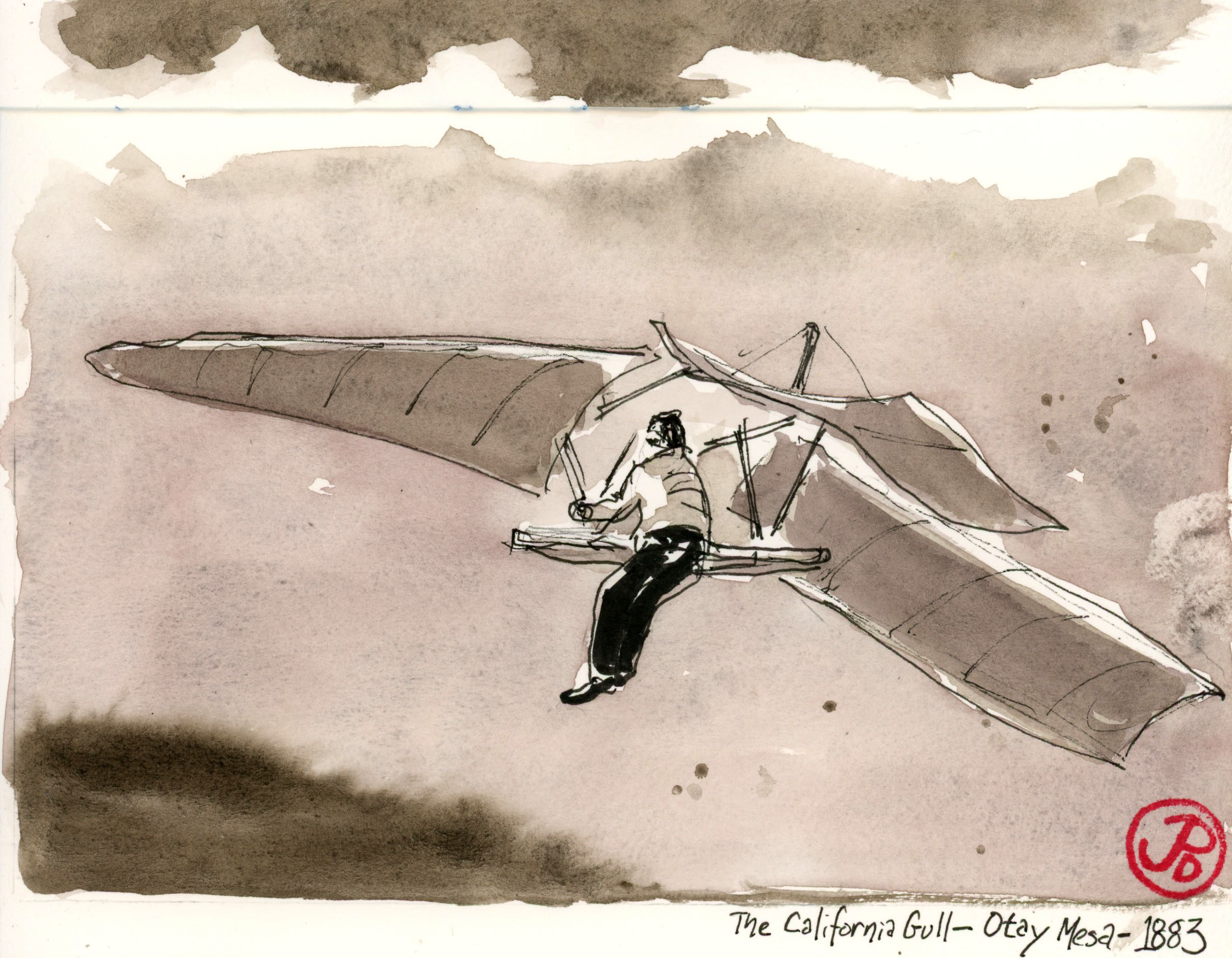
In 1883 the flying professor made pioneering flights near the Mexican border at Otay Mesa. His flights lasted up to 600 feet. He had not yet learned how to design a glider that could soar upwards like a turkey vulture.
Here he flew the Gull, the replica now hangs in the Hiller Aviation Museum.
So I did a loose sketch of the Gull.
 Corvid Sketcher