It is said that every bird is a rarity somewhere and ever birder in the fall is just waiting to find that bird and that somewhere. If that bird is a mega rarity, the type of bird that makes a birder wake up far too early on a Saturday morning and driving through the dark predawn hours, just to see a sandpiper that is common in Asia, then it is even that much better. But to have two California mega rarities in the space of one week in almost too much to take in!
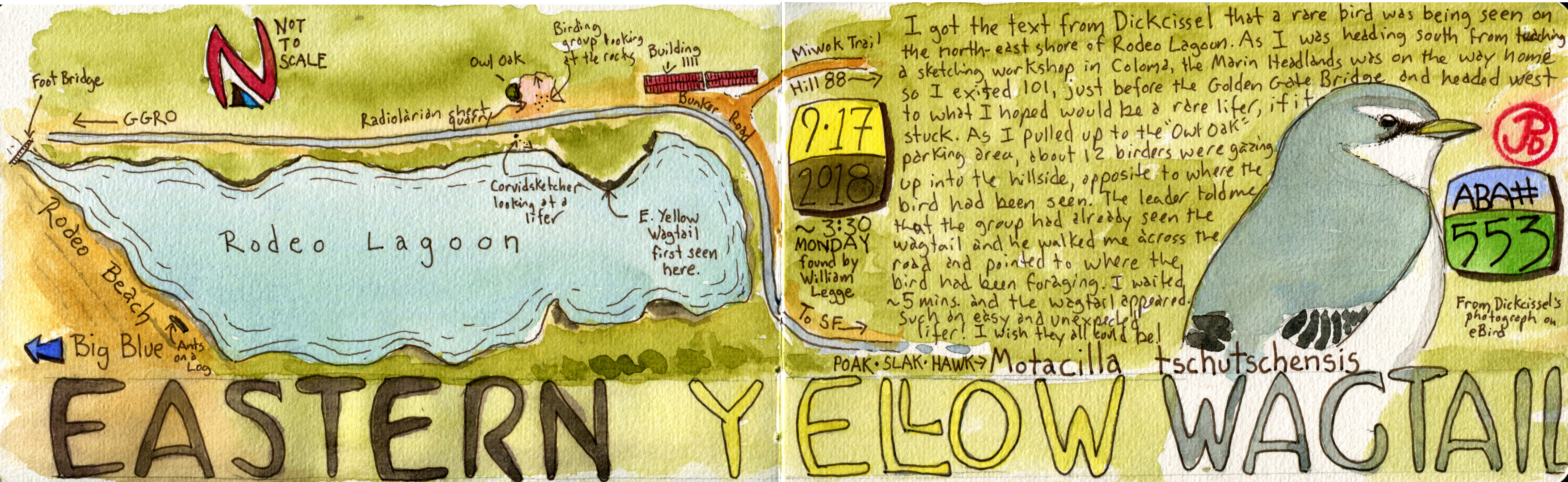
The first rarity was unexpected, but which rarity really is? I was heading back from teaching a sketching workshop in historic Coloma, California to the naturalists at CODS (Coloma Outdoor Discovery School). On my return I received a text from Dickcissel that an Eastern yellow wagtail had been seen the previous day at Rodeo Lagoon in the Marin Headlands.
I pulled off Highway 37 and checked Sialia, the birding listing sight, and sure enough the wagtail had been seen in the morning. I could be in the Headlands in 25 minutes on my way back to San Francisco.
Some lifers are unexpected and easy and that’s even better when we are talking about a mega lifer like Eastern yellow wagtail (Motacilla tschutschensis). This wagtail has only been reported in the Golden State 19 other times in the data that dates back to the 1970’s, making this bird listed as “very rare along the Pacific coast to California (mainly Sep)” according to The Sibley Guide to Birds.
When I rounded the curve of Bunker Road at the eastern end of Rodeo Lagoon, I was coming to the pull off at the Radiolarian chert quarry that was capped by the Owl Oak. There was a group of about twelve birders who were looking up into the hillside. Now this seemed odd for a water loving bird that had been reported on the banks of the lagoon, which was in the opposite direction to where the group of birders were focused.
It turns out the group was from the Central Valley and they had the wagtail five minutes earlier and they were now following a warbler flock on the hillside. Their leader was kind enough to lead me across the road and pointed to where the bird had been seen. I scanned the shoreline out to the point and back again. I only had to wait five minutes until the wagtail reappeared from the reeds and foraged on the shoreline. ABA lifer 553!
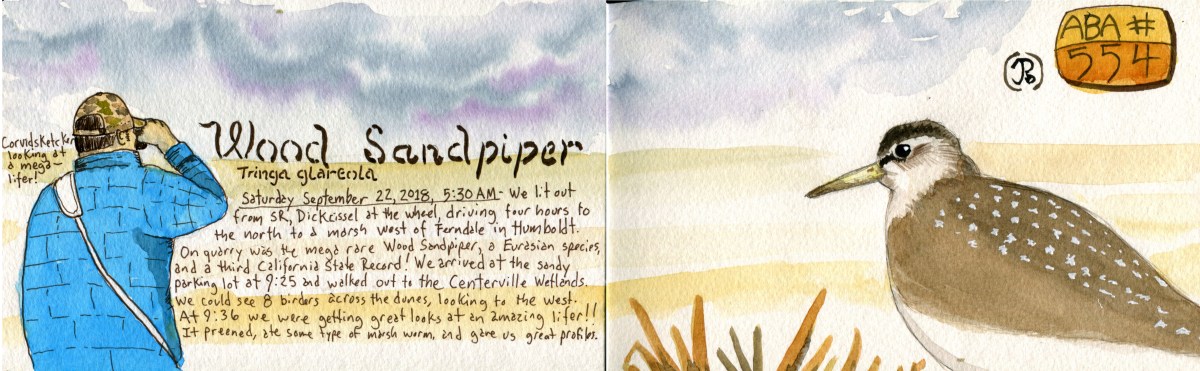
The next mega rarity was first seen on Friday September 14 in Humboldt County at the Centerville Wetlands just west of the town of Ferndale. It was identified as a rare (to California and only a third State record) Eurasian shorebird: a wood sandpiper. It was not refound on Saturday but Sunday morning it was seen again and seen by many birders.
This wetland was four and a half hours from my home, and I did not have time to try to find it on Sunday. So I waited with bated breath, checking all the postings to see if the wood sandpiper would stick. Tensions grew throughout the week as I waited for each new confirmation that the sandpiper was still there. I made a plan with Dickcissel that if the bird was seen on Friday afternoon then we would head up to the wetlands early Saturday morning.
I was up at 4:30AM on Saturday morning, a full half hour before my alarm was set. I was out the door by five and by 5:30, Dickcissel and I where on 101 North, cruising through the predawn darkness willing the wood to stick and hoping that a peregrine has not gotten to the bird before we did!
We where in southern Mendocino County when the sun rose above the hills. We where making great time.
Almost four hours later we exited 101 and headed west toward Ferndale. We bypassed Main Street, noting that we where eight minutes away from our final destination.
We were on what seemed like the longest three miles of our lives know that an incredibly rare visitor could be ours. Once the houses faded away and the vista opened up to the coast we knew we were very close.
To the right was the parking lot. The time was 9:25 AM. As we geared up, two birders, who had journeyed from San Diego, confirmed that the wood sandpiper was still there! We moved across the sand as fast as humanly possible while shouldering a scope toward the line of birders looking off to the west. We knew that find the needle in the haystack was going to be easy!
In ten minutes I had the rarity in my scope: dark tipped bill, eye ring, white eyebrow that extended beyond the eye, white speckled back, and yellowish-green legs. This was a shorebirds that looking like nothing else in the Lower 48. This was the wood sandpiper (Tringa gladiola)! What a journey for a mega lifer!








 Corvid Sketcher