Scotts Bluff is a narrow pass that the Oregon, California, and Mormon Trails all passed through. Any emigrant, no matter where their jumping off point was, converged and crossed at this point on their way to the west coast.
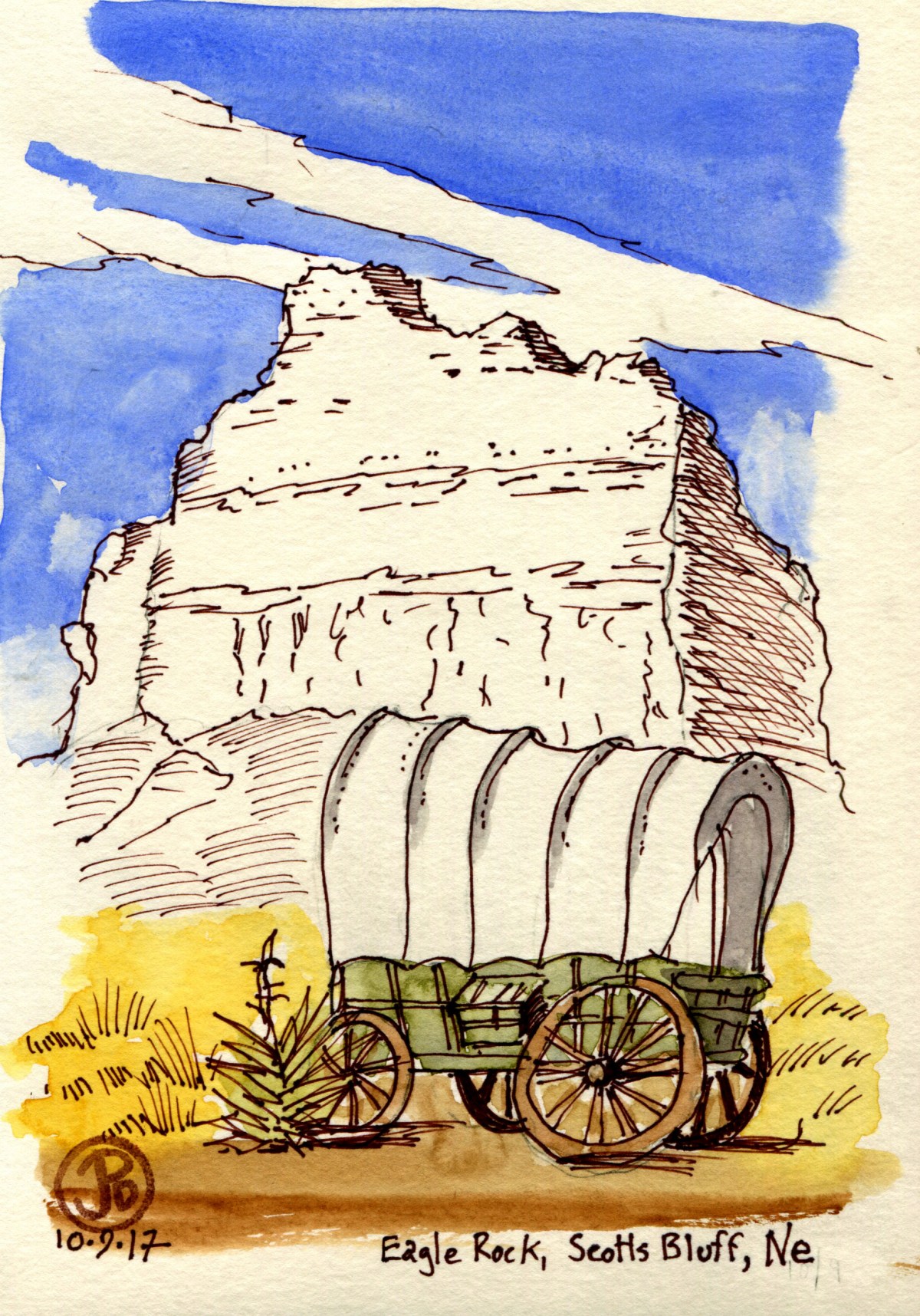
I pulled out my sketching bag, grabbed my sketching stool (yes I packed it in my suitcase) and I walked down the trail at Scotts Bluff National Monument to the three replica wagons along the trail. Rising behind the wagons was the impressive Eagle Rock. I picked my spot, set up my stool and started to sketch. In the late afternoon, I seemed to have the entire park to myself. There was no tourist standing in front of me and my subject asking, “Whatcha do’in? (Long Pause) “Drawl’in?” Okay maybe I’m exaggerating but only just.
 A faux ox with Eagle Rock in the background.
While sketching you enter another world where your focus is complete and the scene before you is translated into lines, shapes, and hashmarks. But a call, from somewhere behind we broke my focus. It was a loud bugle of a call, a call I knew but had trouble placing because I had not heard it a long while. I looked up and I could just make out the flying “V”s heading in a southern directed. These were not the “V”s found in a student handwritting book, no, these were “V”s like the motion of water around an obstacle on a gently flowing stream. It was the southern migration of the sandhill cranes! I watched as hundreds if not thousands passed on their way to the fallow rice field to the south, their wintering grounds.

The passage of the sandhills was an unexpected bonus, the type of serendipity that can happen on the road when everything seems to come together to make a memorable moment. The late afternoon light, Eagle Rock, the replica wagon, sketching on my sketching stool, the sandhill cranes, and me being in the right spot at the right time. This produced one of my favorite field sketches of the trip.


 Corvid Sketcher