Image

Mare Island and the Muddy Puppy

The former Naval base on Mare Island is a sketcher’s paradise. It’s full of cranes, condemned buildings, dry docks, bridges and rusted rails. Plenty of shapes and perspectives to add to my sketchbook.

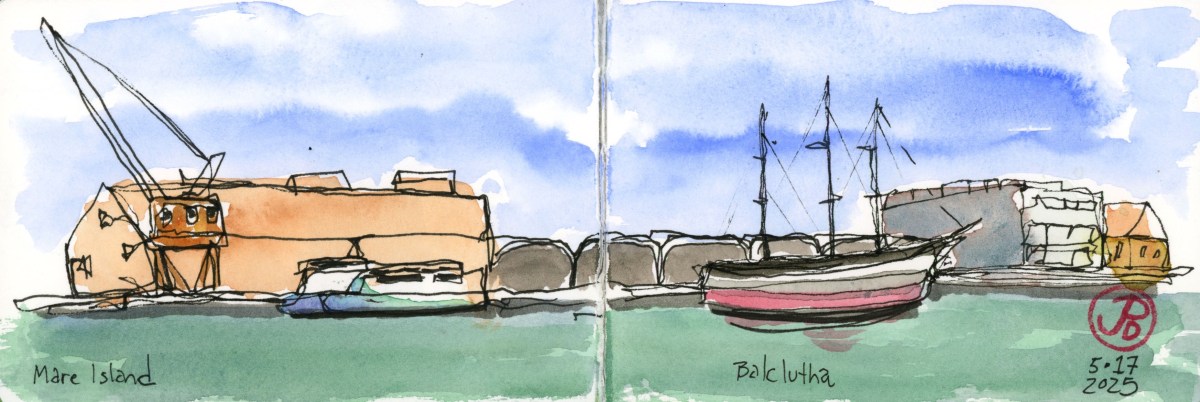
On a recent journey to Vallejo to visit a friend, I headed to the ferry terminal across the Napa River from Mare Island to do a park bench continuous line sketch of the river front with the Balclutha moored to the dock (featured sketch).

The 1886 three master (aka Star of Alaska) is temporarily on display here while the pier at the San Francisco Maritime National Historic Park is rebuilt.

Also moored nearby is a modern bay ferry which I included in the sketch as a bookend to Bay Area maritime history.

Mare Island Mud Puppy

From my sketching position near the Vallejo Ferry Terminal I was looking across the Napa River towards the location of one of the most infamous sinkings in Mare Island history.

On May 15, 1969 the Sturgeon-class nuclear submarine the USS Guitarro was moored to the pier in the Napa River. The sub had been built and launched (July 27, 1968) on Mare Island and now was still under construction.
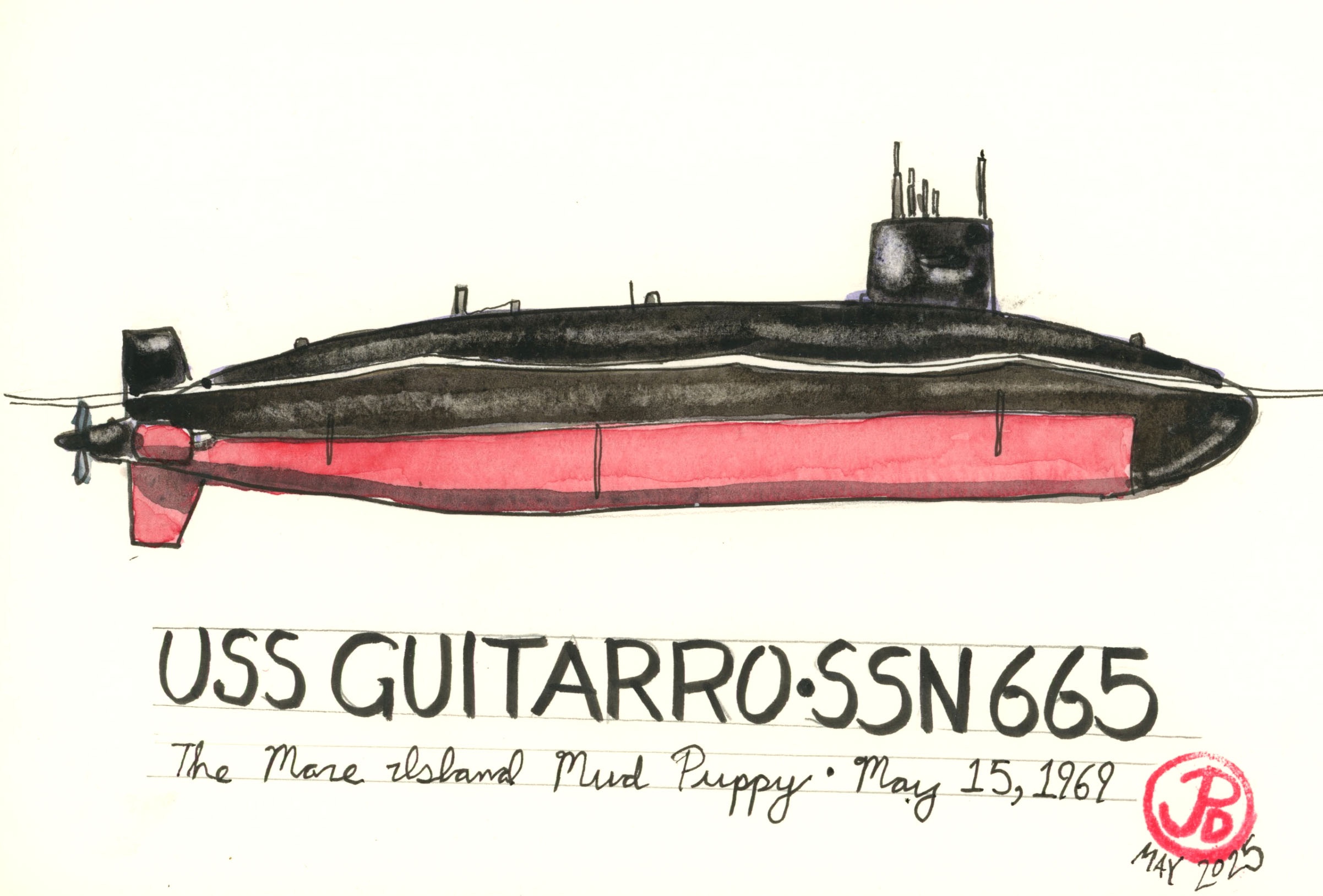
Two construction groups were working on different parts of the sub at the same time. They began adding water to the ballast tanks, unbeknownst to each other. The construction groups were warned that the Guitarro was riding low in the water but did not heed the warnings.

At 20:30 (8:30 PM) the groups, after returning from lunch, noticed the sub taking a downward angle and the Guitarro was taking on water from her forward hatches. At 20:55 the Guitarro sank to the bottom of the river leaving her sail above the waterline thus earning the dubious nickname: “Mare Island Mud Puppy”.

The sub was refloated a few days later and damages were estimated to be between $15 and $22 million. The sinking of the Guitarro put an end to submarine construction and repair at Mare Island. Mare Island Naval Shipyard was once the premier West Coast submarine port. The last sub built at Mare Island was the USS Drum in 1970.

The USS Guitarro was commissioned (32 months late) on September 9, 1972. She was in service until 1992 when she was decommissioned and scrapped at Puget Sound, Washington in 1994.
Image

Castle Air Museum

From my childhood bedroom window on Cormorant Court, I looked down at the scrub-jays, mourning doves, and house sparrows at the feeder and birdbath in the backyard. These noticings fueled a lifelong passion for birds.

To look skyward, to the east, was the flight path of planes as they approached Moffett Field, a naval base in Sunnyvale. The sound of the P-3 Orion’s turboprops were the sound of my childhood, along with the calls of scrub-jays and mourning doves. I learned to identify planes as I identified birds. I knew a C-5 from a C-130, an A-4 from an F-4. I just loved things than fly!

I built models of airplanes such as the F-4, B-52, and KC-135 and hung them from the ceiling with push pins and dental floss. I shared this hobby with a neighbor two doors down and he now is a pilot for United Airlines.

So there should be no surprise that I left Santa Cruz at 6:40 AM, my destination was Atwater, two hours and ten minutes away. My destination was the Castle Air Museum. This air museum is one of the largest collections of military planes (or any planes) on the West Coast.

I am always looking for new sketching challenges and Castle’s collection of almost 70 aircraft would fit the bill. In the end, I did ten sketches in just under three hours.

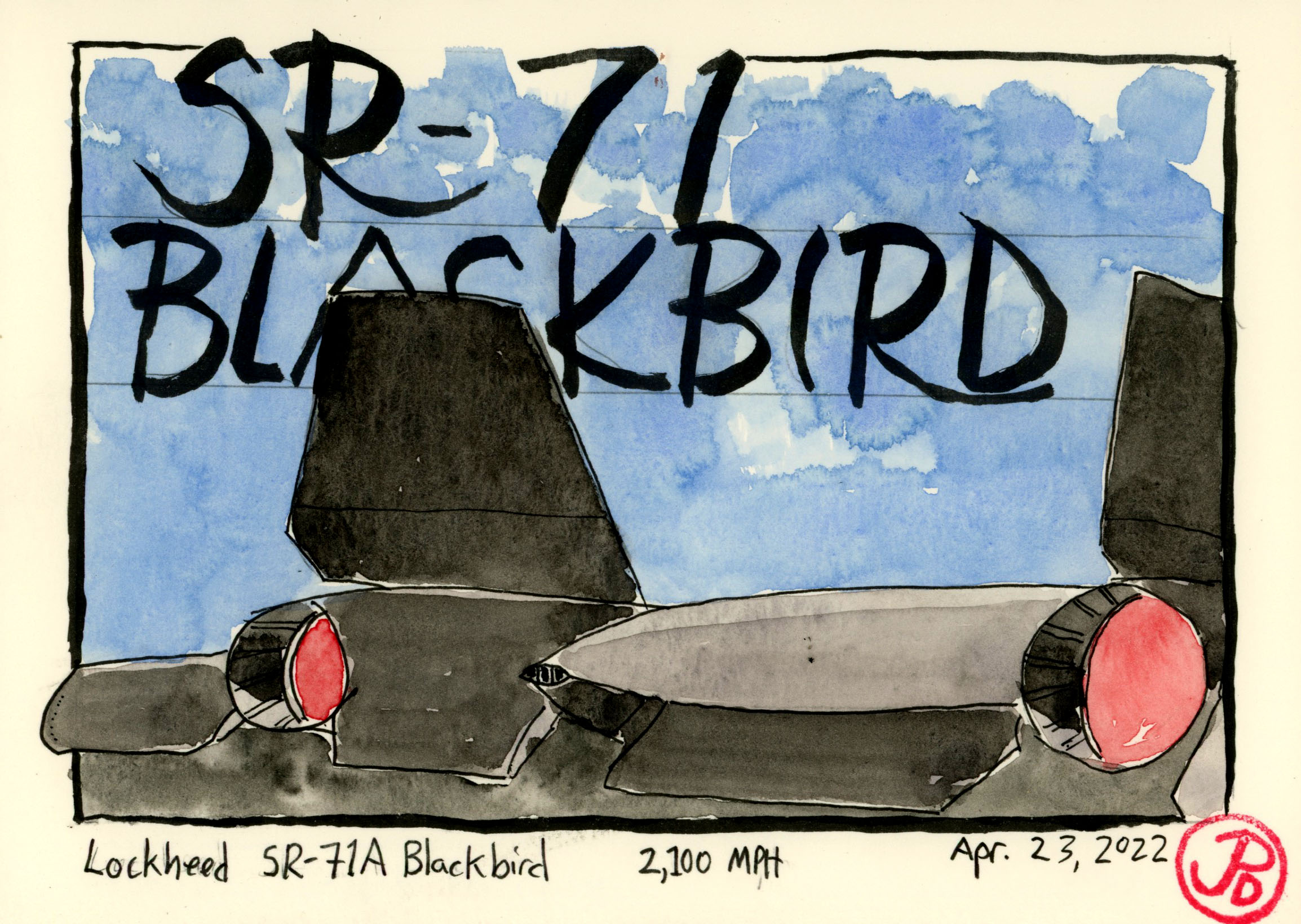
A sketch of the business end of one of the aircraft that mesmerized me as a child, the world’s fastest plane: SR-71 Blackbird. It’s top speed was Mach 3.3, four times as fast as the average cruising speed of a commercial jet. 32 of these high-speed, high-altitude, reconnaissance aircraft where built, 26 still exist and like this Blackbird, are on static display in museums.

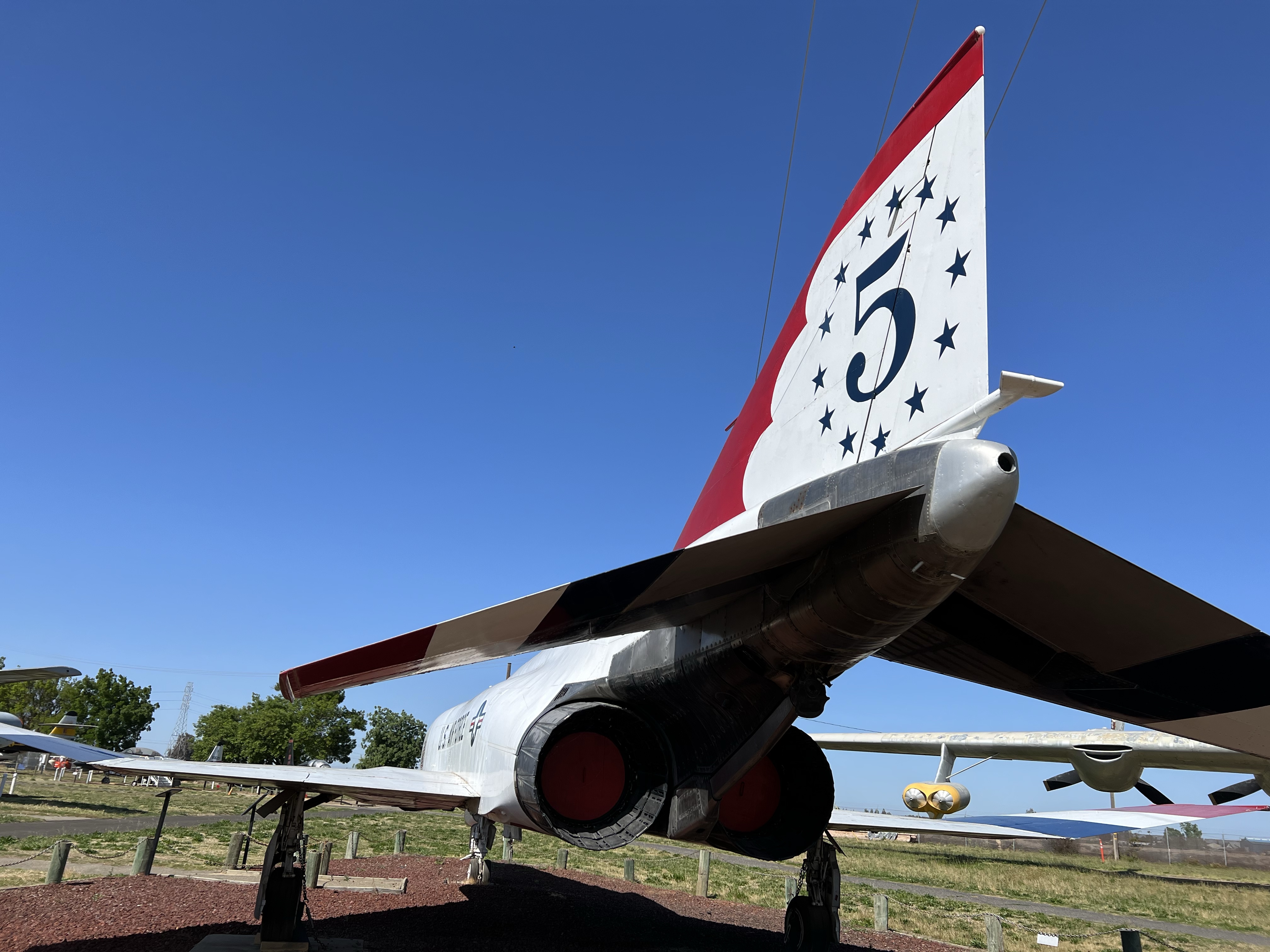
The trip was also a dip into nostalgia as I was sketching an F-4 Phantom, one of the planes I built a model of when I was a kid. As I’ve noted before, you really get to know something when you sketch it.

The business end of an F-4 Phantom. This jet is painted in the livery of the Thunderbirds No. 5, the Air Force Demonstration Squadron. When I was a kid, I built four F-4s in the Blue Angels livery. I would watch the Blue Angles’ performance from my roof.
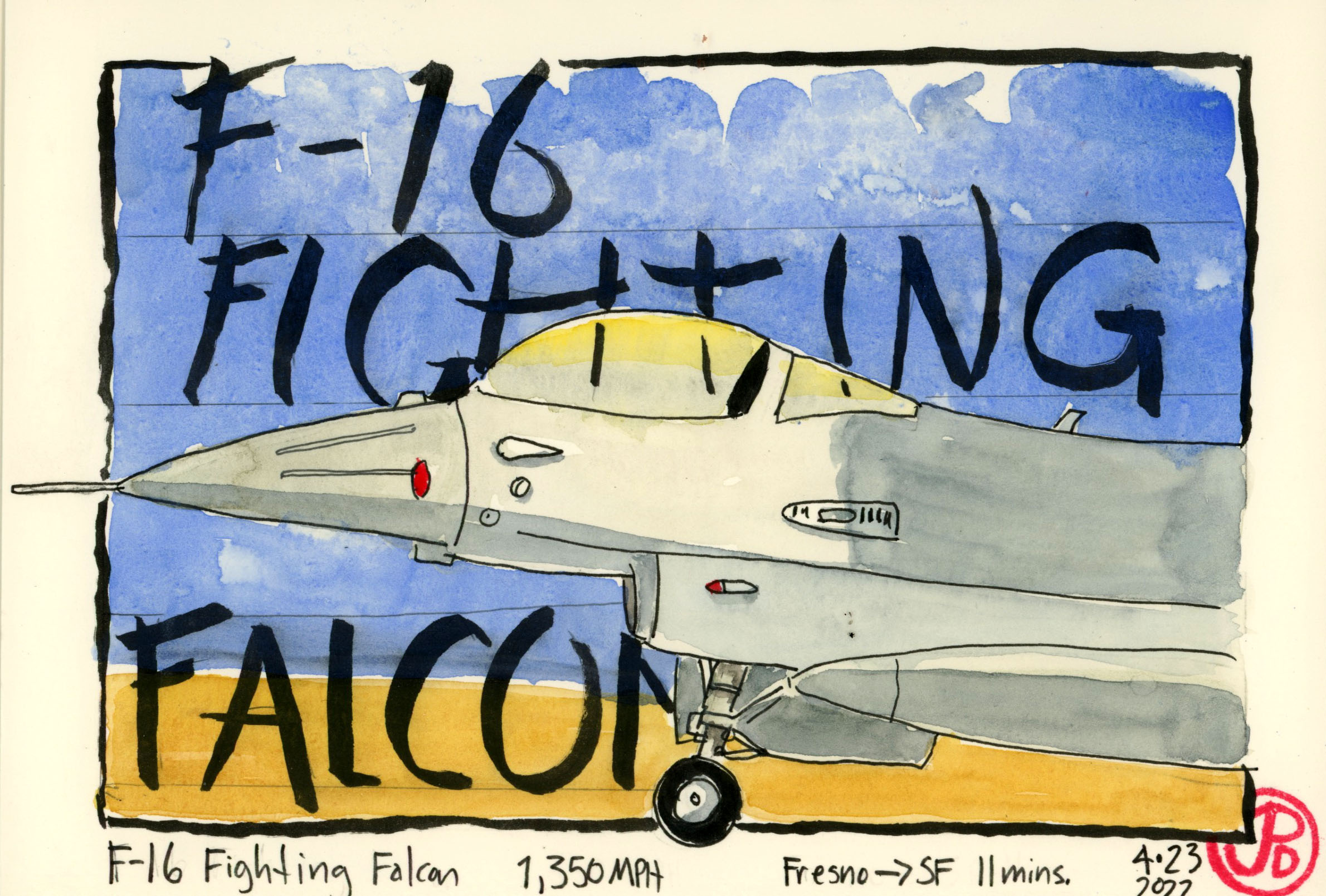
A sketch of an F-16 Fighting Falcon. This plane was part of the National Guard, stationed in Fresno. The F-16 could cover the distance between it’s base in Fresno and San Francisco in 11 minutes!
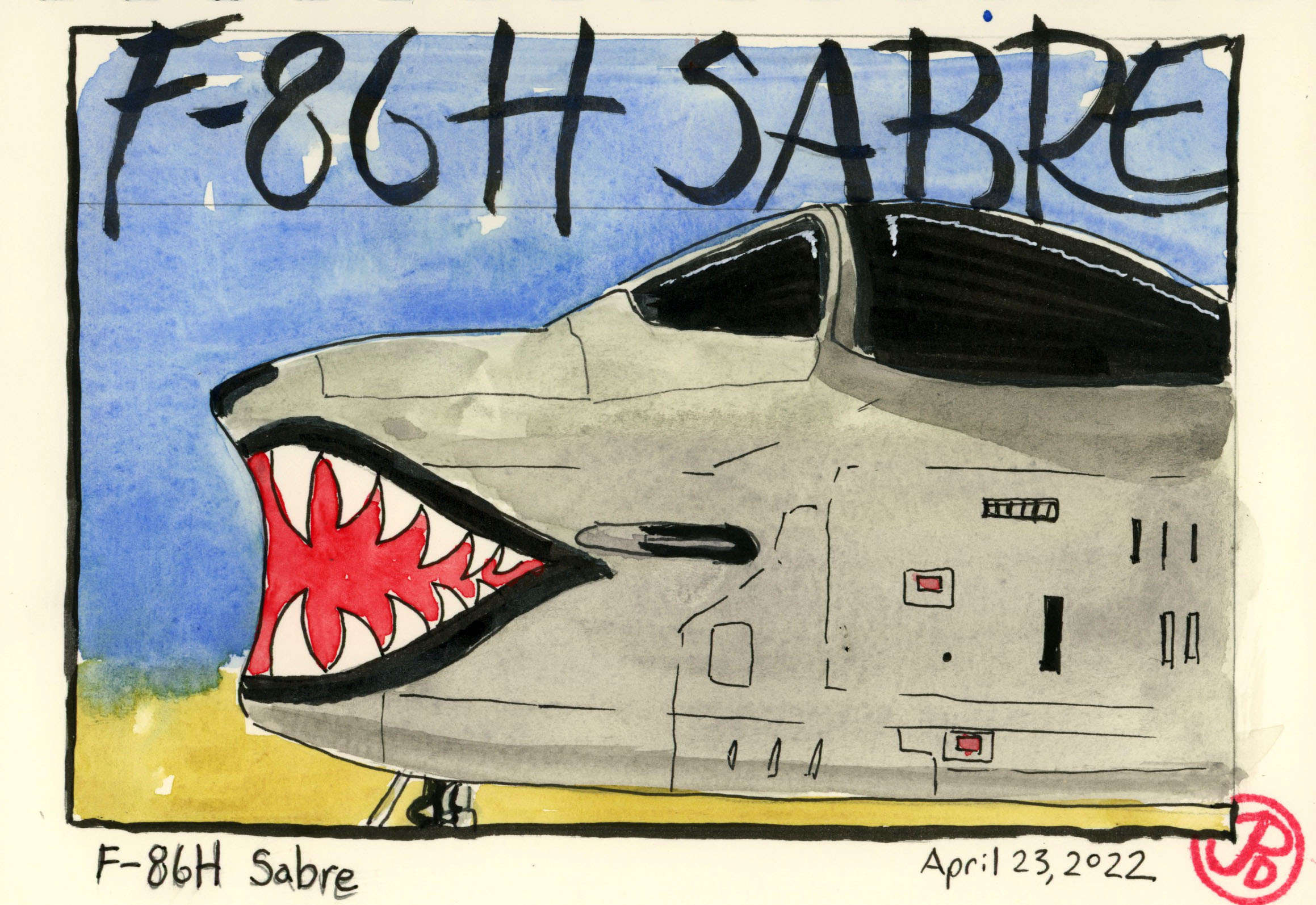
F-86H Sabre, a Korean War swept-wing fighter with a top speed of 600 mph. It’s painted nose is a throw back to the P-40 of World War II.