Image

A380 Over the Golden Gate

In 2025, the largest passenger jet turns 20.

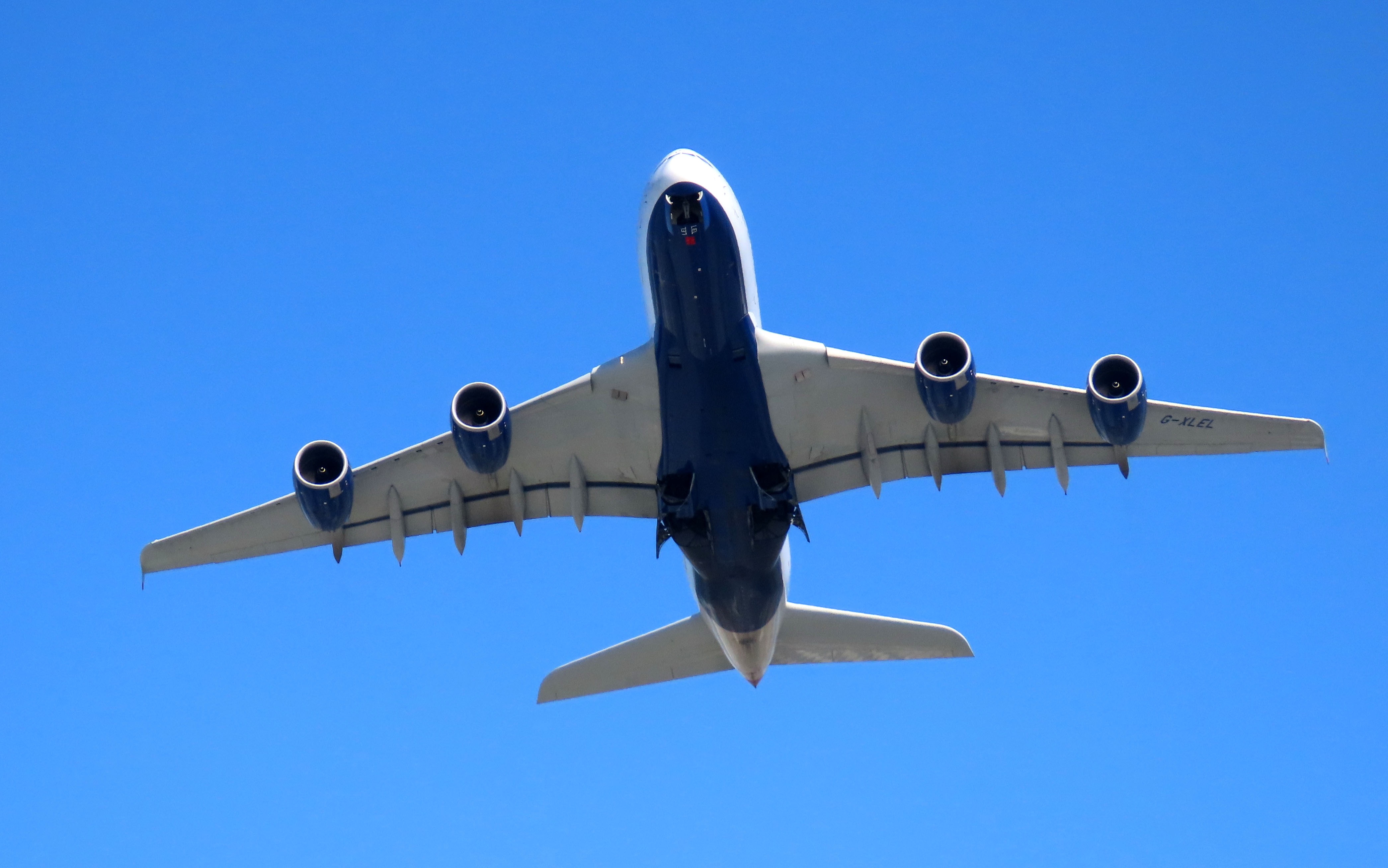
This is the Airbus A380. The A380 is truly an impressive aircraft which I had the pleasure of flying on from SFO to Frankfurt on Lufthansa (the airline currently operates eight A380s but they no longer use them to fly out of SFO).

The A380 is a full double decker with a flight range of 9,200 miles and a capacity of 850 passengers. It is larger than Boeing’s 747 and is designed for long range international flights.

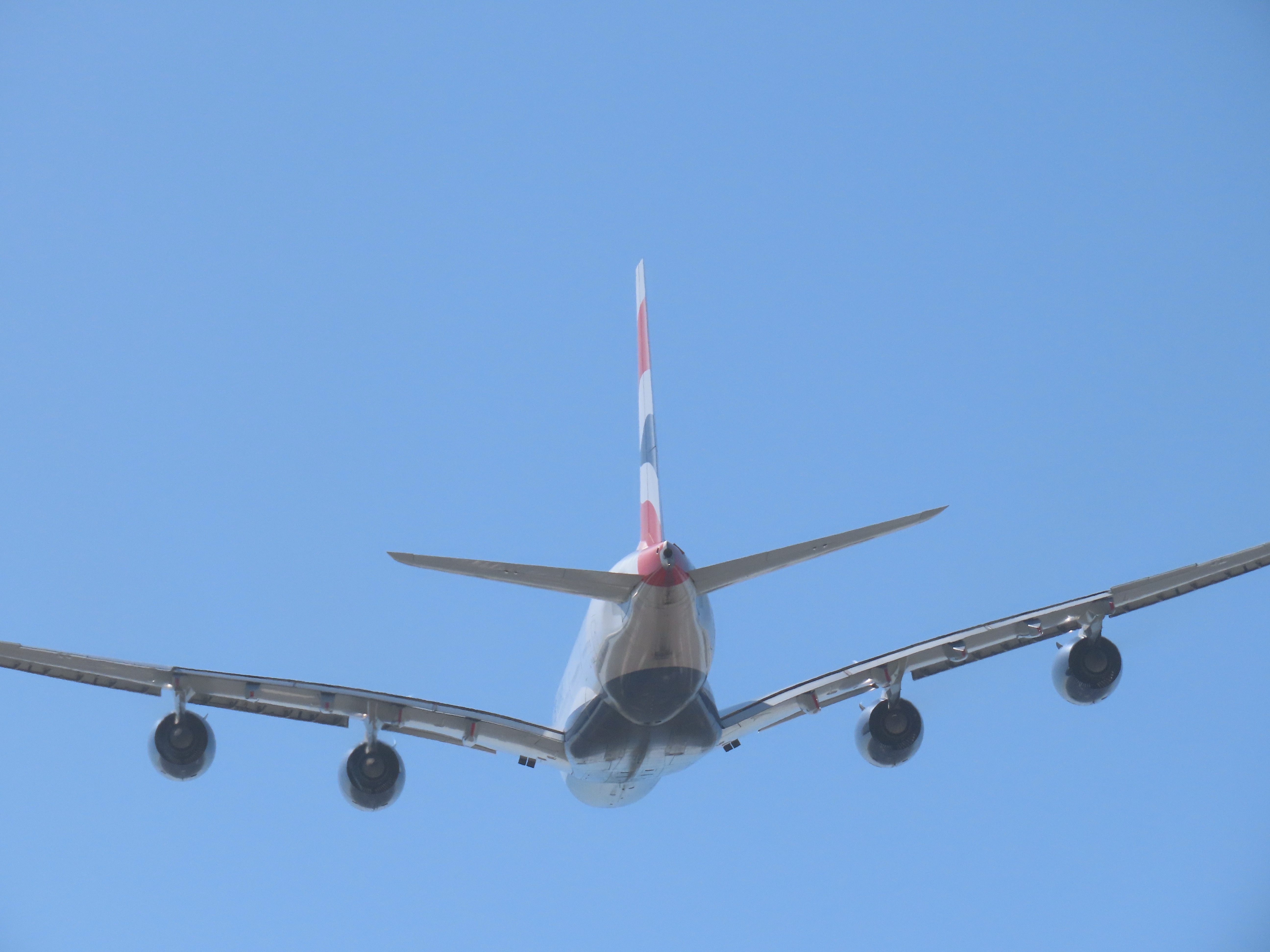
On my afterwork walks I noticed a northbound British Airways A380 at around 5 PM each day. This is flight BA 284. The flight path parallels Ocean Beach and then turns northeast heading toward the Polar route over Greenland to its final destination of Heathrow Airport. I often watch it until it disappears with distance.

After work I wanted to get a sketching perch perspective facing north with the Golden Gate Bridge, Marin Headlands, and Mt. Tamalpais at the base of the panoramic spread and the A380 flying above. Sunset Reservoir fits the bill.

I headed to the northwest corner of the reservoir to Sunset Reservoir Park with a brand new Delta Stillman & Birn sketchbook.
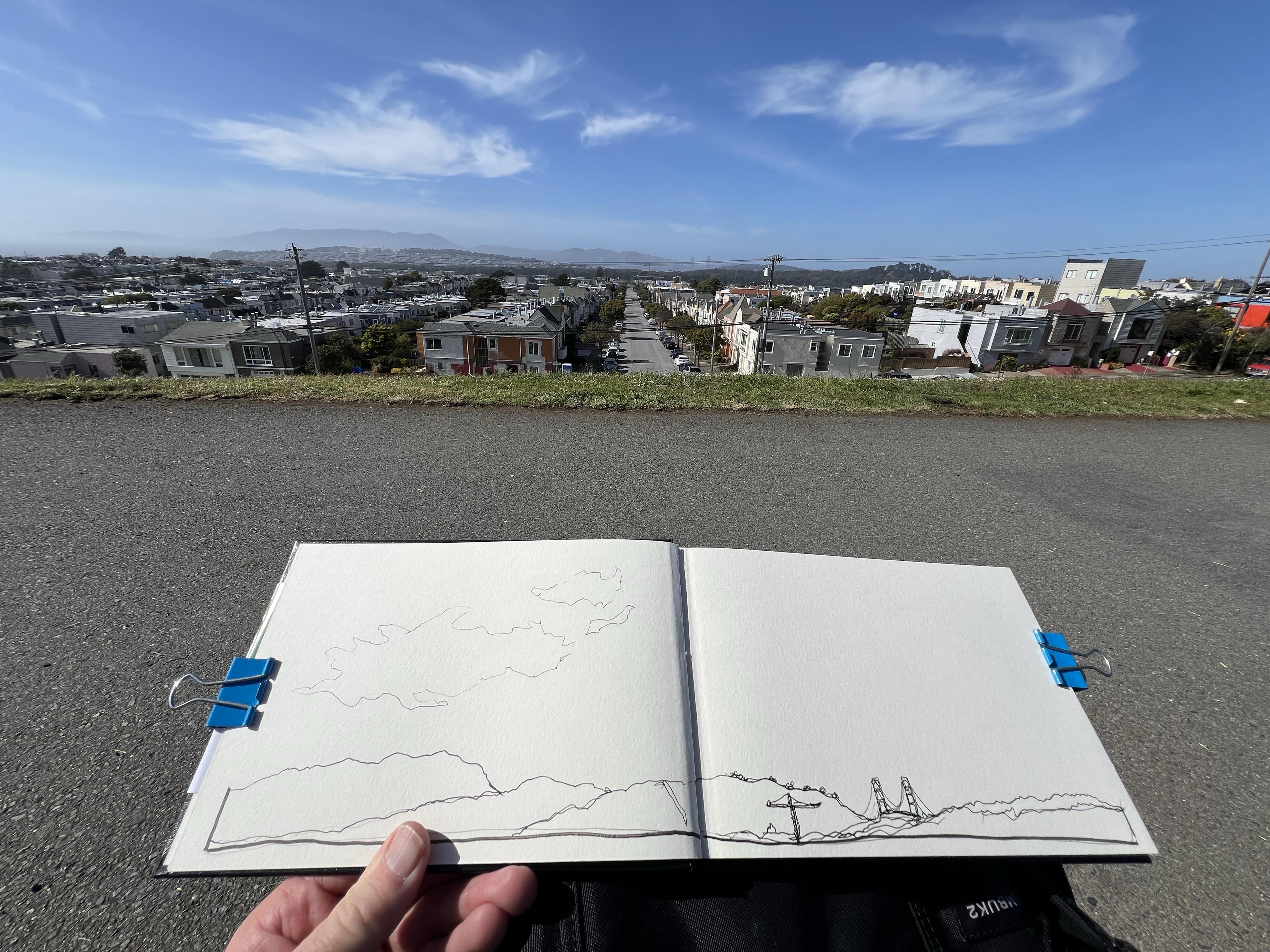
While I was sketching a man and a woman were walking up the path speaking French. I assumed they were from the Lycee Francais de San Francisco school just up Ortega. They had come to take in the amazing views. The woman walked over and asked if I was part of the urban sketchers. I replied that I was not and she told me that she liked to sketch too.

Then she and the man did something that boggled my sketcher’s mind which can be summed up in the following photo:
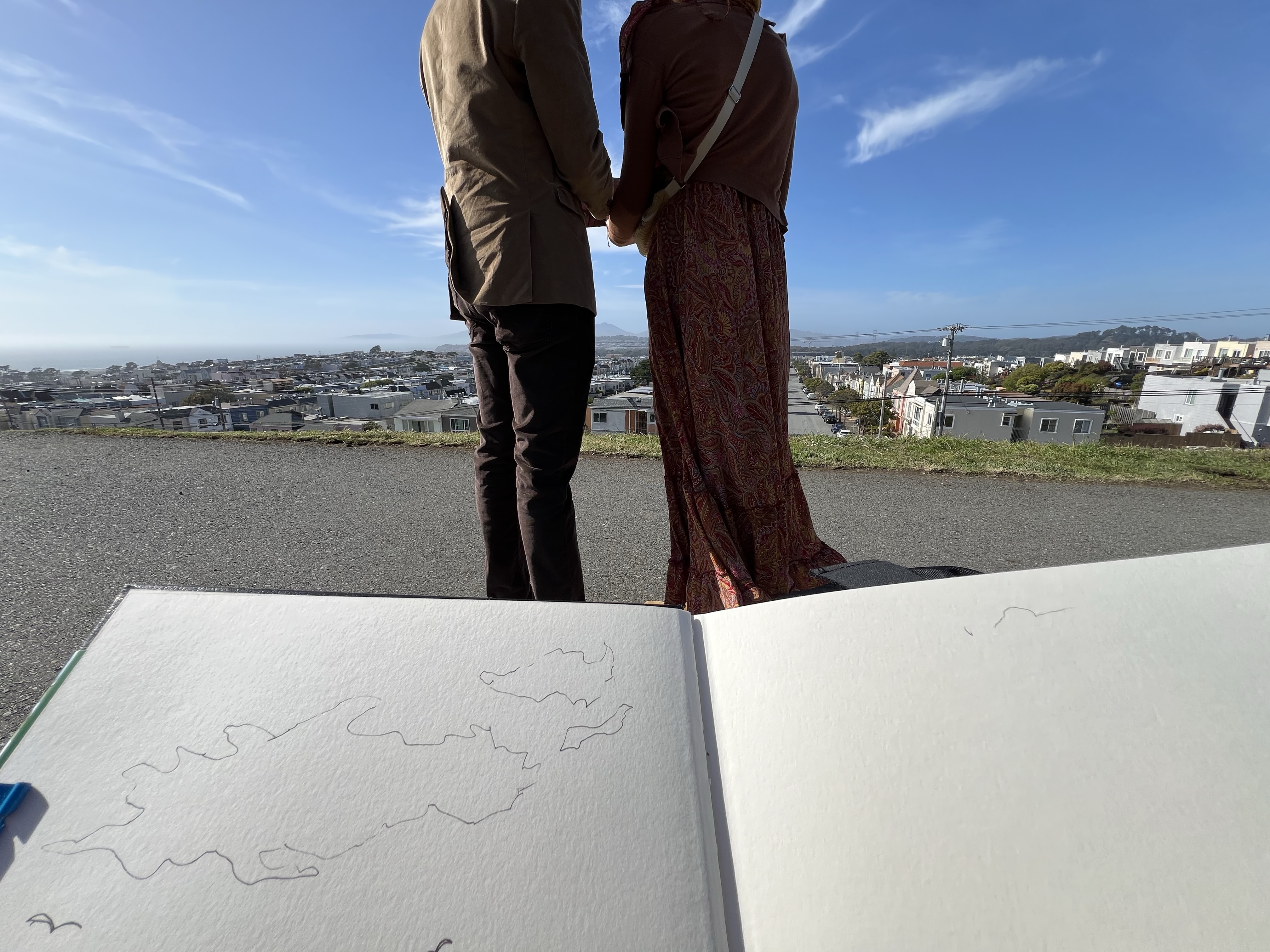
Yes, unbelievably they commented on my sketching and then turned around to stand between myself and my subject!

My plan was to do a loose sketch of the A380 as it headed northeast. Luckily the French couple moved on to take some more selfies with the distant Golden Gate Bridge in the background, before I had to ask them politely, to get out of my way!

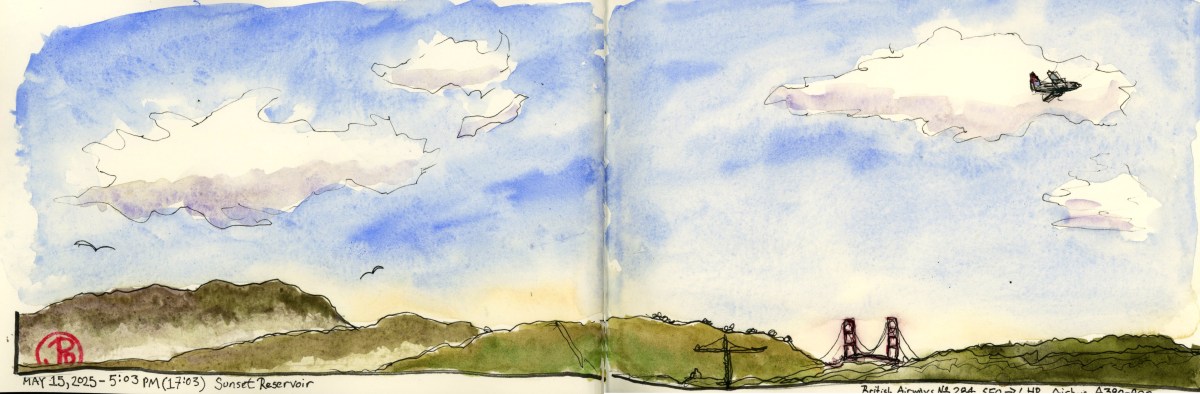
Flight 284 is scheduled to depart SFO at 16:20. It seems it was running a bit late as the A380 passed by at 5:03.
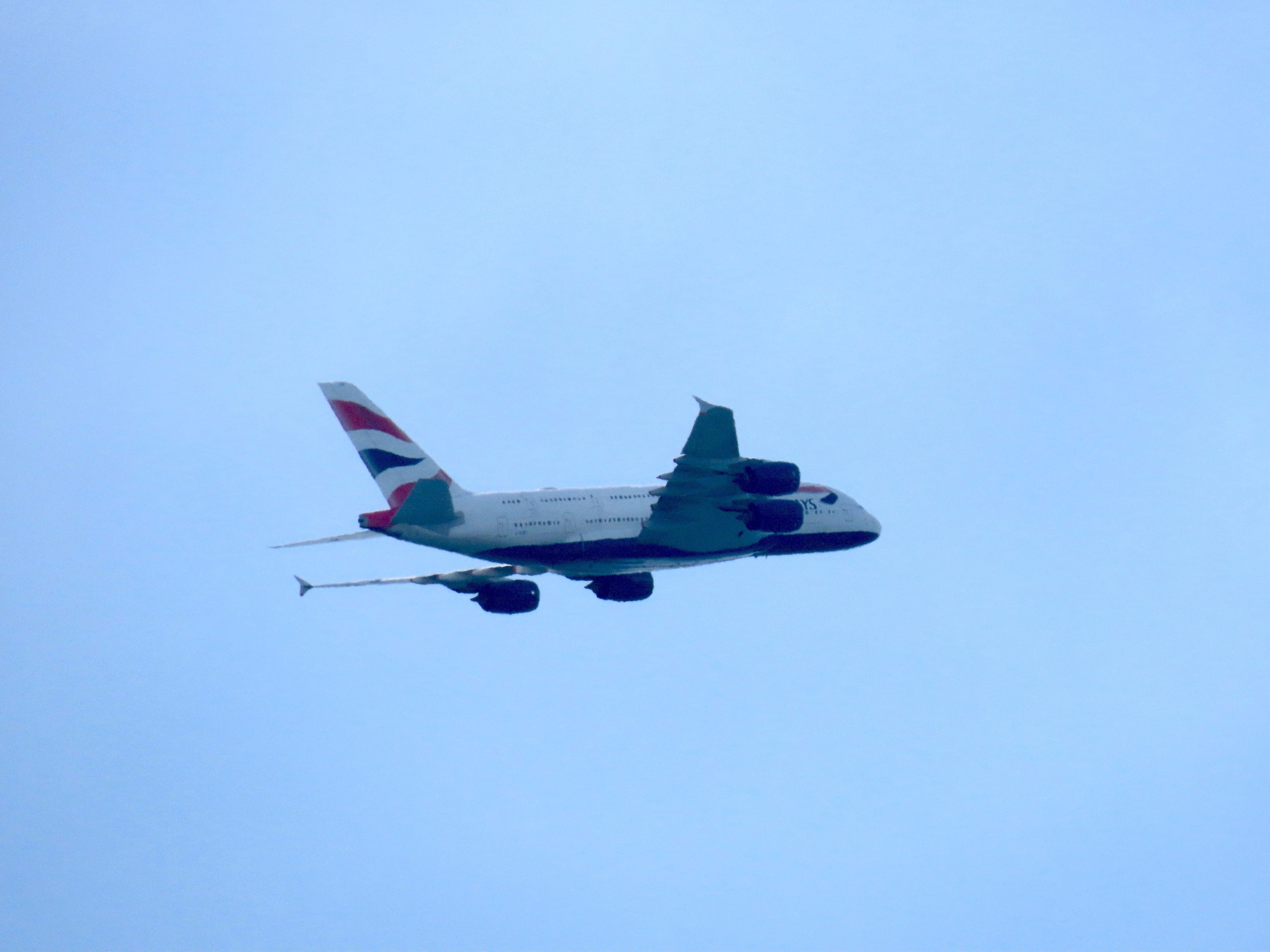
A Heathrow bound British Airways A380 flies past the Sunset Reservoir.

SFO Runway 28R

I had sketched and photographed BA Flight 284 as it passed over western San Francisco and now I wanted to witness an A380 take off, head on!

One of the best ways to look down Runway 28R (SFO’s longest) is to cross Highway 101 on San Bruno Avenue. Here you can look down the runway towards aircraft taxiing into position for take off.

As a side note, runways are named after their magnetic heading to the nearest ten degrees so 28 degrees and the R stands for “right” to differentiate the runway from the parallel runway to the left: 28L.

Flight 284 was late getting out of the gate and I spotted the giant, shark like tail fin, sporting the Union Jack, as it crept towards the runway.
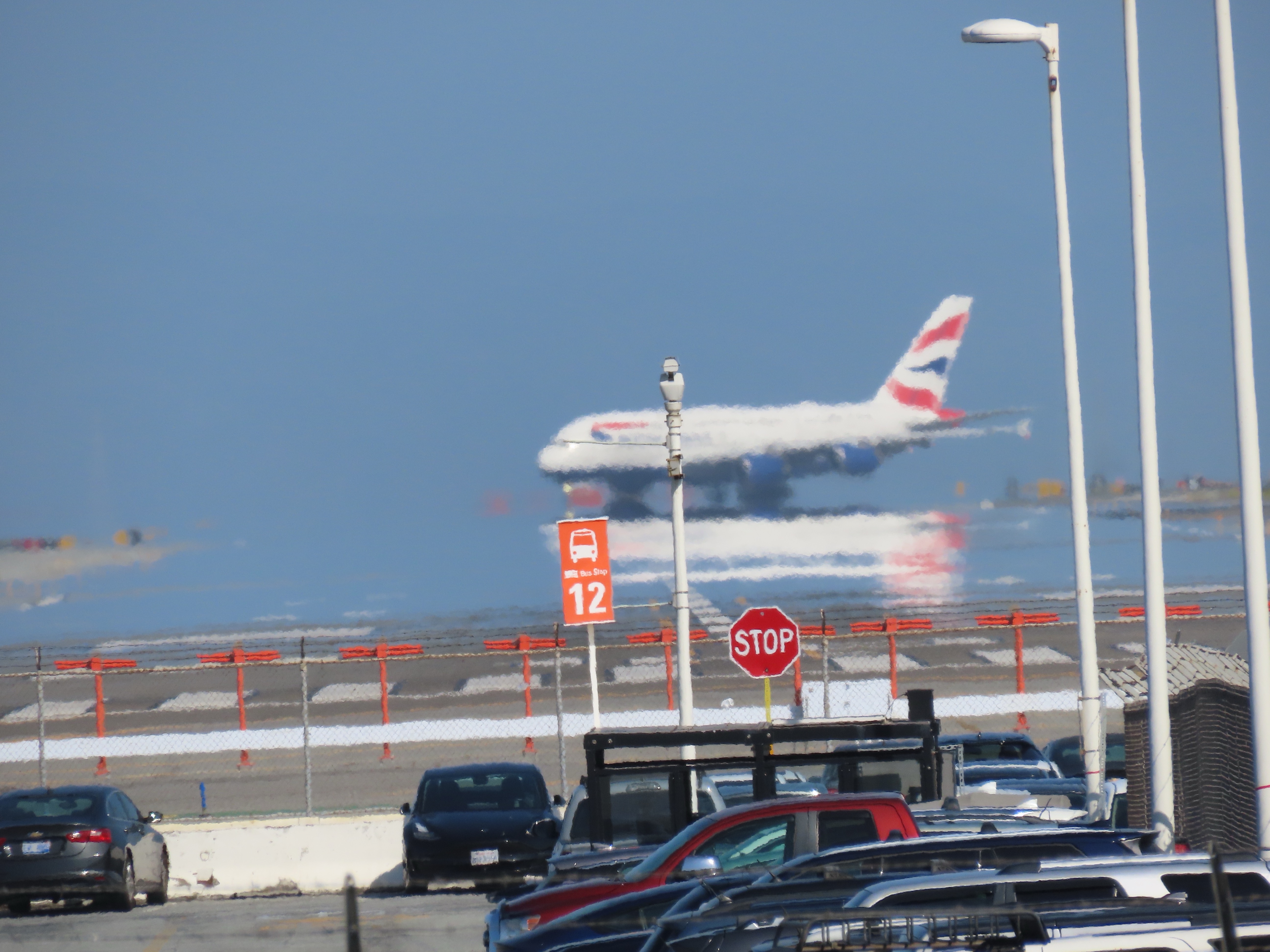
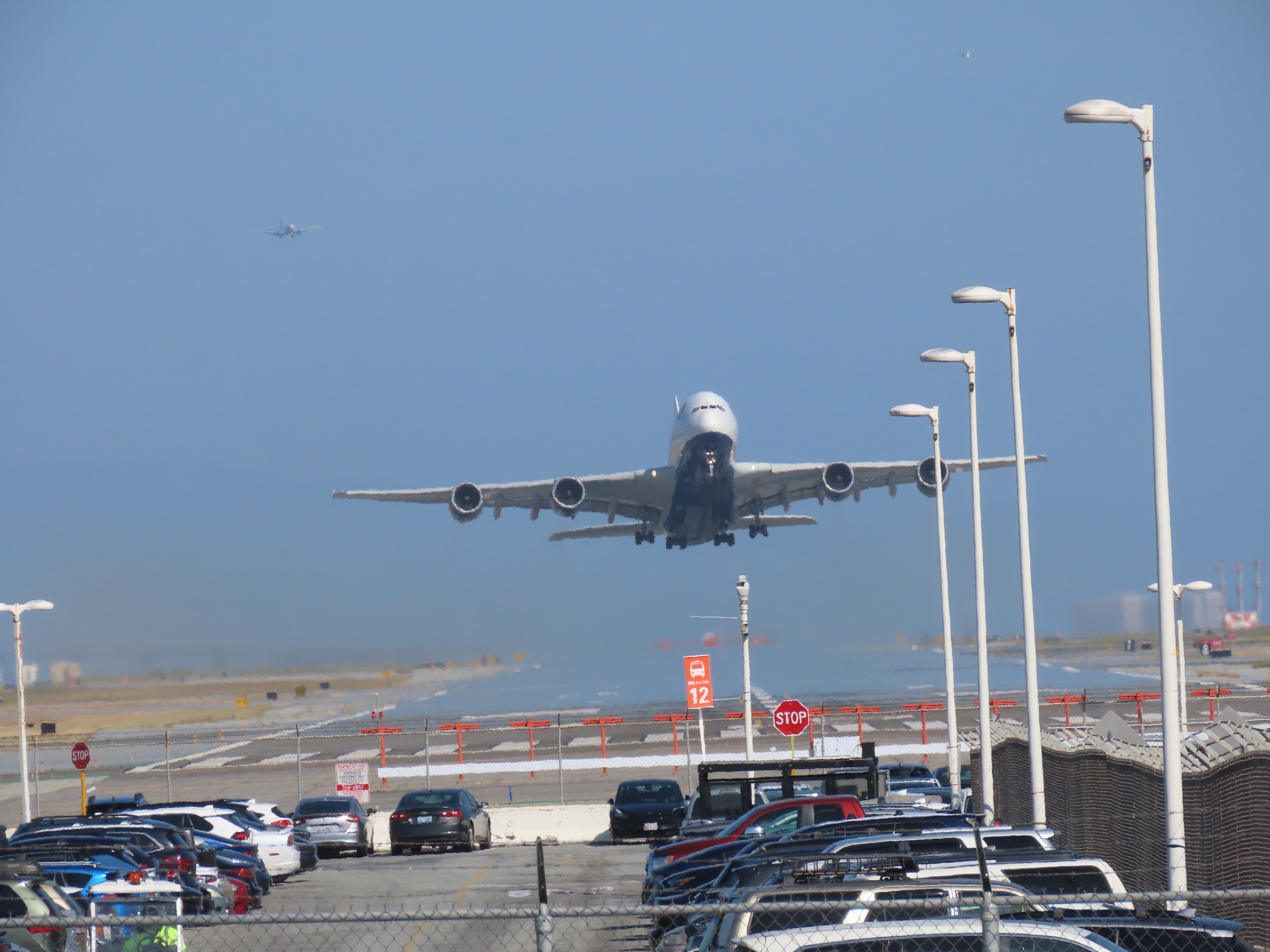
The A380 pulling onto Runway 28R. With the distance, the plane looks like a mirage.
Flight 284 climbs off Runway 28R at 150 knots heading right toward me!
Gear up, the A380 flying overhead.
Next stop (10 hours 35 minutes later) Heathrow Airport.
Image

Portola, the Ohlone, and Sweeney Ridge

Just after 9:30 AM I set out on my ascent to Sweeney Ridge.

The path to the ridge is not a dirt trail but a graded paved road which is an extension of Sneath Lane which runs east to El Camino Real.

This road was built to service the Nike Missile Control Site (SF-51) that was active on the ridge from the 1950s to 1974.

Sweeney Ridge, along with Marin Headlands to the north, is now part of the Golden Gate National Recreation Area.

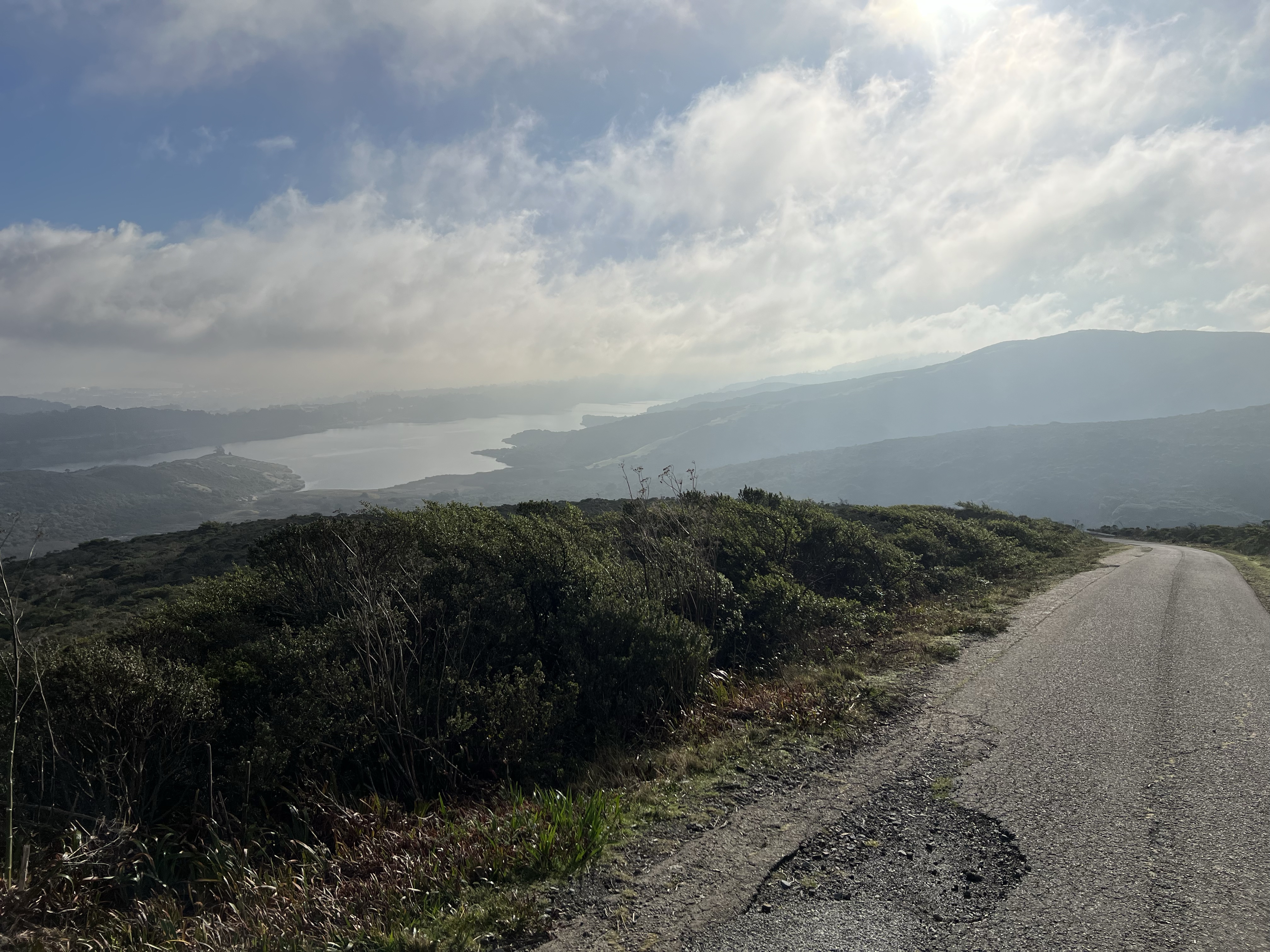
Sneath Lane on the ascent to Sweeney Ridge. From the trail head the almost two mile hike took me 45 minutes. In that 600 foot elevation gain I would be on the ridge at 1,200 feet.

On the way up, looking south, the sun was reflecting off of San Andreas Reservoir. The reservoir is part of the San Francisco Water District and covers the active San Andreas Fault.

San Andreas Fault and Reservoir in the background and Sneath Lane in the foreground. Almost at the summit.

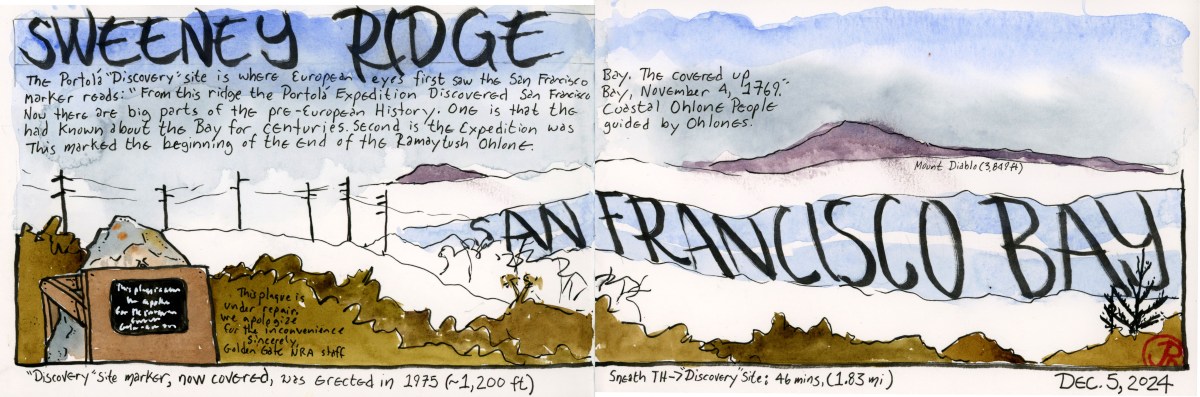
My destination and sketching stop would be the Portola San Francisco Bay Discovery Site. This is the location where on November 4, 1769, the first Europeans set eyes on the San Francisco Bay.

The way history of Spanish Exploration of California has been written negates that the Ohlone had already been on the land and had already seen San Francisco Bay centuries before. So the idea of San Francisco Bay being discovered in 1769 is a fallacy.

I had not been to the Discovery Site in a few years and I was surprised to see that the 1975 serpentine rock that is the Discovery marker was boarded up. The sign on the board read: “The plaque is under repair. We apologize for the inconvenience. Sincerely, Golden Gate NRA staff”.

Now I wasn’t sure if park staff was covering up the inscription that is carved into the rock which reads: “From this ridge the Portola Expedition discovered San Francisco Bay, November 4, 1769” to hide the content from visitors or protecting the marker from vandalism. Perhaps they were doing both. (I later found out that the sign had been vandalized and now the board covering the vandalized maker is now vandalized with the words: “WOKE CENSORSHIP”.)

Just east of the stone marker two information panels have been installed filling in the history of the Ohlone people.

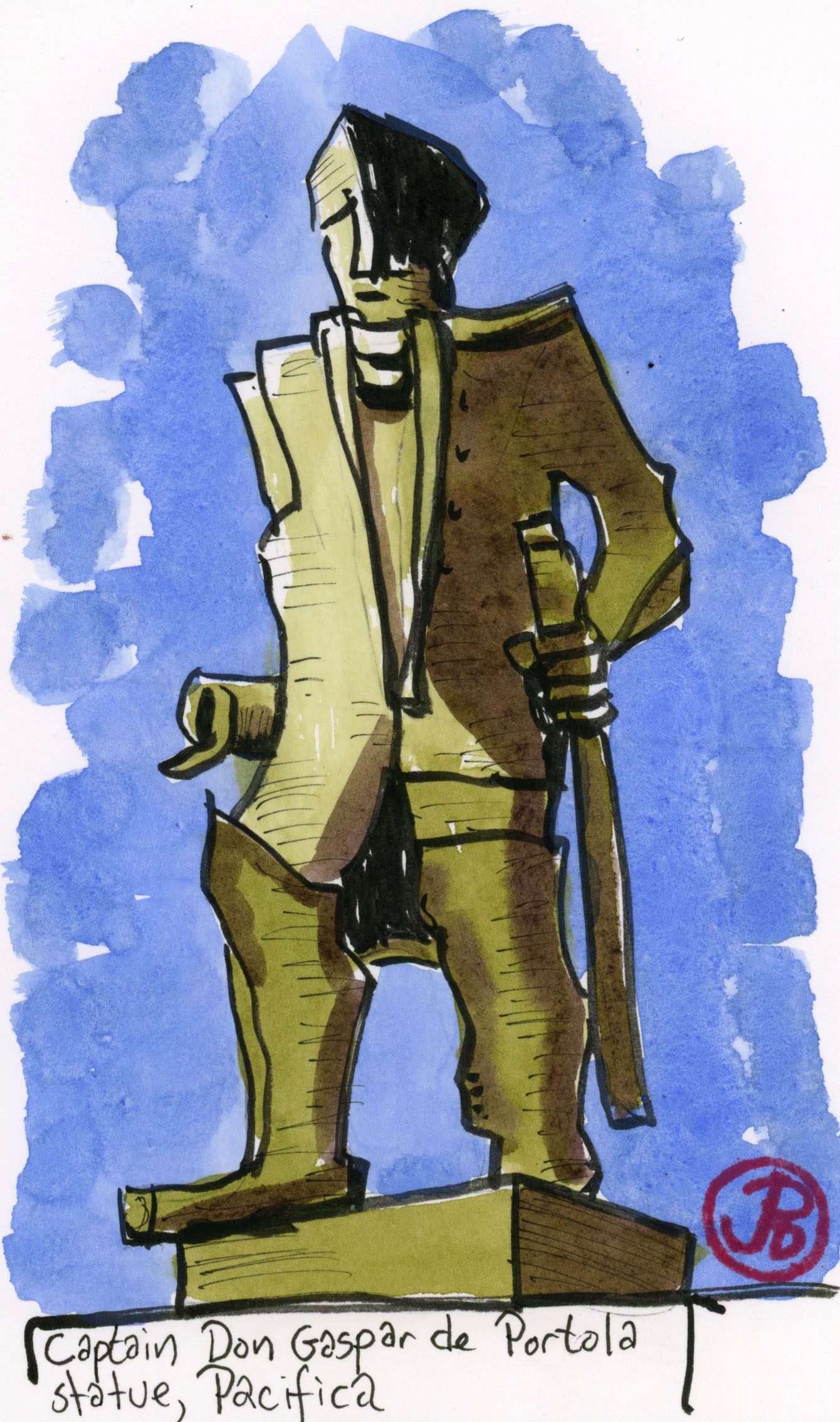
On the western side of the ridge is the town of Pacific. This is were the Portola Expedition set off. Near the community center there is an odd stature of Portola, one hand on his boxy sword, the other clutching a rolled up map.

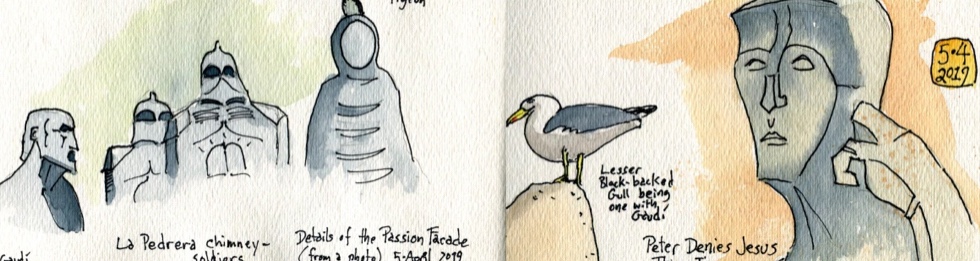
The statue is by Josep Maria Subirachs, a Catalonian sculptor responsible for the statues on the Passion Facade on Gaudi’s masterwork, La Sagrada Familia in Barcelona.

A few years ago I had the opportunity to sketch the cathedral that is still under construction. And I sketched some of the figures on the Passion Facade.

My 2019 sketch of Subirachs’ Passion Facade.
On Thursday January 18, 2020, the Cabrillo statue was removed.
Image

Tanforan Siding

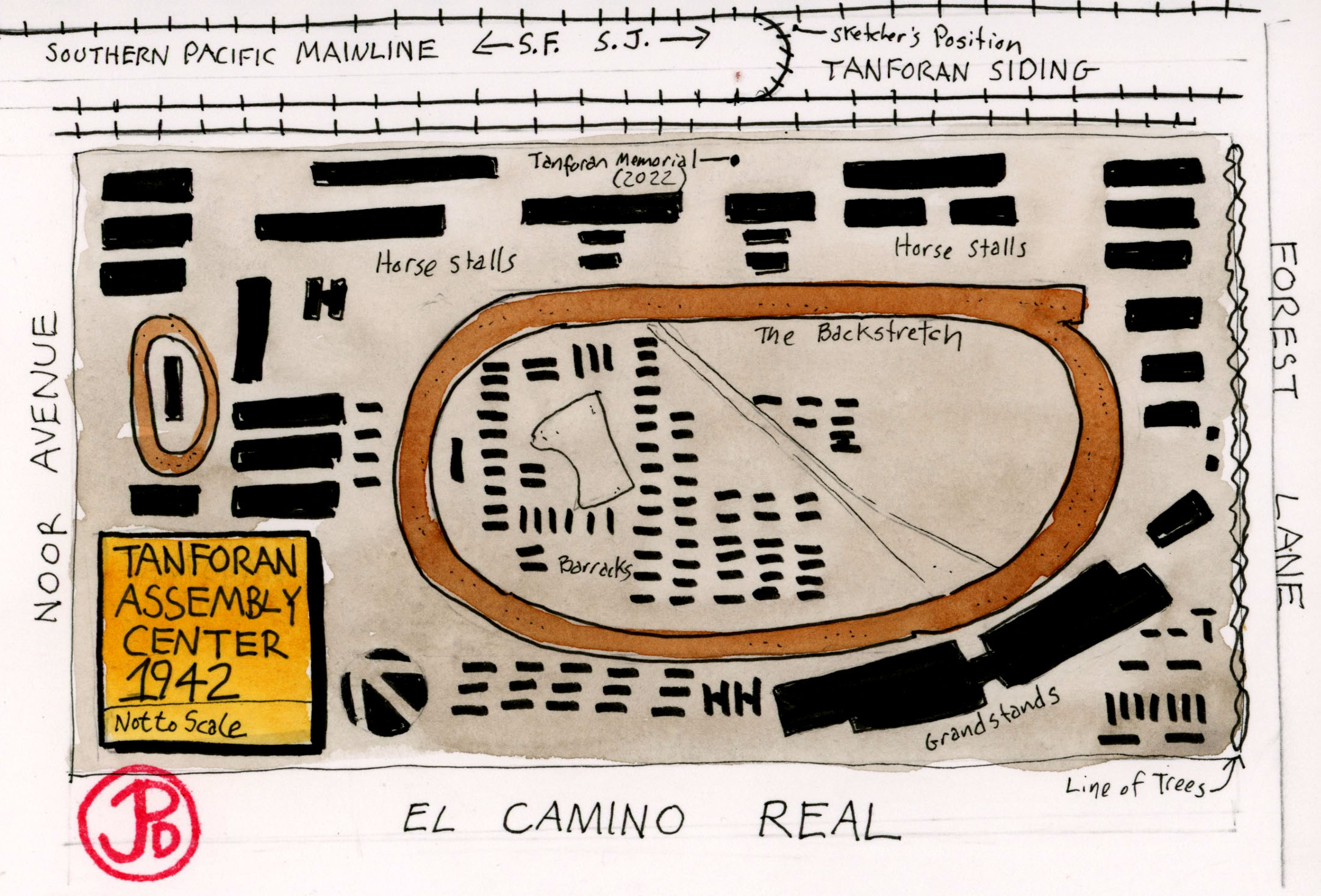
The former racetrack at Tanforan is bordered on one side by the former Southern Pacific mainline (currently used by the passenger service Caltrain).

Heading south, the line joins the wider rail network at Santa Clara and San Jose and on to all points on the National railroad compass.

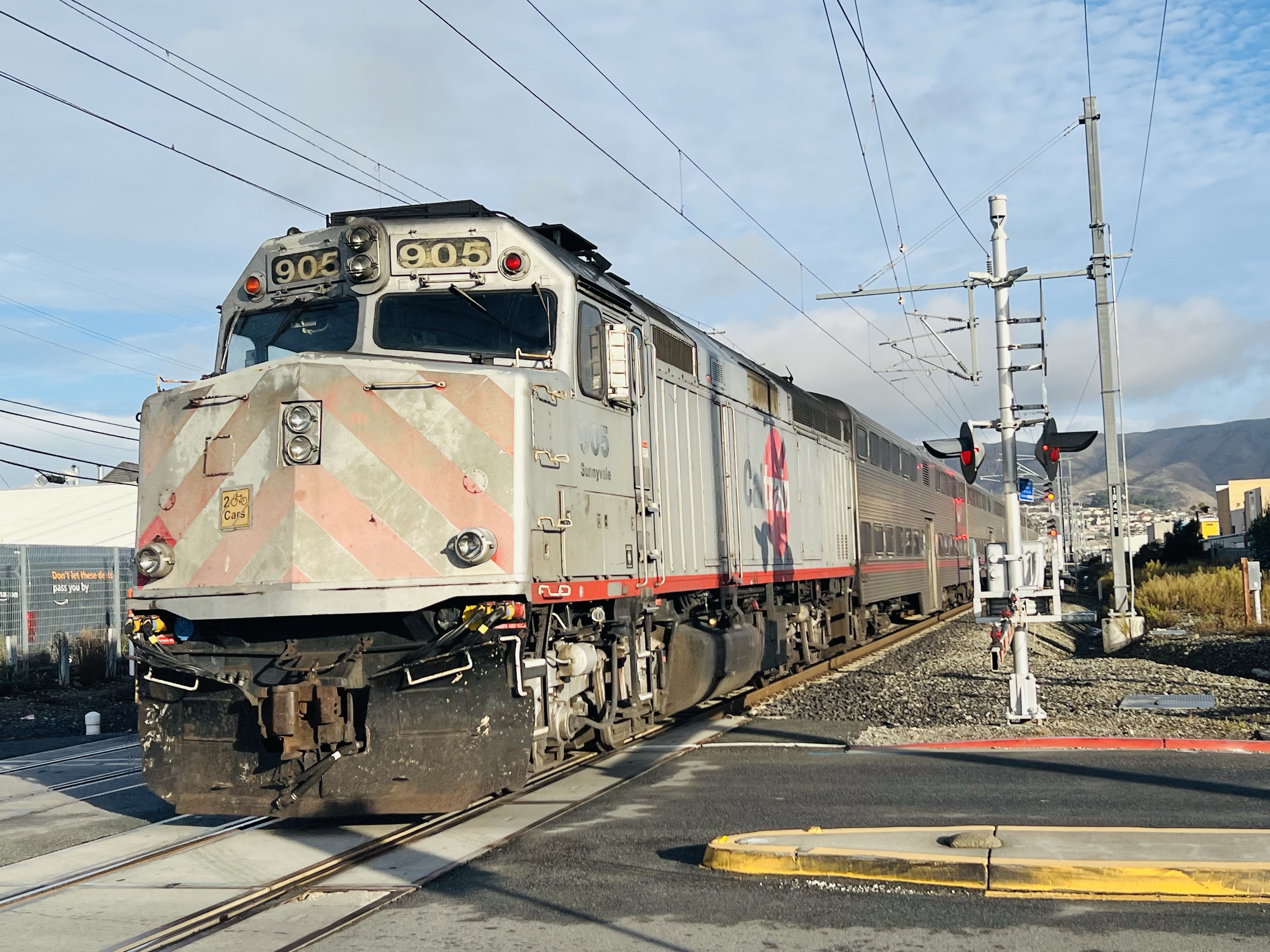
The rails are still very much in use as a northbound Caltrain heads to San Francisco. The train is being pushed by locomotive EMD F40PH-2 No 905 “Sunnyvale”. These diesel-electric locomotives will soon be replaced by electric train sets.

Tanforan was, therefore, connected to the nation through the siding track that brought cars from Tanforan Park proper, to points north (San Francisco) and south (San Jose).

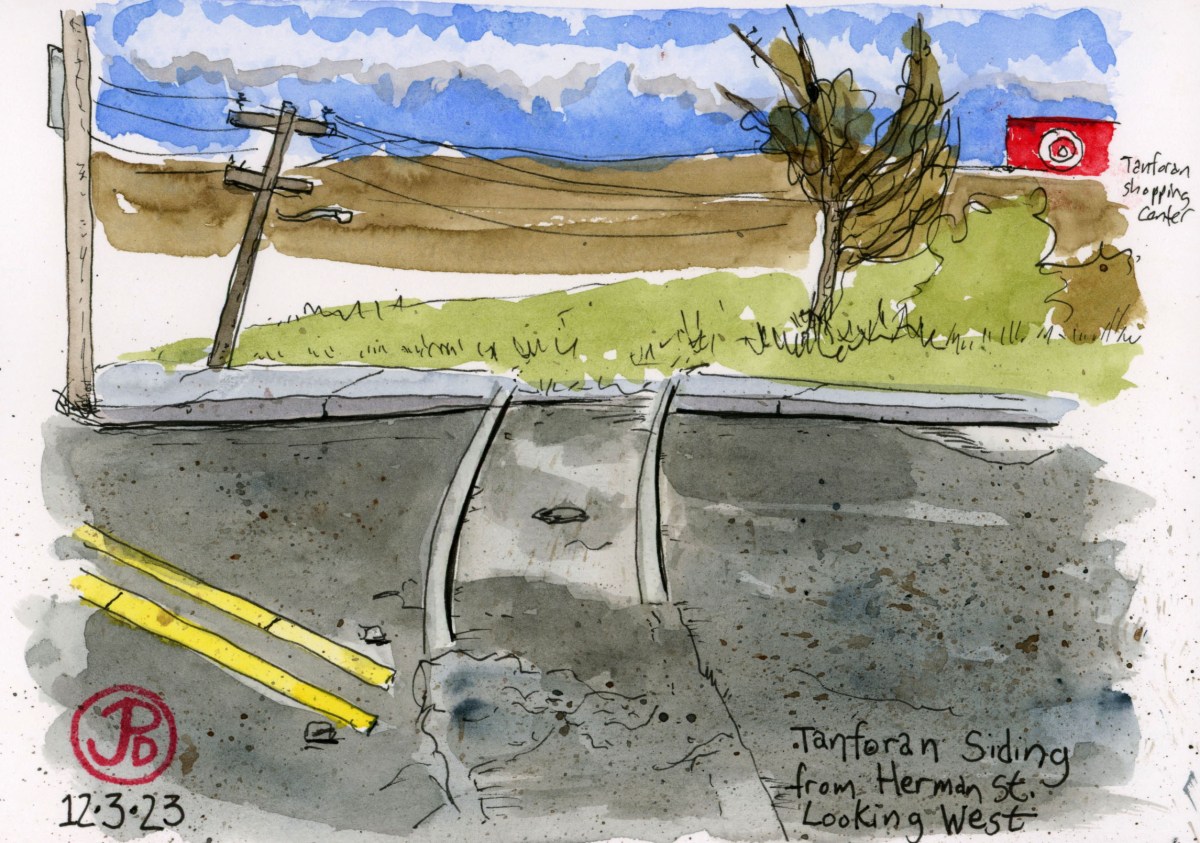
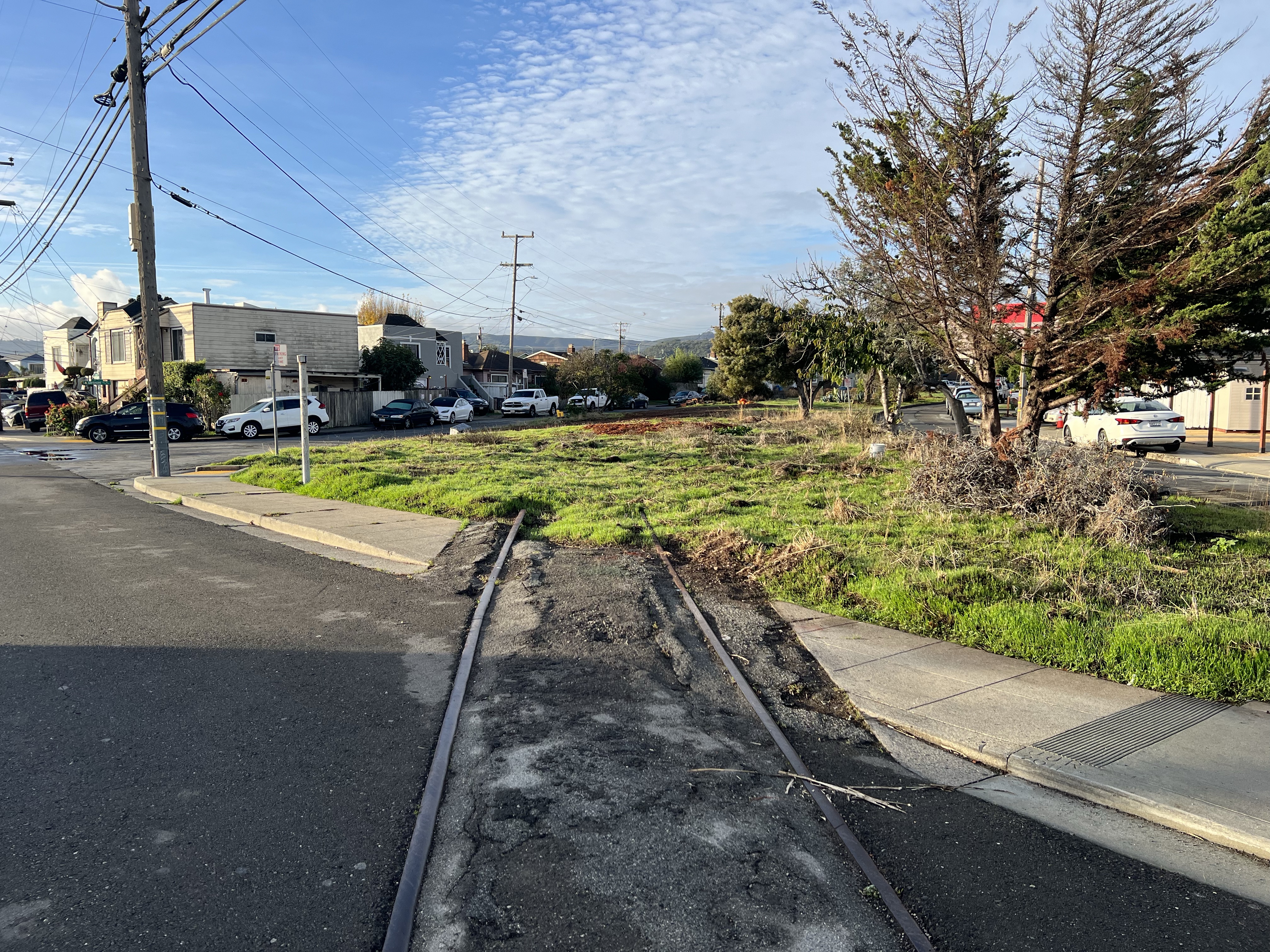
The Tanforan Siding heading towards the former racetrack (now Tanforan Shopping Center). This is the track that connected the siding near the backstretch with the rest of the rail network.

In 1938 the famous thoroughbred racehorse Seabiscuit boarded a special horse baggage car at the Tanforan Siding and he was shipped across the country to the East Coast on his first attempt to beat War Admiral. Large crowds came to see Seabiscuit off at the siding. The first meeting of these racing heavyweights did not happen.

Tanforan does have a dark past. In 1942, the racetrack became the Tanforan Assembly Center (the only assembly center in the San Francisco Bay Area). After the attack on Pearl Harbor, President Franklin D. Roosevelt issued executive order 9066. As a result Japanese Americans where rounded up and about 8,000 men, woman, and children where brought to Tanforan Racetrack now newly christened the Tanforan Assembly Center (one of twelve assembly centers on the West Coast).

Two-thirds of the detainees were U. S. Citizens, born and raised in the United States.

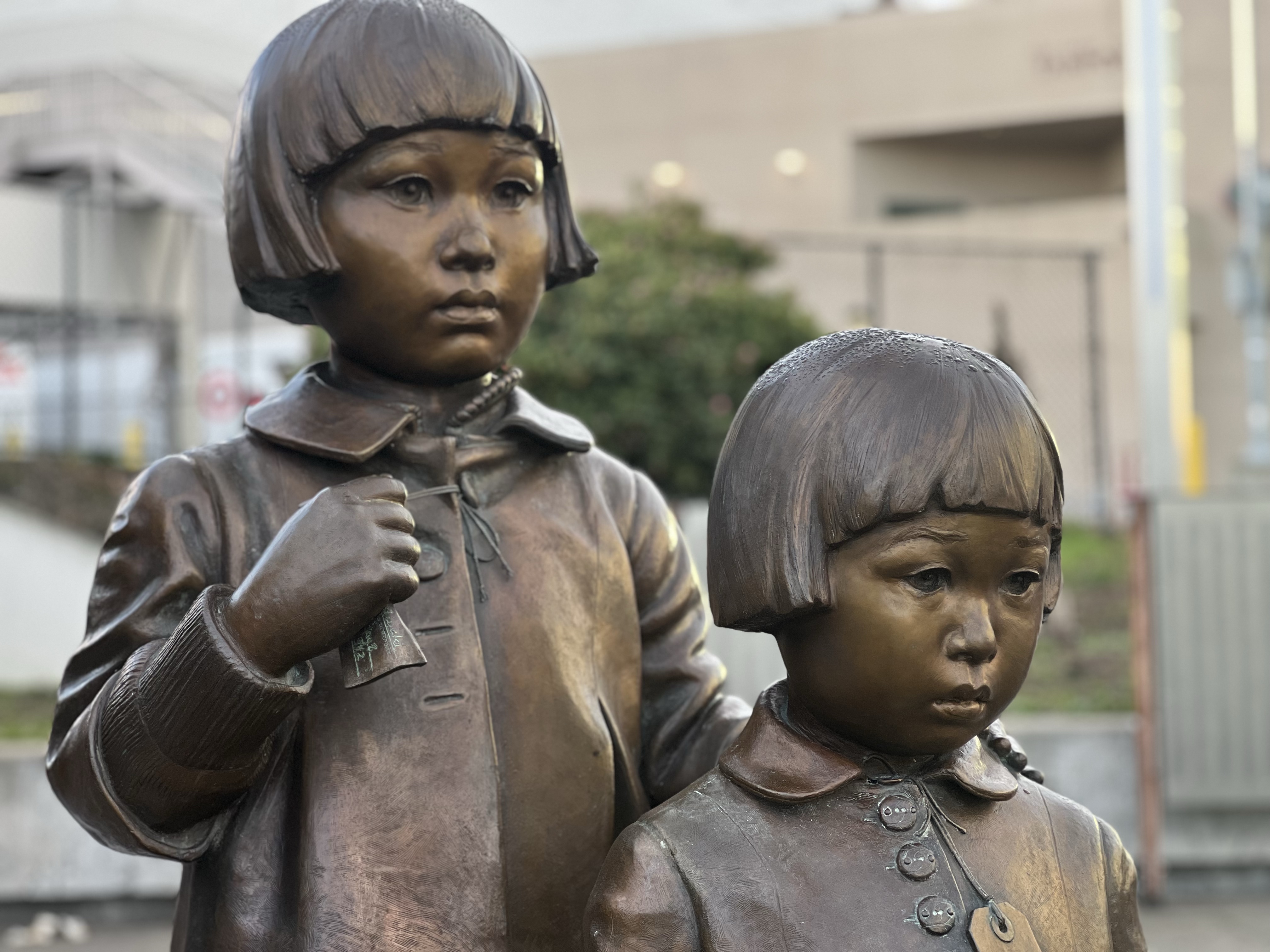
The Tanforan Memorial outside the San Bruno BART Station. The sculpture is based on a 1942 Dorothea Lange photograph of a family on their way to Tanforan. The memorial was dedicated on August 27, 2022.

The first internees arrived on April 28, 1942. They were housed in barracks and horse stalls that reeked of manure and urine. Some families spent about eight months here before being transported, over rail, to the Topaz War Relocation Center in Utah where they remained until the end of the war.

By the fall, the detainees were being sent on a two day rail journey to the Topaz War Relocation Center. On September 9, 1942, the first group of 214 detainees entered the siding that Seabiscuit travelled on a few years earlier and entered the mainline for their trip to the wastes of northeastern Utah. On October 13, 308 detainees, the last to leave Tanforan, entered the siding and then on to Utah.

The Tanforan Assembly Center was now closed.

The site of the former track and assembly center is now a shopping mall.

In 2022 the mall was bought by a developer and there are plans to raze the mall and build a massive biotech campus.