The Battle of Antietam, near Sharpsburg, Maryland, is the single bloodiest day in any American War battle. During the Civil War, every causality was an American so the causality rate is understandably higher than in other conflicts. But the brutality of the fight over once day, makes the Battle of Antietam stand out amongst other battles.
About 23,000 where killed in this once day conflict. The Battle of Antietam, named after the creek that flows east of Dunker Church, was a failed campaign, by General Robert E. Lee to invade the north in the border state of Maryland. It was also not the decisive battle that Lincoln wanted and the ever meek General McCellan, let the depleted rebel army escape across the Potomic. McCellan was soon replaced but this victory was enough for Lincoln to introduce the document that had been sitting in a desk drawer: the Emancipation Proclamation.
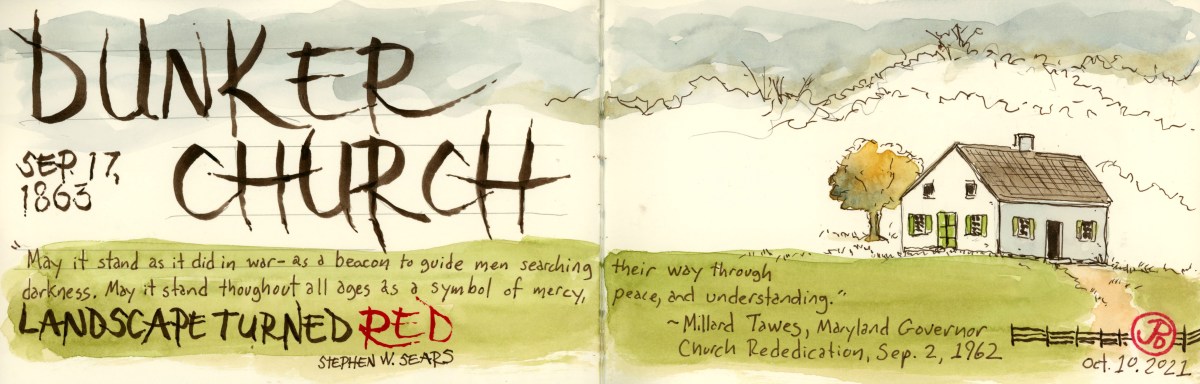
One of the enduring sights from Antietam is the Dunker Church. It has been called, “one of the most famous churches in American military history”. This simple, one room church was surrounded by the horrors of war on September 17, 1862. When soldiers first came upon this small, plain, and unassuming building, some thought it was a schoolhouse.
The church was granted on a parcel of land by farmer Samuel Mumma and was constructed in 1852. The “Dunkers” were a pacifist German Baptist congregation, which is very ironic considering the bloodshed that surrounded the church on a September day in 1862.
Antietam, the mix of the holy and the profane. Dunker Church and cannon.
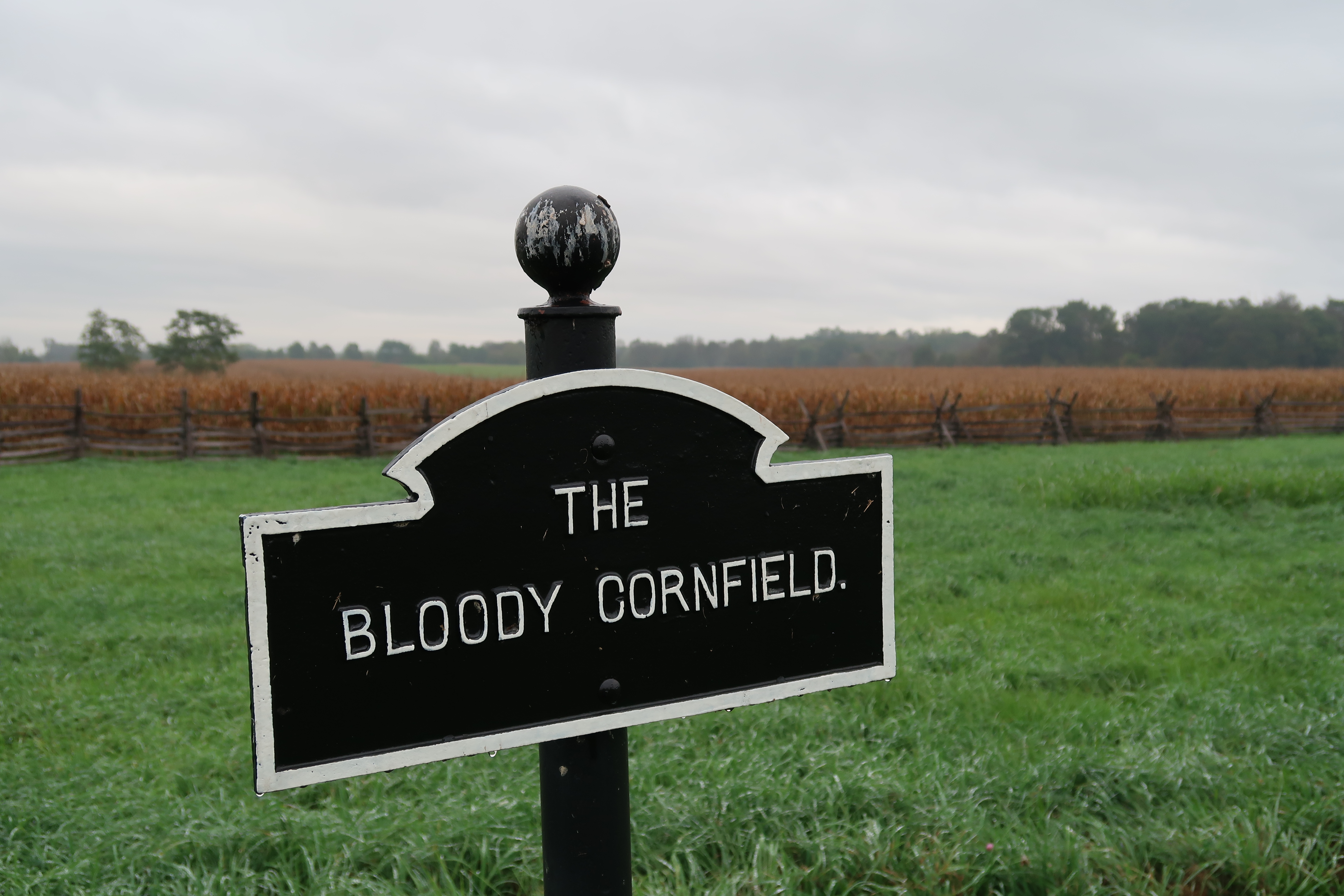
The battle started near the church on the morning of the 17th. Blood runs thought the landscape and place-names of this battlefield. To the northeast of the church was a cornfield, after the battle, it was given the infamous moniker, the Bloody Cornfield. Many men, both north and south, died in a field of life giving corn.
The Dunker Church was the center of the morning’s conflict and today, the visitors center is built near the church. When I visited, on an early October Sunday, there was an artillery demonstration in a field to the east of Dunker Church. So I stuck around because reenactors would be firing a replica Napoleon Cannon.
Civil War reenactments started in 1960, the centennial of the war. It has been a growing hobby, some might say “obsession”, since that time. One of the biggest Civil War reenactments was to celebrate the 135th Anniversary of the Battle of Gettysburg (much more on Gettysburg later). That event included 15,000 participants. It seemed that Civil War reenactments are on the wane these days and younger generations have differing views of the Civil War, its influence and it’s impact. As a result they are not taking up the replica muskets and joining a “battle”.
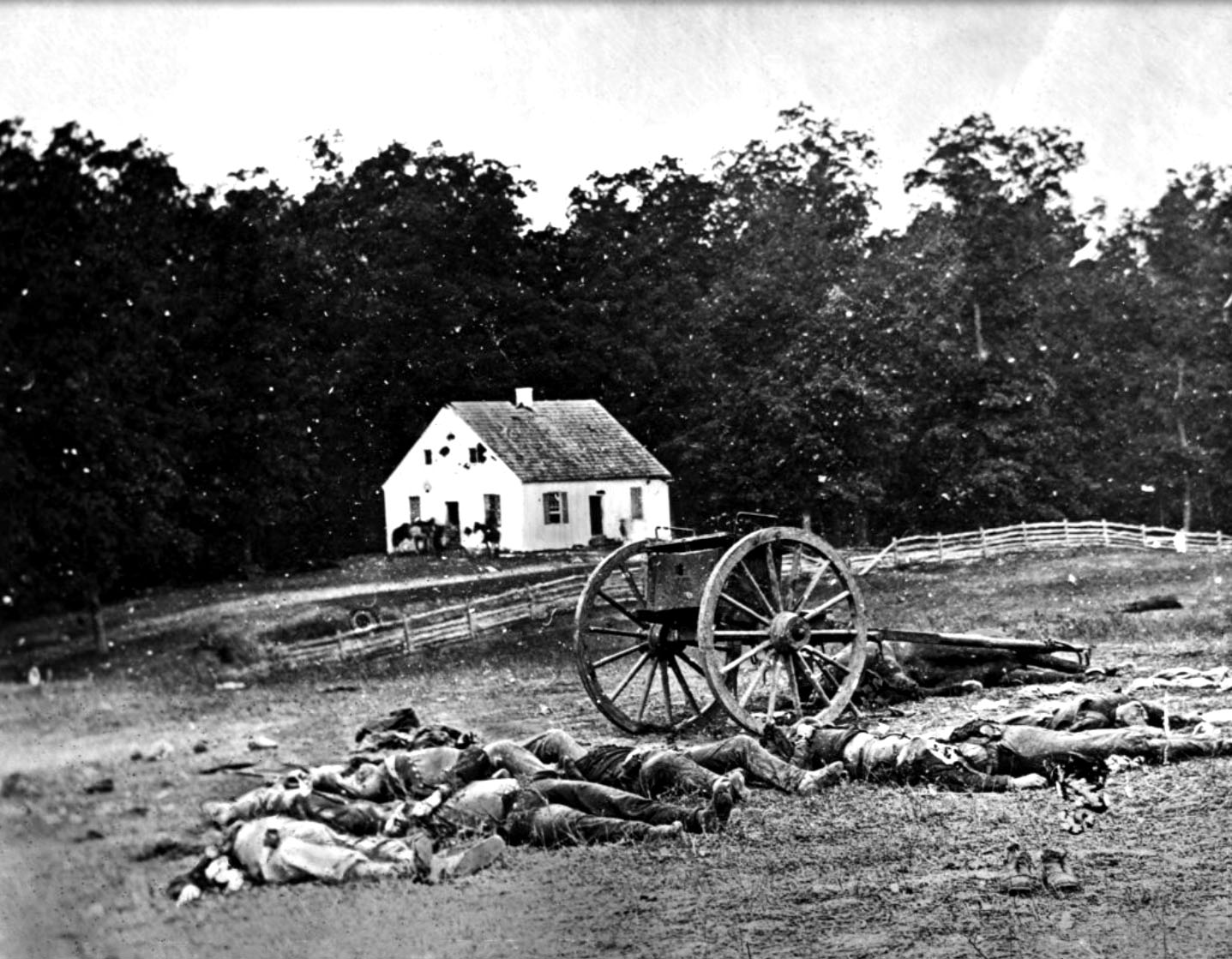
These reenactors where dressed in the mismatched uniforms of the Confederate Army. Maryland was a border state during the Civil War and Lee counted on support from the locals on his Maryland Campaign. In the end, this didn’t really happen.Fire In the Hole! The canon demonstration was both loud and powerful. It was haunting to hear the cannon echoing across the rural Maryland landscape. I’m not sure if the neighbors sleeping off Saturday’s revels felt the same.A photography taken just after the battle of Antietam showing Confederate dead in the foreground. In the background, Dunker Church shows damage from artillery fire. This is the photograph where I took inspiration for my featured field sketch.
During the battle of Antietam, the Sunken Road became the Bloody Lane.
In mid morning, the fighting moved away from the Dunker Church to the area to the southeast known as the Sunken Road. The Sunken Road is a road that bisects two farm fields and as the name implies, runs below the land that flanks it; like a riverbed without the water. This road was worn down over time because of heavy wagon traffic.
This location was the setting of some of the fiercest fighting in a battle known for it’s fierce fighting. This is where the center of the Army of Northern Virginia and the Army of the Potomac came together.
Here, in the Sunken Road, the Confederates under General D. H. Hill placed this division of 2,600 soldiers along this road. Union General William French attacked this position leading to a savagely bloody conflict that lasted for almost four hours. During this battle 5,500 soliders, on both sides, where either killer or wounded. Thus the Sunken Road became the Bloody Lane.
Soldiers who were involved in the conflict later describe the Sunken Road as the “road of death” and a “ghastly flooring”.
On my visit, I placed myself about half way down the Bloody Lane and I sketched looking toward the 132nd Pennsylvania Monument and the observation tower that was built in 1896 by the War Department. Starting out early had it’s benefits because I had the Bloody Lane to myself.
After my field sketch, I headed over to the 60 foot tall observation tower to get a 360 degree view of the battlefield and the receding view of the Bloody Lane. Again, the tower was all mine.
A photo taken from the observation tower, looking down the Bloody Lane. My sketching position was where the green turns to brown, just under an oak.
Before I go one any trip I like to add a title page and a map to my sketchbooks.
For my trip to Civi War battlefields in Virginia, West Virginia, Maryland, and Pennsylvania I chose to bring two Stillman and Birn hard cover watercolor journals. One is my new go-to favorite, the panoramic Delta Series journal. And the other is a Beta Series 5.5 ” X 8.5″ sketchbook. I love both of these papers and they are great for sketching on the road with pen and watercolor.
In the Delta journal I created the title page based on the famous image from Ken Burns’ documentary The Civil War, of a silhouetted canon and a glorious sunset in the background. This footage was filmed at Manassas in Virginia. This opening page is the featured sketch.
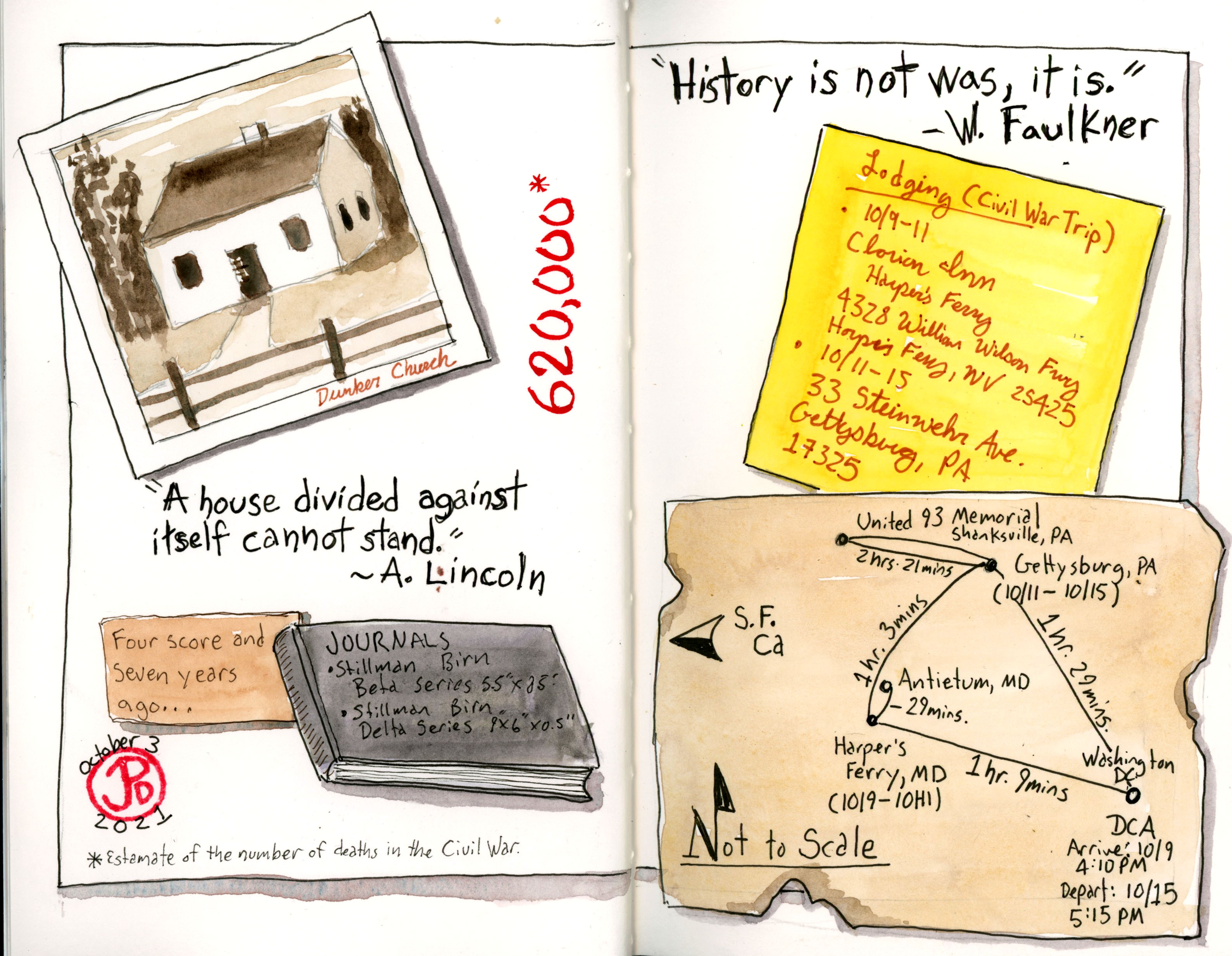
In my Beta sketchbooks I created a map of the places I would be visiting. All of the locations I would be visiting where within 90 minutes of each other. I distressed the map, covering it in mud and blood. Perhaps I added too much “blood”, but somehow since this is the Civil War it was fitting. It is estimated that about 620,000 Americans lost their lives during the Civil War.
In my Beta, created to spread to synthesize a lot of the information about my trip in a creative way. It is a montage of all the important facts of the trip. Well some of them at any rate. This was a fun page to do and involved a few different sketching techniques.
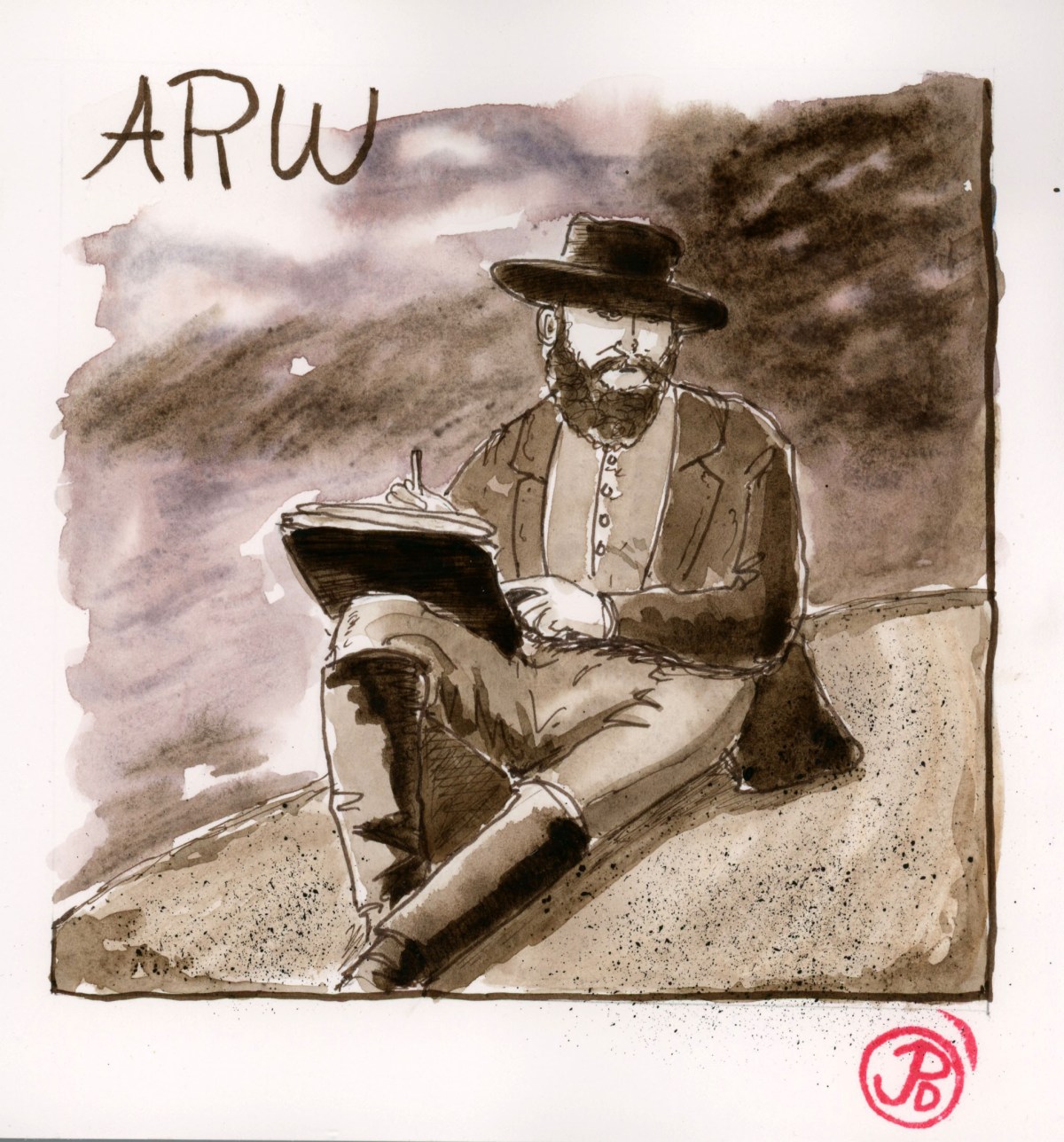
A few years ago a friend, who is a Civil War enactor, told me about the men who sketched Civil War battles, as they happened! He asked if I wanted to suit up and sketch one of their reenactments.
I didn’t get a chance to go back in time and sketch a “battle” but the idea of a sketcher that followed an army and pulled out a pencil and paper when battle erupted, truly intrigued me.
The age of photography was at least 30 years old by the time of the outbreak of the Civil War. However it was not a good medium for capturing a battle. The reason for this was that the camera had to be on a tripod and subjects had to hold still because of the long exposures necessary to expose an image on a glass plate. That is why many photographs of the Civil War generals or soldiers are of seated and sometimes standing, in rigid, staged poses. The other common photographs are of the dead, after a battle (the dead hold still, really well).
A photograph of dead soldiers at Gettysburg taken after the battle. (Tim O’ Sullivan/ Library of Congress)
Photography proved to be an unsuitable medium for capturing a battle but a field sketch could be done quickly and then the field sketch would be sent back to New York and turned into an engraving, creating plates for illustrated newspapers.
One of the most notable Civil War Sketchers was Alfred Waud. He was born October 2, 1828 in London. As an art student he studied to be a marine painter. In the end he did not pursue this style but instead he painted theatrical scenery. Waud sailed for New York in 1850 in pursuit of work.
Waud is most well known for following the Army of the Potomac and sketching every battle from the first Bull Run to the Siege of Petersburg in 1965. During this time he worked for the New York Illustrated New and then he 1861, he sketched for Harper’s Weekly.
Waud’s sketch of the death of General John Reynolds at Gettysburg.
Waud was only one of two artists to sketch the Battle of Gettysburg, the bloodiest battle in the Civil War and the turning point of the conflict. His sketches of Pickett’s Charge, on July 3, 1863, is thought to be the only visual account by an actual eyewitness.
Waud’s illustration of Pickett’s Charge showing Lewis Armistead leading his men, hat on sword. This was the fartherest advance by the rebels during the entire Battle of Gettysburg. Armistead was shot and died a few days later.
Waud’s sketch of Warren, surveying the lay of the land at Little Round Top at Gettysburg, July 1863.
“What we need to remember most of all is that the Civil War is not over until we, today, have done our part in fighting it, as well as understanding what happened when the Civil War generation fought it.” -Barbara Fields.
The Civil War. What a daunting episode in our nation’s history.
It is so daunting that it took me a long time to get around to read about it. And reading about it, takes real time and commitment. For example, Shelby Foote’s account of the war is told across three volumes and over 3,000 pages. The Civil War is the most written about event in American History. The estimate is around 100,000 volumes about out National bloodletting. The President of the Union, Abraham Lincoln, is the most written about historical figure, coming only second to Jesus. About 15,000 books have been written about Honest Abe. Where do you have the time? And where do you even start?
The impetus for me, was my late brother Greg. Greg was an educator of American History and a voracious reader of American nonfiction. One summer we decided to read a book that had been sitting on our book shelves for a while, gathering dust. It was yet another biography of Lincoln. But this one, had been hailed as the latest and greatest history of our 16th, and perhaps our greatest presidents. The book: David Herbert Donald’s Lincoln.
Over the summer we held our unofficial book club over the phone. We discussed Lincoln and his times and the events that shaped his presidency. Greg had to fill me in on many of the details of the Civil War. Now here was a huge void in my understanding of American History. I had avoided delving into the Civil War partly because of it’s overwhelming scope and breath as a subject and also because it seemed to be a blotch on our national character that was uncomfortable to face head on. How could it be that a nation called the “United” States of America be so ununited? (Sounds very contemporary I know!)
I wanted to read more about the Civil War and my brother suggested a very enjoyable read: the narrative and fictionalized historical account of the Battle of Gettysburg: Michael Shaara’s The Killer Angels.
After reading the Lincoln biography and Shaarra’s masterpiece (which inspired the film Gettysburg) I asked my brother for a reading recommendation for the best single volume account of the Civil War. I wanted to understand the times and context of the Civil War without taking a lifetime to read about it. Greg’s response was Battle Cry of Freedom by James McPherson.
I bought Battle Cry of Freedom and like any great or important undertaking, it sat on my bookshelf awaiting the first turn of it’s 909 pages. I thumbed through the pages and looked at the photos but I could not bring myself to take the first step on this long journey of learning.
Then on April 5, 2021, Greg died.
His death was the impetus to finally start reading about our nation’s greatest struggle. I spent the summer reading Battle Cry of Freedom. This masterpiece covers the causes of the Civil War as well as focusing on the people who fought it and it’s battles.
I realized that to really understand the Civil War, you had to visit some of the battlefields. And the the one battlefield that seems to rise above the others is Gettysburg, the battle that became the turning point in the war. (spoiler alert: the North won).
I planned to visit Gettysburg and a few other battlesites in Pennsylvania, Maryland, and Virginia. And before I take any trip, I do a bit of sketching.
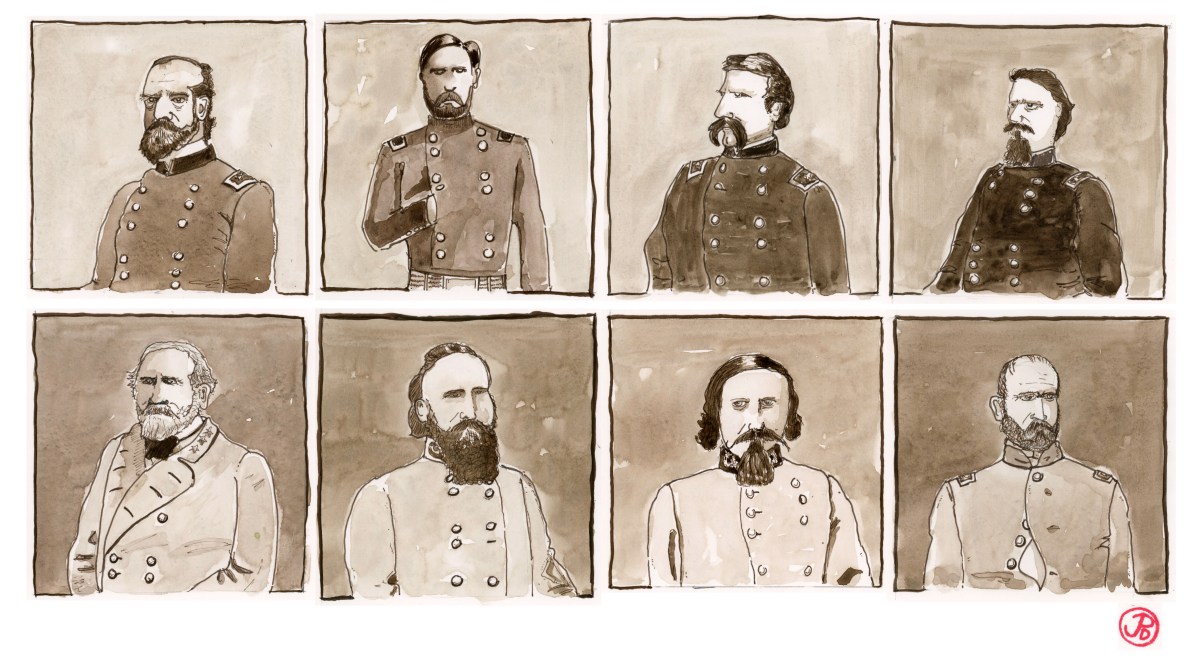
This time I want to sketch the Dramatis personae of the Battle of Gettysburg. Four from the North and four from the South.
By the time of the Civil War, portrait photography was popular and many of the generals, North and South, sat to have their portraits taken. All off my sketches were draw from these portraits.
The Portraits
The North (Left to Right):
Maj. Gen. George G. Meade, head of the Army of the Potomac. Meade became the commander of the Army of the Potomac just three days before the first battle at Gettysburg. Meade’s horse “Old Baldy” was injured during Gettysburg but survived the General to participate in the general’s funeral procession in 1872.
Maj. Gen. John F. Reynolds of the First Corps. Reynolds fought in the Mexican War become friends with Winfield Scott Hancock of the North and Lewis Armistead of the South.This Pennsylvanian was killed on the first day of battle on July 1, 1863. He was a friend and had served under General Meade.
Col. Joshua L. Chamberlain of the 20th Maine. He is know as the Fighting Professor and the hero of Little Round Top for his heroic bayonet charge. Chamberlin taught at Bowdoin College where he was not aloud to enlist, but went on a leave of absence and enlisted anyway. He is one of the key figures in Michael Shaara’s The Killer Angels. Chamberlain suffered six wounds during the Civil War, eventually dying of them in 1914. He is said to be the final casualty of the Civil War.
Maj. Gen. Winfield Scott Hancock of the Second Corps, was fighting in his home state of Pennsylvania. During the fighting in the Peninsula Campaign, he received the nickname, “Hancock, the Superb”. He was wounded on the final day of the Battle while defending Cemetery Ridge against Pickett’s Charge.
The South (left to right):
Gen. Robert E. Lee, Commander of the Army of Northern Virginia. Lee was born in Virginia in 1807. In 1829, he graduated from the US Military Academy, second in his class. He married Mary Anne Curtis and he moved into her family estate home in Arlington, Virginia, later to become Arlington National Cemetery, first opened to bury the Civil War dead. In 1861, Lincoln offered Lee the command of the U.S. Army, he refused and on April 20, 1861, resigned his commission and fought for the South. Lee was a brilliant strategist in the Civil War but the Battle of Gettysburg proved to be his Waterloo.
Lt. Gen. James Longstreet, Commander of the First Corps. Nicknamed “Old Pete” Longstreet served in the Mexican War with many of the men he would be fighting against during the Civil War. Longstreet disagreed with Lee’s tactic on the third day at Gettysburg. He was reluctant to send men forward in what became known as “Pickett’s Charge” because he believed it would fail, which was ultimately the case.Longstreet became a critic of Lee after the war.
Maj. Gen. George E Pickett, head of Pickett’s division in the First Corps. Ranked last in his class at West Point, Pickett served in the Mexican War with Longstreet. The flamboyant Pickett lead the charged on the Northern position on Cemetery Ridge loosing almost his entire division in the process. On their retreat from the charge, Pickett encounter Lee and the General asked Pickett to rally his division for defense, to which Pickett replied, “General Lee, I have no division.”
Brig. Gen. Lewis A. Armistead, came from a military family. He was a West Point drop out that learned his trade during the Mexican War. During the last day of Battle of Gettysburg, Armistead led his Brigade, hat on sword, and made the deepest advance on the Northern lines, becoming mortally wounded in the process. The wounded General was misidentified as Longstreet and under a truce flag on July Fourth, a Northern messenger encountered the very much living Longstreet letting him know that the General “would be taken care of”. Old Pete “told the messenger he believed he could take care of himself quite well”.








 Corvid Sketcher