Image

Lonesome Whistle

“I’ve been down the road and I’ve come back

Lonesome whistle on the railroad track”

-Neil Young – Mellow My Mind 

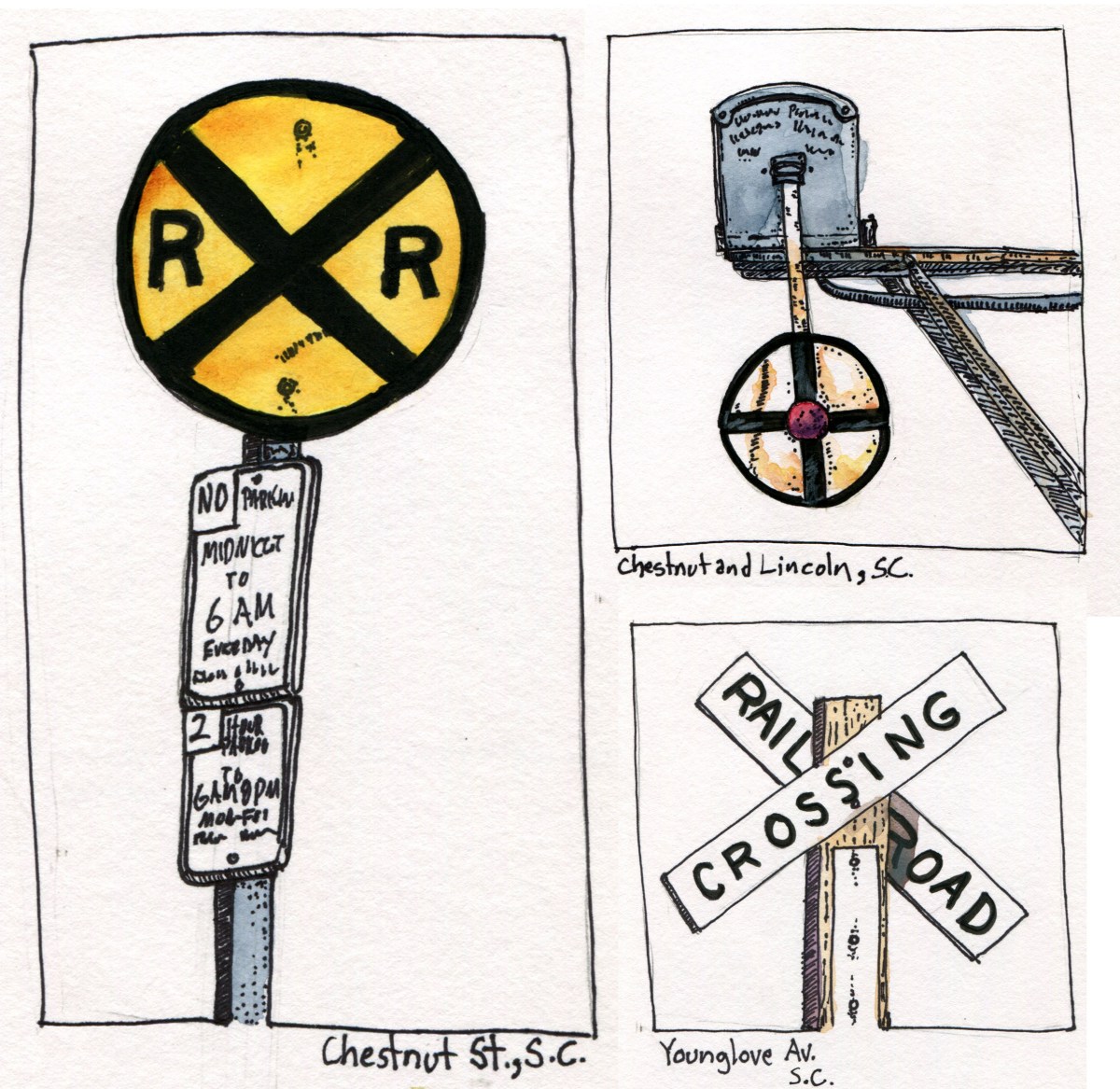
On a recent visit to Santa Cruz I decided to sketch the utterly mundane. The parts of the cityscape that most people ignore and are blind to. Things that, in some cases, are obsolete but still standing. So on one Friday morning I set out to sketch railway signs, and Santa Cruz has quiet a few.

These signs speak of a time when trains passed through town on the now closed branch lines. One line, known as the Suntan Special, once threaded it’s way through the Santa Cruz Mountains to Los Gatos and brought beach goers to the coast in the age before the automobile reigned supreme and another line headed out to Davenport to the now closed cement plant.

My father used to relate the memory from his childhood, of hearing a steam engine, working it’s way up the wet rails, just up the canyon from my cabin and how the driver wheels would spin out and the train would have to back down the grade, sanding the tracks, to make another attempt.

But today, on that same grade the tourist train dubbed Big Trees & Pacific now takes passangers on a motley consist from Felton to the Santa Cruz Beach Boardwalk and back again.  But really this lines goes nowhere, like an ocean going vessel on a landlocked reservior. 

Railway tracks speak of the romance of the rails, about hope, about hopping a freight to a new chapter, a new life. And the signs are still there, if you know where to look, and I do. 

Image

Lifebirds of the Southwest

Shortly after touchdown at Las Vegas International Airport, I had one destination on my mind and it wasn’t the Strip. I took the shuttle to the car rental center and 45 minutes later, I was on the road, my binoculars on the passenger seat, and I was heading to one of the best birding locations around Las Vegas: the Henderson Bird Viewing Preserve.

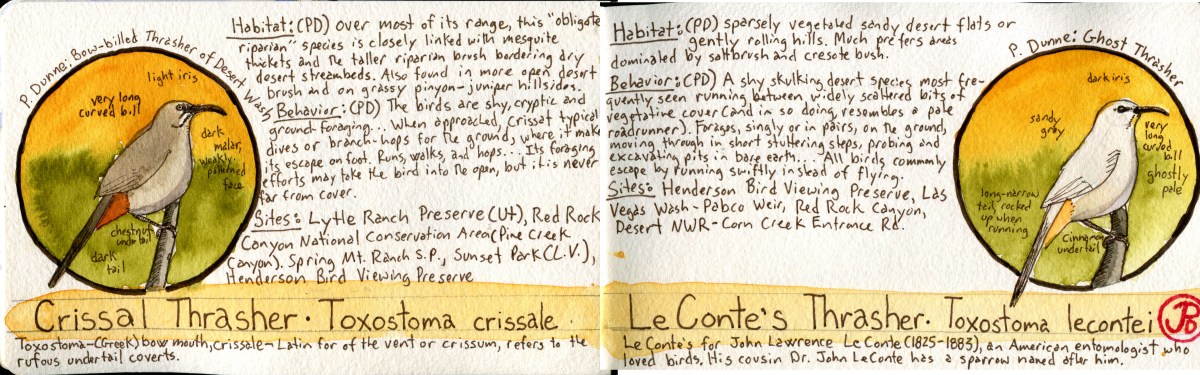
I had two notoriously difficult birds on my wish list that I hoped to see at the birding center. Because of their secretive nature, crissal and Le Conte’s thrashers were a prize on any desert birding trip to the southwest.

On my arrival at the visitor center I was informed that Le Conte’s was not to be found here but crissal could be seen just beyond the fence on the other side of Pond 6.

The Birding Preserve is an oasis of 9 ponds in the desert, southeast of the Vegas Strip and directly east of the airport. I threaded my way out to the far side of Pond 6 and walked the fence line, looking for the secretive thrasher.

In a near bush I spotted a little mouse of a bird, seen in a pair, it was a desert gnatcatcher, the black-tailed gnatcatcher. Life bird number 506.
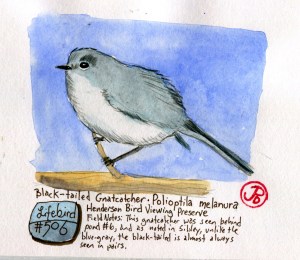
black-tailed

After watching the gnatcatchers, I scanned the brush for any sign of the thrasher and listening for their musical desert song. Then the thrasher appeared on top of a bush near the fence line and I had great looks of this fleeting enigma. It flew from bush to bush and I stayed with the bird for about ten minutes then I headed back to the visitor center, the preserve closed at 2:00 and I was warned that I would be locked in if I didn’t return in time. A roadrunner was a nice treat on my way out.

crissal-thrasher

Life bird number 507, crissal thrasher (Toxostoma crissale).

Two lifers in Las Vegas was not a bad haul and the other lifer I could expect to find was in Zion National Park, two and a half hours away. This bird was not rare and unlike the thrashers, was very conspicuous and easy to see. Indeed this bird was “created” by the American Bird Association (ABA), as it was split from the western scrub-jay. All scrub-Jay’s were once considered one species but are now broken up as Western, Florida,  Island, and now Woodhouse’s.

I didn’t really look for Woodhouse’s, I just knew that eventually we would cross paths somewhere in Zion. This I did while returning from Emerald Pools on the Kayenta Trail. I later have better views of a different jay on the Pa ‘rus Trail. This jay looks exactly the same as the western but favors juniper over oaks and there is no range overlap in southern Utah. Easy lifer.

woodhouse

Woodhouse’s jay, life bird number 508.

I was going to try one more time for the elusive Le Conte’s thrasher. This involve getting up extremely early, and leaving Springdale by 6 AM, so I could make my 1 o’clock flight from Sin City (turns out the flight was delayed by two and half hours because of Bay Area weather). My destination was the entrance road to Corn Creek, north west of Las Vegas. This is a hotspot, according to ebird, for this species. I waited as an approaching thunderstorm bore down on me. I searched the brush that flanked the road, and I heard it’s contact call but I never saw the  ghostly pale phantasma of a bird. It just gives me a bird to look for on my trip to Joshua Tree during my winter break.
img_5767

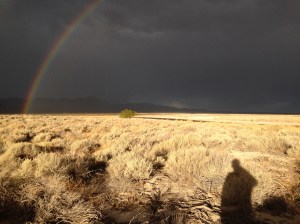
I may have heard a Le Conte’s thrasher at Corn Creek but the elusive bird was not seen, instead I was treated to one of nature’s masterpieces. Sun, rain, thunder, lighting, double rainbow.
Image

My 100th Post: North America’s Sexy Megafauna

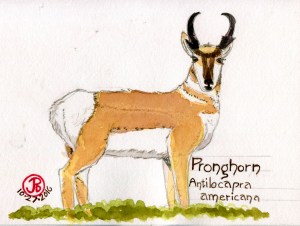
One of the fauna highlights of Bryce Canyon National Park is the possibility of seeing North America’s fastest land animal: the pronghorn antelope. As I headed out to Rainbow Point I stopped to scan every roadside meadow to see if I could find a herd but with no luck.

On my way out of the park I stopped at the visitors center to ask a ranger about possible locations to see pronghorns. The ranger told me that he hadn’t seen any pronghorns in the park for three weeks and in the fall the antelopes head out of the park and sometimes can be seen from the highways near Bryce,  grazing with cattle.

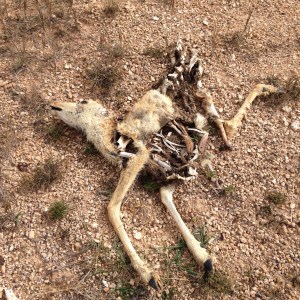
So I stopped at the first field I came to, once I left the park. There were cattle grazing in the field and I walked over to the barbed wire fence to take a closer look. That’s when I spotted a pronghorn, although not one I really wanted to see.

img_5716

The pronghorn that once was. Even in death, the pronghorn looks gracefully fast. 

I headed west on Highway 12 and stopped near the airport and again scanned the planes (no pun intended) for the Northern Hemisphere’s fastest land animal. No luck. I stopped at a few more locations in Red Canyon and the Dixie National Forest.  As I neared the intersection with highway 89, I spotted a lone pronghorn in the field to the south.

I pulled over and crossed the highway to take a closer look. That’s when I noticed that the pronghorn was not alone. Stretched off to the west were about 20 antelope, all of them looking towards the strange man looking at then. A new life mammal!

pha

After watching the herd for 10 minutes I got into the car and headed south on 89, towards the east entrance to Zion National Park. Little did I know that I would soon seen another life mammal. This one would be much closer to the road than the skittish pronghorn antelope.

Just after entering Zion National Park,  Checkerboard Mesa looming off in the near distance, I headed toward the mesa vista point. A line of tan animals appeared on the left side of the road, threading their way down to the mesa. They looked like large, pale capybaras, but with horns. What on earth were these creatures?

img_5741

A herd of bighorns attack a helpless bush on the road side of the Zion-Mt. Carmel Highway.

I pulled over and was surprised to see a herd of desert bighorn sheep descending on a bush at the base of Checkerboard Mesa.

The were about 15 sheep in the herd and a few worked their way up the road bank to almost within touching distance.  There was another herd on the other side of Checkerboard Mesa and this group included a ram. 

Image

Bryce Canyon

On my last full day in southern Utah, I lit out of Zion on the Zion-Mt. Carmel Highway, heading in a northern eastern bearing. My destination was Bryce Canyon National Park.

“Otherworldly” is an adjective often used to describe the landscapes of Bryce Canyon. Over a long period of geologic time of freezes, thaws, and erosion, the sandstone and limestone pillars known as hoodoos, were formed.

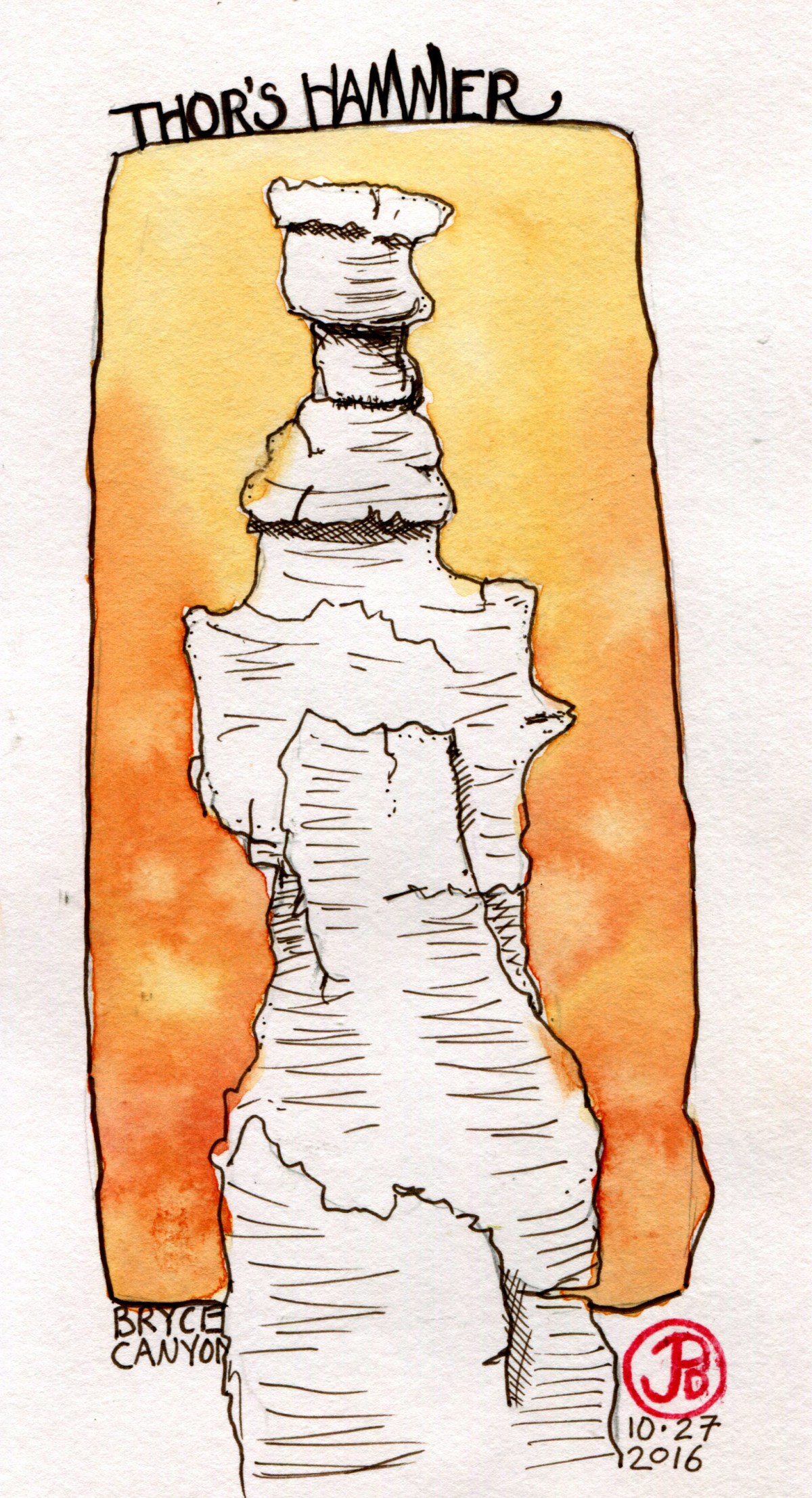
I wanted to get up close and personal with some of these hoodoos, so I got out of my car and left the vista point at Sunset Point and hiked the Navajo Loop Trail. There among the hoodoos and alien moonscapes I perched on the edge of the trail (trying not to drop my sketchbook and/or pen) and sketched Bryce’s most emblematic hoodoo, “Thor’s Hammer”. I let the form of “Thor’s Hammer” stand unpainted as I painted in the background with a loose wet-on-wet wash.

After my hike I returned to my car and headed south on the Bryce Canyon Scenic Drive toward Rainbow Point. As I passed the many vista points along the way I realized that Bryce was a Winnebago Warrior type of National Park. That means it is full of big cars, trucks, and campers that see the park from the road. They spill out of their RV, walk 15 yards to the scenic vista point, take a few pictures, and return to their RV and drive off to the next vista point.

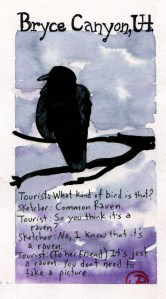
I met a group of these Winnebago Warriors at Rainbow Point. I stopped to admire one of my favorite birds, a raven that was perched near the vista point, quietly quocking to the hoodoos. I recorded the dialogue with a lady:

Tourist: What kind of bird is that?

Sketcher: Common Raven.

Tourist: So you think it’s a raven?

Sketcher: No, I know that it’s a raven.

Tourist: (To her friend) It’s just a raven. You don’t need to take a picture.

This conversation seemed so different from Zion where a lecture on Ravens was being advertised on the Park’s bulletin boards. The talk, which featured a reading of Poe’s poem, “The Raven”, was being held on an auspicious date, October 31st, Halloween at the Zion Lodge.

bryceraven


Image

The Narrows

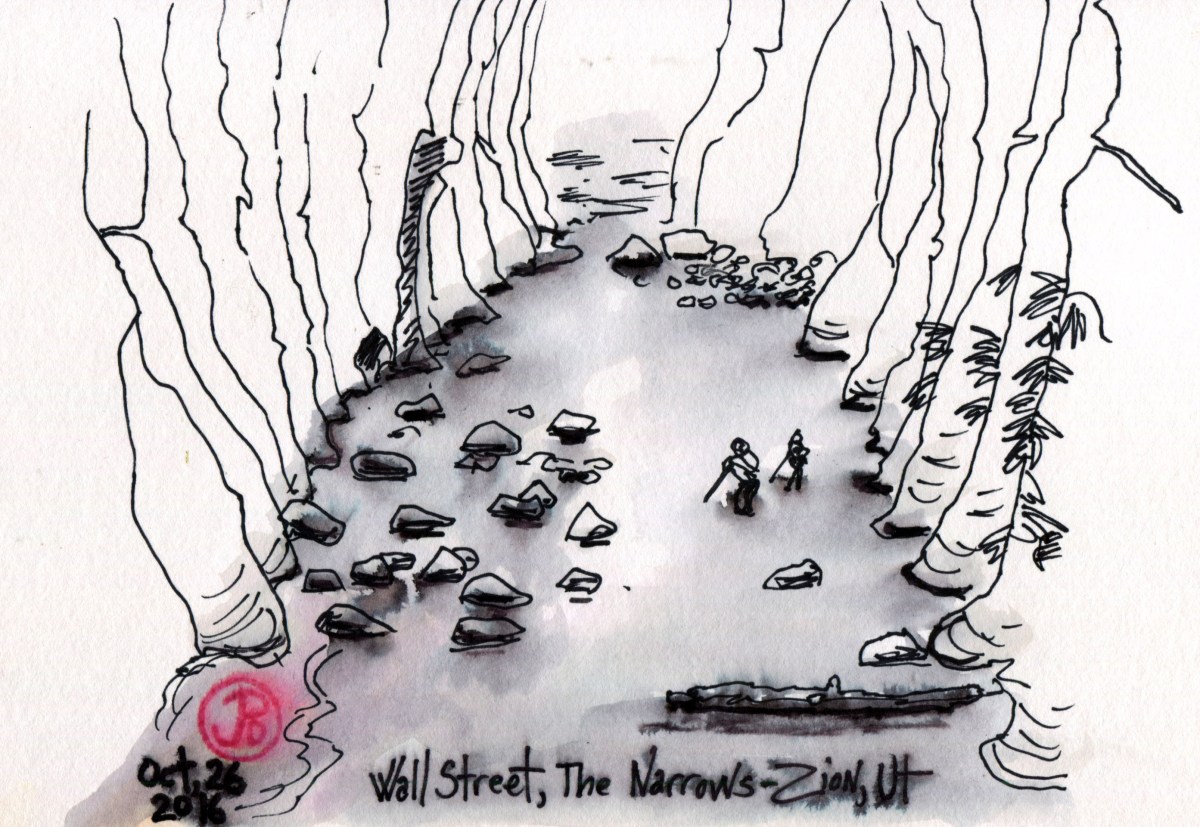
The Narrows is one of the ultimate hikes in Zion, if not all the 59 National Parks. In this hike, there is no trail, the Virgin River is your trail. You spent much of the time hiking in water with cliffs rising up to neck-aching heights. This is best exemplified in a part of the Narrows called Wall Street, where the width of the Narrows narrows to 30 feet across. It is in this part of the Narrows that I worked on two sketches.

Sketching with watercolor in the Narrows is problematic because you are constantly wet and you have to protect your sketchbook and paints from the river, in my case I used two, two gallon zip lock plastic bags. Also because of the dampness and the lack of direct sunlight in Wall Street, paintings dry at a glacial pace.

For the feature sketch I went out on a wire, without a net. Yes I sketched in pen and not pencil. I used a combination of Staedtler Lumocolor pens, both permanent and non-permanent. I used the non-permanent as a dark wash in the river. I wanted to keep this sketch monochrome and focus on the shapes and rock forms of the Virgin.

dsc06712

A boy and his toys, The Narrows.

I had the feeling that a photograph or sketch cannot truly capture the experience of being in the Narrows and sometimes it pays to put down your camera, put down your brush and sketch book, and just take in the world around you and be in the moment. The dipper floating downriver taught me that lesson.

dsc06737

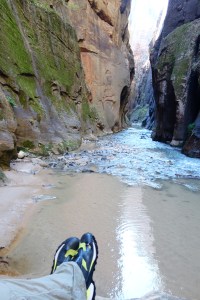
Taking in Wall Street while letting my water logged feet dry out.

narrows1

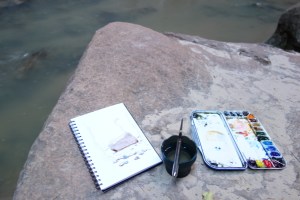
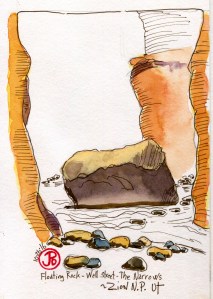
In the Narrows I found a good rock perch and sketched Floating Rock in  Wall Street. As when I’m near any water, I used the Virgin River to add water to my watercolor sketch.

Image

“The Humming-bird of Blooming Waters”

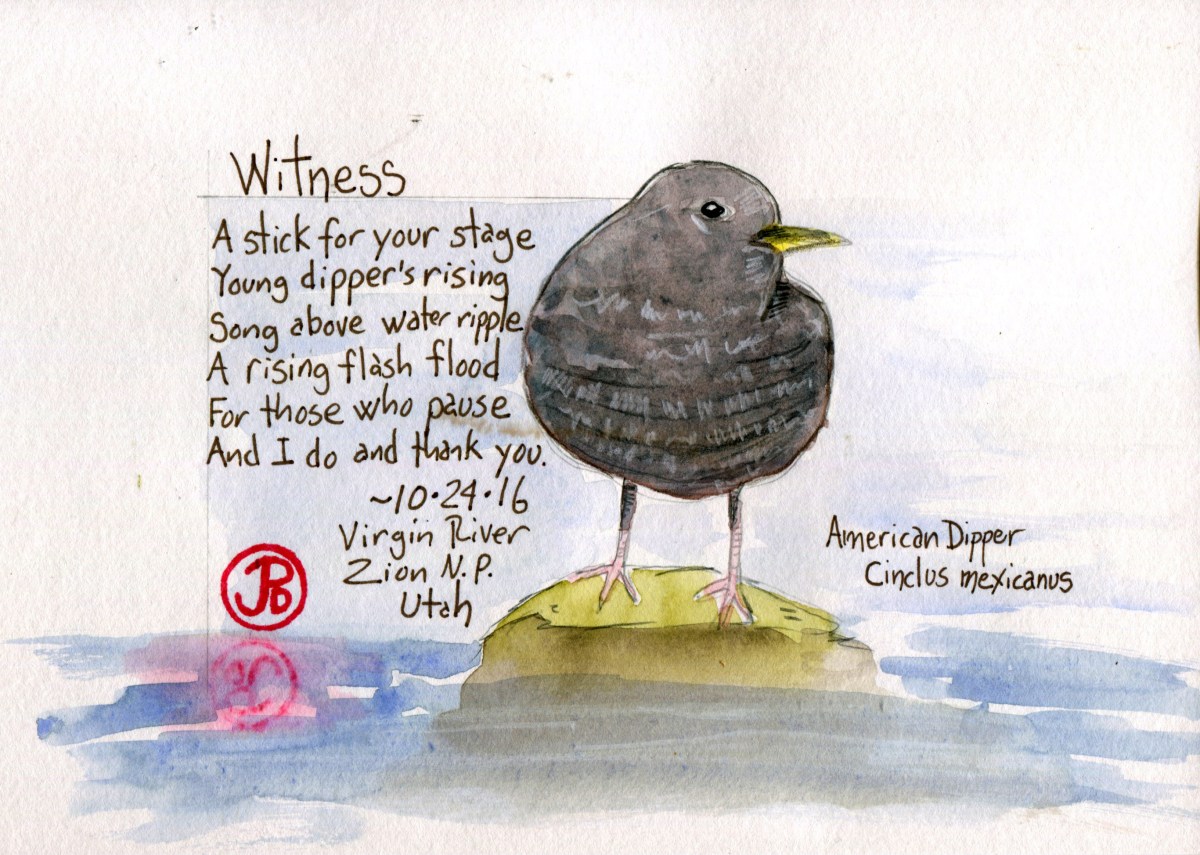
One of my constant companions on my walks along the Virgin River and into the Narrows was the American dipper (Cinclus mexicanus). On purely external appearances this just looks like a dumpy, drab, short-tail bird that flies like a sinking piece of lead but sketching and birding forces you to stop and notice.

I can watch this aquatic song bird for hours as it bobs up and down along the river bank, floats like a leaf downstream, and disappears under the turbulent waters of the Virgin. On one hike up the River Walk Trail I paused at the sound of the whistles and trills of a dipper song, rising above the sound of the river. I finally located the juvenile bird, perched on a branch, close to the water. I sat near, the only audience member to one of nature’s concerts. Here is how John Muir described the song of the dipper:

The more striking strains are perfect arabesques of melody, composed of a few full, round, mellow notes, embroidered with delicate trills which fade and melt in long slender cadences. In a general way his music is that of the streams refined and spiritualized. The deep booming notes of the falls are in it, the trills of rapids, the gurgling of margin eddies, the low whispering of level reaches, and the sweet tinkle of separate drops oozing from the ends of mosses and falling into tranquil pools.

As I was listening to the dipper, many people passed on the trail, none pausing or noticing the wonderful music emanating from one of Zion’s most amazing creatures. I then composed a short poem, really just the same poem that I have composed before, only the words were different. The gist of the theme can be summed up as: People in nature, shame on you for not noticing.

img_5578

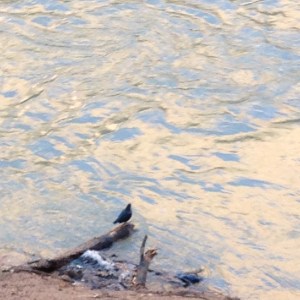
The always enjoyable dipper on the banks of the Virgin River, Zion National Park.

In all the majesty and marvel of the Sierra Nevada Mountains and Yosemite, John Muir focused his attention and writing this small, drab bird, which he called the water-ouzel. He writes so poetically about this bird in The Mountains of California:

He is the mountain streams’ own darling, the humming-bird of blooming waters, loving rocky ripple-slopes and sheets of foam as a bee loves flowers, as a lark loves sunshine and meadows. Among all the mountain birds, none has cheered me so much in my lonely wanderings, –none so unfailingly.

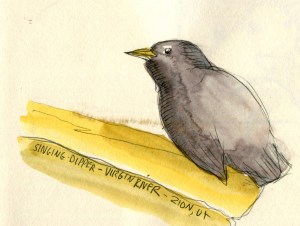
ziondipper-2

A field sketch of the juvenile dipper, singing on it’s perch above the Virgin River.

Image

Zion National Park

For my fall break I thought a visit to a National Park was in order. My first choice was American’s first National Park, Yellowstone. But after further research I found out that most of the lodging options within the park were shut down by late October, so I headed south. And the one park that immediately came to mind was Southern Utah’s Zion National Park.

I was most interesting in a park that would lend itself to my sketchbooks and Zion, with itself vertical landscapes, provided it’s own challenges. I brought a Stillman & Birn Beta Series 9 by 12 spiral sketchbook. In retrospect a panoramic watercolor sketchbook would have suited Zion’s landforms better but I had to make due with what I had. (I did bring a Stillman & Birn Gamma Series landscape book but the paper was not up to take multiple watercolor washes.)

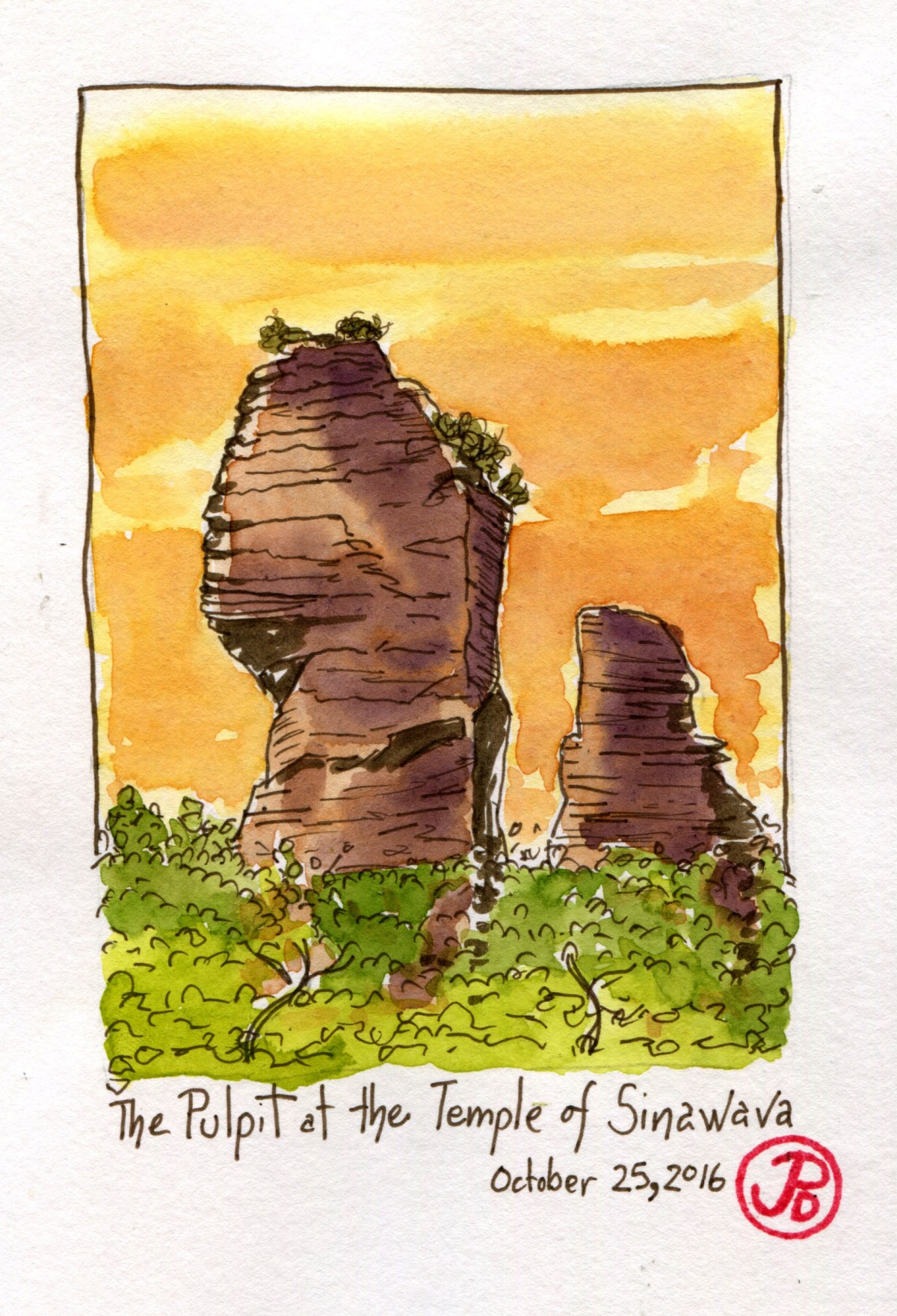
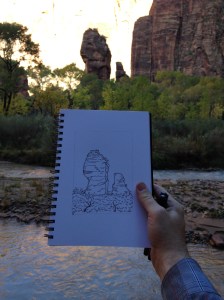
One pleasurable Zion sketching experience was sitting on the banks of the Virgin River, with an American dipper as my companion, sketching the Pulpit at the Temple of Sinawava. In the morning the sun was just hitting the golden cliffs in the background leaving the Pupil in rich, velvety shadow.

img_5597

A little behind-the-scenes in the making of a sketch. Here perched on the peaceful banks of the Virgin River, with an American dipper at my feet (more about these amazing birds in another post).

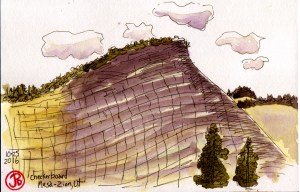
I later took a drive out on the scenic Zion-Mt Carmel Highway (Highway 9) in eastern Zion. I sketched the Checkerboard Mesa.

checkerboard

Image

A Very Rare Lifer

In the early morning my dreams were full of birds. I was in a marauding flock of birders searching the canals and side streets of an unknown seaside town for an unnamed rare shorebird. The dream ended before I saw the bird. I looked over at my bedside clock, it was just past 5 AM.

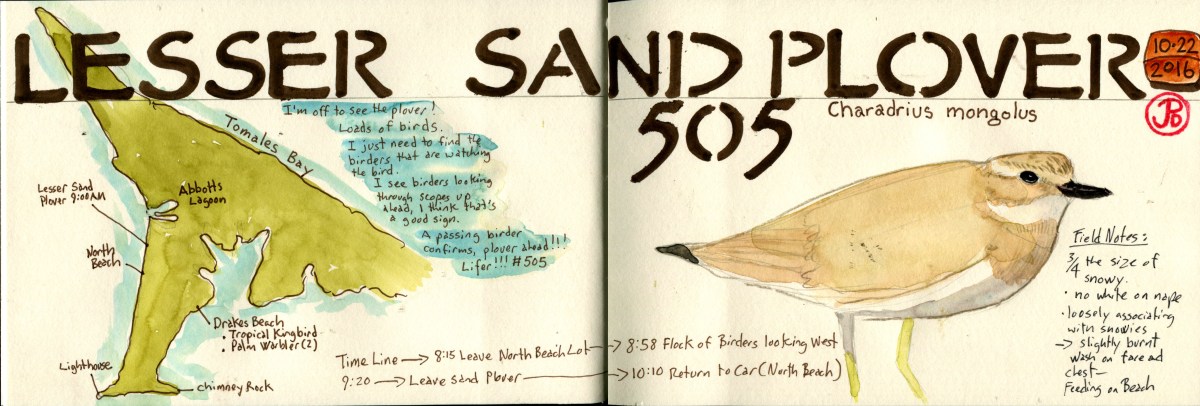
I left by 6:45 on this Saturday morning, in an attempt to make it a two life bird week. My destination was outer Pt. Reyes on the Pacific Plate. There was a very rare plover, that was spending some time with the local snowy plovers on Point Reyes Beach, between North Beach and Abbotts Lagoon. The lesser sand plover (Charadrius mongolus) breeds in Asia and winters in southern Asia, Australia, and Africa. In the fall, a rare few make it to Alaska, and an even smaller number make it down the west coast to California. When I arrived at 8:00 there were already a fair numbers of cars and a few birders heading north with their scopes slung over their shoulders for the 40 minute hike, in sand, to the stretch of beach were the lesser sand plover that been seen on the past few days.

I hit the beach at 8:15, hoping my early morning sand-hike would be fruitful.

img_5472

Corvidsketcher on route to the very rare sand plover on Pt. Reyes beach, with great viewing light to my back.

30 minutes into my hike I passed a birder returning to North Beach and he told me to follow the other birders and he pointed up shore to the north. On the horizon I could see a group of tripods with around ten birders standing in loose groups. This was indeed a good sign. I approached the group at 8:58 and I scanned the beach to the west, finding many snowies hunkered down in the sand. I was looking for a larger plover with a brownish nape. At 9:00 I spotted a plover that stuck out like a sore thumb, standing next to some bull kelp and to the right, the much smaller snowy plover. Bingo, Lifebird # 505! I watched the bird feeding around the snowy plovers for 20 minutes and then headed south, back to my car. That was well worth the hike.

img_5484

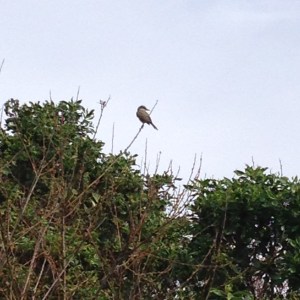
After adding lesser sand plover to my lifelist, I birded a few other sights in outer Pt. Reyes. In the trees of Drakes Beach I found another tropical kingbird and two palm warblers.

Image

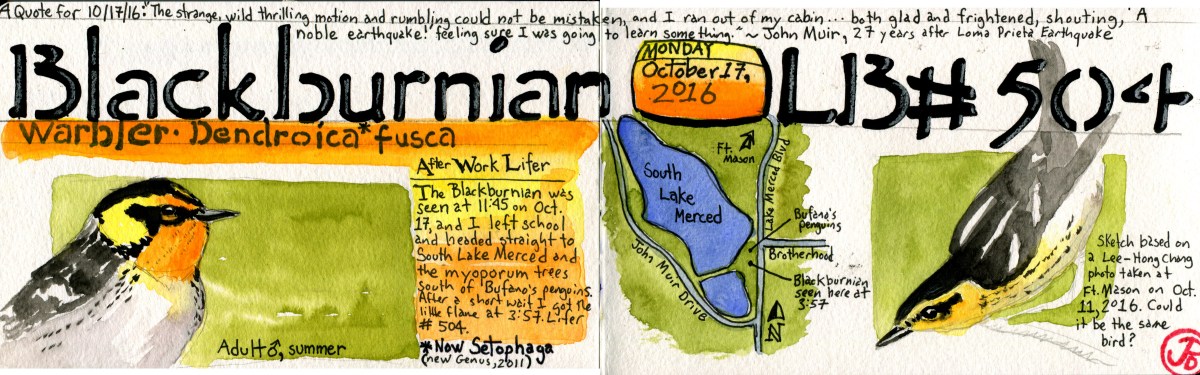
Lifer #504

The Blackburnian warbler had been seen on October 11th in Ft. Mason just before the rainy weekend and I didn’t get a chance to add it to my North American list. I assumed the storm would have washed the bird out of the city and I didn’t see any postings of a continuing Blackburnian so I didn’t venture out during one of the rain windows.

It appears that the storm didn’t wash the warbler out of the city limits completely. A Blackburnian, very similar in appearance to the Ft. Mason young male, was found at 11:45, Monday morning at South Lake Merced, within a few wing beats of the San Francisco/ Daly City border. And just south of the Bufano penguin sculpture, very near where I had a black and white warbler in October of 2012.  Now if the warbler could satisfy itself in the trees of South Lake Merced and stay around for another few hours, I might have an after work lifer.

And so it was that I found myself, a little bit before 4 o’clock, in front of some myoporum trees full of  yellow rumped warblers and cedar waxwings, scanning the green for a flashing flame. A local birder had just seen the bird and now it was just about patience. The patience paid off as the Blackburnian appeared at eye-level, right in front of me at 3:57!

The Sketch

I started this spread with the lettering: Blackburnian LB# 504. To create the lettering I used a Parchment 1” plastic stencil and a black Faber-Castell PITT big brush pen. The anchor for the spread is the adult male warbler in the lower left. This sketch was started with pencil and then layered in watercolor. I intentionally avoided using pen, instead attempting to define and contain shapes with brush work with a Winsor & Newton Series 7  number 3 brush. This is not the warbler that I saw but I think sketching a bird at it’s absolute apex (male breeding plumage), I am able to understand and internalize the bird’s appearance. The breeding male’s foil is a loose, Chinese brush style, fall male, based on a photograph of the bird that first seen on October 11 at Ft. Mason. The overall color scheme of the sketch of black, white, and yellow-orange is dictated by the breeding male’s plumage.

Coda

I saw this life bird on October 17, the  27th anniversary of the Loma Prieta Earthquake that rocked the Bay Area, which I experienced when I was a senior in high school. To crown this sketch I included a quote by John Muir that I re-read in the book I am currently reading, Landmarks by Robert Mac Farlane. Muir wrote:

The strange, wild thrilling motion and rumbling could not be mistaken, and I ran out of my cabin, near Sentinel Rock, both glad and frightened, shouting, ‘A noble earthquake!’ feeling sure I was going to learn something.

Image

Bird on a Wire

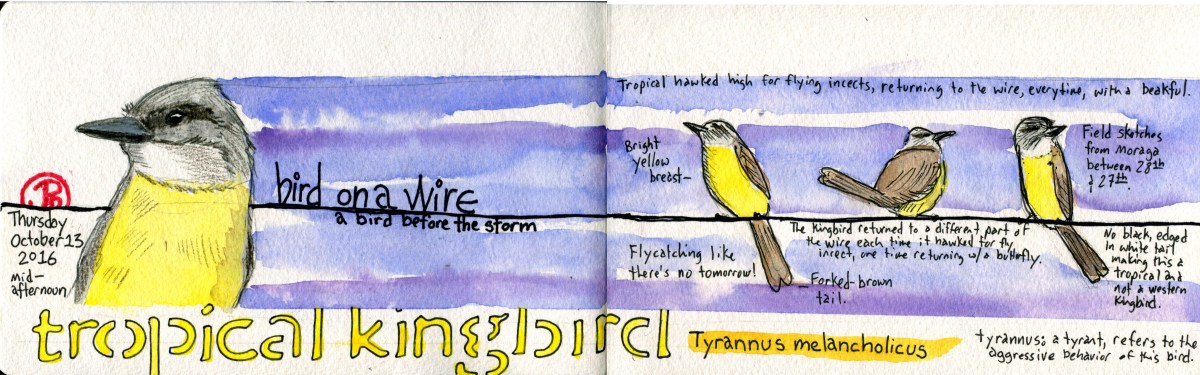
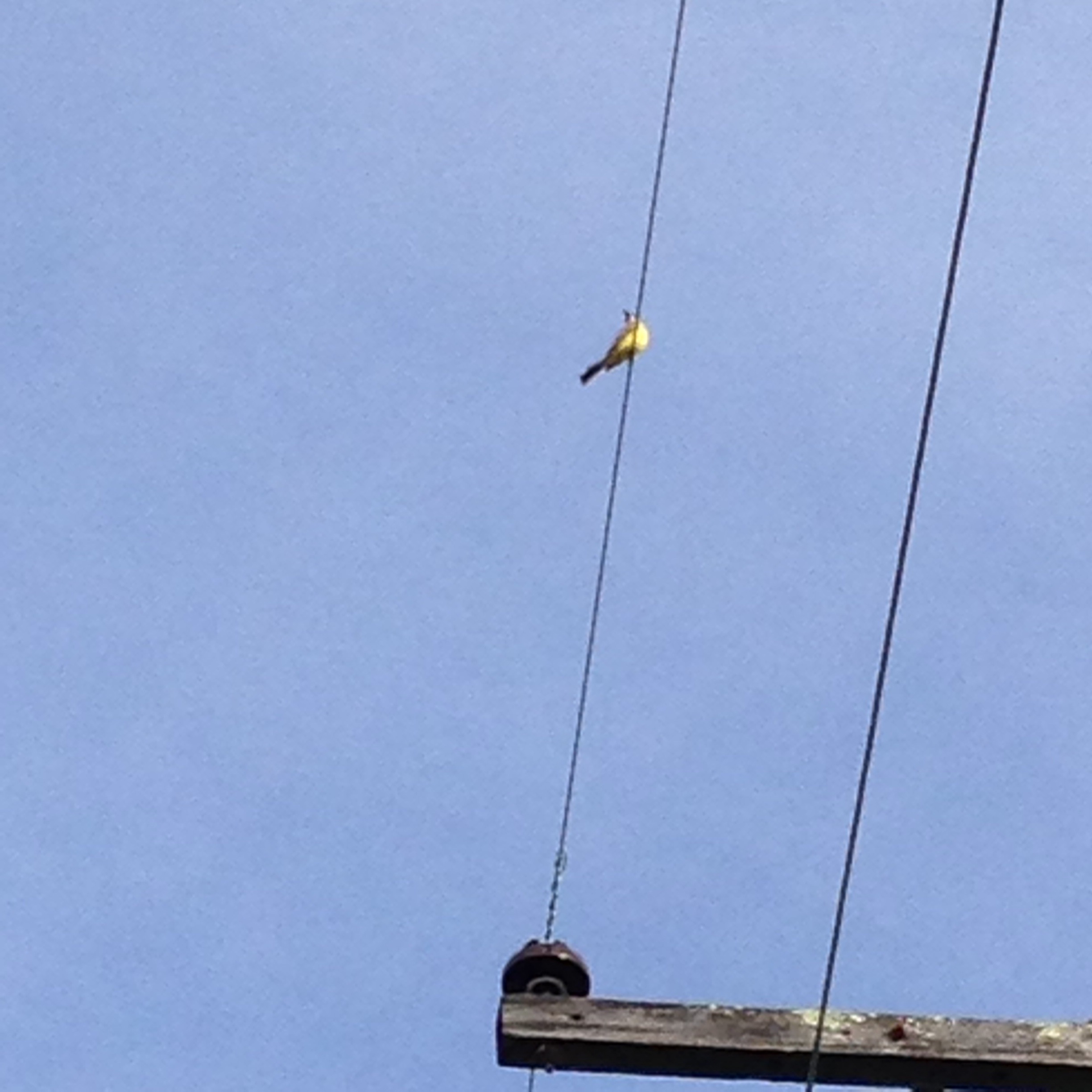
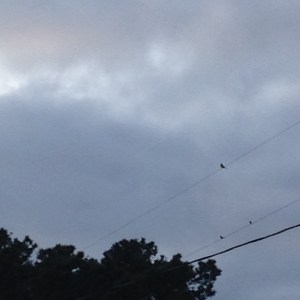
After two long weeks of parent-teacher conferences and a worn out typhoon bearing down on the Bay Area, I had a surprise as I drove up Moraga Street, one block from my home. I took a different route home because of some road work. And as I was heading up the hill, I saw a bird on a wire.

Any bird on a wire that looks a little “off” is bound to catch my attention and this bird did. At first it looked like a really light colored scrub-jay. But as I moved closer I knew it could only be one bird.

The bird’s location in the middle of the wire, it’s bright yellow breast, and its menacing ever vigilant gaze signaled that this was a tyrant flycatcher. And it’s brown, notched tail and heavy, violent bill, seen through by car binos, confirmed that it was the rare but regular visitor to the west coast, the tropical kingbird, Tyrannus melancholicus.

This is an apt name for the genus that shares part of it’s name with the tyrant lizard king, Tyrannosaurus rex. The tyrant moniker is given to the genus of kingbirds (another link with T. rex) because of the aggressive nature of these flycatchers, especially directed towards much larger birds (hawks, eagles and falcons) during the breeding season. The tropical kingbird’s species name, melancholicus, comes from Greek, meaning of a melancholic temperament. The Greeks believed that one was guided by the four humors (blood, yellow bile, black bile, and phlegm) and if you were out of balance, in this case by being over loaded with sullenness or violent anger, then it would contol your demeanor (by being full of black bile). That’s the long way of saying that the tropical kingbird gets really pissed when intruders are in it’s breeding territory.

A kingbird on a wire, looking for a winged meal. I was able to do three field sketches of the flycatcher.

I watched the kingbird sally forth from it’s wire perch returning each time with a flying insect in it’s beak. On one such attack, the yellow-breasted tyrant launched itself 60 feet into the air, returning with a yellow butterfly, which the hawker dispatched in two deft gulps. The bird worked it’s way up and down the power wires of Moraga Street, eating as it went.

img_5457

On my after dinner stroll, as the harbingers of our first winter storm filled the sky, there was the kingbird, taking the highest perch. It sat, resting from it’s travels and it’s high energy aerial hunts, where it now sang, to no kingbird that was anywhere near.