Image

Lifers

“The list total isn’t important, but the birds themselves are important. Every bird you see. So the list is a frivolous incentive for birding, but the birding itself is worthwhile. It’s like a trip where the destination doesn’t have any significance except for the fact that it makes you travel. The journey is what counts. ”

-Rich Stallcup, Birding legend, as quoted by Kenn Kaufman in Kingbird Highway

I  will probably never see 28 life birds on a single trip in North America again. I have birded some of the Meccas of birding, my home state of California, southern Arizona and Texas and finally southern Florida. To see this many new birds, I would have to go to the farthest reaches of Alaska (and be extremely lucky), or have an incredible migrant fallout in Cape May, or travel to another country.

To celebrate this haul of birds I wanted to sketch each bird, because I believe that to sketch something you attain a deeper understanding of it and you really internalize the shape, color, feather patterns and contours of each bird. As source material I used photographs, drawings, and field guides. For these pages I designed a unifying theme, using overlapping cartouches to list the life bird number, date, location, and time.

Florida page 2

This spread documents an amazing morning of birding with a Michigan snowbirder named Dave.We birded Babcock-Webb WMA and Prairie/Shell Creek Preserve.

Image

The Everglades Kite

There is a much sought after bird in Florida and I was going to try my damnedest to add it to my life list. This is the snail kite (Rostrhamus sociabilis), formerly known as the Everglades kite. It’s a much sought-after bird because it is only found in the United States in southern Florida and it specializes in feeding almost exclusively on apple snails. The apple snails depends on water and the depletion of the Everglades means that the population of snail kites has suffered. The kite is currently listed as a Federal and State endangered species because of it’s small population and extreme population specialization. It is estimated that there are currently less than 400 breeding pairs in Florida.

I wanted to see one out of those 400 pairs and according to my Falcon Guide, Birding Florida, there are a few spots on the Tamiami Trail, across the highway from the Shark Valley entrance to the Everglades to check for this bird. I tried there, scanning the marshes for the bird. No kites. I read in my guide:

“A more reliable spot in recent years for this sought-after species has been an abandoned airboat concession across from the Tower Market. . .The kites may be seen coursing over the marsh or may be perched on distant trees. If it’s your lucky day, one may be perched on a cypress tree directly in front of your vehicle.”

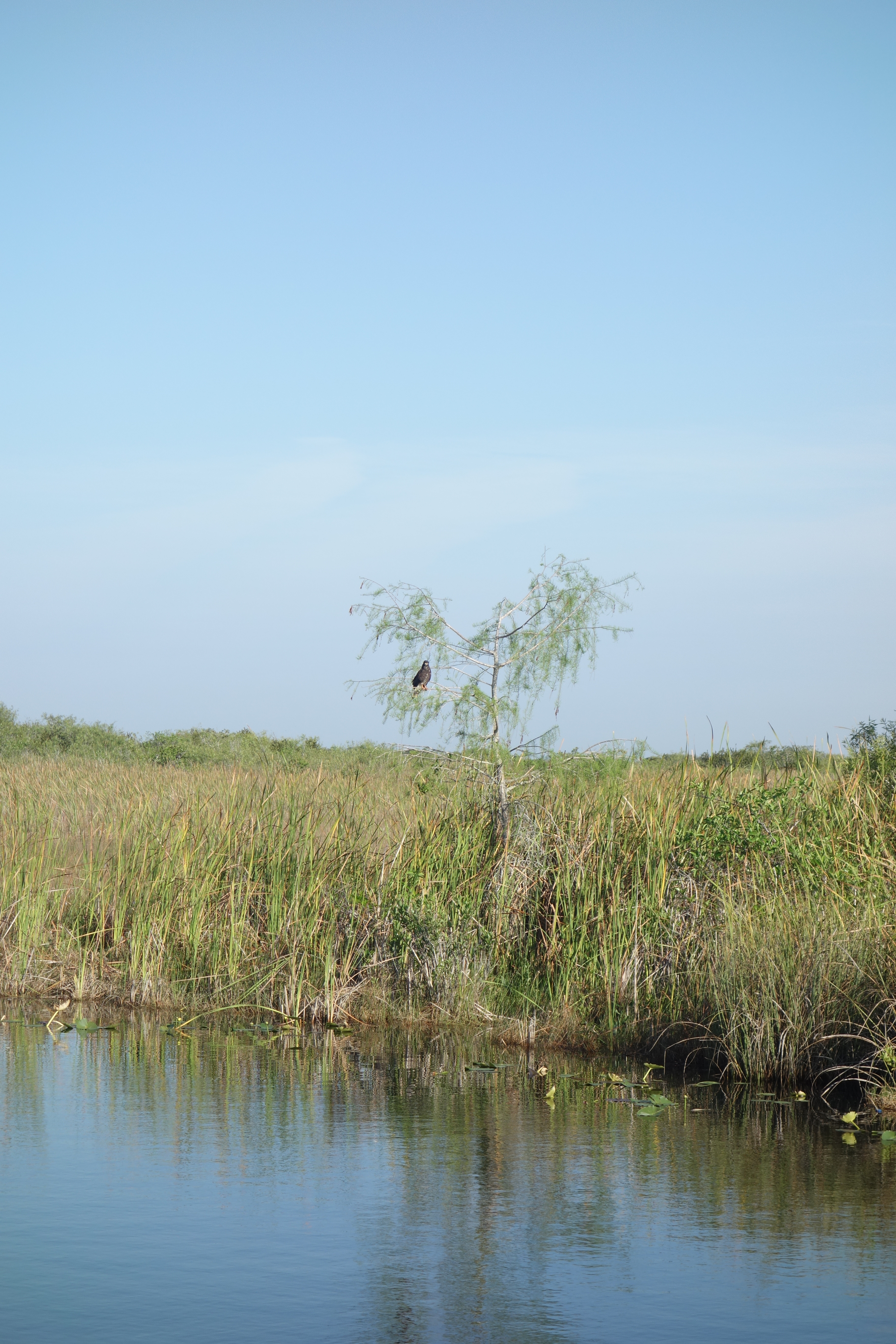
I returned to my rental and drove a mile west to the airboat concession on the right. I pulled into the parking lot and bingo, today, April 1, 2015, was my lucky day! A male snail kite was perched across the canal on a cypress. I was able to take a few photos and I returned to my car to grab my sketchbook and pens. When I returned, the bird was gone. This kite was not to be as accommodating as the black vultures of the Anhinga Trail, but it certainly was one of the easiest Florida life birds to add to my list.
Florida jay

The two other Florida specialties I sought on this trip was the endemic Florida scrub-jay and the red-cockaded woodpecker. Both birds are listed on the state watch list, which includes species most in danger of extinction without significant conservation action.

According to e-bird and my Falcon Guide, Babcock-Webb Wildlife Management Area (just north of Fort Myers) was the hot spot for red-cockaded woodpecker. You must arrive at dawn near their cavity trees (which are ringed with white paint by field biologists). The birds gather near their cavity trees before dispersing to forage for the day. The painted trees were easy to spot and a car was already parked along the dirt road. A snowbirder from Michigan was already there, waiting for the show to begin. As if on cue, a single red-cockaded flew in and perched on a tree for less than a minute, enough time to see the identifying white cheek field mark, and then was gone. The show was over. North American life bird #472.

I followed the snowbirder, (Dave) and we made our way around Babcock-Webb. With his help I picked up three more lifers: brown-headed nuthatch, northern bobwhite, and eastern bluebird. He offered to show me where to find Florida scrub-jay at the Prairie/Shell Creek Preserve near Punta Gorda. After a short walk, Dave led me to the area where they are seen. I spotted the rare jay flying to the top of an oak. Life bird #476 was mine!

DSC04283

One of the photos I was able to get of the male snail kite that was handed to me on a platter, just before he flew off.


Image

Spring Break in the Sunshine State

“There are no other Everglades in the world. ”

-Marjory Stoneman Douglas

Most spring breakers head to Florida’s white-sand beaches to collect stupidity, lovers, and hangovers. But I was here, in the southern extremes of the Sunshine State, to collected birds, alligators, and journal pages.

I had been drawn to Florida at an early age while looking through a book about endangered animals. I had always loved animals but the concept that they could be endangered was new to me. The Florida Panther, American alligator  and the Everglades kite were from the state that presented a continuing threat to their existence and as an adult I wanted to see them before they disappeared for good. And I wanted to see the Everglades before it was completely covered in water.

My first impressions of Florida where driving through the concrete jungle from Miami International to my hotel in Homestead. According to the FBI, Homestead is the sixth most dangerous city in Florida, but it ranks number one when it comes to violent crime. It proves that the most dangerous animals in Southern Florida are not Alligators, venomous snakes, or mosquitoes, but Homo sapiens.

It was nice to leave behind Homestead and the gun shops and strip clubs and enter the fabled Everglades National Park. I picked up three life birds just in the parking lot of the visitor’s center. I headed into the park and my first stop was Royal Palms and the Anhinga Trail.

I headed out on the loop trail and true to it’s name there was an anhinga sunning itself with open wings. At the end of the boardwalk were about twenty black vultures perched on the rails. They were certainly not afraid of close human approach and preferred to walk rather than fly away. This called for a sketch. This sketch, featured above, was a very loose drawing of the different postures of the vultures as they preened before their mid-morning foraging over the “Sea of Grass”.

DSC04265

I had further adventures on my first day in the Everglades, including surprising a four foot eastern diamondback on the Snake Bight Trail, seeing a rare American crocodile, and watching two elegant swallow-tailed kites as they effortlessly rode the thermals. I ended my first day in Florida with 12 life birds.

Over the next few posts I will include pages about some of the 28 life birds I saw over the course of my week in south Florida.

Bird Tower

The observation tower in the middle of the 15 mile bike loop at Shark Valley, the Everglades.

Image

Touchstone

There are subjects that I keep coming back to, touchstones.

One definition of a touchstone is:

a black siliceous stone formerly used to test the purity of gold and silver by the color of the streak produced on it by rubbing it with either metal.

These subjects become the stone which I test my own purity to see if I can extract gold or silver out of my sketch. 

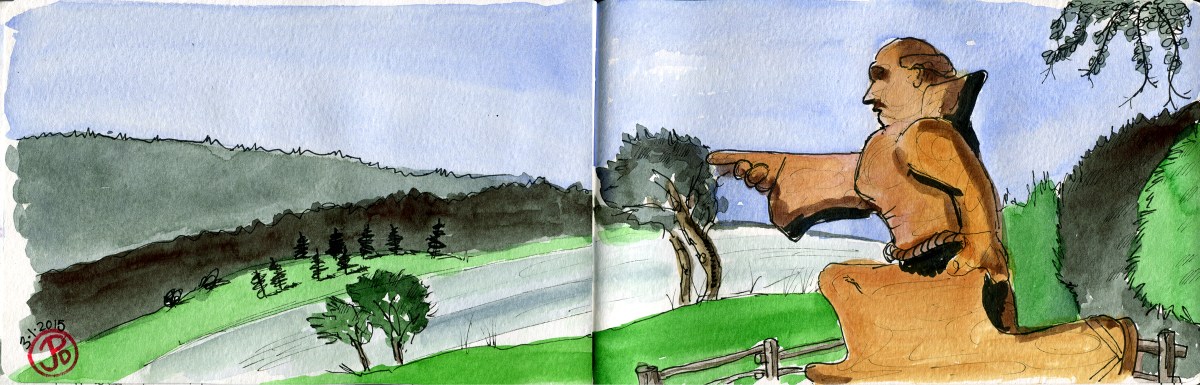
One subject that I keep coming back to is the odd roadside attraction just north of the “Flintstones” house and Crystal Springs bridge on Highway 280. This is that odd Father Junipero Serra statue that is pointing towards an unknown object or, perhaps, looks like he has just released a ball at the bowling alley.

This statue has always been a landmark on my Saturday morning journeys to my grandmother’s house in the West Portal neighborhood in San Francisco. I would first look for the “Flintstones” house that my dad told me was earthquake proof and then I knew the odd roadside statue would be appearing shortly, on the top of the rise, pointing to something on the other side of the highway which I could not see. I would crane my neck to watch the cartoonish padre recede from sight. Of course we never stopped to take a closer look.

Perhaps that is one reason this statue remains a touchstone for me, not because it is a work of incredible artistry or it is something that is fun to sketch, but because it is that one permanent feature from my childhood in the ever charging world of California. A touchstone that takes me back to those pleasant journeys north, to visitmy grandmother. Serra vs Godzilla

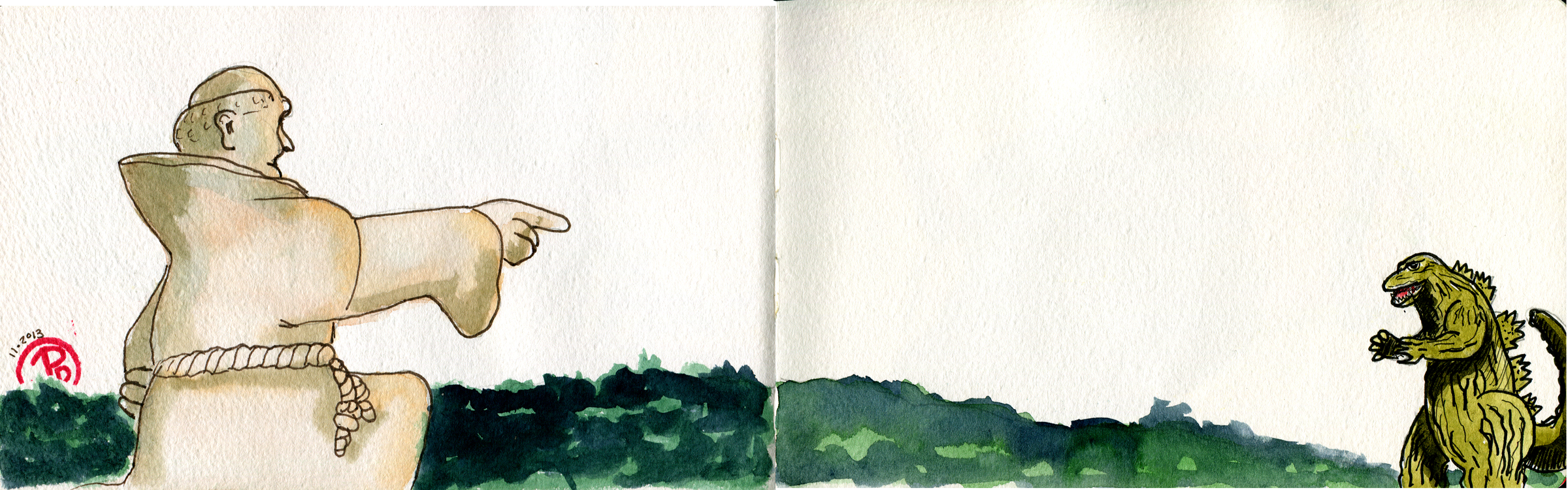
A bit of whimsy from 2013. Godzilla is about to meet his match when he faces off with Father Serra.

Image

Temples of Cinema

“I look up, I look down. I look up, I look down, there’s nothing to it. ”
-“Scottie” Ferguson on sketching

As a celebration of film on this Academy Awards weekend I went to one of the Temples of Cinema, the Stanford Theatre in Palo Alto, to see the film that has recently usurped Citizen Kane, as the greatest film of all time, on “Sight & Sound” list of the 50 greatest films of all time. That film would be Hitchcock’s Vertigo.
I couldn’t think of a better temple to see this masterpiece than in a theater that regularly accounts for 25% of classic film attendance in the United States. The Stanford was opened in 1925, at a time when movie theaters looked more like cathedrals than cinemas.

We were treated to live music on the mighty Wurlitzer as the organist’s hands moved across the rows of keys and his feet danced out the bass line on the pedals. He began to play the spider-like Bernard Herrmann Vertigo theme as the organ and organist slowly sunk from view and the curtains parted. It’s show time!

There are only a handful of these movie palaces left in the Bay Area. The Castro, the Grand Lake, and the Paramount. No other theater focuses more on classic films (films made between 1910 and 1970) than the Stanford, which was purchased by the Packard Foundation in 1987 and restored at an additional cost of $6 million. It reopened in 1989 with The Wizard of Oz.

Paramount

The Paramount Theatre in Oakland featuring Kubrick’s Dr. Strangelove or How I learned to Stop Worrying and Love the Bomb.

Note: The fourth grader I was with described Vertigo this way: “Driving and talking and driving and talking and trees!” Give it another 20 to 25 years and I’m sure he’ll come to love it.


Image

Front Page & Quotes

I try to use every page of my Moleskine watercolor journal including the front two pages. These pages I reserve for quotes, poems, song lyrics, and thoughts that I come upon in the three months it generally takes to fill a journal. I also record the start and stop time of the journal. In the front page above I included my current staff portrait (my students voted for the bow tie over the straight tie), quotes (Dr. Seuss, Dr. King, Kurosawa, the sketcher), a portrait of Captain Joshua Slocum, my hand stamped Coloma miner’s name (Hawkeye) and a part of last years Sibley calendar (a male American kestrel that seems to be staring me down) . Rubber cement is a common tool for my front pages.

Sometimes I come upon a quote that I think deserves its own page. I write the quote and them come up with some sort of image that supports the words. Such was the case when I came upon a quotation while reading Robert MacFarlane’s new book: The Old Ways, A Journey on Foot. MacFarlane walks the ancient footpaths that crisscross England, Scotland and elsewhere.  He quotes the American historian and geographer John Brinckerhoff Jackson:

“For untold thousands of years we traveled on foot over rough paths, not simply as peddlers or commuter or tourists, but as men and woman for whom the path and road stood for some intense experience: freedom, new human relationships, a new awareness of the landscape. The road offered a journey into the unknown that could end up allowing us to discover who we were”

Path

I first sketched out the lines of the path that leads to an inviting distant horizon. I then wrote in the quote, allowing the path to bisect the words. The landscape I created was really a landscape of the mind. I created a place I would have liked to travel through. A place that was a foil to the rainy and windy February day outside. I wanted the landscape to be inviting. The oak tree beckons me to ascend the hill, to see what landscape lies beyond. And maybe I would like to stop for a rest, pause for a meal and I could look over the crest of the rolling hill and maybe even sketch.There is a story in this spread and it is really up to the viewer to fill in the details.

Image

Mendocino Coast

“Injustice anywhere is a threat to justice everywhere” -Dr. Martin Luther King Jr.

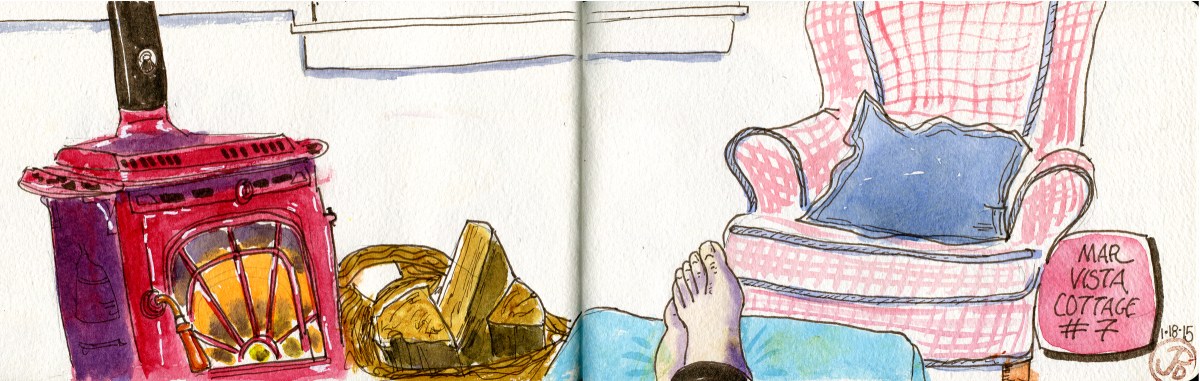
On this MLK three day weekend I headed north with no other agenda than a location: the Mendocino coast, and a place to lay my head (and put up my feet): Mar Vista Cottage Number 7 and my sketchbook and paints.

The Mar Vista cottages are located in Anchor Bay, just north of the Sonoma-Mendocino border. The cast of characters at Mar Vista include the welcoming Renata and Tom, a car chasing black dog named Rascal, two goats, four feral cats named Sally, Farrell, Romeo and Juliette, and about 40 chickens. The organic garden outside my front door was open for the pickings and the feathered ladies of Mar Vista provided four fresh eggs every evening. I was in one of the cottages with a wood burning fireplace. So I had to sketch and paint it. What else is a sketcher supposed to do?

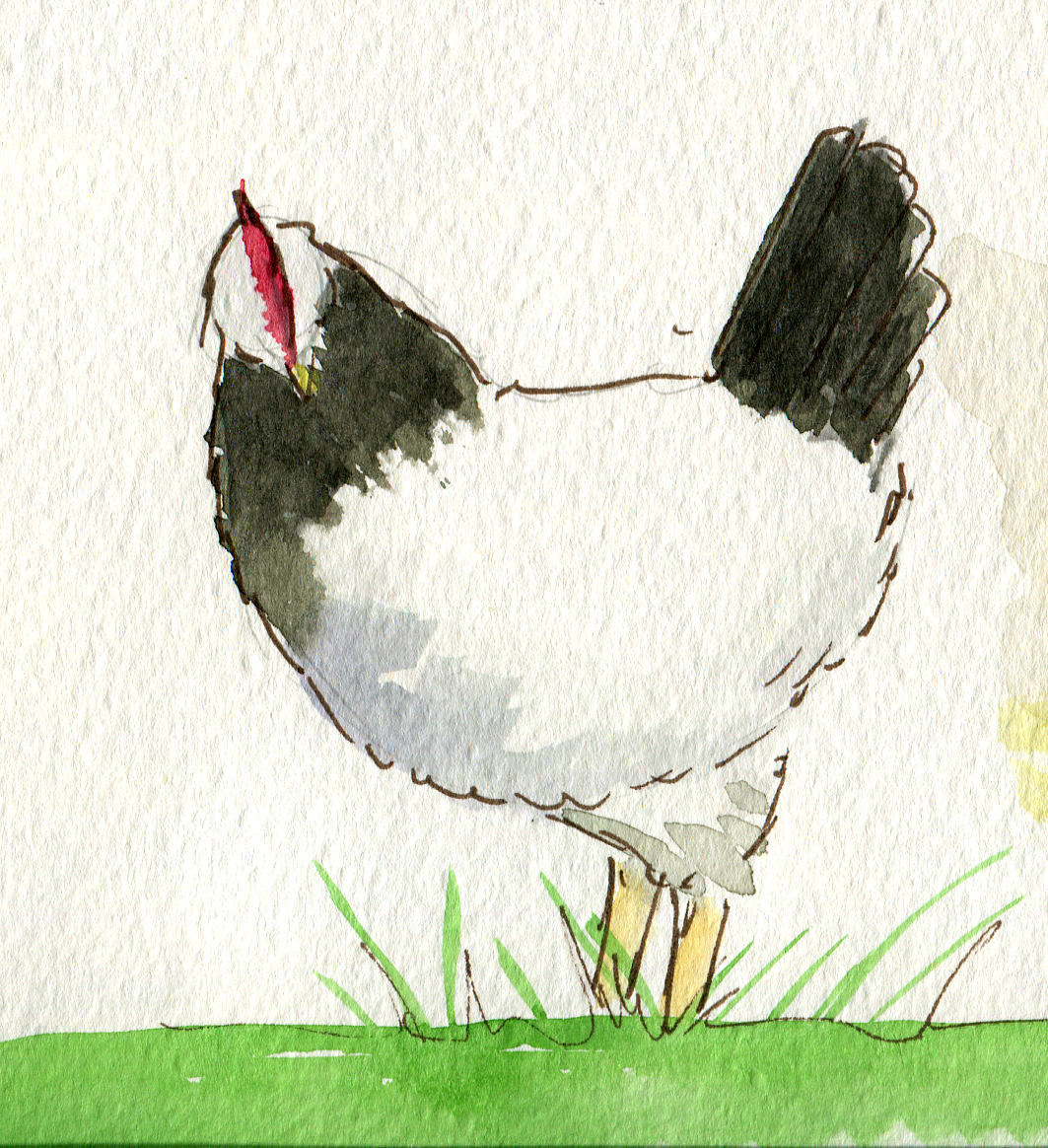
Chicken

One of the free range chickens of Mar Vista.

When I left San Francisco, I left one of those mild, sunny winter’s days that somehow is repayment for the long cold summer and traded it for a drizzly, grey and wet Mendocino day, very reminiscent of a cold San Franciscan summer. This was not going to stop me from sketching so I headed north to Bowling Ball Beach, just south of Point Arena. I hiked a mile south from Highway 1 into an alien landscape, shrouded in a dense drizzle. I had timed my visit so the “bowling balls” would be visible, which requires a low tide below 1.5 feet. These round boulders are called concretions and are formed by minerals in the sedimentary rock as the softer sediments erode away. Sketching and painting in the drizzle was like someone standing behind my left shoulder with a huge spray bottle, constantly misting my pages. The mist gave the rocks a diffused and mottled look. It is now a record of the conditions I worked in and a drizzle was never going to stop me from sketching outdoors.

Bowling Ball Beach

Bowling Ball Beach, Mendocino County.


Image

Sea Elephants Part 2

We shall not cease from exploration
And the end of all our exploring
Will be to arrive where we started
And know the place for the first time.

-T.S. Elliot

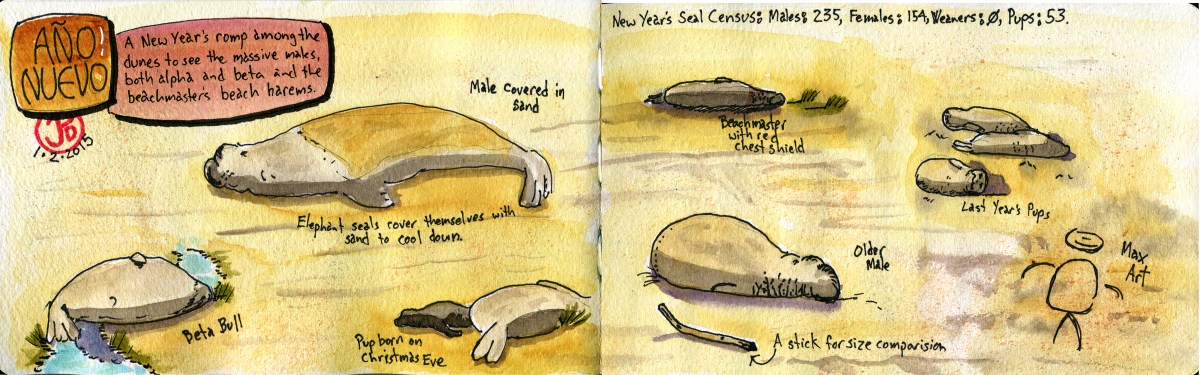
In the New Year I return to its namesake, Ano Nuevo State Park, to see the return of the male elephant seals. In fact there were 235 bull seals hauled up on the beaches and dunes and 53 pups. During this time of year all tours are led by docents and we joined a group of about 15.

At the staging area, a juvenile peregrine falcon spiraled overhead to the complete obliviousness of our group. Some of these people looked like they were on Disneyland’s Safari ride and wanted to be entertained immediately! And some of the ensuing questions like, “can we pet them?”, “are they bored?” and “do they drink water?” show a complete lack of natural literacy. Talk about nature deficit disorder!

Our docent led us over and through the dunes where the sounds of the massive males reached us before we saw them. As we made our way through, the members of our group photographed everything in front of them without really seeing them. As a recovering professional photographer I truly knew the distinction.

While they shot away on their cellphones, I calmly sketched the elephant seals, noticing the details and taking them in with my senses. Sketching is such a simple, unhurried way to translate the outside world into a memory or an observation. In that moment of sketching I could have been a scientist on Drakes’ voyage, seeing an elephant seal for the first time.

When sketching, you are always really seeing something for the first time.

DSC03672

We were within twenty feet of one male who was covering himself with sand to help cool him down.

Image

Year’s Ending-Begining

“The best way to find out if something needs to be in the picture is to leave it out.”

-Tom Hoffmann

I end the year 2014 with a sketch and I begin the year with a sketch. And what exactly else is a sketcher supposed to do?

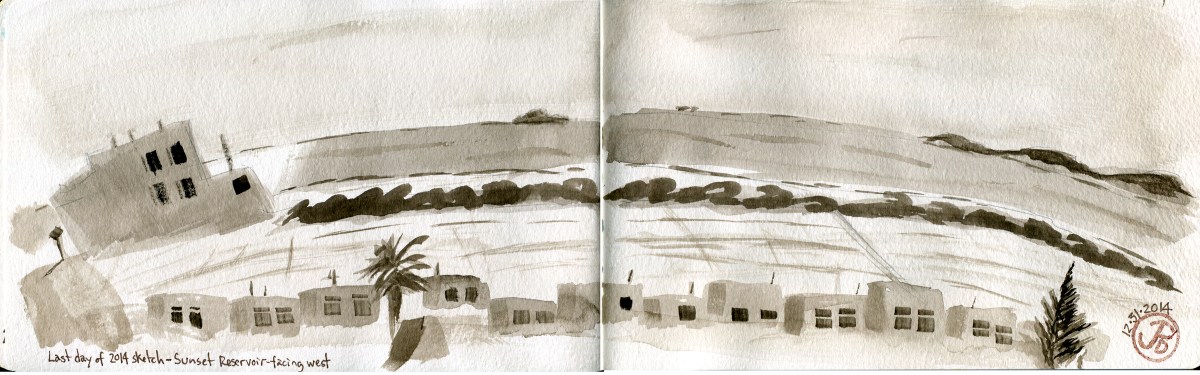
I am currently reading Tom Hoffmann’s excellent book Watercolor Painting (2012). While the title seems pedestrian and predictable, this book is anything but. So many of my watercolor books are about technique, if you want to paint this way do A, B and maybe C. Hoffmann offers few techniques or tricks. Instead his book is more about what not to paint. The secret to sketching and painting is seeing. Seeing your sketch and knowing what to include and what to leave out, how much detail one should add, and when to stop and put your pens and paints away and close your sketchbook. In other words: simplify.

To this end I followed one of Hoffmann’s suggestions and headed to Sunset Reservoir, turned towards Big Blue and created a five-value monochrome sketch. I chose sepia and painted the scene before me on this crisp and clear day, the final day of 2014. It seemed a fitting, zen-like way to end the year. By only using one color, I was forced to assess the values in front of me. I took the complex scene before me and translated it into a simple sketch.

Peace


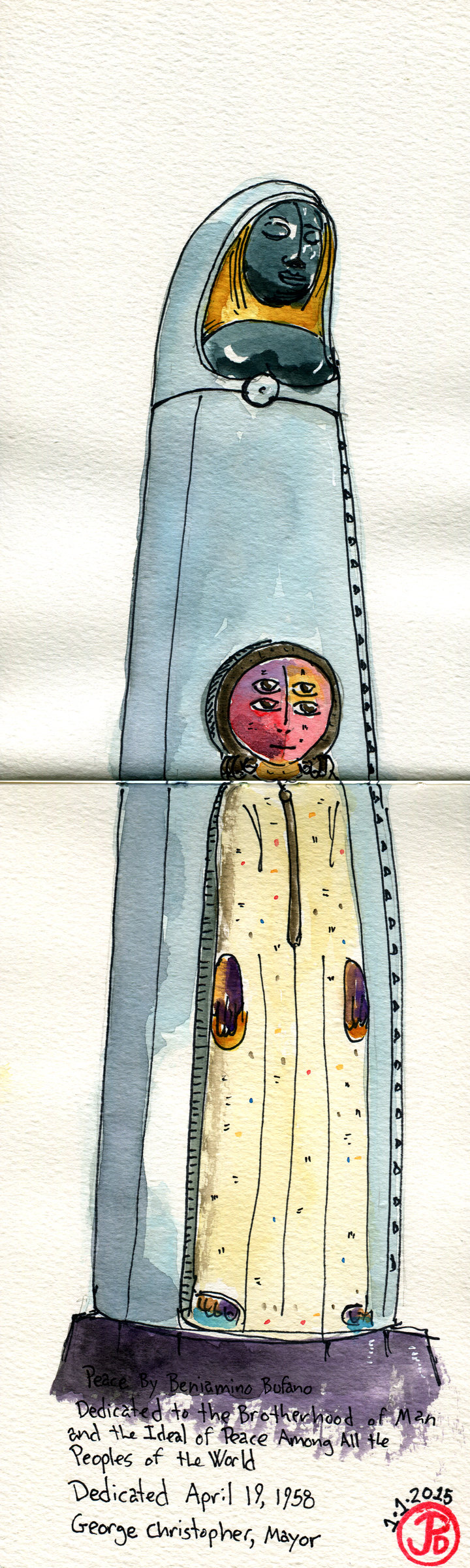
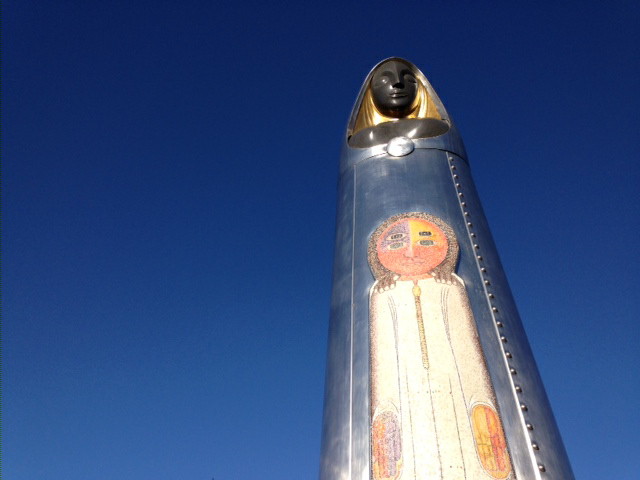
For my first sketch of the 2015 I chose a subject that I have seen many times as a child and a subject that I wanted to sketch for some time: Benny Bufano’s sculpture: Peace. For four decades this 30 foot sculpture greeted visitors to the San Francisco International Airport and now has been downgraded to the side of the road on Brotherhood Way. It seems ironic that a sculpture that is dedicated to “the Ideal of Peace Among All the Peoples of the World” should be marooned amid all the new construction where motorists rarely stop and look at the statute and it is increasingly hemmed in by the jumble of boxy homes that surrounds it.

It is a fitting subject to begin the New Year with, for sketching brings me much peace in a world that can be cluttered and confusing. Perhaps this is an apt metaphor for the stature itself as she peacefully gazes above and beyond the constant stream of traffic and the cookie cutter homes that run rampant, up the hillside behind her.

Happy New Year. May 2015 bring you much joy and peace.

photo (9)


Peace by Beniamino Bufano (1958)

Image

My Back Yard

“it suited me very well to do so and to rusticate in the forests and the streams”

-Captain Joshua Slocum

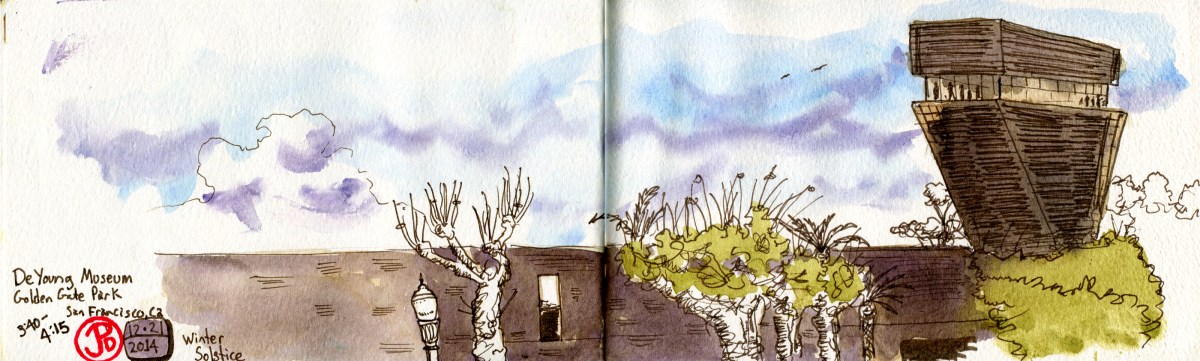
Every city, of any size, needs a place for it’s citizens to relax and find peace. A place to recharge or to participate in sport or to just nature loaf. The City of Saint Francis is blessed with the 1,017 acre Golden Gate Park, a park that is 20 percent larger than New York’s Central Park.

This park was birthed in the Outside Lands of San Francisco’s western edge, in sandy soil that no one thought anything would grow. But today, almost 130 years after it’s beginnings, Golden Gate Park boasts a large urban forest that provides habitat to many animals including coyotes, great horned owls, and hawks. The most viewed wildlife in the park are the 250 different bird species that occur here. There is one bird that has visited my back yard, pushed ahead of a massive northern storm front,  a Eurasian visitor, the very rare: rustic bunting.

This is a bird that will bring birders from all over the state and country. It is found in Northern Europe and Siberia and some have strayed to Alaska’s western Aleutian Islands. This male first year bird was first seen on December 7, a few days before a large weather system arrived in the Bay Area in the evening of December 10. This storm system dumped up to nine inches of rain on the drought-parched soil of California, creating power outages, urban flooding and closing schools (including my own). Every cloud have a silver lining and these dark storm clouds that brought wind and rain also brought a lost visitor from the east.

rustic
One of 17 life birds seen in Golden Gate Park: life bird #454, rustic bunting.