Image

Sea Elephants

The last time I visited the sea elephants at Ano Nuevo State Park, you could walk out onto the beach on a docent-led tour that took you within yards of these massive marine mammals, the largest pinnipeds in the northern hemisphere. Now, almost thirty years later, the beach has been taken away by the fingers of the ceaseless tide. You can no longer walk among the seals but on this foggy November morning I was blessed with a large gathering of juvenile seals and a high tide, placing them at the base of the viewing area.

What prompted me to make a right turn into Ano Nuevo on my way to Santa Cruz, was the book I am currently reading to my fourth graders: Island of the Blue Dolphins. This book is loosely based on the Lone Woman of San Nicolas Island. In one chapter, the main character, Karana, tries to hunt a sea elephant (northern elephant seal) for it’s tusks. It has been a long time since I have seen elephant seals up close and to my surprise I was about to see them very close.

On the way out to Ano Nuevo Point, a sign noted that there were 50-60 seals at the South Point viewing area and 200+ juvenile seals at the North Point viewing area. I first stopped off at South Point and looked over the bluff to see a juvenile cow, right below me on the beach. There was no use for my binoculars as I sketched her into the lower right hand corner of my journal. I then immediately headed out to North Point. The tide was high and all the seals were pushed into the cove making viewing easy on the eyes. I filled in the rest of the page with layer upon layer of sleeping seals and two young males sparring in the surf. As I was sketching, the docent, who had been out for 13 seasons, told me she had never seen the seals so close. I guess timing is everything.

There was one thing missing from my sketch and that was the emblematic adult bulls. These huge, two ton seals with oversized snouts and deeply scarred chests would be arriving in December and January to claim their patch of the sand to try and become the beach master. There were plenty of four year old males sparring with each other in a mock fight, honing their skills for a real grudge match in four or five years time.

To sketch an adult male I had to head further south to the Seymour Marine Discovery Center at U.C. Santa Cruz. Here I found the three life-sized statues of a bull, cow and calf. I sketched the male on the left side of the page. I certainly had no problem sketching this specimen, he wasn’t going anywhere.

Processed with VSCOcam with c1 preset

25 feet! I can barely stay back 15!


Image

Halloween

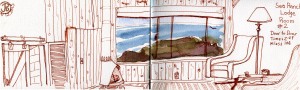
On this All Hallow’s Eve I give you a page I did over the summer during my Mission Rally in Southern California.The subject is an old house in the quiet South Pasadena neighborhood.Ever since my baby sitter allowed me to say up late and watch the movie “Halloween” in the early 1980’s, I have wanted to visit this house. “Halloween” was the highest grossing independent film ever made and it became a mainstay on network television during October, (think: “Viewer Discretion is Advised”, my babysitter lacked this discretion).I love this truly frightening film ,which spawned many rip-offs, because it tied into so many urban myths such as the local haunted house. My friend points to the ugly grey house on the corner and begins, “It was ten years ago in this very house. . . ” Every child had one of these houses in their neighborhood and in “Halloween”, this house was the Myers’ House in Haddonfield, Illinois. In reality it was a house in South Pasadena built in 1888.

1000 Mission Street in South Pasadena, Ca is the current location of one of cinema’s most famous houses. This Victorian, built in 1888, featured prominently in John Carpenter’s classic Halloween (1978). The house was dilapidated and vacant at the time of filming and Carpenter used the exterior and interior. Almost ten years later, in 1987, the house was slated to be bulldozed to make room for new construction. A man was saw that it was going to be destroyed, offered the owner a silver dollar to buy the house. The new owner had to move the house from it’s current location at 709 Meridan to it’s current location on Mission Street. This new location was railway property and the city of S.Pasadena recognized the house’s significance and allowed it to stay. It is known as the Century House, but to film fans it will always be Michael Myer’s house.

An illustration from the sketcher’s early masterpiece, Death Crash (1982).

I wrote and illustrated this book in fourth grade and it was heavily influenced by my viewing of “Halloween”. Something that would have never happened without the help of my baby sitter, who clearly did not use discretion. As a fourth grade teacher, I wonder what I would think if a piece of writing like this came across my desk.

Happy Halloween!

Image

Taking Notes

“Write what should not be forgotten.” -Isabel Allende

While my journals are filled with landscapes, urban scenes, and birds, I sometimes use my journal to simply take notes. Such was the case when I attended a talk by bird guru Kenn Kaufman at the Monterey Bay Birding Festival. Kaufman is the author of Kingbird Highway, an autobiography about his quest on a shoestring to see as many birds in one year (a big year).
As I was waiting for the talk to start I began sketching the black oystercatcher that was displayed on the screen. I placed the sketch in the far corner of the page. As I looked at the shape of the bird and concentrated on its beak, what happened then is what always happens when I sketch, I lose sense of time and I don’t seem to realize what’s going on around me. I am just focused, seeing. A meditation in public. Sometimes when I pause, I sense that I’m being watched. The odds that someone would be looking at me in a room full of perceptive birders is very high. But I sensed that someone to my right was watching my progress. That never really stopped me from sketching. I didn’t look up from my work.
When I did look up from my work, I met the woman sitting next to me. It turns out that she is the editor of the Albatross, the newsletter of the Santa Cruz Bird Club and she took an interest in my note taking. There are times like this, these serendipitous moments, when life provides a fork in the trail. A time when the right person sees my work and as a result my note taking page, which was done for no other reason than self knowledge, is published in the November-December issue of the Albatross.
You can find the article here:

http://santacruzbirdclub.org/59-2.pdf

Oystercatcher

A black oystercatcher at Big Sur.

Image

Blue Angels

Having grown up in the Valley of Heart’s Delight with my bedroom window looking out towards Mount Hamilton and the flight path of airplanes on final approach to Moffett Field, I developed a love of aircrafts and all things that fly. I built scale models of the P-3C Orions that where stationed at Moffett and the drone of their four turboprop engines where part of the sound track of my youth. The monotony of P-3s passing by my bedroom window, returning from submarine patrol, where occasionally disrupted by a C-130 or the largest airplane in the air, the C-5 Galaxy and occasionally, the far sexier F-16 Falcon. No aircraft was more eagerly awaited than the Blue Angels, the blue and gold A-4F Skyhawks arriving for the annual air show.

My fascination with military grade planes and the Blue Angels has waned over the years like my interest in Star Wars action figures. I have left the Valley of Heart’s Delight ( now known as Silicon Valley) and moved north to the city of St. Francis. In 1994, Moffett Field was closed as a navel air field and the Blue Angels followed me up north to San Francisco and Fleet Week.

San Francisco has a love/hate relationship with Fleet Week and the Blue Angels. With the increased traffic and deafening roar of supersonic jets overhead I can understand why. I got out of Dodge during Fleet Week and retreated to the peace of the Santa Cruz Mountains. I did return to the City on Sunday, in time for the last Angel show of Fleet Week. I climbed to the highest point within a two block walk: Sunset Reservoir. I look north towards Golden Gate Park, the Marin Headlands, the Golden Gate Bridge, and Mount Tamalpais.

I have also had the same reservations about the Blue Angels and the use of taxpayer dollars as I look out across the crumbling infrastructure of San Francisco’s streets, not to mention the underpaid and overworked teachers, the true homeland security of the United States. But waiting up on that hill for the first sighting of the F/A-18s, I am brought back to my childhood, eagerly waiting at my bedroom window for the blue and gold gashawks to appear. While I scan the skies the costs and my mixed feelings about the military fades away as the the blue diamond appear over the City.

Blue SFO

Blue Angels taking off at San Francisco International Airport in 2010.

Blue 3

The sketcher on the tarmac of SFO with Blue Angel F/A-18 H number 1.

Image

Nests

The other day a student brought in a nest that he found in his grandparent’s backyard. I suppose it really was just a matter of time that a student brought some sort of bird biofact into the classroom. I do talk about birds quite a bit in class and I was thankful it wasn’t an old owl pellet or a dead bird. And of course I did what any sketcher would do, I took the nest home and I drew it. The more I sketched the nest, it’s twists and curves, the more I was able to see its architecture and design. I began to see things I hadn’t noticed before, like the petal-less flower stems that ringed the base and the variety of materials used. At first I though the nest belonged to a scrub-jay but upon further measurements and research, including looking at Maryjo Koch’s wonderful book The Nest, I determined that the nest was made by a California towhee.

I like it when the detective work is taken out of the equation when it comes to identifying a  nest. Such as seeing a scrub-jay fly into a rose bush at a community garden or a steller’s jay nesting in a potted tree on the patio of a busy restaurant (See the bottom sketch in the Mission #1 post). One nest discovery that made it into my journal was from an experience  hiking around the alien landscape of French Meadows Reservoir in the Sierra Nevadas. While hiking among the rocky shoreline I startled a spotted sandpiper who limped away from me with a “broken” wing. I had seen this mock behavior with other ground nesting birds like the killdeer and I know that I was very close to it’s nest and the bird was trying to lead me away. I was careful not to step on the nest and I found it after a short search. The sandpiper’s nest contains four blotched eggs. An interesting fact about the spotted is that the males broods the eggs instead of the female.

Spotted sandpiper

Image

Life Bird # 453

I have always believed that if you’re patient and wait, the birds will come to you. It also helps that I live in a city that is surrounded on three sides by water and is situated on the western edge of the North American continent. I am also aided by the small army of birders that prowl their patches and report their sightings, both mundane and unusual, on the internet. Birds frequently get lost during migration and head west instead of east on the journey to their tropic wintering grounds. There has been times where I have contemplated travelling to the North Midwest to see the mystic snowy owl only to find that one appears only an hour and a half drive from San Francisco. Or a large seabird, which has never graced the west coast, has taken up residence on Alcatraz Island, or that a rare warbler is spending some time in Golden Gate Park, fueling up for it’s epic migration. This is exactly the bird I spotted, early one foggy Sunday morning, sipping nectar from the monkey hand tree in the San Francisco Botanical Gardens. This magnificent bolt of sunshine was the prothonotary warbler. This oddly named bird with the nearly unpronounceable name gets it’s moniker from the Late Latin word: protonotarius (according to Dictionary of Birds of the United States) which refers to a Vatican notary who wore a yellow robe. I think this is my sort of Sunday worship!

After the horde of binocular wheeling and zoom lens canon bearing vikings moved off into the arboretum, having checked this bird off their life list, Lecy and I lingered to spend some time with our visitor. It paid off as the the warbler paused near a monkey hand tree blossom, ten feet above our heads. I lower my binoculars and and looked at the bird with 1x magnification. It’s not often that we simply have the time to look at a bird, to notice it’s feather patterns and the rich tones of it’s plumage, the shape of it’s beak, and color of it’s legs.

Gannet

One of the strangest San Francisco life birds has to be the Northern Gannet that was spending time on Alcatraz, displaying to the resident cormorants. One morning I strolled out to the end of Aquatic Park Pier and was helped by a birder with a scope. The East coaster was easy to spot, it was the largest white bird on the island. This gannet was the first record on the west coast and it was fitting that it was taking up residence on Alcatraz, a Spanish word meaning “pelican” or “strange bird”. This gannet was a strange bird indeed.


Image

The Brickyard Flying Cigars

Last weekend I witnessed, and sketched, one of the minor miracles of bird migration in the Bay Area: the Vaux’s swifts of McNeer’s brickyard in Marin County. Every September or early October these bat-like birds arrive in, first hundreds and then thousands, to roost for the night in the three abandoned brick smoke stacks at the brickyard. They (or perhaps other birds) stay for a few weeks and then disappear, their next destination is still a mystery. We know that they winter in Mexico and Central America.
We arrived at around 7:00 PM and the persistent calls drew our eyes skyward to pick out the high flying birds that covered the sky like floating ash. The ash cloud spiraled downward into the left smoke stack and nature was giving us a truly wonderful sight as the birds replicated watching a  film of smoke rising from the stack but being shown in reverse. We joined the crowd of birders, biologists, and locals. The previous evening, biologists had counted an incredible 19,685 swifts! Tonight the count was slightly below that but just as impressive at 16,300 birds, 15,700 of which were roosting in the left stack alone (which is the stack I sketched). We missed the peak of migration by one day.

My previous visit to see the swift migration was September 25, 2012. The count on that day was a measly 8,200, almost half of the total seen this evening. In this journal page I noted that Roger Tory Peterson called these swifts “a cigar with wings”.

Image

A Bold, Expressive Pen For a Bold, Expressive Beach

The Pilot “ultra fine point permanent type” pen is a beast. It is the antidote for invisible ink, a black stick of dynamite ready to explode into a growing deep, dark pool if you spend to much time in one place. You must work fast with this pen, it is more unforgiving than watercolor, and when it reads “permanent” in bold gold letters along it’s length, its not a suggestion but a statement of fact. The expressive dark lines of this pen almost bleed through the pages of my Moleskine Journal, the key drawings are visible from both sides of the page.

I can not think of a better choice of weapon to capture this bold, unpredictable beach, where San Francisco ends in sand dunes, slowly being eaten away by the unyielding tides of the Pacific. The beach that has yielded the lives of unsuspecting swimmers, the rip currents at Ocean Beach are legendary.

But on a day like today, Ocean Beach is simply beautiful. The sun is out, for once, in the Outer Sunset, leaving the fog-shrouded streets an almost distant memory of a San Francisco summer. It’s a day in the Tsunami Zone when folks are having a driveway cookout, a time when you can see your neighbors.

After I worked quickly to capture the Big Blue as the sun crept towards the horizon, I worked on the tightrope without a net as I kept my pencil and eraser in my tool bag. I also covered the key ink sketch with a brash,wet on wet, wash. I let colors clash into color and added at bold Permanent Blue Violet (van Gogh) for the shadowed stretch of beach in the foreground. I add in my left boot for scale. A record of a Sunday afternoon walk to Ocean Beach.

Processed with VSCOcam with g3 preset

Image

Mixed Media Hike

Some journal entries capture a landscape or a natural experience but this spread simply records the time of a favorite Santa Cruz Mountains hike. This serves more like a daily diary entry than anything else: went on a hike at Fall Creek- took about 4 hrs. I sometimes draw a map (never to scale) but this time I used the trail map (gluing it into my journal with rubber cement) and recorded the time I reached each destination. On the right side of the vertical spread I added a few highlights from the hike. Including something I had never experienced before, an aggregation of thousand upon thousands of lady bugs covering a stump on the banks of Fall Creek. These beetles mass in large gatherings when it gets colder to conserve warmth. A sure sign that summer is drawing to a close. Again its about noticing the little things that paint a big picture.

The ladies gathering on a tree stump on the banks of Fall Creek in the Fall Creek Unit of Henry Cowell State Park.


Image

The Cinematic Missions

In this post I will cover the three cinematic missions: San Francisco de Asis, San Juan Bautista and San Fernando Rey. Two missions are in Northern California and the other in the Southern part of the state. All three missions where featured in classic films, one film representing a master filmmaker at his height of his powers and the other a  director’s promising start . Missions San Francisco and San Juan Bautista were both featured in Hitchcock’s masterpiece Vertigo (1958). Jimmy Stewart as Scottie, follows the mysterious Madeleine (Kim Novak) to Mission Dolores (the 6th mission and San Francisco’s oldest building) , where Novak visits a grave. The grave of “Carlotta Valdes” was a movie prop and was left over after the film but was eventually removed because it was deemed disrespectful to those buried at the mission.

San Juan Bautista 2

The climax of Vertigo was filmed at the 15th mission, San Juan Bautista. (Spoiler Alert!) Many fans of the film visiting the mission ask to see the tower where Novak plummets to her death is located . Did this tower get destroyed in an earthquake? (The San Andreas Fault is less that 100 yards from the mission). The tower is another cinematic ghost because it was really a matte painting added on in post production. Two objects used in the film still exist. Theyare in the stable across the square from the mission. There you will find the buggy and the plaster horse replica where Stewart gives his “there is an answer of everything” speech.

Greyhound

The southern Mission, San Fernando Rey, was the stand in or stunt double,  for the Alamo in Tim Burton’s first feature length film: Pee Wee’s Big Adventure (1985). “Basement? There’s no basement in the Alamo!”I guess it’s no surprise that this mission is linked with show business because Bob Hope is buried here.

San Fernando

This spread was the last in my Mission Rally.The final field sketch was of the rather creepy statue of Father Serra walking with his arm around a scantily clad native boy.