Image

Whaling in Boston

“In the long view of history, it will seem a remarkable turn-around: that a century that began by actively hunting whales ended by passively watching them. Animals, too, have a history-although one we can know only a tiny part of-and while modern science has demystified the whale whilst revealing its true wonders, our attitudes to whales also changed when we see them close-up.”

-Philip Hoare, The Whale

On my last full day in Boston I chose to spend the afternoon on a New England Aquarium whale watching trip.

It was fitting that I was departing from a Massachusetts port, for the state has a long history in whaling. New Bedford and Nantucket are two of the most well know whaling ports of the American whaling industry. A whaler named Herman Melville, worked out of New Bedford and  it was here that he wrote his masterpiece Moby-Dick, published in 1851. After this, the whaling industry began to decline with the discovery of petroleum, which replaced whale oil. The last whale boat to head out of New Bedford  was the schooner John R. Manta in 1925.

We headed out of Boston Harbor, under clear, blue skies, on the Cetacea at 14:00. I also had a few target birds on this trip. The first one, the common eider, I picked up to the starboard, on a rocky island.

It was an hour and a half cruise to our destination: Stellwagon Bank National Marine Sanctuary, 25 miles east of Boston. The Cetacea slowed, and I loosened the tie on my hat and wiped the sea spray from by binoculars. We cruised along the underwater plateau, all eyes scanning the water for any tell-tales signs of a whale. The Cory’s shearwaters (another lifer) cutting across the water ridges seemed promising. I eyed every white-capped wave and deep blue trough with interest, willing a whale to appear.

We got word that another boat had a whale six miles from our position. The Cetacea surged forward. I tightened my hat and tucked my binos into my jacket. We soon spotted the whale-watching boat, bobbing on the open ocean and then spotted the bushy spout of a humpback. It dived twice before giving us a good look at her flukes which our naturalist was able to identify the whale as “Scylla”, a female born in 1981. “Scylla” saved the best for last as she gave us a full breach off to the starboard.

We had to return to port and I again tightened my hat and stowed my binos. As we headed back we where given one last treat, a tall geyser-like blow of a whale off to the starboard. The whale folded into the waves revealing a pronounced fin. This was indeed a fin whale, the second largest creature in the world, coming in second only to the blue whale. I had seen blues in Monterey Bay but the fin was a lifer for me!

The fin whale has been called the “greyhound of the sea” because of it’s speed. It was fast enough to avoid the harpoon but with the invention of steam power and the explosive harpoon, the fin finally met it’s match. In the 20th century, no other whale have been hunted more than the fin, with an astonishing 725,000 hunted in the Southern Hemisphere alone.

Humans  have been hunting and killing an animal at least 1,500 times heavier than an average man , in a watery element that is not our natural home speaks to our use of technology and willpower, when there is a profit to be made. Unfortunately it does not speak to our empathy and understanding of the natural world. Whaling stopped because it was no longer profitable not because we thought that it was morality objectionable. For whatever reason, we no longer hunt whales to the same extent and the ocean and these magnificent creates can begin to heal. The fin did not follow the passenger pigeon, the dodo, or the moa down the path to extinction and to see this magnificent creature was a true gift on this trip to Boston.

photo (11)

Looking astern on the Cetacea on our return to Boston Harbor, crossing under the flight path of Logan International Airport.


Image

Harvard Natural History Museum

No trip to Boston would be complete without a journey across the Charles River to Cambridge (“our fair city”) and American’s oldest university:  Harvard (1636). What drew me to Harvard was the Natural History Museum. This museum was founded 362 years after the university in 1998 and was created out of three different research museums: the Museum of Comparative Zoology, the Harvard Mineralogical and Geological Museum, and the Harvard University Herbaria. With the price of admission you got three museums in one which also included the Peabody Museum of Native Americans.

I had come to sketch the superlatives, oddities, and extinctions of the animal world, and they were many specimens on display in the museum’s vast collections.

The Superlatives:

The wandering albatross has the distinction of having the largest wingspan in the bird world. It’s wingspan can reach 11ft 6in.

The largest falcon species is the gyrfalcon.

The smallest wren is the winter wren, which also sings one of the fastest songs in the bird world.

The capybara is the world’s largest rodent.

Harvard 2


The Oddities:

The duck-billed platypus is an Australian mammal that is poisonous and lays eggs (one of only five monotremes that currently exist).

The Coelacanth, an ancient fish that was once thought to be extinct, until it was rediscovered on December 22, 1938, off the east coast of South Africa.

Extinctions:

The beautiful passenger pigeon was once the most numerous bird in North America but is was hunted to extinction. The last living bird,”Martha”, died at the Cincinnati Zoo on September 1, 1914.

The ivory-billed woodpecker is very close to being extinct with rare sightings in the southern swamps and Cuba.

The Thylacine or Tasmanian tiger once lived in Australia and Tasmania but the last individual died in the Hobart Zoo on September 7, 1936. Mysterious sightings are still reported.

Moas were large flightless birds endemic to New Zealand. The nine species of Moa were hunted to extinction by the Māori.  All Moas were extinct by the 15th century.

The Dodo has become the poster bird for island extinction. The dodo was endemic to the island of  Mauritius and was first encounter by Dutch sailors in 1598. The last report of a live dodo was in 1662. Why the dodo became extinct is unknown, with over hunting, habitat destruction and the introduction of nonnative species being leading causes.


Image

Statues of The Cradle of Liberty

I just spent seven days in one of the most historic cities in the United States. A city that birthed a revolution, and a nation. A city that is now full of contrasts. That city is Boston, Massachusetts.

I knew that Boston would provide many sketching opportunities and I was never without my sketching kit. On this trip I used much sepia, quinacridone gold, and olive green to color the historic statues and monuments of “The Cradle of Liberty”. Washington, Franklin, Revere,  Sam Adams, Poe and a duck with her ducklings.

Early one morning I walked from my hotel on Washington Street the five blocks to Boston Public Garden. First opened in 1869 (relatively new by Boston standards) the lagoon was added two years later followed by swan boats in 1877. The lagoon (and perhaps the swan boats) attracted ducks and more ducks. This inspired Robert McClokey to illustrate and write the Caldecott award winning children’s book Make Way For Ducklings (1941). This classic has sold over two million copies and is a staple in any primary classroom. In 1987,  a Nancy Schön sculpture was installed in the garden. I sketched this sculpture before the hordes of children arrived, who, over the years, have worn the duck heads from bronze to gold.

On another morning I walked down Washington Street to sketch Boston’s oldest standing public building, the Old State House (1713). In my mind, no other building represents the contrast of old and new that this brick building that is now dwarfed by glassy skyscrapers. It was the center of British government and on March 7, 1770, the Boston Massacre occurred in front of the east facade. The Declaration of Independence was first read in Boston from the balcony of the Old State House on July 18, 1776. This early American history is contrasted by the subway station in the basement on the eastern side of the building. The Declaration of Independence is still read from the balcony every Fourth of July.

Old State House

A spread from two other statues of Boston: Sam Adams and Edgar Allan Poe. The Adams statue stands boldly in front of Faneuil Hall. Adams was a son of the Revolution and a signer of The Declaration of Independence.  Faneuil Hall has hosted speeches as diverse as Frederick Douglass and JFK. The Poe statue stands in Edgar Allan Poe Square near Boston Common and features a raven and a tell-tale heart. At first, the statue seems out of place because Poe is more closely associated with Baltimore than Boston. The master of the macabre was born in Boston on January 19, 1809 to his actor parents while there were on tour. He may have been named after a character in King Lear, a play they were performing in 1809. The two statues are contrasted by time and style. The Adams statue was erected in 1880, but the Poe statue is modern and was unveiled in October of 2014.

Poe Adams

Image

UC Santa Cruz

This year, in 2015, the University of California at Santa Cruz (UCSC) celebrates it’s 50th birthday.

I graduated from The City on the Hill in 1995, not with a degree in Art but in Literature with a pathway of Pre and Early Modern Studies in Literature. What does this degree really mean? And “what is pre and early modern studies?” you might ask. Well it’s just the study of dead white, and sometimes blind, poets: Milton, Donne, Marlowe, and of course Shakespeare.

The first time I encountered the Bard was an old leather bound copy of Shakespeare’s Complete Works that was kept in a cabinet in the front room of my childhood home (it was a wedding gift for my parents). I would occasionally thumb through the onion-skin pages of tiny words, arranged in two narrow columns. I never read the words but I somehow thought that this must be some sort of sacred text that came out from time to time during some of my parents many cocktail parties (this was the 70’s after all), not that anyone would open the book but it sat on the coffee table, looking cryptic and important. To one of the valley’s engineers, it might have even appeared to be an over-sized coaster.

I later encountered Shakespeare in high school, reading Romeo and Juliet and watching a grainy VHS copy of the  iconic Zeffiirelli production. I was hooked! From there I made a pilgrimage to Ashland and it’s Shakespeare Festival.

And then, when attending UC Santa Cruz, while taking a Shakespeare course, I saw my first Shakespeare Santa Cruz production. It was The Merry Wives of Windsor, re-imaged in a 1970’s trailer park, and it all somehow worked. The text was not altered but the setting and concept was very, well, Santa Cruz. Since that time I have seen many Shakespeare Santa Cruz productions until it’s last season in 2013 (it’s 32nd season), a victim of state budget cuts to the universities.

The beautiful campus has provided many sketching opportunities and the sketch above was completed on one recent Sunday, June morning, while seated on stage, looking out to the Sinsheimer-Stanley Festival Glen. My only audience was a feeding doe and her spotted fawn.

College 5

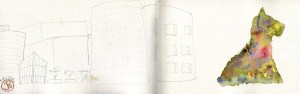
A sketch done from another hike on the UCSC campus and Porter College, formerly College Five. My hiking companion had attended College Five in the early 1970’s. To the left, and out of frame was the the Porter Darkroom Guild, where I spend many hours learning how to print black and white prints.

Kres

A detail from one of the most interesting colleges from an architectural standpoint, Kresge College. When I was there, it was rumored that a college course in Japan was taught, just about the architectural innovations of this college.


Image

From Greenhorns to Sourdoughs

Last week I joined almost 90 fourth graders on a pilgrimage to the place that changed the state of California forever: Coloma.

In January 1848, James Marshall discovered gold in the tailrace of Sutter’s Mill on the South Fork of the American River. There is much dispute about these facts but the effects can not be disputed. The discover of gold in Coloma set off the largest migration in human history. People from across the globe flocked to this quiet valley, displacing the native people and altering the landscape. Now, in the Spring of 2015, the town of Coloma is flooded with nine and ten year olds, with their makeshift gold pans and their unquenchable desire to see the glint of gold in their pans.

For my school, this is the highlight of their fourth grade year. An adventure that lingers long in the mind and also creates students that are stronger, more independent, and resilient by the time they recross the American River on the 1915 Coloma Bridge for the final time. The true gold that they find are not the tiny flecks of gold, swishing in the bottom of their gold pans but the transformational journey they have taken over the course of three days. The journey from Greenhorn to Sourdough.

This is the field trip where I really see my students shine. They have been on a journey of joy, scrapped knees, and tears. Along the way, they have lived the life of a gold miner, felt a connection with the earth, danced the Virginia Reel, and conquered many of their fears. A journey that has all the highs and lows of a tide chart and they somehow come out the other end changed in some way.  This metamorphosis is symbolized and celebrated in a ceremony on the banks of the South Fork of the American River. In the ceremony, they dip their gold pouches in the waters of the famed American River, just upstream from the site of Sutter’s Mill, and when they put their pouches back around their necks, they have become experienced Sourdoughs.
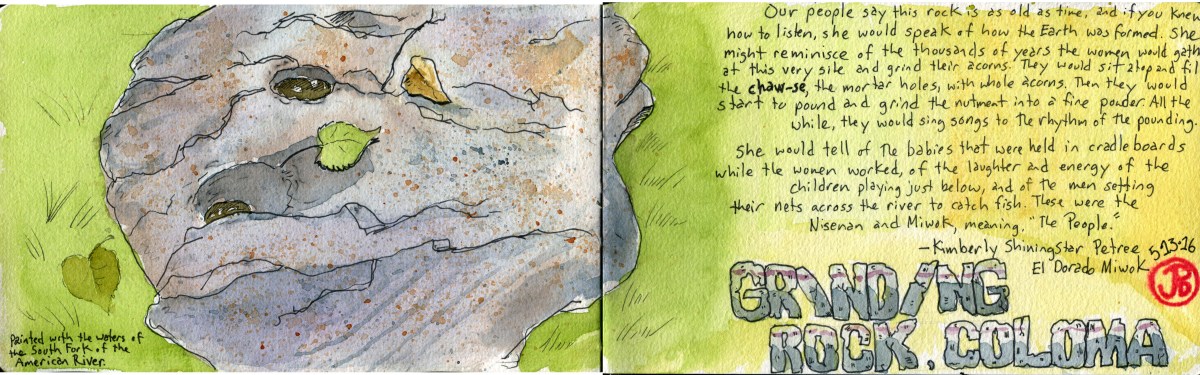
While the Greenhorns were dipping their pouches in the waters, I walked out to a rock that faced downstream, filled a cup with American River water and made a quick sketch of the scene to capture the mood and moment.

DSC02753

Corvidsketcher dipping his own gold pouch into the waters of the South Fork of the American River on his first journey to Coloma in May of 2014, almost 166 years after gold was discovered just downstream.

Image

Alligator 

The American alligator, Alligator mississippiensis. It seems that you can’t spit in the Everglades without hitting an alligator. This reptile is the barometer of the Glades and one of the poster children for its conservation.

Visiting the Everglades today, it’s hard to imagine man’s assault on Mother Nature at the turn of the 20th century. For decades the Everglades was seen as a paradise on earth, the only problem was that it was and is, covered in water. In man’s hubris to control and conquer nature, many attempts were made to drain the swamp but Mother Nature always wins. Her most decisive victory was in 1928 with a hurricane that claimed 2,500 lives.

For years men had used guile, hyperbole, backroom politics, and downright lies to convince others that the Everglades could be conquered and her rich soil could be reclaimed but it took a handful of women to try and save it. It was the women of Florida that helped create Florida’s first State Park in November of 1916. The 4,000 acres of Royal Palm State Park was just one-tenth of one percent of the Everglades ecosystem but it was a start. This 4,000 acres is now the epicenter of Everglades National Park and features the Anhinga Trail, the Gumbo-Limbo Trail and Royal Palms Visitors Center. This is the core of the Everglades that draws a million visitors a year. And the Anihinga Trail is the location where many visitors see their first wild alligator as well as bring an inspiration for the spread above.

Alligator

The alligators of the Everglades were not the first time I had seen this famed reptile in the wild. That honor goes to South Padre Island in Texas on a birding trip in 2013. Unlike like birds, rodents, and humans, alligators have the capacity to hold still for hours, making them an ideal subject for the sketchbook. The above sketch was done in one sitting.


Image

Sanibel and the Stokes

On my final full day in Florida I headed out of Fort Myers and drove west to Sanibel Island. I had a few lifers on my wish list and I was going to start at a well known migrant hot spot: Lighthouse Park. I crossed the three mile bridge from the mainland, scanning the deep blue for any life birds. Just some gulls that weren’t worth risking my life to identify.

I pulled into the sandy parking lot and perched on the roof of the car to my left was my first life bird, or was it? American crow vs fish crow can be one of the toughest IDs in North America, that is, until it opens it’s mouth. If you ask a fish crow if it is an American it will deny it by replying “nah-nah”. This crow certainly denied it, life bird #481.

At 7:45, there where already birders scattered around the trees and bushes that surrounded the lighthouse, all hoping for a bounty of birds. Lighthouse Park is on the eastern point of Sanibel Island and it’s trees are a magnet for northern bound birds coming up from the tropics. The anticipation was palpable as we waited for a warbler or a vireo to appear and the park was abuzz with news of what was being seen and where.

Blue-headed vireo, then a northern parula, follow by a white-eyed vireo. Then in the upper branches of a tree was the liquid gold of a male prothonotary warbler, a bird that I had added to my life list in Golden Gate Park the previous October (see the post from October 8, 2014). As I lowered my binoculars I noticed there were even more birders in the park and they had just seen a Swainson’s warbler!

Among these birders were field guide authors Don and Lillian Stokes. They spent half the year on Sanibel Island and they were essentially birding their local patch. A male hooded warbler was seen and the birders with binoculars and cameras circled the tree where the bird was foraging.

I introduced myself to the Stokes and I headed to another part of the park with Don. On the way I asked him if he had seen all the birds in his guide books. He asked me what I meant by “seen”. He noted that there are many ways in which a bird can be “seen”: adult plumage, juvenile, 1st year, 2nd year, 3rd year, male, female, etc. In all my rush to add birds to my life list I had sometimes lost sight of the pleasure of simply looking at birds for just the enjoyment of looking at birds. We stopped and looked up into a palm where two birds where foraging. A hooded and prothonotary warbler where giving us nice views as they moved between palm fronds. I had seen both of these birds in California, in two different places in San Francisco and with 11 years between sightings and now I was seeing them together in the same tree with Don Stokes as my walking and talking field guide.

I left Sanibel Island without adding Swainson’s warbler to my life list. But my short experience of birding with the Stokes helped me remember that it really didn’t matter whether I had 28 or 29 life birds on this trip to Southern Florida. It was about the quality of experience. I was a guy with his binoculars and journal and paints, marveling at the the splash of sunshine turning on a palm frond above.

This was somehow enough. And it was.

Fish Crow

Image

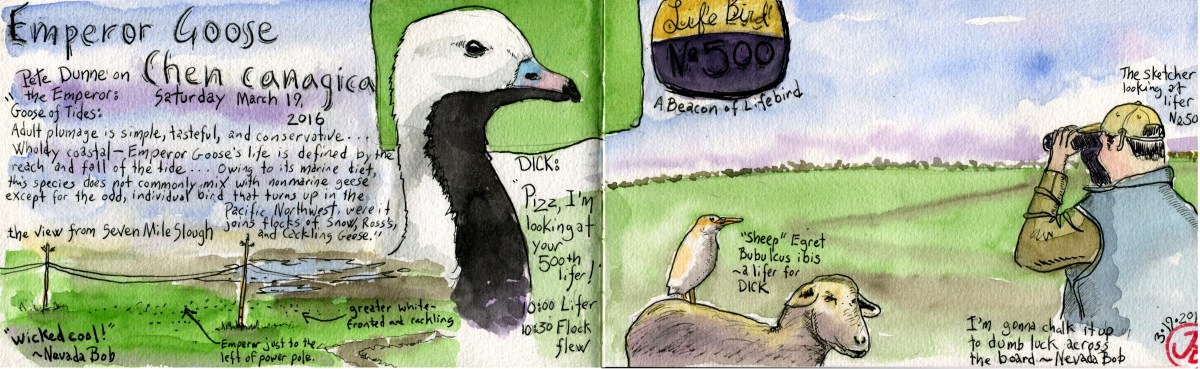
Lifers

“The list total isn’t important, but the birds themselves are important. Every bird you see. So the list is a frivolous incentive for birding, but the birding itself is worthwhile. It’s like a trip where the destination doesn’t have any significance except for the fact that it makes you travel. The journey is what counts. ”

-Rich Stallcup, Birding legend, as quoted by Kenn Kaufman in Kingbird Highway

I  will probably never see 28 life birds on a single trip in North America again. I have birded some of the Meccas of birding, my home state of California, southern Arizona and Texas and finally southern Florida. To see this many new birds, I would have to go to the farthest reaches of Alaska (and be extremely lucky), or have an incredible migrant fallout in Cape May, or travel to another country.

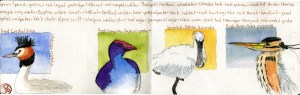
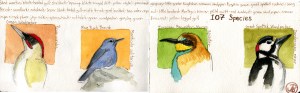
To celebrate this haul of birds I wanted to sketch each bird, because I believe that to sketch something you attain a deeper understanding of it and you really internalize the shape, color, feather patterns and contours of each bird. As source material I used photographs, drawings, and field guides. For these pages I designed a unifying theme, using overlapping cartouches to list the life bird number, date, location, and time.

Florida page 2

This spread documents an amazing morning of birding with a Michigan snowbirder named Dave.We birded Babcock-Webb WMA and Prairie/Shell Creek Preserve.

Image

The Everglades Kite

There is a much sought after bird in Florida and I was going to try my damnedest to add it to my life list. This is the snail kite (Rostrhamus sociabilis), formerly known as the Everglades kite. It’s a much sought-after bird because it is only found in the United States in southern Florida and it specializes in feeding almost exclusively on apple snails. The apple snails depends on water and the depletion of the Everglades means that the population of snail kites has suffered. The kite is currently listed as a Federal and State endangered species because of it’s small population and extreme population specialization. It is estimated that there are currently less than 400 breeding pairs in Florida.

I wanted to see one out of those 400 pairs and according to my Falcon Guide, Birding Florida, there are a few spots on the Tamiami Trail, across the highway from the Shark Valley entrance to the Everglades to check for this bird. I tried there, scanning the marshes for the bird. No kites. I read in my guide:

“A more reliable spot in recent years for this sought-after species has been an abandoned airboat concession across from the Tower Market. . .The kites may be seen coursing over the marsh or may be perched on distant trees. If it’s your lucky day, one may be perched on a cypress tree directly in front of your vehicle.”

I returned to my rental and drove a mile west to the airboat concession on the right. I pulled into the parking lot and bingo, today, April 1, 2015, was my lucky day! A male snail kite was perched across the canal on a cypress. I was able to take a few photos and I returned to my car to grab my sketchbook and pens. When I returned, the bird was gone. This kite was not to be as accommodating as the black vultures of the Anhinga Trail, but it certainly was one of the easiest Florida life birds to add to my list.

Florida jay

The two other Florida specialties I sought on this trip was the endemic Florida scrub-jay and the red-cockaded woodpecker. Both birds are listed on the state watch list, which includes species most in danger of extinction without significant conservation action.

According to e-bird and my Falcon Guide, Babcock-Webb Wildlife Management Area (just north of Fort Myers) was the hot spot for red-cockaded woodpecker. You must arrive at dawn near their cavity trees (which are ringed with white paint by field biologists). The birds gather near their cavity trees before dispersing to forage for the day. The painted trees were easy to spot and a car was already parked along the dirt road. A snowbirder from Michigan was already there, waiting for the show to begin. As if on cue, a single red-cockaded flew in and perched on a tree for less than a minute, enough time to see the identifying white cheek field mark, and then was gone. The show was over. North American life bird #472.

I followed the snowbirder, (Dave) and we made our way around Babcock-Webb. With his help I picked up three more lifers: brown-headed nuthatch, northern bobwhite, and eastern bluebird. He offered to show me where to find Florida scrub-jay at the Prairie/Shell Creek Preserve near Punta Gorda. After a short walk, Dave led me to the area where they are seen. I spotted the rare jay flying to the top of an oak. Life bird #476 was mine!

DSC04283

One of the photos I was able to get of the male snail kite that was handed to me on a platter, just before he flew off.