Image

Chimney Rock

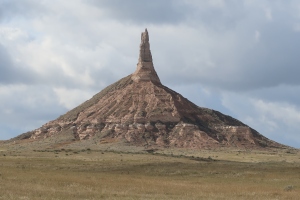
There was one landmark that I was looking forward to seeing and sketching, more than any other.  And like the emigrants, I saw it miles before I reached it.

A good number of the pioneers were midwestern flatlands and their first sightings of Chimney Rock must have made them feel like they were in a completely different world, in a landscape they could not quite comprehend.

Seeing the spire of Chimney Rock, through my windshield was like a beacon that drew me toward it. No wonder why this unique landform is the most mentioned landmark in pioneer journal accounts.

As I pulled into the visitor’s center parking lot, I noted the numerous rattlesnake warning signs. The center was closed for Columbus Day so I skirted around the building, keeping my eyes down, scanning for a snake in the grass, to reach the viewing deck.

The winds and the rains of the morning seemed a thing of the past. The storm covered Cheyenne in six inches of snow and closed highway 80 for 9 hours but now the majestic prairie clouds rolled above the spire.

I could picture the masses of wagons, livestock, and people, populating the plains around the rock where now a few cows grazed. As I sketched the landmark, I was continuing a long tradition of drawing the landscape along the trail. At the time the spire was much taller in the mid 19th century due to erosion and a little pioneer vandalism. I read one pioneer pastime included shooting at the spire and collecting what ever pieces were blown off and kept as souvenirs. Another pastime was carving their names into the rock. Now all names have eroded away but in two locations further to the west, emigrates signatures are still visible to this day. But more about that in another post.

 

Image

Roosevelt Arch

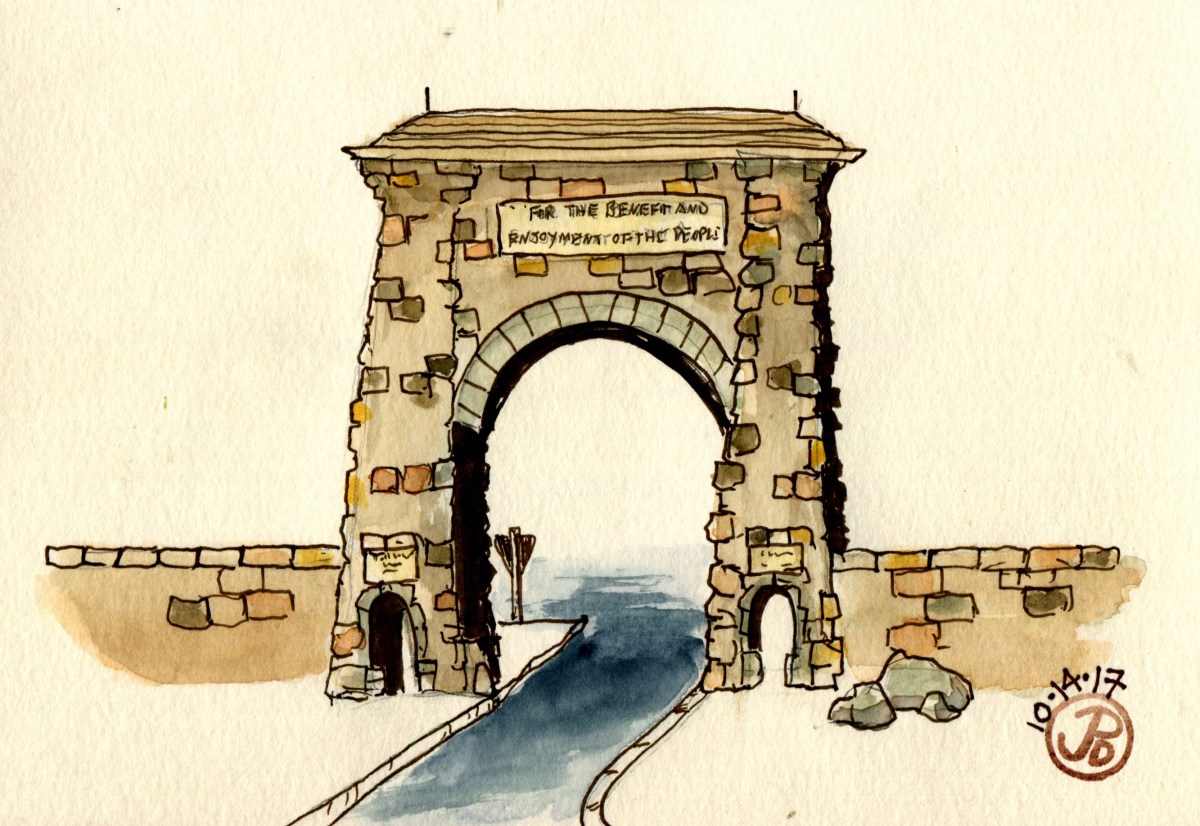
There was one site in Yellowstone than I wanted to see and sketch more than any other. This includes Old Faithful, the many geysers, or the Grant Canyon of Yellowstone. This was the Roosevelt Arch at the northern entrance of Yellowstone in the gateway town of Gardiner, Montana.

This monument is the spiritual and metaphorical gateway to our Nation’s National Parks. Yellowstone became the first National Park on March 1, 1872, and it became the template for all of the 57 National Parks that followed. These parts of land where not bought up and reserved for the wealthy for their own private views, but instead, they were preserved for the people. The inscription above the Arch reads: “FOR THE BENEFIT AND ENJOYMENT OF THE PEOPLE”.

Roosevelt Arch, viewed from the southside. Only one car at a time can fit through the arch. I went through twice.

The cornerstone laying ceremony was held on June 1, 1904 with President Teddy Roosevelt in attendance. He had arrived in Gardner, Montana two weeks previously and he rode out with only one companion and heading into Yellowstone to explore the land. During his speech Roosevelt said of Yellowstone:

The Yellowstone Park is something absolutely unique in the world so far as I know. Nowhere else in any civilized country is there to be found such a tract of veritable wonderland made accessible to all visitors, where at the same time not only the scenery of the wilderness, but the wild creatures of the Park are scrupulously preserved … The creation and preservation of such a great national playground in the interests of our people as a whole is a credit to the nation

The arch was one of first entrances to the park to serve visitors arriving by rail but now most visitors use other entrances. But by the numbers of visitors on this late October morning, the Roosevelt Arch is still a popular destination in this very popular National Park.

Corvidsketcher in action at Roosevelt Arch.


Image

A Californian on California Hill

The first major incline on the Oregon trail was California Hill in western Nebraska. The emigrants would have just crossed the Platte River and this was one of many tests along the trail they would encounter on their long journey west.

To begin my first journey on the Oregon and California trails, I drove to Brule and headed west on highway 30, passing corn fields and grazing cattle and keeping highway 80 and the Union Pacific mainline to the south (both parallel parts of the original trails). Four miles from town, to my right, the California Hill historical marker came into view. I read the plaque and now it was time to get the Grand Cherokee dirty!

I turned north on a rutted dirt road with rolling fields stretching off on both sides. If it weren’t for the cows, barbed-wire fences and power lines, I could be on the Oregon Trail back in 1850.

On the left there was a gap in the barded-wire fence, the gateway to the ruts of  California Hill. Julie Fanselow, in her guide: Traveling the Oregon Trail (my Bible for this journey) describes the ruts as, “some of the finest Oregon Trail ruts to be seen anywhere along the route”.

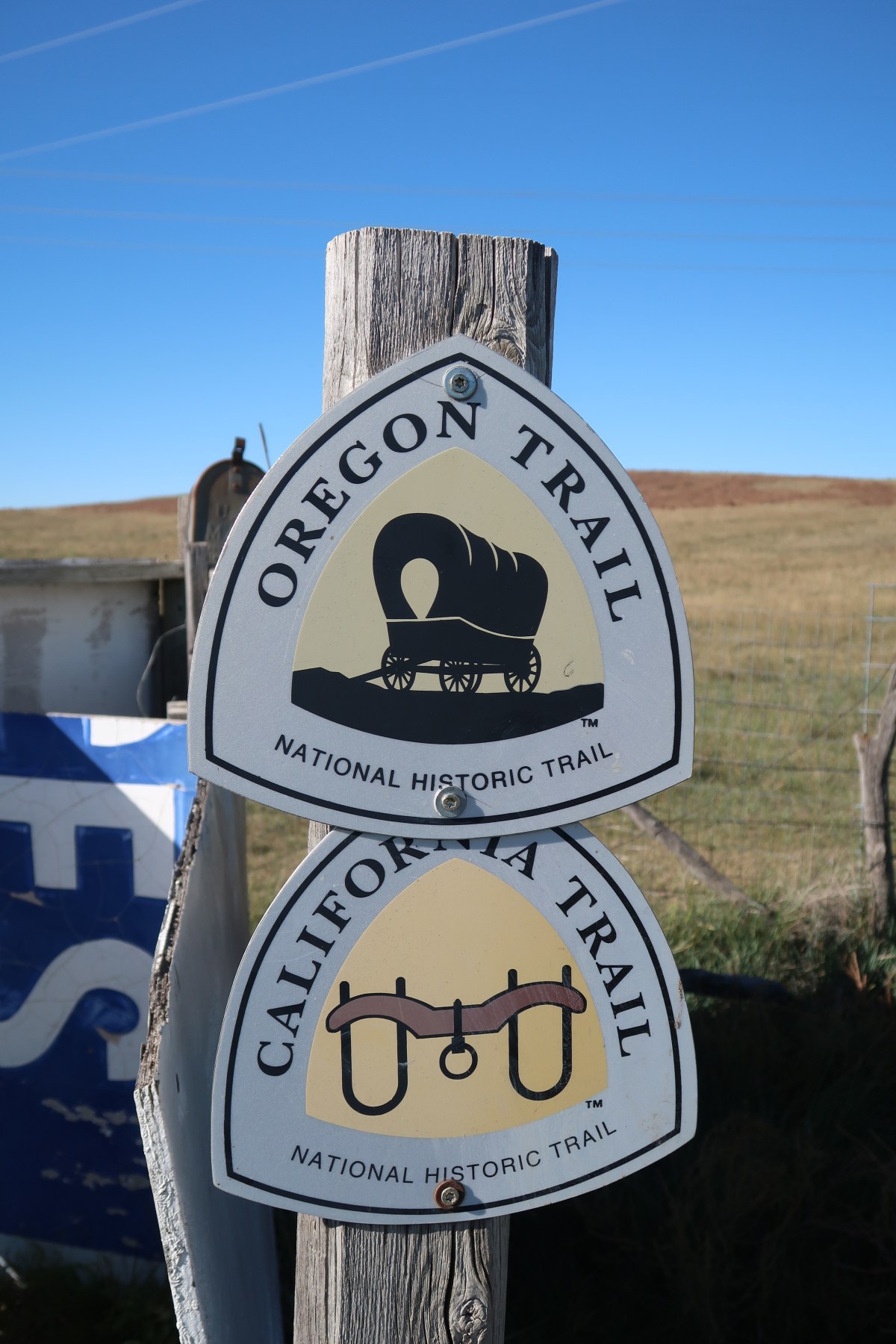
On a post werethe shields of the Oregon and California trails. I was in the right place. Now I just needed to find the ruts.

IMG_1384I passed through the narrow gate, skirted a cattle trough, and spotted a trail marker on the brow of a gentle hill. I headed towards it.
IMG_1380

The Oregon Trail marker and the ruts of California Hill just to the left of the marker, at the brow of the hill.

Once I crested the hill, the passage of thousands and thousands of emigrants was clear. Ruts wound up the hill and amazingly, over 170 years later, they were still visible. The ruts were helped by the erosion of wind and rain, etching the passage of the pioneers into the landscape.

Over the next few days I would be seeing other etchings upon the landscape that spoke of the thousands of travelers that passed by these historic trails, some for a better life, other to an early trailside grave.

Image

Union Pacific’s Big Boys

Union Pacific Railroad created the largest steam engines in the world to tackle the Sherman Grade from Cheyenne to Ogden, Utah. The articulated 4-8-8-4, if stood on end, would be as tall as a 12 story building and the engine and tender weighed 1,250,000 lbs. 

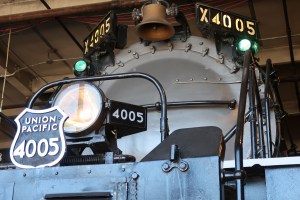
Of the 25 “Big Boys” built between 1941 to 1944, only eight of them remain, the rest were scrapped. Seven of them are on static display, and one of them, No. 4014, is being restored to working order in Cheyenne, Wyoming at Union Pacific’s Steam Shop. Of the seven on display, I would be seeing and sketching two of them: No. 4004 in Holliday Park in Cheyenne and No. 4005 at the Forney Museum of Transportation in Denver, Colorado.

The Forney Museum of Transportation is only 30 minutes from DEN, so I picked up my Grand Cherokee (I was in the true west after all) and headed to northeastern Denver.

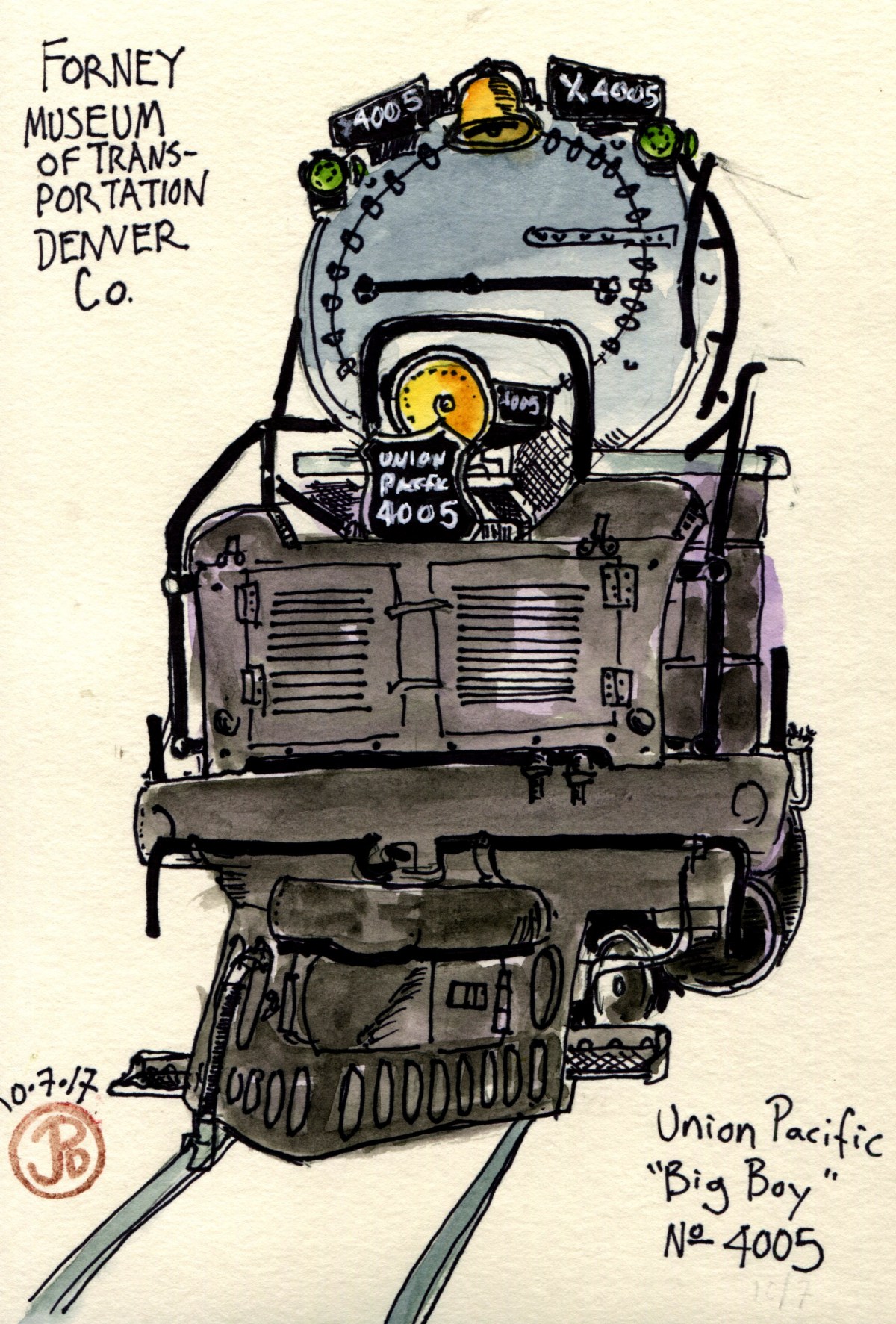
The museum was full of vintage motorcycles, automobiles, aircraft, and bicycles but I made a B-line to the largest single piece in their collection: the impressively massive UP No. 4005.

Up close and personal with a true beast of the era of steam.

The Big Boy doesn’t get many points for style, it was function over form for this freight locomotive. It is not a beautiful engine like the streamlined passenger express engine, SP No. 4449, the steam engine I followed on excursions with my father. But what the Big Boys lacks in style, they made up with pure power and size. The Big Boy is essentially two engines in one, capable of hauling long freight trains over steep grades.

No. 4005 also bears the dubious distinction of being the only Big Boy involved in an accident. In 1953, the engine jumped a track switch at 50 mile per hour while it was hauling a 62 car consist. The engine pitched to her left side killing the engineer and fireman. The engine received massive damage but was repaired at Union Pacific’s Cheyenne facility.

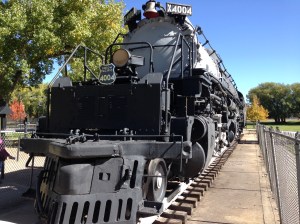
The second Big Boy was No. 4004 in Cheyenne’s Holliday Park. Cheyenne actually has two of these massive engines. No. 4014 is currently being restored to working order in UP’s Steam Shop.

Union Pacific’s Steam Shop, where they are currently restoring Big Boy No. 4014 to working order. I tried to sign up for a tour but it was sold out a month in advance.

I remember my father telling me about the Big Boy on display in a park in Cheyenne and I have always wanted to see one. Once I checked in at the Historic Plains Hotel, across the square from the impressive train depot, I headed down the street to Holliday Park where Big Boy No. 4004 has been on static display since Union Pacific donated the engine to the city of Cheyenne in 1963.

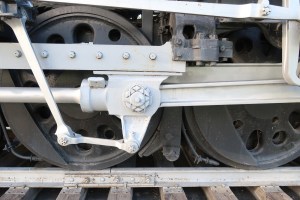
The driving train and and two and the 16 driving wheels of No. 4004 in Cheyenne.

This is one massive engine! Union Pacific always goes big and the Big Boy is the tops in steam power.

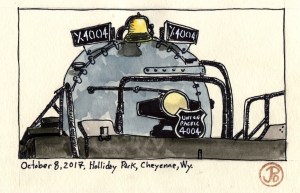
A sketch from one of my photographs for Big Boy No. 4004 in Holliday Park, Cheyenne, Wy.


Image

The Oregon Trail

This summer, while I was halfway through reading The Oregon Trail: A New American Journey by Rinker Buck, I was determined to travel the route of the Oregon Trail on my October break. But unlike the Buck brothers, I would not be traveling in a covered wagon pulled by three mules but using the horsepower of a rented car. 

Yes , I wanted to start in St. Louis, Missouri, the traditional “jumping off” point and drive the over 2,000 miles to Portland, Oregon. But how could I pass through Wyoming and not visit our nation’s first National Park? And how could I be so close to Cheyenne and not see one of only eight Union Pacific “Big Boys” in existence, the largest steam engine in the world? And then there was Carhenge and who wouldn’t want to visit Carhenge?

So many destinations keep pulling me off the Oregon Trail l that I decided to have my griddle cake and eat it too. Instead of doing the whole trail, I decided to do the most scenic section, from California Hill in western Nebraska to Independence Rock in central Wyoming. The sights along this section where eagerly awaited by the pioneers of the 19th century. Courthouse Rock. Chimney Rock, Scottsbluff, Fort Laramie. Independence Rock. And I planned to see and sketch them all!

Now before any great or important undertaking, I first make a sketch. In this case, a stylistic map (not even close to scale). These sketches help me visualize my trip. I am a planner but I believe that organized chaos is my creed. I want to be open to the seemingly random coincidences of life on the road. The people you meet and the unexpected gems you encounter while heading off the main trail.

The map is headed with a my favorite quote by N. Scott Momaday from the PBS series, The West:

It’s a landscape that had to be seen to be believed. And I would say, on occasion, it may have to be believed in order to be seen. 

Image

Hummingbirds of Costa Rica

Out of the 338 species of hummingbirds found only in the New World, 53 species can be found in Costa Rica compared to 19 in all of the United States. In the US most species are found in the southwestern part of country and only one species, the ruby-throated, is the only hummingbird on the east coast. 

The diversity of species in such a small country (CR is about the size of West Virginia) and the wide variety of flowering plants means that you don’t have to travel far to be in the thick of hummingbirds. And the eccentric names only hints at the diversity of this group: green hermit, green violetear, purple-crowned fairy, green-crowned brilliant, fiery-throated hummingbird, purple-throated mountain-gem, violet sabrewing, and snowcap. At the end of the tour we had ticked 22 species of hummingbirds!

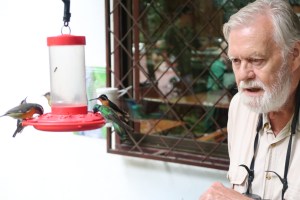
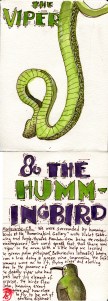
One of the most hummingbird-rich locations on the tour was a coffee shop in Monteverde know as the ebird hotspot: “Hummingbird Gallery”. This shop was surrounded by hummingbird feeders that were teaming with hummers.

At the Hummingbird Gallery we were surrounded by hummers, flying inches away from our heads as males aggressively defended their feeder. It was truly a 360 degree experience with incredibly close views of these iconic little gems.

A highlight of our hummingbird visit was seeing our first viper of the  trip: a palm viper (Bothriechis lateralis). It was

A front row view of the hummingbirds (and bananaquit) of Monteverde. No binoculars needed.

A highlight of our hummingbird visit was seeing our first viper of the  trip: a palm viper (Bothriechis lateralis). It was hanging from a tree doing a good vine impression but the local hummers knew it was there and mobbed the snake, staying just out of striking distance. We had great views and the viper stayed completely still.


Image

The Laughing Falcon and the Bellbird

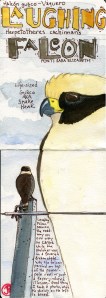
Two birds that I was really looking forward to seeing on my Costa Rica trip were the laughing falcon and the three-wattled bellbird.

I remember looking back at a plate of the laughing falcon in my Belize animal guide and thinking, ” Now here is an interesting looking bird, I wonder if I will see it?” Of course I didn’t because I spend much of the time underwater looking at barracudas, queen angelfish, and whale sharks on my first trip to Central America in 2000.

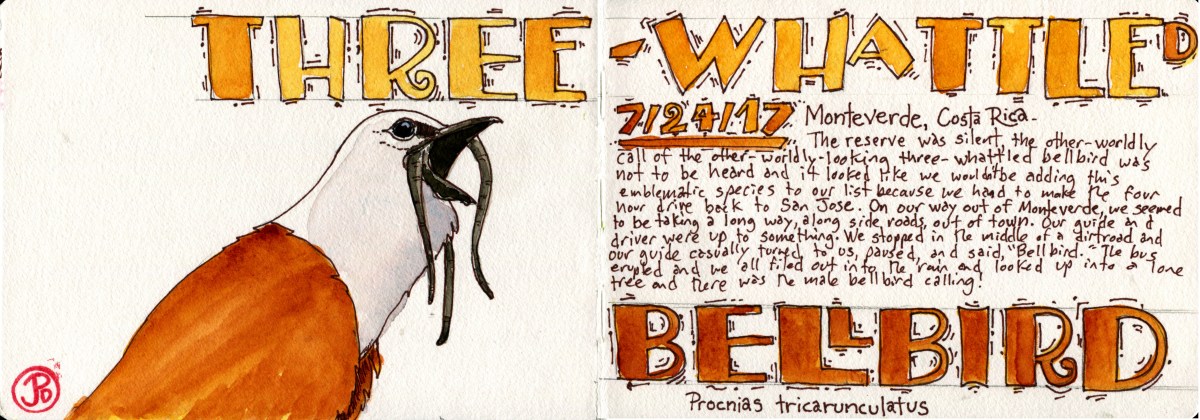
The three-whattled bellbird seems like a species from another planet or a bird you would only see in a BBC documentary, accompanied by David Attenborough’s excitable narration.

Our guide Scott promised that we would certainly hear the raucous laugh of the laughing falcon but we might not actually see the raptor. Such are the ways of tropical birding. We did hear our first snake hawk on our first evening in La Selva. We crossed the suspension bridge in the fading light to see the silhouette of a falcon in the top of a riverside tree calling to the gathering night. I hoped we would get a better look at this tropical falcon.

We did indeed get a better look on our way to Carara National Park on the Pacific coast. Unfortunately I was in a feverish haze and was able to lift myself, get a bin full of the falcon perched on the power pole and get a few photos before I slumped down for another sweaty nap. Great bird.

Our last stop of the trip was the cloud forests of Monteverde and our main target bird was the three-whattled bellbird.

The forests of Montenegro at Curi-Cancha Refugio de Vida Silvestre was oddly silent, the “bonk” call of the male bellbird was absent. As the morning wore on in our final day in the field it became clear that the bellbird would not be on our trip list.

On our way out of Monteverde, we seemed to be taking a circuitous route out of town via some dirt roads (most of the roads in Monteverde were unpaved) through an residential part of town. Scott and our driver appeared to be up to something, but what?

We stopped in the middle of one street and Scott casually turned to us, paused, and said, “Bellbird.” The bus exploded into action as we filed out into the light rain and saw a male bellbird in the top of a fruiting aguacatillo tree. Three bellbirds flew across the street and we relocated then in a tree and we all got scope views of the male calling! What a great way to end our trip!

Image

The Capuchins of Carara

Our guide, Scott, told us that when monkeys are near, all birding comes to a standstill.

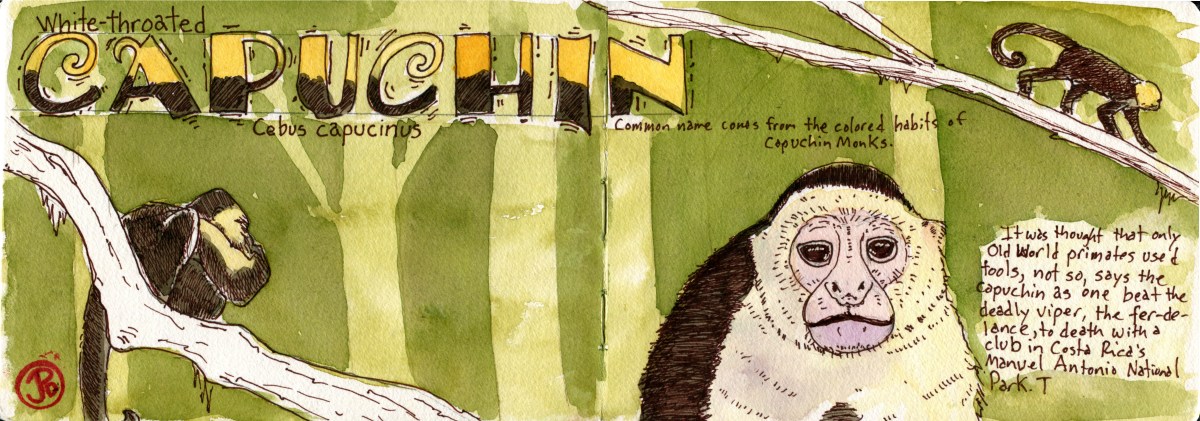
This is even more true when these monkeys happen to be capuchins.

We were taking a morning walk through the coastal, lowland rainforest of Parque Nacional Carara. We had great views of a royal flycatcher, seen two circling short-tailed hawks through the trees, and stood on the trail under a mixed feeding flock as they passed over us.

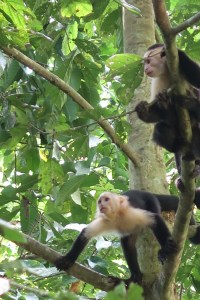
We took a side trail in search of other mixed feeding flocks and were soon alerted to a loud crashing of leaves and branches that signaled that a large animal or animals were very near. Which-necked capuchin monkeys!

It was impossible to ignore these energetic primates that made the howler monkeys that we had seen at La Selva look like lethargic sloths by comparison. The troop of 10 to 15 monkeys moved up, down, and around the canopy as we earthbound mammals craned our necks to follow their frenetic progress.

It is no wonder why primates and these new world monkeys, fascinate us. When you look into the face of a capuchin, it’s like looking into the face of a long, lost cousin. Albeit one with a long, prehensile tail.

These monkeys also share another trait with Homo sapiens: they also use tools. In Manual Antonio National Park (just down the coast from Carara) a capuchin was observed beating a fer-de-lance (a viper responsible for many human death each year) to death with a stick. Well done!

Capuchins in the canopy of Carara National Park, on the Pacific slope of Costa Rica.

Image

Cruising Upriver

One part of the tour that I was really looking forward to was the afternoon boat trip on the Tárcoles River. Judging by the advertising signs on our way to the dock, American crocodiles where the main draw for the tourist dollar on this wide, brown waterway. The larger than life crocodiles with massive, gaping jaws seemed utterly unreal, but we were here for the birds. 

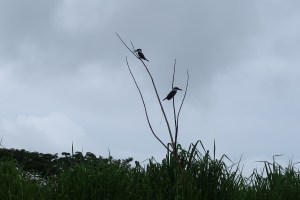
We headed upstream keeping our eyes on the banks and skies for birds and scanning the wide waters for reptilian logs. On the port side, perched on a snag was the America’s largest kingfisher, a bird I had first seen on the Rio Grande on the US-Mexico border. Now here were two ringed kingfishers in one bin-view.

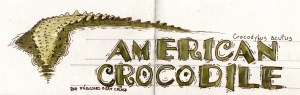
Our captain pulled off to the starboard and planted the bow into a muddy channel to look at a brown scaly “log”. This “log” was over three feet long and was the half submerged head of a massive male American crocodile. We all scrambled to the bow to get views and I got a quick sketch of the crocodilian in which I grossly underrepresented the size of its massive brain case. It was hard to tell how long this croc was but some mature males can reach 20 feet and weigh a ton! Time to get back to birding.

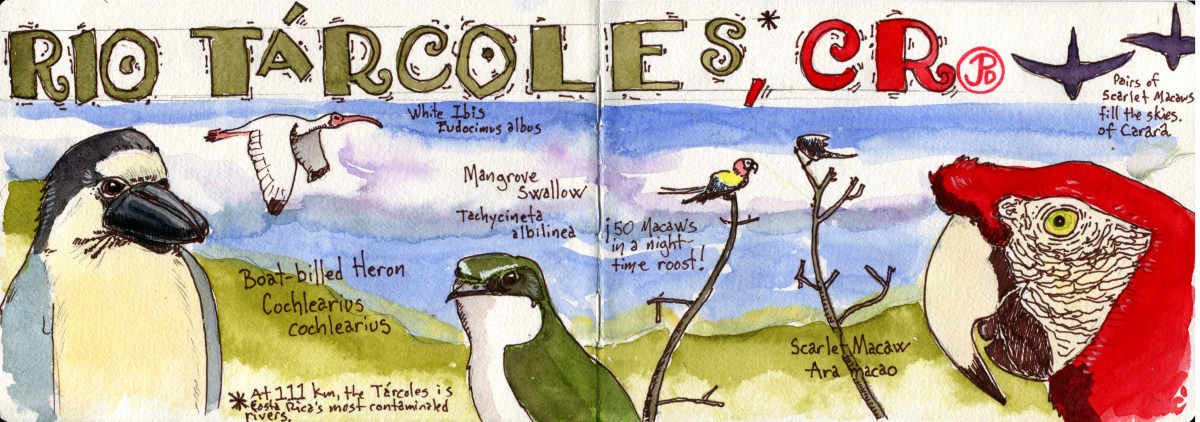
We turned and headed downstream and the birding made a quantum leap. Near the river’s end we came to a debris strewn beach. Everywhere we looked were waders: wood stork, roseate spoonbill, white ibis, Wilson’s, black-bellied, and collared plover, green and little blue heron, spotted sandpiper, and night herons.

We headed up another channel and picked up the impressive boat-billed heron, mangrove warbler, and green kingfisher.

The most impressive sight of the boat trip was soon to come as we headed back down the channel. The raucous calls of scarlet macaws surrounded us. Off to the port side was a tree ornamented by 20 macaws, a tropical Christmas tree in July. We had been seeing this iconic parrot, usually flying in pairs, for parts of the boat trip and it was awesome to see so many in one place as they perched in their roost tree.

A tree full of macaws, a great way to end a wonderful afternoon boat trip.

Image

God of the Air

From the lowland rainforests of La Selva we headed upwards to the cloudforests of the Savegre Valley. We would be at about 7,000 feet in elevation, where the humidity and temperature drops and the oak hillsides reminded me of the rolling green hills of California. In fact some of the same species, band-tailed pigeon and acorn woodpecker, are found in both locations. But we were here to see a species that is not found in California, a species of bird that has been called the most beautiful bird in the world.

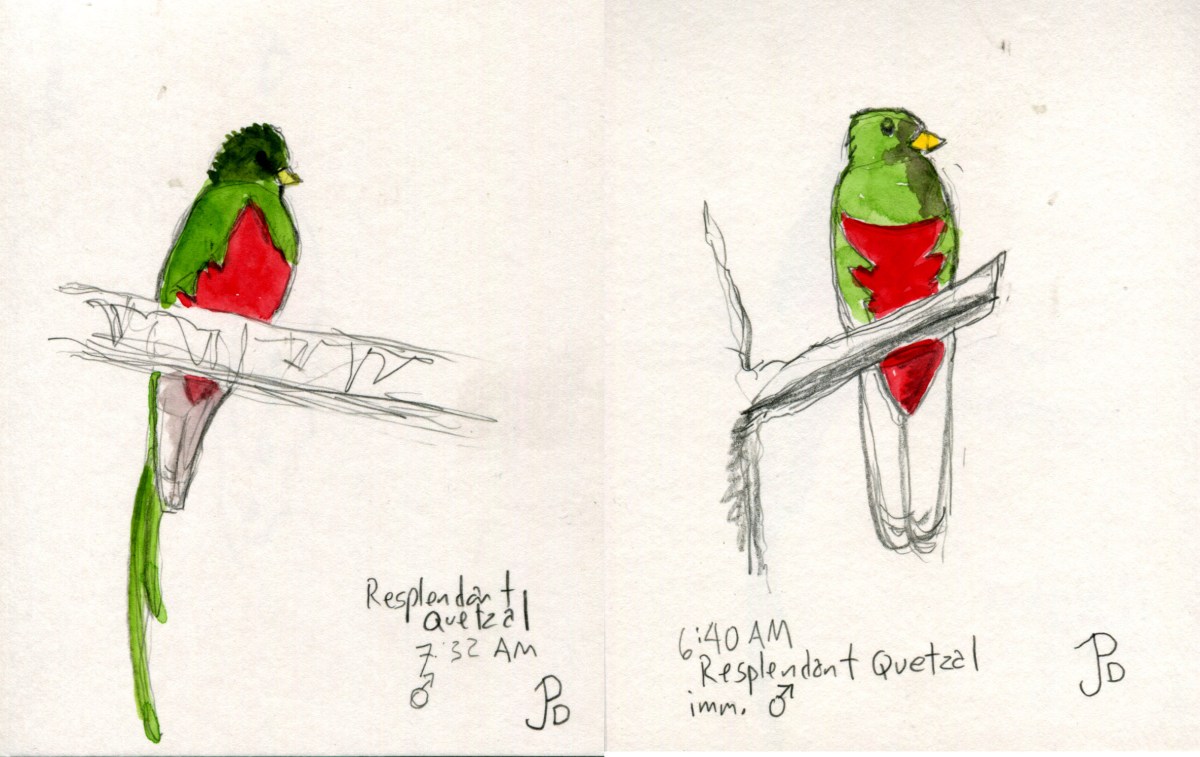
This extravagant trogon is the resplendent quetzal (Pharomachrus mocinno). The male is an eruption of iridescent green and red and it’s green tail streamers cascade far below the bird.

The quetzal was revered by early Mesoamerican societies. It’s tail streamers were seen as a sign of strength, freedom, and power by the Maya and Aztec people. The quetzal is the national symbol of Guatemala and the nation’s currency is the Quetzal.

We would begin our search before breakfast in the Savegre Valley. I had envisioned hiking up a steep, mist-shrouded, forested canyon trail to a tree at the far end of the canyon where the quetzal was known to roost. In reality, we drove a mile down the road and were now standing by the roadside near an abandoned rock quarry, looking up into some trees with about 50 other quetzal searchers. Each group had their own guide who was armed with binoculars and scope.

IMG_0525The quetzal searchers gather at the roadside rock quarry to wait for the resplendent quetzal to make an appearance.
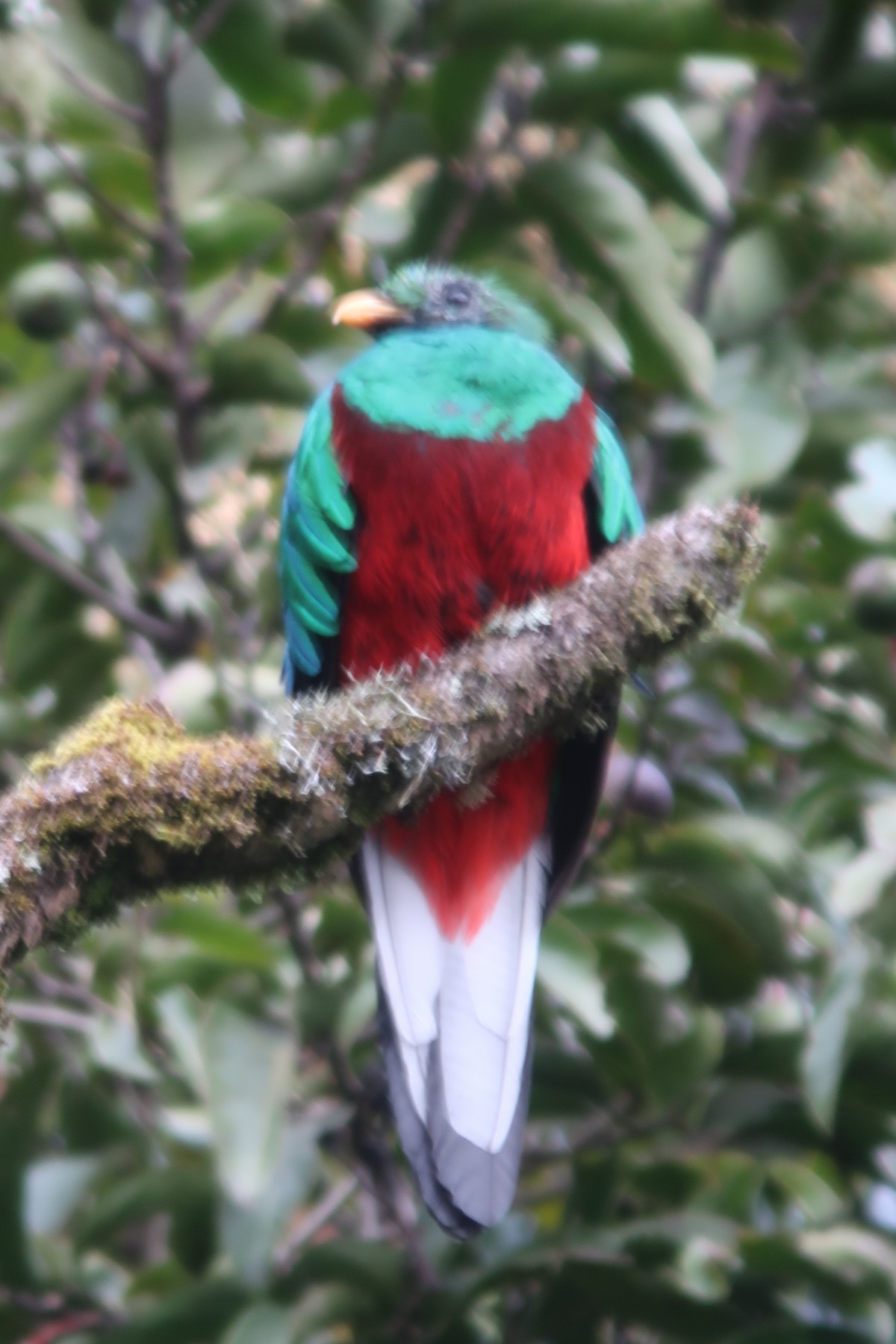
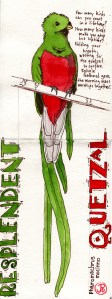
We didn’t have to wait long as a juvenile quetzal flew into view. The crowd let out a gasp as this was truly a stunning bird. The male sat in view giving the crowd decent looks through the branches.

About 20 yards down the road a guide was on an even more stunning quetzal, this time an adult male with green, flowing tail streamers.

I was able to do quick field sketches of both males which are the featured images to this post. It was one of the few field sketches I was able to complete due to the quick pace of the tour and the quetzal being an obliging subject, they seemed to do a whole lot of nothing except perch in one place for an extended amount of time. Perfect for sketching.

IMG_0542

The male juvenile quetzal, lacking the long tail streamers.


How many birds

can you count

in a lifetime?

How many birds

make you gasp

in a lifetime?

Holding your

breath,

waiting for

the quetzal

to surface.

Exhale

feathered gem,

the morning mass

worships together.

An adult male resplendent quetzal with full tail streamers, truly on if the most beautiful birds in the world.