Image

Lifer #504

The Blackburnian warbler had been seen on October 11th in Ft. Mason just before the rainy weekend and I didn’t get a chance to add it to my North American list. I assumed the storm would have washed the bird out of the city and I didn’t see any postings of a continuing Blackburnian so I didn’t venture out during one of the rain windows.

It appears that the storm didn’t wash the warbler out of the city limits completely. A Blackburnian, very similar in appearance to the Ft. Mason young male, was found at 11:45, Monday morning at South Lake Merced, within a few wing beats of the San Francisco/ Daly City border. And just south of the Bufano penguin sculpture, very near where I had a black and white warbler in October of 2012.  Now if the warbler could satisfy itself in the trees of South Lake Merced and stay around for another few hours, I might have an after work lifer.

And so it was that I found myself, a little bit before 4 o’clock, in front of some myoporum trees full of  yellow rumped warblers and cedar waxwings, scanning the green for a flashing flame. A local birder had just seen the bird and now it was just about patience. The patience paid off as the Blackburnian appeared at eye-level, right in front of me at 3:57!

The Sketch

I started this spread with the lettering: Blackburnian LB# 504. To create the lettering I used a Parchment 1” plastic stencil and a black Faber-Castell PITT big brush pen. The anchor for the spread is the adult male warbler in the lower left. This sketch was started with pencil and then layered in watercolor. I intentionally avoided using pen, instead attempting to define and contain shapes with brush work with a Winsor & Newton Series 7  number 3 brush. This is not the warbler that I saw but I think sketching a bird at it’s absolute apex (male breeding plumage), I am able to understand and internalize the bird’s appearance. The breeding male’s foil is a loose, Chinese brush style, fall male, based on a photograph of the bird that first seen on October 11 at Ft. Mason. The overall color scheme of the sketch of black, white, and yellow-orange is dictated by the breeding male’s plumage.

Coda

I saw this life bird on October 17, the  27th anniversary of the Loma Prieta Earthquake that rocked the Bay Area, which I experienced when I was a senior in high school. To crown this sketch I included a quote by John Muir that I re-read in the book I am currently reading, Landmarks by Robert Mac Farlane. Muir wrote:

The strange, wild thrilling motion and rumbling could not be mistaken, and I ran out of my cabin, near Sentinel Rock, both glad and frightened, shouting, ‘A noble earthquake!’ feeling sure I was going to learn something.
Image

Bird on a Wire

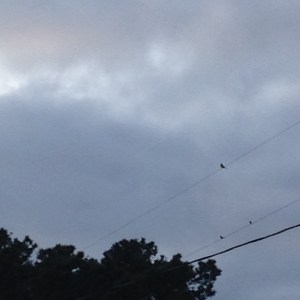
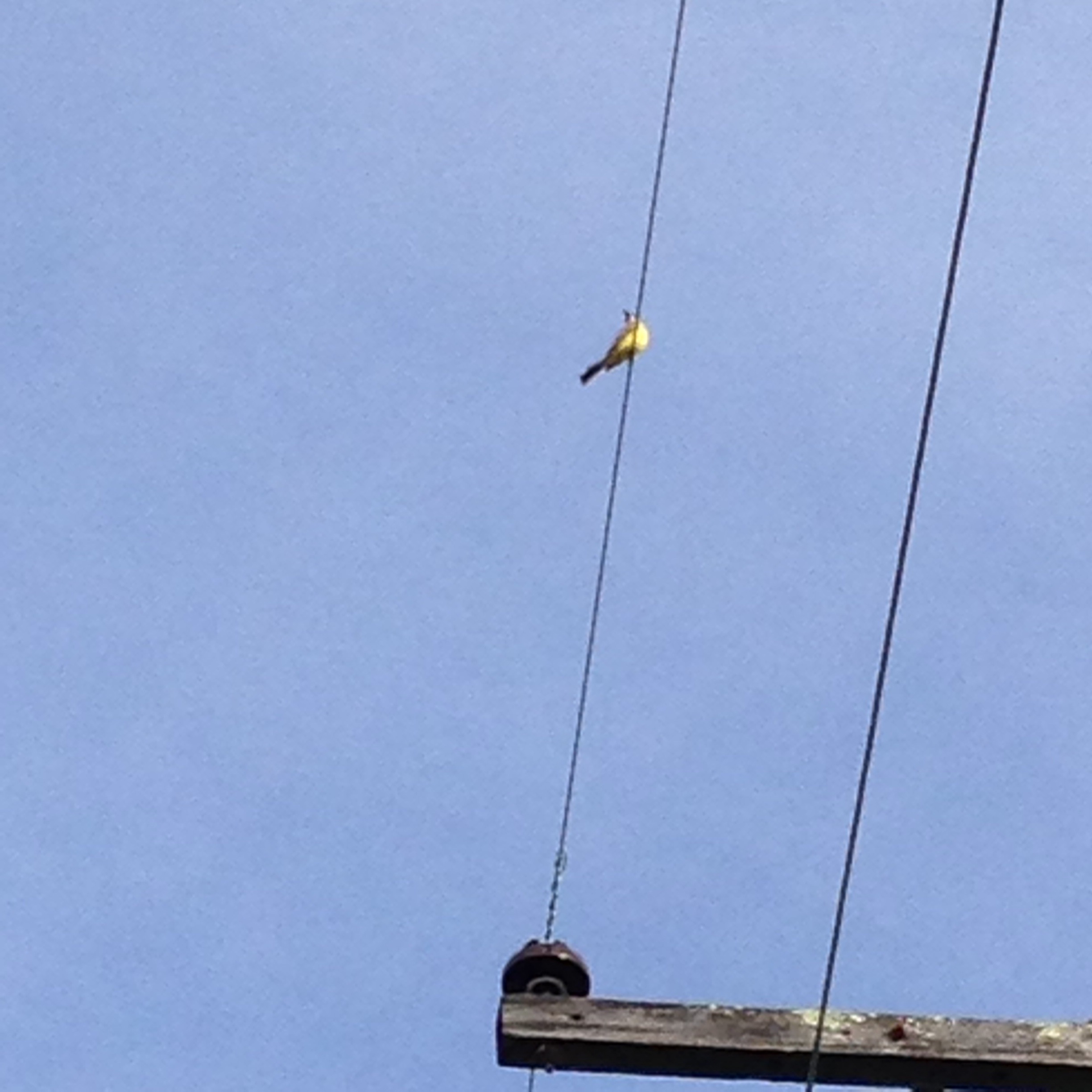
After two long weeks of parent-teacher conferences and a worn out typhoon bearing down on the Bay Area, I had a surprise as I drove up Moraga Street, one block from my home. I took a different route home because of some road work. And as I was heading up the hill, I saw a bird on a wire.

Any bird on a wire that looks a little “off” is bound to catch my attention and this bird did. At first it looked like a really light colored scrub-jay. But as I moved closer I knew it could only be one bird.

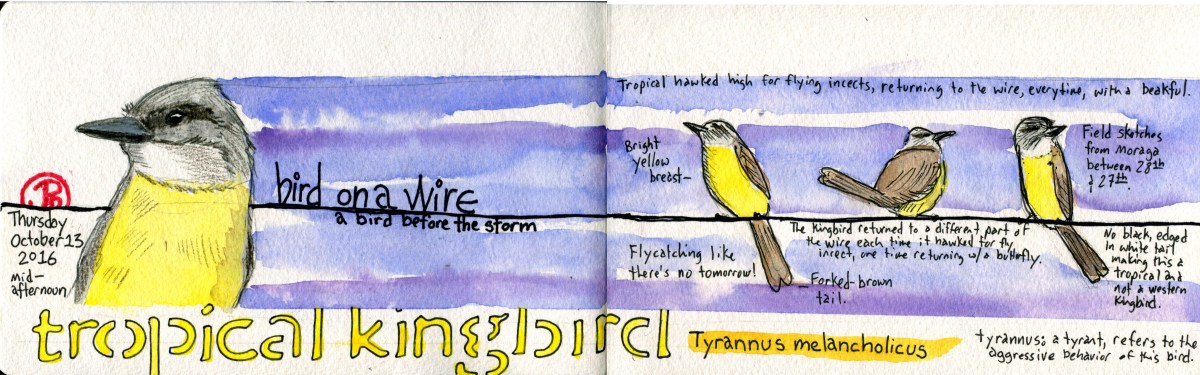
The bird’s location in the middle of the wire, it’s bright yellow breast, and its menacing ever vigilant gaze signaled that this was a tyrant flycatcher. And it’s brown, notched tail and heavy, violent bill, seen through by car binos, confirmed that it was the rare but regular visitor to the west coast, the tropical kingbird, Tyrannus melancholicus.

This is an apt name for the genus that shares part of it’s name with the tyrant lizard king, Tyrannosaurus rex. The tyrant moniker is given to the genus of kingbirds (another link with T. rex) because of the aggressive nature of these flycatchers, especially directed towards much larger birds (hawks, eagles and falcons) during the breeding season. The tropical kingbird’s species name, melancholicus, comes from Greek, meaning of a melancholic temperament. The Greeks believed that one was guided by the four humors (blood, yellow bile, black bile, and phlegm) and if you were out of balance, in this case by being over loaded with sullenness or violent anger, then it would contol your demeanor (by being full of black bile). That’s the long way of saying that the tropical kingbird gets really pissed when intruders are in it’s breeding territory.

A kingbird on a wire, looking for a winged meal. I was able to do three field sketches of the flycatcher.

I watched the kingbird sally forth from it’s wire perch returning each time with a flying insect in it’s beak. On one such attack, the yellow-breasted tyrant launched itself 60 feet into the air, returning with a yellow butterfly, which the hawker dispatched in two deft gulps. The bird worked it’s way up and down the power wires of Moraga Street, eating as it went.

img_5457

On my after dinner stroll, as the harbingers of our first winter storm filled the sky, there was the kingbird, taking the highest perch. It sat, resting from it’s travels and it’s high energy aerial hunts, where it now sang, to no kingbird that was anywhere near.

Image

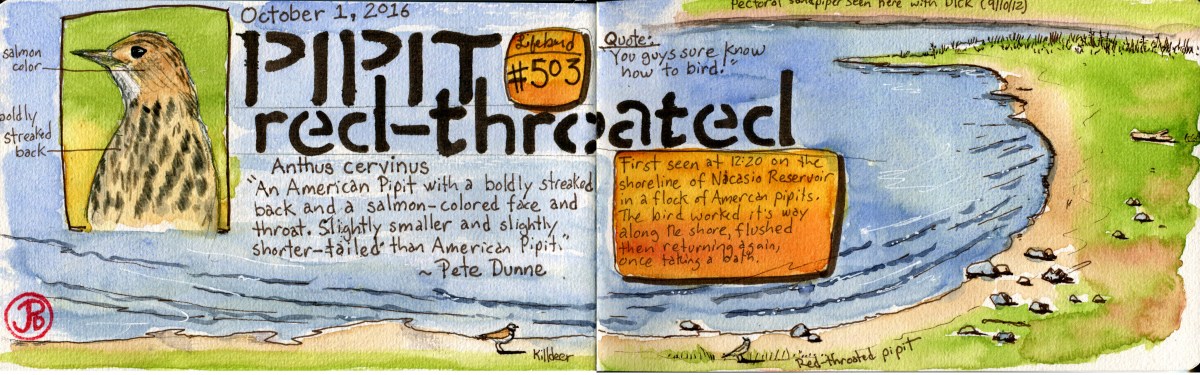
Lifer #503

After striking out on three separate occasions on the ultra rare dusky warbler in South San Franciso, I was in need of a life bird. Once you have crept into the 500s, a completely new North American species can be very hard to find. But with time and patience, anything is possible.

Nicasio Reservoir in western Marin County has always been a great place to bird. In September of 2012, DICK and I had great views of a pectoral sandpiper on a fall afternoon. What brought me back to this reservoir, just across the channel from where I first saw the pectoral, was a small twitcher of a bird with a streaky back and a buffy wash. It was a rare red-throated pipit. This Eurasian pipit has a very limited breeding range in Alaska and a few red-throateds make their way down to the California coast each fall.

When I arrived I scanned the eastern shoreline from Nicasio Valley Road. The first birds to catch my attention were two killdeer and then I noticed smaller birds working their way among the grass, American pipits. This was a promising sign. The red-throated tends to associate with Americans during migration.

I scampered down to the shoreline and headed towards the channel off to the northwest. There were at least 15 pipits on the shoreline ahead. I scanned the flock for the one that looked different, the one with the streaky back. No luck.

I returned to the shoreline where the pipit had been seen over the past few days. I sat  on a boulder and waited for the bird to come to me. Slowly small groups of pipits returned to work the shoreline. I carefully examining each bird, trying to turn the plain back of the American into streaks.

Then at 12:20, a pipit seemed to appear out of the grass, directly in front of me. This was a pipit of a different sort, bluff wash, white wing bars, and a streaked back. Bingo, North American life bird #503, red-throated pipit (Anthus cervinus).

I called DICK to coax him out to western Marin, which was not hard to do. While I waited for him to arrive, I sketched the shoreline of the reservoir. He arrived half and hour later with containers of golden hoppy celebration. He raised glasses, then we raised glasses, toasting to a new life bird.

A fellow birder on the beach commented, “You guys sure know how to bird!”

And indeed we do!

Image

San Juan Bautista, again 

Last Saturday morning I drove the 40 minutes from my cabin in Santa Cruz to the mission town of San Jusn Bautista.

For the past three years and beyond we have made a field trip to the underwhelming Mission San Jose and at the beginning of this year we floated around the idea of visiting a new mission. Our top choice was Mission Dolores in San Francisco, but parking is always an issue.

I have always believed that the best mission within 60 minutes is San Juan Bautista. The journey will take an hour and ten but who would not want to take 60 fourth graders to the mission featured in the best movie of all time (according to the British Film Institution), Hitchcock’s Vertigo. I do remember a fourth graders review of the masterpiece: “Driving and talking and driving and talking and trees!”

Well then they might enjoy the massive three aisled church, the arched colonnade, a part of the original El Camino Real, and of course the local cannabals (the Breens of the Donner Party were early residents).

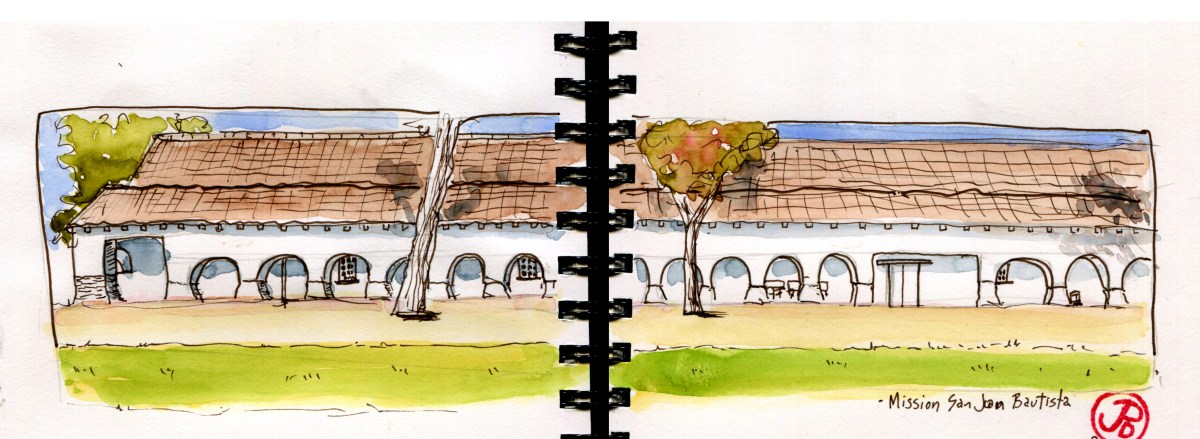
I arrived early, before the mission opened, and was surprised to learn that a foot race was in progress, the finish line being right on the plaza. The loud pop music blared from the portable speakers, somehow didn’t jive with the California history which surrounded me.

I sat on a picnic bench across the square from the mission and I started to sketch until the mission opened. The sketch that resulted is this post’s featured image.

I then entered the mission and took notes to create a new scavenger hunt for our fourth graders.

Image

SFMOMA

On a recent Saturday, I went with a friend to the newly renovated San Francisco Modern Art Museum (SFMOMA).I checked my bag but brought in my Aquajournal and pencil case.

We headed up to the 6th floor, which we were informed was not very crowded because it contained German art since 1960. I turned to my friend and challenged him to exclaim, “That isn’t art!!” when a piece was a fine example of a white painted canvas  masquerading as “fine art” or a similar example of an artist extracting large sums of money  from a wealthy patron with a minimal amount of talent (or effort).

We  headed down to the fifth floor and the impressive and massive canvases of Chuck Close. Here too were a few Ruschas and Rauschenbergs. We entered a gallery and a tall, thin  pyramid of white florescent lights elicited a “That isn’t art!!” from my companion. Wow, that didn’t take long!

I wandered into a gallery called “British Sculptors” and a Gordsworthyesque circle of stones caught my attention. I took out my journal and started to sketch. I started with a light pencil sketch to capture the form and then I chose that black weapon of death, the Ultra Fine Point Sharpie, from my holster. I had been spotted! The blue-suited gallery guard stood in front of me and asked the mystifying question, “Is that a ball point?” This question was so odd that I asked the guard to repeat the question. Is that a ball point? No, I thought, can’t you see that it’s an Ultra Fine Point Sharpie?! Any pillock can see that! The guard informed me that only pencils and not Ultra Fine Point Sharpies were allowed in the museum. And so my sketch was left half finished, halted by the pen police.

serra

Busted with a  ball point (the weapon was really an Ultra Fine Point Sharpie). And Richards Serra’s amazing work, Sequence (2006).

A highlight of the MOMA was an amazing sculpture by the San Francico born Richard Serra. The sculpture was titled Sequence and was remanisant of Serra’s pieces I have sketched last spring at the Guggenheim Bilbao. Walking in between the twisted rusted steel plates gives the viewer a 360 degree experience and the feeling of passing through a narrow Utah canyon.

I ended my visit with  two sketches, a sketch of one of my favorite pieces, Robert Arneson’s California Artist and another of the exterior from Yerba Buena Gardens. This museum was a little easier to sketch than Gehry’s Spanish Silver-flying-fish!

Image

The Oregon Coast

I started my journey from Portland to the Oregon coast by first driving north on Highway 5 into the state of Washington. I doubted my GPS so much that I pulled off the highway to make sure I was going to arrive in Astoria instead of Seattle! I eventually exited 5 and headed west, toward the coast and then south and into Astoria, Oregon at the mouth of the Columbia River.

My first destination near Astoria was Ft. Stevens State Park  and the wreck of the Peter Iredale. The four masted barque ran aground on October 25, 1906 and its rusted, skeletal hull remains. I did a sketch from my camp chair.

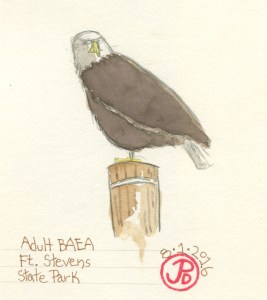
On my way back to the parking lot, in fact as I was loading my camp chair into my trunk, I sensed a large raptor behind me. I turned around to see a bulky bird perched on top of a tall wooden post. I quickly rummaged through my recently pack daypack for my pencil bag and journal. I got off a sketch before the bird flew off to the west over the Pacific.
scan-89

I wish I could have identified this raptor before it flew off!

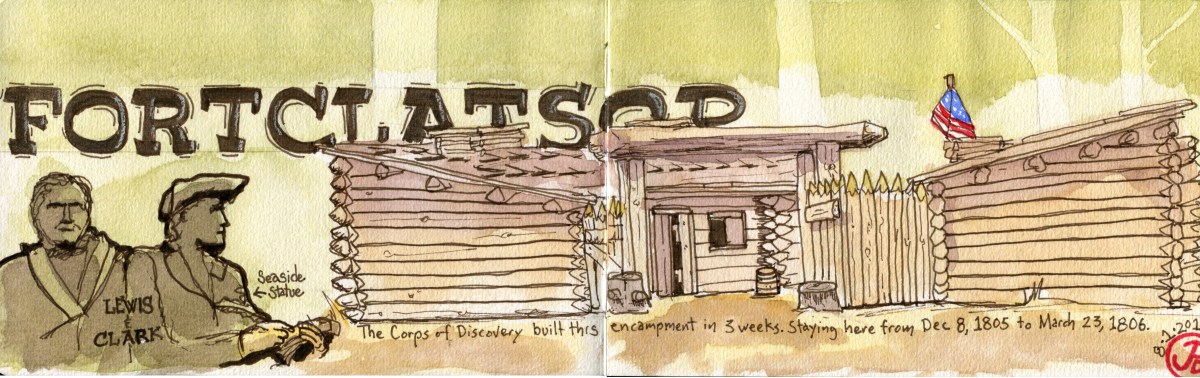
After watching a humpback feeding in the mouth of the Columbia, I headed south toward a piece of Lewis and Clark history: Ft. Clatsop. This fort is a replica of the fort that the Corps of Discovery built and over wintered in during 1805-06. Historians think the replica is close to where the first fort was located but we will really never know. The design is based on a sketch of the fort done by members of the expedition.

The Corps of Discovery spent a very wet and cold winter at Ft. Clatsop before heading back up the Columbia on their return voyage to the United States. What is most remarkable is that in the entire journey, they did not lose a single soul.

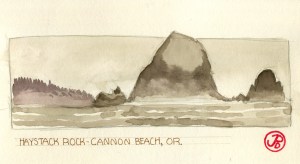
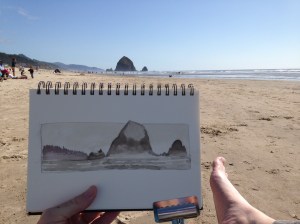
After sketching the Ft. Clatsop replica I headed to my night quarters in Seaside. After checking in I headed south to the most famous beach in the Oregon coast: Cannon Beach. The beach was full of people but I found a relatively quiet patch to set up my camp chair and start a sketch of the iconic Haystack Rock. I only attracted the attention of a few dogs and children (that has to be some sort of metaphor) as I was able to finish two sketches: one in color with ink and the other a monochromatic painting in pencil.

hatstack2

The monochromatic monolith, Haystack Rock.

img_5241

A little behind the sketch footage!


Image

A Feathered Omen

At the beginning my fourth year of teaching fourth grade at Highlands Elementary, I was heading heading south on Highway 280 on my first day of school.

Highway 280 is usually blanketed in fog this time of year (summer) and today was no exception. I drive this route over 200 times a year and you develop a certain flow to your commute and I look forward to certain landmarks on my southward journey into San Mateo County. The first is a mile or two after the 280 and 238 split, when the tree line falls away to reveal the wooded rolling hills of the coast range that rise up from that crack in the earth known as San Andreas Fault. As I near Crystal Springs Reservoir, I scan the skies for raptors in general and bald eagles in particular. I have seen bald eagles on only three occasions in the past three years. Seeing an adult bald is always a good way to start my day, especially on the first day of school, but today my morning was baldless.

My next landmarks, in quick succession, were the Father Serra statue on the right, perpetually pointing to the west, the “Flintstone House” (price tag: $3,195,000), and the power tower level with the roadway on Crystal Springs Bridge, where a lone peregrine frequently perches. But this morning the tower was sans peregrine. I will check the tower on my afternoon homeward commute, when the helmeted wanderer is more reliable.

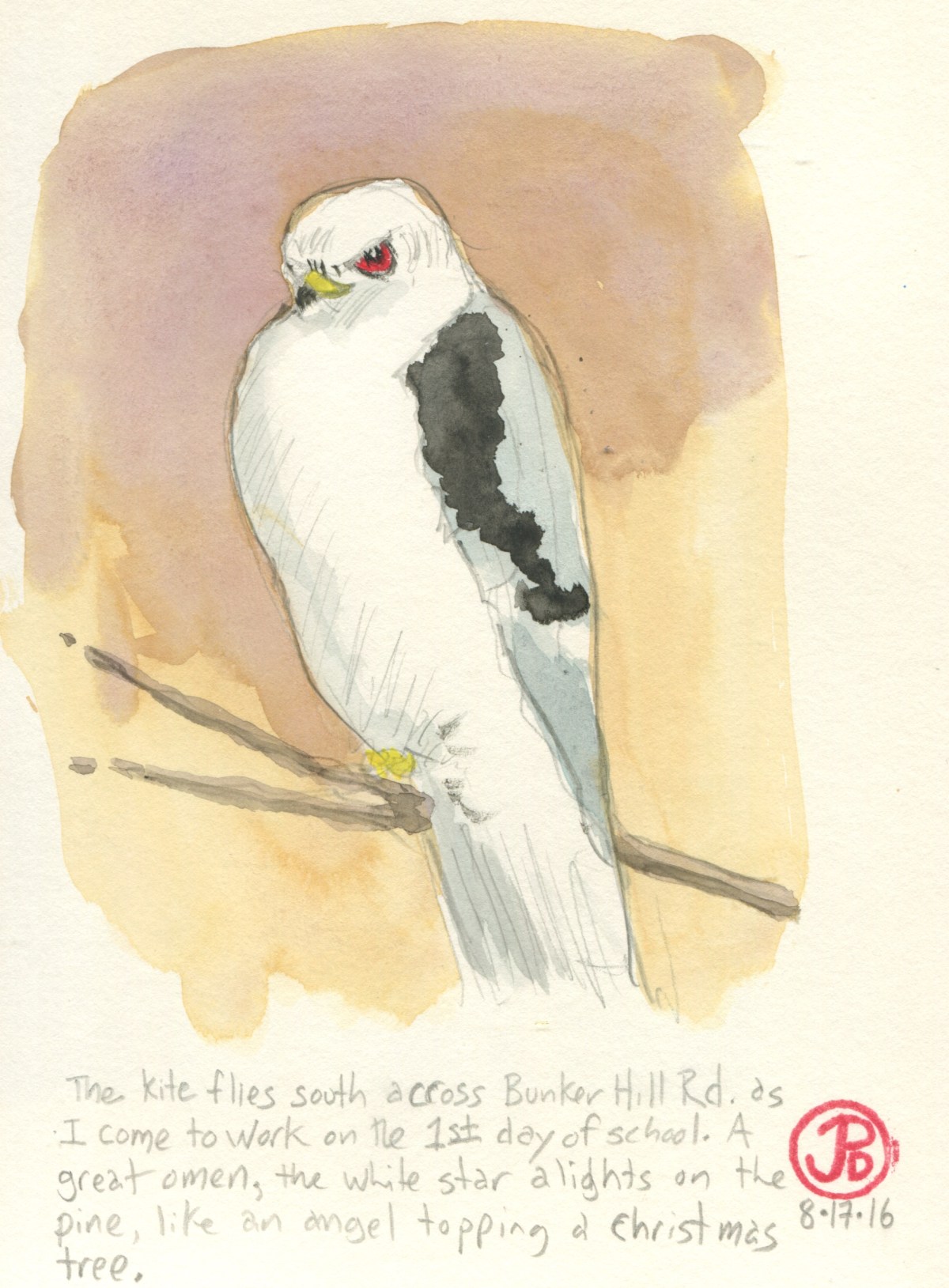
I exited 280 at the Bunker Hill turn off and then headed east, over the flow of Silicon Valley sludge, climbing the hill to the school. Just ahead, a white ghost passed over Bunker Hill Road, heading south. An excellent omen, our local white-tailed kite (Elanus leucurus). I parked and as I walk to my classroom I saw the kite alight on top of the tall pine (it’s lookout perch), like a Yuletide angel toping a Christmas tree. This certainly was the omen I had been looking for  This was going to be a great school year.

Scan 103

A white-tailed kite kiting. This species has been making a recovery in California, helped by green belts along roads and highways. The Highlands kites use the greenbelt that parallels Highway 280 as a hunting territory. 


Image

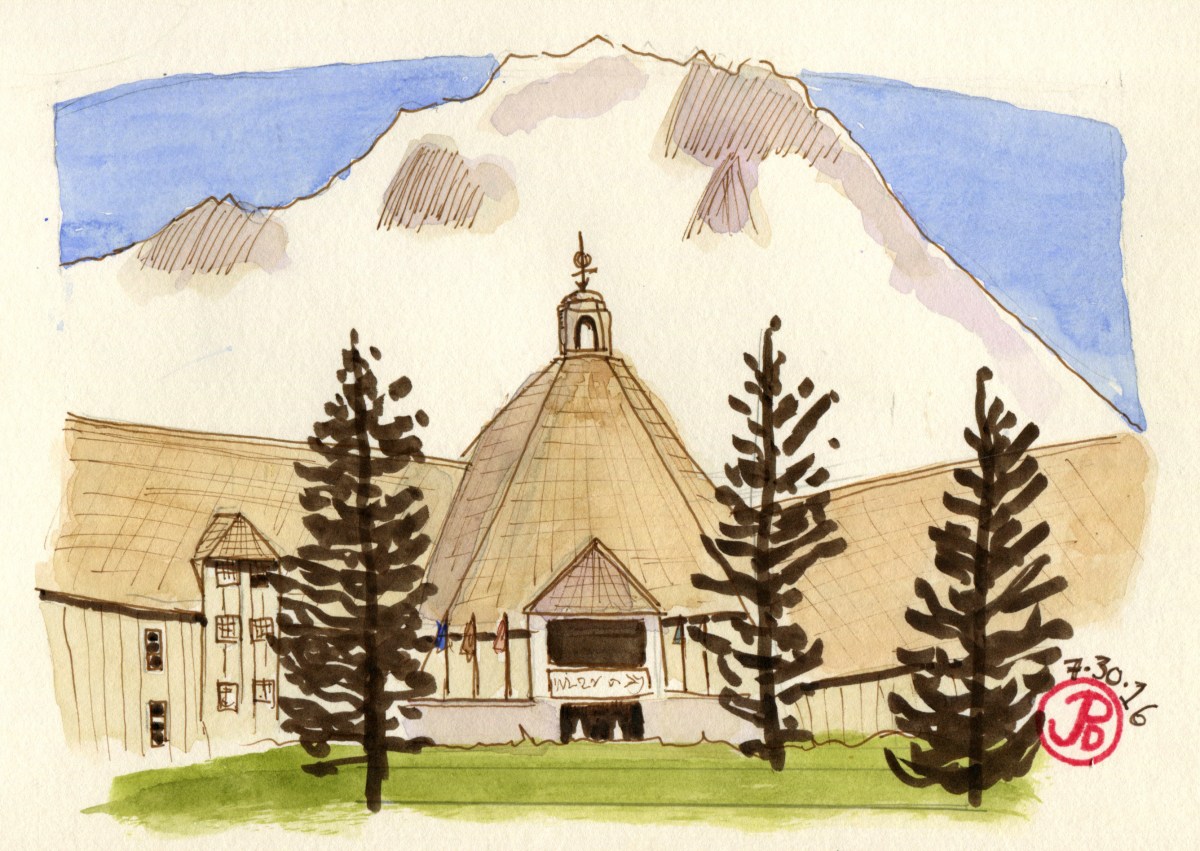
Overlook Hotel, Mt. Hood

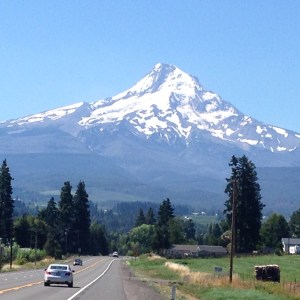
I left the course of the mighty Columbia River at the town of Hood River, headed south and wound up the hill towards the tallest peak in Oregon, Mt. Hood.

At  11,249 ft in elevation, Mt. Hood is not the tallest peak in the Lower Forty-eight but it stands out like a white beacon from miles around. The peak is adorned, year round, with snow and it’s upper slopes can be skied all year long.

IMG_5156

My destination was as lodge built on the slopes of this not-so-dormant volcano at 5,960 ft. It’s name is the Timberline Lodge. But to many movie fans, it will forever be the Overlook Hotel.

The Timberline Lodge was was dedicated September 28, 1937, by President Franklin Roosevelt as part of the Works Progress Administration that provided labour during the Great Depression.

Overlook 2

A carved panel about a doorway representing a mountain lion.

Skilled and unskilled artisans where used to carve the ornate interior details, reflection the local flora and fauna of the Cascade Mountains.

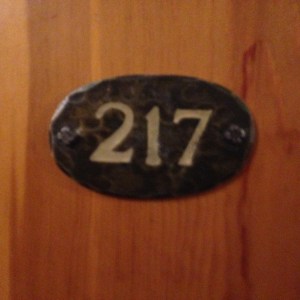
The Timberline also provided the exterior location for Kubrick’s 1980 classic The Shining. The lodge portrayed the Overview Hotel which was set in Colorado. The  interiors where all filmed on a constructed set in England. The interior was not based on the real Timberline but on the Ahwahnee Hotel in Yosemite. The film was based on the Stephan King book of the same name and the Timberline asked that the “haunted” room, which in the book is 217, be changed to room another number. In the film room 237 is used (a nonexistent room at the Timberline). Since that time, room 217 has become the most requested room at the Timberline Hotel.

IMG_5160

The most requested room.

killersweater

The Apollo sweater that Danny wore in The Shining. From the Kubrick show at the Contemporary Jewish Museum in San Francisco.

Image

Columbia River Gorge

I headed out of Stumptown early on Friday morning heading east along the southern side of the mighty Columbia River. I was hoping to avoid the many summer visitors that congregate in this  river valley. In other words, I was hoping to sketch in peace.

At this point the river is a mile across, making most rivers in California appear to be creeks by contrast. North across the river was the state of Washington. This is a major waterway in the same way the the San Francisco Bay and the Great Lakes are.

the falls

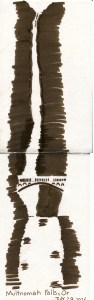
Sketch of the very popular Multnomah Falls. For this sketch I filled in the negative spaces with by dark sepia brush pen.

The gorge contains many waterfalls but the most iconic and by proxy, the most visited is Multnomah Falls. The falls fall 620 feet and is broken up into two sections with an arched concrete footbridge that bisects the two. I arrive early enough to get a parking space and avoid the remote shuttle but there were plenty of other tourists was who had the same idea. I did two sketches (resisting the urge to sketch some of the interesting humans that where getting sore necks looking  up at the falls) and then headed eastward up the gorge.

image

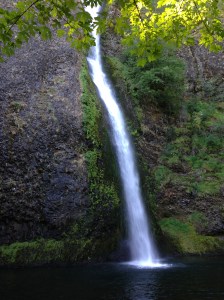
Horsetail Falls, Columbia River Gorge.

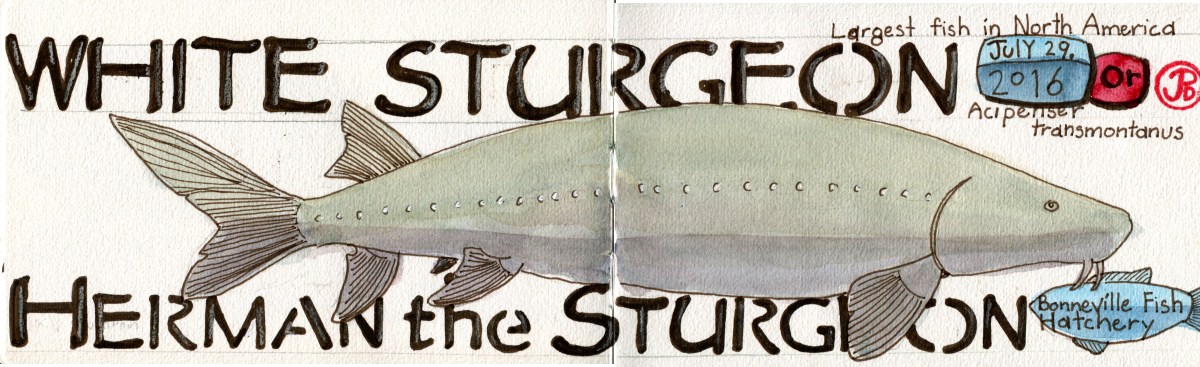
After a short stop at Horsetail Falls, I headed to the Bonneville Fish Hatchery. A teacher friend who hails from the Pacific Northwest, told me that I had to stop at this hatchery to see a massive fish. His name is Herman the Sturgeon and he is a ten foot white sturgeon who is 70 years old.

White sturgeons are the largest freshwater fish in North America and Herman was just plain huge. I sketched him, attracting the interest of tourists, and I later added lettering with a stencil.

I returned to my car, my next destination was an old lodge on the side of Mt. Hood! It was time to sketch at altitude!