Last spring break I booked a roomette on the California Zephyr, a 2,438 mile journey from Emeryville, Ca to Chicago, Il. This route passes through such cities as Sacramento, Truckee, Reno, Salt Lake City, Denver, Omaha, and Chicago. It is one of the most scenic routes on the AMTRAK network.
Last spring I was going to travel the entire route but then Covid 19 happened and I had to cancel the trip. I knew that this rail dream was deferred and at first chance I would rebook this trip because I have always wanted to travel by rail through the Sierra Nevada and the Rocky Mountains.
The opportunity came in spring break of 2021. Instead of traveling the whole route, I booked a round trip with a roomette from Colfax, Ca (near my mom’s house) to Denver, Co. This stretch includes the most scenic parts of the route and Denver provides it’s own destinations.
On this trip, I plan to do many quick sketches of train views along the route. At California Arts Supply in San Mateo, I got a custom Ronquad which is a 4 by 6 piece of card stock that would be a template for framing each sketch. I used my Ronquad on the featured sketch.
But why Denver and not Chicago? Both cities provide great sketching opportunities but Denver has an edge over Chicago: life birds! I had a few ABA lifers on my list: scaled quail, dusky grouse, American three-toed woodpecker, brown-capped and black rosy-finch, sharp-tail grouse, and the much sought after white-tailed ptarmigan. And while Chicago offers lots of architecture sketching opportunities, Denver has that too but also beautiful landscapes.
The Zephyr stops at the historic Union Station in downtown Denver and I booked a “Pullman” room in the hotel at the station, the Crawford Hotel. I admit this is a bit a splurge but I love the idea of stepping off the train in the evening, after a two day trip, and walking a short distance to my room in Union Station. It seems a throwback to a different era. An era when more people travelled by rail, when the airline industry was in it’s infancy.
As I do before any trip, I do a few sketches to build knowledge and excitement. The featured sketch is from the AMTRAK website for the California Zephyr. This location looks to be somewhere in the Rocky Mountains. I also like to do a map of my future journey. In this case, Train 6, from Colfax to Denver with all the stops in between.
California Zephyr map showing all the stops from Colfax, Ca to Denver, Co.
On a Saturday morning I drove over the Bay Bridge to the Emeryville Amtrak Station to sketch the California Zephyr Train # 6. This is the train I booked a roomette on back in April. I had to cancel the trip because of the pandemic. This route usually runs seven days a week but with the current Covid situation, it now runs just three times a week: Tuesday, Thursday, and Saturday. Unfortunately I would not be board the train, although it was very tempting!
I wanted to challenge myself to do a quick sketch because I didn’t know how long the California Zephyr would be at the platform before it departed. I guessed I would have at least 15 minutes because the engineer stepped out of the cab and walked down the platform to a get a packed lunch while the conductors assisted with boarding. I liked the ephemeral nature of this challenge because unlike a piece of sculpture or architecture, the Zephyr was not going be here for long. For this task, it helps to have a smaller journal so I went with my Stillman & Birn Delta Series 6 X 8″ sketchbook.
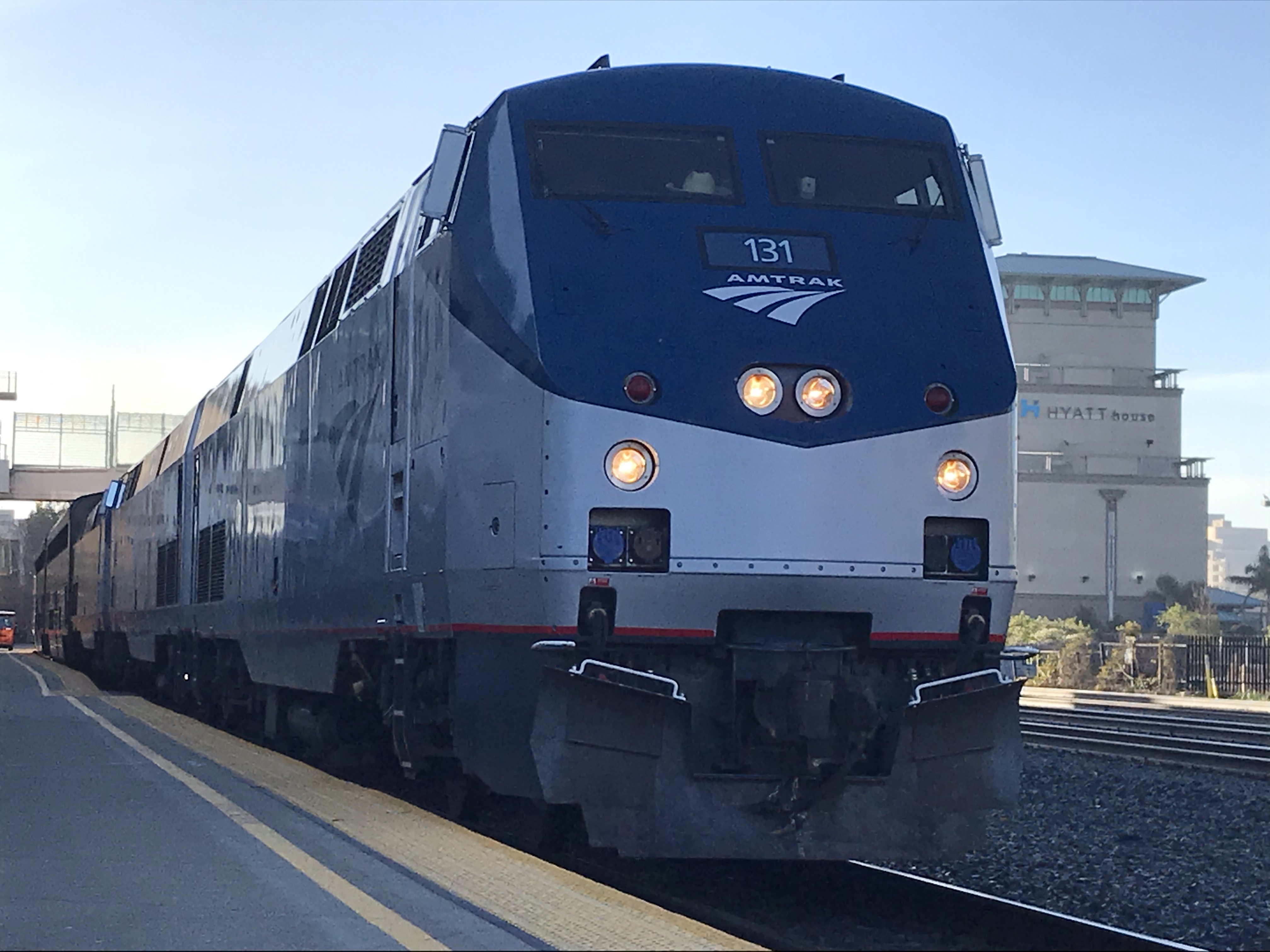
California Zephyr # 6, pulling into Emeryville Station. This is one of Amtrak’s longest routes. In three days time it will end it’s journey in Chicago. Note the cowboy hat in the window. This consist was a little odd because it contained three instead of two locomotives. It also did not include a baggage car, so the Zeph has no baggage.
I also wanted to work with perspective by sketching the train as it reversed toward my eyeline and vanishing point. If you don’t get the perspective right, the whole sketch can fall apart. That’s why it’s best to lay in your perspective lines in pencil.
Emeryville is the western terminus of it’s 2,438 mile journey and train number 6 pulled into the platform at 8:45 AM to take on it’s first passengers. I first established where my eye or horizon line was by holding my pencil straight out at arm’s length and closing one eye. I added the line to my sketch. I then blocked in the position of the front of the locomotive. Next, I added the vanishing point on the eyeline. This is where all the lines of the receding train converge. Now it was about adding shapes and details and then inking the sketch before the Zephyr departed at it’s schedule time of 9:10 AM.
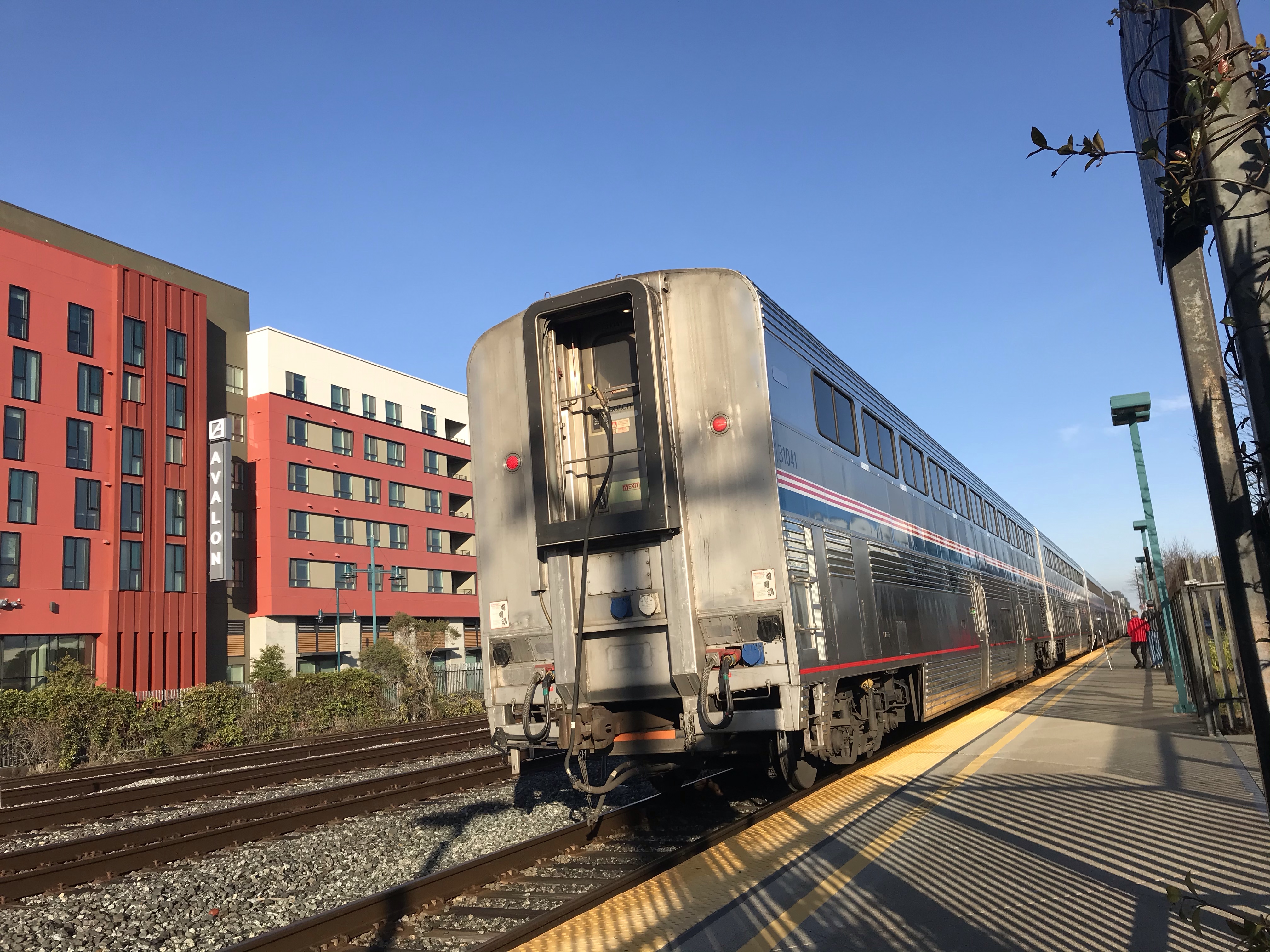
Eastbound California Zephyr heading out towards the north and eventually climbing out of the Sacramento Valley up into the Sierra Nevada Mountains towards the legendary Donner Pass. On the platform, wearing a red coat, is a fellow train nerd. In three days and 2,438 miles later, the Zephyr will end it’s journey in Chicago.
After the California Zephyr departed, right on time, I headed south into West Oakland to take a look at the old station that Emeryville Station replaced. This is Oakland’s 16th Street Station.
The current building was designed by architect Jarvis Hunt in a Beaux-Arts style and completed in 1912. It was Southern Pacific’s main passenger station in Oakland. Passengers could take ferries from Oakland Pier to San Francisco, which was two miles away.
Once the Bay Bridge was built, in 1936, it put an end to ferry service and passengers then could take buses over the bridge to get into San Francisco. In 1971, Amtrak took over passenger service from Southern Pacific.
On October 17, 1989, the Loma Prieta Earthquake struck, severely damaging 16th Street Station. The earthquake also damaged the Cypress Structure, which was parallel to the railroad tracks. 14 blocks of this double deck freeway structure, collapsed or was damaged starting at 16th Street and heading to the MacArthur Maze. In total, 42 people lost their lives here. The most in any single location.
In the 1990’s, the rails were removed to make way for the construction of the 880 Freeway which replaced the Cypress Structure and 16th Street Station was left marooned without rails. The station was closed on August 5, 1994.
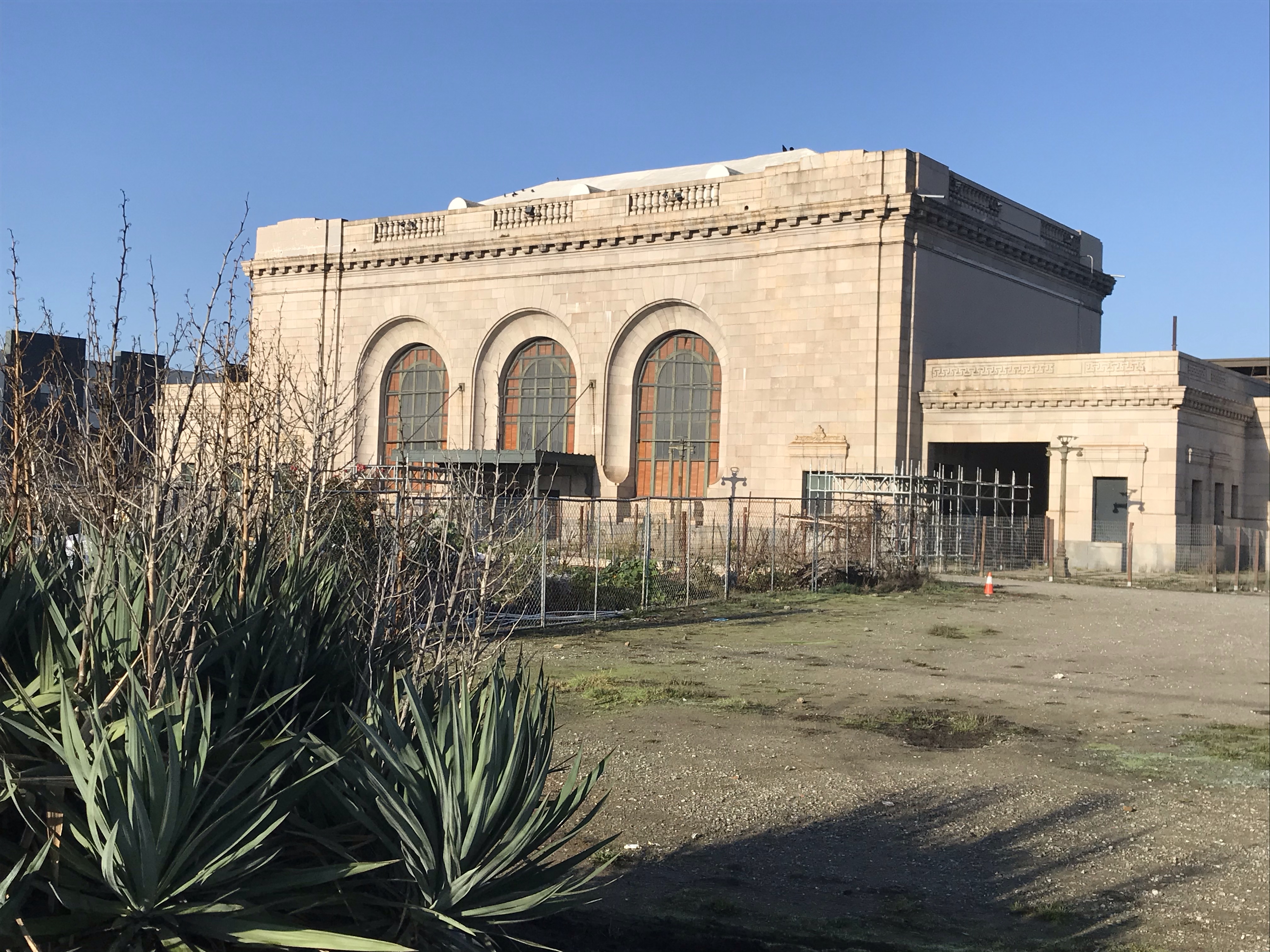
The abandoned 16th Street Southern Pacific Station. This was once the terminus of the superliner, the City of San Francisco.
From 16th Street Station I headed two miles to the Oakland Pier. This was once the busy hub of Southern Pacific’s Western Division. Oakland Pier was one of the busiest rail terminals in the country handling 763 trains a day and 56,000 passengers in a 24 hour period.
To control all this rail traffic, the Oakland Pier Control Tower made an average of 1,900 switches in a day! The majority of railroad tracks are now gone and the Oakland Pier is busy with shipping and truck traffic. The only reminder of this busy railroad hub is the remaining control tower.
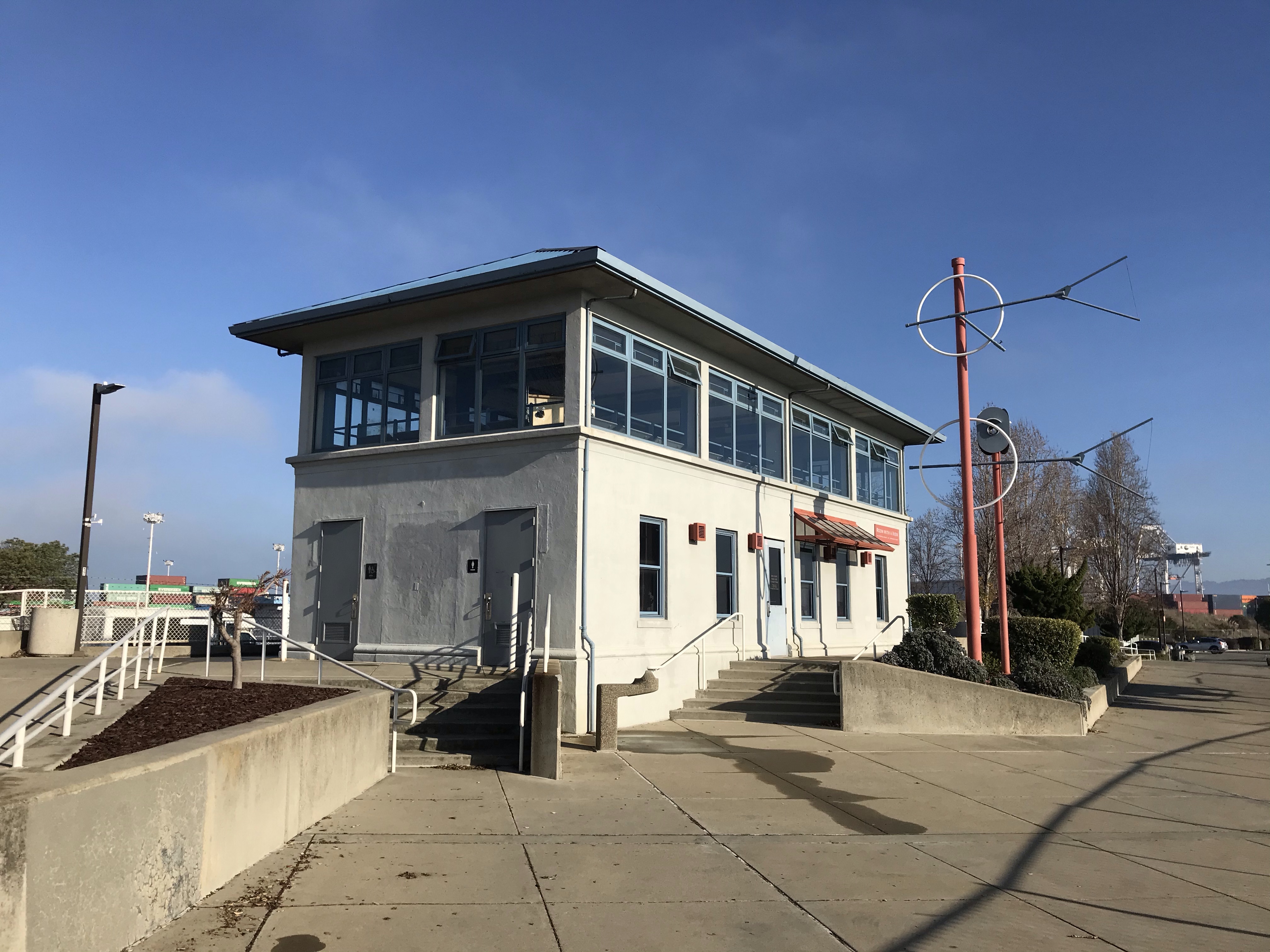
The massive Oakland Pier interlocking control tower. The two poles to the right were used for “hooping up” orders, which was a way to pass orders to a train in motion. Using these poles to transfer train orders meant that the train did not have to stop to pick up orders. The tall pole was either for the engineer or fireman and the shorter one was for the conductor in the caboose.
“The only way of catching a train I have ever discovered is to miss the train before.” ~G. K. Chesterton
The romance of the rails on a long distance journey has always been calling me. Being rocked to sleep to the rhythm of the rails and meeting strangers on a train, drew me to want to go on an American rail odyssey. On my Spring Break, I booked a ticket on the California Zephyr, from Emeryville in California to Chicago, Illinois. This is Amtrak’s longest daily route. The route covers 2,438 miles and makes 33 stops.
Then the pandemic was upon us and I cancelled by railway journey and sheltered in place for my two week break in the Santa Cruz Mountains. The lure of the rails became the lonesome far-off whistle of a Johnny Cash song (sans Folsom Prison of course).
During early July, I visited my mother near Grass Valley in the Gold Country. She lives 40 minutes away from one of the 33 stops on the California Zephyr Route. So I decided to go make the drive to Colfax.
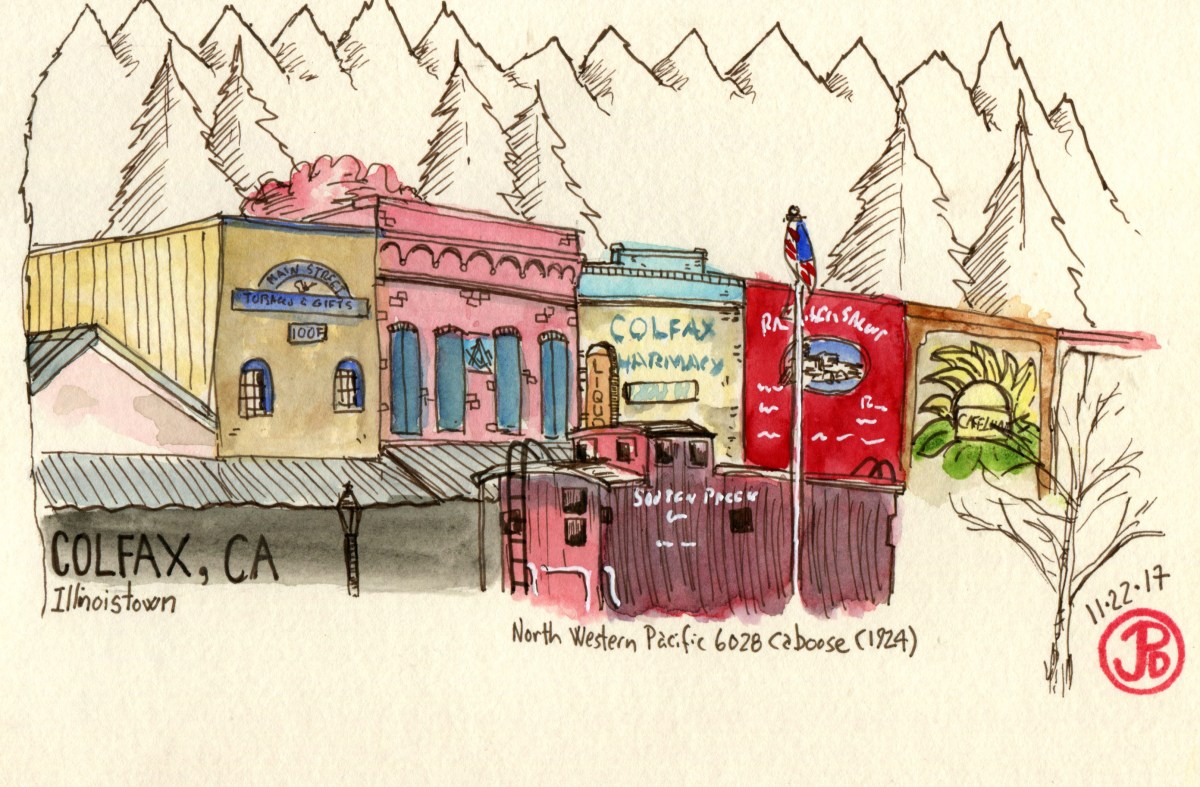
Colfax is on the route of the Central Pacific side of the Transcontinental Railway and it was, at one time, a railway camp called Camp 10. The camp was later called Illinoistown but was again renamed after the Speaker of the House, Schulyer Colfax by Leland Stanford, when Colfax came to see the progress on the railroad. Colfax later served as the 17th Vice President during Ulysses S. Grant’s first term.
The town of Colfax (population 1,800) bears an important meeting point of the east and westbound Zephyrs. The westbound train (Number 5) arrives at Colfax at 11:48 AM. The train’s final destination is Emeryville in the San Francisco Bay Area. The eastbound train (Number 6) arrives less than 30 minutes later at 12:21 PM. Train number 6’s finally destination is Chicago, the journey will end about 50 hours later, if the the Zephyr is running on time.
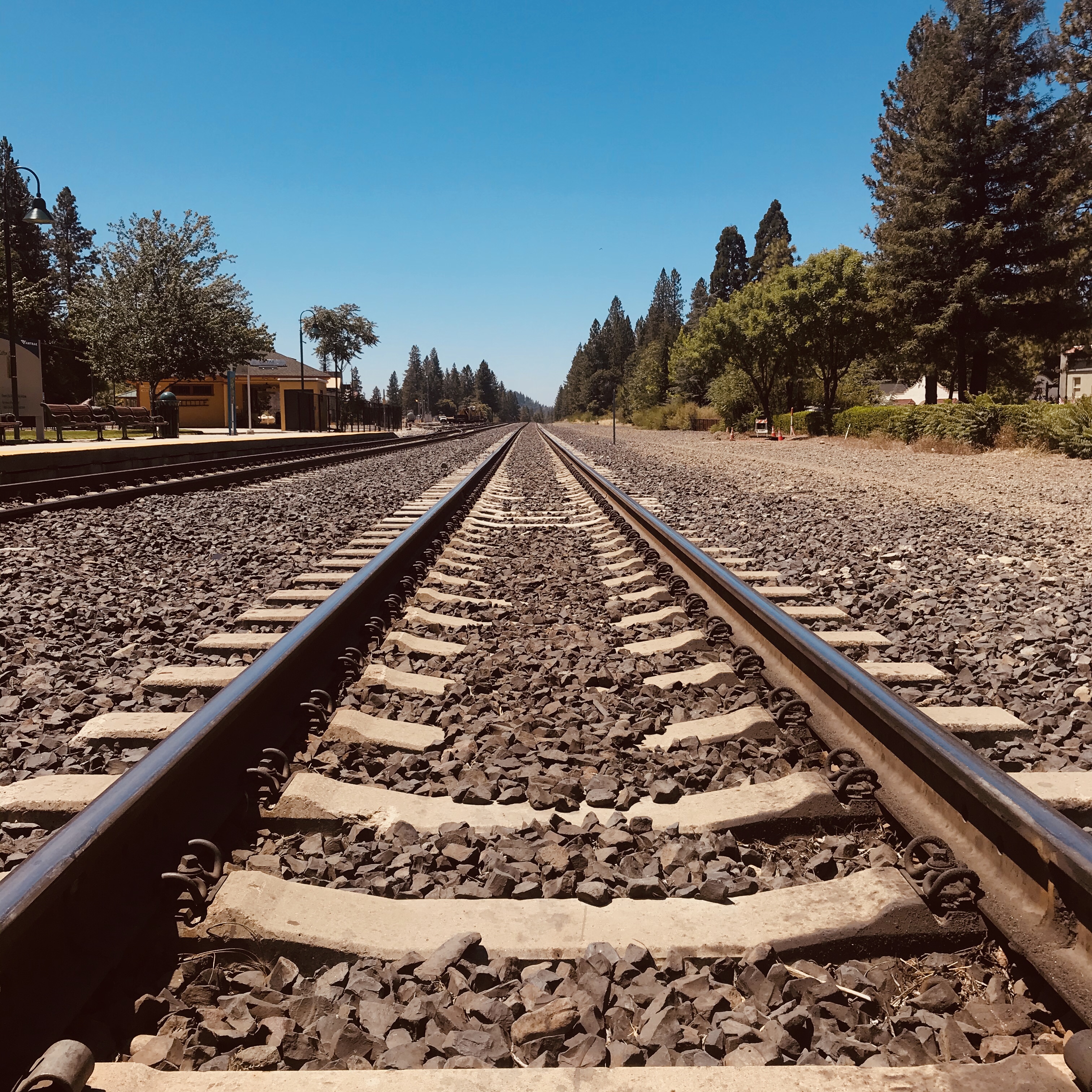
Looking westward down the rails of the transcontinental mainline. The historic Southern Pacific Colfax depot can be seen on the left.
I arrived at Colfax Depot at 11:20. Train number 5 was running on time so I found a view point next to the line and sketched in the perspective, the railway crossing sign, and the background trees. Now all I needed was the California Zephyr to pull in for her portrait and do a quick sketch with my brush pen before she departed. I figured I had about five minutes.
Westbound California Zephyr arrives at Colfax headed by two General Electric P42DC diesel-electic locomotives.
The westbound Zephyr was running a little early, which was pretty incredible because the train’s origin was Chicago. The train rolled to a stop and two passengers disembarked and I was able to get a loose brush pen sketch in before the train made it’s way down the gentle slope of the western side Sierra Nevada Mountains towards Sacramento, the original terminus of the Transcontinental Railroad.
The eastbound train was running about 20 minutes late. So I crossed the tracks and found a new vantage point right next to the rail crossing guard. The Chicago bound Number 6 pulled into Colfax and I have a short time to sketch the Zephyr. A woman passenger had decided to crossed the tracks, always a bad idea with an approaching train, and she became cut off as the Zephyr blocked the road and sidewalks to load and unload passengers. I’m not sure if she caught her train.
While I longed to catch the train I missed back in April, it was good to see, if not sketch, this iconic American railway route, the California Zephyr.
I have always wanted to travel on the original Transcontinental Railroad, from the West Coast to the East and see some the sights from the original right of way over the Sierra Nevada and Rocky Mountains. The closest you can come to doing this today is by taking the California Zephyr.
AMTRAK operates the California Zephyr from Emeryville to Chicago (not the East but the Middle Coast). The daily route covers 2,438 miles and takes 51 hours and 30 minutes (that is if the train is running on time). The route covers seven states and stops at 35 stations including Sacramento, Reno, Salt Lake City, Helper (Utah), Denver, and Omaha, to name a few of the major stops.
So I booked a roomette for my Spring Break in April. Which at $550, I thought was a good deal because it included two nights and all the food was part of the fare.
Since the time of booking the trip, the spread of Coronavirus and Covid-19 (not related to Corvid in any way!) in the United States has thrown a monkey wrench into the works. At this time my continental train trip hangs in the balance as some predictions estimate that the virus might spike in late April.
One thing that I sketched, regardless of if I would be boarding the California Zephyr in Emeryville in early April or not, was to sketched out the route with all the stops in a visual map (featured sketch). I also drew the locomotive that is used on this route, the P42DC, with all it’s specifications (below).
The workhorse of much of AMTRAK’s long distance routes, General Electric’s P42DC.
I have always loved train travel. The idea of a traveling community that passes through landscapes, towns, and cities in stasis. On this day, one of the biggest travel days of the calandar, I was in stasis in an important railway town on the transcontinental railway, Camp 20. Later to become Illinoistown and later renamed for the Speaker of the House, Schuyler Colfax by then Governor Leland Stanford.
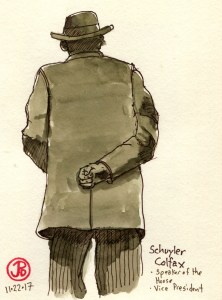
The only statue in existence of Schuyler Colfax, later to be Vice President under Grant. Stanford named the town after him after a brief visit by Colfax. At the Southern Pacific Passenger Depot.
The east bound passanger train from Sacramento, worked it’s way up the valley into the station. The California Zephyr was running a little late. I walked over to my car and headed out towards Highway 174 to the Historical Viewpoint for Cape Horn. I waited and down below, the Zephyr passed and soon, on the distant hill, the train worked it’s way up the mountain and started up the grade towards the Cape Horn cut, high above the North Fork of the American River. The cars rounding the horn and disappearing from sight. I returned to the train depot to start working my Colfax sketch.
I was sitting on a bench at the restored Southern Pacific passenger depot platform as the westbound California Zephyr worked itself down from the heights of the Sierra Nevada, on it’s way to Sacramento and the San Francisco Bay Area. The train, now being headed by two underwhelming Amtrak diesels, paused long enough for passengers to embark and disembark, as relatives greeted or waved goodbye to those on the platform. And I was just in limbo, not on the train but wanting to be there, as the cars rocked gentle on the steel rails.
Eastbound California Zephyr rolling into Colfax station on it’s way to it’s final destination of Chicago. The old Southern Pacific passenger depot is on the left.






 Corvid Sketcher