Image

4014 on the Mountain Sub

One of the legendary railroad routes is the section of the Transcontinental Railroad that climbs the western flank of the Sierra Nevada Mountains up to Donner Pass. The construction of the railroad was an engineering marvel and much of the original route is still in use.

Southern Pacific used their AC articulated cab-forwards to tackle the grades and heavy freight over the pass and now the world’s largest articulated locomotive would be climbing up to Donner Pass for the very first time. And I planned to be there.

There was a planned 30 minute whistle stop at the historic railroad town of Colfax at 11:15.

I was in Colfax an hour and a half before arrival and more and more people were streaming into town.

4014 left Roseville on time but was halted when the train hit a tree that had fallen near Auburn. The UP tracking app noted that 4014 was “currently stopped near Auburn”. At first I thought it was just a maintenance stop but then word spread that Big Boy had hit a tree and there was some damage to the underside. This was not good. Especially for the hundreds of people waiting in the heat for 4014 at Colfax.
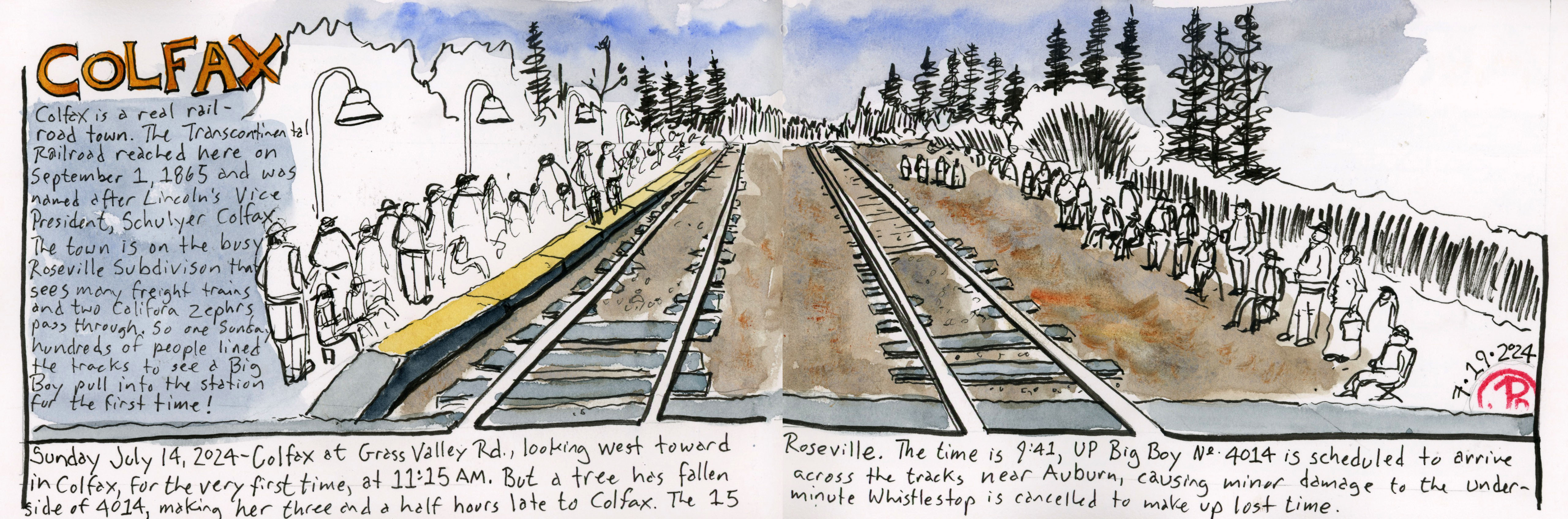
Word spread that the locomotive might have to be towed back to Roseville. The train was now an hour late. I decided to head back to Penn Valley, to air conditioning and the second half of the European Cup Final. I would continue to monitor the UP tracking site. But I had to beat the heat in Colfax.

Just after the game ended (Spain was European champions for the fourth time), the tracker read, “4014 currently moving near Auburn”.

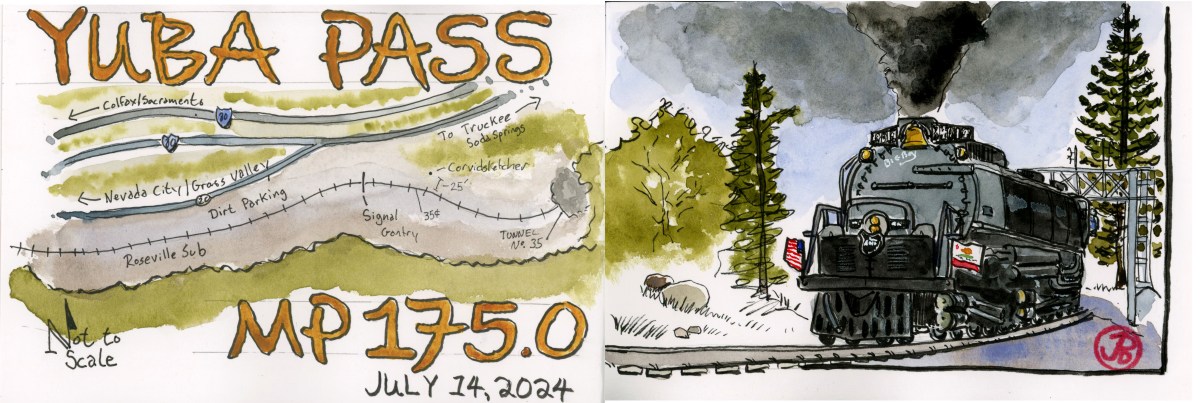
My plan was to drive on Highway 20 to where it merged with Highway 80. This was Yuba Pass and I wanted to see Big Boy in this historic location.

I arrived and there were plenty of other rail fans lining the tracks at Yuba Pass. This was a good sign because 4014 was still climbing the grade and had not reached my position.

After about a 45 minute wait a plume of steam exhaust appeared down line and the mighty roar of the Big Boy filled the cut.

Then the iconic articulated giant appeared working up grade towards my position near the signal gantry. 4014 was putting on a show that enveloped all the senses.
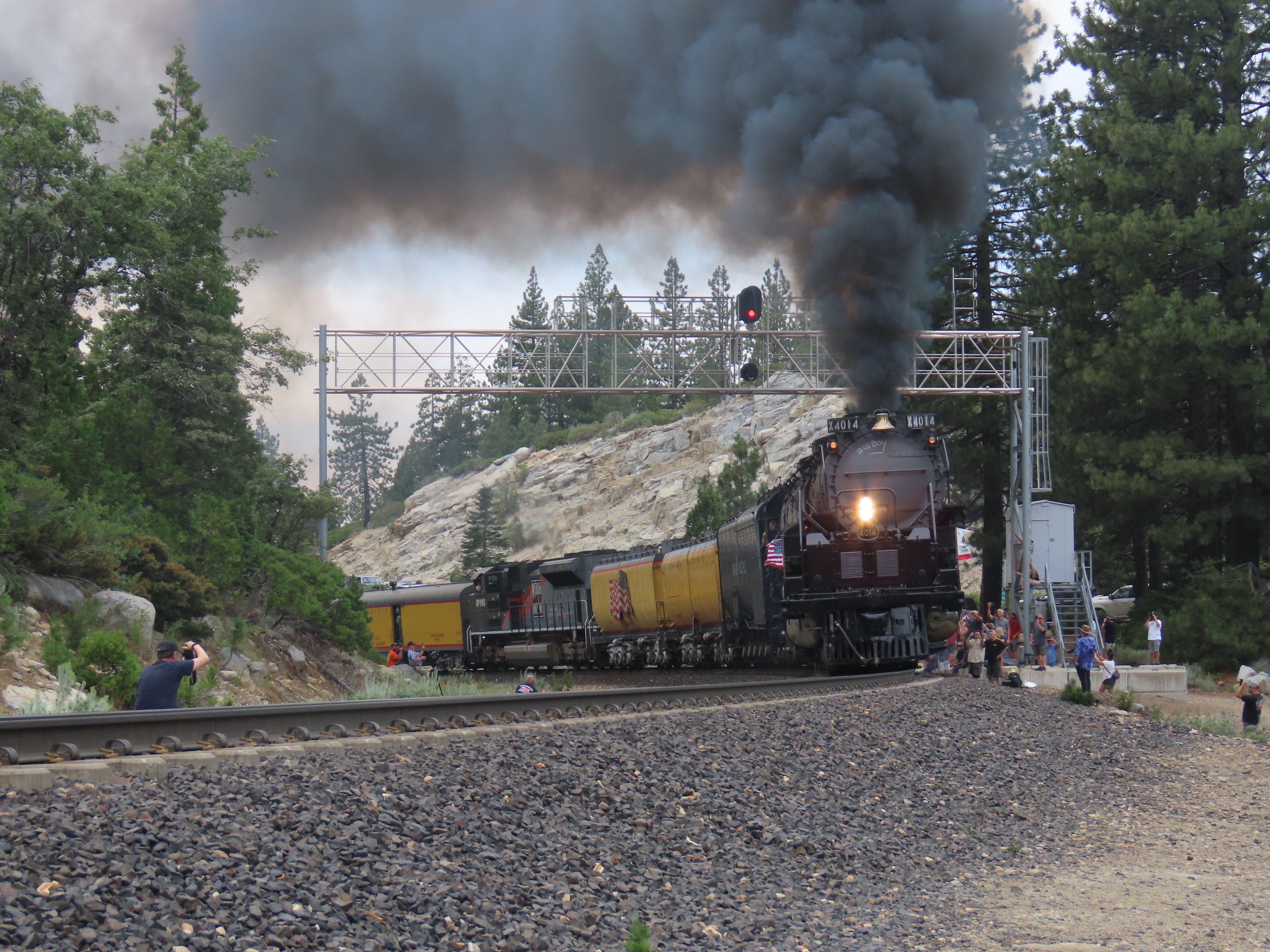
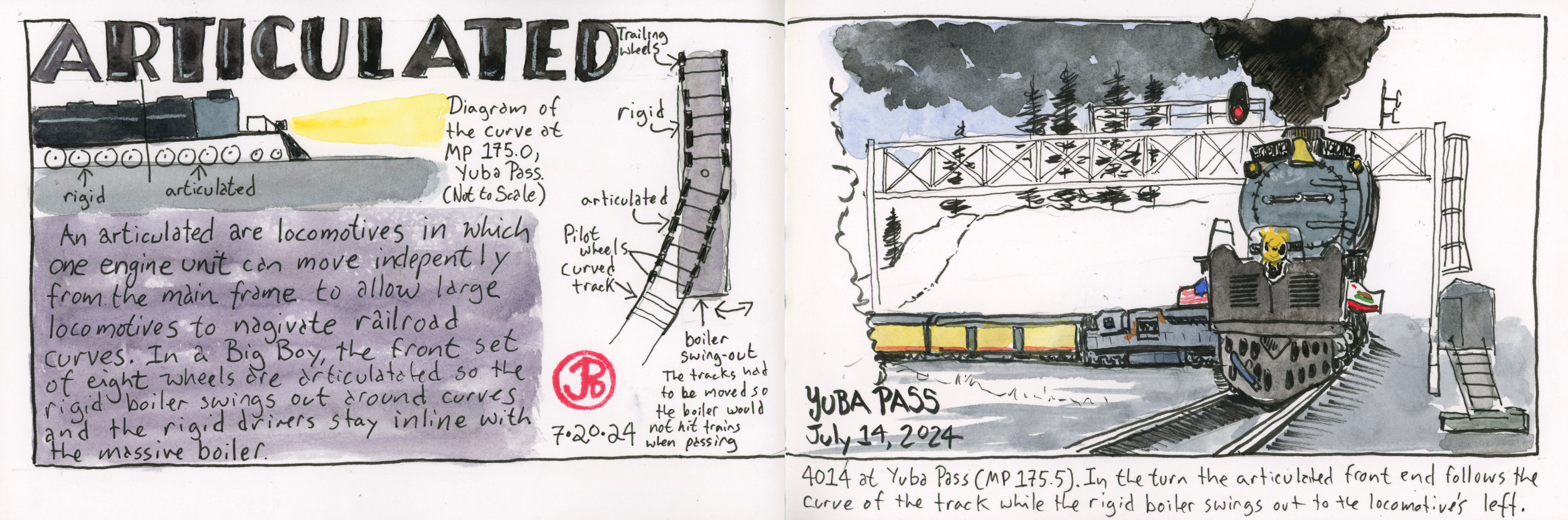
As 4014 rounded the curve, the articulated properties of the design were in full display. While the leading truck and front drivers rounded the curvature of the track the boiler remained rigid making it appear that the drivers and boiler were separating. Afterwards I did a spread to understand the articulation design (below).
After the train disappeared into the tunnel, I headed back to my car and was soon driving east on Highway 80. To my right, I could see the tell-tale exhaust up the hill on the railroad grade. Soon I was pacing with 4014 and I then pulled ahead and planned to head to Soda Springs to see the steam mammoth as she neared Donner Summit.

I made it to Soda Springs off Historic Highway 40 and the biggest challenge was finding a place to park as there were many people waiting trackside for the arrival of the Big Boy.

I found a parking spot and headed down to the grade crossing. There was a festive atmosphere around the tacks and to the south many Cal Fire trucks and personal (including Smokey) looked and listened down track for the first appearance of the 4-8-8-4.
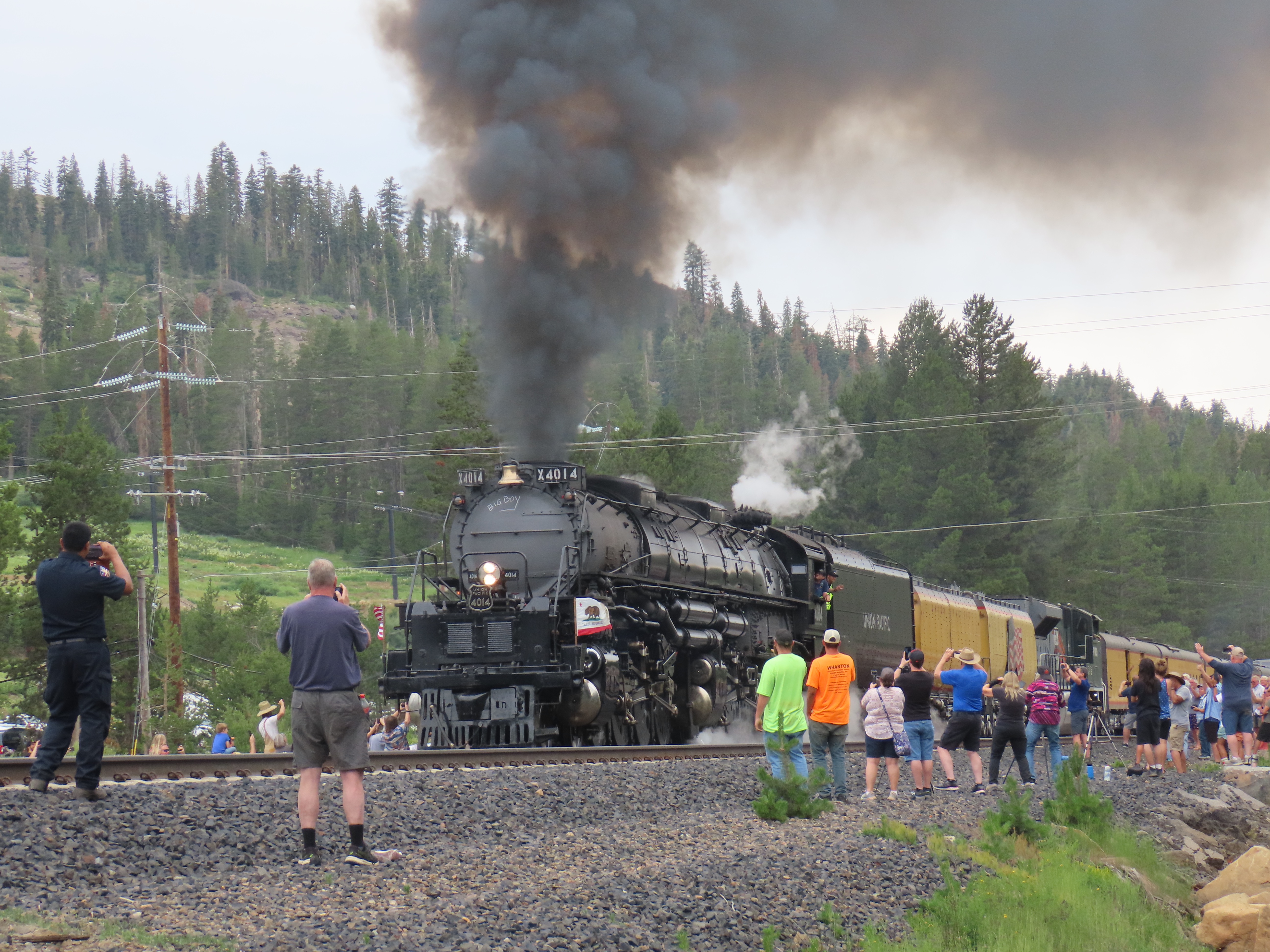
4014 at Soda Springs.

Image

Southern Pacific Cab Forward No. 4294

The last steam locomotive that Southern Pacific ever purchased is on display at the California State Railroad Museum in Sacramento. And she’s massive!

This is the only one of the 256 cab-forwards that still exist. The 4-8-8-2 locomotive was turned around so the cab was in front and the exhaust was behind the cab and crew. The natural habitat of the AC-12 Class No. 4294 was over Donner Summit. And because of the heavy snowfall in the Sierra Nevada Mountains, 37 miles of the line was covered in snow sheds to keep snow off the tracks. This innovative design prevented the crew from smoke exhaust induced asphyxiation.

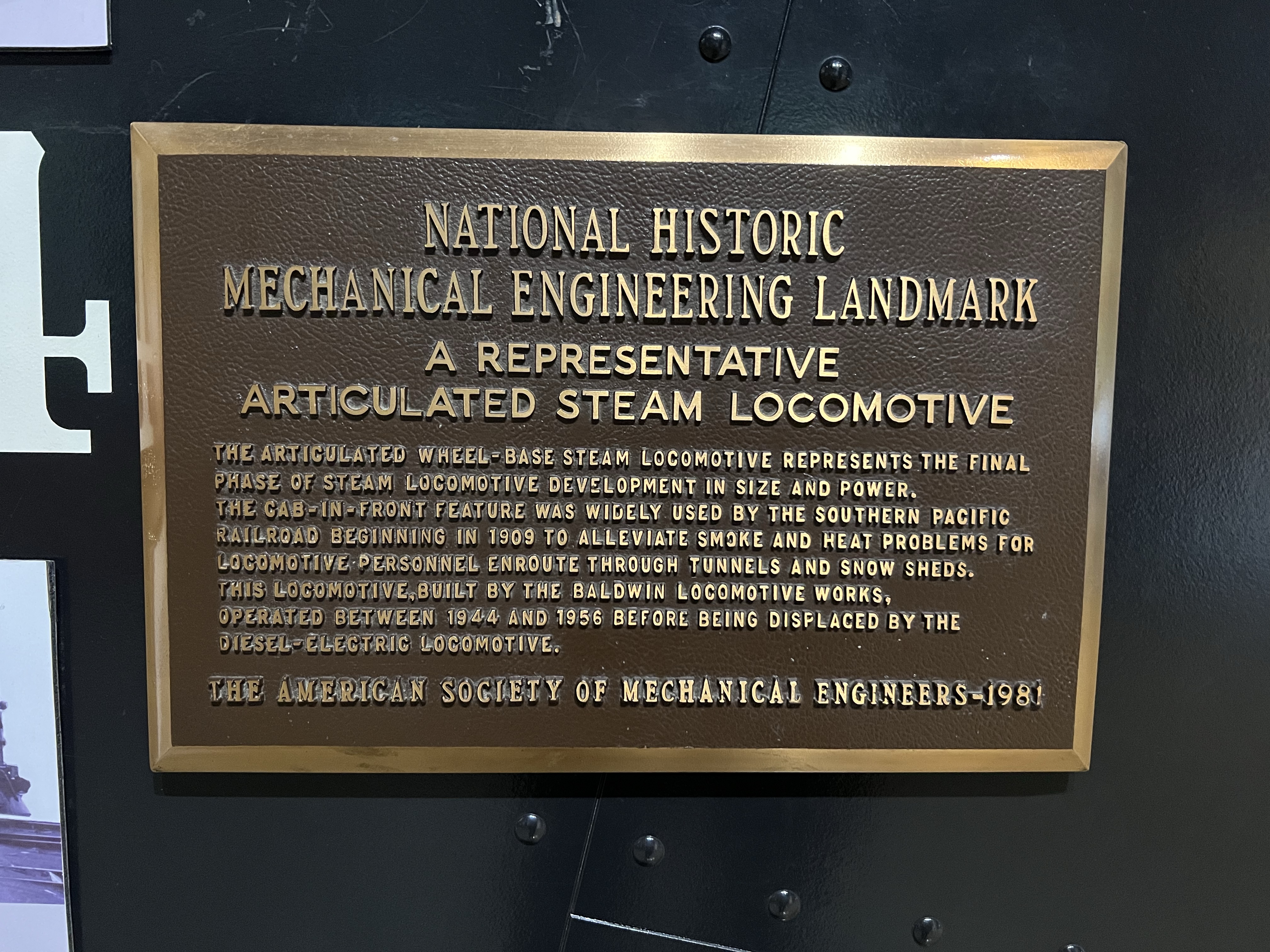
This last of the cab-forwards was such an engineering marvel that it was designated a National Historic Mechanical Engineering Landmark by the American Society of Mechanical Engineers in 1981. It was the first steam locomotive to be added to the list. Of the 300 landmarks in existence, only seven are steam locomotives, including Union Pacific’s Big Boy No. 4023 and Norfolk and Western J-Class No. 611 (more about 611 in a later post).

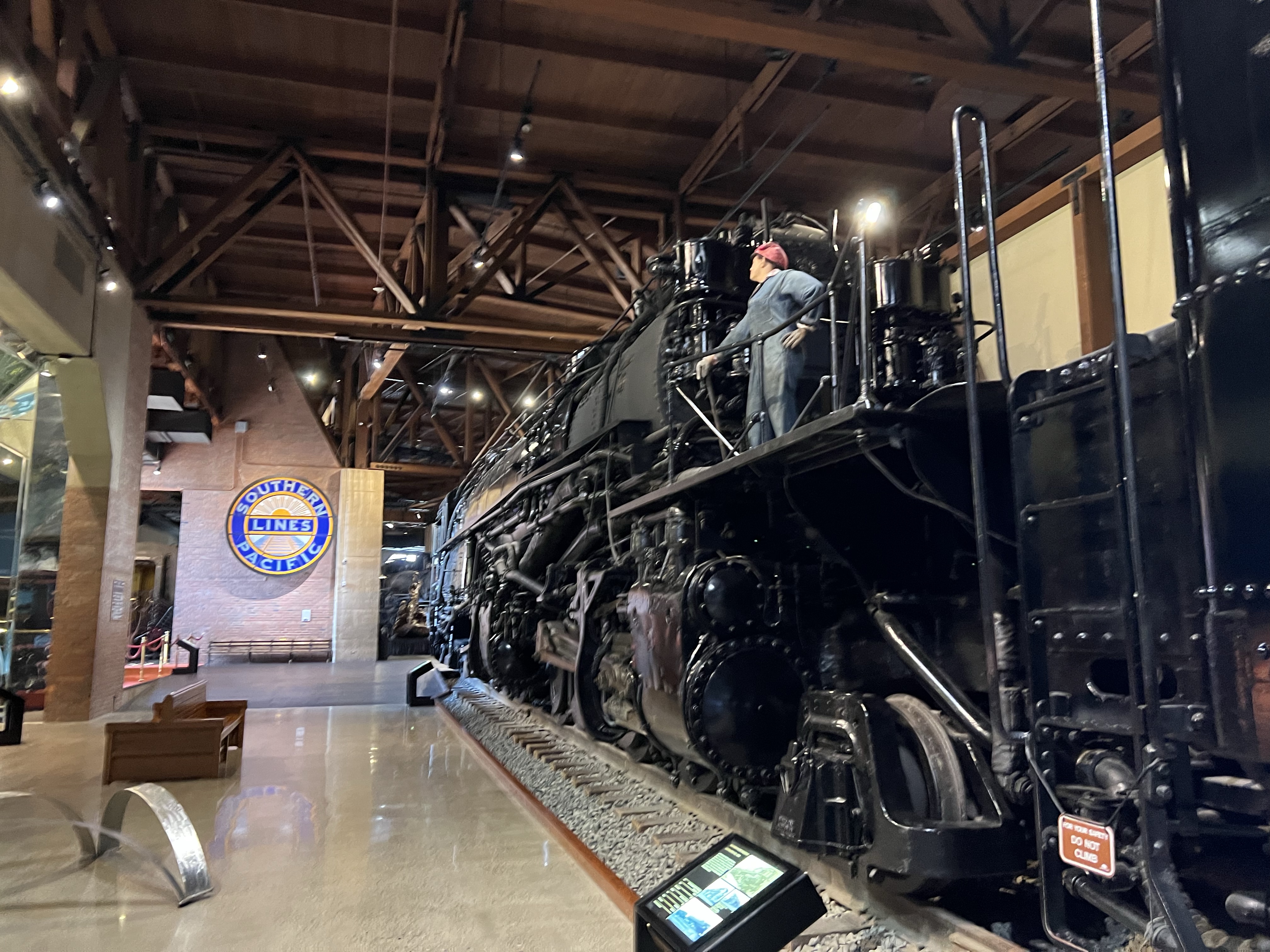
This locomotive is massive and the largest and most powerful locomotive in the museum’s collection. The locomotive and tender are 123 feet and 8 inches long and the total weight of this Beast of the Sierras is 1,051,200 pounds (525 tons). One of the docents I talked to was old enough to see a cab-forward in action as a child and he told me that the locomotive scared him and the ground shook when it passed by.

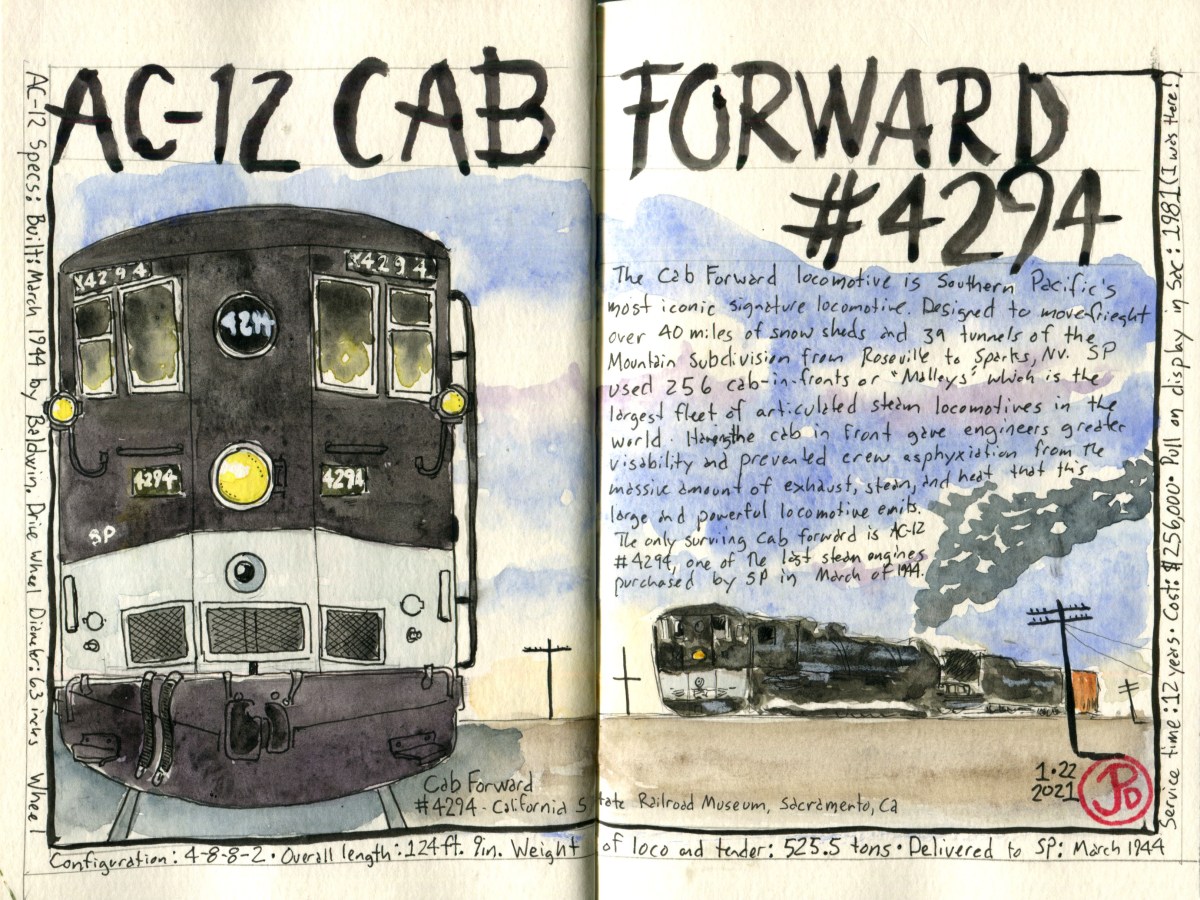
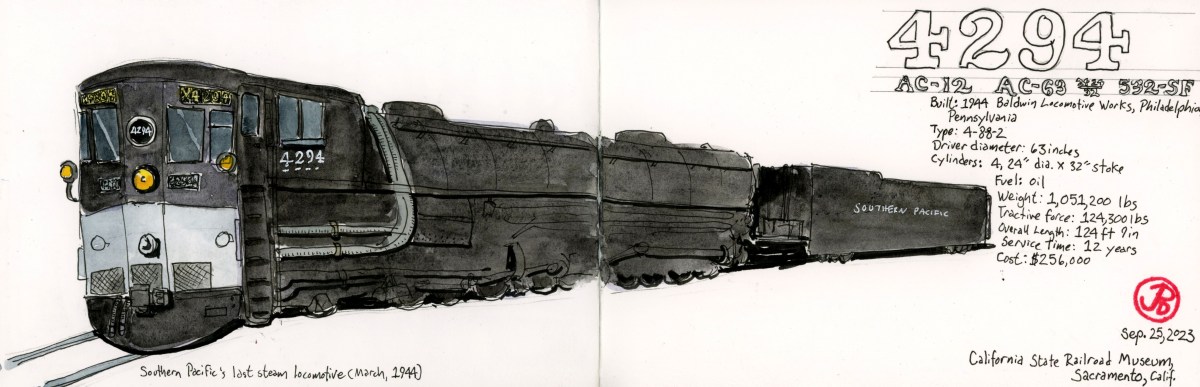
On my visit to the California State Railroad Museum, high on my sketching list was this massive cab-forward. There was only so many perspective to sketch 4294, I tried sketching from above but I couldn’t see the entire locomotive and tender from the third floor gallery so I took a seat under the massive glass Southern Pacific logo and sketched 4294’s front and left side. My wide panoramic journal was perfect for this.

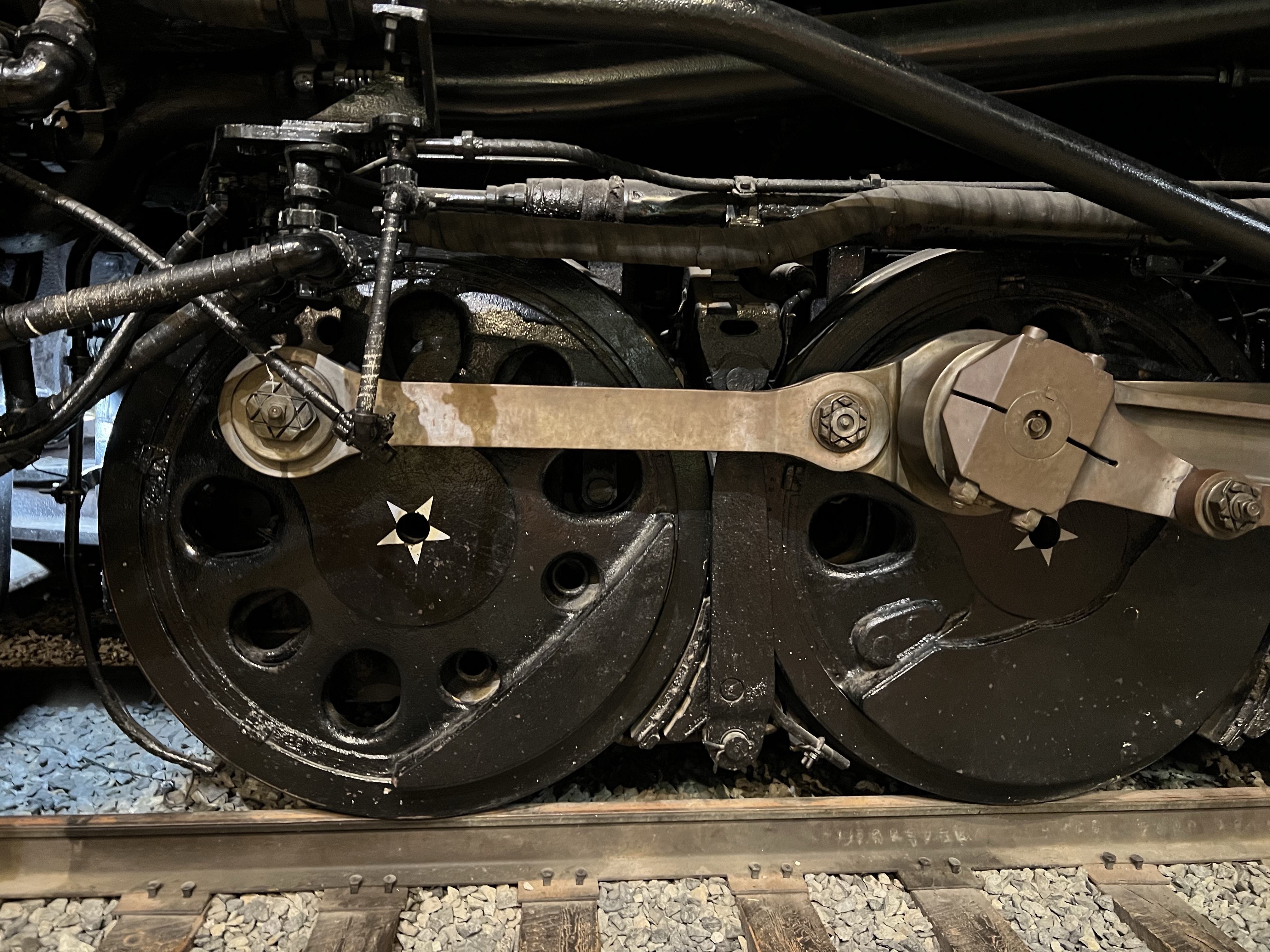
Drawing the complicated running gear was a challenge so I used along of shorthand and used my sketcher’s license!
Looking down the length of 4294 to where I sketched this Beast of the Sierras. I sat on the bench under the SP logo that was once at the Port of Oakland.
Image

Southern Pacific’s Cab Forward

Southern Pacific’s signature, and most iconic locomotive was the 256 AC (Numbers 4000 to 4294) cab forward locomotives.

These were some of the largest and most unique locomotives in the United States. The AC-12 class is less than ten feet shorter than the largest steam locomotives ever built: Union Pacific’s “Big Boy”. The AC-12 locomotive and tender weighed more than a Boeing 747 and an Airbus A380, combined.

The reason the cab forwards were unique is that, as the name implies, the crew cab was in the front of the locomotive, like a modern diesel-electric locomotive, instead of the cab being in back, near the tender.

Having the cab in front gave the engineer and fireman unequalled views of the track ahead. But the real reason for the innovations was to conquers the steep grades of Sacramento’s Mountain Subdivision over the Donner Pass. This massive locomotives operated between Roseville, Ca and Sparks, Nv where a powerful locomotive was needed to tackle the steep grades and have the tractive effort to haul long freight trains over the Sierra Nevada Mountains. A locomotive of this size emits of lots of steam exhaust because a 4-8-8-2 was essentially two locomotives in one.

The Donner Pass route had 40 miles of snow sheds and 39 tunnels. This meant that in a standard locomotive, the crew could suffer from asphyxiation from the steam exhaust. By putting the cab forward, the exhaust stack was behind the crew and they avoided the caustic smoke, steam, and heat that these powerful locomotives emitted.

The cab forward proved to be a very successful locomotive for SP, with 256 of these engines used on it’s rail over the period of 50 years. The railroad had the largest fleet of articulated “Malleys” in the world. As a comparison, Union Pacific fleet contained 25 Big Boy locomotives.

In the 1950s, as diesel replaced steam, cab forwards spend the rest of there working life away from the mountains on the Coast Line and the Western Division. One of the last places cab forwards worked on Southern Pacific rail was the Cal-P line between Oakland and Roseville. 1958 was the last year a cab forward rode the rails, nine of these locomotives were taken out of service on September 24, 1958.

Out of the 256 cab forwards that were built, only one survives. The AC-12 number 4294 which is also the last steam locomotive that Southern Pacific ever purchased. 4294 was in service on March 19, 1944 and was taken off the the roster on March 5, 1956. She was only in service for 12 years.

While the other cab forwards were scrapped, 4294 was put in storage and then was put on static display on October 19, 1958, in front of the Sacramento train station. When the California State Rail Road Museum was opened, 4294 became the centerpiece amongst it’s collection of locomotives and rolling stock.

I was at the museum with my father in 1981 for the official opening of the museum. SouthernPacific’s GS-4 4449 and Union Pacific’s 844 (then numbered 8444) where in attendance and I will never forget when the two locomotive stood, pilot to pilot, on the track outside of the museum!

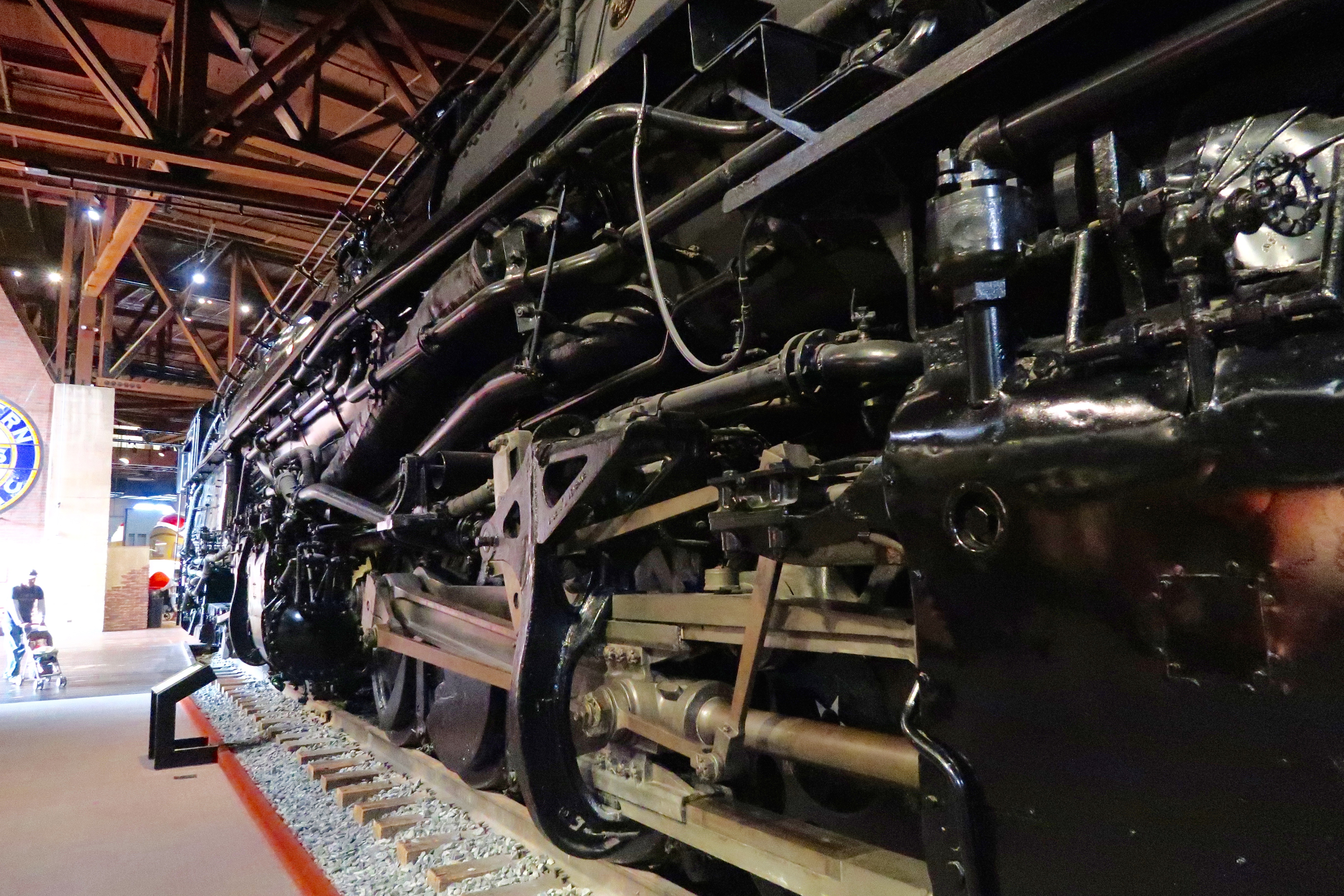
The massive running gear of the AC-12, Cab Forward. 4294 is the only surviving example of this locomotive.

The last time I have visited the museum was in November of 2017 where I did an aborted field sketch of the cab forward. There was something about the proportions of the locomotive that I did not get right. I had planned to return to the California State Rail Museum in the early Spring of 2020 but the cases of Covid-19 were growing at an alarming rate in the state and the museum eventually closed it’s doors for an indeterminate time.

So if I could not sketch the AC-12, at least I could sketch it from an image, which really is the next best thing.