Sketching the Mendo Coast

I found plenty of sketching subjects on a Monday morning drive north from my Caspar digs on the Mendocino Coast: two whales and a rock shaped like an elephant.

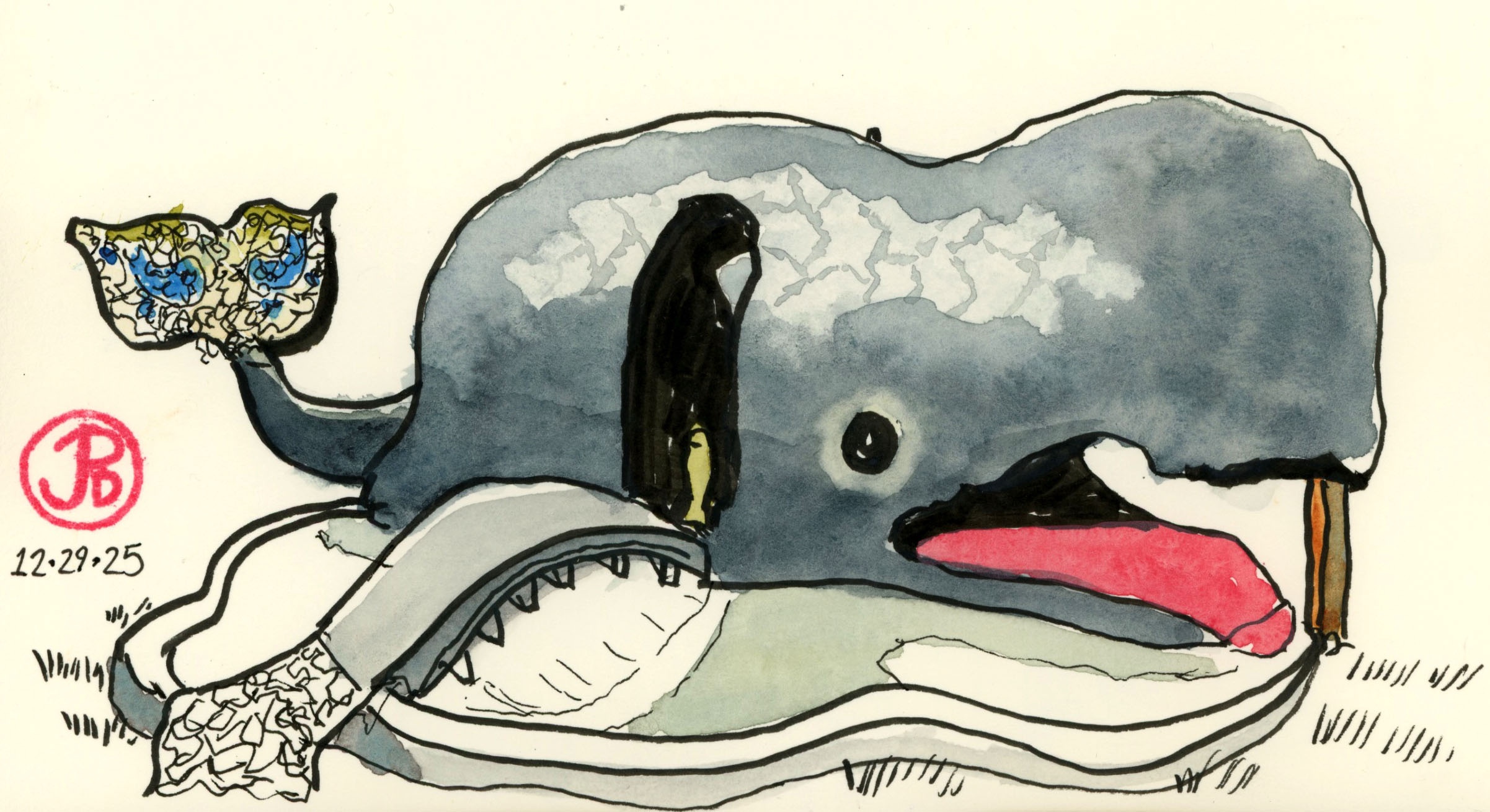
My first “whale” was to be found in Westport (population 299) about 15 miles north of Fort Bragg on Highway One.

If you build a whale, they will come. At least that’s what I think the sculpture/creator thought and I did come to sketch it. At onetime you could enter the belly of the whale and recline and watch television. Now it seemed closed to the public with a sign on the white picket fence warning of the Dalmatian. I didn’t see the Dalmatian, so I guessed I would be safe.
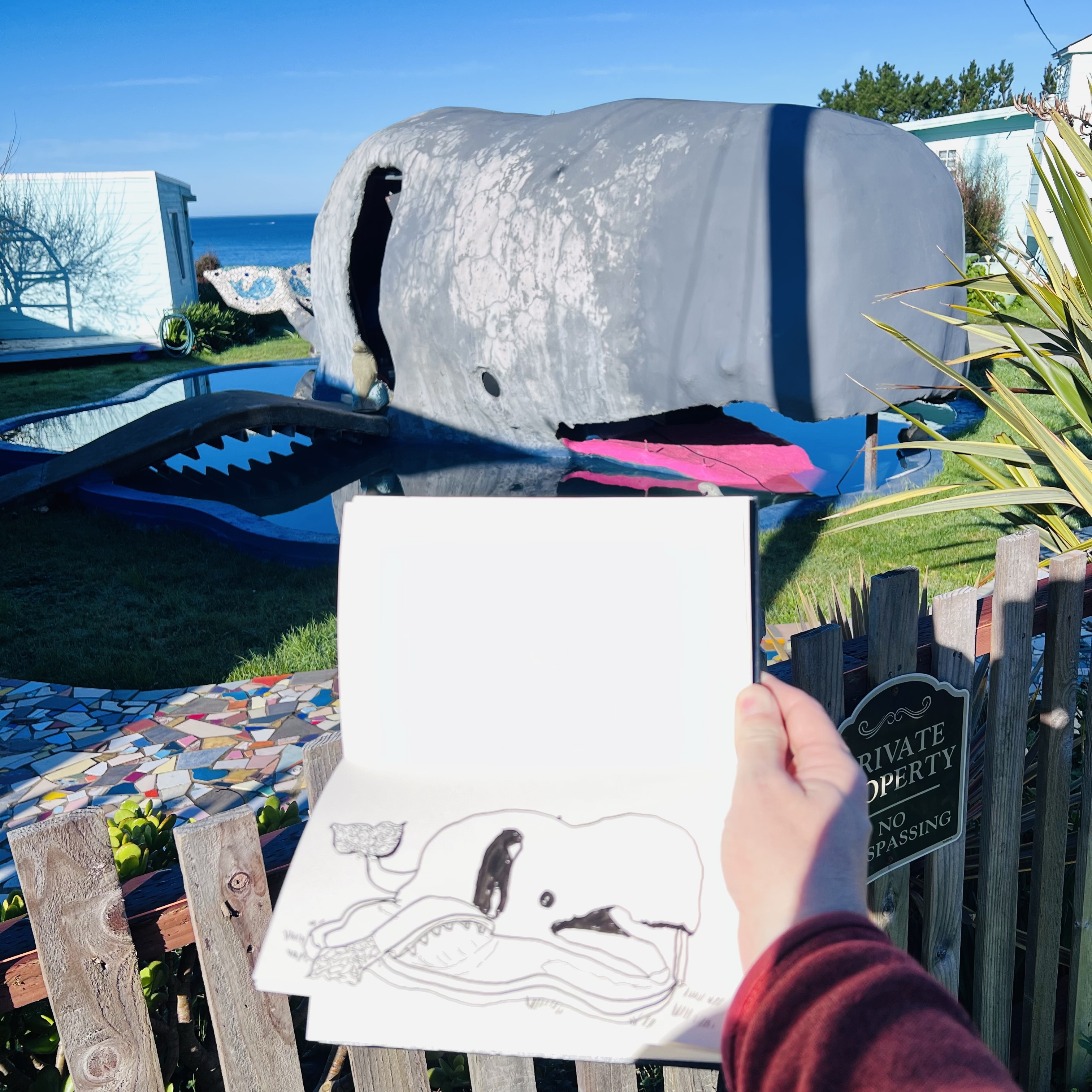
Thar she blows!!

Some things are beyond the realm of understanding such is the gray sperm whale in the front yard in Westport. Everyone knows that gray whales are the stars of the Mendocino Coast whale migration not Moby Dick!

Roadside attraction gone bad or failed hotel room, who knows! I sketched it anyway.

I retraced by way south to Blues Beach. My next sketching subject was a large rock which, if your squinted, looked like a pachyderm, hence the name Elephant Rock.

My final whale sketch was alas, a real whale. At least a former one. This was to found at MacKerricher State Park just north of Fort Bragg.

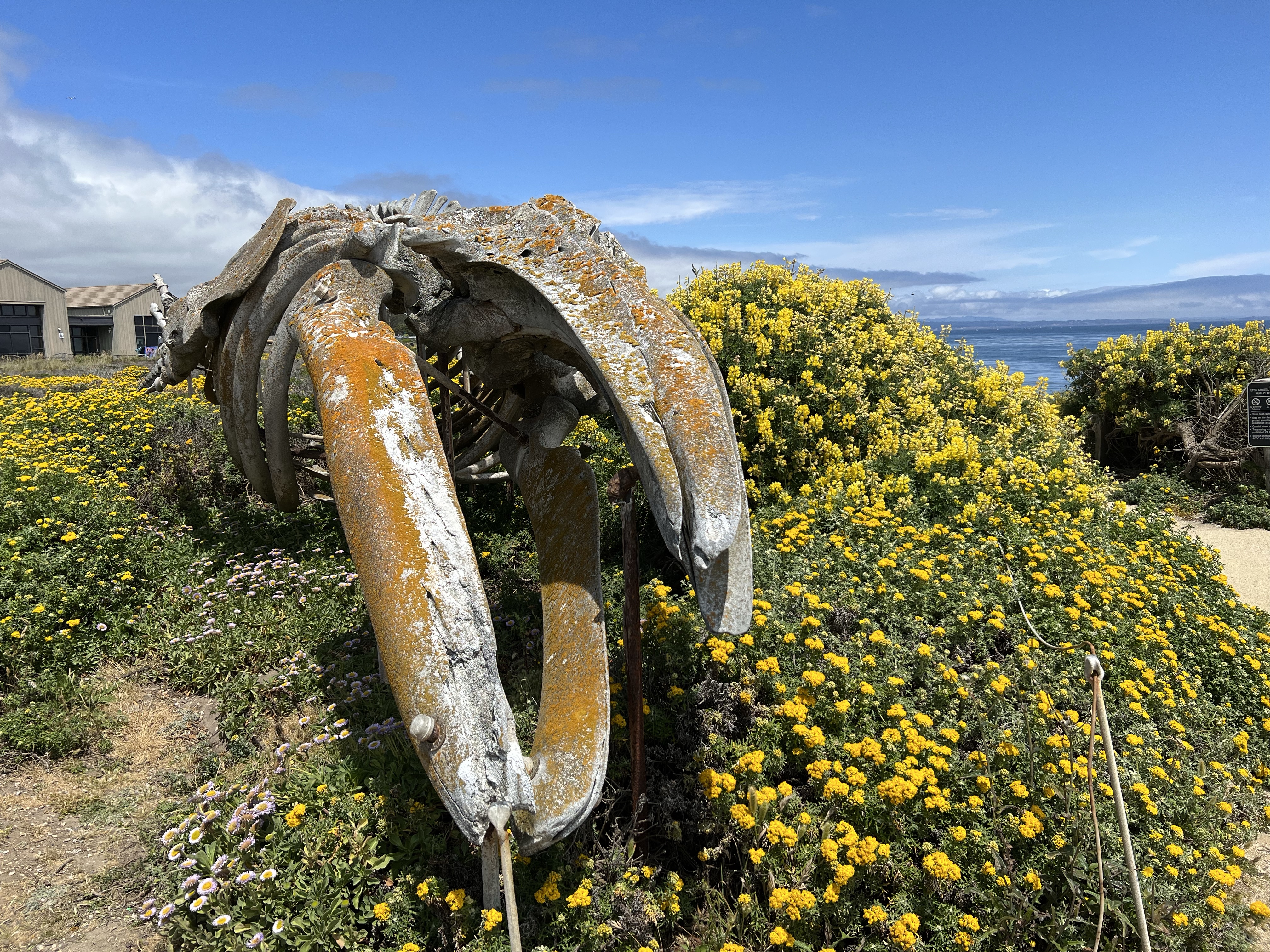
Near the visitors center is a collection of whale bones. The 32 foot gray whale skeleton was what caught my sketcher’s eye.

I seated myself on a nearby picnic table and started to sketch the jigsaw bones of the gray whale.
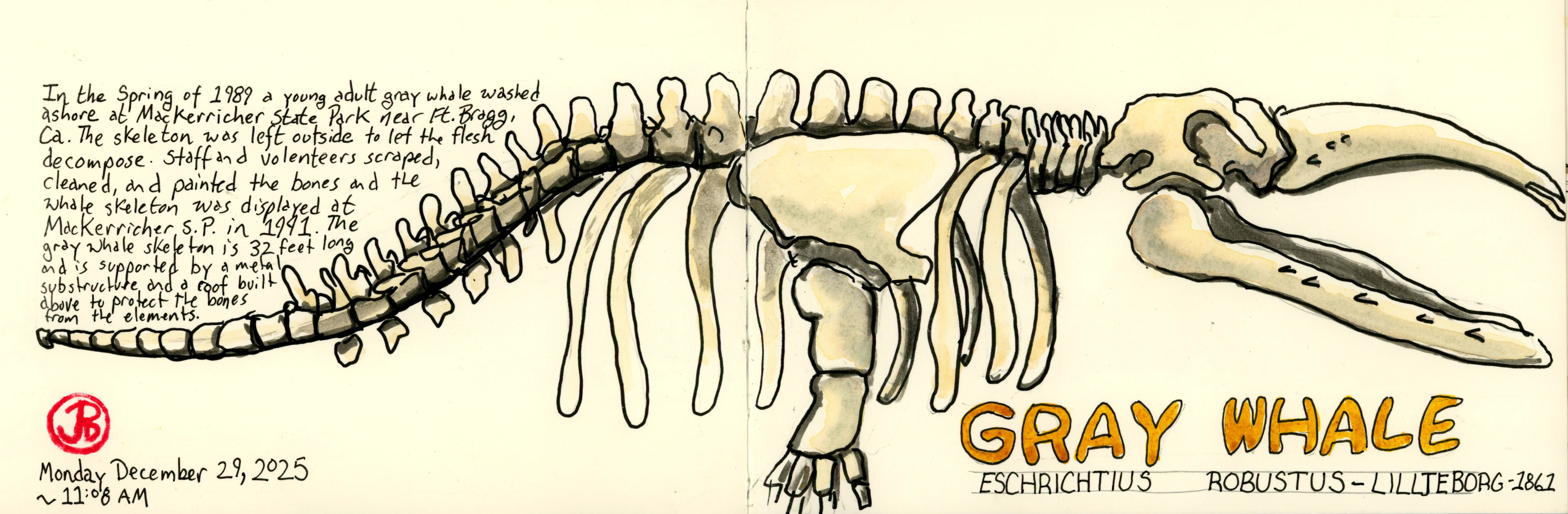
The gray whale migration should begin in earnest in February as adults would be heading south to their birthing lagoons in Baja California.

Image

The Former Whales of Long Marine Lab

One joy of sketching is to return to a previous subject but sketch it from a different perspective. Such is the case with the whales of Long Marine Lab in Santa Cruz. (Former cetaceans, that is.)

Long Marine Lab is part of the University of California at Santa Cruz (UCSC) and is a research and educational facility for marine biology. The campus also features a small aquarium (the Seymour Marine Discovery Center) that is open to the public. The biggest draw for me is the biggest creature that ever lived on Planet Earth: the blue whale. The Discovery Center has an incredible blue whale skeleton on display flanking one side of the museum.

I had sketched the massive blue whale skeleton and the smaller gray whale skeleton before but I wanted to sketched them in a different way. For the blue, I stood directly in front and sketched it head on, as if the largest creature on Planet Earth was swimming towards me.

I have been lucky enough to see blue whales in the wild from pelagic boating trips. Most of these trips have been in Monterey Bay. I remember the first time I saw this massive cetacean on a trip out of Monterey Harbor with my father in the late 1980s. My high school biology teacher at the the time didn’t believe blue whales could be seen in Monterey Bay, until I showed him the photos.

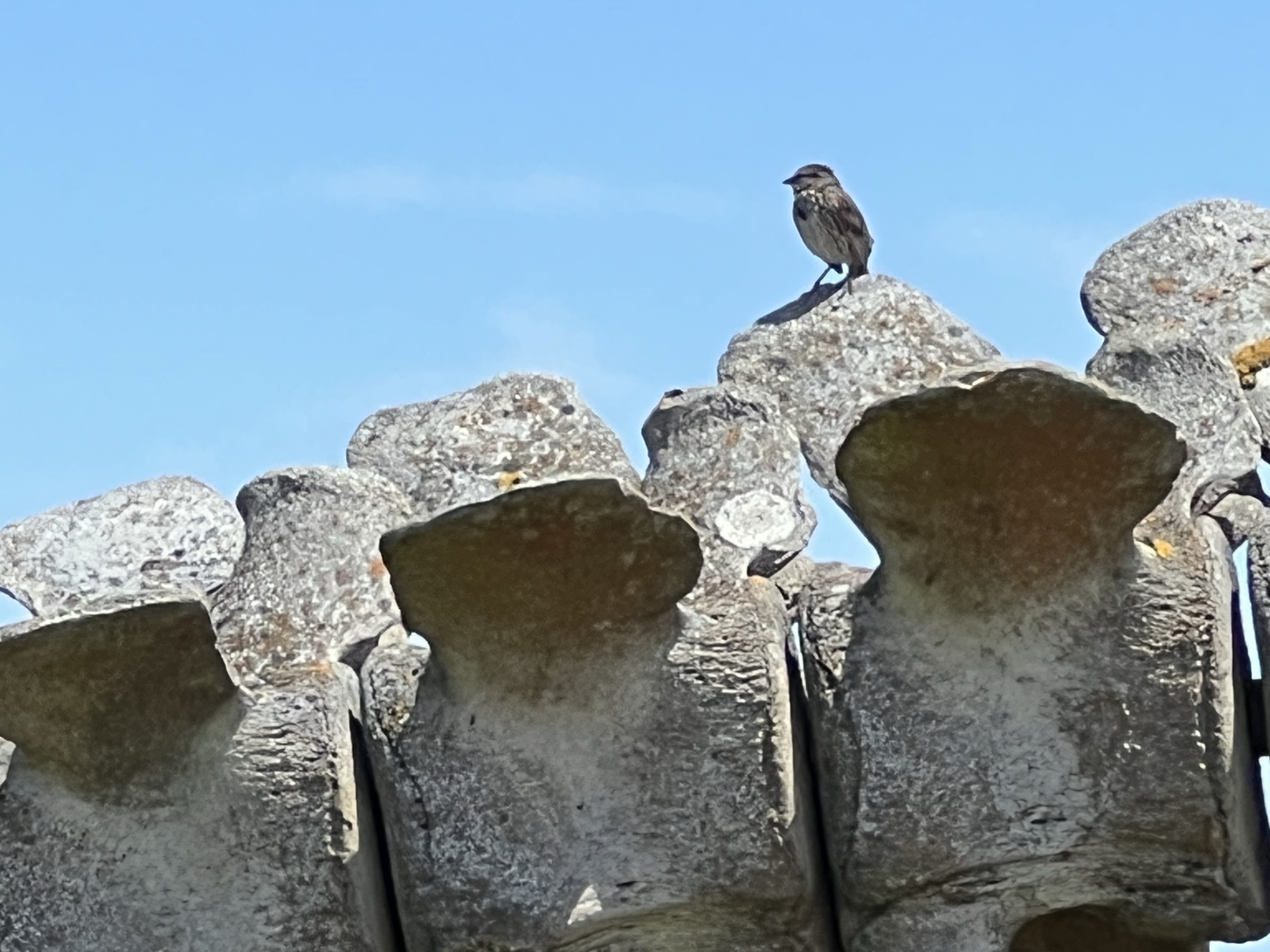
Song sparrow using the vertebrae of the gray whale for a singing perch.
Gray whale skeleton with the Seymour Marine Discovery Center on the left and Big Blue on the right.
Image

Pacific Grove Museum of Natural History

On my first full day of summer I headed 50 minutes south of Santa Cruz to Pacific Grove on the Monterey Peninsula.

This is a return trip (it had been a while) to the Pacific Grove Museum of Natural History.

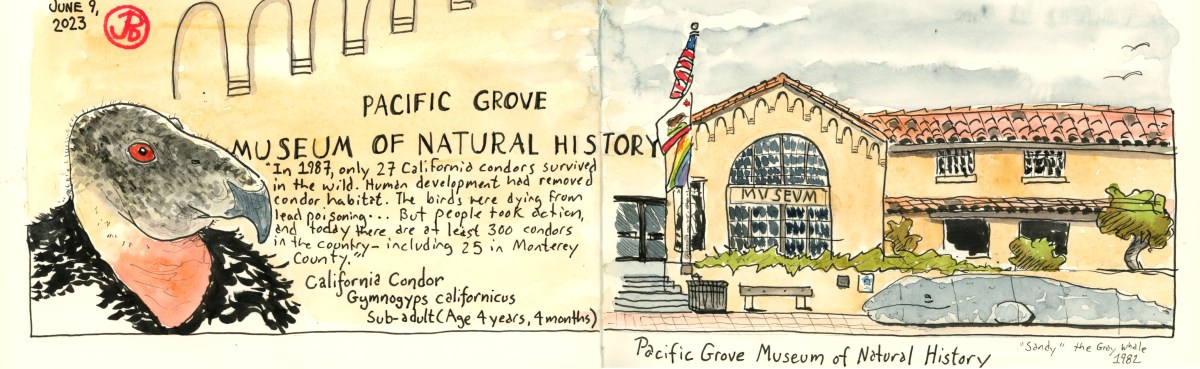
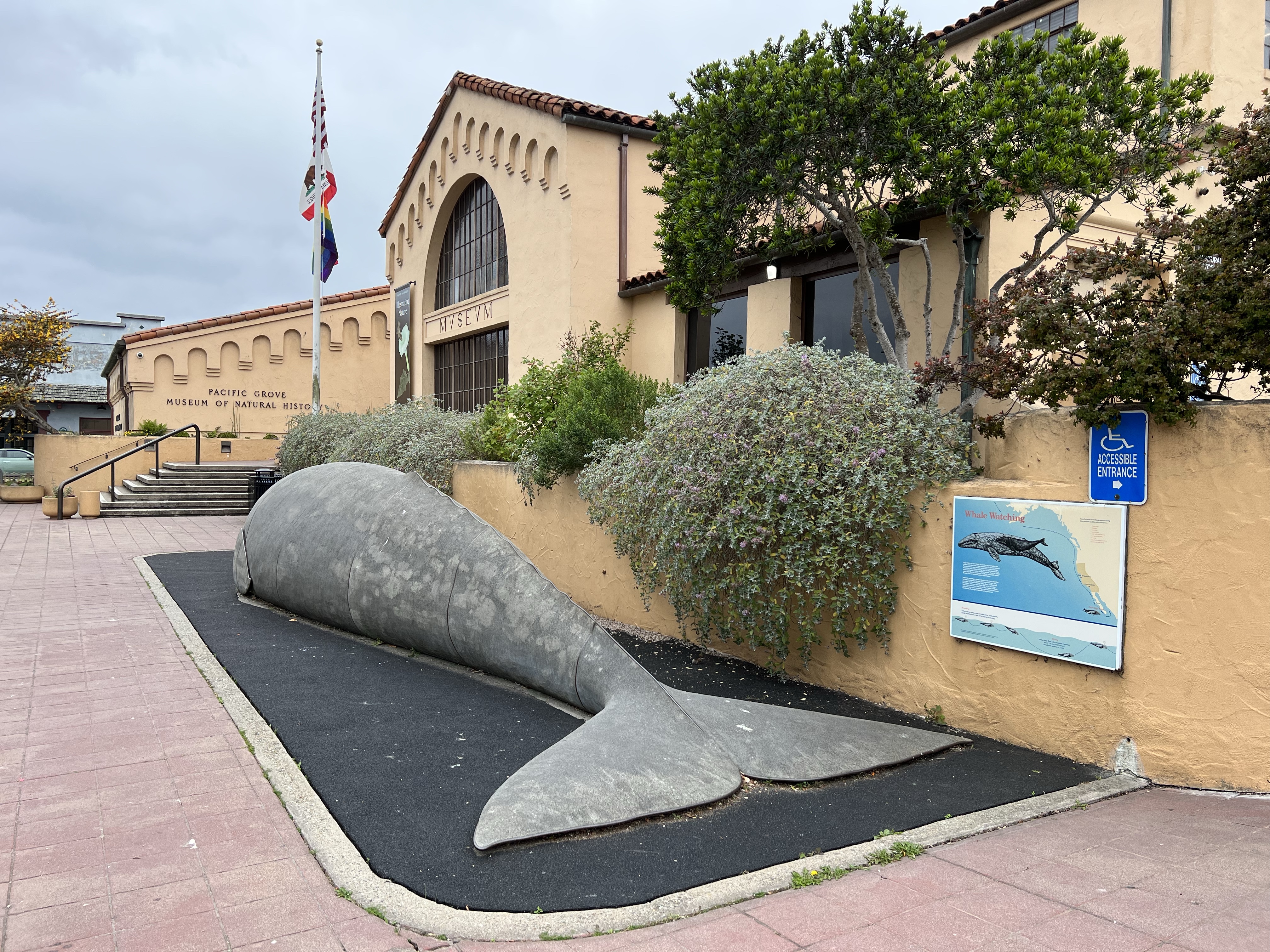
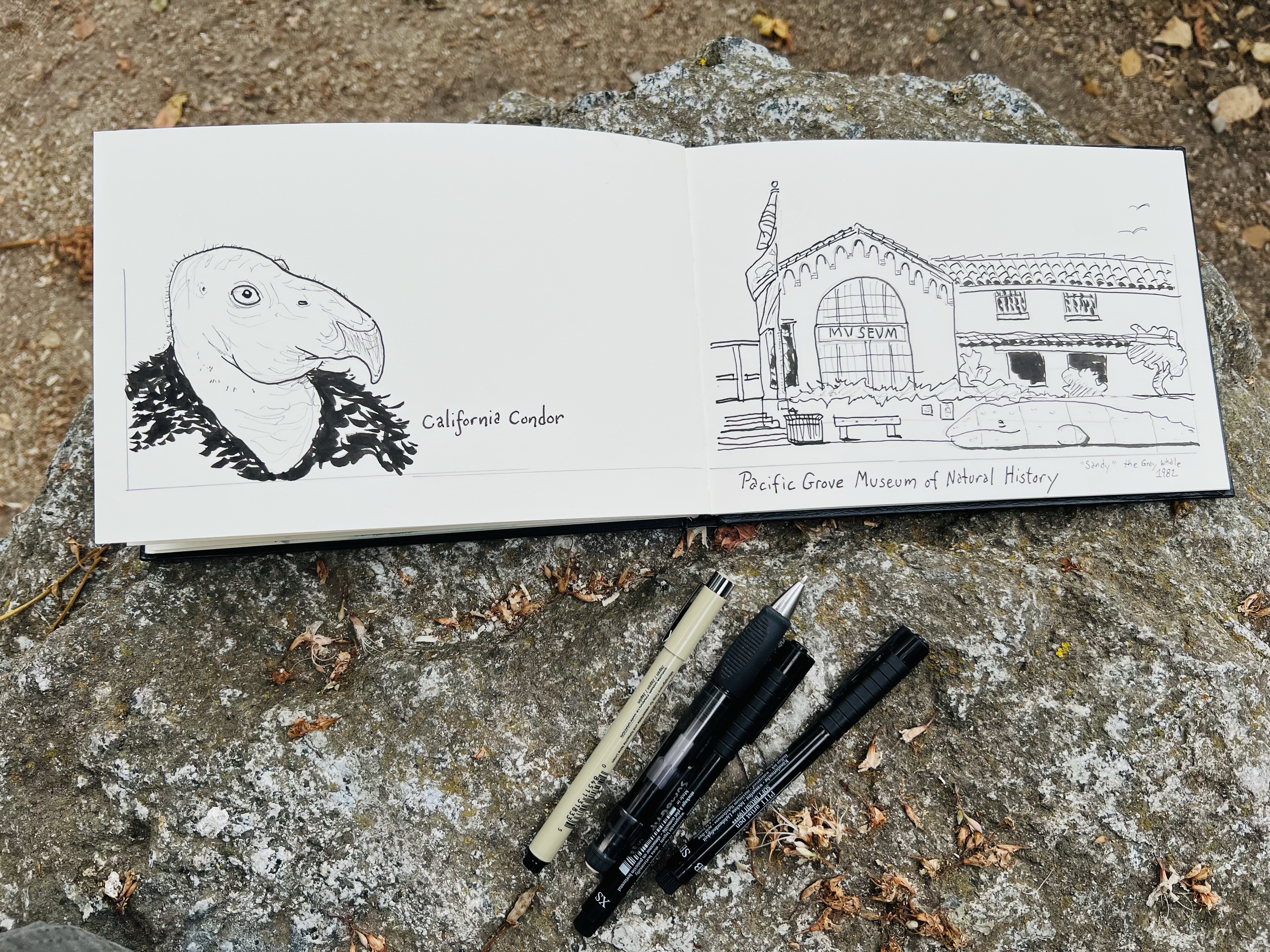
I arrived early and sat in the park across the street to sketch the 1932 Spanish Mission Revival museum. To the right was a statue of a female gray whale named “Sandy”, built in 1982.

“Sandy” in the foreground and the museum in the background.

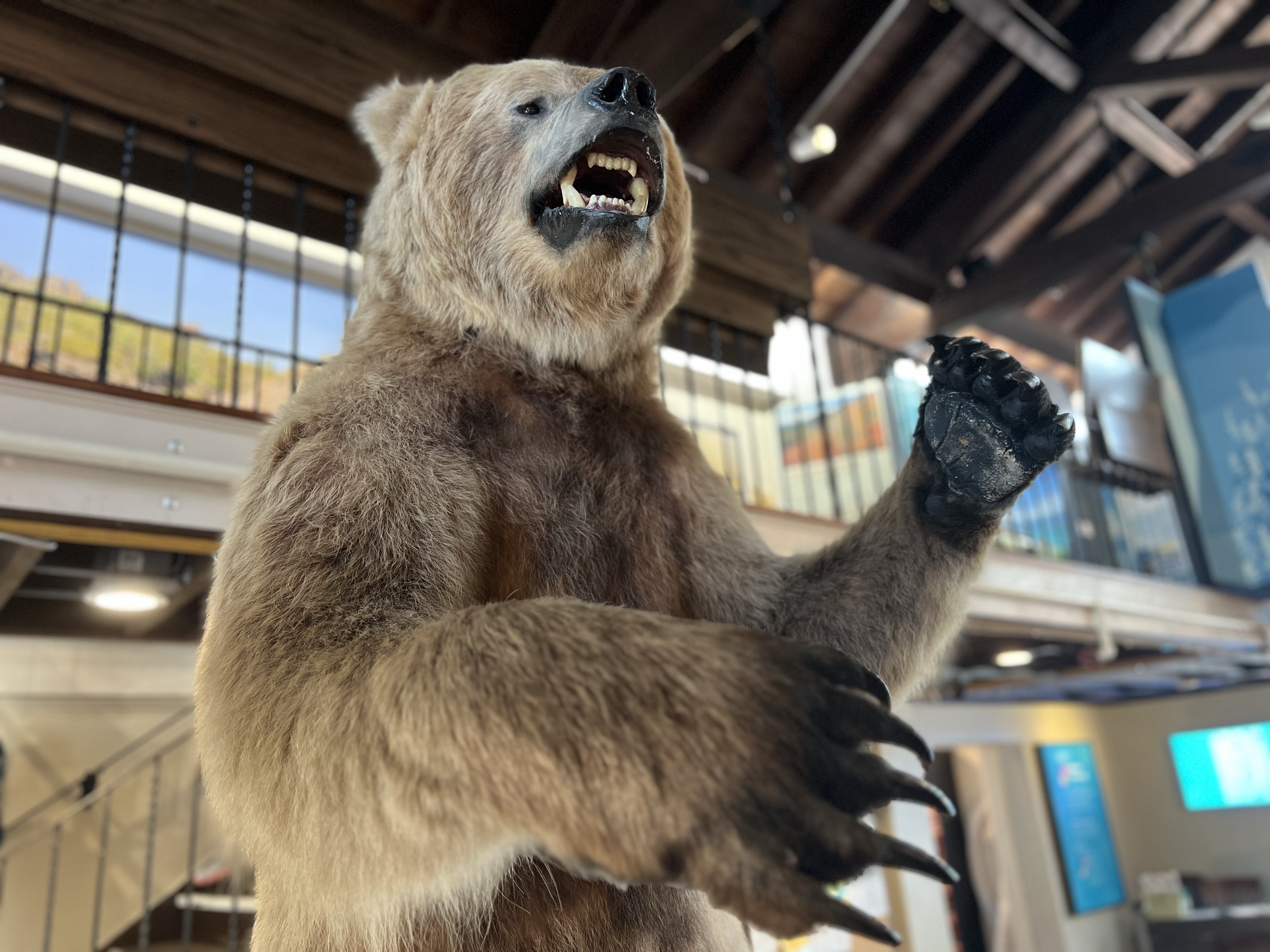
The museum opened at ten and after paying my $10 admission I walked into the gallery, greeted by a grizzly bear standing up on it’s hind legs. The grizzly is the extinct State Mammal of California. This specimen came from Alaska.

The Pacific Grove Museum of Natural History is full of animals: insects, amphibians, reptiles, fish, mammals, and birds, lots of birds. But all of them are dead. This is a mount museum where the visitor are surrounded by taxidermy. Some very lifelike but others a little comical.

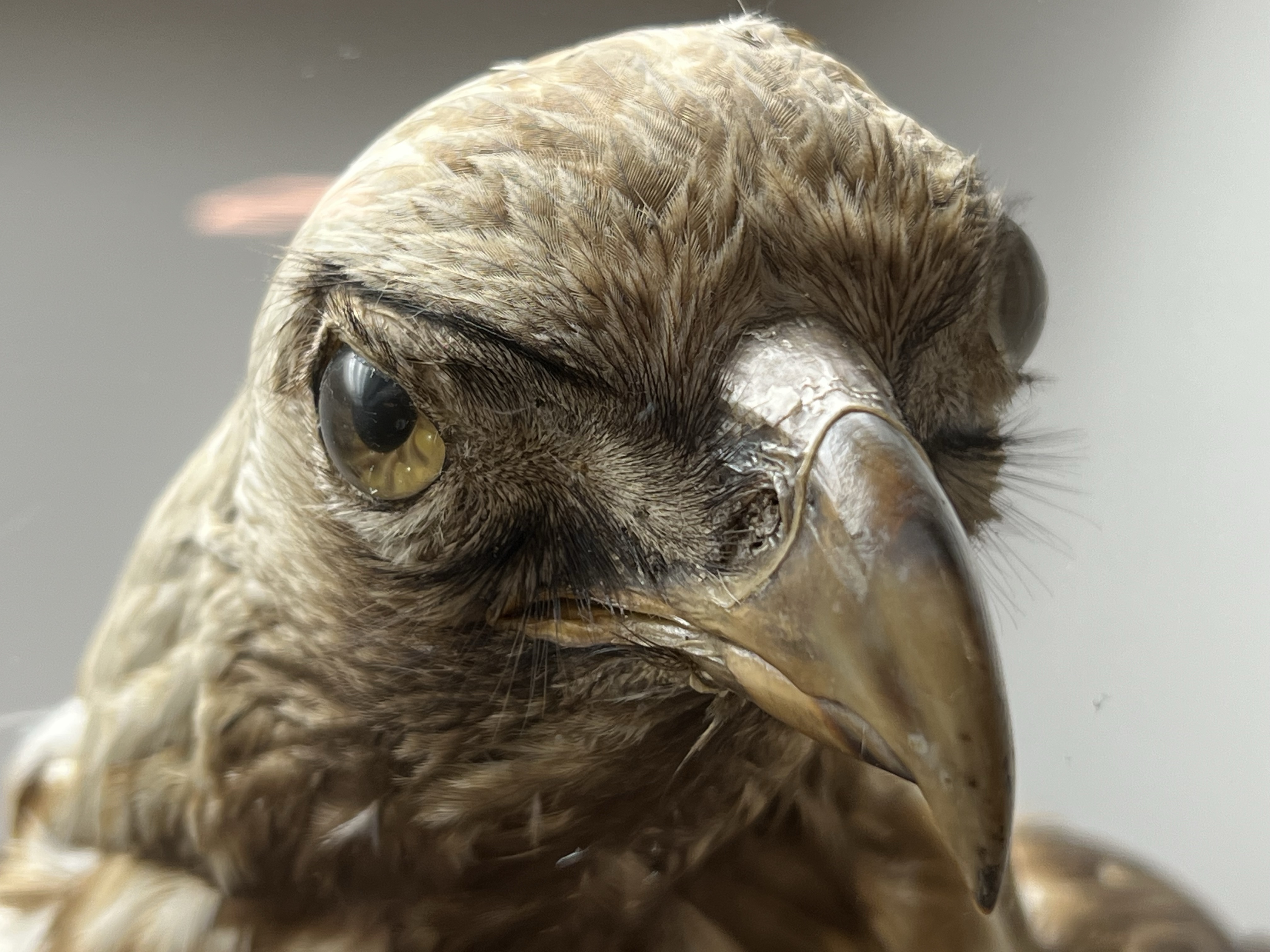
This taxidermy golden eagle looks like someone squeezed it a little too hard.

This is a sketchers paradise because it provides lots of subjects, none of which are moving anytime soon. After sketching the exterior of the museum, I added a California condor from the bird hall. These magnificent and rare birds can be seen a short distance from PG on the coast of Big Sur.

My spread in progress from the Monterey Native Plant Garden in the back of the museum.
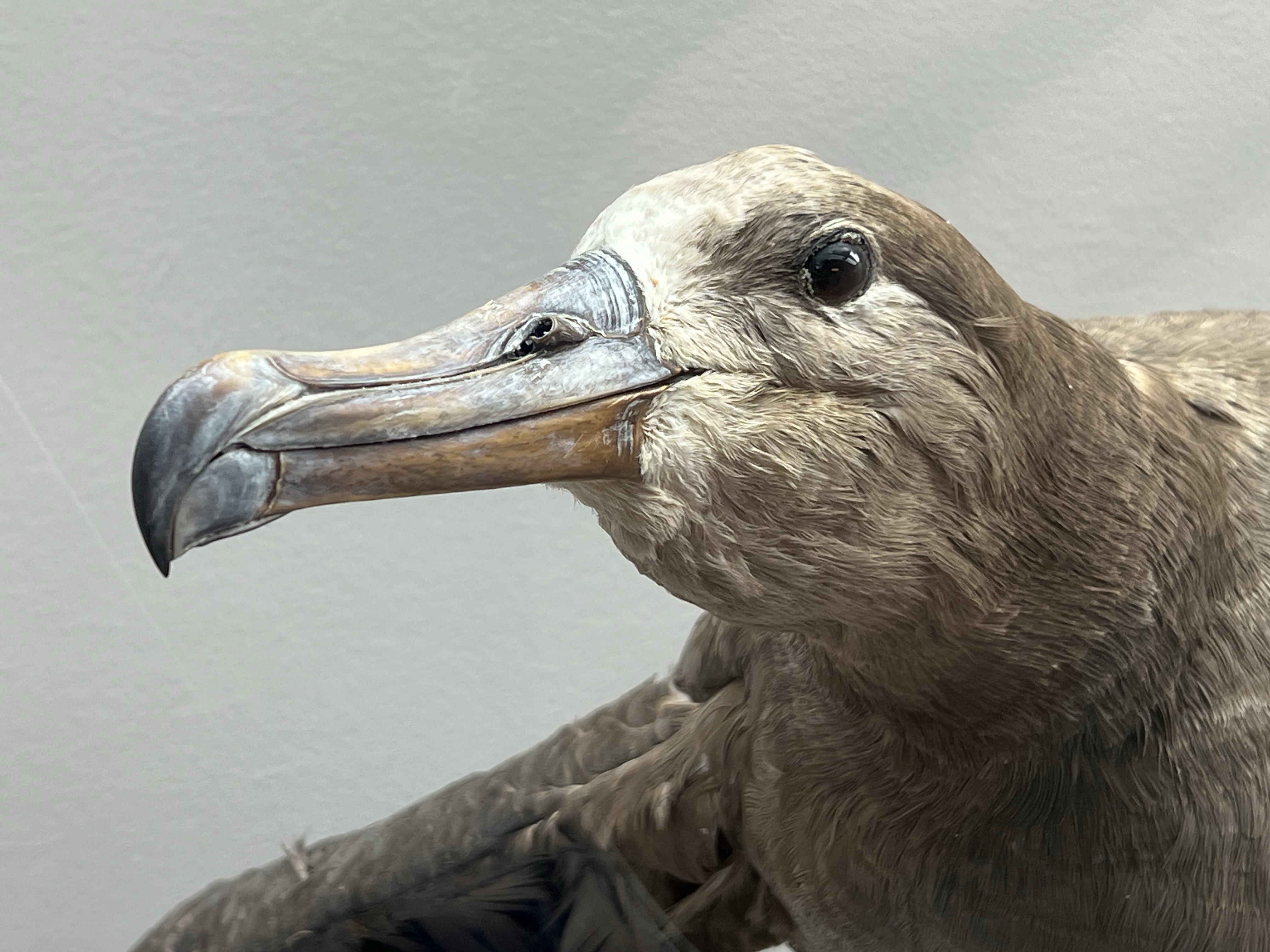
The black-footed albatross can be seen in the Monterey Bay, usually on a pelagic boat trip. A Northern California coast pelagic trip is not the same without a sighting of this iconic species.

One avian mount that I was looking forward to sketching was the extinct passenger pigeon. In Washington I had seen “Martha”, the last passenger pigeon at the Smithsonian Museum of Natural History so I was looking forward to sketching PG’s pigeon.

I looked and looked but I could not find the passenger pigeon. I thought it might be in the pigeon cabinet between band-tailed pigeon and rock dove. Nope. I even asked the lady at the desk and I got a blank stare. You think such a noteworthy mount would be well known to museum staff. Nope. None of the docents knew where it was nor what it was.

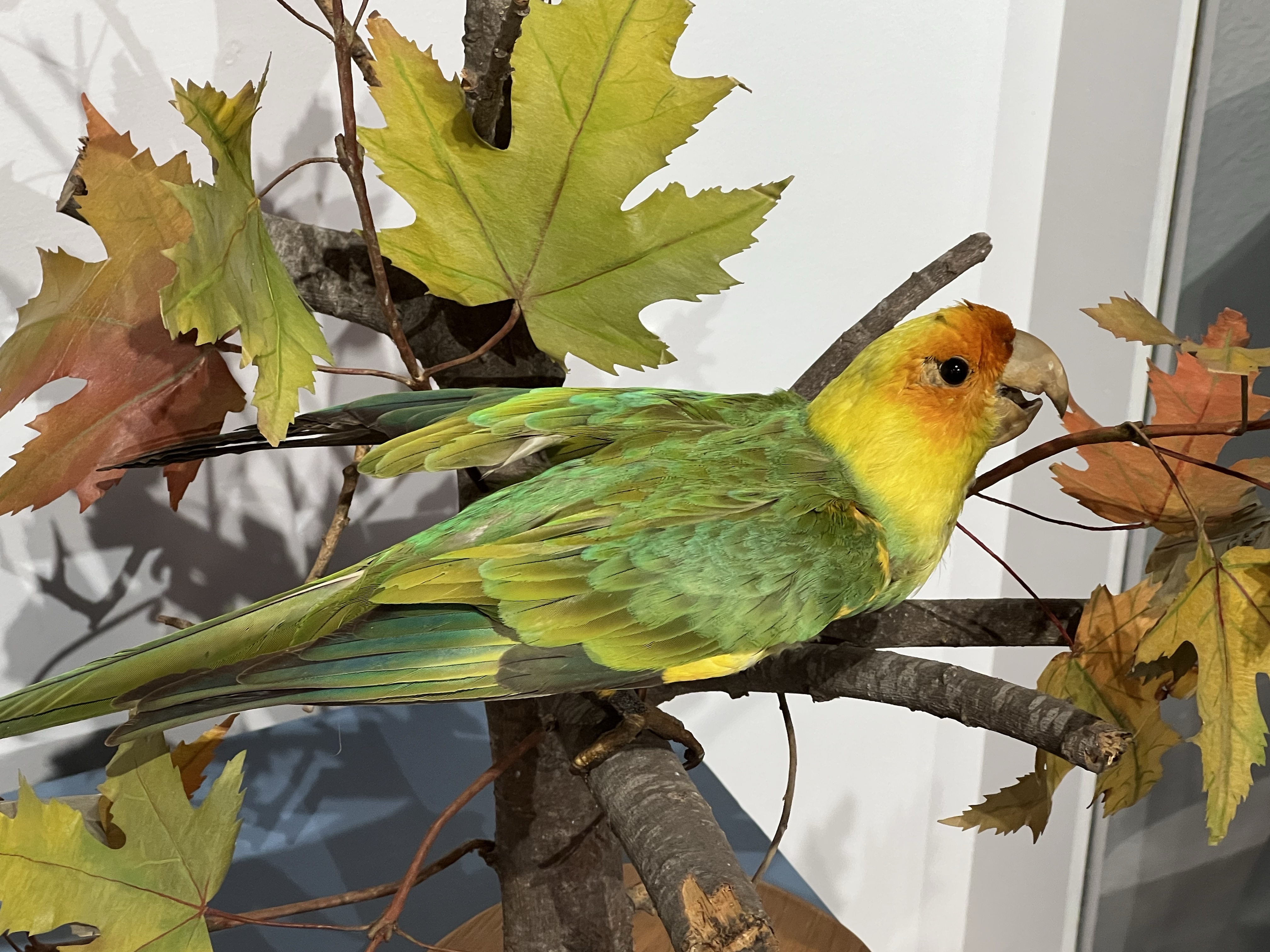
A consolidation was the mount of the Carolina parakeet, long extinct. The last individual died in 1918 at the Cincinnati Zoo.

Image

San Mateo and Santa Cruz Whalewatch

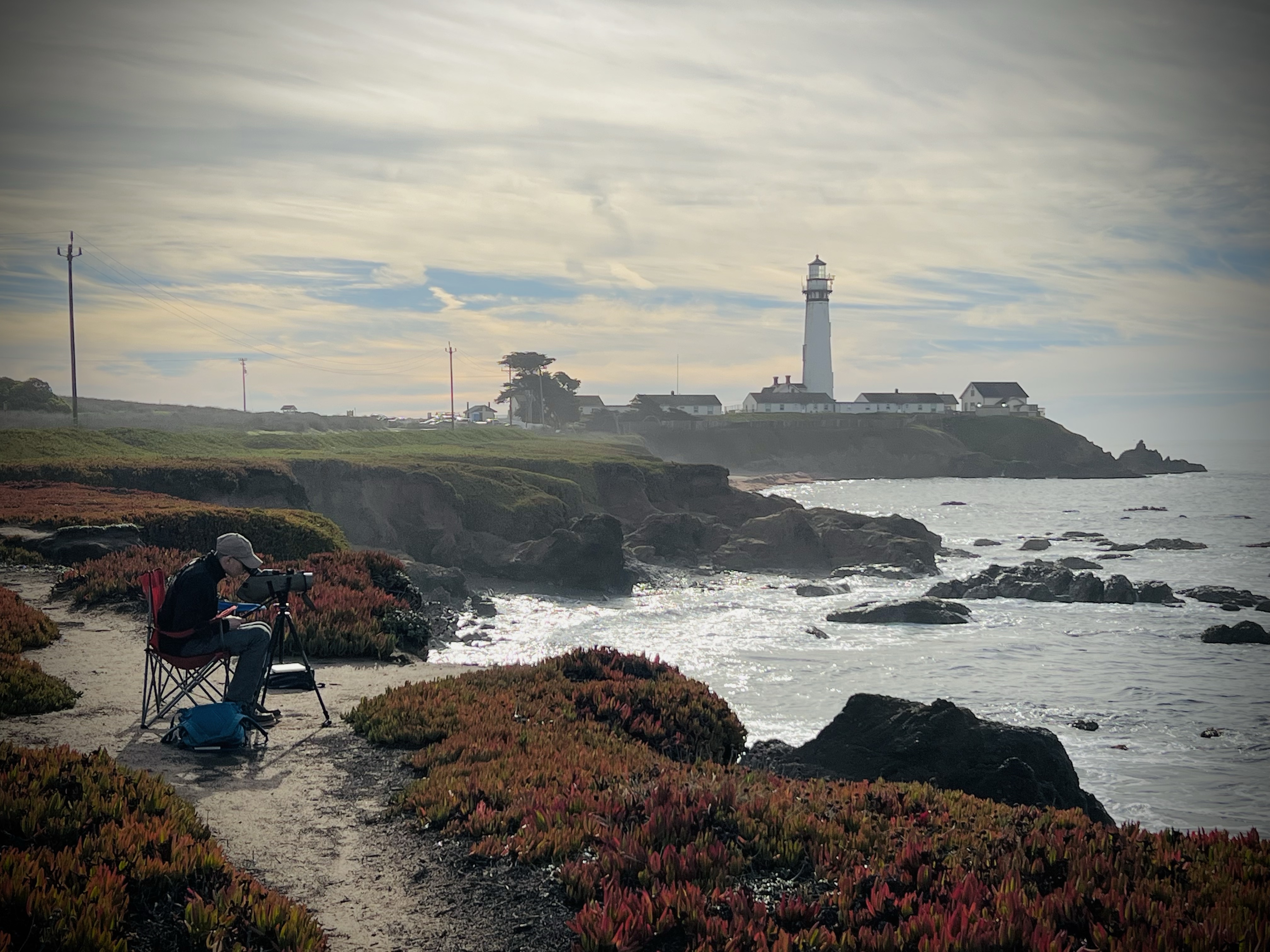
Before setting out on my adventure to Mendocino, I wanted to do a little coastal whale watching in the Bay Area. So I met Grasshopper Sparrow (he has wheels now!) in Half Moon Bay and we headed south to Pigeon Point and turned our lenses west.

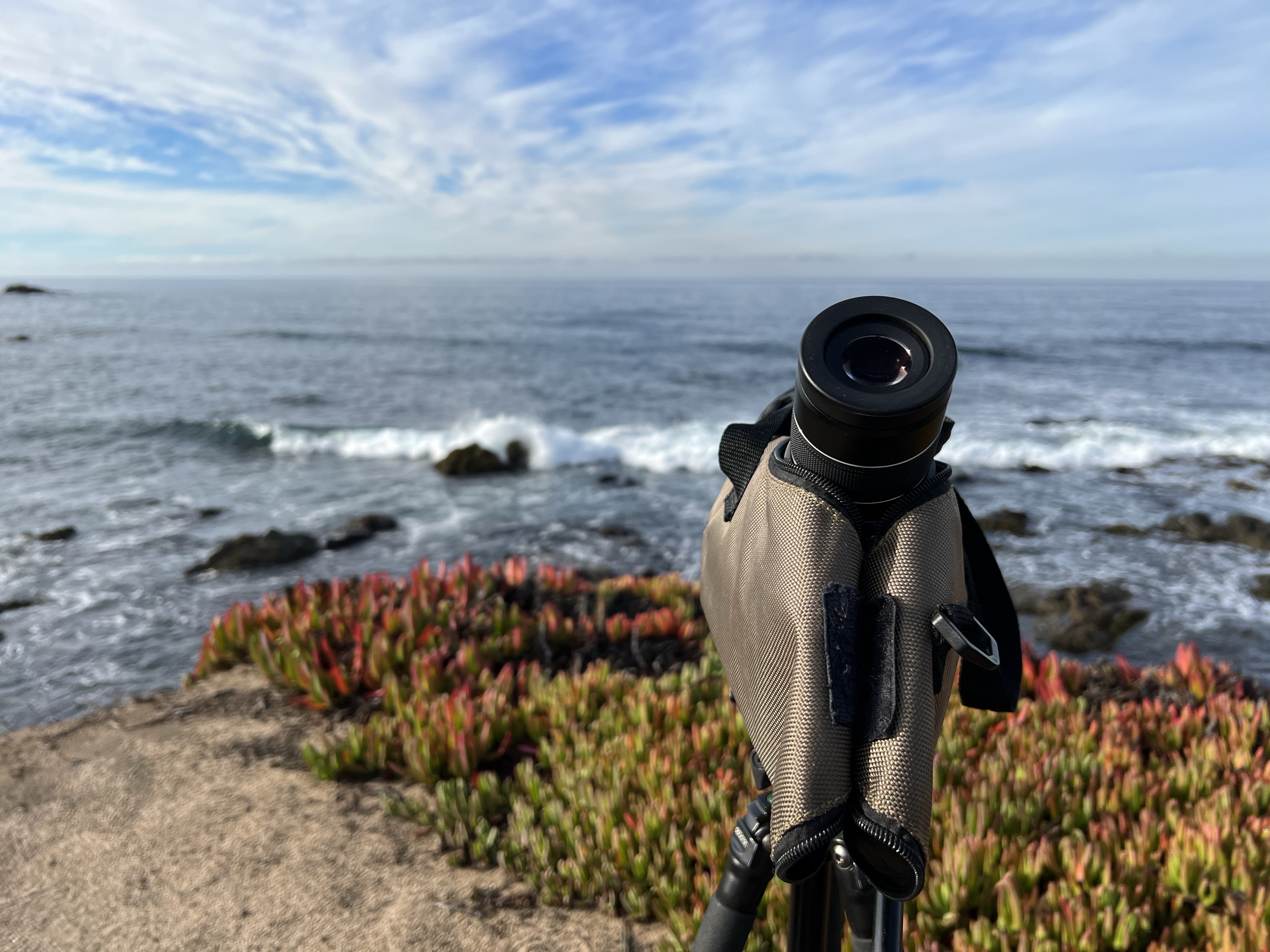
My scope pointed west at Pigeon Point.

We found a point overlooking the ocean just to the north of Pigeon Point Lighthouse. It was a beautiful, clear day and the seas were calm with a lot of bird life flying both north and south. Perfect conditions for land-based whale watching.

We scanned the horizon looking about an inch below, to see if any blows were visible. This is the telltale sign of a whale. Blows happen when their warm breath makes contact with the cold air and the white exhaust can be seen from a long ways away. We were looking for a short bushy blow which is a sign of a migrating gray whale.

I wandered off a few yards to the north to get a look at some roosting surfbirds when Grasshopper exclaimed, “Whale!” I turned my bins to the horizon, scanning about and inch below. Near the horizon I picked out a white blow in the middle of a flock of birds on the water and circling above. These attendant birds are also a great sign of cetacean activity.

Grasshopper spotting blows just below the horizon with the lighthouse to the south. It always helps to have a set of young eyes along for whale watching.

Now we just needed to identify the whale by its unique blow. Grasshopper noted that the whale he saw through the scope had a dorsal fin. Now this would exclude grays because they do not have a fin but a dorsal ridge. Also the blow looked taller than the heart-shaped gray whale blow.

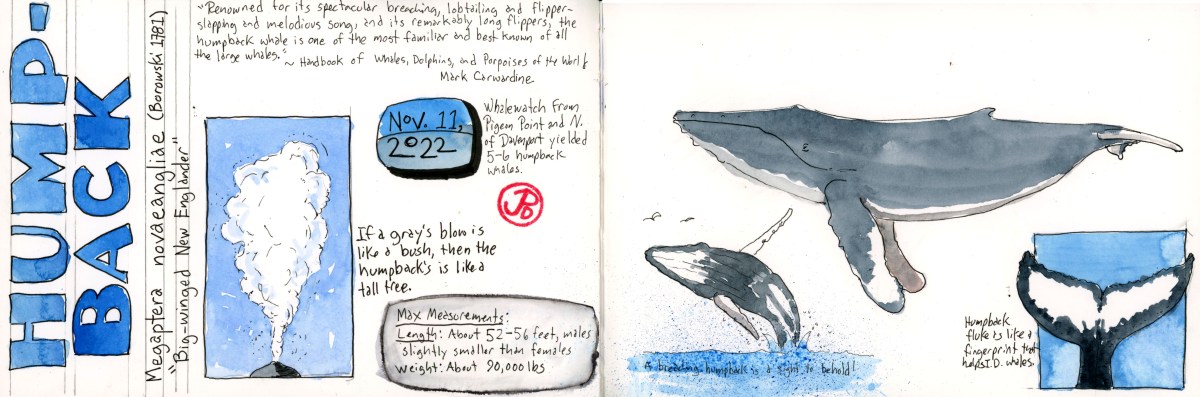
After a few more observations, with a few of the whales showing their pied flukes, I knew we where looking at a group of three humpback whales!

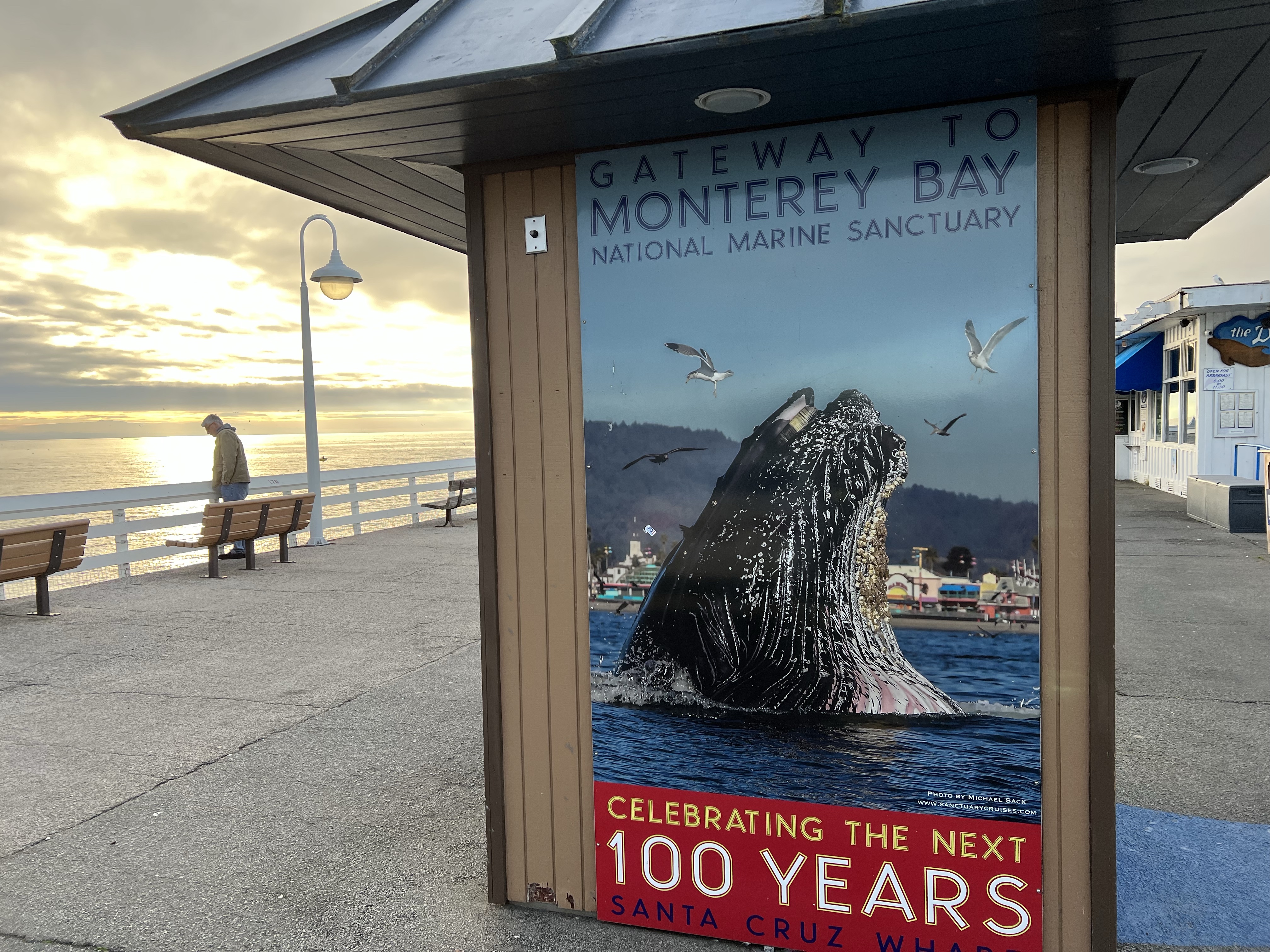
While looking at the rare red-footed booby I spotted this billboard on the Santa Cruz Wharf.

I later headed south down Highway 1 towards Santa Cruz. I pulled off just north of Davenport to have a little lunch and scan the Pacific for whales. I didn’t have to wait long before I saw my first blow with the naked eye. I put a scope on the whales and identified a few more humpbacks but I did not see any grays.

I would have to drive north to meet them “halfway”. Well, that was the plan all along.

Mendocino, here I come!

Image

The Ultimate Mammal Migration

My thoughts and sketches were turning north to my road trip along the California Coast.

I would be using the quaint coastal town of Mendocino as my base camp to explore points north and south along the Mendocino County Coast.

Since I was making my visit during Thanksgiving week, I planned to turn my scope and pen towards the west, to witness one of the longest mammalian migrations in the world.

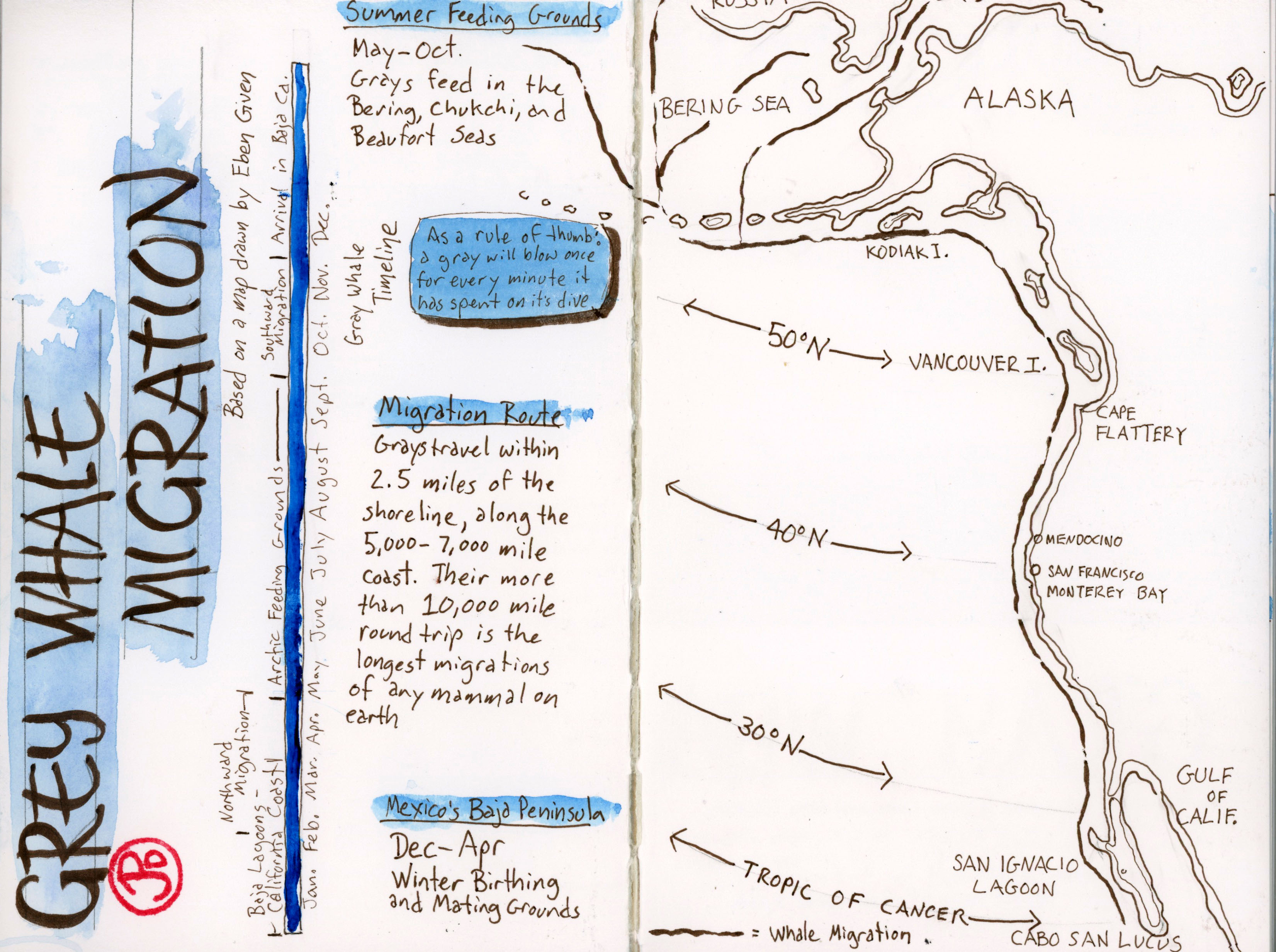
This is the annual migration of the gray whale. In mid November, I was hoping to spot the southern migration of pregnant females as they headed south to the birthing lagoons of Baja California from their summer feeding grounds in the Arctic.

Just down the street from my Mendocino digs at the Mendocino Arts Center, is Mendocino Headlands State Park, one of the best whaling points on the Mendo coast.

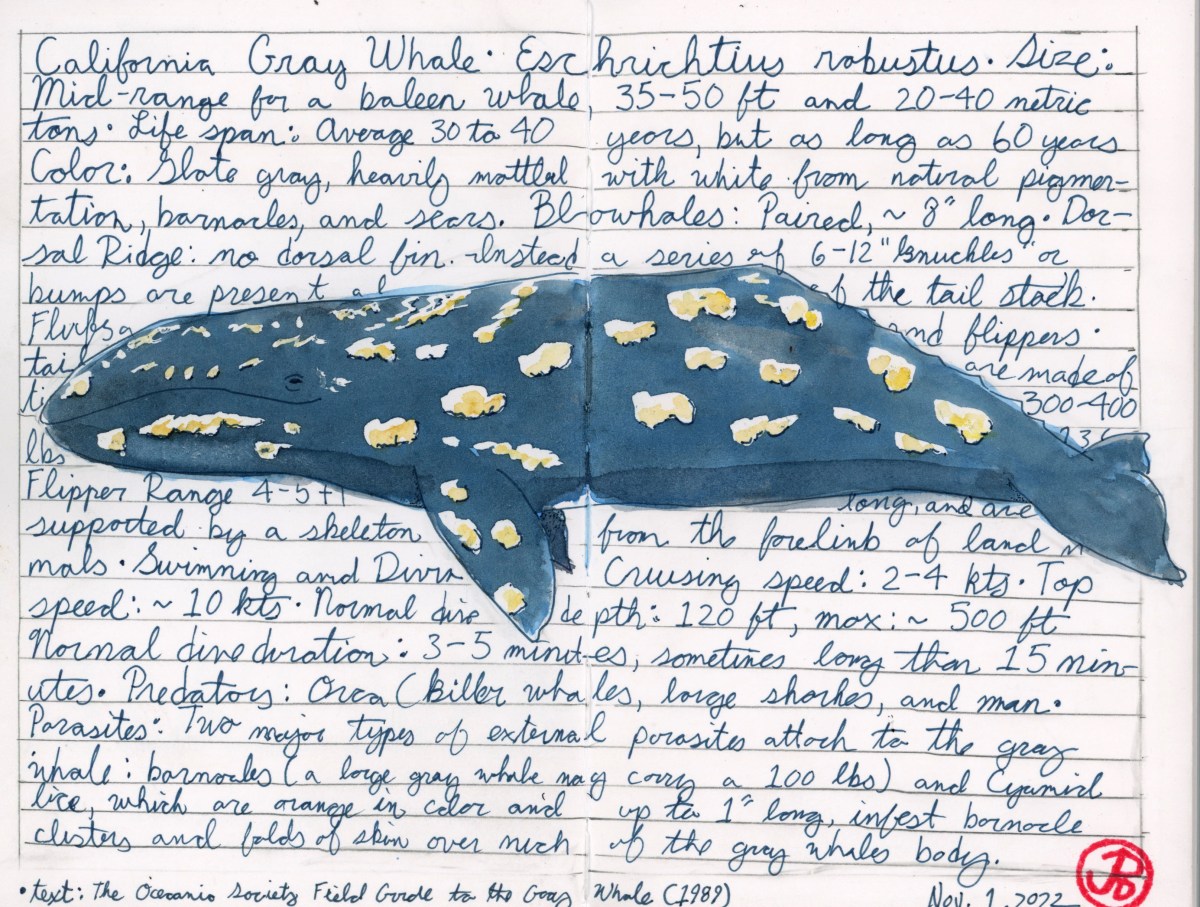
Before I headed out on my three hour road trip to the north, I wanted to understand the life cycle and form of the whale that whalers dubbed “Devilfish”.

And to do this, I opened my new Stillman & Birn Beta Series journal and started to fill some pages. Any adventure for me, always starts with a map, in this case, the migration route of the “California” gray whale.

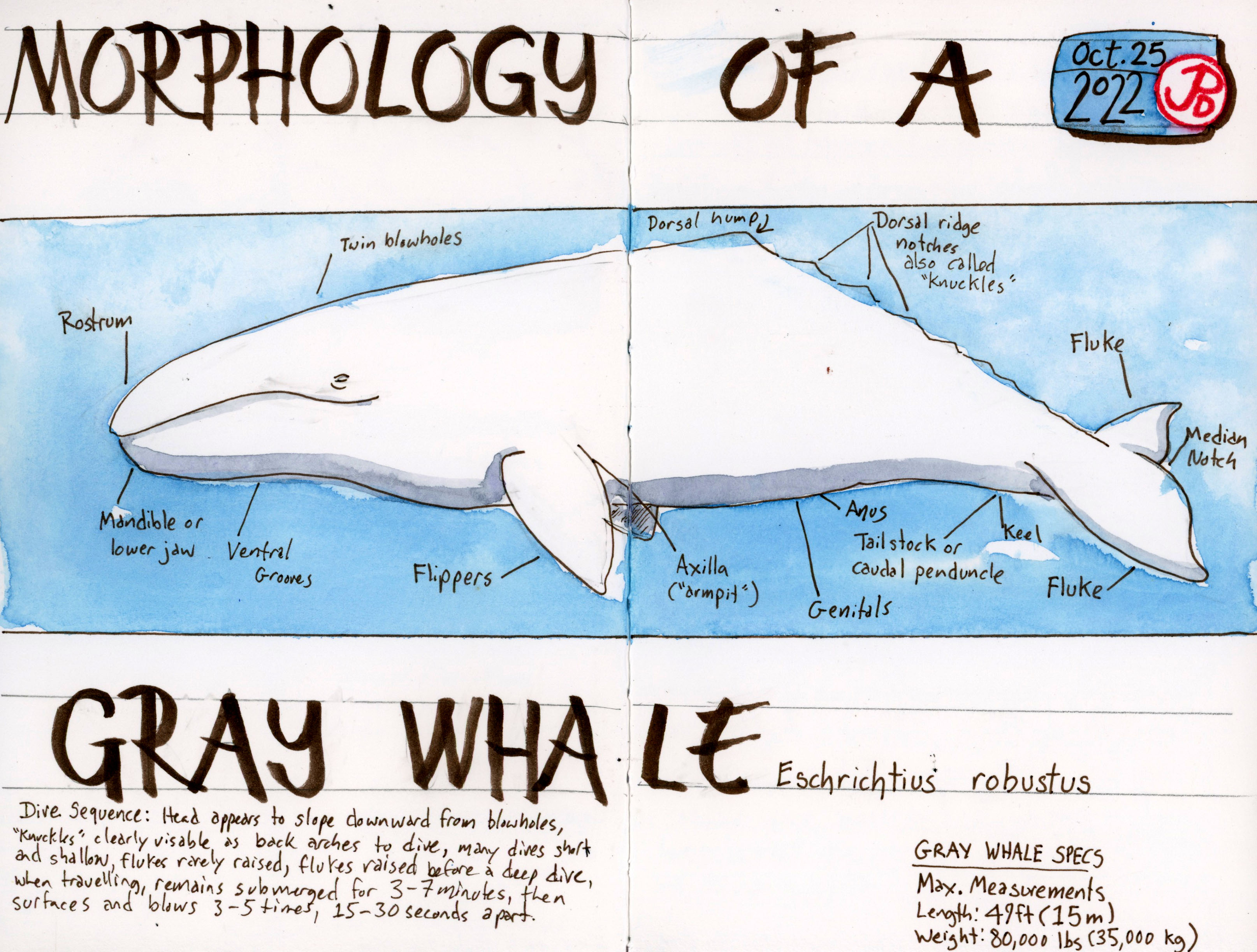
I also did a spread about the morphology of a gray whale. I drew a whale and added labels to various parts and then added a description of the whale’s dive sequence (a valuable tool for identifying grays in the field), and specs of the whale

I set a goal for myself, that I would fill in all the pages of this journal on my weeklong Thanksgiving Break. Let’s see if I can do it. I have cheated a bit by filling in 11 pages so far, some of which are included in this post.

But art is always a bit of a cheat. As Picasso said, “Art is the lie that helps us see the truth.”

And the goal of my sketching life is always to see the “truth”.

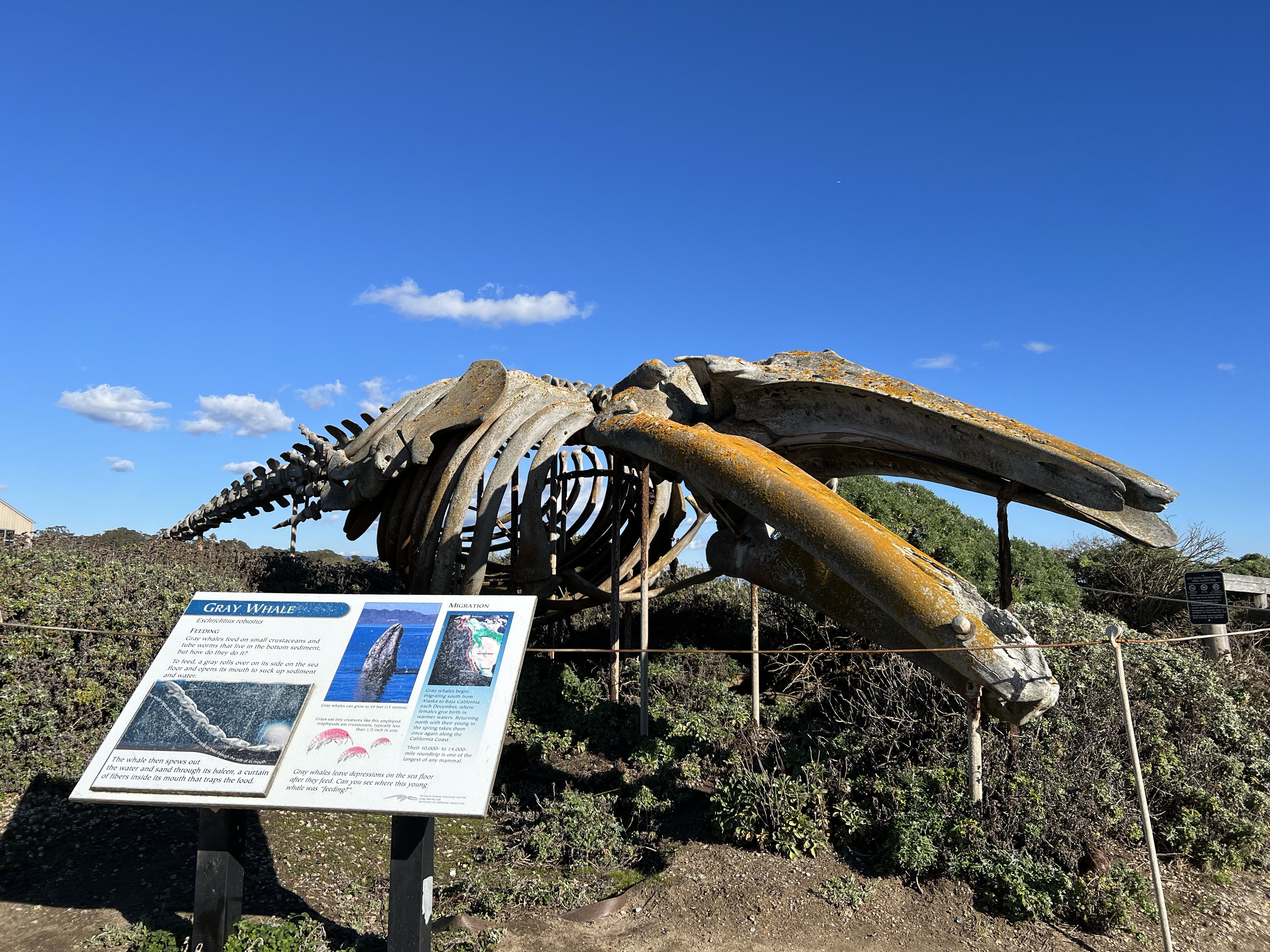
Gray whale skeleton at the Long Marine Lab in Santa Cruz.