There is a concept known as a “spark bird” in birding. This is the bird that first ignites your passion for birds. For the pioneering field guide artist, Roger Tory Peterson, it was the northern flicker. Why can’t a child also have a spark locomotive?
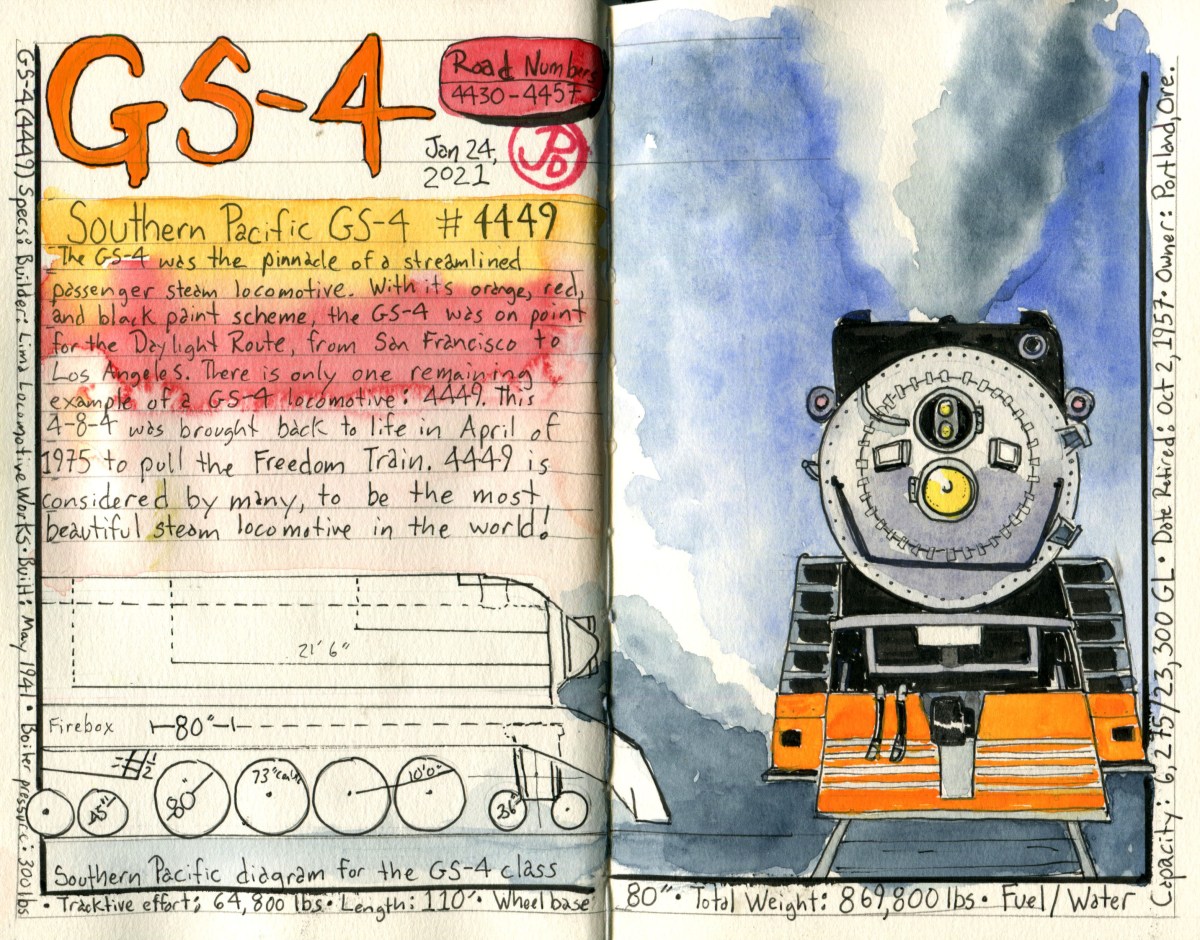
My “spark” locomotive is Southern Pacific’s GS-4 number 4449.
Many children are attracted to trains. Most often it might be a locomotive on static display or maybe watching a commuter or freight train pass by. My passion for steam locomotives comes from my father, who, as an only child growing up in San Francisco, loved anything that rode on two rails: street cars, cable cars, and trains.
While many children, “put away childish things”, my connection to trains, railroads, and locomotives connects me to my father, and that bond has grown stronger since his passing five years ago.
One Christmas, my father gave me a HO scale model railroad. Together, well, mostly my dad, created an oval layout on a large piece of particle board. It came out on our dining room table, a few weeks before Christmas, and stayed up, certainly as long as our neighbor’s Christmas lights. On a part of the oval track was a paper mache tunnel which spanned the tracks. It was made by my father, probably with some help from his father.
My first locomotive was a Santa Fe F7 in the ironic warbonnet paint scheme. This locomotive pulled a short, motley freight consist around the oval, over and over again.
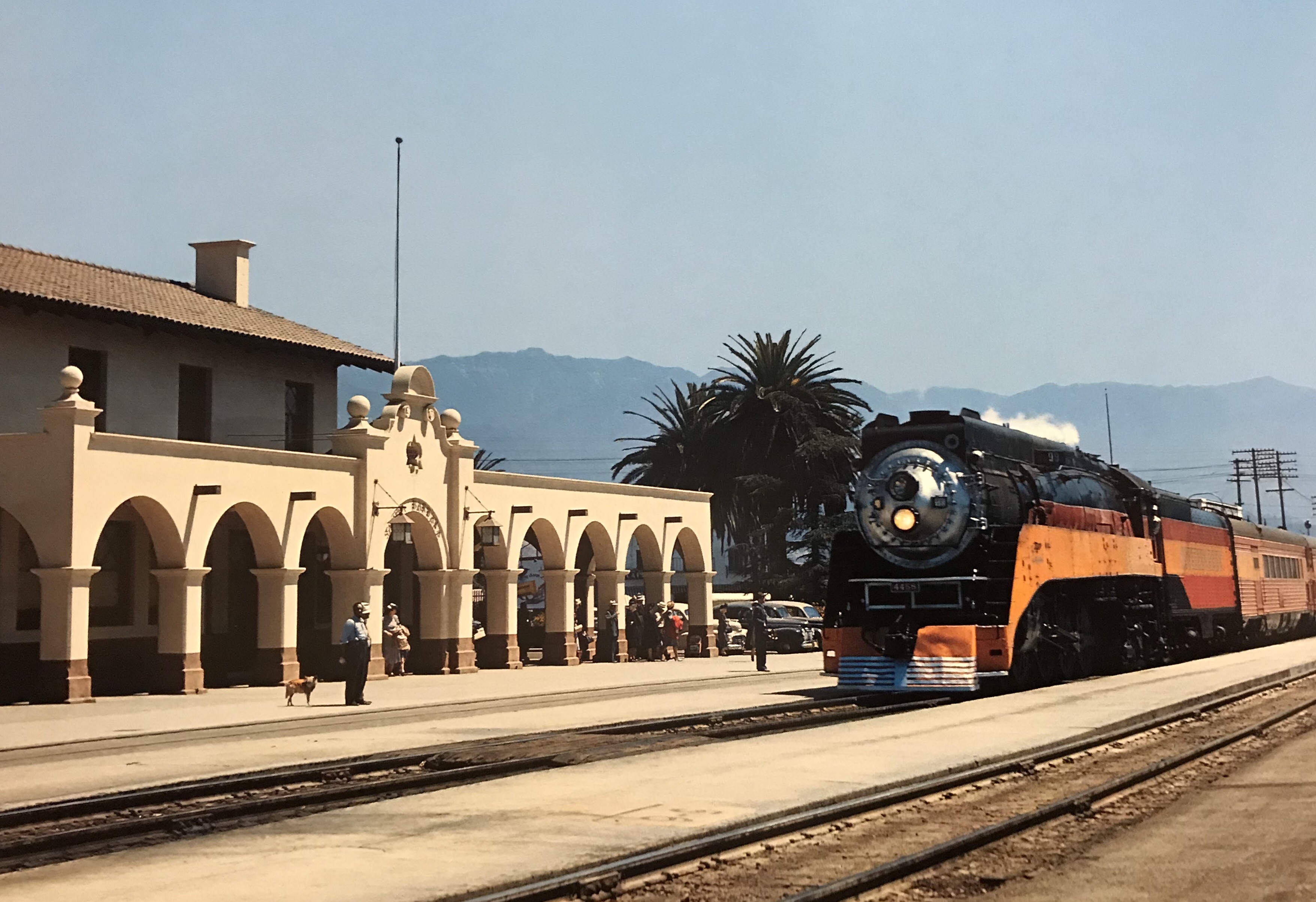
Then one Christmas came an HO replica of one of the most beautiful steam locomotives ever built: Southern Pacific GS-4 #4449. And later came a Daylight baggage car, a few passenger cars, and an observation car.
A GS-4 was a Northern class (4-8-4) of passenger steam locomotives, built for the Daylight route from San Francisco to Los Angeles. Southern Pacific reached it’s zenith with the design of this streamlined locomotive that also had plenty of power and speed to make the 470 mile trip.

Out of the 28 GS-4s built by the Lima Locomotive Works, only one survived. As a point of comparison, Union Pacific produced 25 “Big Boys” and now eight are still in existence, including 4014, which has recently returned to steam, making it the largest steam locomotive in operation.
The last remaining GS-4, 4449, was built in May of 1941 and was retired from service on October 2, 1957. It was donated to the City of Portland, Oregon where she was placed on static display at Oaks Park. In the following years the locomotive was vandalized and it builder’s plate and whistle stolen.
In 1974, as our Bicentennial was approaching, 4449 was evaluated to see if she could be restored and brought back to life to haul the Freedom Train, a traveling exhibit featuring historical artifacts aboard train cars that visited all of the Lower 48 states. 4449 was restored and pulled the Freedom Train for many stretches on it’s national tour. 4449 was given the moniker, “The Queen of Steam”.
After 4449 was done with it’s two year tour, she returned to Portland, Oregon when in 1981, she was repainted in her red, orange, and black paint scheme of Southern Pacific’s Daylight. During the 1980’s my father and I followed 4449 around the state, this time I took the Super 8 footage while my dad took stills. We even rode on a train pulled by 4449 on a two day excursion from San Francisco to Los Angeles.
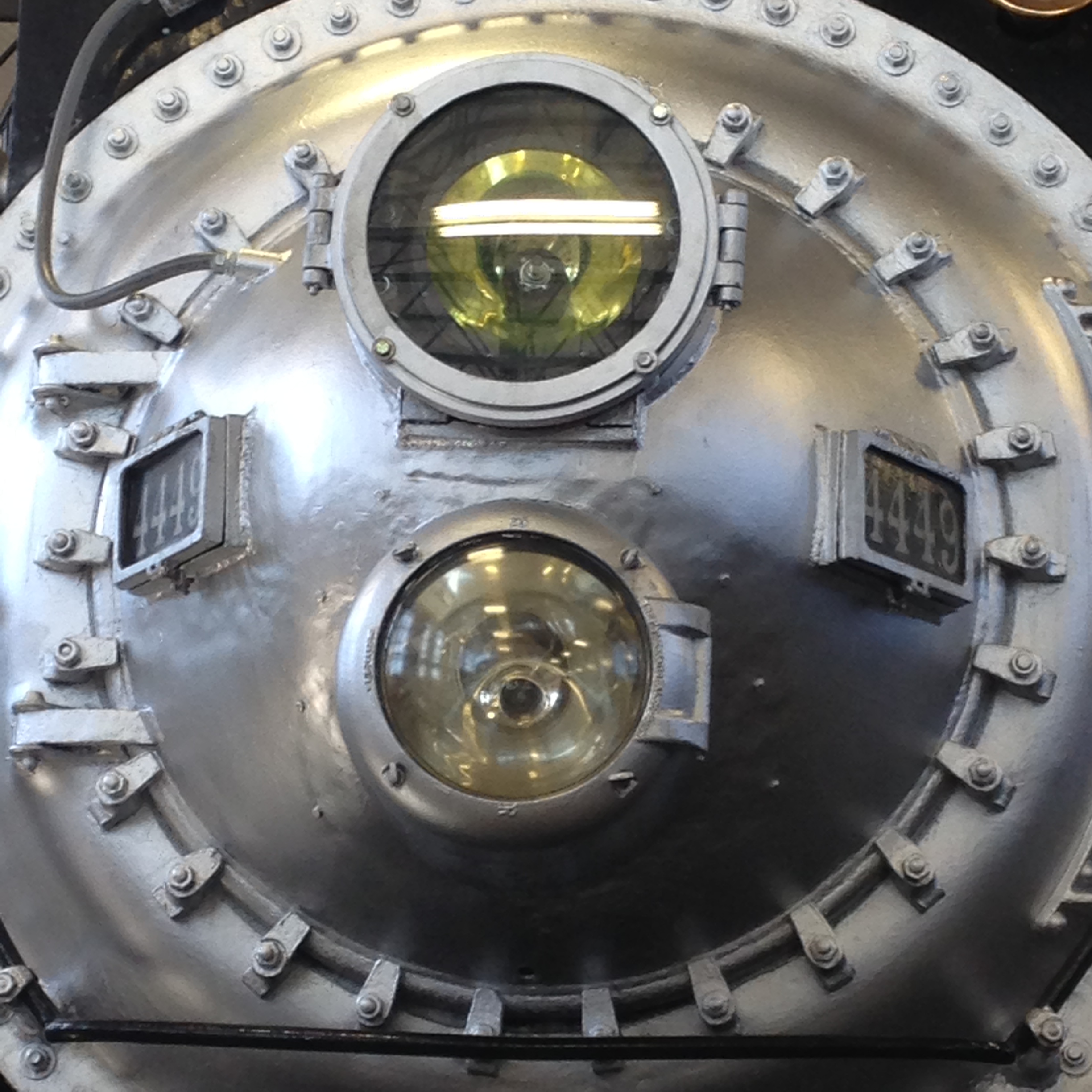
One wonders how to keep connected to someone who has passed? While they are in the ethereal and unknown world, that touchstone is often something earthy and physical. It could be a photograph, a house, or a landscape. For me, that touchstone is a locomotive that was built in 1941, nine years after my father was born. While my father is no longer here, 4449, a touchstone to the past, still lives and breaths. When I look into the eyes of her ever-moving mars light, I somehow see the eyes of my father.



 Corvid Sketcher