Image

California Registered Historical Landmark No. 714

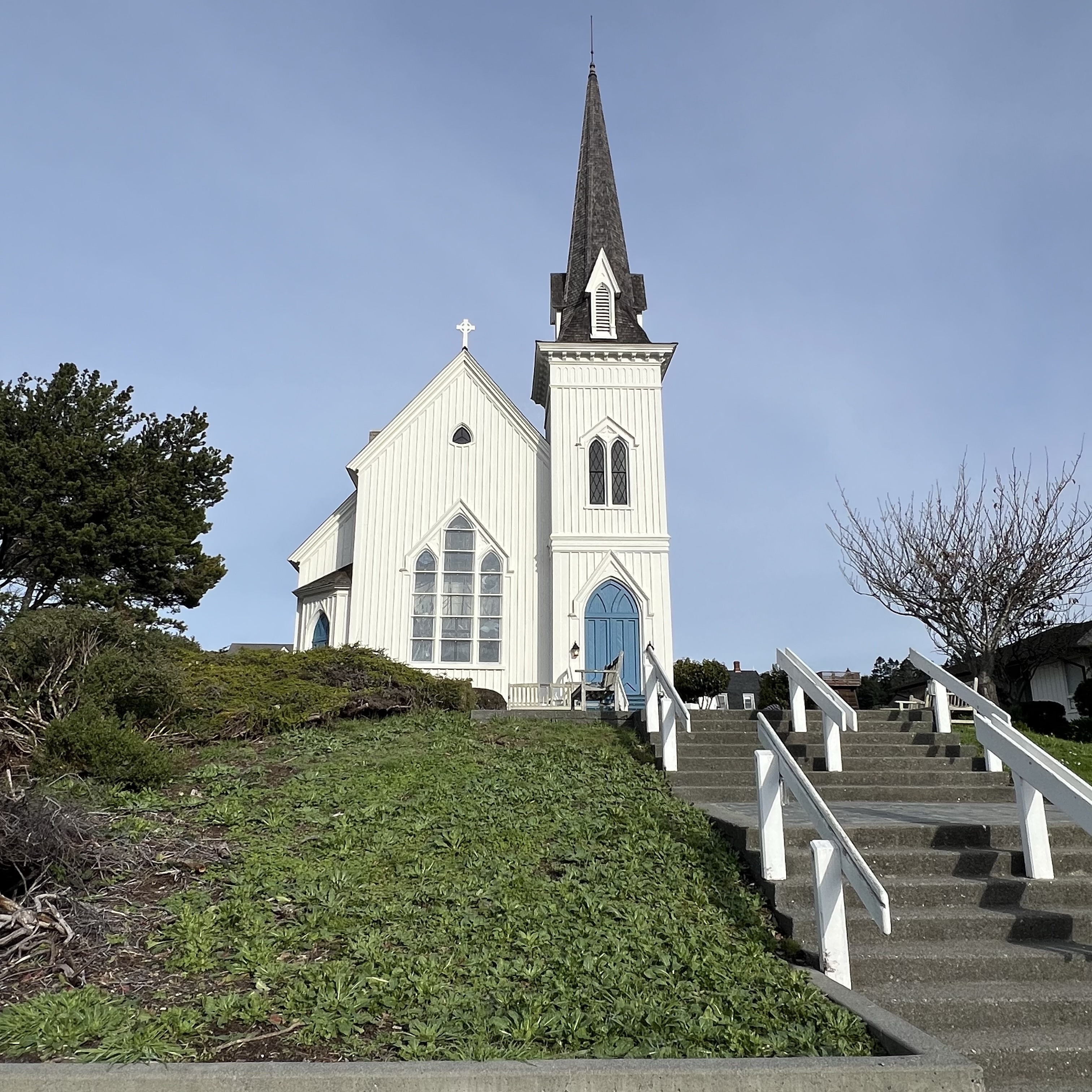
The town of Mendocino has two California Registered Historical Landmarks, both are houses of worship.

I had already sketched the Temple of Kwan Tai on a previous visit and now I wanted to sketch the Mendocino Presbyterian Church.

I sketched the church from my curbside sketching blind and when I finished I walked over to get a closer look at the California State Historic Landmark Plaque.

The church was dedicated in 1868 and is the oldest church in continual use in California. As I was reading the plaque a kindly local asked if I wanted to have a look inside.

I replied in the affirmative and the kindly church lady put her dog indoor and returned with the key.

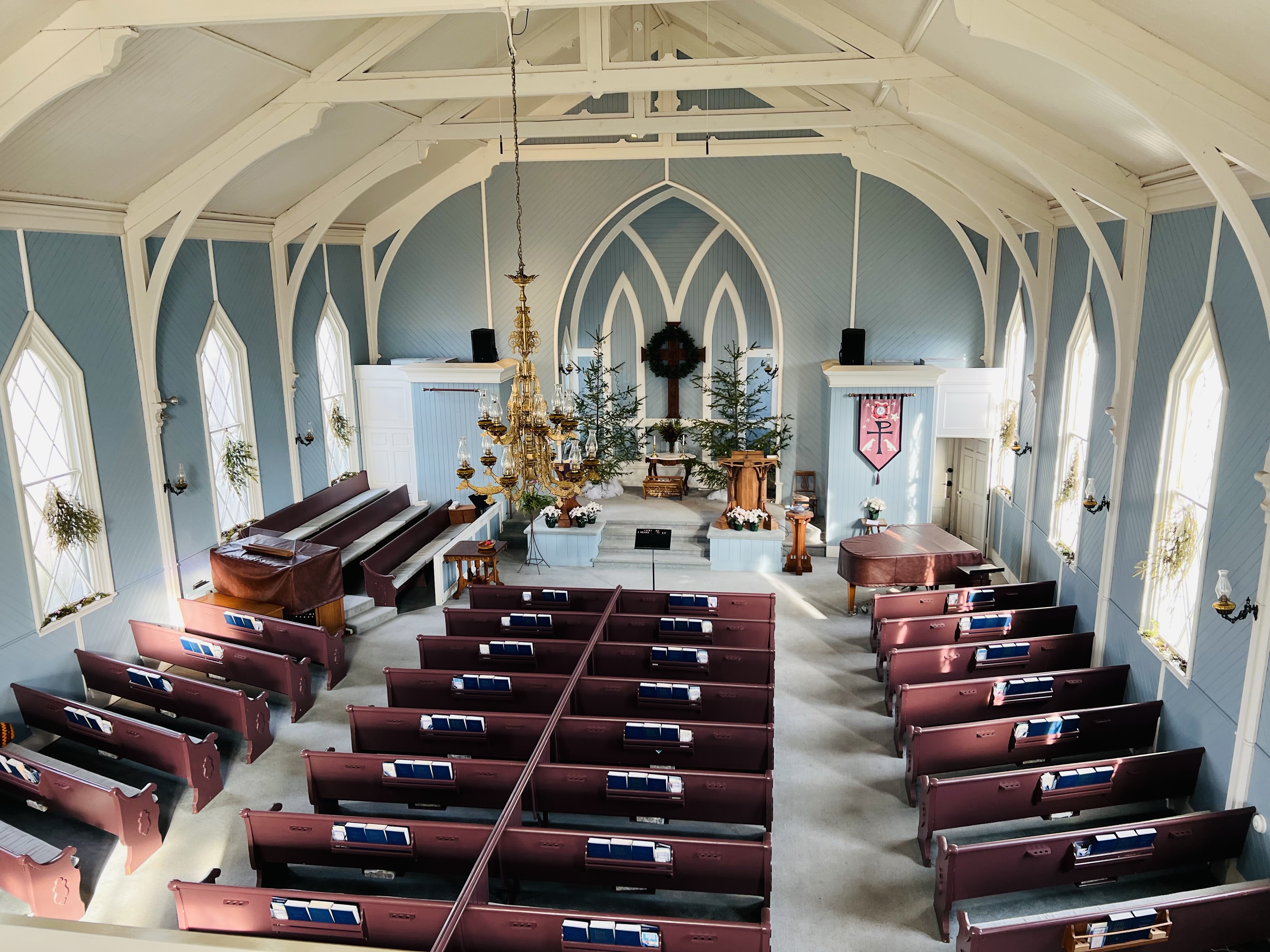
She gave me a brief tour and told me if I was brave (I was) that I could climb the ladder in the choir loft to see the chalk signatures of past pastors and church members on the inside of the bell tower (which I did).

She also said that I could ring the bell, so I grabbed the pull and did.

The church is built of the local wood, the wood that put Mendocino on the map: coast redwood.

Image

The Pygmy Forest of Jug Handle

I left my Caspar cottage at 8:45 and I walked down the road to Jug Handle State Natural Reserve.

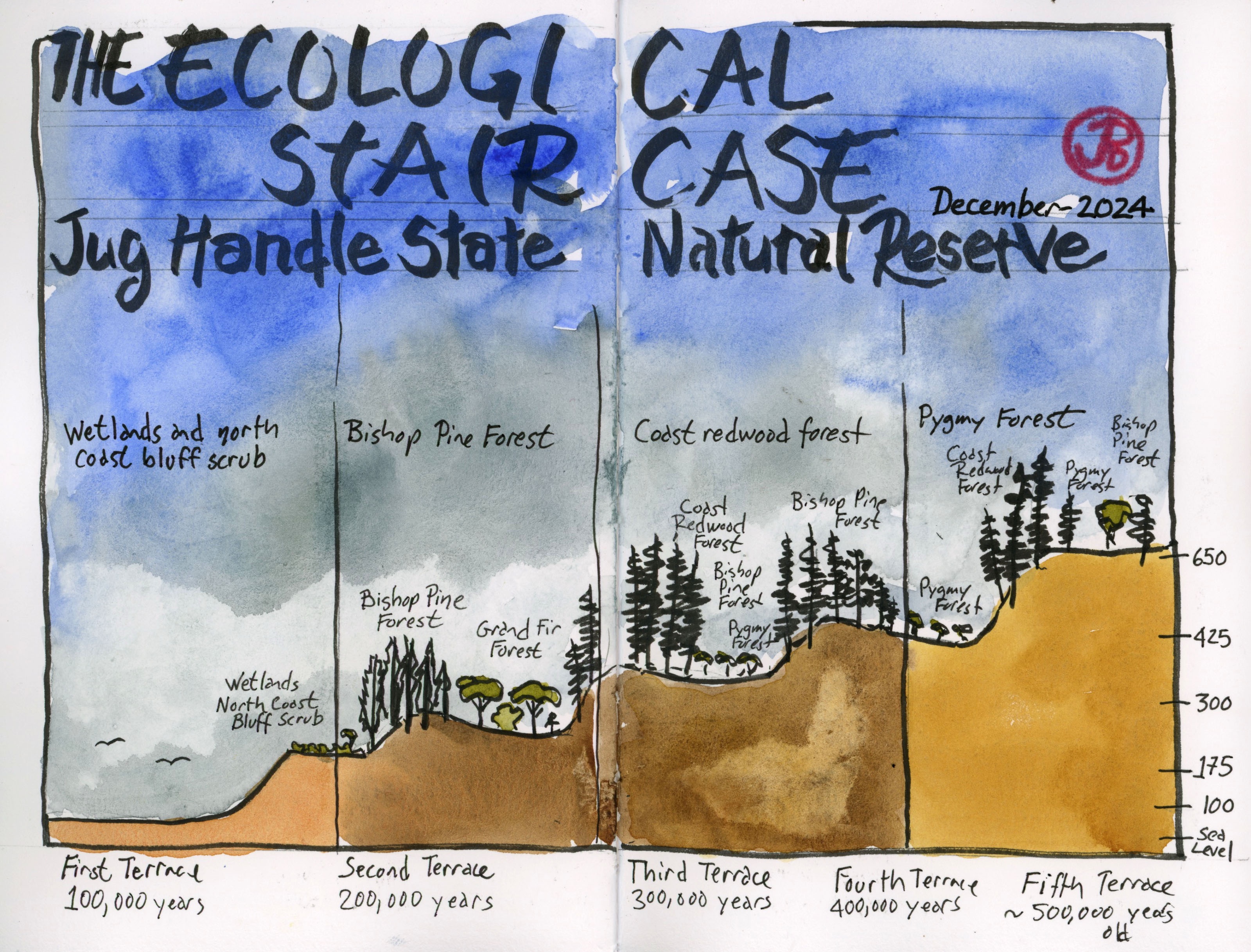
I would he ascending the Biological Staircase of terraces, my final destination would be 2.5 miles from the trailhead on the third terrace. This is the 300,000 year old Pygmy forest!

One reason that the Biological Staircase is so appealing to the naturalist is that you pass through very different habitats, giving you a nice cross section of this rare part of Coastal California.

Weeks before I set off on my journey to the Pygmy forest, I did a sketch of a cross section of the five terraces to help me understand that ecosystems I would be traversing.

The trail was filled with large puddles and portions of the trail became a small stream bed from recent winter rains. This was a wet walk but well worth the mud and the blood and the tears. (Okay just mud, but lots of it.)

I had been on the trail for almost an hour when the tree cover opened up and the morning sun warmed my bones.

I was now nearing my destination: the Pygmy Forest! A small sign marked the beginning of the boardwalk.

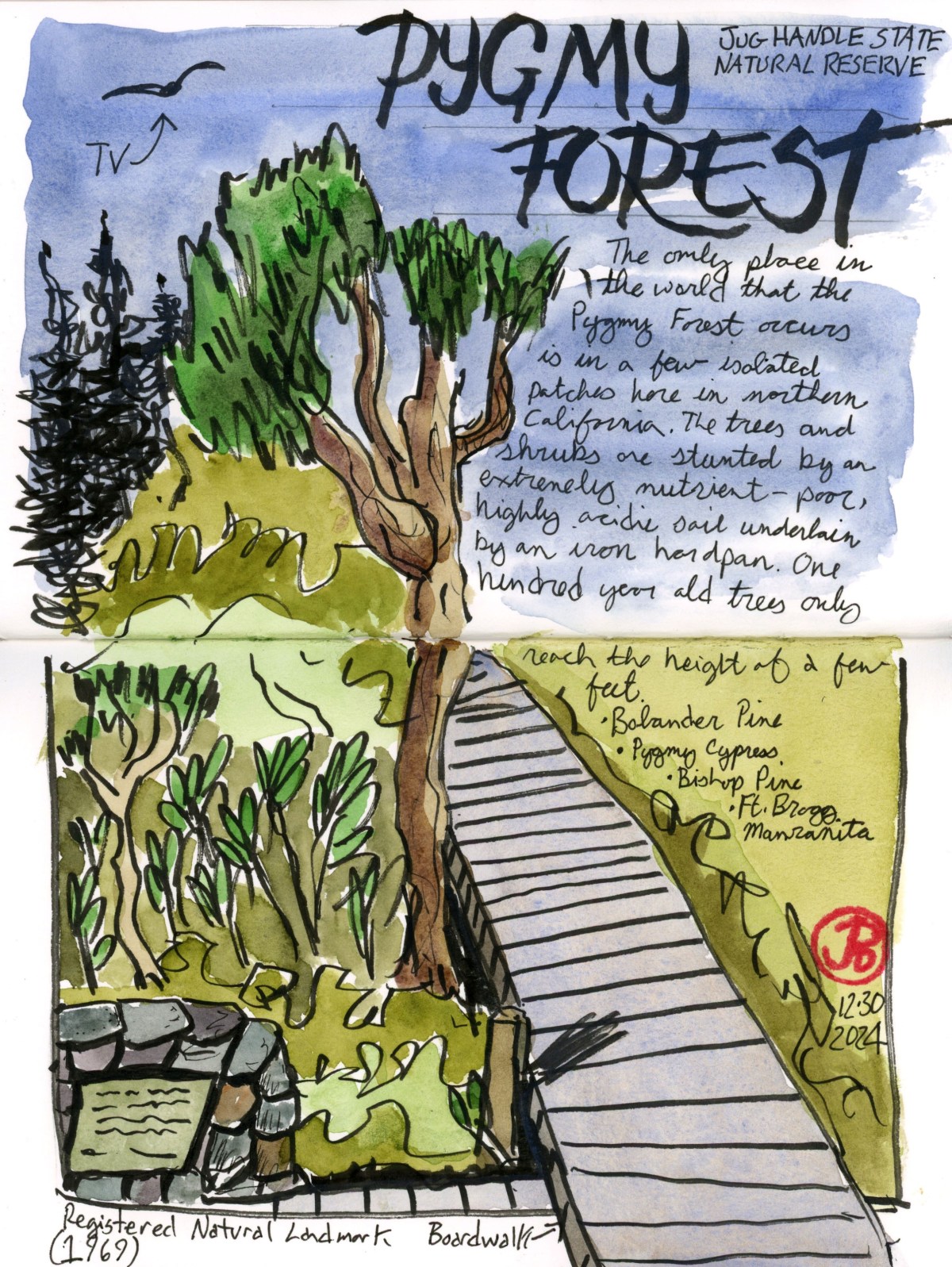
A Pygmy forest occurs when the soil is nutrient poor and plant species are stunted as a result. A Pygmy forest is rare habitat that is only found in a few locations in Northern California. The boardwalk protects the valuable soil from visitor’s damaging footfalls.

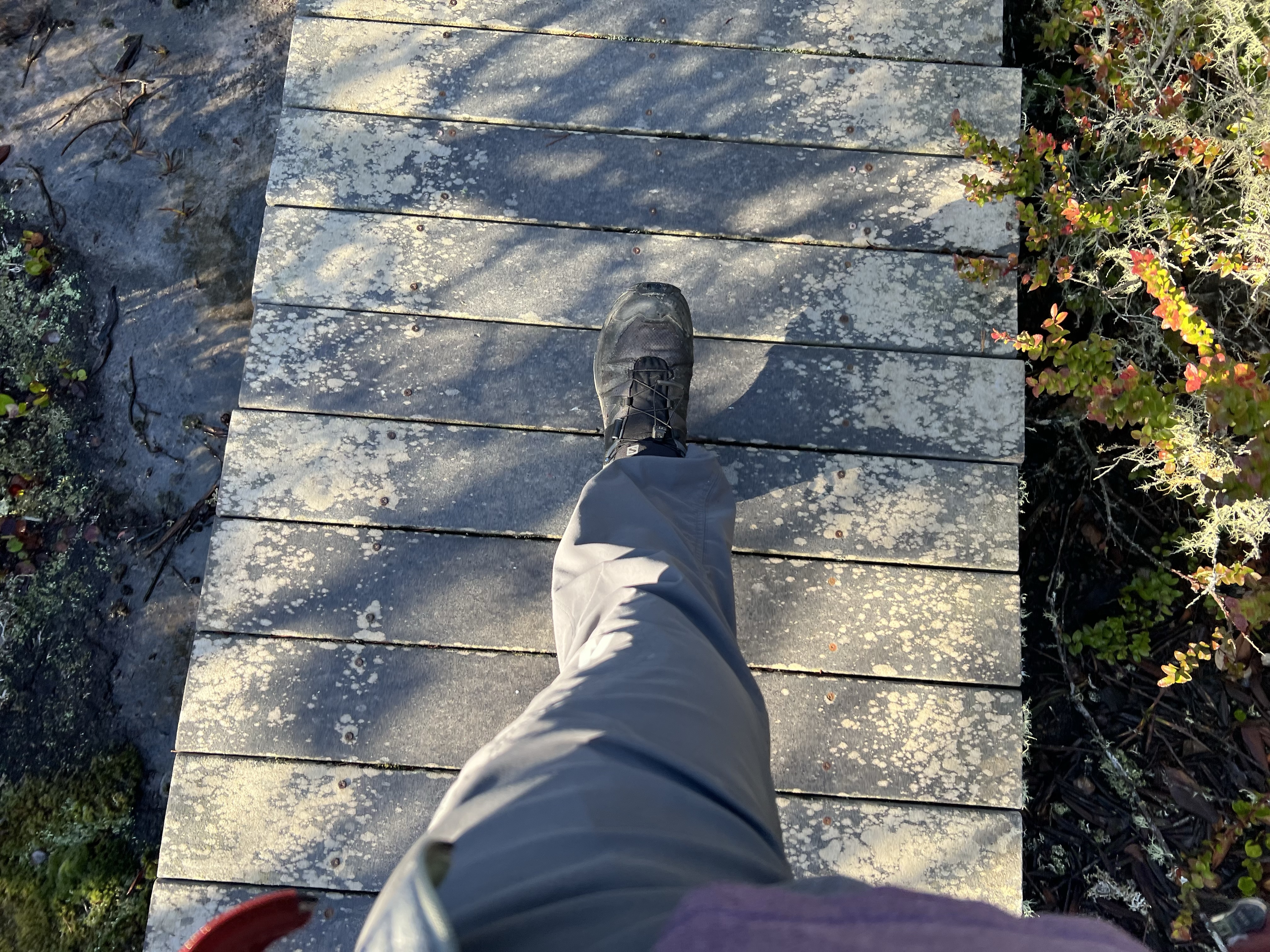
The serpentine boardwalk through the Pygmy forest.

Half way through the board walk there was a pull out with benches and a 1968 plaque proclaiming the Pygmy forest as a California Registered Natural Landmark. I rested here, had a snack, and did a sketch of the view. I’ll admit the sketch is a bit loose and wild (featured sketch).

My return journey on the boardwalk.
Image

Mendocino Town-Sketching

The town of Mendocino is really a sketcher’s paradise.

I have sketched this town many times and there are endless angles, perspectives, and hidden gems to add to my sketchbook.

As a sketcher you can either “zoom” in or “zoom” out depending on what strikes your fancy (no zoom lens required). For much of my panoramic sketches I chose to zoom out with a wide angle perspective.

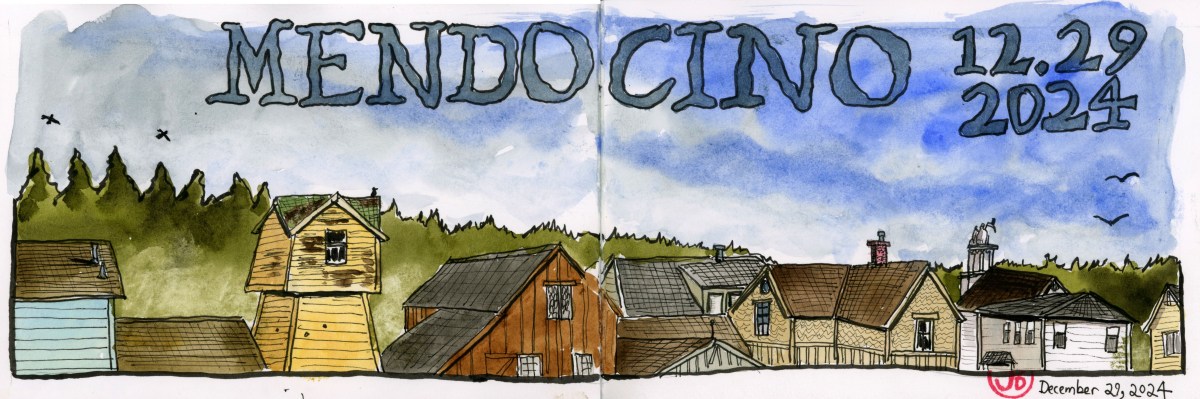
For the featured sketch I positioned myself across the street from the Blair House (used in Murder, She Wrote) right beside Heider Field. The sketch looks towards Lansing Street at a water tower, old buildings, and the Masonic Lodge. A rustic townscape.

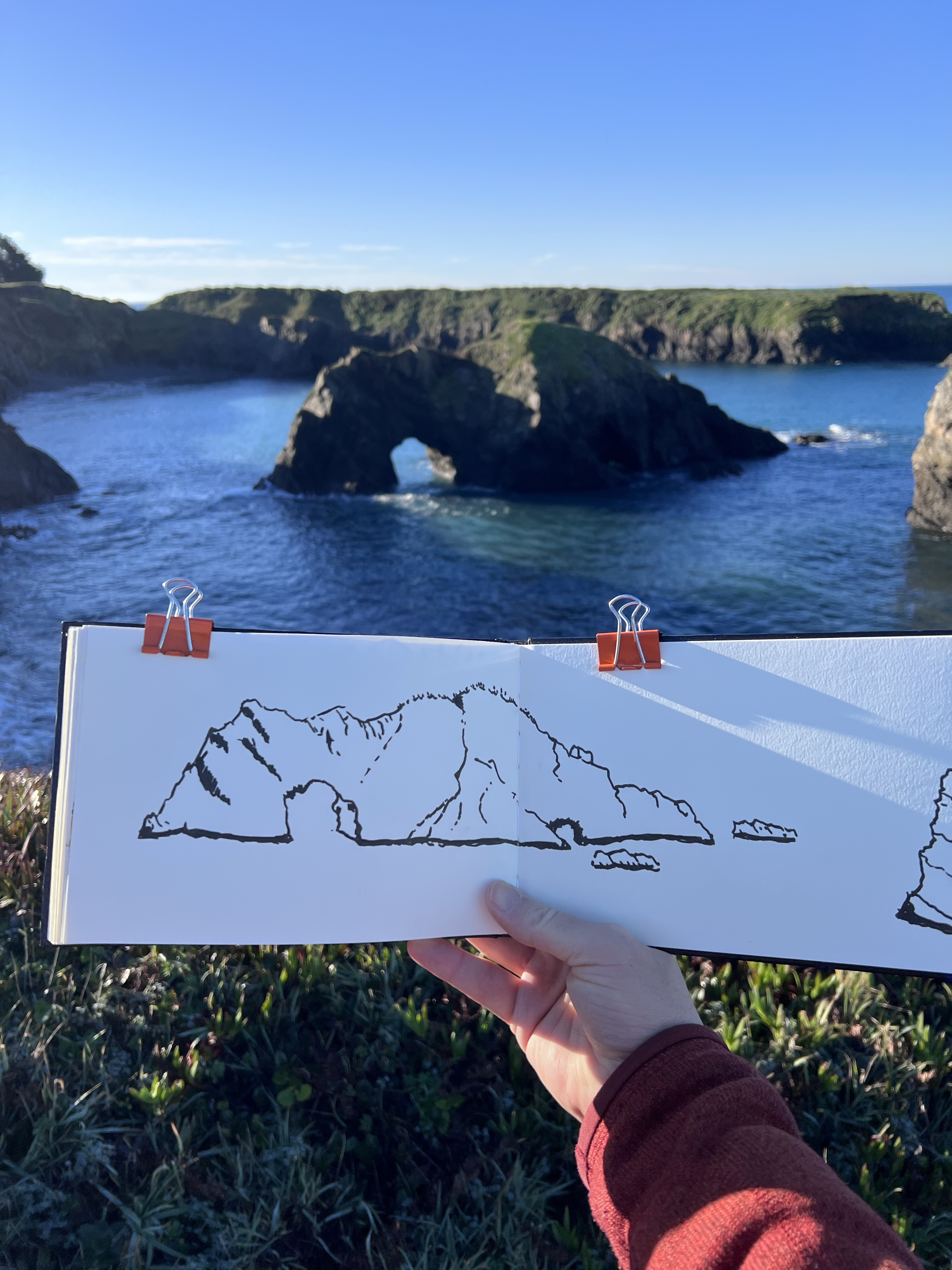
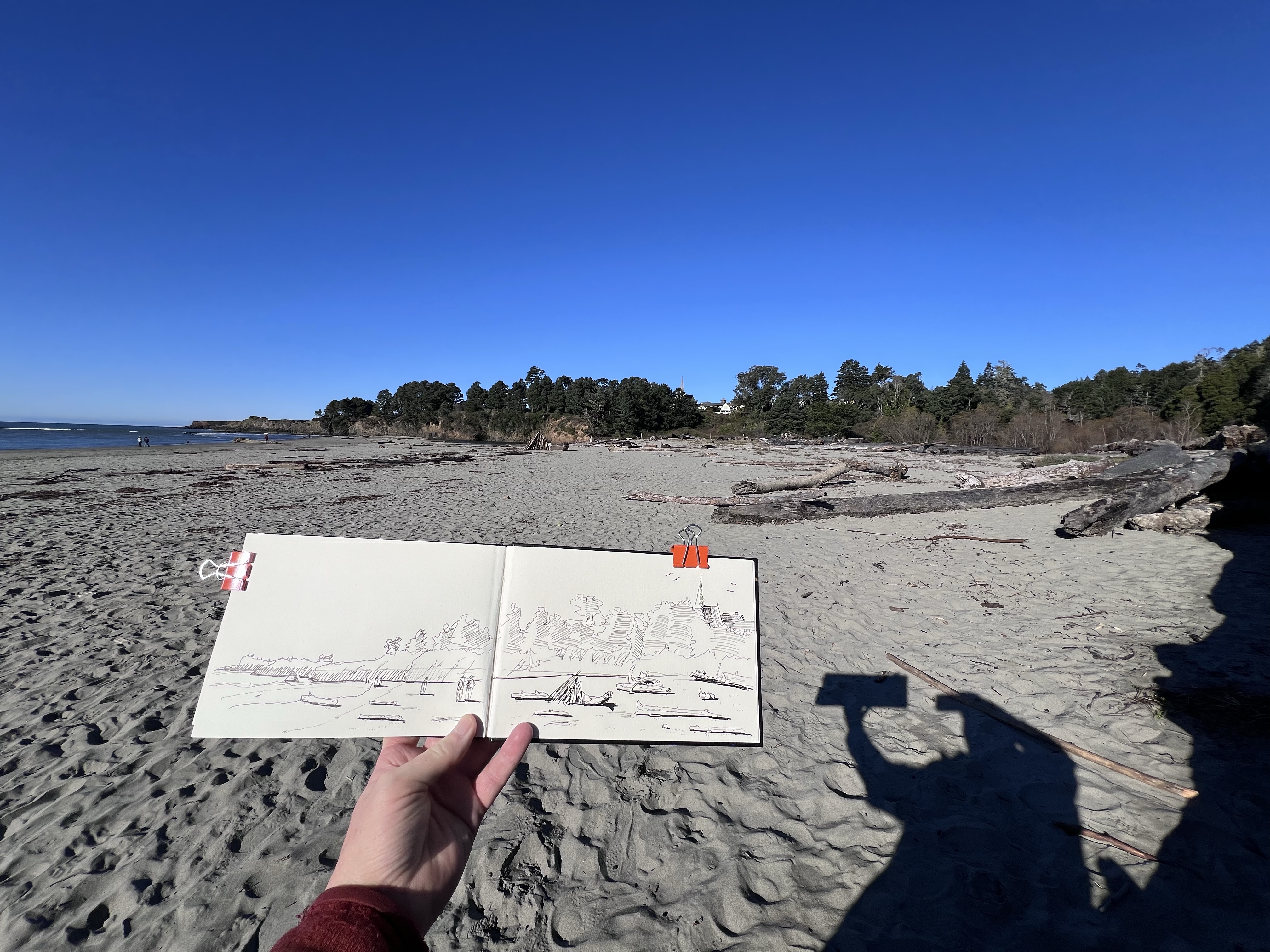
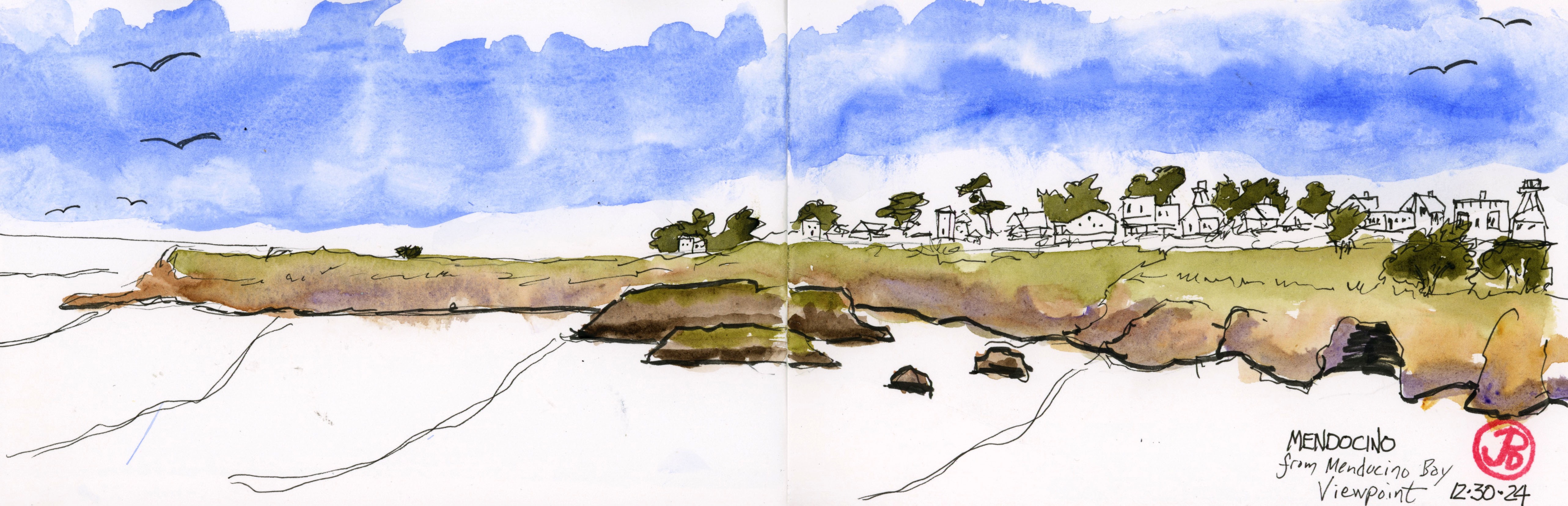
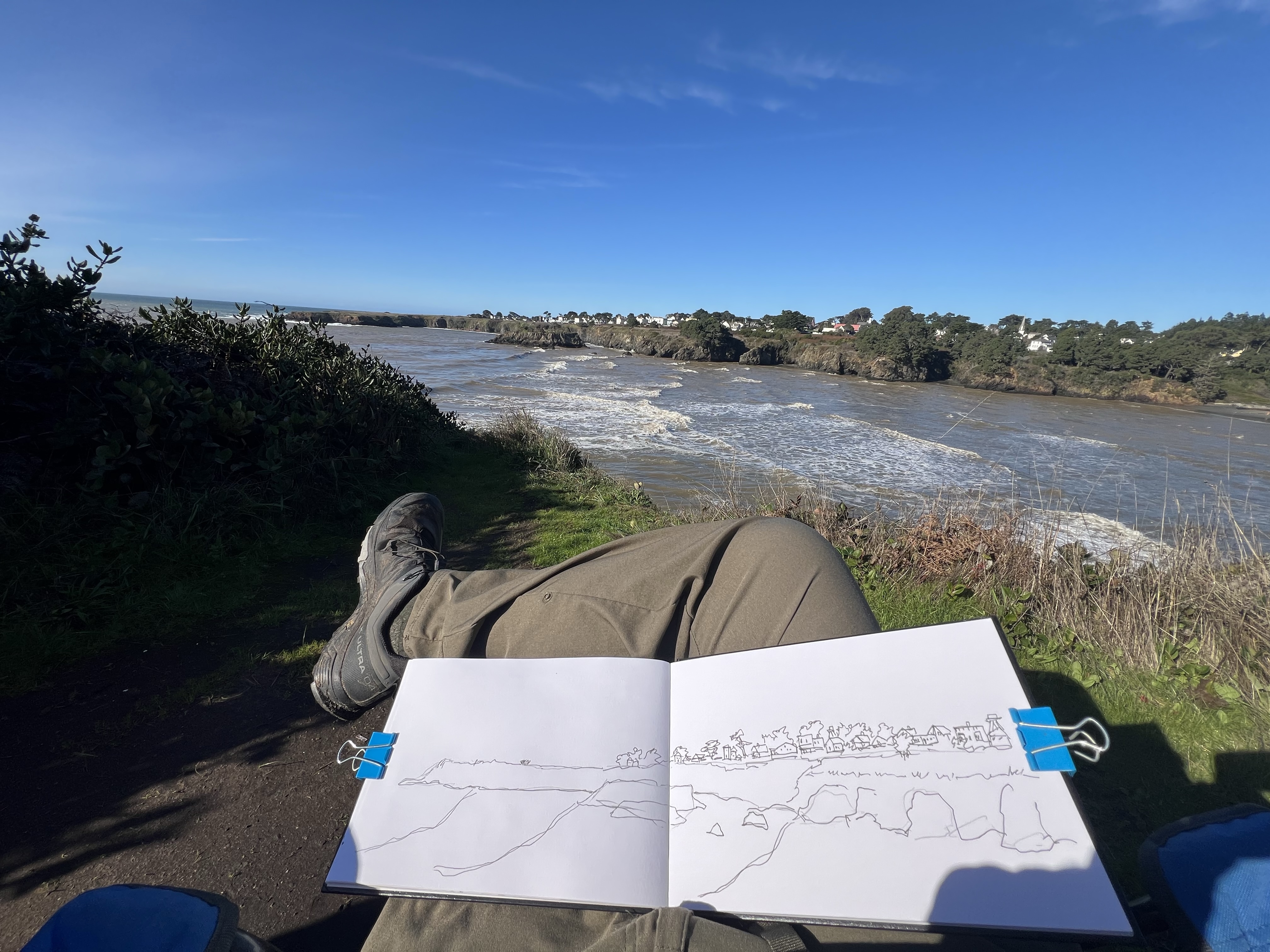
On another day I took a wide angle perspective from the small park across the Big River mouth to draw the bluffs and the town (below).

A panoramic sketch of Mendocino.
What a view!

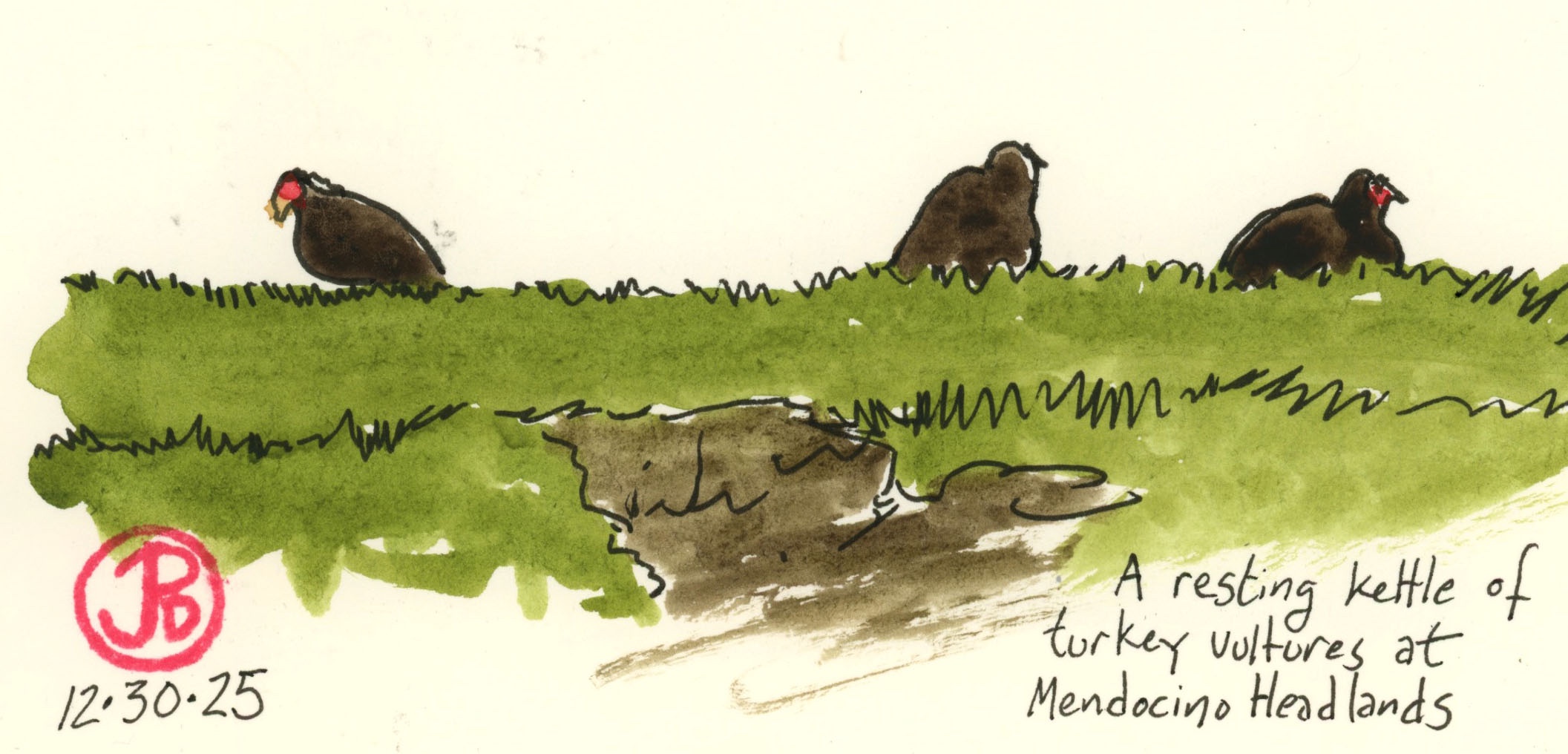
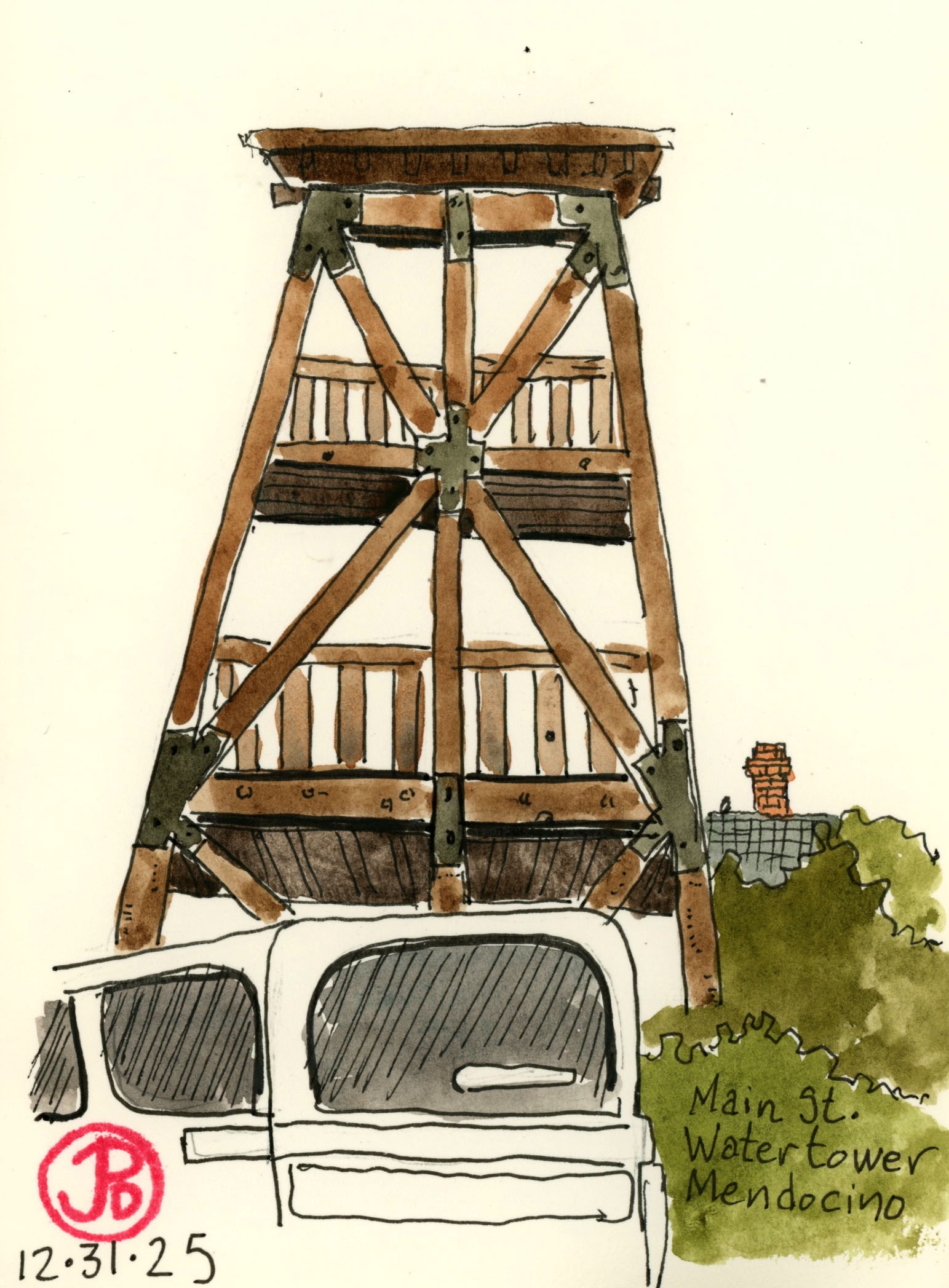
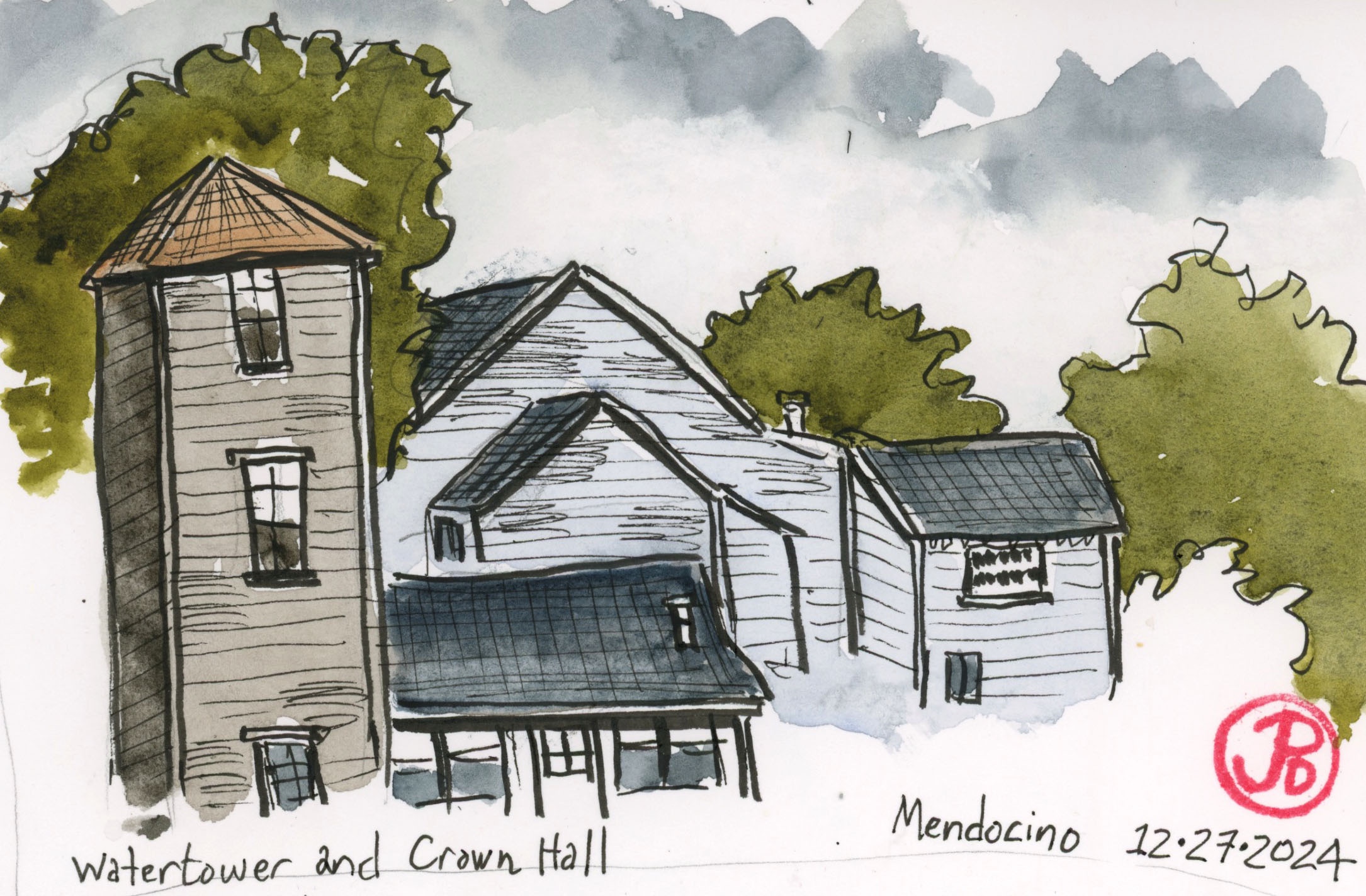
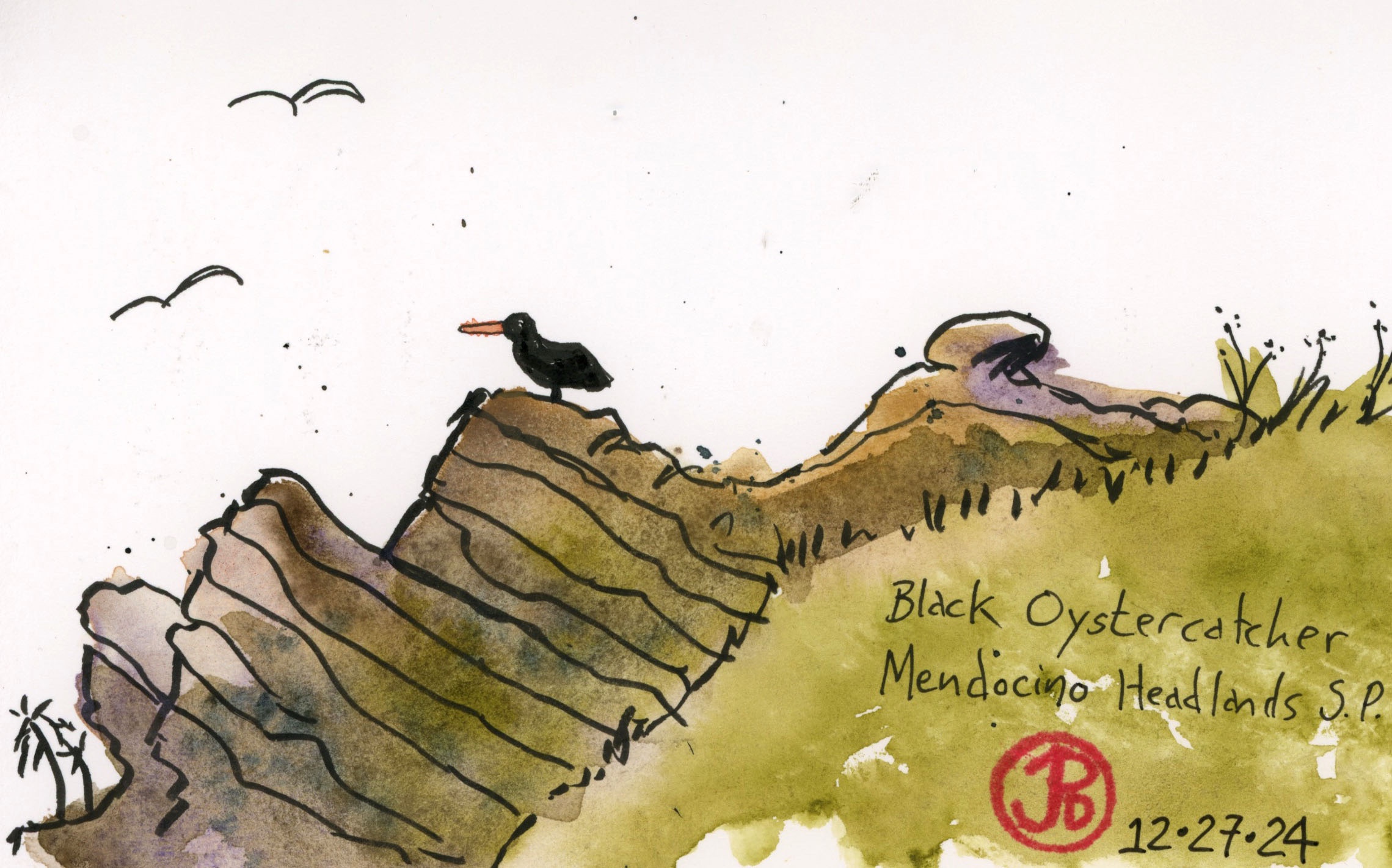
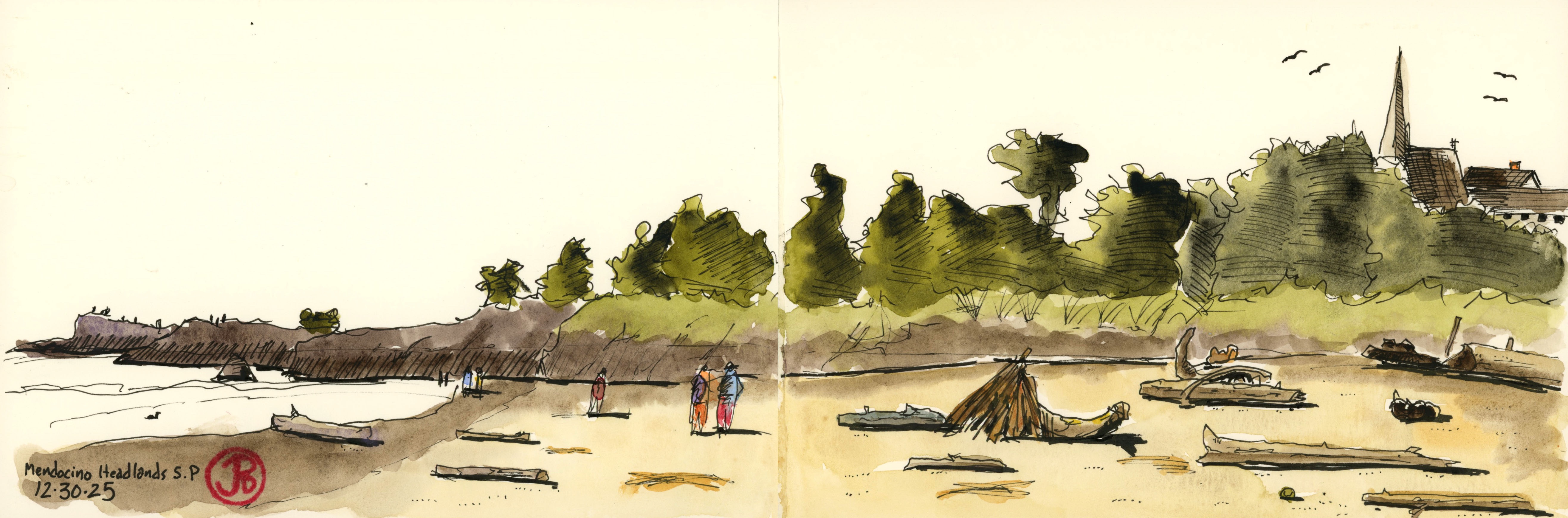
I did do a few sketches a little more “zoomed in”. One was of a water tower and the back of the Crown Hall and the other is at the Mendocino Headlands State Park and a black oystercatcher.

Black oystercatchers are easy to see at the Mendocino Bluffs.
Image

Sketching Ft. Bragg

While many painters, sculptors, and artists are attracted to the picturesque town to the south, Ft. Bragg has plenty of objects to sketch.

And I added a few to my sketchbook.

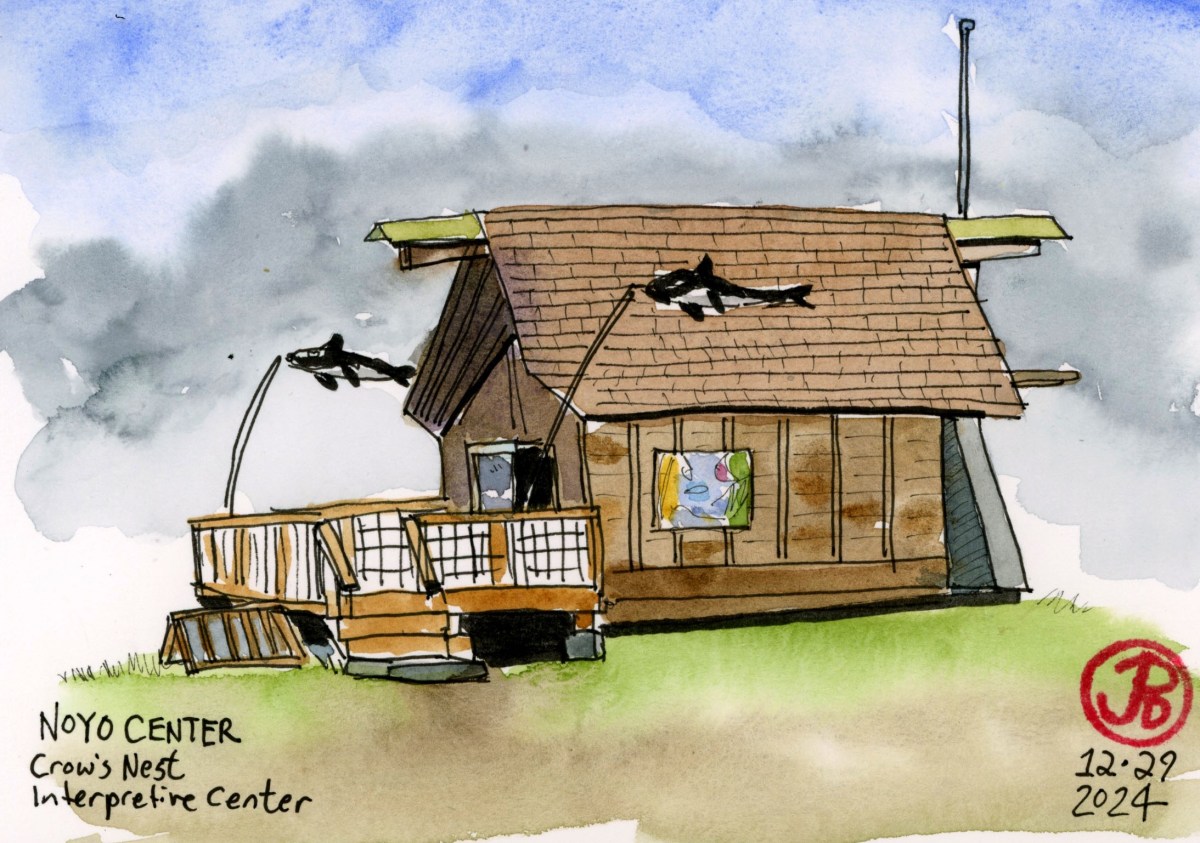
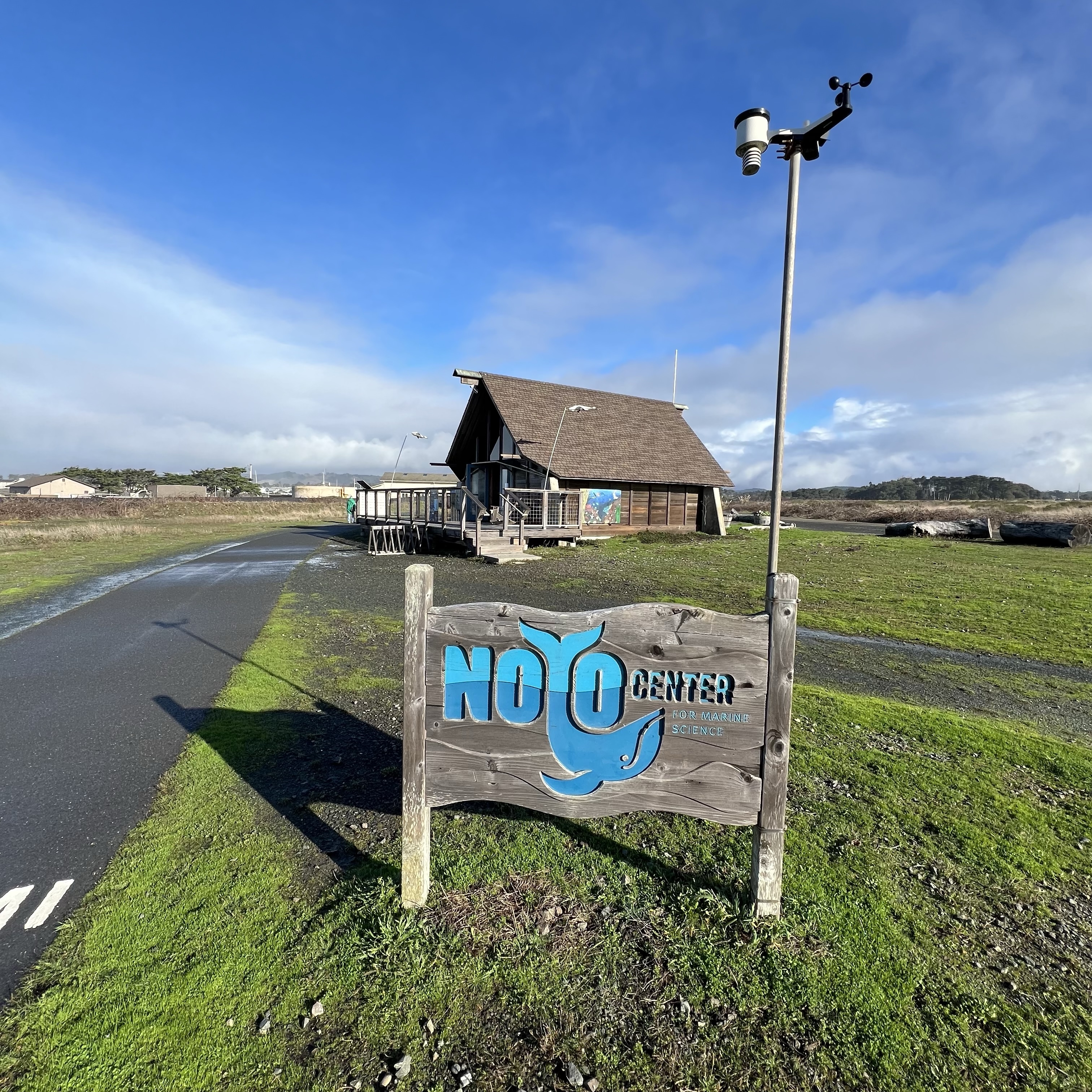
I hiked out on the Noyo Bluffs, north of the river mouth. My destination was the Noyo Center’s Crow’s Nest Interpretive Center.

This center has marine mammal skulls and bones, maps and diagrams, a tide pool tank, and a deck for whale watching.

I sat at a picnic table and sketched the interpretive center. All this hiking and sketching makes me thirsty.

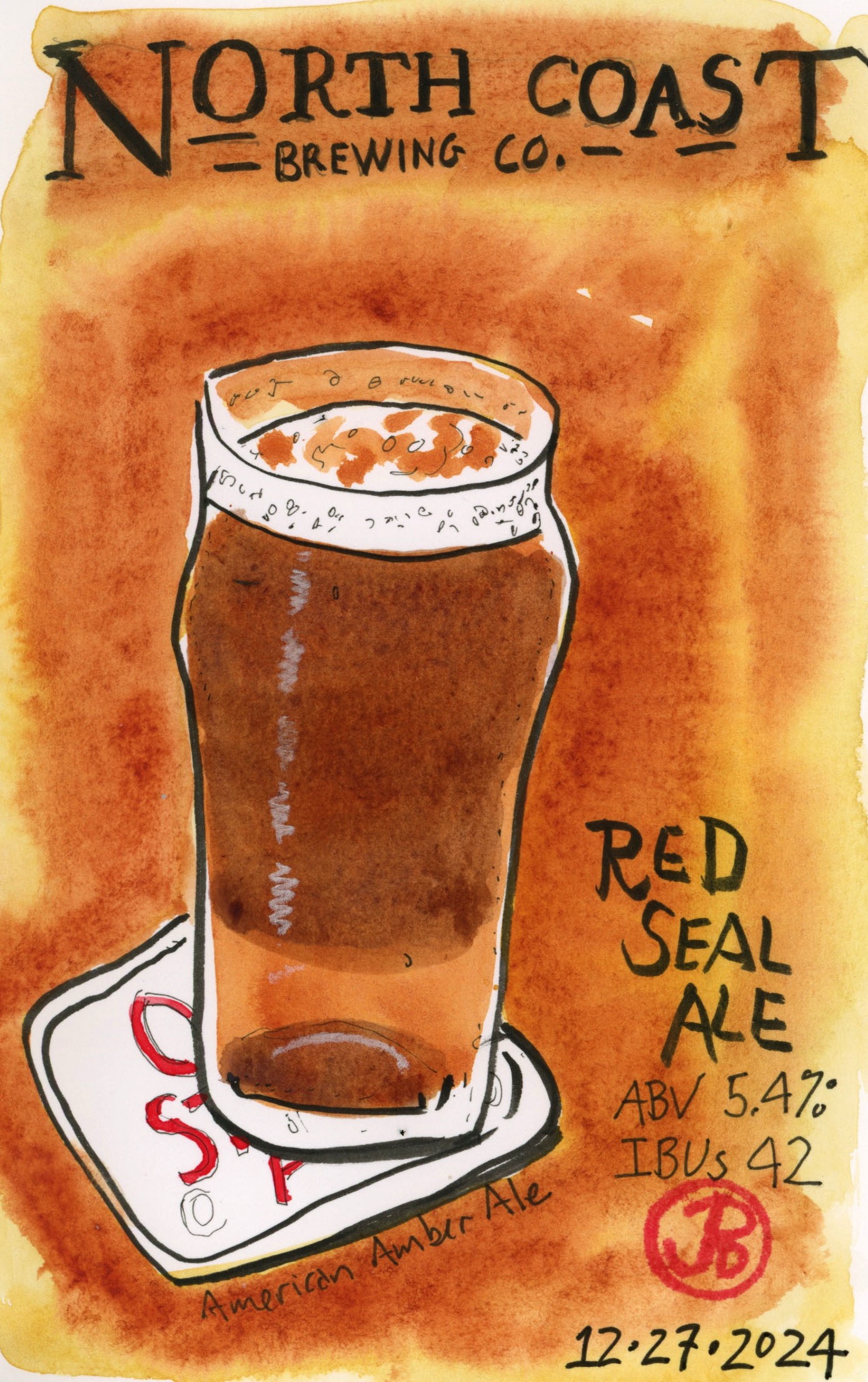
Good thing I was in Fort Bragg, because on Highway One, near the train depot, is the North Coast Brewing Company. Across the street from the brewery is their pub where you can get a bite to eat and sample their brews.

North Coast has been brewing since 1988, well before I could legally drink. They always have creative names for their brews such as Scrimshaw, Old Rasputin, Brother Thelonious, Old No. 38 Stout (named after a California Western Railroad steam locomotive), and my favorite Red Seal Ale (sketched above).

Cheers from Fort Bragg!

Image

Train Sketching: Ft. Bragg

I have enjoyed sketching in the town of Fort Bragg, just to the north of Mendocino.

The genesis of Fort Bragg as a town was the huge strands of coast redwoods and lumber mills sprang up to harvest the timber.

Now how to get the lumber to markets like San Francisco to help build the growing city?

Lumber was shipped south by boat but once the California Pacific connected Ft. Bragg with Willitis and the Northwestern Pacific, milled lumber could be shipped by rail.

The rails of the past lives on as the Skunk Train. Now a tourist railroad.

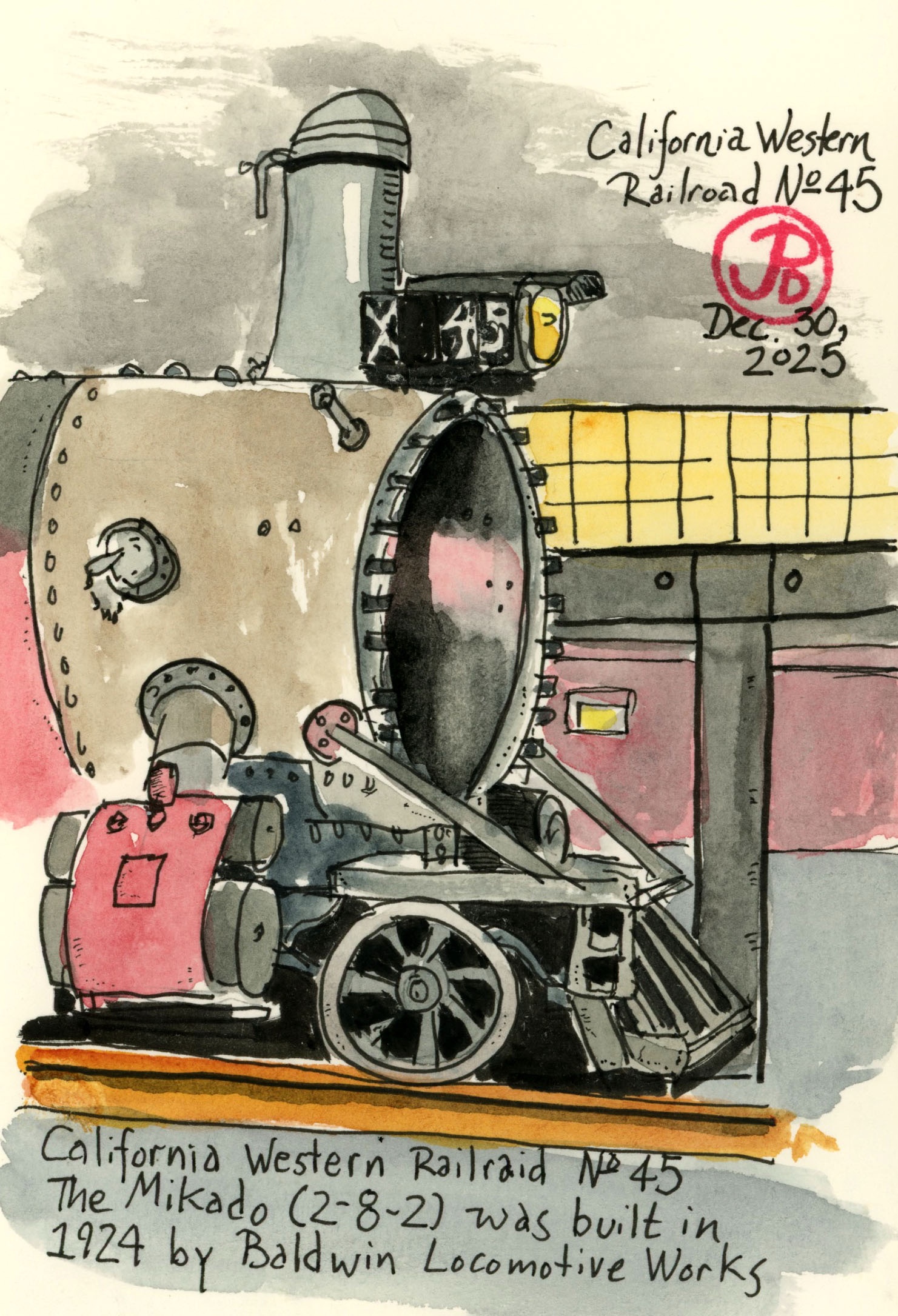
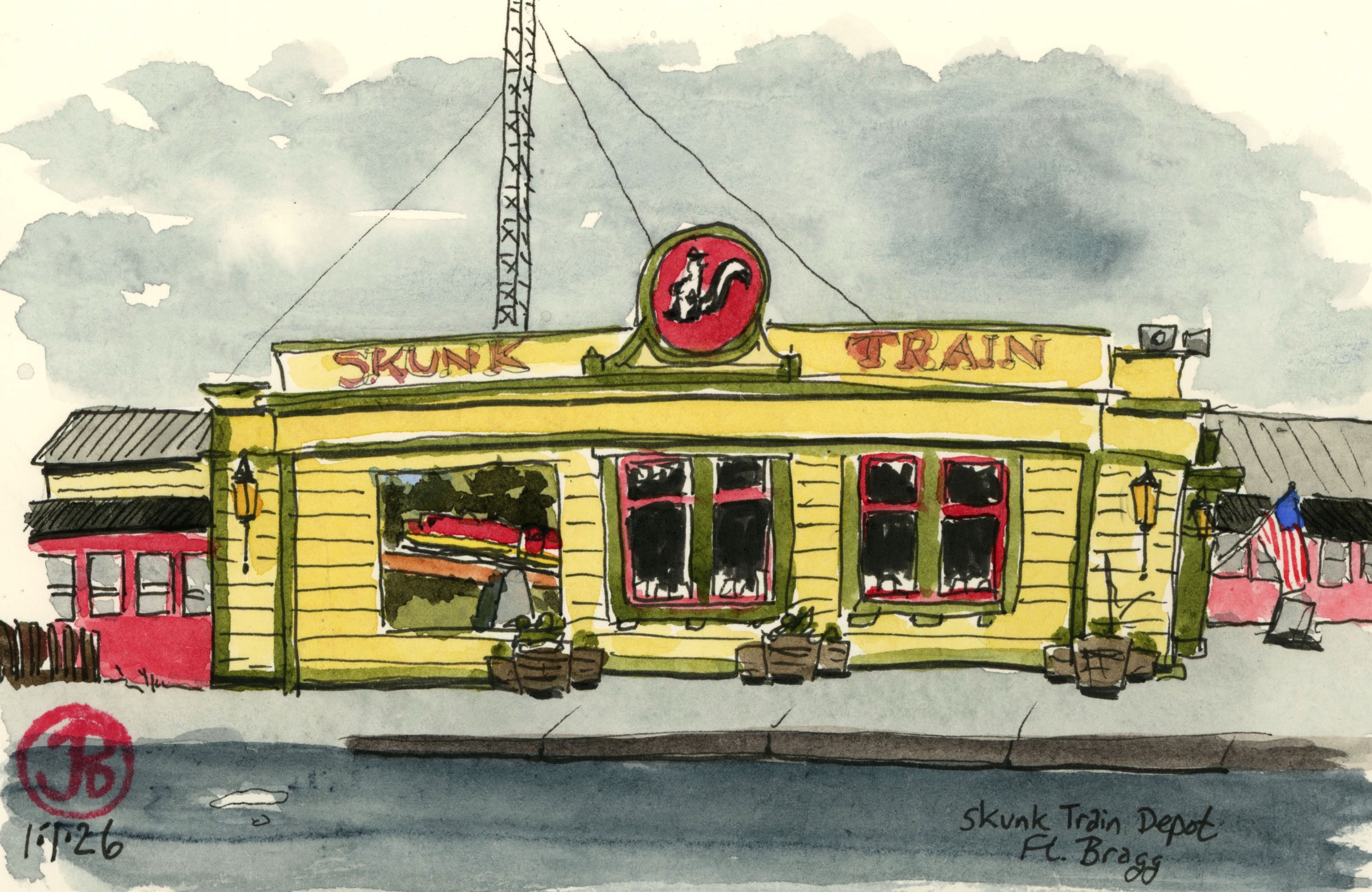
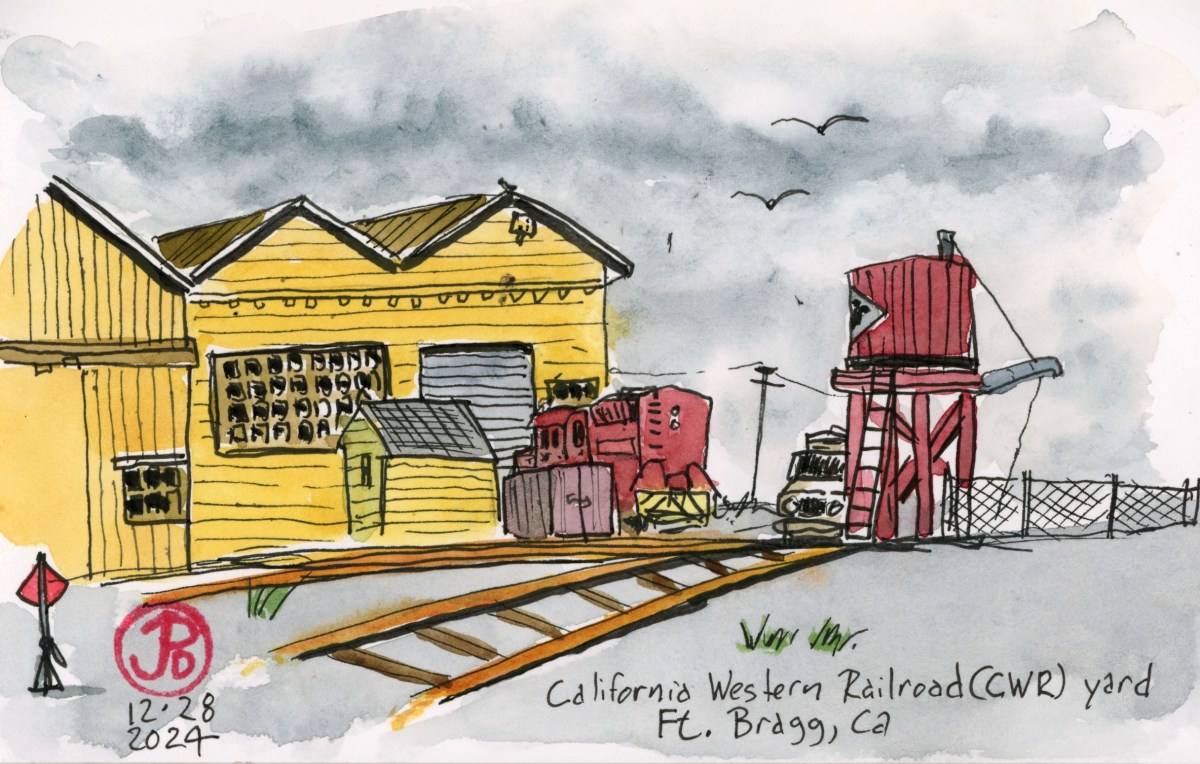
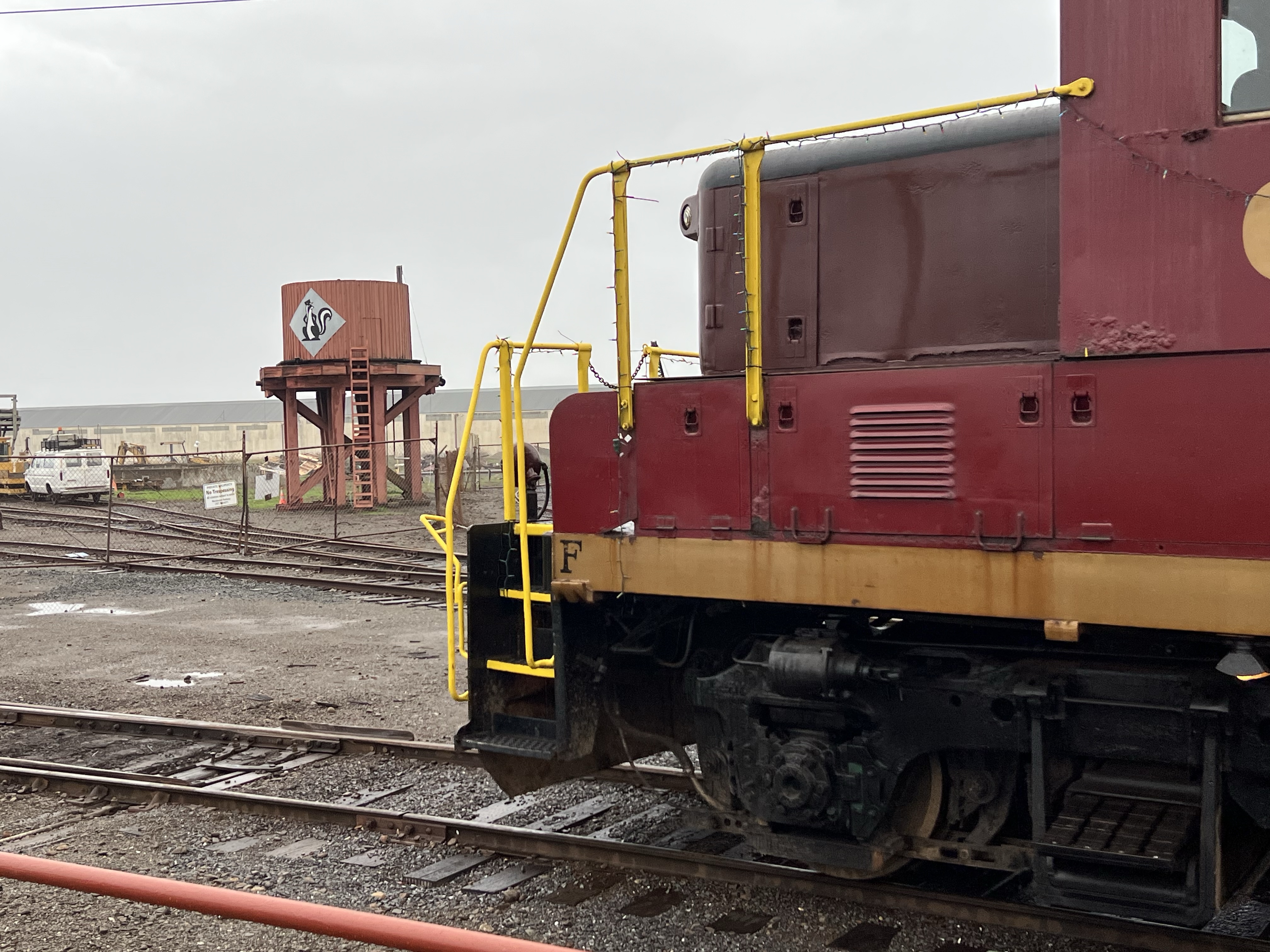
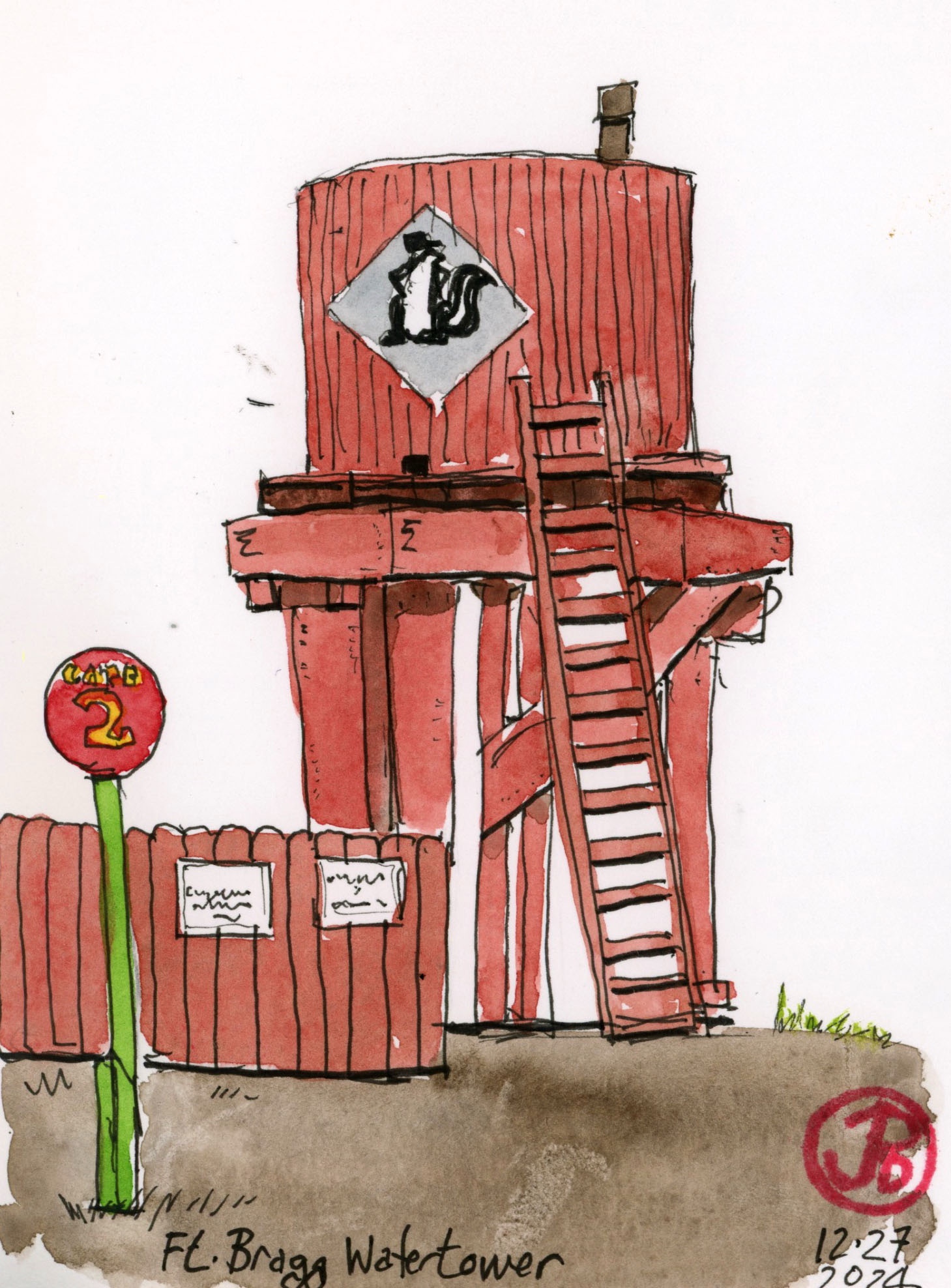
I did some sketching at the train yard (featured sketch) including the water tower with the skunk logo.

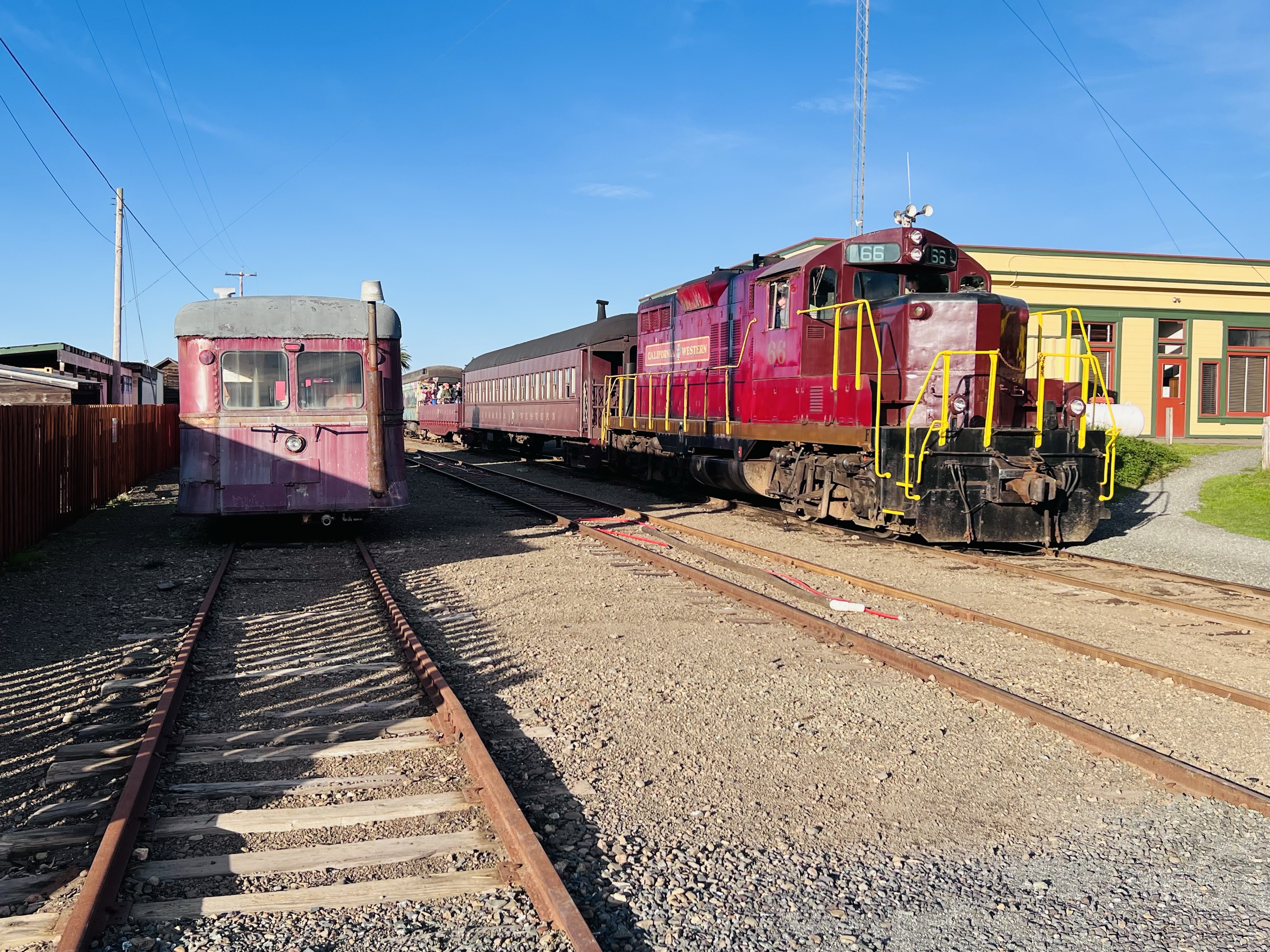
The past and present of Skunk Train. A diesel pulling into the station with a water tower of the steam age in the background.
Image

Pomo Bluffs Park and the Noyo Rivermouth.

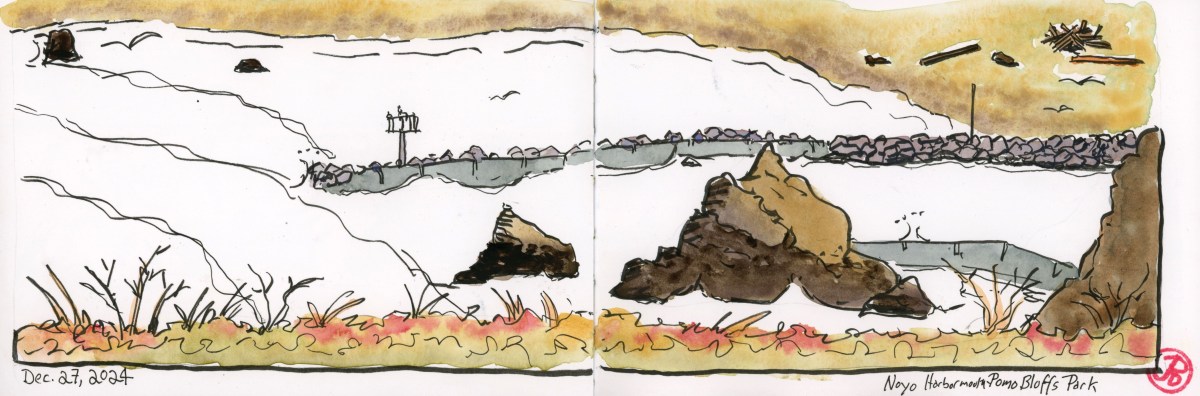
In between rain showers I made it out to Pomo Bluffs Park to sketch the large swells at the harbor mouth.

The trail along the southern bluffs offers a great view to witness the drama where the Noyo River meets the Pacific.

On this December morning, the wave action was epic. No boats were entering or leaving the harbor with these crashing swells.

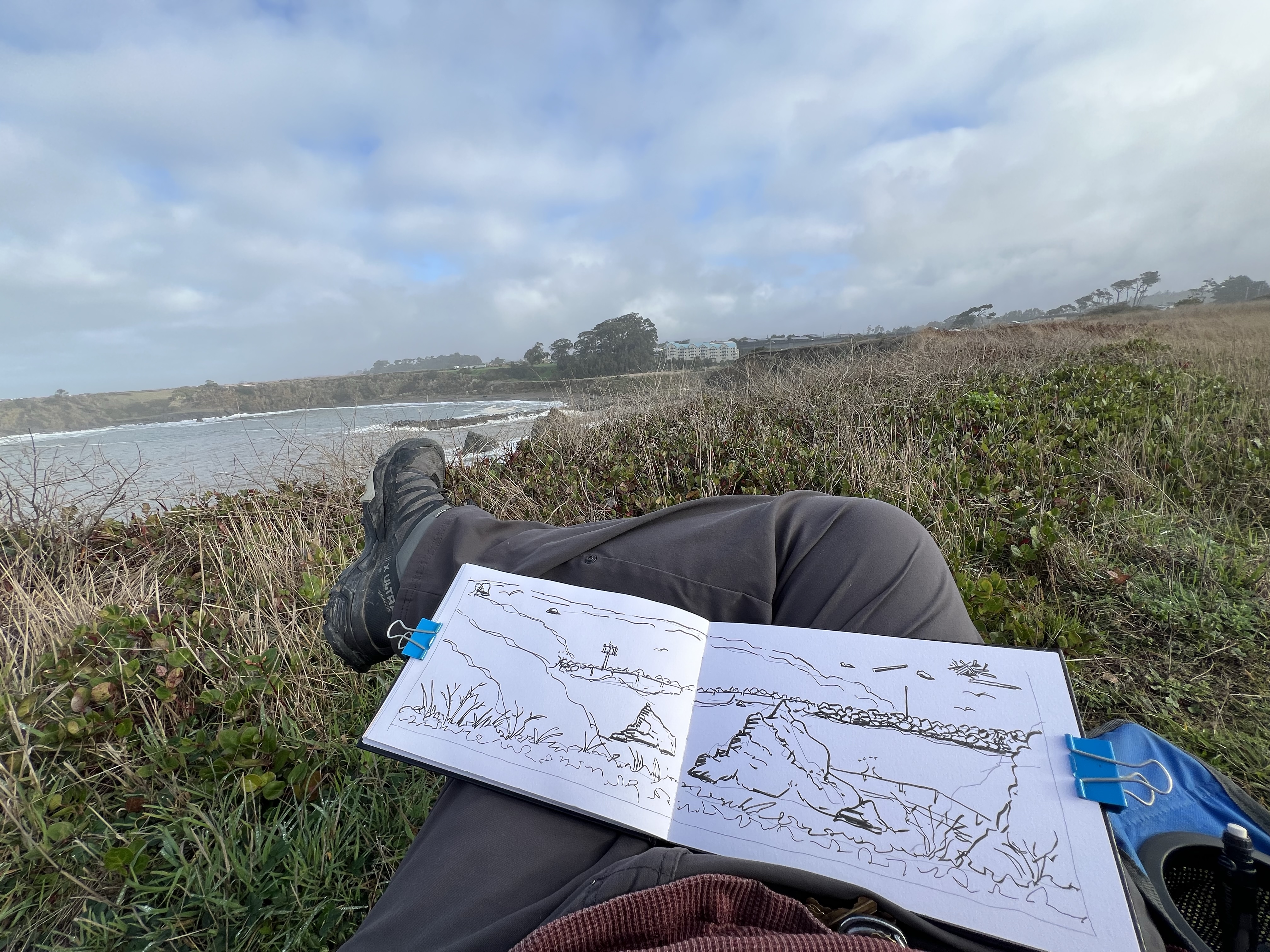
I found a patch, set up my sketching chair, and opened my panoramic sketchbook. The result is the featured sketch.

Sketching the harbor mouth.
The locals have a screwdriver and a sense of humor!
Image

Sonoma Coastal Sketching

One a recent weekend trip with the lads on the Sonoma Coast I added some coastal impressions to my sketchbooks.

I have sketched the coastal locations of Bodega Bay and Sea Ranch many times.

On the drive up I stopped at the Tides Restaurant in Bodega Bay for lunch (made famous in Hitchcock’s The Birds). I had a table with a view of the bay and the Bodega Head across the waters.

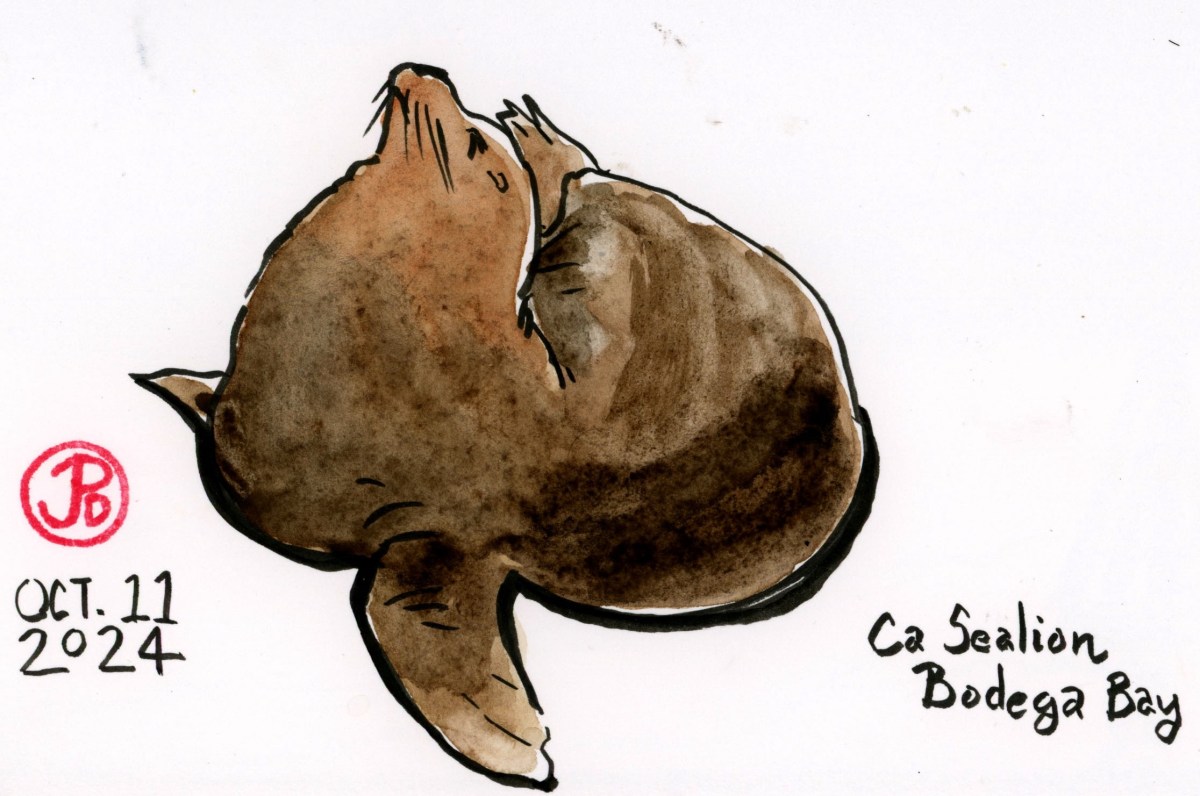
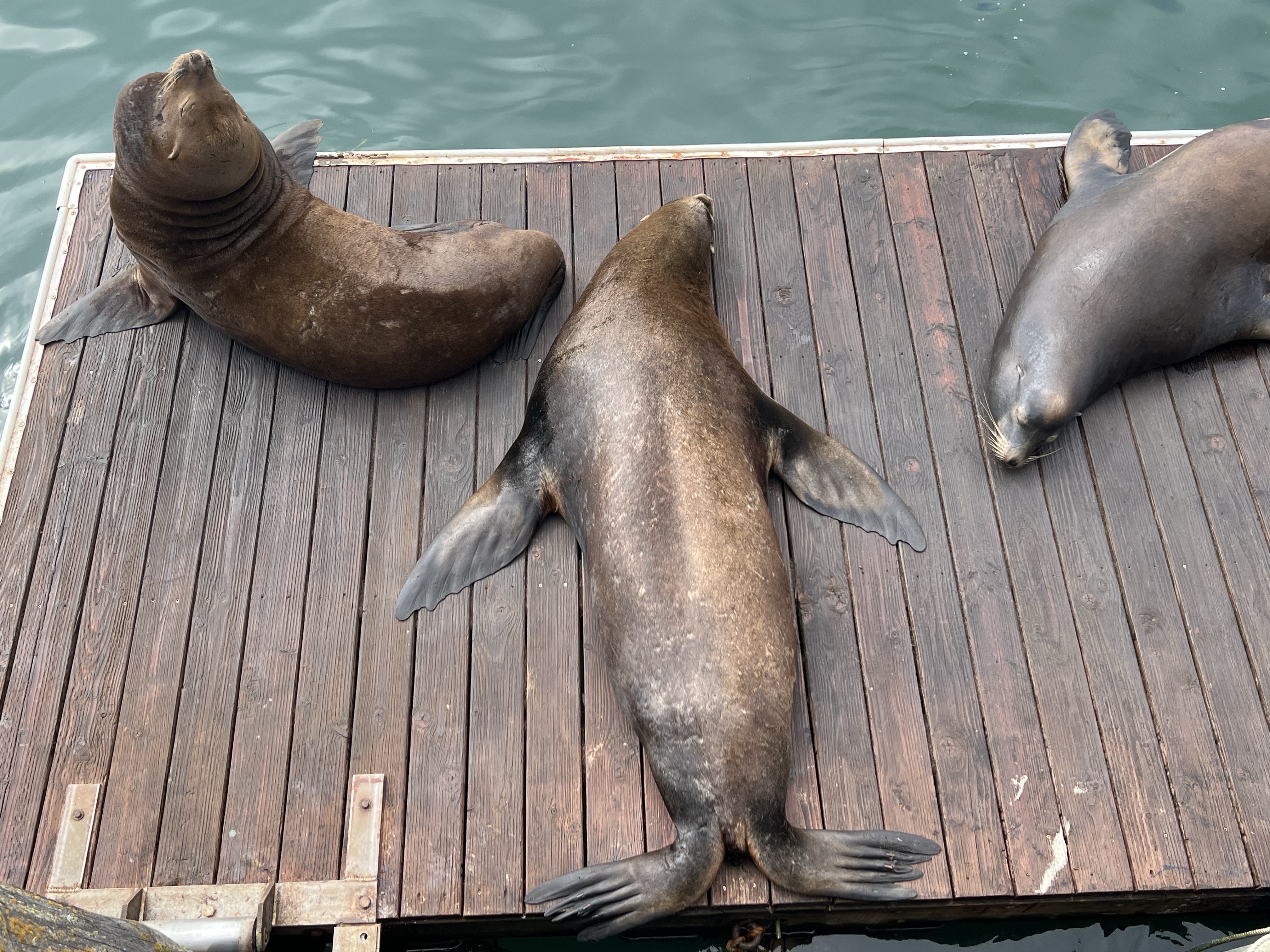
After lunch I walked along the wharf where I saw a group of sea lions resting on a dock. They didn’t seem to be going anywhere anytime soon so I sketched one of them (featured sketch).

The sea lion on the left is begging to be sketched!

After my sketch I drove north on Highway One towards our cabin in the woods just north of the Sonoma/ Mendocino border.

From our base camp in Gualala we headed south back into Sonoma County to visit Sea Ranch.

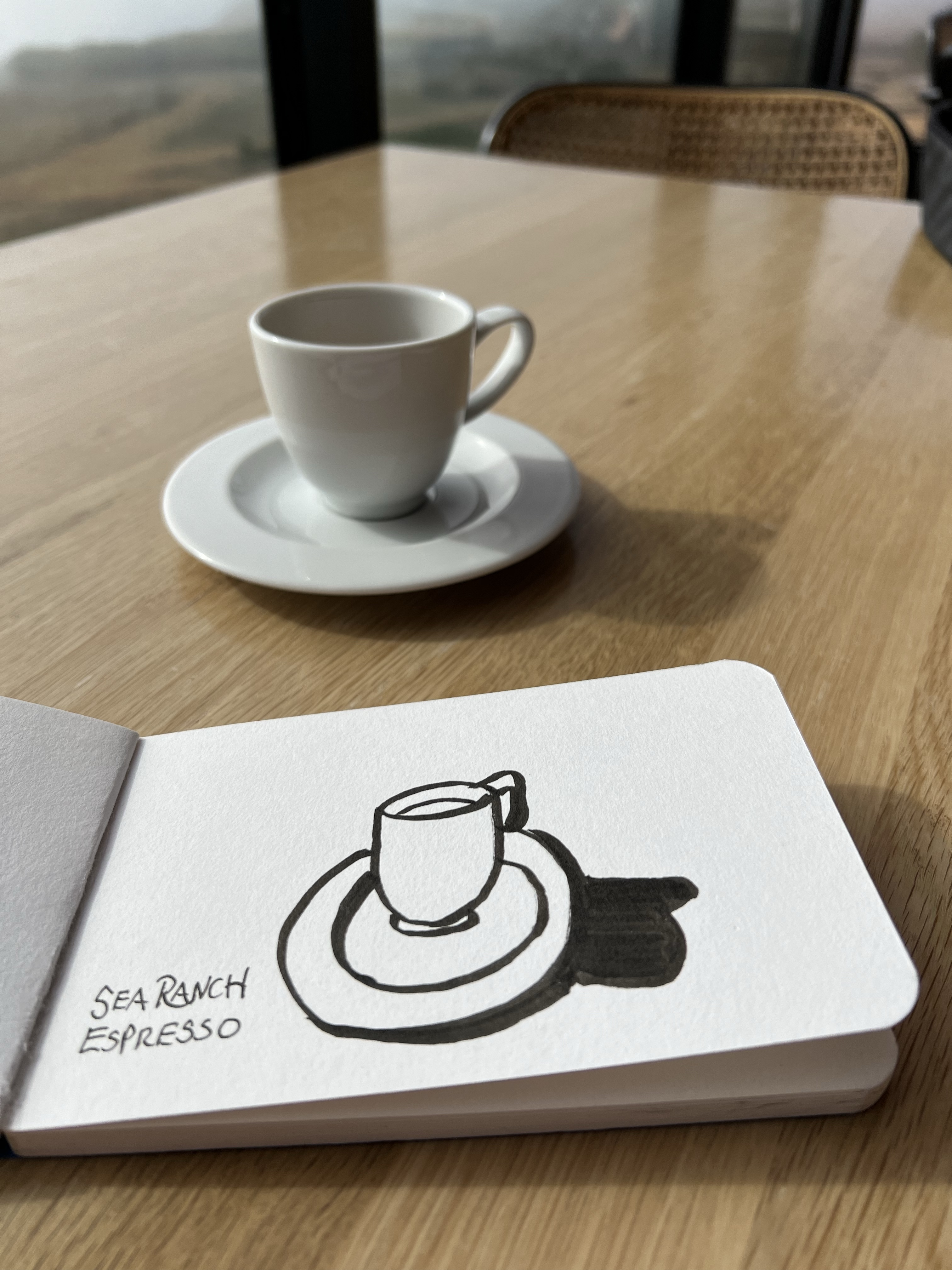
A Sea Ranch espresso sketch.

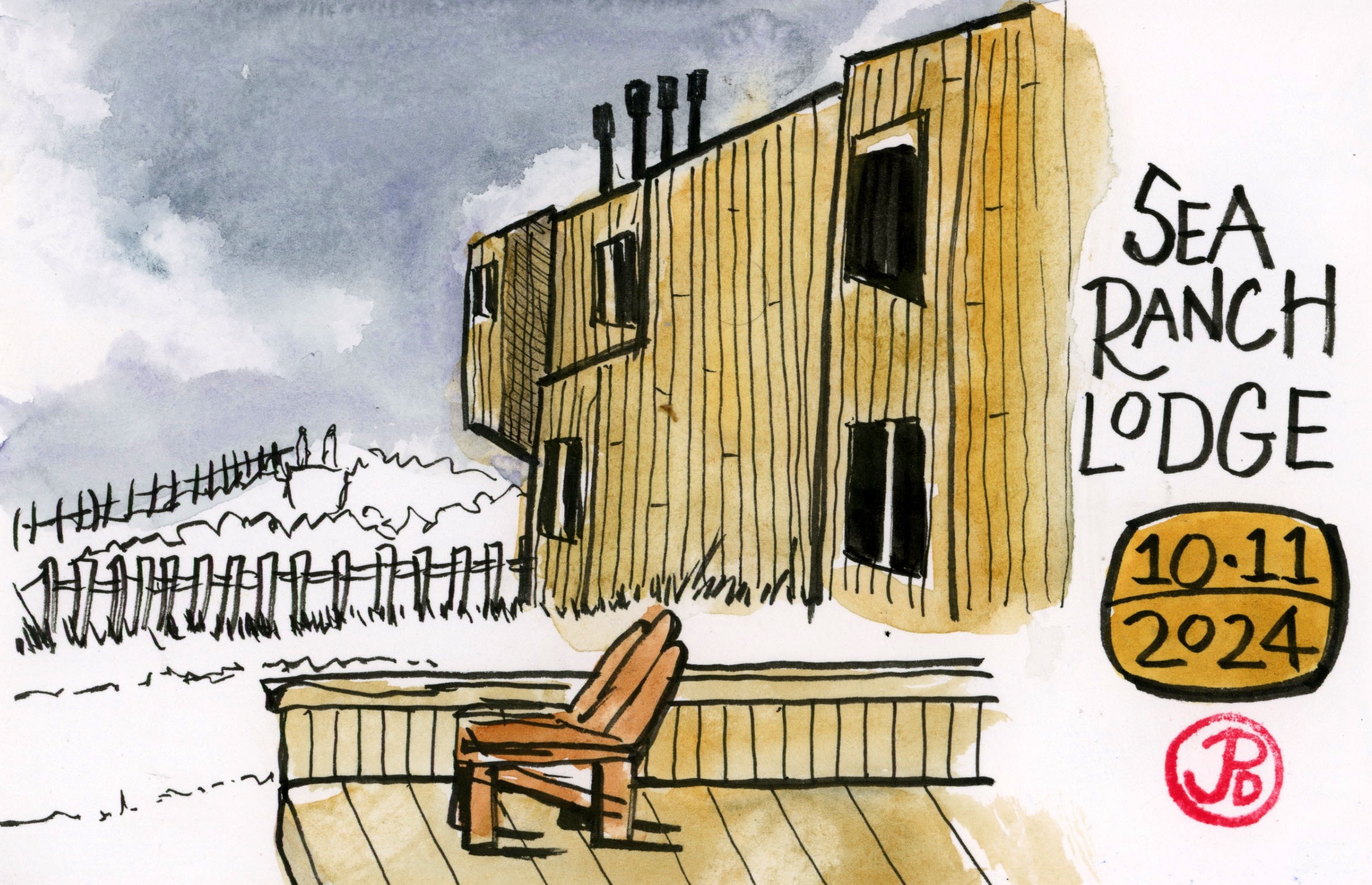
While I was at Sea Ranch Lodge, I did a sketch of the lodge buildings. I had stayed here once before.

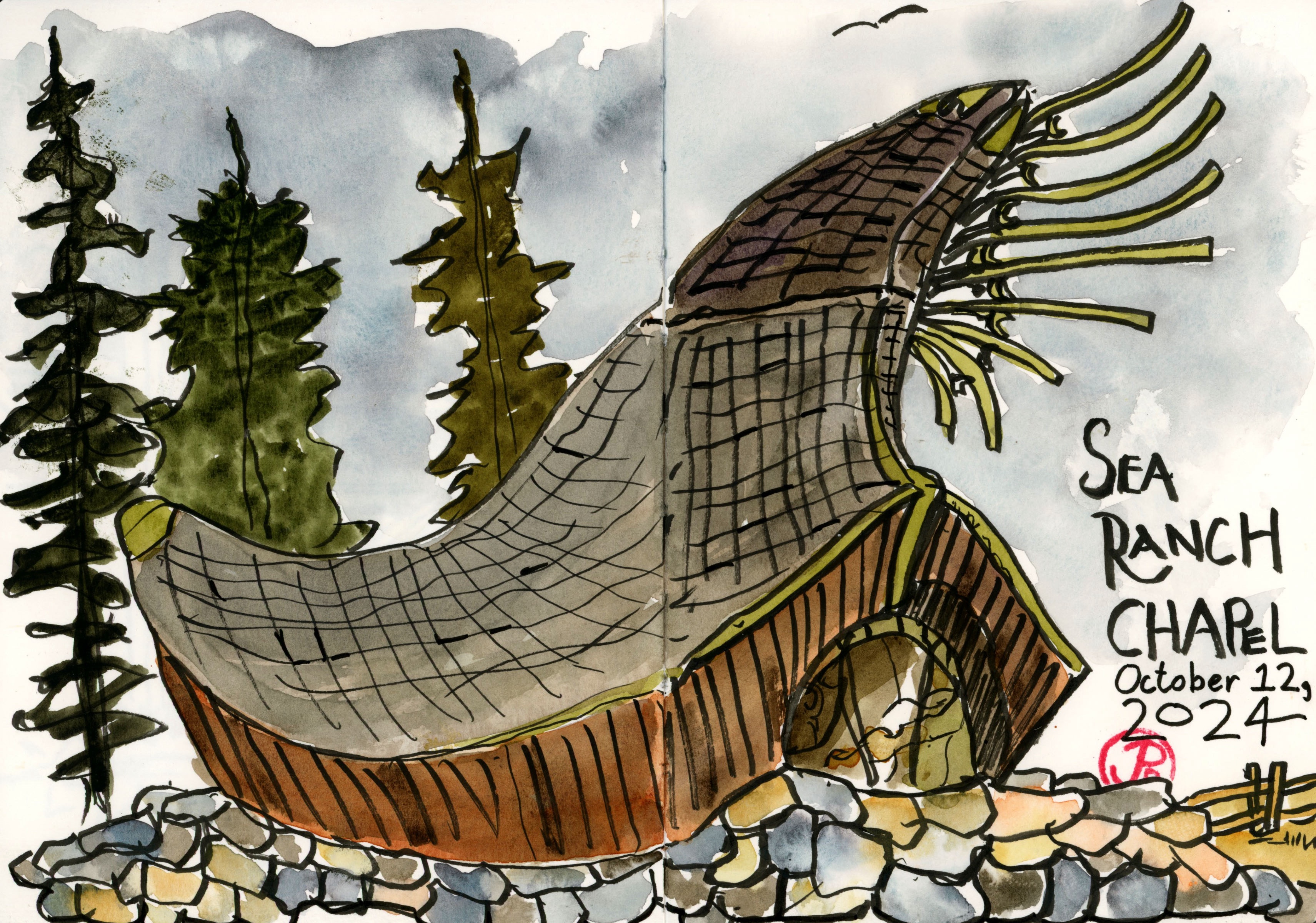
One of my Sonoma County sketching touchstones is the seaslug-like Sea Ranch Chapel. I have sketched this whimsical building every time I am in the area. Every angle yields a new sketch. This time I sketched the chapel from the side, slightly to the rear. I never seem to tire of sketching this unique structure.
Image

Frog Woman Rock

An imposing landmark on Highway 101, just south of Hopland is Frog Woman Rock (formerly known as Squaw Rock).

This was a barrier to the progress of the railroad that was following the Russian River on it’s West Bank. They could not go around the monolith so they had to tunnel through it.

This became the 1,270 foot Tunnel No. 8 on the Northwestern Pacific Railroad (NWP). While this monolith was a new delay to the railroad’s northern progress, the local Pomo people knew this location very well.

Frog Woman Rock with Highway 101 in the foreground.

To them it was know as Bi-tsin’ ma-ca Ka-be, Frog Woman Rock.

There are various legends of how the rock got its name. One Pomo story, filtered through early settlers, is that the rock was a sort of “Lover’s Leap” featuring in a lover revenge quarrel of the scorned Sotuka. Other say Sotuka is the wife of Coyote the trickster and the Pomo people avoided the rock. While others believe when the railroad tunnels through Frog Woman Rock, it released evil spirits.

Whatever the “truth” behind the legend of the rock, it was always be hidden in the past.

In 2024, Frog Woman Rock was designated California Historical Landmark No. 549. The plaque reads:

Since time immemorial, this monolith has been revered by Pomo people as the home of Frog Woman, the consort of coyote, and a special being in her own right. For native people it is a place of sacred power and a reminder of the connection we still have with our spirituality and natural environment. The presence of this great rock on the local landscape is a solemn witness that will forever be a local symbol of our indigenous collective conscience, strength, and perseverance.

The abandoned NWP train station at Hopland, six miles north of Frog Woman Rock, with rusted rail leading north (to the right) to Willits and Eureka.
Image

Freedom: March 1, 1980

On the evening of March 1, 1980, Steven Stayner made one of the biggest decisions of his 14 year old life.

He had to choose to turn his back on the former identity (a forced identity) he had been assuming over the last seven years and four months and help to save a young boy from going through the abuse he had gone through.

It is said that every journey begins with a single step, and their first step out of the one room cabin on Mountain View Road was monumental.

They headed east on Mountain View Road for a quarter of a mile when a car pulled over to give them a ride. The truck was driven by a Mexican laborer and he took the boys down the mountain into the Anderson Valley and then over the hill into the Mendocino County seat of Ukiah.

Timmy couldn’t remember where his parents lived so they went to his babysitter’s house instead. No one was home so the boys walked north on South State Street towards the Ukiah Police Station.

They passed within a block of the Palace Hotel, where Parnell was working as a night security guard. They turned right onto East Standley Street and walked the two blocks to the police station.

The boys passed within a block of the Palace Hotel. Parnell was working as a night security guard at the time of their journey to the Ukiah Police Station. This once majestic hotel is now boarded up and closed.

Steven sent Timmy to the police station alone. He opened the door to the station, got scared, and then turned back and recrossed the street to Steven. This caught the attention of the officer on duty (Offiicer Warner) and the police caught both boys and returned them to the station.

The view of the former police station coming from the direction the two boys traveled, east from State Street.

It was in one of the interrogation rooms at the Ukiah Police Station that Dennis Parnell became Steven Stayner. Uttering the now famous words: “I know my first name is Steven”.

While preparing for Parnell’s trial, a psychiatrist named Robert Wald wrote in his evaluation of Steven about the pivotal moment at the Ukiah Police Station : “It is my absolute belief that with the acknowledgement of his true identity, Steven Stayner freed himself from his state of being kidnapped . From a psychological point of view, he was still in a state of kidnap until he spoke his name, thus ending a psychic capture that lasted two thousand, six hundred forty-four days.”

Sketching notes: The featured spread is a field sketch from the shoulder of Mountain View Road of the one room cabin that was the last dwelling Steven shared with Parnell. While I was reading the account of Steven’s travails I thought that this cabin surely no longer existed and if it did, it must be so far off the road on private property making a sketch impossible. With a short search on Google maps, I found that, indeed the cabin still existed and in plain sight 15 yards from the road.

Before me was a bucolic country road and a rustic cabin surrounded by oaks and conifers. The morning was cold but a clear winter’s day. It seemed a perfect start to the day. The only ominous undercurrent was the presence of the cabin and the knowledge of what happen here in 1979 and 1980. It symbolized Steven’s prison as well as the start of his road to freedom.

The barn across the road from the cabin on Mt. View Road where Steven spent time and raised animals.
Image

Timmy White

Five year old Timmy White left Yokayo Elementary School in Ukiah, California, on Valentine’s Day, 1980 at about 11:30 AM.

The kindergartener walked south down South Dora Road with a classmate. His destination was his babysitter’s home on South Street. He parted ways with his classmate and crossed the street and turned left down Luce Street.

No one witnessed or heard Timmy White’s kidnapping on Luce Street. It was as if he had disappeared into thin air.

The layers of time: while this looks like a quiet residential street in a small town, this is where Timmy White was kidnapped by Kenneth Parnell.

Timmy was the kidnap victim of sex offender Kenneth Parnell who enlisted the help of a teenager named Sean Poorman to assist with the kidnapping.

Timmy was taken to Parnell’s one room cabin at Mountain View Ranch, about an hour away from Ukiah. The cabin did not have electricity or indoor plumbing. Timmy’s first “home” away from home was very Spartan.

The cabin in rural Mendocino County where Timothy White was help captive for two weeks.

Luckily Timmy’s stay with his new “dad” was only two weeks. His savior was another boy that Parnell had kidnapped as he was walking home from school in Merced seven years previously. This was Timmy’s new “brother” Dennis. Dennis acted as Timmy’s protector and never left the five year old alone with Parnell. He was not going to allow what happened to him happen to his new purloined “brother”.

Coda: WhenTimothy White grew up, he relocated to Southern California where he gave presentations to students about the dangers of kidnapping. He became a sheriff with the Los Angeles County Sheriff’s Department. He married and had two children. White died at the age of 35 on April 1, 2010 of a pulmonary embolism.