Image

Sketching Historic Monterey

Most think of the Monterey Aquarium when the namesake of Monterey Bay is mentioned.

As a fourth grade teacher I think of the depth of California History when I think of Monterey: Colton Hall, the Customs House, and the Larkin House.

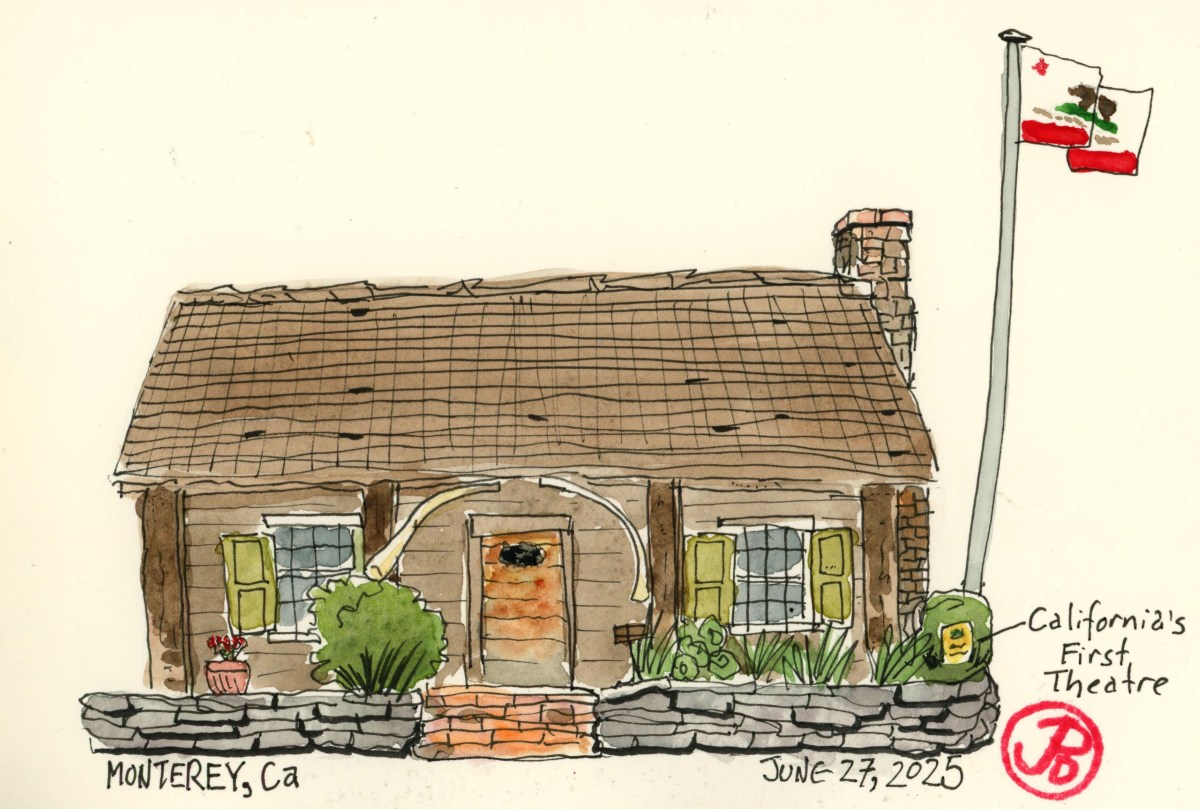
This morning I would not be sketching any of these buildings (although I have already sketched two) I turned my journal to the many firsts in California to be found in Monterey: California’s First Theatre and brick building.

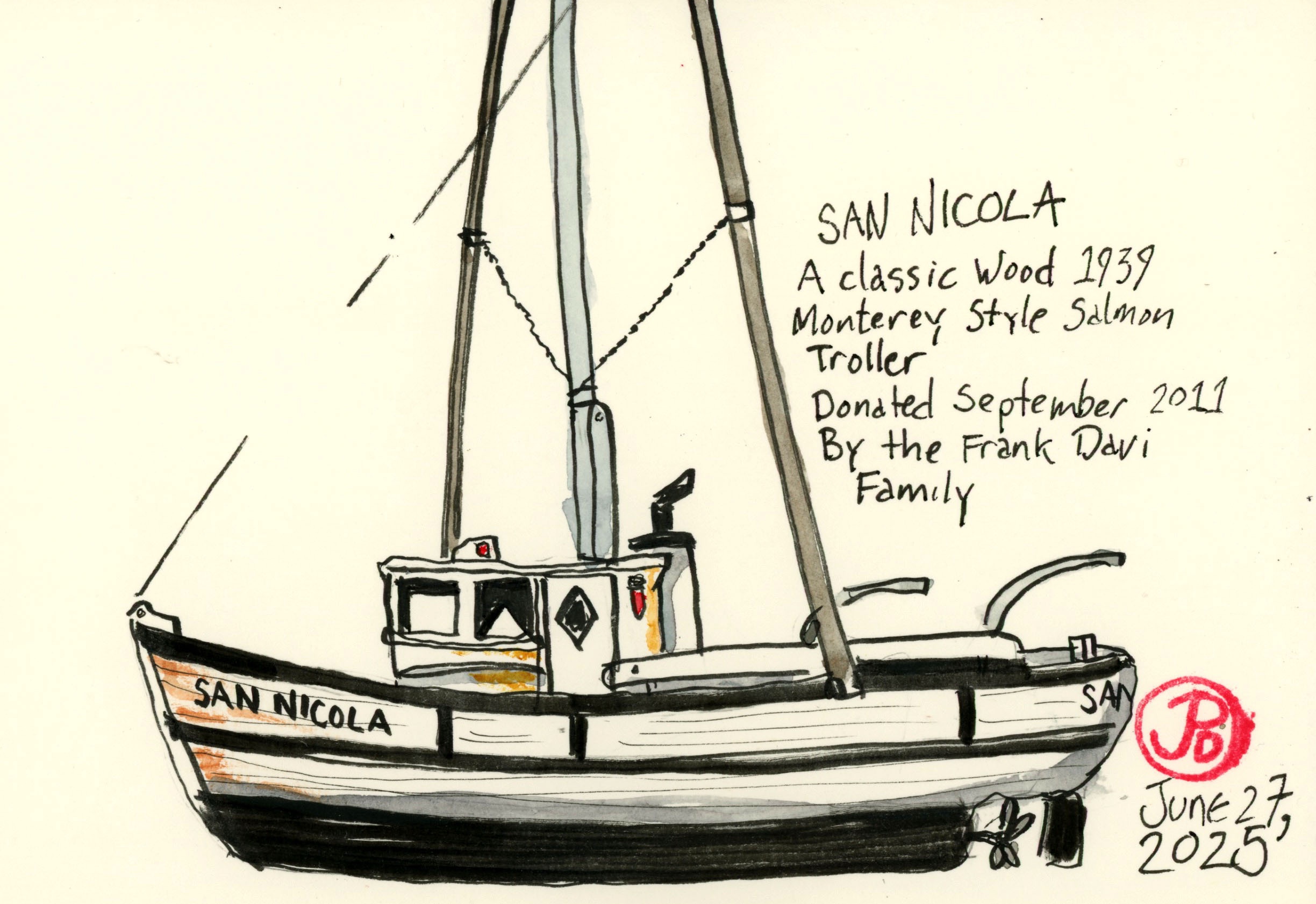
I started off with a warm up sketch of the San Nicola. The San Nicola is a 1939 wooden salmon trawler on display near the entrance to the Monterey Historical District. It is a reminder of Monterey’s fishing heritage.

After my warm-up sketch, it was now time to head to one of the first firsts in Monterey, California’s First Theatre.

Two whale ribs frame the entrance to the theatre.

The theatre was built in 1846 by Jack Swan. It was first used as a theatre in 1850 when the US Army officers of the 1st New York Volunteers put on plays to raise money.

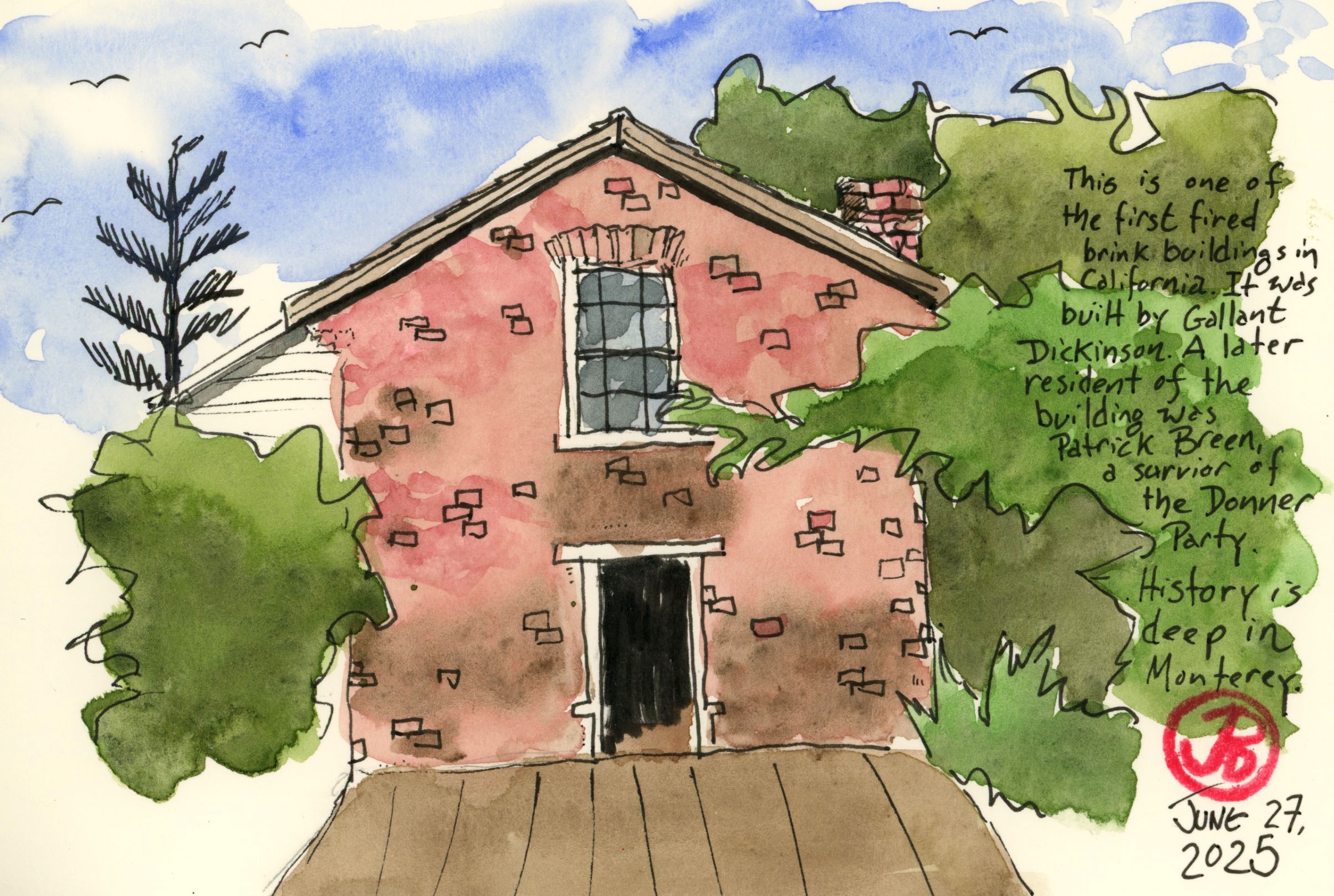
My second first of the day was just around the corner, it is the first brick building in California.

A sketch in progress.

Now this bears a little bit of explanation. The early Spanish and Californios had built buildings with adobe bricks, the first “brick” building was built with European style fired bricks.

The structure was built by Gallant Dickinson in 1947. A well known resident of this building was Patrick Breen, a chronicler and survivor of the Donner Party. The building served as a restaurant in the early part of the 20th century.

Image

Point Pinos Lighthouse

On NPR I heard a report on the Newshour about lighthouses and their women keepers.

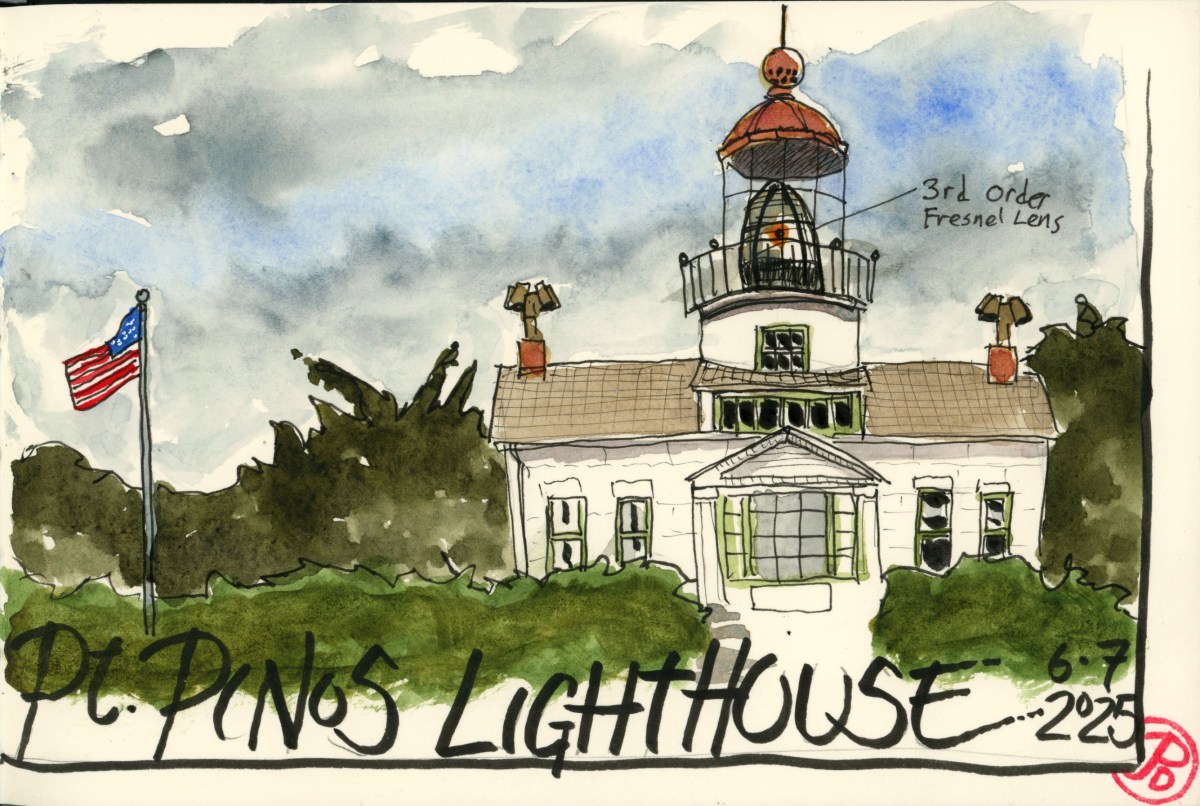
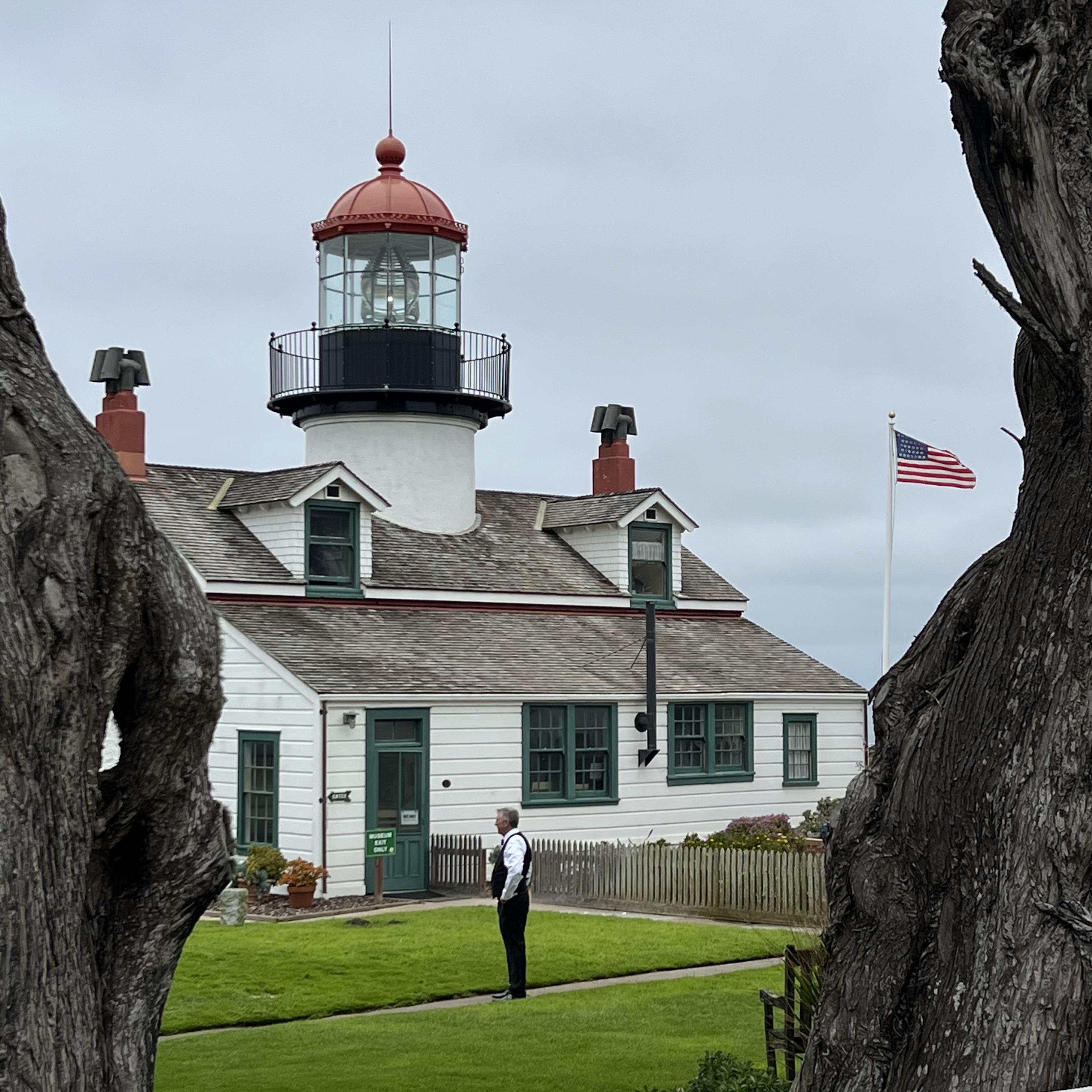
One lighthouse featured was the Point Pinos Lighthouse in Pacific Grove, just northwest of Monterey. What I didn’t know but learned from the report was that the lighthouse is the oldest light in continuous use on the West Coast. So it seemed like a great Saturday morning sketch adventure.

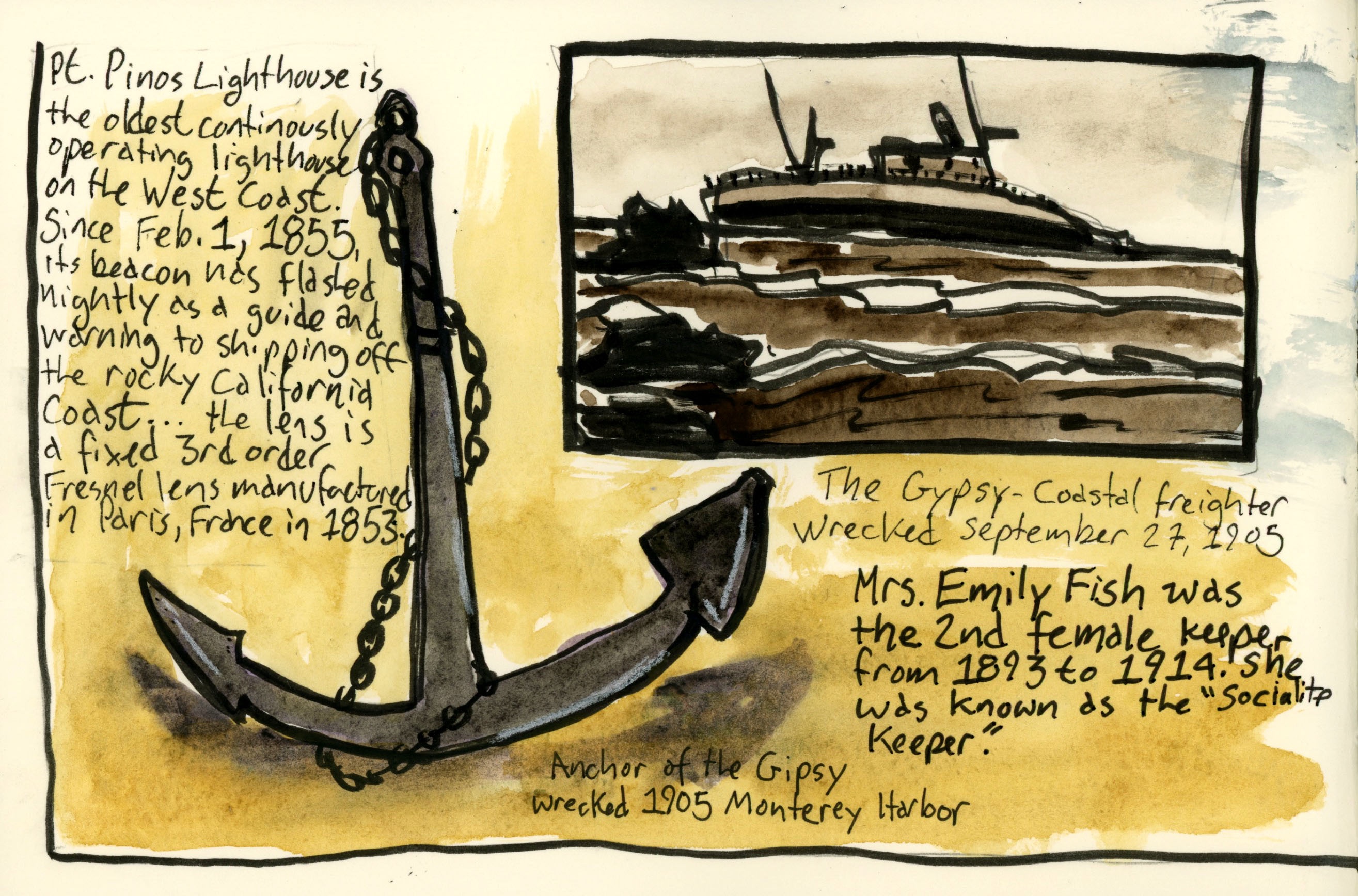
The light first shown its beam on February 1, 1855. The current lens is a 3rd-order Fresnel Lens that was built in Paris, France in 1853 which is the lighthouse’s original lens. In clear weather the light can be seen from 17 miles at sea. In dense fog the foghorns are activated.

The first woman lighthouse keeper was Charlotte Layton. She became keeper when her husband, the first keeper at Point Pinos, was murdered by while taking part in a posse to capture the bandit Anastasio Garcia. Garcia got Layton first. She was the keeper from 1856-1860.

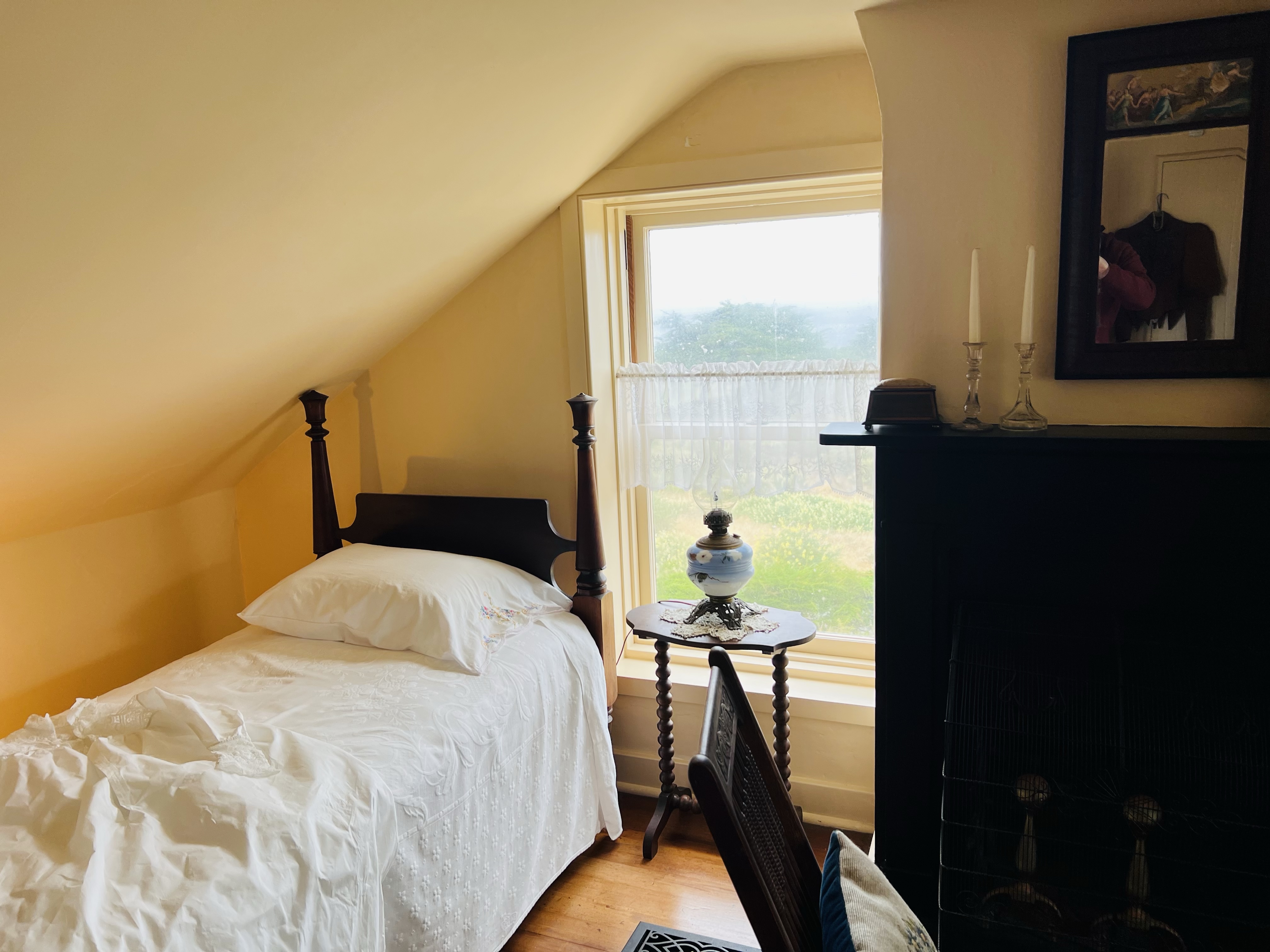
Perhaps the lighthouse’s most famous female keeper is Emily Fish, known as the “Socialite Keeper” for her entertaining at the lighthouse. She served as keeper from 1893 to 1914. While she was not the first woman lighthouse keeper at Pt. Pinos, she was the last.

Emily Fish’s bedroom at the lighthouse.

When I arrived at the lighthouse just after 11, I was greeted by Nancy, the docent interviewed on the Newshour. I told her I was here because of seeing the lighthouse featured on the news.

I jokingly asked her if she had signed many autographs yet.

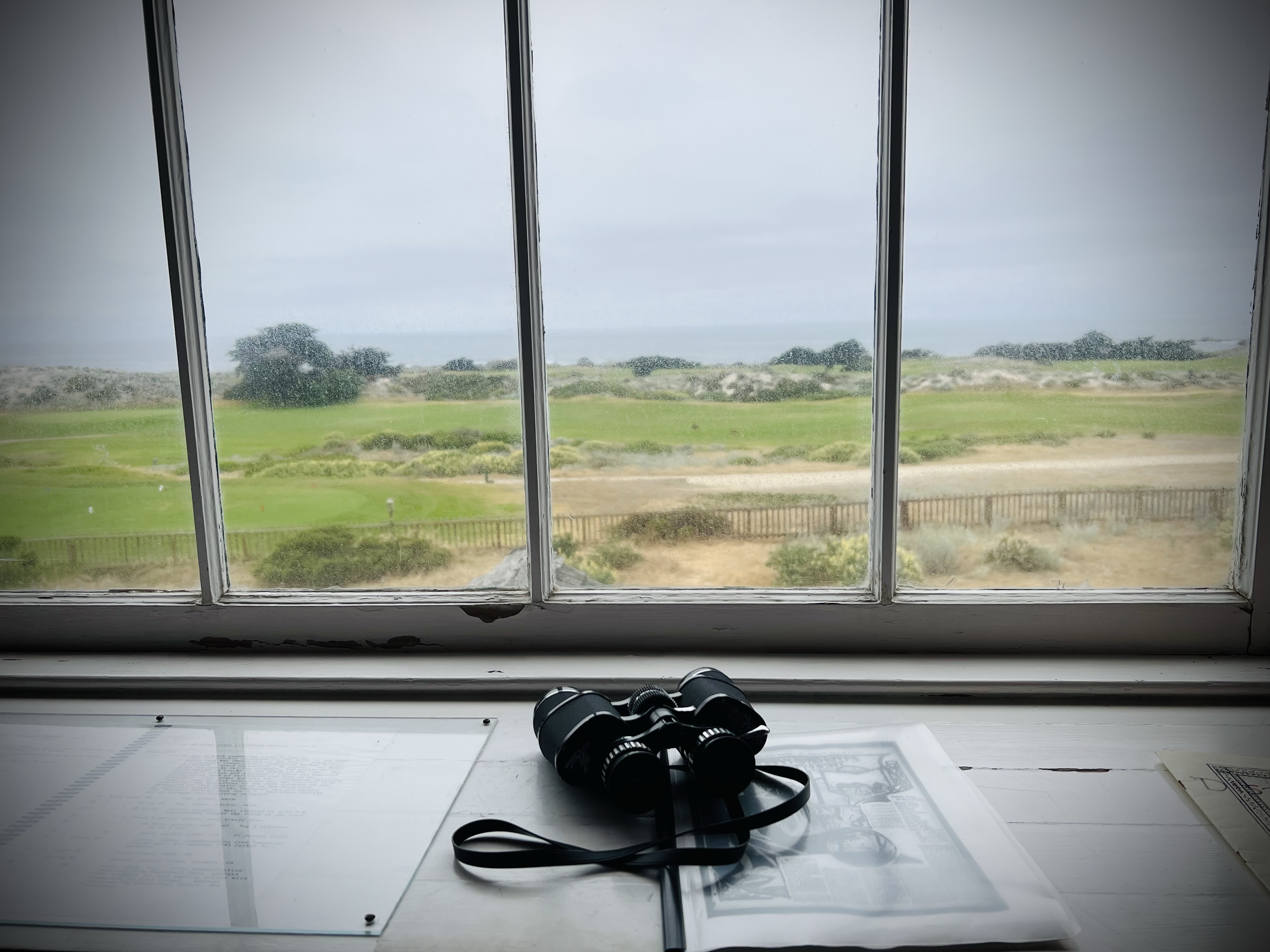
The observation room with great views of the Pacific Ocean. You feel this was a room where Emily Fish spent time filling out the keeper logs.

I walked around the lighthouse to look for a sketching perspective and thought the view from the front would do just fine (featured sketch).

On the lighthouse grounds is the only remainder of the freighter Gipsy: her anchor. This is a reminder of why lighthouses exist, to let sailors at sea know where they are and that land is near. And hopefully the two shall not meet, well not at speed anyway.

The Gipsy hauled freight and people up and down the California Coast from San Francisco to San Diego. The ship was known as “Old Perpetual Motion”. On a foggy night on September 27, 1905, the ship was going from San Francisco to Monterey when the inexperienced relief captain mistook a red marker construction light for the marker at the end of Monterey wharf. The ship was wrecked on the rocks near McAbee Beach. The ship was a total loss.

Image

Otter 841

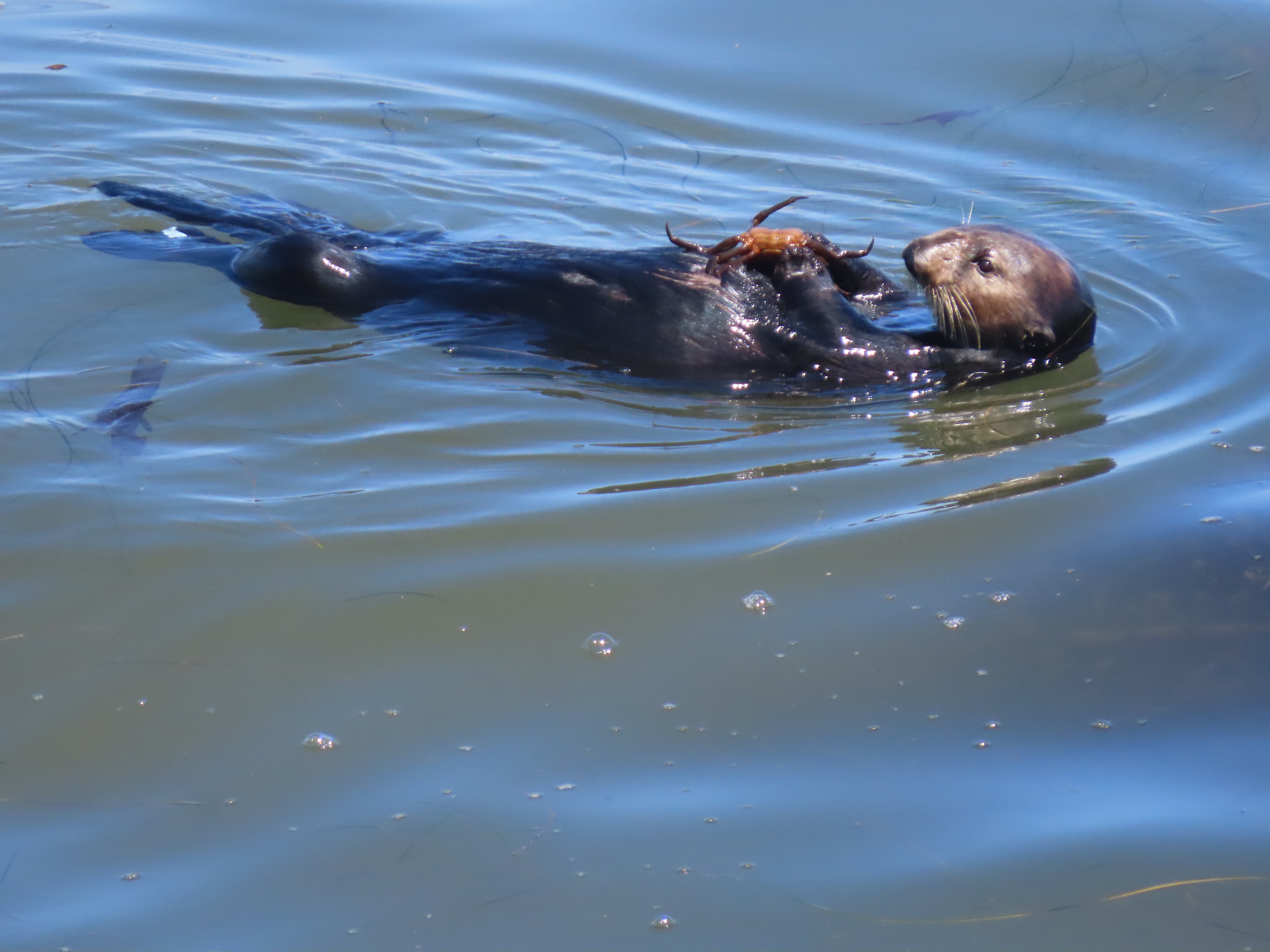
It is nice to see sea otters along the Santa Cruz coast. Laying on their backs, bashing a mollusk to death or eating a crab, recently caught, and still alive, one foot at a time, or rolling in the kelp, belly full, and settling in for a nap.

Fresh caught crab is on the menu off of West Cliff Drive.

This marine mammal was hunted to near extinction because of their pelts. Now they are protected and have prospered on the California coast.

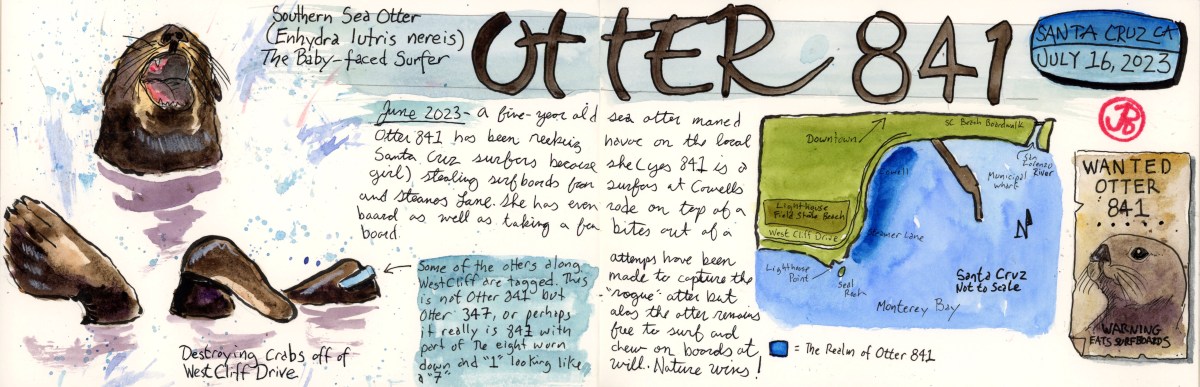
A five year old female, branded a “terrorist” by some in the media, has grabbed the world’s attention.

This is Otter 841.

Otter 841 was born in captivity and then released to the wild. Her mother, Otter 723 was taken out of the wild because she was habituated to people and was approaching kayakers begging for food. It was apparent that Otter 723 was being fed by humans.

While in captivity they realized that Otter 723 was pregnant and she soon gave birth to our troublemaker Otter 841.

841 was released to Monterey Bay where for four years she swam under the radar.

Starting in June of 2023, 841 has become a surfboard pirate. The otter has been observed and photographed jumping up onto surfboards, dislodging it’s surprised rider, in the popular surf spots of Steamers Lane and Cowells. On one occasion, 841 took some bites out of a surfboard.

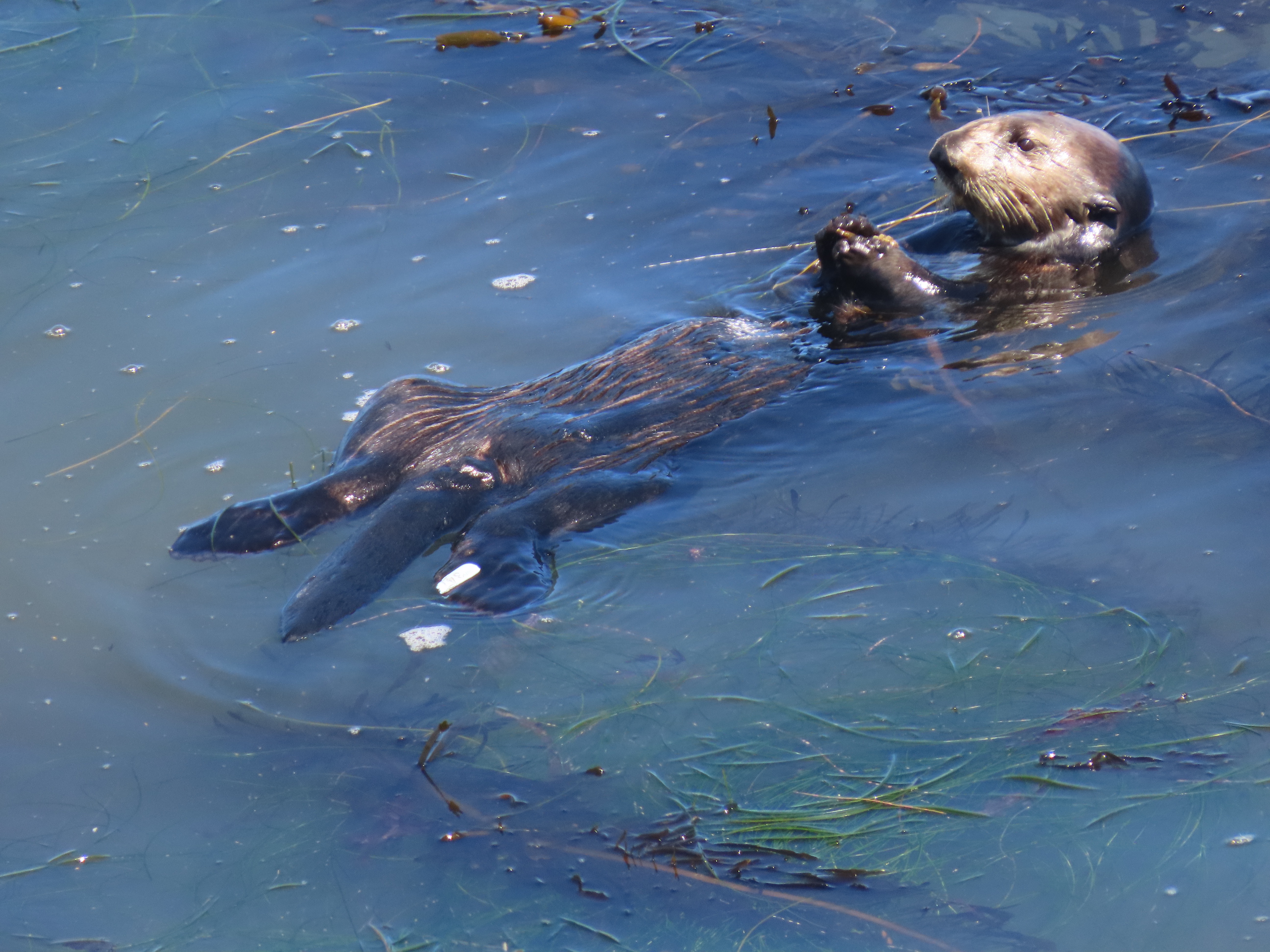
Is this Otter 841? On the otter’s left flipper is a light blue tag with a three digit identification number.
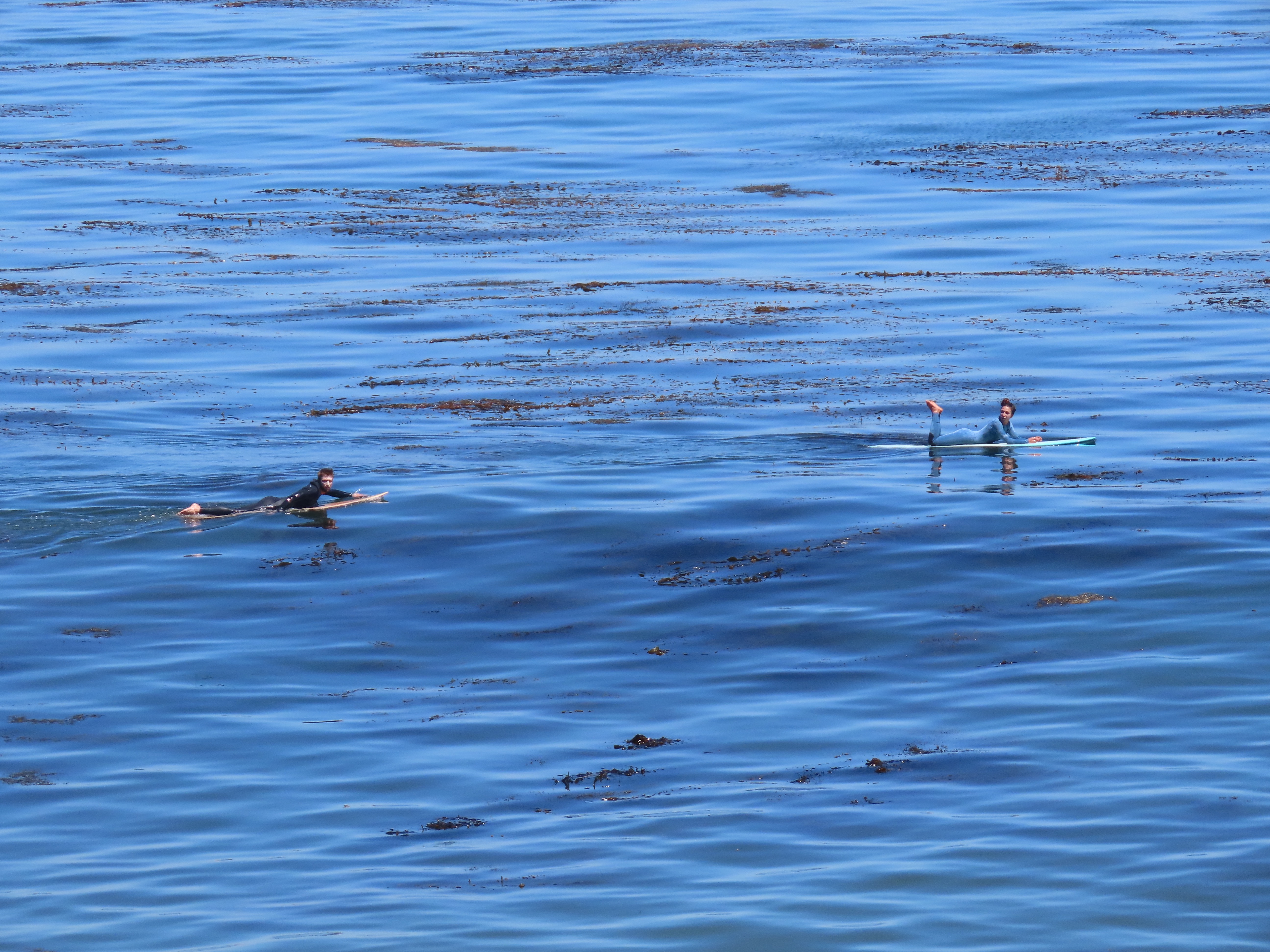
Surf at your own risk! Surfers keeping an eye on the infamous otter.

The powers that be decided that 841 should no longer be in the wild and attempts were made to capture 841 employing the cunning use of a surfboard. They tried and tried again but they could not capture the piratical otter.

And as of publishing, Otter 841 still swims free off the coast in Santa Cruz.

Don’t mess with nature because nature usually wins.

Image

Pacific Grove Museum of Natural History

On my first full day of summer I headed 50 minutes south of Santa Cruz to Pacific Grove on the Monterey Peninsula.

This is a return trip (it had been a while) to the Pacific Grove Museum of Natural History.

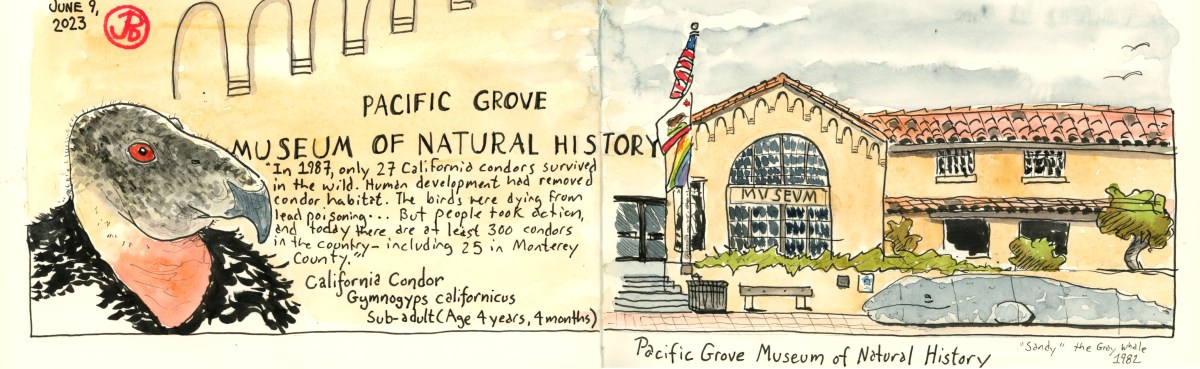
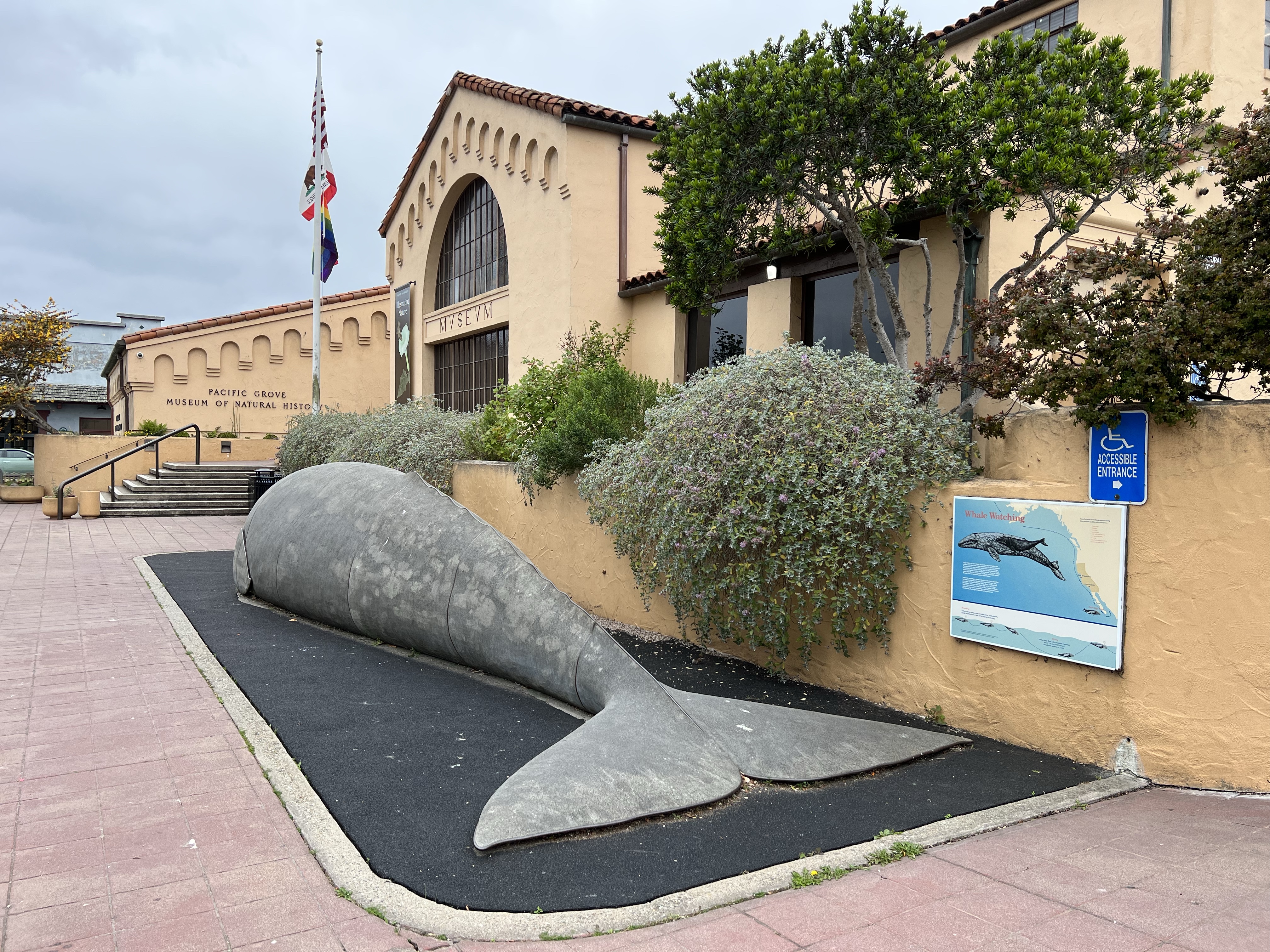
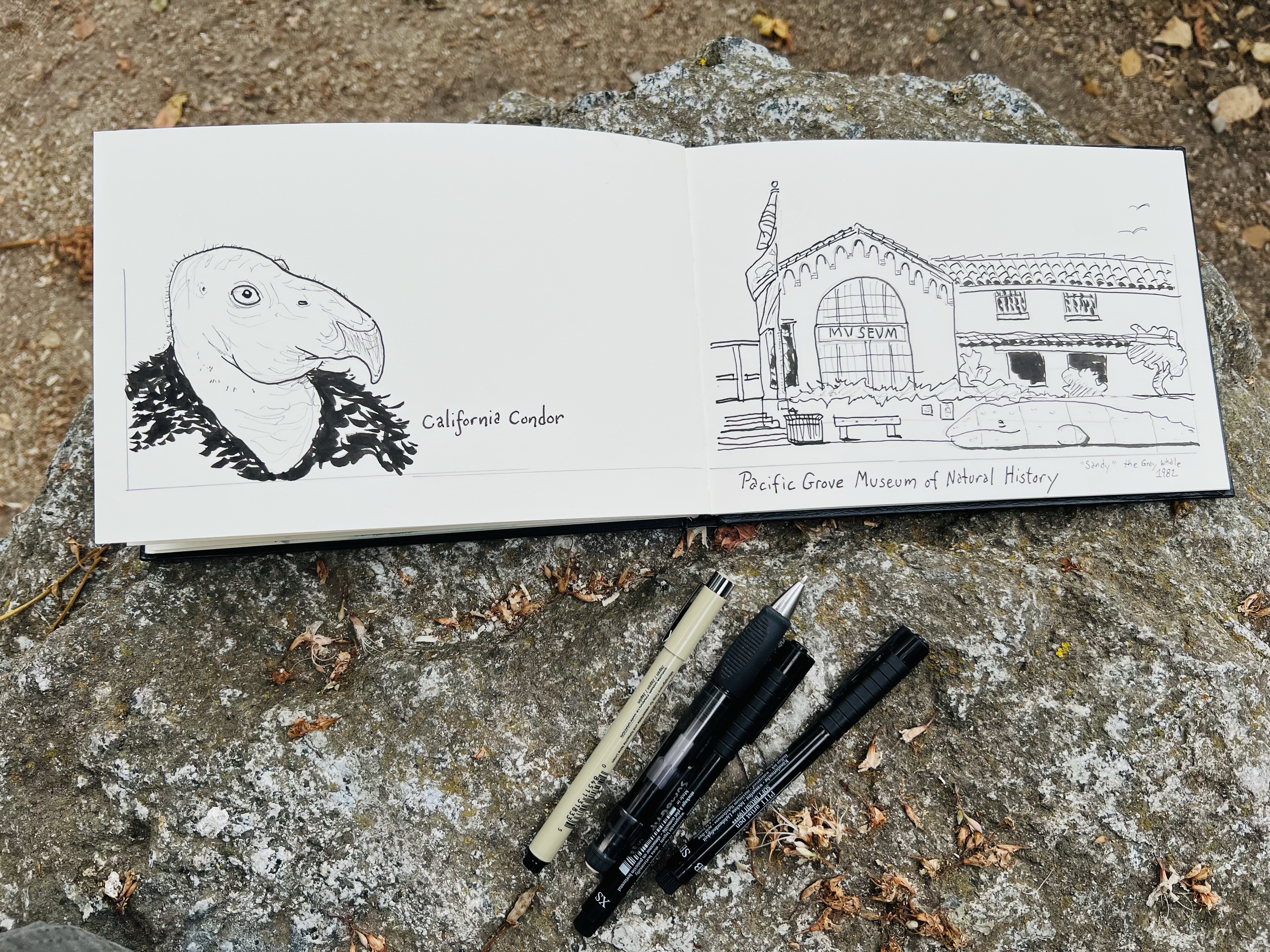
I arrived early and sat in the park across the street to sketch the 1932 Spanish Mission Revival museum. To the right was a statue of a female gray whale named “Sandy”, built in 1982.

“Sandy” in the foreground and the museum in the background.

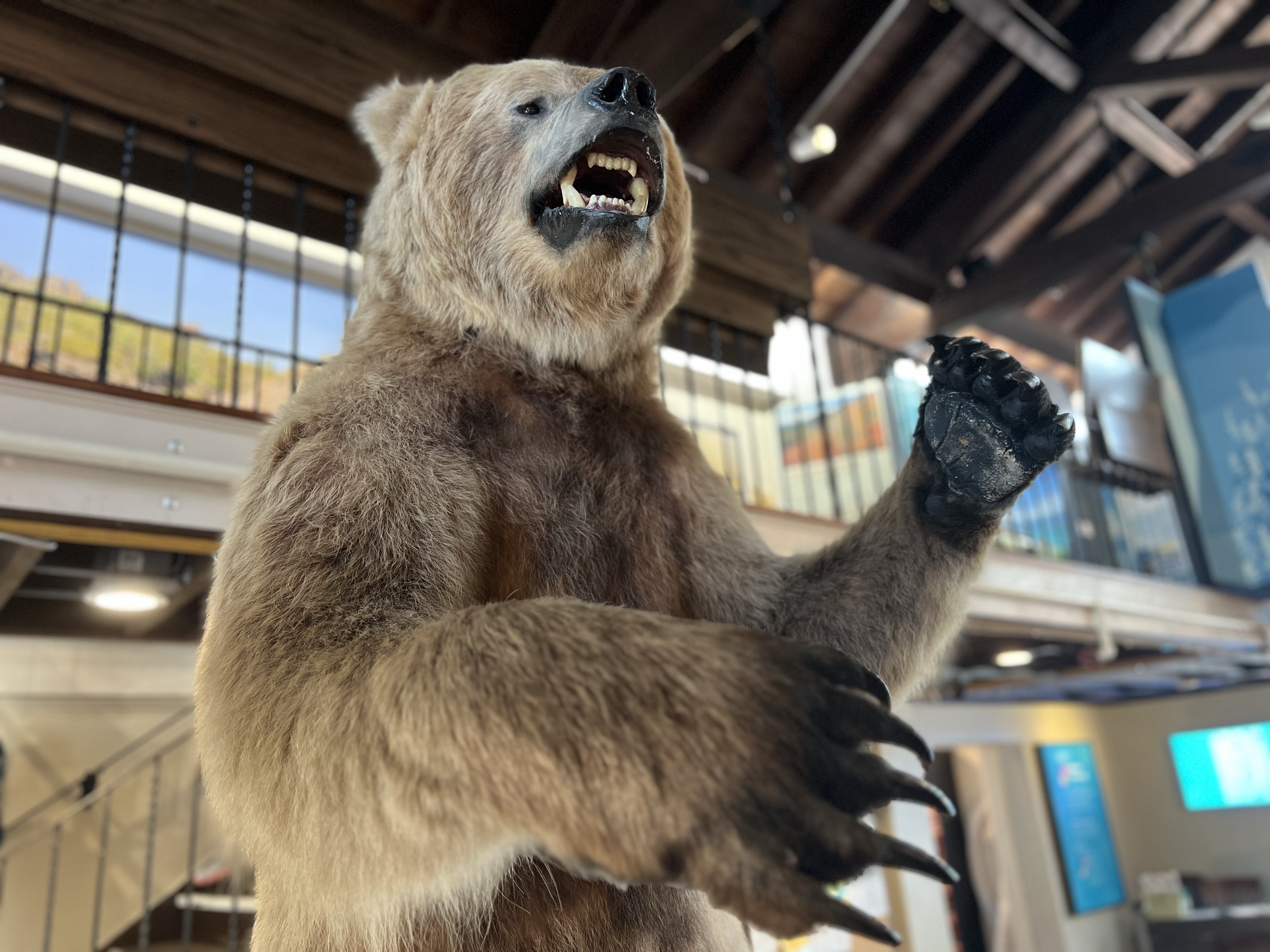
The museum opened at ten and after paying my $10 admission I walked into the gallery, greeted by a grizzly bear standing up on it’s hind legs. The grizzly is the extinct State Mammal of California. This specimen came from Alaska.

The Pacific Grove Museum of Natural History is full of animals: insects, amphibians, reptiles, fish, mammals, and birds, lots of birds. But all of them are dead. This is a mount museum where the visitor are surrounded by taxidermy. Some very lifelike but others a little comical.

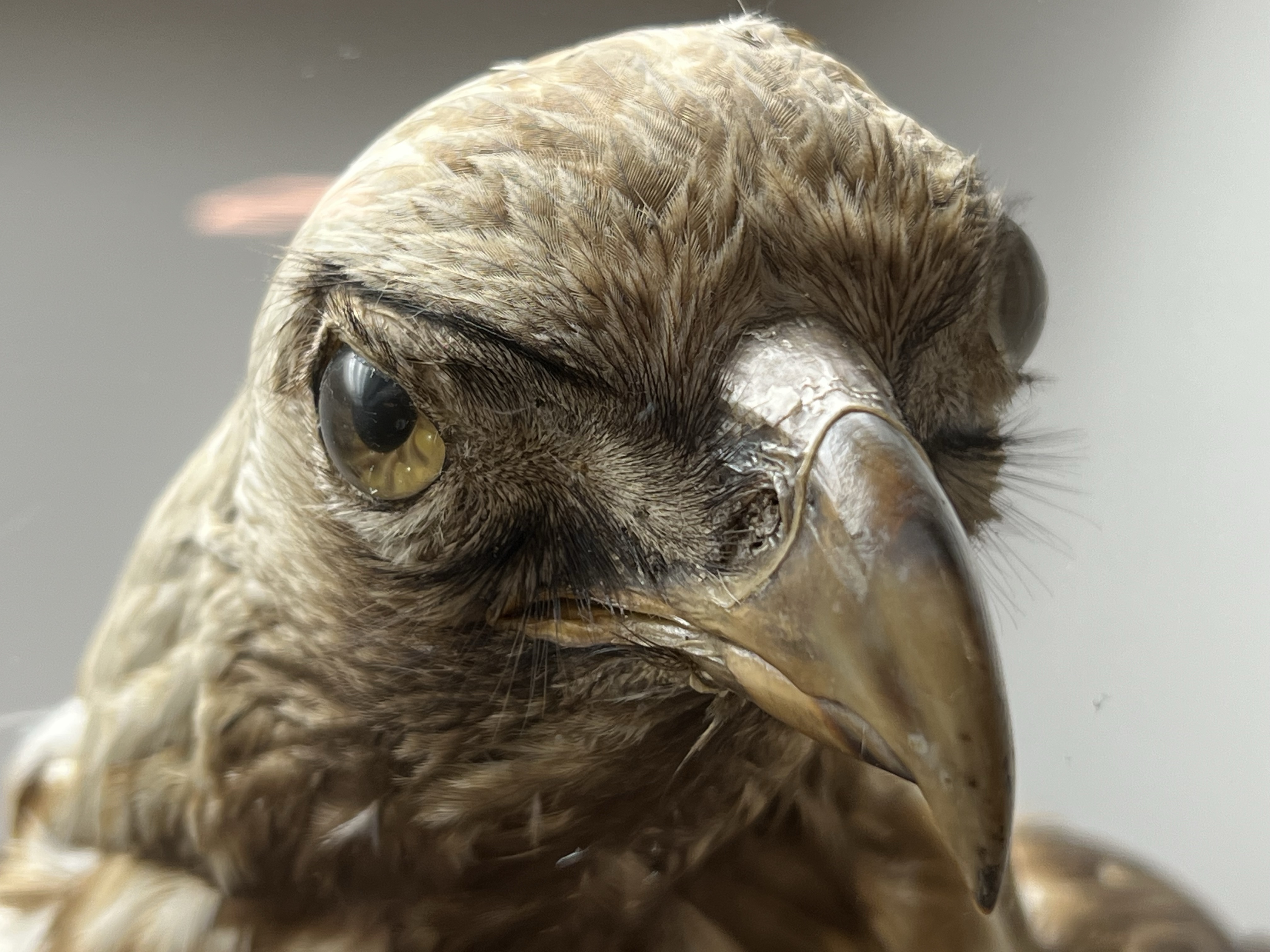
This taxidermy golden eagle looks like someone squeezed it a little too hard.

This is a sketchers paradise because it provides lots of subjects, none of which are moving anytime soon. After sketching the exterior of the museum, I added a California condor from the bird hall. These magnificent and rare birds can be seen a short distance from PG on the coast of Big Sur.

My spread in progress from the Monterey Native Plant Garden in the back of the museum.
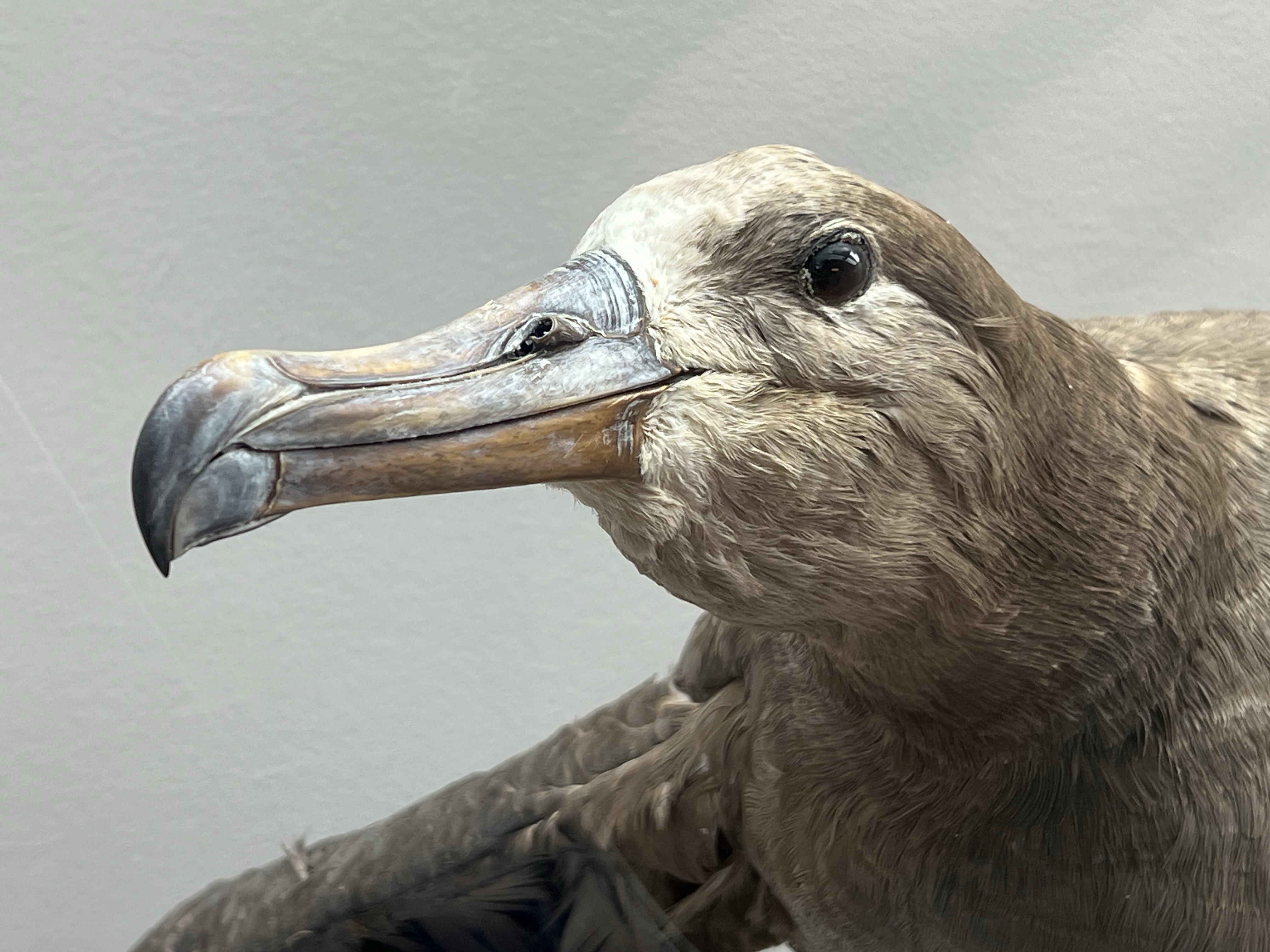
The black-footed albatross can be seen in the Monterey Bay, usually on a pelagic boat trip. A Northern California coast pelagic trip is not the same without a sighting of this iconic species.

One avian mount that I was looking forward to sketching was the extinct passenger pigeon. In Washington I had seen “Martha”, the last passenger pigeon at the Smithsonian Museum of Natural History so I was looking forward to sketching PG’s pigeon.

I looked and looked but I could not find the passenger pigeon. I thought it might be in the pigeon cabinet between band-tailed pigeon and rock dove. Nope. I even asked the lady at the desk and I got a blank stare. You think such a noteworthy mount would be well known to museum staff. Nope. None of the docents knew where it was nor what it was.

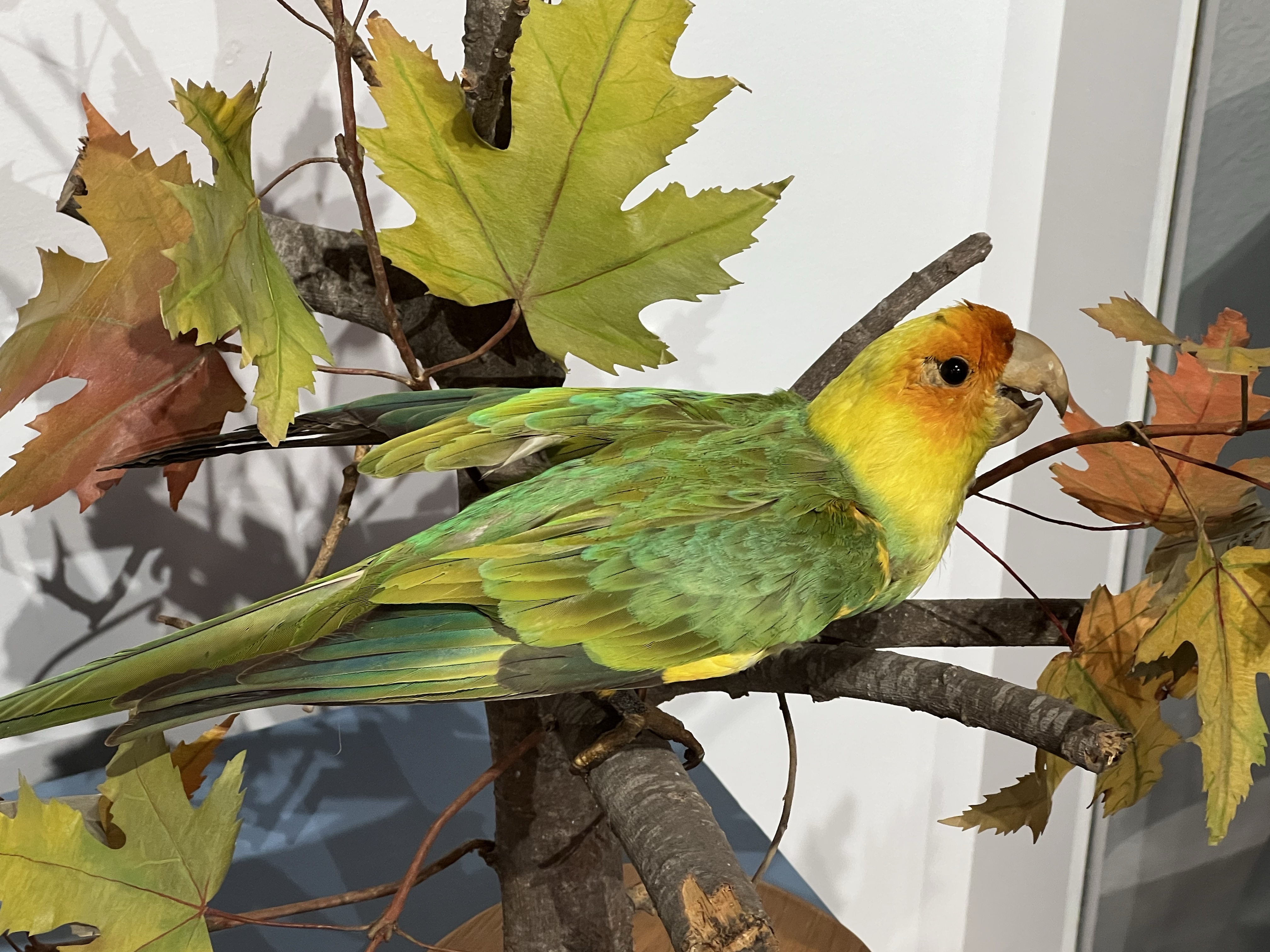
A consolidation was the mount of the Carolina parakeet, long extinct. The last individual died in 1918 at the Cincinnati Zoo.

Image

Long in the Tooth

In late May, something interesting washed up on Rio Del Mar Beach in Aptos on the shore of Monterey Bay. It was not your standard bit of driftwood, a dead marine mammal, or a piece of flotsam from Japan.

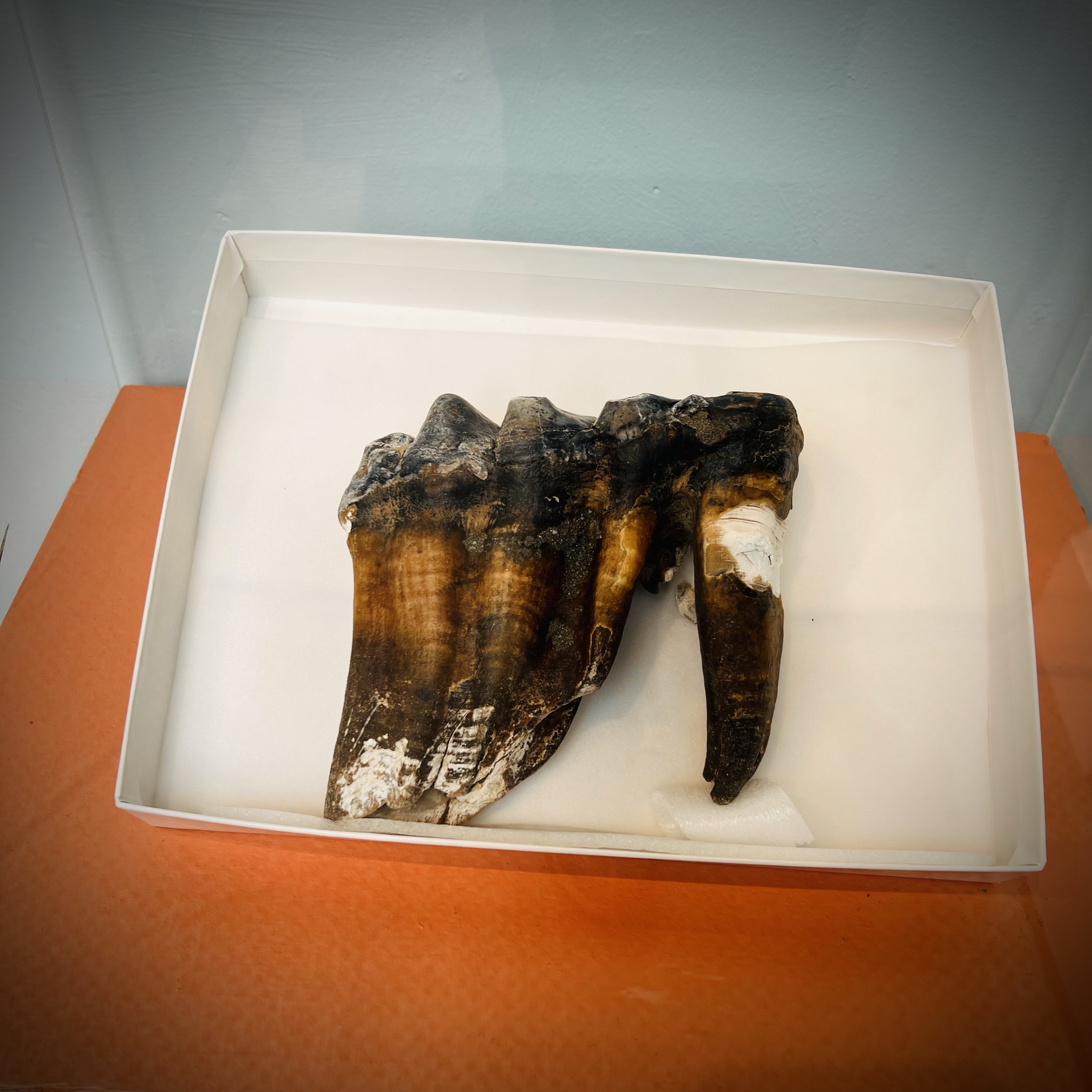
In fact the jogger who found it did not know what she found, so she took a picture of it and did what most of us seem to do nowadays: she posted the picture on social media. Someone who did know what it was saw the post and that person was Wayne Thompson, the Paleontology Advisor for the Santa Cruz Museum of Natural History. He identified the object as a tooth from an extinct mastodon!

When they returned to the beach the tooth was gone. So a search was begun to find where the molar tooth has gone through national and even international media. The efforts soon turned up the tooth. A local man saw the tooth on the beach and took it home. He saw that this was being sought after and he called the Santa Cruz Museum of Natural History.

The tooth was put on display at the museum for three days on the first weekend in June. And that is where I saw the tooth and sketched it.

The recently found mastodon molar in a box, on display for three days at the Santa Cruz Museum of Natural History. I sketched it on the second day.

When I first stepped into the museum, it was much busier than usual. In front of the mastodon display stood the man himself, Wayne Thompson, being interviewed by a local news station. He told the reporter that the tooth was probably washed down Aptos Creek during the record rains of 2023 and then washed up onto the beach. This was a big story. I was told that NPR would be visiting the museum on Monday.

Mastodons are related to the wooly mammoth and the modern elephant. The Pacific mastodon (Mammut pacificus) once roamed the land that became California between five million to 10,000 years ago. So the tooth was an incredible and rare find. In fact the name mastodon comes from ancient Greek meaning “breast tooth”, referring to the nipple-like appearance on the crown of the molars.

Mastodons disappeared from North and Central America about 10,500 years ago. It believed that the mastodon was driven to extinction by early human hunters.

Image

Santa Cruz County Pelagic

County lines are a bit strange when it comes to off shore waters. They can seem arbitrary in the same way that county, state, or country lines can be. Only these county lines are drawn over deep water.

One of Alvaro’s pelagic boat trips was scheduled to head north from Monterey Harbor into Santa Cruz County waters. So I had to take this trip on my quest fro 300 Santa Cruz County birds.

Pelagic birding can be sublime and maddening in equal measures. For one, you are birding from a platform that is pitching in constant motion and the birds are often on a surface that is undulating where birds appear and disappear at a blink of an eye. Some birds fly to and over the boat while other birds, that had been resting on the water, take off at the first sight of a boat and you get a view of a retreating bird. Also because the bird boats are really designed for fishing and not pelagic birding, it is impossible to be two places at once. So if you are on the starboard rail and a rarity is seen on the opposite side of the boat, you have to make a mad scrabble on a surface that make one look like a drunk sailor, and only to find that the bird is gone with a spotter pointing to the spot where the Manx shearwater used to be!

I suppose this is the draw of pelagic birding. It is challenging and it can often give you incredible memorable experiences. Such as the time when our boat was surrounded my a pod of Pacific white-sided dolphins that numbered in the high hundreds or the time when we kept pace with two blue whales or another time when a black-footed albatross flew in and rest in the water a few yards from the boat.

We where scheduled to depart at 7:30 AM and at 7 a group of Santa Cruz Bird Club members where milling about, cleaning their optics and looking at gulls in the harbor. Our leader, Alvaro walked down the wharf. I was surprised to see him upright because he had flow in the night before from Spain, having just finished a birding trip. He said he felt fine but joked that if we found him asleep later in the afternoon we where to kick him awake.

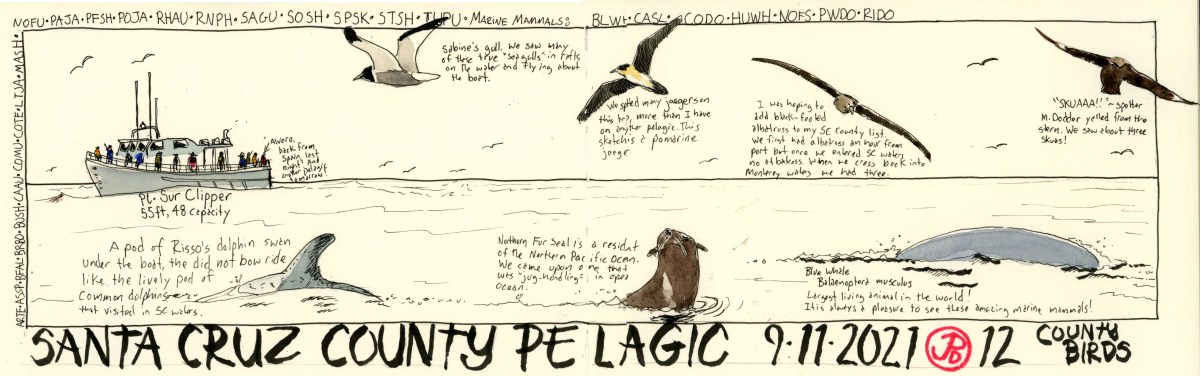
We left on time and we where only about an hour from port when we saw our first pelagic gem: the black-footed albatross. We soon crossed into Santa Cruz water and I wanted to add this albatross to my county list but unfortunately the four that we saw where all in Monterey waters. There where large numbers of shearwaters throughout our trip, the most common being sooty and pink-footed but with sightings of Buller’s and just one short-tailed and Manx shearwaters.

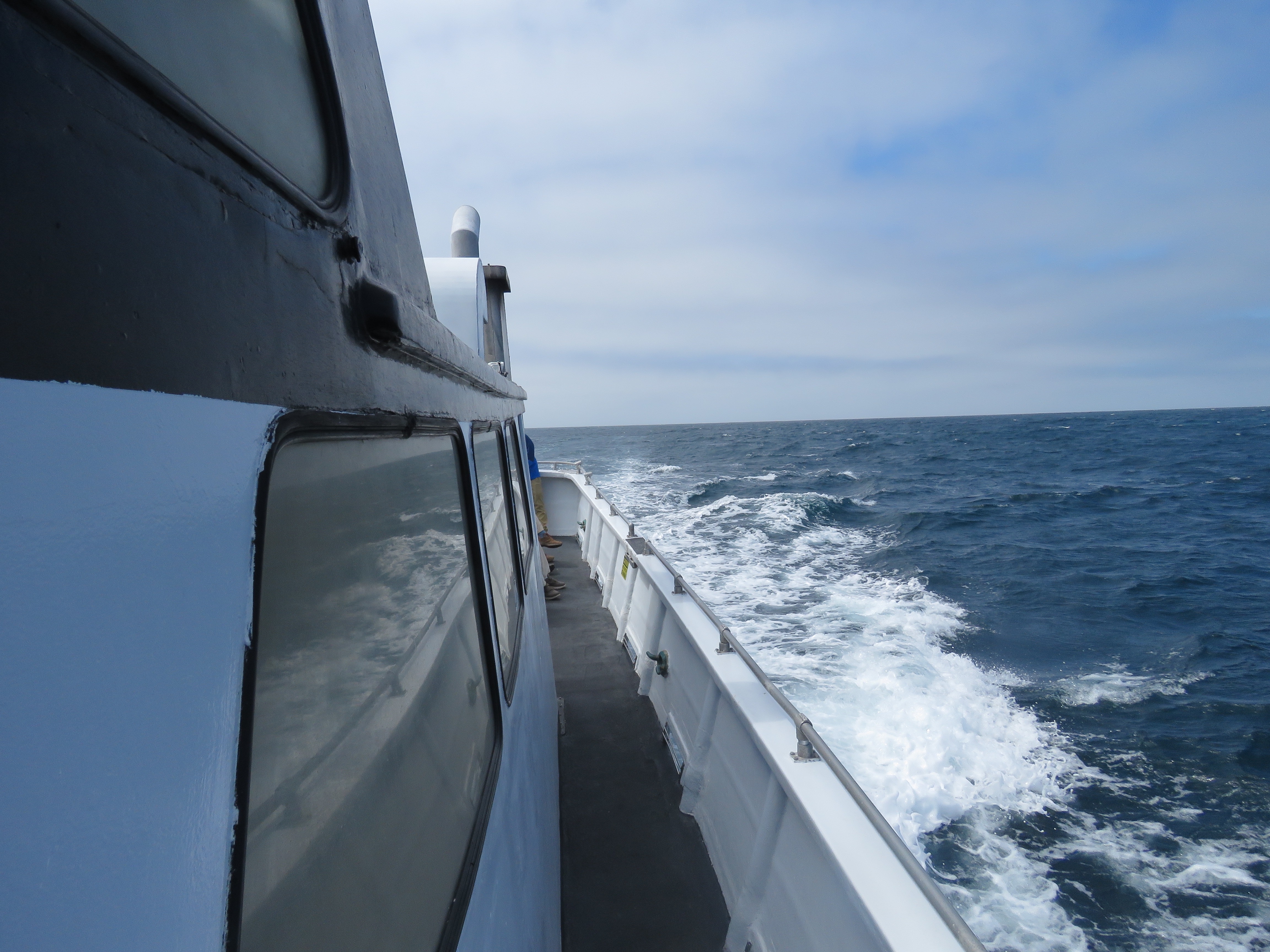
Looking down the port side of the Pt. Sur Clipper, or in pelagic birding parlance, 6 o’ clock to 9 o’clock. Here we are cruising above the Monterey Bay submarine canyon.

In all it was a very pleasurable cruise, even though I did not get an albatross over Santa Cruz waters, I did add 12 new county lifers, including: south polar skua, Arctic and common tern, Sabine’s gull, two jaegers, northern fulmar, Manx, Buller’s, and pink-footer shearwater.

As we headed back towards Monterey Harbor and the pelagic species where being replaced with inshore species like brown pelican, Brant’s cormorant, and western gull, there was one last surprise for use. One of the spotters picked out a far off brown booby flying along the coast. Not a bad way to ended a productive pelagic.

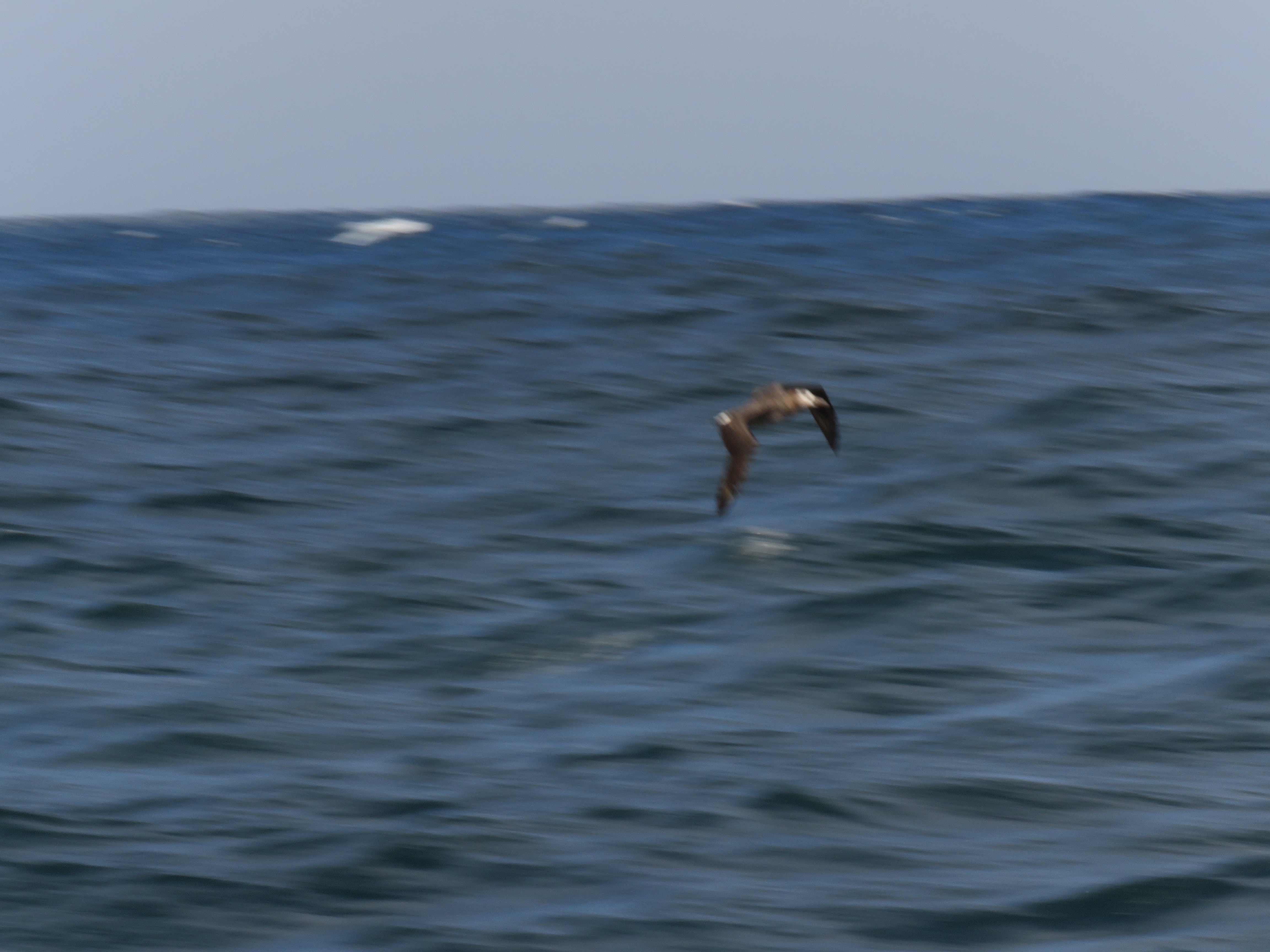
While we whiffed on black-footed albatross in Santa Cruz County, this photo of an albatross, blurred in motion over Monterey waters, sums up the motion and excitement of a classic Monterey Bay Pelagic.
Image

Monterey Bay Classic Pelagic

The first time I remember going out on a boat on Monterey Bay I was in high school. That year (1988, I think), numbers of blue whales were being attracted by krill into the nutrient-rich bay.

My dad and I took a whale watch boat out of Monterey’s Old Fisherman’s Wharf and it was the first time I set eyes on the world’s largest animal. I was able to take a few pictures of the whale’s blue-gray mass. Later, I told my biology teacher that I had seen blue whales in Monterey Bay. He didn’t believe me, but I showed him pictures to prove it!

In the ensuring 30 years, I have been on a few Monterey Bay pelagic birding and whale trips. But it had been a while so, when I saw that Alvaro’s Adventures was taking a trip to the bountiful Monterey Bay, I signed up.

I love Monterey because of it’s place in California’s history. The American flag was first raised in Monterey. Our state constitution was written (in English and Spanish) at Colton Hall, a short walk from Monterey Wharf.

What I don’t love about Monterey is it’s wharf. This is full of tourist junk shops and cheesy nautical themed restaurants but it’s saving grace is to be found at the end of the wharf: the companies that lead nature tours (mainly for whales) out into the Monterey Bay Sanctuary.

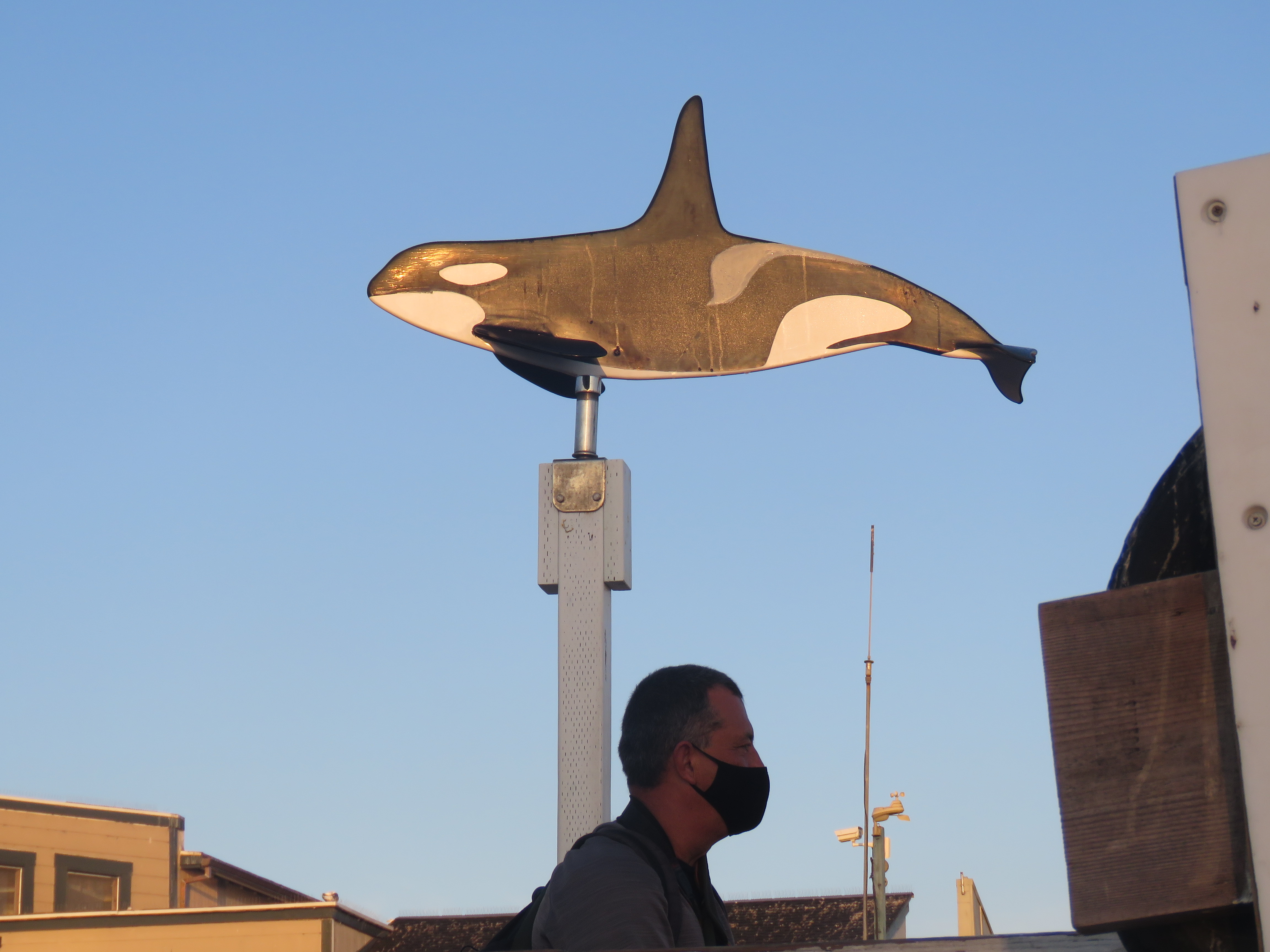
The orca sign at the dock to Monterey Bay Whale Watch and our masked-leader below, Alvaro. I had seen a pod of orca in the bay a few years ago. I wouldn’t mind seeing the world’s largest dolphin again.

I found myself here at a quarter to seven at a wharf that was slowly coming to life, which would be a jarring contrast on our return later that afternoon when hordes filled the wharf, having not got the note about social distancing.

A few pelagic birders were milling about. You could always tell them apart, they had on birding hats, often displaying some national or international birding destination. They usually had optics around their neck and were nibbling on ginger snaps or cookies and thumbing through bird guides. Some where even checking out the local western gulls and pelicans.

Today our boat was manned (this doesn’t sound right) by two women. She was a large boat, the 70 foot Sea Wolf II and was made, not for fishing, but whale watching, a perfect vessel for pelagic birding! Of course the real Sea Wolf of the seas is the orca aka the killer whale.

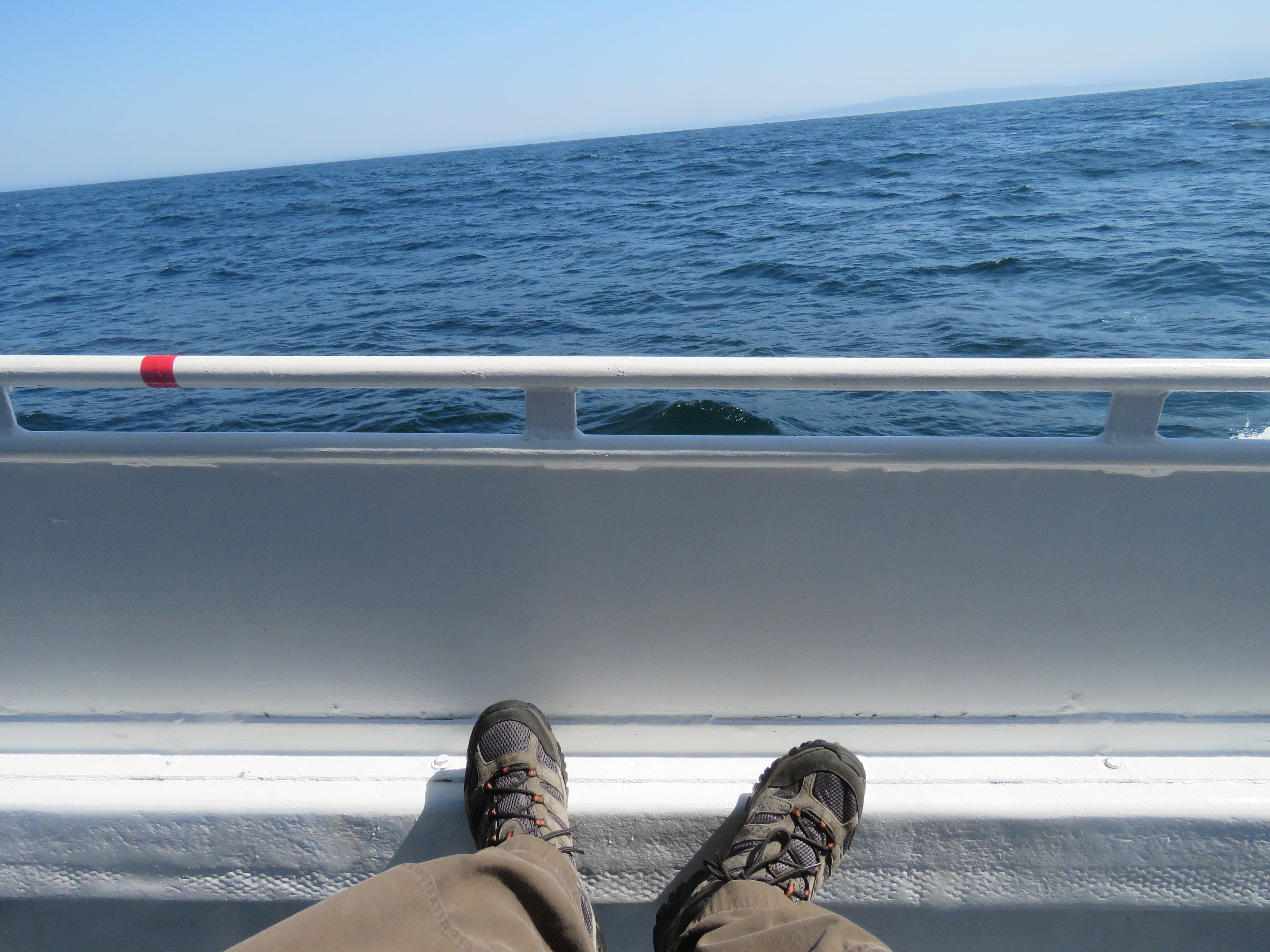
There was plenty of leg room on the Sea Wolf II. The red tape on the rail was placed six feet apart to encourage social distancing. One of these lines of perspective is straight. My money is on the horizon. The Sea Wolf had lots of places to stand or sit with clear views of Big Blue.

We boarded and before long where heading out into Monterey Bay. The swells were high and I enjoyed riding the rhythms of the sea like a nautical bucking bronco, a raucous sea horse! A few members of birders joined the Feeding-the Fish Club. Luckily, touch wood, I have never been a member of this club.

The reason Monterey Bay is a legendary location for pelagic life is the marine canyon, the Monterey Submarine Canyon, that bisects the bay. This canyon starts just to the west of Moss Landing. The canyon, at certain places, is a mile in depth and is the deepest submarine canyon on the west coast; a Grand Canyon of the Pacific. This canyon produces nutrient-ruch waters that attracts cetaceans (from blue whales to orca) and pelagic birds. This also means that you do not have to travel too far out to see pelagic species.

Today we headed south to search the waters off the coast of Big Sur. I told Alvaro that I would be checking the skies for California condor! (there is a nerdy bird joke in there.) The pelagic birding in the bay had not been as prolific in recent weeks, possibly because of water temps, so Alvaro directed the crew of the Sea Wolf to head south. And it turned out to be a good decision.

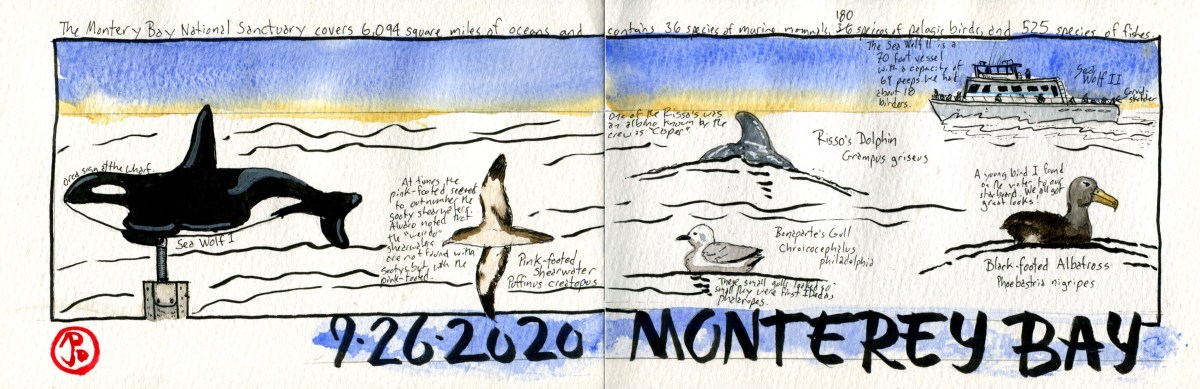
Within 30 minutes of leaving port, we had our first pelagic species, a lone sooty shearwater. This trip was dominated by the presence of pink-footed shearwaters. Alvaro noted that “weirdo” shearwaters (aka rare) associate with pink-footed and not sooty shearwaters. I could only hope for a Manx!

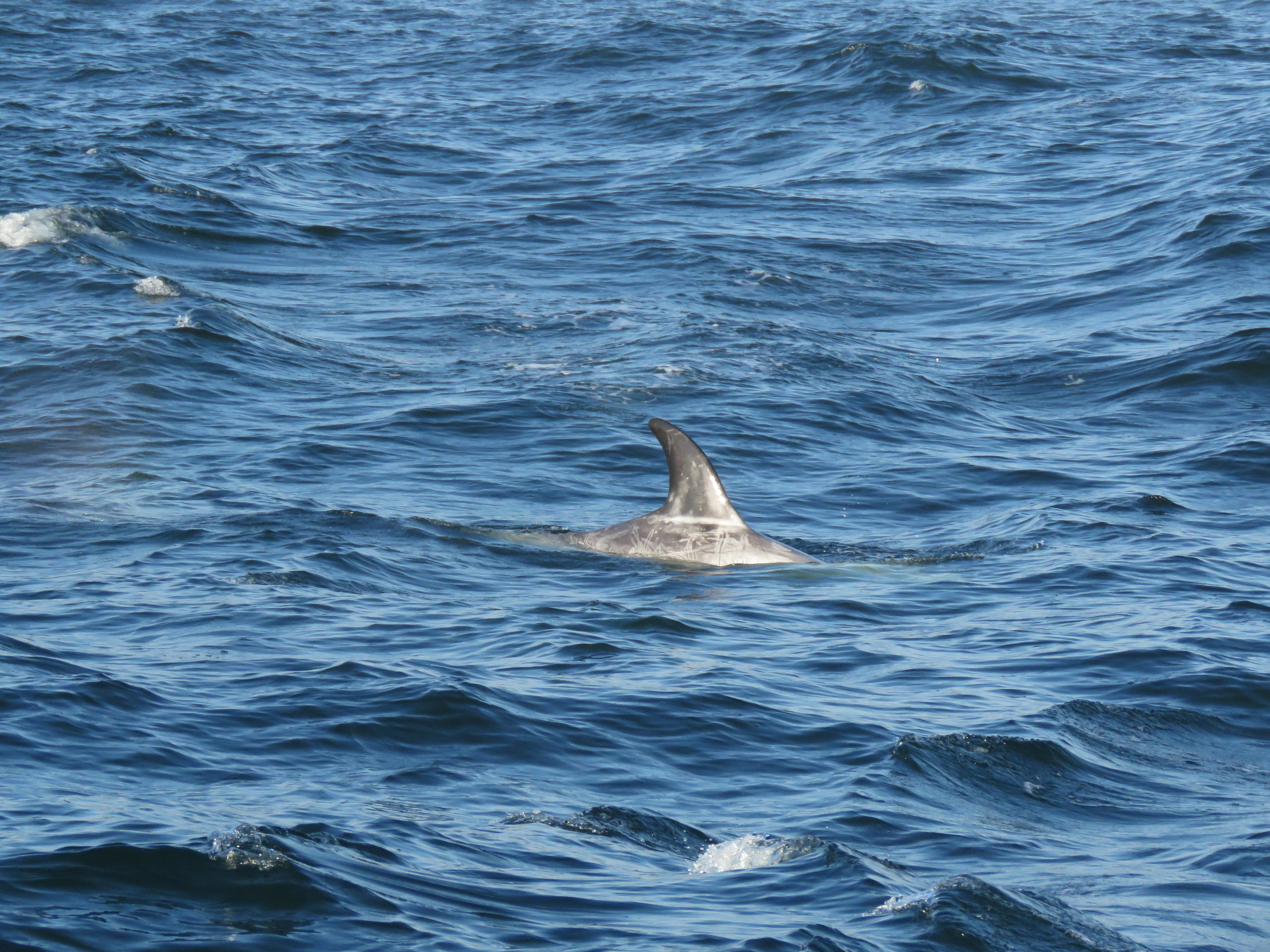
A little further out, we were upon a pod of Risso’s dolphins. These gray dolphins have dorsal fins that resemble female orcas. Our captain called attention to one individual Risso’s, an albino, named by whale watchers as “Casper”.

Risso’s dolphin. These dolphin don’t seem to enjoy bowriding like the gregarious Pacific white-sided dolphin. But a great dolphin to see nonetheless.

Further south we encountered sweet spots with many shearwaters, a smattering of ashy storm-petrels, and some south polar skuas. One skua was being chased by a Heerman’s gull, oh how the tables had turned. In this general direction we saw our first, of about ten, black-footed albatross. We added two species of jaegers to our list.

I spent most of my time in the stern of the boat. It it usually is less crowded, less wet, and less turbulent in the back. Once we headed back north again, I migrated to the bow of the Sea Wolf. Here is was important to keep at least three points of balance and attempt to hold binoculars to your eyes. At times, I wore my binos like a dense necklace and scanned the waters with the naked eye. This is a wide angle lens approach to pelagic birding. This approach has payoffs.

I spotted a chocolaty shearwater crossing our bow from right to left. “Shearwater”, I called out. Alvaro, who was standing to my left, got bins on it and proclaimed, “Flesh-footed!” It really does pay off to stand next to someone who knows more than you do. It always makes you look better. This was the only flesh-footed shearwater we saw on the trip and only the second one I had ever seen.

Something similar happened a dozen miles later when I spotted a grouping of four birds. It looked like two phalaropes bookended by two California gulls. One of the spotters identified the two birds as red phalaropes. The seas, swells, and light can play tricks on the birder, even the most seasoned pelagic birder. As we came closer the birds were not phalaropes but the smaller Napoleon’s gull. They showed their dark bills and ear muffs. These small gulls were a pleasant pelagic surprise. I have never seen this gull in open ocean but on terra firma.

It was surprising to see a few passerines so far out at sea. The closest these birds might come to water was a bird bath. An American pipit strafed the boat and then later a golden-crowned sparrow crossed our stern. We also spotted an unidentified sparrow that was laboring, inches above the waters. It was flying towards us. Some passerines hitch rides back to port but this sparrow did not look long for this world. It most likely had gotten lost flying over the bay and this shortcut can prove deadly. We soon lost sight of the sparrow, it disappear behind the swells.

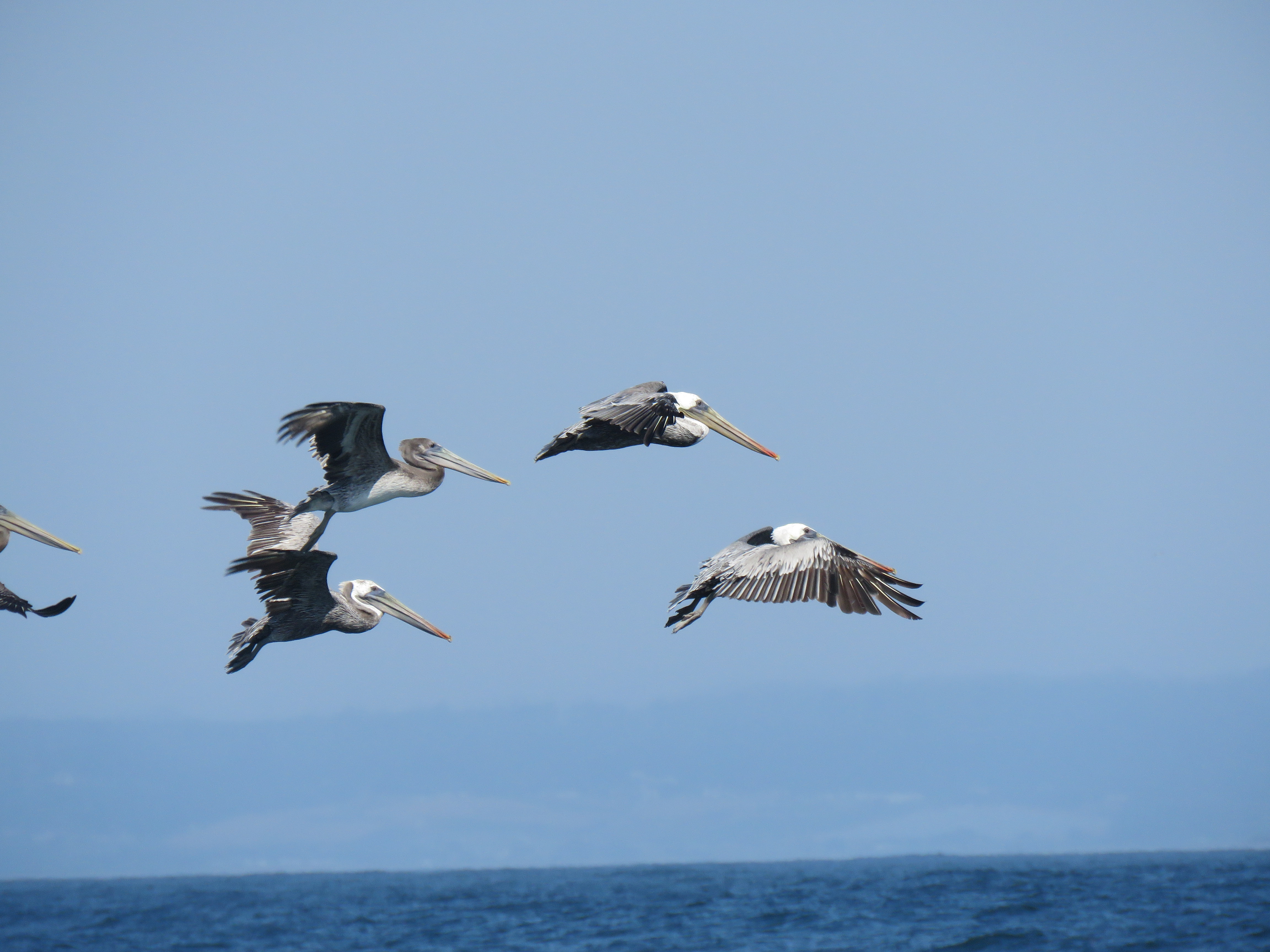
We soon made a course to the west as we headed back to port. Here we saw more inshore species like common murre, Brandt’s cormorant, and brown pelican. The latter species it’s truly one the of the iconic inshore west-coast species. Brought close to extinction by the pesticide DDT, they now flourish in the Pacific. A line of pelicans approached from our port side. Such a common species here, now, but is there no other bird in flight, over the seas that is more soothing to soul and meditative, than a line brown pelicans?

To me, there never has been, nor will there ever be a species that says “Monterey Bay” than the brown pelican.

Image

Monterey Orcas

As part of the Guild of Natural Science Illustrators Conference at UC Santa Cruz a group of illustrators set out from Moss Landing Harbor on a Thursday morning for a three hour tour.

Monterey Bay is known for its pelagic birding and the many marine mammals that enter the bay throughout the year. The reason for this lies under the waters. Starting just off Moss Landing’s shores and stretching out to the west for 95 miles, lies the Monterey Canyon. This submarine canyon is larger than the Grand Canyon reaching depths of 11,800 feet and is the largest submarine canyon on the west coast. The deep waters provides a nutrient rich feeding ground for birds, fish, sea turtles, and marine mammals which includes the largest animal on planet earth, the blue whale.

I had first seen blues in the bay on a whale whatch trip out of Monterey when I was a junior in high school (to the disbelief of my biology teacher, but I had the pictures to prove it). It was not uncommon to see gray and humpback whales in Monterey Bay. But on this trip I was going to see a life marine mammal in the wild!

The first marine mammals we encountered in the harbor were sea otter, harbor seal and California sea lion. We turned to the portside at the foraging white pelicans and headed out of the break water to the open ocean and the Monterey Canyon.

It wasn’t long before I spotted our first marine mammal, a lone harbor porpoise (they always seem to be alone), crossing our western bearing, heading to the north of the bay.

After about 15 minutes our captain spotted a blow on the horizon and off we went to find the source. We caught up to the whale, a young humpback and were treated with nice views of its flukes as it dove down. We followed the whale and watched it resurface, take a breath and dive again. We then spotted another humpback and followed it.

Murmurings from the cabin let me know that something was afoot. The captain was on the radio with another whale watch boat and it seemed that they had just sited something special in the southern part of the bay.

As we throttled up heading on a southern bearing, scattering sooty shearwaters in the process, I knew it could be two things: a blue whale or an orca pod. I was hoping it was the latter! Our naturalist was keeping quiet about the sightings to the south.

My first experience with live orcas or killer whales, happened not too far from my childhood home. It was just north on Highwsy 101 on the western rim of San Francico Bay. The setting was the ambitiously titled Marine World Africa USA in Redwood Shores. This amusement park’s main draw, aside from the water skiing show, was the killer whale show where the world’s largest pied dolphin swam in circles and leapt up to snatch a herring from the trainer’s mouth. This is the way most children fell in love with killer whales in the last 1960’s and 70’s.

Since that time, attitudes have changed about keeping these magnificent marine mammals in captivity and training them to do tricks for eager audiences. Marine World left it’s original site on the west side of the bay in 1986 and moved to Vallejo later to be renamed Discovery Kingdom. The amusement park sent it’s last captive orca to San Diego in 2012, ending 40 years of orca captivity at the park.

I now wanted to see orcas in the wild, orcas swimming in a straight line, orcas not doing tricks for an audience. And hopefully we would be seeing a pod soon. We arrived at a location just off the coast of Monterey where there was five other watching boats in pursuit.

DSC06382

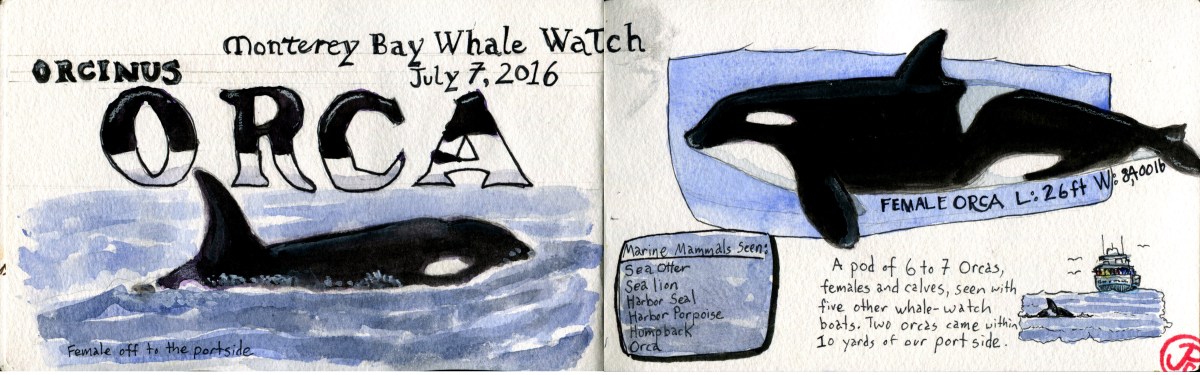
Part of the pod whale watch boats following the pod of orcas. Here a female breaks the surface.

There was a moment of anticipation as we scanned the waters, willing every wave or shadow to materialize into the black back of an orca. Soon we were rewarded with a pod of about seven orcas consisting of females and calves. Two came within ten yards of our boat to give us a look-see!

Recently more and more orcas have been sited in Monterey Bay. It was previously thought that they appeared during grey whale migration to prey on mothers with their calf as they headed north from their birthing lagoons in Baja California to head to their feeding grounds to the north. But now they can be seen throughout the year.
GWhale

A sketch of a grey whale and calf from the Seymour Marine Discovery Center in Santa Cruz.