You can’t be in Cairns (pronounced “cans”) without heading out to the natural wonder that is the Great Barrier Reef.
I chose a trip on the Ocean Spirit to Michaelmas Cay, a sandy island on the reef.
While I am a certified SCUBA diver and I love marine life, I was here for the birds.
I checked in and walked out to the dock under a light, warm drizzle. It rains almost everyday in Cairns. I was early so I headed to the breakwater to try to pick up a lifer.
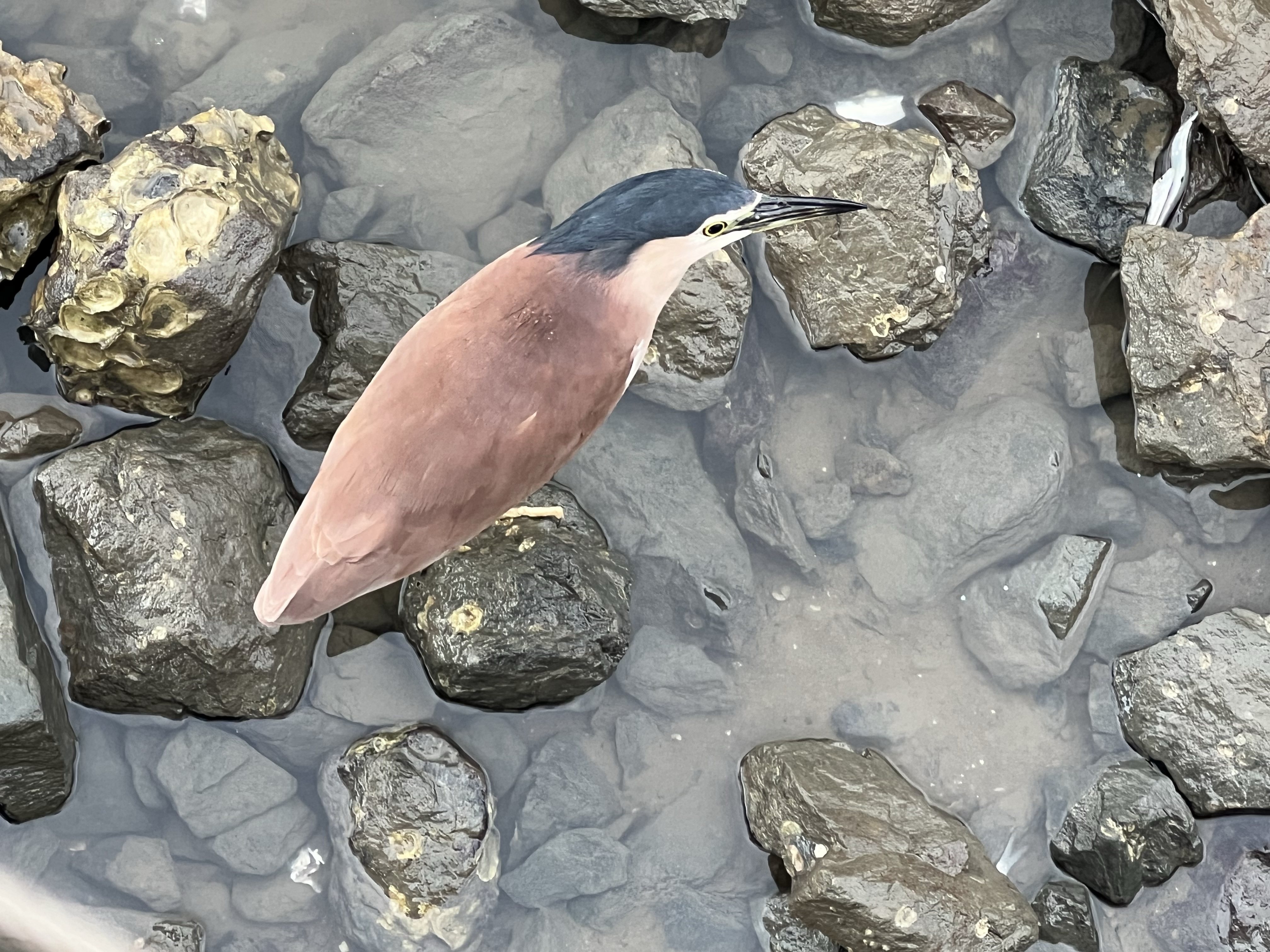
I scanned the nearby trees for roosting birds, I was looking for a night-heron. I found one foraging at the breakwater. I guess no one told it that it was a night-heron, a Nankeen night-heron.
I headed back to the dock and boarded the Ocean Spirit.
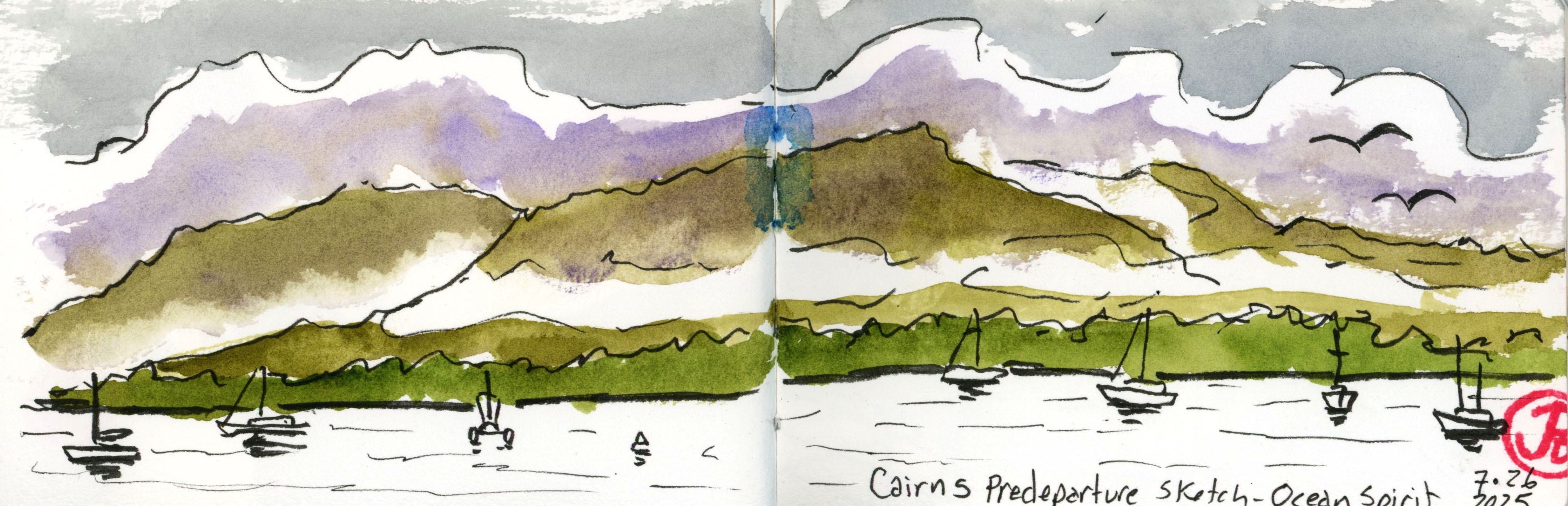
While waiting for the Ocean Spirit to depart I sketched the mountains to the south and the boats moored in the foreground.
During the two hour cruise to the cay, we stopped to look at a few humpback whales.
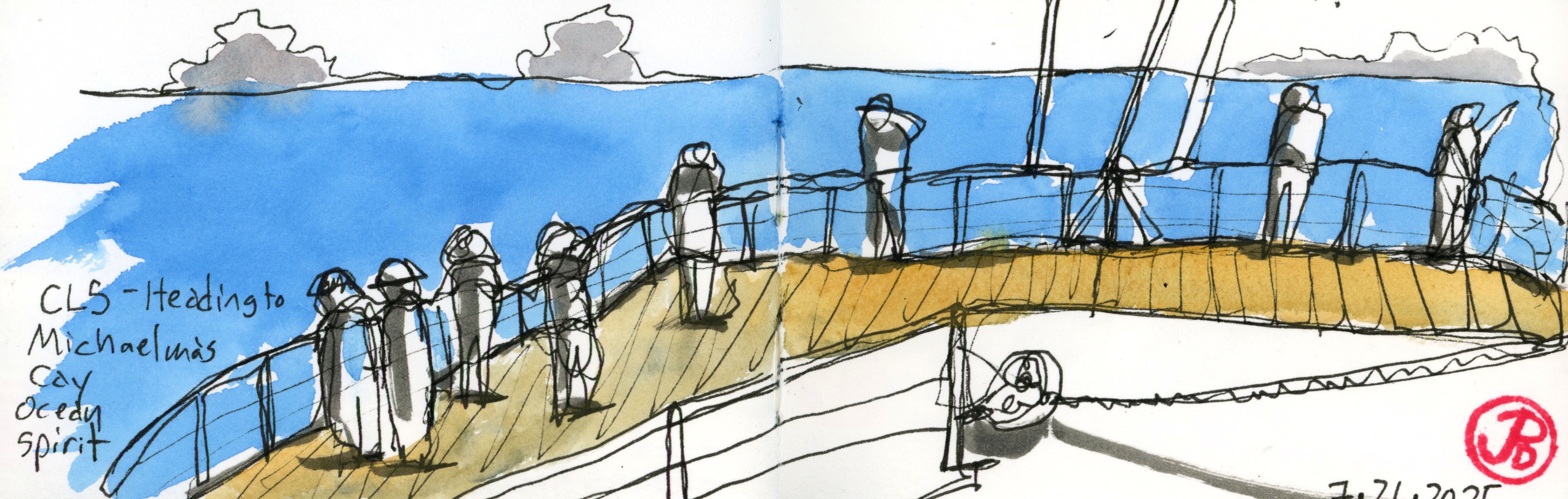
This is a continuous-line sketch of the Ocean Spirit looking towards the bow as we head to the cay.
We arrived at the cay and anchored to the buoy. The launch began to take snorkelers to the sandy cay.
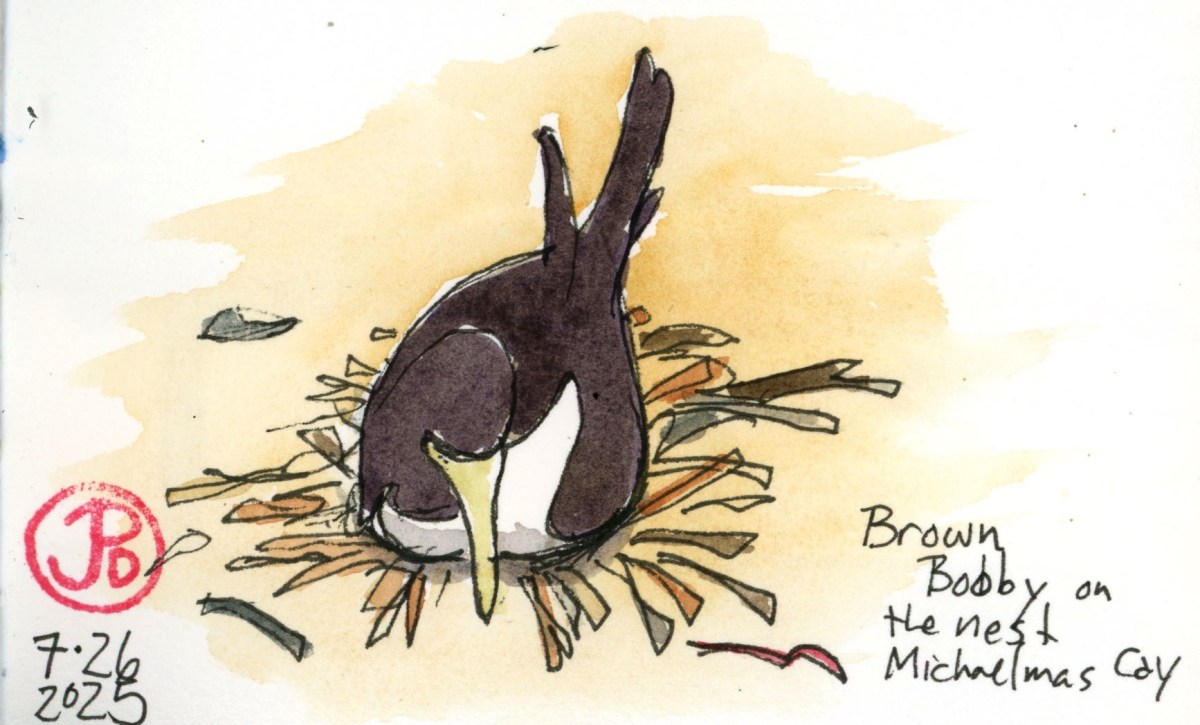
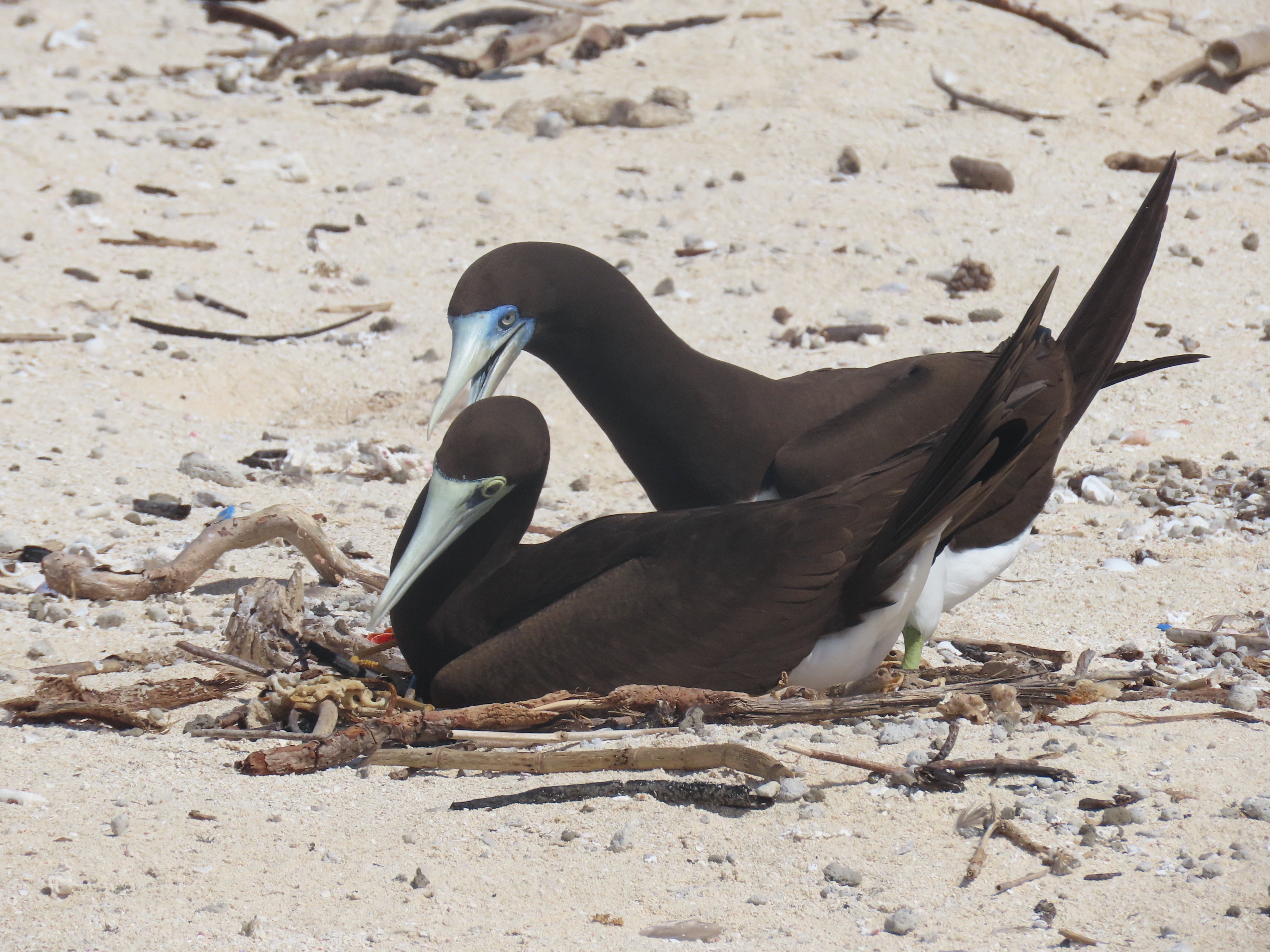
I headed over and walked on the vibrant sands. The cay is a bird sanctuary and various pelagic birds nest and roost here. The most prominent breeding bird at this time of year is the brown booby.
This a semi-regular vagrant to the west coast of California but I had never seen one this close and in it breeding plumage. I sketch one on it sandy nest (featured sketch).
If the cassowary was number one on my bird wishlist, a monotreme topped my mammal wishlist. A unique creature only found in one place in the world: the eastern coastal region of Australia.
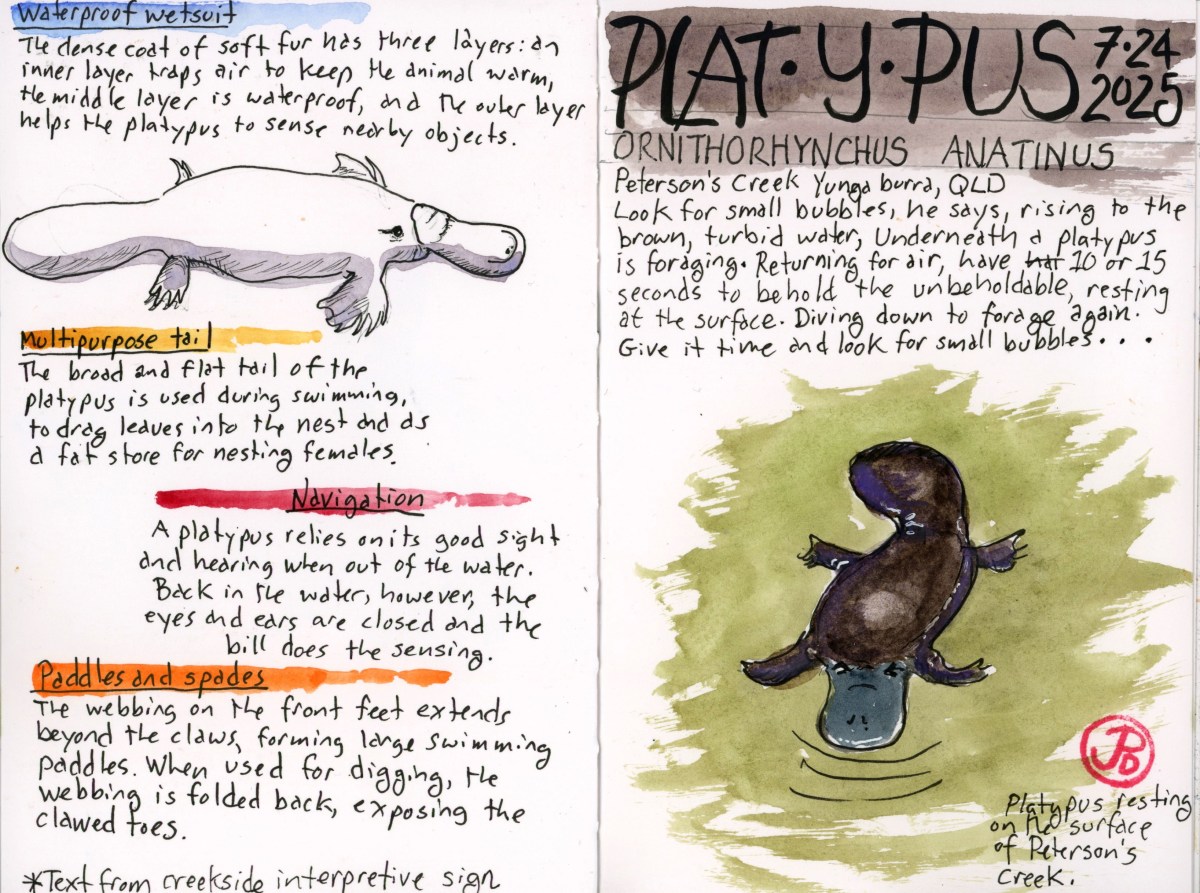
This is Ornithorhynchus anatinus, the platypus.
Before I left for Australia, my guide hinted that we might have a chance for platypus in the way that most nature guides don’t overpromise what they can’t control while giving you real hope of the possibility of seeing a sought after species in the wild.
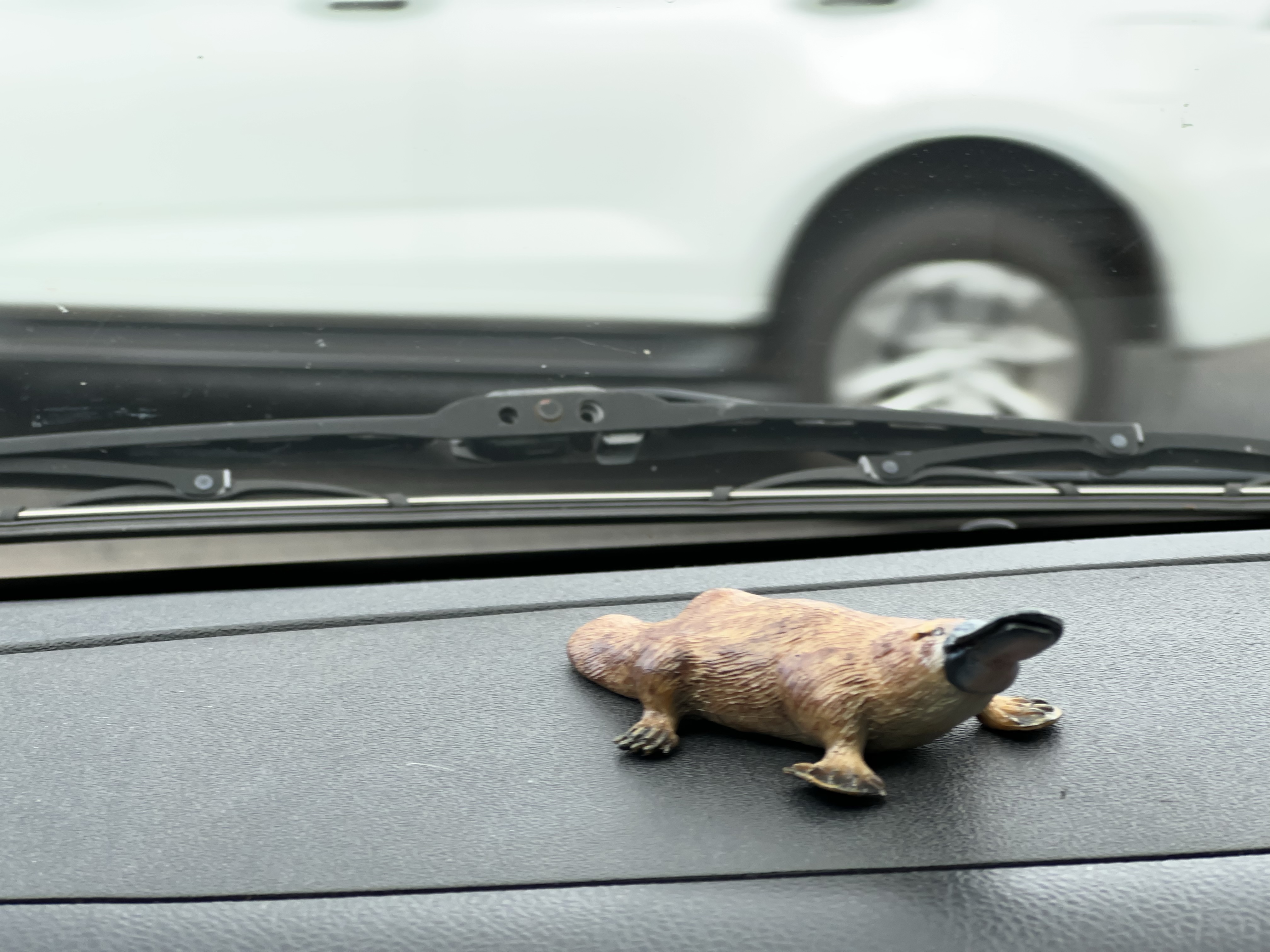
I brought with me my good luck platypus in giving me extra luck in seeing this sought after species.
Our search was conducted at Peterson Creek in Yungaburra, North Queensland.
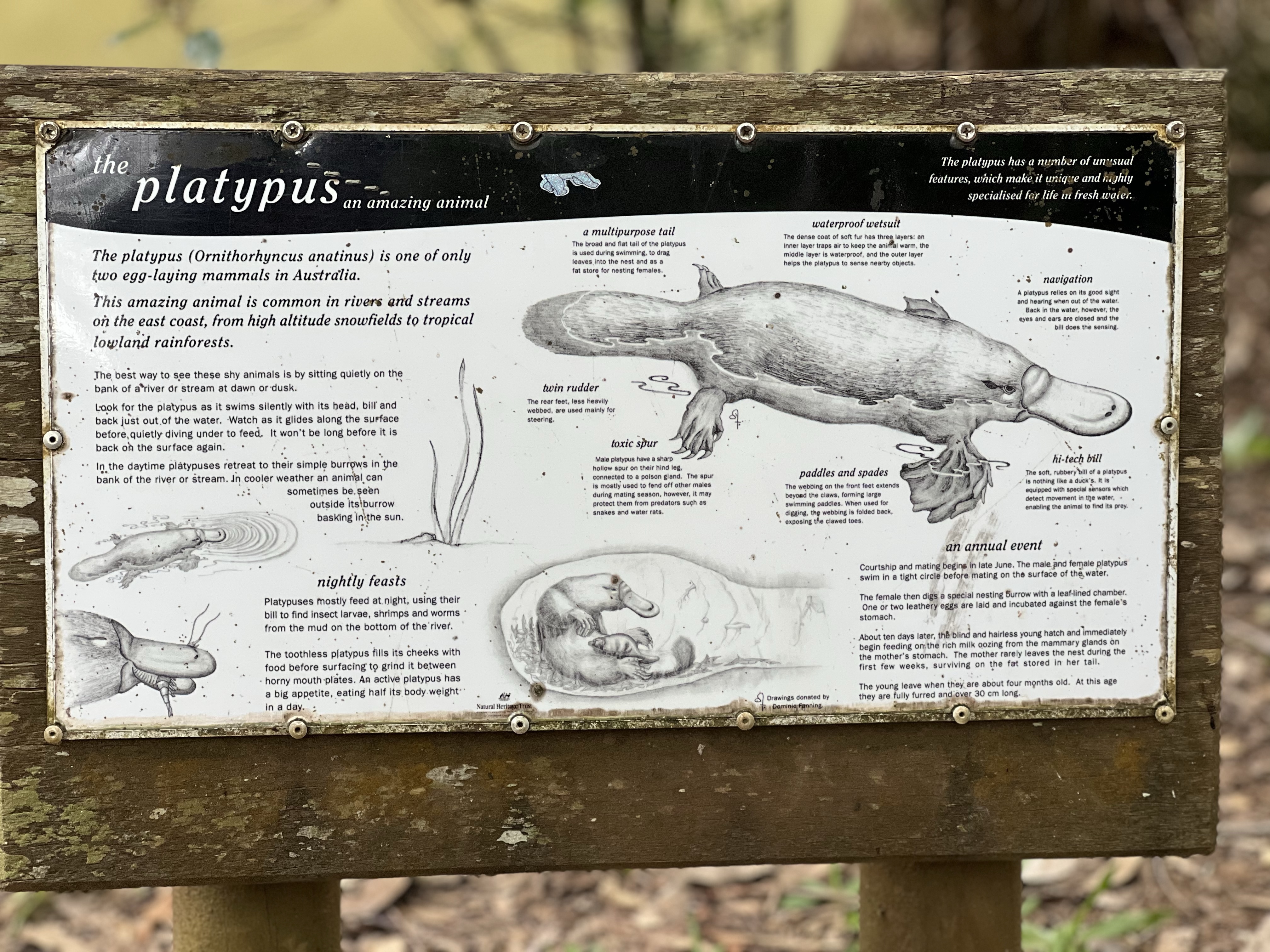
A platypus interpretive sign on the banks of the creek. We must be in the right place.
Out guide told us to look for small bubbles at the surface as we walked along the creek. This was a sign that a platypus was foraging under the brown turbid water. The platypus would come to the surface for a breath of air. It would be at the surface for 10 to 15 seconds and this was the best time to see Australia’s mammalian oddity before it dove down to continue foraging.
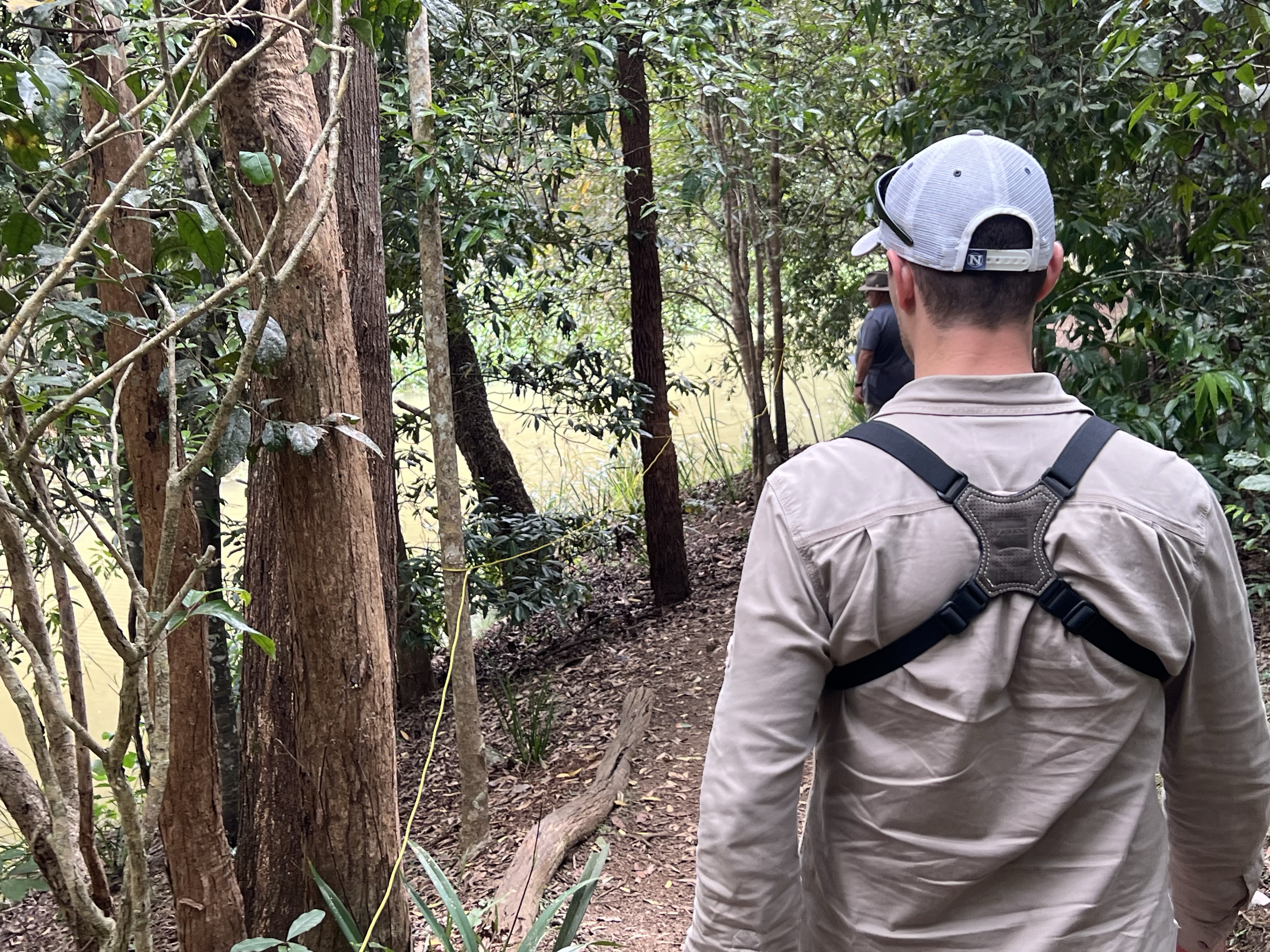
Walking along the creek looking for tell tale bubbles.
Now platypus lore says that the best time to see this aquatic mammal is at dawn and dusk. So why were we at the bank of the creek in early afternoon? According to our guide, we had a good chance of seeing platypus on this stretch of creek at any time of day. Platypus spend a lot of the hours of the day foraging for food. And that is the best time to see them.
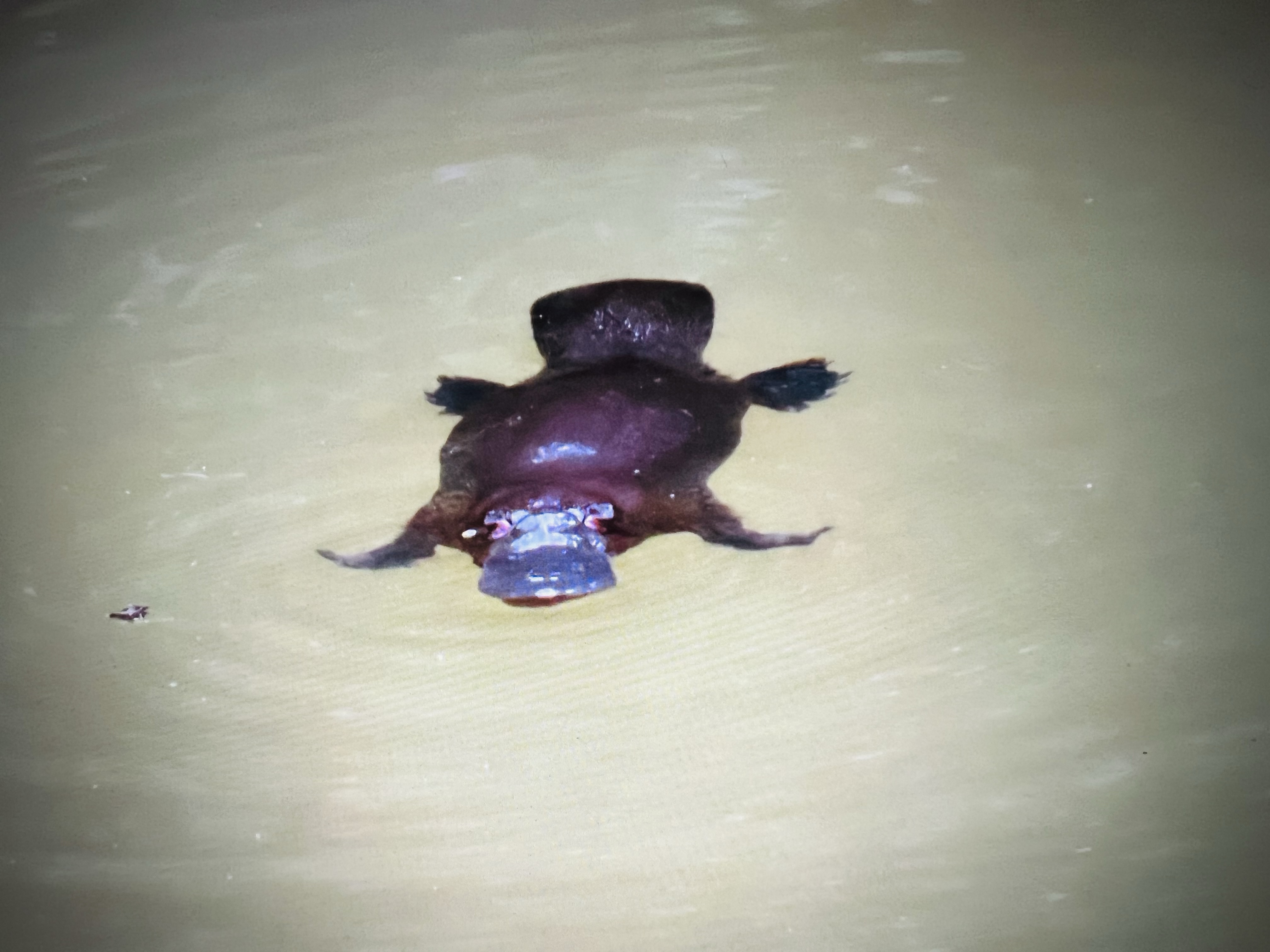
It did take long before we saw small bubbles rising to the surface and followed shortly by the platypus itself. The amazing mammal stayed at the surface for about 20 seconds before diving down to forage.
We spent about 20 memorable minutes with the platypus, getting excellent looks and photos.
Australia is home to ten species of bowerbird and I saw half of them.
Bowerbirds themselves are a beautiful and varied group of birds. What makes them well known around the world is the bowers that the males build to attract females. And we thought humans are the only artists on the planet.
All the bower designs are different depending on species and each female of the species seems to be attracted to different colors. For instance, female satin bowers birds prefer blue while great bowerbirds go for white and light gray.
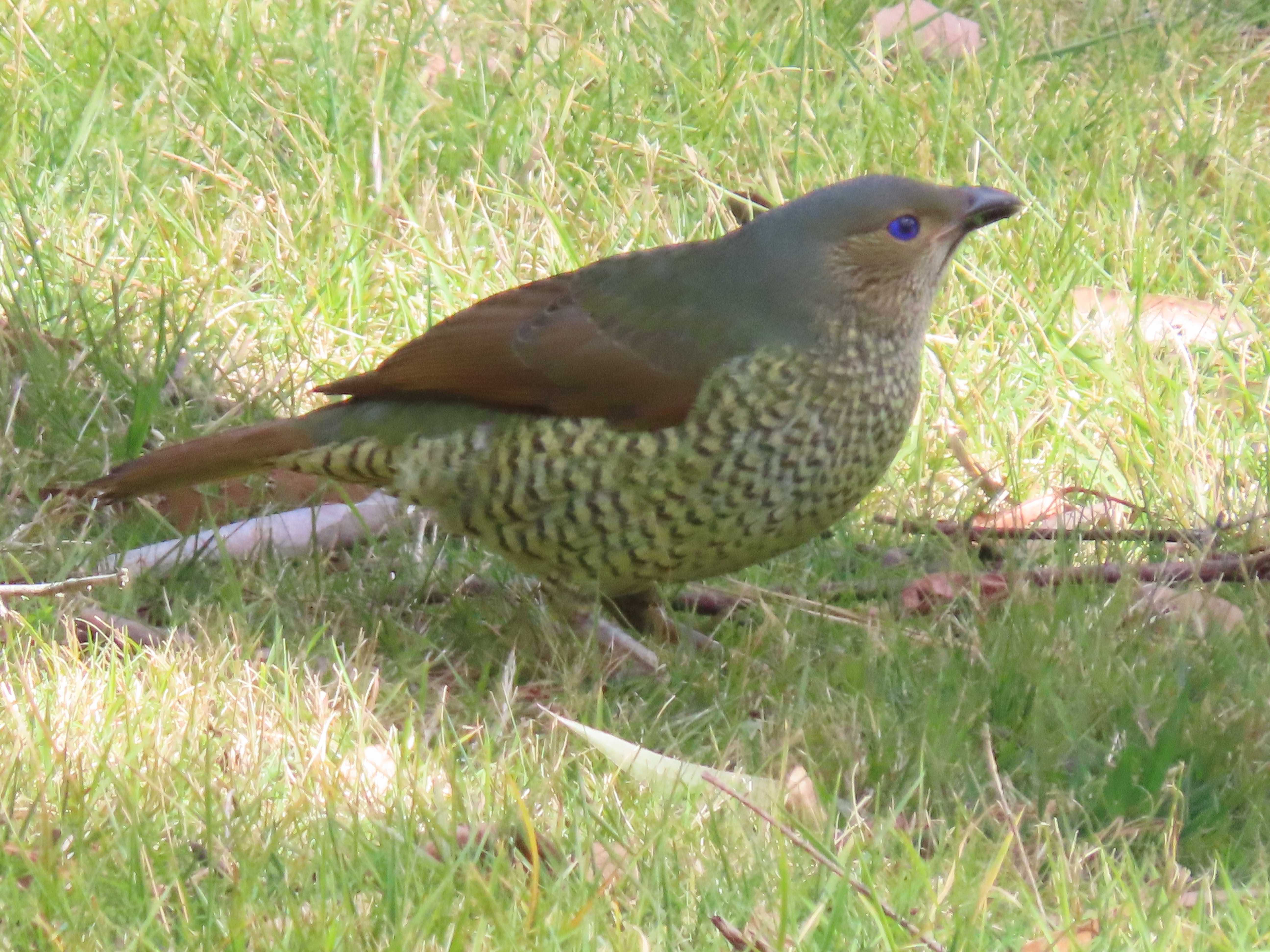
Female satin bowerbird prefers blue decorations like her eye color.
Once the bower had been constructed, the male finishes the bower off with decorations purloined, or foraged, by the male. Many of the decorations are human made plastics.
I was able to see and sketch two bowers on my Australian trip. Bowers constructed by the male golden and great bowerbirds.
I was in Australia during their winter and so it was out of breeding season but some bowers remain standing year round.
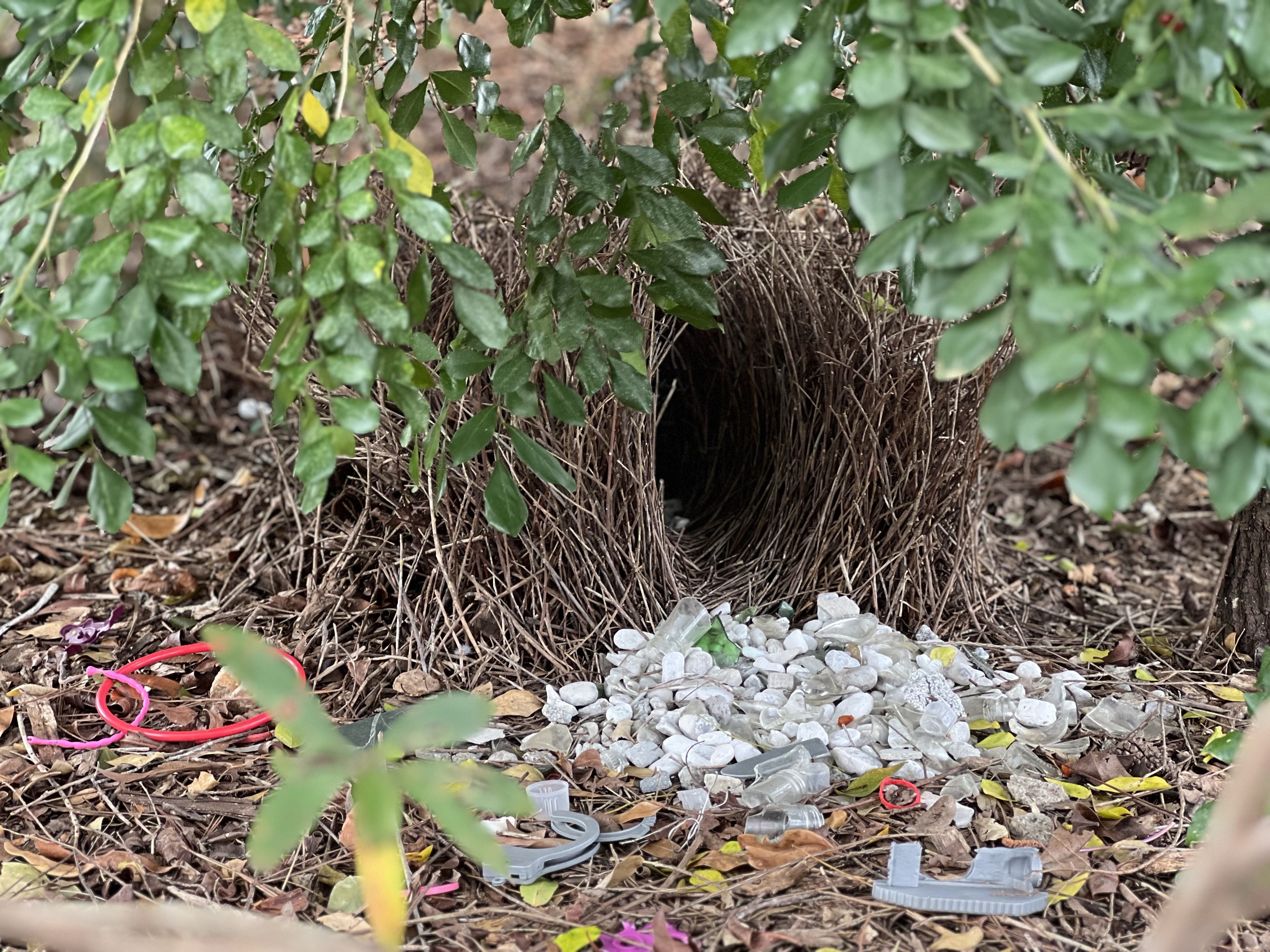
One such bower was in a cemetery and our guide showed us the bower of the great bowerbird.
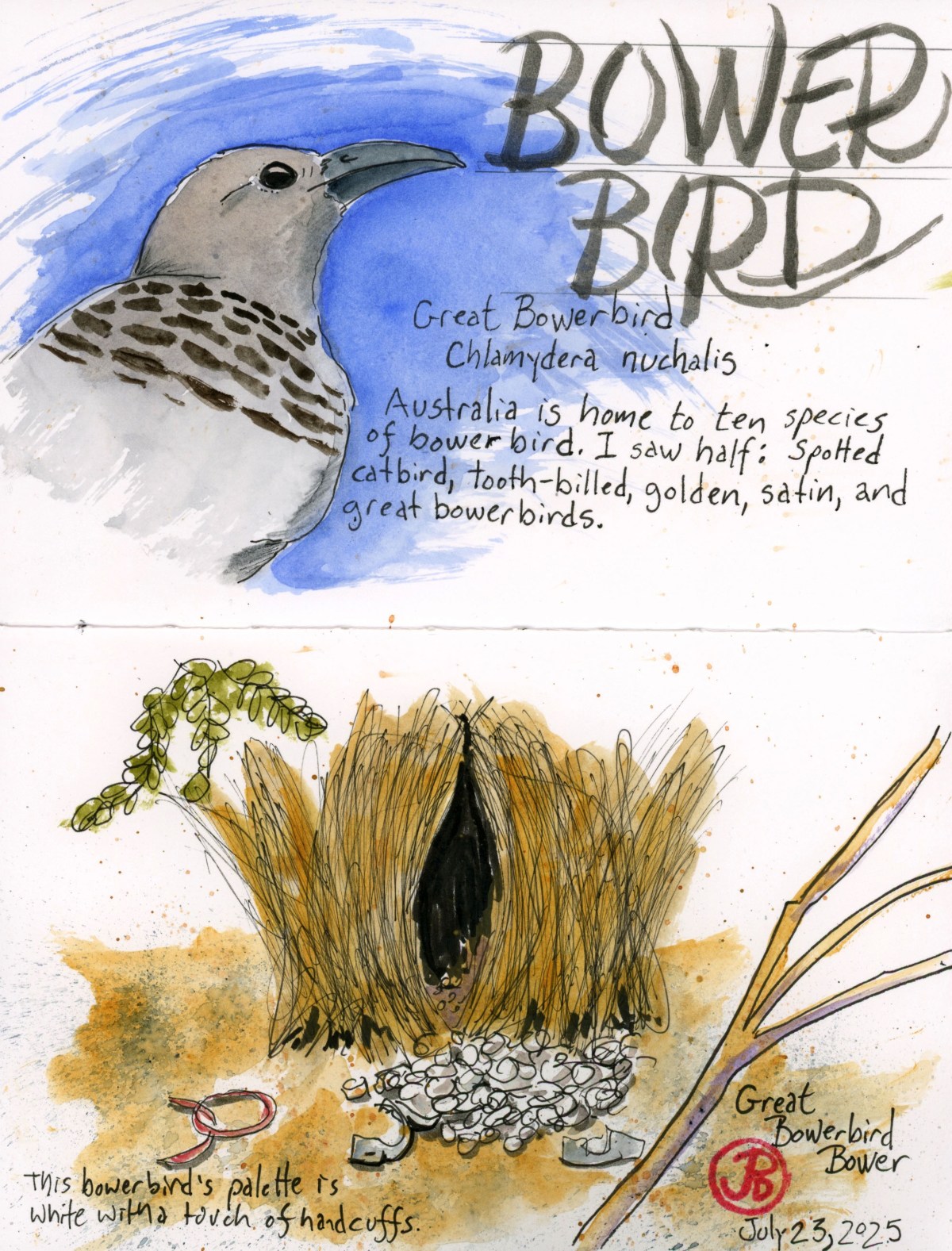
The great bowerbird paints in a palette of whites and grays including a set of plastic toy handcuffs.
I did a spread about the bower and the bird that created it (featured sketch).
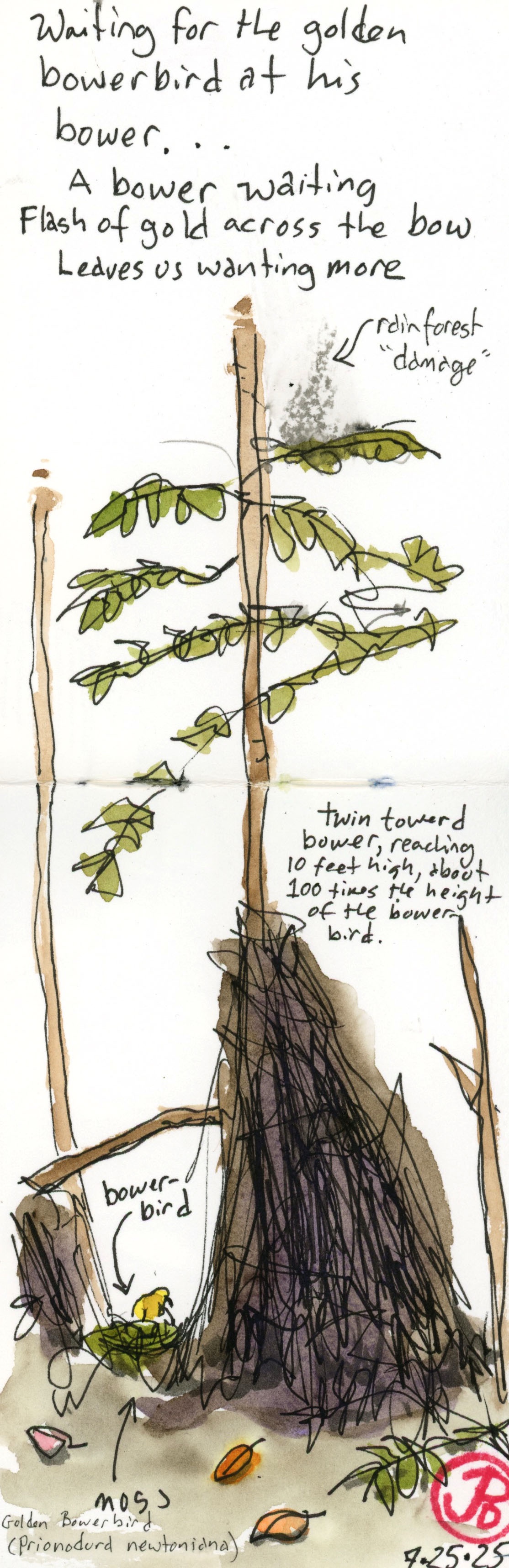
Our next bower was in the rain forests of north Queensland at an elevation above 2,000 feet.
We hiked up a short way to the bower. But we also wanted to see the male that the bower belonged to. This required waiting.
This is a where being a sketcher has its advantages. Waiting means, “Time for a sketch!”
I sketched the impressive bower that was constructed of two tall towers. In the off season, the bower was a work in progress with one tower being about five feet high and the other was under construction. Between the towers was the “stage” lined in green moss.
Now we had to wait for Australia’s smallest and most sought after bowerbird.
After about 15 minutes, I saw a flash of gold cross from left to right which caused me to write a haiku:
A bower waiting
Flash of gold across the bow
Leaves us wanting more
The bower bird flew into a tree out of view, in this case the North Queensland endemic golden bowerbird.
In the darkness under the rainforest canopy I realized another benefit of field sketching, you don’t need a lot of light to sketch but as my shifty photos of the bowerbird proves, you need light to paint with light.
A blurry photo of the male golden bowerbird.
After another wait, the male bowerbird returned to his bower with some green moss to cover his stage. The group all got great looks at this most sought after Queensland endemic.
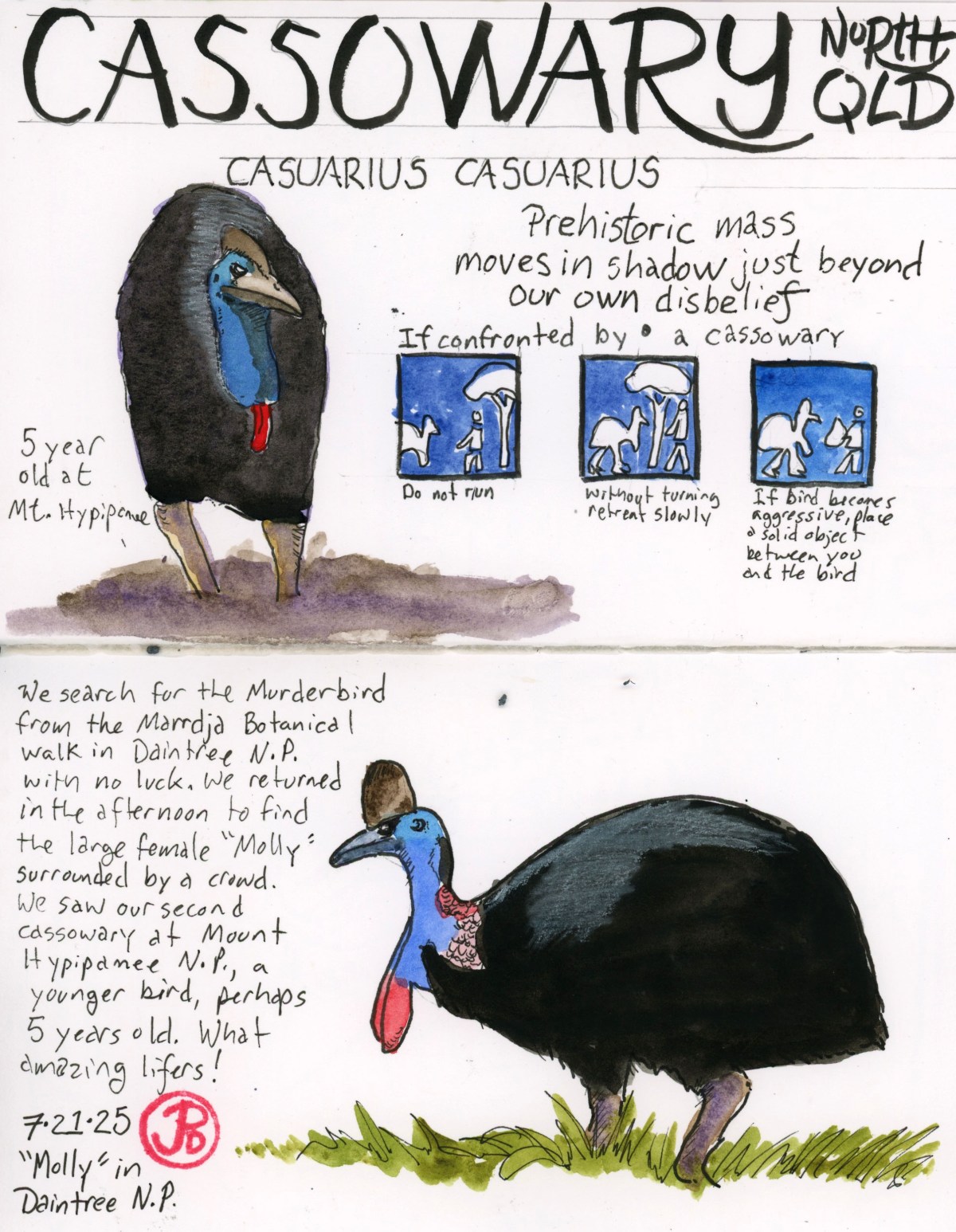
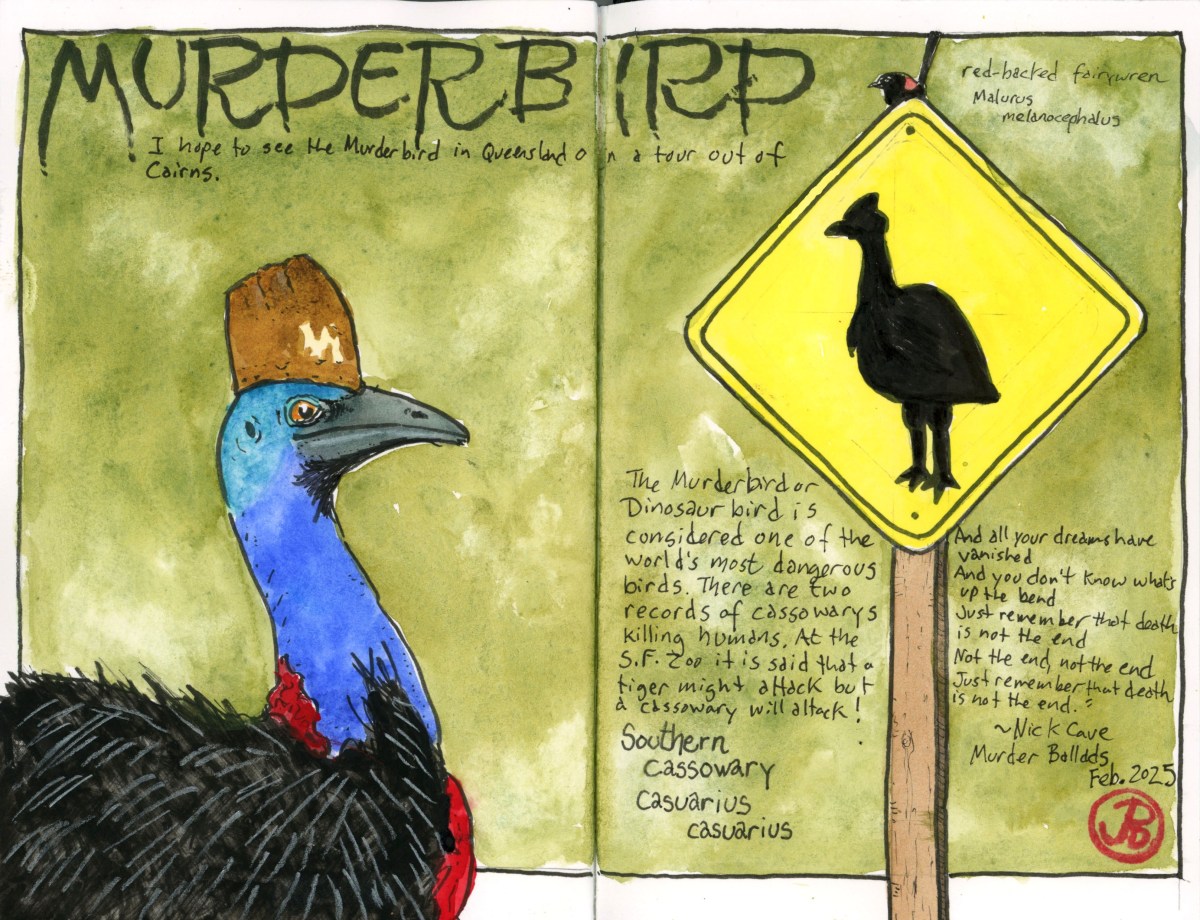
The bird that topped my wishlist for North Queensland (and Australia) is the southern cassowary (Casuarius casuarius).
The southern cassowary is a large flightless bird and the second largest bird Down Under only beaten by the emu. It forages on fallen fruit on the rainforest floor. It is a rather docile unless you try to hunt one. The lit lives up to its moniker: Murder Bird!
There are two known instances in which a cassowary has attacked and killed a person. One was a young boy in Australia, who was attempting to hunt a cassowary , the other was a 75-year-old man in Florida (proof that cassowaries don’t make good pets).
How hard can it be to find a large flightless bird in the rainforest? Turns out, pretty hard.
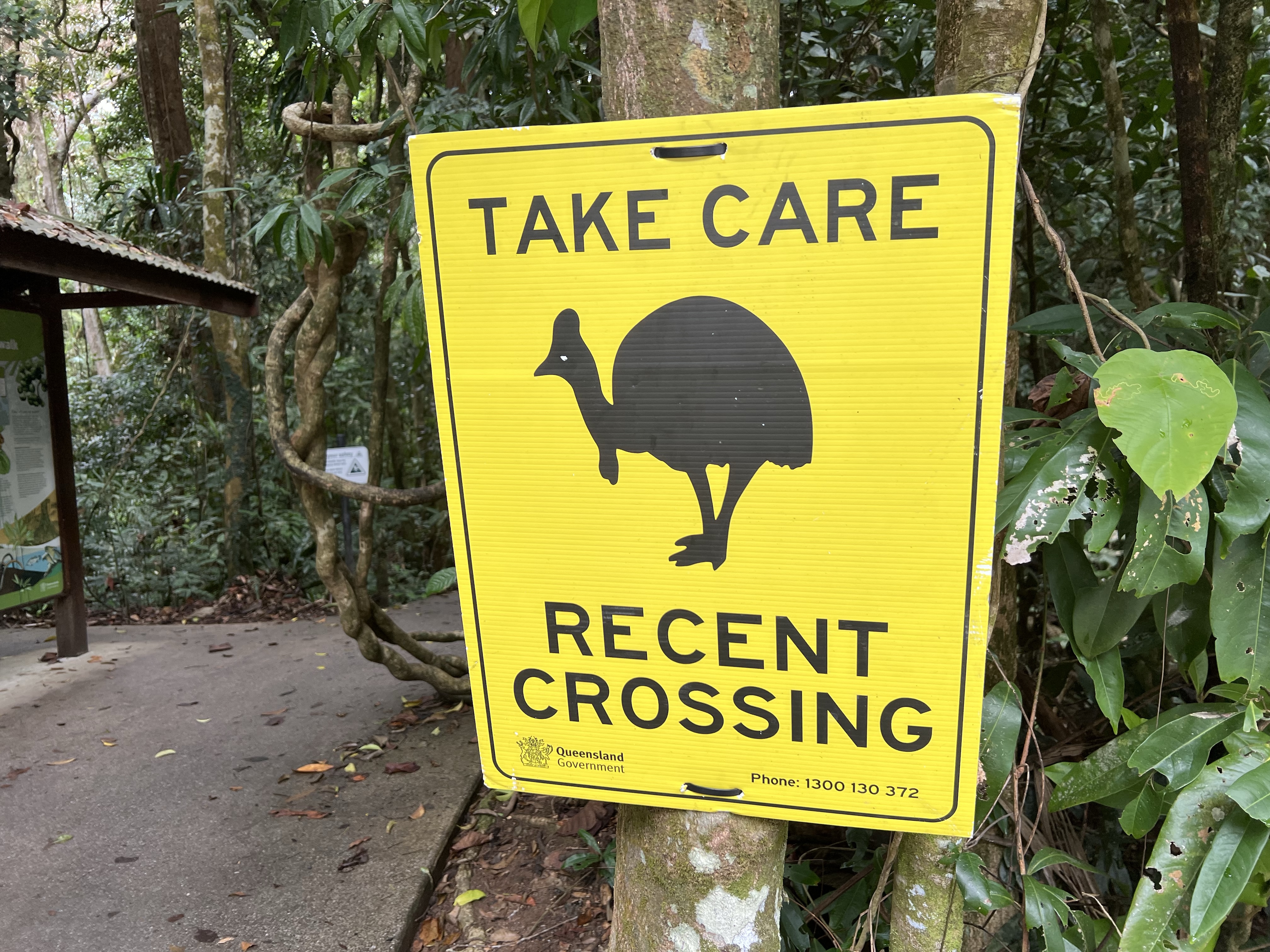
Signs for cassowarys are everywhere in North Queensland. Their images appear on murals, billboards, tour vans, and postcards. But finding one takes sweat (easy in a humid rainforest), perseverance, and patience.
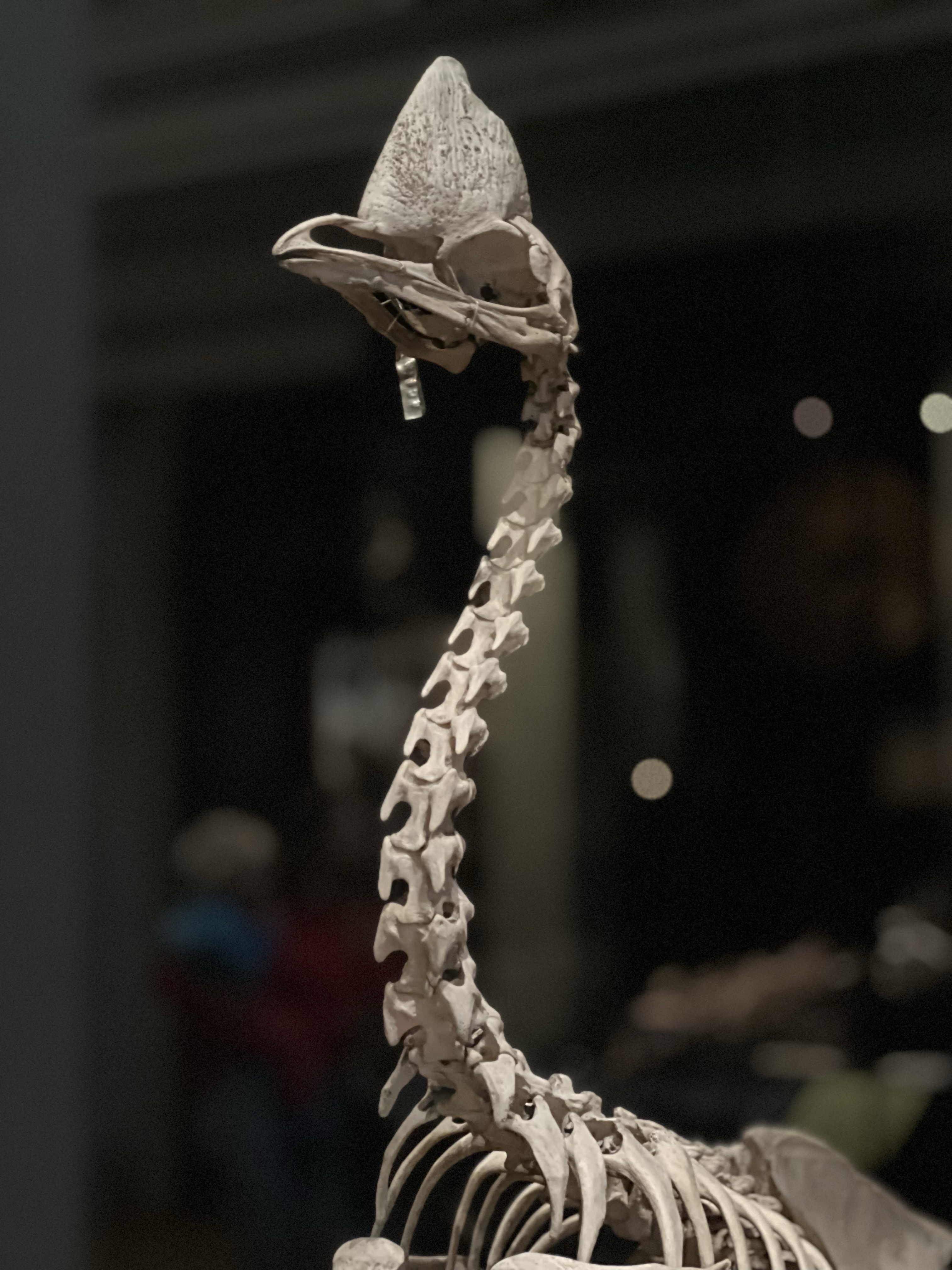
Cassowary skeleton at the Australian Museum.
We first tried for this much sought after bird by walking the boardwalk through Daintree National Park at the Marrjda Botanic Walk. We walked the boardwalk looking and listening for the Dinosaur Bird parting the vegetation with its massive casque or battle helm!
Unfortunately, Bigbird’s angry uncle didn’t show. So we headed out to bird in other parts of the National Park, vowing to return for another try in the afternoon.
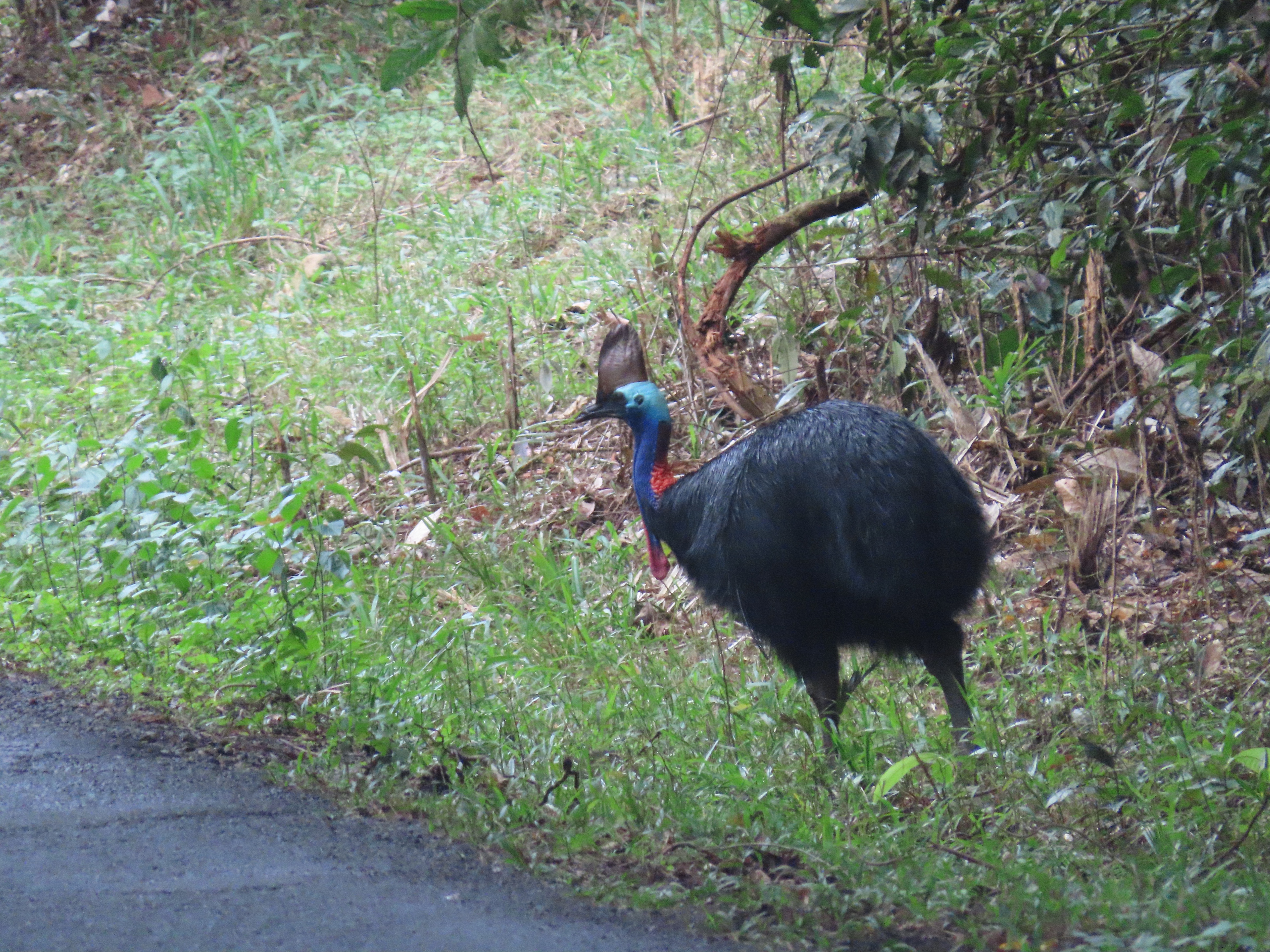
A few hours later we returned to the parking lot and as we pulled up, we were told that a Cassowary was on the roadside!
We quickly geared up and sped-walked down the road to where there was a line of people looking down the road. But we could not see the cassowary. We were told the bird had wandered into the forest.
A few seconds later she returned to the grassy roadside. It was a she, in cassowarys, the females are larger and our guide recognized the bird by her casque size and shape. It was cassowary known as “Molly”.
Why couldn’t the cassowary cross the road?
She was trying to cross the road but the mass of people was preventing her from doing so. We all got good looks but “Molly” eventually retreating into the forest to wait it out until the crowds dispersed.
We were lucky enough to not have one cassowary encounter but two.
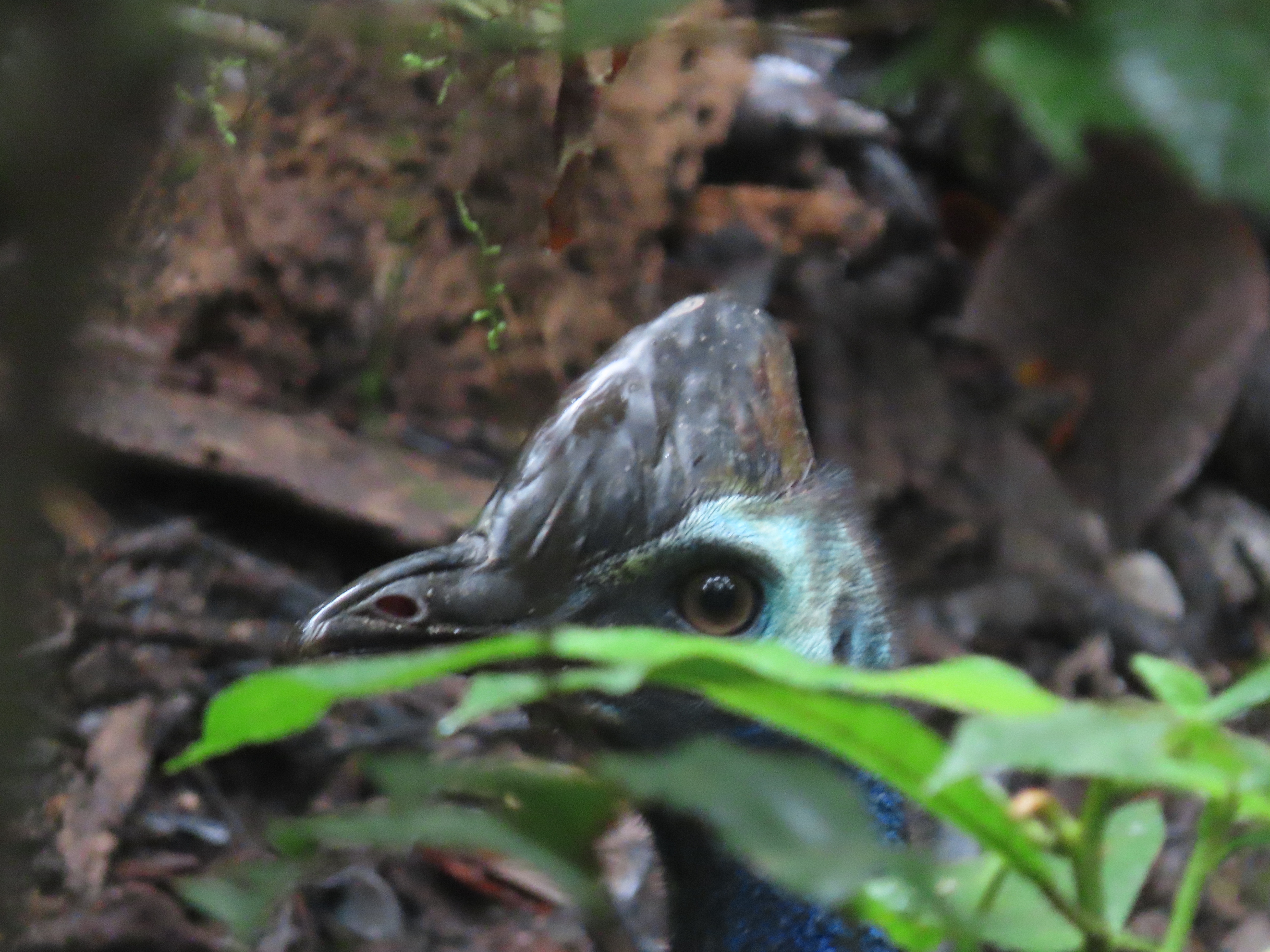
Our second Cassowary was seen in Mt. Hypipamee National Park, resting just off the trail. This bird was much younger than “Molly”, our guide estimated that this bird was about five years old.
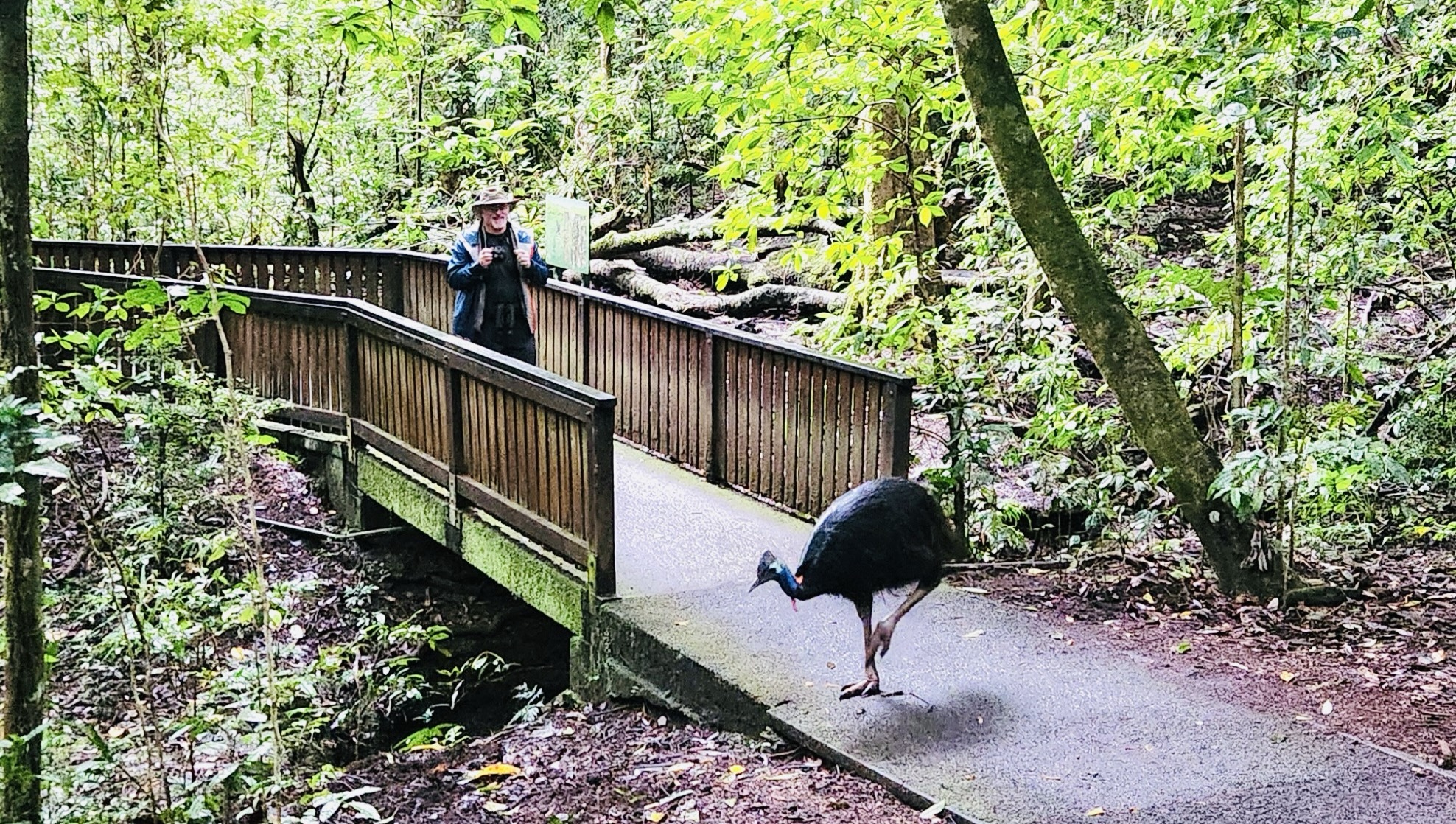
In the young bird’s wandering it headed straight towards me. I stepped aside like a slow motion matador of peace and the bird crossed the path and heard down the bank to the creek.
Corvidsketcher watching a cassowary cross the road.
I watched the cassowary wanted down the hill to the creek where it stood in the cool water and drank. This was a great experience spending some time with the young Murderbird.
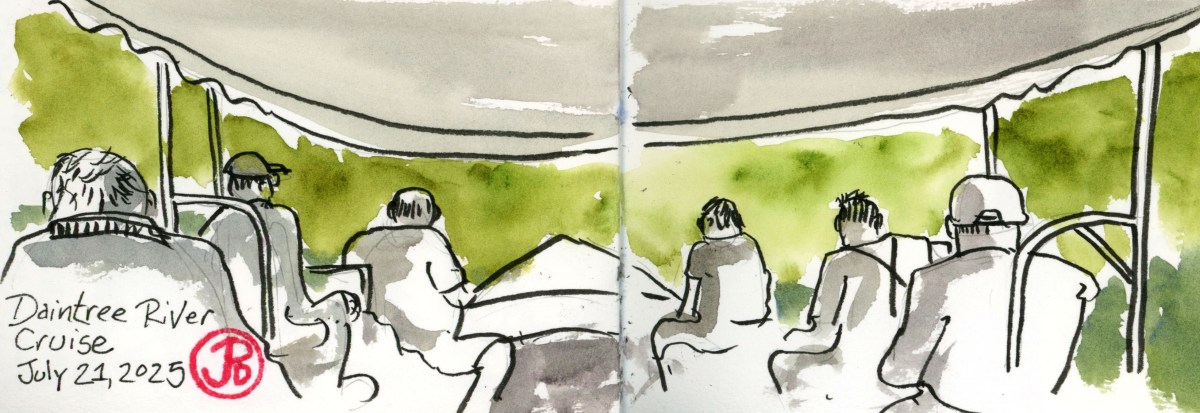
On day one of my North Queensland birding tour with FNQ Nature Tours I was picked up at my hotel in Cairns at 6:30 AM and met my fellow travelers: three Aussies from Melbourne and two Kiwis and our local guide James.
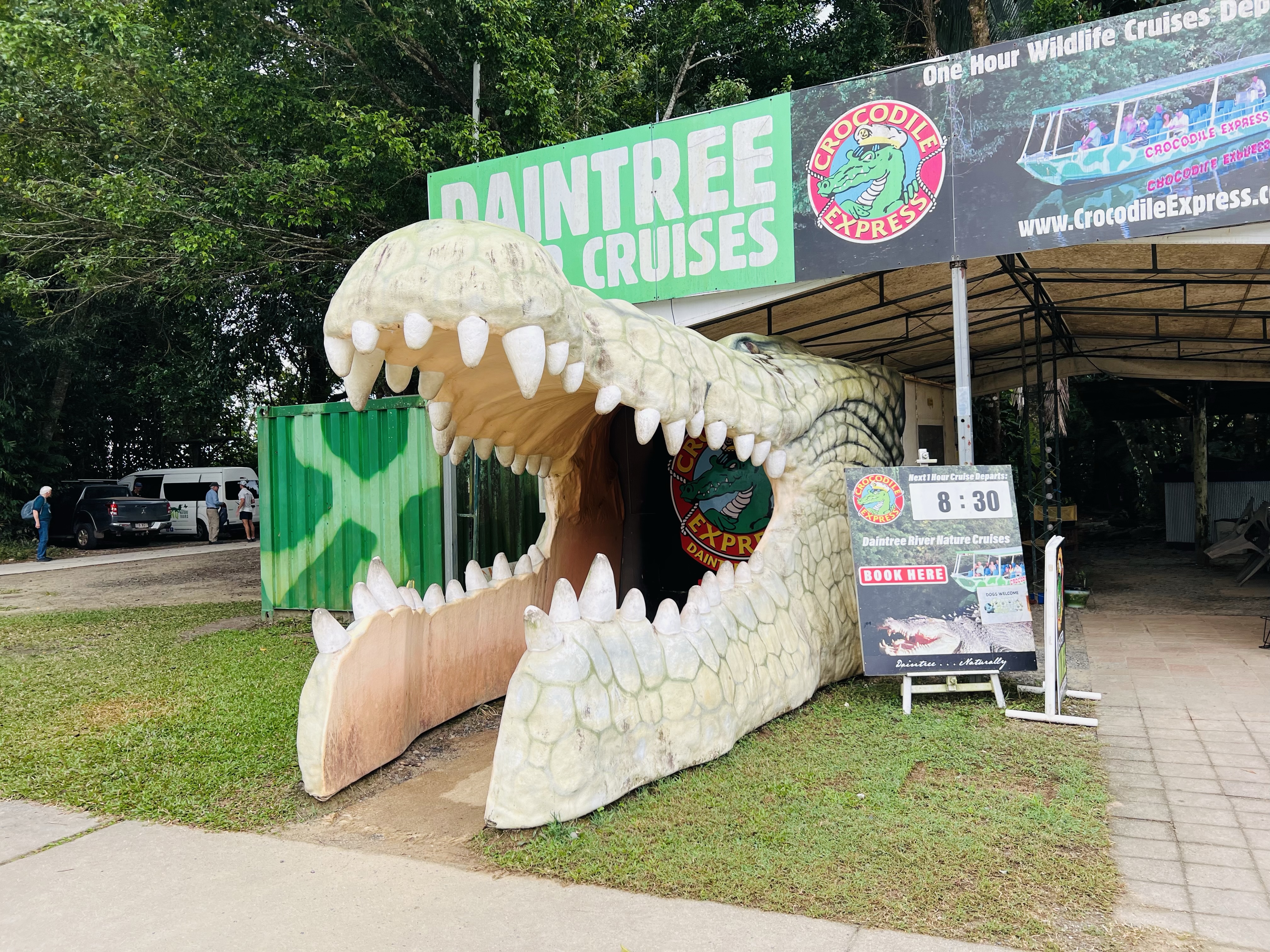
About forty minutes later we arrived at the banks of the Daintree River.
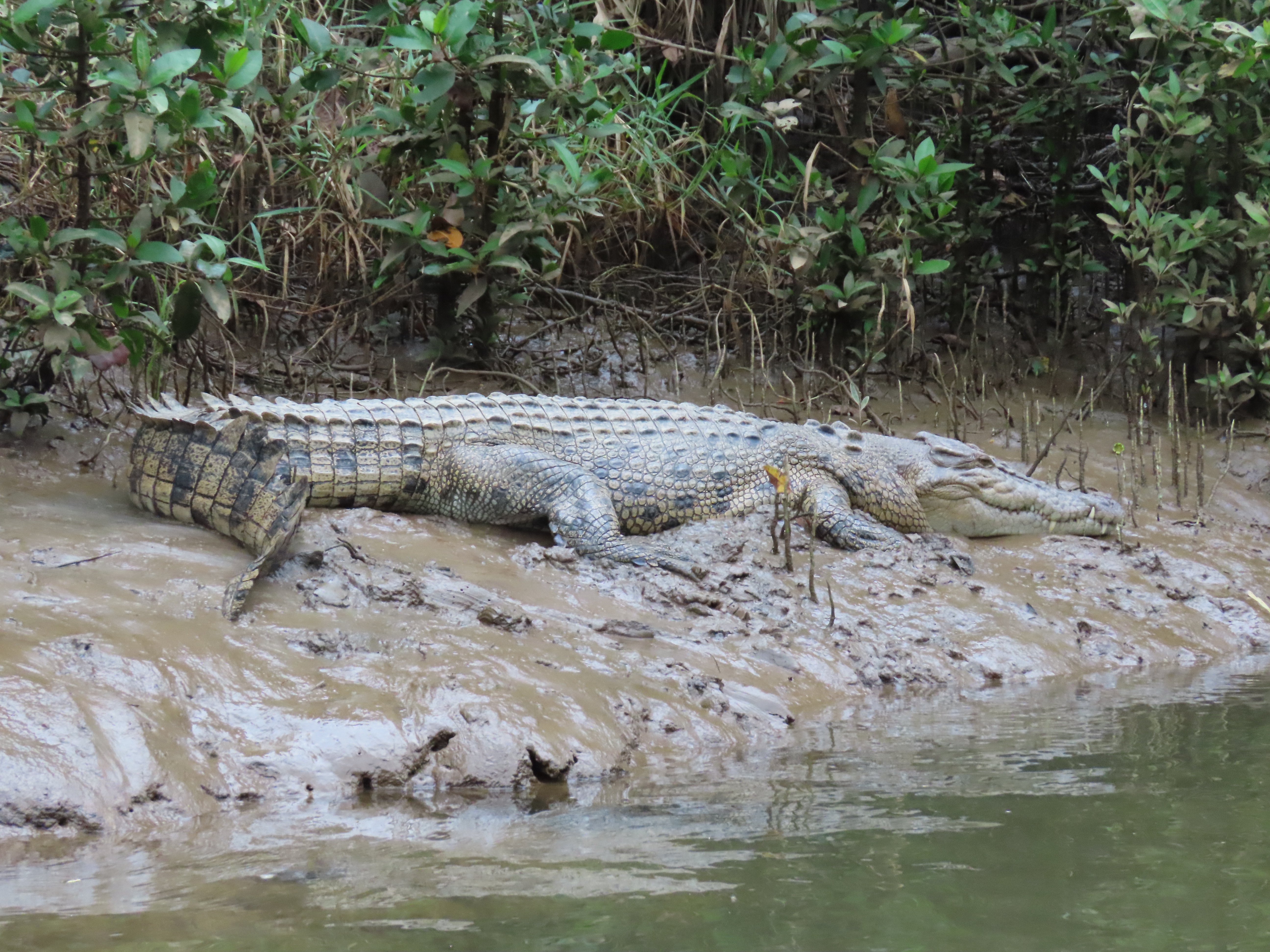
In case you didn’t know, saltwater crocodiles are the big draw on the Daintree.
While we were sure to see crocodiles, our main focus was on the avian life.
We departed from the dock and headed across the Daintree and went up a creek in search of Australia’s smallest kingfisher, the appropriately named little kingfisher.
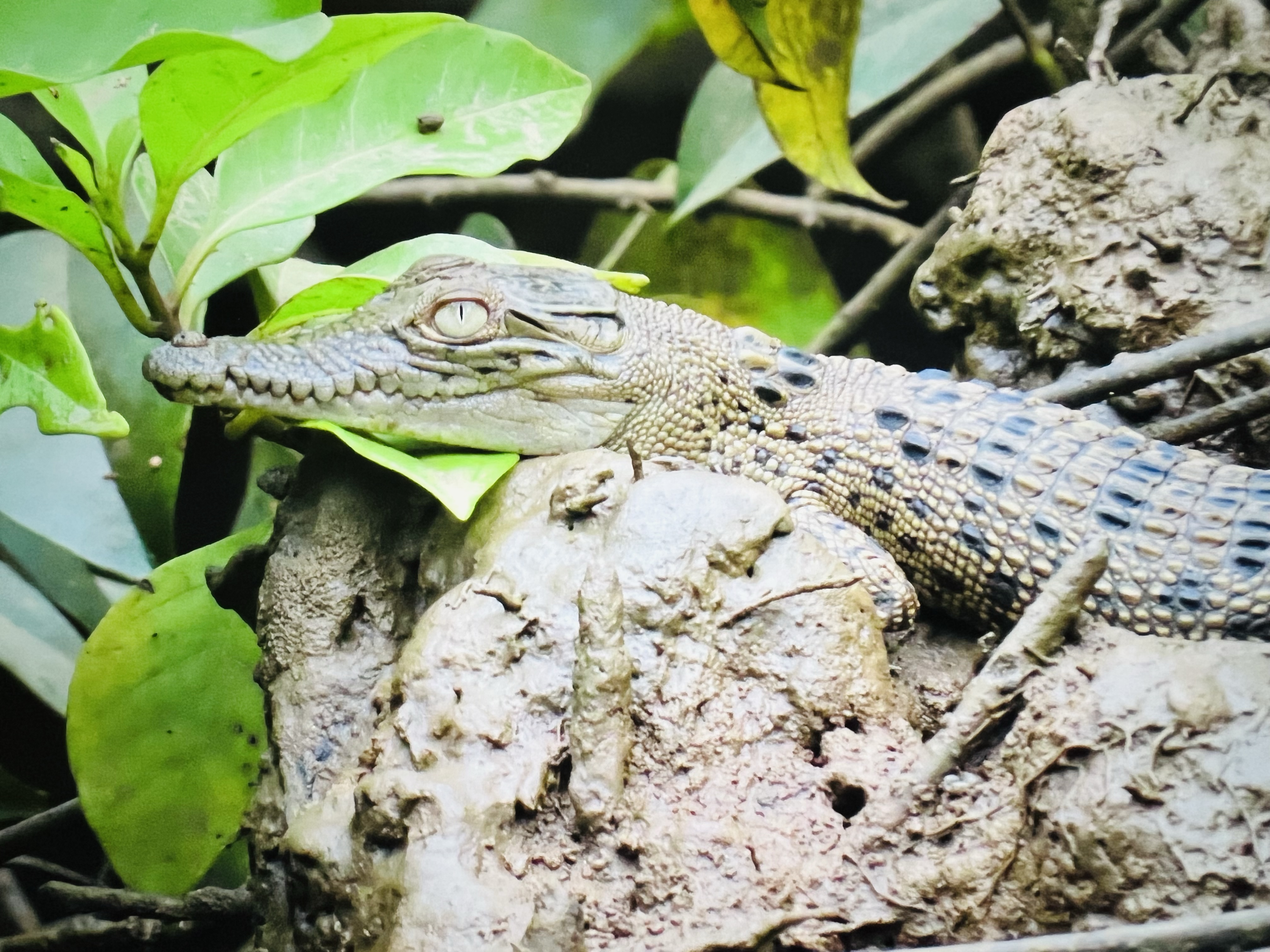
On the way there, our guide pointed out a small salty resting on the bank.
A small salty, perhaps a year old.
We peered down every small tributary and every low hanging branch. While everyone had their bins focused on the tributary on the port side, I peered over to the starboard and there it was, perched on a limb over the creek.
A little kingfisher photographed at the Botanical Garden in Cairns.
After getting more looks at the little kingfisher, we headed back to the Daintree to see bigger crocs.
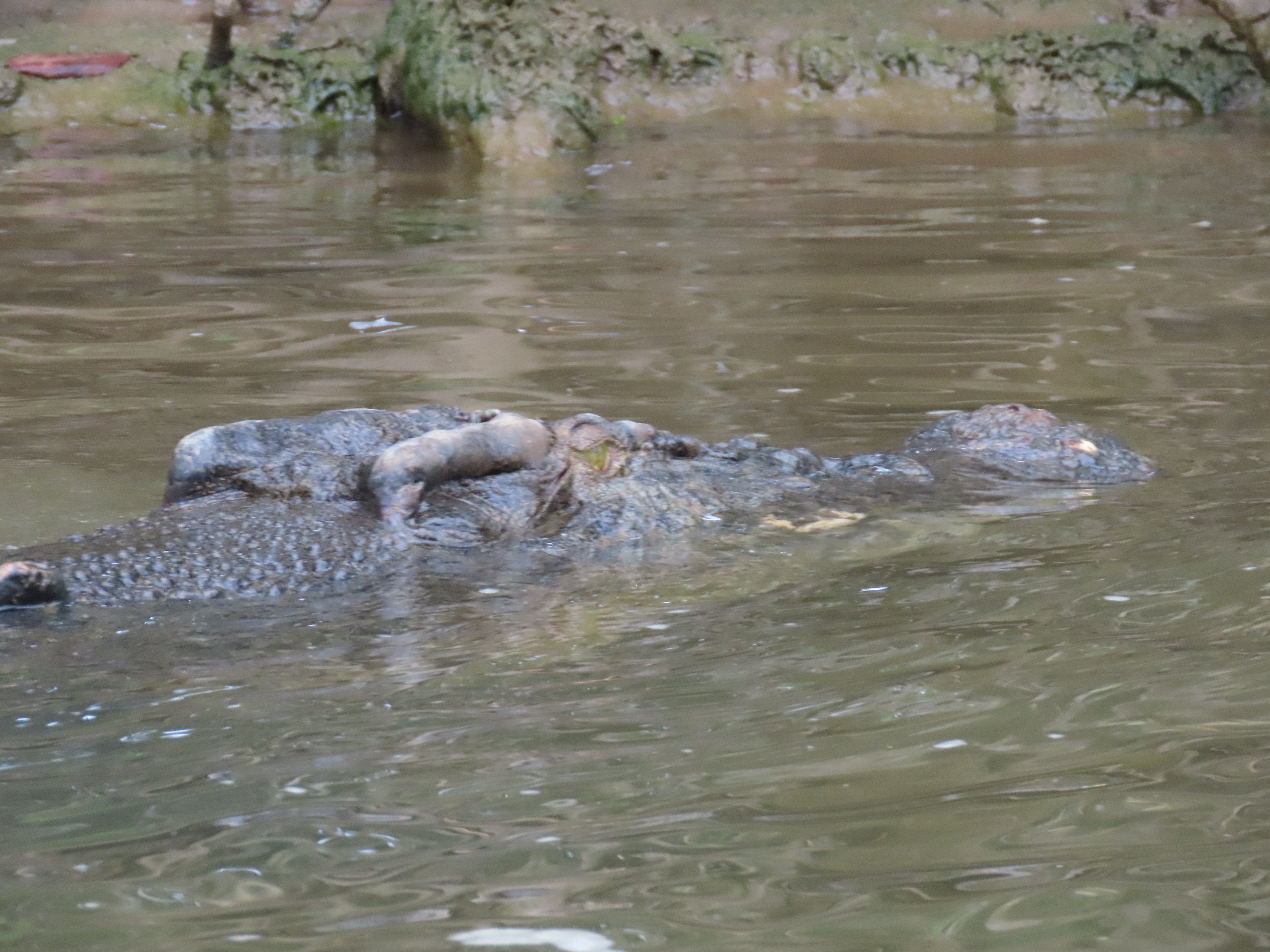
The king of the crocs on this stretch of the river is a large male with three teeth named “Scarface”.
The three-toothed dominant male of the stretch of the river: “Scarface”.
After getting looks at “Scarface”, we headed up another small creek to get a look at a resting female.
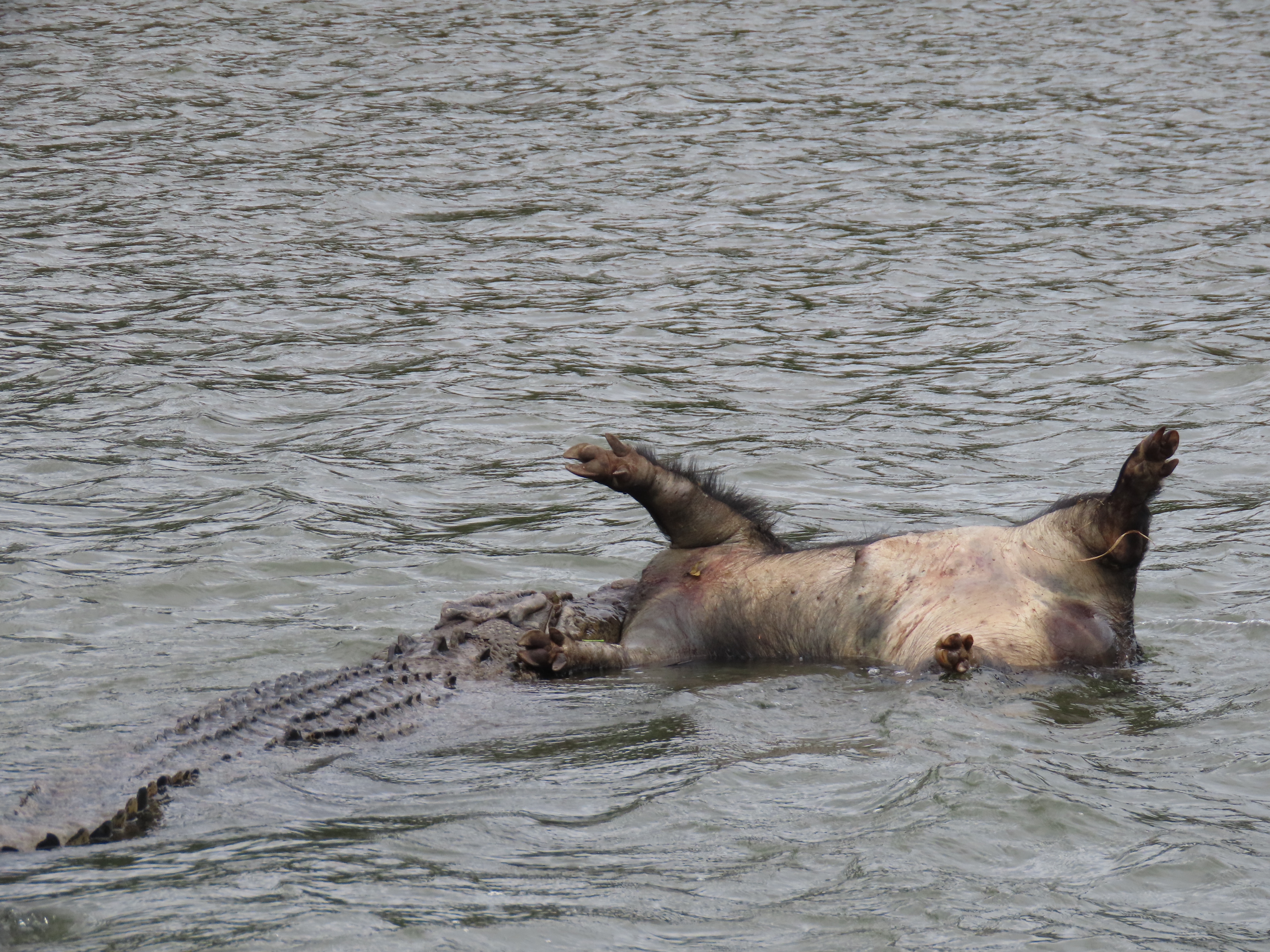
Our most interesting sight of the morning, and one our guide had never seen, was an interloping male carrying a bloated feral pig across the Daintree.
Feral pigs, as in parts of the United States, are a major problem in Australia. They eat and destroy crops and destroy native habitats. The open season for hunting pigs is year round. It is assumed this is how a feral pig made it into the river and into the jaws of a hungry male salty.
“Consider the platypus. In a land of improbable creatures, it stands supreme. It exist in a kind of anatomical nether world halfway between mammal and reptile. Fifty million years of isolation gave Australian animals the leisure to evolve in unlikely directions, or sometimes scarcely to evolve at all. The platypus managed somehow to do both.”-Bill Bryson
Australia has a host of really odd creatures.
Some are only found Down Under such as kangaroos, wallabies, wallaroos, and certain tree-possums.
There is one animal that tops the oddity list and this has to be the duckbill platypus.
The platypus is a monotreme, an order of the only mammals that lay eggs. There are just the platypus and four species of echidnas in existence today in this order.
The platypus seems to be put together from some surplus animal parts: the bill of a duck, body of an otter, the tail of a beaver, and the webbed feet of a goose. Who knew what early scientists made of the platypus?
I hoped to get a chance to see this mammalian oddity in Queensland.
I ordered a platypus model to use as a sketching tool. I think I might bring this long with me in my carry-on. An Aussie mascot.
My Aussie good luck platypus mascot. I wonder if it will bring me a real platypus.
“The saltwater crocodile is the one animal that has the capacity to frighten even Australians. People who would calmly flick a scorpion off their forearm or chuckle fearlessly at a pack of skulking dingos will quake at the sight of a hungry croc.”
-Bill Bryson, In a Sunburned Country
I was looking forward to my encounter with the world’s largest reptile in Queensland on a Daintree River cruise. I just hope it will not be a close encounter!
Australian wildlife has the capacity to kill. Even a cone snail can kill a human! Oz is home to 213 venomous snakes. That is more venomous snakes than anywhere else in the world.
Australia is also home to the Murder bird, a small venomous octopus, the world’s most deadly spider (Sydney funnel-web), stonefish, box jellyfish, the common death adder, the blue bottle, the bull, tiger, and great white shark, and many others.
But as Bill Bryson notes, there is one deadly animal that rises above all others: the saltwater crocodile.
This apex predator sometimes sees humans as prey. In Australia from 1971 to 2013, saltwater creatures crocs killed 106 people. On average there are about 2 fatal attacks per year.
I have seen the American alligator and crocodile in Florida and the Yacare caiman (above) in the Pantanal. I was really looking forward to seeing the largest crocodilian in the world.
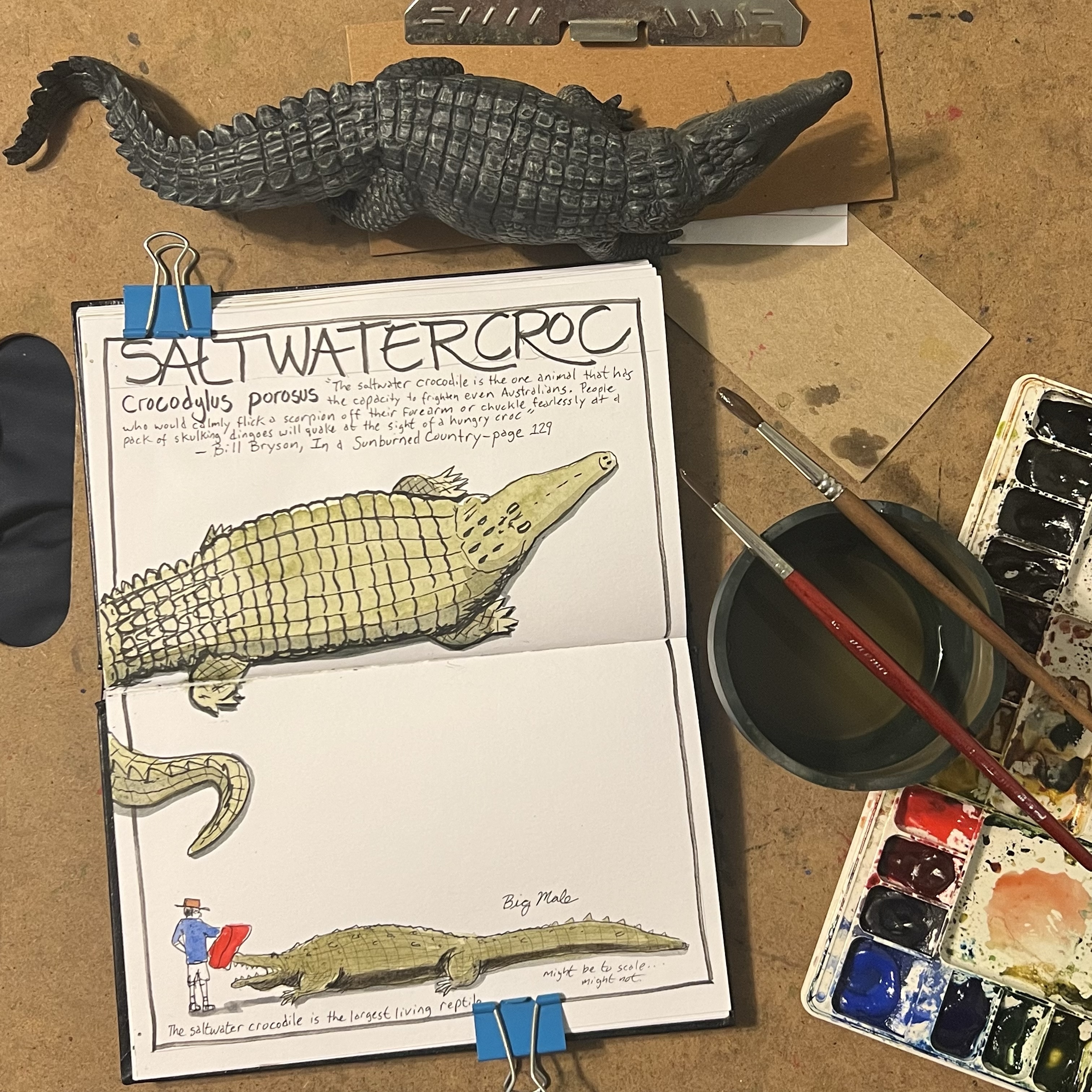
In order to sketch a croc I ordered a model to help me sketch. This way I could sketch it from any angle such as from above.
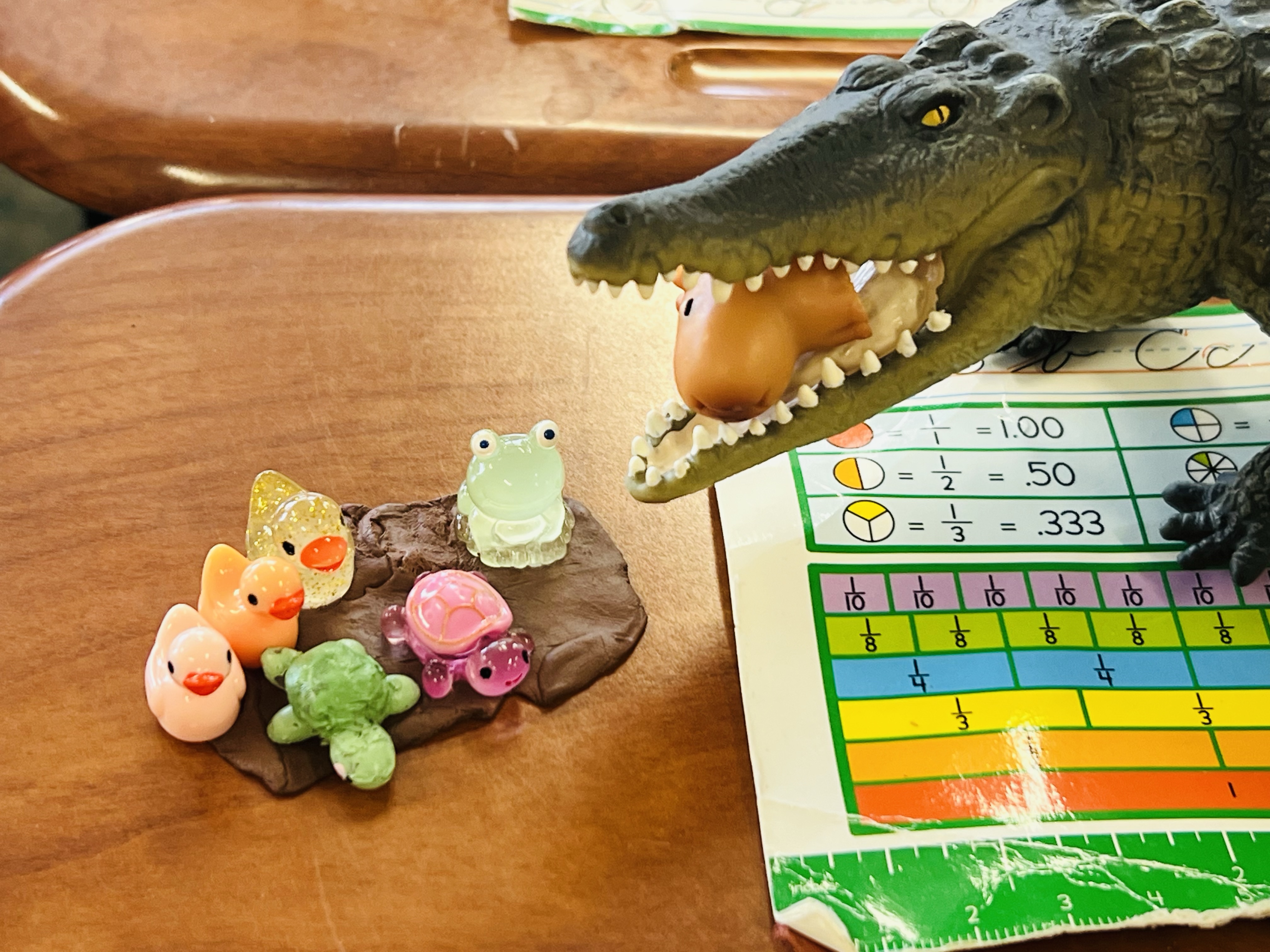
My saltwater croc model and my sketch in progress. My croc eating my student’s capybara! No plastic was harmed in the making of this photograph.
There was one creature in Australia, out of all the deadly and dangerous creatures, that my Australian mate was concerned with me encountering: the murderbird (southern cassowary).
When asking zookeepers at the San Francisco Zoo to list the most dangerous animal in the zoo they often replied: a tiger might attack you but a cassowary will attack you. This flightless beast topped the list.
And I intended to see a cassowary in North Queensland. The Murderbird topped my Australian birding wishlist.
I will be on a five day guided birding trip out of Cairns and we would be looking for the flightless Danger Bird on three different days.
If the tawny frogmouth looks like a Muppet, then the cassowary looks like a denizen of Sesame Street, but from the other side of the tracks. A satanic Big Bird.
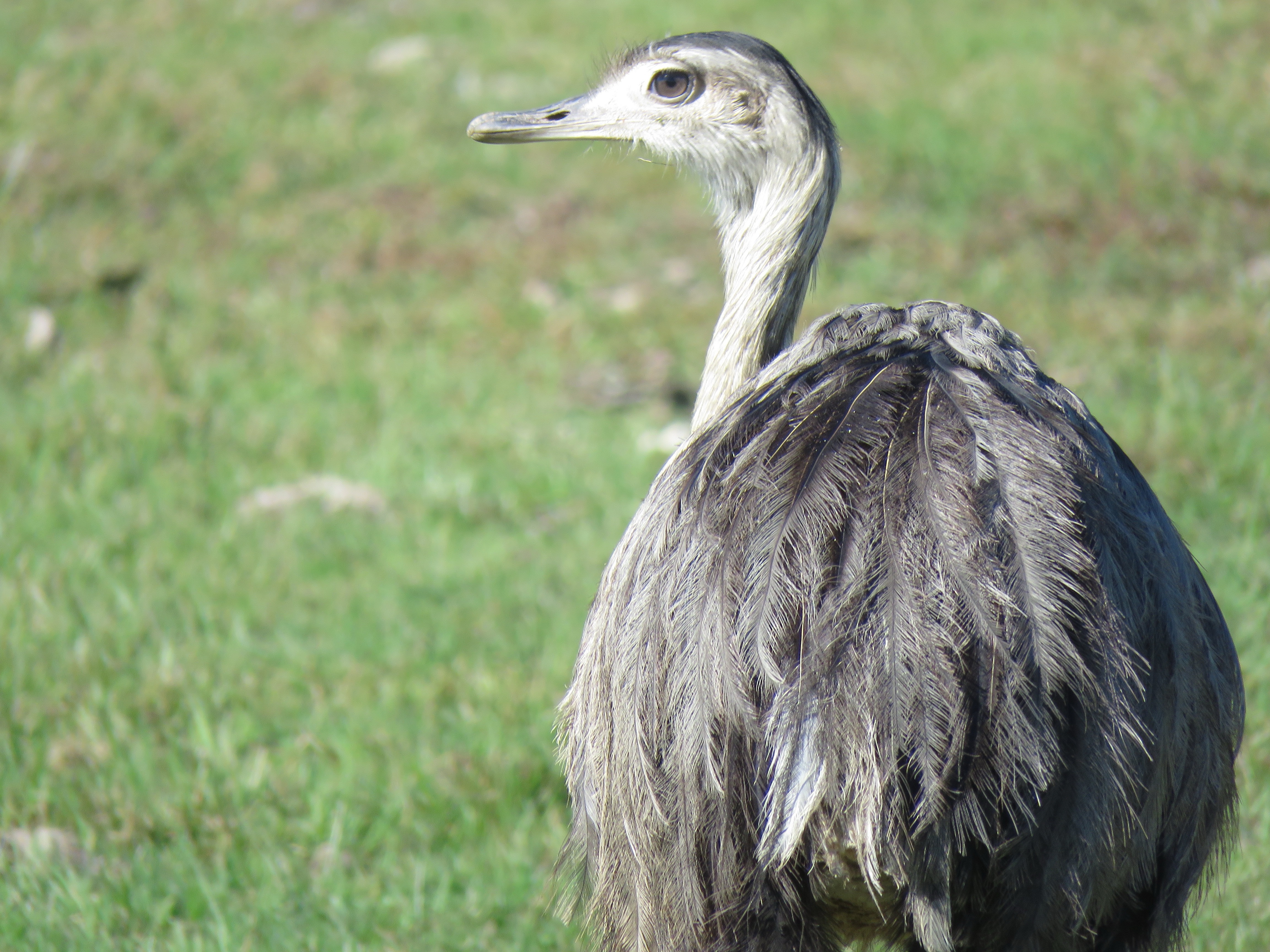
I have seen large flightless birds before, like this greater rhea in Brazil’s Pantanal. The rhea looks friendly and inviting, unlike the cassowary!!




 Corvid Sketcher