Image

Where the River Ends, a Gull Bath

I headed to the bluff on the east side of the San Lorenzo River. This is where the river ends into Monterey Bay.

On my left was the Monterey Bay and beyond was the Municipal Wharf (sight of great fork-tailed storm-petrel sightings last year) and to my right was Santa Cruz Beach Boardwalk, now in winter dormancy. I knew that any time a large river entered the ocean, where fresh water meets salt, there would be bathing gulls. Lots of gulls.

Down below, there were hundreds of gulls. This multi age and many specied gathering contained mainly California, herring, mew, and western. I scanned the gathering and found no rarities. But it did give me an opportunity to observe the dynamics of gull bathing and preening.
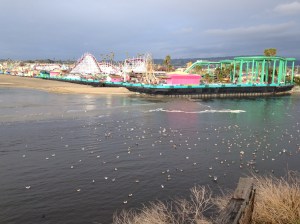
The mighty San Lorenzo River is a major winter gull bathing and resting location on Monterey Bay. The Santa Cruz Beach Boardwalk is on the west side. The Logger’s Revenge to the right and my favorite roller coaster, the Big Dipper, is on the left.

Using my not-so-secret powers of observation I noted two areas that the gulls used: river and sand. The river is used for washing and the sand for preening, resting and playing.

The gulls used the river right in front of the railway trestle which was featured in the 80’s vampire flick Lost Boys. The birds were doing their indelible flappy wing dance followed by a head plunge and a wiggle. Yes very scientific I know.

The gulls on the sand spit where resting or preening. I noticed a few juvenile gulls playing with slicks on the spit point. They would carry a stick around and then drop it and pick it up. Repeat. I can only guess that they are practicing their eye-beak coordination.

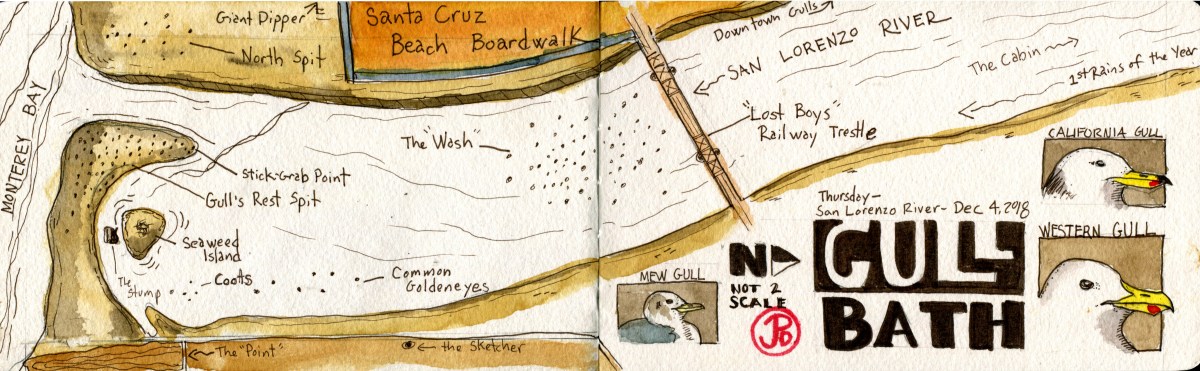
The spread I sketched was a not-to-scale gull’s eye view of the river mouth. I love to make my own maps, using my own names for the land. This map contains my own: Seaweed Island, the “Wash”, Stick-Grab-Point, Gull’s Rest Spit, North Spit, and the “Stump”. Most of these land and watermarks are ephemeral, changing and disappearing with the tides and the winter rain, washing down from the Santa Cruz Mountains.
Image

Put a Fork-tailed in It

This lifer was a parking lot bird in a manner of speaking. I looked at the text from Dickcissel: “fork tailed storm petrel san lorenzo river mouth. you going?”.

I really needed a pair of black pants but they could wait for a possible lifer so I left the Capitola Mall parking lot and headed to the San Lorenzo River overlook, which was about 15 minutes away. 

At 9:52 AM a fork-tailed storm-petrel was seen again, two were first first reported from the rivermouth at 8:23 AM, one was being stooped on by the local peregrine. It was now 10:15 AM and I hoped the pelagic petrels would stay close enough to shore to be seen.

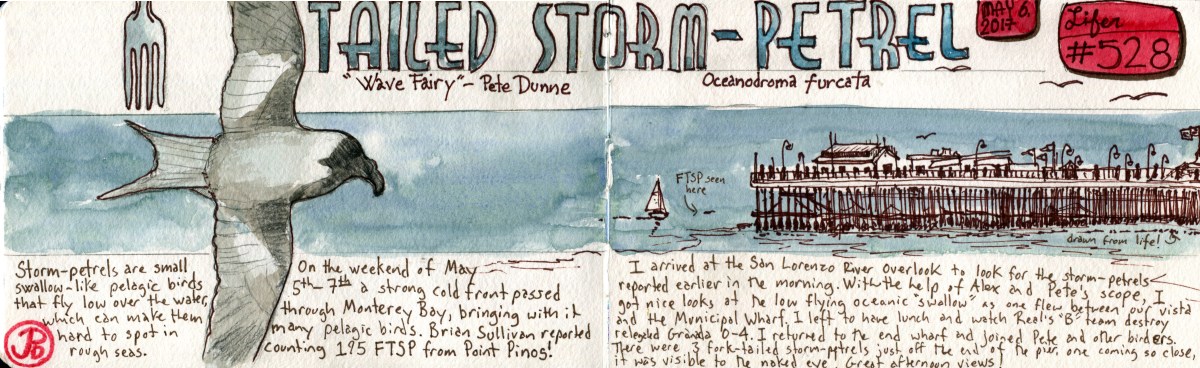
I parked, grabbed my car binos and headed out to the overlook. The first thing I saw was two birders, which was a very good sign. I walked out to the point and scanned the waters between the buoy and the Municipal Wharf, looking for a grayish low-flying petrel. One birder had it and I soon had the sea-swallow in my binos, tracking it as it flew to the right. The bird passed in front of the wharf and one birder suggested heading off to the wharf to get closer looks.

I was off to lunch to watch a Real Madrid “B” team slaughter already relegated Granada 0-4. It reminded me of the time I was in Bilbao last Spring, on a Sunday afternoon after the home team, Athletic Bilbao had drawn 1-1 with Granada. I was walking up to the Federico Moyúa Plaza, the town’s center, as the Granada team bus circled the plaza, quietly making it’s way out of town and now the Spanish minnows were quietly making it’s way out of the Spanish Primera Division.

A shop front in Bilbao sporting the crest of the local all Basque team. Futbol is a religion in this northern part of Spain. But I digress. . .

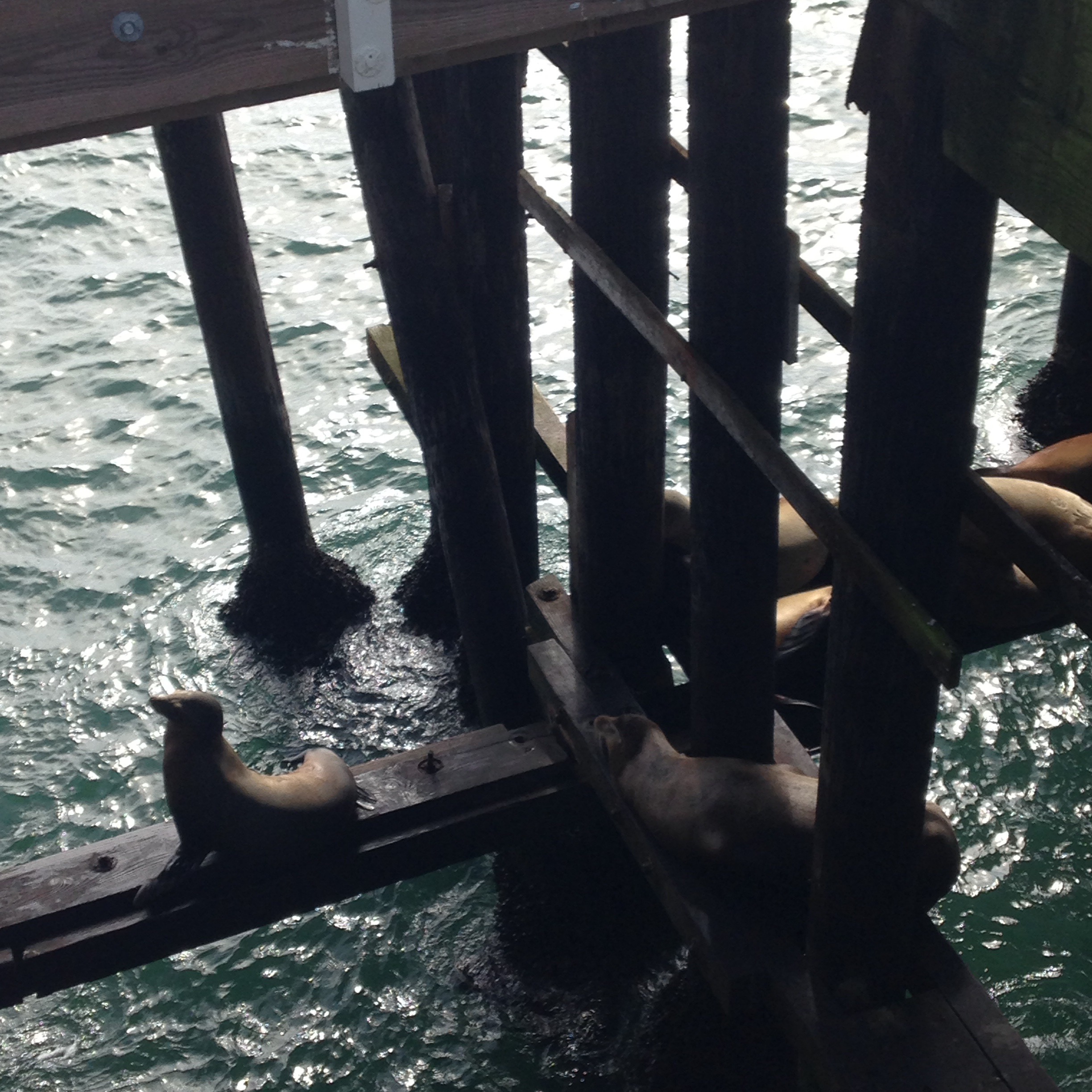
In the afternoon I decided to head out to the wharf, which was a popular destination in my childhood. I have many memories of eating burgers and fries with my dad and brother and then heading to the end of the wharf to watch the snoozing California sea lions. This area and the Santa Cruz Beach and Boardwalk is the tourist side of Santa Cruz and I now rarely visit this part of town, but close looks at a rare Monterey Bay petrel drew me to the very end of the west coast’s longest pier at 2, 745 feet. That’s 2,745 feet jutting out into the Monterey Bay was almost like being on a pelagic boat trip but without the rocking and rolling. Dramamine not needed.

The sealions of my youth. Under the wharf of the West Coast’s longest pier. 

When I walked to the end of the pier, there were two good omens.the first was that there with about eight birders peering off to the waters (always a good sign). And the second was a honey bee that alighted on my right hand (can’t ask for a better blessing). And I just kept birding with my pollinator guest.

Show no fear, don’t get stung. It’s a lesson I  teach all my students: don’t be afraid of nature, nature has more reasons to fear us.

It didn’t take too long, with so many scopes and binos  trained on the waters to find a fork-tailed storm-petrel. One was sighted as I walked up, in fact there were three of them foraging off the pier. One came so close that I lowered my glasses and watched it with the naked eye. Amazing for a pelagic species and not being on an ocean going vessel!

We were frequently asked by the tourists if we where looking for whales. The standard response was, “No, just a small ocean bird. ” That answer usually struck them dumb and they hurriedly walk off as if we had the Pneumontic Plague.

As a nice bonus I spotted a humpback’s blow on the horizon, followed by its flukes as it dove. So I  now could say we where looking at whales. But they didn’t ask and I didn’t answer.