Image

4014 on the Mountain Sub

One of the legendary railroad routes is the section of the Transcontinental Railroad that climbs the western flank of the Sierra Nevada Mountains up to Donner Pass. The construction of the railroad was an engineering marvel and much of the original route is still in use.

Southern Pacific used their AC articulated cab-forwards to tackle the grades and heavy freight over the pass and now the world’s largest articulated locomotive would be climbing up to Donner Pass for the very first time. And I planned to be there.

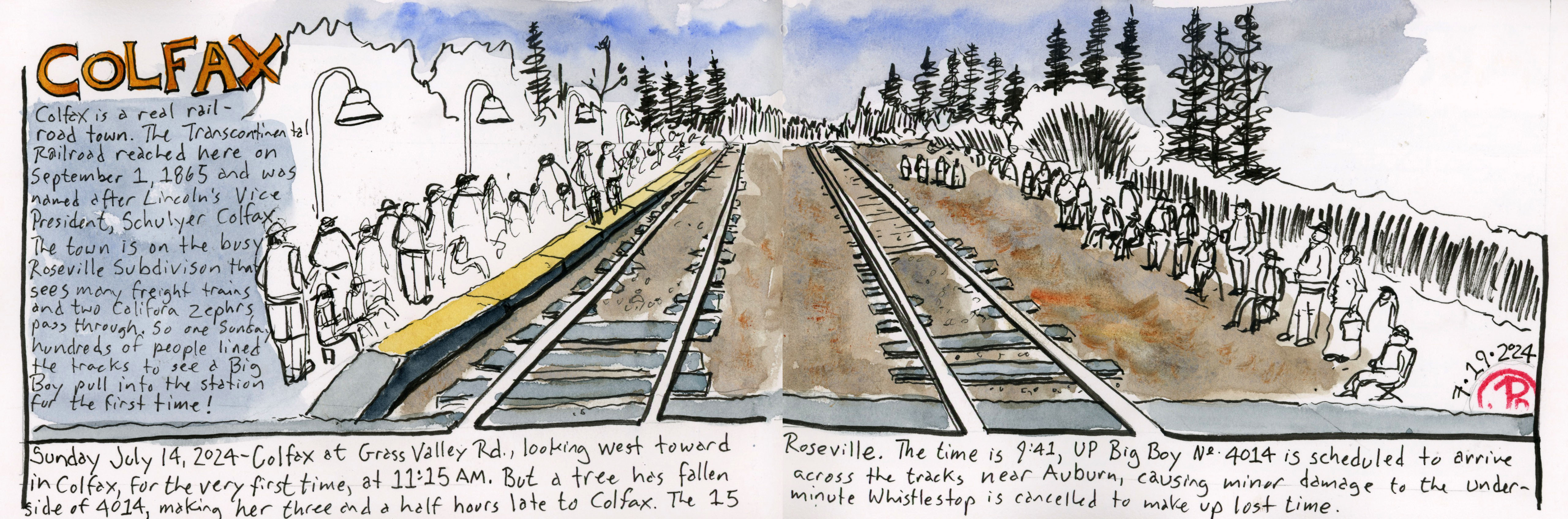
There was a planned 30 minute whistle stop at the historic railroad town of Colfax at 11:15.

I was in Colfax an hour and a half before arrival and more and more people were streaming into town.

4014 left Roseville on time but was halted when the train hit a tree that had fallen near Auburn. The UP tracking app noted that 4014 was “currently stopped near Auburn”. At first I thought it was just a maintenance stop but then word spread that Big Boy had hit a tree and there was some damage to the underside. This was not good. Especially for the hundreds of people waiting in the heat for 4014 at Colfax.
Word spread that the locomotive might have to be towed back to Roseville. The train was now an hour late. I decided to head back to Penn Valley, to air conditioning and the second half of the European Cup Final. I would continue to monitor the UP tracking site. But I had to beat the heat in Colfax.

Just after the game ended (Spain was European champions for the fourth time), the tracker read, “4014 currently moving near Auburn”.

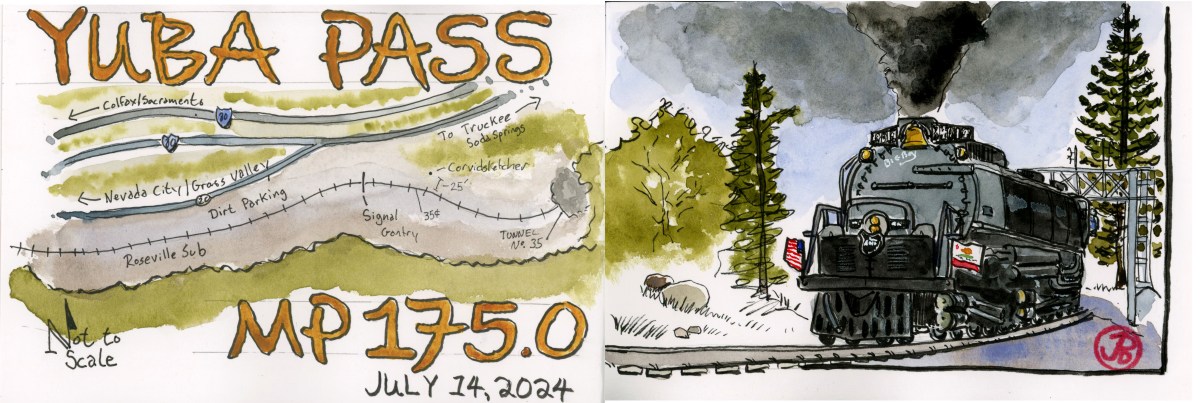
My plan was to drive on Highway 20 to where it merged with Highway 80. This was Yuba Pass and I wanted to see Big Boy in this historic location.

I arrived and there were plenty of other rail fans lining the tracks at Yuba Pass. This was a good sign because 4014 was still climbing the grade and had not reached my position.

After about a 45 minute wait a plume of steam exhaust appeared down line and the mighty roar of the Big Boy filled the cut.

Then the iconic articulated giant appeared working up grade towards my position near the signal gantry. 4014 was putting on a show that enveloped all the senses.
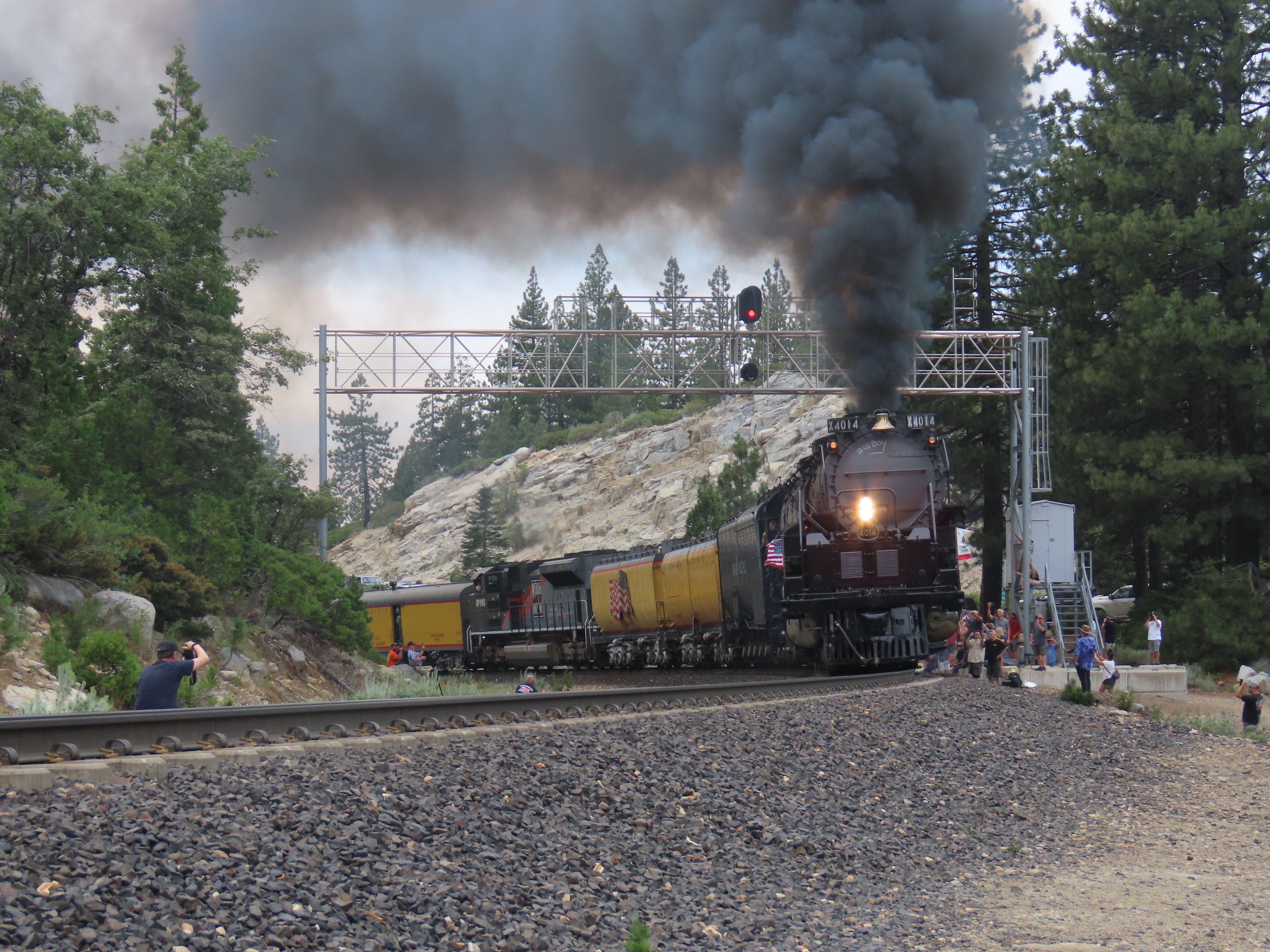
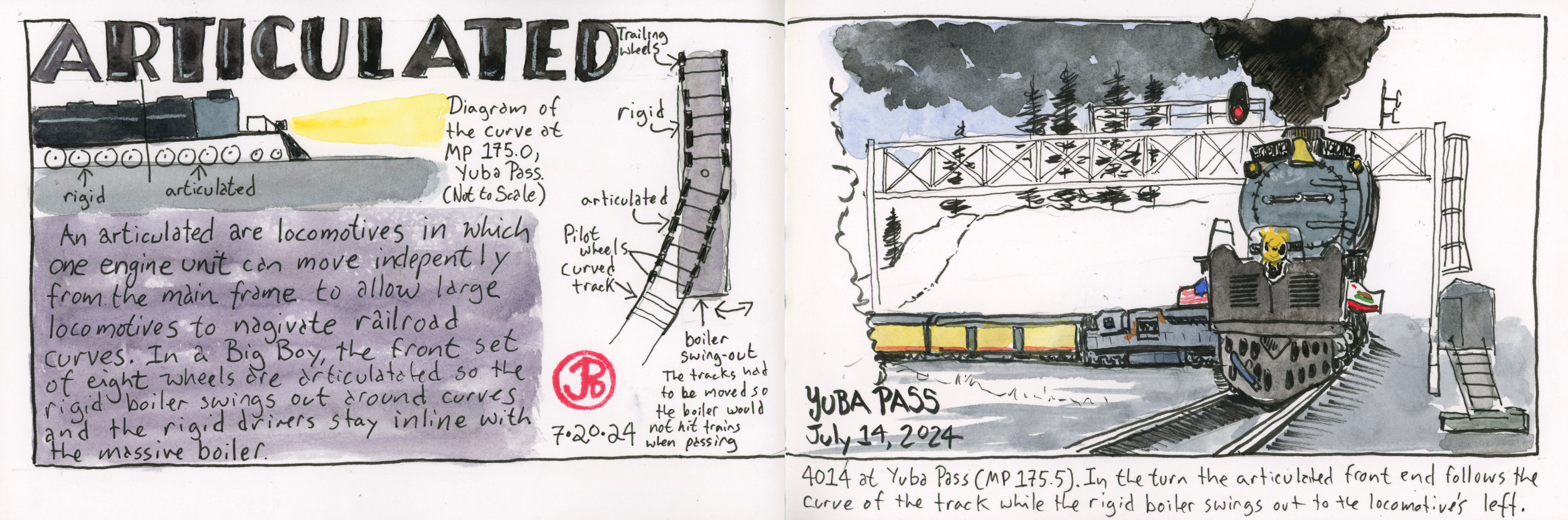
As 4014 rounded the curve, the articulated properties of the design were in full display. While the leading truck and front drivers rounded the curvature of the track the boiler remained rigid making it appear that the drivers and boiler were separating. Afterwards I did a spread to understand the articulation design (below).
After the train disappeared into the tunnel, I headed back to my car and was soon driving east on Highway 80. To my right, I could see the tell-tale exhaust up the hill on the railroad grade. Soon I was pacing with 4014 and I then pulled ahead and planned to head to Soda Springs to see the steam mammoth as she neared Donner Summit.

I made it to Soda Springs off Historic Highway 40 and the biggest challenge was finding a place to park as there were many people waiting trackside for the arrival of the Big Boy.

I found a parking spot and headed down to the grade crossing. There was a festive atmosphere around the tacks and to the south many Cal Fire trucks and personal (including Smokey) looked and listened down track for the first appearance of the 4-8-8-4.
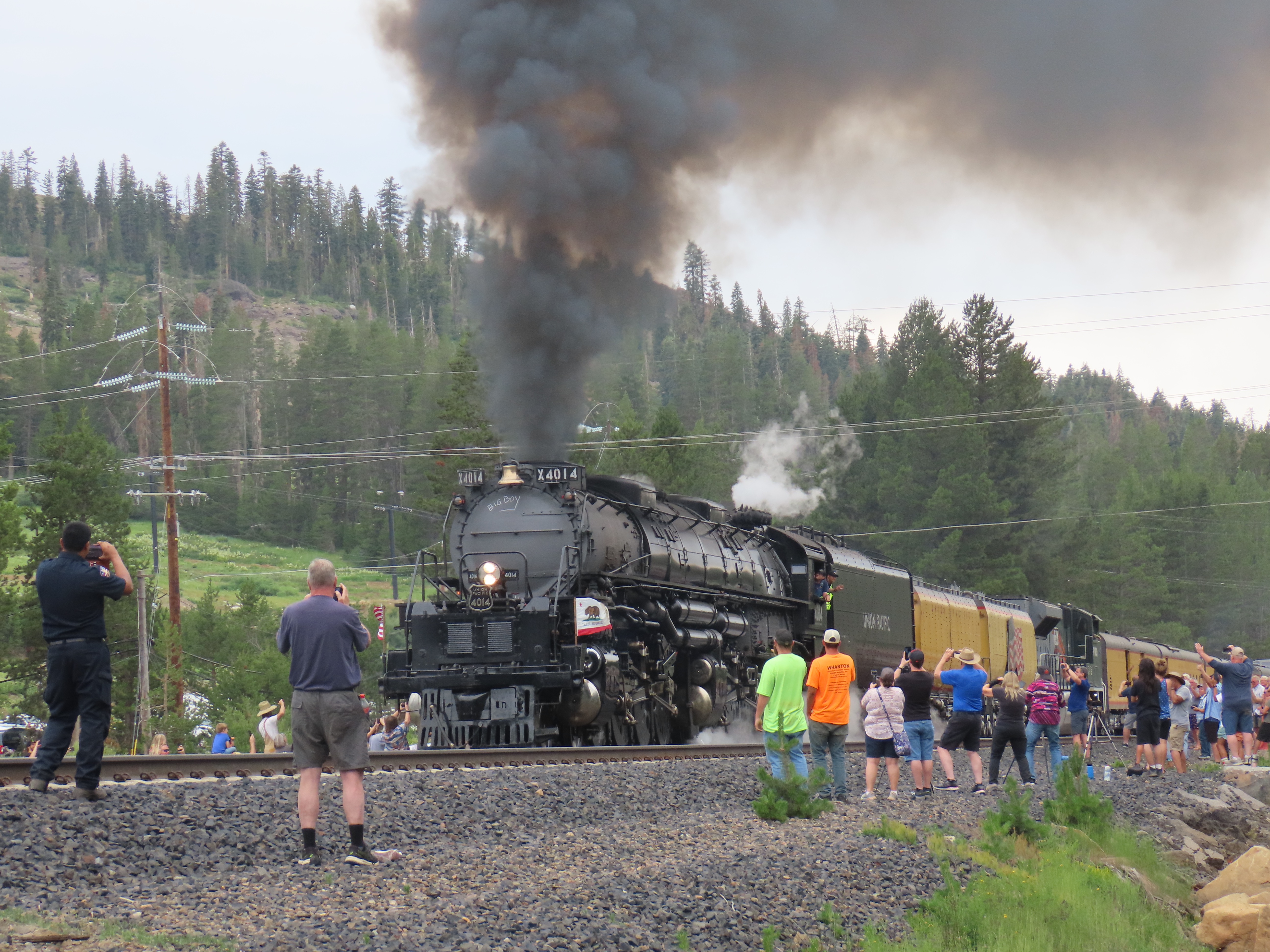
4014 at Soda Springs.

Image

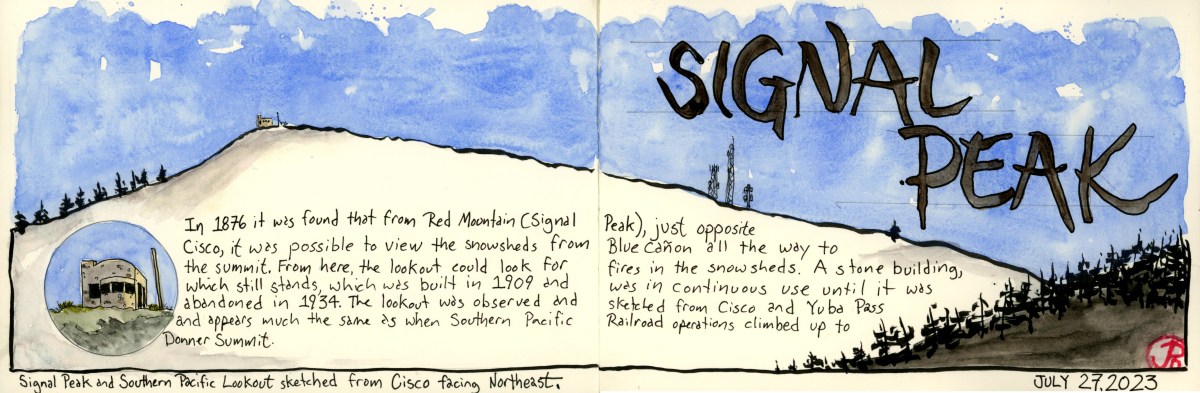
Signal Peak and the Southern Pacific Fire Lookout

On my latest sketching odyssey I headed to one my favorite locations in California, if not the world: Donner Pass.

Before I set out, I sketched the rail route of the East Slope of Donner Pass, heavily influenced by a map drawn by John Signor (author, artist, and former Southern Pacific employee) in his marvelous book: Donner Pass: Southern Pacific’s Sierra Crossing.

I would be driving parallel to the Central Pacific side of the first Transcontinental Railroad on Highway 80. In 1865 the railroad became Southern Pacific.

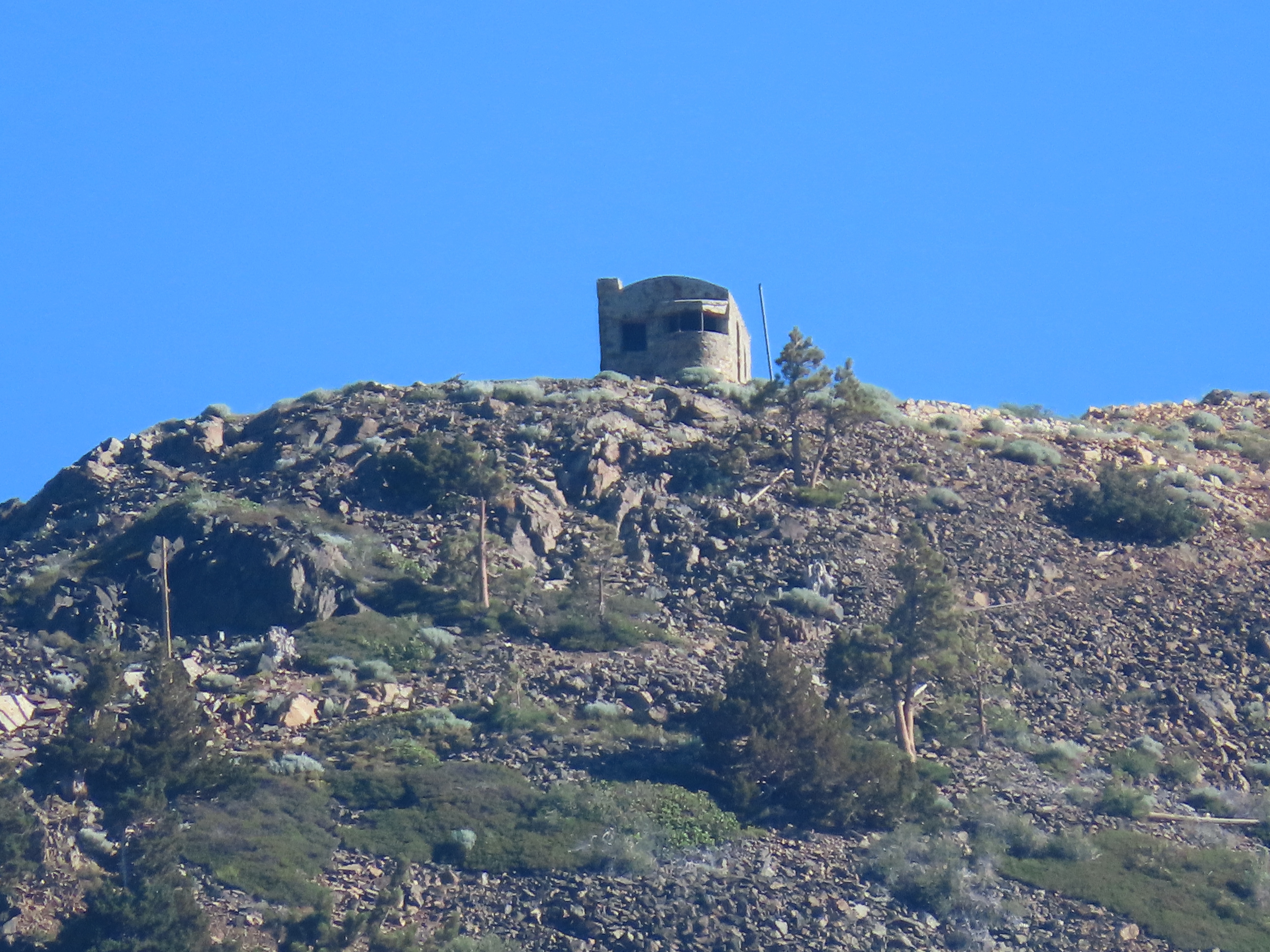
I was looking for a stone structure that was built in 1909 as a fire lookout and I reckoned that Cisco, which is directly across the valley from the building, would be my best position for seeing Southern Pacific’s fire lookout on Red Mountain.

The lookout on Red Mountain was built because, from this vantage point, the rail line from Blue Canon to Donner Summit could be observed. Because 50 miles of the trackage was above 5,000 feet in elevation, snow was a real problem for keeping the line open during the long winters. The solution was to build wooden snowsheds to keep snow off the tracks. Work on the snowsheds began in 1867 and the sheds were completed by 1873. In total, 30 miles of sheds where built.

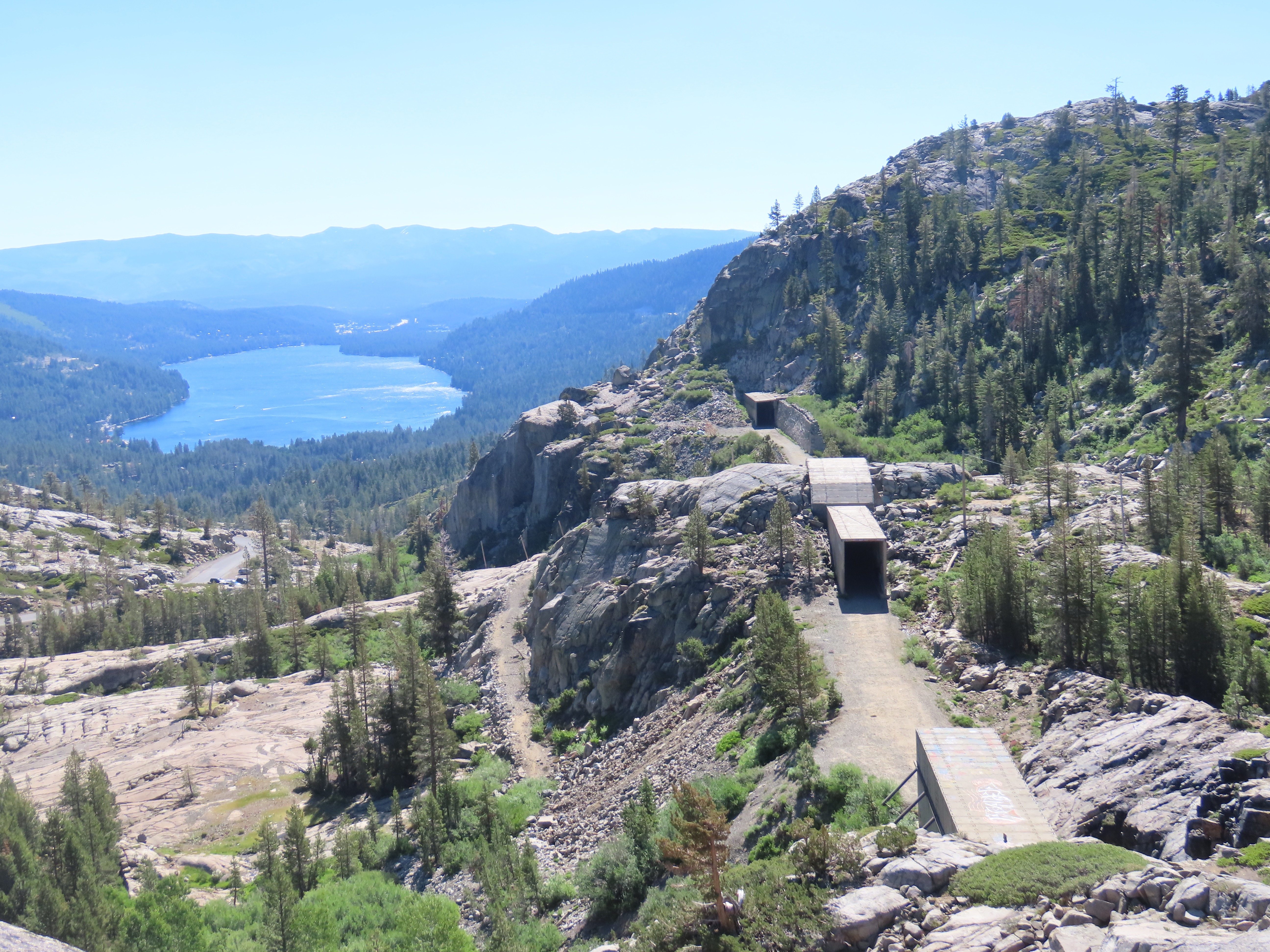
The view from Donner Summit. On the right is the original rail bed of the Transcontinental Railroad. The east portal of the Summit Tunnel (Tunnel #6) and Tunnel #7 is beyond. The snowsheds are made of concrete, replacing the flammable wooden sheds. In the middle ground is Historic Highway 40 and in the background is Donner Lake.

When you combine wooden snowsheds with wood burning steam locomotives the result can be fire.

Southern Pacific employed fire trains that could be called into action to put out fires in the snowsheds but first someone had to observe the smoke. This is where the fire lookout came into play.

The fire lookout was in continuous use until 1934 when it was abandoned.

Before I got to Cisco, I pulled off Highway 20, just before it merges into Highway 80 at Yuba Pass. From here I looked down the line and just above the signal gantry was Signal Peak and to the right I spotted the prominent silhouette of the fire lookout.

Yuba Pass with Red Mountain and Signal Peak in the background.

I headed east on 80 for one stop, I took the Cisco exit which just a service station stop. I pulled behind a parked truck and looked to the northeast across the highway.

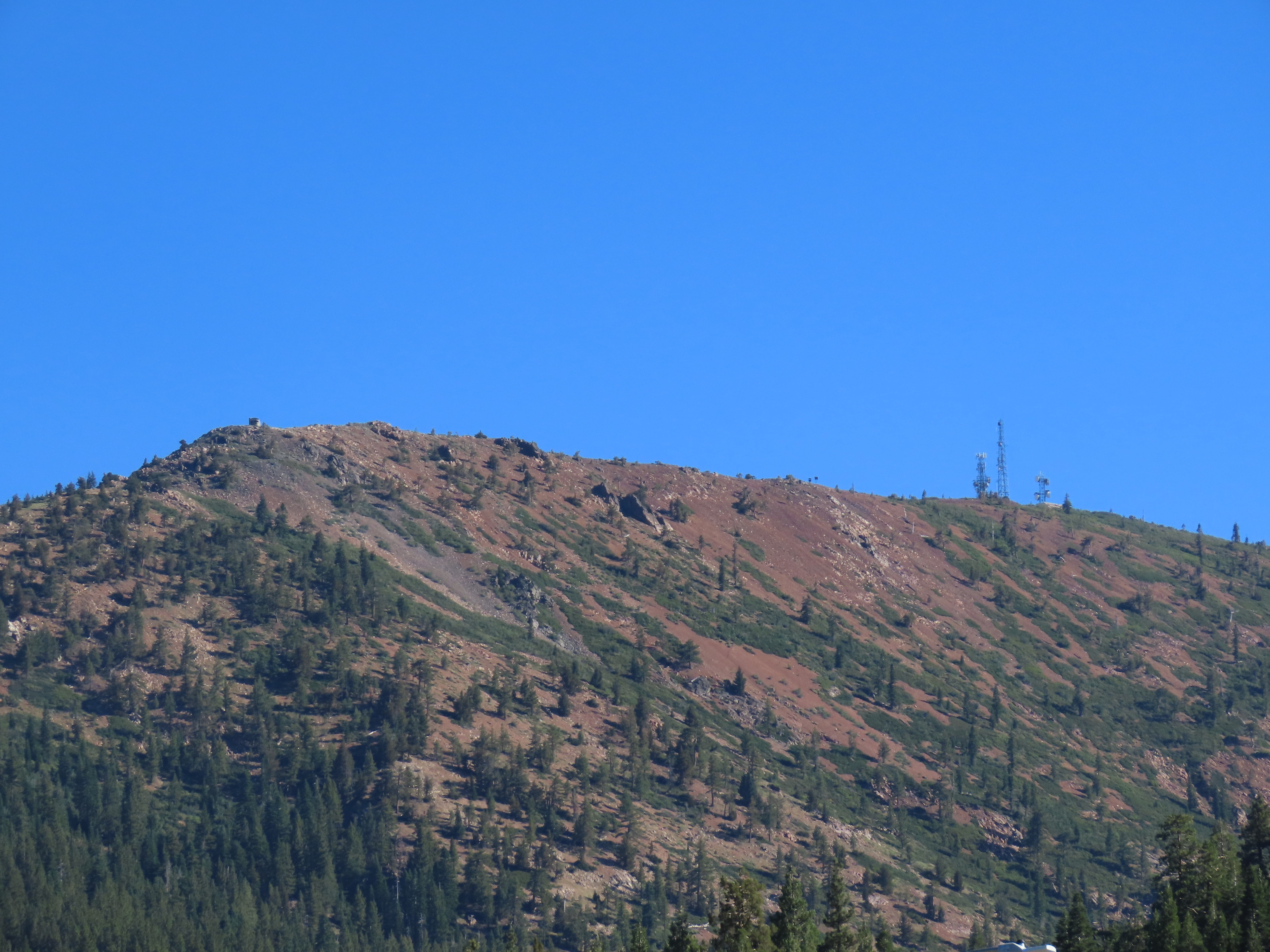
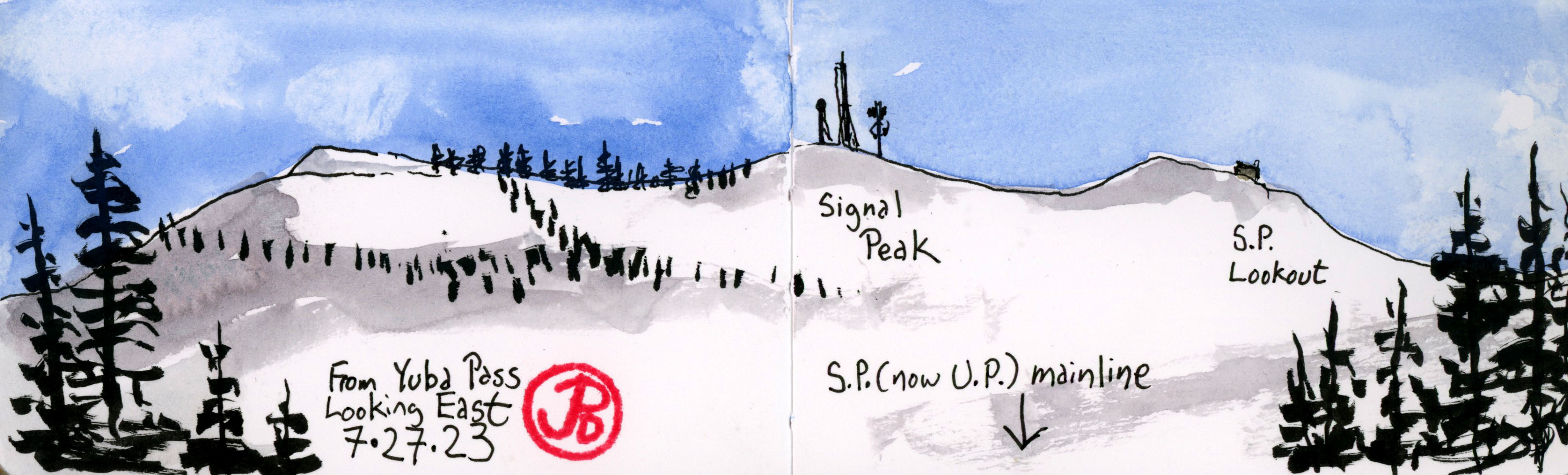
Behind me, further up the hill was the mainline. In front of me was Red Mountain and Signal Peak. To the right was antennas and towers, to the left was the Southern Pacific fire lookout.

Red Mountain and Signal Peak.

Now it was time for a sketch using my Delta panoramic journal (featured sketch) to capture the peak.

Close up of the Southern Pacific stone lookout built in 1909 and used until 1934.

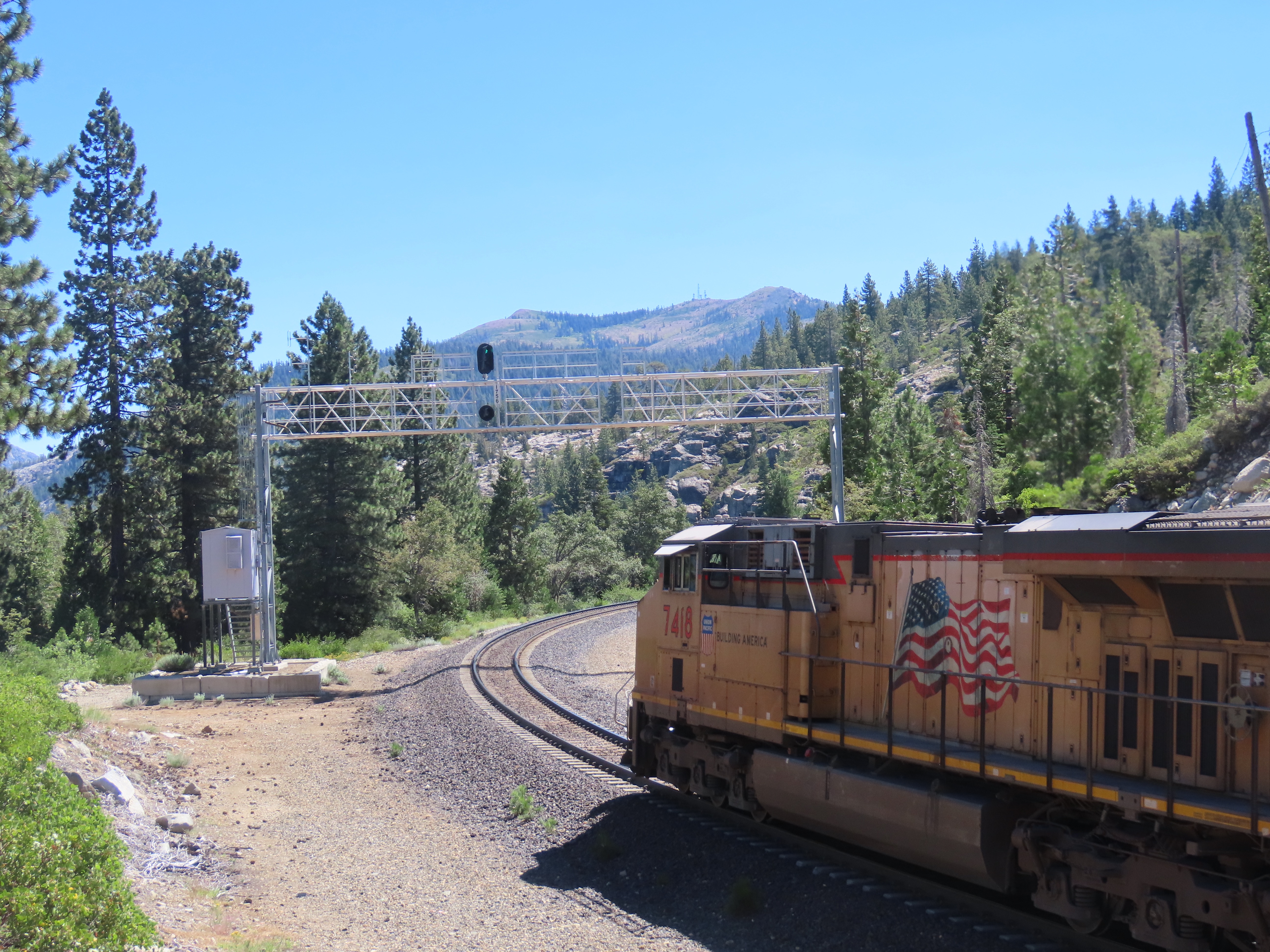
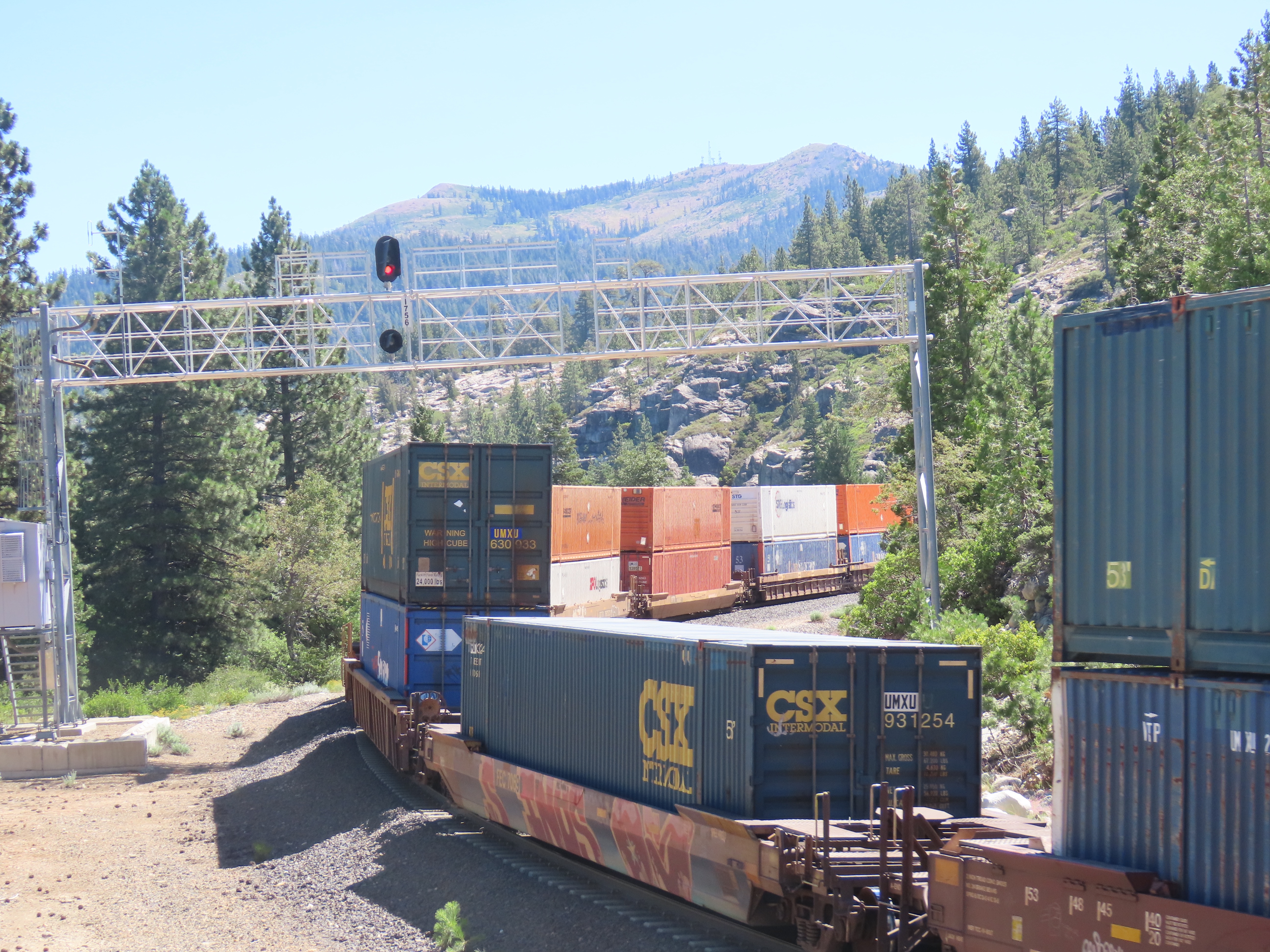
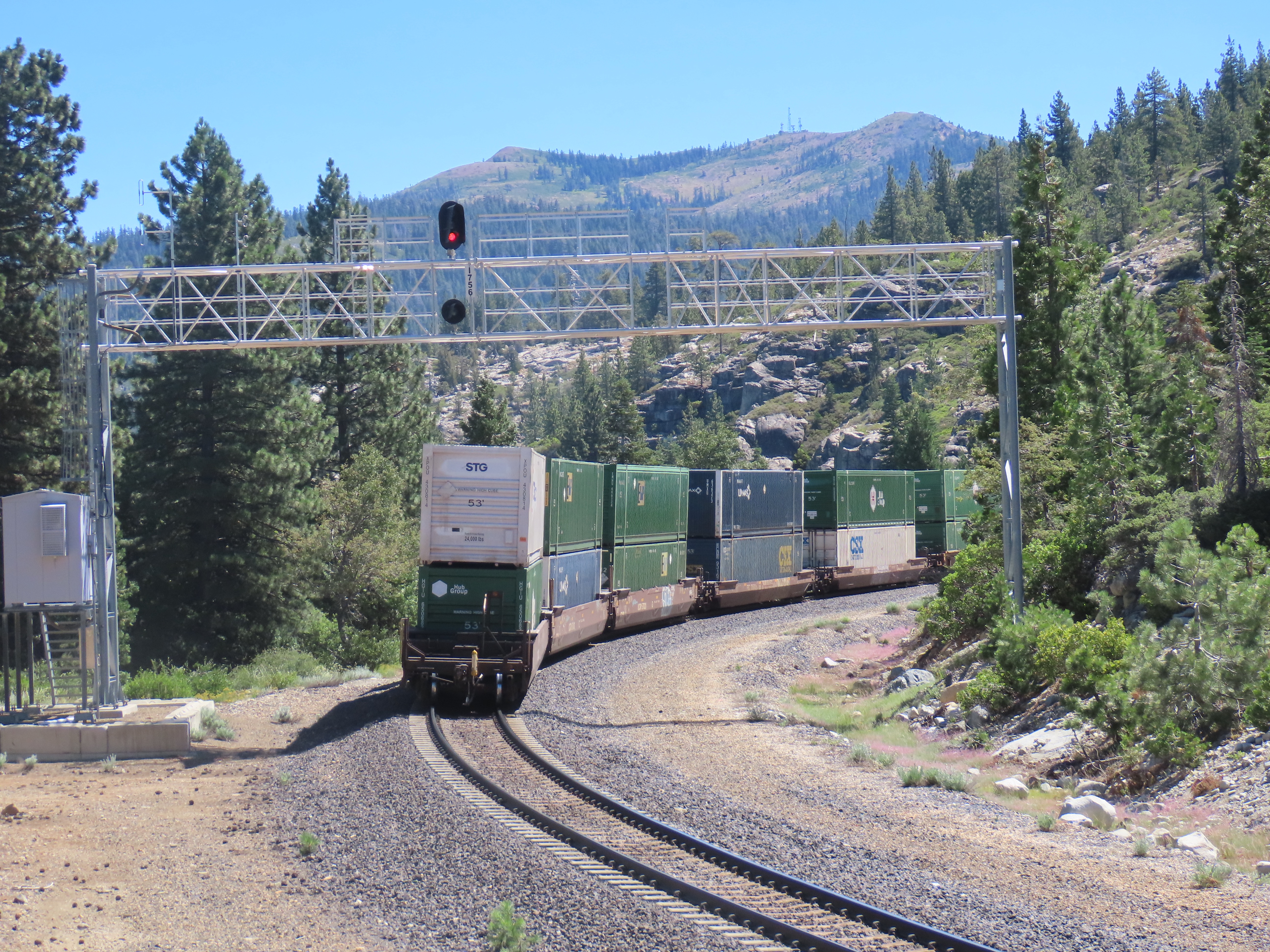
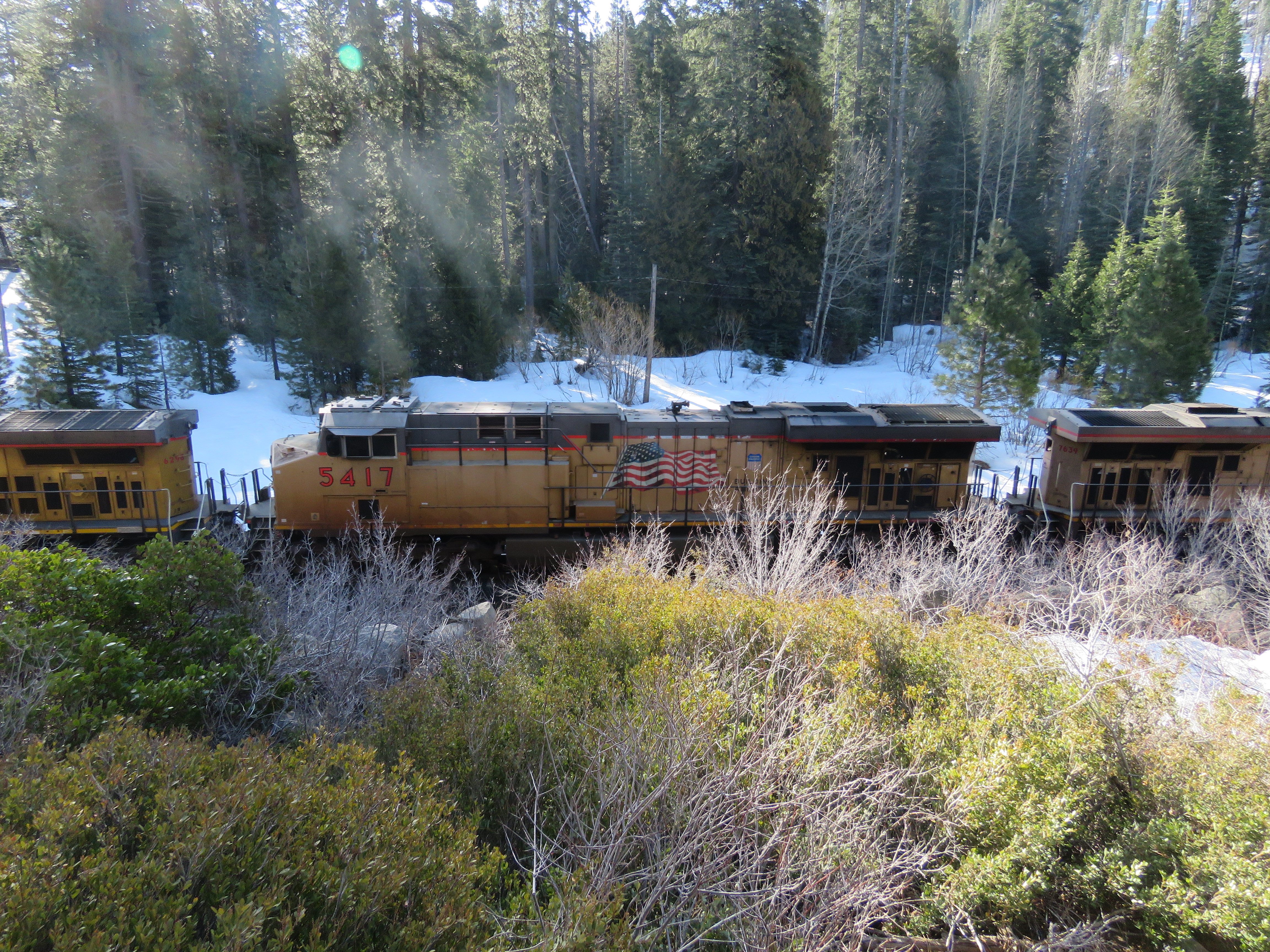
I returned to Yuba Pass to get a sketch of Red Mountain from this perspective. The signal on the gantry was green so an eastbound freight was imminent. Before long I could hear the rumble of a Union Pacific intermodal freight train climbing the grade towards Donner Summit. This consist contained six locomotives and I lost count of how many cars it train contained. (In truth I didn’t attempt to count. Seeing this long freight train mean less truck traffic on America’s highways).

What follows is a series of photographs of the UP freight making the climb to Donner Pass with Signal Peak in the background.

Image

Chasing an Intermodal Over Donner Summit

I once chased the California Zephyr Train # 6 from Roseville to Truckee but now I wanted to chase what really makes Union Pacific the big bucks: an intermodal freight train!

Intermodal is freight that is transported by various forms of transportation: ships, trains, planes, and trucks, for example. Most of the intermodal freight trains across the Sierra Nevada consist of double stacked freight containers, known as Container on Flatcar (COFC), or single truck trailers on flat cars, known as Trailer on Flatcar (TOFC) or piggybacks.

I first caught sight of my freight as it really began it’s climb up the western slope of the Sierra Nevada Mountains at Cape Horn, just out of Colfax. (I had just missed it’s passage through Colfax.)

I attempted to follow the train on Historic Highway 40 with some stretches on the highway that relegated Highway 40 to a little used country road: Interstate Highway 80.

Catching up with the train should not be a problem (even on windy side roads) because the average speed of a freight train climbing up to Donner Summit is between 25 to 30 miles per hour. And sometimes the freight’s speed could be even less.

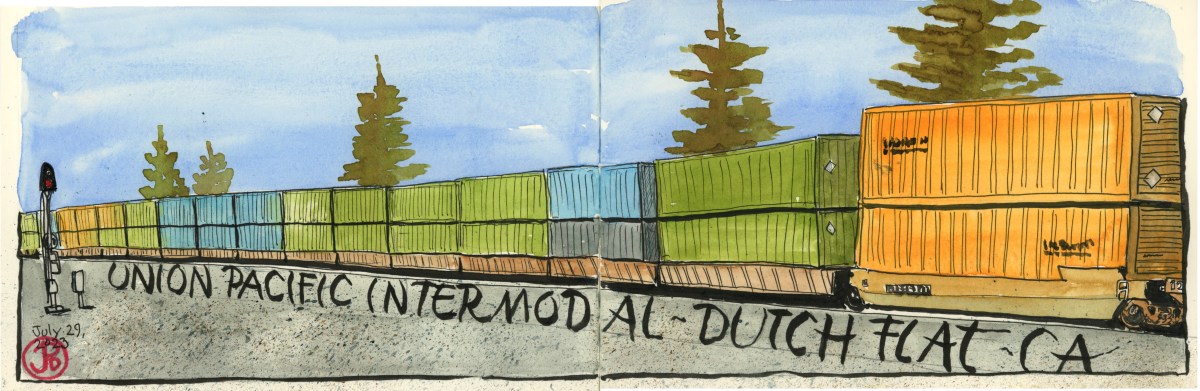
I headed east on a patchwork path of Historic 40, side roads, and Interstate 80. When I thought I was sufficiently ahead of the intermodal, I searched for the mainline. This consisted of picking either side of the road, north or south (at Blue Canon I picked the wrong side), and then driving until I came upon railroad tracks. This I did at the grade crossing at Dutch Flat. The eastbound signal light was green indicating that the train had not passed this point yet.

I picked my vantage point and after about ten minutes I could hear the rumble of the diesel-electric locomotives as they climbed the grade followed by the sounding of the horn, and then the crossing gates were triggered and the safety arms lowered to stop traffic.

The Transcontinental Railroad reached Dutch Flat in June 1866.

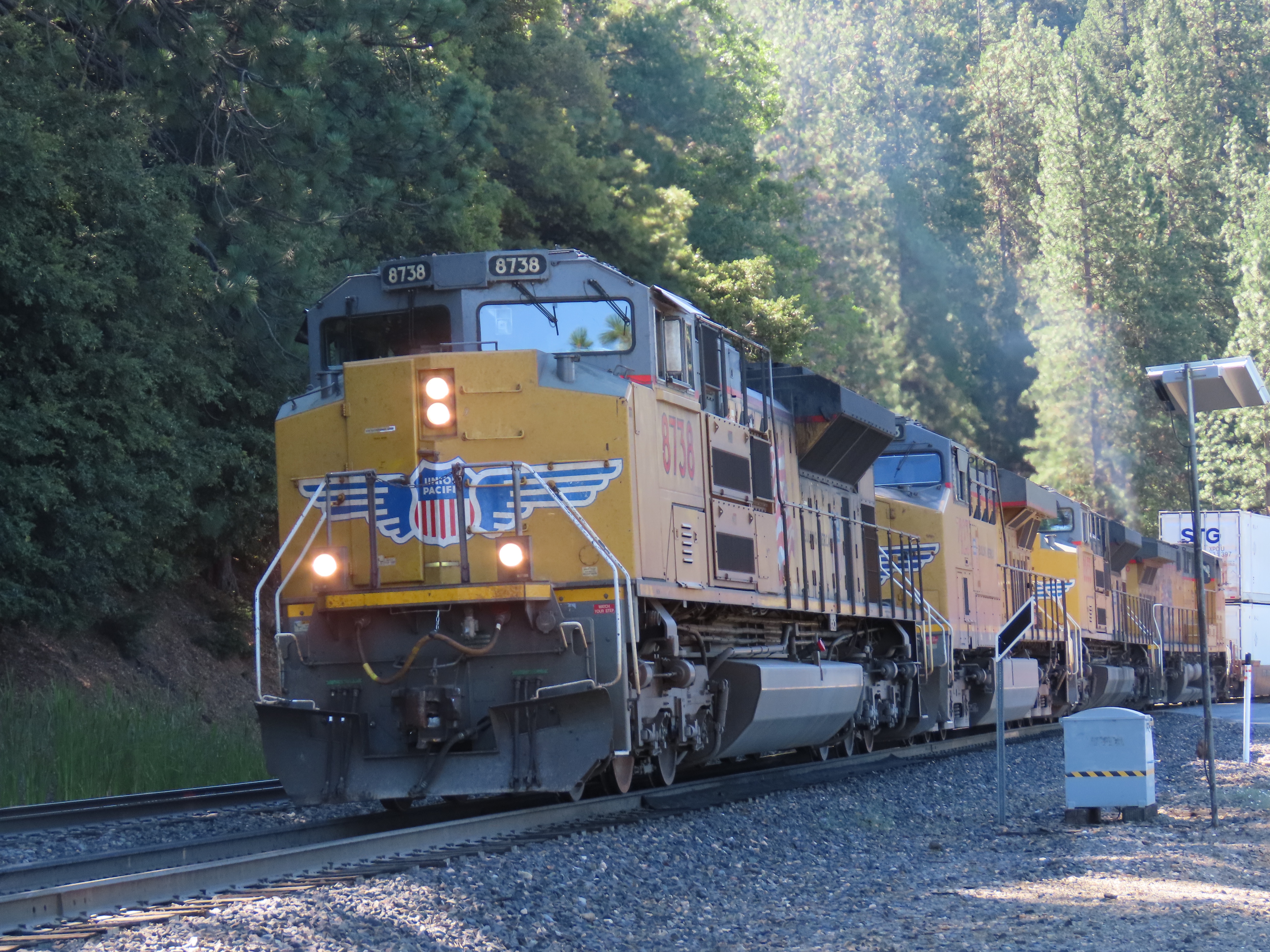
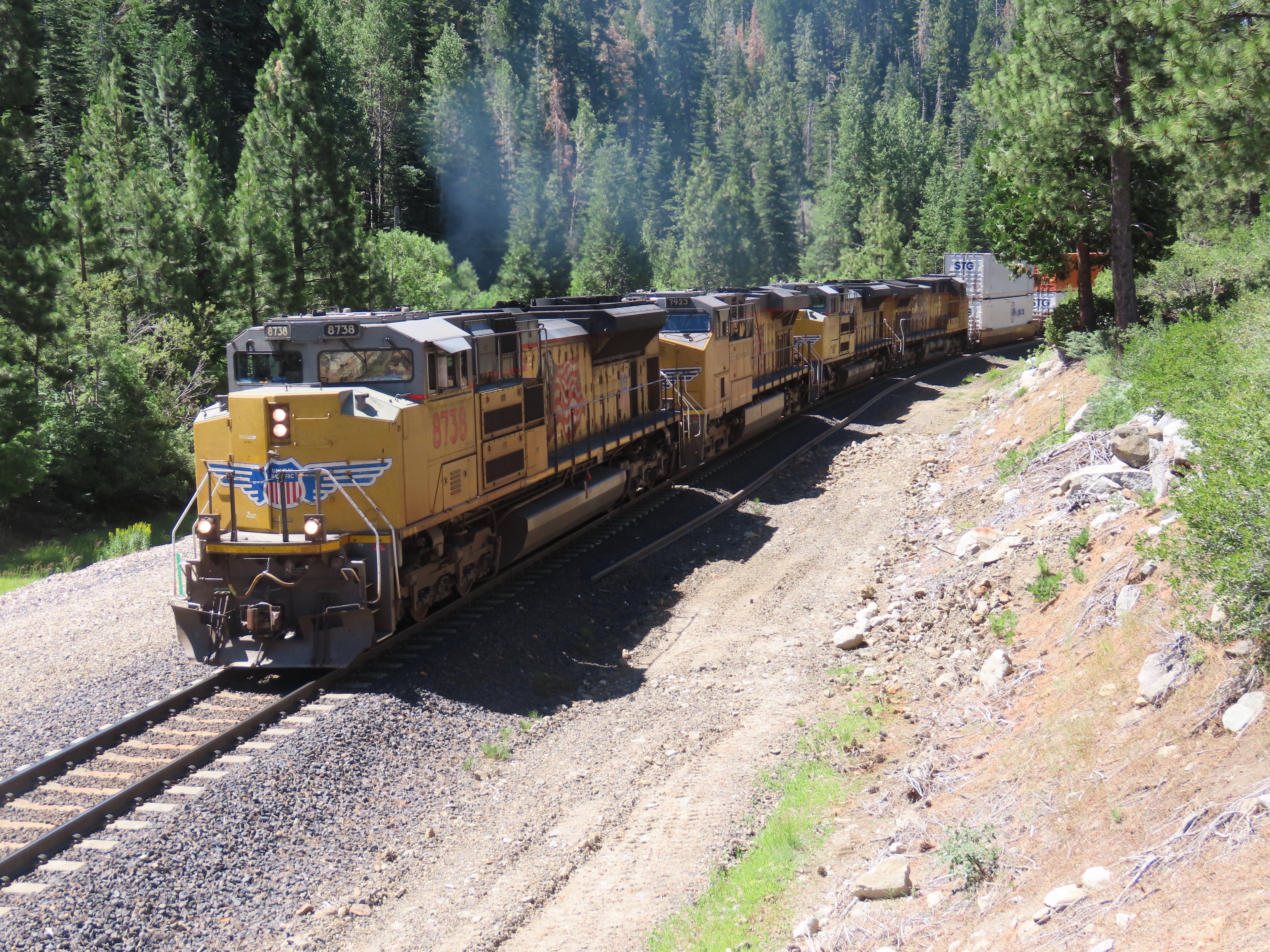
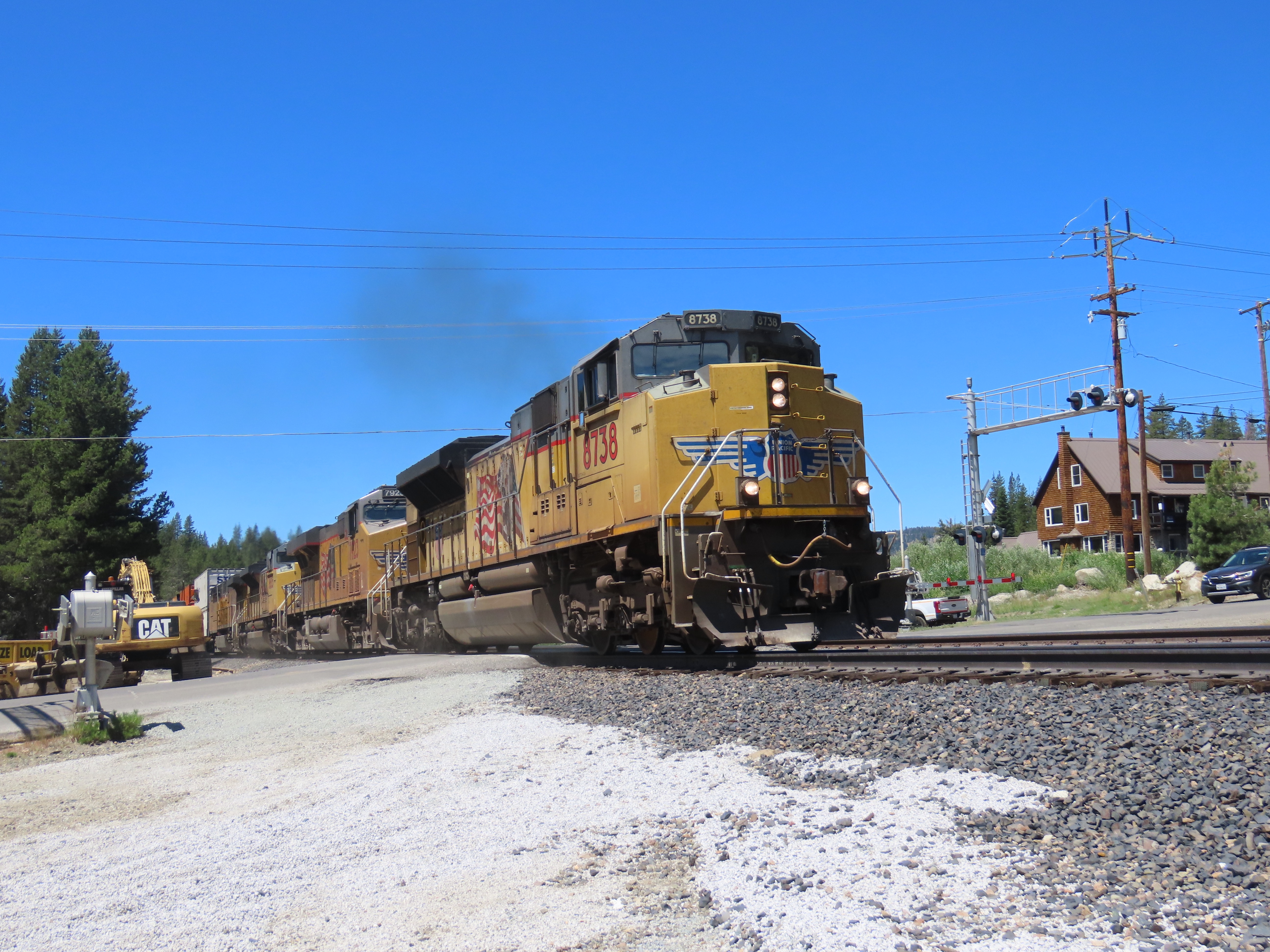
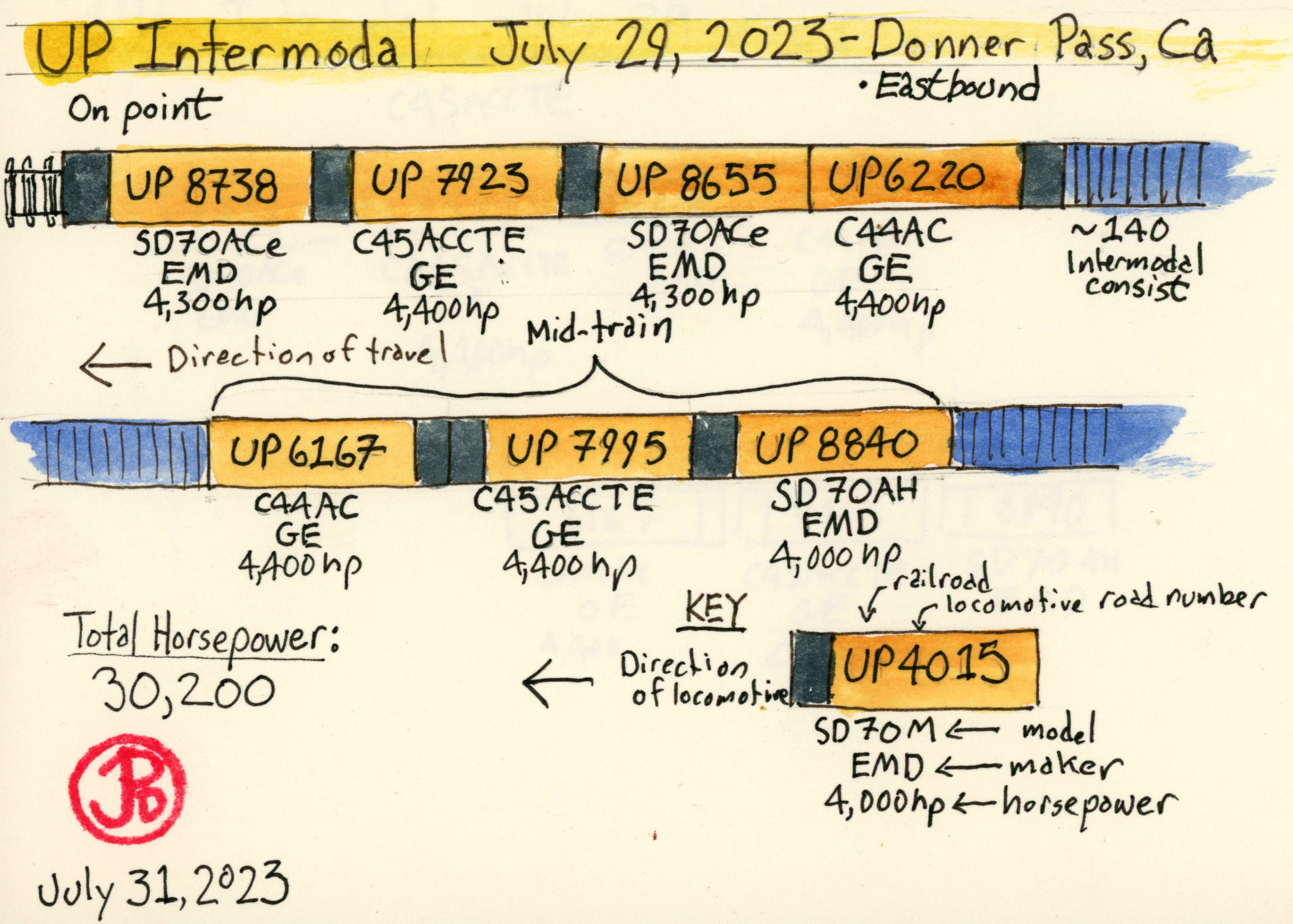
Union Pacific No. 8738 came into view. No. 8738 is an Elctro-Motive Diesel (EMD) SD70ACe. These 408,000 pound locomotives generate 4,300 pounds of horsepower and this consist featured four locomotives on point and three more mid-train. These seven locomotives generate a combined 30,200 pounds of horsepower. They need this power to pull/push the heavy loads up and over Donner Summit.

Just to provide some context, the Southern Pacific locomotive that was designed to tackle the grades and snowsheds of Donner Pass were the cab forwards. The last cab forward built, the AC-12 class No. 4294 (which is preserved ay the California State Railroad Museum in Sacramento) weighed 1,051,000 lbs (locomotive and tender) and the locomotive produced 6,000 pounds of horsepower.

When compared to standard vehicles on Interstate 80, 30,200 horsepower equals about 30 semi trucks or 150 Toyota Camrys.

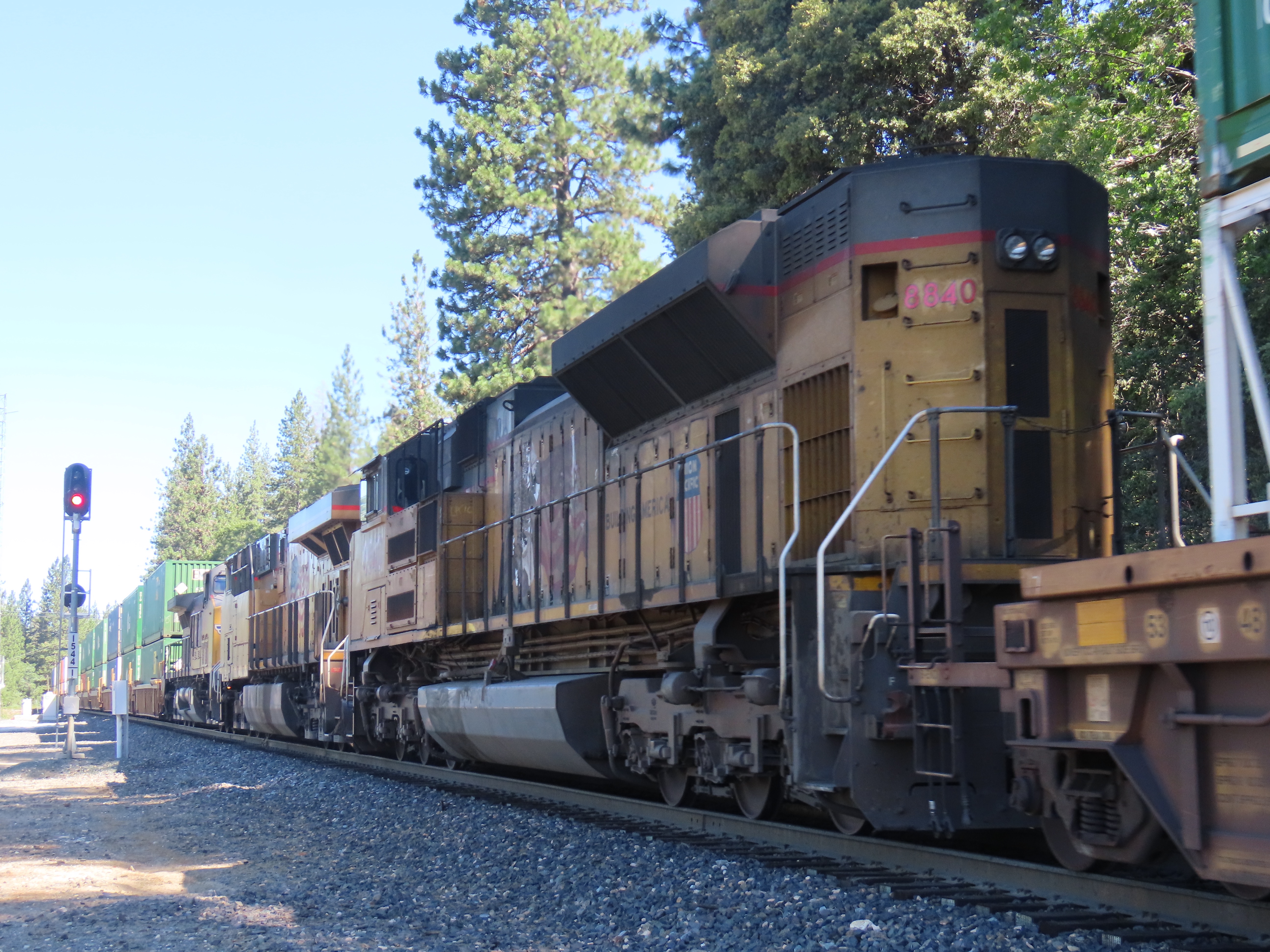
Three helpers to help push and pull the intermodal consist towards Donner Pass. The signal at Dutch Flat is now red, halting any train traffic that should come too close to the tail end of the train.
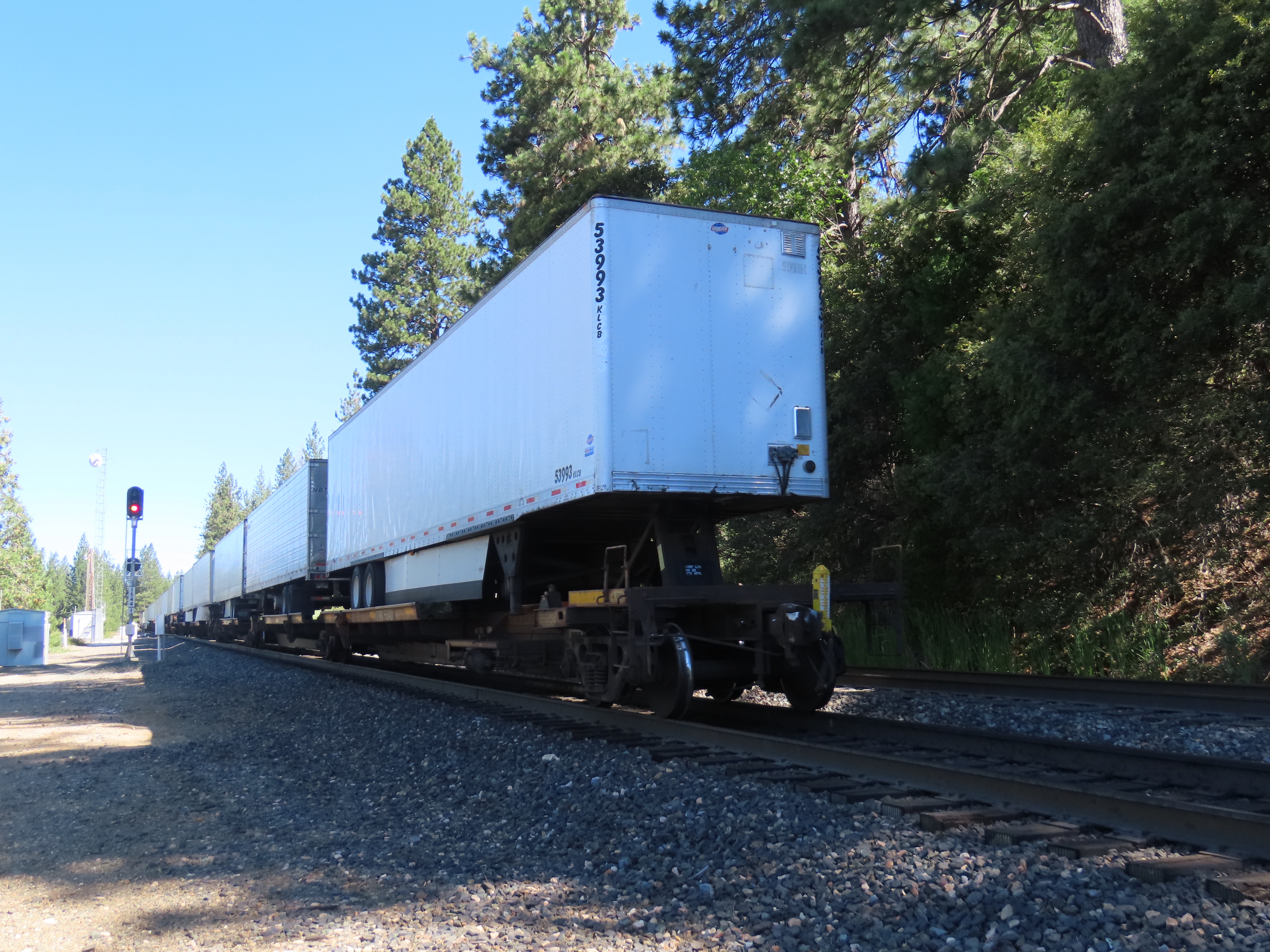
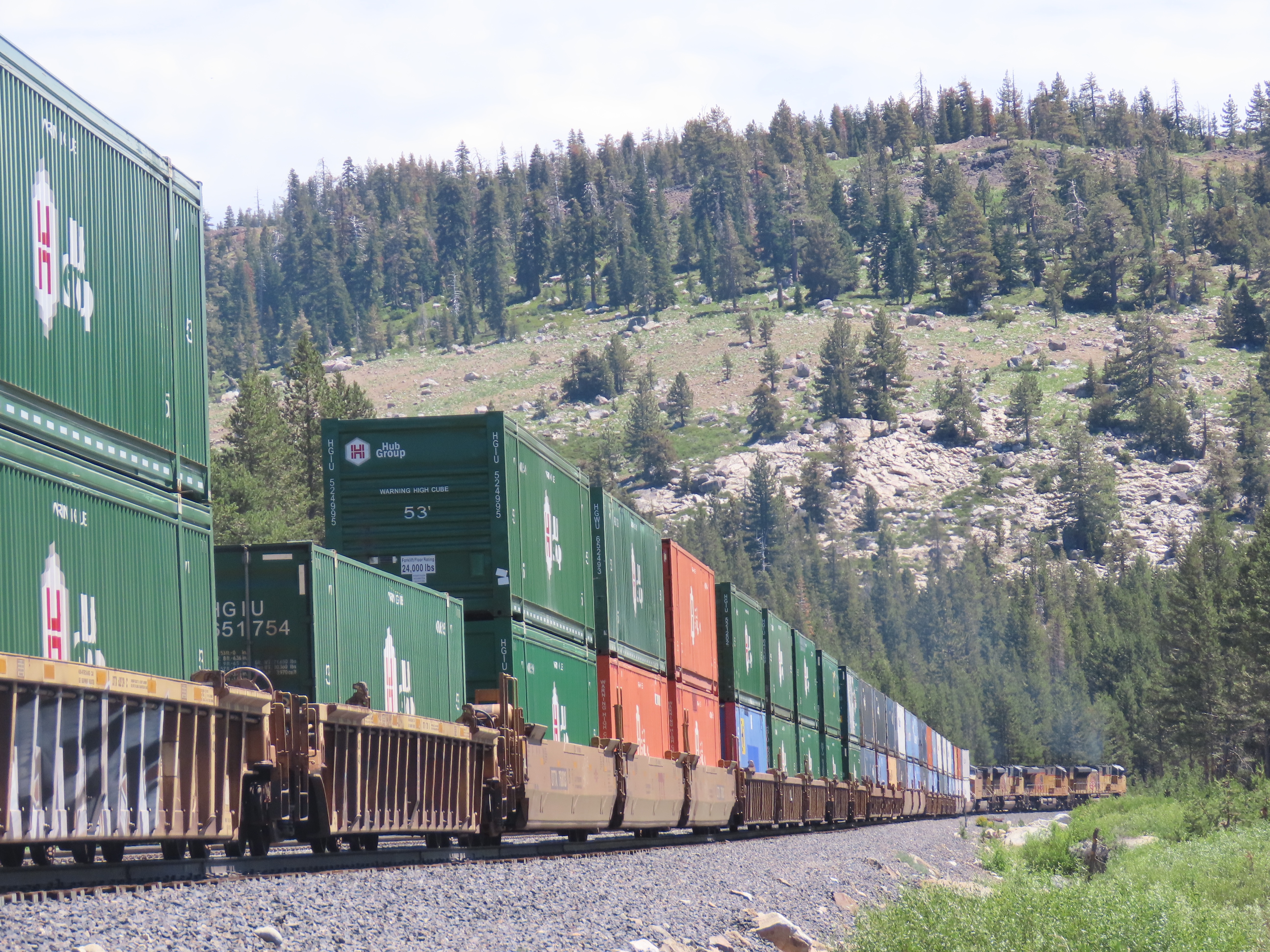
The end of the train consisted of truck trailers on flatcars or piggybacks. This was the end of the train and there was no caboose. Cabooses have not been used on mainlines since the mid-1980s. They have been replaced by a small yellow box known as an End-of Train Device (ETD). This has reduced the crew of freight trains. Now the crew consists of just two people: an engineer and conductor.

Once the train passed I drove down the road into “downtown” Dutch Flat and headed back toward the highway. I came to a grade crossing where the last few cars where just passing. The arm rose and the race was on!

I hit the highway trying to outpace the freight train as well a finding a new point to see the train. I made it to my tried and true spot at Yuba Pass, where Highway 20 merges into 80. I knew I had not missed the train because the signal on the gantry above the rails was green. I must have made really good time because I had to wait almost 30 minutes before I heard the rumble of the diesels laboring on the hill. The intermodal passed and this time I got a wave from the conductor, seated on the left side of the cab. In the days of steam, this would have been the fireman’s position and the conductor would have been riding at the end of the train in a caboose.

The intermodal heading into Yuba Pass.

The average length of a freight train on a Class I railroad is about 5,400 feet. At Soda Springs I wanted to do a little experiment with the intermodal to see if I could come to an estimation on how many cars where in the consist. This started with timing the train from the grade crossing at Soda Springs. How long would the train take to pass a single point? The answer was four minutes and 54 seconds. That was almost a five minute wait for any motorist at the crossing!

Now for a little railroad mathematics. I estimated that it took about 2 seconds for one car to pass so I divided 294 seconds (5 minutes and 54 seconds) by 2 and got 147 train cars. I then subtracted the number of locomotives (7) and came to an estimation that this freight train consist consisted of 140 cars. An intermodal of this length takes a lot of trailer trucks off the roads. Just how many trucks?

I estimated that about 75% of the train consisted of double stacked Container on Flatcar (COFC) which is 105 cars and the remaining 35 cars were Trailer on Flatcar (TOFC). 2 times 105 is 210, add 210 to 35 and we get 245. So this intermodal freight train removes about 245 trailer trucks from Highway 80. Every motorist motoring to Lake Tahoe or Donner Lake should be thankful these Union Pacific freights that put in the hard work that make life a little easier.

The intermodal at the grade crossing at Soda Springs, almost at the top of it’s climb to Donner Summit.
The train with it’s 140 cars, heading towards Donner Summit near Sugar Bowl Ski Resort.

Based on my field photos I was able to get the road numbers of all seven locomotives on the freight train. Using a Union Pacific roster I was able to identify the maker and model of each locomotive and it’s horsepower output. There where three EMD (Electro-Motive Diesel Inc.) and four GE (General Electric) locomotives. I put this information into a locomotive map showing the road number, model, maker, horsepower, and direction of travel for each locomotive. The total horsepower output for all seven locomotives was 30,200 hp.

Image

Yuba Pass, M. P. 177

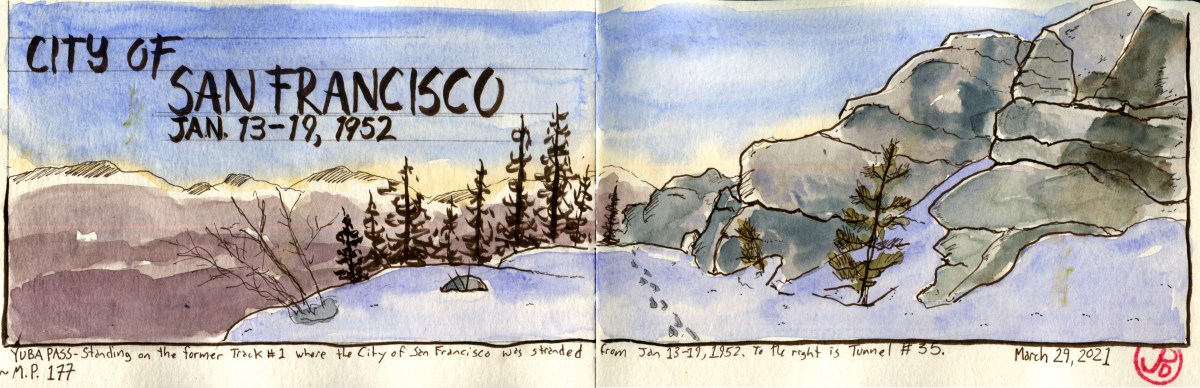
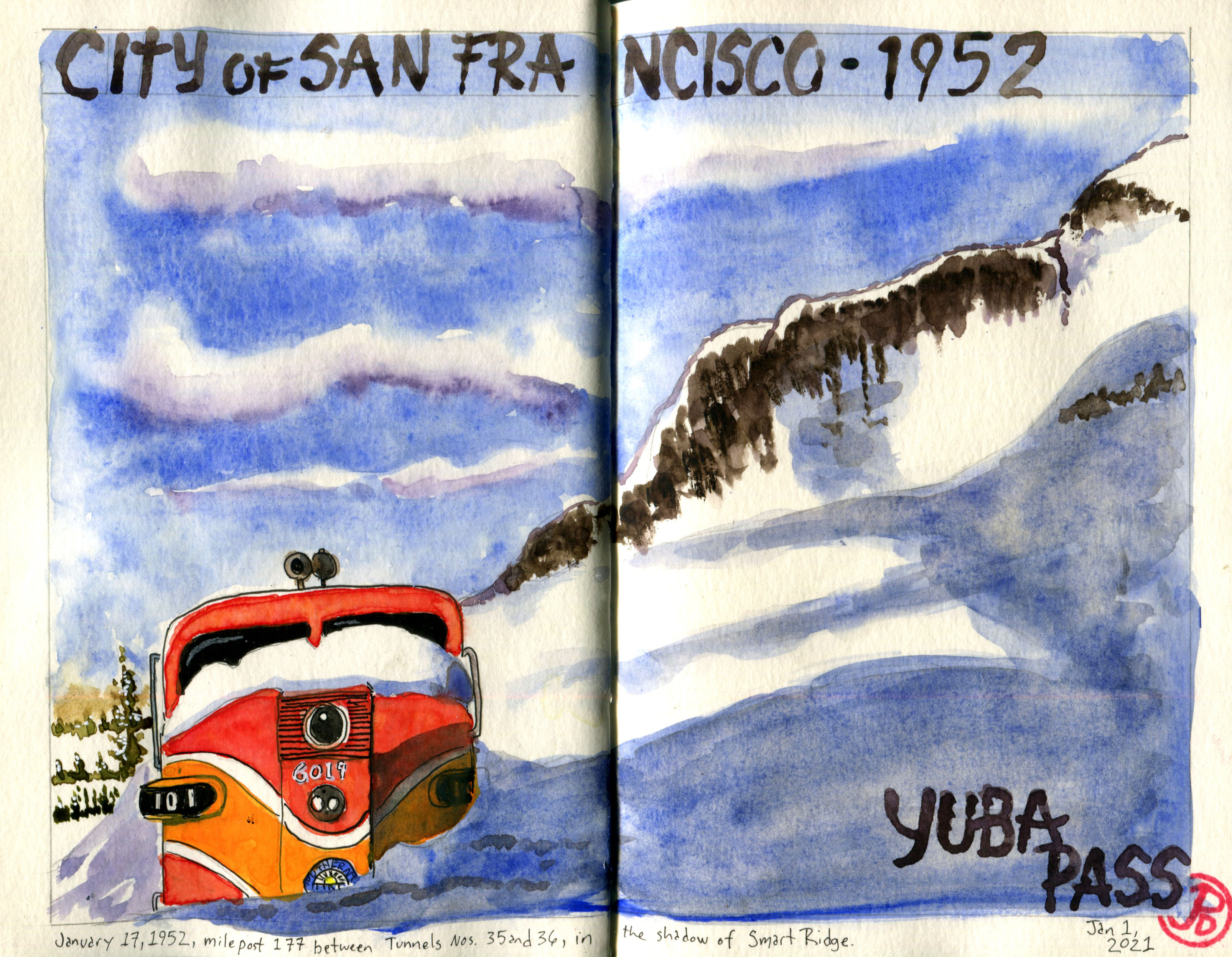
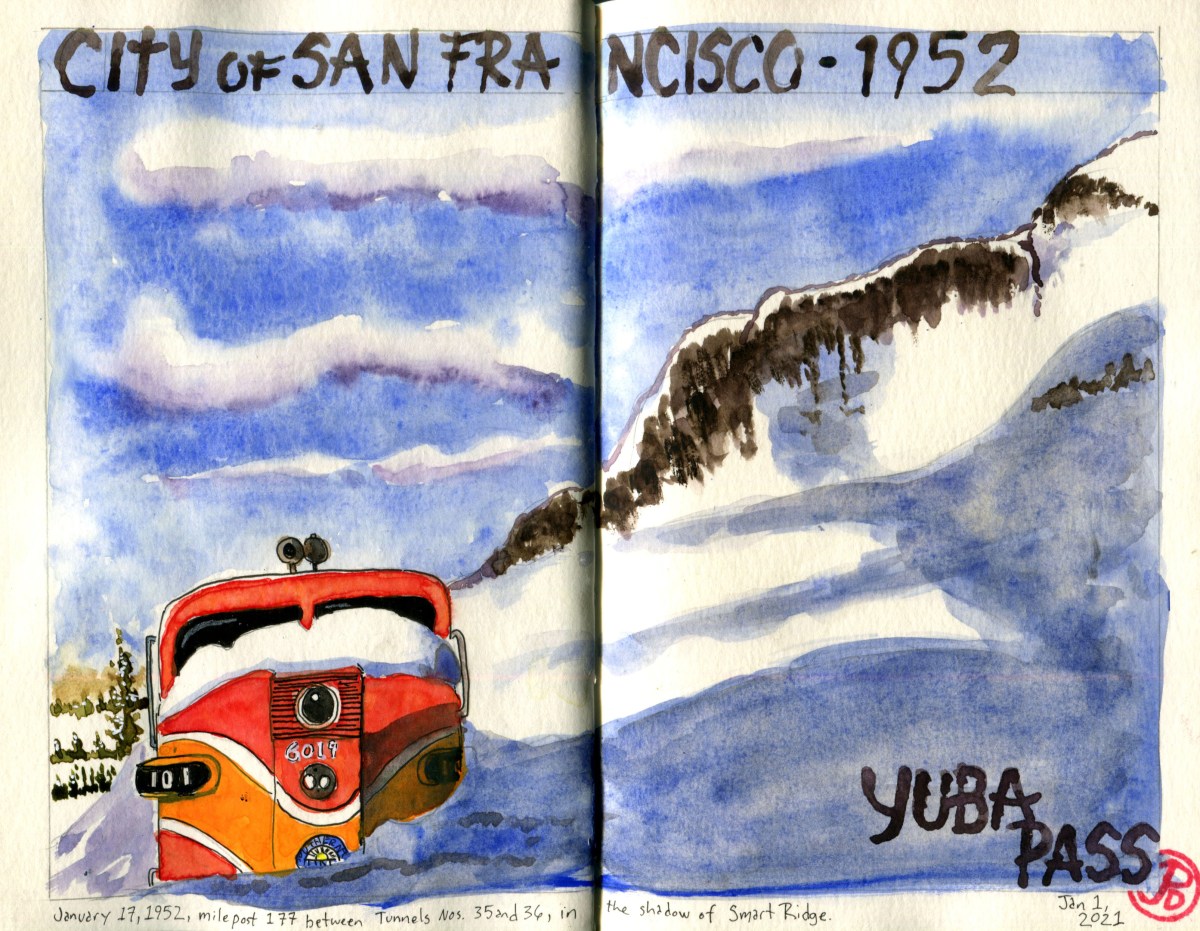
Ever since I had read about the stranding of the City of San Francisco in January 1952, I have wanted to visit the location and do a sketch.

In January of 2021, I did a sketch of the stranded super liner that was based on a historical photo. Since that time I had wondered if the stranding site was accessible or if it was on a part of the line that was far from roads or trails. In January 1952, the whole landscape was snowbound, paralyzing all transportation routes. After some research, I found out that the site was ridiculously accessible because Milepost 177 was a ten minute walk from where Highway 20 joins Highway 80.

As I pulled off Highway 20, I donned my snowboots, an east bound Union Pacific freight passed by with a consist mainly featuring tanker cars. Freight has the right of way over passage service, it is the bread and butter of the contemporary railroad business.

A UP freight climbing towards Tunnel numbers 35 and 36 and off toward Donner Summit.

I wanted to find the exact location that the City of San Francisco became stranded: milepost 177, between Tunnels 35 and 36. But I also wanted to time my visit so I could see and photograph some trains at Yuba Pass. Well I just missed a freight train but my real prize was now running two minutes late and would depart Truckee at 9:39 AM.

This was the passenger service that replaced the City of San Francisco. It is one of the longest, and some would argue, most beautiful, routes on the Amtrak system. This is the California Zephyr. The hike up to Yuba Pass was extra special because on the following day, I would be boarding the eastbound California Zephyr, Train #6, to Denver, Colorado. Nine days later I would be returning on the westbound, Train #5. This was the train I was waiting for.

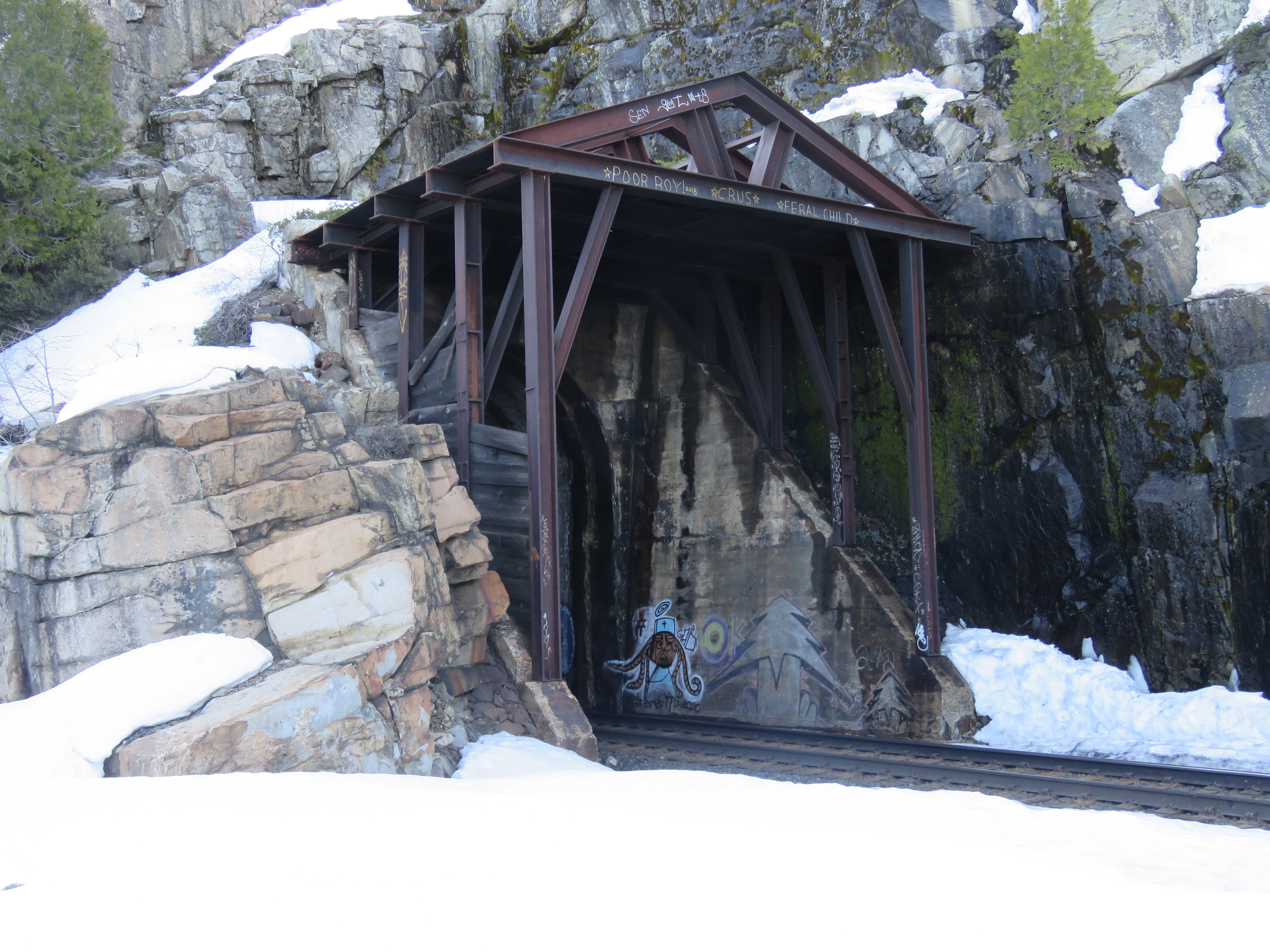
I hiked along the former grade of Track #1, the route is currently single tracked. The hike was relatively easy because it was along a railroad grade and the snow wasn’t too deep. It took me about ten minutes to reach Tunnel # 35. The current track goes through the tunnel but the former track goes around Smart Ridge. It was in this area that the City of San Francisco became stranded in 1952.

I looked at a few arial reference photos and picked my spot, in the shadow of the rocky ridge. I sketched in the ridge on the right and the trees in the background and far off the spine of a mountain range. For this I used Micron dark sepia pens.

The west entrance of the 738 foot long Tunnel # 35.

I sketched for about 20 minutes and then I walked toward Tunnel #36 to find a good vantage point to photograph the Zephyr and I decided on standing near the eastern entrance of Tunnel #35 so I could photograph the train coming out of Tunnel #36. And then turn westward to capture the Zephyr as it disappeared into Tunnel # 35.

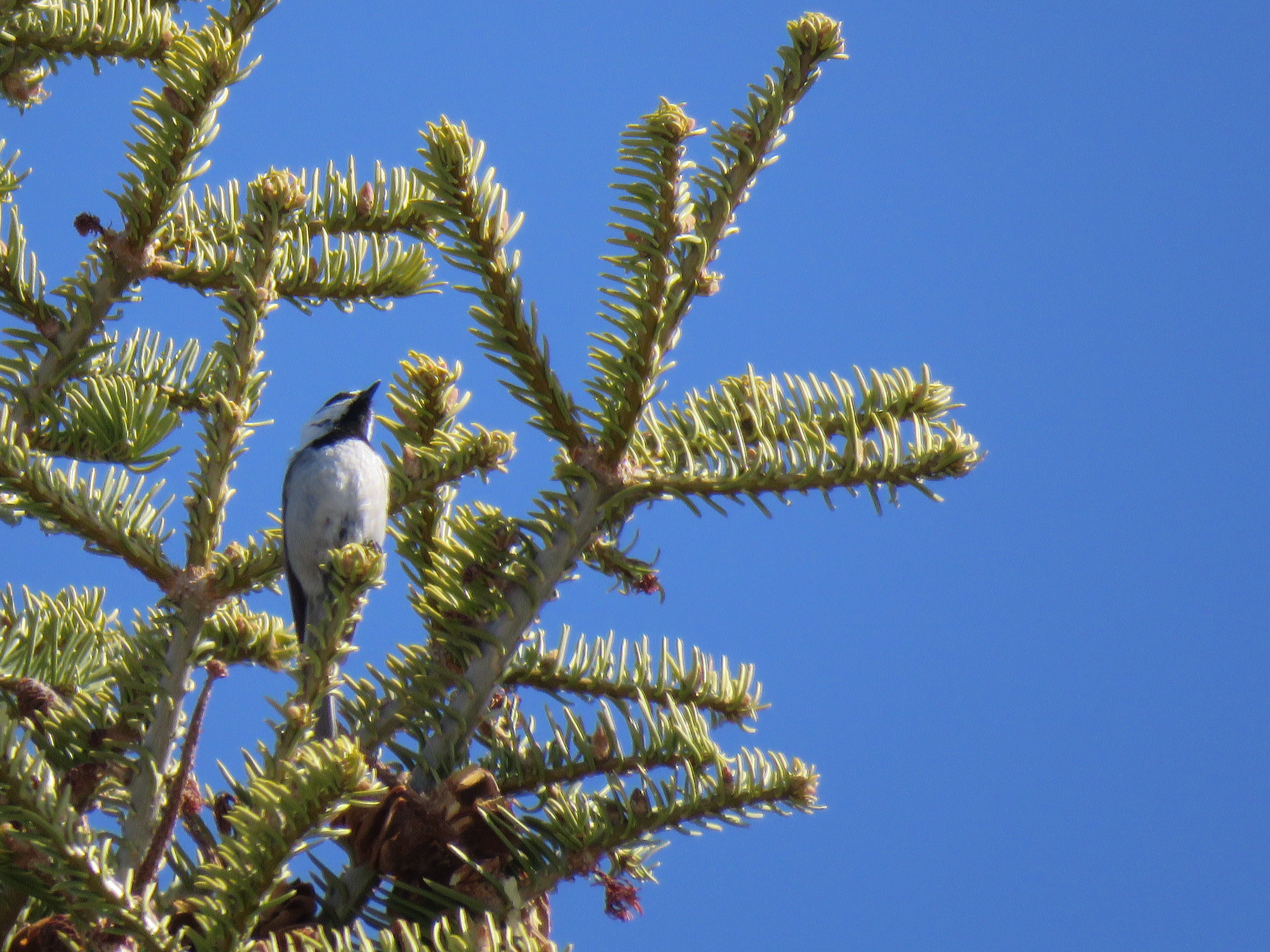
I had no idea when the train would be emerging from the tunnel but I filled my time being serenaded by the beautiful whistle of a mountain chickadee. This is the song of the western mountains. Spring was slowly arriving in the Sierras.

A mountain chickadee singing from the top of a pine. Bird and trains in the Sierra Nevada, I’m in heaven!!

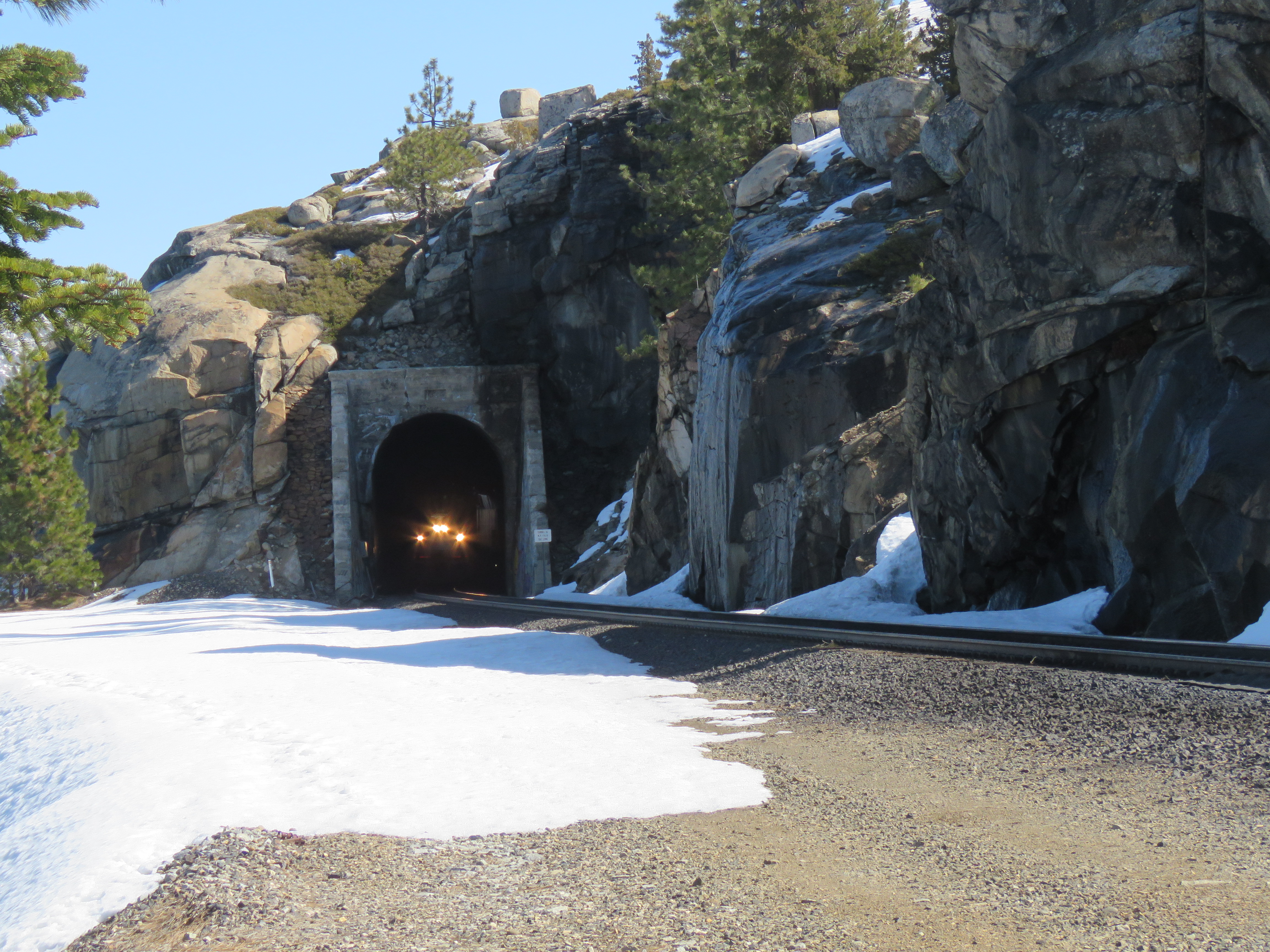
At 10:40, I saw the headlights of the westbound Zephyr.

A first sighting of the California Zephyr coming out of the east portal of the 326 foot long Tunnel #36. In the foreground is the rail bed of the former track #1.
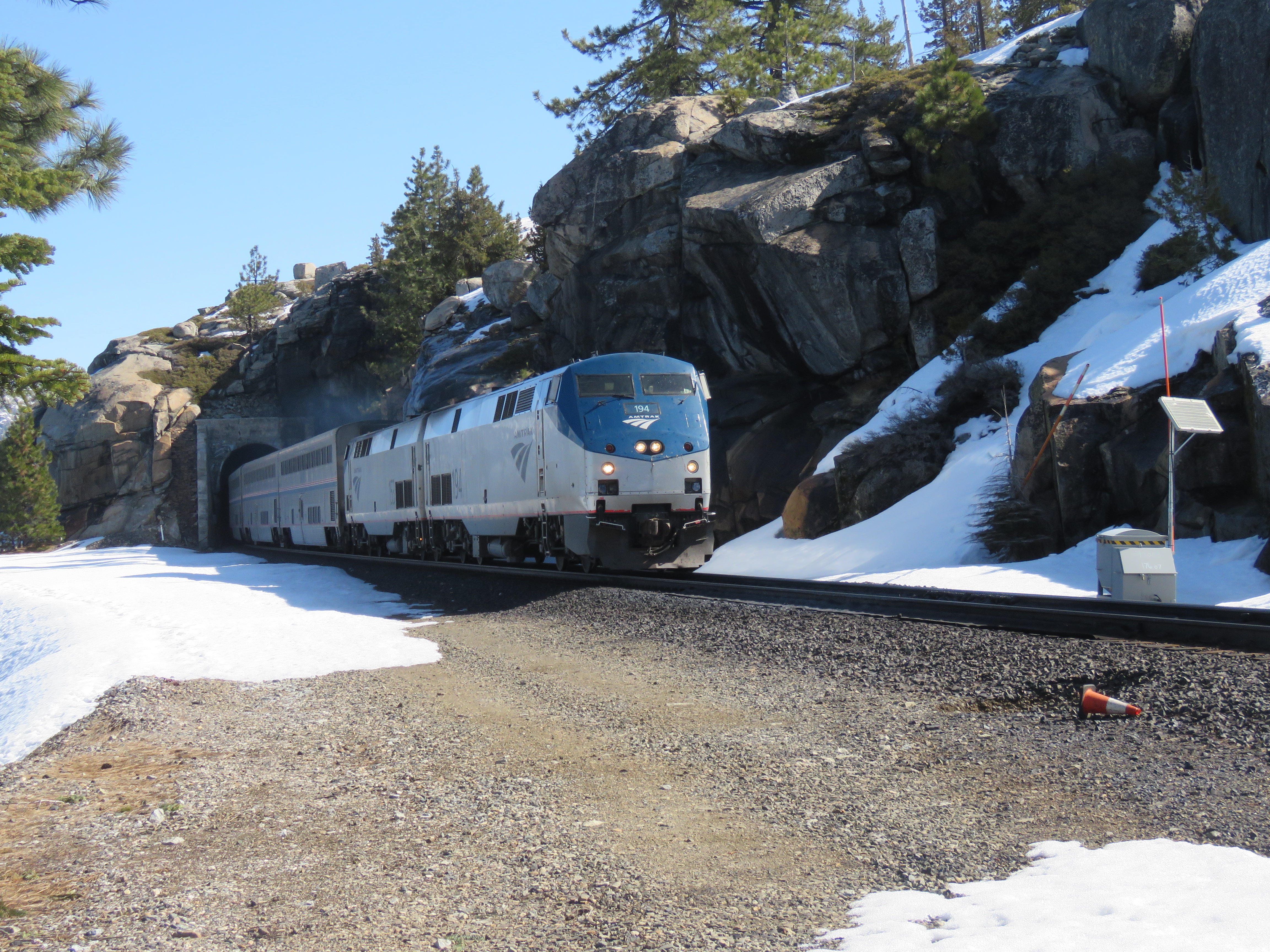
California Zephyr train #5. This train started in Chicago.
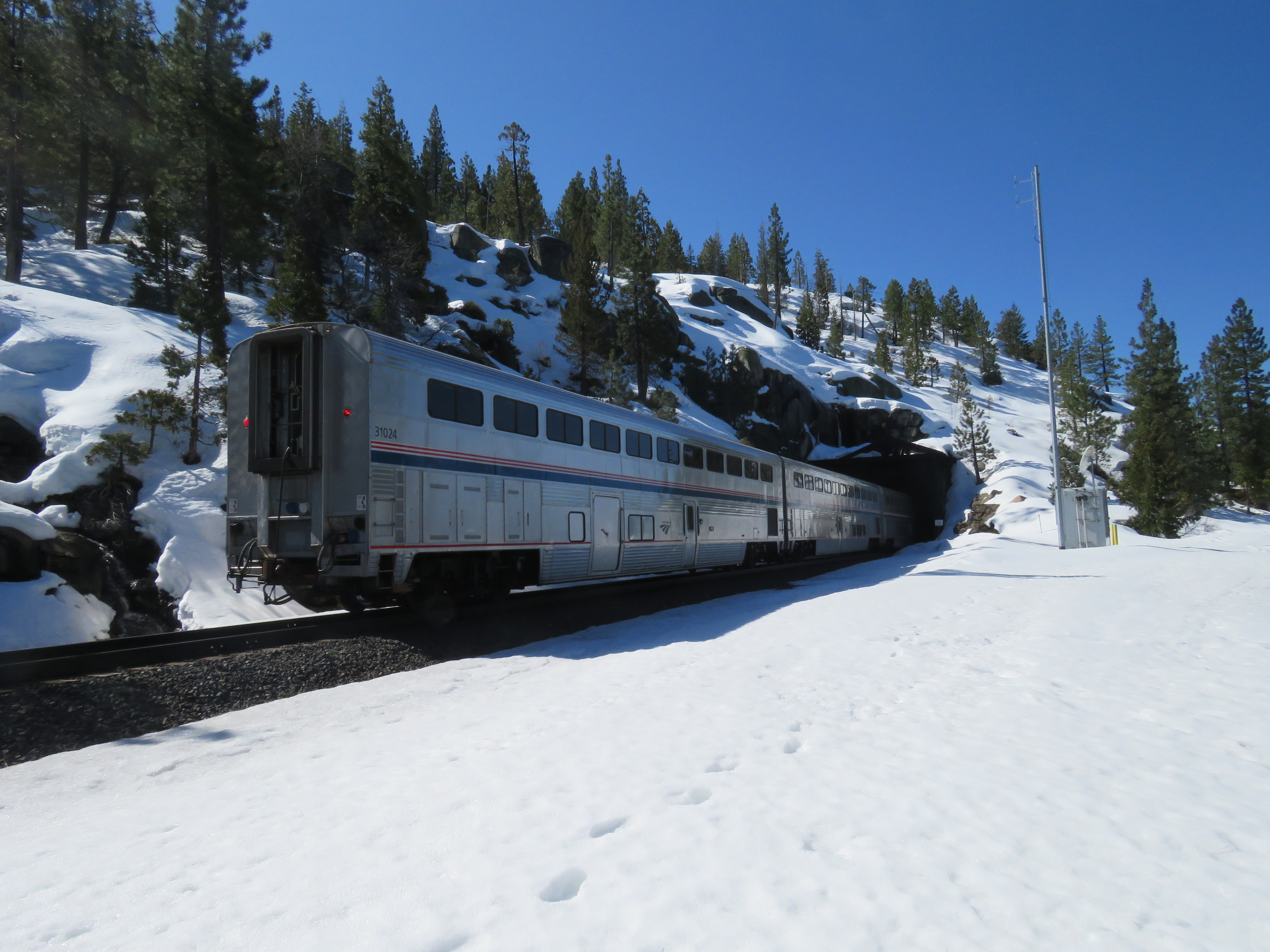
The Zephyr heading into Tunnel #35 as it climbs down the valley toward it’s next stop, Colfax. My footsteps are in the foreground.
Image

The City of San Francisco, 1952

January 12, 1952. Milepost 177, Yuba Pass.

The snowfall in January of 1952 on the western edge of the Sierra Nevada Mountains was relentless. By mid-January, Highway 40 was closed. There was no way to drive from Sacramento to Truckee or Reno without a huge detour.

The winter storms during the winter of 1951-52 dumped 65 feet of snow on Donner Summit. Southern Pacific took pride in keeping the line open over Donner Pass, even in the winter.

Donner Pass is one of the snowiest places in the Lower 48 with an average snow fall of 411.5 inches of snow each winter. According to the report, Donner Summit Snowfall and Snowpack 1879-2011, there have been four times, since 1880, the snowfall on Donner Summit has exceeded 775 inches, and on two occasions the snowfall has exceeded 800 inches: in 1938 and 1952.

Southern Pacific had an arsenal of snow fighting equipment, including plows, flangers, and spreaders but their ultimatum snow fighting weapon was the rotary plow. They used this plow when the ordinary plows failed to clear snow from the tracks so the rotaries had to be called in to finish the job.

The railroad had always kept the line open, until January, 1952. Heavy snowfall will temporality close the line but so will an avalanche.

The story of the stranded Southern Pacific streamlined passenger service, the City of San Francisco seems to come out of an Agatha Christie novel. Think Murder on the Orient Express without the murder.

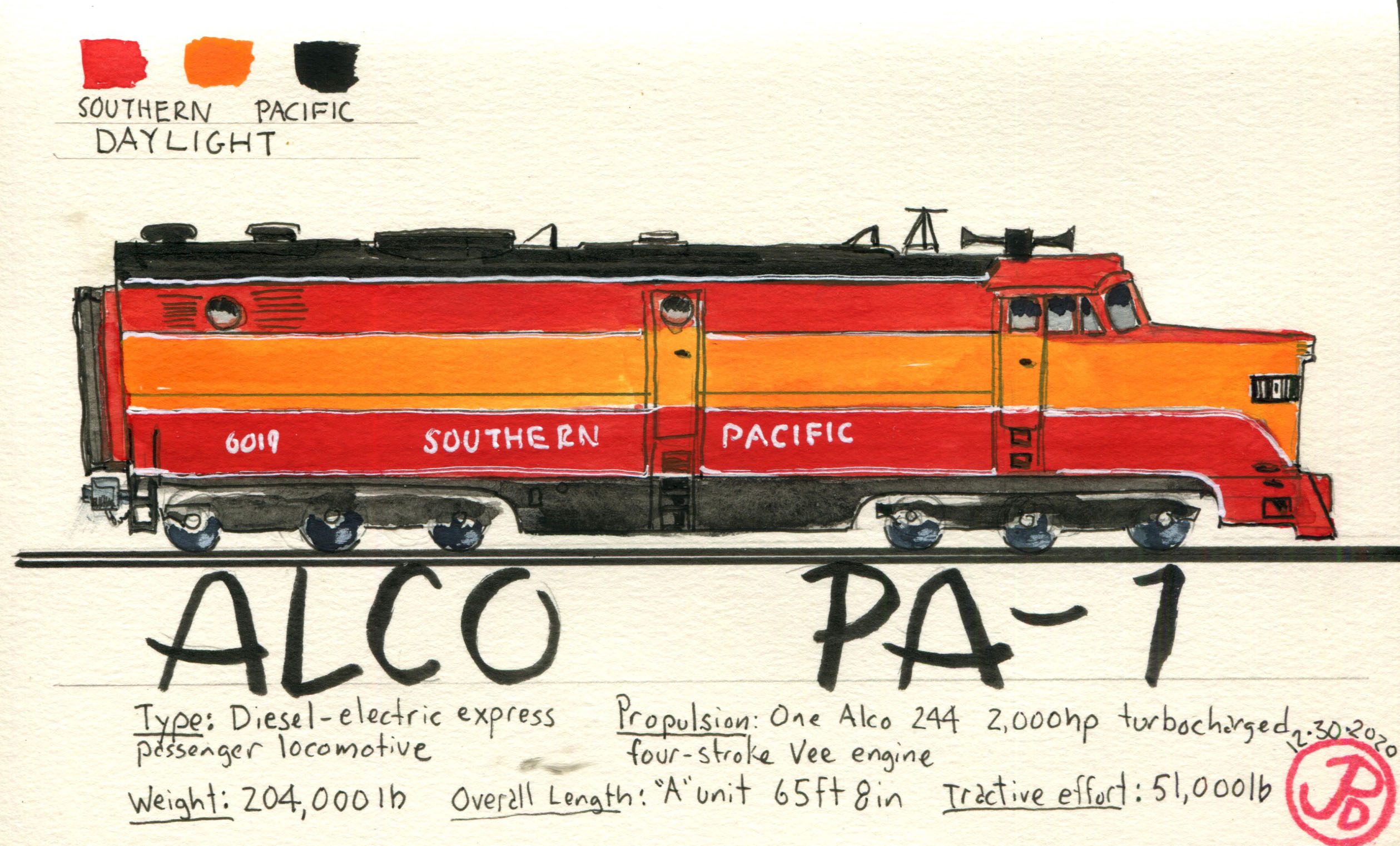
Into the snowy conditions, at just after 10 AM, the westbound City of San Francisco No. 101 headed out of Norden, Ca to make the slow descent, down into the Sacramento Valley on January 12, 1952. The 15 car train was headed by three Alco PA locomotives, decked out in the red, orange, and black of the Daylight paint scheme.

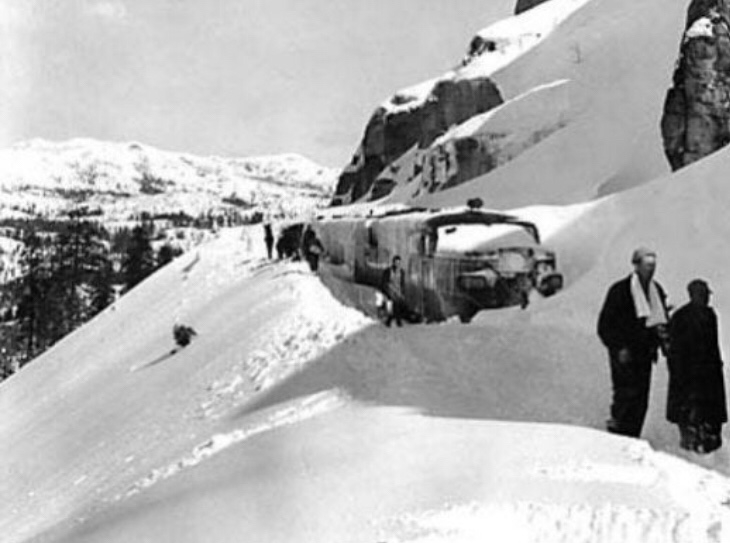
The train was several hours late because of the snowy conditions. As it rounded Smart Ridge on track #1, the train was stopped in it’s tracks, blocked by a snow slide that covered both tracks. The slide was a quarter of a mile wide. The engineer tried to back the train up but the City of San Francisco was trapped by snow on both ends.

At milepost 177, between tunnels 35 and 36, the City of San Francisco became stranded with 196 passengers and 30 crew members aboard. The passengers and crew would be stranded here for three days and the City of San Francisco would be stuck here for six days.

A photograph of passengers leaving the City of San Francisco behind to hike down to Highway 40 and the cars that would take them to Nyack Lodge.

Once the train had become stranded, Southern Pacific sprung into action to try and free the City of San Francisco and rescue those aboard. Rotary plows where sent up from both Roseville and Truckee in a attempt to clear the line and reach the disabled train.

Over the next three days the rescue of the City of San Francisco continued on with the use of rotary plows pushed by cab-forward Mallet locomotives, cars, trucks, helicopters, dog sleds, and Tucker snowcats. The rescue effort would claim two lives and damage rail equipment.

On the first day, the passengers took it their stride with the belief that the ordeal would be over soon. But as the train lost power and with in the heating system, things seem to worsen. The water system aboard the passenger cars froze taking the toilets out of commission. And they were also running low on food.

On the afternoon of the fourth day they were able to get all the passengers to hike down to Highway 40 which had been plowed clear up to Yuba Pass. They were driven by private automobiles to Nyack Lodge. After warming themselves ay the lodge’s fire place, the passengers were then put on a special train that took them down into the valley where they arrived in Roseville just before midnight.

Almost four days late, the train pulled into it’s final destination, just before 4 AM, to the city of Oakland. Oddly enough the City of San Francisco does not go to the city of San Francisco.

On point for the City of San Francisco on January 12, 1952 was an ALCO PA number 6019. Southern Pacific bought 52 PAs. While these locomotives are railran favorites, they proved to be a maintenance nightmare and SP later scraped the locos.