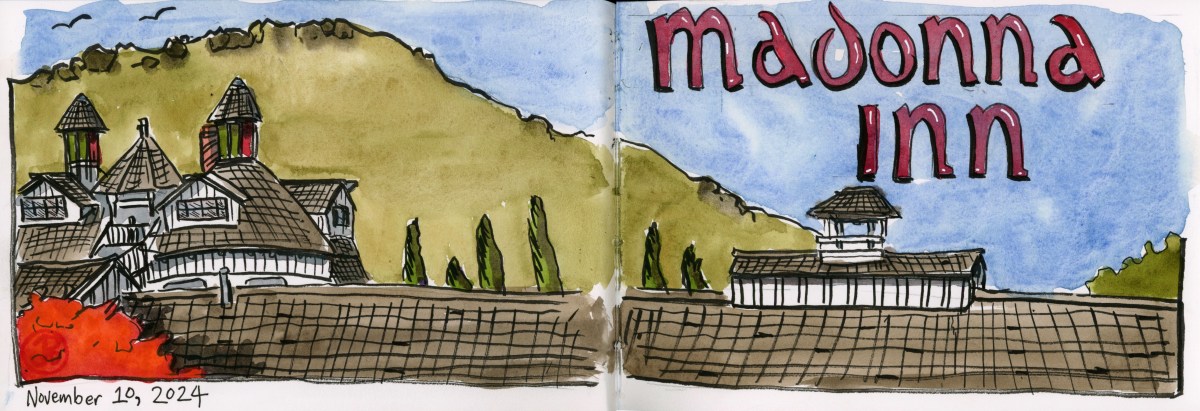
On a SLO Saturday morning with a breakfast at the Copper Cafe at the Madonna Inn (celebrity sighting: Steve Perry), Grasshopper and I headed out west past the Men’s Colony to do some birding-hiking-sketching at Morro Rock.
The 581 foot tall Morro Rock is a volcanic plug on California’s coast. A volcanic plug is the extinct neck of a volcano. It is a prominent landform that is a beacon for wildlife. The extinct volcano formed about 23 million years ago.
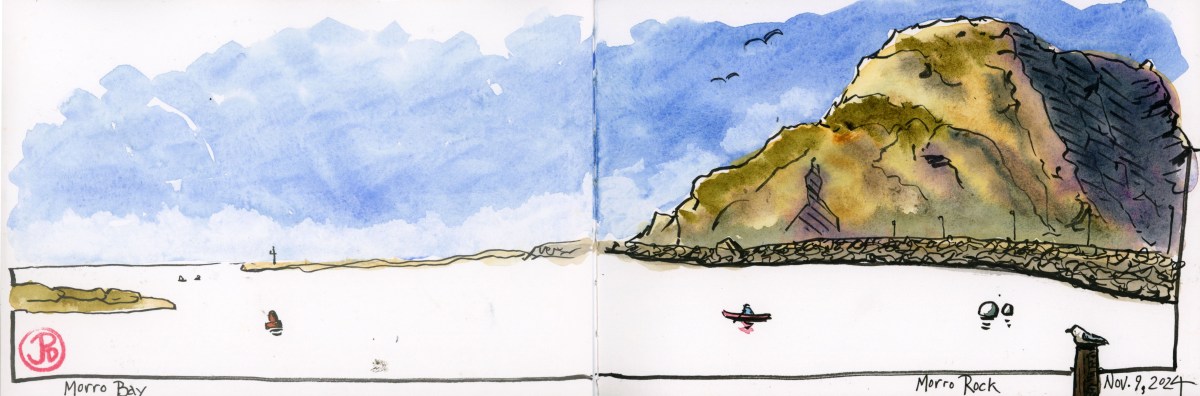
We birded around the rock. Avian highlights included white-throated swift, Bewick’s wren with common loons on Morro Bay and willets, black oystercatchers, and brown pelicans on the breakwater.
Around the base of the rock were “No Climbing” signs because Morro Rock is a peregrine falcon reserve. On our visit there were no signs of peregrine falcons.
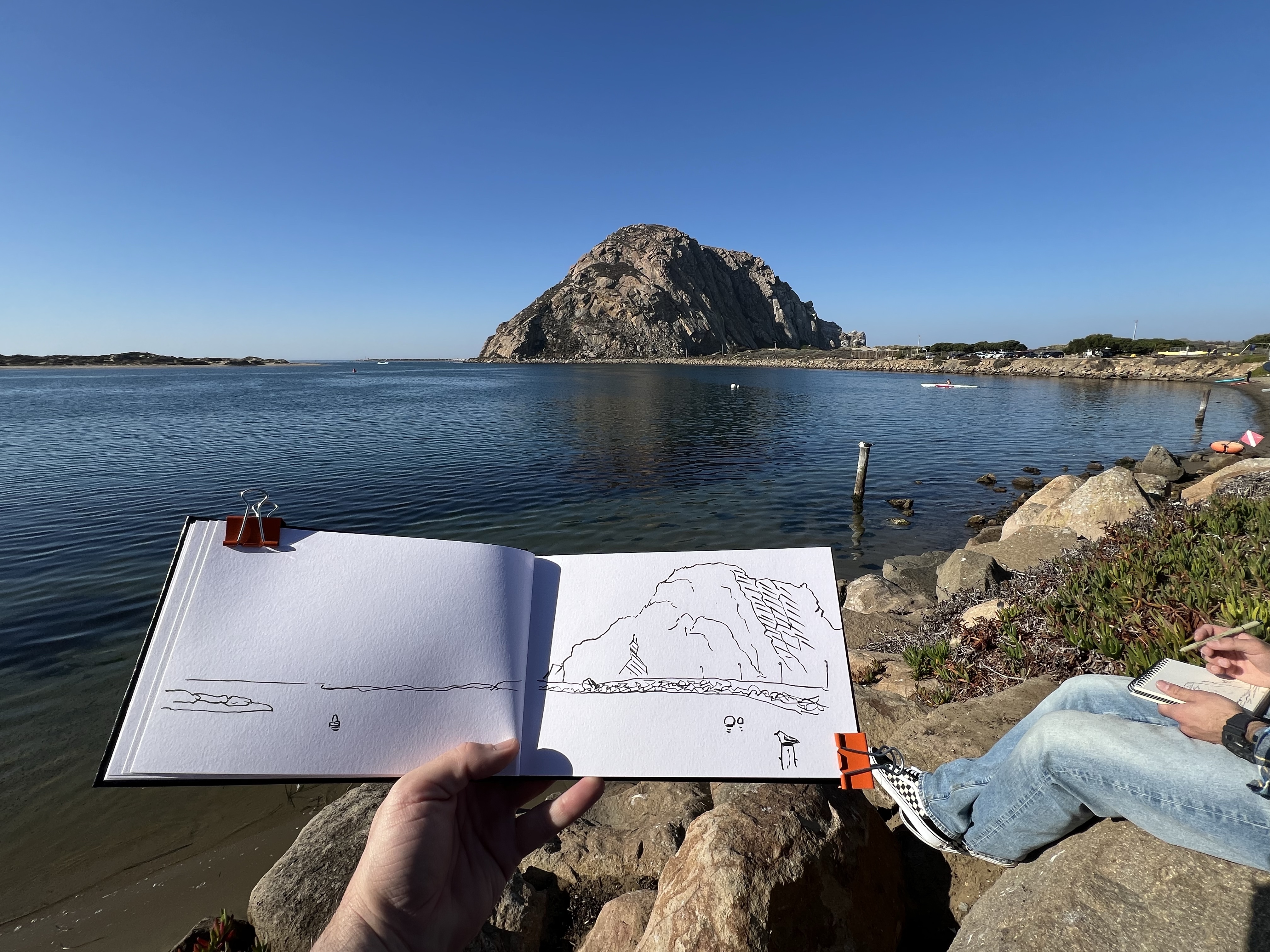
Sketching Morro Rock with Grasshopper.
We left the trailhead and found a sketching perspective with Morro Bay in the foreground and found a sketching boulder to sketch from (featured sketch).
A friend’s 50th Shindig in San Luis Obispo provided me the opportunity to stay at the historic Madonna Inn for the first time.
The roadside hotel was opened in 1958 and has grown to the sprawling compound that it is today featuring five buildings on its 1,500 acre site.
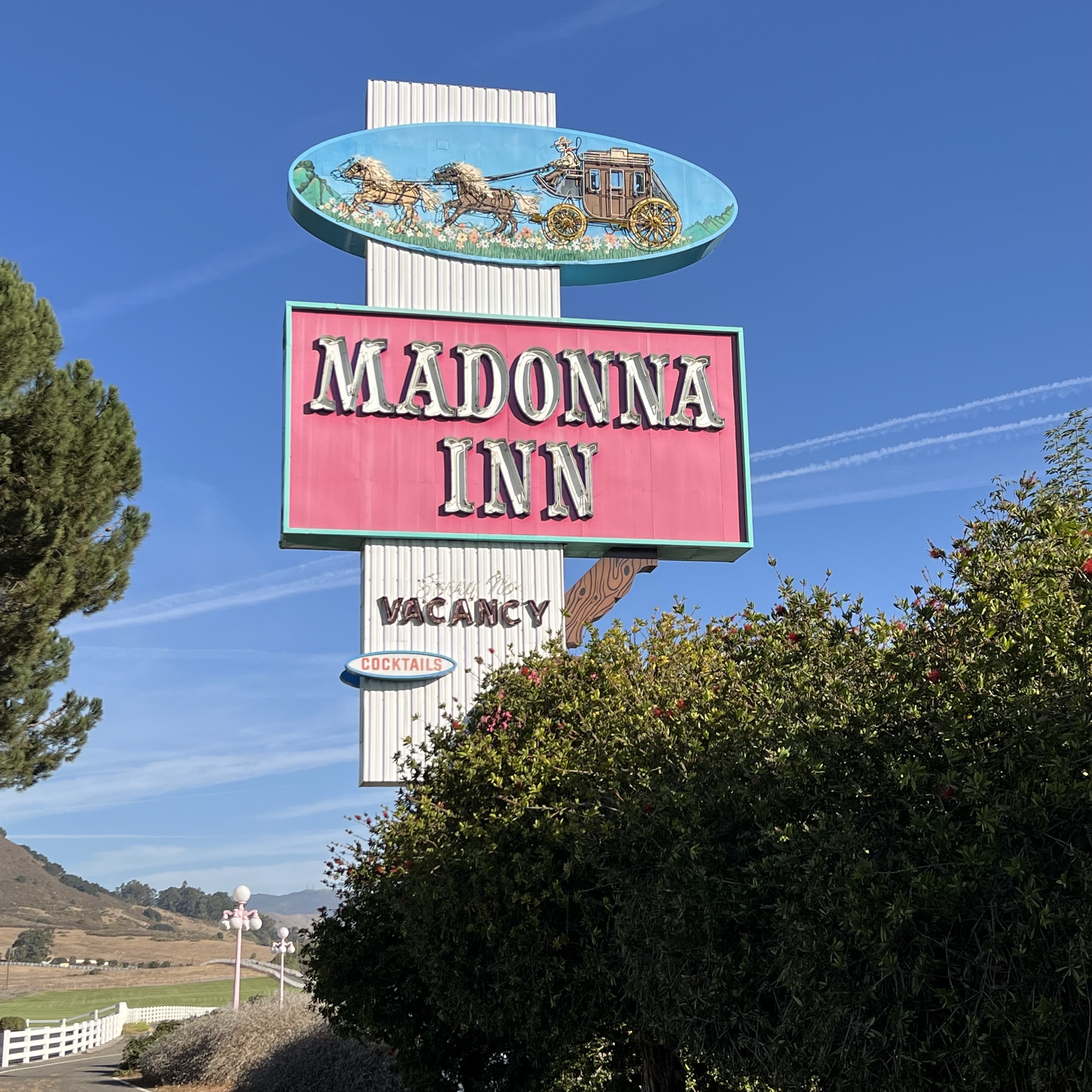
The Madonna Inn sign calling visitors in from Highway 101. San Luis Obispo lies between San Francisco and Los Angeles.
The hotel is known for its oddball decor, its hot pink accents, western murals, and 110 themed rooms.
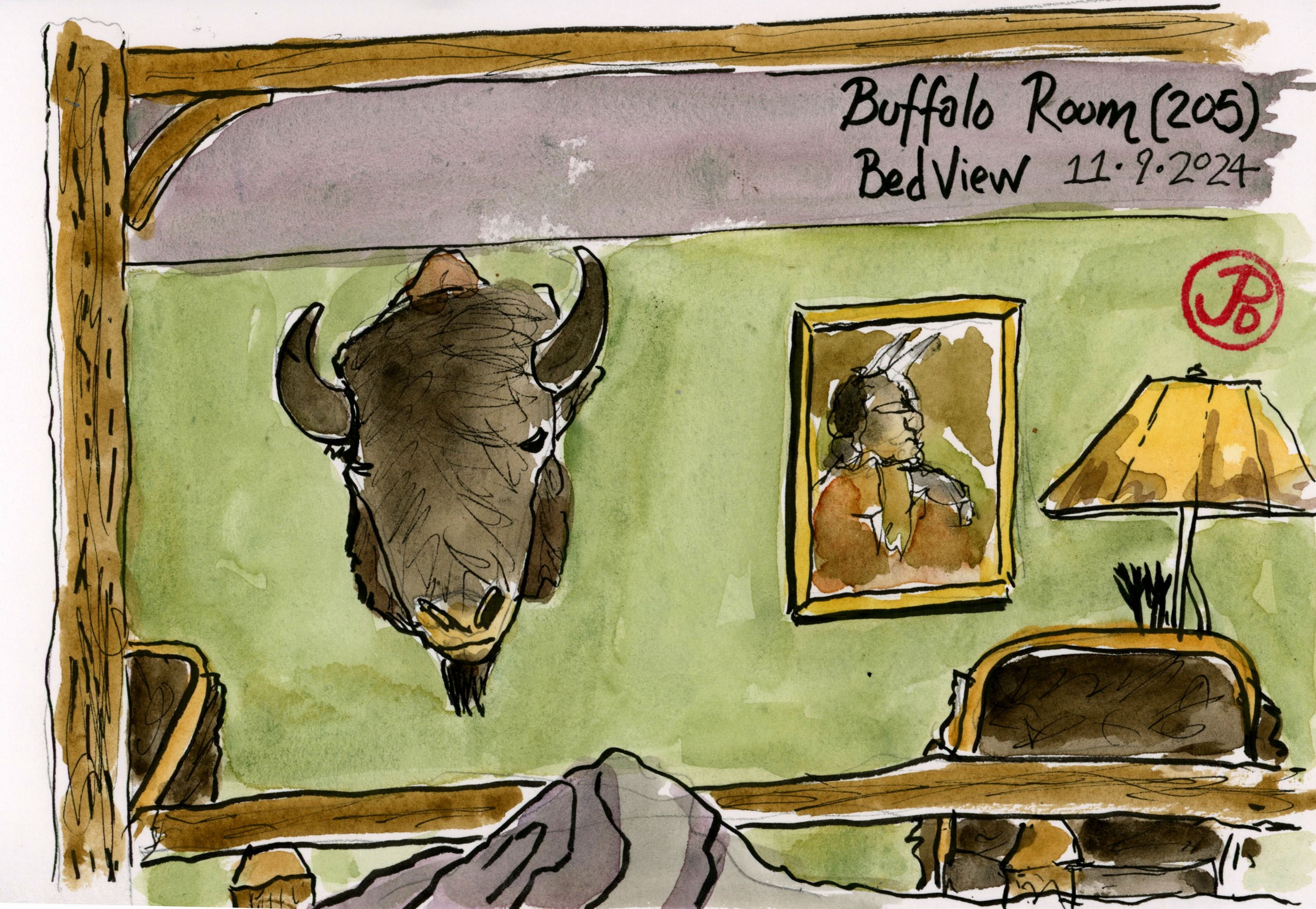
I was staying in room 205, the Buffalo Room. The room has western/Native American themed accents, a rustic wooden four poster bed, and a huge American bison head hanging on the wall. This was sketcher’s paradise.
I just hoped the bison head didn’t give me nightmares!
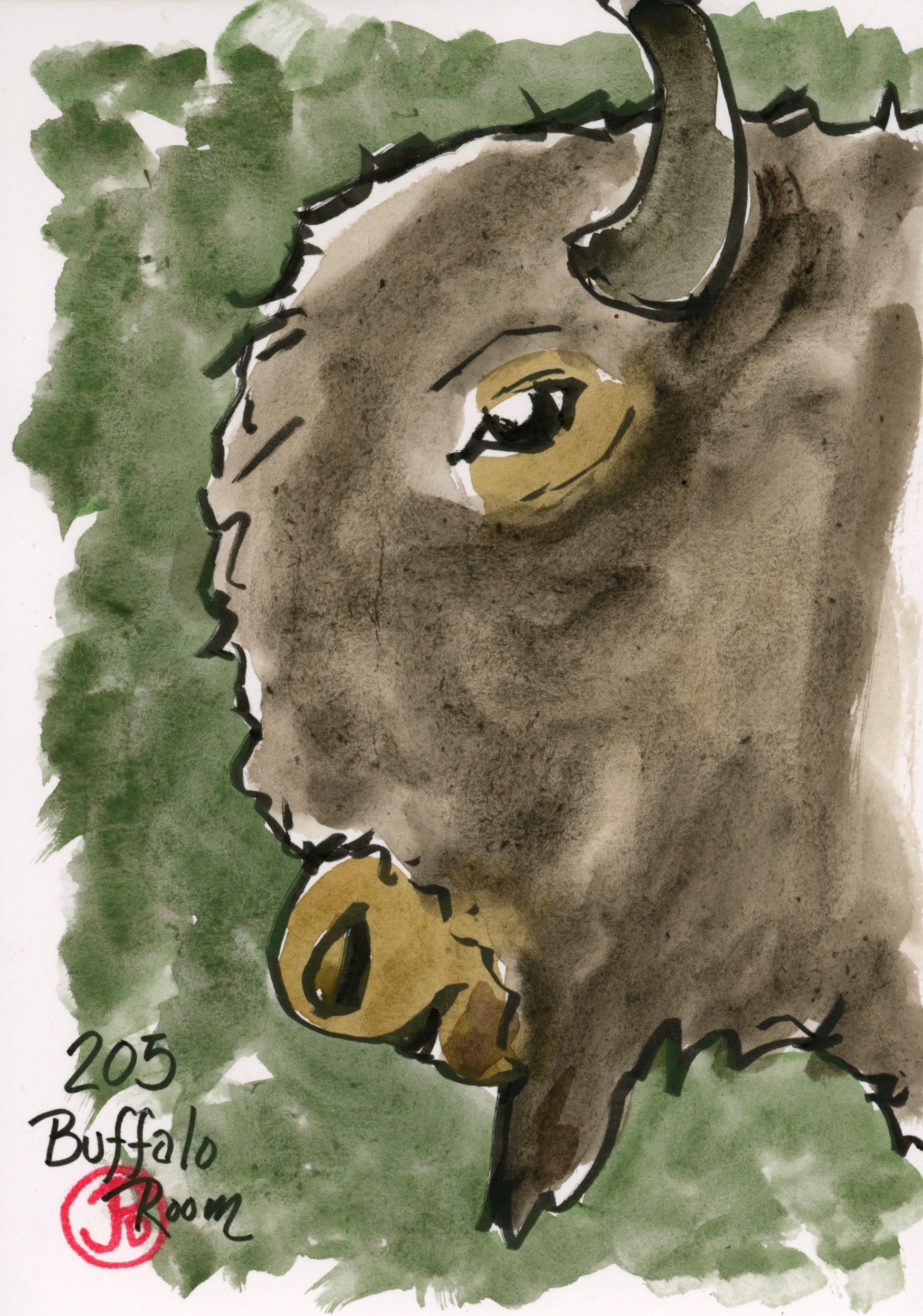
A bed sketch from room 205. Buffalo head detail. It seems to be looking at you no matter where you stand in the room.
One a recent weekend trip with the lads on the Sonoma Coast I added some coastal impressions to my sketchbooks.
I have sketched the coastal locations of Bodega Bay and Sea Ranch many times.
On the drive up I stopped at the Tides Restaurant in Bodega Bay for lunch (made famous in Hitchcock’s The Birds). I had a table with a view of the bay and the Bodega Head across the waters.
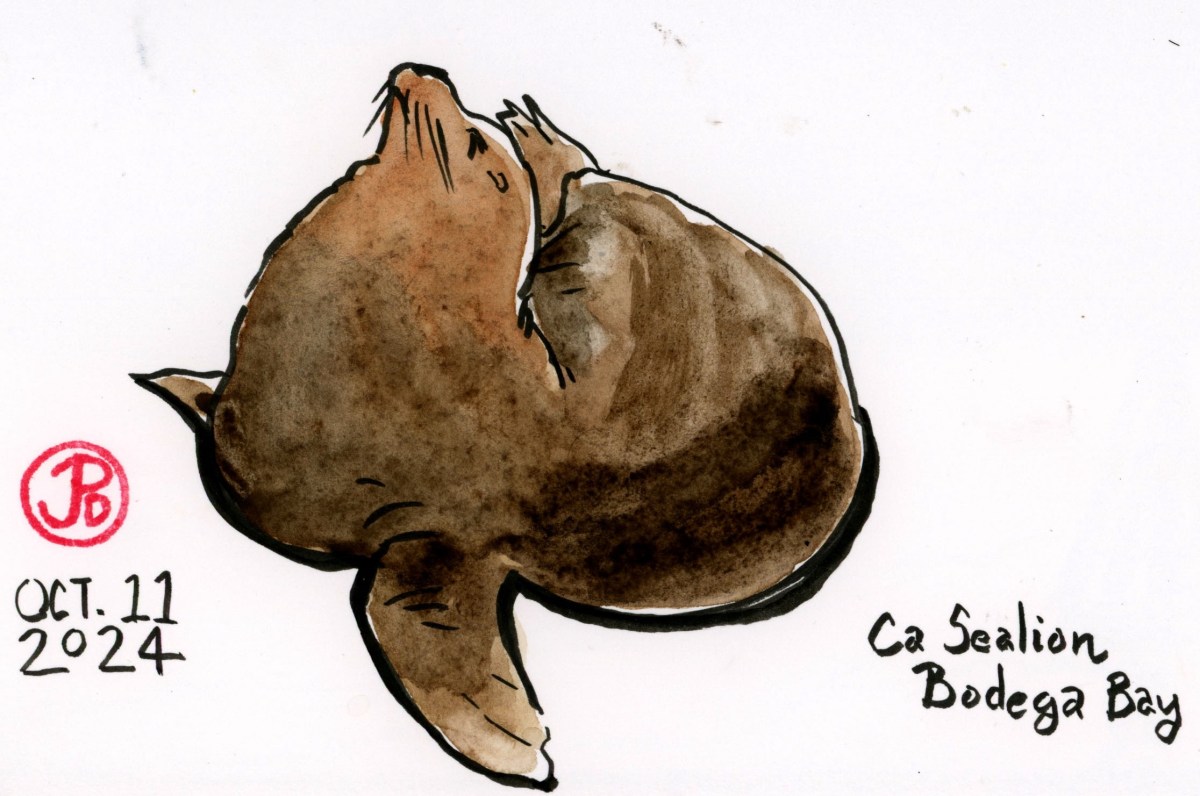
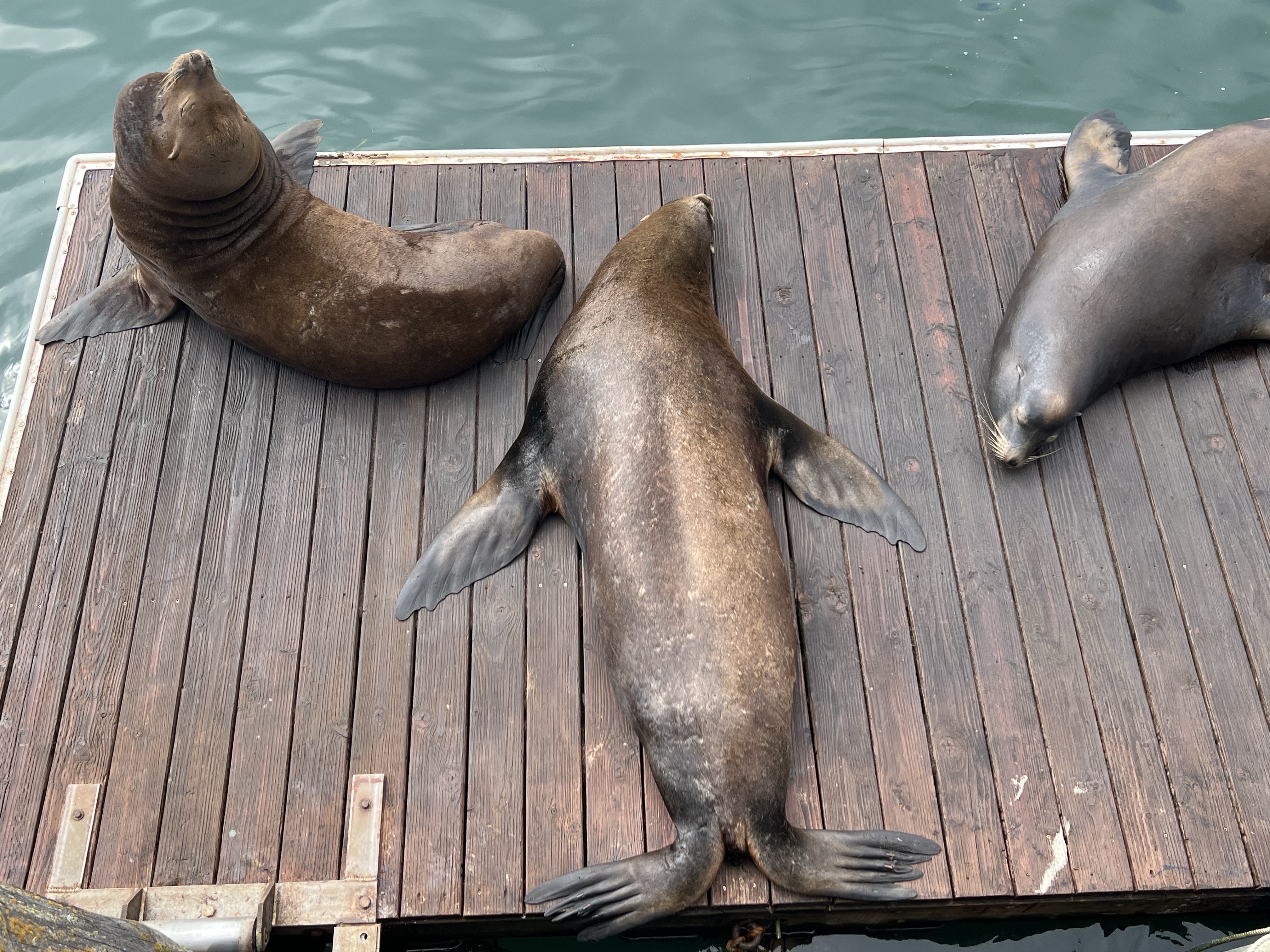
After lunch I walked along the wharf where I saw a group of sea lions resting on a dock. They didn’t seem to be going anywhere anytime soon so I sketched one of them (featured sketch).
The sea lion on the left is begging to be sketched!
After my sketch I drove north on Highway One towards our cabin in the woods just north of the Sonoma/ Mendocino border.
From our base camp in Gualala we headed south back into Sonoma County to visit Sea Ranch.
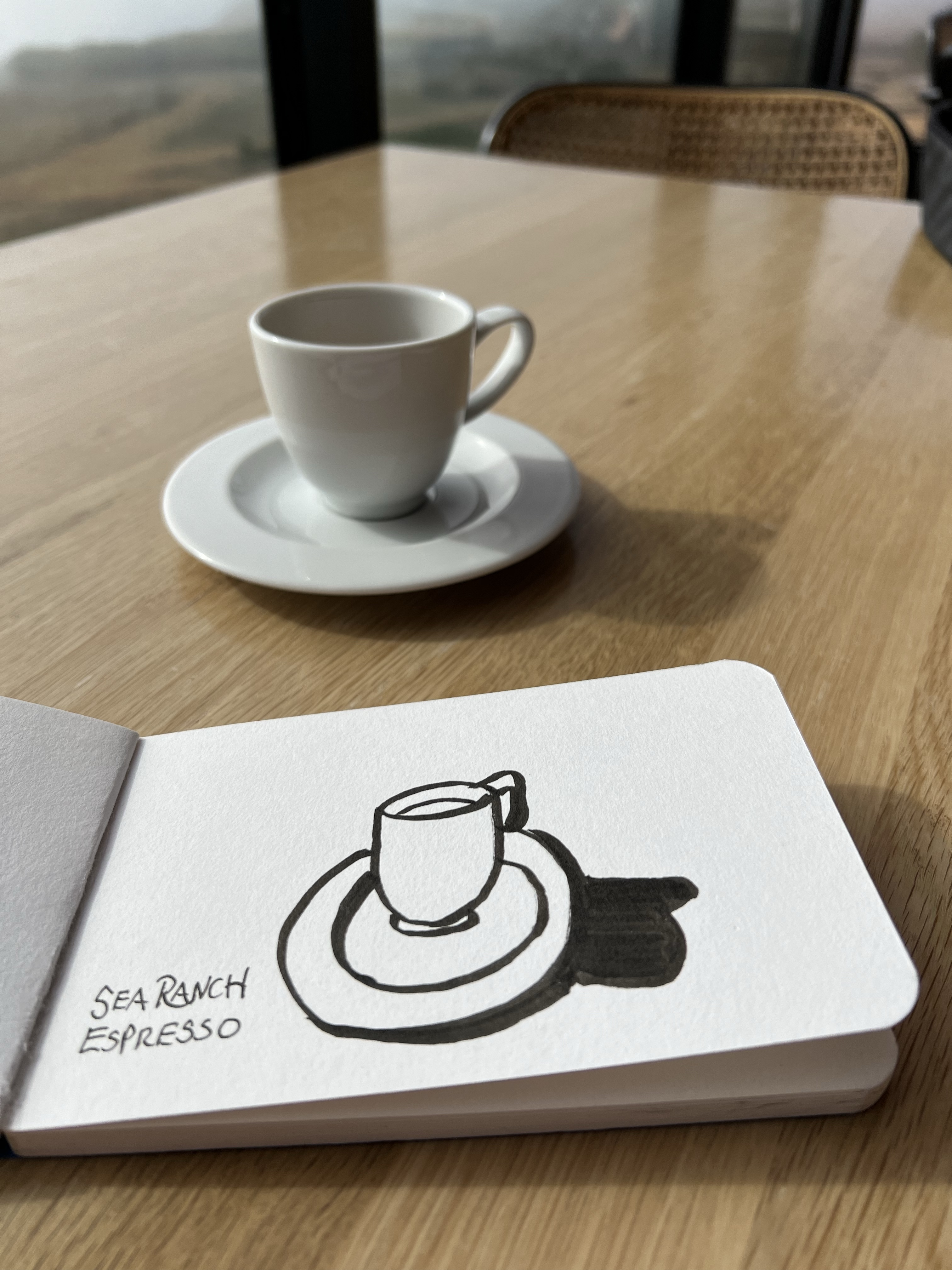
A Sea Ranch espresso sketch.
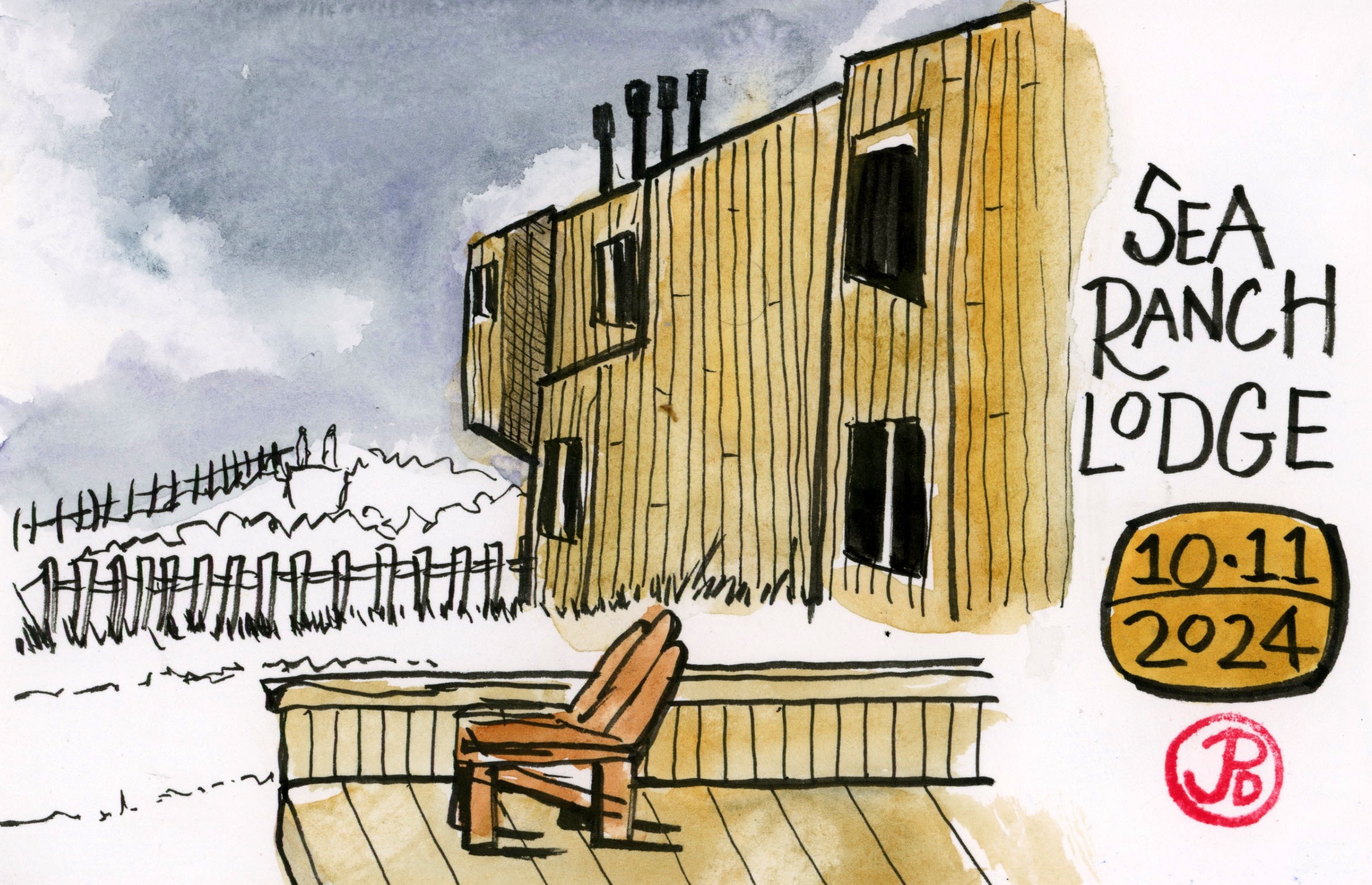
While I was at Sea Ranch Lodge, I did a sketch of the lodge buildings. I had stayed here once before.
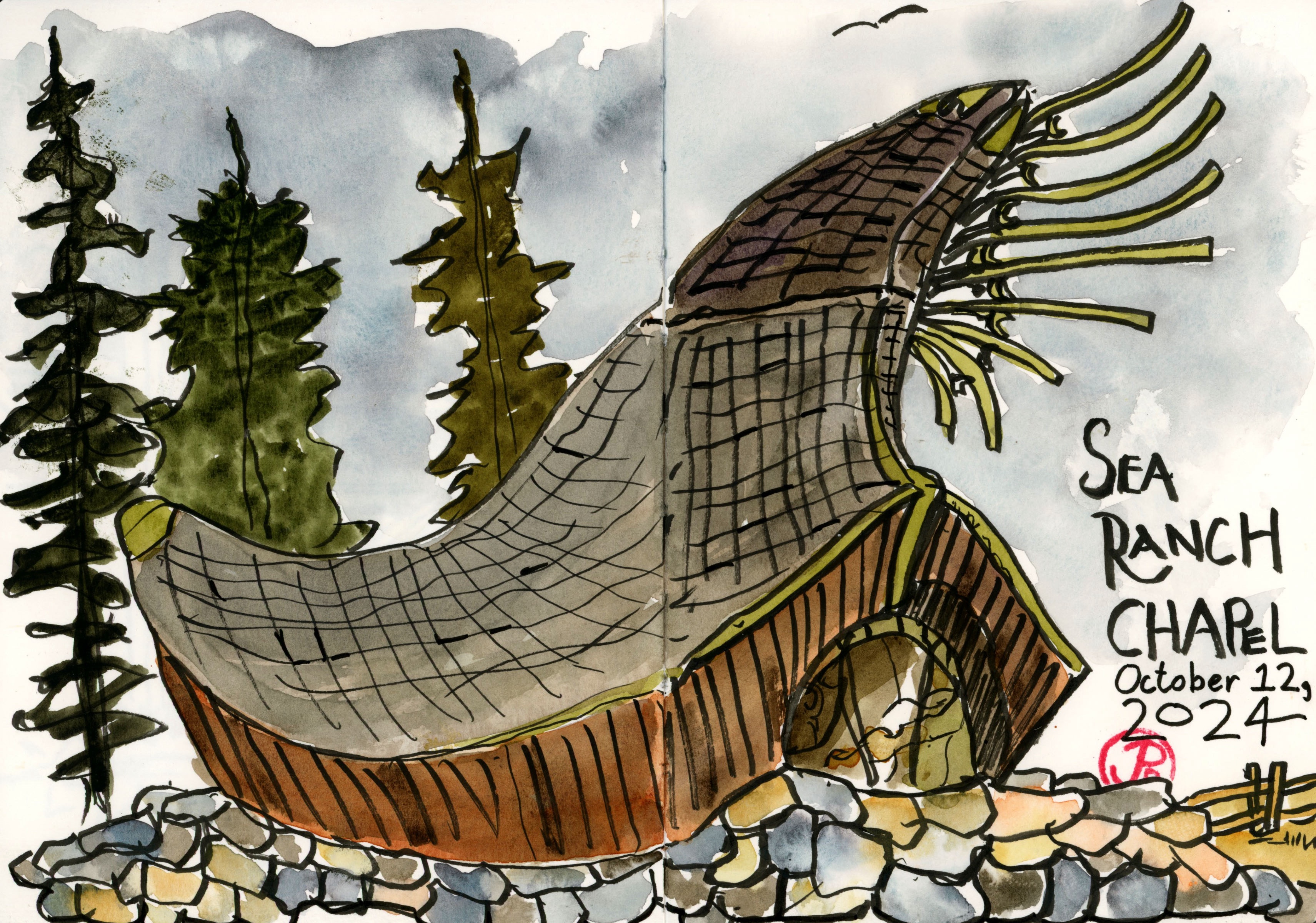
One of my Sonoma County sketching touchstones is the seaslug-like Sea Ranch Chapel. I have sketched this whimsical building every time I am in the area. Every angle yields a new sketch. This time I sketched the chapel from the side, slightly to the rear. I never seem to tire of sketching this unique structure.
I visited the second most visited cemetery in the United States, the most visited is Arlington National Cemetery.
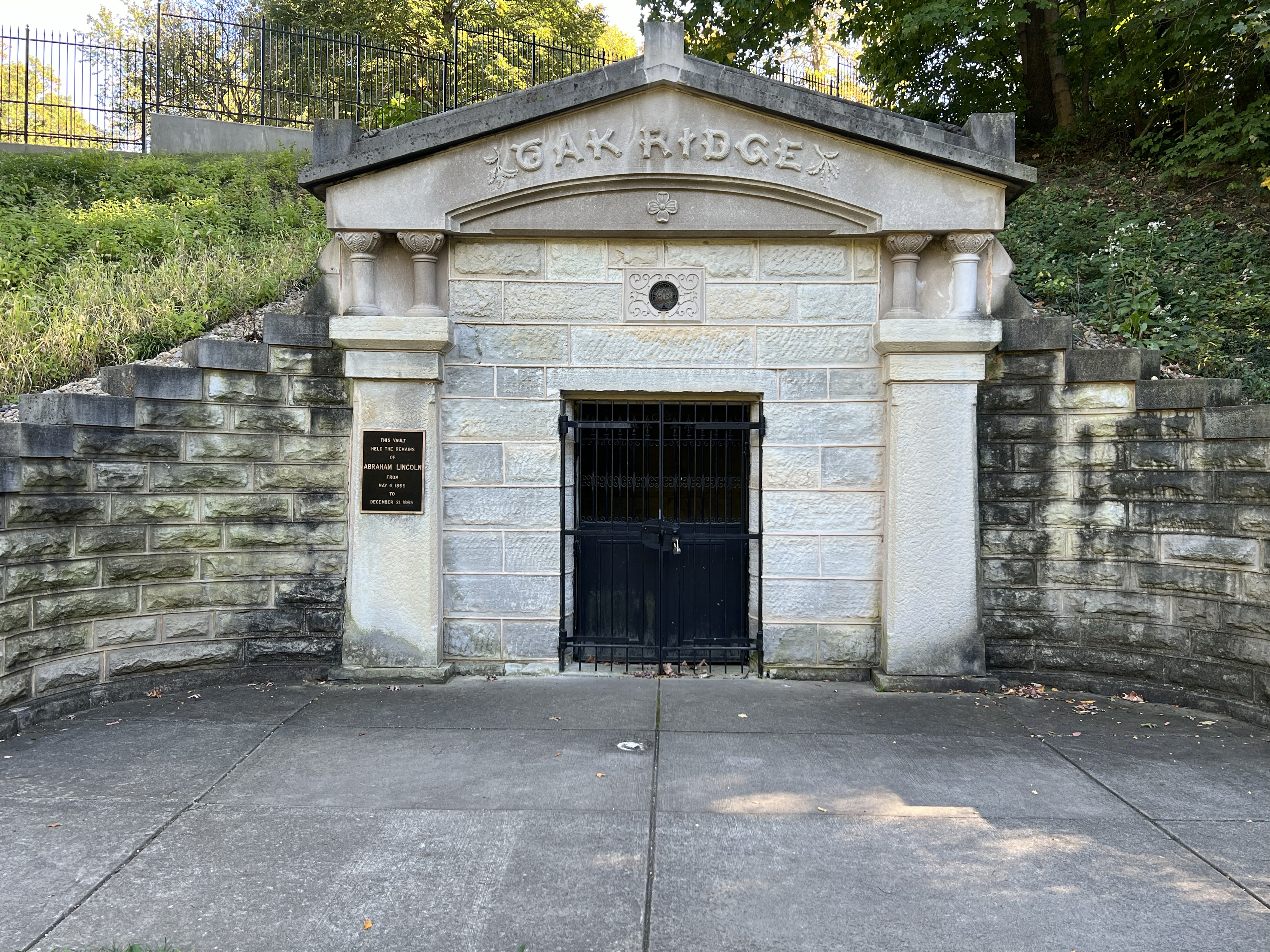
This is Oak Ridge Cemetery in Springfield, Illinois. The main draw of this cemetery is the tomb of our 16th President, Abraham Lincoln.
After Lincoln returned to Springfield on the funeral train he was placed in the Old State Capital for public viewing and then moved to Oak Ridge Cemetery where he was placed in a temporary vault.
The temporary vault at Oak Ridge.
The current memorial was dedicated October 15, 1874 and the 117 foot granite obelisk is the Memorial’s focal point.
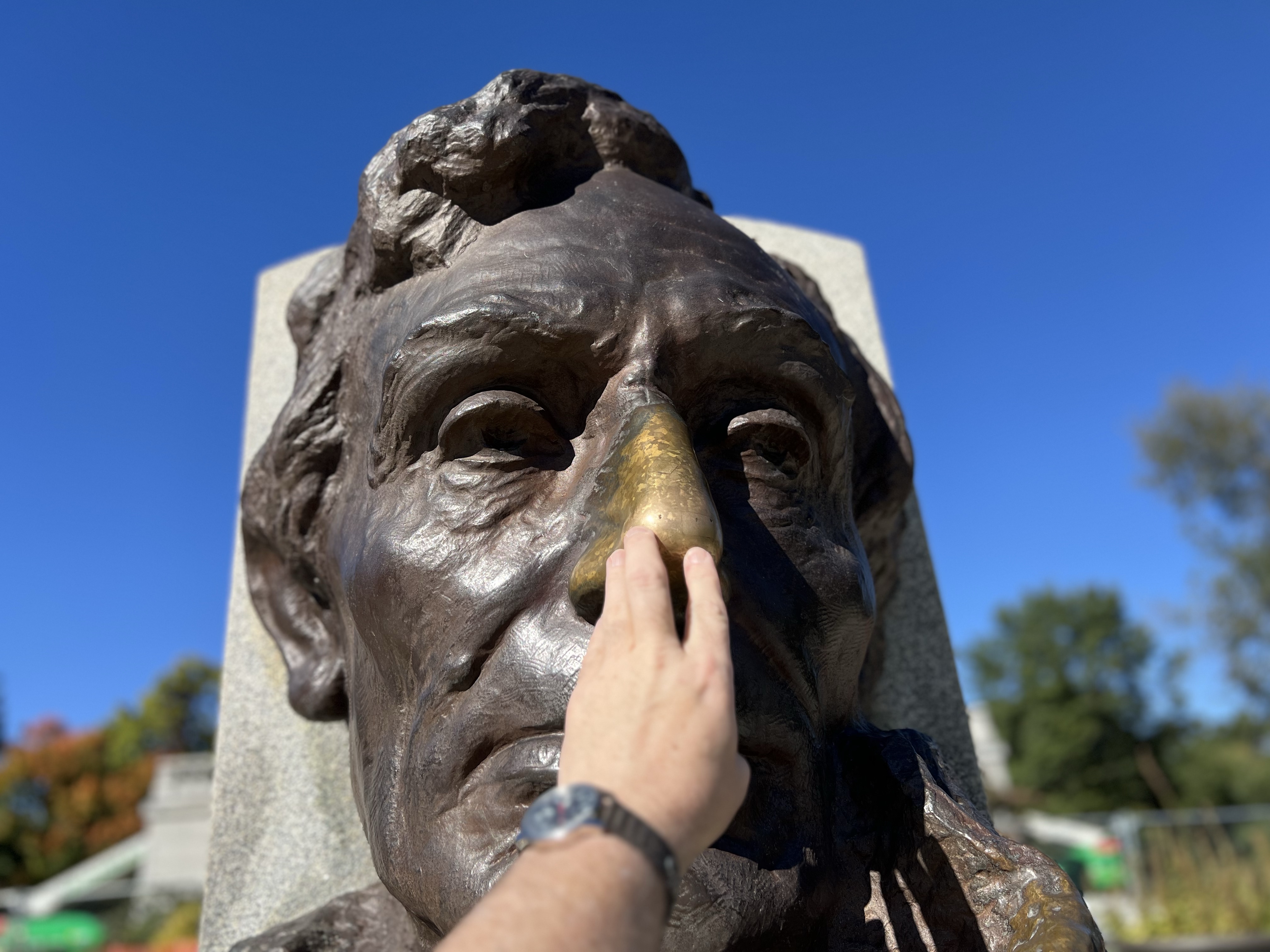
In front of the vault is a bronze recasting of Gutzon Borglum’s head of Lincoln. Borglum is the sculptor behind the design of Mt. Rushmore. Lincoln’s nose is a shiny gold from the thousands and thousands of visitors who rub the nose for good luck.
I wouldn’t mind some good luck!
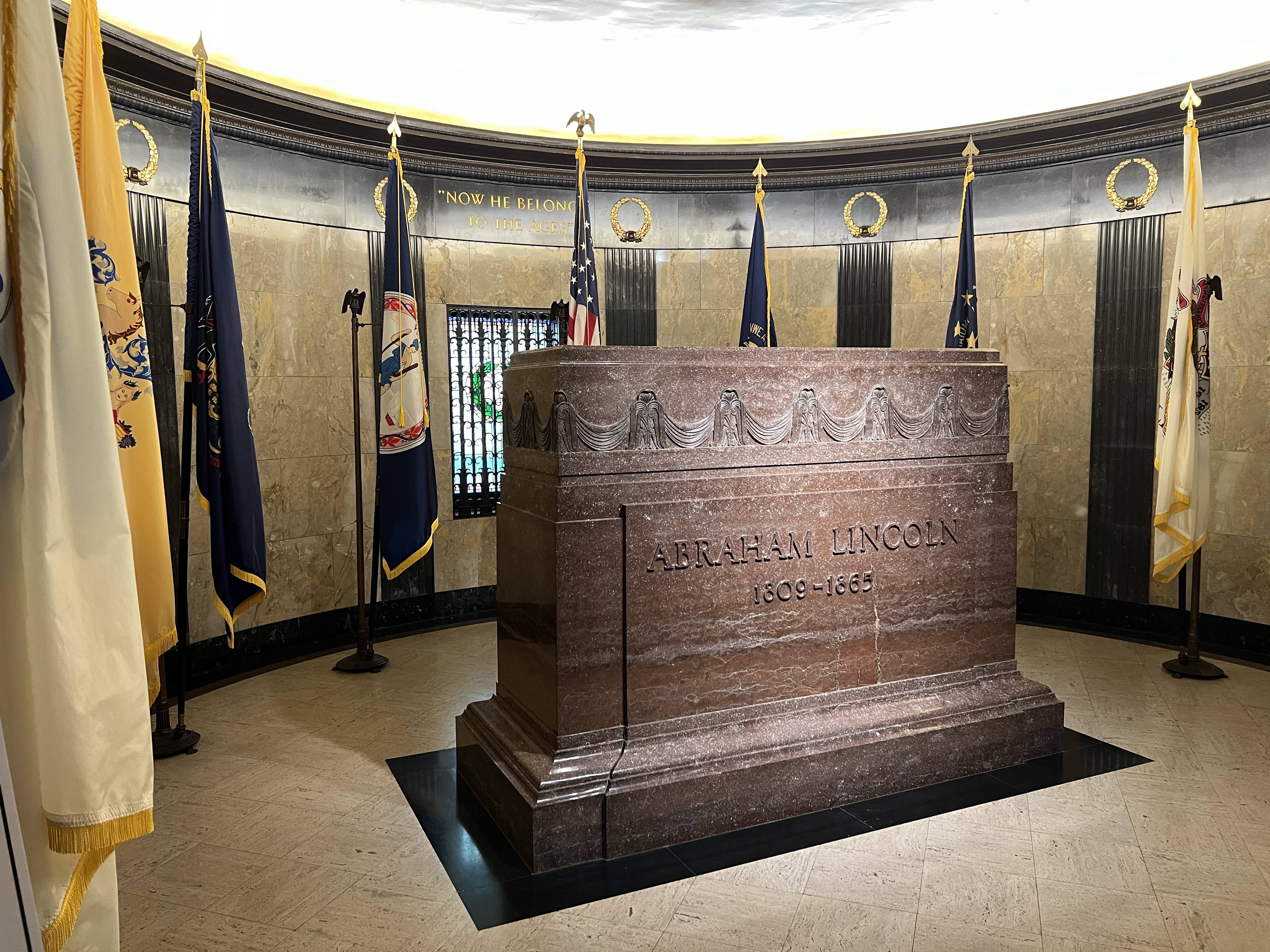
Inside the tomb is where Lincoln, his wife Mary Todd, and three of his four boys: Edward “Eddie”, William “Willie”, and Thomas “Tad” are interred. His oldest son, Robert, is buried at Arlington.
In the vault is the red marble monument to Abraham Lincoln. On the wall above is the quote that Lincoln’s Secretary of War Edwin Stanton uttered at the President’s passing, “Now he belongs to the ages”
There are at least 250 statues of our 16th President of the United States around the world. That’s about 150 more statues than that of our first president, George Washington.
On top of these monuments and statues, between 15,000 to 20,000 books have been written about Lincoln, more than any other American historical figure. And there is only one other world figure that has more biographies written about them that tops Lincoln and that’s Jesus Christ.
There were more than enough statues and monuments in Springfield, Illinois. So I sketched a few.
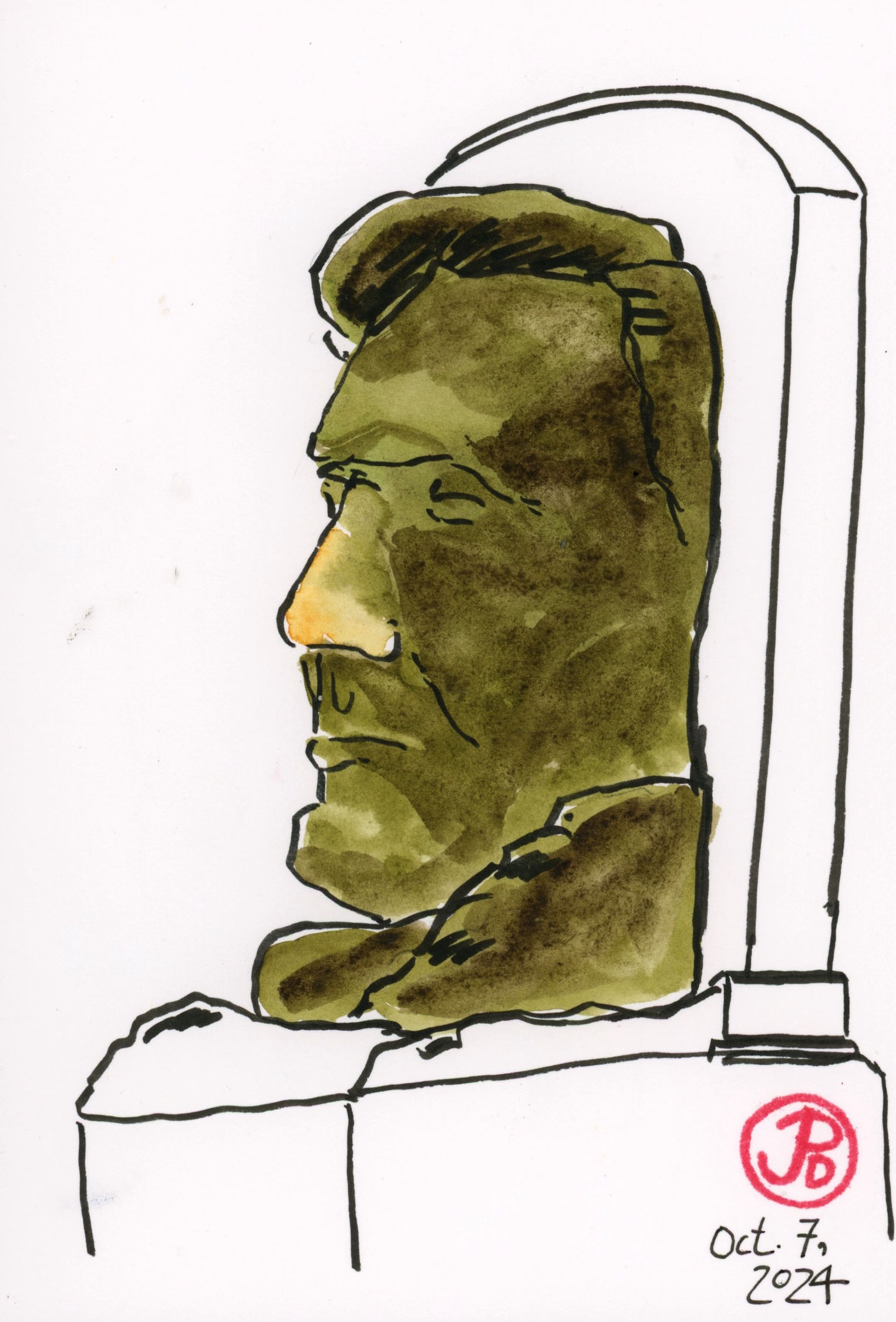
The lucky nose bust of Lincoln outside his tomb at Oak Ridge Cemetery. This was a continuous-line sketch. This is such an iconic statue I sketched it four times.
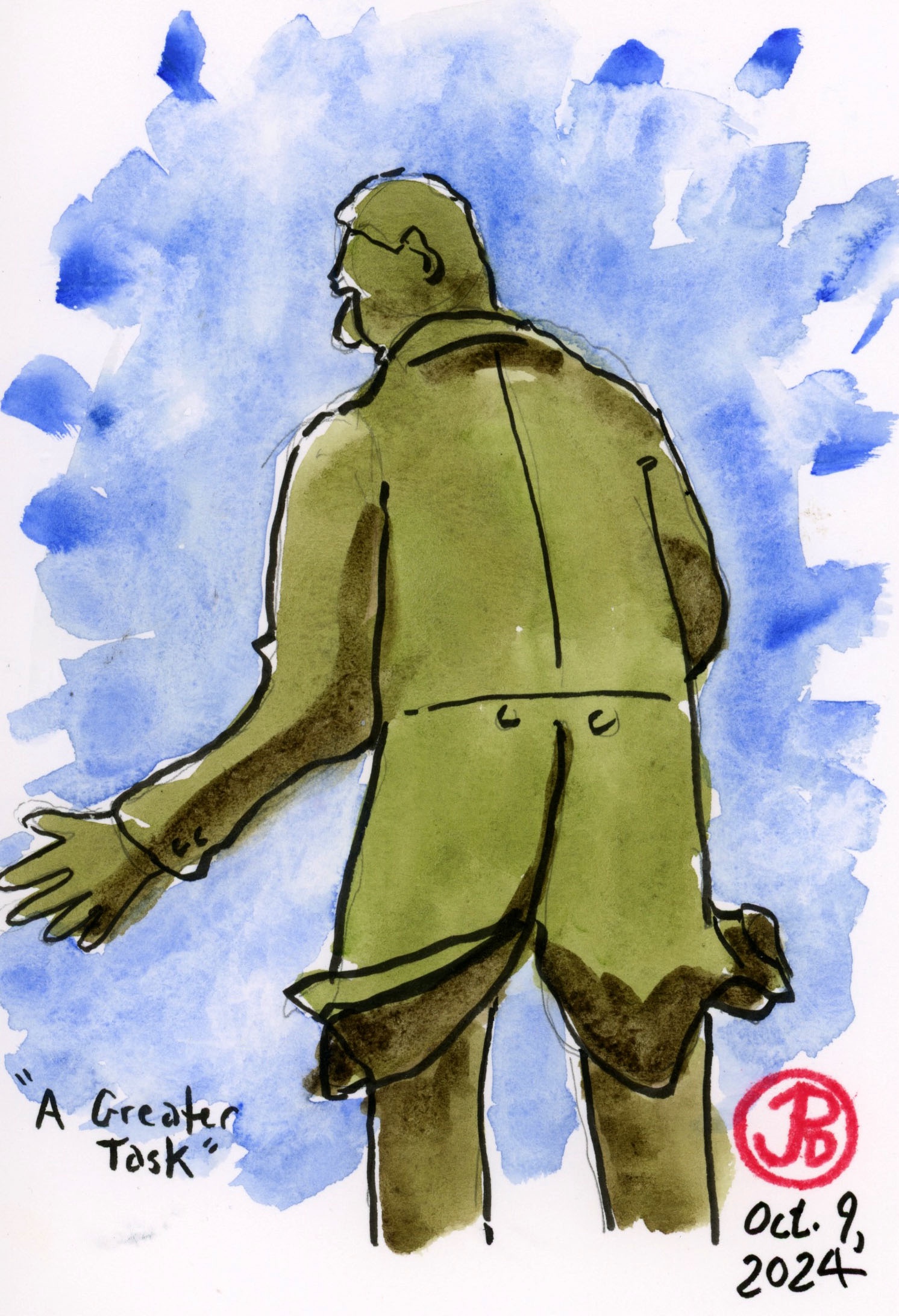
Near the old state capitol is the group of statues called “Springfield’s Lincoln” by Larry Anderson. The statues represent the Lincoln family on October 4, 1854 as the head of the household pauses before the capital before delivering a speech about the spread of slavery into U. S. Territories. His wife Mary, straightens his tie.
“A Greater Task” in the square in front of Union Station, Springfield.
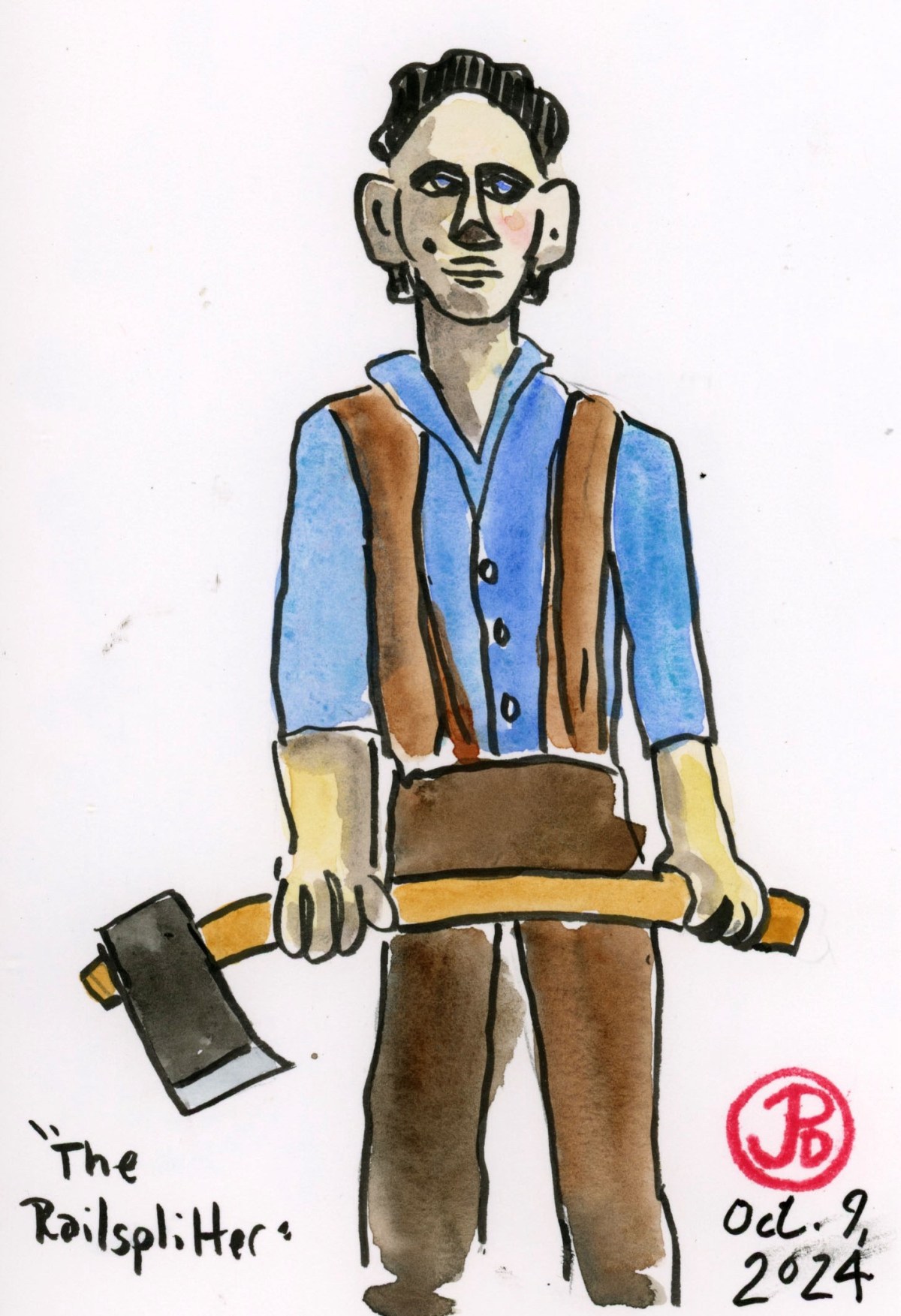
Perhaps one of the oddest representations of Lincoln is to be found at the State Fairgrounds. This is the whimsical “The Railsplitter” statue (featured sketch).
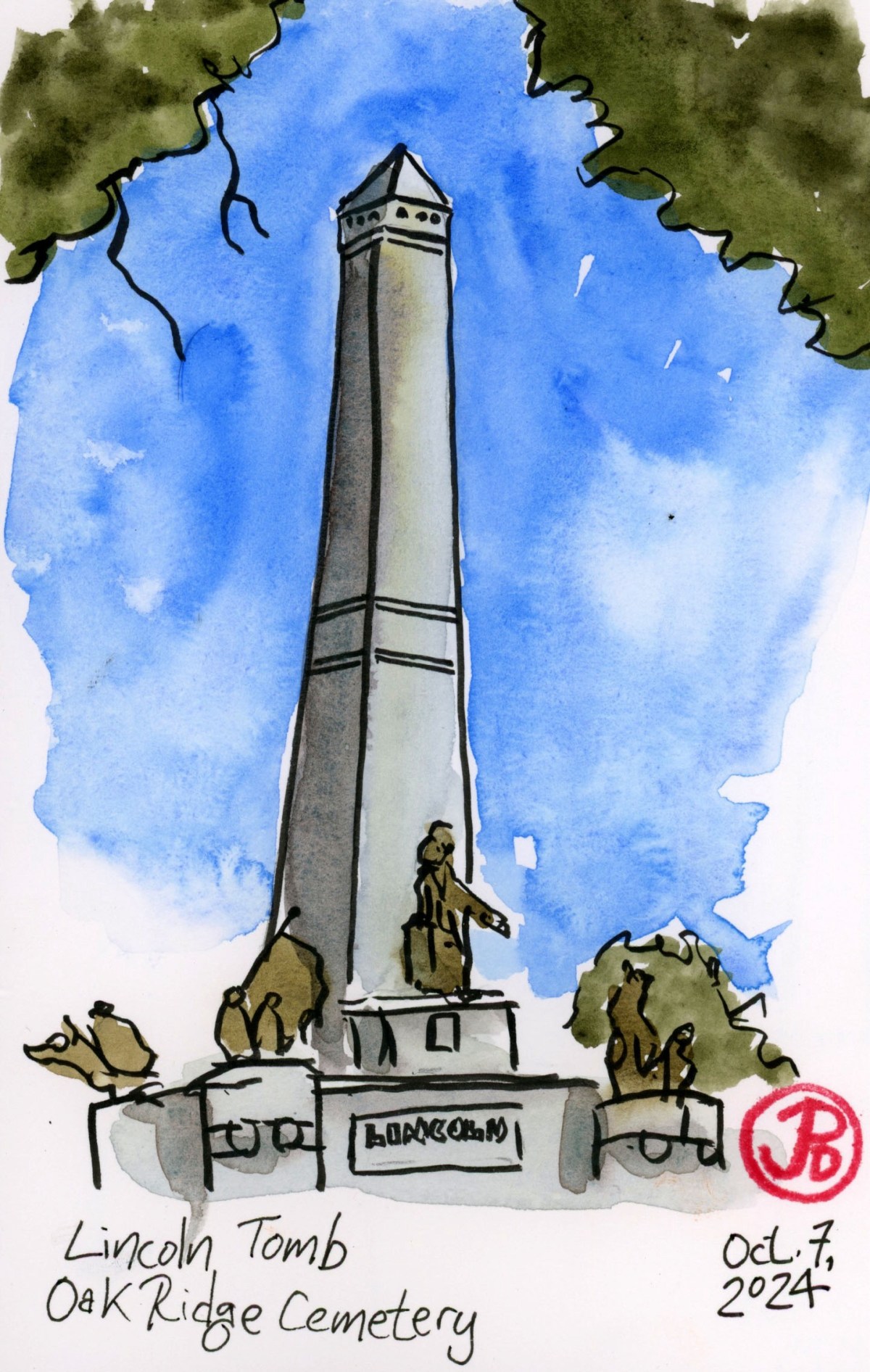
To me in Lincoln History there are two hallowed locations that are a must visit for any Lincolntonian. These are the Lincoln Memorial in Washington DC and the Lincoln Tomb in Springfield. Below is a sketch of the tomb.
Two railroad lines parallel each other through downtown Springfield, Illinois.
On both of these lines are two train stations that feature strongly in Lincoln history.
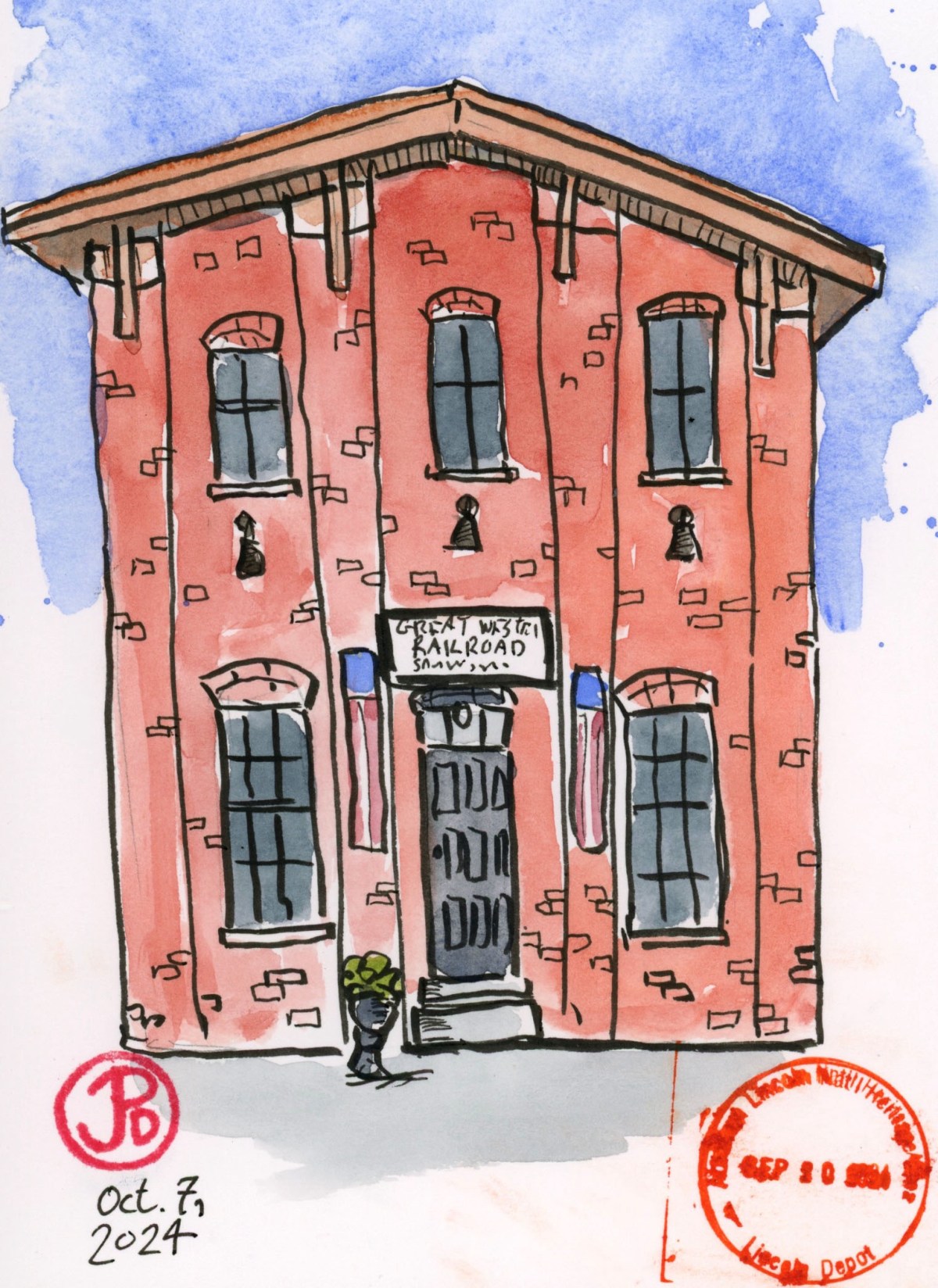
It is from one of these stations, the Great Western Depot, on a cold rainy morning that Lincoln said his farewell to Springfield, at the time not knowing that he would never return alive.
On February 11, 1861 Lincoln gave a two minute speech from the back of his passenger car, Lincoln’s assistant secretary John Hay noted that it was “the key-note of the journey”:
“My friends, No one, not in my situation, can appreciate my feeling of sadness at this parting. To this place, and the kindness of these people, I owe everything. Here I have lived a quarter of a century, and have passed from a young to an old man. Here my children have been born, and one is buried. I now leave, not knowing when, or whether ever, I may return, with a task before me greater than that which rested upon Washington. Without the assistance of that Divine Being, who ever attended him, I cannot succeed. With that assistance I cannot fail. Trusting in Him, who can go with me, and remain with you and be everywhere for good, let us confidently hope that all will yet be well. To His care commending you, as I hope in your prayers you will commend me, I bid you an affectionate farewell.” This was the last speech Lincoln ever delivered in Springfield.
Lincoln left Springfield on a 13 day journey chronicled in the excellent history, “Lincoln on the Verge: Thirteen Day to Washington” by Edward Widmer. The journey really endeared Lincoln to the American people as he was previously known as an unknown westerner who won the presidency my a slim margin.
On the railroad journey, Lincoln travelled 1,904 miles on eighteen different railroad lines that covered eight states. Along the journey Lincoln gave over 100 speeches.
The Great Western Depot was the first building I sketched when I arrived in Springfield (featured sketch).
On that other Springfield train depot Lincoln returned four years later. This time in much different circumstances.
After his assassination at Ford’s Theater, Lincoln body traveled back to Springfield on much of the same rail that brought him to Washington.
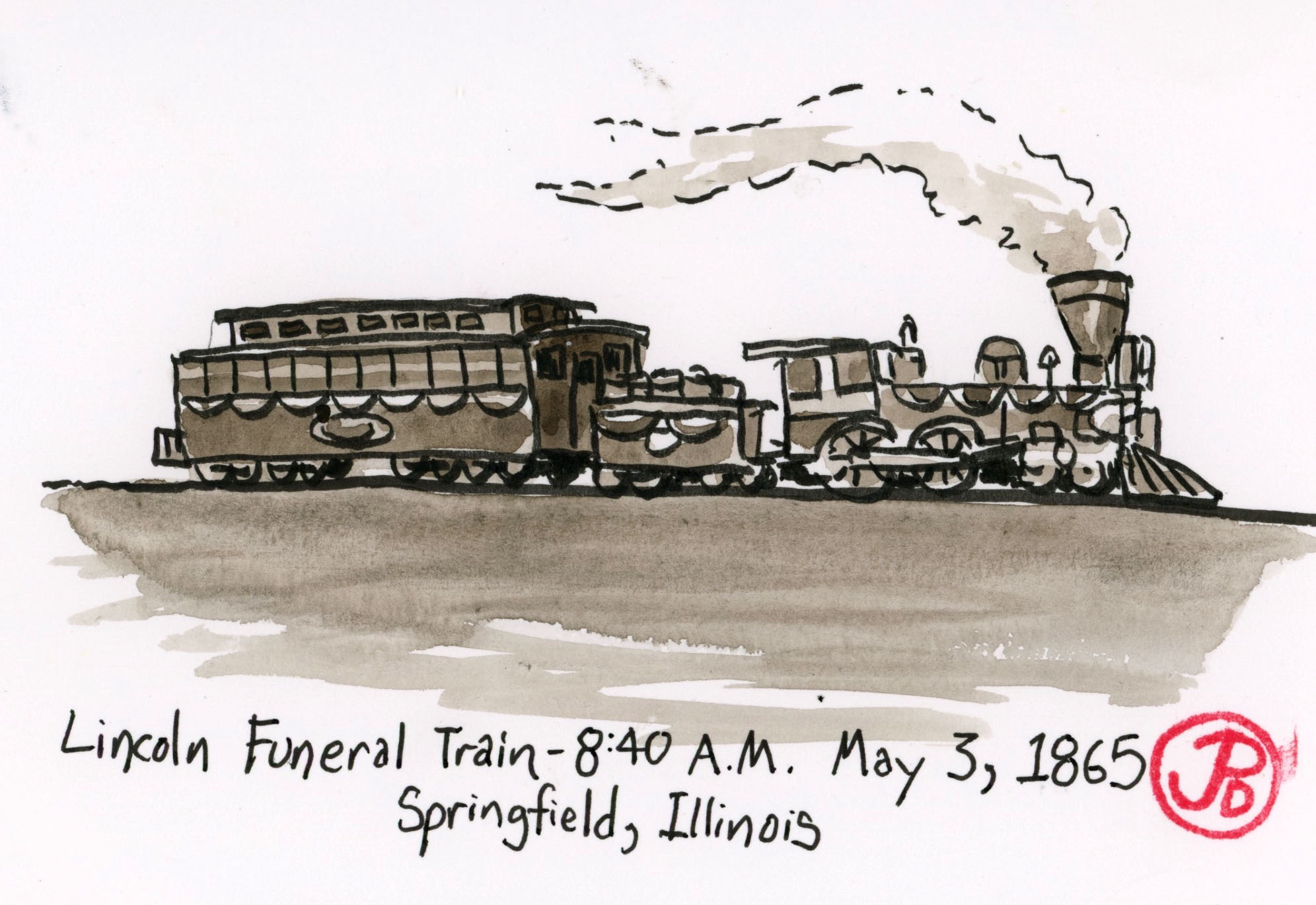
The funeral train stopped at many of the same cities and towns four years earlier. One deviation from the previous trip is that the train stopped in Chicago. So when the funeral train arrived in Springfield on the morning of May 3, 1865, the journey terminated at the Chicago & Alton Depot on Jefferson Street.
The historic depot had been replaced with a modern AMTRAK station but the funeral train’s arrival in Springfield is memorialized by a black monument on the platform.
A detailed sketch of the funeral train from the monument at Springfield station. Passenger trains are still alive and well in Springfield. This is train 302 to Chicago’s Union Station with the State Capital in the background.
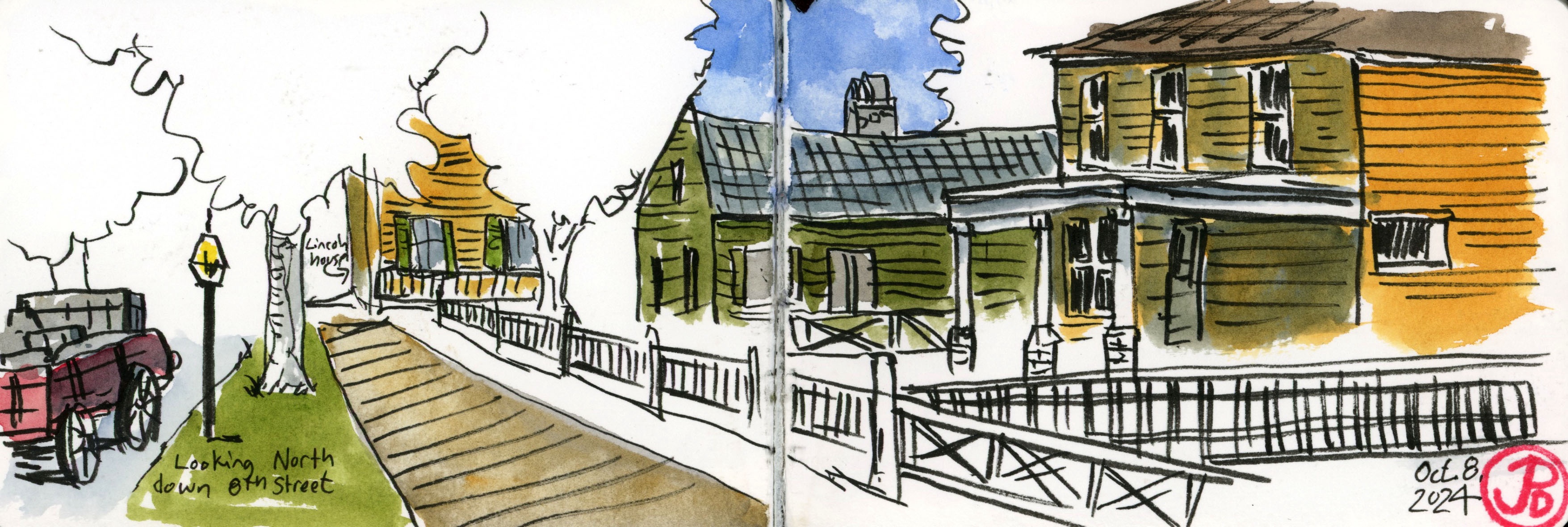
Springfield is the capital of the state of Illinois. Just east of the State Capitol building is a preserved neighborhood which is now a National Historic Site. Walking these streets makes you feel like you’re back in the 1860s.
A sketch looking down 8th Street.
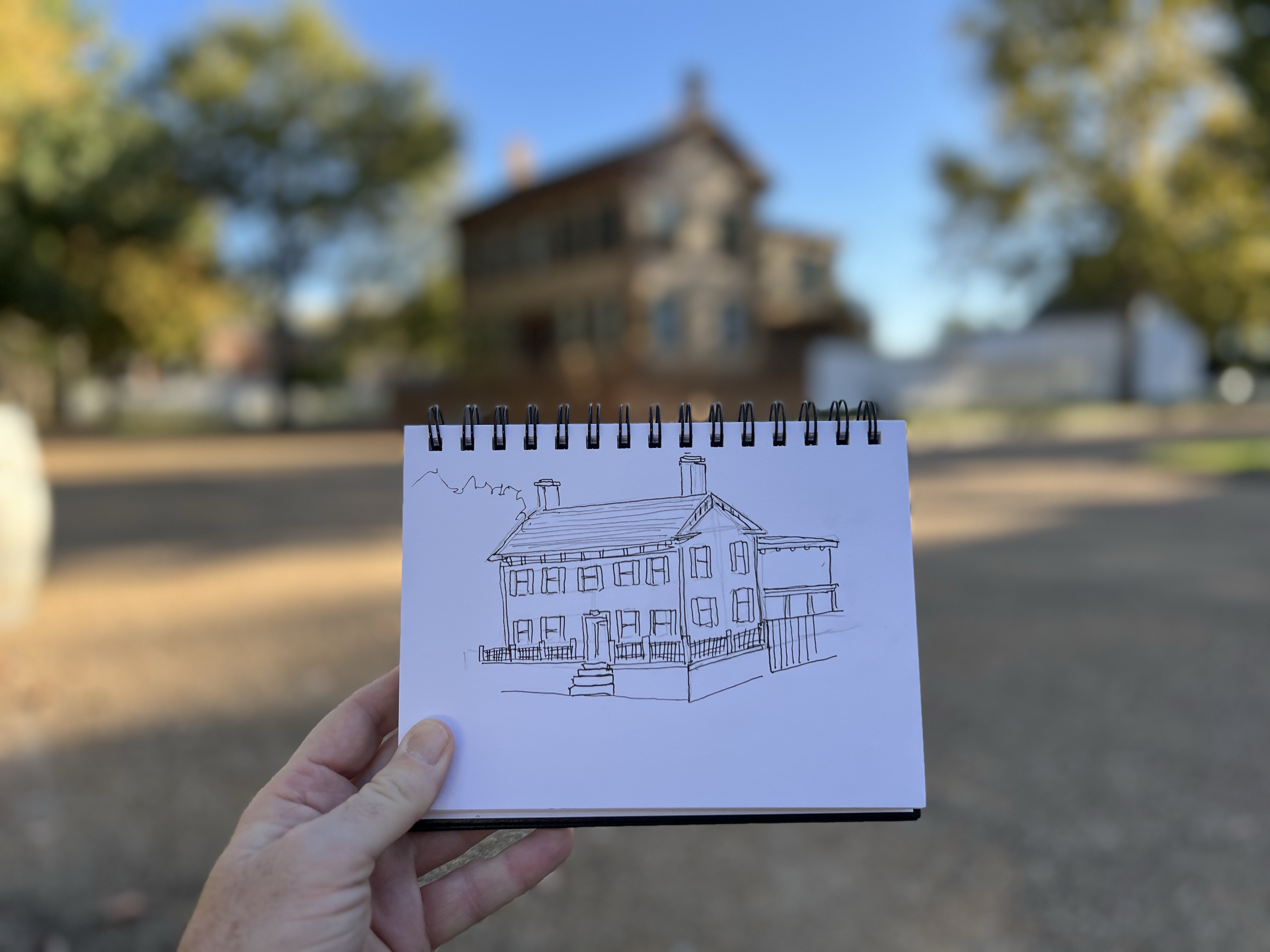
I was here to see and sketch the house on the corner of Eighth Street and Jackson Street. In fact, I was looking forward to sketching this house more than any other structure on my midwestern jaunt.
I headed to the intersection early in the morning to avoid the crowds surrounding the house or the tourists standing behind me wondering or asking what I was doing. The only other people out and about were maintenance workers, gardeners, and park rangers arriving to work.
I sat on the curb, across the intersection from the house, opened my sketchbook, and started to draw. Before me was the only house that Abraham Lincoln ever owned.
The Lincolns lived in Springfield for seventeen years (1844-1861). They raised their four boys here, three of which were born in the house. Lincoln practiced law here, he walked to his law office from this house. When Lincoln bought the small cottage in 1844 in was a small single story house. The cottage expanded with his growing family to be the two story house that exists today.
Lincoln left the house for the last time in February 1861. A few blocks to the northeast, Lincoln boarded a train at the Great Western Station (more about this in another post) to Washington DC as President-elect on his way to become the 16th president.
After my sketch (featured sketch) I joined the first tour of the day (you can only visit with a National Park guide).
The inside of the house was even more impressive than the outside for within these walls is where the Lincoln family lived. Seeing where they ate, lived, wrote, read, played, and slept really humanizes the Lincolns, a contrast to the stern and stale history books of old. About 40% of the furniture and furnishings are original to the Lincolns.
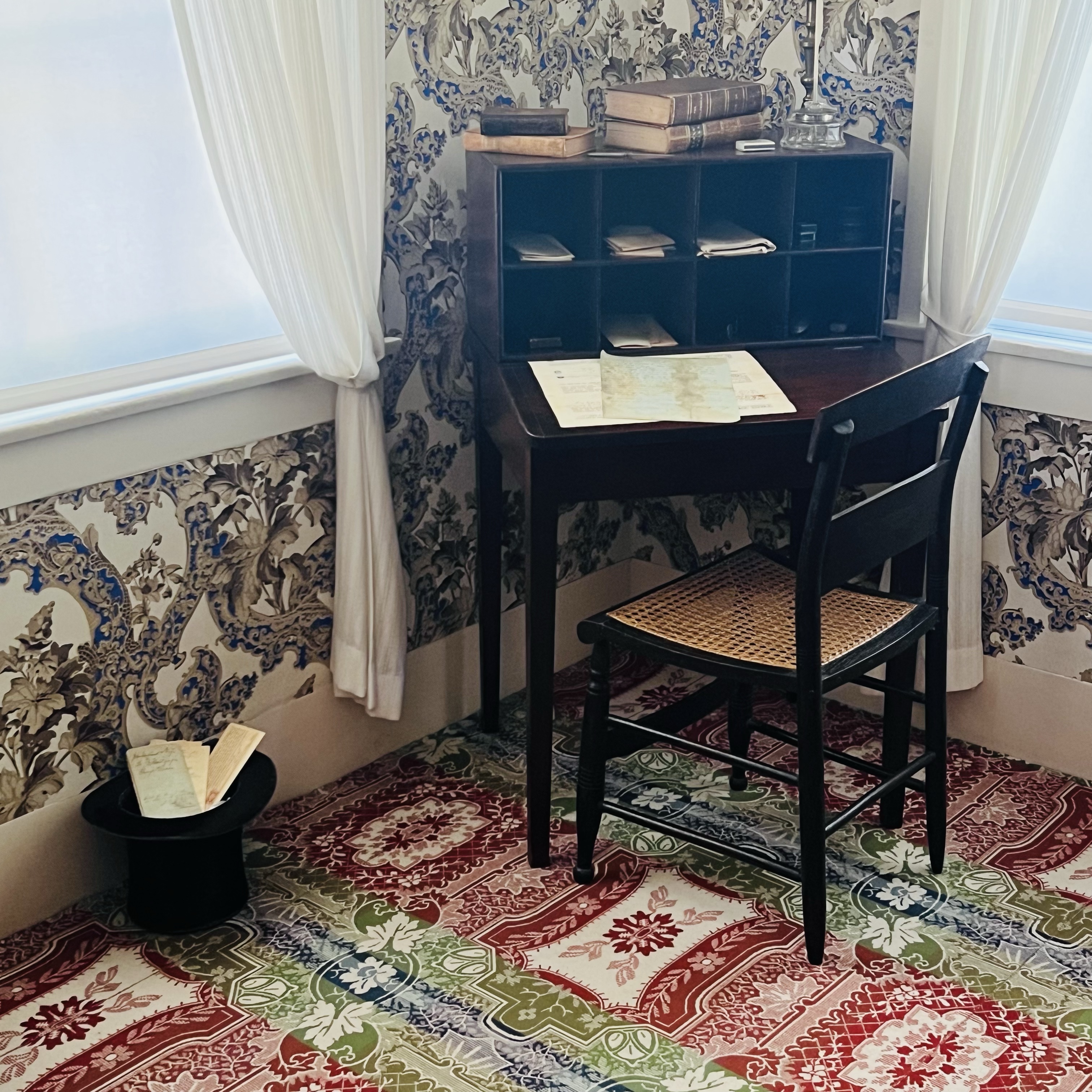
It was here in front of the fireplace in the sitting room that Lincoln was told that he was the Republican nominee for president. His life and the country would be changed forever.In Lincoln’s bedroom sits his writing desk. He loved this desk and it is believed that he wrote his “house divided” speech while sitting at this desk.
I have been to many endpoints of the members of the Donner Party: Alder Creek, Donner Lake, the Pioneer Monument, Johnson’s Ranch, Oak Hill Cemetery, and San Juan Bautista. And I have sketched them all. But I had never visited their starting point; until now.
The Pioneer Memorial is near the site of the Breen cabin, one of the Donner Party members. The monument lies near the eastern shore of Donner Lake.
Some of the key members of the party, the Donners and the Reeds, were wealthy residents of Springfield.
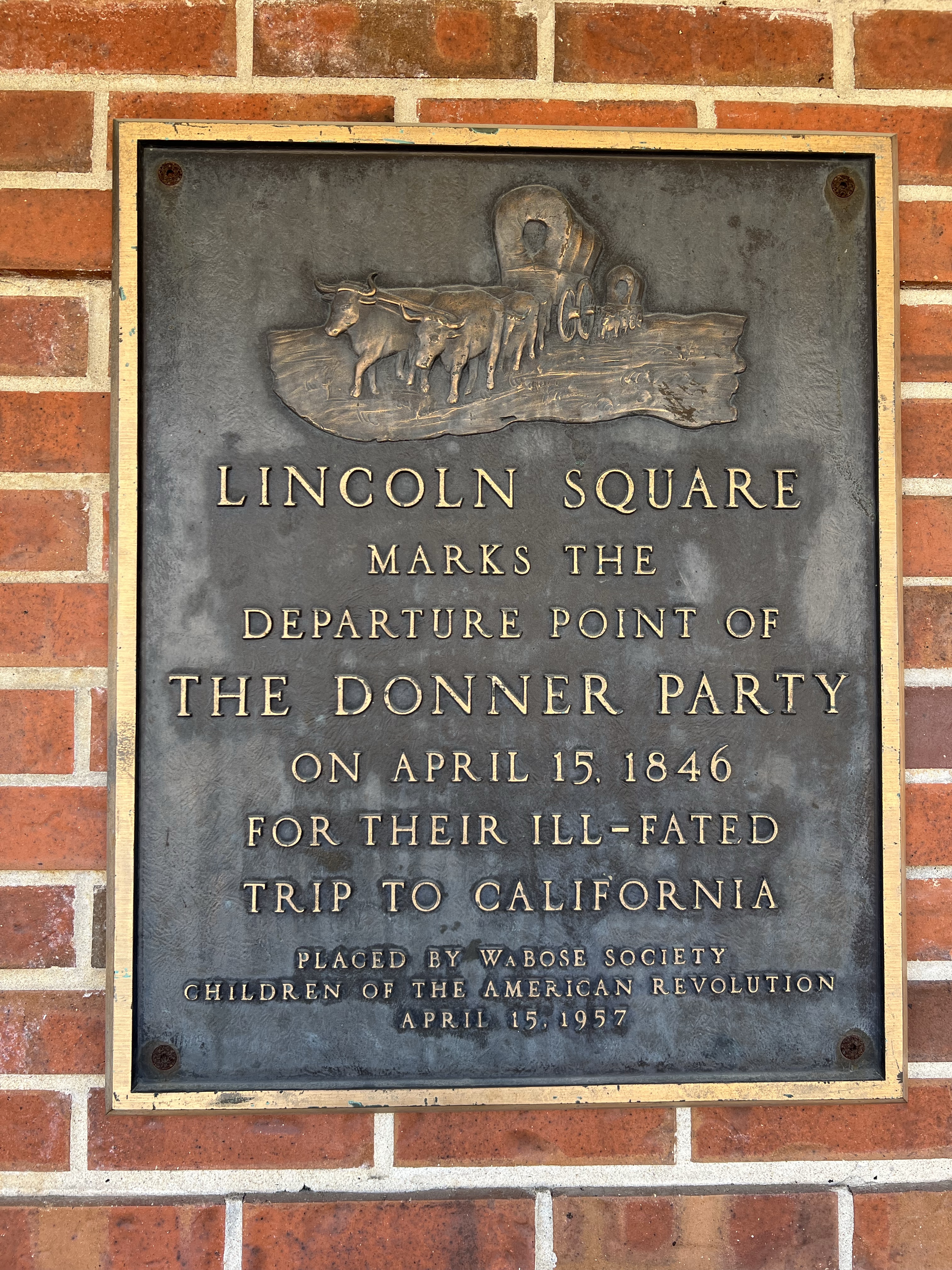
It is from the square near the Old State Capitol that about 90 members of a group of immigrants set out for California on April 15, 1846. The ill-fated group has gone down in history as the Donner Party.
The plaque commemorating the start of a very tragic journey.
I sketched from back the Old State Capitol, which is currently closed for restoration. The Donner plaque is on a building on the left of the sketch which is a stairway that leads to underground parking.
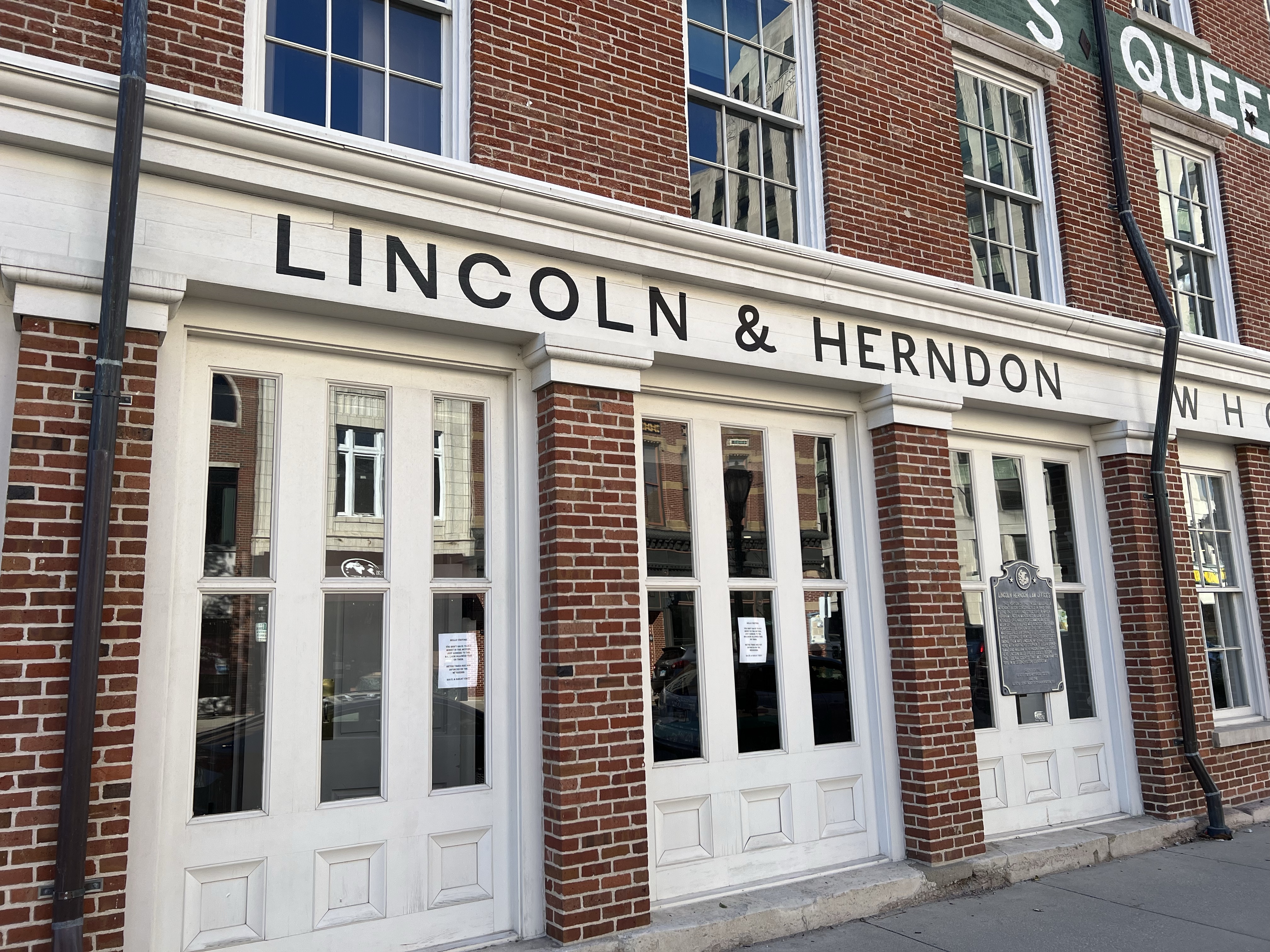
On the square is the law office of Lincoln & Herndon. Much more about one of these law partners in other posts.
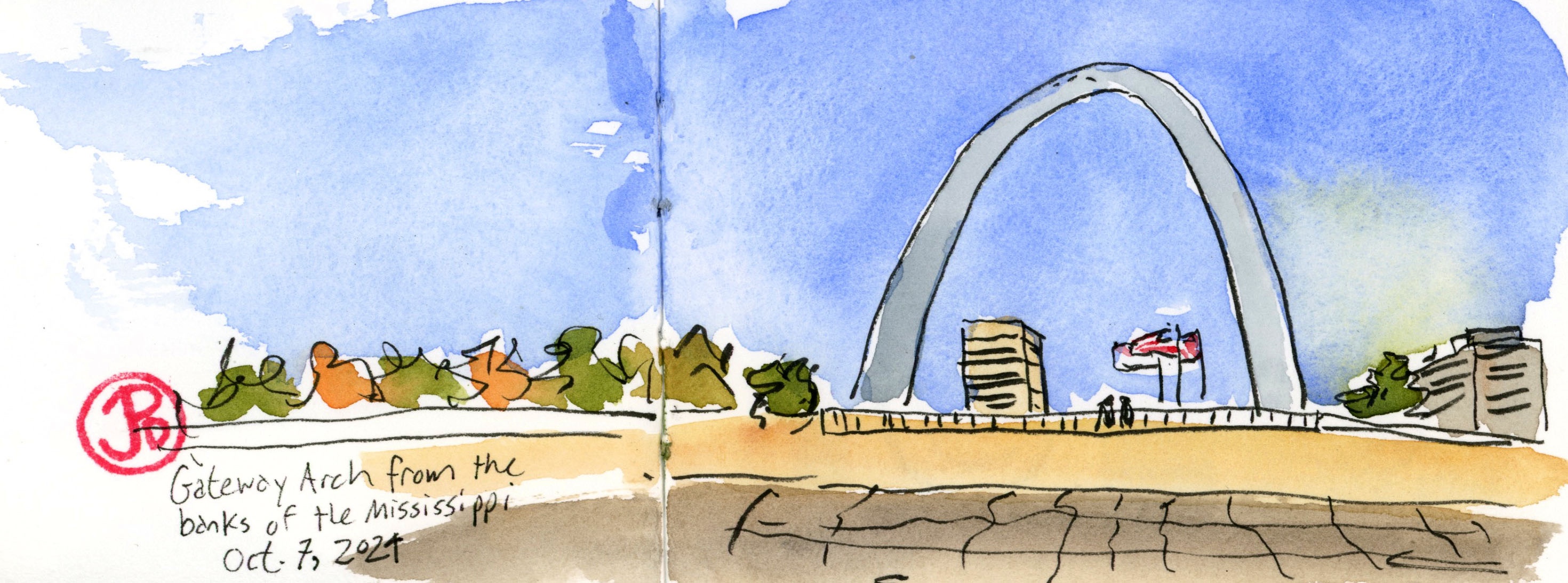
You can’t visit St. Louis without visiting (and sketching) it’s city symbol, the Gateway Arch.
And that’s what I did.
The arch was designed by Finnish architect Eero Saarinen when his design was selected in a competition. Construction started in February of 1963 and the arch was completed in October of 1965.
The arch signifies the beginning of the west as many explorers left from Missouri to California, Oregon and other points west.
I arrived well before my 9:20 ticket to the top to do some sketches of the Arch from different perspectives.
My shadow and the Gateway Arch from the Banks of the Mississippi. This was perfect sketching light.
At 630 feet tall, the arch is a perfect shape (and the largest arch in the world) and is an intriguing shape to sketch because walking 20 feet north or south, offers such a different perspectives. During my three hour visit I sketched the arch five times.
A sketch from the banks of the Mississippi in my “point and shoot” journal.
I headed to the victor’s center, I had a 9:20 ticket at the north span. I was a little early and I went in with the first group. Eight pods, seating five visitors each, rises to the apex of the arch. The pods are a tight fit, one visitor compared them to the pod in Mork and Mindy!
Once in, rubbing knees with total strangers, the door closed and we climbed to the top. The journey took about four minutes. This is definitely not a ride for the claustrophobic or anthrophobic!
At the apex there are viewing windows both east and west. To the east lies the Mississippi River and the State of Illinois. The view to the west is of downtown St. Louis where the shadow of the arch falls below at this time of the morning.
I was with the first group up to the top and with the rising sun behind us, the arch’s shadow enters the cityscape.
The views from the top were amazing in the morning light.
The mighty Mississippi looking towards the Land of Lincoln. The river is an important waterway for barge traffic.
I had to journey to the very edge of the 42 acres of the National Museum of Transportation to see the number one locomotive on my museum sketch list. (Ironically it the first locomotive I saw driving in from Barrett’s Station Road.)
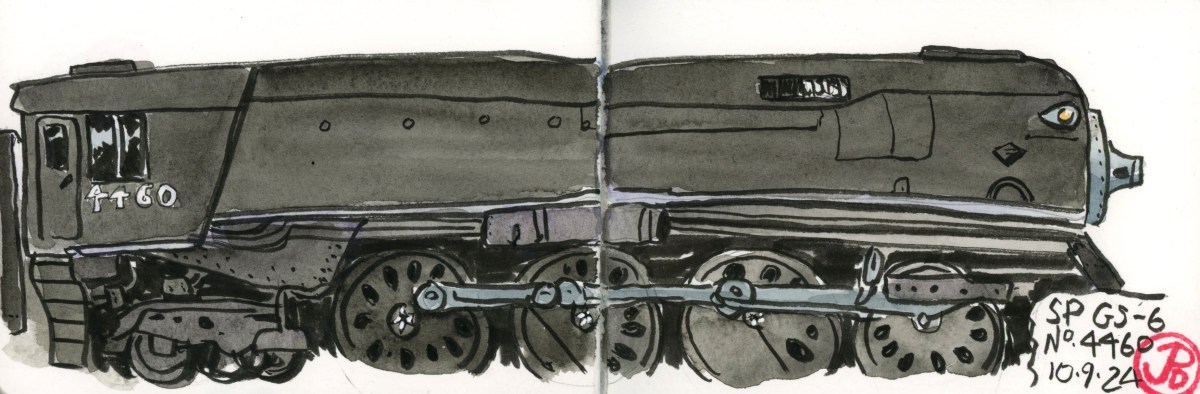
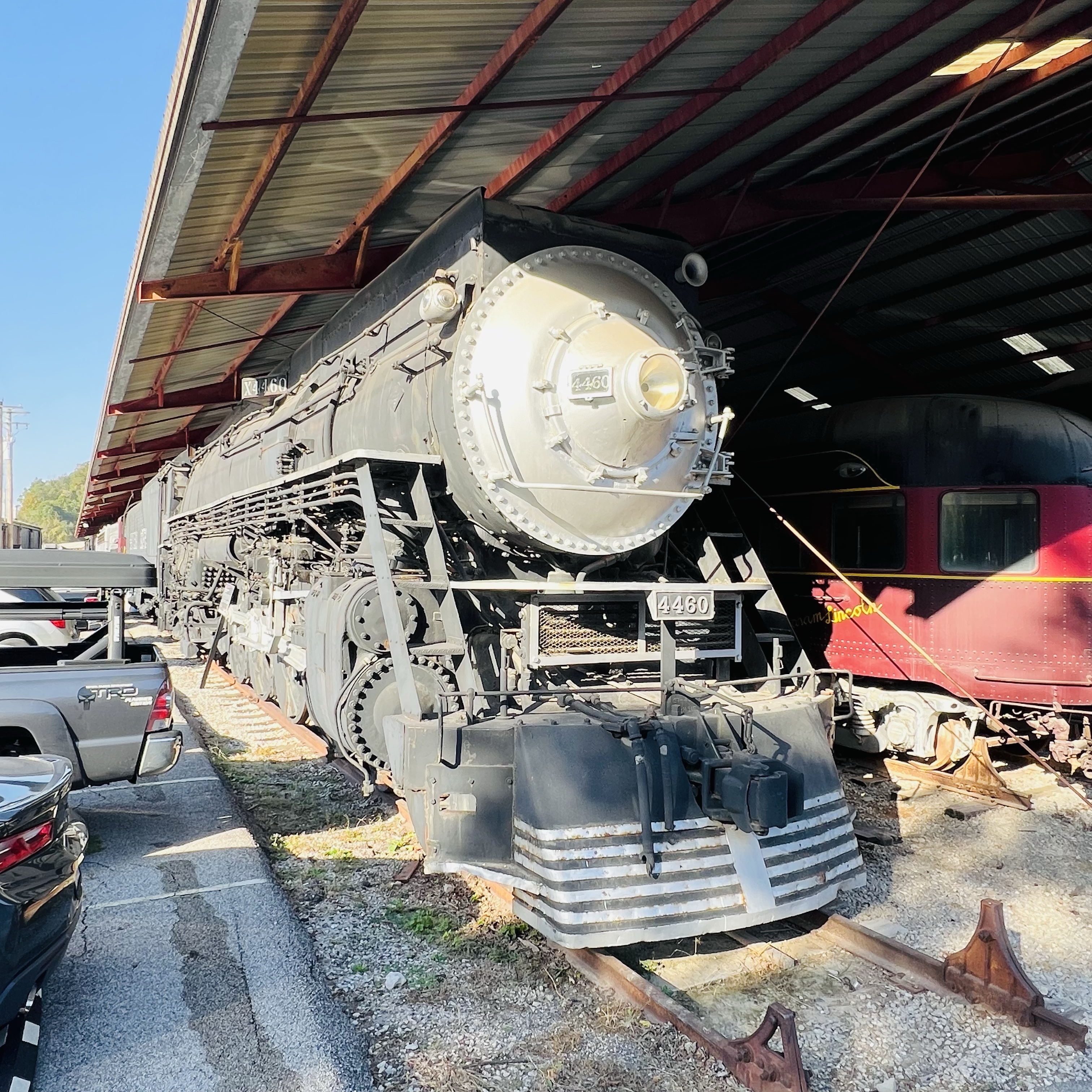
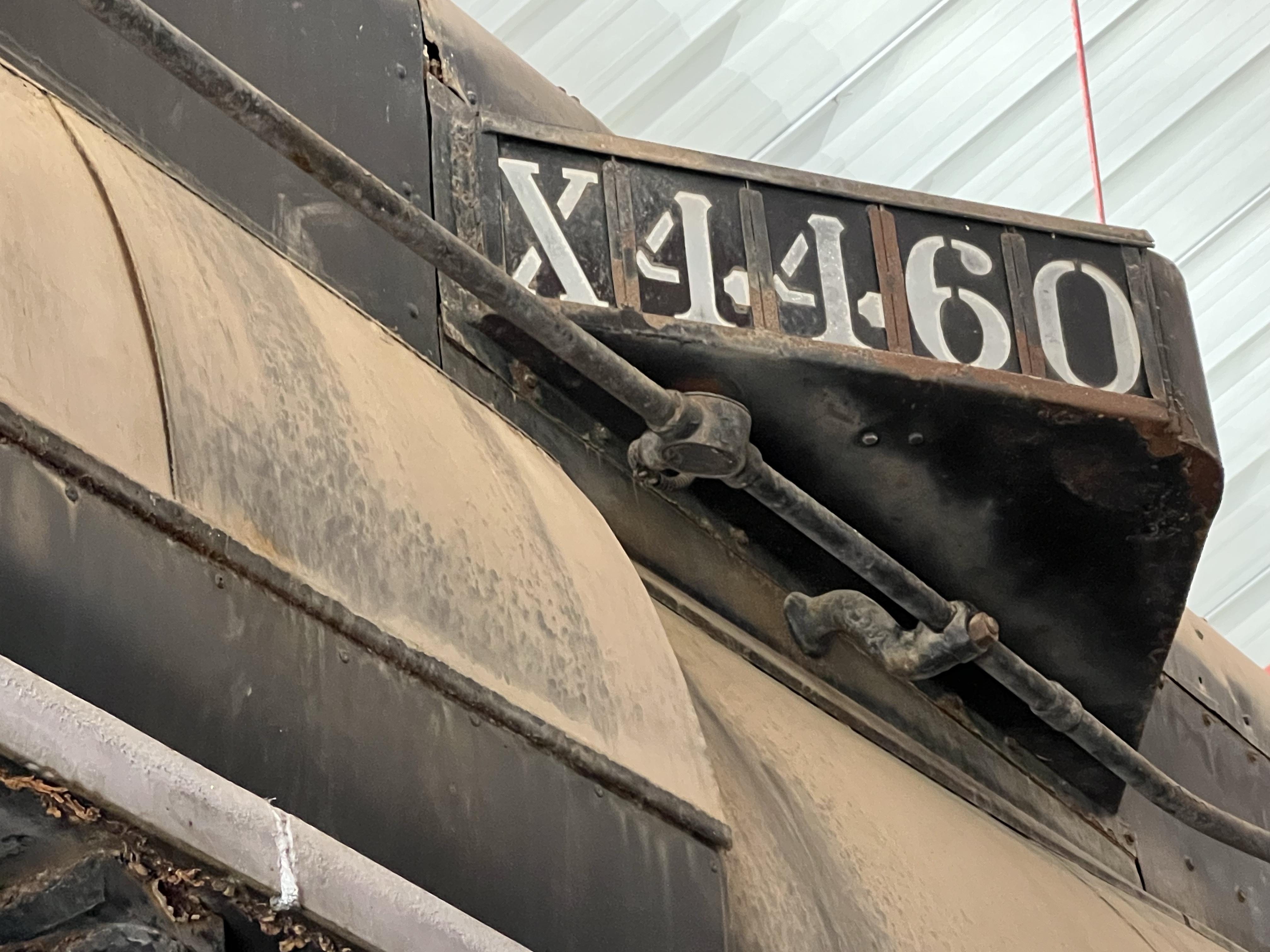
The Northern type 4-8-4 GS-6 (only ten were built) was in the far corner of the engine shed bordered by the employee parking lot. This was an unfortunate and sad location to display one of only two of Southern Pacific’s “Golden State” or “General Service” locomotives in existence.
Another name for 4460 is the “Forgotten Daylight” because it gets far less attention than her famous relative, GS-4 No. 4449. It’s placement in the corner of the engine shed, hemmed in by parked cars at the museum, gives a new meaning to the “Forgotten Daylight”.
No. 4460 with employee’s cars preventing you from getting a nice broadside view of the running gear.
The “War Baby” was built in 1943 by Lima and had to work within the limits of the War Production Board. The side skirting of the previous GSs was removed and the locomotive lacked the mars light of the GS-4, resembling the GS-2s. 4460 was the first GS-6 built at the Lima Locomotive Works in Lima Ohio. These locomotives could be used for passenger and freight trains.
4460 is the last steam locomotive operated by the Southern Pacific. In October 1958 the last run of an SP steam locomotive was between Sacramento and Sparks, Nevada over the famous Donner Pass. This was on a Goodbye to Steam excursion. 4460 ran to Sparks and then back to Sacramento, unassisted.
The iconic GS-6 was not scrapped like so many other steam locomotives but was donated to the Museum of Transportation in April of 1959.
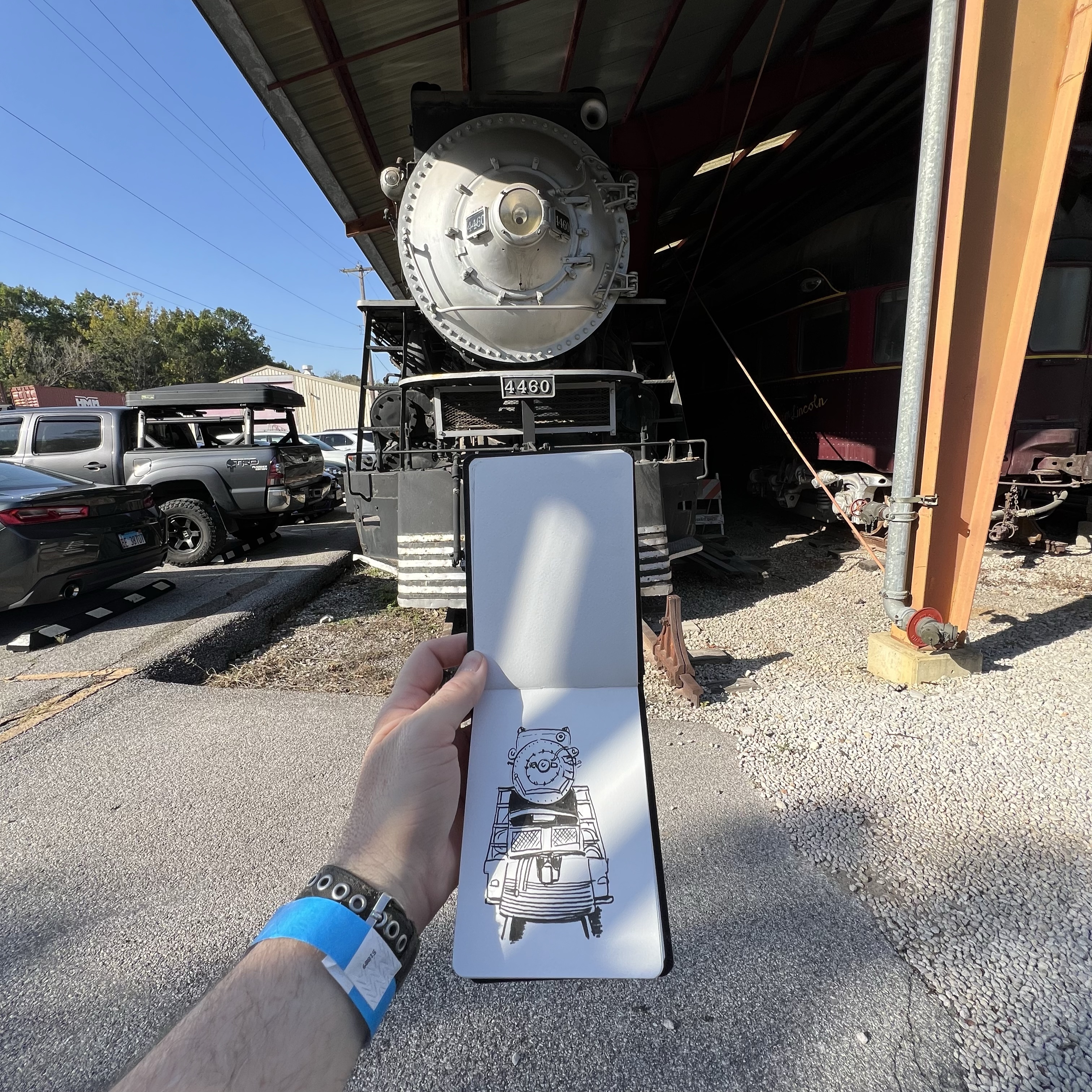
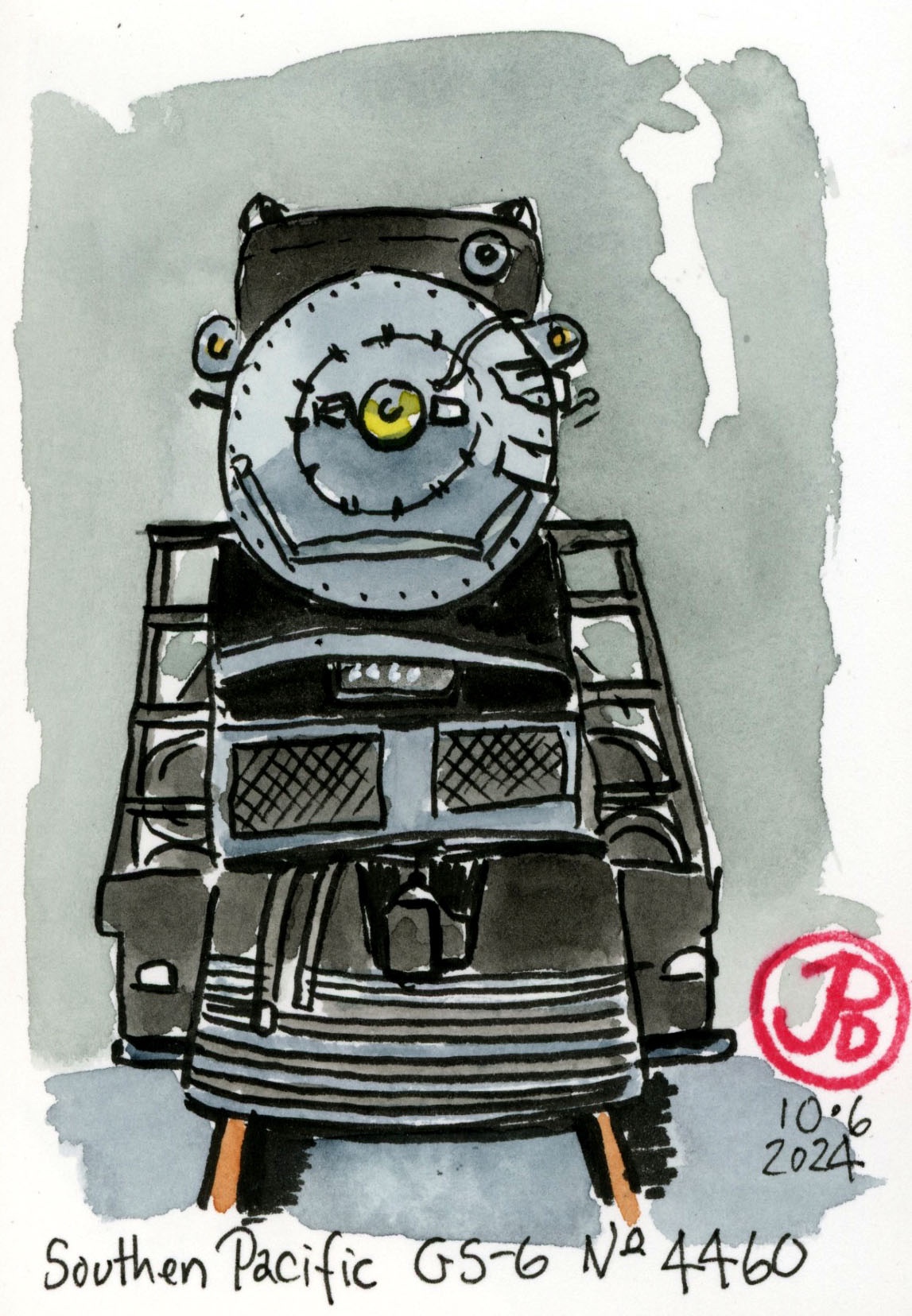
Sketch in progress at the NMOT. This was in my “point and shoot” Hahnemuhle 100% cotton sketchbook.The finished field sketch with watercolor.
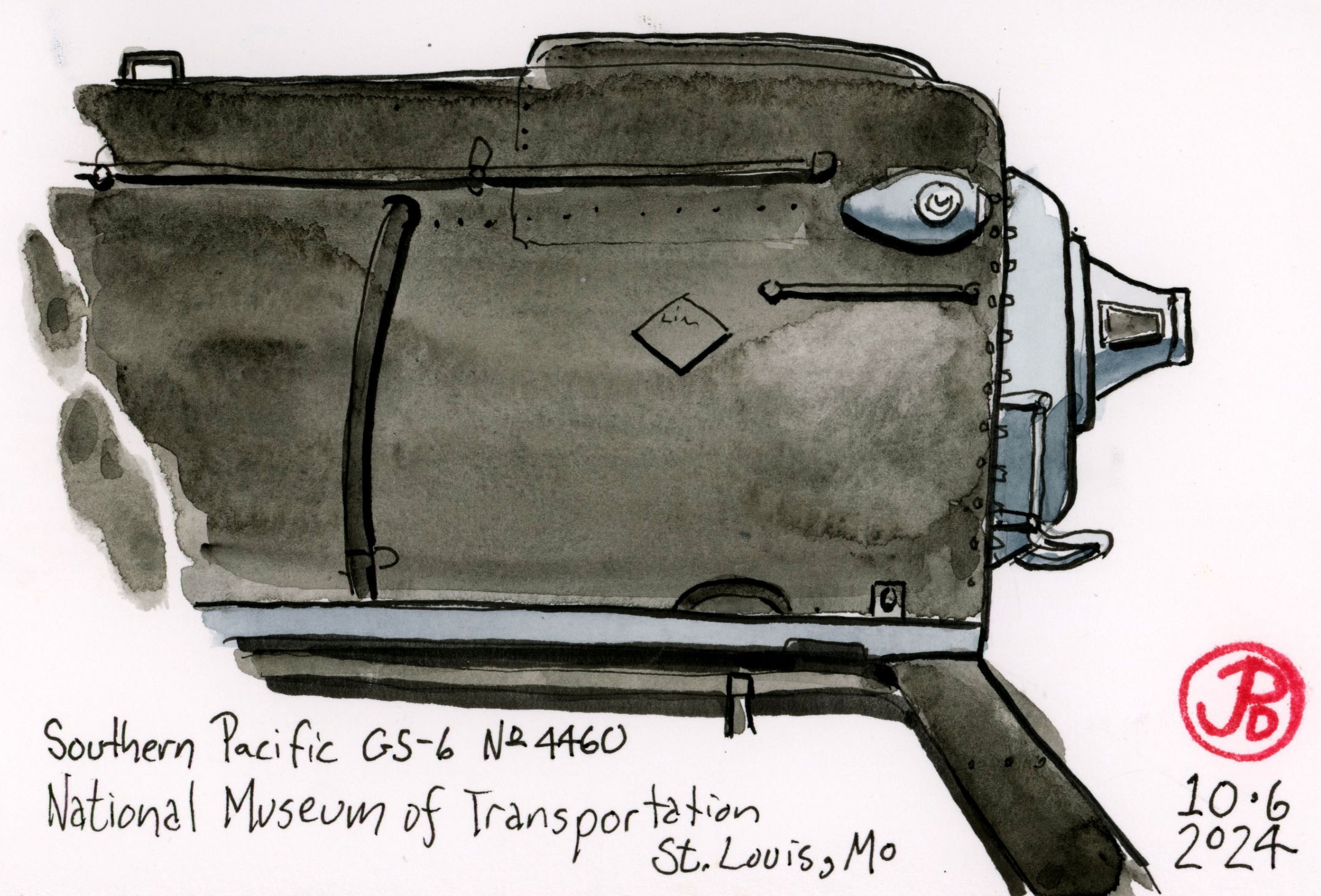
I also sketched 4460 in profile, focusing in on its classy smoke box and headlight.














 Corvid Sketcher