Image

Summit Fog Birding

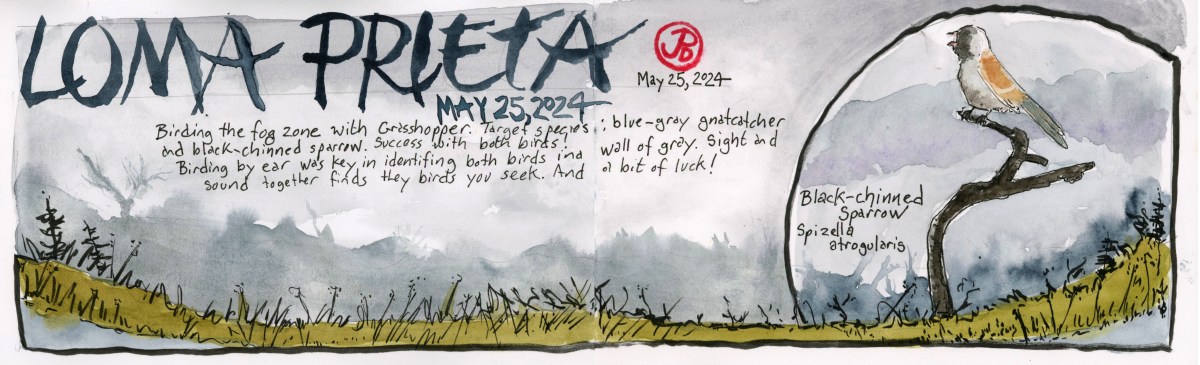
Early on a Saturday morning, Grasshopper and I headed up on winding Summit Road. Our birding destination the Bay Area birding hotspot: Loma Prieta and the “Saddles”.

About 10 miles in from Highway 17 the road devolves into a pock-marked rural ramble as it threads its way over the spine of the summit, defining the line between Santa Cruz and Santa Clara Counties. Near the junction with Loma Prieta Way the asphalt ends entirely and the graded dirt begins.
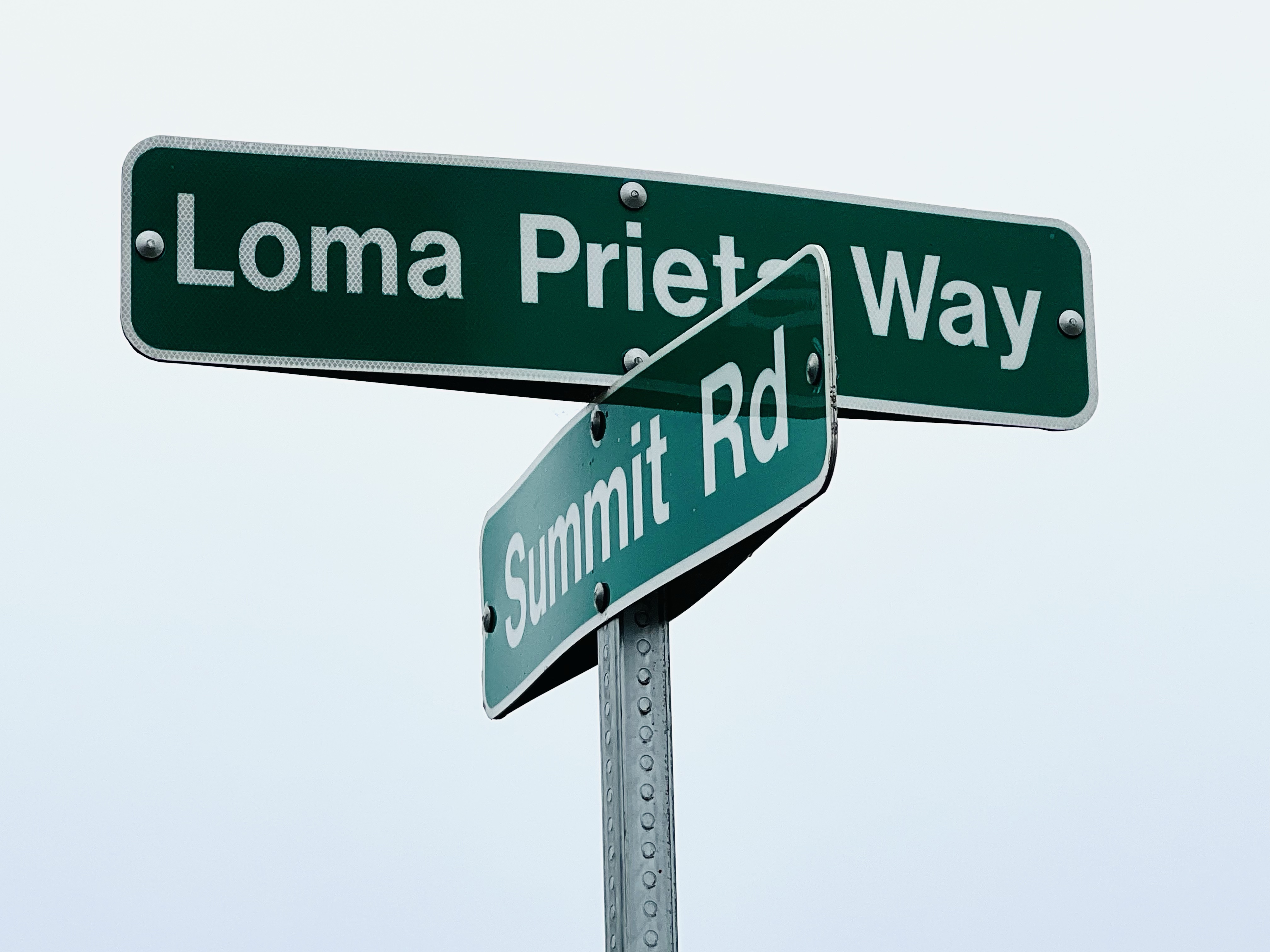
We parked in the dirt lot, light drizzle covering the windshield. This didn’t look like great birding weather. Wet, windy, with limited visibility. Would be able to pick out a blue-gray gnatcatcher or a black-chinned sparrow in these conditions? Both would be lifers for Grasshopper. And it was my goal to get him life birds number 321 and 322.
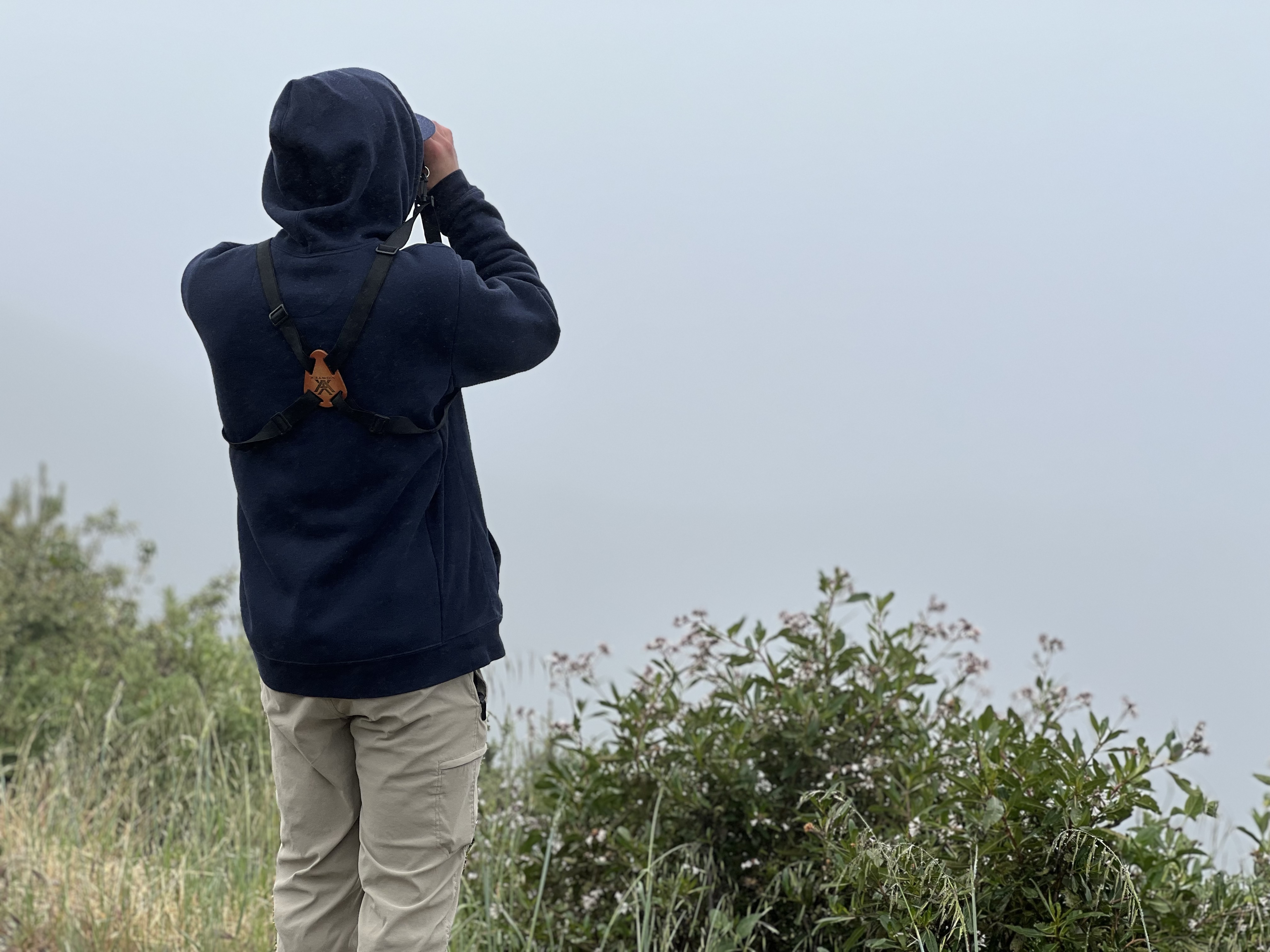
Grasshopper looking at water droplets.

We got out of the car, geared up, and surveyed the wall of grey to the west. I had a feeling we would be birding by ear, something Grasshopper can always get better at.

We headed down Loma Prieta Way stopping and listening as we went. Wrentits, spotted towhees, a far off California quail but none of our target birds, so we walked on. Luckily the damp, windy weather did not stop the birds from their spring songs.

After we were about a quarter of a mile down from the parking lot I heard something different, a cat-like mewing on the upslope. This was not the fooler Bewick’s wren (who had almost fooled me a few yards back) but one of our target birds!

Now we needed to get eyes on it. The younger eyes of Grasshopper found it out on a tree branch: blue-gray gnatcatcher!

After getting so-so looks of the energetic gnatcatcher, we headed a little further down and I first heard our second target bird far up the hill. An accelerated bouncing ball of a song.

I willed the bird down by saying a little prayer to the Birding Gods and soon enough the sparrow flew over the road and landed downslope on a charred snag. Our binos swung up and we enjoyed prolonged views of a singing male black-chinned sparrow!
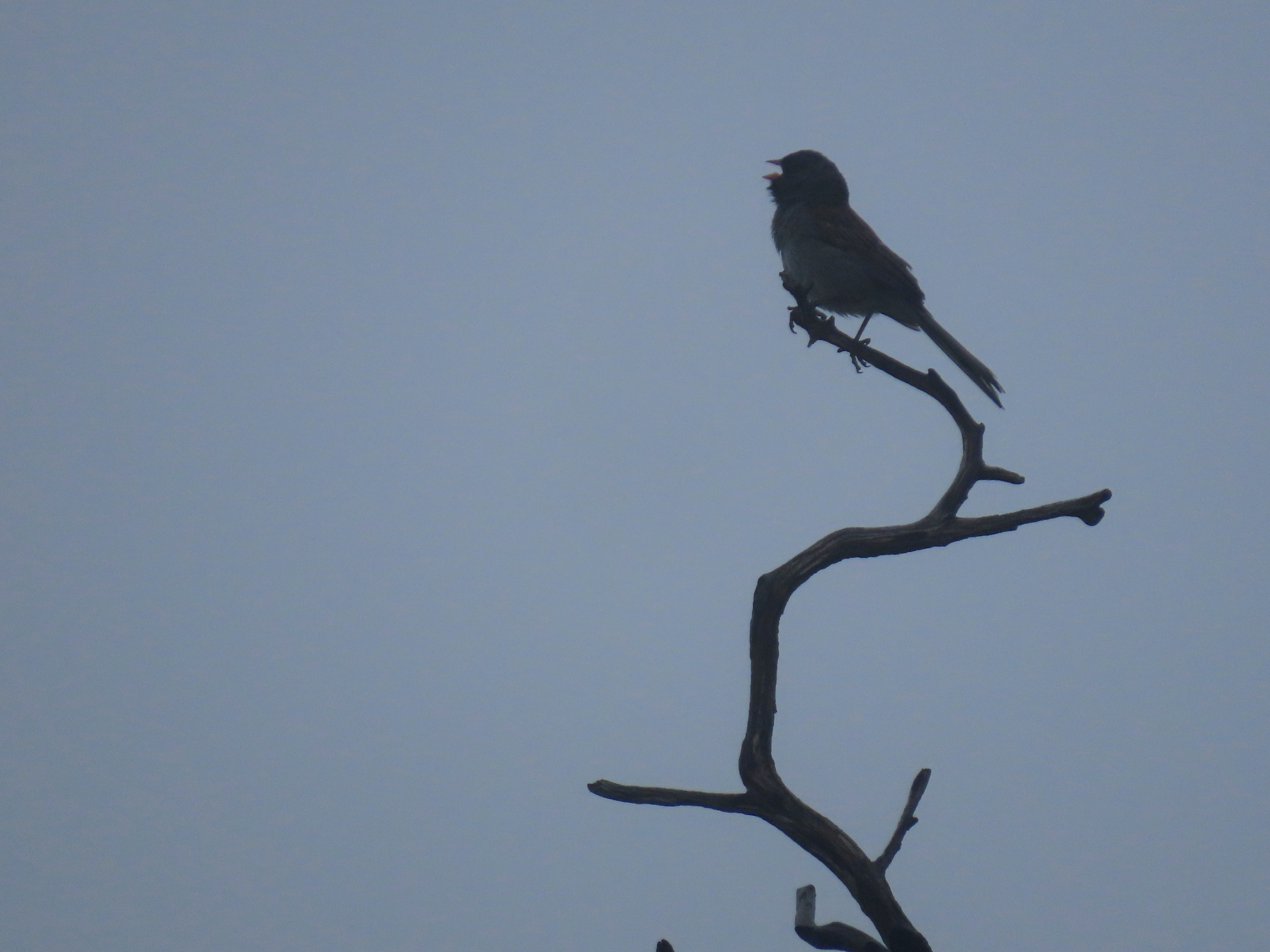
The foggy silhouette of one of our main targets: the black-chinned sparrow singing on a burnt snag. The black-chinned is an early adopter of burnt out areas.

Lifer number two for Grasshopper!

By this time we were coated with dizzily dampness and we headed back up to the parking lot. On the way up Grasshopper saw birds flying below the road. It was a pair of lazuli buntings! This is not a lifer for me or Grasshopper, but it has been a while since I have seen or heard this neotropic migrant.
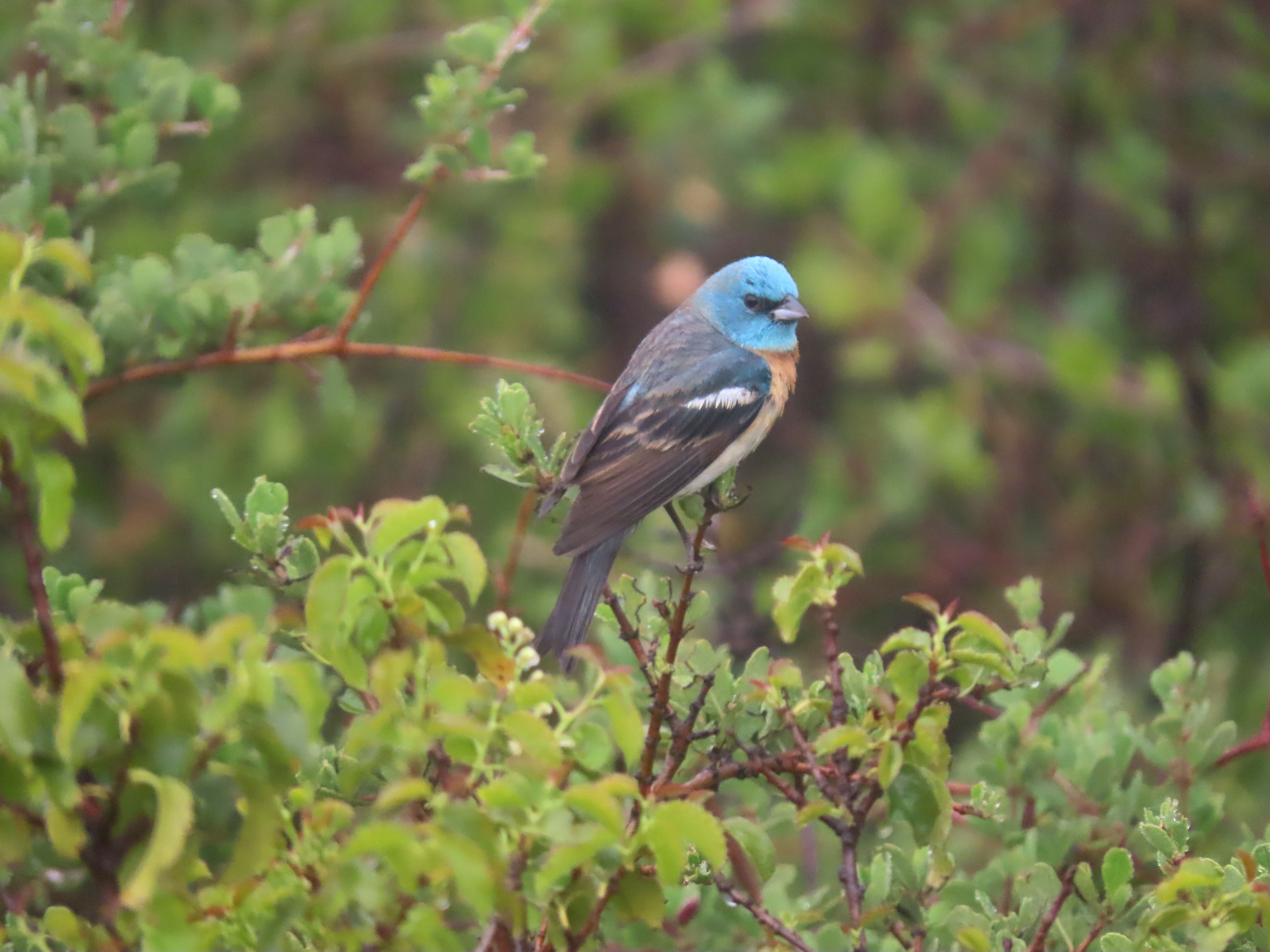
A stunning male lazuli bunting. I never get tired of seeing and hearing this bird.

This is why birding remains a passion for me. I’m still excited to see and hear birds that I have seen many times before but the excitement remains.

And so it will always remain.
Image

Montgomery at the Hiller

After sketching in Evergreen, I headed north up the Peninsula to San Carlos. My destination: the Hiller Aviation Museum.

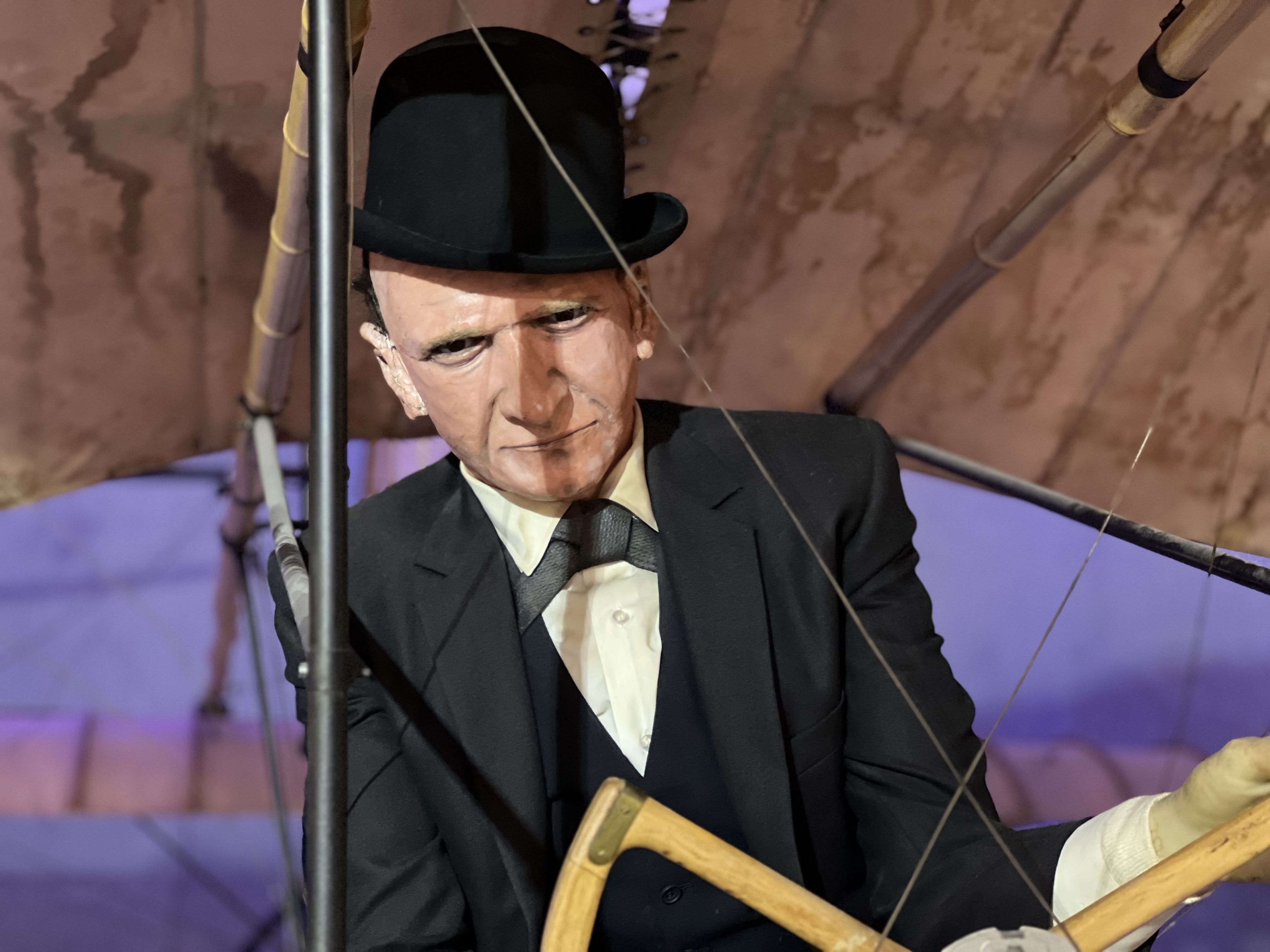
I was here to see and sketch three gliders and look at a plaque. The three gliders are replicas of the Gull, Santa Clara, and Evergreen, all designed by John J. Montgomery. Two are suspended from the ceiling and the Evergreen sits in a dark corner with a dubious mannequin, representing John Montgomery, sitting at the controls.

The odd mannequin of John Montgomery really looks like he’s three sheets to the wind!

The plaque sits off to the left of the replica of the Evergreen and mannequin. I have seen a plaque like this before, last fall in Roanoke, Virginia and also at the California State Railroad Museum in Sacramento.

The plaque in Roanoke honored the engineering achievements of Norfolk and Western’s J-Class No. 611. The plaque at the Hiller, by the American Society of Mechanical Engineers, designates the glider as an International Historic Mechanical Engineering Landmark. The plaque reads:

Montgomery Glider

1883

This replica represents the first heavier-than-air craft to achieve controlled, piloted flight. The glider’s design was based on the pioneering aerodynamic theories and experimental procedures of John Joseph Montgomery (1858-1911), who designed, built, and flew it. This glider was way ahead of its time, incorporating a single parabolic, cambered wing, with stabilizing and control surfaces at the rear of the fuselage, with his glider’s success, Montgomery demonstrated aerodynamic principles and designs fundamental to modern aircraft.

The plaques placement is a bit unfortunate because it actually refers to the Gull, which hangs above and not the Evergreen (the curator I talked to admitted that this part of the museum has been neglected).

John Montgomery was a true Californian, born in Yuba City. He was many things in the Golden State: inventor, pilot, engineer, physicist, and a professor at Santa Clara University.

He studied the soaring flight of hawks, eagles, pelicans, turkey vultures, and gulls around San Diego Bay and further inland and then tried to design his gliders influenced by nature’s own design. He referred to birds as, “tutors in the art of flying”. Montgomery put this understanding the flight of birds with creating a heavier than air glider this way, “It has always seemed to me that the secret of aerial navigation lay in the discovery of the principle of bird’s flight.”

In 1883 the flying professor made pioneering flights near the Mexican border at Otay Mesa. His flights lasted up to 600 feet. He had not yet learned how to design a glider that could soar upwards like a turkey vulture.

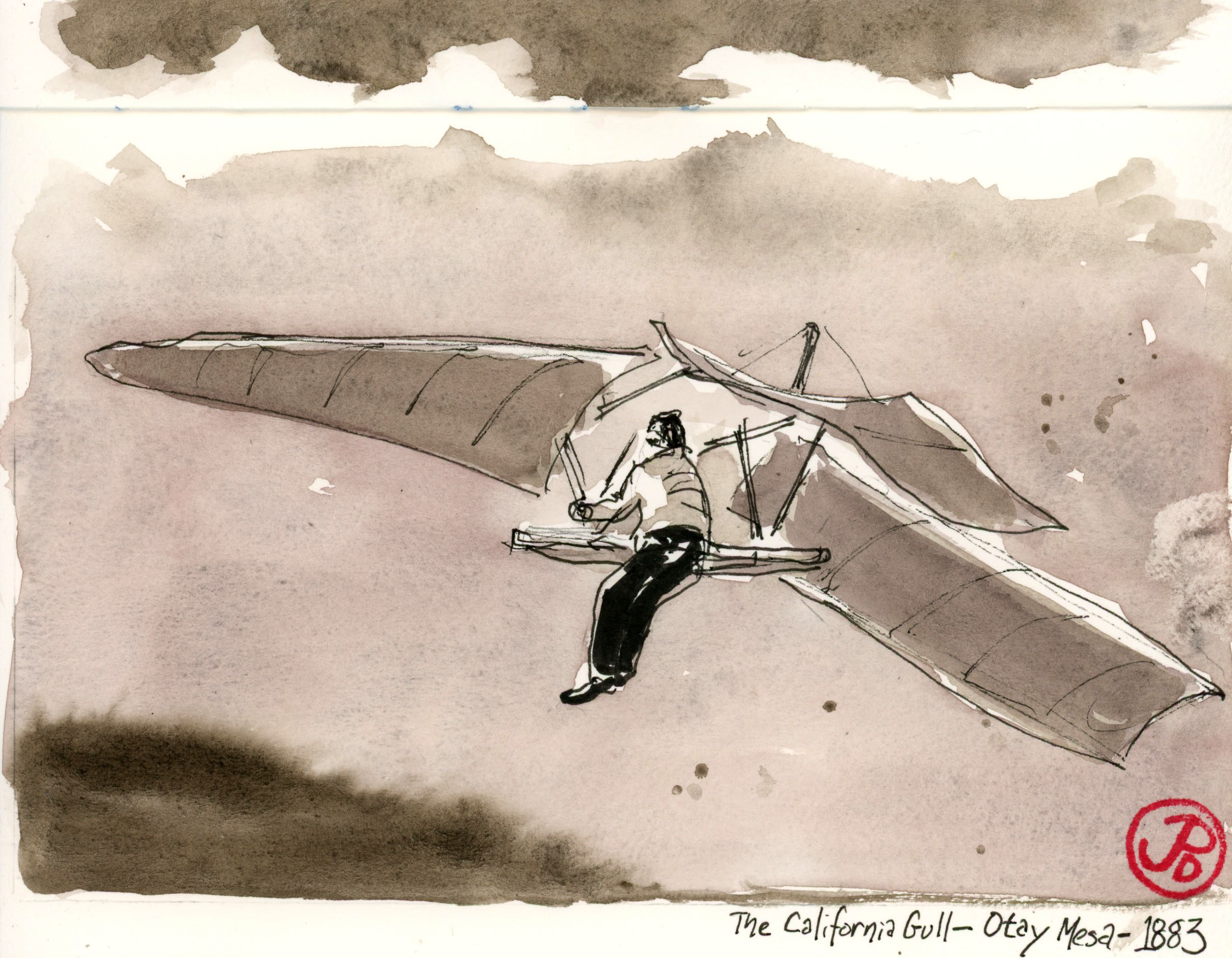
Here he flew the Gull, the replica now hangs in the Hiller Aviation Museum.

So I did a loose sketch of the Gull.

I chose to sketched the Gull loosely with another mannequin of Montgomery (as a younger man) perched uncomfortably on the glider’s “saddle”. I left out all the other aircraft around it and used my artistic license to add the setting: Otay Mesa.
Image

Professor John Montgomery and Evergreen

Previously I had written about aviation history above the skies of Aptos on the Monterey Bay. The man who designed the glider was a Professor John L. Montgomery.

Montgomery had a long history of flight development in California. He is overshadowed by aviation developments in Europe and on the East Coast. And his accomplishments are eclipsed by the Wright Brothers, who must have had a better PR man.

There are a few reasons for this. Montgomery had trouble securing patients for his flight inventions and being far away on the west coast and far from the national media in New York and Boston meant that his exploits didn’t get the same coverage as the Wrights. Even though he flew a glider 20 years before the famous Wright Brothers.

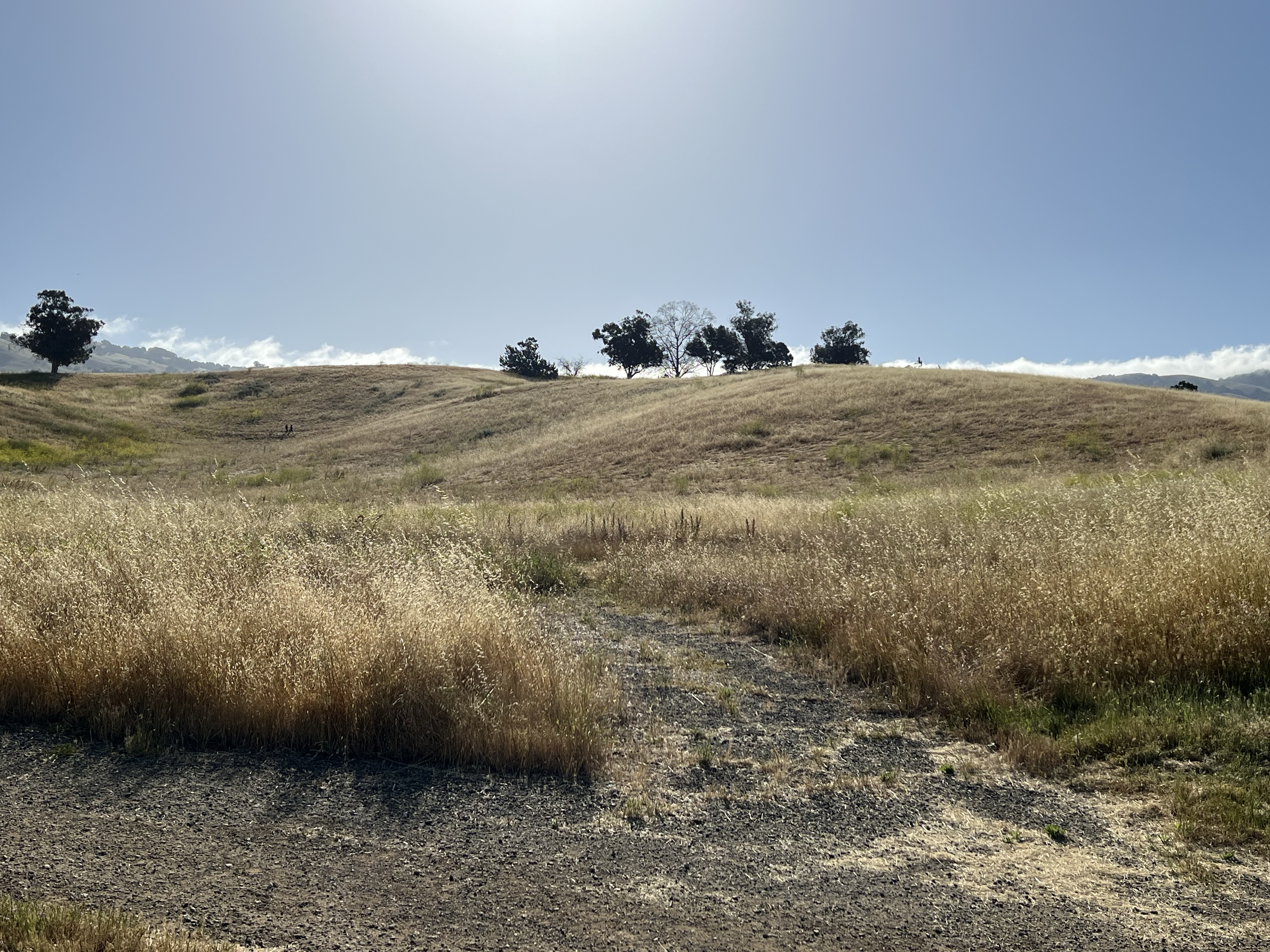
I wanted to visit and sketch the hillside where be flew his last glider. This is in the Evergreen neighborhood of East San Jose. The hillside is now named Montgomery Hill in his honor and is behind present day, Evergreen Valley College.

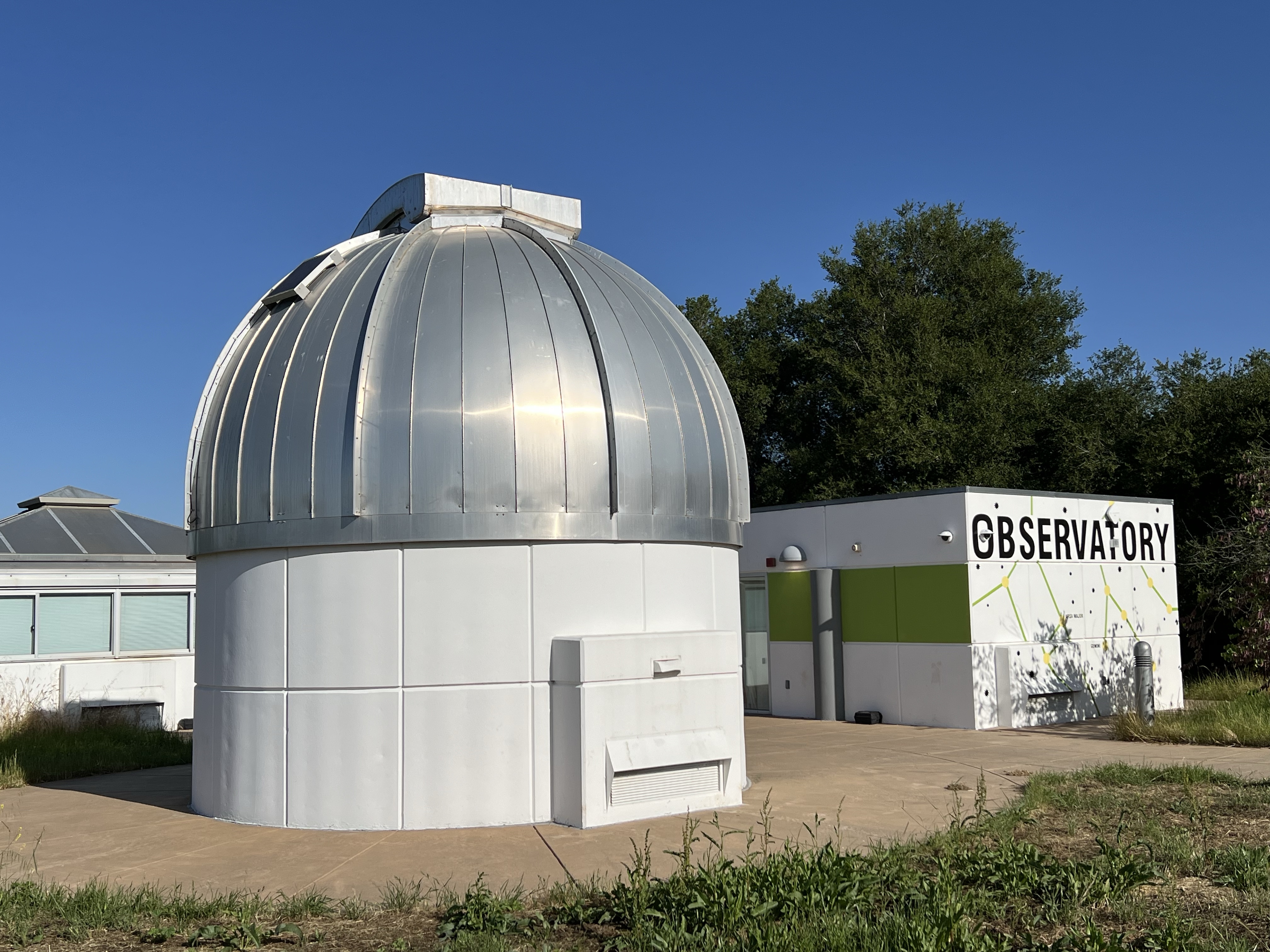
I arrived at the collage early on Sunday morning, free parking! My plan was to walk up to the observatory and sketch Montgomery Hill.

The Observatory at Evergreen Valley College.

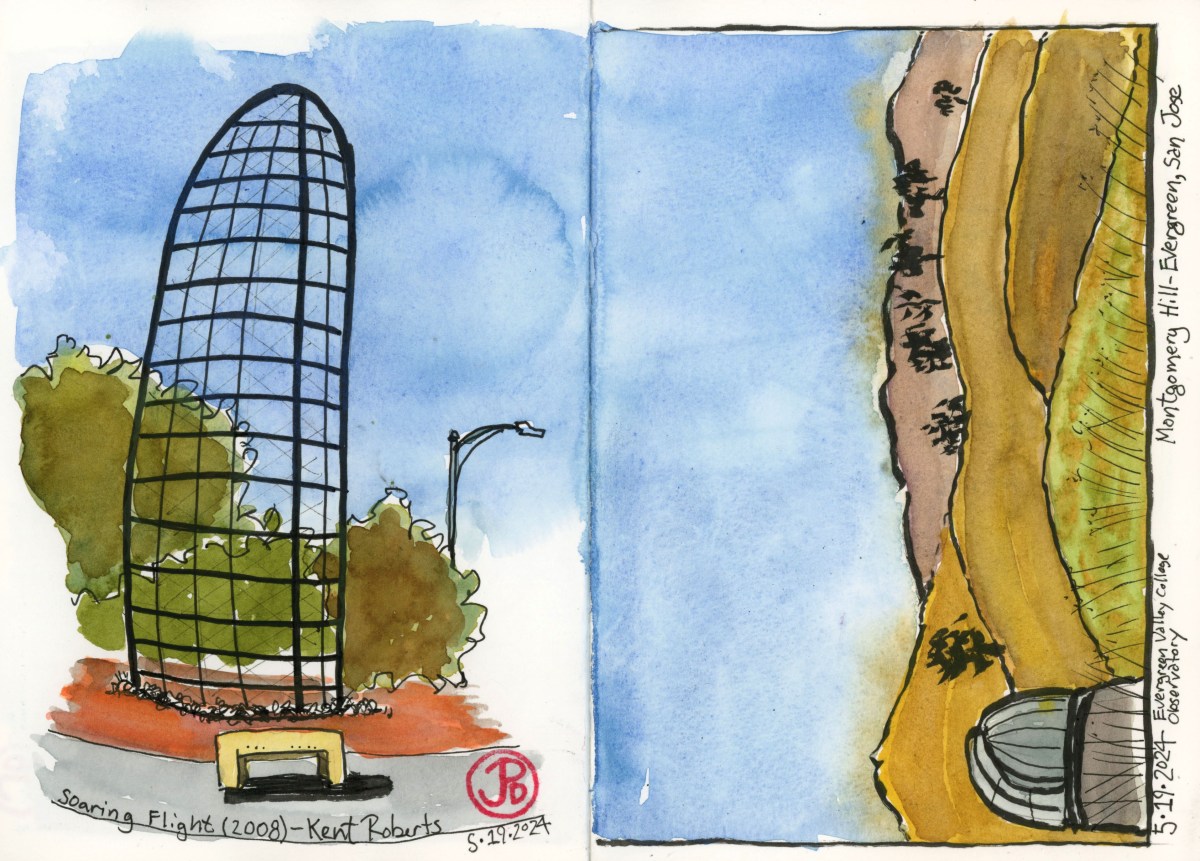
I positioned myself so I could sketch the dome of the observatory in the foreground and the hill that stretched off into the distance (featured sketch right).

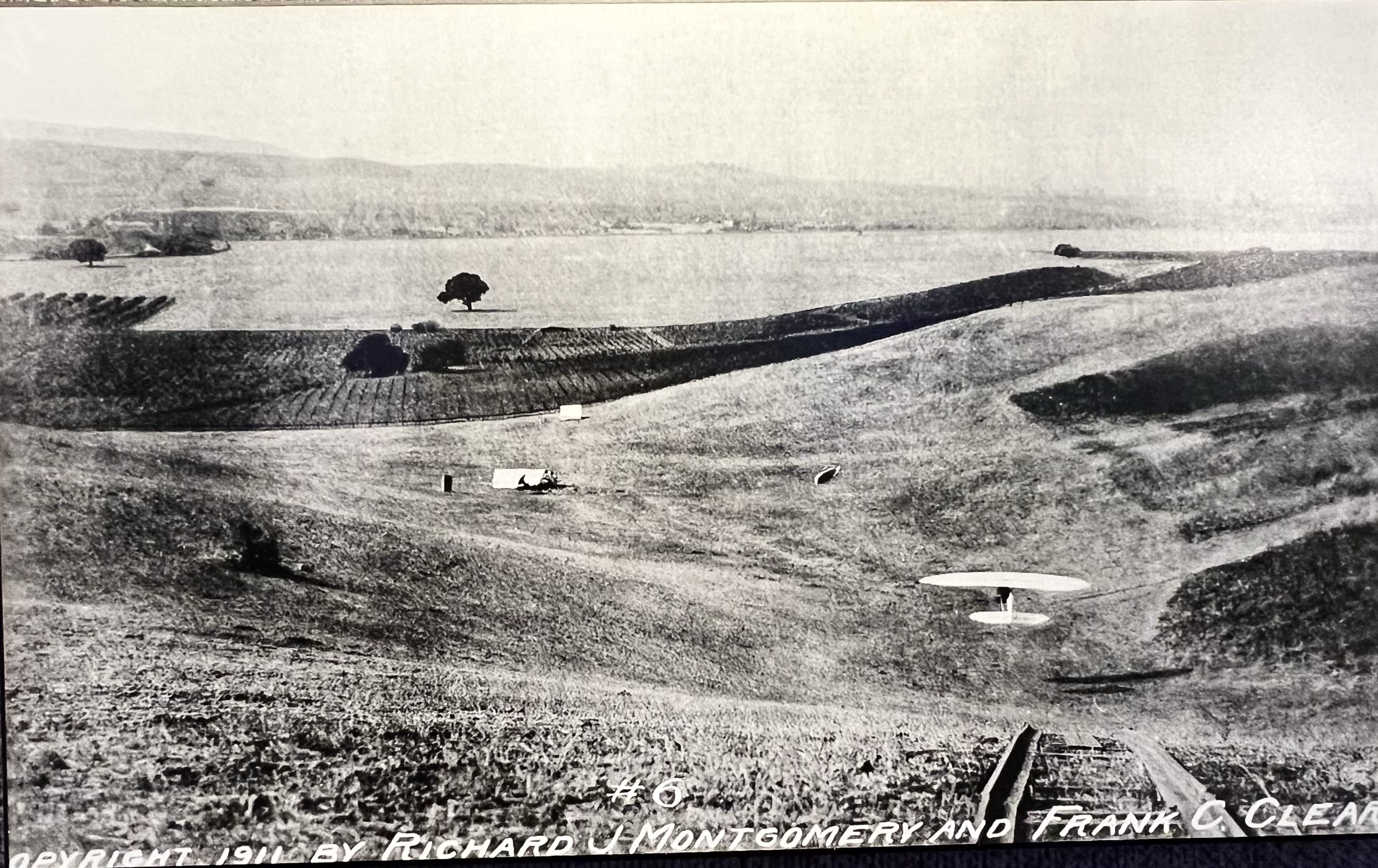
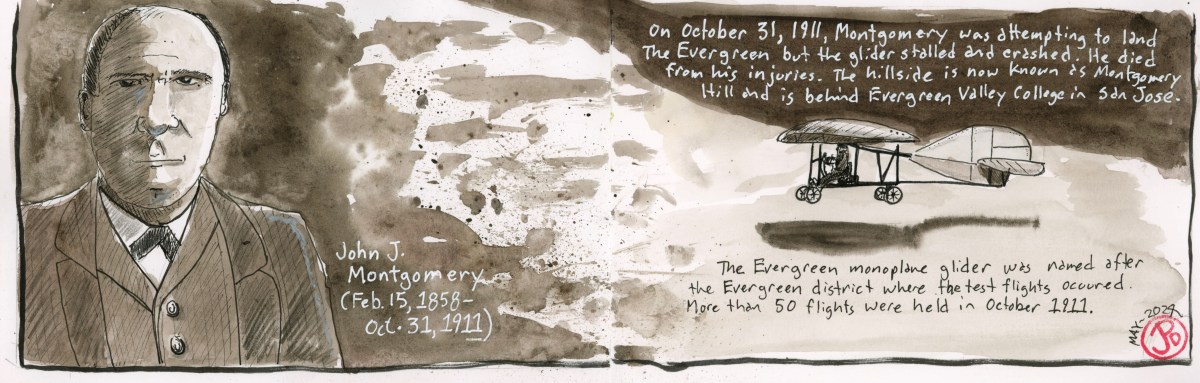
The hill before me was where Montgomery did many test flights with the glider her designed. The glider was named after this area: Evergreen.

A 1911 photograph of Montgomery flying the Evergreen, shortly before his death. The location is now called Montgomery Hill.

In was on this hill on October 31, 1911, that Professor Montgomery crashed his glider Evergreen, and died of his injuries. He was 53 years old.

Montgomery Hill, the sight of Montgomery’s last flight.

John J. Montgomery is starting to get the recognition in aviation history that he so rightly deserves. In the Evergreen neighborhood at the intersection of San Felipe and Yerba Buena, there is a 30 foot wing that stretches up to the sky (featured sketch).

This Public art is titled “Soaring Flight” (2008) by artist Kent Roberts.

On an interesting side note, sculptor Kent Roberts (1947-2019) was a Bay Area artist. Before attending the San Francisco Art Institute, he served as an officer in the US Navy aboard an aircraft carrier. The ship’s name: the USS Kitty Hawk.

Uncanny.

Image

Coloma 2024

For eight years I have been part of my school’s ultimate overnight field trip to Coloma.

Coloma is the epicenter of California’s Gold Rush. It was in the tailrace of Sutter’s Mill, on January 24, 1848, that James Marshall “discovered” gold.

And the world rushed in to California, changing the state, country, and the world forever!

So in early May, two coaches carried 66 fourth graders, 18 parent chaperones, and three teachers on the three hour journey to the Gold Country!

This overnight trip is a lot of work. The paperwork, medical forms, medications, student group spreadsheets, and unexpected last minute changes make this trip a bit stressful.

But once we are on our way and we see our student’s journey from a Greenhorn to becoming a Sourdough miner, in the end I realize that creating one of their best elementary school memories, is really worth the blood, sweat, and fears.

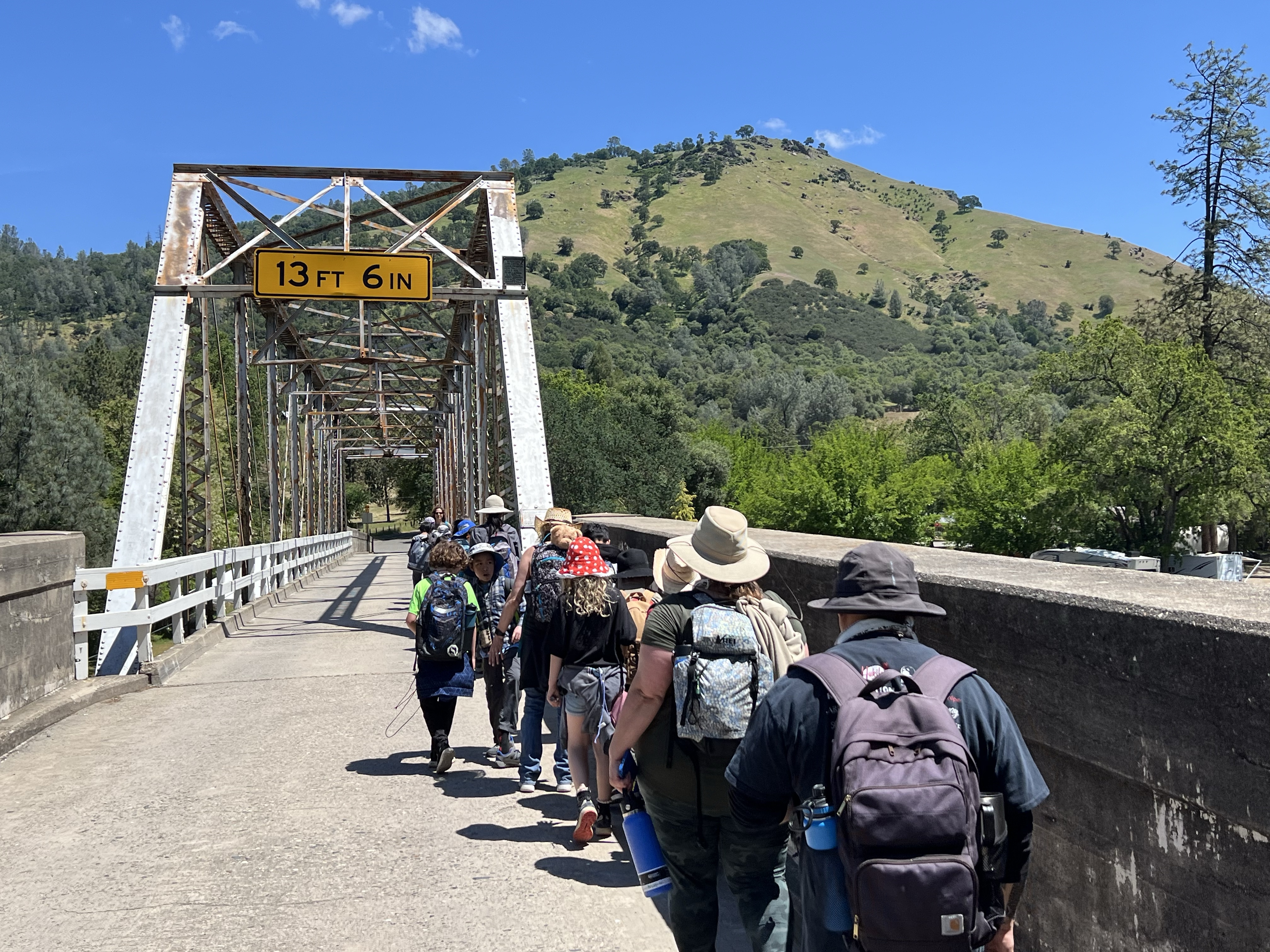
Our Gold Rush town heading back to camp with Mt. Murphy in the background.

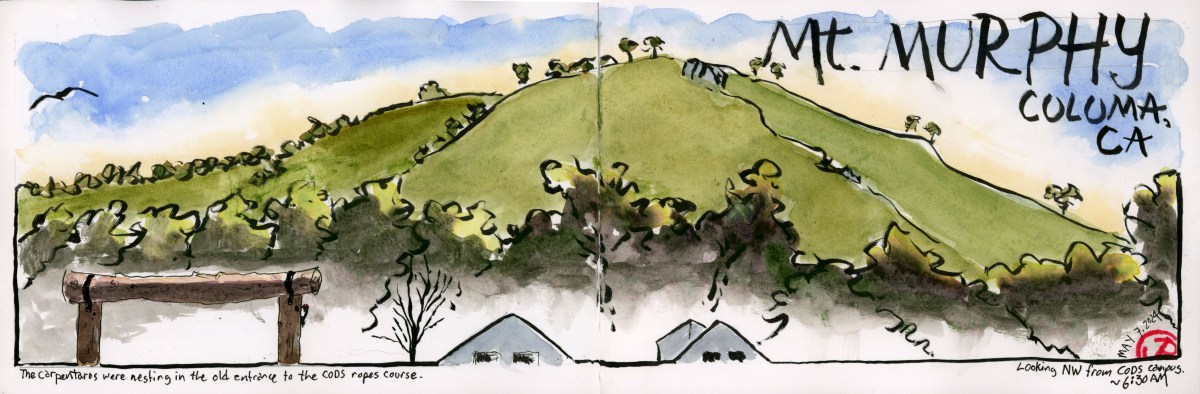
In the Gold County I’m an early riser and one way I get centered and prepare for a day full with students is to do an early morning sketch (featured sketch). A morning meditation.

This time I turned my sketchbook to the northeast toward the tallest peak around: Mount Murphy (elevation 1,932 feet).

I wanted to include the wooden gate that was once the entrance to the ropes course but is now the site of an acorn woodpecker nesting hole.

A female acorn woodpecker perched on the gate. The nest hole is on a vertical support off to the right.
Image

First Flights Over Aptos

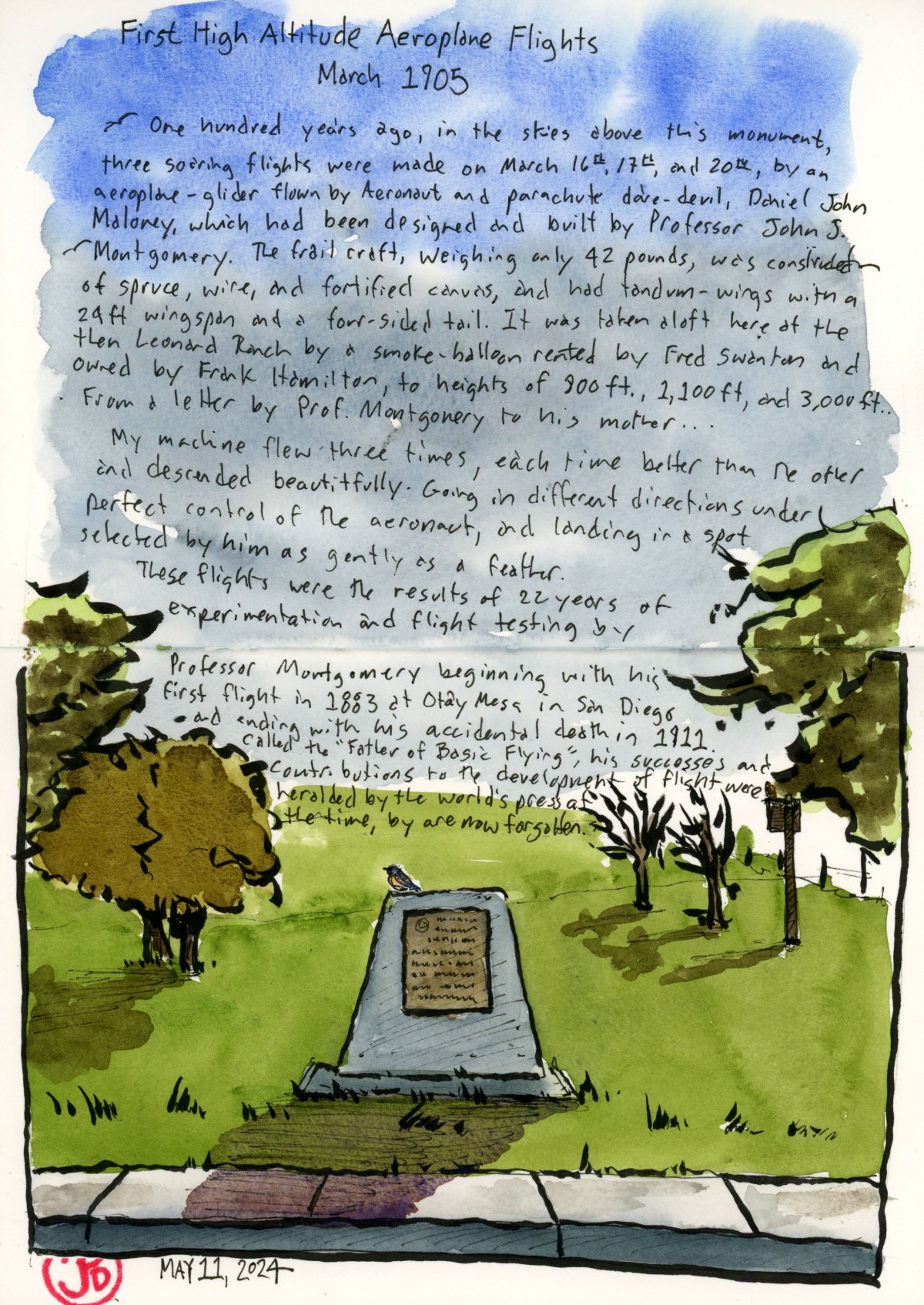
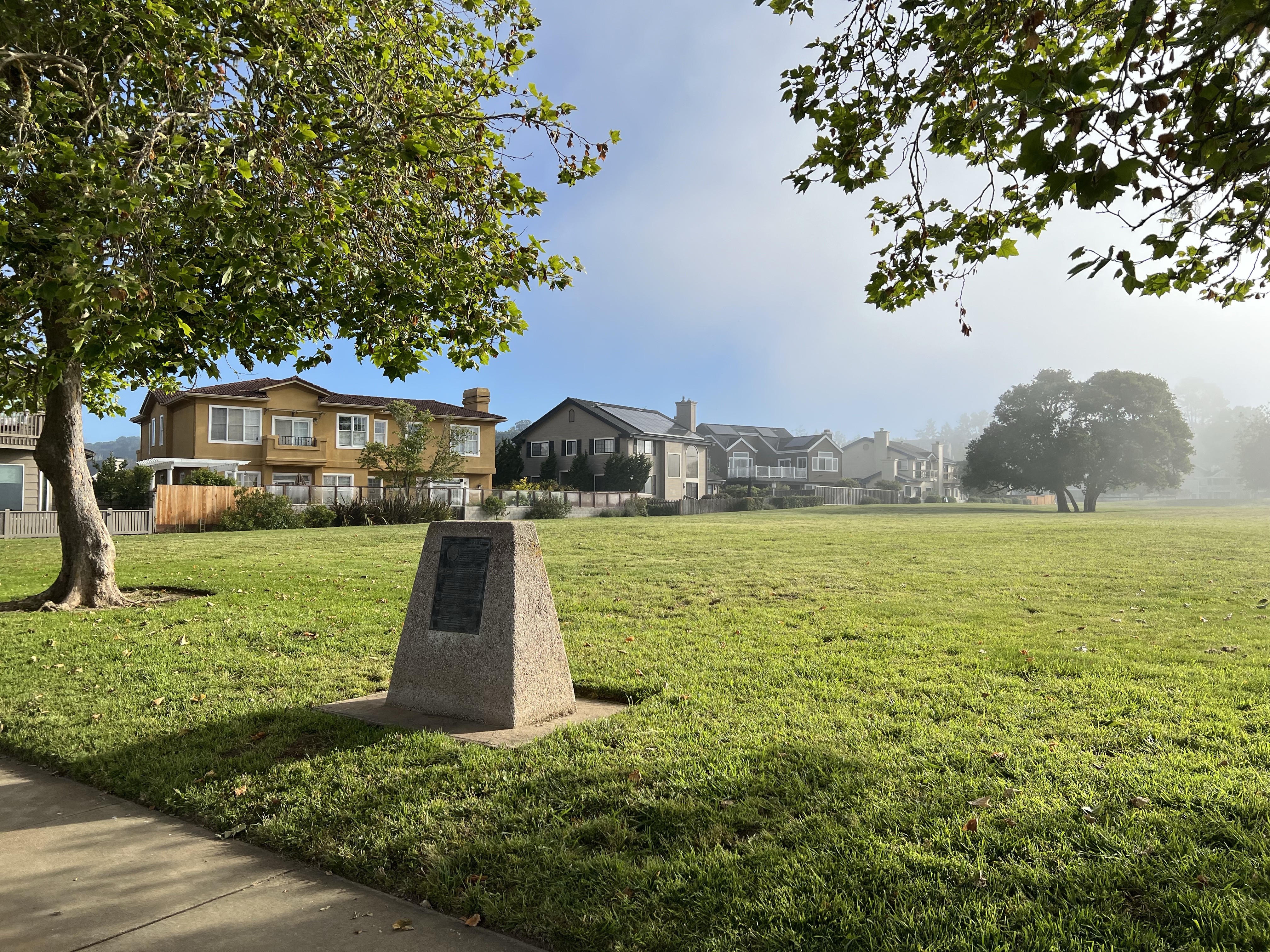
Down a cul-de-sac in a part of residential Aptos I have never explored before there is a monument to aviation at the edge of a green field.

This is what these hidden monuments are for, to reminds us of the anonymous people who have loved, lived, and lost who had come before us. The ones, on whose shoulders we stand, that have changed the world in ways we don’t understand or acknowledge.

The plaque on the monument reads:

One hundred years ago, in the skies above this monument, three soaring flights were made on March 16th, 17th, and 20th, by an aeroplane- glider flown by Aeronaut and parachute dare- devil, Daniel John Maloney, which had been designed and built by Professor John. J. Montgomery.

The frail craft, weighing only 42 pounds, was constructed of spruce, wire, and fortified canvas, and had tandem-wings with a 24 ft. wingspan and a four sided tail. It was taken aloft here at the then Leonard Ranch by a smoke-balloon rented by Fred Swanton and owned by Frank Hamilton, to heights of 800 ft., 1,100 ft., and 3,000 feet. The longest flight lasted over 18 minutes and covered over 2 miles…From a letter by Prof. Montgomery to his mother…

My machine flew three times, each time better than the other and descended beautifully. Going in different directions under perfect control of the aeronaut, and landing in a spot selected by him as gently as a feather.

These flights were the result of 22 years of experimentations and flight testing by Professor Montgomery, beginning with his first glider flight in 1883 at Otay Mesa in San Diego and ending with his accidental death in 1911. Called the “Father of Basic Flying”, his successes and contributions to the development of flight were heralded by the world’s press at the time, but are now largely forgotten.

The plaque was erected in 2005 by E Clampus Vitus El Viceroy Marques de Branciforte Chapter 1797, E Clampus Vitus Capitulus Redivivus Yerba Buena #1, Hiller Aviation Museum San Carlos Ca,. Aptos Chamber of Commerce and Museum Capitola/Aptos Rotary.

Now the monument serves as a perch for western bluebirds and the green field is used by a murder of crows for foraging. Off to the right is an owl box that a pair of red-shouldered hawks use as a hunting perch.

119 years ago, a frail, 42 pound glider soared above this field. Now it has been returned to the true masters of flight: the gulls, corvids, and hawks that effortlessly glide above.

But if you look further above you will see the great grand children of Montgomery’s passions: the modern passenger jet on final approach to SFO and SJO.

Image

OSH and San Jose History

Grasshopper and I headed down south to the county of my birth (Santa Clara) to sketch in it’s biggest city (San Jose). Our destination was in Kelly Park: the San Jose History Museum’s History Park.

This open air museum has a collection of about 30 historic buildings, some original and others replicas. Streetcar tracks run down the streets and on weekends, a vintage street car operates. What drew my attention was a train (of course!)

Stepping back in time.

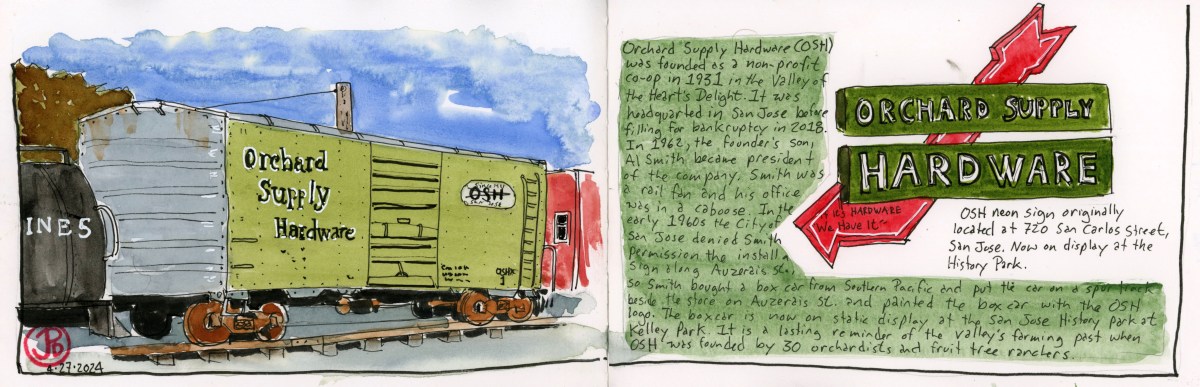
On a set of tracks is Southern Pacific 0-6-0 switcher No. 1215 attached to a consist of a green boxcar, and a SP bay window caboose (No. 1589). What attracted my sketching attention was the green boxcar with the words “Orchard Supply Hardware” painted on the side.

Orchard Supply Hardware or OSH was founded as a co-op in 1931. Its founders were 30 farmers, mainly orchardists and fruit tree ranchers.

The name “Orchard Supply” harkens back to the time when Silicon Valley was then called the Valley of Heart’s Delight and was covered in apricot and cherry orchards.

Growing up in the 1970s in Sunnyvale, our house was built on a former apricot orchard. We even had a remnant tree in our backyard. There were still orchards on the edges of housing developments. The agrarian past, back then, did not seem so far away. Now it has all but disappeared.

OSH was part of my childhood. The second president, Al Smith, was a huge rail fan. He even had his office in a caboose. Starting in 1975, each year OSH would put out a calendar with paintings of trains. There was always one in our household.

In the 1960s Smith petitioned the city of San Jose to install a sign for OSH but he was denied. He did not give up. Instead he bought a boxcar from Southern Pacific and put it beside one of his stores on a rail siding. He then painted it bright green and painted “Orchard Supply Hardware” in big letters. This boxcar is now in the History Park along with a 1950s neon sign for the store. I sketched both (featured sketch).

After sketching the boxcar and neon sign we walked around the park looking for a new perspectives.

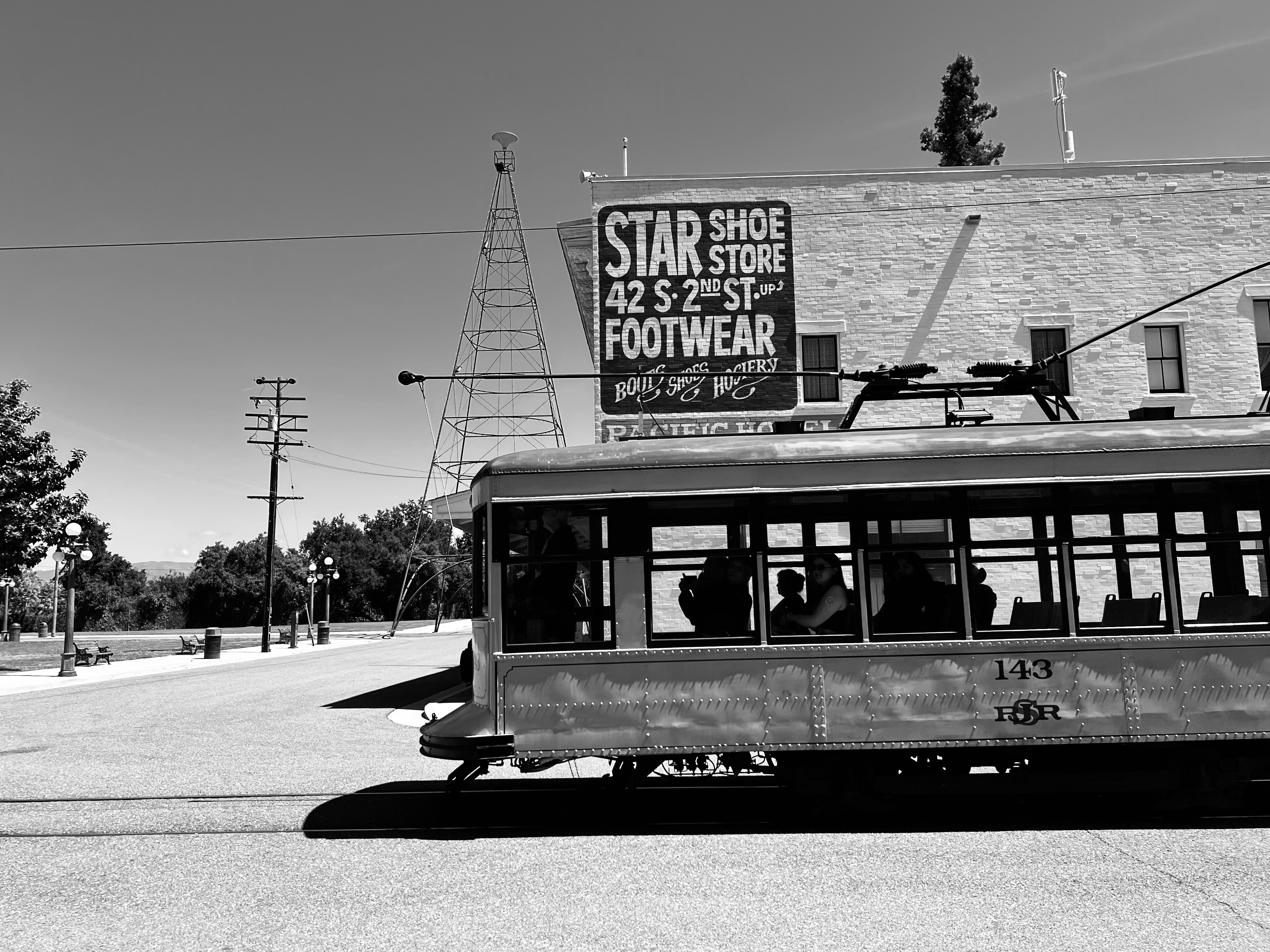
I chose to sit across the street from the replica of the Pacific Hotel. In the background is a half-scale replica of San Jose’s Electric Light Tower. The original 1881 tower was 237 feet tall. In 1915, the tower was damaged in a windstorm and it later collapsed.

While I was sketching I struck up a conversation with an elderly volunteer who had been volunteering at the museum for the past 20 years or so. We reminisced about the valley’s yesteryears (am I really that old!!) and we reflected on the changes to the South Bay. During our conversation I was well aware that it was volunteers like her that keep the hidden history from disappearing forever.

And she is a retired teacher, but of course she is keeping fleeting history alive! That’s just what teachers do.

Image

Sunset Reservoir

I live a hop, slip but not even a jump from San Francisco’s largest reservoir: Sunset Reservoir.

This terminal reservoir was completed in 1960 and has an impressive capacity of 270 acres. To put this into context the sides of the reservoir are four blocks north and south and two blocks east and west. The surface area is 11 acres.

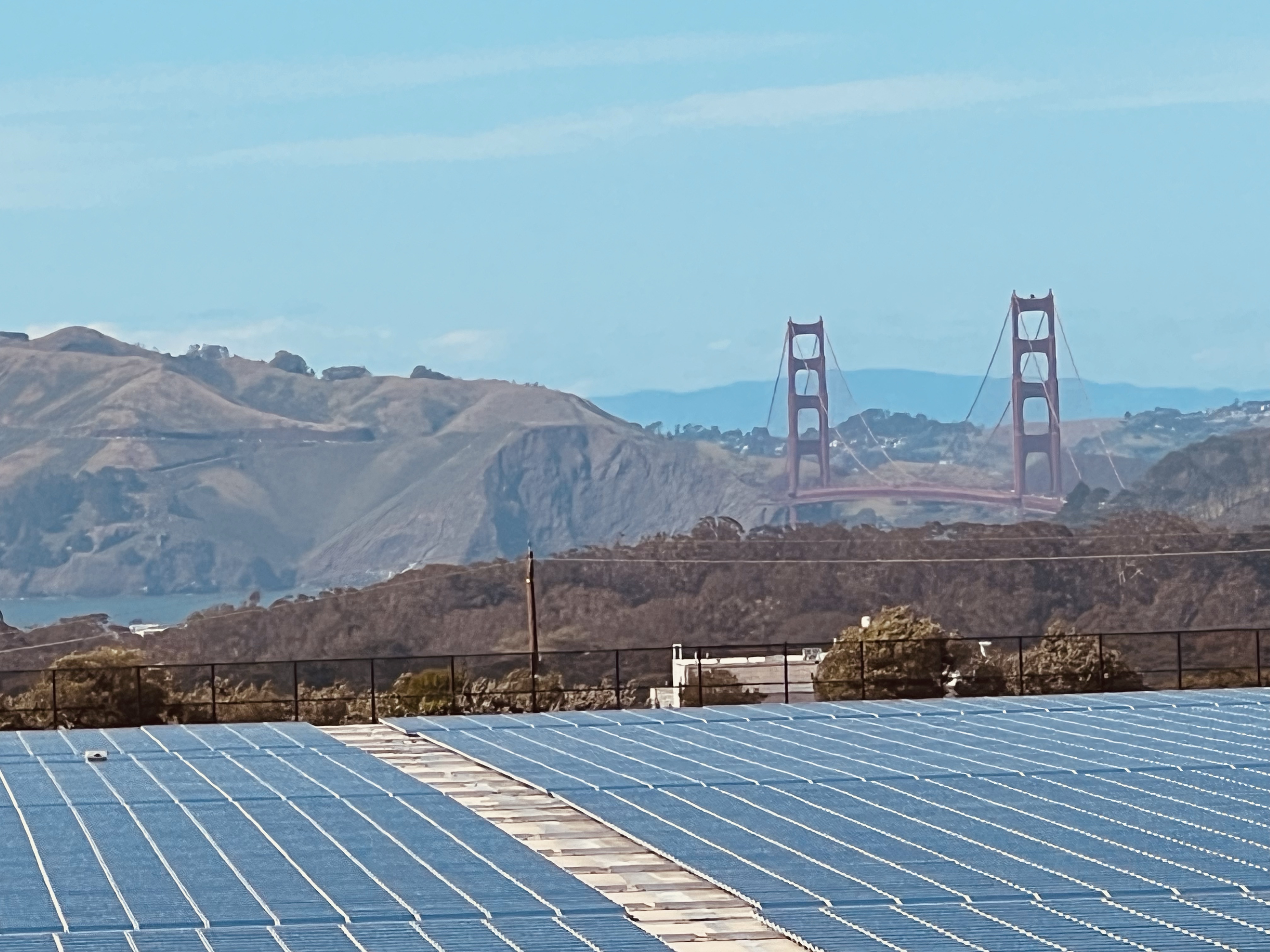
The reservoir is covered and fenced off. Over half of the reservoir is blanketed in 25,000 solar panels. The Sunset Reservoir Solar Project started in December 2010 and has tripled San Francisco’s solar generation capacity.

The irony is that the Sunset is the foggiest part of the city.

Some of the 25,000 solar panels of Sunset Reservoir.

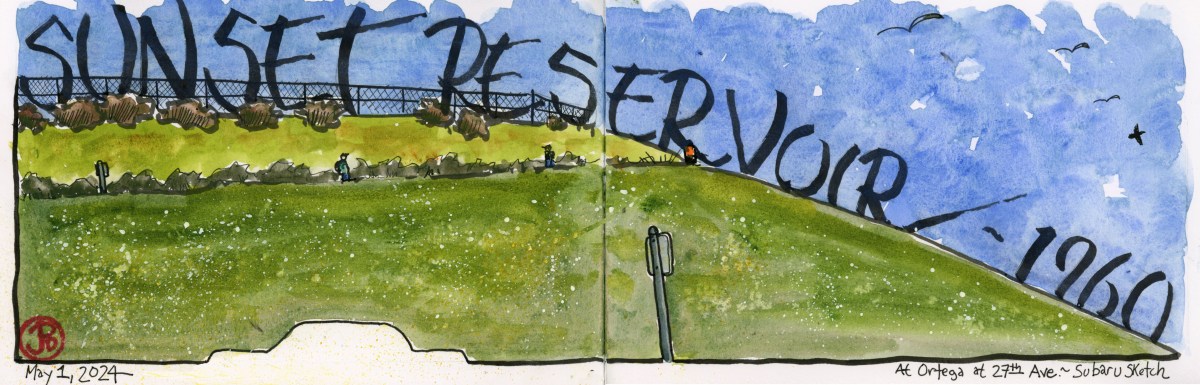
While the reservoir itself is not a sight to behold, the northwest corner (featured sketch) affords some of the best views in the Sunset. Along the embankment are walking paths and at the northwest corner are a line of benches.

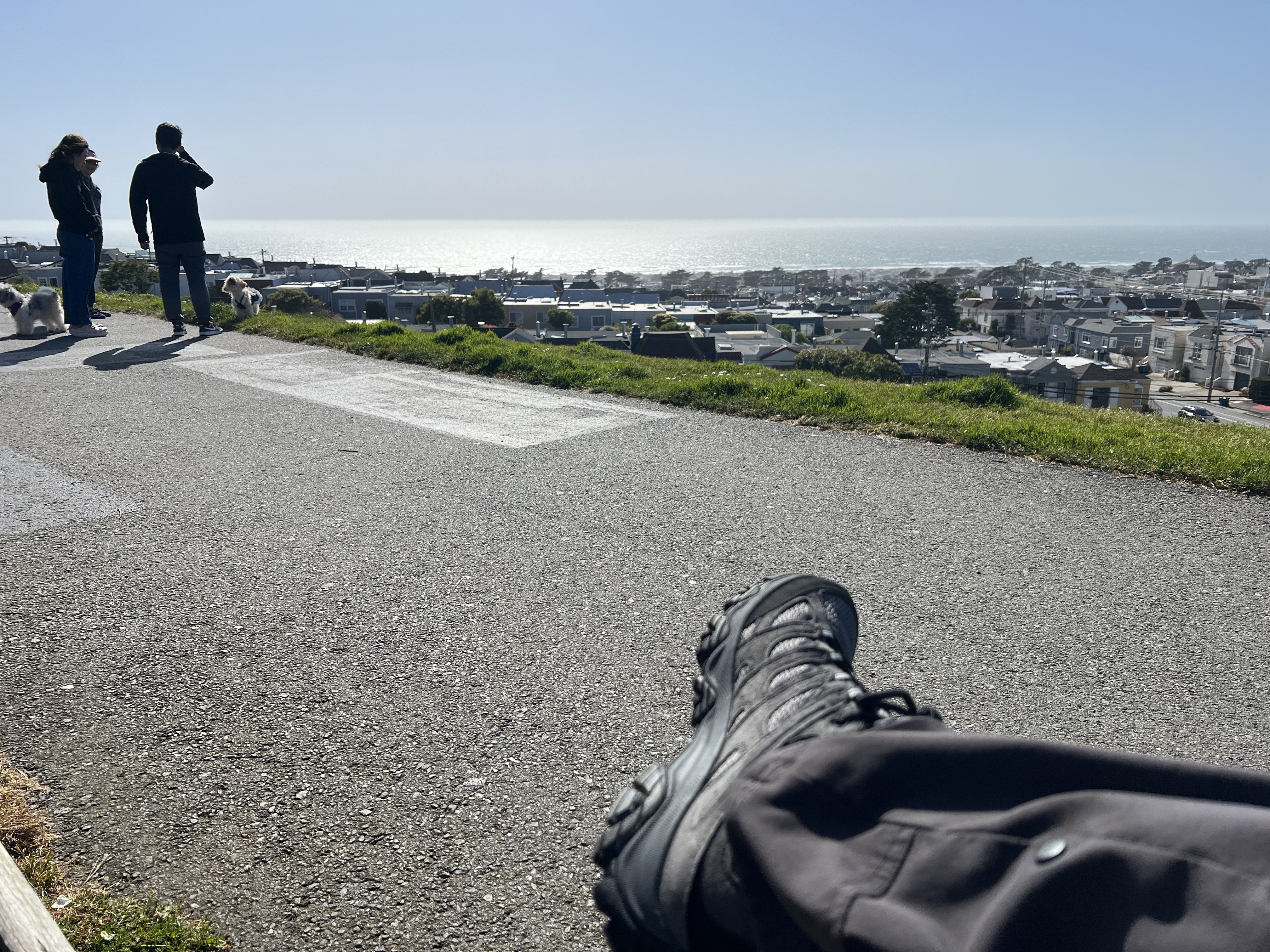
The bench-view to the north. I can almost see the Farallons. These paths are popular with dog walkers.

Here you can look out to the west towards the Pacific Ocean and on a clear day, you can see the Farallon Islands perched on the horizon like a large, gray battleship.

The views to the north as just as stunning taking in Golden Gate Park, the Richmond District, the Golden Gate Bridge, Marin Headlands, and Mt. Tam. On really clear days you can see outer Pt. Reyes.

Looking north down 27th Avenue towards the Golden Gate from one of the walking paths.