Alcatraz

“Break the rules and you go to prison. Break the prison rules and you go to Alcatraz.”

Living on the west side of San Francisco, it is sometimes easy to forget that the City has its tourist attractions and is a huge draw for global visitors. If I look north from in front of my digs, I can see the one of the City’s biggest attractions, the Golden Gate Bridge (I just can’t see the gift shops).

I wanted to return and sketch one of San Francisco’s top destinations: Alcatraz. The last time I was on the Rock was about 25 years ago.

My father never visited because when he was growing up in San Francisco, the island was still a penitentiary. He had a friend who lived on Alcatraz, his father was a prison guard, but the boat curfew was 10 PM.

I would be taking the first ferry to Alcatraz at 8:40 AM. The boat was packed (1.4 million people visit the island every year.)

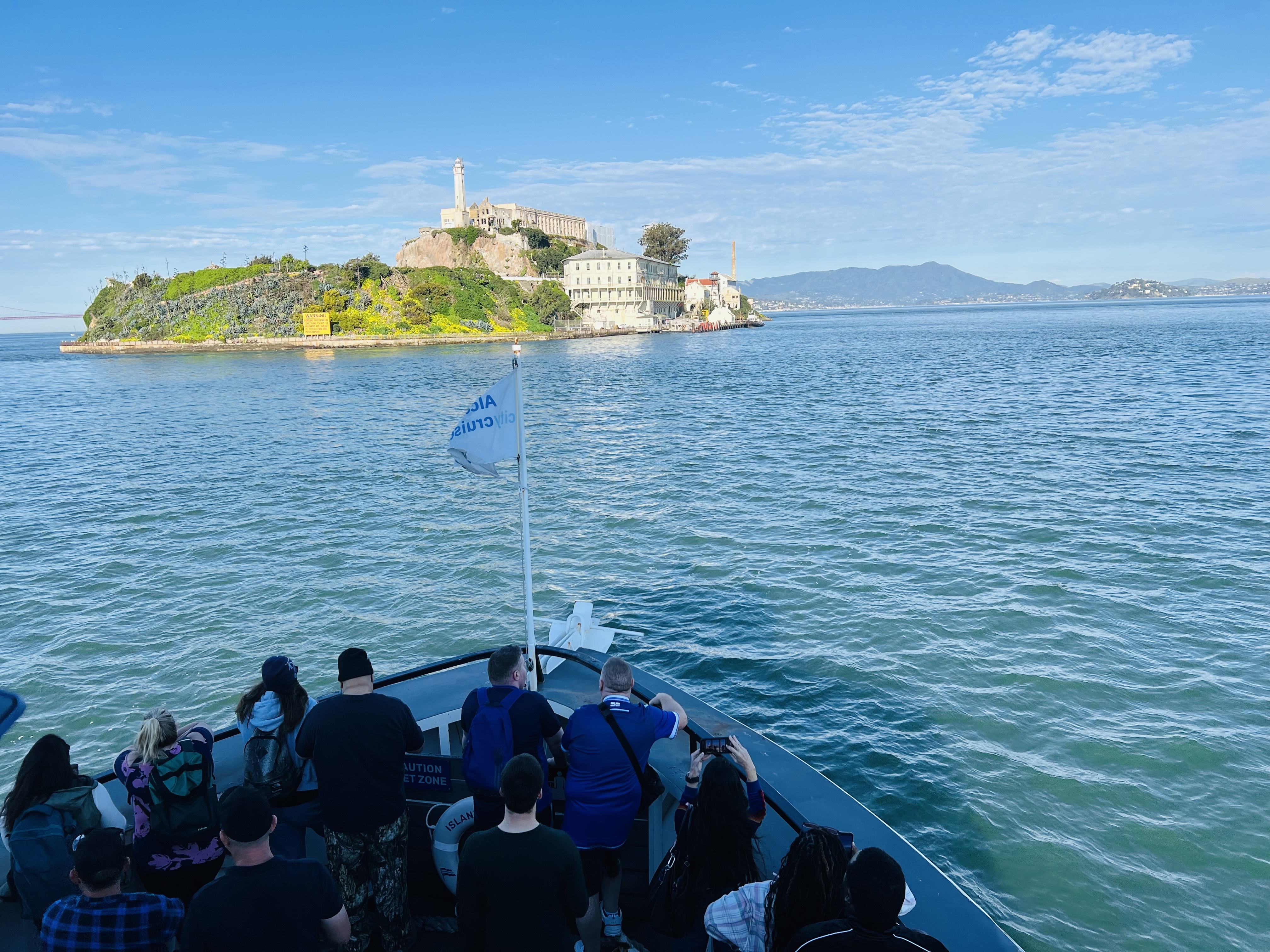
Approaching the Rock. Prisoners left from Pier 33, just like tourists.

The journey was short, about 20 minutes. The ferry turned into the dock and the boat spilled its human cargo.

A park ranger greeted the crowd and commented on the beautiful late February weather. He noted that the previous day was foggy and asked is anyone knew what fog was named in San Francisco. No one answered so I did,“Karl!”

Darn these knowledgeable locals!

I left the masses and zigzagged my way up the hill to the Cellhouse. Once in the former penitentiary, I walked down “Michigan Avenue”, past the three cells of the John and Clarence Anglin and Frank Morris.

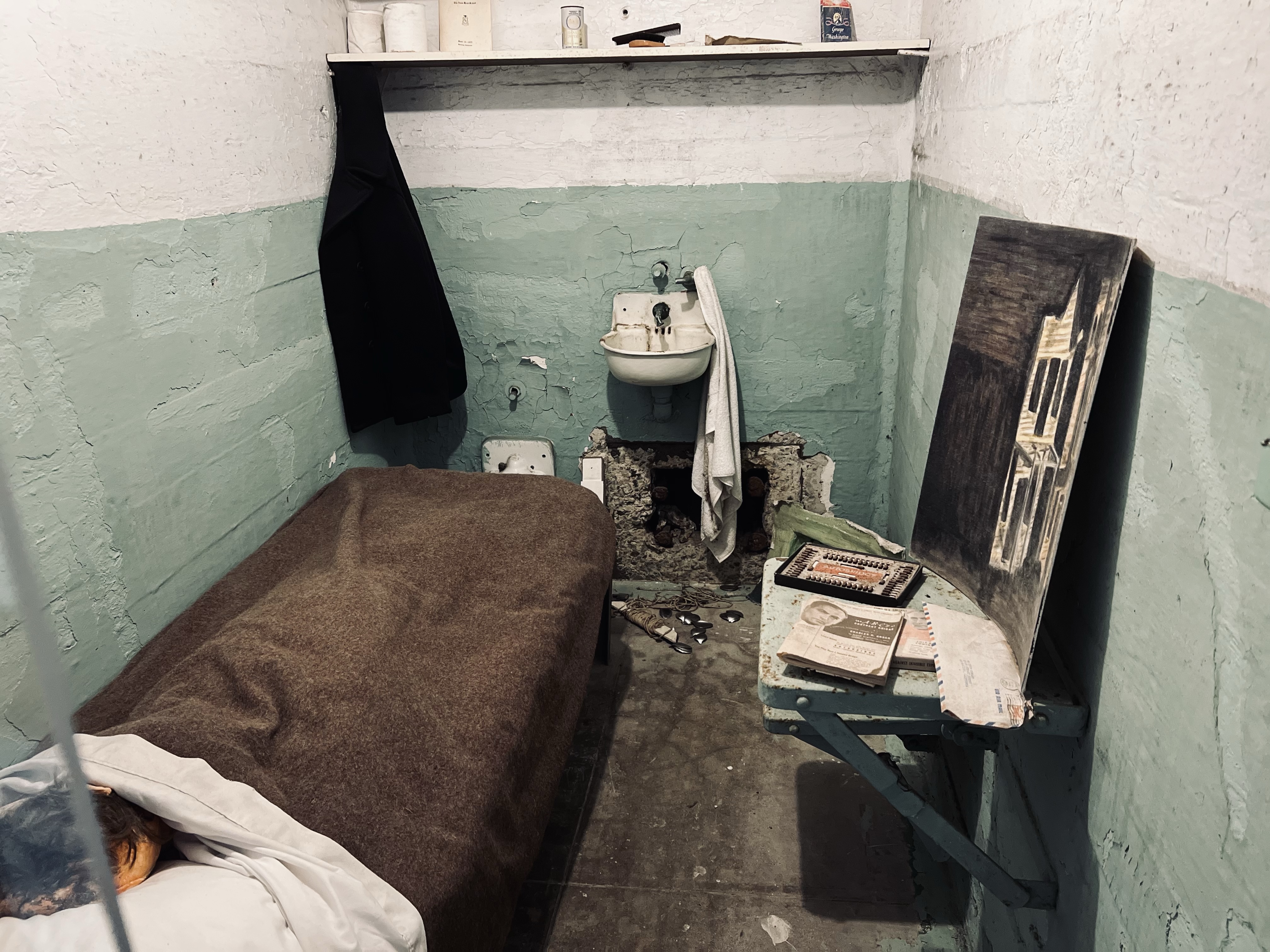
These are the three inmates that escaped in June of 1962 and they were never seen again. Did they drown or escape?

Frank Morris’ cell. He escaped through the vent under the sink. He made a paper-machete head to fool guards that he was still in his cell.

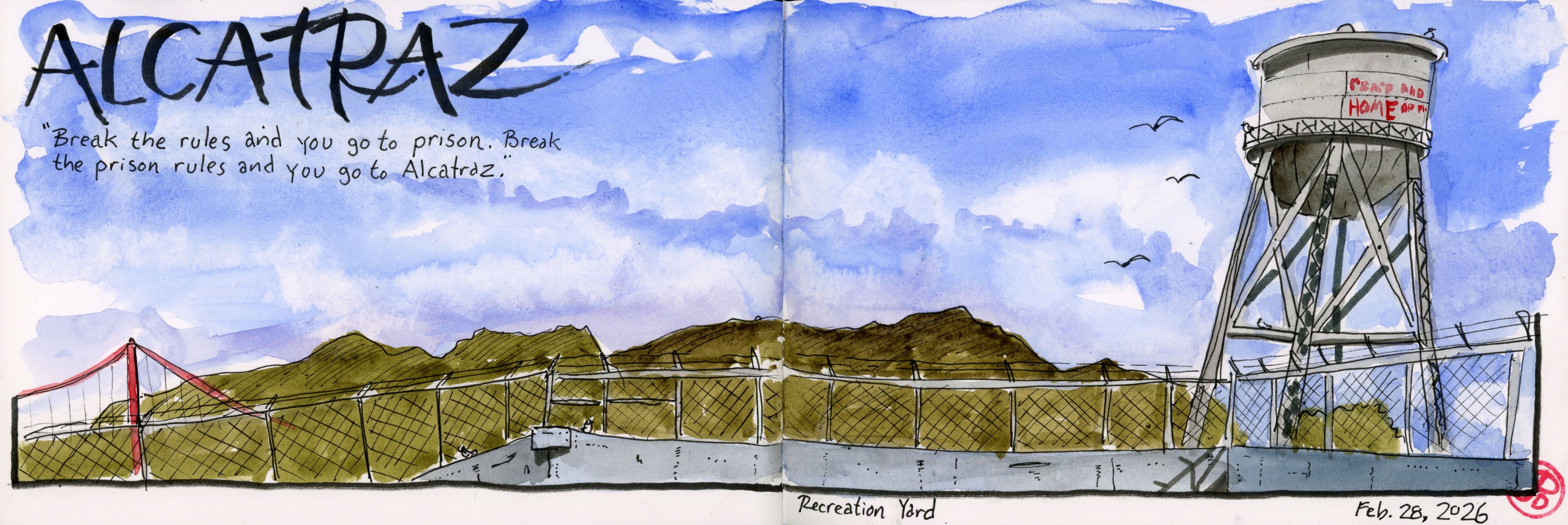
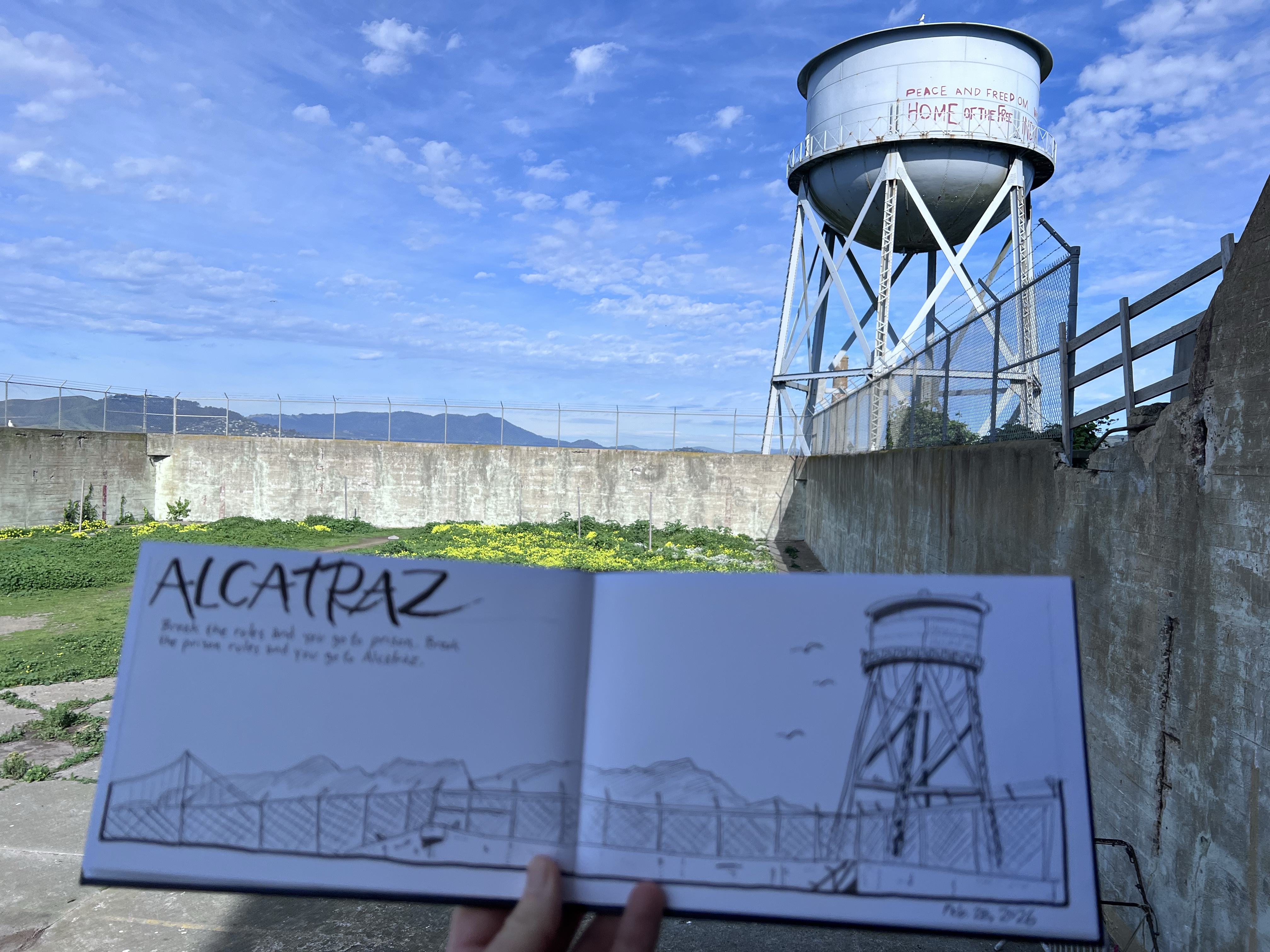
I headed through the Cellhouse to my first sketching location, the Recreation Yard. I wanted to sketch the view from the steps looking towards the water tower with Mount Tamalpais in the background.

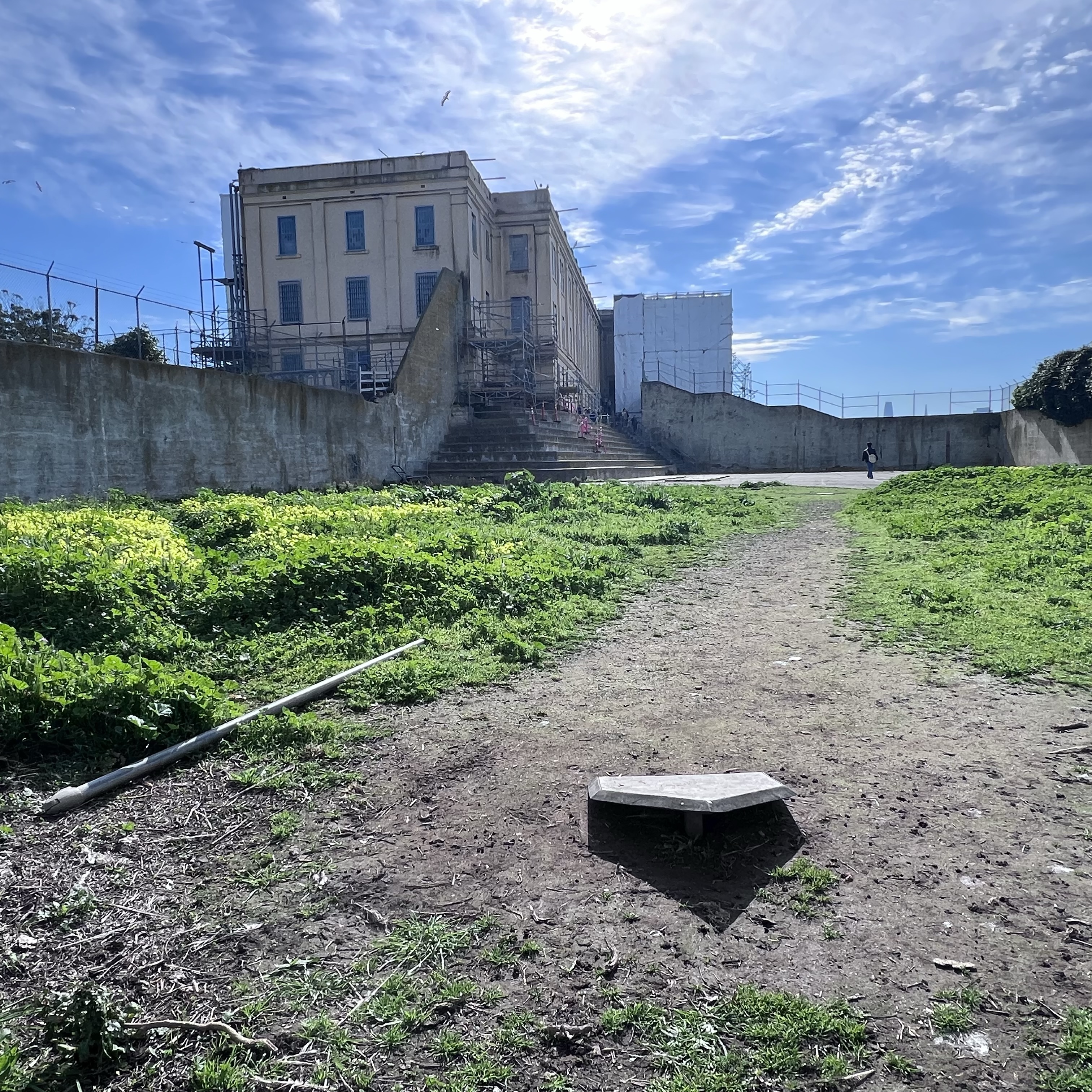
Home plate view of the yard. I wanted to sketch the Cellhouse but part of it was covered in scaffolding.

Several scenes from the Don Seigel film Escape From Alcatraz (1979) were filmed in the yard, and elsewhere on the island. Clint Eastwood played Frank Morris and Patrick MacGoohan “I am not a number, I am a free man!” played the warden.

I sat on the steps near where the infamous “King of the Mountain” scene was filmed (featuring Eastwood and Paul Benjamin) after displacing a few western gulls who are the real kings and queens of the mountain at Alcatraz these days.

My panoramic journal was made for this view.

The irony of the Recreation Yard is that prisoners had million dollar views of the Golden Gate Bridge, Mt. Tam, and Angel Island but they could never leave the Rock to enjoy them.

After my sketch I headed out of the yard and walked around the island. I kept an eye out for the coyote that recently swam to the island from San Francisco but I didn’t see it. A ranger told me it hadn’t been seen in a while and maybe had swam to Angel Island.

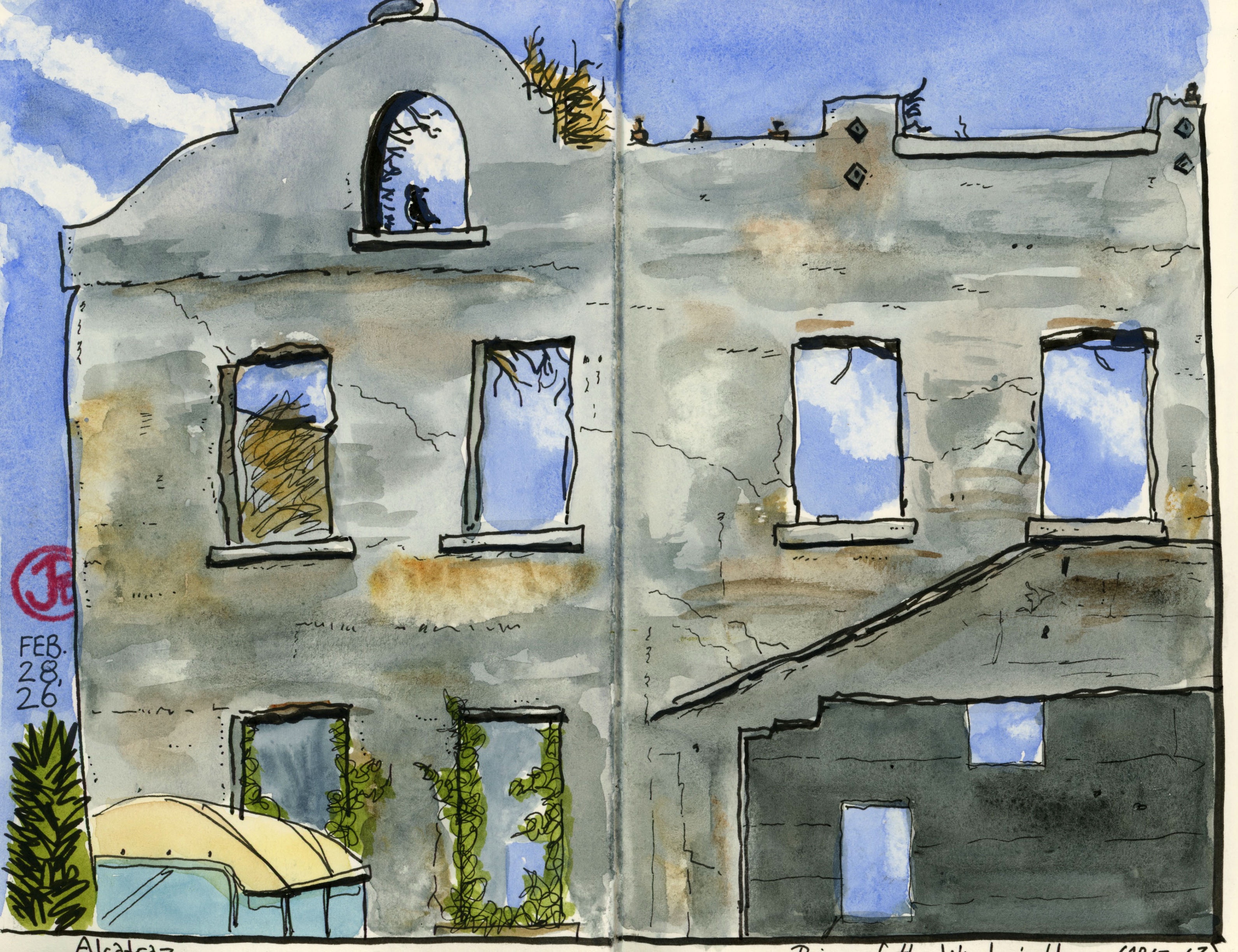
I found my next sketching subject near the west coast’s oldest lighthouse: the ruins of the warden’s house.

My father always disliked the Indian Occupation on the island and the graffiti left behind, which is now preserved as part of the history of Alcatraz. Truth be told, my father hated graffiti on anything, especially buses and streetcars!

Several buildings were destroyed by fire, including the home of my father’s friend. It is unclear how these fires started and who was responsible.

One such building that burned in 1970 was the hollow shell of the Warden’s house that I was now sitting in front of.

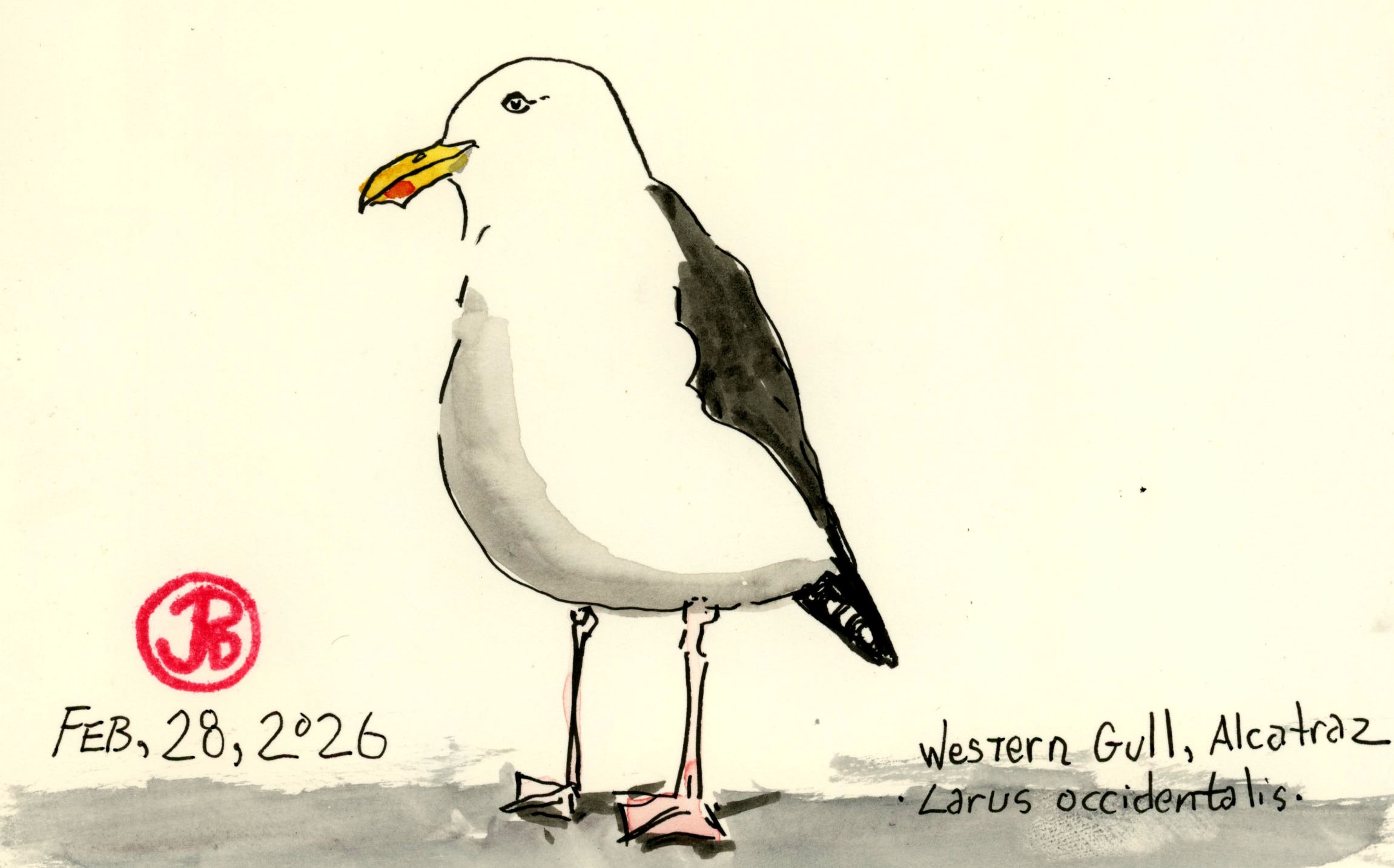
It is hard to not notice the avian life on the island named for the pelican or gannet (depending on who you believe). There are gulls everywhere. Alcatraz is a major breeding colony of western gulls on the island.

Alpine Meadows: March 31, 1982

With the recent February 17, 2026 avalanche at Castle Peak that took the lives of nine skiers, it reminds me of another tragic avalanche that gripped the nation in 1982.

I was 11 years old at the time and an avid skier. I remember the news coverage of this event, it was a story of tragedy, strength, and hope.

This was the avalanche at the ski resort at Alpine Meadows on March 31, 1982.

I wouldn’t call this natural occurrence a “natural disaster”, it just becomes a disaster when human lives are caught up in it because avalanches are perfectly natural and are often created by human activity.

An early spring storm brought loads of snow to the Lake Tahoe region; seven to eight feet.

The ski patrol at Alpine Meadow were in charge of avalanche control (as if there is such a thing) and the mountain had an extensive program that used hand thrown dynamite charges, a 75 mm recoilless rifle, and a howitzer cannon to prompt the build up of snow to reach its angle of repose.

The steep slopes at Alpine Meadows, from the peaks down to the base area, is an avalanche machine. The resort is graded a Class A, the highest hazard designation for avalanches and Alpine Meadows is one of the most avalanche prone ski resorts in the country.

The mountain manager knew of the potential dangers and closed the mountain to skiers on Wednesday the 31 and told employees not to show up for work that day.

The only people on site were the mountain manager, Bernie Kingery and assisting him with monitoring the avalanche control was Beth Morrow. A few others were around the resort helping in the effort to clear snow and avalanche control.

In the afternoon of the 31st lift operator Anna Conrad and her boyfriend returned to the Summit Terminal building from Conrad’s cabin. She wanted to pick up her snow pants in the locker room on the second floor.

The Summit Terminal was a three story modified A-frame that housed the ski school, lift operations, trail crew, and the ski patrol office. It was also the nerve center when monitoring avalanche control. As the name implies, the Summit Chairlift (the resorts longest lift) departed from the building and rose up to the top of Ward Peak.

At 3:45 PM, the tons of snow on the ridges that had been building up began to move downhill. Seconds later the avalanche, traveling at almost 200 miles per hour, took out the Summit Terminal and crashed through the lodge and filled the parking lot with 12 feet of snow.

In a blink of an eye the avalanche created a path of destruction that claimed seven lives. This disaster remains the most devastating avalanche at a ski resort in North America.

The news coverage of the event remains in my mind’s eye as the search for survivors in the wreckage of the Summit Terminal building and underneath the snow continued.

As the days after the 31st passed it seemed less and less likely there would be any survivors. Rescue was turning into recovery.

Rescue and recovery effort were hampered by the continued snowstorm and the fears that the snow build up would cause another avalanche.

Miraculously on the fifth day they found a survivor trapped in an air space created by a fallen locker and a bench. This was lift operator Anna Conrad.

In the weeks after the avalanche I remember the interviews shown on the local newscasts that Conrad gave from her hospital bed at Tahoe Forest Hospital in Truckee.

Sketch Notes and References

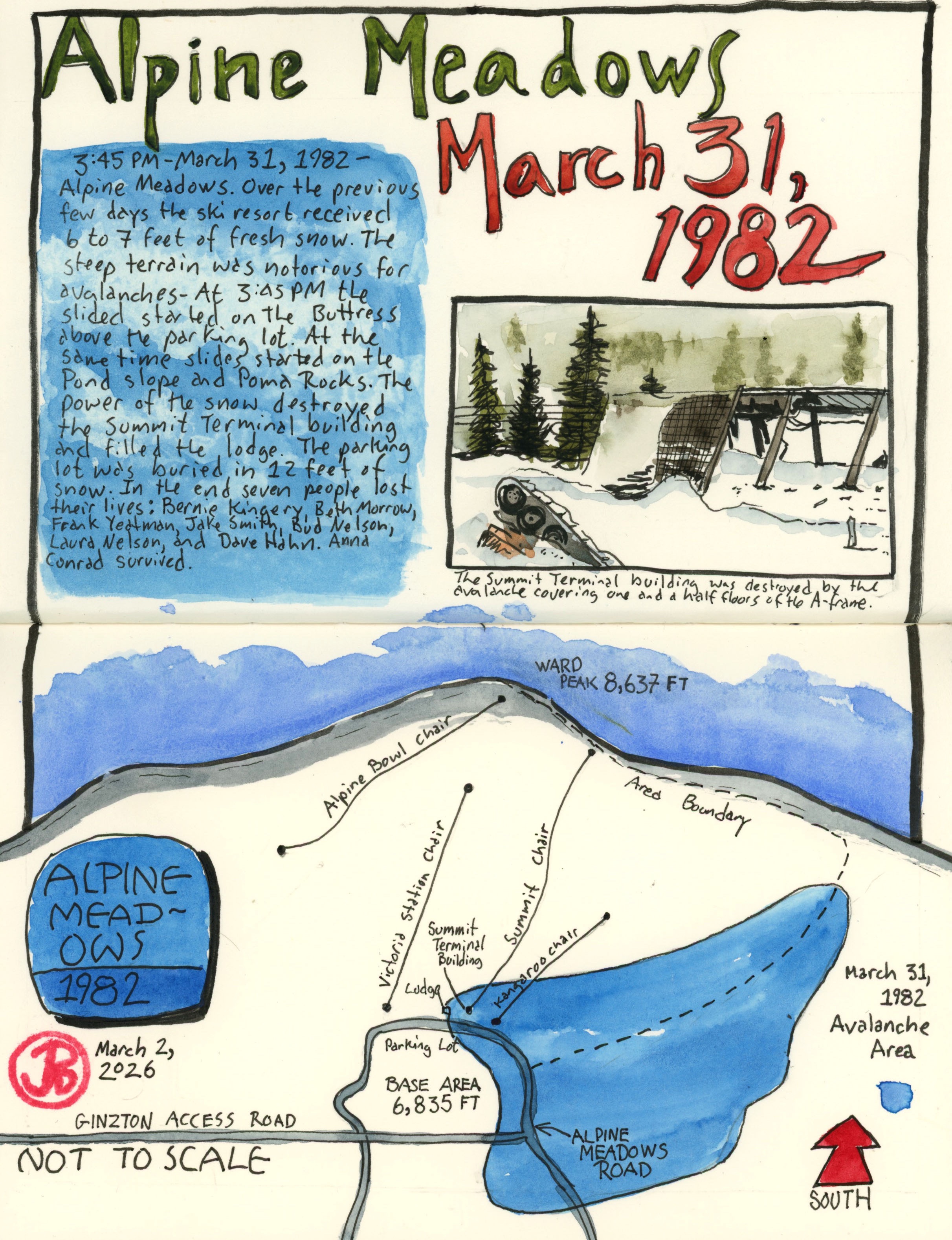
While researching the events of March 31, 1982, I created a spread with a map of Alpine Meadows and the path of the avalanche. I also sketched the ruins of the Summit Terminal building after the avalanche.

I used two main references in my research of the Alpine Meadows avalanche: the gripping book, A Wall of White by Jennifer Woodlief (2009) and the award winning documentary Buried: The 1982 Alpine Meadows Avalanche (2022) directed by Stephan Siig and Jared Drake.

Sketching Out My Back Door

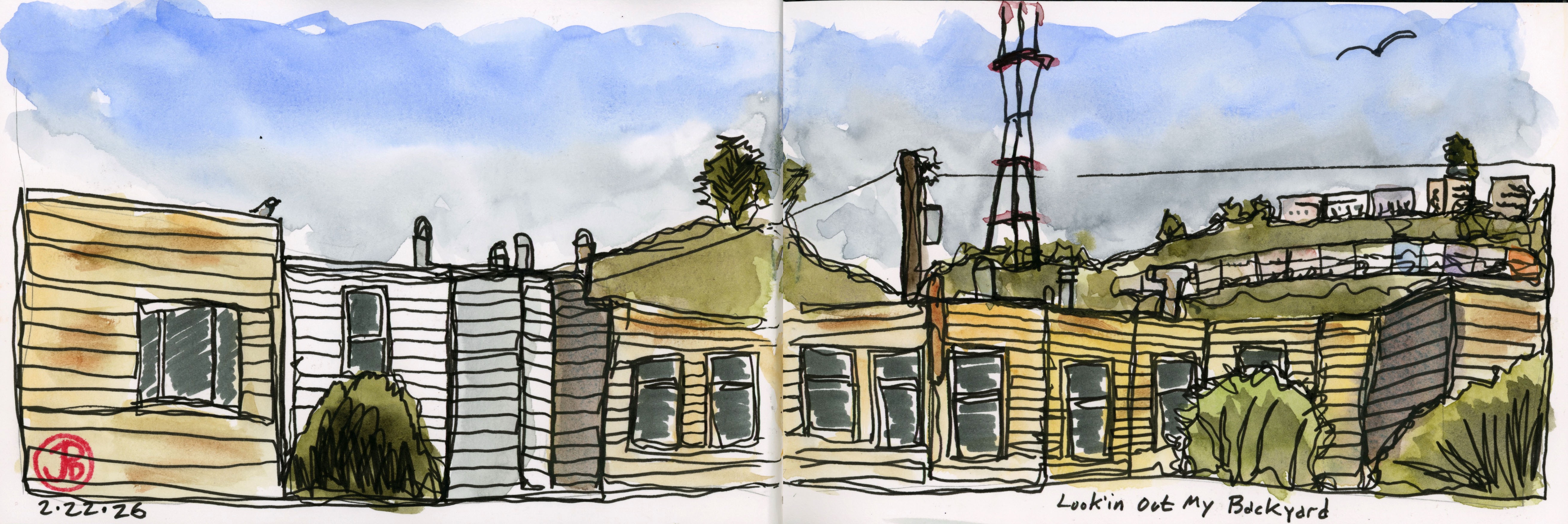
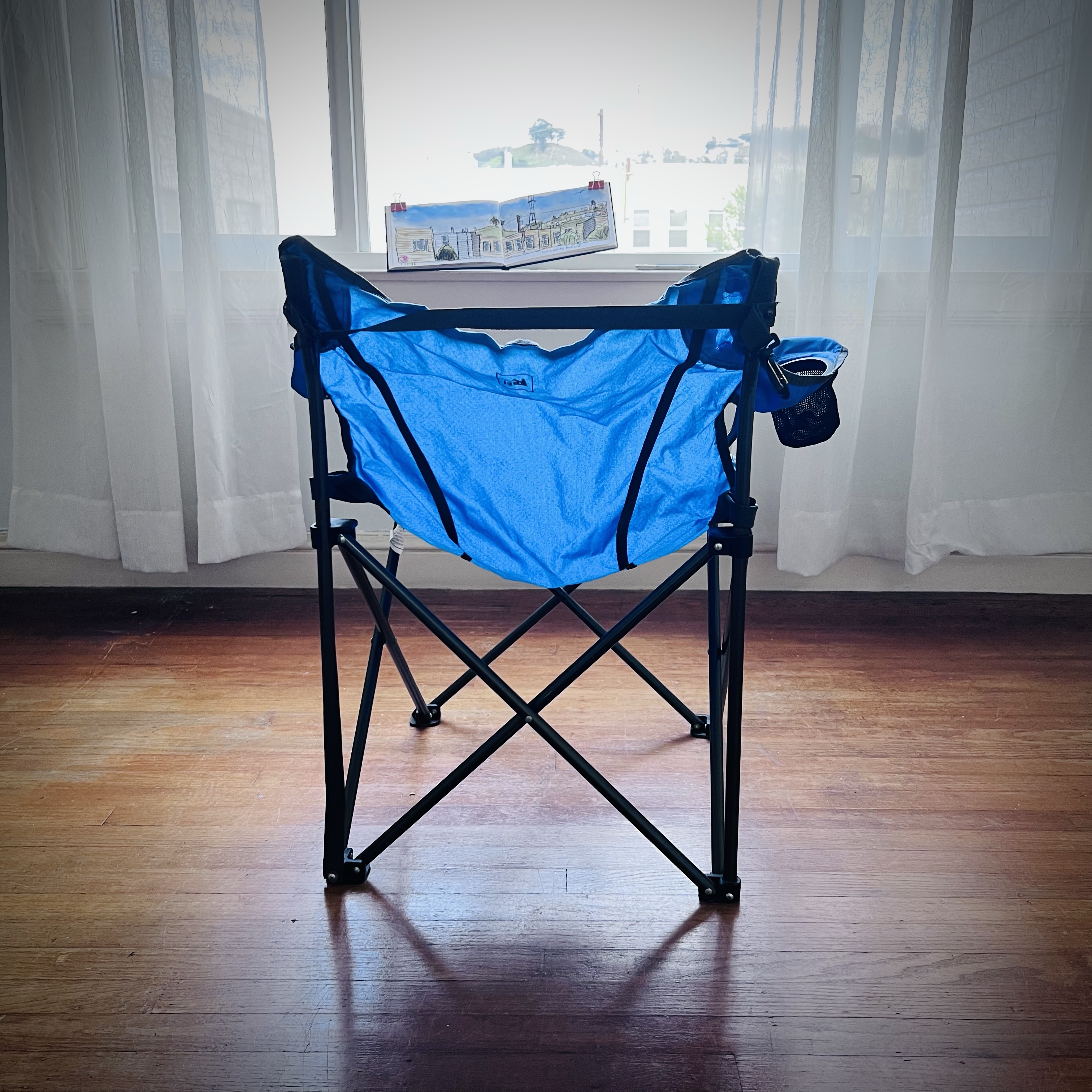
With the tenets upstairs moved out for Italy I used the opportunity to sketch the view from the empty upstairs east facing bedroom.

Now this isn’t exactly sketching out my back door but the sketching above my back door. With the altitude gain I could see the landmark that dominates the view: Sutro Tower.

Sutro Tower was erected between 1971 and 1973. For 45 years the 977 foot tall radio and television transmission tower was the tallest structure in San Francisco before it was usurped by the Salesforce Tower (1,070 feet) in 2018.

In the foreground are the houses that border my backyard, in the middle ground are the houses of the Golden Gate Heights.

I used my Stillman & Birn panoramic watercolor journal to sketch in the scene. I used a thick pen (Micron 10) and rendered the scene in a continuous-line.

My sketch was loose and not exactly to scale but that what makes continuous-line sketching so exciting and vibrant.

Tomales Point Tule Elk Reserve

I headed to the most northern point of Point Reyes to see some tule elk.

I arrived at the dirt parking lot at the historic Pierce Ranch at 8 AM on Saturday morning. So early in fact, that the local California quail were out feeding in front of the old dairy buildings yet to be disturbed by the hiking groups and picnickers that would soon be arriving over the next few hours.

I hit the trail trying to put some distance between myself and the chatty group of six young folk looking extremely underdressed for a winter coastal hike.

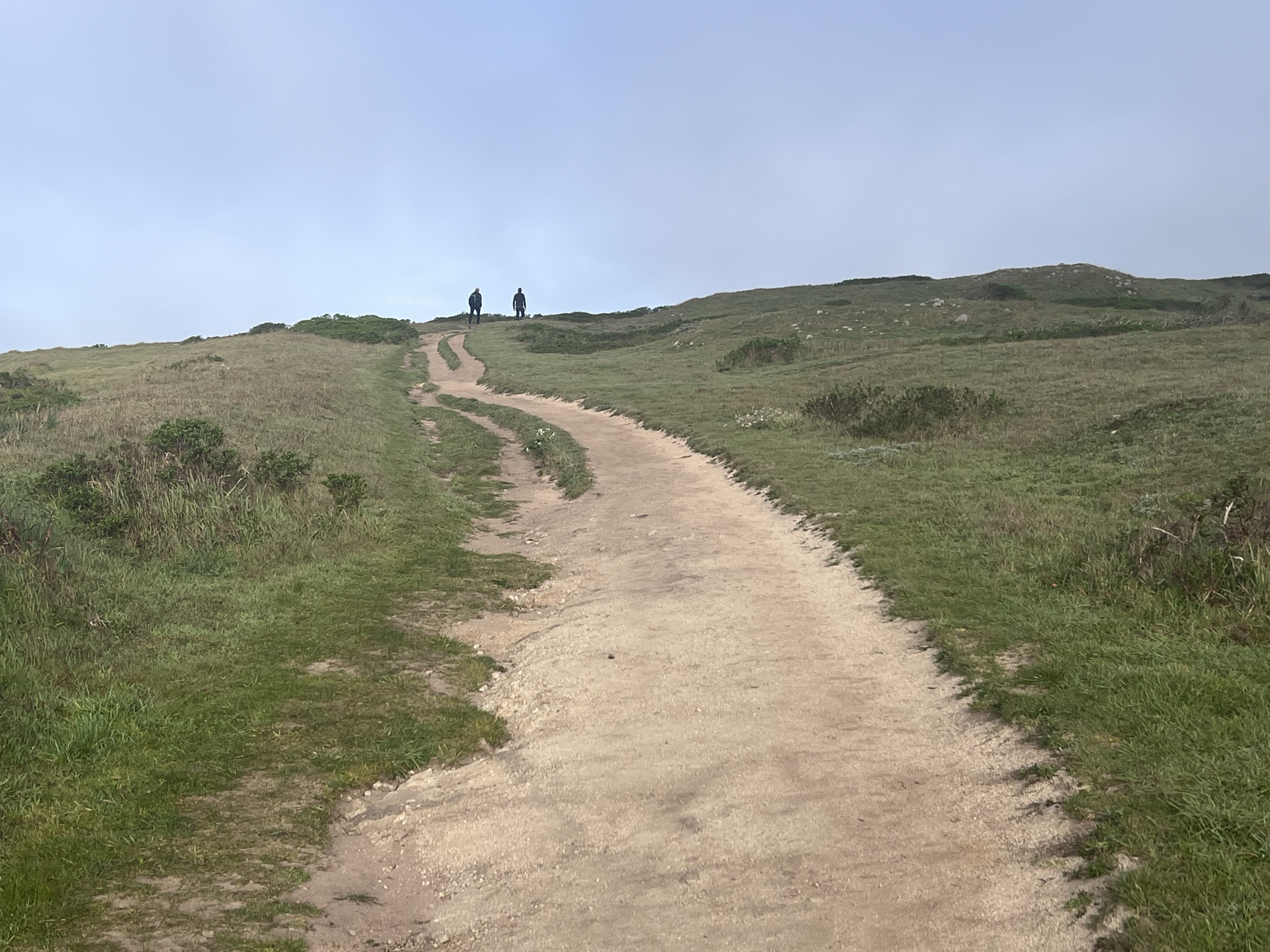
Looking north on the Tomales Point Trail.

I was only on the Tomales Point Trail for a few minutes and I looked back towards the ranch and on the far hillside where a mass of golden brown dots. Tule elk! They were a long way aways but I hoped to get closer looks.

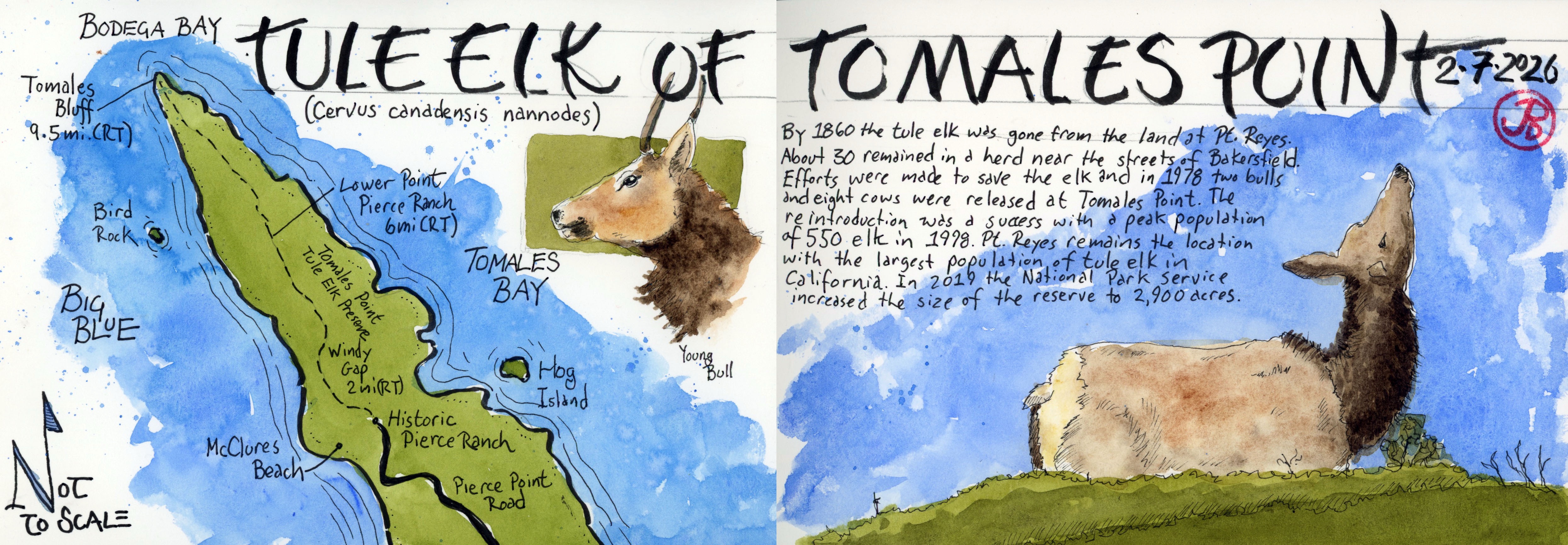
Tule elk (Cervus canadensis nannodes) were once native to this part of California but by 1860 they had disappeared from the land from over hunting and being displaced by cattle. This is the smallest subspecies of elk and are exclusively found in the Golden State.

The elk was thought to be extinct until a small group was discovered on a ranch near Bakersfield. Efforts were made to save the large deer with successful results.

Over one hundred years later in 1978, two bulls and eight cows were released at Tomales Point. The reintroduction of elk to Point Reyes was a success and the population peaked at 550 elk in 1998. The Pt. Reyes herd is the largest population of tule elk in California. One of the best places to see them is the Tomales Point Tule Elk Reserve.

After about an hour on the trail I approached the appropriately named Windy Gap, a great location for spotting elk. Up on the far ridge I could see the antlers of adult males breaking above the grasses and scrubs. They were a ways off but I hoped for closer views as I proceeded north.

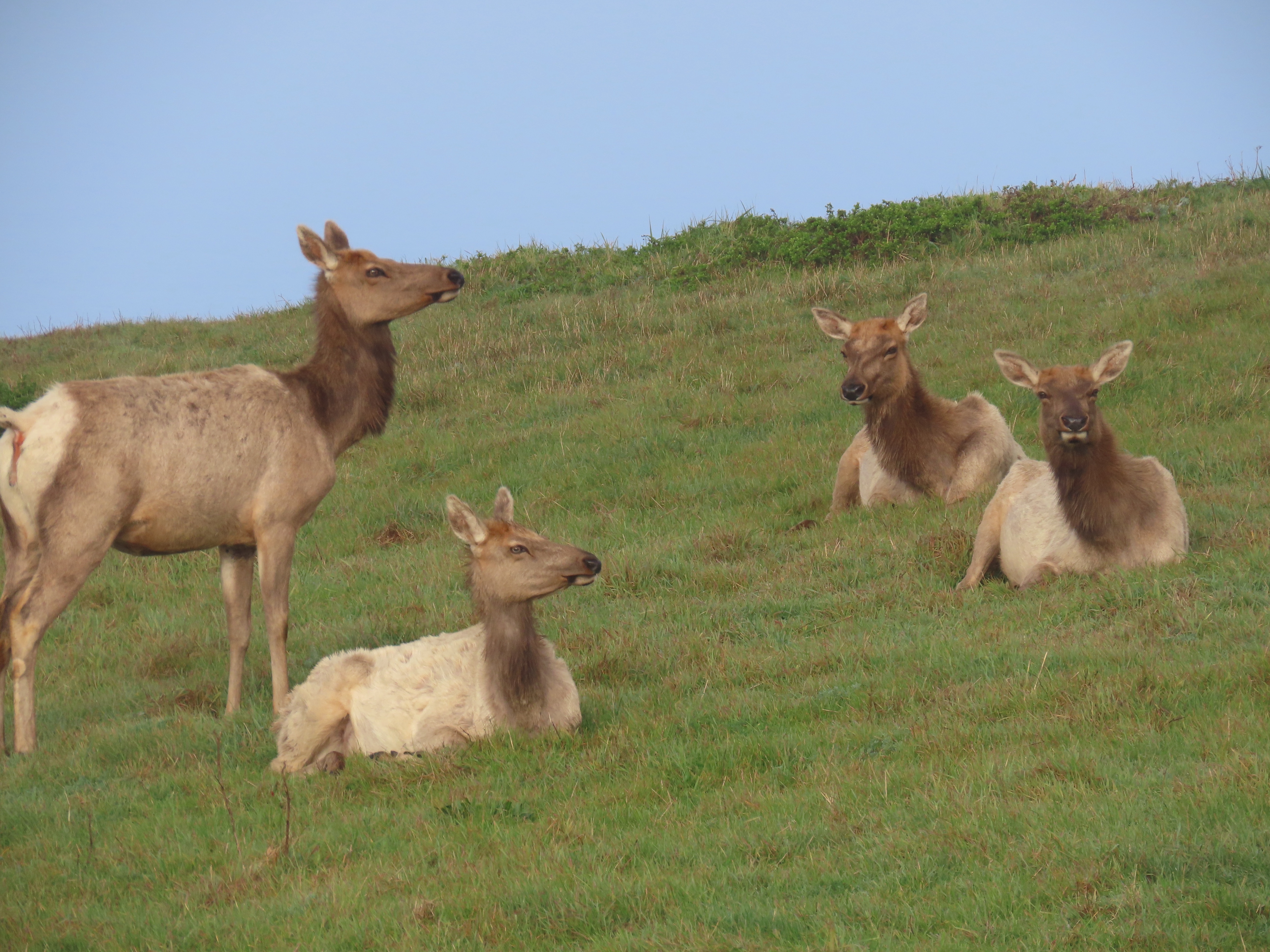
These elk were close to the trail!

After heading up the other side of the gap I came upon a group of twelve cows and calves on the Pacific side. They sized me up with their deep dark eyes and their large ears. Was I harmless or a threat?

While I was not a threat, the chatty-scantily clad youths that were coming up behind me were. The elk stood up and moseyed north. But not before the girl in pink short-shorts and top took a few selfies.

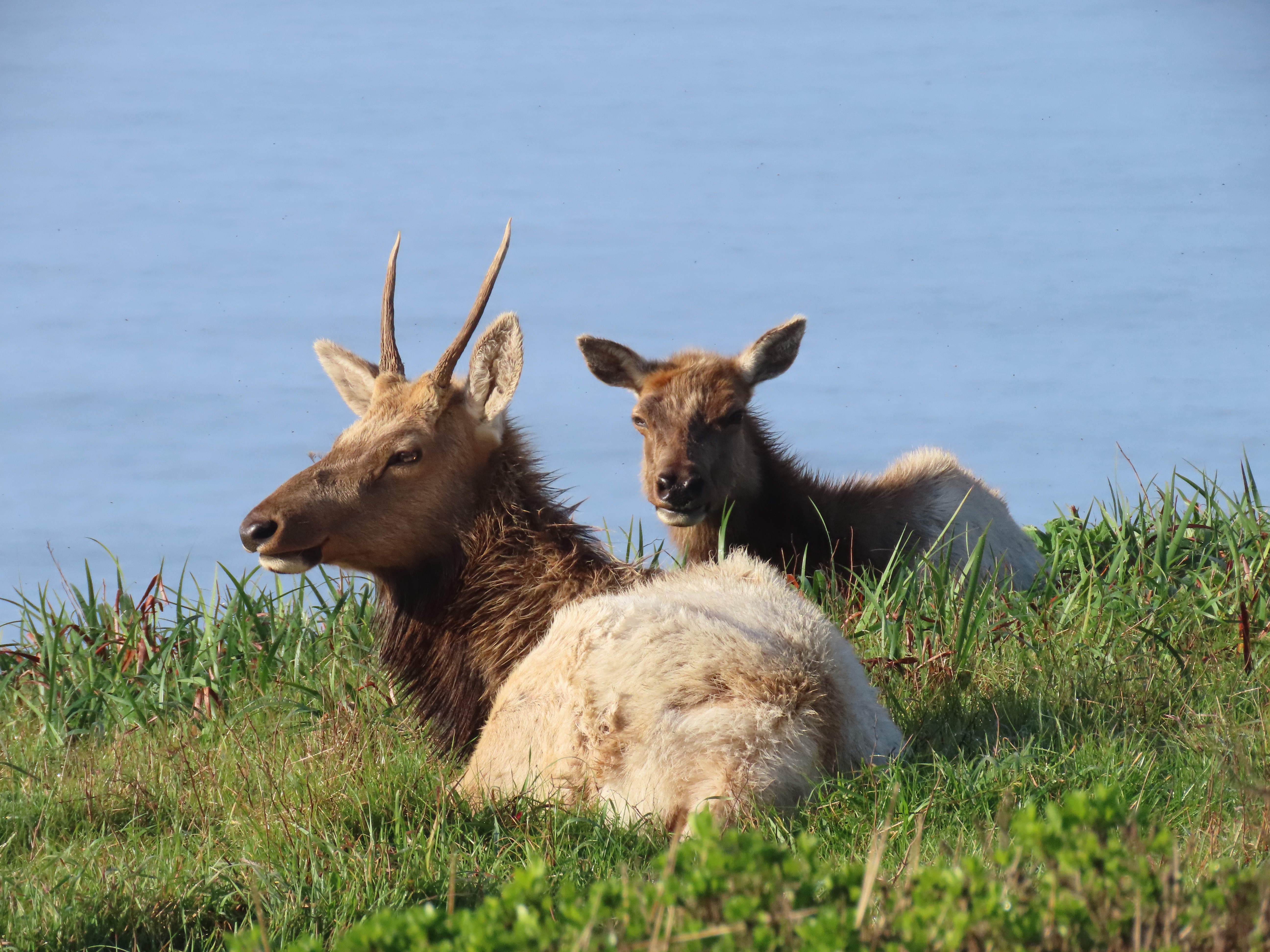
Young bulls and the Pacific.

I headed another 15 minutes north and I came upon a group of young bulls that were resting (elks seem to do a lot of resting) near the trail. At this point in the year the males and females seemed to be in separate groups, until rutting season in the late summer and early fall.

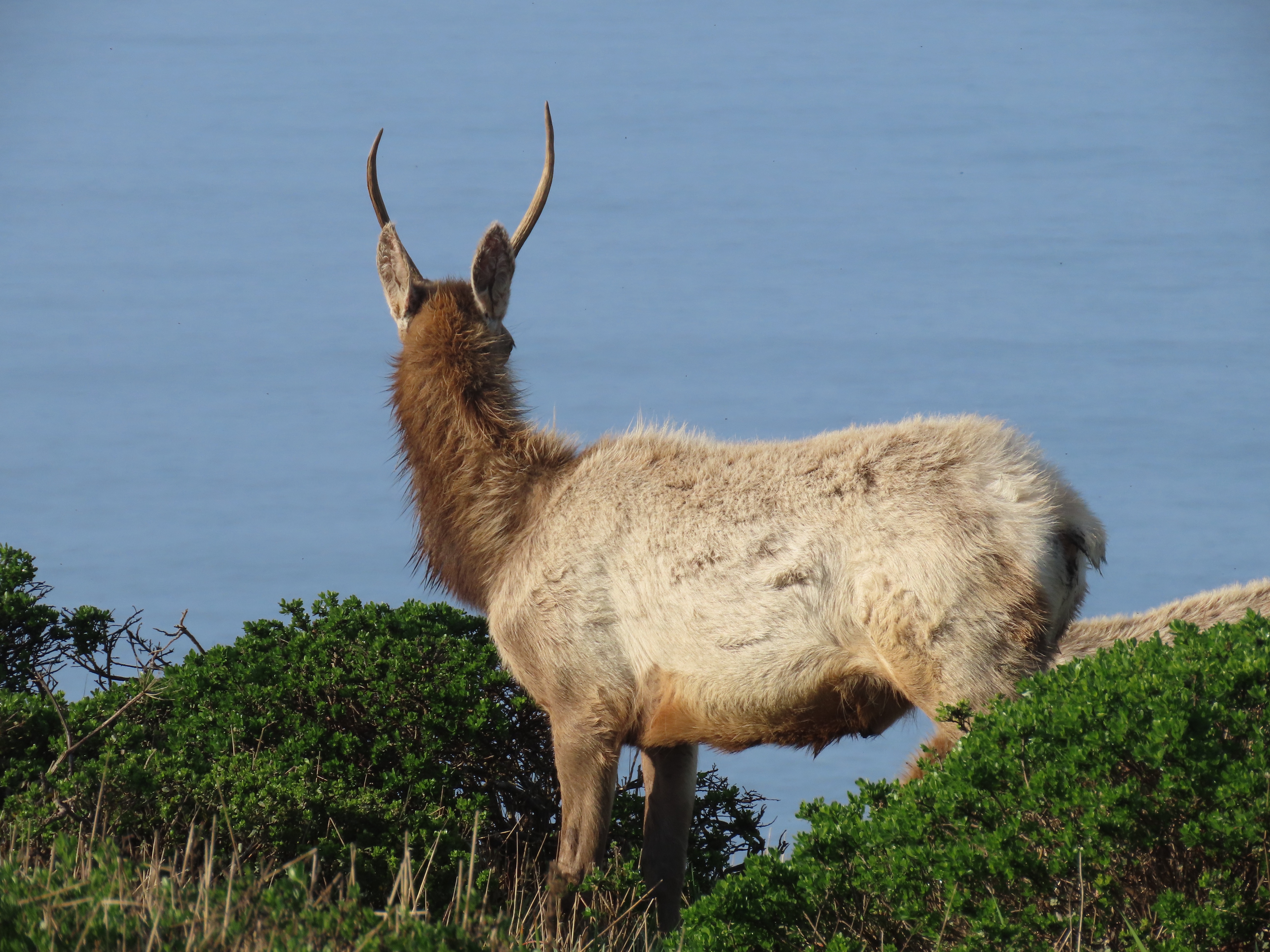
Even though the young bull’s eyes are not on me, his ears clearly are.
Silhouetted against Tomales Point, looking north. This part of Pt. Reyes is stunningly beautiful.

The Sanchez Mud Pit

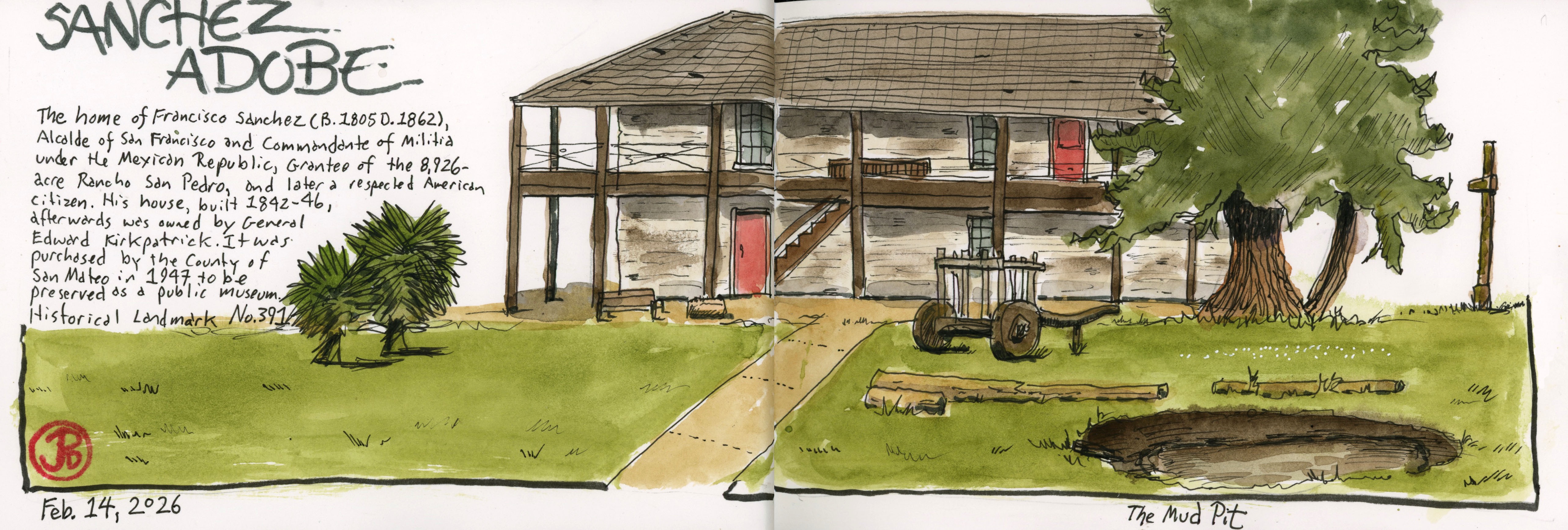
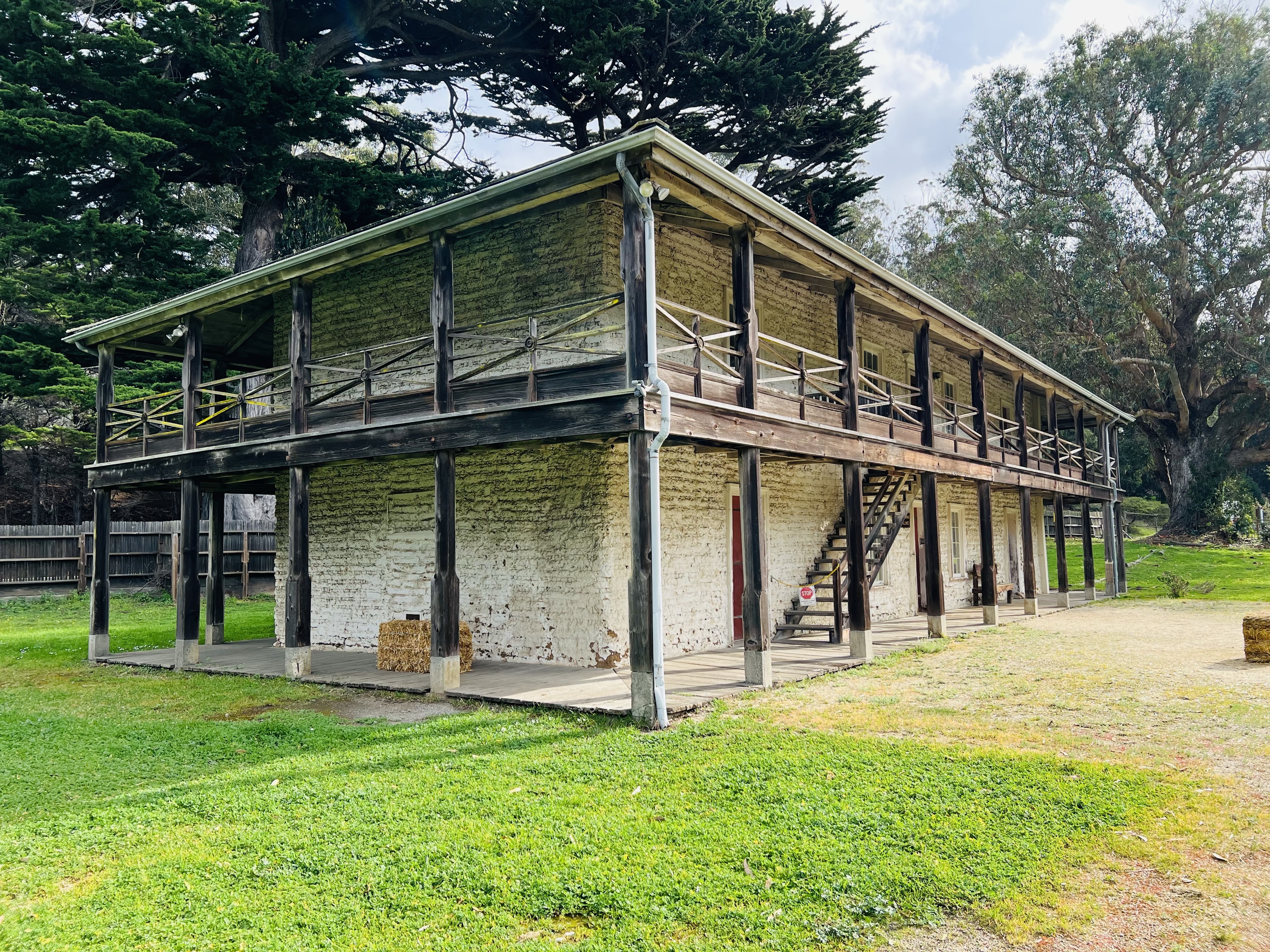
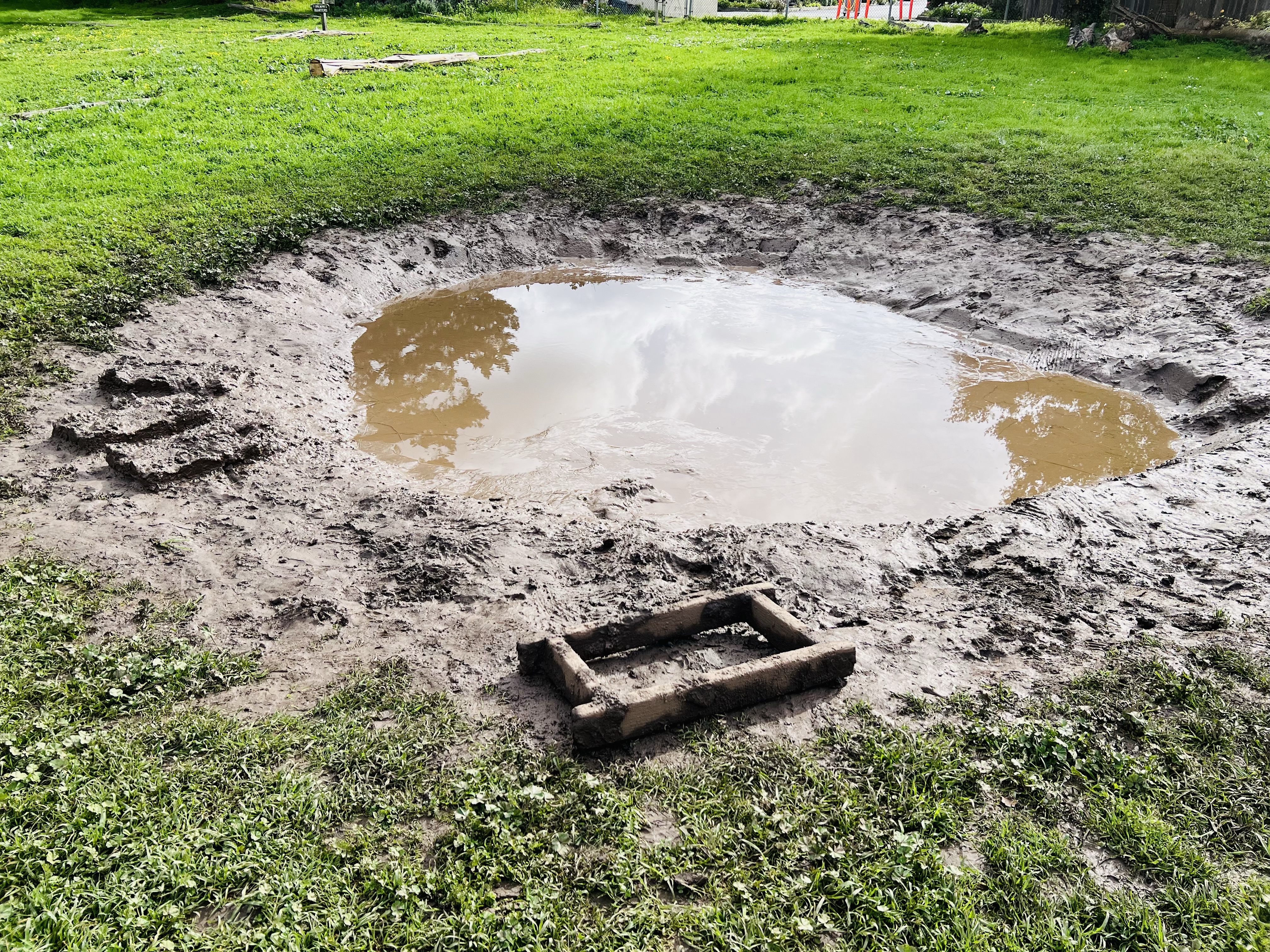
One of our most popular field trips in fourth grade is to Pacifica’s Sanchez Adobe and its infamous mud pit.

The adobe building was built by Francisco Sanchez in 1842-43 and is the oldest building in San Mateo County.

As the former Alcade of San Francisco and Commandante of the Militia he was gifted 8,926 acres of land by the government of Mexico, which is now the city of Pacifica.

Since Don Sanchez, the building has changed hands and has assumed many guises including a hotel, a speakeasy, an artichoke storage warehouse, and now California Historic Landmark No. 391.

Try explaining a Speakeasy to a fourth grader!

When I take fourth graders to Sanchez Adobe we first learn about the layers of history at the site: Native California, Spanish Missions, the Mexican and then the American eras. After our truncated tour of history the real fun begins.

One of the reasons this is such a popular trip for my nine and ten year olds is because it is the best kind of social studies: hands-on history.

My students rotate between three activities: roping a steer and grinding cornmeal, candle making, and forming adobe bricks.

The activity that long remains in the memory is making bricks in the mud pit.

The mud pit at Sanchez Adobe has been the setting of many memories over the years.

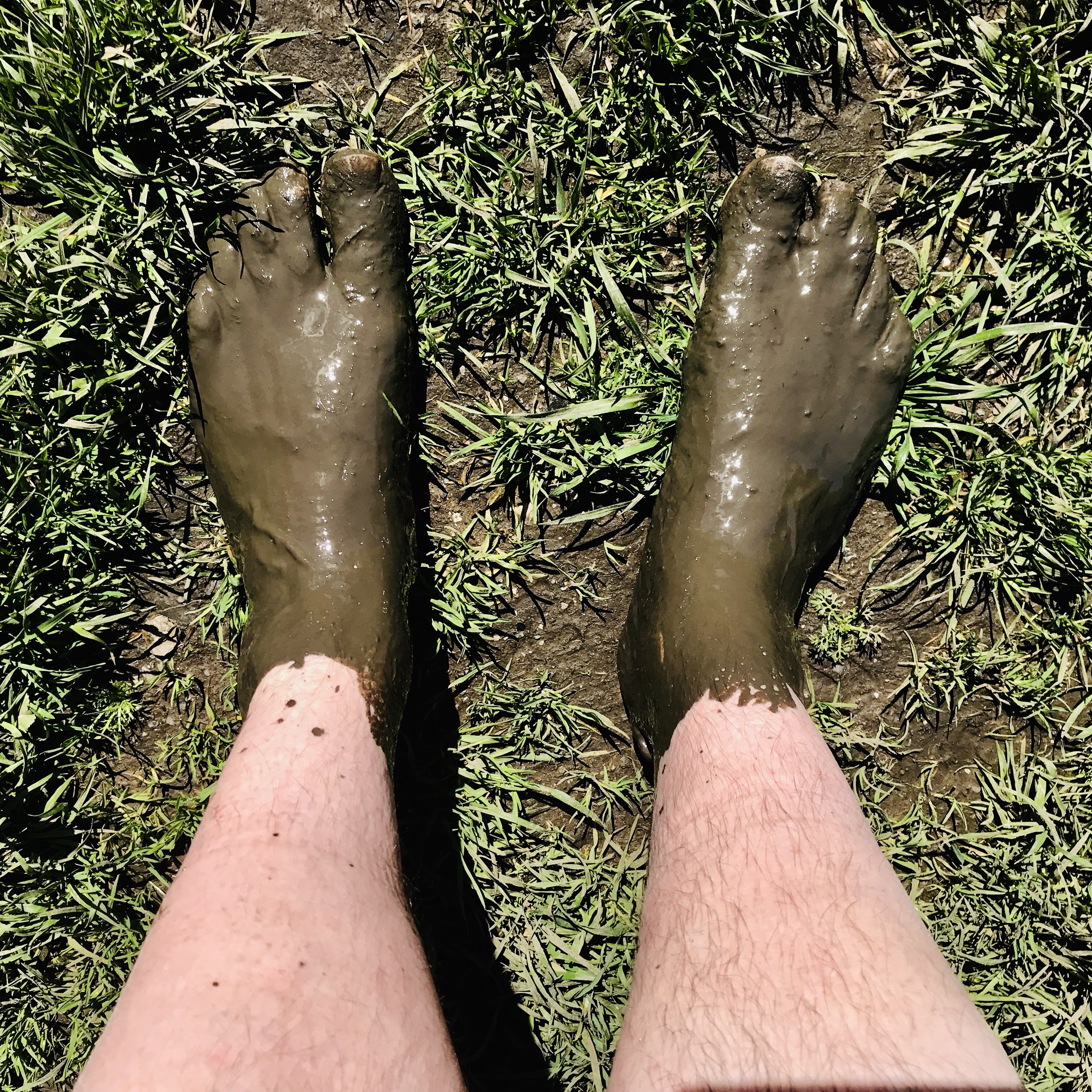
Students take off their shoes and socks and then gather around the pit. They raise their right hand (no your other right hand) and take an oath to promise not to get mud on any other person but themselves.

Now it’s time to enter the pit, students walk in a clockwise circle to mush up the mud for brick making. At first they are tentative and a bit scared of the cold mud. Was that a worm I just stepped on? And then they acclimate and it becomes hard to get students to leave the mud pit and wash up!

Now they use their hands to scoop up mud and put it in a rectangular wooden mold to form the “bricks”.

In some years I become one in the minority: a teacher that enters the mud pit.

Wearing my Sanchez Adobe brown boots.

Sketching Notes

I returned to Sanchez Abode on a February Saturday morning and I had the place entirely to myself. We had already had our field trip in January.

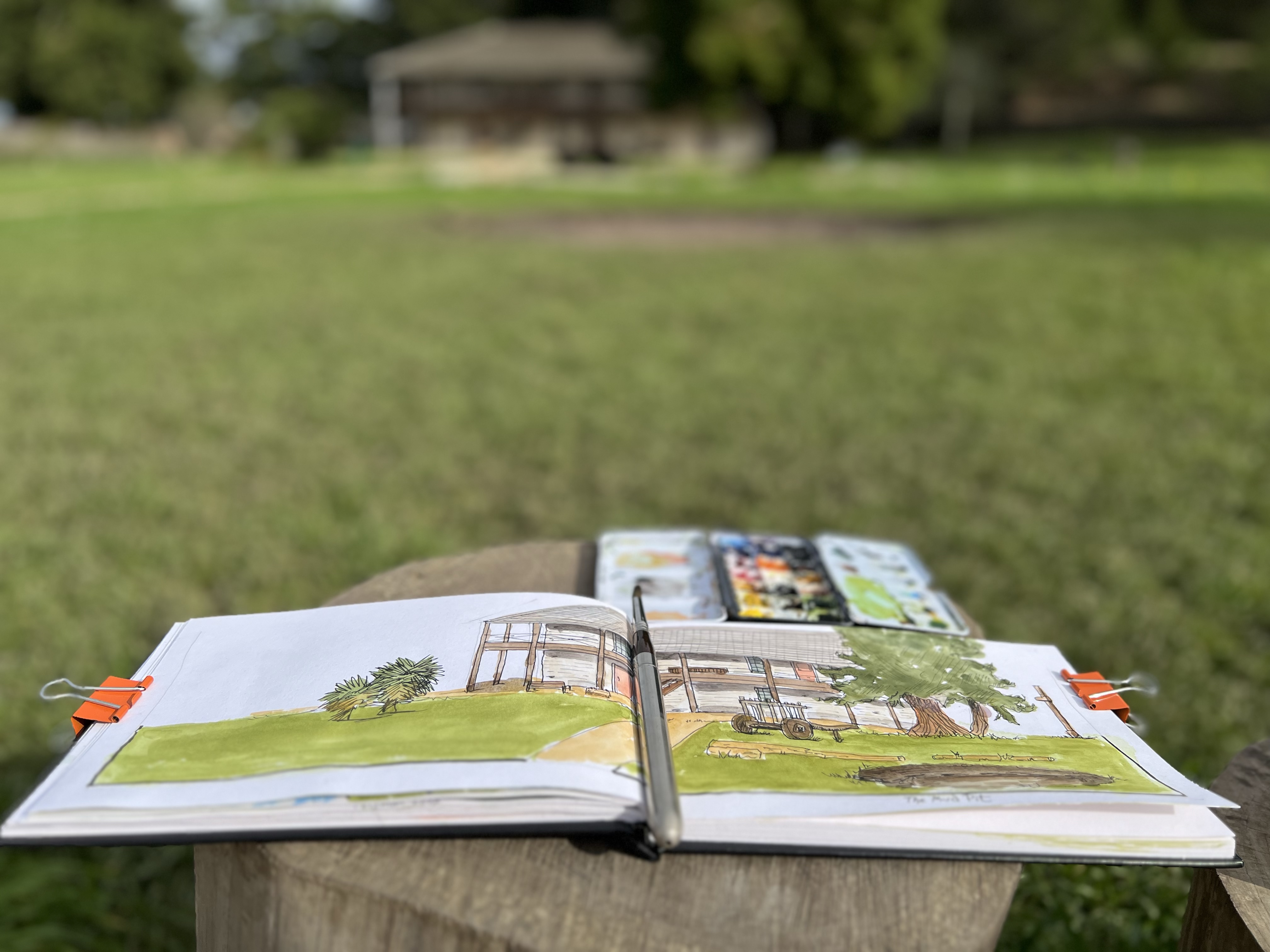
It was odd to be here without the sounds of students having fun while learning. The local black phoebes entertained me as I sat on my sketching stump near the mud pit.

For my panoramic sketch the mud pit was my anchor with wooden cart and adobe building in the background.

This was a true plein air sketch that would make urban sketchers proud. I used my small travel palette with half pans of watercolor and my Escoda travel brushes.