Image

Columbine

April 20, 2021

“The world breaks everyone and afterward many are strong at the broken places.” ~ Ernest Hemingway, A Farewell to Arms

With the recent shootings in Boulder, Colorado, I headed to the memorial to one of the most tragic school shootings in United States history.

Indeed the word “Columbine” is code for a school shooting and unfortunately there have been many Columbine copycat crimes. This tragedy took place on April 20, 1999 at Columbine High School in Littleton, Colorado.

When I knew I was going to be in the Denver area and looking at a map, I realized that Littleton was a short drive from the Denver metro area. I knew as a American and as an educator I had to visit the memorial to the victims and those wounded in this tradegy, in a park behind Columbine High.

So on the morning of April 2, 2021, almost 22 years after the shootings, I headed down to Littleton to the Columbine Memorial in Clement Park. Littleton is a town without a downtown or really a main street. It is full of tract homes of various sizes, strip malls, big box stores, big box churches, parks, and schools.

When I arrived at Clement Park, two workmen where shoveling dirt at the entrance and a woman was jogging around the memorial. It was the quintessential picture of “life goes on”. I had the memorial to myself, except for a brief visit from a Say’s phoebe and a western meadowlark.
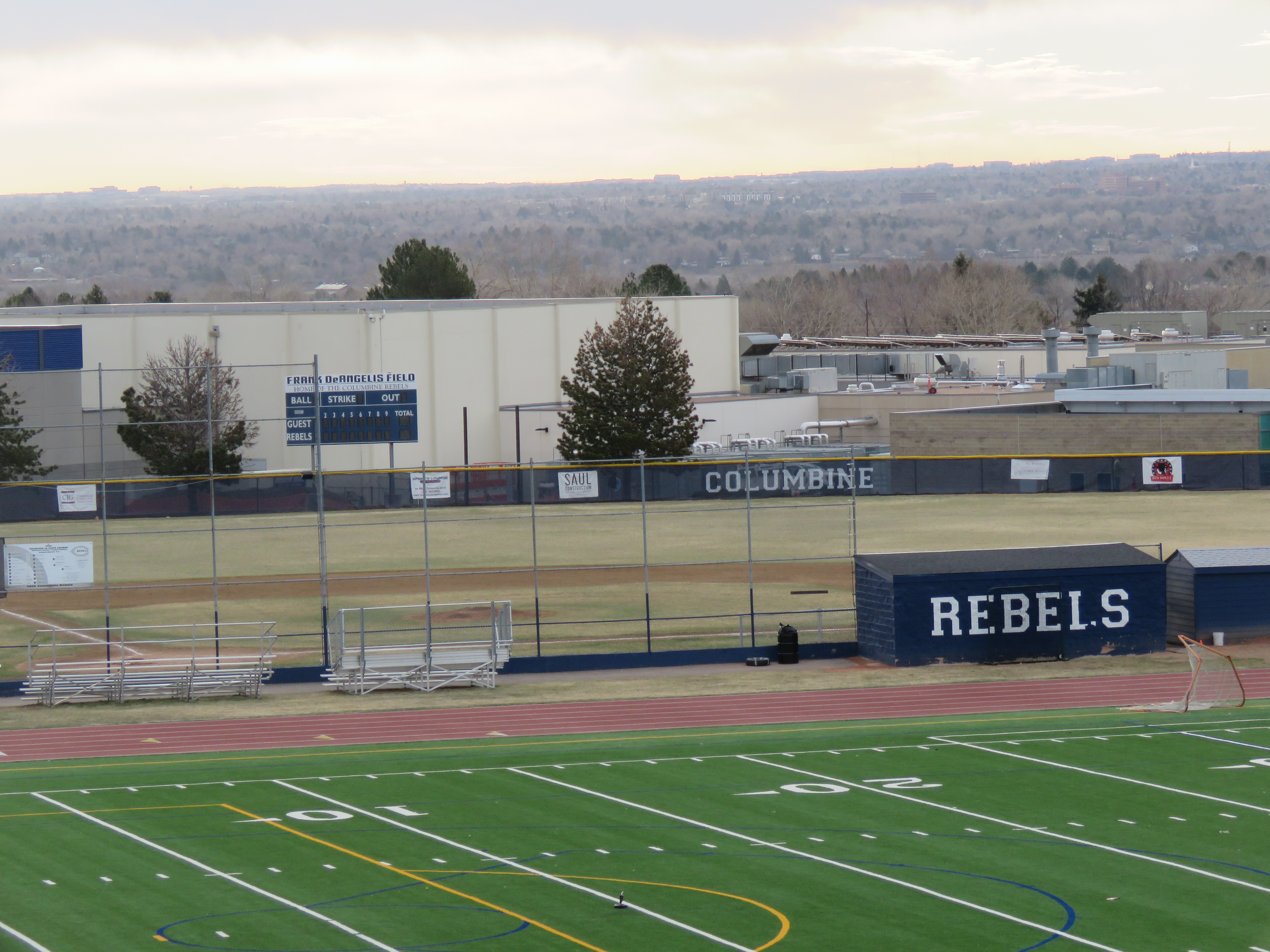
From the top of the memorial looking out to Columbine High School. The baseball field is named after “Mr. D” the much-loved principal at Columbine at the time of the shootings.

The memorial consists of two concentric circles. The inner circle, called the Ring of Remembrance, honors the lives of the 13 victims of the gunfire. Much of the memorial is made out of local red sandstone. For me the most touching and emotional rock slab honors the teacher that was killed on April 20, Coach Dave Sanders.
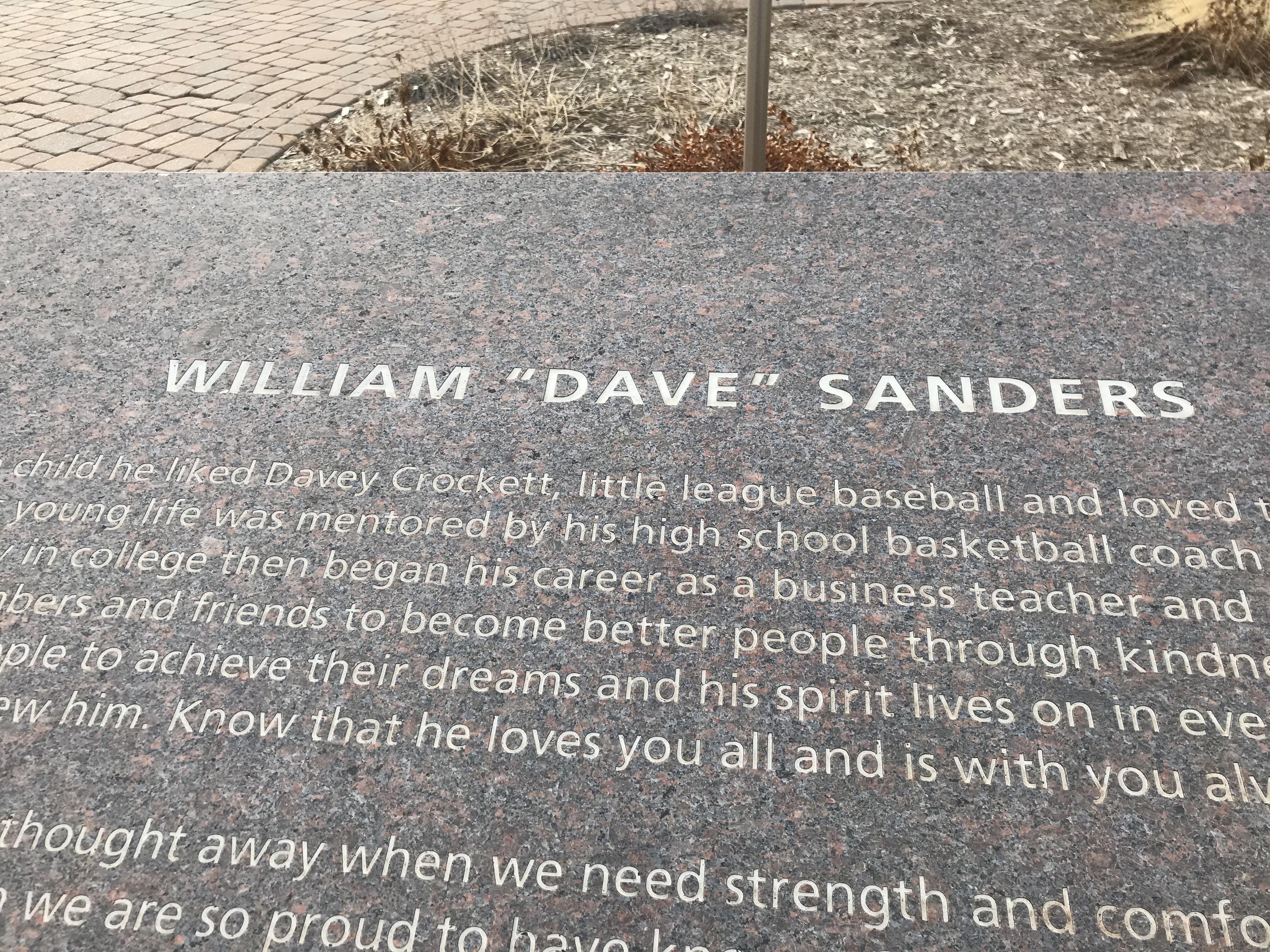
Each panel of the Ring of Remembrance is dedicated to each victim with statement written by family members, some including quotes from scripture, and one included a poem written by a victim shortly before her passing.
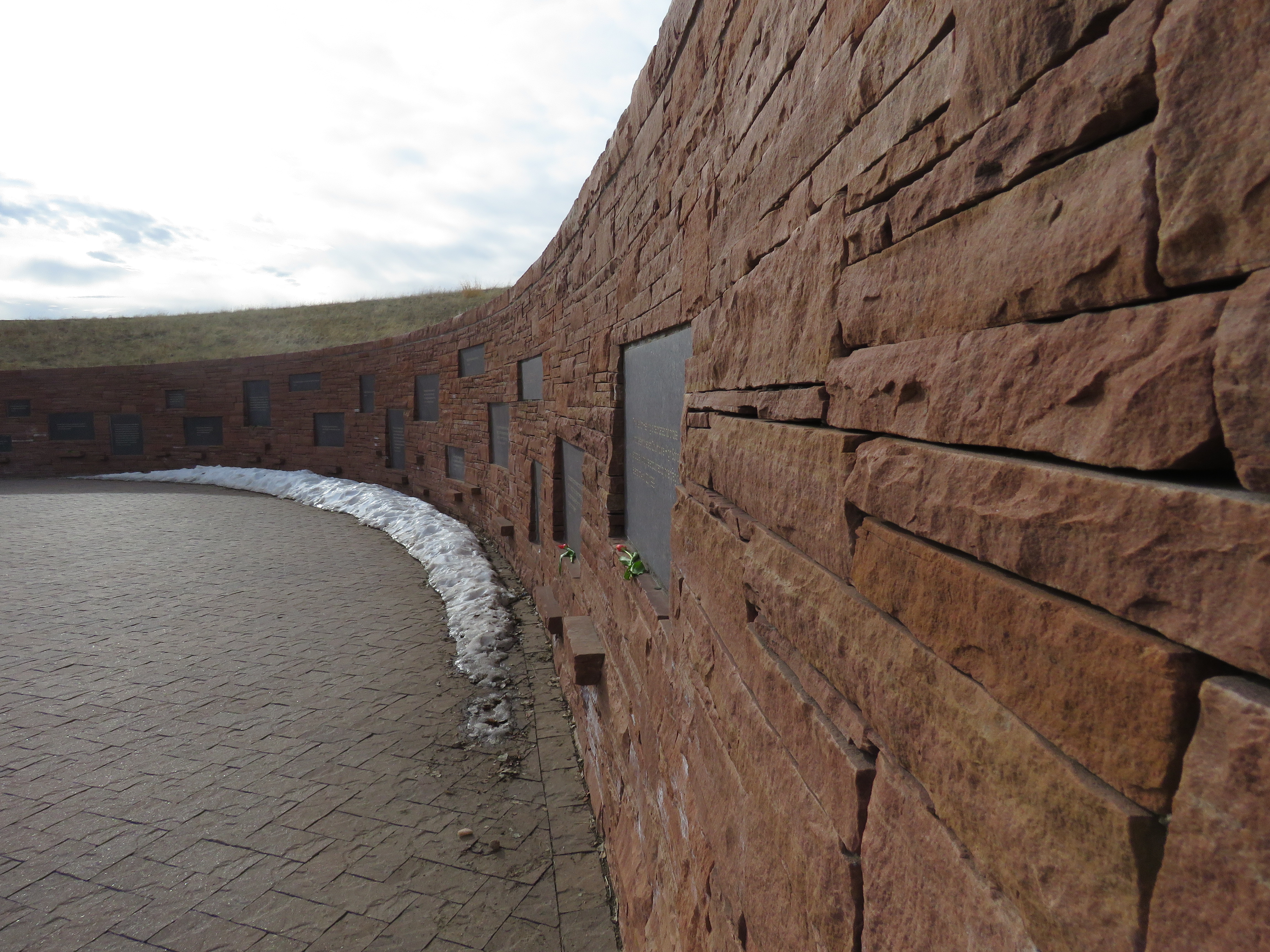
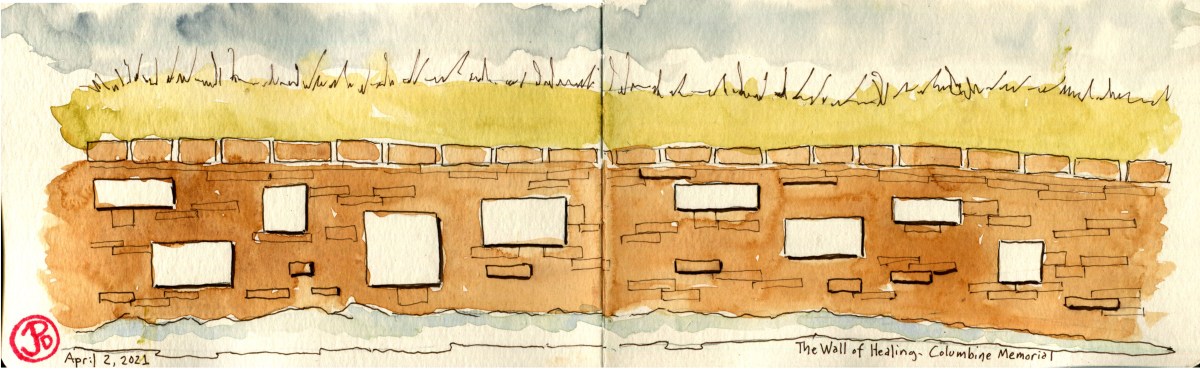
The outer circle is called the Wall of Healing and contains statements from the Littleton community. This is the part of the memorial that I chose to sketch. Across from the redbrick sandstone wall was a low bench for reflection. It was here that I chose my spot, looking across to the wall with a line of snow underneath.
Sketching is capturing the outward but also turning inward. Sketching, in other words, is a mediation. And I though about this tragedy and how it altered the Littleton Community and the wider world. It was startling to think that two students could turn death and destruction on their own peers. As an educator, could I seen signs of this in the eyes of my own students? At what point does innocence end?

“Why?” is a frequently asked question about the events that unfolded 22 years ago. And there is much misinformation and speculation in an attempt to answer this seemingly simple question. I have no answers to this question and at times we have to come to terms with not really knowing the full truth, or settling with an incomplete answer.

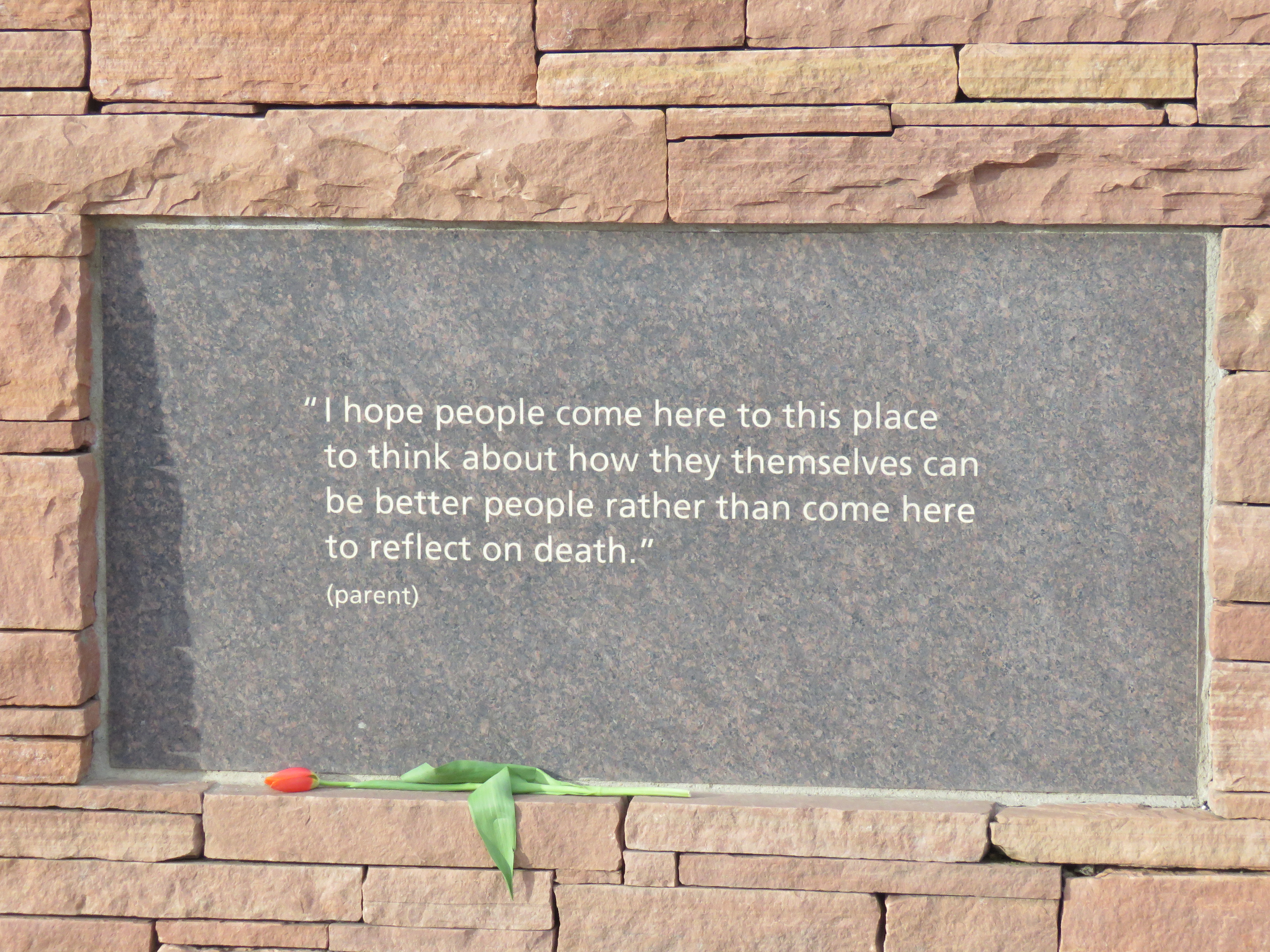
But this memorial is also a testament to hope and is a statement to one community’s response to violence. Some of the statements on the Wall of Healing reflects this hope. One panel reads, “Rather than a loss of innocence, I’ve got to hope that something like this encourages us to be better people.”
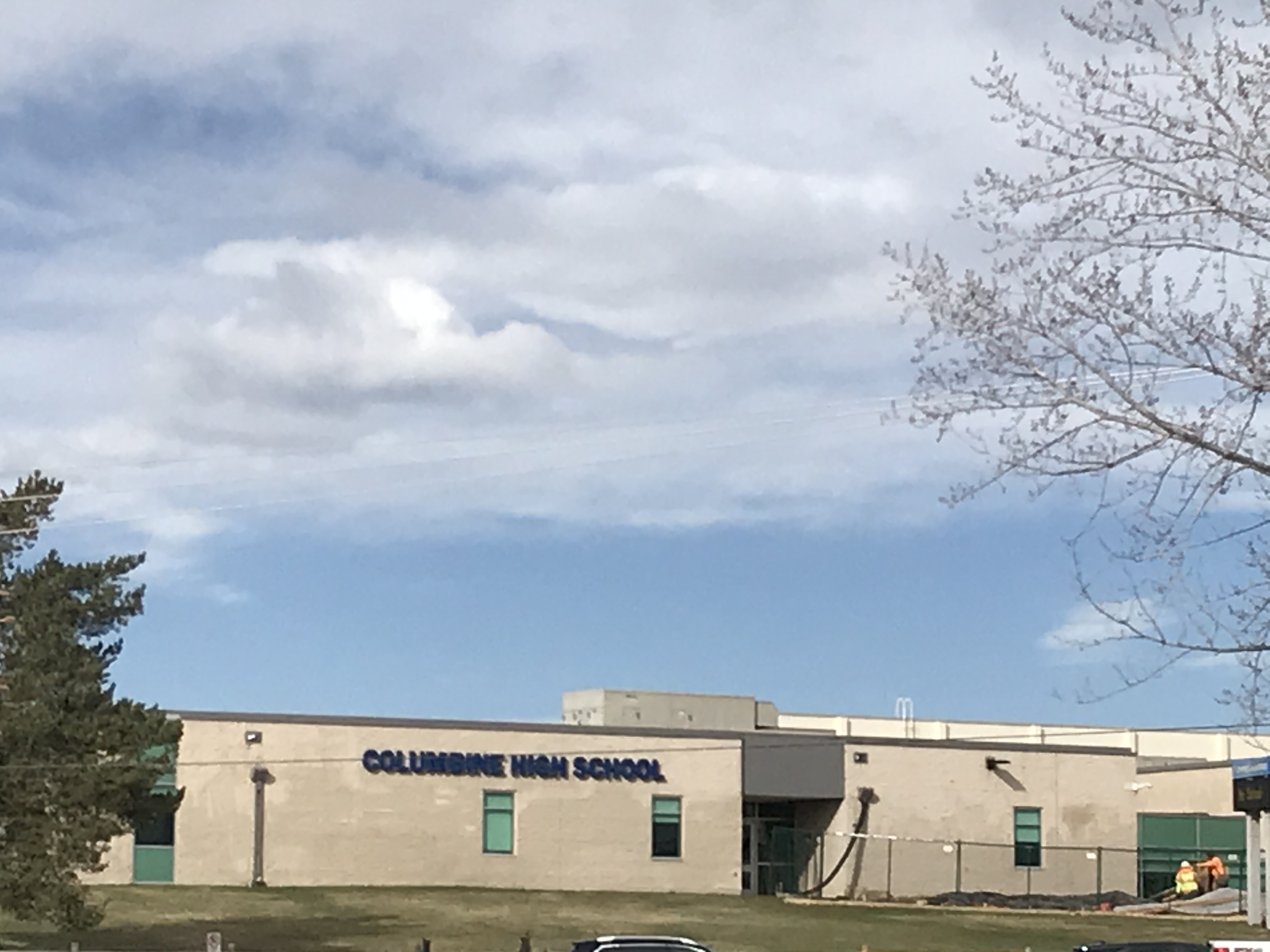
The above photo was taken from Leawood Park, the park across the street from the high school. Many of the students evacuated to the park on April 20, 1999. One student noted that a line of teachers spanned the street in front of the park to protect the students. This is a strong metaphor for the love and compassion all teachers have for their students.

Another panel on the Wall of Healing, written by a faculty member, simply states: “The children and Dave are what we need to remember.”
Image

Red Rocks Amphitheatre

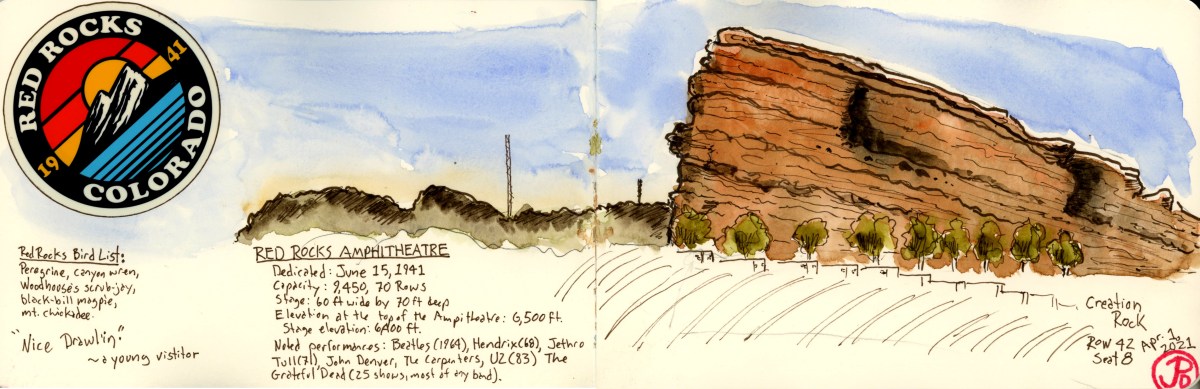
One Colorado location on my sketch list is Red Rocks Amphitheatre near Morrison, Colorado.

While I have never seen a concert at Red Rocks, the stunning amphitheatre first came to my attention from a live music video played on MTV (back when MTV played music videos). It featured a little known Irish band named after a spy plane. This was U2 and the song was the anthem about the Troubles, Sunday Blood Sunday.

The band was framed in tall, red rock with fire blazing on the top of three of the mesas. The singer, Bono, with this breath steaming into the 6,400 foot, cold, rainy air, yells, “No more, No more war!”

This was in 1983 but Red Rocks has been a music venue since June 15, 1941 and has hosted such notable artists as the Beatles, Hendrix, Jethro Tull (part of the Red Rocks Riots that banned rock music at the venue for five years), John Denver (Duh!), U2, the Grateful Dead (they have played the venue 25 times, more than any other band), the Moody Blues, Steve Martin, a ton of jam bands, Neil Young, and many others who will never be mentioned in this blog! (Think John Tesh).

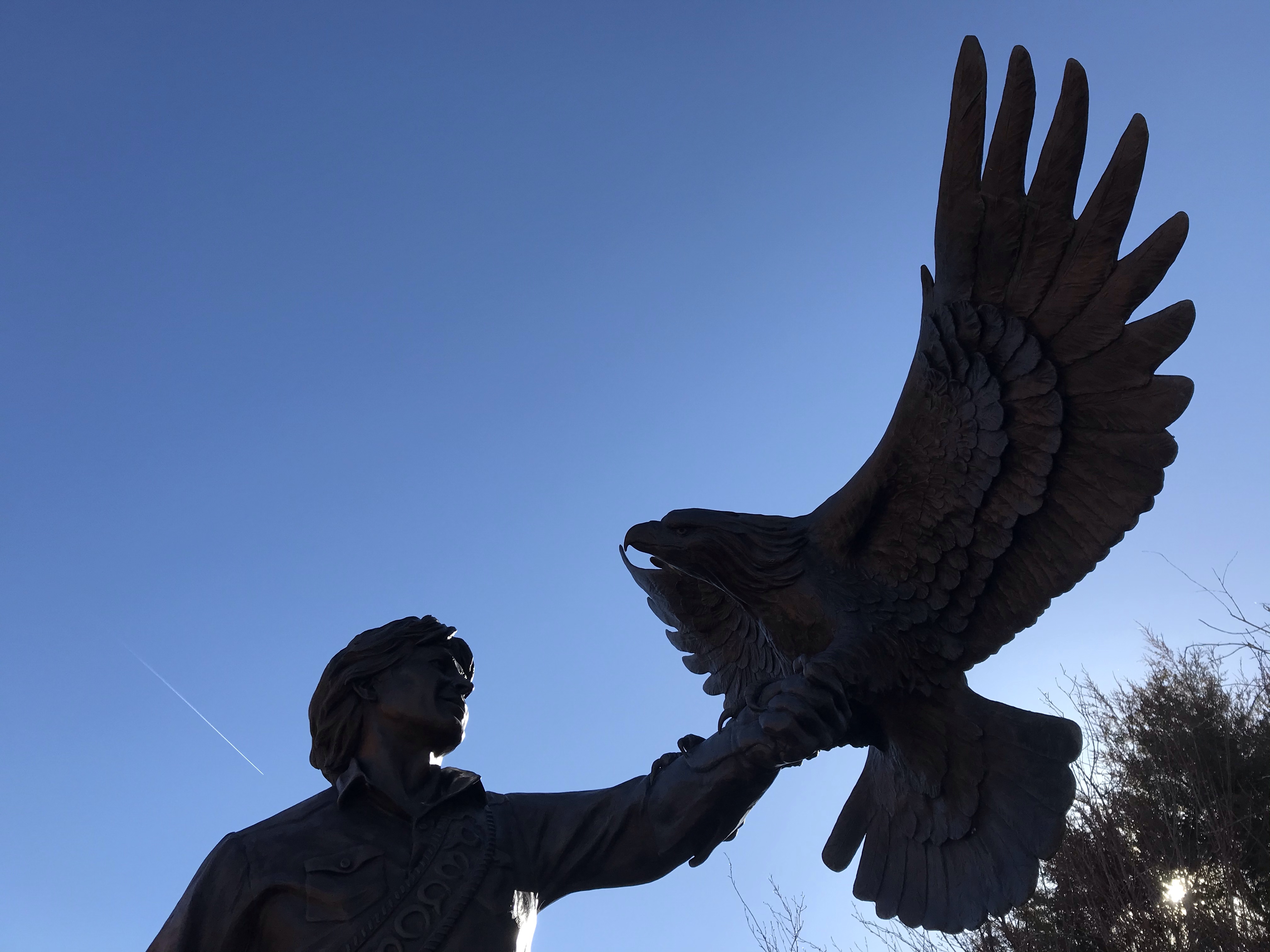
A statue of John Denver with a Golden Eagle at the Trading Post.

The venue is not only used for musical performances. On May 2, 1999 a student memorial for the Columbine High School shootings was held at Red Rocks. At the time, Columbine was the most deadly school shooting in history. Columbine High School is in Littleton, 22 miles from the amphitheater. Sadly the death toll has now been eclipsed.

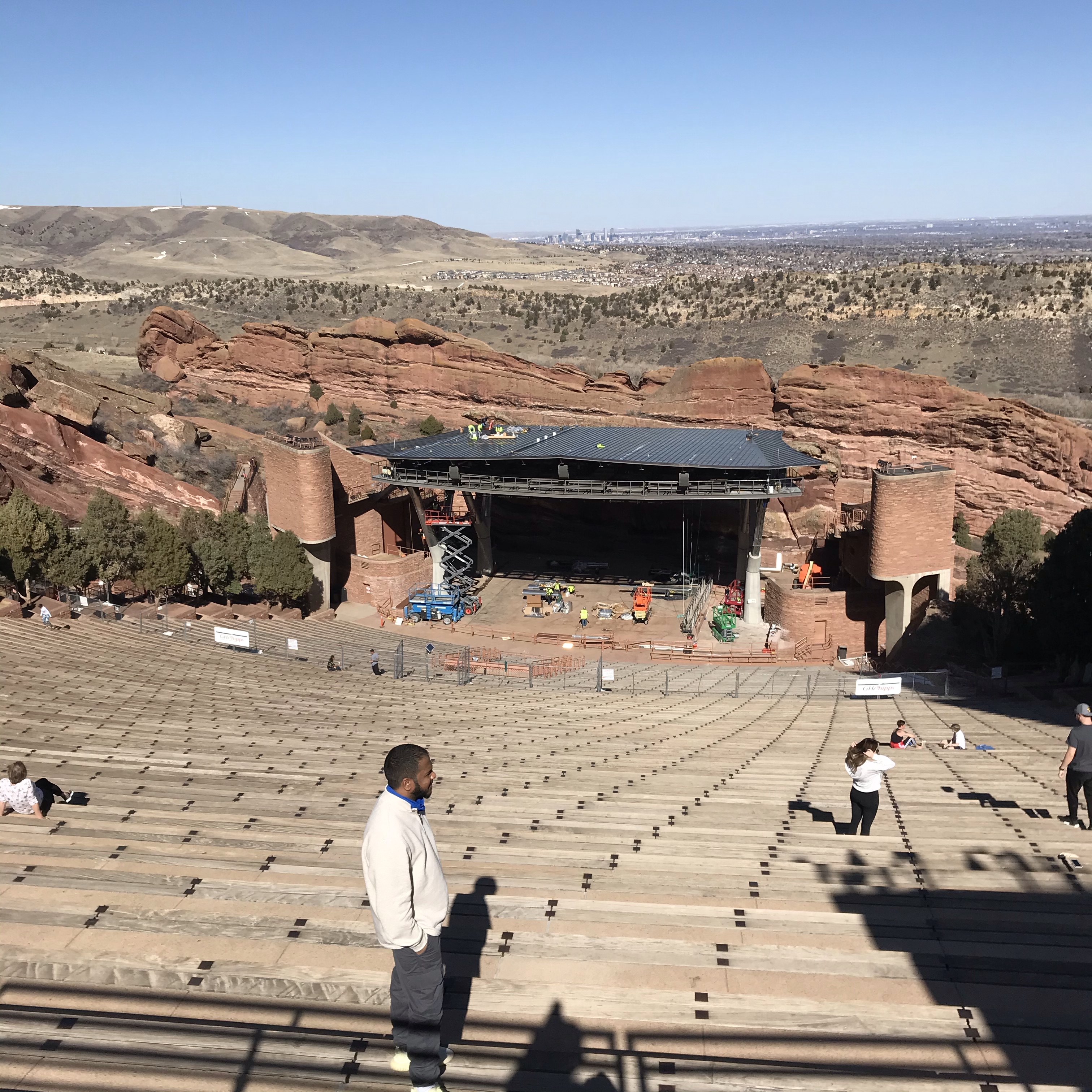
Looking toward the stage from the top of the amphitheater. In the distance is the Denver metropolitan area.

Red Rocks is open to the public, even when there is not a concert. When I visited in the afternoon, there where quite a few visitors, just to see the beautiful location. Music was provided by a high school girl playing the flute. Her rendition of “Rolling in the Deep” was sublime. I picked a row (42) and a seat (8) to start my sketch. I sat in the shade because Colorado was unseasonably warm and under my feet was unmelted snow.

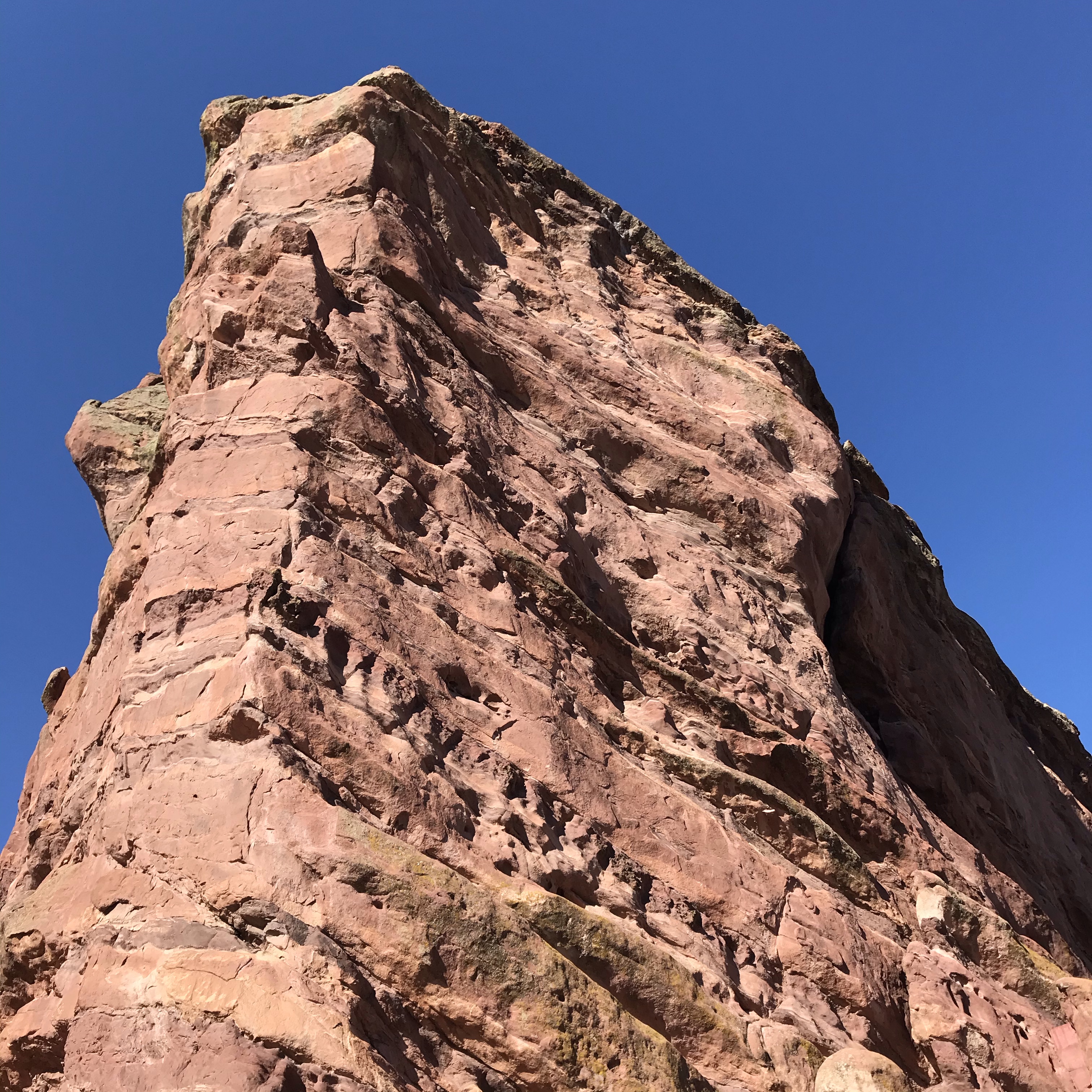
A different angle of Creation Rock. On the opposite rock formation, Ship Rock, where two peregrines and I couldn’t leave Red Rocks without hearing the best music ever performed here. The call of the canyon wren. The wren did not disappoint.

As I was sketching a young girl, a third grader I would guess, walked by. She doubled back and looked at my work in progress. “Nice drawling” she proclaimed.

That’s all the encouragement I need to just keep on sketch’in!

Image

California Zephyr #6: Colfax to Denver

“Trains seems to rattle out stories, as though the motion of the track acts to shake up thoughts and loosen tongues. There’s a world outside the window and a whole separate world within.” ~Ticket the Ride, Tom Chessyre (My California Zephyr book)

For a while now I have wanted to ride the California Zephyr, one of AMTRAK’s most scenic routes.

Last Spring, I had to cancel my train journey but this Spring Break I booked an abbreviated trip, not departing from Emeryville but Colfax and detraining in Denver instead of Chicago.

I chose Colfax because it is a 35 minute drive from my mother’s house in Penn Valley. The train was running two minutes late. When I would finish the journey to Denver, the number 6 was running two hours late. Freight trains are given priory over passage service like the California Zephyr.

Four other people boarded at Colfax, two middle aged women looked like they were headed to Reno. The two other travelers were a bit older and appeared to be heading further down the line. They are all traveling in coach. I never saw them again.

Colfax is not one of the “Fresh Air- Smoke Break” stops (oxymoron I know), so the Zephyr stops only long enough to pick up or drop off passengers.

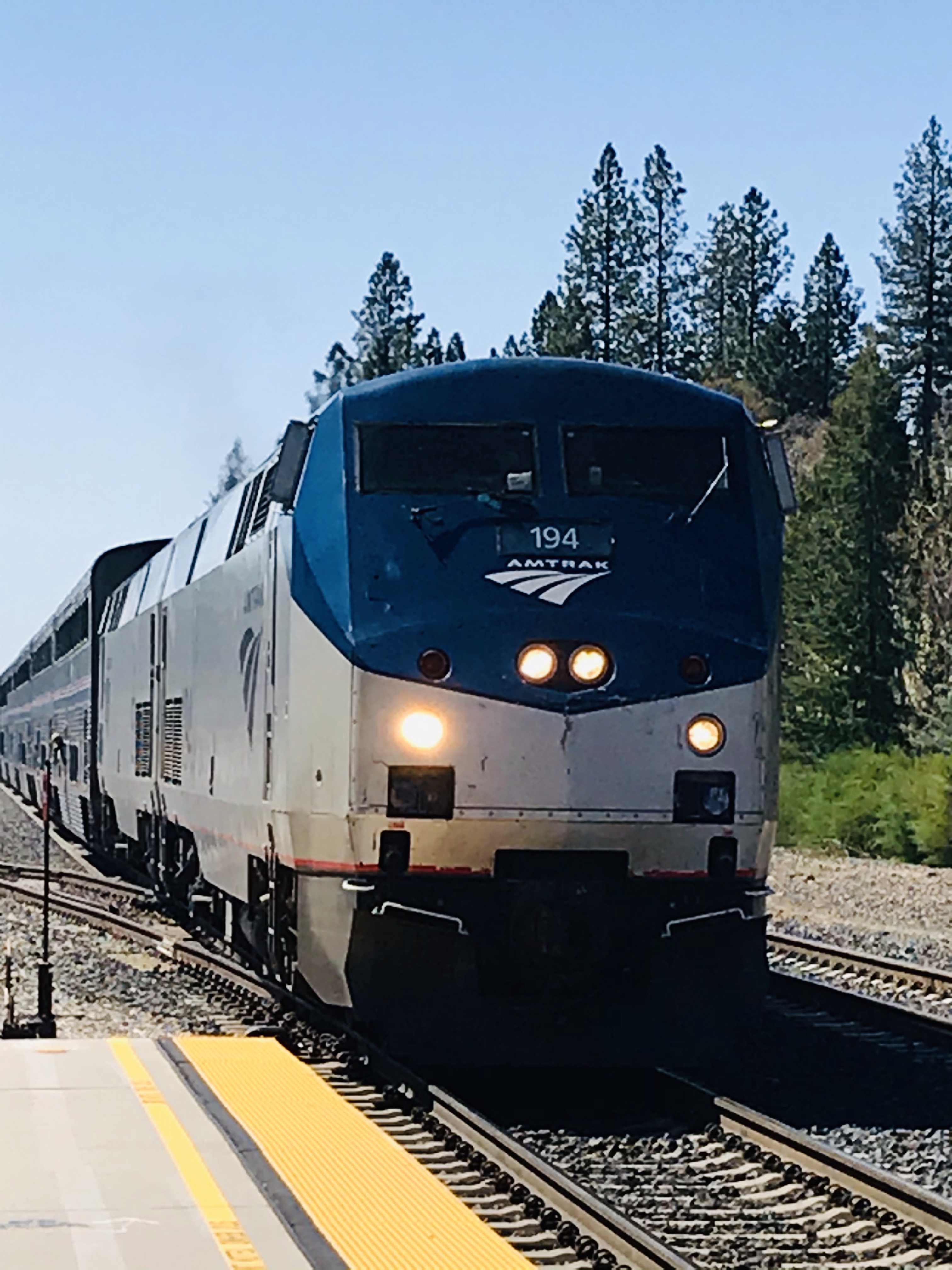
The California Zephyr train # 6 pulling into Colfax running two minutes late. On point is a General Electric P42DC, built September of 2001. Number 194 and 153 are now 20 years old.

Number six pulls into Colfax. The platform is too short for the two locomotives with the eight car consist. I am on the first car behind the locomotives, sleeper car 32048 and roomette number 003. This will be my address for the next 30 hours or so. Once I have boarded, the train slowly pulls forward so the Reno travelers can board the coach car, at the end of the train.

There is something wonderful about stepping off the platform and into another moving world. The California Zephyr is a self-contained world with everything you could possibly need: food, drink, a bathroom, and a bed (not to mention the amazing views).

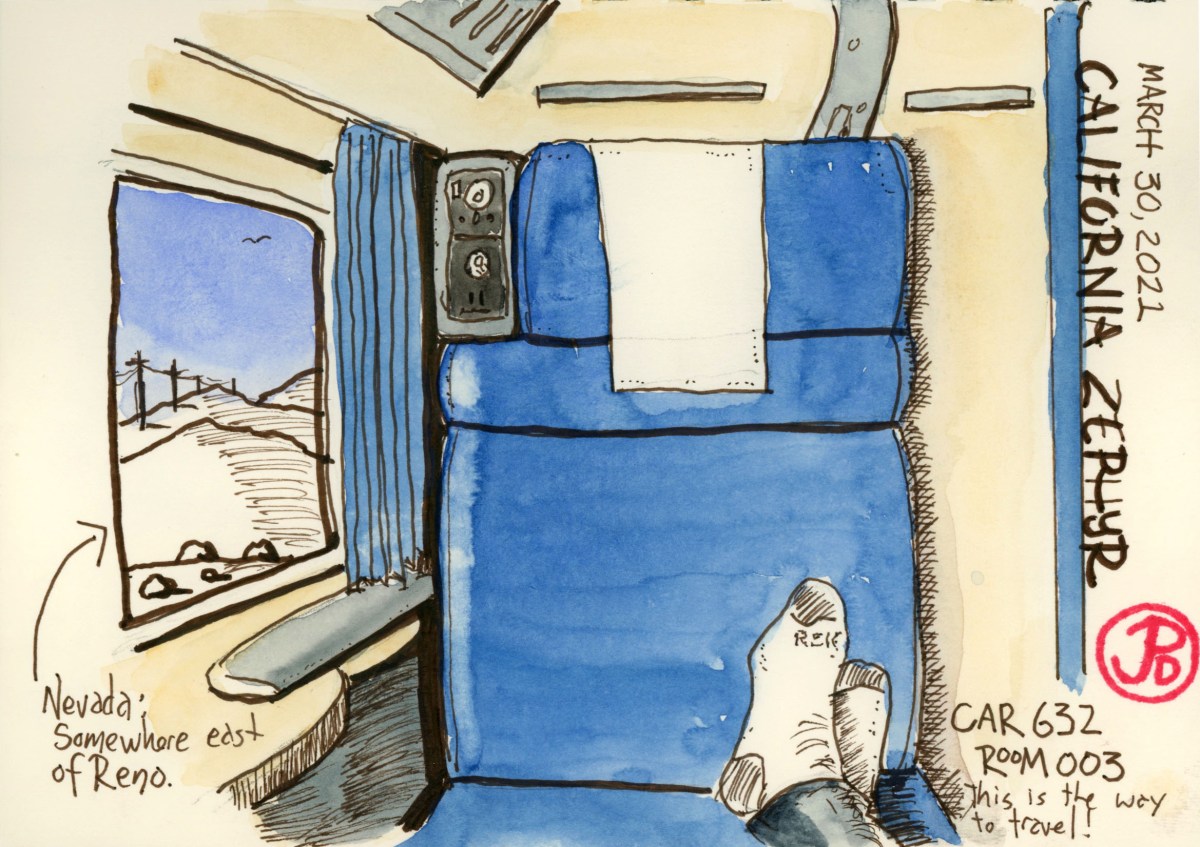
The locomotive throttled up and headed east out of Colfax and my car attendant showed me to my roomette (featured sketch). I set my bag down and I headed to the opposite side of the train to see the first of many views: Cape Horn. If there is one problem with the Zephyr is that there are great views on both sides of the train and unless your sitting in the observation car, your roomette faces only one side of the train.

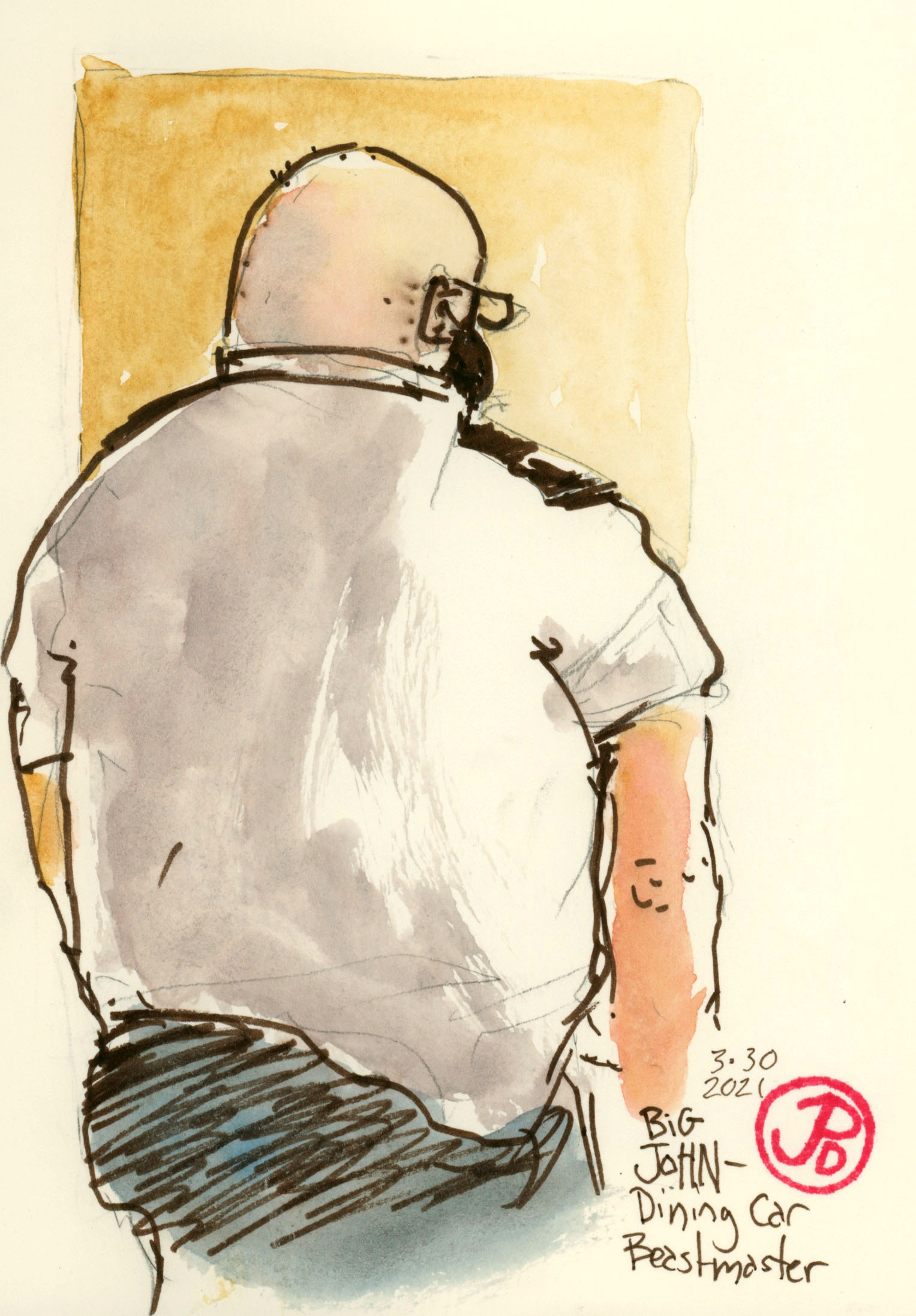
I book a late lunch in the dining car with the dining car attendant, John. I head to the observation car and wait for my name to be called. Here I do my first sketch abroad the Zephyr. Over the course of the journey I do many more.

John, also known as Big John, seems to have worked for Amtrak for a while. He reminds everyone that they are short staffed for this leg of the journey. This is because many of the Amtrak workers have been furloughed because of Corvid-19. At one point, one of the engineers helps out with lunch service. Don’t worry. Some engineers are on board and there was someone at the controls as we headed over the Sierra Nevada Mountains.

I enjoyed talking train talk with the engineer, now promoted to dining car assistant. He tells me a little about the locomotive and we discuss the recently restore Big Boy 4014, that largest steam locomotive in operation.

After lunch I head back to my roomette and do some more scenic sketches.

Image

A Sketcher’s Prep

Before any great journey, I do some sketcher’s prep.

In this case, the featured sketch, is a spread about my Colorado birding wishlist featuring such birds as scaled quail, sharp-tailed grouse, American three-toed woodpecker, and white-tailed ptarmigan. I did quick thumbnail sketches of each species, in other words, you would never use this spread as an identification guide.

While these sketches are no where near David Allen Sibley standards, they help me to see each bird better. To sketch from a photo requires close attention, once when the sketch is penciled in, then when it’s inked and finally a third time when the image in painted.

I also wanted to use a new travel palette for Colorado and I documented it’s creation in another spread.

I first sketched out the layout of my new palette in my landscape Delta Stillman & Birn softcover sketchbook. As I added each color to the wells of the palette I painted it in and added a swath on the opposite page. This will provide a good reference of what the colors look like on the heavy weight Delta paper.

I love using Stillman & Birn sketchbooks and I love the feel of a panoramic, landscape format but I dislike the fact that this book is not made in hard cover but softcover only. It does not provide a solid sketching surface to paint on. I will see how this book holds up on this trip.

I also carry a small notebook that help me prep before a trip. I writing down my itinerary, addresses, lodging information, any travel notes, random poems, target life birds, and a targeted sketch list.

Image

Post 400: A Zephyr Deferred

Zephyr: (n) a gentle wind from the west.

Last spring break I booked a roomette on the California Zephyr, a 2,438 mile journey from Emeryville, Ca to Chicago, Il. This route passes through such cities as Sacramento, Truckee, Reno, Salt Lake City, Denver, Omaha, and Chicago. It is one of the most scenic routes on the AMTRAK network.

Last spring I was going to travel the entire route but then Covid 19 happened and I had to cancel the trip. I knew that this rail dream was deferred and at first chance I would rebook this trip because I have always wanted to travel by rail through the Sierra Nevada and the Rocky Mountains.

The opportunity came in spring break of 2021. Instead of traveling the whole route, I booked a round trip with a roomette from Colfax, Ca (near my mom’s house) to Denver, Co. This stretch includes the most scenic parts of the route and Denver provides it’s own destinations.

On this trip, I plan to do many quick sketches of train views along the route. At California Arts Supply in San Mateo, I got a custom Ronquad which is a 4 by 6 piece of card stock that would be a template for framing each sketch. I used my Ronquad on the featured sketch.

But why Denver and not Chicago? Both cities provide great sketching opportunities but Denver has an edge over Chicago: life birds! I had a few ABA lifers on my list: scaled quail, dusky grouse, American three-toed woodpecker, brown-capped and black rosy-finch, sharp-tail grouse, and the much sought after white-tailed ptarmigan. And while Chicago offers lots of architecture sketching opportunities, Denver has that too but also beautiful landscapes.

The Zephyr stops at the historic Union Station in downtown Denver and I booked a “Pullman” room in the hotel at the station, the Crawford Hotel. I admit this is a bit a splurge but I love the idea of stepping off the train in the evening, after a two day trip, and walking a short distance to my room in Union Station. It seems a throwback to a different era. An era when more people travelled by rail, when the airline industry was in it’s infancy.

As I do before any trip, I do a few sketches to build knowledge and excitement. The featured sketch is from the AMTRAK website for the California Zephyr. This location looks to be somewhere in the Rocky Mountains. I also like to do a map of my future journey. In this case, Train 6, from Colfax to Denver with all the stops in between.

California Zephyr map showing all the stops from Colfax, Ca to Denver, Co.

Image

Waddell Beach: Black Scoters and an Elephant Seal

I had a nice Santa Cruz County After-Work-Lifer (AWL) as I just crossed into Santa Cruz County on Highway 1.

A pair of black scoters had been reported just north from the dirt parking lot at Waddell Beach.

Three scoters are found on the California Coast in winter: surf, white-winged, and black. The most numerous is the the surf scoter. There were about fifty (probably many more) riding the waves or diving under them, off the sands of Waddell Beach.

Black scoter is the least common off the Santa Cruz County coast. Luckily for birders, it is the easiest to identify. Both the male and female are distinctive. The black has a rounded head where as the surf and white-winged scoter have a flatten head as if they were hit on the head with a frying pan!

The male black scoter, like it’s name implies, is all black. It’s head is rounded and it’s orange “golf ball” at the bases of it’s bill is a beacon that yells out, “Black Scoter!!”
The female also has a rounded head and a dark cap that contrasts with a lighter checks and neck.

I returned to Waddell Beach on Saturday morning to look through the gull flock at the Waddell Creekmouth. I was hopping to see a kittiwake or the rare lesser black-backed gull that had recently been reported. I saw neither.

What I did find, foraging in the near shore of Waddell Creek, was a long-billed dowitcher. Turns out that this is a new county shorebird for my list!I always love these shorts of birding surprises!

I did want to look for the black scoters again and try to get a few photos of the continuing sea ducks in good morning light. They obliged as the rode the tide about 40 yards from the parking lot. I was able to photograph the two together and separately as they associated with the surf scoters.

On Sunday morning, I headed back to Waddell Beach. The creek provides a large public gull bath along the coast and this area has produced much sought after gulls as black-legged kittiwake, glaucous gull, Bonaparte’s and, just once, an adult lesser black-backed gull! Gulls congregate here to wash in the fresh water and you are more likely to see a larger number of gulls at this early hour before the beach crowds arrive.

On Sunday morning all I recorded was California, western, mew, herring, and four Heerman’s gulls. Nothing too out of the ordinary. It did give me practice at sorting through gulls which can be notoriously tough to identify.

On my way back to the parking lot I refound the two black scoters in even better morning light. The two photos included in this post were taken on Sunday morning.

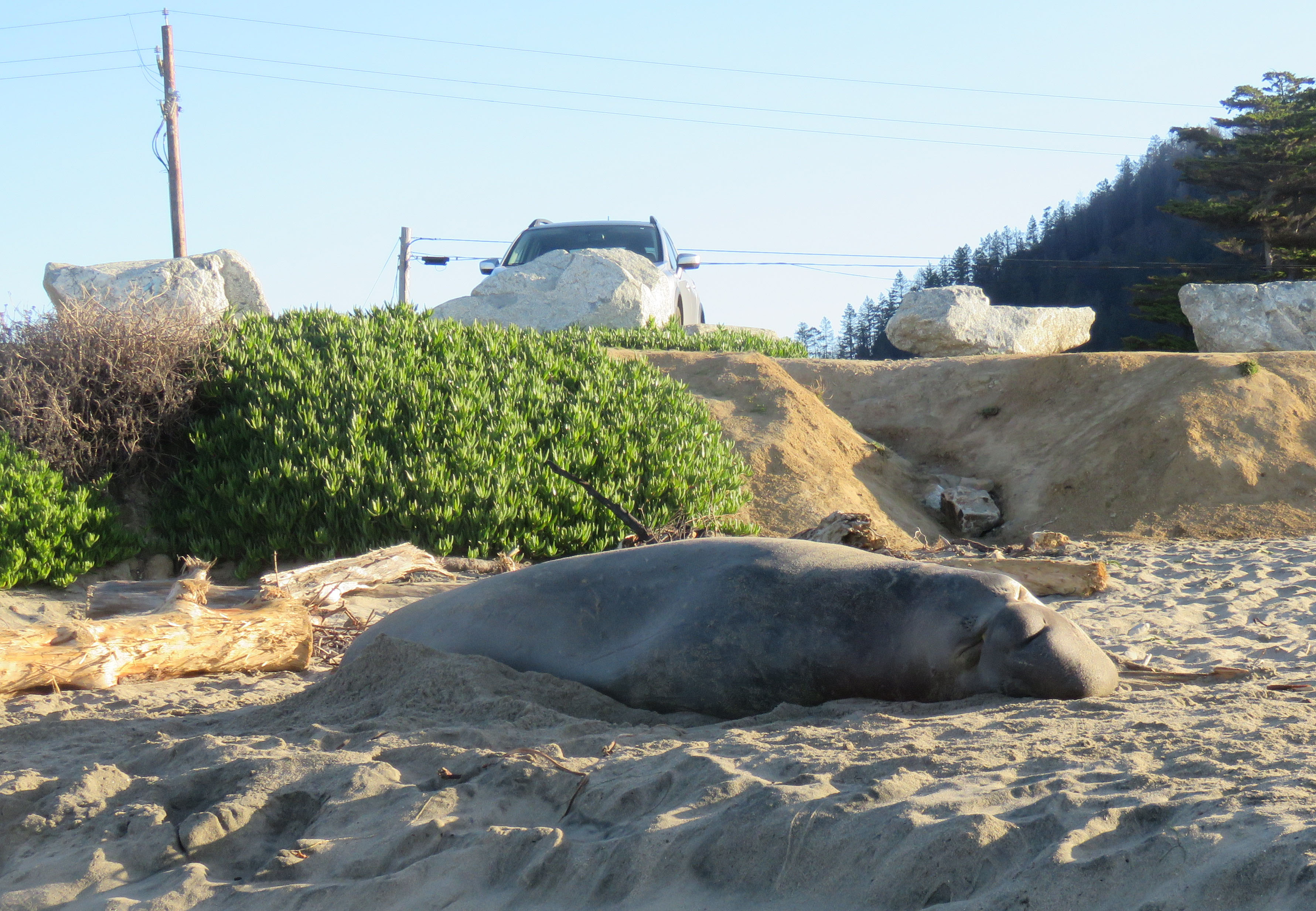
When I returned to my car I looked down at the beach and about 20 feet away was large 12 to 15 foot bull elephant seal resting on the sands. How had I missed such a large beast?

I had come here to see a county life bird. Instead I found a county life pinniped!

The view from the parking lot. Seems so hard to miss.
Here is my car to provide some scale.
This young male northern elephant seal looks like he has been in a few scuffles by the number of scars on his body. He is defiantly the beach master of this beach.
Image

Del Puerto Canyon and the Canyon Wren

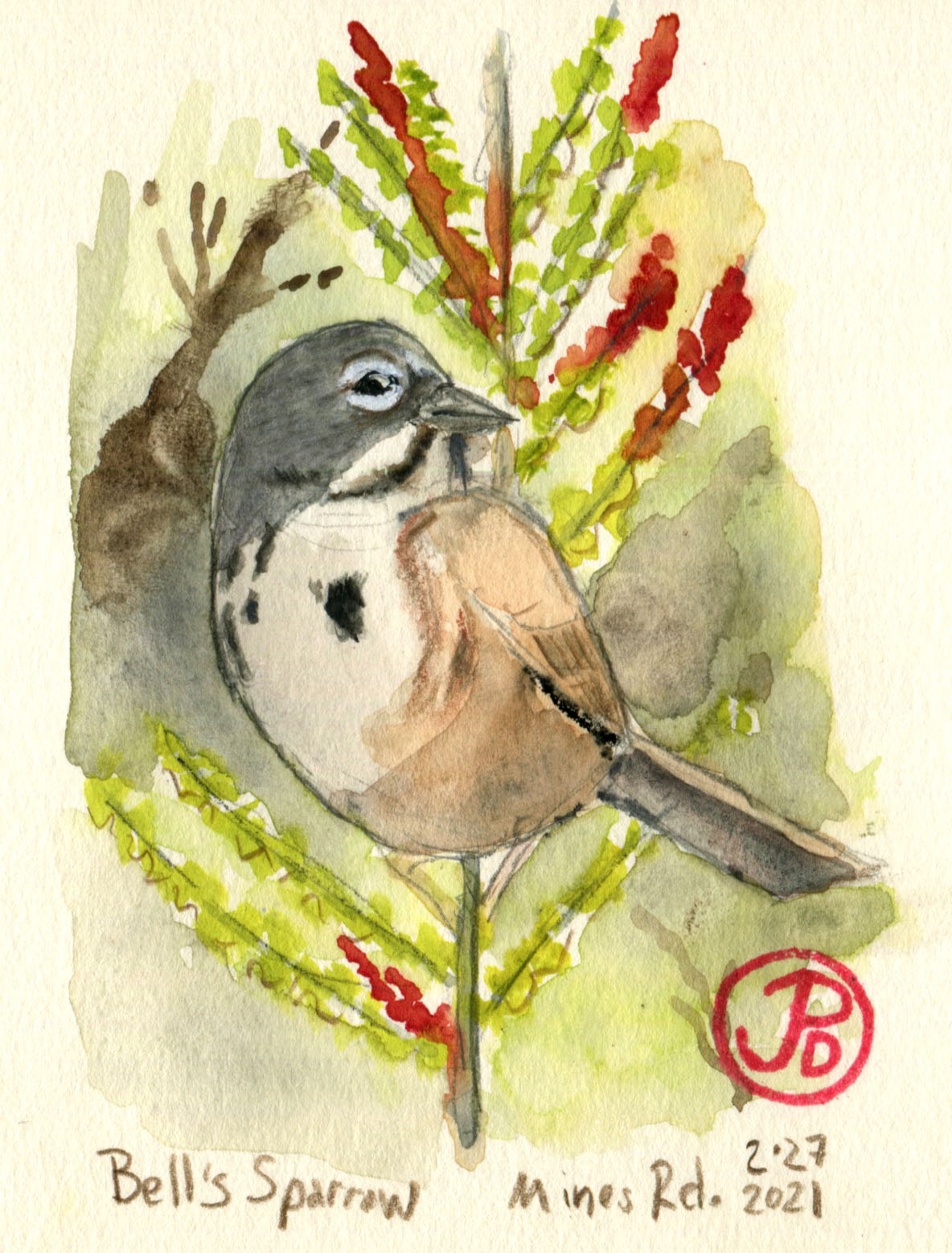
After enjoying brief but distinctive views of the Bell’s sparrow we headed south on Mines Road towards The Junction.

The Junction is the junction of three roads: Mines, San Antonio Valley, and Del Puerto Canyon Roads. At the corner is a store which is popular with cyclists (both ped and motor) and birders.

We continued on to San Antonio Valley Road. The open oak grassland is a great place to look for Lewis’s woodpecker. I have seen this woodpecker at this location on a few other trips but today was not our day so we turned back and headed northeast on Del Puerto Road.

When headed into Stanislaus County on Del Puerto Canyon Road, I only think of seeing and hearing one bird: the canyon wren.

Hearing the spiraling song of the canyon wren is one of those emblematic sounds that is often used in nature documentaries, television shows, and feature films. Along with the primal scream of the red-tailed hawk, the canyon wren’s song is often used to represent desolate desert wilderness. Think: broken down car on a one lane desert road, miles from nowhere, cue the canyon wren.

Del Puerto Canyon looks very different form the time that I had last visited. A wildfire, the SCU lighting complex, burned in five counties for 44 days from August to October in 2020. The fire consumed 369,624 acres. We may never know how this affects the local animal populations and also how this might affect the future avian migrants like the western kingbird, ash-throated flycatcher, and Bullock’s oriole.

There are many arid rocky canyons and steep hillsides along the 25 mile road that is perfect habitat for the rock loving canyon wren.

Canyon wren (Catherpes mexicanus) is at home on rock as most birds are on limb. This is a small rufous and white-throated wren with a white-flecked back, ending in a short, thinly banded tail. The canyon wren forages on rocks and crevices, exploring rock for insects and other morsels. Pete Dunne describes the wren this way, “Movements often have a theatrical air. The bird pauses before a jump, as if posing”.

We stopped at any habitat that looked good. I played it’s contact call, as well as it’s cinematic song that Dunne describes as “heart-gladdening tumble of notes”. We did not get a response. We tried at a handful of inviting habitats. Nothing.

At our fifth stop, just west from where as the Del Puerto Creek passes under the Del Puerto Canyon Road, we stopped for another attempt. In the past, this location has been reliable for canyon wren.

Within a minute I heard a contact call of a canyon wren from across the road. Now the tough part was locating the rufous gem. Because their call is so loud, judging distance can be a bit challenging. The contact call stopped and the canyon wren erupted into it’s signature song. Now we only had to get bins on this Del Puerto Canyon classic!

Young eyes have an edge over aging eyes and Grasshopper Sparrow spotted the canyon wren on the near bank, perched on a rock (of course), singing it’s heart out.

We spend a good ten minutes watching and listening to the small bit of feathered rapture. It stayed perched on the it’s rock, with it’s back towards us and then it turned to show it’s white throat. Later it perched down in a little rocky cave. This is what is illustrated in the featured sketch.

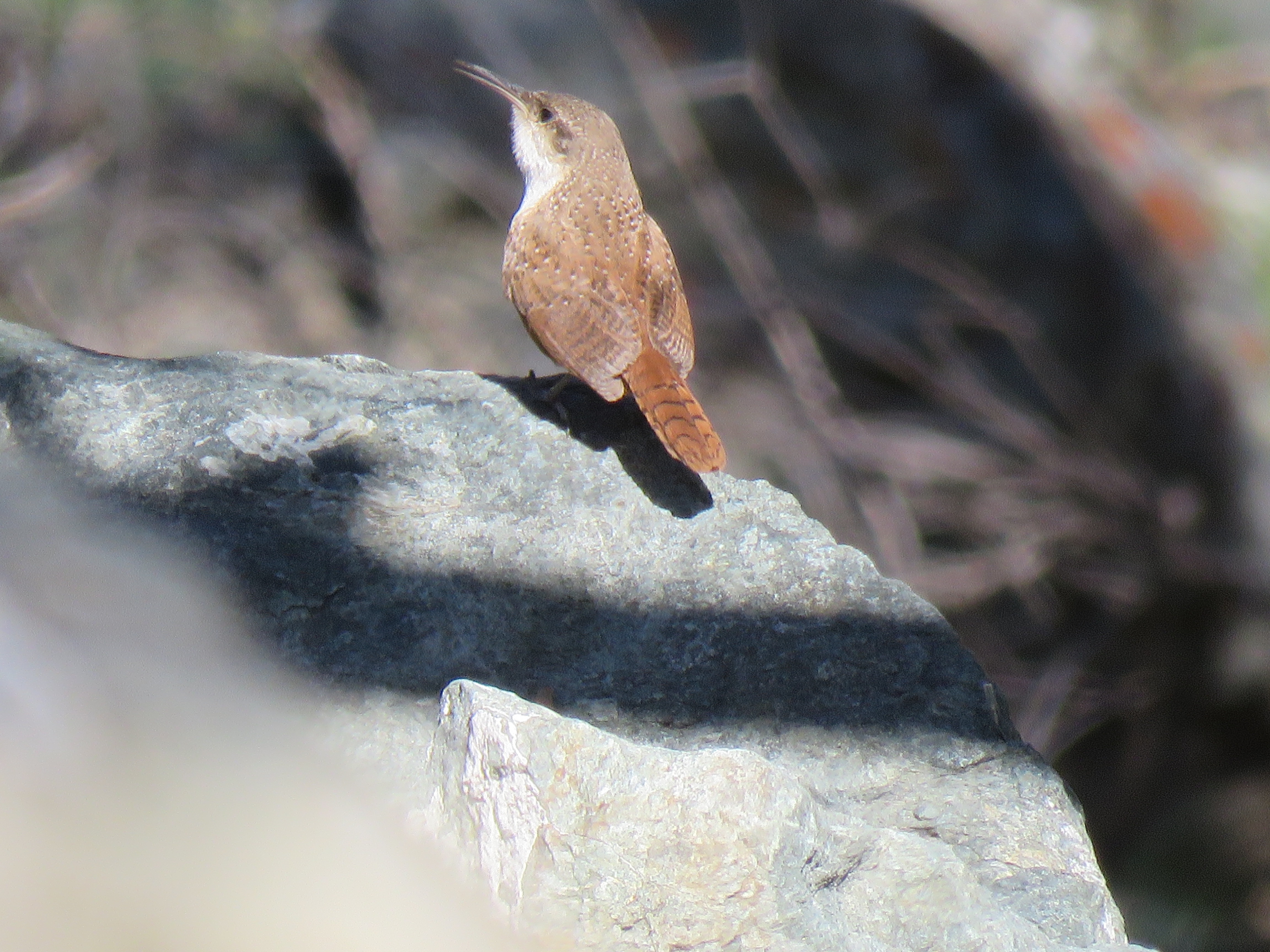
Our first view of the singing canyon wren, perched on a rock of of course!
A closer view of it’s epic song. It’s amazing that such a small bird produces such a loud and intense song.
The curious canyon wren, looking our way.

Sketching note: I first started the featured painting with a lot of wet on wet and I was attempting to build up layer upon layer. I came to the point where I hated the sketch and wanted to abandon it, half-finished. Then I remember the sage advice from my childhood friend Erik, “If you don’t think your poetry’s shit, you’re a shitty poet!” The next morning I came back to the work, this time holding it together with black ink. I built up layers on the rock using different mediums and tools like watercolor, masking fluid, pen, colored pencil, and charcoal. I used a variety of methods and technics to create texture and depth including brush, tooth brush, finger smudging, wet on wet, glazing, hatching, dotting, and paint splatter. I worked on this failed work until I loved it.

Image

A Split Lifer on Mines Road

I had first seen a sage sparrow on the morning of April 10, 2003 in the the South Tufa area of Mono Lake. This is the time of year when sparrows are up singings as they defend their breeding territory. This is also the time of year when they are easiest to see.

Then in 2013, the sage sparrow was split into two distinct species. A split is when ornithologists determine that one species is now considered two separate species, usually using DNA analysis. Before these were all considered subspecies of sage sparrow. They were now divided into the sagebrush sparrow and the Bell’s sparrow. Birders do love a good split because it means there are even more birds to add to their life lists!

The bird I had seen in the spring of 2003 was now considered a sagebrush sparrow and now I had to look for a Bell’s. And I knew just where to look!

I picked Grasshopper Sparrow up at 6:15 AM. Our destination was the legendary birding Mecca known as Mines Road and Del Puerto Canyon. This area encompasses three counties: Alameda, Santa Clara, and Stanislaus. Specialty species of this area are: golden eagle, prairie falcon, greater roadrunner, Lewi’s woodpecker, yellow-billed magpie, Lawrence’s goldfinch, canyon wren, phainopepla, lark and rufous-crowned sparrow, and of course Bell’s sparrow.

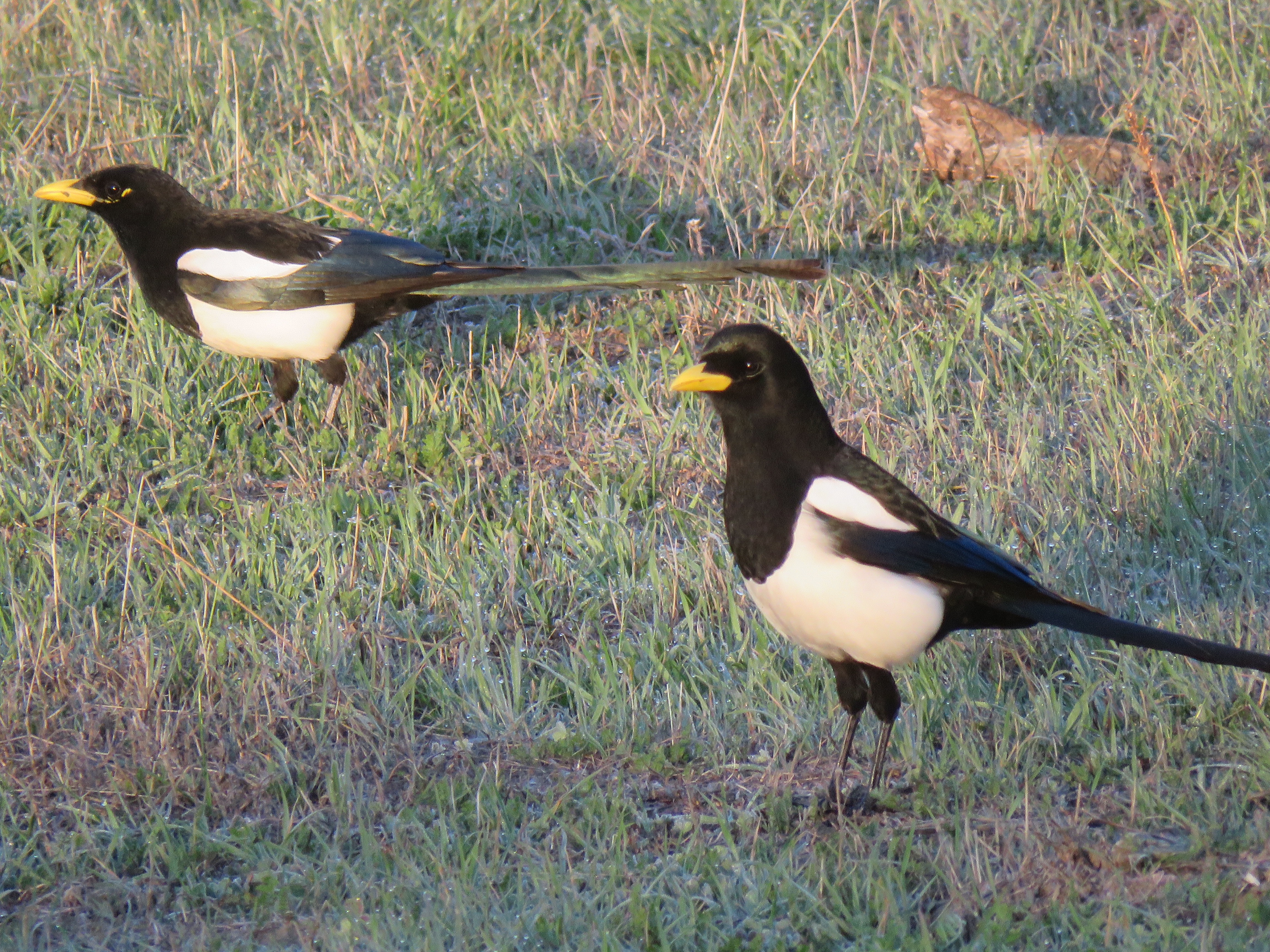
A much sought after bird: the yellow-billed magpie. Why? This is a California endemic, it is only found within the state boundaries of the Golden State. We found ten in the first few miles of Mines Road. This two where at the Junction of Mines and Del Valle Roads.

From the wine growing region in Livermore, Mines Road climbs out of the flats and weaves up a canyon dotted with oaks. This is probably the most beautiful area in the Mines Road and Del Puerto Canyon area,

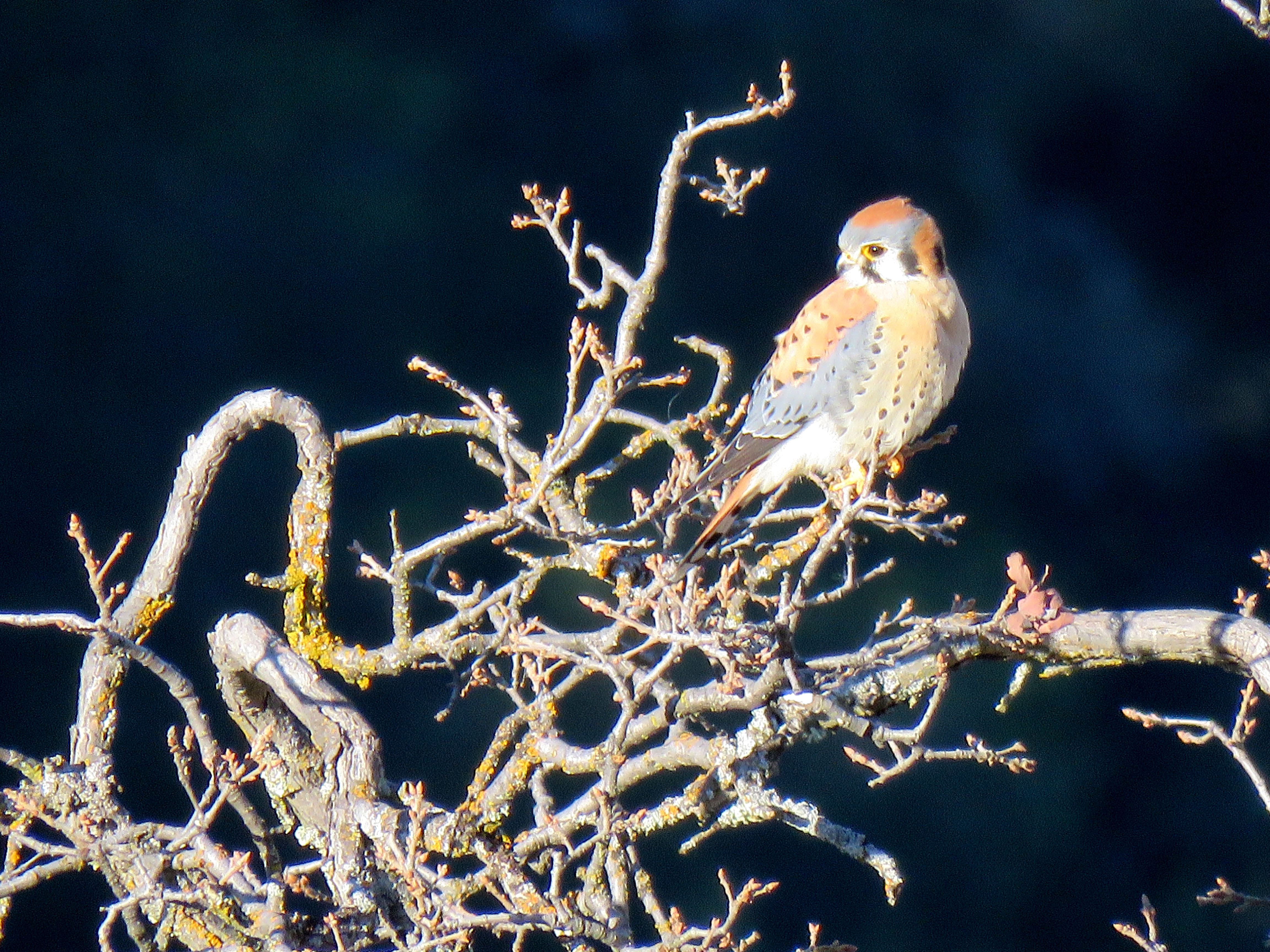
While the American kestrel is a common falcon, seeing a male perching in morning light , below Mines Road, is a jaw dropping experience.

Our destination was a bend in the road, about five miles from the Santa Clara County line. this is where Bell’s had been recently reported. We pulled off Mines Raid near a roadside memorial.

I fired up my Bluetooth speaker and we stood in front of a hillside of chemise. Within two notes of it’s recorded song, a Bell’s sparrow shot up into the top of a bush. ABA lifer!

Image

Norfolk and Western No. 611

As far as surviving steam locomotives go, Norfolk & Western’s No. 611 is a baby. She’s only 70 years old.

She was built in May of 1950, very late in the age of steam when diesels when rapidly replacing the labor intensive steam locomotives. No. 611 was built in the shops of the Norfolk & Western and was at the cutting edge of steam technology at the end of an age.

No. 611, known as “Spirit of the Roanoke”, is one of the most powerful Northern type (4-8-4) locomotives ever built with a tractive effort of 84,981 pounds. Tractive effort is the theoretical figure of how much a locomotive can pull. As a comparison to other northerns in existence, Union Pacific’s 844 tractive effort is 63,800 pounds and Southern Pacific’s 4449 is 64,800 pounds. 611is clearly in another tractive power league.

This Norfolk & Western locomotive was also very innovation is a way to decrease the labor it took to maintain these beasts. The locomotive used roller bearing and many of the 200 other bearings were self lubricating which cut down of man-hours of maintenance. The locomotive could be run 15,000 miles a month and only need servicing ever one and a half years.

Unfortunately No. 611 was in service for a short time, she was retire in 1959, giving Norfolk and Western just under ten years of service.

The locomotive was dormant, placed on static display in Roanoke Transportation Museum in Roanoke, Virginia. She was restored in the early 1980’s and returned to steam on August 14, 1982.

Image

Shot in the Arm

It seemed to happen very suddenly.

I had been waiting to become eligible to get the Corvid 19 vaccine. Educators were not included in the first round of vaccinations. There was a lot of waiting. Then I became eligible but appointments were scarce if not possible to get.

Vaccine envy is a real thing and I experienced it as friends or coworkers got appointments and then later that shot in the arm.

Then on Monday, after repeated attempts to find appointments on my fourth attempt, they appeared suddenly. I booked one for Wednesday, scarcely believing this was real.

The reason that there were so many appointments available was that the Federal Government had opened a massive vaccination site across the bay in the parking lot of Oakland Coliseum.

So just after noon I headed over the Bay Bridge and then south down 880 toward the place were I had seen my first concert (Billy Joel) as well as my last concert (Iron Maiden). I know I have eclectic tastes.

I was directed into the parking lot and I was entering into a well oiled machine run with military efficiency by FEMA. It restored my faith in government. That big government does care about people and at it’s best, can help at a massive scale.

There were thousands of traffic cones that led me on a serpentine course and National Guard soldiers that directed cars into different vaccination bays. I pulled into Bay 5. I was asked a battery of questions, which I answered in the negative and then rolled up my sleeve and received the first injection of the Pfizer vaccination.

I was then given by vaccination card and directed to pull forward to the 15 minute waiting period area to see if there were any adverse reactions to the vaccination before being released.

The line of cars slowly inched forward.

The last contact was an older man, decked out in a mask, radio, and florescent vest. I thanked him for the efficiency of the operation.

He replied, “Thank you, that means a lot.”

The total time from entrance to exit: 30 minutes!

A note about the sketch: This is a feeble attempt at a Joseph Zbukvic painting of the scene.