Image

Sea Watch: Northern Fulmar

On a Saturday morning in early March, I headed to the platform just below the Cliff House, I set up my tripod and scope to scan the Pacific to the west.

Before I focused my scope on the horizon, looked down at the tideline, sanderlings ebbing and flowing with the tide and a group of willets hung back and rested. I then scanned the rocks, just below my position. It didn’t take long to find the resident black oystercatchers who proclaimed their existence with their raucous calls, a call that carries above the din of the surf. A closer inspection revealed black turnstones and surfbirds working the inshore rocks.

I removed the lens caps from my scope and began to scan the waters beyond Seal Rocks. There was some movement of red-throated loons and cormorants but the bird I was looking for was a true pelagic species. A bird that remained on the outer range of most binoculars but in the winter of 2018, a number of northern fulmars had come closer to shore than in previous winters.

I continued to scan the water looking for something that stood out, something different from the roll of species that normally visited these waters. A 7:20, I caught a bird in my scope that was shearwater-like, flying low to the surface. A dark bird with a large head that was flap-flap gliding near the surface of the waters. This was it! Life bird #546, northern fulmar. toward the end of my sea watch I spotted another fulmar flying off to the south.

Image

The Black Vulture of New Year’s Creek

I found myself, on a Saturday morning, stationed on an abandoned auto bridge in Año Nuevo State Park, not to look at the famed elephant seals, but to pick through every turkey vulture that flew over head. And there were many to pick through.

Plenty of turkey vultures. I count four.

I was here, in-between storm cells, to find the lone black vulture  (Coragyps stratus) that had been haunting the Santa Cruz and San Mateo coast.

I had seem plenty of black vultures in the Everglades and my most recent sighting was in a large kettle with turkey vultures and two impressive king vultures. This kettle was soaring above the rainforest of Costa Rica.

This lone and lost bird had first been seen on February 15 at Swanton Road in Santa Cruz County and then later above Wilder Ranch. In Late February the black had fallen in with a volt of turkey vultures (TVs). You see, the black vulture has great eyesight but their sense of smell pales in comparison to that of the turkey vulture. Black vultures soar high on thermals and look for a kettle of TVs. When the TVs locate a carcass, the black vulture make it’s appearance. It being a more aggressive bird, it will dominate the carcass, preventing the TVs from a place at the table.

After an hour and a half of searching, I was joined by three other birders on the bridge over Año Nuevo Creek. At the creek mouth, was a carcass of an elephant seal. Earlier I had seen four turkey vultures at the seal, joined by gulls and two ravens.

The clouds to the north look darkly ominous. Rain would be upon us in a short time. We saw a far off red-tailed hawk that we tried to turn into the south after scavenger. I looked up to the northeast and the bird seemed to appear out of the approaching black storm clouds. “There’s the bird!” I announced to the birders on the bridge.

12:58 PM. My first out of focus shot of the black vulture. The shape, the “flying coffee table” as Pete Dunne notes, is distinctive as well as the extremely short tail.

The vulture alighted on the top of the pine snag, a macabre Christmas Tree. It was soon joined by other turkey vultures filling in as ornaments.

We were able to enjoy the vulture for about 15 minutes before the rain started. Here the black is crowning they pine showing off it’s upright posture.

The pine snag full of vultures. The black vulture is on the near horizontal branch on the left, perched at the very end in it’s diagnostic upright posture.

The black vulture in the rain. Perching in the lone pine snag with turkey vultures.

Image

PEFA Goes to School

I have my morning rituals in my early morning work routine. I arrive at least an hour before my students so the campus is peaceful. I plan for the day, make copies, review the day’s math and language arts lessons, correct student work, and do a bit of housekeeping.

There are a few avian routines that are also part of my morning ritual. The first is usually to check the field and backstop for the red-shoulder hawk pair. They are there most mornings, perched on the baseball backstop, helping to rid the field of gophers. I also check the food court for the resident white-crowned sparrows and juncos that scatter to the bushes before my footfalls. When I head out to the teacher’s lounge to make copies, I check the cypress that looms in the back of the school.

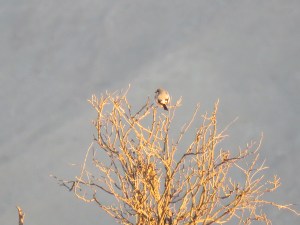
I call this tree the Kite Perch because it is frequently topped by a local white- tailed kite. I sometimes find an American crow but this morning I spotted a bird that stood out. Even without my binoculars, I could identify this raptor, but I wanted it to fly to confirm its existence. I was able to take a few far off phone photos in the beautiful morning light.

A phone photo of the Kite Perch. That tiny speck christening the top of the cypress is the avian death angel: the peregrine falcon.
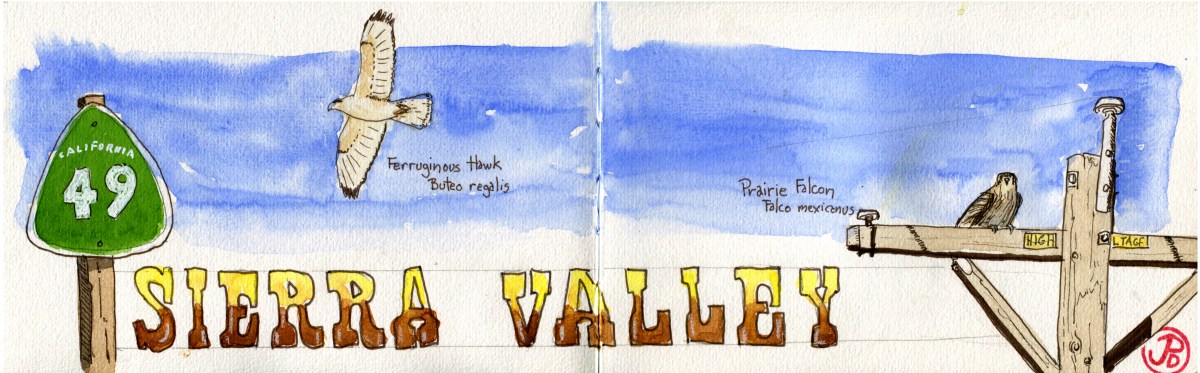
After about five minutes the falcon lit out north, it’s powerful wing beats talking the peregrine in a straight line toward the PEFA Perch near Crystal Springs Road.

This was a great way to start the school day. The only downside was that I was not able to share it with my students.

Image

Peregrine Crossing

“The excitement of seeing a peregrine stoop cannot be defined by the use of statistics.”

J. A. Baker

The Peregrine

On most afternoons I am treated with a sighting of one of the most revered birds in the avian world. A wanderer that is found on every continent with the exception of Antarctica.

On some afternoons I can see the bird perched on the power tower, just to the right of the Crystal Springs Bridge. Or if you are a Bay Area Native, it’s the tower nearest the “Flintsone” house.

But on this early morning the peregrine falcon was extremely close. Just a few yards in front of my car. As I turned east on Bunker Hill Road, crossing over Highway 280, the deadly slate and white bolt crossed within yards of my car. The peregrine was following the river of road on a northern heading toward the peregrine perch along Crystal Springs.

Anytime I see a peregrine is a good omen. This powerful predator was near the brink with about seven pairs in the entire state of California. Now, with the intervention of the species that is the most harmful, the peregrine is no longer on the brink and it can be common enough, that I see one almost every week on my commute.

Image

Robinson Raptors

It was again time for our annual trip to the winter raptor hotspot known as Robinson Road in Solano County.

I also used this trip as a field test for my new camera. As a reformed professional photographer, I have been used to top end, professional gear. This gear is very expensive and heavy and cumbersome. Instead I opted for a “bridge” camera, that is a camera between a point-and-shoot and a professional set up. I wanted a camera that was light, took quality images, and had the capacity to zoom into my far away subjects. I settled on the Canon Powershot SX60 HS. All photos in this post were taken with this camera and my sketches were also based on some of the photos.

The day started with valley fog but afforded views of a few hundred yards. Good enough to spot perched raptors but not good enough to get raptors up off the ground and into the sky, making identification a little easier.

On the first part of the journey we had seen the usual suspects: red-tailed hawk and American Kestrel. There was no sign of ferruginous or rough-legged hawk. It wasn’t until we paused at “Owl Corner” that things became interesting. I call the intersection of Flannery and Robinson Road “Owl Corner” because it is always reliable for this gem:

B OwlBurrowing owl is always a welcome sight at this intersection and this trip, again, proved to be fruitful.

After taking a few photographs with my new field camera (the above photo is an example), we headed off to look for other raptors on our target list.

It wasn’t long before I spotted a raptor on the ground in the pasture to the right. It was one of our target birds, Buteo regalis, the ferruginous hawk.

IMG_0062A typical view of our largest buteo hawk from Robinson Road. Perched on the ground.The zoom on my Canon Powershot SX60 was able to bring this far off raptor, a little closer for a diagnostic view of this wintering  hawk.

We drove the circuit but could not find mountain plover or any roughies. Mountain plovers looked like small clumps of dirt and could be very hard to detect. We did have a nice surprise as a Peregrine swept the landscape and alighted on a power pole. So I took a few pictures.

We left Robinson Road and headed towards Grizzly Island. Off to the left, perched on a ridge, was an unmistakable profile: golden eagle. Two, in fact.

Image

Where the River Ends, a Gull Bath

I headed to the bluff on the east side of the San Lorenzo River. This is where the river ends into Monterey Bay.

On my left was the Monterey Bay and beyond was the Municipal Wharf (sight of great fork-tailed storm-petrel sightings last year) and to my right was Santa Cruz Beach Boardwalk, now in winter dormancy. I knew that any time a large river entered the ocean, where fresh water meets salt, there would be bathing gulls. Lots of gulls.

Down below, there were hundreds of gulls. This multi age and many specied gathering contained mainly California, herring, mew, and western. I scanned the gathering and found no rarities. But it did give me an opportunity to observe the dynamics of gull bathing and preening.

The mighty San Lorenzo River is a major winter gull bathing and resting location on Monterey Bay. The Santa Cruz Beach Boardwalk is on the west side. The Logger’s Revenge to the right and my favorite roller coaster, the Big Dipper, is on the left.

Using my not-so-secret powers of observation I noted two areas that the gulls used: river and sand. The river is used for washing and the sand for preening, resting and playing.

The gulls used the river right in front of the railway trestle which was featured in the 80’s vampire flick Lost Boys. The birds were doing their indelible flappy wing dance followed by a head plunge and a wiggle. Yes very scientific I know.

The gulls on the sand spit where resting or preening. I noticed a few juvenile gulls playing with slicks on the spit point. They would carry a stick around and then drop it and pick it up. Repeat. I can only guess that they are practicing their eye-beak coordination.

The spread I sketched was a not-to-scale gull’s eye view of the river mouth. I love to make my own maps, using my own names for the land. This map contains my own: Seaweed Island, the “Wash”, Stick-Grab-Point, Gull’s Rest Spit, North Spit, and the “Stump”. Most of these land and watermarks are ephemeral, changing and disappearing with the tides and the winter rain, washing down from the Santa Cruz Mountains.

Image

The Klamath Basin

Why would anyone drive to the California-Oregon Border with daytime highs perching precariously in the low 30’s and drive on a muddy road in the middle of no where with visibility down to 50 yards? The answer is simple: Winter raptors!

I started my trip at Lower Klamath National Wildlife Refuge. President Teddy Roosevelt established this refuge in 1908, becoming our Nation’s first waterfowl refuge. The Refuge was designated a National Historic Landmark in 1965. The refuge contains 50,912.68 acres, which straddles the border of Oregon and California.

The winter raptorland that is the Lower Klamath Wildlife Refuge. Looking south east from the auto route.

One the first day I arrived the visibility was down to 50 yards, making raptor spotting very difficult. My scope would remain in the truck, I didn’t need a closeup view of wintry gray.  Luckily there were a few raptors perched by the roadside of the auto route. None was more wintery than the raptor with leg warmers: rough-legged hawk. This Arctic breeder winters in Northern California and I was lucky to encounter one perched on a road sign, which allowed a close approach in my moveable blind.

Buteo lagopus vacating a roadside sign showing two identifying field marks: feathered legs and a carpal patch. Note the “wonderful” visibility in the background.

The really star of this raptor wonderland is our National symbol, the bald eagle. The Klamath Basin holds the largest winter concentration of bald eagles in the Lower 48. Winter counts can be between 500 to 1,000 individuals. Their peak numbers were still a few months away in late February to early March, a time that coincides with the northern migration of waterfowl.

All of us in the United States are familiar with this bird, indeed it must be the most recognizable bird to all North Americans (yes I also mean youth, dear Canadians). It is on our stamps, posters, trucks, mudflaps, flags, paintings, sculptures, etc. But to see one, let alone a convocation of eagles, is a life experience that all Americans should have. That also includes you, Central and South!

On the first day, full of chilling ground fog, I saw five eagles. But what a difference a day would make.

After a nighttime roost in Oregon at Klamath Falls, I parted the curtains to find the dense ground fog had flown. I changed plans and headed back to the Klamath Basin.

On my second day, the roads and vistas were clear. Perfect for winter raptor spotting. And I had many.

This day can be summed up with one location: Tule Lake. A binocular search made it clear that I needed to set up my scope for a closer look across the frozen surface of Tule Lake. In one 180 degree scan, from the north to the south, I counted 30 bald eagles!

Not the best photo, but this digiscope photo confirms the most bald eagles seen in one view: four! 

Here is the total raptor count for both Lower Klamath NWR and Tule Lake on the morning of December 27:

50 Bald Eagle

33 Red-tail Hawk

14 Northern Harrier

7 American Kestrel

3 Rough-legged Hawk

1 Peregrine Falcon

1 Cooper’s Hawk (being harassed by a kestrel)

An adult bald keeping watch at Tule Lake, Klamath Basin.

Image

Gray Lodge, Christmas Day

I took my annual Christmas Day trip, down from the foothills, into the wintering waterfowl wonderland of the Central Valley to Gray Lodge Wildlife Area.

If this experience can be summarized in one photo, then here it is:

Thousands and thousands of wintering waterfowl. In this case snow geese at Sacramento National Wildlife Refuge. When you have high numbers of ducks, geese, coots, and swans you also have raptors and it is always a treat to see our National Bird: an adult bald eagle.

In the past few years, Gray Lodge has always produced a few of these emblematic species. It only took reaching the halfway mark on the auto route that I spotted two large shapes in a marshside tree.

Bald eagles at Gray Lodge on Christmas Day, check and check!

Image

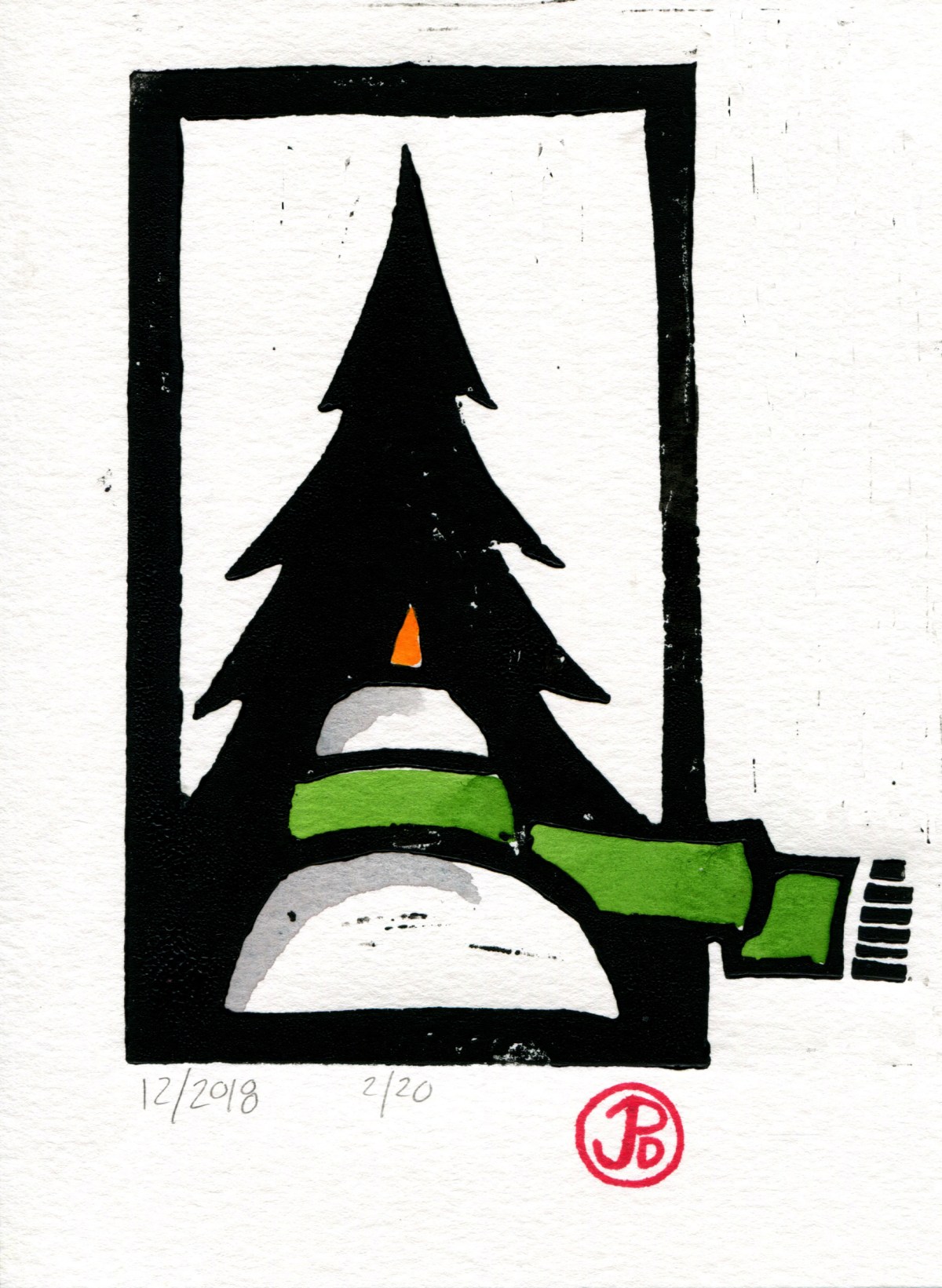
2017 Winter Linocut Print

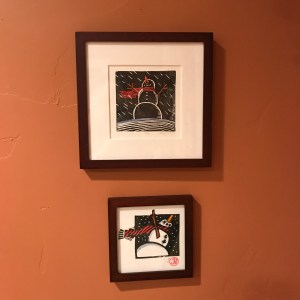
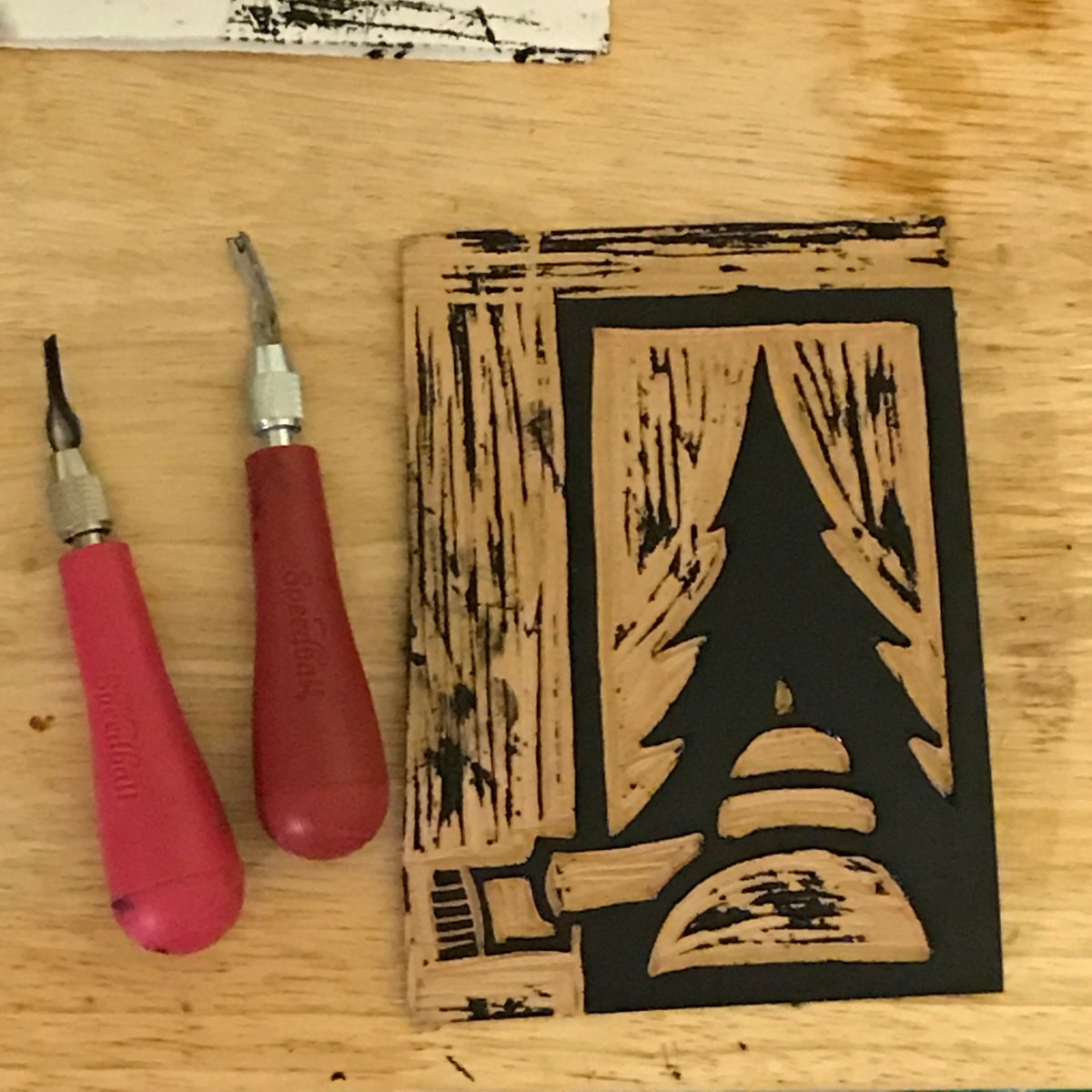
It is that time of year when I continue my tradition of creating a linocut print, a gift to my friends and family.

I had read that children in Japan, design, cut, and print a holiday woodcut for their families. Over the past ten years I have started this tradition in my own life.

This year I decided to keep it basic. No background. No Border. No complex lines. Just a snowman on white.

In the past, I tried to get perfectly inked blocks that would leave perfectly black lines. This year I want to embrace imperfect perfection. A celebration of the medium, its benefits and it’s limitations. As a result, this years prints has more of a brush-like quality.

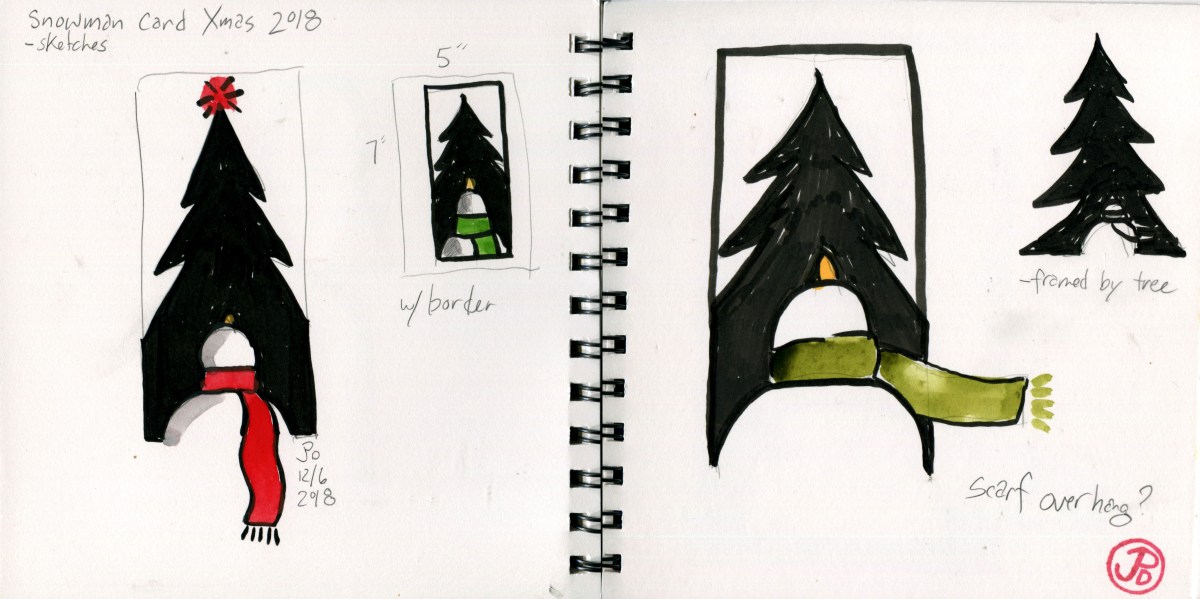
A coffeehouse design sketch in a Stillman & Birn journal. This is the sketch that would go on the linoleum. When it prints, it is the mirror reversed image (featured image).

Over the course of a week I sketched out designs for the print, making small changes until I had settled on an image that worked. In the end, the image is a snowman, facing away from the viewer, his head held up, scarf flowing behind, and his arms raised to the sky. The title of this print is “A Prayer”.

Preparing to print with a charged linocut and my Speedball printer’s press. For these prints I used black oil-based ink and then mixing in a little brown ink. The prints will later be hand painted with watercolor.

I leave it up to the viewer as to what the snowman is praying for or even if he can pray at all.

The title was inspired by the Mary Oliver poem, A Summer Day. In the final few lines she writes:

I don’t know exactly what a prayer is.
I do know how to pay attention, how to fall down
into the grass, how to kneel in the grass,
how to be idle and blessed, how to stroll through the fields
which is what I have been doing all day.
Tell me, what else should I have done?
Doesn’t everything die at last, and too soon?
Tell me, what is it you plan to do
With your one wild and precious life?

I have always loved this poem. It captures the ephemeral nature of life. Just like the snowman, who lives but a short season. Maybe that’s what he’s praying for: more time.

Like the proverbial snowflake, each handmade print is unique. 

Image

The Flight of the Boobies

Pillar Point Harbor, on the San Mateo County coast, is a Mecca for avian ratites. I mean the sort of rarites that makes a birder want to jump in their car and drive all night or book a last minute flight to the west coast. A drop-everything-and- go rarity.

A prime example was the Ross’s gull that showed up on Thursday January 12, 2017 and stayed until it was taken by a pair of peregrine falcons on Saturday afternoon. This is a mega rarity and only the second record in the lower 48.

I saw my first booby in Pillar Point. A brown booby had flown into the harbor in January 2003 and perched on the breakwater.

There are six species of boobies. The name comes from the Spanish word bobo, meaning “stupid” or “clown”. This refers to their tame disposition. Because they show little fear towards humans, there were easy to capture and kill for food.

Almost fifteen years later, another booby flew into Pillar Point Harbor. This time it was the smallest species of booby, a native to southern tropical waters , the red-footed booby (Sula sula).

With climate change, will we see more equatorial birds coming into Pillar Point to rest and be seen by birds former and wide? We can only hope to see the silver lining.