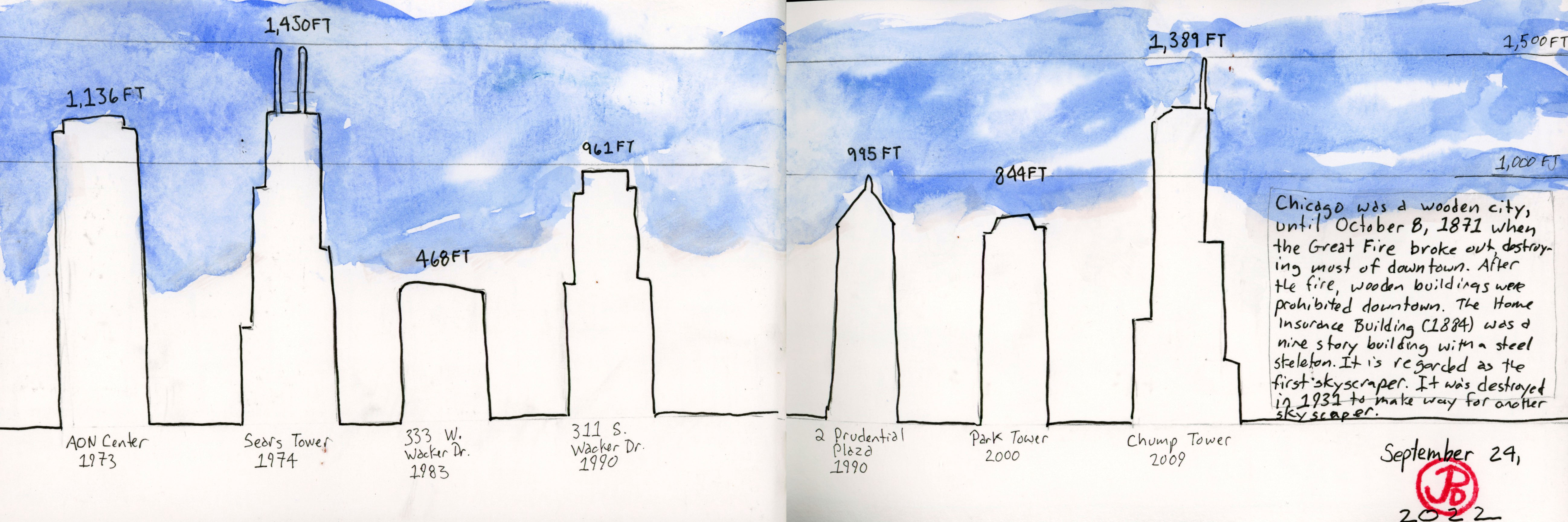
Chicago is known as the birthplace of the skyscraper as a result of the previous wooden city that burned in the Great Fire of 1871. After the fire, an 1874 bylaw outlawed wooden building construction in the downtown area. As a result, architects had to find other building materials that were not wood.
The nine story Home Insurance Building (1885), is often credited with being the world’s first skyscraper. It was only 138 feet tall but was built with a steel skeleton which meant that the structure could be built higher than any wooden structure. By 1889, Chicago had five more skyscrapers than New York City. The Home Insurance Building was as razed in 1931 and replaced by an even taller building, the 535 ft tall Field Building.
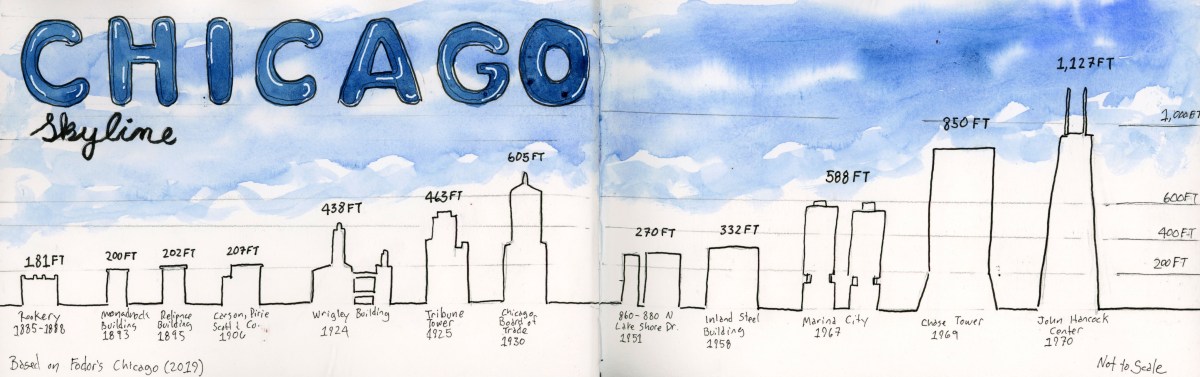
I have always had an interest in seeing and sketching architecture and I wanted to do a pre trip sketch about Chicago’s skyline. I found my inspiration in a Fodor’s travel guide (2019).
The guide laid out some of Chicago’s more iconic buildings in chronological order. It looks like a stock prospectus, as it grows over time, with occasional dips.
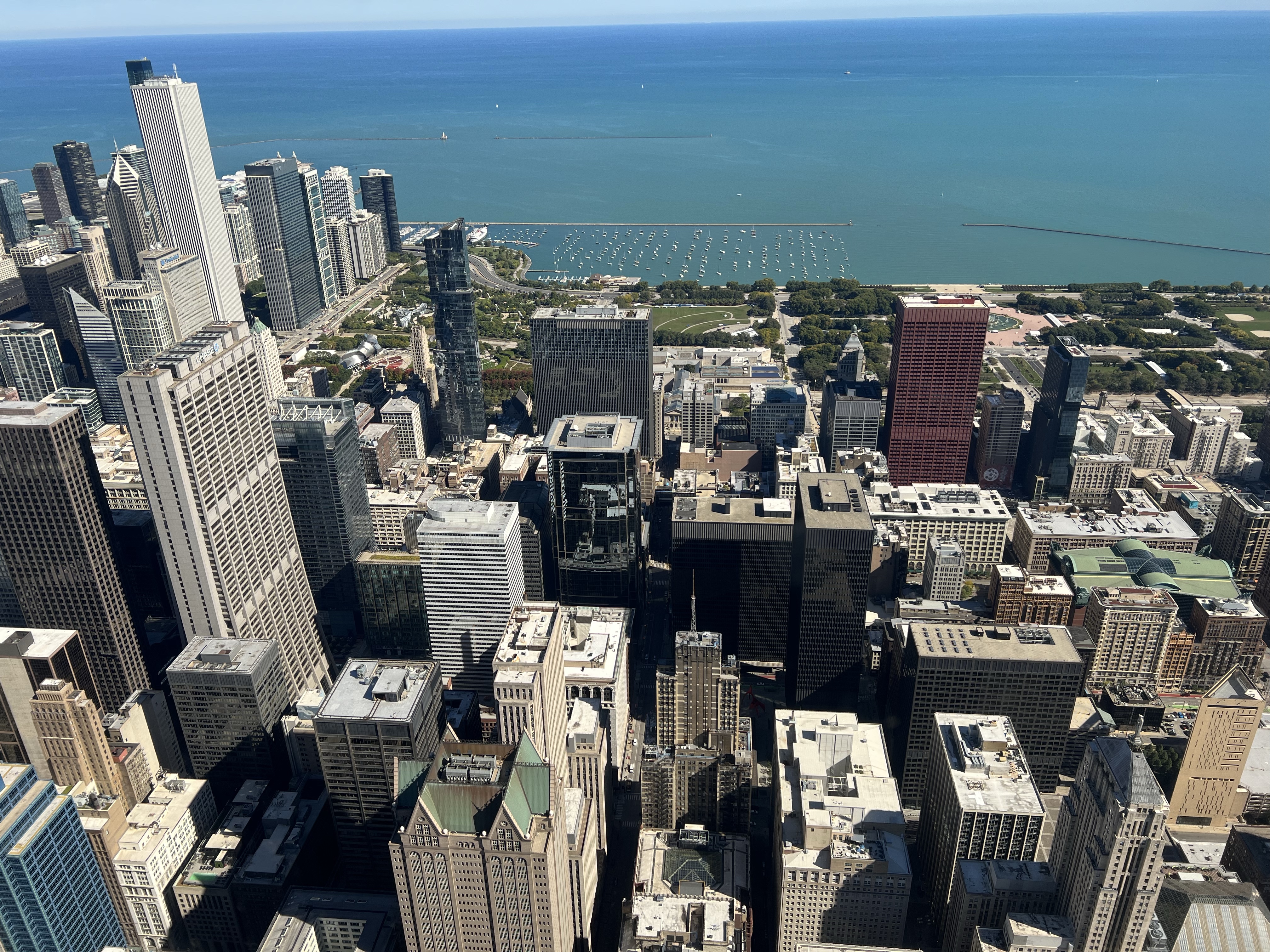
A view of Chicago’s skyscrapers from its tallest skyscraper.
The tallest building in Chicago once held the title of tallest building in the world for almost 25 years, this is the Sear Tower (now called the Willis Tower).
The tower was completed in 1974 and it tops out at 1,451 feet with 108 stories. It’s is now the third tallest building in the Western Hemisphere and the 23rd tallest building in the world. This skyscraper is a giant amongst giants in the Chicago skyline and speaks to the importance is the Sears Company which, at the time, was the world’s largest retailer.
The Sears Tower dominating the buildings around it. The antenna towers are struck by lightening about 30 times a year! This photo was taken from the river during the architectural river cruise.
My destination in the tower was the 103 floor Skydeck, which gets more than 1.7 million visitors a year making it one of Chicago’s top tourist attractions. The Skydeck is the tallest observation deck in the United States.
I presented my Citypass and was given a 1:30 ticket to the top. I was corralled with other elevation-seekers, through lines, and mazes, and we finally came to the elevator. The elevator is one of the world’s fastest elevators, climbing 1,600 feet per minute. We reached the 103rd floor in just over a minute.
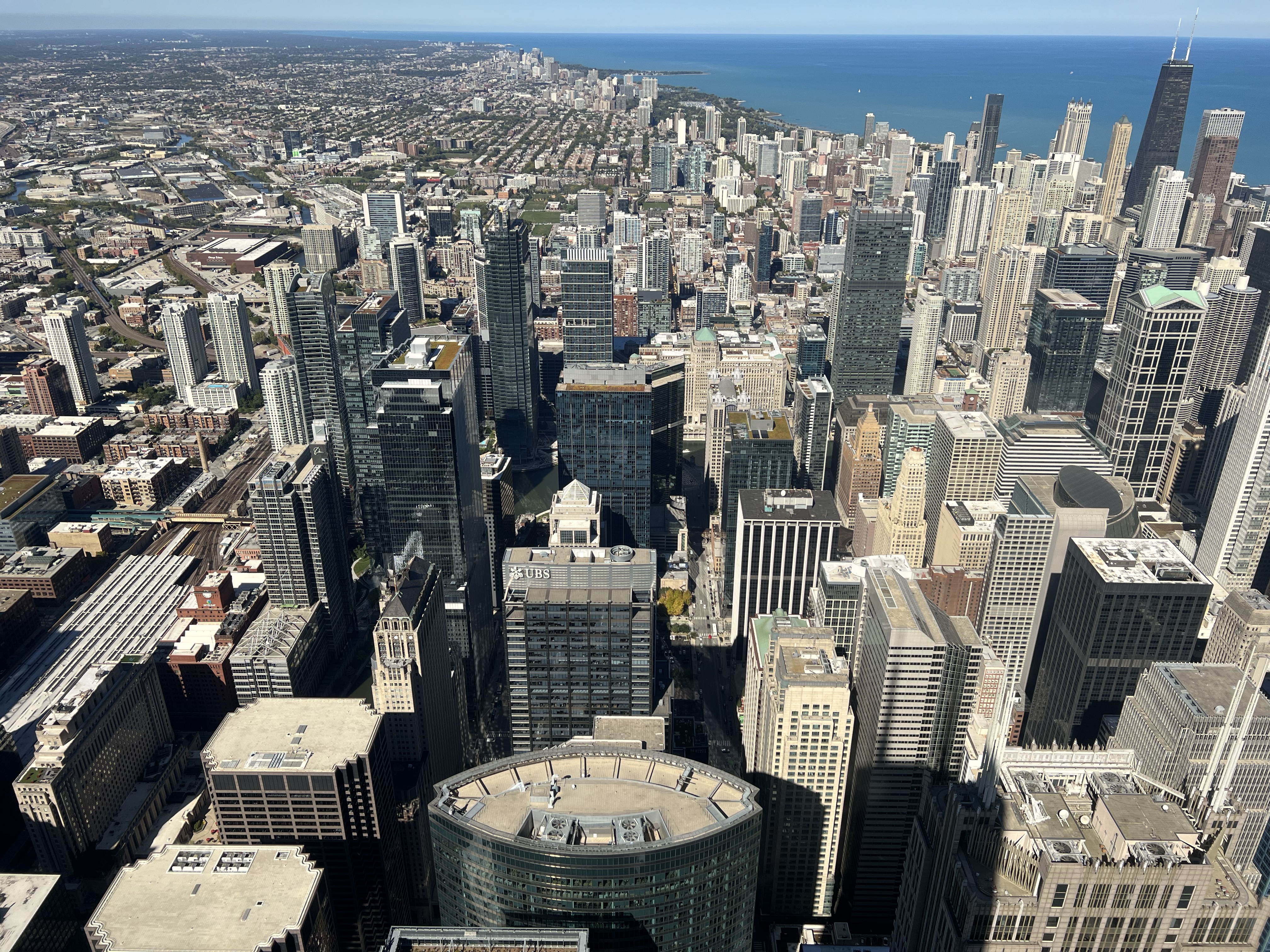
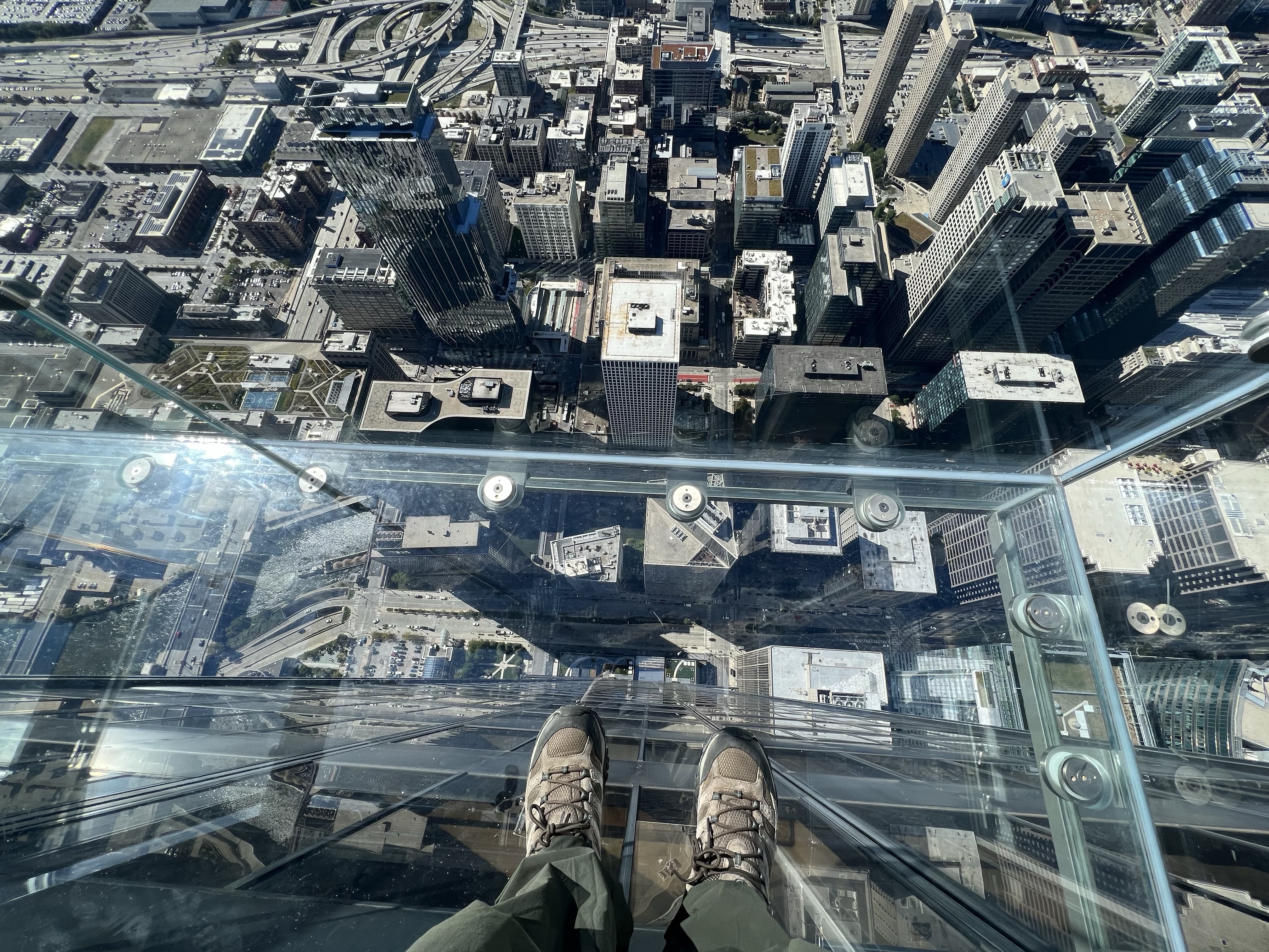
The view from the 103rd floor looking north. In the top right corner is “Big John”, the John Hancock Center, and beyond, Lake Michigan. I couldn’t have asked for a clearer and more beautiful day!Taking a step out on “The Ledge”. Here my toes are pointing west. If you look at the silver skyscraper (address 222 S. Riverside Plaza) near the center of the photo, just behind it, but also partially obscured by it, is Chicago’s Union Station. This is the starting point and terminus of the California Zephyr.
After spending some time at elevation, I headed down to street level, had a margarita at one of Rick Bayless’ restaurants, and then looked for a good perspective to sketch the tallest building in Chicago. I found a location across the street at 311 South Wacker Park.
I had to lean back, in an almost a sleeping position to fit the tower into my sketchbook. I’ve had warbler neck before but this was the first time I ever had skyscaper neck!
My sketch of the tower, and I needed all of my panoramic sketchbook to capture it!
After I had visited the very touristy Skydeck on the 103 floor of the Sears Tower, I headed north of the river and went to the 93 floor of the less touristy John Hancock Center.
When the building was completed on May 6, 1968, it was the second tallest building after the Empire State Building. It is now the fifth tallest building in Chicago and the thirteenth in the United States.
This building also has a personal twist. A mother of one of the my former students not only grew up in Chicago but grew up on the 62nd floor of the John Hancock Center! She would swim at the world’s highest indoor swimming pool on the 45th floor. For some reason, it never occurred to me that people actually lived in these skyscrapers. I always thought of them as just office towers. The docent on my architecture river cruise noted that Big John was one of the first residential towers ever built.
The John Hancock Center from Michigan Avenue. My neck hurts just looking at this image!
I entered the tower on the Michigan Avenue side and secured a ticket to the 93 floor. The elevator was not as pacy as the Sears Tower but I arrived at 360 Chicago in due time.
The view from the 93 floor was astonishing. Partly because it seems like you are right on the shore of one of the Great Lakes, Lake Michigan. You can walk around the 93 floor and have views from all the cardinal points of the compass. But first I needed a sketching seat and a drink.
Looking down from the east side of the tower.
I found both at the Cloud Bar on the northern facing part of the tower. Here you certainly pay for the view. At elevation, drinks on my flight to Chicago where cheaper!
I took my bubbling concoction to a table and sketched the shoreline below me and the skyscrapers to my left. Out on the lake where sailboats and motor craft and a steady stream of traffic heading north on Lake Shore Drive.
$21 for Windex in a glass. It was smoking and bubbling like something in Doctor Frankenstein’s lab. But it was delicious!My Cloud Bar sketch from the 93rd floor. From the view looking north. I chose to only paint in Lake Michigan.
After work I took my sketching pack and wandered north through Golden Gate Park into the Richmond District. My destination, once I exited the park, was two long blocks north and two short blocks west.
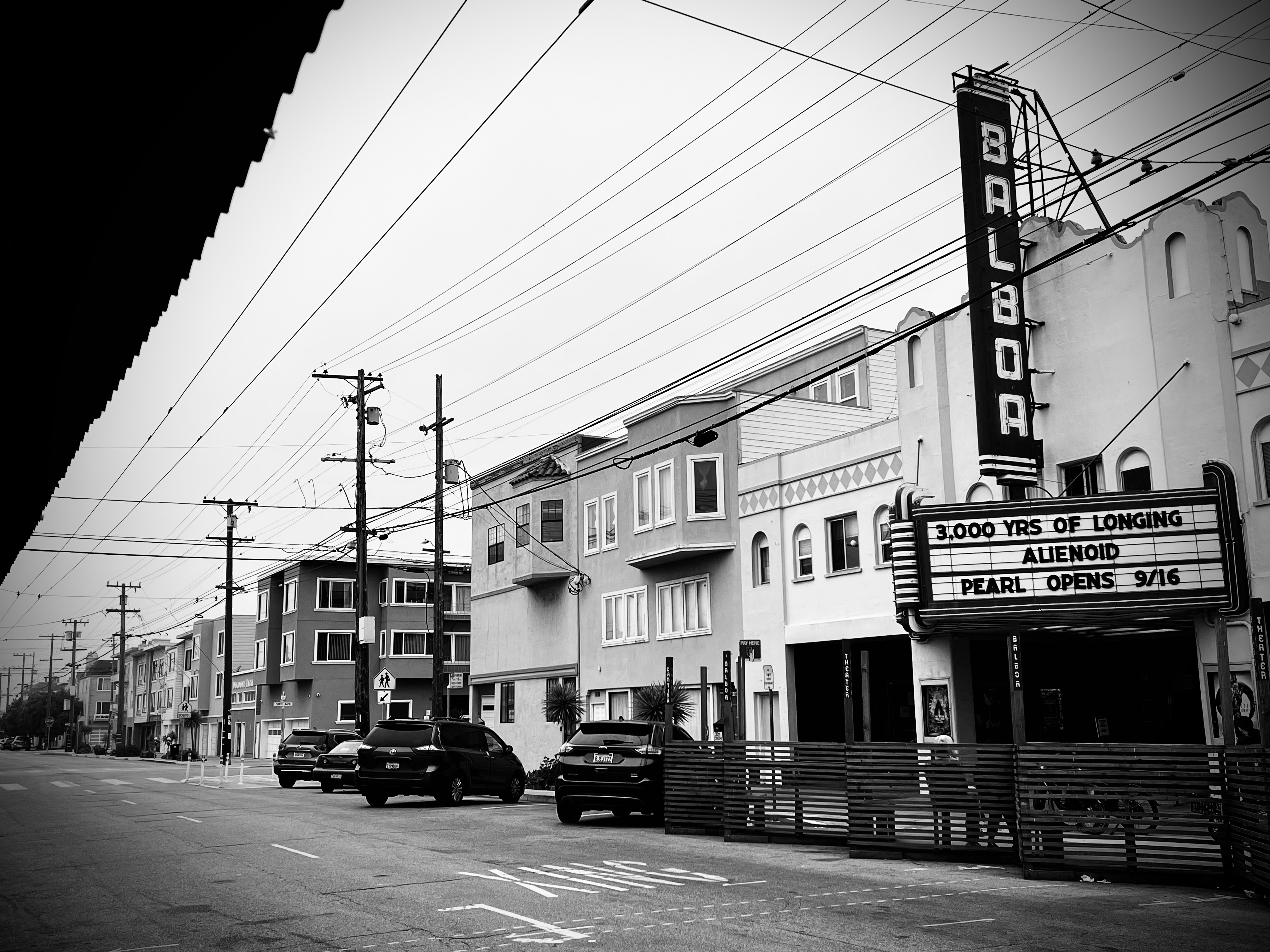
I found a seat in the parklet outside the theater and started to sketch the tall neon sign of the neighborhood cinema: the Balboa Theatre, in the unrolling Pacific fog.
The Balboa is one of the last operating neighborhood movie theaters in San Francisco. It was built as The New Balboa and opened on February 27, 1926.
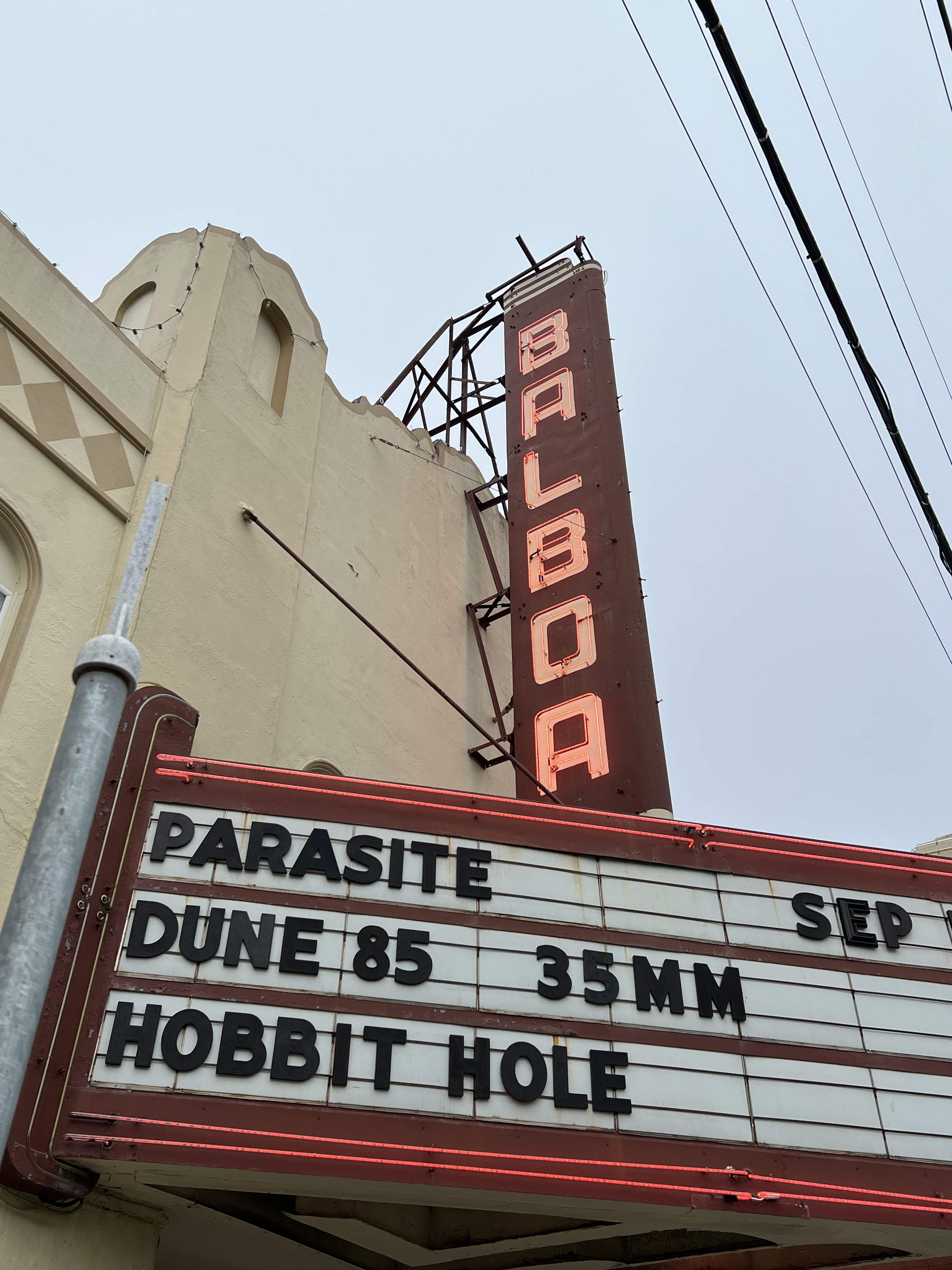
The marquee and sign of the Balboa. The amazing Korean film Parasite and 1985’s Dune are on the bill.
The theater was built by Samuel Levin as part of a neighborhood chain, San Francisco Theatres Inc. The 800 seat theater was designed by the same architects that were responsible for the Cliff House, the Fairmont Hotel, and the Spreckel’s Temple of Music.
Over the years the Balboa has been know for it’s long runs such as the 92 weeks that “The Sound of Music” ran between 1966 and 1967.
Like the city of San Francisco, the Balboa has been all too familiar with conflagrations. But like the Phoenix, the symbol of San Francisco, the Balboa has always risen from the ashes. After a fire in 1978, the Balboa was rebuilt and the 800 seat theater was divided in two and reopened on April 21, 1978.
Today the Balboa remains a vibrant, neighborhood theater that now focuses on second-run films. I remember seeing Harakiri by Masaki Kobayashi at the Balboa, as part of a samurai film festival.
The city had to first burn down before it could build up. And up and up.
Before the fire of 1871, the city of Chicago was a city of wood. When the city was rebuilt, wooden buildings where banned in downtown by bylaws. Architects had to find other building materials and they chose steel!
A great way to see Chicago’s architecture, especially the skyscrapers, is from the Chicago River. And the best way to do that is to take an architectural boat cruise.
Cruises are offered by many companies but the best are run by the Chicago Architecture Center, so I boarded Chicago’s First Lady at 3:15 and sketched the scene before we departed (featured sketch).
Each cruise has a volunteer docent that gives history and insight into the towering buildings the boat passes under. Our docent, Mike, was especially interested in my sketches. I feel the best way to understand architecture (or anything else really), is to sketch it. I planned to do some quick sketches on the tour but I was too engrossed with the architecture and history to open a sketchbook and make that pen dance.
What follows are some photos from the cruise.
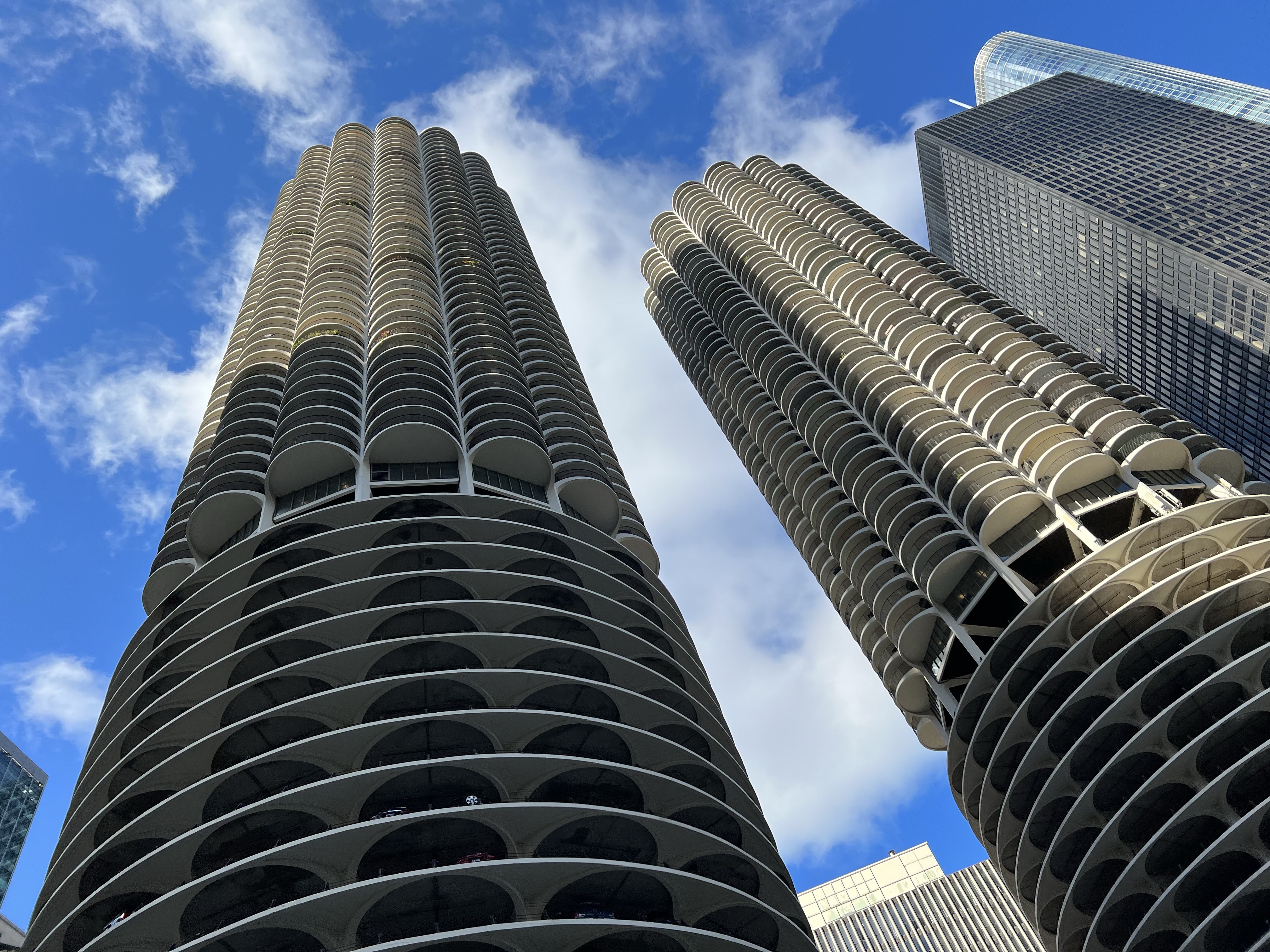
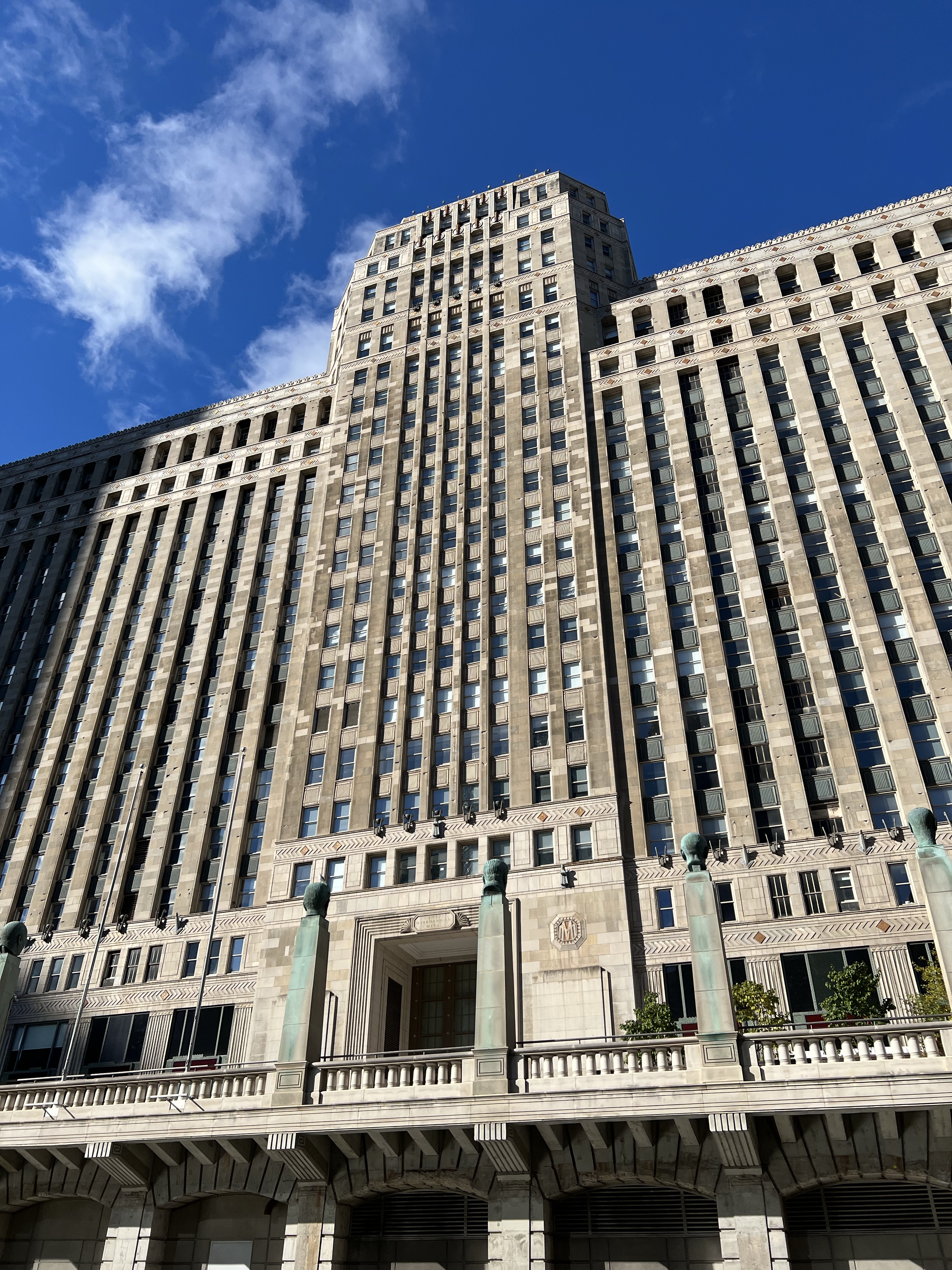
The twin 61 story residential towers of Marina City (1967). A Chicago Art Deco masterpiece the Union Carbide and Carbon Building (1929). It is said that the top of this build was designed to look like a Champagne bottle. You be the judge. Another Art Deco masterpiece: the Merchandise Mart (1930). One of Chicago’s newest skyscrapers: the St. Regis tower, at 1,198 feet is the third tallest skyscraper in Chicago. The 101 story tower was completed in 2020. It was designed by Jeanne Gang making it the tallest building in the world designed by a woman.
On Sunday morning, I took the Red Line into the Loop, which is the name of downtown Chicago.
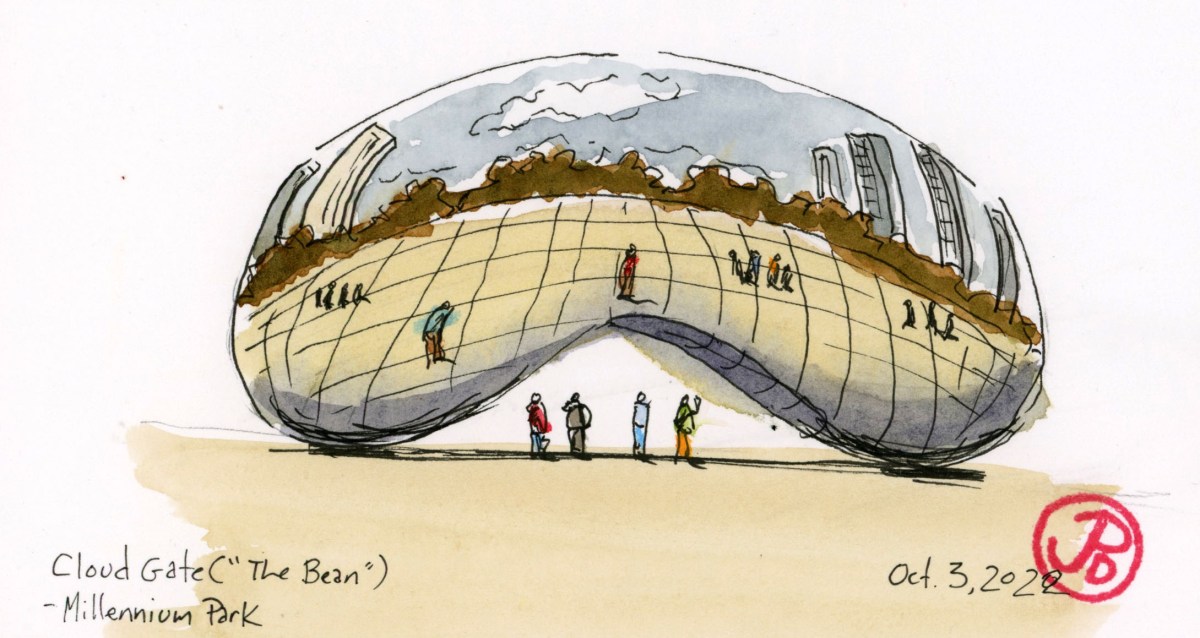
I had a few things on my sketch list: Cloud Gate (locally known as “The Bean”), the Art Institute of Chicago lions, the Marina City towers, the Chicago Theatre sign and some public art. And I managed to sketch all of my sketching targets.
My first target was the sculpture in Millennium Park, Anish Kapoor’s Cloud Gate, which locals call “The Bean”. This recent sculpture has become a huge tourist attraction so I wanted to get here before the masses. I found a seat on a wet bench and started my sketch. At this early hours, there where still plenty of tourists, photographing the 110 ton silver sculpture. I added a few tourists for scale (featured sketch).
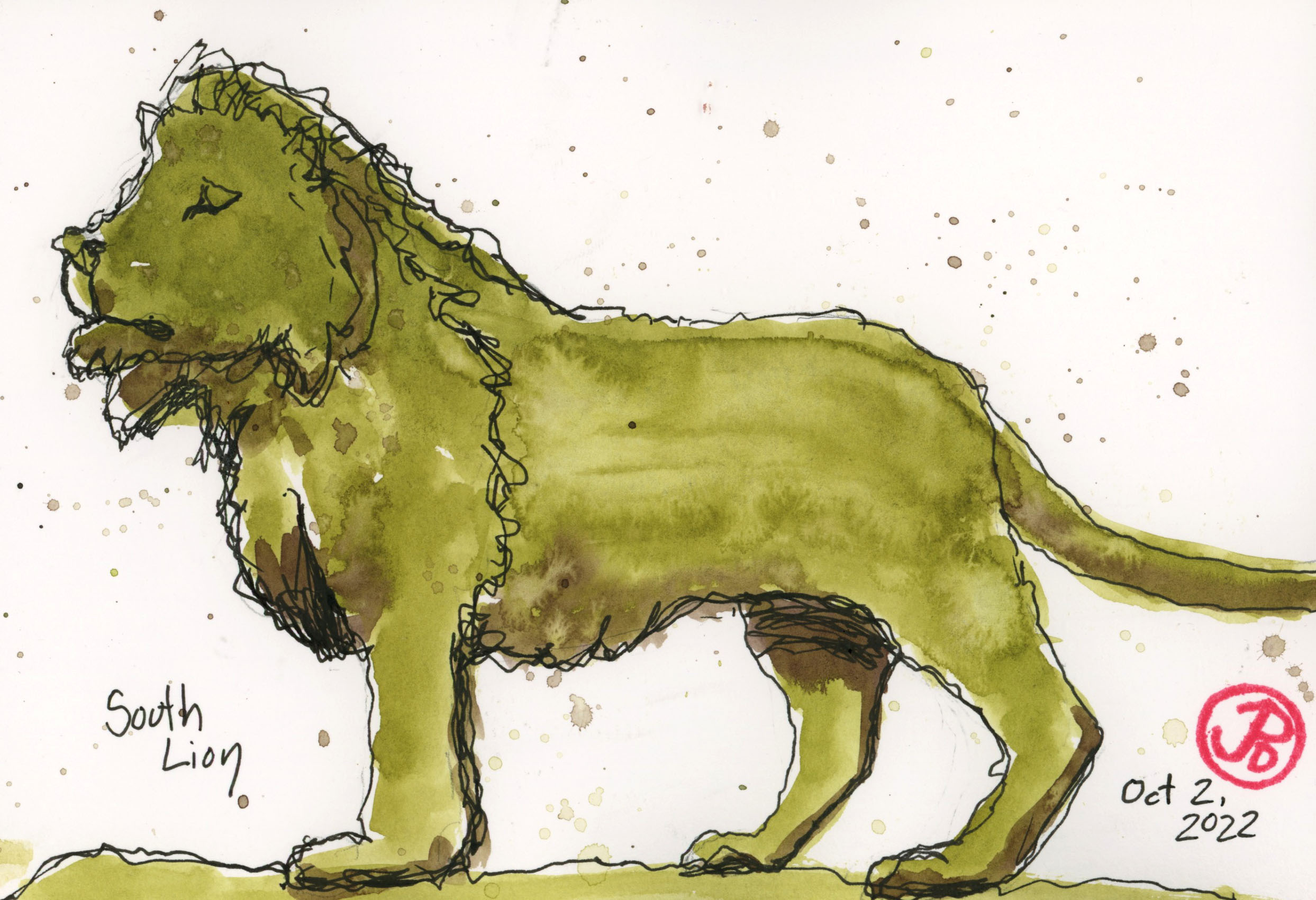
I then headed a few blocks south on Michigan Avenue to the Art Institute of Chicago. Here I sketched the lions that frame the entrance. I chose to go with a loose, unbroken line approach. It was loser and wild but I was pleased with the results.
I headed west to State Street to put the iconic Chicago Theatre sign in my sketchbook. This sign is a symbol of Chicago and I felt I couldn’t leave Chicago without sketching it.
Alexander Calder’s sculpture “Flamingo” was next on my list. I first laid out the form in paint and then hemmed it in with ink. I then added a human figure for scale.
I first heard these famous lines, in 1982, in a seat of the Rio Theatre in the Eastside of Santa Cruz.
The 938 seat Rio was opened on June 12, 1949, with the double feature of “Song of India” and “Law of the Barbary Coast”. Clearly not masterpieces of world cinema.
The screen was built as a cycloramic or curved screen which created a 3-D like effect for the movie goer.
While the Rio was not built during the Golden Age of Art Deco movie palaces (1920s-30s), the neon sign that illuminates the T junction of Soquel Avenue and Seabright is a classic.
While the Rio Theatre is not the mecca for cinema that it once was, today the Rio is alive as a music and performance space.
In recent times, like many historic, single screen cinemas, the Rio no longer serves as a mere movie theater. It now functions as a live music venue. Graham Nash and Judy Collins are slated to play at the Rio in the near future.
The stylized sign became my anchor for the sketch. I got to the theatre by 7 AM but the downside was the marine layer drizzle that covered my windshield. This was going to make field sketching a challenge. I found a parking spot on Seabright, facing the theatre and I used my car as a sketching blind.
I just had periodically use my windshield wipers to unblur my subject.
I returned later and sketched the ticket booth of the Rio.
It’s a bit like the man behind the curtain in the Wizard of Oz. The music and voices comes through the car radio, but where does it really come from?
In my mind’s eye I envisioned a tall building with radio towers crowning the roof and an expansive studio on the top floor where a large staff puts together playlists and commercials while the DJ speak to their devoted listeners, taking requests and forecasting the weather and traffic patterns.
While I’m down in Santa Cruz, my radio is often tuned to 107.5, which is the frequency of the legendary radio station, KPIG. KPIG plays Americana (and other worldly music) music: rock, folk, blues, bluegrass, western swing, country, reggae, and everything in between.
The radio station identifies it’s location as Freedom, California but in reality the station is based in an unassuming building in Watsonville, across Main Street from Ramsey Park. Freedom does have a much nicer ring than Watsonville!
What brought me to Main Street was a bumper sticker. For years, I had seen the KPIG sticker on numerous cars and plenty of trucks. The other ubiquitous sticker in the Monterey Bay Area is for the Mystery Spot. I have always loved the design of the sticker,( by John F. Johnson of Teapot Graphics) of a sunglasseted swine dolfing his black hat. I wanted a sticker for my sketchbook but I have never seen it sold in local stores or on KPIG’s website. I thought maybe KPIG has a business office and I would be able to buy a sticker there. So off I went towards Watsonville.
As I drove out from my cabin, my radio was tuned to 107 “oink” 5 FM. Through my speakers was the Slickers song, “Johnny Too Bad”, a song I had first heard while watching film The Harder They Come. This is the film that introduced reggae to the world. I loved the eclectic variety of KPIG. Pig music, really, is just good music, no matter what genre. You can’t put your finger, or cloven hoof, on it, but it just seems right.
Twenty minutes later, I pulled off Highway 1 and drove down Main Street. As I neared KPIG Central, to my left, there was no tall building, crowned in tall radio towers, just a collection of businesses and a strip mall. I made a left hand turn and drove through the Dollar Tree parking lot. I came upon a complex that looked like it had once been a hotel. To my right was a single story long building that might have once been the hotel’s office. On the other end of the parking lot was an L shaped building which, at one time, housed the hotel rooms but now where businesses.
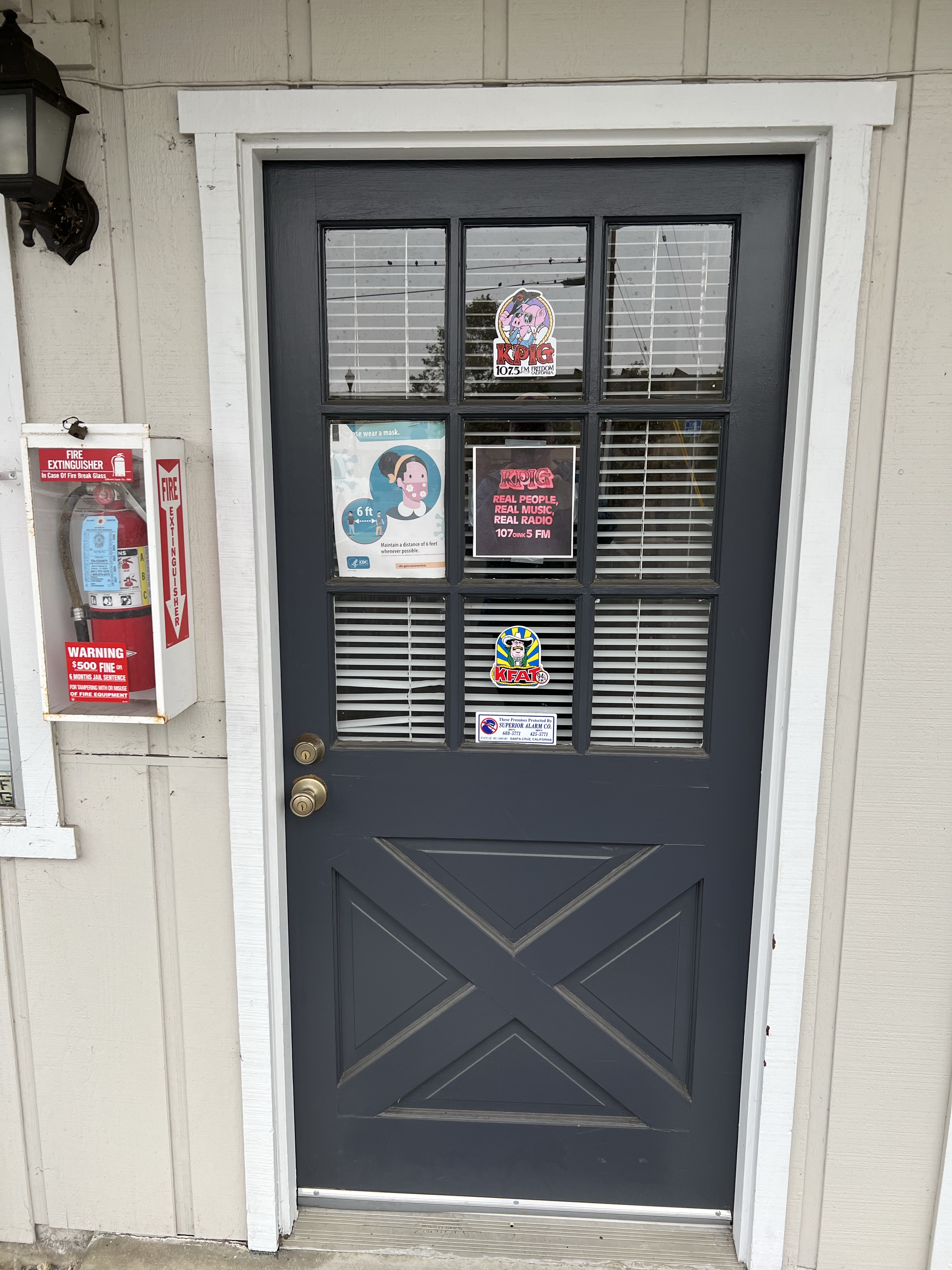
There was no sign, no ostentatious display proclaiming the business behind it’s twin brown doors, that this was the epicenter of one of the most beloved radio stations around. Somehow this seems just exactly right. The only reason I knew this was KPIG studios was that there was a sticker, the one which I was now seeking, one of the two doors. Also the sign in the window, “Beware of Attack Pig” was a swine giveaway.
What’s behind the brown door?
I parked and walked over to take few pictures of the door.
To my surprise, the door to the right opened. I was greeted by Vicki, the Saturday morning DJ. This was the woman behind the wizard! She invited me in. On the door was the phrase: “Real People, Real Music, Real Radio”. This rang true as I stood before the “real” DJ that I had just been listening to a few minutes earlier.
To my left was the studio, lined with shelves and shelves of music. In the center of the room was a deck with computer screens, a chair, and a microphone.
“So this is where the magic happens.” I said.
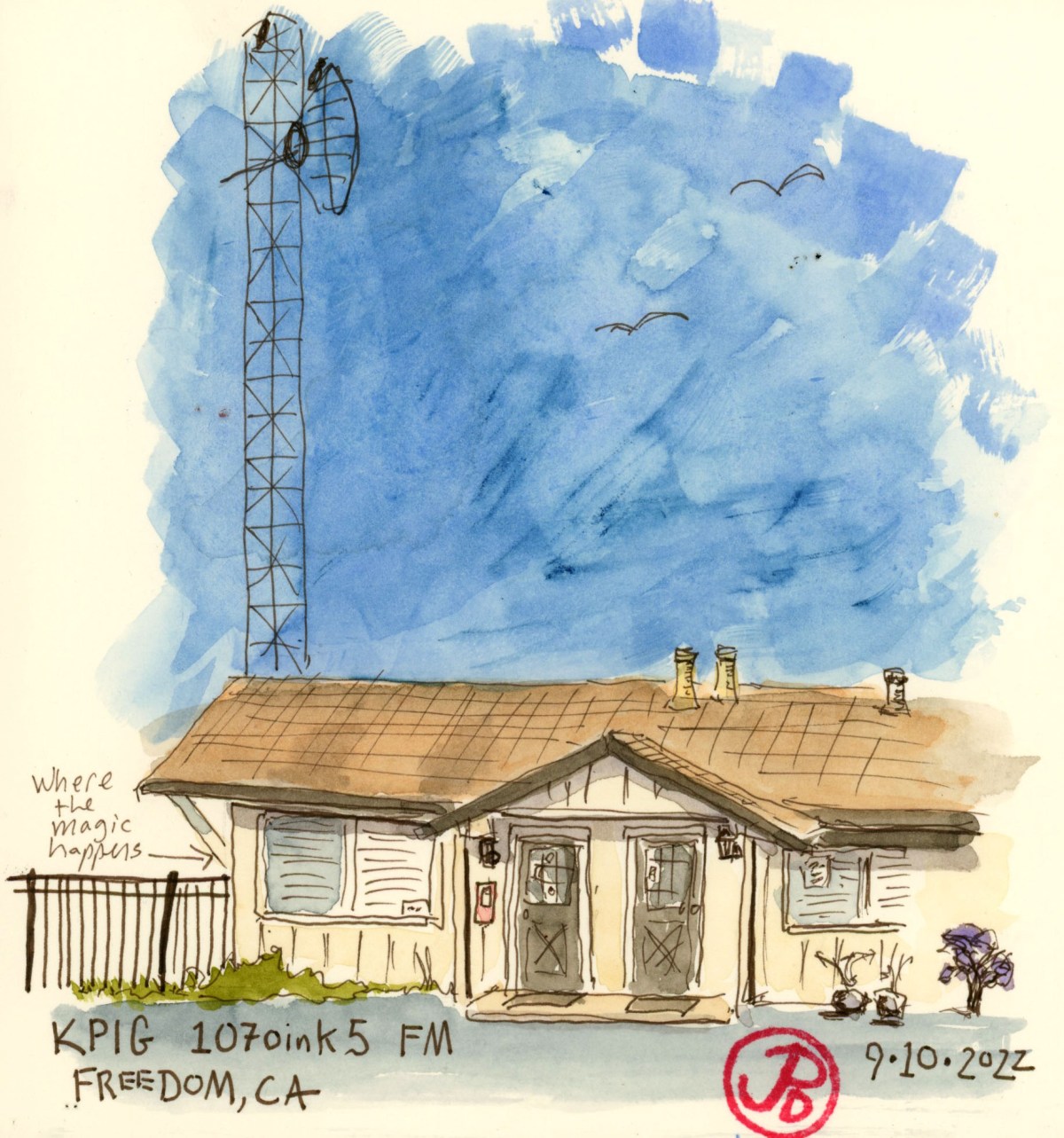
She gave me a few stickers and I thanked her for the music. I returned to the car and sketched the studio with the antenna rising above the former hotel.
On my ride back to Santa Cruz, I listened to the PIG and as I pulled off Highway 9 towards my cabin, Neil Young’s title track from his legendary second album came on, “Everybody Knows That This is Nowhere.”
This seemed somehow a fitting soundtrack to my KPIG morning adventure!
On Pacific Avenue, the Main Street in downtown Santa Cruz, is an impressive example of the era of the movie palaces.
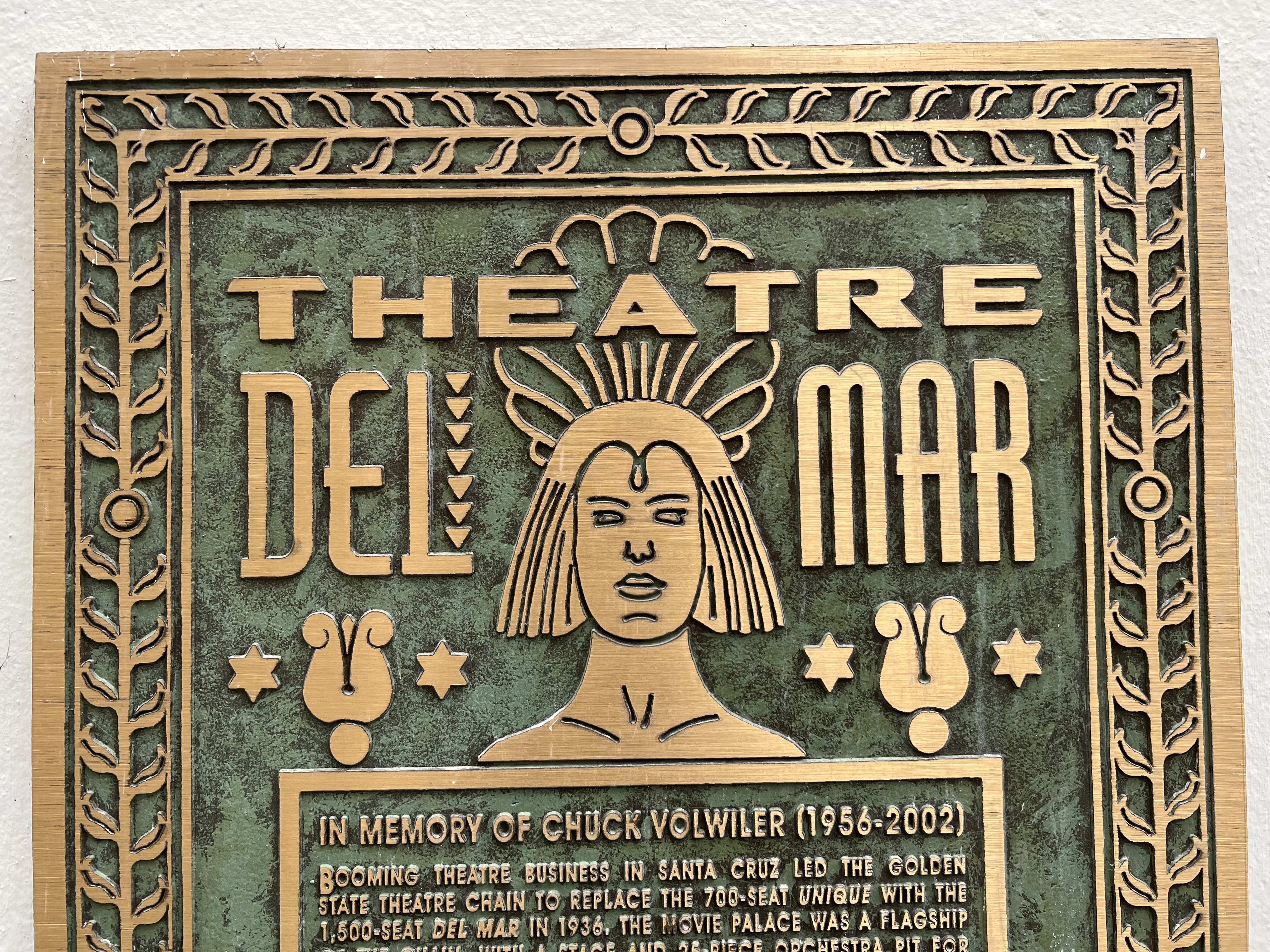
This movie palace was opened on August 14, 1936 with the feature “China Clipper”. The Del Mar has a capacity of 1,521. This means that the town of Sea Ranch, in Sonoma could all attend a movie at the Del Mar!
The sign and marquee are now shrouded in trees from the street level and the sign could use a lick of paint.
The Del was built during the pinnacle of cinema and is designed in an Art Deco Zig-Zag Moderne style. The theater was built with a stage and a 25 piece orchestra pit. This was a space designed for many forms of entertainment from celluloid to live theater to music.
Many notable musicians over the years, have taken the stage at the Del, including: Lionel Hampton, Duke Ellington, Jerry Garcia, and Emmylou Harris.
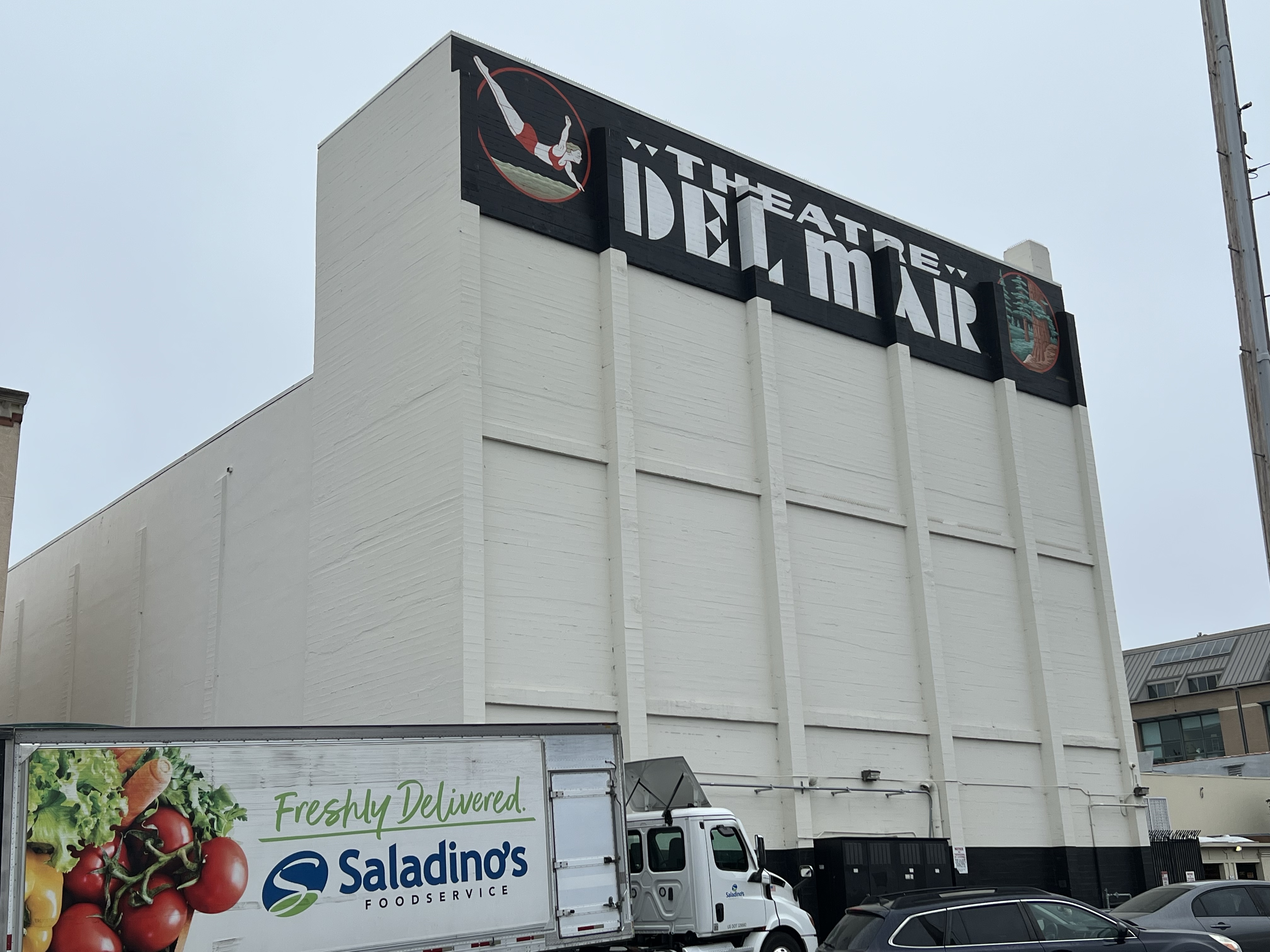
The imposing bulk of the back of the Del Mar as viewed from Front Street. I have always loved the mural that crowns the back of the Del.
Like many grand cinemas of the era, The Del Mar closed for a time, her vertical sign and marquee went dark.
At one time the theater was slated to be turned into a parking lot but local activists fought to save the landmark theater. The theater was renovated in 2002 then divided into three separate theaters and reopened.
It is now the grand dame of Santa Cruz Cinema whose neon sign again welcomes a new generation of movie goers.
I was looking for a new Bay Area sketching challenge and a weekend sketch of the backside of the Del Mar Theatre in Santa Cruz provided the genesis.
As a child I remember seeing the large white building with the large words “DEL MAR” framed by one painting of a bikini clad beauty diving into water and a scene from a redwood forest on the other side. It wasn’t until I was in college that I attended a movie at the Del Mar, a cinema that my father visited many times in his youth. The Del Mar and my father share the same birth year. This provided another reason to sketch this historic building.
The backside of the Del Mar Theatre is one of the most prominent buildings in downtown Santa Cruz and a building that looms large in my childhood.
I would be sketching back in time to the 1920s, 30s, and 40s to the time when Art Deco movie palaces where prominent features in many towns and cities. These cinemas’s large neon signs illuminated the communities they served. This was the Golden Age of cinema, time before television and an eon before the rabbit hole that is the internet.
I decided to focus on the most visible part of these classic theaters: the sign and marquee. This proclaimed the name of the theater and was a neon advertisement for what was inside and what was currently playing.
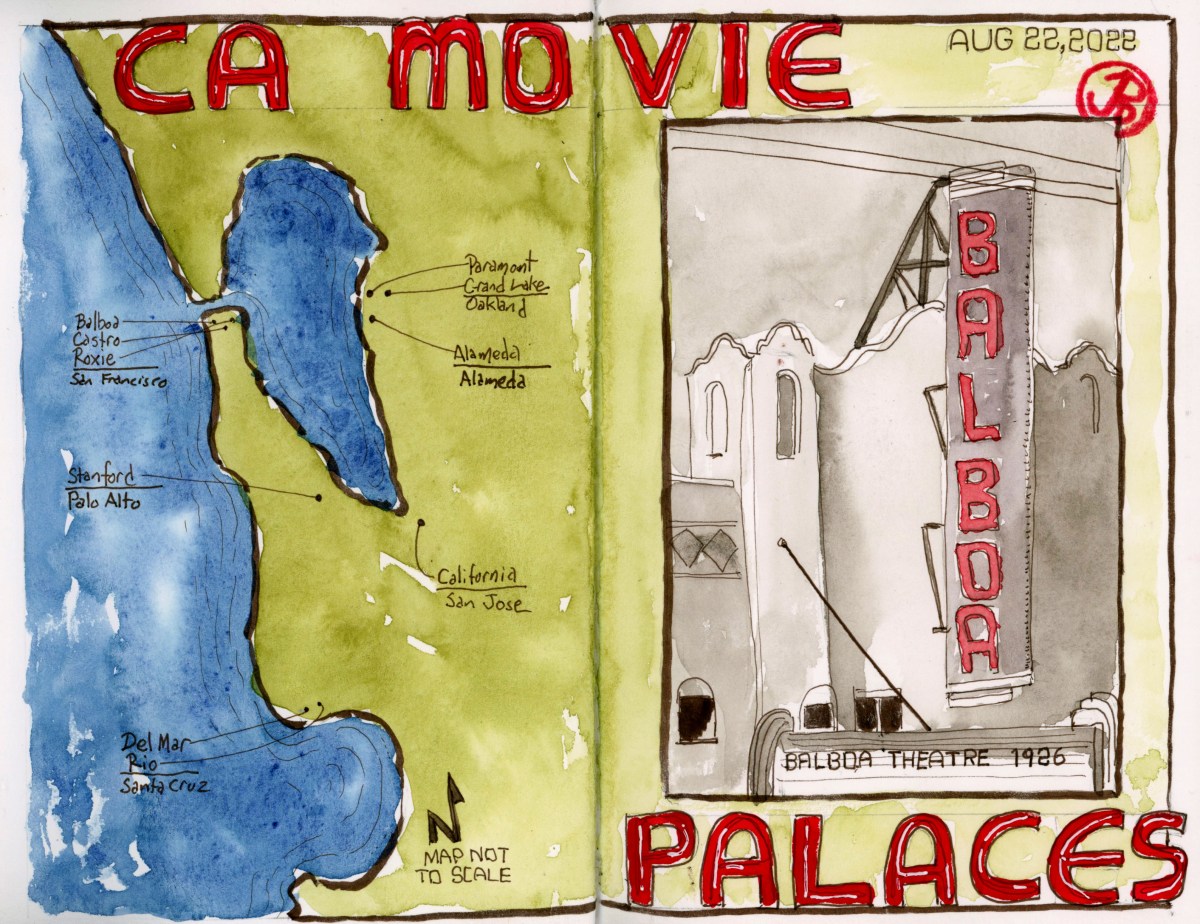
I began my sketching adventure by doing research of existing cinemas that meet my timeline criteria and then putting that information into a Bay Area map (featured sketch).
I complemented the map with an inset sketch of the movie palace that is a mere 38 minute walk north through Golden Gate Park, from my city digs. This is one of the only remaining neighborhood theaters in San Francisco: the Balboa Theatre.
While the inset sketch was based on my photograph, I knew that I would be returning to the Balboa to sketch the theater in earnest.
Next I pack my sketching bag and head down to Santa Cruz to Sketch the Rio Theatre.











 Corvid Sketcher